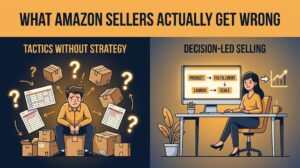


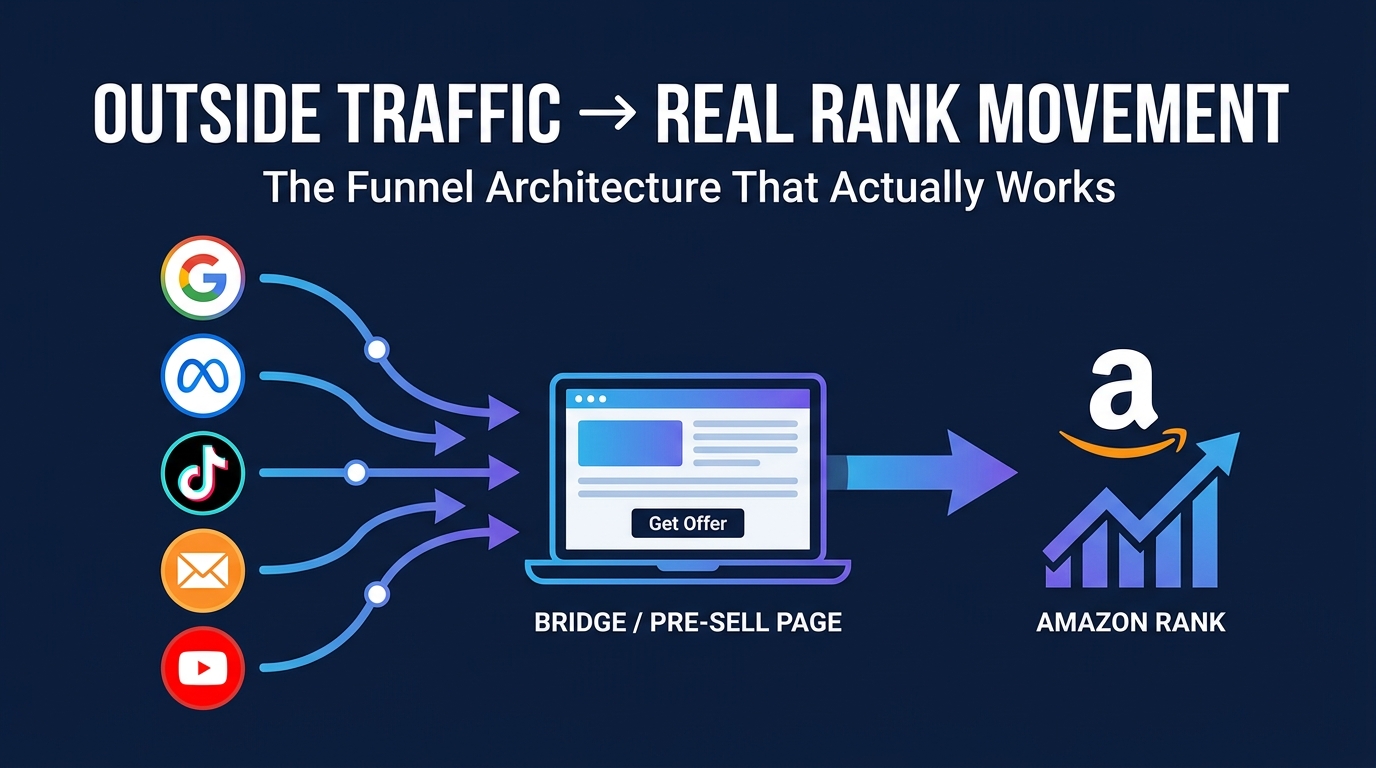

Sellers send external traffic to Amazon every day. Most of them don’t move rank at all.
The advice to “drive outside traffic” has been around long enough that it now functions as a truism — repeated in every seller community, every agency pitch deck, every Amazon conference. And yet, when you actually audit the funnels behind that advice, a consistent pattern emerges: traffic is being sent, but the underlying architecture is broken. The rank needle doesn’t move because the funnel was never designed to move it.
This article isn’t about whether external traffic matters for Amazon ranking — it does, and the mechanism is well-understood. It’s about the gap between “sending traffic” and “building a funnel that actually generates the conversion signals Amazon rewards.” Those are two completely different things, and conflating them is expensive.
What follows is a ground-up examination of how outside traffic funnels should be built — from how Amazon reads those signals in the first place, to the structural role of a bridge page, to channel-specific setups for Google, Meta, TikTok, email, and content, to the attribution architecture that makes measurement meaningful. The goal isn’t to cover every traffic channel; it’s to explain the logic that separates funnels that produce rank movement from funnels that just produce spend.
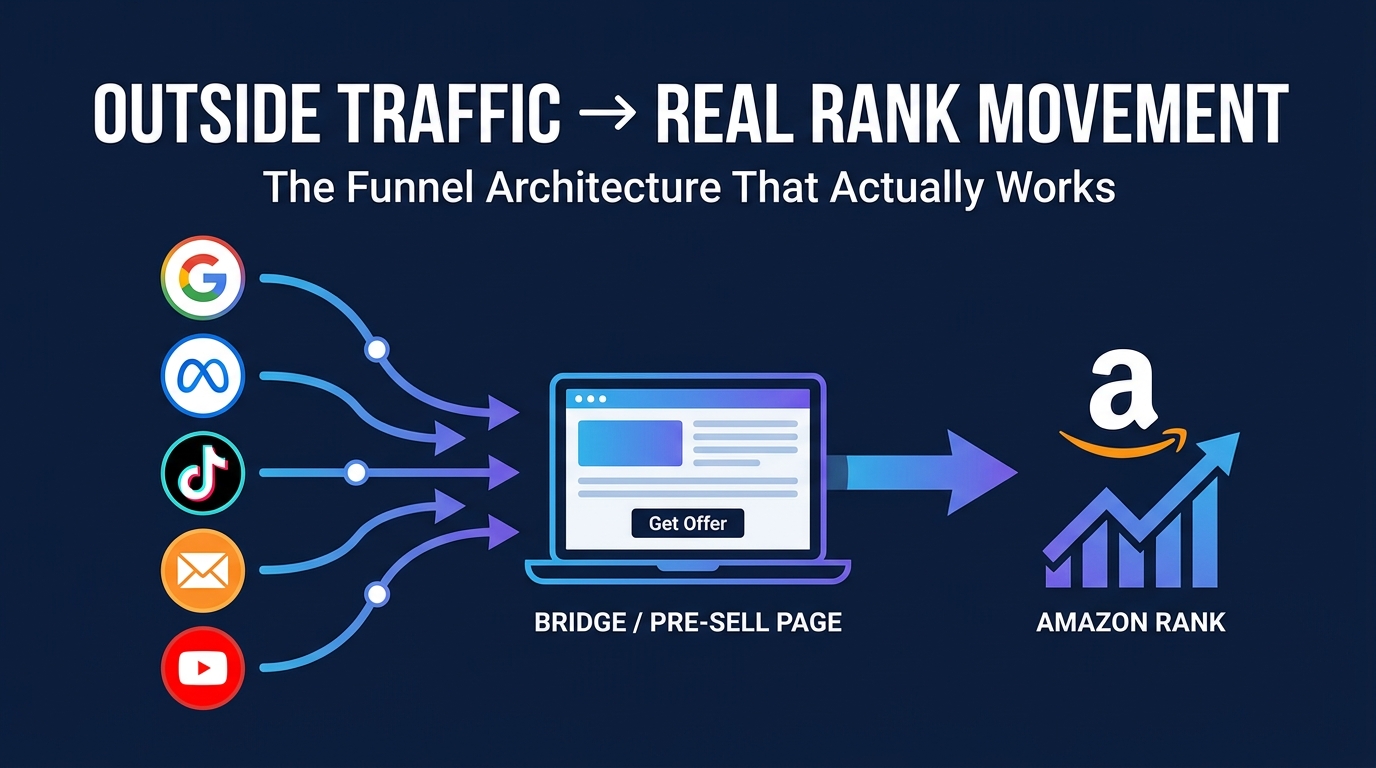
How Amazon Actually Reads External Traffic Signals
Amazon has never officially confirmed the exact weight it assigns to external traffic in its ranking algorithm. What it has confirmed — through its own developer documentation, Attribution program mechanics, and Brand Referral Bonus incentive design — is that external traffic that converts carries meaningful downstream value.
The operative phrase is “that converts.” Amazon’s ranking systems measure performance signals tied to specific ASINs, and those signals include sales velocity, conversion rate on the product detail page, add-to-cart rate, and click-through rate from search results. When external traffic drives genuine purchases, it feeds the sales velocity signal directly. But the way that signal gets read depends heavily on the quality of the traffic that preceded it.
The Demand Signal Hierarchy
Not all purchase events are equal in Amazon’s model. A sale that originates from a branded keyword search — where the customer typed your brand name — carries a different signal than a sale from a generic category browse. A sale from a high-intent Google Shopping click carries a different signal than a sale from a cold Meta prospecting ad shown to a broad interest audience.
Amazon’s algorithm is calibrated around intent. The reason branded search correlates so strongly with ranking is that it represents explicit, confirmed demand. When your external traffic funnel generates brand searches — either by running campaigns that prime buyers to search for you on Amazon, or by cultivating an audience that already knows your brand — those searches compound your organic rank in a way that raw direct-link traffic simply cannot replicate.
Traffic Source Quality Is a Real Variable
Expert consensus across the Amazon seller and agency community in 2026 points to traffic source quality as a distinct ranking variable — not just a proxy for conversion rate. The working theory, supported by observed seller data rather than official documentation, is that Amazon’s systems can distinguish between sessions that enter the marketplace with high purchase intent versus sessions driven by broadly targeted ad creative that catches people mid-scroll.
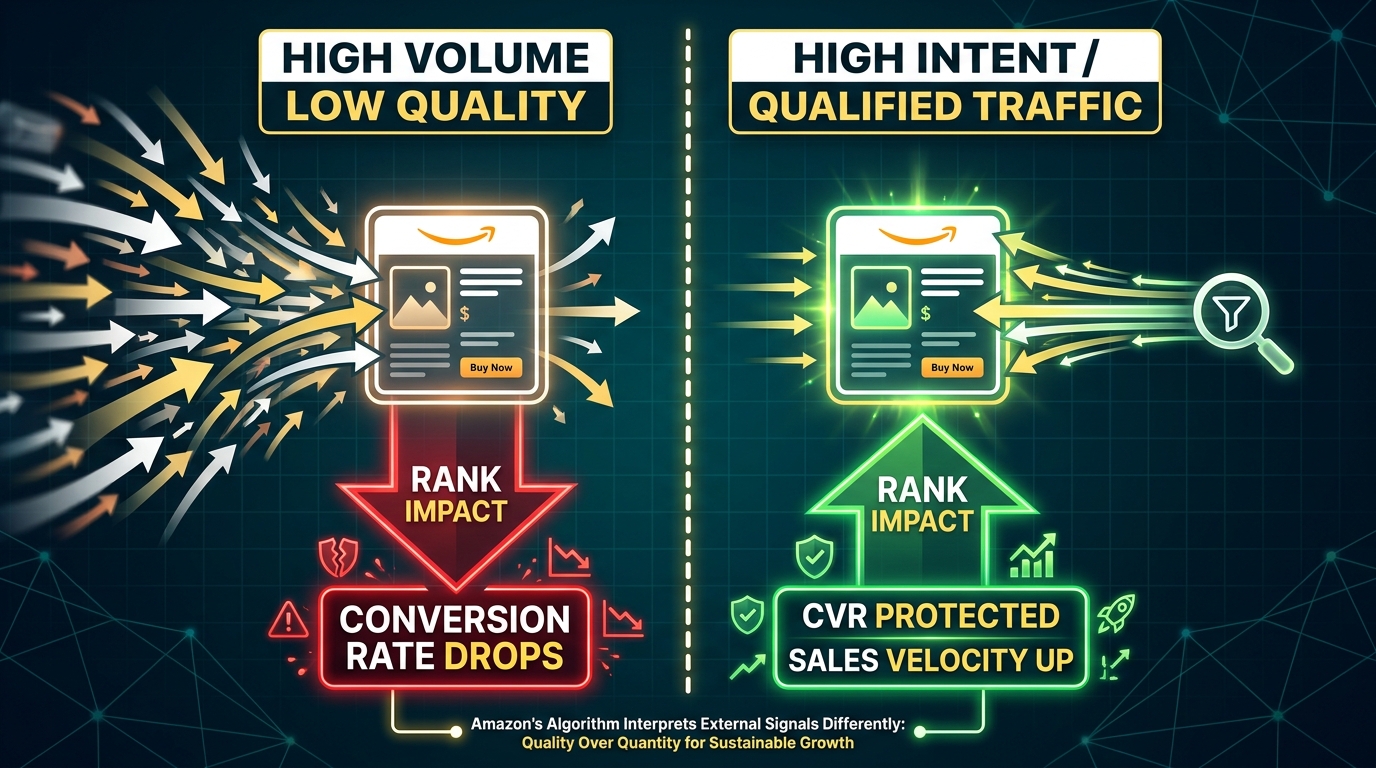
This matters practically because it changes how you should think about your traffic budget. Sending 10,000 low-intent visitors to your listing who collectively purchase at a 1% conversion rate does not produce the same ranking benefit as sending 500 warm, pre-qualified visitors who convert at 12%. The volume-obsessed approach to external traffic was always a mistake; in 2026, it’s an actively counterproductive one.
The Pre-Sell Bridge Page: Your Funnel’s Most Critical Stage
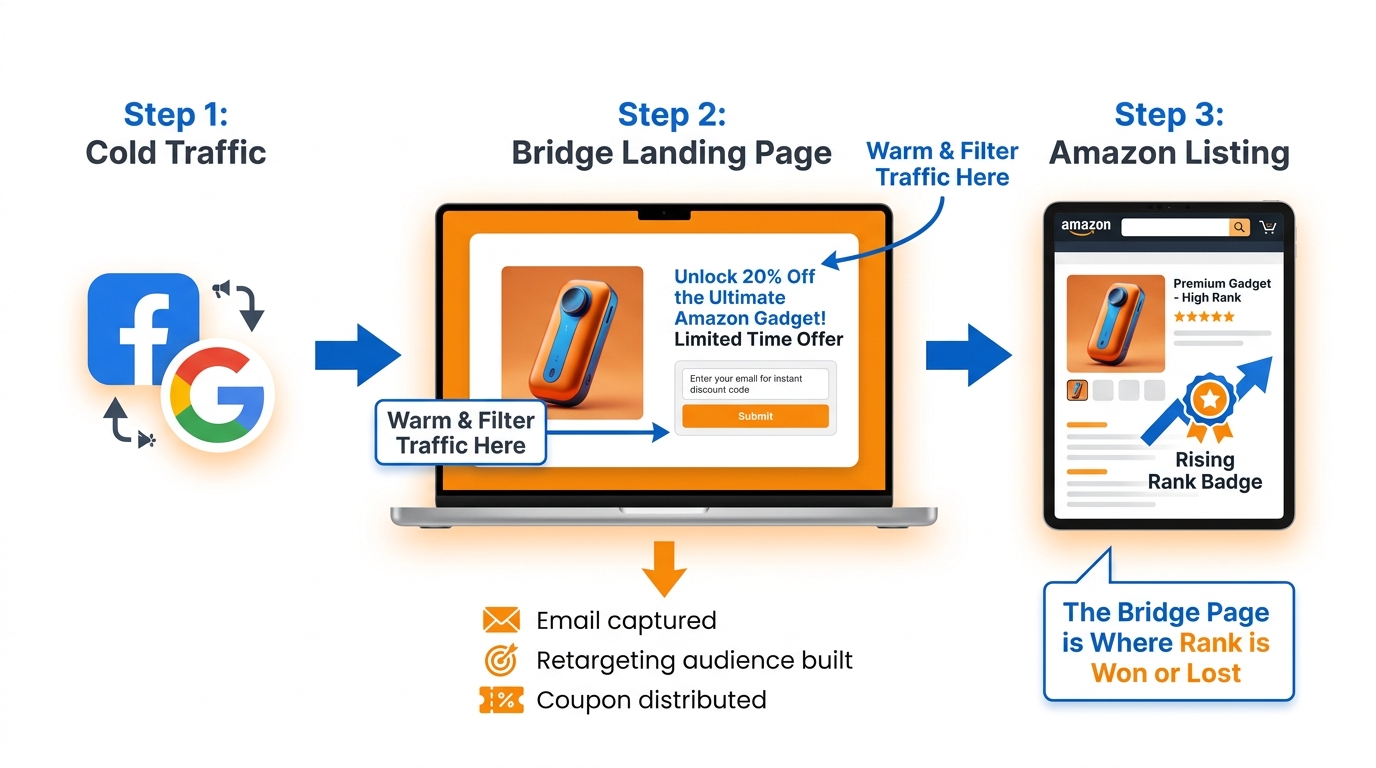
The most consequential decision in any external traffic funnel for Amazon is whether or not you use a bridge page — a standalone landing page that lives between your ad or content and the Amazon product detail page. This single architectural choice determines more about your funnel’s ranking impact than any ad creative, audience targeting, or bid strategy you’ll ever run.
The logic is straightforward: people who click a Facebook ad, a TikTok video, or even a Google Shopping result are not in the same mental state as someone who has typed a product search query into Amazon’s search bar. They’re in discovery mode. Interruption mode, in some cases. Sending them directly to your Amazon listing means Amazon now sees a stream of visitors who may browse, add to cart, then leave — or worse, bounce immediately after a few seconds on the page.
Each of those non-converting sessions gets counted. And over time, a listing that receives substantial non-converting external traffic will see its conversion rate pulled downward — a damaging signal that can suppress organic ranking regardless of how many actual purchases occurred.
What a Bridge Page Actually Does
A well-constructed bridge page performs three functions simultaneously:
- It filters traffic by intent. A visitor who reads a bridge page, engages with the product story, and then clicks through to Amazon has self-selected as interested. A visitor who bounces from the bridge page never reached your listing — so Amazon never saw that non-converting session.
- It captures value before the Amazon click. An email address, a Messenger subscriber, or a pixel fire from a bridge page visit means you now own that relationship independent of whether this particular visit converts. You can follow up, retarget, and send them back.
- It distributes coupons or incentives without creating visible price signals on Amazon. A discount code offered on a bridge page (and redeemed at checkout on Amazon) drives conversions without changing the listed price, protecting Buy Box eligibility and perceived value.
Bridge Page Architecture That Works
The most effective bridge pages in 2026 share a few structural characteristics. They focus on a single product or tightly related product line — not a storefront, not a category. They lead with the buyer’s problem, not the product’s features. The primary CTA is a single button that either claims a coupon or goes directly to Amazon, depending on the traffic temperature.
Above the fold, the bridge page needs enough information to qualify intent — a product image, a core benefit statement, and evidence of social proof (review count, star rating, or a short quote). Below the fold is where you can deepen the story, address objections, and add video if you have it. The goal is not to do all the selling on the bridge page — that’s what the Amazon listing is for. The goal is to ensure that only genuinely interested buyers complete the journey to Amazon.
Mapping Traffic Sources to Funnel Temperature
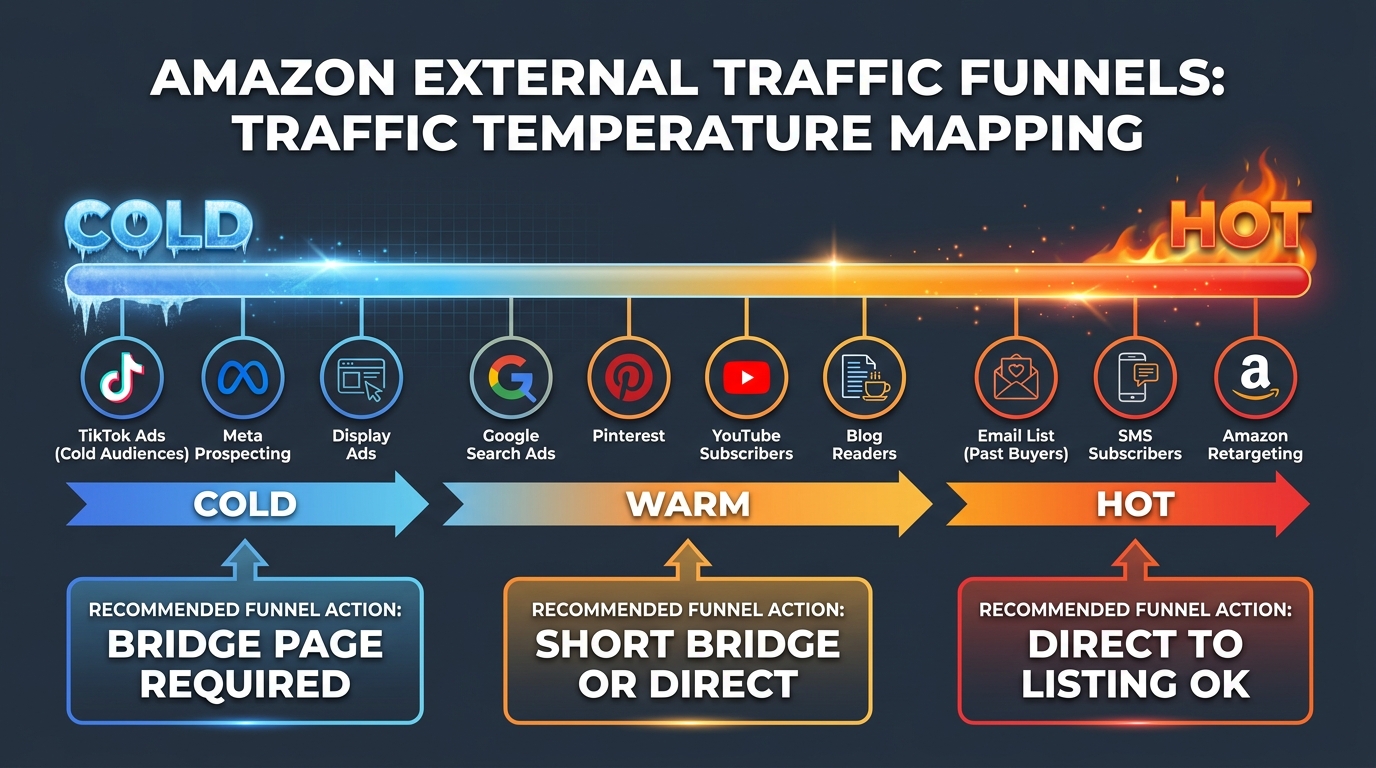
One of the structural failures in most external traffic funnels is treating all traffic sources the same way. Sellers build a single bridge page, point three different channels at it, and wonder why performance varies wildly. The answer is almost always funnel temperature mismatch: different traffic sources bring visitors at radically different stages of awareness and purchase intent, and a single funnel stage cannot serve all of them equally.
Traffic temperature — the degree to which a visitor is already aware of your product, your category, and their own need — should determine both the depth of your bridge page and the nature of the incentive you offer. This is a concept borrowed from direct response marketing, and it applies directly to Amazon external traffic strategy.
Cold Traffic: Interrupt and Qualify
Cold traffic includes Meta prospecting campaigns targeting interest-based or lookalike audiences, TikTok ads served to people who have never interacted with your brand, and broad display campaigns. These visitors don’t know you, may not know they need your product, and are typically mid-session on an unrelated activity when your ad appears.
For cold traffic, a full bridge page is non-negotiable. The page needs to do problem-awareness work first — establishing that the visitor has a need — before presenting your product as the answer. Direct-to-Amazon sends with cold traffic are almost always a conversion rate liability. The numbers consistently show this: cold social traffic converting at 1-3% on a product detail page, versus 8-15% when that same traffic is first filtered through a purpose-built bridge page.
Warm Traffic: Shorten the Bridge
Warm traffic — YouTube subscribers who’ve watched your content, Pinterest users who’ve saved your product pins, blog readers who’ve spent time on related articles, or retargeting audiences from bridge page visits — carries higher baseline awareness. These visitors need less problem-education and more purchase reassurance.
For warm traffic, the bridge page can be leaner: stronger emphasis on social proof, a clearer comparison to alternatives, and a more direct CTA. Some warm traffic segments, particularly high-engagement YouTube subscribers or active blog readers, can be sent directly to Amazon with a coupon in the URL — though even here, capturing the email first is usually worth the extra click.
Hot Traffic: Direct is Fine (With Attribution)
Hot traffic — past buyers on your email list, SMS subscribers who opted in at purchase, or highly specific branded search audiences — already knows your brand, trusts it, and has a demonstrated purchase history. For this segment, a direct link to the Amazon listing with an Amazon Attribution tag is the right approach. Adding a bridge page for past buyers creates friction without adding filtering value, because the intent signal is already strong.
The key for hot traffic is that the Amazon Attribution tag must be in place. Without it, you cannot track whether the email blast or SMS campaign actually converted, and you lose both the measurement data and the Brand Referral Bonus credit.
Google Ads to Amazon: The High-Intent Funnel Most Sellers Misuse
Google Search Ads represent the closest external analog to Amazon’s own search advertising — both capture demand that already exists rather than creating new demand. A buyer searching “best stainless steel water bottle 40oz” on Google is in a purchase-research mode that makes them one of the highest-value external traffic sources available to an Amazon seller.
And yet most sellers running Google Ads to Amazon do it wrong, in ways that reliably produce either poor conversion rates or zero attribution data. The most common mistake is sending Google traffic directly to the Amazon product detail page without any Attribution tagging, which means you can’t measure what converted, can’t claim Brand Referral Bonus credits, and can’t make any data-driven decisions about scaling or cutting the campaign.
The Search-Intent Matching Problem
Google Search traffic quality varies enormously depending on match type and keyword specificity. Broad match keywords on Google can trigger impressions for loosely related queries that bear little resemblance to what your product actually is. A seller running broad match on “water bottle” might be capturing clicks from people searching for baby bottles, hot water bottles, or glass bottles for canning — none of whom are going to convert on an Amazon listing for an outdoor hydration product.
The solution is tight keyword discipline: phrase match and exact match on highly specific, product-aligned search terms, plus an aggressive negative keyword list that excludes category-adjacent but intent-mismatched terms. The goal is to pay for Google clicks that represent buyers who are already in the same purchase intent zone as Amazon search traffic — not to compete on volume with broad awareness campaigns.
The Two-Funnel Google Architecture
The most effective Google-to-Amazon setup in 2026 uses a two-funnel structure based on search intent stage. The first funnel targets informational and comparison queries (“best X for Y,” “X vs Y,” “X review”) and sends traffic to a bridge page with educational content, product comparison, and a soft CTA. The second funnel targets high-commercial-intent queries (“buy X,” “X on Amazon,” “[brand name] X”) and can send traffic either to a lighter bridge page with a coupon offer or, for the most brand-specific searches, directly to the Amazon listing with Attribution tagging.
Google’s average search conversion rate across industries sits around 4-5% for general ecommerce in 2026. High-intent product searches in competitive categories with well-optimized bridge pages can push significantly higher than that — but only if the search terms are properly matched to buyer stage. A campaign spending $50/day with 4% conversion from tightly targeted, high-intent terms will consistently outperform a campaign spending $200/day with 2% conversion from broad match scatter.
Google Shopping Campaigns
Google Shopping is a separate consideration from Search. Shopping traffic is image-driven, price-visible, and typically represents buyers who have already committed to comparison-shopping a specific product type. For Amazon sellers with brand-registered products, Shopping campaigns can be effective, but they carry a structural disadvantage: the visible price must be competitive, and the landing page needs to handle the price-anchoring comparison that Shopping traffic arrives with.
Shopping traffic to a bridge page that doesn’t immediately address pricing context often sees poor engagement rates. The bridge page for Shopping traffic should lead with price confidence — whether through a coupon offset, a clear value statement, or a comparative “why this product at this price” framing — before moving to the Amazon CTA.
Meta and TikTok: Warming Social Traffic Before It Hits Your Listing
Social traffic from Meta and TikTok is cold traffic by definition. You are interrupting a scroll, not answering a search. The entire funnel architecture for social platforms needs to be built around that reality — and most Amazon sellers’ social funnels are not.
The default social-to-Amazon approach looks like this: run a product video ad, include “Shop Now” as the CTA, and link directly to the Amazon listing. This approach has two structural problems. First, as established, cold social traffic converting directly on Amazon at 1-3% depresses listing CVR over time. Second, and often overlooked, is that you are paying for every single click — including the browsers, the curious-but-not-serious, and the accidental taps — and all of those clicks land on your listing and generate non-converting sessions that Amazon registers.
Meta Funnel Structure: The Three-Stage Approach
A properly designed Meta funnel for Amazon rank has three distinct stages, each with its own campaign type, audience, and bridge page variant.
Stage 1 — Awareness (Cold Audiences): Video views campaigns targeting lookalike or broad interest audiences. The goal here is not clicks to Amazon — it’s building a retargeting pool of people who have watched 50%+ of your video. No direct Amazon link in Stage 1. Measure cost per video view and audience quality. This stage costs less and builds the warm audience pool for Stage 2.
Stage 2 — Consideration (Warm Retargeting): Traffic or conversion campaigns targeting people who watched 50%+ of Stage 1 video. These visitors go to the bridge page — the full one, with email capture and coupon offer. Measure bridge page visit rate, email capture rate, and click-through to Amazon. This stage generates the most useful funnel data and the most attributable conversions.
Stage 3 — Conversion (Hot Retargeting): Campaigns targeting people who visited the bridge page but didn’t purchase, or email list custom audiences. These can go directly to the Amazon listing with an Attribution tag, or to a lighter bridge page with a urgency-framed offer. Conversion rates from Stage 3 audiences should be high — often 10-20% or more — because you’re re-engaging people who already self-selected as interested.
TikTok: The Volume-Intent Tradeoff
TikTok’s ad platform and organic creator ecosystem represent a different opportunity — and a different set of risks — compared to Meta. TikTok traffic can move at extraordinary volume when content resonates, but the intent profile of that traffic is often lower than Meta or Google equivalents. Viral TikTok traffic is driven by novelty and entertainment; converting that into qualified Amazon purchases requires more aggressive pre-sell work at the bridge page stage.
For TikTok Ads, the same three-stage Meta structure applies, with one modification: the bridge page needs to be entertainment-aligned. TikTok users respond poorly to formal, feature-list style landing pages. A bridge page optimized for TikTok traffic should continue the video’s tone and energy, use casual language, feature user-generated content or creator video, and present the Amazon CTA as the natural next step in a story rather than a hard sell.
For TikTok organic and creator-driven traffic, the funnel is slightly different. A creator’s TikTok video links to a bridge page (via the bio link or TikTok Shop integration), and the bridge page qualifies and routes traffic to Amazon with Attribution tagging. The creator’s audience tends to be warmer than cold ad traffic — they’ve already consumed content from someone they trust — which means bridge pages for creator traffic can be leaner and more direct.
Email and SMS: The Owned-Audience Rank Weapon
Among all external traffic sources available to an Amazon seller, email and SMS lists represent the highest-quality, lowest-cost, and most controllable rank lever. The reasons are structural: your list is composed of people who have voluntarily opted in to hear from you, who likely have prior purchase intent or purchase history with your brand, and who can be communicated with at near-zero marginal cost once built.
Despite this, email and SMS are dramatically underutilized in Amazon ranking strategy. Most sellers who have a list use it reactively — sending “check out our new product” campaigns on launch day — rather than proactively building a cadence of high-intent traffic flows that generate sustained rank improvement over time.
List Building as a Ranking Asset
The rank value of your email list is directly proportional to its size, engagement rate, and match to your Amazon product line. A list of 5,000 highly engaged past buyers of products adjacent to your current catalog is vastly more valuable as a ranking asset than a list of 50,000 cold leads who came in on a discount promotion.
Building a list specifically for Amazon ranking purposes means capturing emails from buyers at the point of Amazon purchase (via product inserts that direct buyers to a registration page, not soliciting reviews directly), from bridge page coupon captures, and from content and social channels where your target buyer spends time. The email content that earns the best engagement — and therefore the best click-through to Amazon — is content that provides genuine value between launches: how-to content, tips related to product use, community building content that keeps the brand relationship alive.
The Launch Email Sequence Architecture
For a product launch or rank push, an email sequence driving toward Amazon should be structured over three to five days rather than in a single blast. Day 1 sends a “we have something new / limited coupon” email with a bridge page link for cold-ish list segments and a direct Attribution link for past buyers. Day 2 sends a follow-up with social proof — early reviews, user feedback, or a creator video. Day 3 sends a final coupon reminder with explicit urgency.
This sequence structure serves two purposes. First, it staggers the conversion events across multiple days rather than spiking them on a single day, which produces a more sustained sales velocity signal that Amazon’s algorithm reads as consistent demand rather than a promotional blip. Second, it gives non-converters multiple contact points, significantly improving the total conversion rate compared to a single-email blast.
SMS: Speed and Intent
SMS subscribers tend to have even higher purchase intent than email subscribers, because the act of providing a phone number for text messages represents a stronger commitment than providing an email address. Open rates for SMS campaigns regularly exceed 90%, compared to email open rates that average 20-30% for most commerce brands.
For Amazon rank pushes, an SMS message with a coupon and a direct Attribution link to a product listing can produce near-immediate sales velocity. A well-constructed SMS campaign to a list of even 2,000-3,000 engaged subscribers can meaningfully move rank for a competitive keyword within 24-48 hours — a speed that email typically cannot match. The tradeoff is that SMS list building is slower and requires more careful opt-in management to avoid opt-outs from over-messaging.
Content Channels: The Slow-Burn External Flywheel
Not every external traffic channel is a paid acquisition channel. Pinterest, YouTube, and SEO-optimized blog content represent a fundamentally different category of external traffic — organic, evergreen, and compounding over time rather than dependent on continuous spend.
These channels don’t produce the rapid rank velocity spikes that a concentrated email campaign or a TikTok ad push can generate. What they do produce is sustained, consistent traffic from highly qualified visitors who discovered your product through their own active search — which is precisely the kind of traffic Amazon’s algorithm reads most favorably.
Pinterest: The Underused Visual Search Engine
Pinterest functions as a visual search engine, not a social platform — an important distinction that most Amazon sellers miss. Users searching Pinterest for “small bathroom organization ideas” or “kitchen tools for meal prep” are in an active planning mindset that closely mirrors Amazon purchase intent. Pins that appear in those searches and link to a bridge page (or to an Amazon listing with Attribution tagging for Product Pins) generate traffic from buyers who have already done their own research and intent-qualification work.
Pinterest content is also genuinely evergreen: a well-optimized pin can continue driving traffic for 12-24 months after it’s published, compared to the 24-72 hour lifespan of a typical social media post. For Amazon sellers in home goods, kitchen, beauty, fitness, and lifestyle categories, Pinterest represents a compounding traffic asset that most competitors are not utilizing — which means early movers in any niche have significant ranking advantage available if they build the Pinterest funnel before their competitors do.
YouTube: Pre-Sell at Scale
YouTube functions simultaneously as a search engine (the world’s second largest), a social platform, and a content repository. For Amazon sellers, YouTube’s most relevant function is as a high-retention pre-sell environment. A buyer who watches a 6-minute “honest review” video of your product on YouTube is arriving at your Amazon listing with more purchase context, more trust, and more specific intent than almost any other external traffic source.
YouTube content that drives Amazon rank improvement tends to fall into three categories: product demonstration videos (showing the product in real use), comparison videos (your product vs. alternatives), and problem-solution videos (addressing the buyer need your product solves). All three should include Amazon Attribution links in the video description, and the most effective setups add a bridge page link as the primary CTA — both to capture emails and to route traffic through a conversion filter before the listing.
YouTube’s compounding nature means that a library of well-optimized product videos can deliver sustained rank-supporting traffic years after the videos were published. This is a fundamentally different economics model than paid traffic: the cost per conversion decreases over time rather than staying constant or increasing.
Blog and SEO Content
A brand-owned blog targeting buyer-intent keywords in your product category — “best [product type] for [specific use case],” “[product category] buying guide,” “[your product type] vs. [competitor product type]” — creates a passive external traffic pipeline that operates independently of ad spend. Visitors who find these articles through organic search have already articulated their need by their query; they arrive at your content pre-qualified.
The blog-to-Amazon funnel is straightforward: the article provides genuine research value, positions your product as the top recommendation, and links to Amazon via an Attribution-tagged URL. The email capture opportunity on the article page — offering a discount or a related resource guide in exchange for an email — turns one-time blog visitors into recurring funnel assets.
Amazon Attribution: Building a Tracking Architecture That Actually Tells You Something
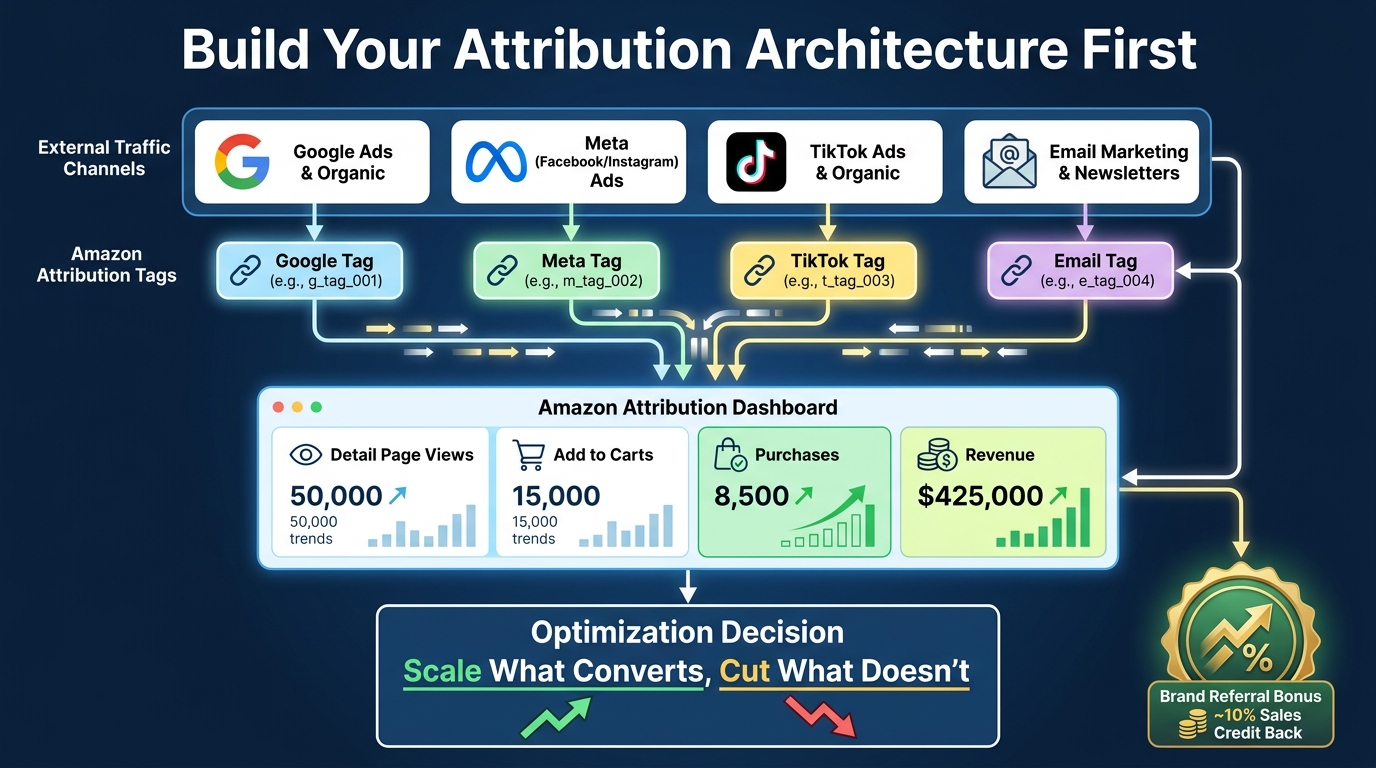
Amazon Attribution is a free tool available to brand-registered sellers and vendors. It generates tagged URLs that, when placed on external traffic sources, pass conversion data back to Amazon — detail page views, add-to-cart events, purchases, and revenue — segmented by the traffic source that drove them.
Most sellers who use Attribution do so at the minimum viable level: one tag per channel, checked sporadically. This produces data that’s directionally useful but operationally useless — you can tell that “Meta drove some purchases this month,” but you can’t tell which campaign, which creative, which audience, or which funnel stage produced those purchases. That level of attribution doesn’t support optimization; it just produces reassurance that something is working.
The Campaign Hierarchy That Enables Real Decisions
An Attribution architecture that actually drives optimization decisions should mirror your campaign structure in your advertising platforms. The recommended hierarchy is:
- Campaign level: One Attribution campaign per channel-product combination (e.g., “Meta-US-ProductA,” “Google-US-ProductA”). This lets you compare channel-level performance for the same ASIN.
- Ad group level: One Attribution tag per campaign type or audience segment within that channel (e.g., “Meta-Cold-Lookalike,” “Meta-Warm-VideoWatchers,” “Meta-Hot-EmailList”). This lets you see funnel stage performance.
- Creative level (optional but powerful): For high-spend channels, individual tags per ad creative lets you identify which specific video, image, or copy variant is driving the most qualified Amazon traffic.
The naming convention matters enormously here. Attribution tags that are named with dates, channels, audience types, and product identifiers baked into the tag name itself (e.g., “FB-Warm-VideoWatch-ProductA-2026Q2”) make the dashboard readable and actionable. Tags named “campaign 1,” “test,” or “facebook” produce a dashboard that tells you nothing useful.
Reading the Attribution Dashboard for Rank Signals
The four metrics Amazon Attribution tracks — detail page views (DPVs), add to cart (ATC), purchases, and total revenue — tell you different things about funnel health. A high DPV-to-purchase ratio (many people viewing, few buying) indicates either a traffic quality problem (wrong audience reaching the listing) or a listing quality problem (something on the PDP is failing to convert qualified visitors).
A low DPV count despite high click volume from your bridge page suggests bounce issues — people clicking the Amazon button on your bridge page but not actually loading the product detail page, which can happen when the Amazon link is broken, the ASIN is suppressed, or the bridge-to-Amazon transition creates enough friction that buyers abandon the session. Each of these issues is diagnosable only if you have the attribution data structured to surface them.
The Brand Referral Bonus: Making the Financial Case for Outside Traffic
Beyond its ranking implications, external traffic has a direct, quantifiable financial benefit for brand-registered Amazon sellers through the Brand Referral Bonus program. When qualifying external traffic — tagged with Amazon Attribution links — drives a purchase, Amazon credits the seller an average bonus of approximately 10% of the qualifying sale value. This credit is applied against future referral fees rather than paid as cash, but the economic effect is real: external traffic effectively reduces your cost of sale on Amazon-sourced revenue.
The program covers traffic from non-Amazon channels: Google Ads, Meta Ads, TikTok Ads, email campaigns, influencer content, and display advertising. Traffic from Amazon’s own advertising systems — Sponsored Products, Sponsored Brands, etc. — does not qualify. The bonus calculation is based on a percentage of sales, not a flat fee, and varies by product category, though the average across categories is approximately 10%.
The Effective Cost Reduction Math
In a practical example: if you sell a product with a $40 retail price in a category with a 15% referral fee, you’re currently paying $6 per unit in referral fees. A 10% Brand Referral Bonus credit on that $40 sale equals $4 — reducing your effective referral fee from $6 to $2, or from 15% to 5% of the sale price. At scale, across hundreds of external-traffic-driven units per month, this adds up to a meaningful reduction in Amazon’s take of your revenue.
This financial benefit changes the ROI calculation for external traffic campaigns significantly. A Meta campaign that produces conversions at a $15 customer acquisition cost looks very different when $4 of that is effectively returned as a referral fee credit. For sellers comparing external traffic to Amazon PPC as competing uses of marketing budget, the Brand Referral Bonus needs to be factored into the true cost comparison — it’s one of the least-discussed financial advantages of a properly structured external traffic program.
Brand Referral Bonus Pitfalls
The most common way sellers fail to capture the Brand Referral Bonus is by not applying Attribution links to their external traffic. This is more widespread than it sounds — a seller running a TikTok creator campaign who shares a standard ASIN URL (rather than an Attribution-tagged link) gets none of the bonus credit, even if the sales clearly originated from the creator post. Every external link to your Amazon listings that isn’t tagged is Brand Referral Bonus revenue left on the table.
The second common failure is structural: sending traffic to an Amazon storefront page rather than a product detail page. Storefront traffic does not qualify for Brand Referral Bonus. Traffic must reach a specific product listing (ASIN) to generate the credit. This means the “send traffic to our storefront and let them browse” approach, common among brand-focused sellers, sacrifices both the attribution data and the financial bonus.
The Conversion Rate Trap: When External Traffic Hurts Rank
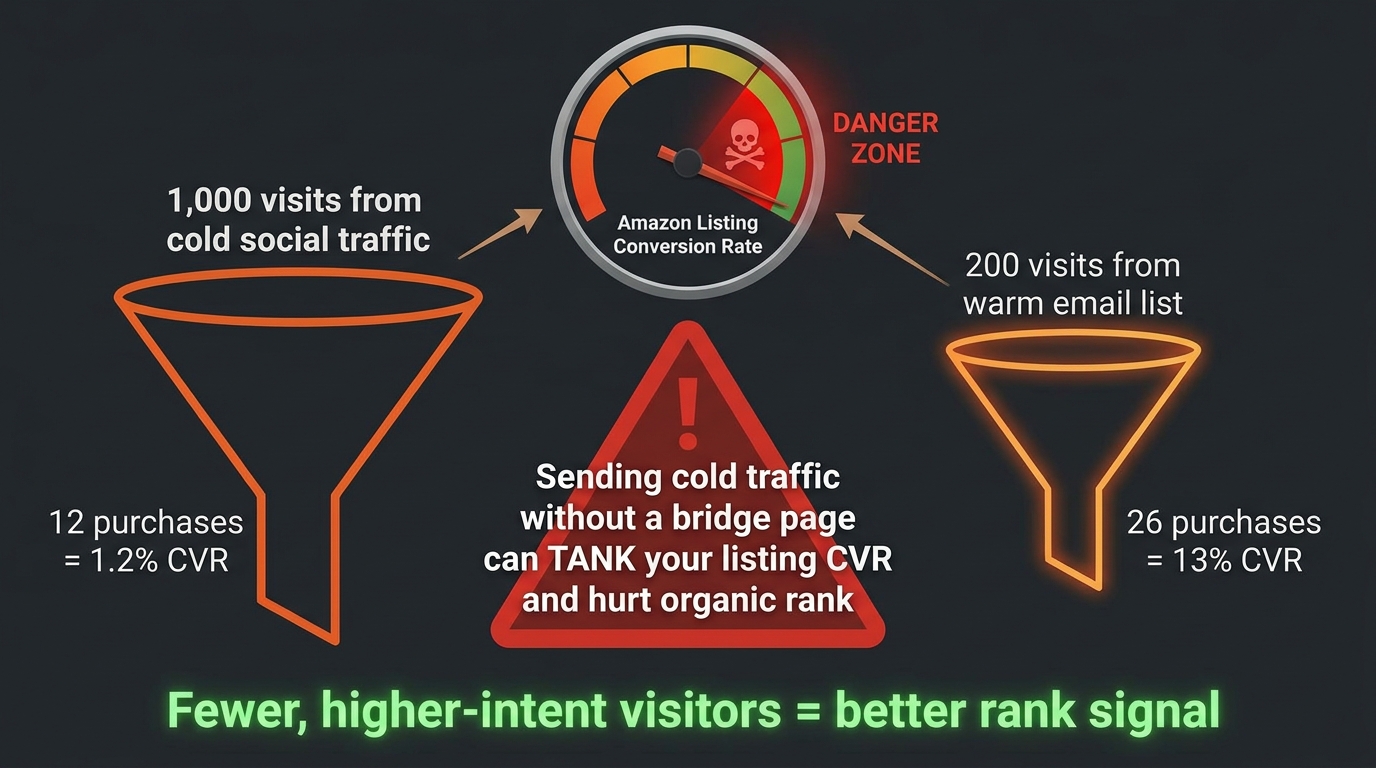
This is the risk that most external traffic advocates understate, and it deserves direct attention: external traffic can actively hurt your Amazon organic ranking if it’s structured incorrectly. The mechanism is conversion rate dilution, and it operates quietly, making it one of the more insidious failure modes in Amazon marketing.
Amazon uses conversion rate — the percentage of product detail page sessions that result in a purchase — as a significant ranking signal. When your listing receives high-intent organic Amazon traffic and converts at 12%, that conversion rate contributes to the ranking signal that keeps you on page one. When you layer in a large volume of cold social media traffic that converts at 1.5%, the blended conversion rate across all your sessions drops — say, to 7% — and Amazon’s algorithm reads that as a weakening demand signal, regardless of the fact that your actual purchase volume may have increased.
The Session Count Problem
Amazon’s Seller Central data shows session counts for your listing. Every click on an Attribution-tagged link that loads your product detail page registers as a session, whether that visitor purchases or not. If you run a broad TikTok campaign that drives 5,000 clicks to your listing and 75 of them purchase, Amazon’s algorithm now has a data point suggesting your listing converts at 1.5% — a number that, for most categories, is well below average and signals a relevance or quality issue with the product.
The bridge page is the primary structural defense against this problem. By filtering cold traffic through a bridge page before the Amazon click, you ensure that only visitors with demonstrated engagement (those who actually read the bridge page and clicked through) register as Amazon sessions. The traffic volume hitting Amazon is lower, but the conversion rate from that traffic is dramatically higher.
Measuring the Conversion Rate Impact
Sellers running external traffic campaigns should monitor their Amazon listing conversion rate in Seller Central’s Business Reports section before, during, and after any major campaign. Specifically, watch the “Unit Session Percentage” metric, which is Amazon’s conversion rate measurement. If you see a meaningful decline in Unit Session Percentage coinciding with an external traffic campaign launch, you have a bridge page problem — cold traffic is reaching the listing and diluting conversion signals.
The corrective action is not to stop external traffic. It’s to add the bridge page (or improve the existing one’s filtering performance) and reduce the spend on the ad sets generating the lowest-quality traffic. The goal is to maintain or improve Unit Session Percentage while also increasing total purchase volume — the two are not in conflict when the funnel is properly structured.
Putting the Architecture Together: A Channel-by-Channel Action Plan
Building an external traffic funnel that genuinely moves Amazon rank requires coordinating several components that most sellers treat as independent. The architecture is the differentiator — not the individual channel or ad creative, but the way all the pieces connect and reinforce each other. Here is a practical starting framework for sellers at different stages of funnel maturity.
Phase 1: Foundation (Weeks 1-2)
Before spending a dollar on external traffic, three foundational elements need to be in place. First, Amazon Attribution must be set up and tested. Create a campaign, generate a test tag, click it yourself, and confirm the detail page view registers in the Attribution dashboard within 24 hours. Second, build a single bridge page for your primary ASIN. It doesn’t need to be elaborate — a product image, a problem-solution headline, a single CTA with a 10-15% coupon, and an email capture field. Third, confirm your Brand Referral Bonus enrollment in Seller Central under the “Programs” section.
Phase 2: Single-Channel Test (Weeks 3-6)
Start with one traffic channel — ideally either Google Search Ads (if your product has clear, high-volume search intent) or your existing email list (if you have one with more than 1,000 engaged subscribers). Run the traffic through your bridge page, track Attribution data daily, and watch Unit Session Percentage in Business Reports weekly. The goal in this phase is not scale; it’s learning. You want to understand your bridge page conversion rate, your email capture rate, your Amazon attribution rate, and the downstream conversion rate from bridge page visitors.
Phase 3: Multi-Channel Expansion (Weeks 7-12)
Once your single-channel funnel is working and you have baseline conversion data, add a second channel. If you started with Google, add Meta retargeting using a lookalike audience built from your email list. If you started with email, add a Pinterest content strategy targeting your buyer keywords. Each new channel gets its own Attribution tags, its own bridge page variant (or segment of the same page with different entry points), and its own conversion tracking.
The measurement discipline from Phase 2 pays off here: you now have a baseline conversion rate to compare new channels against, which tells you quickly whether a new channel is delivering qualified traffic or diluting your listing’s conversion signals.
Phase 4: Flywheel (Ongoing)
The long-term goal of an external traffic program is not to replace Amazon PPC — it’s to build a compounding system where organic content channels (YouTube, Pinterest, blog) provide a sustained baseline of qualified traffic that reduces reliance on paid spend, while email and SMS lists enable controlled rank pushes during launches, promotional windows, or competitive response campaigns. PPC on Amazon, when layered on top of this foundation, operates against a listing that already has stronger sales velocity and better conversion rate history — which is exactly the condition under which Amazon Advertising performs most efficiently.
The sellers who consistently maintain top-page organic ranking are almost always the ones who have built multiple traffic inputs, each contributing a steady stream of high-intent buyers to their listings — not the ones who found a single clever hack and scaled it until Amazon closed the gap.
Final Takeaways: What Separates Funnels That Move Rank From Funnels That Don’t
After examining every major component of an Amazon external traffic funnel, a few clear patterns separate the setups that produce genuine rank movement from the ones that just produce spend.
Architecture first, channels second. The structural decisions — whether to use a bridge page, how to match funnel depth to traffic temperature, how to build the Attribution tagging hierarchy — matter more than which specific channels you choose. A well-architected funnel through Meta will outperform a poorly architected funnel through Google every time.
Conversion rate protection is non-negotiable. Any external traffic that can reach your Amazon listing without filtering through a bridge page is a conversion rate risk. This is true regardless of how good your ad creative is, how precisely targeted your audience is, or how much volume you’re driving. Cold traffic and warm traffic behave differently on Amazon, and a bridge page is the mechanism that enforces that distinction.
Attribution is not optional. Running external traffic without Amazon Attribution tags means you have no measurement data, no Brand Referral Bonus credits, and no ability to optimize toward the channels and creatives that actually drive conversions. At minimum, every external link to every Amazon product listing should carry an Attribution tag. There is no downside to this; it’s a free program.
Own your audience. Email and SMS lists are the most controllable, highest-converting, and most durable external traffic assets an Amazon seller can build. Every bridge page interaction, every product insert, every brand touchpoint is an opportunity to capture a buyer’s contact information and bring them back through a funnel you fully control — independent of any algorithm change on any platform, including Amazon’s own.
Think in sequences, not blasts. Single traffic events don’t build sustained rank. Rank movement comes from consistent, repeated conversion signals over time. The sellers who build email sequences, content calendars, and retargeting flows that produce steady weekly traffic to their listings outperform the sellers who run a big launch blast and then go quiet. Amazon’s algorithm reads recency and consistency in sales velocity; structure your traffic program to provide exactly that.
External traffic funnels that actually move Amazon rank are not complicated — but they require more architectural intentionality than most sellers apply. Build the foundation correctly, protect your conversion rate, measure everything, and compound the results over time. The rank improvement will follow.