


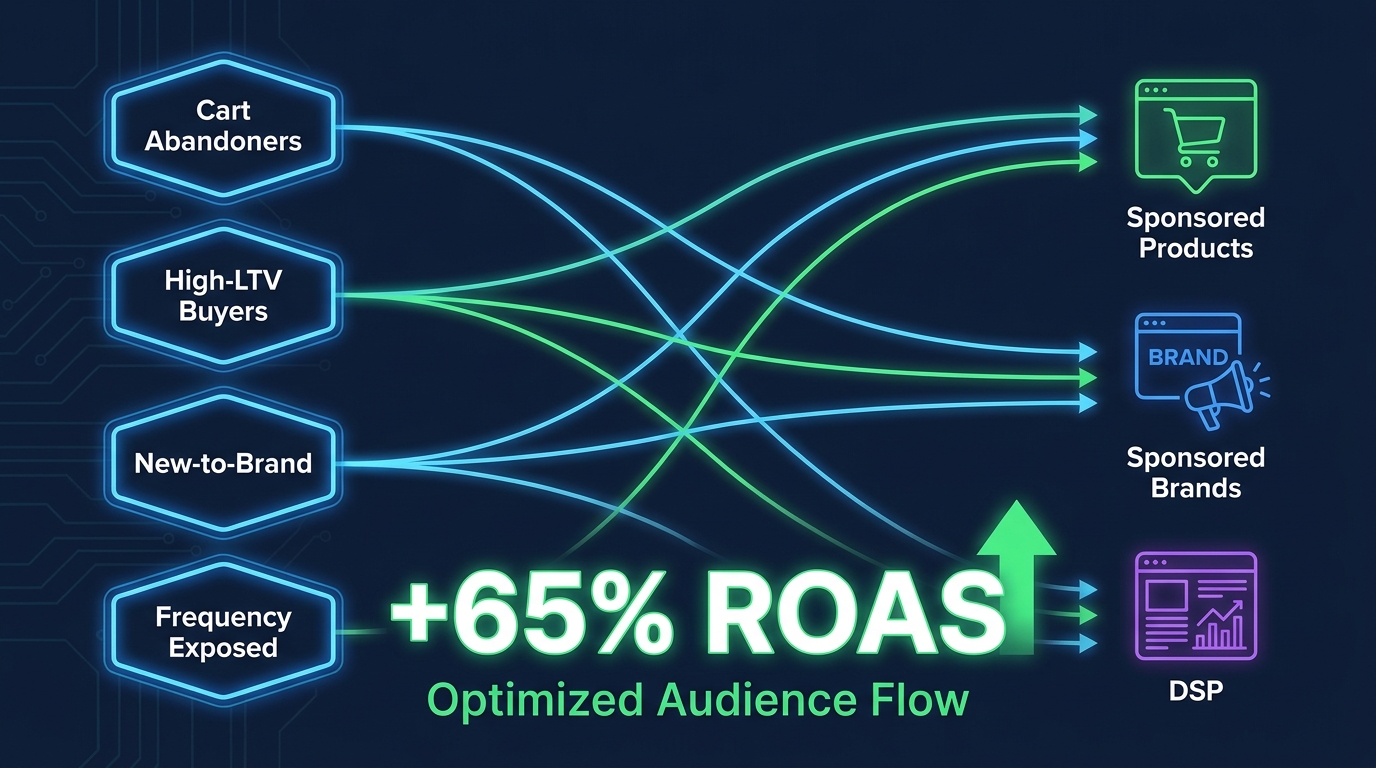

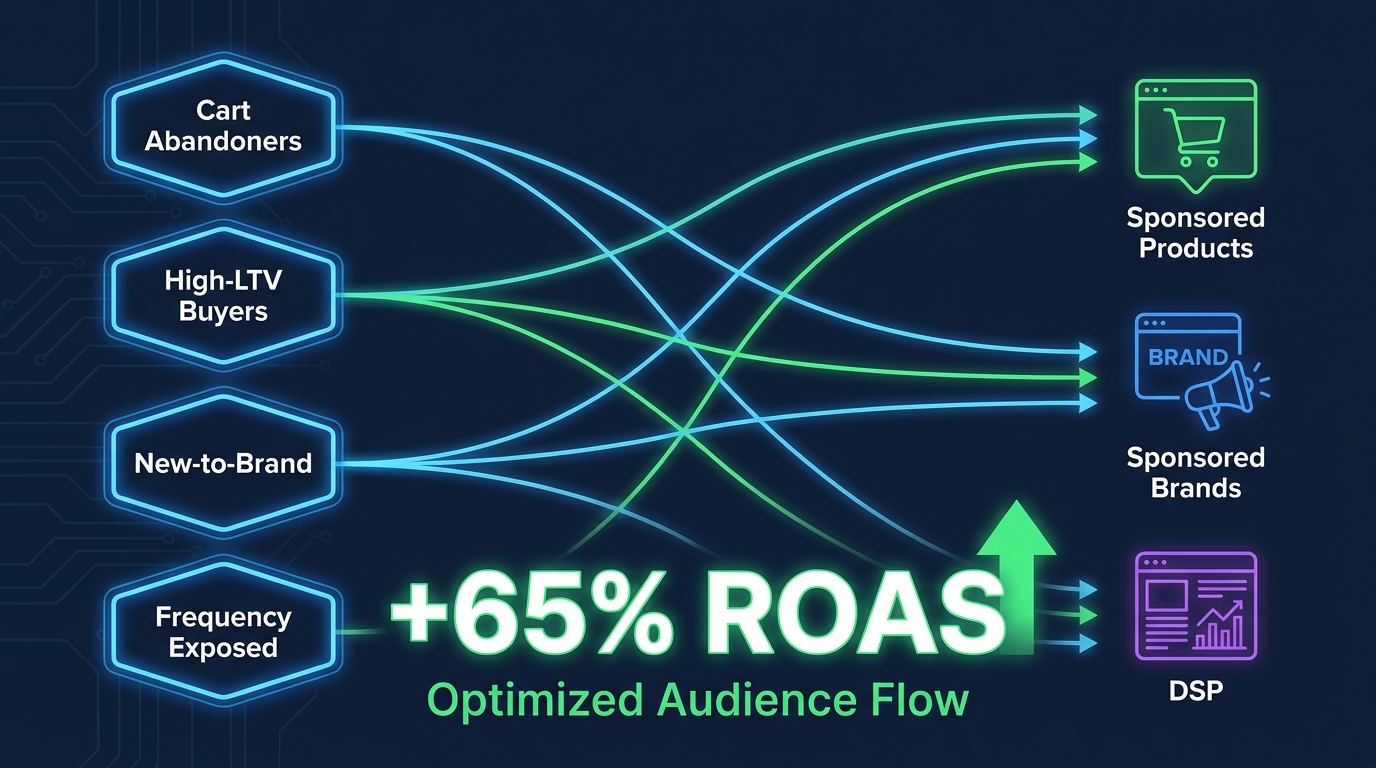
Keyword targeting on Amazon used to be the whole job. You found high-volume terms, matched them to your ASINs, set competitive bids, and let the algorithm do the rest. That model still works — but it’s become the floor, not the ceiling. Every serious seller is running keyword campaigns. The brands pulling ahead are the ones layering a second dimension on top: who is searching, not just what they’re searching for.
That’s where Amazon Marketing Cloud (AMC) enters the picture. And while the term gets thrown around a lot in agency decks, what AMC actually does — and how to translate its data into live, profitable PPC audiences — is far less understood than it should be.
This isn’t a primer on what AMC is. It’s a working guide to what you can build with it: specific audience segments, activation paths, bid strategies, suppression logic, and the measurement loops that make each campaign smarter than the last. The goal is a concrete understanding of how AMC data moves from the clean room to your ad account — and what that’s worth on the bottom line.
We’ll cover five high-value audience types worth building today, the SQL-less entry points Amazon has added in 2026, the distinction between DSP activation and Sponsored Products bid boosting, how multi-touch attribution changes the story your data is telling you, and the most common mistakes that drain budget rather than grow it.
If your AMC instance is collecting data but not generating audiences, this is the guide that changes that.
What AMC Actually Is — And What It Isn’t
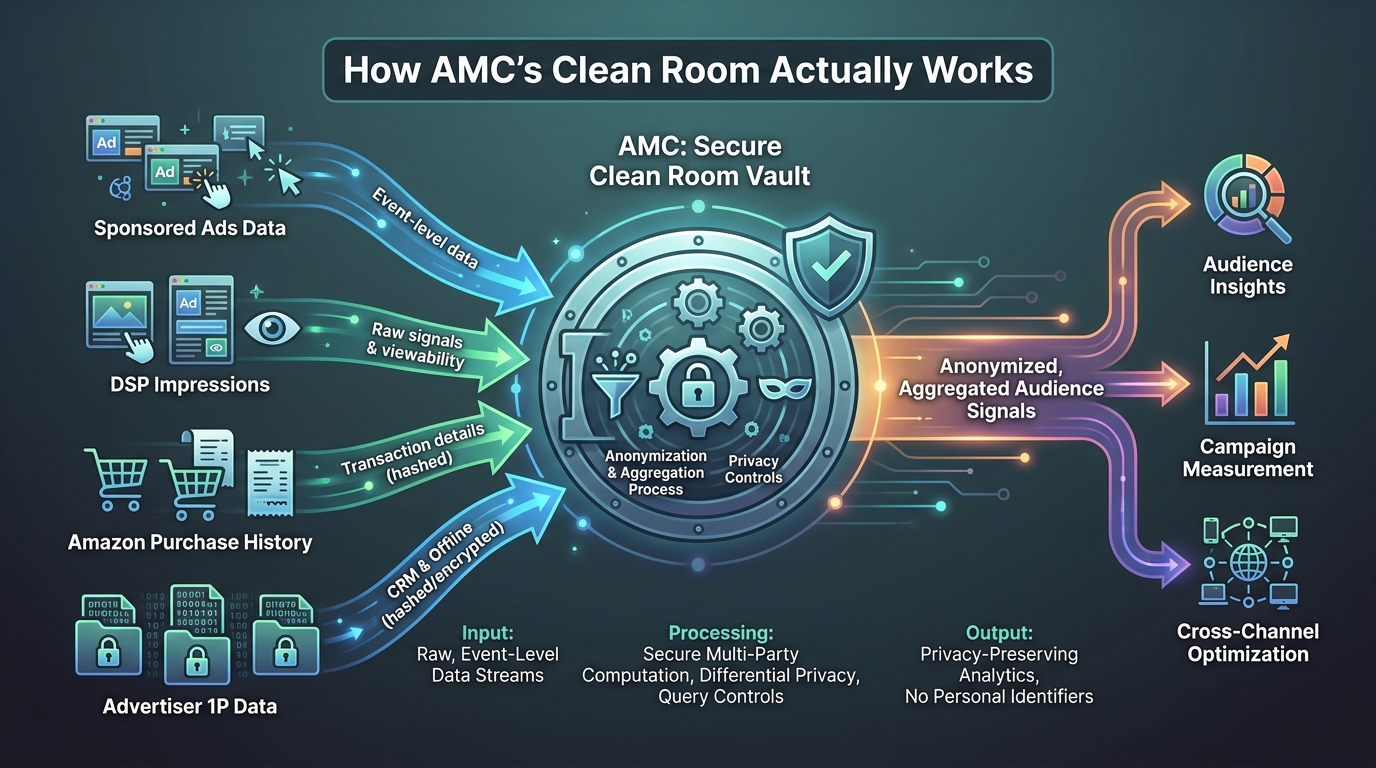
Amazon Marketing Cloud is a privacy-safe, cloud-based data clean room. That phrase is technically accurate but practically opaque, so here’s what it means in operational terms.
The Clean Room Model
When a shopper sees your Sponsored Brands ad, clicks your Sponsored Products listing, watches your Streaming TV creative, and then purchases three days later, each of those events generates a data record. Under normal Amazon reporting, those records are siloed by ad type — your Sponsored Products report doesn’t talk to your DSP report, and neither connects to your brand’s own customer data.
AMC changes that. It ingests pseudonymized event-level data from across your Amazon ad stack — Sponsored Ads, DSP, Amazon Attribution, Streaming TV, and more — and lets you query it as a unified dataset. The “clean room” part means that raw user-level data never leaves Amazon’s environment. Queries are run against aggregated outputs, and results only return when the sample size meets minimum threshold requirements (typically at least 100 users per segment). Privacy is enforced structurally, not just by policy.
What Data Lives in AMC
The event table in AMC contains every interaction a pseudonymized user ID has had with your advertising across Amazon’s ecosystem. That includes impressions, clicks, detail page views, add-to-cart events, purchases, subscription enrollments, and video completion rates. With Sponsored Ads data going back up to 13 months (and DSP extending further), you have the raw material for time-based behavioral analysis that Amazon’s native reporting simply cannot produce.
You can also upload first-party data from outside Amazon — hashed email lists, CRM segments, subscription status flags — and link those records to Amazon’s pseudonymized IDs. This is where AMC’s value becomes genuinely distinctive: the ability to bring your own customer intelligence into a space where Amazon’s behavioral signals can enrich and activate it.
What AMC Is Not
AMC is not a campaign management platform. It doesn’t bid, it doesn’t launch ads, and it doesn’t optimize spend directly. It’s an analysis and audience-creation layer. Audiences built in AMC get pushed to Amazon DSP or applied as bid modifiers in Sponsored Ads — but the activation happens in those downstream channels, not inside AMC itself.
This is a meaningful distinction because a lot of brands set up AMC, run a few exploratory queries, and then stop there. The clean room becomes a reporting tool rather than an audience engine. The payoff only comes when analysis flows into activation — when the insights you extract are converted into live audience segments that change how, and how much, you bid.
AMC also requires access to Amazon DSP (or at minimum the Sponsored Ads API) to activate audiences. Self-serve advertisers without a DSP relationship have historically been limited, though Amazon’s integration of AMC audiences into Sponsored Products bid adjustments has significantly widened access since late 2024, a development we’ll examine in detail later.
The Five AMC Audience Segments Worth Building Right Now
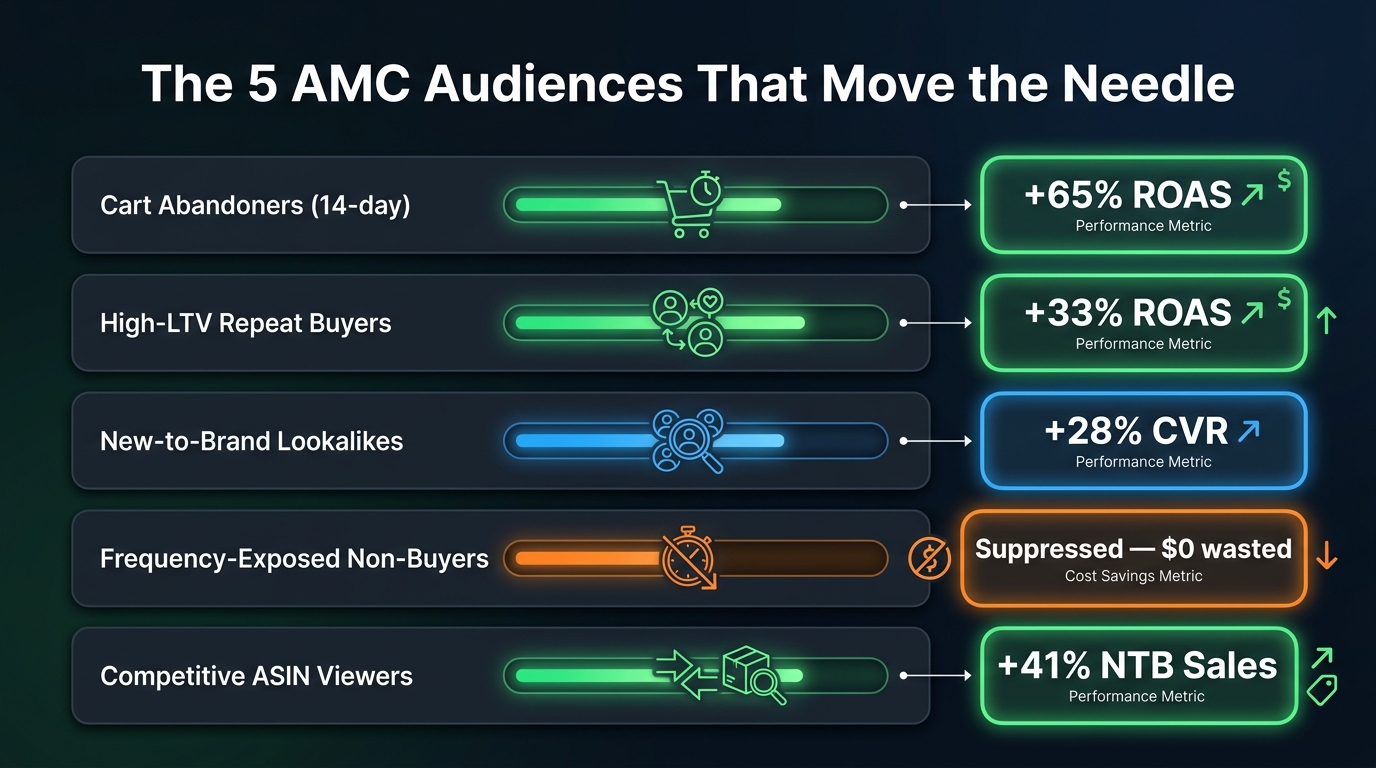
Not every AMC audience is worth the build time. Some segments are theoretically interesting but fail the minimum user thresholds needed to activate. Others are conceptually sound but too broad to generate meaningful lift. These five represent the highest signal-to-effort ratio across verticals.
1. Cart Abandoners (14-Day Window)
This is the clearest high-intent audience Amazon data can generate. A user who added your ASIN to cart but didn’t purchase in the last 14 days has demonstrated intent that no keyword alone can confirm. They knew your product, evaluated it, and stopped short of buying — which means the barrier is almost certainly price, distraction, or comparison shopping rather than awareness.
Tinuiti’s documented work with this segment in Sponsored Products campaigns showed a 65% higher ROAS versus non-branded baseline, with over 100 incremental conversions in a single month on high-competition terms. The key mechanics: build the audience in AMC using the add-to-cart event table, set a 14-day lookback, then apply it as a bid boost in a manual Sponsored Products campaign targeting your own branded and category terms. The audience modifier increases your bid only when that specific user is searching — everyone else sees the standard bid.
The AMC SQL pattern for this segment filters on users where event_type = 'ADD_TO_CART' and purchase event is absent within the same window. Amazon’s template library includes a pre-built version of this query, so custom SQL isn’t strictly required.
2. High-LTV Repeat Purchasers
Customers who have purchased from your brand two or more times in the trailing 90 days represent a different kind of value. They’re not conversion risks — they’re retention assets. The audience segment here is less about acquisition and more about maximizing share of wallet.
The AMC query for this segment groups purchase events by user ID, filters for users with two or more distinct orders, and can be further refined by total spend threshold. Activating this audience in DSP for retargeting and cross-sell campaigns has shown consistent ROAS improvements — Perpetua documented a 33% higher ROAS for Beekeeper’s Naturals using this segment type on DSP retargeting. The strategy: suppress this audience from your customer acquisition campaigns (they’re already buyers) and use them exclusively for upsell, cross-sell, or Subscribe & Save conversion creatives.
3. New-to-Brand Lookalikes
Amazon’s new-to-brand (NTB) flag in AMC identifies users who converted as first-time buyers of your brand. That cohort is your seed audience for lookalike prospecting. By analyzing the behavioral patterns of users who converted NTB — their pre-purchase engagement pattern, the number of ad touchpoints, the categories they also browsed — you can build a lookalike audience in Amazon DSP targeting users with similar profiles.
This is particularly powerful for brands in competitive categories where conquesting on competitor ASINs is expensive. Instead of bidding against everyone searching a competitor keyword, you can layer NTB lookalike targeting to focus spend on users who look like people who actually converted. Advertisers using NTB lookalike segments in DSP have reported 28% higher conversion rates versus cold audience targeting in the same category.
4. Frequency-Exposed Non-Buyers
This audience is defined by what didn’t happen. Using AMC’s frequency analysis — one of its most underutilized capabilities — you can identify users who have seen your ads five or more times (the threshold varies by category and campaign type) but have never clicked or converted. This group is burning impressions without generating returns.
The action here is suppression, not targeting. Push this audience to your DSP exclusion list to stop serving them impressions and reallocate that budget to higher-potential users. This isn’t a flashy audience strategy, but recapturing even 8–12% of wasted DSP spend and redirecting it toward the cart-abandoner or NTB lookalike segments can shift overall account efficiency materially.
5. Competitive ASIN Viewers
AMC can identify users who viewed competitor ASINs on Amazon without purchasing, then later engaged with your ads. This audience sits in the consideration zone — they’re actively evaluating your category, have seen your competitor’s product, and have now interacted with your brand signals. That’s a high-intent comparison shopper, and they warrant aggressive bidding.
Building this segment requires access to competitive ASIN data within AMC’s product detail page view signals, which is available to DSP advertisers with AMC access. The audience can then be activated in DSP with custom creative emphasizing differentiation from the competitor product they viewed — a level of personalization that standard Sponsored Products simply can’t achieve.
SQL Without Fear: How AMC’s AI Query Generator Changed the Access Model
For most of AMC’s history, building custom audience segments required writing SQL queries against Amazon’s event tables — a technical barrier that locked most brands out without an agency or in-house data engineer. That changed in 2026 with Amazon’s rollout of the AI Audience Generator inside AMC.
How the AI Generator Works
The AI Audience Generator accepts natural language input describing the audience you want to build. You describe the behavior — “users who added to cart in the last 14 days but didn’t purchase” or “customers who bought from my brand twice in the last 90 days” — and AMC generates the working SQL query behind it. You can review, edit, or run the query as-is. The output is a targetable audience segment ready for DSP or Sponsored Ads activation.
This matters beyond just convenience. It collapses the skill requirement for AMC audience building from “can write SQL against a complex event schema” to “can describe customer behavior in plain language.” Brands that previously had AMC access but weren’t using it for audience creation because of the technical overhead now have a practical on-ramp.
Template Library as a Starting Point
Amazon also maintains a template library within AMC — pre-built query patterns for the most common audience types: cart abandoners, past purchasers, frequency-overexposed users, video completers, and NTB converters. These templates can be deployed directly or customized with filters (date ranges, spend thresholds, product categories) without touching the underlying SQL structure.
The practical workflow for a brand just getting started: begin with templates to build two or three foundational segments, run them against your data, and review the audience size outputs. If segments clear the minimum threshold (100 users), activate them. If they don’t, widen the lookback window or loosen a filter condition until you reach a viable size.
When You Still Need SQL
The AI generator handles standard segments well, but complex cross-channel analysis still benefits from hand-crafted queries. Multi-touch attribution modeling, time-decay analysis across ad touchpoints, or cohort comparisons between NTB buyers from different ad channels — these require specific query logic that natural language prompts can’t reliably produce. For advanced analysis, the SQL route remains the more precise path, but the template and AI layers handle the majority of profitable audience use cases without it.
Activation Paths: DSP vs. Sponsored Products Bid Boosting
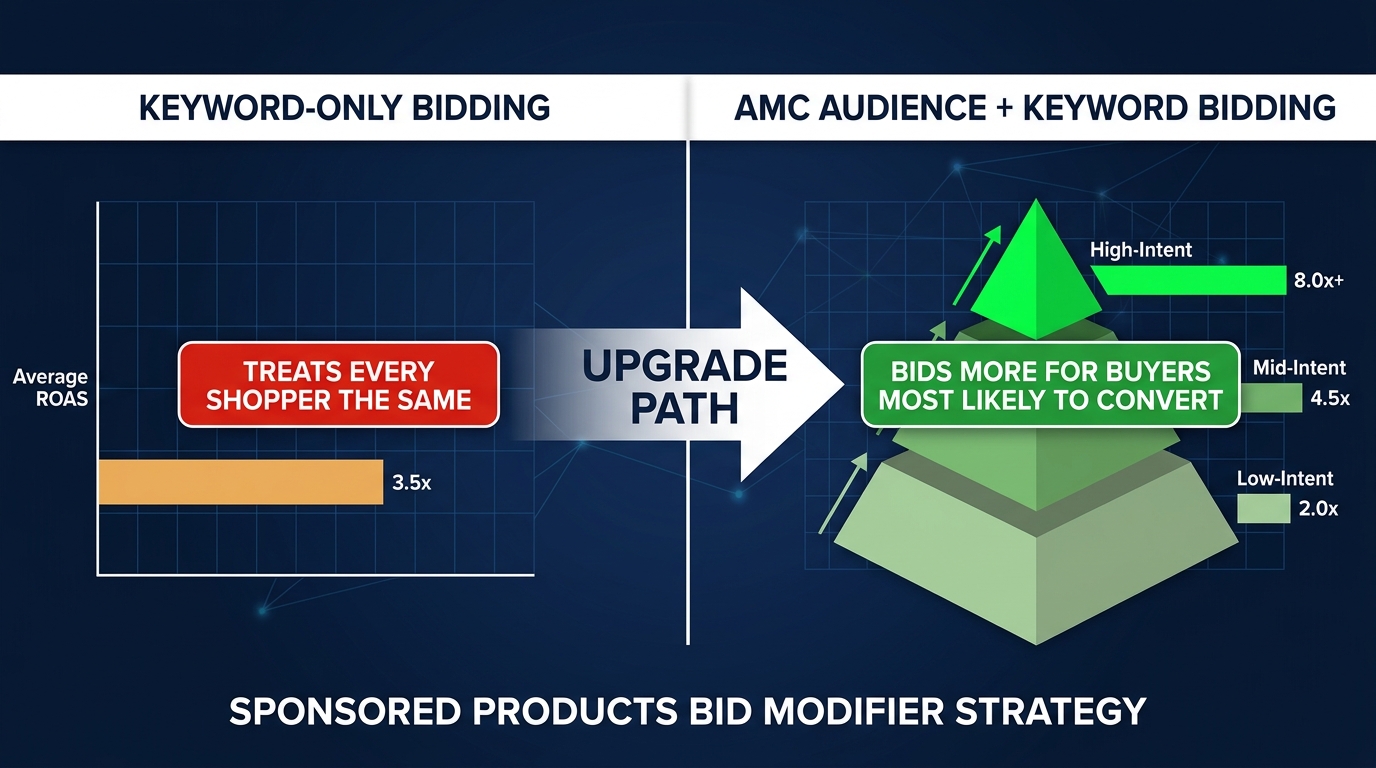
Building an audience in AMC is half the work. The other half is choosing where to activate it, and that choice has significant implications for campaign structure, cost, and what you can actually measure.
Amazon DSP: Full Creative and Targeting Control
Amazon DSP (Demand Side Platform) is where AMC audiences have historically been activated. DSP lets you run display, video, audio, and Streaming TV campaigns against custom-built AMC audience segments. You control creatives, placements, frequency caps, and bid strategies at the audience level.
The strength of DSP activation is reach and creative flexibility. You can serve a video ad to your high-LTV repeat purchasers promoting a new product line, or show a display creative to your competitive ASIN viewers highlighting a price advantage — messaging matched to behavior in a way that Sponsored Ads cannot replicate.
The limitation is cost and access. DSP has historically required a minimum spend commitment (often $10,000–$35,000/month through managed service) or a self-service DSP account. For many brands, this makes DSP activation a channel-of-last-resort rather than a standard tool.
Sponsored Products and Sponsored Brands Bid Boosting
The expansion that opened AMC audiences to a much wider advertiser base was Amazon’s integration of audience bid modifiers into Sponsored Products and Sponsored Brands. Launched in late 2024 and now fully established in 2026 workflows, this feature lets you apply an AMC audience segment as a bid multiplier on existing Sponsored Ads campaigns.
The mechanism works like this: you maintain your normal keyword-targeted Sponsored Products campaign with its standard bids. You then attach an AMC audience to that campaign. When a user in that audience triggers your keyword, your bid is automatically multiplied by the configured modifier — typically between 1.1x and 2x. Users not in the audience are served your base bid. The result is a campaign that prices intent signals differently based on behavioral context, not just keyword match type.
This is a meaningful shift because it brings audience-level intelligence to a channel most Amazon brands run regardless of their DSP status. A brand spending $15,000/month on Sponsored Products that applies a 1.5x bid modifier to cart-abandoner audiences and a 1.8x modifier to high-LTV buyers is effectively running an audience-prioritized search campaign — without needing a DSP relationship or budget tier.
Choosing the Right Path
The decision between DSP and Sponsored Ads bid boosting isn’t either/or. The most efficient architecture uses both: Sponsored Ads bid boosting for high-intent segments (cart abandoners, high-LTV) where capturing the active search moment is the primary goal, and DSP for upper and mid-funnel segments (NTB lookalikes, competitive ASIN viewers) where you need to create or maintain consideration between search sessions.
The key question for each segment is: where in the purchase journey does this audience sit? If they’re actively searching, bid boosting in Sponsored Ads captures that moment. If they’re not yet in-market search mode, DSP brings them back into the funnel.
The Multi-Touch Attribution Angle: Why Last-Click Is Costing You Budget
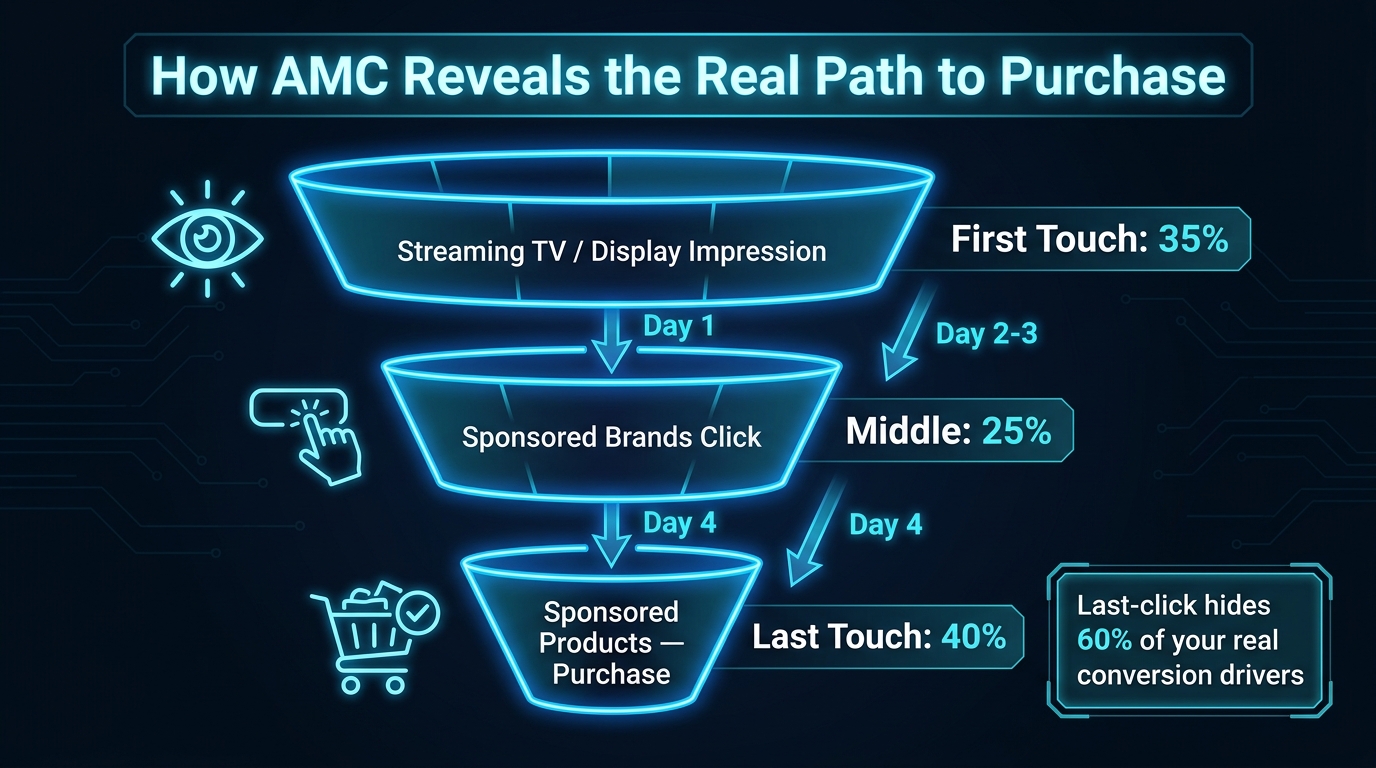
If you’re optimizing your Amazon PPC solely on the basis of attributed sales per ad type, you’re reading an incomplete story. Last-click attribution — the default across Amazon’s native reporting — assigns 100% of conversion credit to the final ad touchpoint before purchase. It sounds logical until you look at what it systematically hides.
The Problem With Last-Click in Amazon’s Environment
Consider a common conversion path: a shopper sees a Streaming TV ad for your brand, searches your category keyword two days later and clicks a Sponsored Brands ad, then returns the following day and purchases via a Sponsored Products placement. Under last-click attribution, the Streaming TV campaign receives zero credit, Sponsored Brands receives zero credit, and Sponsored Products receives 100% of the conversion value.
The budget conclusion your team draws from that data: reduce upper-funnel spending on Streaming TV and Sponsored Brands because they don’t appear to drive sales. But this is precisely backward. Without the Streaming TV exposure, the category search might not have happened. Without the Sponsored Brands click, the consideration stage wasn’t completed. Cutting those touchpoints may reduce last-click-attributed Sponsored Products sales in ways that don’t show up for weeks.
AMC’s multi-touch attribution lets you see the full sequence. By querying the event table for all ad touchpoints associated with a user ID prior to a purchase event, you can build attribution models that distribute credit across the path rather than concentrating it at the end.
How to Build Multi-Touch Models in AMC
AMC supports several attribution frameworks you can apply via SQL: first-touch, last-touch, linear (equal credit across all touchpoints), time-decay (more credit to touchpoints closer to conversion), and position-based (40% to first touch, 40% to last touch, 20% distributed to middle). None of these is universally correct — the right model depends on your category’s purchase journey length and the typical role your ad types play.
A practical starting point: run a linear attribution model across your last 90 days of campaign data, then compare the credited sales by channel to what your last-click reports show. The delta reveals which channels are systematically under-credited. Brands doing this for the first time routinely discover that DSP display and video contribute 30–50% more to conversions than last-click data suggests.
Turning Attribution Insight Into Audience Strategy
The attribution analysis itself becomes an audience-building signal. Users who completed specific multi-touchpoint journeys before converting — say, DSP impression followed by Sponsored Brands click within 72 hours — can be identified as a high-intent pattern. New users who match the beginning of that pattern (have received DSP impression, not yet clicked search ads) can be built into an audience for accelerated Sponsored Brands bidding, effectively guiding more shoppers into the conversion path you’ve identified as efficient.
This is where AMC transitions from backward-looking measurement to forward-looking activation — and it’s the most sophisticated application of the platform available to non-enterprise advertisers today.
Path-to-Purchase Timing: Making Lookback Windows Work for You
Every AMC audience query involves a lookback window — the time period from which behavioral data is drawn. Getting the window right is less obvious than it sounds, and the wrong choice is one of the most common reasons AMC audiences underperform expectations.
Understanding Window Length Trade-Offs
A shorter lookback window (7–14 days) captures high-recency intent: users who engaged with your brand recently are more likely to still be in an active consideration phase. The trade-off is audience size — shorter windows produce smaller segments that may struggle to clear AMC’s 100-user minimum, particularly for smaller catalogs.
A longer lookback window (60–90 days) produces larger, more stable audiences but includes users whose intent may have cooled. A cart abandoner from 80 days ago has almost certainly made a purchase decision — either with you, a competitor, or not at all. Including them in a “high intent” retargeting segment dilutes the signal quality.
Category-Appropriate Window Selection
The right window aligns with your category’s typical purchase cycle. Beauty and consumables have short replenishment cycles — 30–45 day windows are appropriate for most segments. Electronics and high-consideration items have longer research phases; 60–90 day windows better capture users still in the decision journey. Seasonal categories (holiday decor, outdoor furniture, school supplies) need windows anchored to the seasonal calendar rather than rolling averages.
AMC’s path-to-purchase analysis helps calibrate this. Query your conversion events and look at the median time between first ad interaction and purchase event. That number is your category’s effective consideration window — and it should anchor all of your lookback window decisions.
Stacking Windows for Funnel Logic
A more sophisticated approach uses multiple overlapping windows to represent funnel stages. A 7-day cart-abandoner window captures urgent retargeting candidates. A 30-day ASIN viewer window (no cart add) captures mid-funnel considerers. A 90-day brand interactor window (impression with no click) captures early awareness contacts. Each receives different bid treatment: the 7-day window gets the highest boost, the 30-day window gets moderate, the 90-day window gets the lowest. This replicates a full-funnel bidding structure entirely within the AMC audience layer, without requiring separate campaign architectures for each funnel stage.
Suppression and Frequency Capping as Profit Levers
Most discussions of AMC audiences focus on who to target more aggressively. The equally important application is who to exclude — and it’s the one most brands overlook until their DSP costs become a problem.
Why Suppression Matters for Margin
Amazon DSP is a CPM (cost per thousand impressions) model. Every impression served to a user who will never convert is budget destroyed. AMC’s frequency analysis — which shows you how many times specific user cohorts have been exposed to your ads without converting — identifies exactly these users at scale.
The optimal frequency point varies by ad type and category. Amazon’s own research suggests most categories see diminishing returns after 5–7 DSP impressions per user per 14-day window, with some categories hitting that threshold even earlier for video. Users beyond the optimal frequency represent what practitioners call “frequency waste” — impressions that cost money, inflate your frequency metric, and generate no sales.
An AMC query that surfaces users exposed to your DSP campaigns 8+ times in 30 days with no conversion event gives you a concrete suppression list. Push that audience to your DSP exclusion targeting, and the impressions previously wasted on them are reallocated to fresh users or redeployed in lower-CPM placements.
Current Customers as a Suppression Segment
Customer acquisition campaigns should almost always suppress known purchasers. AMC lets you build a “purchased in last 90 days” audience and use it as an exclusion on new-to-brand campaigns. This prevents spending customer acquisition budget on people who are already customers — a mistake that’s common in keyword-targeted Sponsored Ads where returning buyers search the same terms as first-timers.
The same logic applies to Subscribe & Save subscribers. If you have subscription data connected through first-party data upload, building a “current subscriber” suppression audience for your DSP acquisition campaigns ensures those impressions reach genuinely new prospects. Brands that implement this consistently report 12–18% improvement in their NTB customer acquisition cost, simply by stopping spend on already-acquired users.
Competitive Suppression
A less obvious suppression strategy: excluding users who have purchased a competitor ASIN in the last 30 days from standard retargeting. These users have just bought from your competitor — they’re almost certainly out of the market for a competing purchase in the short window. Including them in your retargeting audience inflates CPMs and reduces effective reach. AMC can identify this cohort from product detail page conversion event data when competitors’ ASINs appear in your category data signals, though the specificity depends on your DSP access level.
First-Party Data Integration: Bringing Your CRM Into the Clean Room
AMC’s clean room architecture allows you to upload first-party data and link it to Amazon’s behavioral signals — a capability that fundamentally changes what kinds of audience segments are possible and how precisely you can personalize at scale.
What You Can Upload and How
Amazon accepts hashed, pseudonymized first-party data via Amazon S3 upload into your AMC instance. The most common upload types include: hashed email lists from your CRM, customer purchase history from your DTC or brand website, subscription status data (active, churned, trial), and loyalty program tier data.
Amazon’s identity resolution layer attempts to match your hashed records to its own pseudonymized user IDs. Match rates vary — typically 40–70% depending on how your customer base skews between email domains — but even at 50% match, this creates an audience layer that no keyword strategy can replicate: behavioral data from outside Amazon linked to behavioral data inside Amazon for the same user.
High-Value Use Cases for 1P Integration
The most immediately profitable 1P integration use cases tend to be win-back campaigns targeting churned customers. A user who purchased from your DTC store six months ago and hasn’t returned is a high-value retargeting target on Amazon. AMC can match that churned customer to their Amazon ID, confirm they haven’t purchased your brand on Amazon either, and create a “lapsed buyer” audience for DSP win-back creative or Sponsored Products bid boosting when they search relevant terms.
A second high-value use case: suppressing active subscribers from promotional campaigns. If a user is already on Subscribe & Save or has an active DTC subscription, serving them acquisition-priced promotions wastes margin. Matching your subscription list against Amazon IDs and building a suppression audience prevents this systematically.
A third: loyalty tier segmentation. Users in your top loyalty tier from your owned channels almost certainly have different price sensitivity and brand affinity than mid-tier buyers. Building separate audiences for each tier and applying different bid strategies — higher multipliers for mid-tier trying to push them to top tier, different creative angles for top-tier cross-sell — creates an audience-driven personalization layer that’s genuinely sophisticated by Amazon advertising standards.
Privacy and Compliance Considerations
All 1P data uploaded to AMC must be hashed (SHA-256 is the standard Amazon accepts) before upload. Raw personally identifiable information should never enter the AMC environment. Amazon’s clean room infrastructure ensures that uploaded data cannot be extracted in user-identifiable form — the privacy protection is architectural, not just contractual. Brands operating in regulated industries or jurisdictions with strict data privacy laws (GDPR, CCPA) should verify their data sharing agreements and consent frameworks cover AMC upload before proceeding, but the clean room model is specifically designed to accommodate privacy-compliant data collaboration.
The Measurement Loop: Feeding AMC Insights Back Into Your Bid Strategy
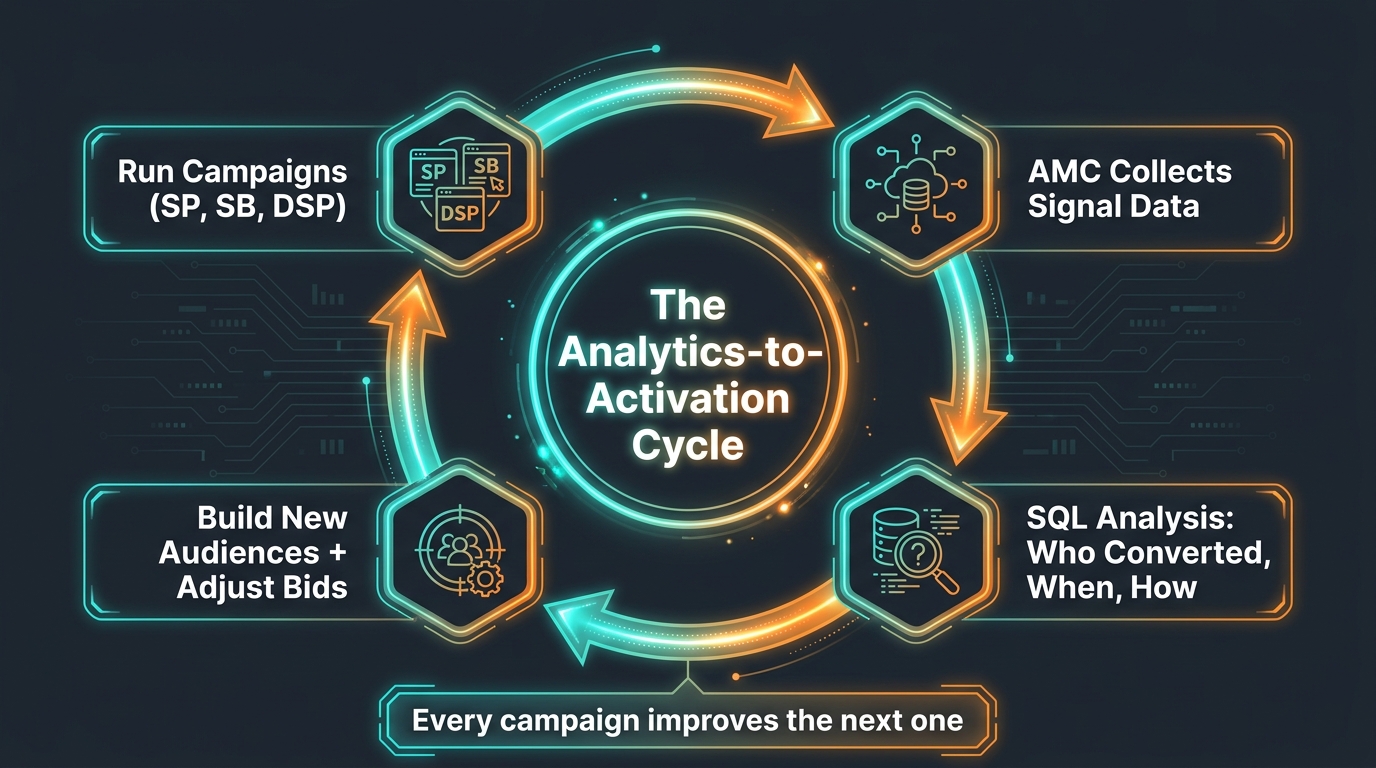
The most durable competitive advantage AMC creates isn’t any single audience segment — it’s the compound effect of a measurement loop where every campaign cycle produces better inputs for the next one. Understanding how to structure that loop is what separates brands that get one-time lifts from AMC from those that build sustained efficiency advantages.
The Anatomy of the Loop
The cycle runs in four stages. First, campaigns run — Sponsored Products, Sponsored Brands, DSP, and any other Amazon ad types in your mix. Second, AMC ingests the event data those campaigns generate: impressions, clicks, conversions, add-to-cart events, video completions, and frequency by user. Third, you run AMC analysis: which audience segments converted at what rates, which paths to purchase were most efficient, which user cohorts are overexposed or underserved. Fourth, you build or refine audiences based on those findings and adjust bid modifiers, suppression lists, and DSP targeting accordingly.
Then the campaigns run again — now with better-structured audiences — and the data they generate is richer and more actionable than the previous cycle’s. Over three to six months, this loop produces an audience architecture that’s been iteratively refined against your actual customer behavior, not generic demographic or interest-based guesses.
Cadence and Practical Execution
Most brands running AMC effectively operate on a monthly analysis cadence — pulling the previous month’s event data, refreshing audience segments, and updating bid modifiers before the next month’s campaigns go live. For high-volume or high-velocity categories (consumables, supplements, pet care), a biweekly cadence captures behavioral changes more quickly.
The analysis doesn’t need to be exhaustive every cycle. A practical approach: rotate through three analysis priorities — conversion path efficiency (multi-touch attribution update), audience freshness (are your current bid boost segments still the right people?), and frequency health (are any DSP cohorts hitting waste threshold?). Cycling through these three consistently catches the most expensive inefficiencies without requiring hours of SQL work each cycle.
When to Recalibrate Bid Modifiers
Audience-level bid modifiers should be treated as hypotheses, not permanent settings. A 1.5x modifier on cart abandoners was set based on performance data from a prior period. If conversion rates in that audience segment shift — due to price changes, competitive entrants, or seasonal demand patterns — the modifier should update accordingly.
AMC allows you to query performance by audience segment over time, giving you the data to audit whether your current modifiers still reflect actual conversion value. Modifiers that made sense at Q4 prices may overcost in Q1 when competition cools. Rebuilding audience performance benchmarks quarterly, and adjusting modifiers to match, keeps bid strategy tethered to reality rather than running on stale assumptions.
Common Mistakes That Drain Budget Instead of Growing It
AMC is genuinely powerful, but it’s also where several expensive mistakes tend to cluster — particularly among brands that are new to the platform or working through agencies without clear implementation standards. These are the errors that show up most consistently across accounts.
Mistake 1: Building Audiences Too Narrow to Activate
AMC’s minimum audience size requirement (typically 100 users for a segment to be activatable) catches a lot of first-time builders off guard. Highly specific queries — “users who watched 75% of my video ad and added to cart and are Subscribe & Save eligible within 7 days” — often produce segments of 30–60 users that can’t be pushed to DSP or Sponsored Ads at all. The analysis runs, the segment looks promising, and then it fails to activate.
The fix is to design audience segments with activation threshold in mind from the start. Validate your expected segment size before investing heavily in query refinement. If your category or brand scale means that specific segments will chronically underperform the threshold, widen the behavior window or combine related behavioral signals (e.g., add-to-cart OR ASIN page view) to reach viable sizes.
Mistake 2: Treating All AMC Audiences as Equal
Not every AMC segment deserves the same bid modifier or creative investment. Cart abandoners are demonstrably higher intent than someone who saw one display impression three months ago. But some brands apply a flat bid boost (say, 1.3x) to every AMC audience segment in their account, regardless of how those segments were built or how they’ve historically converted.
Segment performance should drive bid modifier sizing. Run a 30-day conversion rate analysis per segment in AMC, rank segments by conversion rate relative to baseline, and set modifiers proportionally. High-converting segments warrant higher modifiers; segments performing near or below baseline should be rebuilt or dropped.
Mistake 3: Skipping the Suppression Layer
Brands that build AMC targeting audiences but never build suppression audiences are running an incomplete strategy. The net efficiency of AMC activation depends as much on who you stop bidding for as who you bid up. Without suppression, acquisition campaigns serve repeat buyers, retargeting campaigns serve already-converted users, and DSP campaigns run at full CPM against users who’ve demonstrably tuned out.
Every AMC audience build-out should include at least two suppression audiences: current buyers (last 30 days) for acquisition campaigns, and frequency-saturated users for DSP campaigns. These take less time to build than targeting audiences and often have an equivalent or greater impact on account efficiency.
Mistake 4: Running Analysis in a Silo
AMC analysis loses most of its value if it lives in a reporting deck without connecting to campaign decisions. The clean room is only as useful as the rate at which its insights change something in an active account. Brands that run monthly AMC reports but don’t have a direct protocol for translating findings into bid changes, audience refreshes, or budget shifts are paying for infrastructure without extracting its return.
The structural fix: create a standing AMC review cadence with explicit outputs — at minimum, an audience refresh action and a bid modifier review action — tied to every analysis cycle. Analysis without activation is sunk cost.
Mistake 5: Not Accounting for Audience Overlap
When multiple AMC audiences are applied across campaigns in the same account, the same user can appear in several segments simultaneously — cart abandoner, high-LTV buyer, and NTB lookalike, for instance. Without overlap analysis, you can end up bidding aggressively against yourself on the same user across multiple campaigns, inflating CPCs without proportionate conversion benefit.
AMC’s overlap query capability lets you see the size of the intersection between any two audience segments. Run overlap analysis before finalizing a multi-segment campaign structure, and use exclusion logic to ensure each campaign’s audience is as clean as possible. The rule of thumb: your most specific, highest-intent audience should be excluded from broader audience campaigns to prevent bid cannibalization.
Building the AMC-Powered Advertising Machine: A Practical Starting Framework
AMC’s capabilities are extensive enough that knowing where to start is genuinely useful tactical guidance. The following phased framework represents the most efficient ramp from zero to a functioning AMC audience engine, calibrated for brands without dedicated data engineering resources.
Phase 1: Foundation Audiences (Weeks 1–3)
Begin with two segments: a 14-day cart-abandoner audience and a 90-day current-purchaser suppression audience. Both can be built using AMC templates without custom SQL. Activate the cart-abandoner segment as a 1.5x bid modifier in your highest-spend Sponsored Products campaign. Apply the purchaser suppression to your primary DSP prospecting line. Run for 30 days and pull conversion data segmented by audience in AMC.
Phase 2: Expansion Audiences (Weeks 4–8)
Add two more segments informed by Phase 1 data: a high-LTV repeat buyer audience (for cross-sell DSP creative) and a frequency-overexposed non-buyer suppression list (for DSP exclusion). Run a multi-touch attribution query for the same period to understand which ad types are genuinely driving upper-funnel contribution. Adjust DSP budget allocation based on attribution findings — resist the pull to cut channels that are performing well under multi-touch but appear weak under last-click.
Phase 3: Refinement and 1P Integration (Weeks 9–16)
Upload your most valuable first-party data segment — CRM churned customers or active subscribers for suppression. Build your first NTB lookalike audience from the NTB converters identified in Phase 1 data. Start running monthly audience overlap analysis to prevent bid cannibalization. Review and recalibrate bid modifiers against 60-day performance data rather than running on original settings.
By the end of this three-phase cycle, the account is running five or more AMC-informed audiences, suppression logic is reducing DSP waste, multi-touch attribution is guiding budget allocation, and the measurement loop is generating monthly refinement inputs. That architecture — when maintained consistently — produces compounding efficiency gains that keyword optimization alone cannot replicate.
Conclusion: The Audience Layer Is Now Table Stakes
Amazon PPC has always been a keyword game. It’s increasingly also an audience game. The brands that figure out how to stack both dimensions — precise keyword targeting combined with AMC-powered behavioral audience logic — are operating with a structural advantage over those still treating every impression as equivalent.
The tools to do this have never been more accessible. Amazon’s AI Audience Generator removed the SQL barrier for foundational segments. The Sponsored Products bid modifier integration brought AMC audiences to advertisers without DSP access. The template library shortened build time for the most impactful use cases to hours rather than days.
What remains as the differentiator is discipline: the discipline to run analysis on a consistent cadence, translate findings into account changes rather than slide decks, build suppression audiences alongside targeting audiences, and treat the measurement loop as an asset that compounds over time.
AMC doesn’t reward setup — it rewards iteration. The value accumulates each month that insights cycle back into bids, audiences are refreshed against current behavior, and waste is systematically eliminated. Start with two segments. Activate them. Measure the delta. Refine. Repeat. That cadence, maintained consistently across quarters, is how AMC data becomes margin — and margin is what the keyword game alone was never going to give you.
Actionable Takeaways
- Start with cart abandoners: A 14-day cart-abandoner AMC audience with a 1.5x Sponsored Products bid modifier is the highest-confidence first deployment. Documented cases show 65% ROAS improvement over non-branded baseline.
- Build suppression before you build targeting: A current-buyer suppression audience on your DSP acquisition campaigns will likely return faster efficiency gains than any targeting audience you add.
- Run multi-touch attribution before cutting DSP or upper-funnel spend: Last-click data routinely undervalues display and video by 30–50%. Check the full path before reallocating budget away from apparently “low-performing” channels.
- Use AMC’s AI generator for the basics, not for everything: Natural language query generation handles foundational segments reliably. Complex cross-channel cohort analysis still benefits from SQL or agency support.
- Validate segment size before investing in activation: Confirm your AMC segment clears the minimum 100-user threshold before building campaign infrastructure around it. Narrow high-intent segments often require wider lookback windows to become activatable.
- Monthly cadence beats quarterly: A consistent monthly analysis-and-refresh cycle compounds faster than quarterly deep-dives. Even a two-hour monthly review that produces one audience update and one modifier adjustment adds up across a year.