



Here is the pattern that repeats across enterprise AI teams in 2026: the demo is convincing, the pilot looks promising, and then production happens. Tickets start arriving. An agent silently retried a write operation four times. A multi-step workflow stalled at step seven and nobody noticed for six hours. An approval that was supposed to pause the workflow passed straight through because the gate was wired to the wrong condition. The ops team — who had been cautiously optimistic — now has a very different opinion.
This is not a model-quality problem. The model is not confused. The design is confused.
As of early 2026, roughly 78% of enterprise leaders have at least one AI agent pilot running, but only around 14% have reached anything resembling organisation-wide deployment at scale. The gap between those two numbers is not filled with bad AI — it is filled with workflows that were designed for demos and then deployed into systems that demand something far more rigorous. According to production tracking data, between 60% and 72% of agent pilots stall before reaching durable production value, and approximately 35% to 45% of agents that do reach production are deprecated within their first twelve months.
What separates the teams that clear that gap from the ones that don’t has very little to do with which foundation model they chose. It has almost everything to do with how they designed the workflow around the model — the permissions, the controls, the observability, the failure paths, and critically, the relationship between the agent system and the people who have to operate it every day.
This article is a design guide for building AI agent workflows that ops teams can actually run without anxiety. Not a framework pitch. Not a vendor overview. A practical, engineering-focused breakdown of the design decisions that determine whether your agent workflow survives contact with production — or quietly collapses inside it.
Why Ops Teams Actually Push Back (And Why That Pushback Is Usually Correct)
Before talking about how to design ops-safe workflows, it is worth understanding why the friction between AI teams and ops teams keeps recurring. The instinct in most organisations is to treat ops resistance as a cultural problem — people who are slow to adopt new things, who protect the status quo, who are insufficiently enthusiastic about automation. This framing is almost always wrong.
According to recent field data, employee resistance to AI agent deployment has increased to roughly 20% of affected workers — up from around 5% just a year prior. But the reasons behind that resistance tell a very different story than simple change aversion. The dominant concerns are workload complexity, unclear ownership, and transparency deficits — not ideology about automation itself.
The Actual Source of Friction
When ops teams push back on AI agent workflows, they are typically reacting to one or more of the following concrete problems:
- Added review burden with unclear authority. An approval gate appears in the workflow, but the ops person approving it is not sure what they are approving, what criteria they should use, or what happens if they reject it. The gate adds work without adding meaningful control.
- Opaque retries. The agent retried something. Nobody knows how many times, under what conditions, or whether the retries had side effects. The ops team is now debugging a state they did not create and cannot fully see.
- Weak rollback paths. Something went wrong mid-workflow. The agent stopped, but the work it did up to that point is in some indeterminate state. There is no clean way to undo what happened or resume from a safe checkpoint.
- Undefined ownership at failure time. When a human process fails, responsibility is clear. When an agent workflow fails, ownership often becomes genuinely ambiguous — was it the AI team’s model? The platform team’s integration? The ops team’s configuration? Nobody wants to be responsible for a system they do not fully control.
These are rational responses to real design gaps. The implication for AI workflow architects is direct: ops-team buy-in is not a communication problem you solve after design — it is a design constraint you build in from the start. Every control, every approval gate, every observability hook is also an answer to a legitimate operational concern.
The Integration Layer Is Where Confidence Gets Built or Lost
Integration failures are consistently the most-cited operational problem in enterprise AI agent deployments — particularly when agents must work across ERP, CRM, ITSM, and custom internal systems. These systems have their own expectations about idempotency, rate limits, schema versions, and authentication. An agent that works perfectly against a sandboxed test environment can produce genuinely confusing behaviour when it hits a production ERP system with different timeout thresholds or an API that returns undocumented 200-status error states.
Getting integration right is not primarily a model problem. It is an engineering and ops problem, and it needs to be treated as such from the first design session.
The Compounding Error Problem: Why Per-Step Accuracy Doesn’t Mean What You Think It Does
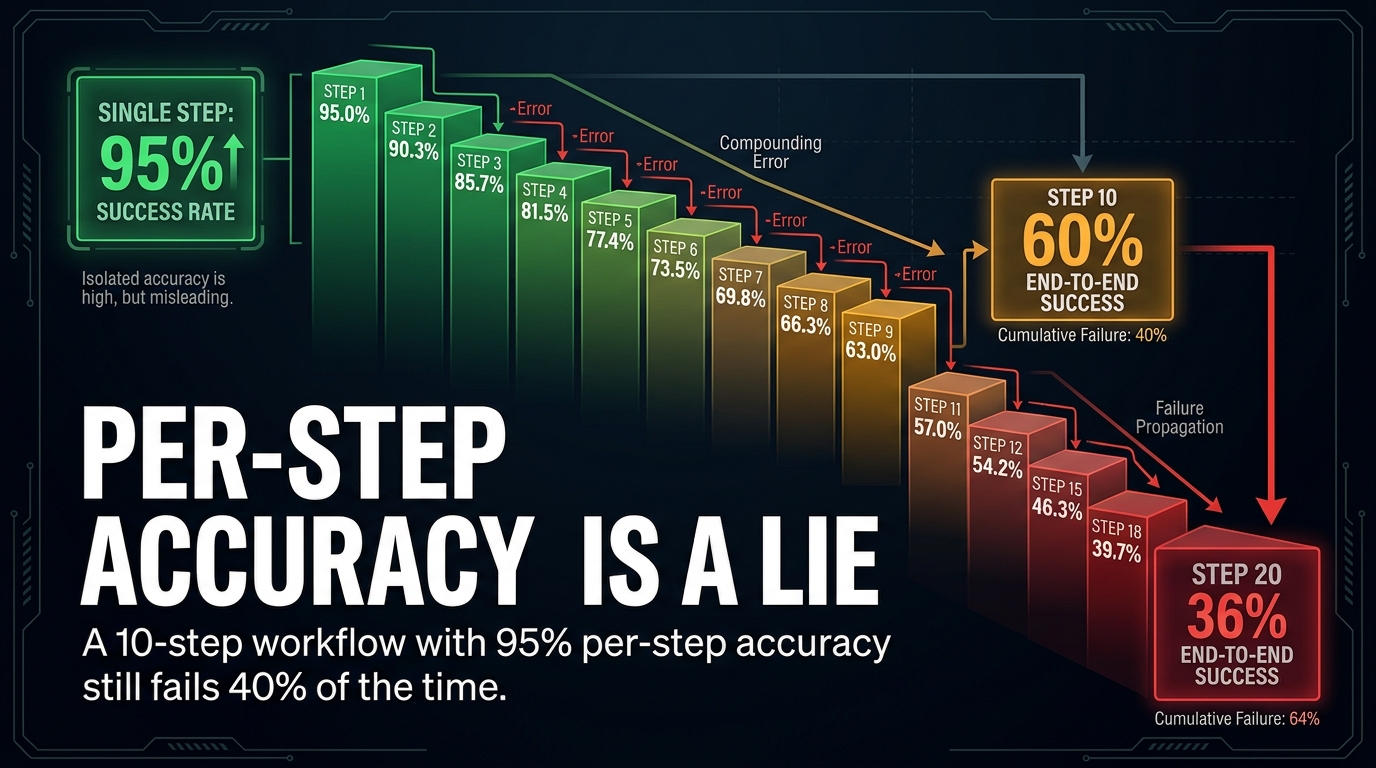
There is a specific kind of false confidence that gets teams into trouble early in agent deployment: the per-step benchmark. An agent correctly handles 92% of customer service queries in a test environment. It correctly classifies 95% of incoming documents in a pilot run. These numbers feel solid, and when the workflow is simple, they are. But when the workflow has multiple steps that depend on each other, per-step accuracy stops being a meaningful predictor of production success.
The math is unforgiving. In a sequential workflow where each step depends on the output of the previous one, end-to-end success probability is approximately the product of all per-step success rates. A 10-step workflow where each step succeeds 95% of the time has an end-to-end success rate of roughly 60%. Extend that to 20 steps and you are looking at around 36% — well under half — even though each individual step looks nearly perfect in isolation.
Real-world production data confirms this pattern. Depending on task complexity and how success is defined, multi-step agent workflow failure rates in production range from approximately 41% to 87%. One recent benchmark tracking first-attempt success on real-world multi-step tasks found only about 24% of runs succeeding without any human correction or retry.
How Errors Actually Compound
The compounding problem is worse than the multiplicative math suggests, for one important reason: errors in step three are not independent of errors in step seven. When an agent misclassifies a document at step three of a 10-step workflow, it does not just fail step three — it passes a corrupted context forward to steps four through ten. Downstream steps then reason from a flawed starting point, which means subsequent errors are not random but directional. They cluster around the original failure and amplify it.
This is why production debugging of multi-step agent failures is so difficult. The failure that surfaces at step eight was often caused by a decision at step two, and tracing that causation requires end-to-end visibility that most teams have not built yet.
What This Means for Workflow Design
The design implication is that longer workflows need more intervention points, not more model confidence. Specifically:
- Break long workflows at natural decision boundaries where a human or an automated validator can inspect the state before proceeding.
- Treat step outputs as typed contracts — if step three must produce a structured object with specific fields, validate that schema before step four receives it. Do not let malformed outputs propagate silently.
- Track cumulative confidence, not just per-step confidence. If the agent’s confidence degrades progressively across steps, that is a signal to pause and route to a human reviewer, even if no individual step has failed outright.
- Design for partial success. Define what a valid partial outcome looks like so that a failure at step seven does not erase the verified work from steps one through six.
Understanding compounding errors also reframes the question teams should be asking about their workflows. Instead of “how accurate is our agent?”, the operative question becomes “how long is our workflow, and what is the error budget at each step?” Those are engineering questions, and they deserve engineering answers.
Process Mapping Before Automation: The Step That Gets Skipped Most Often
One of the clearest patterns in failed AI agent deployments is that the underlying process was never cleanly documented before the agent was built to run it. Teams pick a workflow that feels promising — invoice processing, sales follow-up, ticket triage — and start building the agent against a mental model of how the process works, rather than how it actually works when executed by humans on a Tuesday afternoon with a backlog of edge cases.
The result is an agent that handles the clean-path case well and encounters a wall of undocumented exception handling every time the real world shows up. Worse, because nobody mapped the exceptions before automation, there is no existing playbook for what the agent should do when they occur. It either halts, retries incorrectly, or — most dangerously — proceeds with a low-confidence output that looks like a high-confidence one.
What a Pre-Automation Process Map Should Actually Capture
A useful process map for AI agent workflow design is different from a standard business process document. It needs to capture the operational reality that makes automation design decisions possible:
- Trigger conditions: What initiates this workflow? Are there multiple triggers? Can they overlap or race?
- Inputs and their variability: What formats, sources, and quality levels do inputs actually arrive in? Where do inputs sometimes fail to arrive at all?
- Decision points with their real criteria: Where in the workflow does a human currently make a judgment call? What information do they use? How often do they override the “standard” path?
- Exception paths and their frequency: Which edge cases come up weekly versus once a quarter? Who handles them now, and what authority do they need?
- Downstream effects: Which systems does this workflow write to, update, or notify? What breaks if those writes happen twice, or in the wrong order?
- Success criteria: How does a human operator currently know the workflow completed correctly? Is there an audit step? A recipient confirmation?
This kind of pre-automation mapping serves two functions simultaneously. First, it surfaces the design requirements for your agent — what it needs to handle, where it needs to pause, and how it needs to communicate its state. Second, it surfaces processes that are themselves broken or poorly documented, which is the more common finding than most teams expect.
Automating a Broken Process Is a Force Multiplier for the Wrong Outcomes
The industry has accumulated a consistent lesson about this: agents that automate undocumented or dysfunctional processes do not fix those processes — they accelerate whatever dysfunction existed. A billing workflow with ambiguous approval logic becomes a billing workflow with fast, autonomous ambiguous approval logic. A customer escalation process with unclear ownership becomes an agent that escalates to the wrong queue at 10x the previous volume.
The discipline of mapping first and automating second is not bureaucratic delay. It is the step that determines whether the automation delivers value or amplifies problems. Budget time for it explicitly. Treat it as an engineering deliverable, not a pre-project overhead to minimise.
Scoping Agent Permissions: Thinking About Blast Radius From Day One
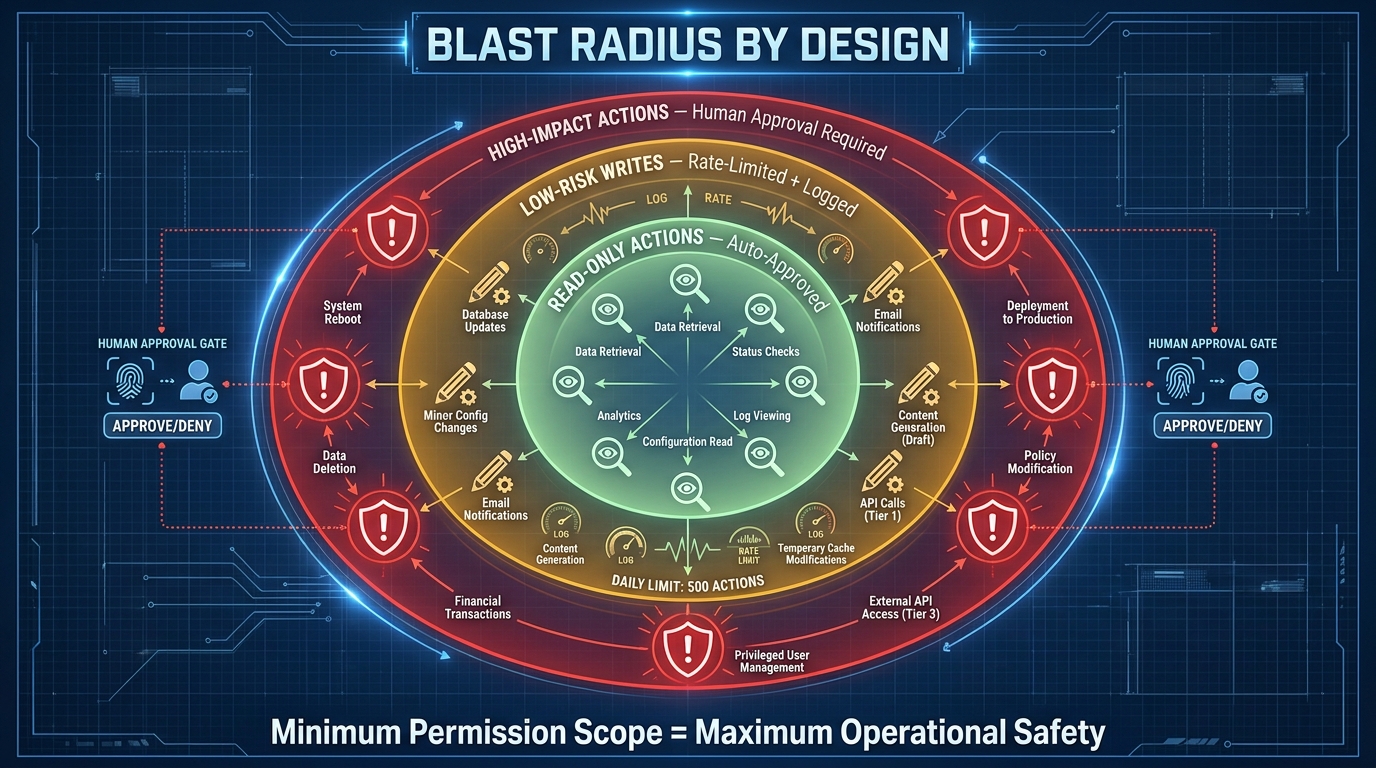
Blast radius is a term borrowed from incident response engineering, and it translates directly to AI agent design. In the context of an agent workflow, blast radius refers to the maximum damage that can result from a failure, a misdirected action, or a compromised workflow run. Controlling blast radius is one of the most concrete things you can do to make an agent system safe to operate — and it is determined almost entirely by permission design, not by model prompting.
This distinction matters. Many teams attempt to constrain agent behaviour through prompting: “Only take the following actions,” “Do not modify records without explicit confirmation,” “Limit yourself to read operations unless instructed otherwise.” These constraints work in demos. In production, they are fragile. A sufficiently unusual input, a prompt injection in retrieved content, or a context window that has drifted from its original framing can cause a well-prompted agent to take actions it was instructed to avoid. The prompt is a soft constraint. Permissions are a hard one.
The Three-Zone Permission Model
A practical approach to blast radius control is to classify every tool or action available to an agent into one of three zones based on reversibility and scope of impact:
Zone 1 — Read-Only, Auto-Approved: Actions that observe state without modifying it. These can be executed freely, rate-limited for cost control, and logged for audit purposes. Examples: reading records from a CRM, querying a database, fetching a document from storage, calling a read API endpoint.
Zone 2 — Bounded Writes, Rate-Limited: Actions that modify state in ways that are reversible or limited in scope. These can be executed without per-action human approval but should be logged with full payloads, rate-limited to prevent runaway execution, and subject to automated validation before dispatch. Examples: updating a CRM field, sending an internal notification, creating a draft record, adding a comment to a ticket.
Zone 3 — High-Impact, Human-Gated: Actions that are irreversible, have broad system scope, or carry financial or legal consequences. These require explicit human approval at execution time, with the full proposed payload surfaced for review. Examples: sending external customer communications, executing financial transactions, modifying production configuration, deleting or archiving records, provisioning access.
Credentials Are Where This Lives or Dies
Permission zoning is only effective if it is enforced at the credential and tool layer — not just at the application layer. This means assigning agents task-scoped, short-lived credentials that only cover the tools and operations they genuinely need for the specific workflow run. Just-in-time credential provisioning, with automatic revocation after the task completes, is the model that keeps blast radius tightly bounded even when something goes wrong inside the workflow itself.
The engineering cost of implementing this correctly is real. But it is consistently cheaper than the cost of a runaway agent with broad permissions reaching systems it should not have touched. The worst-case scenario for a permission-scoped agent is contained. The worst-case scenario for an over-permissioned one is not.
Idempotency, Rollback, and the Controls That Actually Contain Damage
In distributed systems engineering, idempotency is the property that makes an operation safe to execute multiple times without producing different results after the first execution. An idempotent write that runs three times has the same outcome as one that runs once. This property is fundamental to building reliable systems, and it is equally fundamental to building reliable AI agent workflows — yet it is skipped far more often in agent design than in traditional software engineering.
The reason idempotency matters so much in agent contexts is that agents retry. They retry because they operate in environments with transient failures — network timeouts, rate limit responses, temporary unavailability of downstream services. In a well-designed system, retrying a failed step is safe because the underlying operations are idempotent: they detect whether the intended effect has already occurred and skip re-execution if it has. In a poorly designed system, retrying sends the email three times, charges the customer twice, or creates three copies of the same record.
Designing for Idempotency in Agent Workflows
Idempotency in agent workflows requires intention at the design level, not just at the implementation level. The practical checklist:
- Assign idempotency keys to every mutating action at workflow design time. The key should be bound to the business intent (this specific order confirmation for this specific order), not to the execution attempt or prompt text.
- Before executing any mutating action, check whether the intended effect has already been applied. This check should happen at execution time, not just at planning time — because state can change between when the agent plans and when it executes.
- Design tool interfaces to accept and honour idempotency keys. If you are integrating with external APIs that support idempotency headers, use them. If you are building internal tools for the agent, build idempotency in from the API contract level.
- Log the outcome of every mutating action with enough detail to verify effect. A receipt log is what makes post-failure investigation possible.
Rollback and Compensation Paths
True rollback — undoing an action as if it never happened — is only possible for some types of operations. Deleting a draft is reversible. Sending an email is not. Designing for operational safety means being explicit about which actions in your workflow are reversible and which are not, and building compensation paths for the ones that cannot be undone.
A compensation path is a defined sequence of actions that bring the system to a consistent state after an irreversible step has produced an unintended outcome. It might be sending a follow-up correction email, issuing a credit, or creating a high-priority human review ticket. The key design principle is that compensation paths must be defined before deployment — not improvised after an incident. If you are building a workflow where step four sends an external communication, you need a defined answer to “what happens if step five fails after step four has already executed?” before that workflow goes live.
Approval Gates: Where to Put Them, How to Build Them Right, and When to Remove Them
Approval gates are the most visible form of human oversight in AI agent workflows, and they are also the most commonly misimplemented. The failure mode is not building too many gates — it is building gates that do not actually give the approver enough information to make a meaningful decision. A gate that asks “approve this action: yes/no” without surfacing the full context of what the action is, why it was proposed, and what effect it will have is not a control — it is a formality that adds latency without adding safety.
What Makes an Approval Gate Meaningful
A well-designed approval gate surfaces four things to the approver:
- The full proposed payload — not a summary, the exact data or action the agent intends to execute. For a customer email, that means the complete email text. For a database update, that means the specific fields and values. Abstractions at the approval stage are a recipe for rubber-stamping.
- The reason the agent proposed this action — a brief, human-readable explanation of the reasoning or trigger that led to this proposal. This lets the approver evaluate whether the agent’s logic was sound, not just whether the output looks acceptable.
- The consequence of approval and the consequence of rejection — what happens downstream if the action proceeds, and what happens if it does not. Without this, approvers cannot assess the trade-off they are making.
- The confidence level of the proposing agent — particularly for classification or reasoning tasks. High-confidence, well-supported proposals should feel different from low-confidence ones that are flagging themselves for human review.
Where Gates Actually Belong in the Workflow
The principle for gate placement is risk and reversibility, not workflow position. Gates should appear immediately before:
- Any Zone 3 action (external communications, financial operations, access changes, irreversible modifications)
- Any action the agent flagged as low-confidence or outside its training distribution
- Any action that triggers downstream automation — because a gate here catches errors before they propagate
- The first execution of a new action type in production (new tool, new API, new write target)
When to Remove Gates
Gates are also not permanent fixtures. As a workflow accumulates a track record — known error rate, known edge case distribution, known approval patterns — some gates can be safely moved to exception-only triggers. The signal for gate removal is not time in production but quality of track record: a workflow that has processed 500 instances with 99% straight-through approval and zero adverse incidents is a workflow where the gate is adding friction without adding meaningful safety.
Track this data. Build approval rate metrics into your observability stack. Use them to have evidence-based conversations about when gates can be loosened, rather than defaulting to either “gates forever” or “gates never.”
Observability as a Control Plane, Not Just a Dashboard
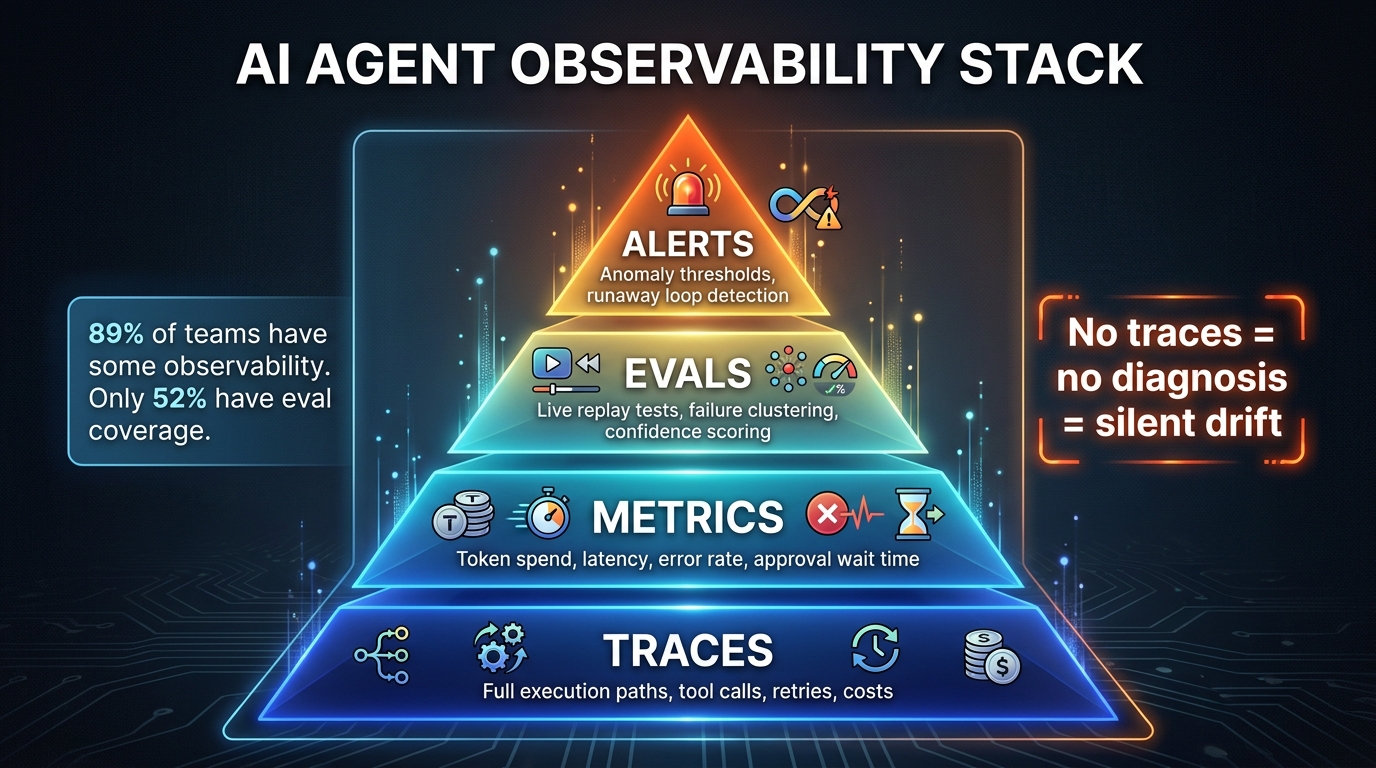
As of 2026, approximately 57% of engineering teams are running AI agents in production, and roughly 89% of those teams have implemented some form of observability. But only about 52% have meaningful eval coverage — the ability to replay and assess agent runs, cluster failure types, and identify patterns across production incidents rather than diagnosing them one by one.
That gap between observability and eval maturity is significant. Observability without eval gives you visibility into symptoms. Eval gives you the ability to understand causes — and to proactively catch degradation before it manifests as a customer-facing incident.
The Four Layers of Agent Observability
Effective AI agent observability is not a single dashboard. It is a stack with four distinct layers, each serving a different operational function:
Layer 1 — Traces: Full execution paths for every agent run, capturing model calls, tool calls, retrieval events, retries, approval gate events, and their associated payloads, durations, and outcomes. Traces are what make post-incident debugging possible. Without them, you are guessing at causation from outcome logs.
Layer 2 — Metrics: Aggregate signals computed from trace data — token spend per workflow run, end-to-end latency distributions, per-step error rates, approval gate approval/rejection rates, and retry frequency. Metrics are what detect drift over time: if the per-step error rate for a tool call has moved from 3% to 9% over two weeks, that is a signal you need to catch before it becomes a 20% rate that breaks the workflow.
Layer 3 — Evals: Replay-based assessment of agent runs against defined quality criteria. This means taking real production traces and running them through an evaluation harness that asks whether the agent’s reasoning, tool choices, and outputs met the intended standard. Evals applied to production data — not just offline benchmarks — are what build the feedback loop from deployment back into workflow improvement.
Layer 4 — Alerts: Real-time anomaly detection for runaway conditions: infinite retry loops detected by step-count thresholds, token budget overruns, latency spikes past defined SLAs, and error rate increases above baseline. Alerts are what prevent minor operational problems from becoming major incidents.
Traces as the Foundation of Trust
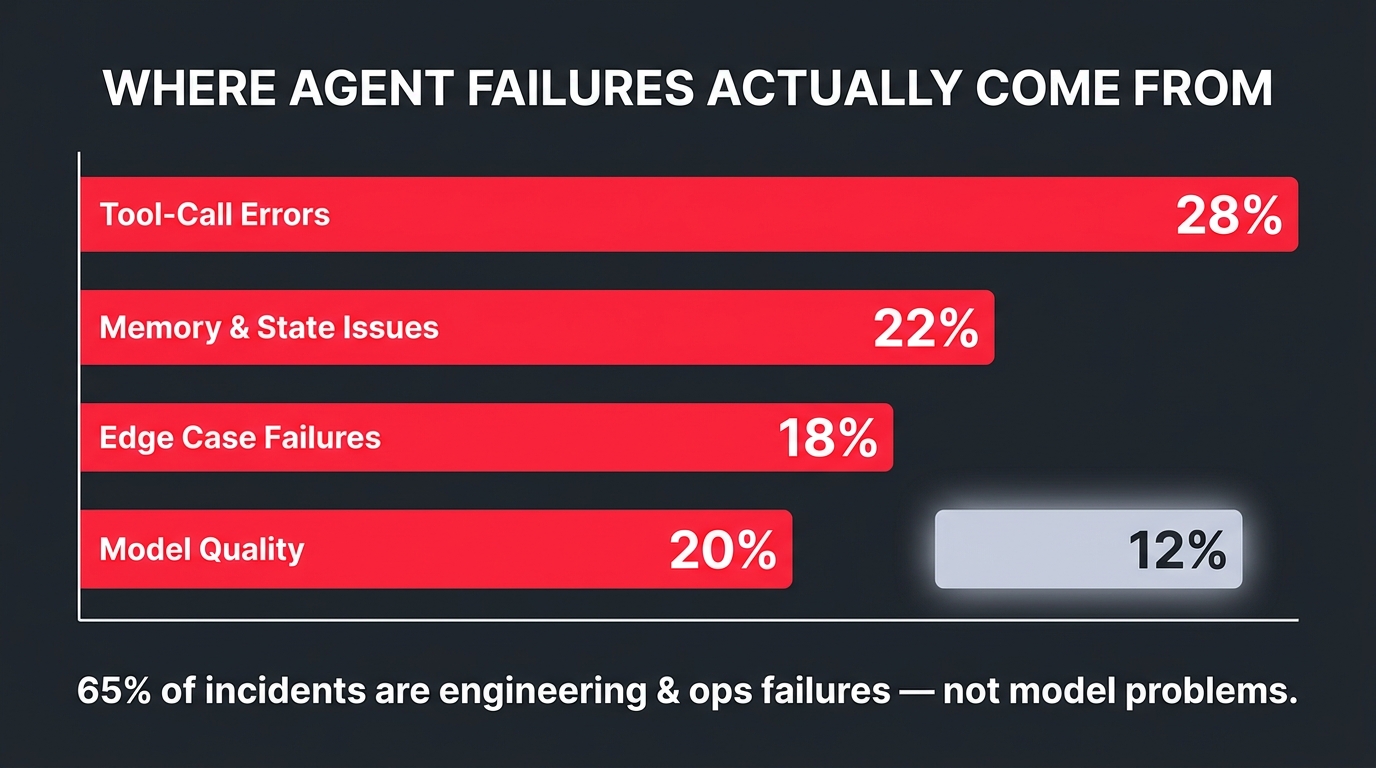
Production data on the breakdown of agent failures is instructive here. The underlying LLM accounts for only about 35% of production incidents in enterprise AI agent systems. The remaining 65% come from engineering and observability gaps — broken integrations, state management failures, retry logic errors, and timeout misconfigurations that would have been caught earlier with better tracing.
The practical implication: if your organisation cannot explain, from trace data, exactly what an agent did during a given run — every tool call, every retry, every state transition — you do not yet have operational control of that agent. You have deployed it, but you are not running it. That distinction matters when something goes wrong, and in production, something eventually does.
OpenTelemetry as the Emerging Standard
The observability tooling landscape for AI agents is consolidating around OpenTelemetry-based instrumentation with extensions for GenAI telemetry. Standardising on this approach — rather than proprietary logging schemes — means that trace data is portable across tools, correlatable with infrastructure-level traces, and usable with the growing ecosystem of agent observability platforms. If you are building agent observability infrastructure now, building on OpenTelemetry is the decision that will age best.
Shadow Mode Testing: The Deployment Phase Most Teams Skip
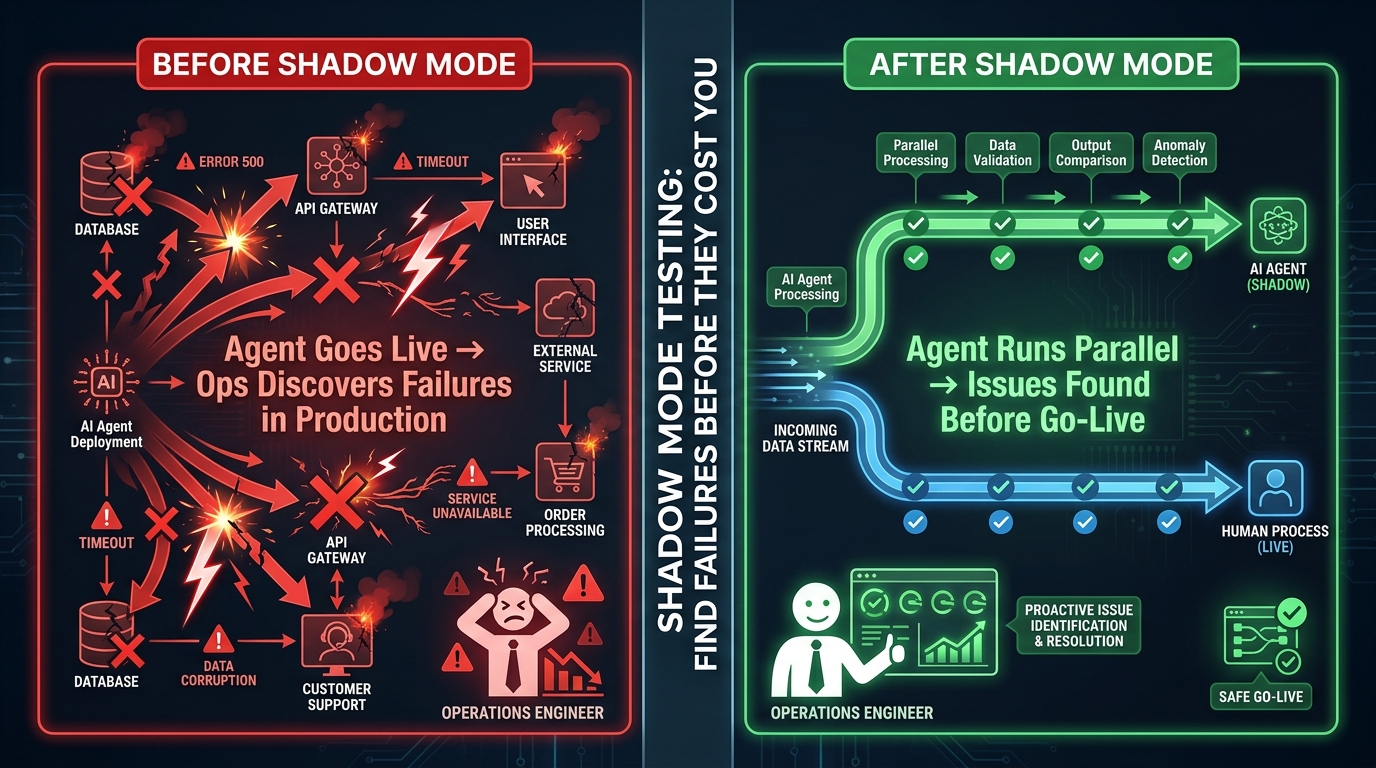
Shadow mode testing is the practice of running an AI agent through a real workflow against real production data — but without allowing it to execute any actions that have real-world effects. The agent observes, plans, and proposes; humans continue to execute; and the comparison between what the agent proposed and what the human did becomes the primary evaluation signal.
This testing phase generates something that synthetic test suites fundamentally cannot: a realistic distribution of the inputs, edge cases, timing patterns, and system states that the agent will actually encounter when it goes live. It also generates this data without exposing the organisation to the risk of the agent acting incorrectly on a live system.
What Shadow Mode Reveals That Testing Does Not
Shadow mode testing consistently surfaces several categories of issues that pre-production testing misses:
- Input format variability in production data. Real inputs from real users and systems are messier, more variable, and more ambiguous than test cases. Shadow mode reveals the specific input patterns that the agent handles poorly before they become live failures.
- Edge case frequency in the actual workload. An edge case that appears 0.3% of the time in production is invisible in a test suite of 50 cases. At 10,000 daily transactions, that 0.3% is 30 failures per day. Shadow mode gives you the real frequency distribution, not the assumed one.
- Latency behaviour under real system load. Integration partners that respond quickly in off-peak test environments may behave differently during production load windows. Shadow mode captures realistic timing behaviour.
- Approval gate calibration. Shadow mode lets you observe how often the agent would have triggered each approval gate, which helps calibrate whether gates are positioned correctly before real approvers have to work with them.
Running Shadow Mode as an Engineering Discipline
Shadow mode is most useful when it is structured as a formal comparison exercise. This means:
- Defining in advance what metrics you will compare (agent proposal vs. human action: match rate, divergence categories, divergence severity)
- Running a sufficient volume of transactions to capture the realistic edge case distribution (this is often 2-4 weeks at real production volumes, not a few hundred synthetic runs)
- Reviewing divergences in daily or weekly sessions where both AI team members and ops team members are present — this is where the operational perspective most often catches issues that engineering review alone would miss
- Documenting a clear go/no-go criteria before shadow mode begins, so the decision to proceed to live execution is data-driven rather than optimism-driven
The ops team involvement in shadow mode review is not incidental. It is the part that builds operational confidence. When ops team members have reviewed hundreds of real agent proposals alongside what they would have done themselves, they have evidence to assess the agent’s reliability. That evidence-based confidence is qualitatively different from assurance and far more durable in production.
The Thin-Agent, Thick-Guardrails Principle
The most resilient AI agent workflows in production in 2026 share a structural characteristic that runs counter to the intuition most teams have when they first start building with agentic systems. They give the model less autonomy, not more. They constrain the agent’s action space, scope its tool access, and enforce its output format through mechanisms outside the model. The model’s job is to reason within a well-defined envelope. The system’s job is to enforce that envelope reliably.
Anthropic’s engineering team describes this distinction clearly in their production guidance: workflows — systems where LLMs and tools are orchestrated through predefined code paths — offer predictability and consistency that open-ended autonomous agents cannot match for production use cases. The industry phrase that has emerged to describe the pattern is thin-agent, thick-guardrails: the agent’s sphere of autonomous action is deliberately narrow, while the structural controls surrounding it are deliberately robust.
What Thin-Agent Design Actually Looks Like
Thin-agent design does not mean the agent is less capable. It means the agent’s capabilities are focused and the boundaries of its decision space are explicit. In practice:
- Each agent does one thing well. A classification agent classifies. A draft-generation agent generates drafts. A routing agent routes. Combining multiple responsibilities into a single agent increases the complexity of its decision space and expands the range of possible failure modes.
- Tools are single-purpose and precisely scoped. Rather than giving an agent a general-purpose “database access” tool, give it a specific “get open invoices for customer X” tool. The schema is explicit. The scope is bounded. The agent cannot accidentally query a table it was not intended to touch.
- Outputs are structured contracts, not free-form text. If an agent’s output feeds a downstream system, that output should conform to a validated schema — not be parsed from natural language. Structured outputs make integration deterministic and make validation tractable.
- Planning is separated from execution. In high-stakes workflows, the agent plans the full sequence of actions it intends to take before executing any of them. The plan is reviewed — automatically or by a human — before execution begins. This prevents the agent from taking an early action that forecloses options it should have kept open.
Thick Guardrails at the System Level
The “thick guardrails” half of the principle refers to controls that live outside the model’s context: permission enforcement at the tool layer, schema validation at every interface, rate limits and step count ceilings to prevent runaway execution, timeout enforcement, and policy checks that run at execution time rather than only at planning time. These are not backup plans for when prompting fails. They are the primary safety mechanism, and they are implemented in deterministic code where their behaviour is predictable and testable.
The design heuristic to remember: anything you would trust a prompt to enforce, ask yourself whether you would trust a prompt under adversarial conditions, or under unusual inputs, or after the context window has been partially overwritten by retrieved content. If the answer is no — and for production safety controls, the answer is usually no — enforce it outside the model instead.
Multi-Agent Orchestration Without Creating a Coordinator Bottleneck
Multi-agent architectures introduce a class of operational problem that does not exist in single-agent systems: coordination failure. When multiple agents work together on a shared task — one doing research, one generating content, one validating output, one routing the result — the handoffs between them become failure surfaces in their own right. A single-agent workflow has one execution path to trace. A multi-agent workflow has as many execution paths as there are handoff permutations between agents, and failures in one can propagate to all downstream agents in ways that are difficult to anticipate.
The data on this is sobering: approximately 40% of multi-agent pilots fail within their first six months, with coordination failure as the leading cause. The coordinator — the orchestrator agent that decomposes tasks and delegates to sub-agents — frequently becomes the system’s bottleneck, especially when task decomposition is imprecise or when the coordinator must wait for sequential completions before proceeding.
Designing Orchestration That Distributes Rather Than Concentrates Risk
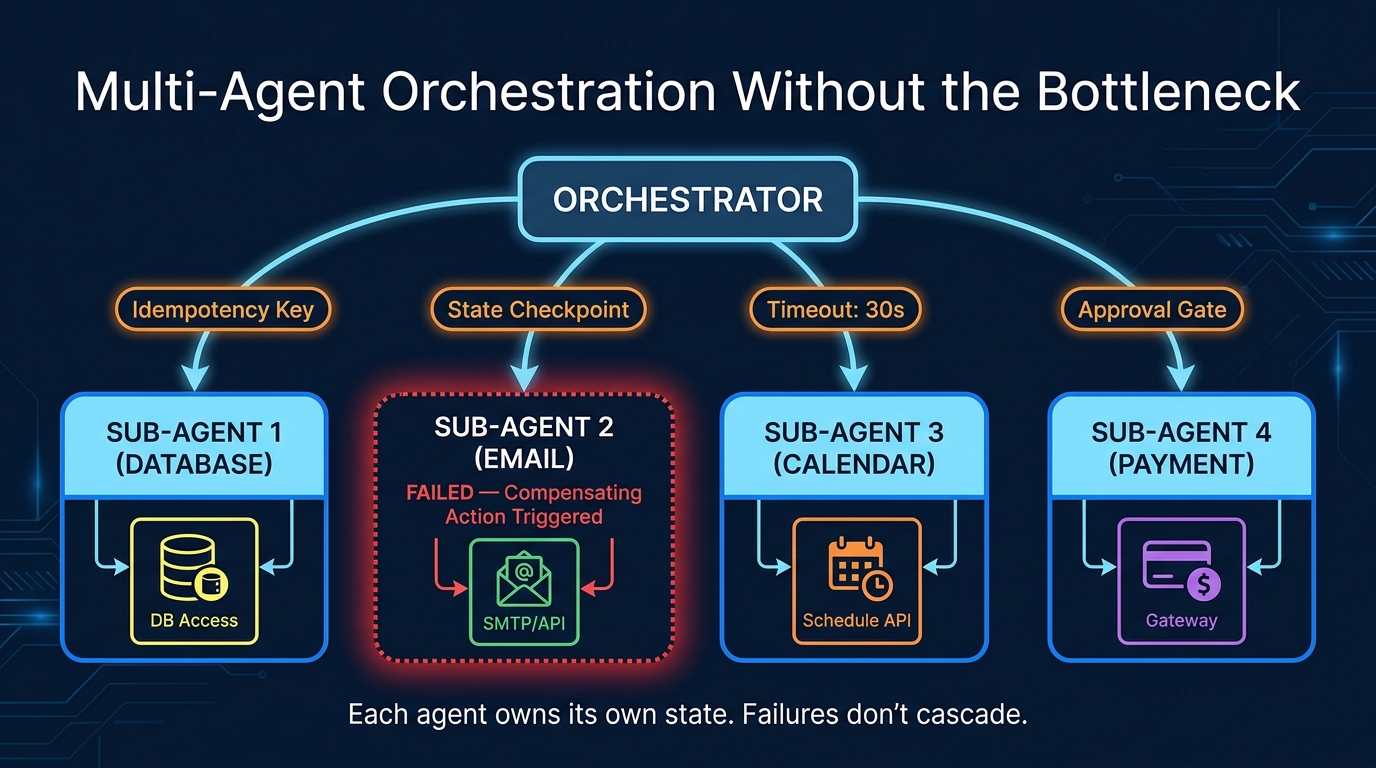
The principle for resilient multi-agent orchestration is that each agent should own its own state. Failures in one sub-agent should not corrupt the state of other sub-agents or require the entire workflow to restart. In practice, this means:
Explicit handoff schemas. When agent A passes work to agent B, it should do so through a validated, typed interface — not by passing its raw output as a string for agent B to interpret. The handoff schema is a contract, and contracts make failures localised and debuggable.
State checkpoints between agents. After each agent completes its contribution, that output should be persisted to durable state before the next agent begins. This allows the workflow to resume from the last verified checkpoint if a downstream agent fails, rather than restarting from the beginning.
Independent timeouts per agent. If sub-agent B stalls — stuck in a reasoning loop, waiting on a slow API, or encountering an unhandled edge case — the orchestrator should be able to time it out, apply a fallback, and proceed without waiting indefinitely. A stalled sub-agent should not stall the entire workflow.
Asynchronous delegation for independent tasks. When sub-agents can work in parallel — their tasks do not depend on each other’s outputs — they should do so. Sequential execution of inherently parallel tasks is a common source of unnecessary latency that makes multi-agent workflows feel slow compared to human execution.
When Not to Use Multi-Agent Architectures
Anthropic’s engineering guidance is explicit on this point: many applications that appear to require multi-agent coordination can be handled more reliably by optimising a single well-structured LLM call with appropriate retrieval and tool access. Multi-agent architectures add value when the task genuinely exceeds a single agent’s context window or when parallel execution of independent sub-tasks materially reduces end-to-end latency. They add complexity and failure surface in every case.
If your workflow can be completed by a single bounded agent with well-scoped tools, build it that way first. Add agents only when you have a specific, demonstrated need that the single-agent architecture cannot address — not because a more complex architecture feels more impressive or more “agentic.”
Failure by Design: Building Runbooks Before You Need Them
The final design discipline that separates ops-safe agent workflows from fragile ones is treating failures as first-class design artifacts rather than edge cases to handle later. Every production workflow will eventually encounter a failure condition it was not explicitly designed for. The question is not whether that happens — it is whether the failure produces a recoverable, diagnosable state or an ambiguous, potentially damaging one.
Runbooks — documented response procedures for known failure modes — are the mechanism that makes failures recoverable by humans who did not build the system. In AI agent workflows, the most important runbook scenarios to define before deployment are:
- Silent stall: The workflow has stopped progressing but has not thrown an error. What triggers detection? Who is notified? What manual intervention is available?
- Retry exhaustion: The agent has retried a step the maximum allowed number of times without success. What is the fallback? Is there a human escalation path? Is partial workflow state preserved?
- Approval timeout: A gate requiring human approval has been waiting beyond an acceptable window. Does it auto-reject? Auto-escalate? Hold indefinitely? What is the business impact of each option?
- Context drift: The agent’s outputs have changed character in a way that suggests its effective context has shifted — possibly due to retrieved content, a prompt injection, or a model update. What monitoring detects this? What is the safe response?
- Integration degradation: A downstream system is returning errors or slow responses. Can the workflow degrade gracefully — completing what it can and flagging what it could not? Or does a dependency failure cause total workflow failure?
Runbooks are also ops team onboarding documents. When an unfamiliar operator is paged at 2 a.m. about a stalled agent workflow, the runbook is what makes that a manageable situation rather than a crisis. Writing them before deployment is not pessimism — it is the design discipline that makes production ownership actually workable.
Measuring Operational Confidence: The Metric That Actually Determines Scale
There is a final framing shift that matters enormously for teams trying to move AI agent workflows from pilot to durable production deployment. Most teams measure deployment success by task completion rate, accuracy scores, or time-to-completion metrics. These are important, but they measure model performance, not operational readiness.
The metric that actually determines whether a workflow scales — whether ops teams will trust it with higher volumes, more critical processes, and broader system access — is operational confidence. And operational confidence is a different measurement entirely.
What Operational Confidence Actually Measures
Operational confidence is the aggregate of several operational-quality signals that together determine whether the people responsible for running the system believe it is safe to extend:
- Explainability rate: What percentage of recent workflow runs can be fully explained from trace data — every decision, every tool call, every state transition — without requiring the agent to be re-run or the original developer to reconstruct what happened?
- Failure-to-safe rate: When the workflow fails, what percentage of failures result in a safe, clearly-defined state (stalled at a checkpoint, escalated to a human, compensation action taken) versus an ambiguous or corrupted state?
- Gate approval turnaround time: How long does a human approval gate typically wait before being actioned? Excessively long wait times signal that gates are positioned in ways that create bottlenecks for operators.
- Ops team incident escalation rate: How often does the ops team have to escalate agent-related incidents to the AI team or engineering for diagnosis? A high escalation rate means the workflow is not yet maintainable by its operators.
- Straight-through processing trend: Is the percentage of runs completing without human intervention stable or improving over time? Degradation in this metric is often the first signal of model drift, integration decay, or input distribution shift.
Building Operational Confidence Deliberately
Operational confidence is not something that accumulates passively with time in production. It is built deliberately through the design choices described throughout this article: process mapping before automation, permission scoping, idempotency and rollback, meaningful approval gates, layered observability, shadow mode testing, thin-agent architecture, resilient orchestration, and runbook preparation. Each of these is a direct investment in the operational confidence metric.
Teams that skip these steps and move directly to production deployment often find that confidence moves in the opposite direction — eroding as incidents accumulate and as ops teams develop an experience-based expectation that the agent will be the source of unusual and difficult-to-diagnose problems. Rebuilding eroded trust is significantly harder than building it correctly the first time.
The organisations running AI agent workflows at real scale in 2026 are not the ones with the most sophisticated models or the most ambitious automation roadmaps. They are the ones whose ops teams can answer yes to the question: “Do you trust this workflow to run tomorrow without you watching it?” Getting to yes on that question is the actual job of AI workflow design. Everything else is a step toward it.
Conclusion: The Engineering Mindset That Makes Agents Production-Ready
The central lesson from two years of enterprise AI agent deployment at scale is that the hard problem is not building an agent that can do a task. It is building a workflow around the agent that a real organisation can operate, debug, audit, scale, and trust. Those are distributed systems engineering problems and change management problems far more than they are AI problems, and they require the disciplined design practices of both domains.
The teams making durable progress are the ones who treat each of the following as non-negotiable:
- Map the process before you automate it. Understand the real workflow — exceptions, edge cases, decision criteria, and downstream effects — before you build an agent to run it.
- Scope permissions at the tool and credential layer. Blast radius is determined by what the agent can reach, not by what you told it to do. Keep that radius small by design.
- Build idempotency in from the start. Every mutating action needs an idempotency key and a pre-execution state check. This is not optional for production systems.
- Design meaningful approval gates. Gates that surface context and reasoning are controls. Gates that just ask for a yes or no are theatre. Build controls.
- Instrument everything. Traces, metrics, evals, and alerts are not overhead — they are the mechanism by which you discover what is actually happening in production versus what you believe is happening.
- Shadow mode before live execution. Use real production data volumes and involve ops team members in the review. That shared evidence is what builds operational confidence.
- Keep agents thin and guardrails thick. Narrow scope, structured outputs, and system-level enforcement outperform broad autonomy and prompt-level constraints in every production environment.
- Write runbooks before you need them. Define the failure modes, the safe states, and the response procedures for each one before the workflow goes live.
None of these are exotic practices. They are the standard engineering disciplines of building reliable systems, applied to a new kind of component — an LLM-powered agent operating in a real production environment. The teams that apply them systematically are the ones whose agent workflows are still running, improving, and expanding in scope six months after deployment. The ones that skip them are the ones filing incident reports and wondering why their pilot never quite made it to production scale.
Build for the ops team, not just for the demo. That is the design choice that makes the difference.