


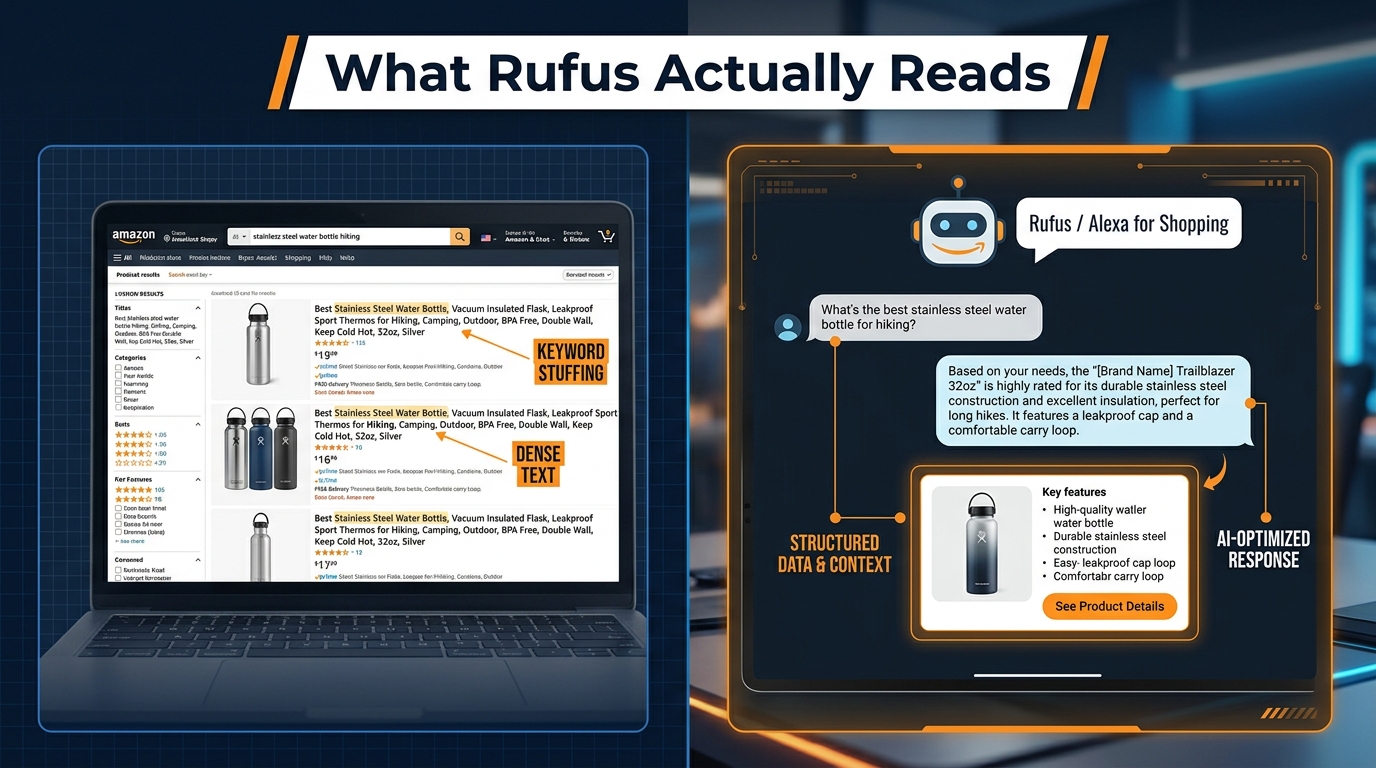

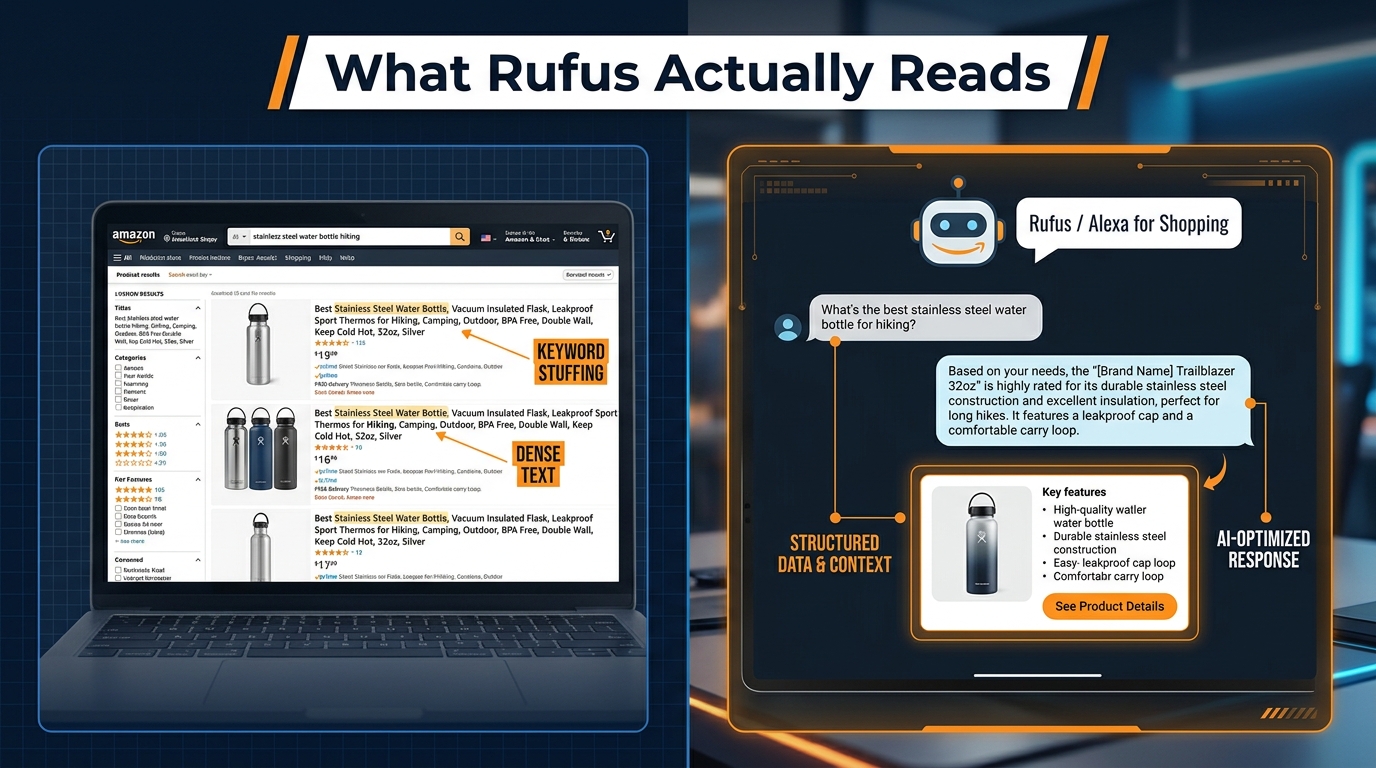
On May 13, 2026, Amazon quietly retired the Rufus brand name and rolled the AI shopping assistant into what is now called Alexa for Shopping. The interface changed. The name changed. The underlying machine did not.
Everything that sellers spent the past year learning about optimizing for Rufus still applies — and in some respects, it matters more than ever, because Alexa for Shopping has a wider surface area, deeper integration with Amazon’s mobile app, desktop, and Echo Show devices, and a growing share of first-touch product discovery that is pulling traffic away from traditional keyword search.
This article is not about surface-level tips like “add more natural language to your bullets.” It’s about understanding what the AI is technically doing when it processes your listing, why certain content elements function as ranking signals in an AI-mediated discovery environment when they never really did in keyword search, and how to audit and restructure your catalog to be genuinely readable by a system that is asking fundamentally different questions about your product than the old A9 algorithm ever did.
The sellers who are winning Rufus visibility right now are not the ones who wrote the most keywords. They are the ones whose listings best answer the questions that real shoppers are actually asking — in the form, depth, and structure that the AI can confidently extract, synthesize, and present. That is a very different optimization problem, and most Amazon catalogs are nowhere close to solving it.
Let’s get into the specifics.
From Search Engine to Conversation Engine — What Changed and Why It Matters
For roughly fifteen years, Amazon search worked on a variation of the same core premise: a shopper types keywords, the algorithm matches those keywords to product listings, and ranking is determined by a combination of relevance (how well your listing contains those terms) and performance (sales velocity, conversion rate, review score). The seller’s job was to put the right words in the right fields and then drive enough sales to build the velocity signals that kept you near the top.
Rufus — and by extension, Alexa for Shopping — is built on an entirely different premise. The shopper does not type keywords. They describe a problem, a situation, a comparison, or a need. “What’s a good gift for a ten-year-old who likes science?” “Which protein powder doesn’t taste chalky?” “I need running shoes that work on both trails and roads.” These are not keyword queries. They are requests for judgment.
The Scale of the Shift
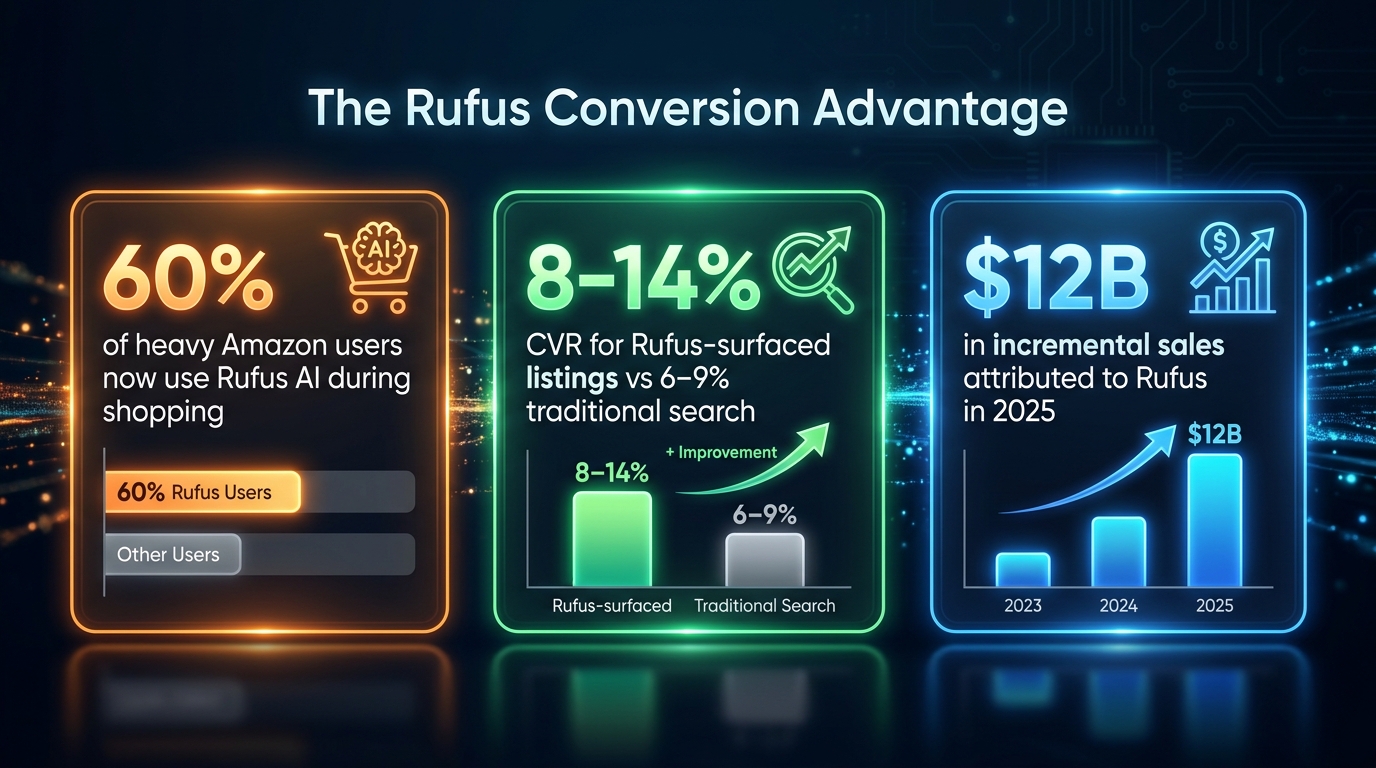
Velocity Sellers’ internal review of over 40 brands across Q1 2026 found that Rufus was mediating 15–20% of shopper queries on mobile, with that share growing every quarter. Among heavy Amazon users — the platform’s most valuable shoppers — 60% now use Rufus-style AI assistance during their shopping sessions, according to a Sensor Tower panel of 60,000 U.S. shoppers conducted across Black Friday 2025 through Q1 2026.
That is not a niche feature. That is a meaningful and rapidly expanding fraction of your most purchase-ready audience making buying decisions through a discovery surface that your listing optimization has almost certainly not been built for.
Why This Breaks Old SEO Logic
In a keyword-match world, your listing could be functionally unintelligible as long as it contained the right strings of text. A title reading “Stainless Steel Water Bottle 32oz BPA Free Leak Proof Insulated Tumbler Flask Hydration” was a perfectly rational optimization choice — it contained every plausible search term a buyer might use.
Rufus cannot use that listing effectively. It doesn’t search for strings — it tries to understand what your product is, who it’s for, what problems it solves, and whether it’s trustworthy enough to recommend. A keyword-stuffed title gives it almost no useful information for any of those tasks. In fact, it actively obscures the semantic signals the AI needs to include your product in a relevant recommendation.
The conversation engine model requires listings that function as clear, factual, structured answers to the kinds of questions shoppers are likely to ask. That is the shift. Everything else in this article explains how to execute it.
How COSMO and Rufus Actually Read Your Listing
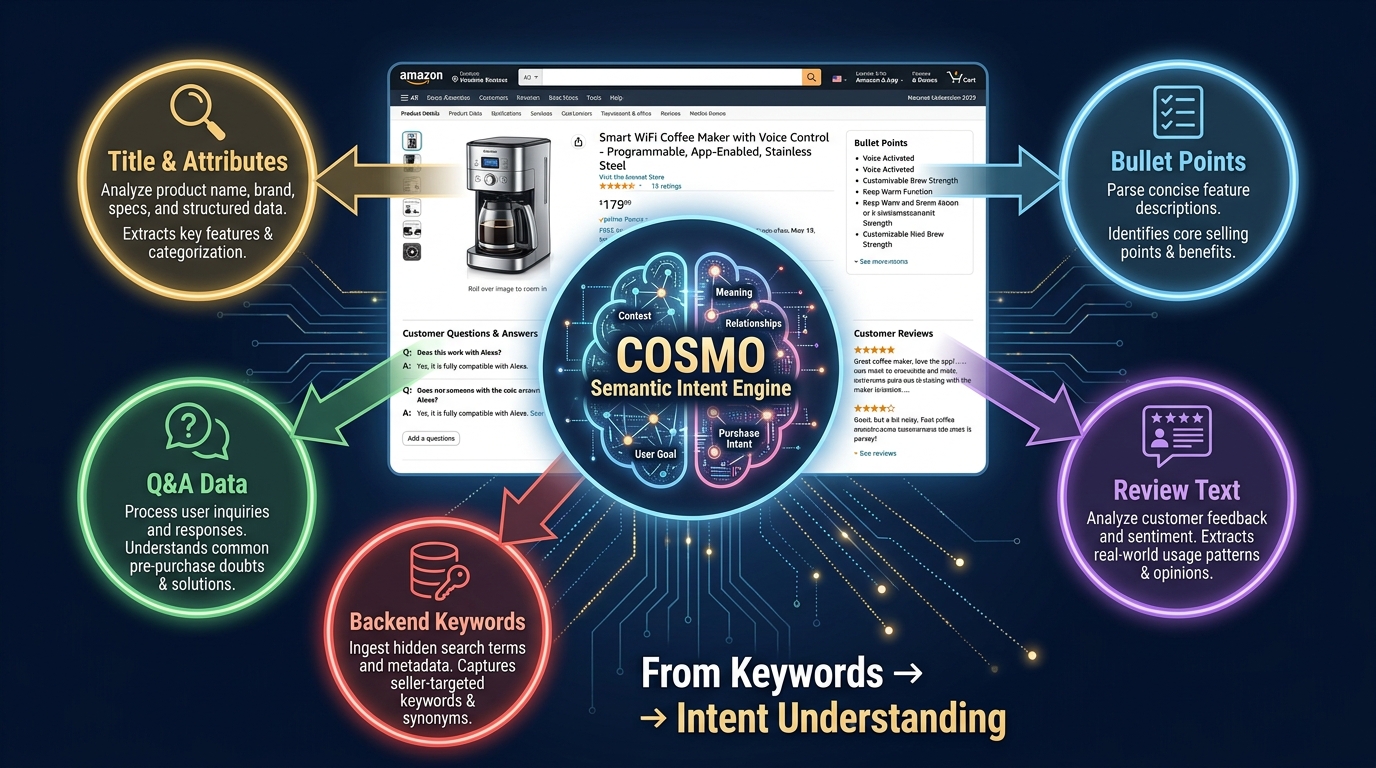
To understand what Rufus actually does with your listing, you need to understand the layer beneath it: a model called COSMO (Commonsense Shopping Model), which Amazon Science has described as an industry-scale knowledge graph that mines user-centric commonsense knowledge from large-scale shopping behavior and product data.
COSMO is the part of the system responsible for transforming raw catalog data — your title, bullets, description, attributes, reviews, Q&A — into a structured semantic understanding of what your product is and who it helps. Rufus is the conversational interface that uses COSMO’s output to answer shoppers’ questions. In simple terms: COSMO does the reading. Rufus does the talking.
What COSMO Is Looking For
COSMO does not scan for keywords. It attempts to build a knowledge representation of your product by answering a series of implicit questions:
- What is this product, precisely? (Category, type, material, form factor)
- Who is it designed for? (Age group, skill level, body type, lifestyle)
- What problem does it solve or what outcome does it enable? (Use case, pain point, goal)
- What are its verifiable specifications? (Dimensions, weight, capacity, compatibility)
- What do buyers who actually used it say? (Review sentiment, specific feature mentions)
- What constraints or limitations exist? (Not suitable for X, requires Y, incompatible with Z)
The more completely and clearly your listing answers each of these questions — across every available content field — the more richly COSMO can represent your product, and the more confidently Rufus can recommend it to a relevant query.
The Extraction Hierarchy
COSMO does not weight every listing element equally. Based on available Amazon Science documentation and practitioner analysis, the extraction hierarchy appears to run roughly in this order of AI readability: structured product attributes (backend), title, bullet points, product description/A+ content, Q&A, review text. This is not the same as the ranking weight order — it describes how cleanly the AI can extract reliable information from each field. Structured attributes are the easiest for the model to parse because they are already formatted as discrete data points. Free-form description text is richer but harder to reliably extract from.
Understanding this hierarchy explains why filling out backend attributes is not a nice-to-have in the Rufus era — it is a prerequisite for reliable AI readability of your core product facts.
The Five Signal Buckets Rufus Uses to Rank Products
Rufus ranking is not a single score. It appears to operate on a multi-factor system that combines content quality signals with behavioral and commercial signals. Based on current practitioner evidence and Amazon’s public documentation, these can be grouped into five distinct buckets:
1. Semantic Relevance
How well does the total content of your listing — across all fields — match the intent of the shopper’s query? This is not about exact keyword match. A shopper asking “what’s a good pan for a beginner home cook who doesn’t want to deal with seasoning” needs your listing to contain information about ease of use, low-maintenance surface, and suitability for casual cooking. If that information exists only in your reviews but not in your bullets or attributes, your semantic relevance score for that query is weaker than a competitor who has explicitly addressed those use cases in the listing itself.
2. Content Completeness
Rufus gives preferential weight to listings that have fewer gaps. A listing with 80% of backend attributes filled, no answered Q&A, a sparse description, and only three bullets is categorically harder for the AI to use than a listing with complete attributes, 20+ answered Q&A entries, rich bullets, and detailed A+ copy. Completeness is not about word count — it is about leaving no answerable question about your product unanswered in the listing.
3. Behavioral and Sales Signals
COSMO is trained on behavioral data, which means products with strong click-through rates, conversion rates, and Best Seller Rank carry an implicit quality signal into the AI’s decision-making. This creates a compounding dynamic: optimizing your listing for Rufus improves conversion, which improves behavioral signals, which in turn improves your Rufus ranking further. The loop works in both directions — poor listings lose Rufus visibility, which reduces their behavioral signal quality, which reduces their Rufus ranking further.
4. Review Quality and Content
Rufus reads review text, not just review scores. A product with a 4.6-star rating but sparse, generic reviews is less useful to the AI than a product with 4.4 stars but 400 detailed reviews that discuss specific use cases, features, and outcomes. The AI mines review text as a secondary source of product truth — particularly for use case confirmation and quality verification.
5. Trust and Recency Signals
Rufus appears to weight listing freshness and seller trust metrics. Price history, fulfillment method (FBA vs. FBM), return rate, and seller feedback score all contribute to whether Rufus is willing to actively recommend your product. This is the “trustworthy enough to recommend” filter — even a perfectly optimized listing may underperform in Rufus if the underlying trust profile is weak.
Why Your Title Is the First Thing Rufus Gets Wrong About Your Product
The product title is where most Amazon listings fail in the Rufus era — and fail in a specific, predictable way. Because titles were optimized for keyword match under A9/A10, they tend to be front-loaded with high-volume search terms and back-loaded with attributes, leaving almost no room for the kind of use-case signal that COSMO is actually trying to extract.
What a Bad Title Looks Like Through Rufus’s Eyes
Take this example title, which would have been perfectly reasonable under old SEO logic: “Running Shoes Men Women Lightweight Athletic Tennis Sneakers Non Slip Breathable Gym Training Walking Jogging Sports”
From Rufus’s perspective, this title is nearly useless. It tells the AI: this is a shoe. That is approximately all that COSMO can reliably extract. It cannot determine the primary intended user (men? women? both?), the primary use case (gym? trail? road?), any meaningful specification (weight? cushioning level? drop?), or any differentiating attribute. When a shopper asks Rufus “what are good running shoes for someone training for their first half marathon,” this listing has almost no signal to offer.
The Rufus-Ready Title Structure
A title optimized for Rufus is built around three components: primary use case, key differentiator, and core specification. In practice:
“Men’s Road Running Shoes — Extra Cushioned Midsole for Long Distance Training, Size 8–14 Wide Available”
This title gives COSMO: a primary user (men), a primary activity (road running), a key feature (extra cushioning), the purpose of that feature (long distance training), and a specification relevant to a common pain point (wide sizing). A shopper asking about marathon training shoes, or about running shoes for people with wide feet, now has a listing that can credibly appear in Rufus’s answer.
The Balance You Still Need to Maintain
Abandoning keyword optimization entirely would be a mistake. Rufus does not operate in isolation — traditional A10 search still accounts for the majority of Amazon discovery, and your title still needs to carry indexing weight for standard search results. The correct approach is to lead with a clear, use-case-anchored phrase that naturally contains your primary keyword, rather than starting with a bare keyword cluster that contains no interpretable intent signal for the AI. The goal is a title that serves both the algorithm and the shopper question simultaneously.
Bullet Points Rewritten for AI Intent — The Structural Shift
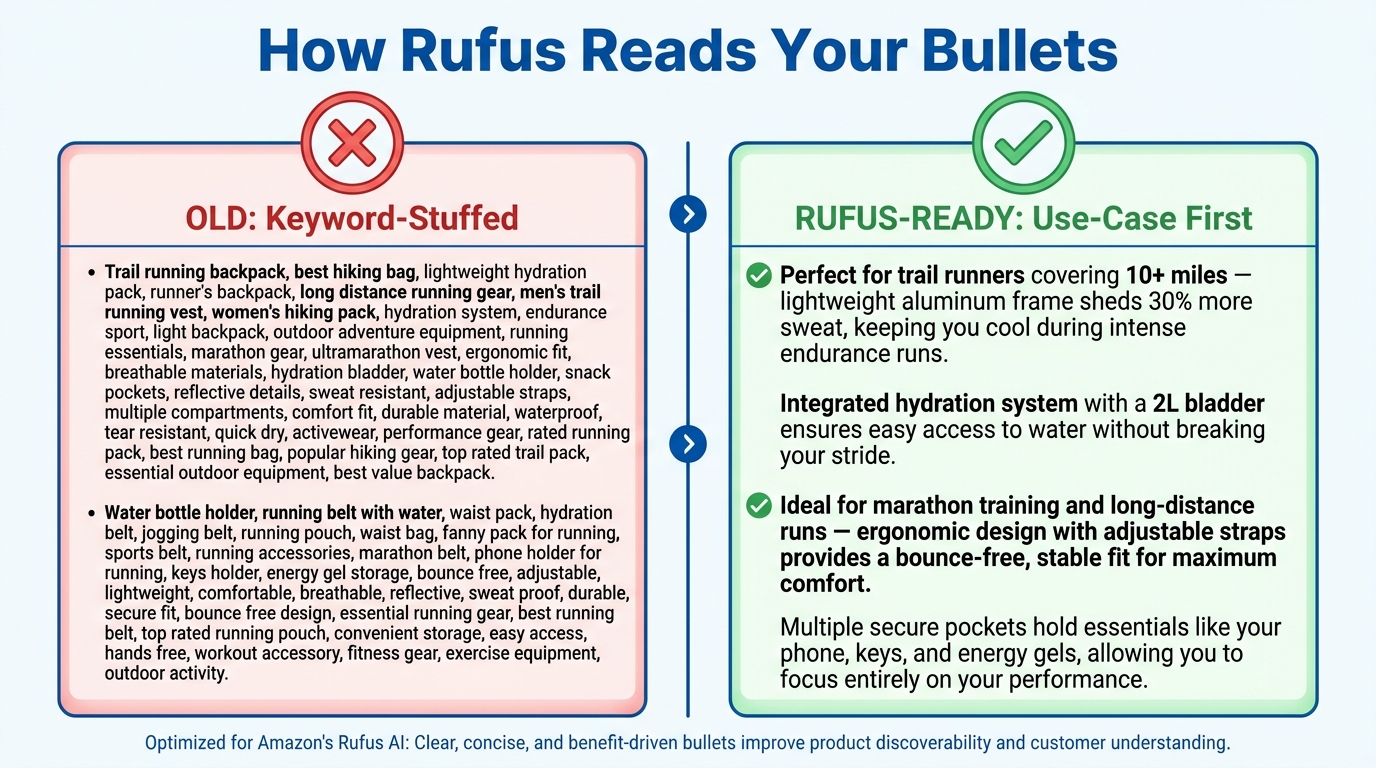
Bullet points are the highest-leverage content element in your listing for Rufus optimization. They are structured, relatively short, and directly extracted by COSMO as the primary source of feature and benefit information about your product. Getting bullet point structure right is the single biggest change most sellers can make to immediately improve Rufus visibility.
The Problem With Benefit-First Bullets
Conventional Amazon copywriting wisdom has long taught “lead with the benefit.” This produced bullets like: “STAY HYDRATED ALL DAY — Our advanced double-wall insulation keeps your drinks cold for 24 hours, ensuring you never have to deal with warm water again!”
This bullet is conversion-optimized for a human reader skimming a PDP. But Rufus reads it and struggles to extract a clean, reliable fact. The feature (double-wall insulation) is buried. The spec (24 hours cold) is present but surrounded by promotional language that lowers the AI’s confidence in using it as a quoted fact. The all-caps opener is meaningless to the AI.
The Feature → Benefit → Context Structure
Rufus-ready bullets follow a different pattern: lead with the specific, verifiable feature, follow with the benefit it creates, and optionally close with the context or user scenario where that matters most. This is not the same as keyword stuffing — it is precision over promotion.
Rewritten for Rufus: “Double-wall vacuum insulation keeps beverages cold for up to 24 hours and hot for 12 — ideal for all-day hikes, outdoor work, or gym sessions where you can’t refill frequently.”
Now COSMO can extract: the feature (double-wall vacuum insulation), the specification (24h cold, 12h hot), and the use cases (hiking, outdoor work, gym). When a shopper asks Rufus “what’s a good water bottle for long hikes,” this bullet now actively contributes to a match.
One Use Case Per Bullet
One of the most common structural errors in bullet point writing is trying to cover too many use cases in a single point. Rufus extracts information at the individual bullet level — a bullet that tries to be relevant to hikers, gym-goers, office workers, and parents simultaneously ends up being reliably relevant to none of them. Each bullet should anchor on a single, specific use case or audience segment, supported by a concrete feature and spec. Five focused bullets beat five omnibus bullets for AI readability every time.
Use Numbers Wherever Possible
Quantified claims are dramatically easier for COSMO to extract and use than qualitative ones. “Extremely lightweight” is not useful to the AI. “Weighs 6.2 oz — 30% lighter than standard stainless bottles in this class” gives the model a number it can compare, a category context, and a relative performance claim it can apply to queries about lightweight options. Wherever your listing currently uses adjectives (strong, durable, lightweight, comfortable), ask whether there is a number that could replace or accompany that adjective. In most cases, there is.
Q&A and Reviews as Ranking Fuel — Not Just Social Proof
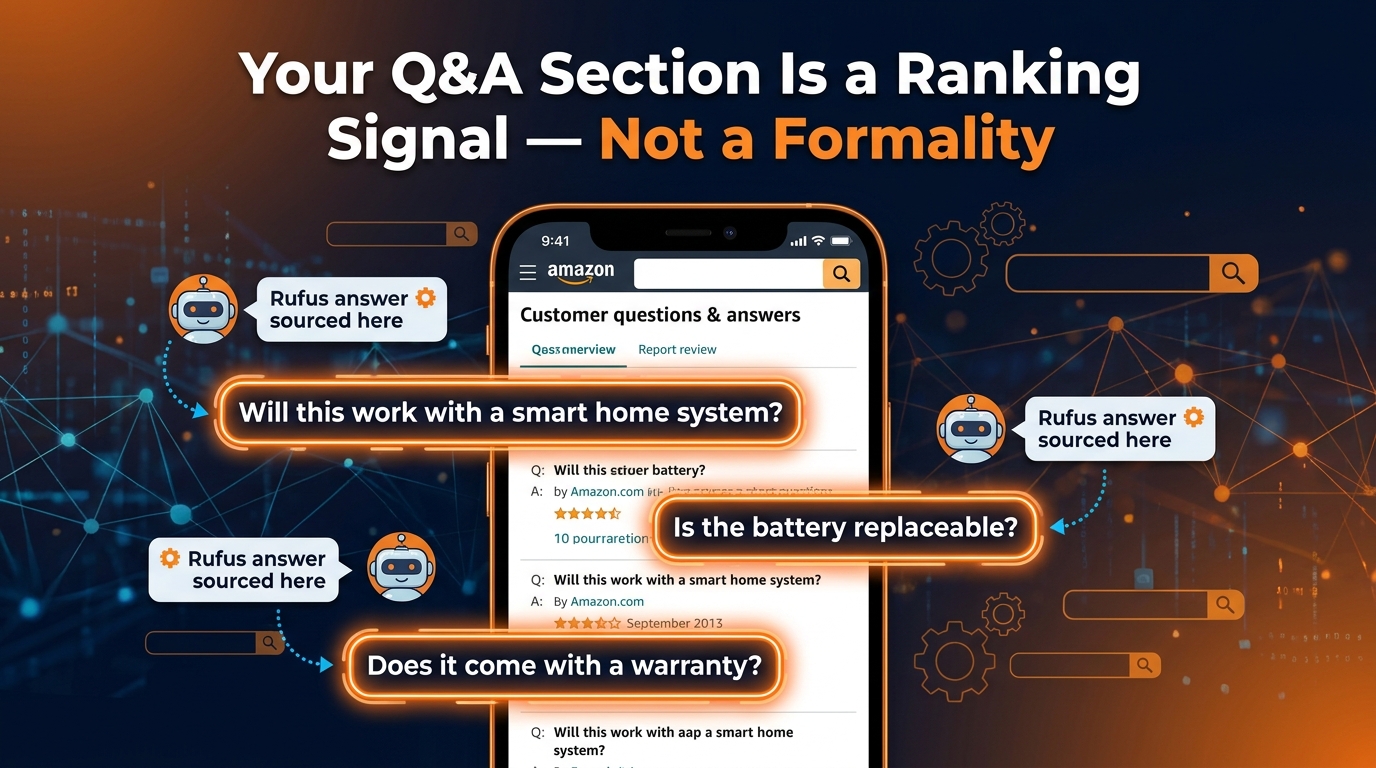
The Q&A section and review corpus have always mattered for conversion — they provide the social proof that pushes undecided buyers over the line. In the Rufus era, they serve a second, equally important function: they are active content inputs that COSMO mines for semantic information about your product that may not appear anywhere else in your listing.
How Rufus Sources Answers from Q&A
When a shopper asks Rufus a specific question about a product category — “does this fit in an overhead bin?” or “is this safe for kids with nut allergies?” or “can I use this with a Samsung Galaxy?” — Rufus often answers directly by citing text from Q&A entries on relevant products. This is both visible in the UI (Rufus quotes the answer source) and documented in Amazon’s own description of how the system works.
The implication is significant. A product with a well-populated Q&A section that covers the most common shopper questions is effectively providing Rufus with pre-written answers to use in recommendations. A product with an empty Q&A section forces Rufus to either not answer or to source from a competitor’s listing that has that information. In competitive queries, Q&A completeness can be the deciding factor in which product Rufus surfaces.
How to Systematically Build Q&A Coverage
The most effective approach is to treat Q&A as a structured FAQ exercise rather than a reactive response to buyer questions. Start by compiling the 20 most common pre-purchase questions about your product category — these typically cluster around compatibility, sizing/dimensions, safety, materials, use case suitability, and product longevity. Seed answers to each of these questions using your brand account or by proactively soliciting questions from real buyers and answering them immediately with detailed, factual responses.
Aim for answers that are at least two to three sentences long and contain specific, verifiable information. “Yes, it fits most standard overhead bins” is a mediocre Q&A answer. “Yes — the bag measures 22 x 14 x 9 inches, which meets the carry-on size requirements for United, Delta, and American Airlines’ standard overhead bins. The telescoping handle folds flush with the body for easier loading” is a Q&A answer that Rufus can quote directly, and that is far more likely to tip a buying decision.
Review Content as a Secondary Signal Source
Rufus is documented as being trained on and actively reading product review text. This means the language that your actual buyers use to describe your product becomes part of the semantic fingerprint COSMO associates with it. A product whose reviews consistently use phrases like “perfect for car camping,” “great for toddlers,” or “holds up to daily use in a commercial kitchen” acquires those use-case associations over time, even if those phrases appear nowhere in the listing itself.
This is not something you can directly control, but it does suggest two important actions. First, proactively solicit detailed reviews — not just five-star reviews, but reviews that describe how the buyer is actually using the product. A review that says “I use this every morning before my 6am run and it keeps coffee hot until I get back at 7:30” is worth more to COSMO than ten reviews that just say “great product!” Second, monitor review language for the use cases being attributed to your product, and ensure those use cases are also explicitly covered in your listing copy.
Backend Attributes and Structured Data — The Silent Ranking Engine
No content element in your listing is more undervalued for Rufus optimization than backend product attributes. These are the structured data fields that sellers fill out in Seller Central — material composition, item weight, product dimensions, compatibility, target audience, style, color, finish, and dozens of category-specific attributes that vary by product type.
For traditional A9 keyword search, backend attributes mattered primarily as indexing signals — they helped the algorithm match your product to relevant searches, but shoppers never saw them directly. In the Rufus environment, they serve a very different and more direct purpose: they are the primary structured data source that COSMO uses to build its factual representation of your product.
Why Attributes Are the AI’s Favorite Data Format
COSMO has to do significant work to extract reliable facts from free-text fields like bullets and descriptions — it has to parse sentences, resolve ambiguities, and assess how likely a given claim is to be accurate versus promotional. Structured attributes require none of that work. A field that says Material: 18/8 Stainless Steel is unambiguous, machine-readable fact. COSMO can use it immediately and confidently.
This means that information which exists in both a structured attribute field and in your bullet points is weighted more heavily for AI purposes than information that exists only in free text. And conversely, critical product facts that are in your bullets but missing from backend attributes are less reliably available to the AI than you think, because extraction from free text is lossy.
The Completeness Imperative
Most sellers fill out the required backend attributes — the ones Amazon won’t let you skip — and leave the optional fields largely empty. In the Rufus era, optional is not optional. Every unfilled attribute field is a piece of information about your product that the AI has to guess at, infer from context, or simply not have. When Rufus is comparing your product to a competitor’s and the competitor has filled out 35 attributes while you have filled out 12, the competitor’s product is simply more knowable to the AI, and will appear in more targeted recommendations as a result.
A full attribute audit should be part of any Rufus optimization process. For each ASIN, pull up the product type’s full attribute schema in Seller Central and systematically work through every available field. Prioritize: compatibility information, material and composition details, dimensions and weight, target audience/demographic, special features, and any category-specific attributes that shoppers in your category commonly ask about before purchase.
Compatibility Data as a Special Case
Compatibility attributes deserve specific attention because they are among the most common inputs to conversational Rufus queries. “Will this case fit my iPhone 17?” “Does this filter work with the Brita pitcher I already have?” “Is this compatible with my KitchenAid 6-quart mixer?” These are exactly the kinds of questions Rufus is asked, and the answer lives almost entirely in your structured compatibility attributes. If that data is missing or incomplete, Rufus will either skip your product in the answer or return a confident answer about a competitor who filled that field out properly.
A+ Content’s New Job in the AI Discovery Era
A+ Content has traditionally been understood as a conversion tool — rich imagery, comparison modules, brand storytelling, and feature deep-dives that turn interested browsers into buyers once they have already reached your product detail page. That framing is not wrong, but it is now incomplete.
In the Rufus era, A+ content serves as a secondary semantic layer that the AI can mine for use-case and context information that the primary listing fields do not capture. The text within your A+ modules — headings, body copy, comparison table rows — is indexed and readable by COSMO, making it a meaningful content asset for AI discovery, not just conversion optimization.
What A+ Content Rufus Can Actually Use
Not all A+ content is equally useful to the AI. Image-heavy modules with minimal text provide rich visual context for human shoppers but limited semantic information for COSMO. Text-forward modules — particularly comparison tables, feature breakdown sections, and use-case scenario blocks — are significantly more useful for AI extraction.
A+ comparison tables are especially high-value in the Rufus context. When you build a comparison module that contrasts your product against other sizes, variants, or even category alternatives, you are providing COSMO with structured comparative information that it can draw on when shoppers ask “which size should I get?” or “what’s the difference between the standard and the pro version?” These are extremely common conversational queries, and A+ comparison modules are one of the few places in your listing where that information can be presented in a structured, AI-readable format.
Rewriting A+ Copy for Conversational Alignment
The shift in A+ content writing approach for the Rufus era is similar to the shift in bullet writing: away from promotional language and toward factual, use-case-anchored copy that reads like a direct answer to a question a shopper might ask. Instead of “Experience the power of our industry-leading filtration system,” write: “Removes 99.9% of chlorine, lead, and microplastics — certified to NSF/ANSI Standard 53, making it suitable for tap water in most U.S. cities including those with aging municipal infrastructure.”
The second version is harder to write, requires actual product knowledge, and is less catchy as marketing copy. But it gives COSMO something to work with — a specific claim (99.9% removal), a certification (NSF/ANSI 53), and a use context (aging municipal water infrastructure) that can match to queries from shoppers who are specifically worried about the quality of their local tap water.
The Conversion Rate Advantage of Rufus-Optimized Listings
There is a business case for Rufus optimization that goes beyond visibility. Rufus-sourced traffic converts at a meaningfully higher rate than traffic from traditional keyword search — and understanding why clarifies why optimizing for Rufus is not just a discovery play but a conversion economics play.
The Pre-Qualification Effect
Velocity Sellers’ Q1 2026 data showed that Rufus-attributed product detail page sessions converted at 8–14% CVR, compared to 6–9% CVR for the same ASINs accessed through traditional keyword search. That is a meaningful lift, and the explanation for it is structural rather than coincidental.
When Rufus surfaces your product in response to a conversational query, it has already done several things that traditional search does not: it has matched your product to the shopper’s stated use case, extracted and presented relevant features from your listing, and in many cases provided a summary recommendation with reasoning. The shopper arrives at your PDP already knowing why this product is supposed to be relevant to them. They are not browsing — they are verifying.
This pre-qualification effect means that Rufus traffic is qualitatively different from keyword traffic. It’s further down the decision funnel before it ever touches your listing. The conversion rate premium is the natural consequence of that pre-filtering.
The Scale of What’s at Stake
Amazon attributed approximately $12 billion in incremental annualized sales to Rufus in 2025. For context, that is a discovery and conversion channel that did not exist in any material form three years ago. With Rufus now rebranded and expanded into Alexa for Shopping with broader device reach, that figure will grow substantially through 2026 and beyond.
The brands and sellers who have restructured their listings for Rufus readability are already capturing a disproportionate share of that GMV. Velocity Sellers also reported a darker data point from the same Q1 2026 review: some category leaders that did not adapt their listings to Rufus-compatible formats lost 12–18% of organic discovery volume in a single quarter as competitors rewrote their content. Rufus optimization is not only an opportunity — for incumbents in competitive categories, it is a threat they need to take seriously.
Ads Do Not Substitute for Organic Rufus Visibility
One question sellers consistently ask is whether Sponsored Product or Sponsored Brand ads compensate for weak organic Rufus visibility. The answer, as of 2026, is partially but not fully. Rufus does surface some sponsored content in its conversational answers, and advertising remains a meaningful lever for initial visibility in AI-assisted discovery. But Rufus’s recommendation logic heavily weights organic listing quality signals — content completeness, review richness, behavioral signals — that paid placement alone does not fix. A seller running heavy ad spend on a listing that Rufus reads as thin or incomplete will pay to bring traffic to a product the AI is actively less confident recommending, limiting the conversion lift that would otherwise justify the spend.
Common Rufus Optimization Mistakes — And What to Do Instead
Sellers who are aware of Rufus and are trying to optimize for it are making a predictable set of mistakes that are worth naming explicitly, because they represent a specific misreading of what the AI actually needs from your content.
Mistake 1: Stripping All Keywords in Favor of Natural Language
An overcorrection that some sellers make after learning that Rufus favors natural language is to remove all keyword targeting from their listings in favor of purely conversational copy. This is a mistake. Traditional A10 keyword search still drives the majority of discovery, and your listing needs to maintain keyword indexing for both surfaces simultaneously. The correct approach is not to choose between keywords and natural language — it is to write natural language that organically contains your keywords, because a well-constructed use-case statement almost always does.
Mistake 2: Treating A+ Content as Image-Only
Many sellers build A+ content with minimal text, relying on images and iconography to carry the communication. This was a reasonable approach for human-first design under old search. In the Rufus era, it leaves one of your most flexible semantic content fields nearly empty from the AI’s perspective. Every A+ module that contains meaningful text is a content asset. Every module that is images-only is invisible to COSMO.
Mistake 3: Ignoring Q&A Until Buyers Ask Questions Organically
A reactive Q&A strategy — waiting for buyers to ask questions and answering them as they come in — is far too slow for Rufus optimization. You can wait months for organic questions to build meaningful Q&A coverage, during which time your listing is being recommended less frequently than a competitor who proactively seeded their Q&A with the 20 questions their category shoppers actually ask. Take a proactive approach: use customer service records, ad search term reports, and Amazon’s “Customers Also Asked” data to identify the question inventory your Q&A should cover, then build it out systematically.
Mistake 4: Using Vague, Unanchored Benefit Language
Phrases like “premium quality,” “superior performance,” “designed for the modern lifestyle,” and “built to last” are invisible to COSMO because they are unverifiable and non-specific. The AI has no way to know what “premium quality” means for your product or how to match it to a query. Replace every unanchored adjective in your listing with either a specific number, a certification, a comparison, or a concrete use-case scenario. “Superior durability” becomes “military-grade drop protection rated to MIL-STD-810H standards.” “Premium quality” becomes “all components certified food-safe under FDA 21 CFR regulations.”
Mistake 5: Optimizing the Listing Without Addressing the Review Corpus
Your listing can be perfectly optimized in every seller-controlled field, but if your review corpus is sparse, generic, or dominated by negative reviews about a specific use case, Rufus will factor that into its recommendation confidence. High-quality listing optimization and a strong review generation strategy are not independent workstreams in the Rufus era — they are two halves of the same optimization problem. Reviews are a content input, not just a reputation metric.
Building a Rufus Audit Checklist for Your Catalog
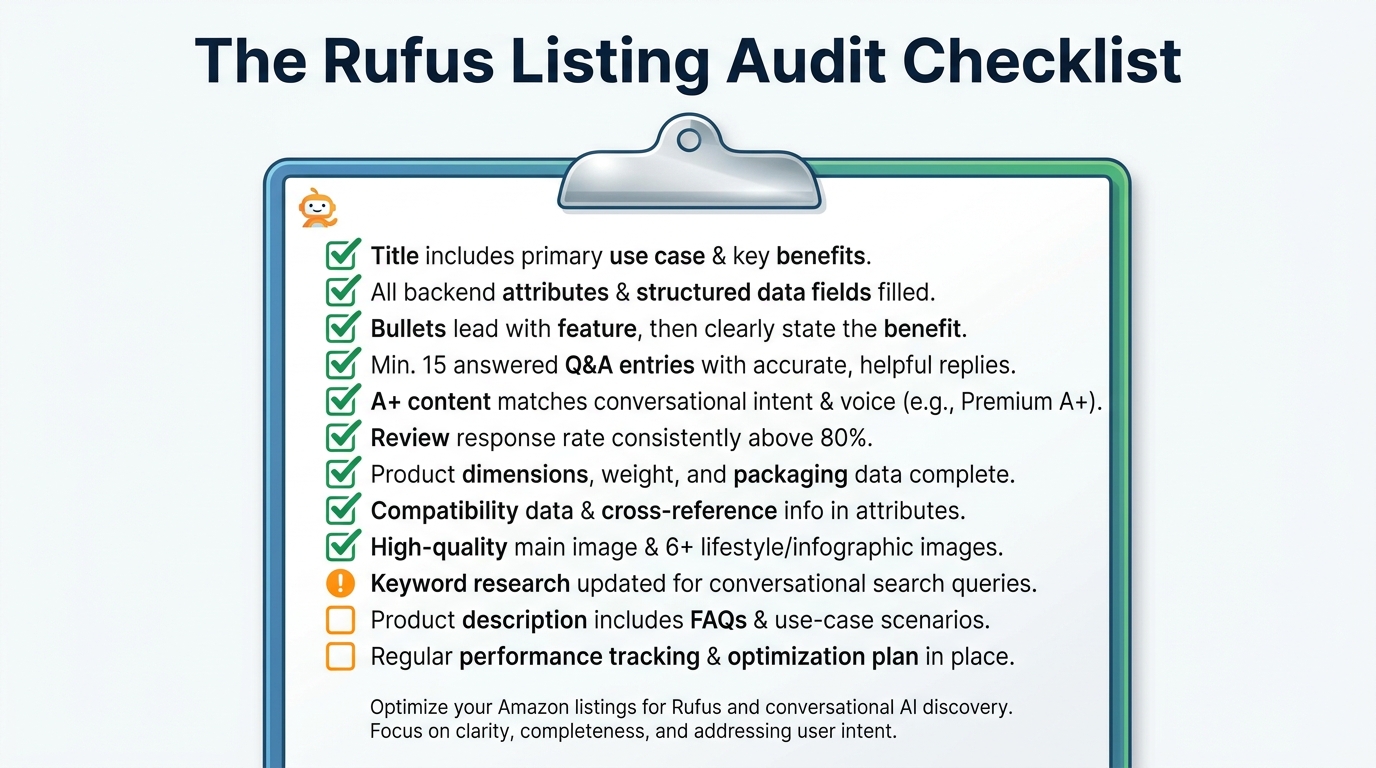
Putting all of the above into a practical framework requires a systematic audit process that you can apply across your catalog. The following checklist covers the primary optimization surfaces in priority order. Run each ASIN against this framework and score it honestly — the gaps you find are your action list.
Title Audit
- Does the title include the primary intended use case (not just the product type)?
- Is the primary differentiating feature or specification present and specific (a number, material, or measurable attribute)?
- Does it mention a specific audience or constraint where relevant (men’s, kids’, industrial-grade, travel-size)?
- Is the title free of redundant keyword stacking that obscures the use-case signal?
Bullet Point Audit
- Does each bullet lead with a specific, verifiable feature rather than a generic benefit claim?
- Does each bullet anchor on a single use case or audience segment?
- Are there quantified specifications in at least three of the five bullets?
- Is promotional language (all-caps, exclamation marks, superlatives) minimal or absent?
Backend Attributes Audit
- Are all required attributes filled? (This is a baseline, not an achievement.)
- Are all optional attributes in the product type schema filled where applicable?
- Is compatibility data complete — covering all major compatible products, systems, or standards?
- Are material composition, dimensions, weight, and target audience fields complete?
Q&A Audit
- Does the listing have at least 15 answered Q&A entries?
- Are the top 10 most common pre-purchase questions for the category covered?
- Are answers two to three sentences long with specific, factual information?
- Have questions been proactively seeded rather than left to organic accumulation?
A+ Content Audit
- Does at least one A+ module contain substantive text (not just image captions)?
- Is there a comparison module covering variants, sizes, or complementary products?
- Does the A+ copy use factual, use-case-anchored language rather than promotional framing?
- Are certifications, standards, or third-party validations called out in text (not just in images)?
Review Corpus Audit
- Does the product have sufficient review volume for the category (generally 30+ for new ASINs, 100+ to be competitive in most categories)?
- Do reviews mention specific use cases, not just general satisfaction?
- Is there a proactive review generation strategy in place (Vine, follow-up sequences, insert cards where permitted)?
- Are negative reviews about specific use cases addressed in the listing to preemptively manage AI mis-recommendation risk?
Prioritizing the Audit Results
When you score your catalog against this checklist, prioritize remediation in this order: backend attributes first (highest impact, lowest effort), bullet points second (high impact, moderate effort), Q&A third (high impact, moderate sustained effort), title fourth (high impact but carry significant risk if changed on high-BSR ASINs — change carefully), A+ content fifth, and review strategy sixth (ongoing, not a one-time fix).
For catalogs with large numbers of ASINs, start with your highest-revenue SKUs and work down. The Rufus visibility gain for a well-optimized, high-BSR ASIN is significantly larger in absolute terms than the same optimization applied to a slow-moving ASIN, because behavioral signals amplify the content quality improvements you make.
What Comes Next as Alexa for Shopping Matures
The transition from Rufus to Alexa for Shopping is not the end of this evolution — it is a milestone in an ongoing expansion of AI-mediated discovery at Amazon. Several trends that are already visible in 2026 will intensify over the next 12 to 18 months, and sellers who understand the direction of travel will be better positioned to adapt ahead of the curve rather than reacting to changes after they’ve already cost them visibility.
Voice and Multimodal Queries Will Grow
Alexa for Shopping’s integration with Echo Show and other Alexa-enabled devices means that an increasing share of product discovery will happen through voice, where keyword search is literally impossible. Voice queries are almost always conversational and use-case-anchored (“Alexa, find me a birthday gift for my mom who likes gardening”) in exactly the format that the optimization principles in this article are designed to serve. The visual search component — where shoppers can photograph an item and ask Alexa to find it or find something similar — adds another non-keyword discovery layer that rewards complete attribute data and rich product imagery.
Listing Freshness Will Become a Stronger Signal
Early evidence suggests that Alexa for Shopping places meaningful weight on how recently a listing has been updated, particularly in rapidly evolving categories like electronics, health, and apparel. Sellers who treat their listings as set-and-forget assets will gradually lose AI visibility to competitors who regularly refresh their content to reflect current product specifications, updated compatibility data, and improved Q&A coverage. A quarterly listing review cadence — not an annual one — is the appropriate rhythm for the AI-mediated discovery era.
Brand Analytics Data Will Increasingly Reveal AI Attribution
Amazon has signaled that Brand Analytics reporting will provide more granular insight into AI-mediated discovery paths over time. Sellers who are already familiar with reading Brand Analytics data for traditional search patterns will be positioned to quickly adopt AI-specific attribution reporting as Amazon surfaces it, giving them a measurable feedback loop for their Rufus optimization investments.
Conclusion: The Listing as an AI-Readable Knowledge Base
The fundamental shift that Rufus — and now Alexa for Shopping — demands of Amazon sellers is a change in how they think about what a product listing is for. For fifteen years, a listing was a conversion tool dressed up with keywords. Its job was to rank for terms and then persuade the human who clicked through to buy.
In the AI-mediated discovery era, a listing is a knowledge base. Its job is to be a complete, accurate, well-structured source of truth about your product that a machine can read, extract from, synthesize, and present to a shopper who asked a question you may never have directly anticipated. The machine is the intermediary now. It decides whether your product is recommended. And it makes that decision based on how well it can understand your product from the information you have provided.
The good news is that the optimization work required to serve the AI also serves human shoppers better. Clearer titles, factual bullets, complete attributes, detailed Q&A, and substantive A+ content are simply better product listings by any measure. The sellers who build this kind of catalog are not making a sacrifice for the algorithm — they are building content that is genuinely more useful, more trustworthy, and more deserving of the conversion rate premium that Rufus-sourced traffic delivers.
The audit checklist in this article gives you a practical starting point. The most important thing is to start, to prioritize your highest-revenue ASINs, and to treat listing quality as an ongoing operational discipline rather than a one-time setup task. The AI’s expectations will continue to rise. So should yours.