



In late January 2026, TikTok Shop quietly sent U.S. sellers a notice that would have rewritten how the entire platform operates: Seller Shipping — the option that let merchants choose their own carriers, print their own labels, and control their own last mile — was being discontinued. The deadline was March 31. No exceptions. No grandfather clause.
Then came the backlash. Sellers flooded forums, operator communities, and TikTok Shop support channels with complaints. Small brands that had spent years building carrier relationships, negotiating rates, and weaving TikTok into multi-channel fulfillment setups suddenly faced having to tear it all down in 60 days. The pressure built fast enough that TikTok reversed course — or at least paused.
But here is what most sellers got wrong about that reversal: they read it as a win. It wasn’t. It was a delay. TikTok’s intent to control logistics top-to-bottom hasn’t changed. The direction of travel is unmistakable: the platform is building the same fulfillment moat that Amazon built over two decades, and it intends to do it in a fraction of the time. The sellers who treat the pause as a reprieve and go back to business as usual are the ones who will get caught flat-footed when the policy swings again.
This post is not about the drama of the rollback. It’s about what the entire episode reveals about where TikTok Shop is heading on logistics, what the current fulfillment landscape actually looks like, and what operators need to do right now — before the next policy announcement lands. If you sell on TikTok Shop and fulfillment strategy isn’t on your quarterly roadmap, this is your reminder to change that.
What TikTok Actually Tried to Do — And What the Reversal Really Means
To understand where TikTok Shop logistics is going, you first need to understand what the platform actually attempted in early 2026 and why the rollback doesn’t mean what most sellers think it means.
The Original Mandate
TikTok Shop’s January 2026 announcement established a phased elimination of Seller Shipping for all U.S. merchants. The timeline was structured in two stages: existing sellers would see the option begin disappearing from February 25, with a hard cutoff on March 31. New sellers would no longer have access to Seller Shipping from the point of the announcement onward.
Under the new mandatory framework, sellers would be required to route all orders through one of four approved logistics pathways: Fulfilled by TikTok (FBT), Upgraded TikTok Shipping, Collections by TikTok (CBT), or an approved ERP/WMS integration from a small list of certified third-party technology partners. Self-generated shipping labels from carriers like UPS, FedEx, or USPS — the lifeblood of many small sellers — would no longer be accepted.
Why TikTok Pushed This
The platform’s motivations were not purely punitive. TikTok Shop has a serious delivery consistency problem that it needs to fix at scale. Across the platform’s early U.S. growth phase, delivery experiences varied wildly depending on which seller a buyer purchased from. Some sellers dispatched same-day with tracking. Others took three to five days to even generate a label. That inconsistency erodes buyer trust in the platform as a whole, not just in individual sellers.
Amazon solved this problem with Prime and FBA. TikTok is trying to solve it with FBT and platform-controlled logistics rails. The logic is sound. The execution timeline was just too aggressive for a seller base that wasn’t ready.
What the Pause Actually Signals
When TikTok reversed the mandate, it did not abandon the goal. What changed was the timeline and the enforcement mechanism — not the destination. Seller Shipping remains available for now, but the platform has continued expanding FBT infrastructure, tightening performance scoring, and linking algorithmic visibility ever more tightly to fulfillment quality. The sellers who currently use Seller Shipping and don’t migrate will simply find themselves progressively disadvantaged in the algorithm while TikTok waits for adoption rates to reach a threshold where a hard cutoff becomes less controversial.
This is a classic platform playbook. Incentivize the behavior you want before you mandate it. The incentives, in TikTok Shop’s case, are already substantial — and we’ll walk through the numbers in detail below.
The Four Fulfillment Lanes — And When Each One Actually Makes Sense
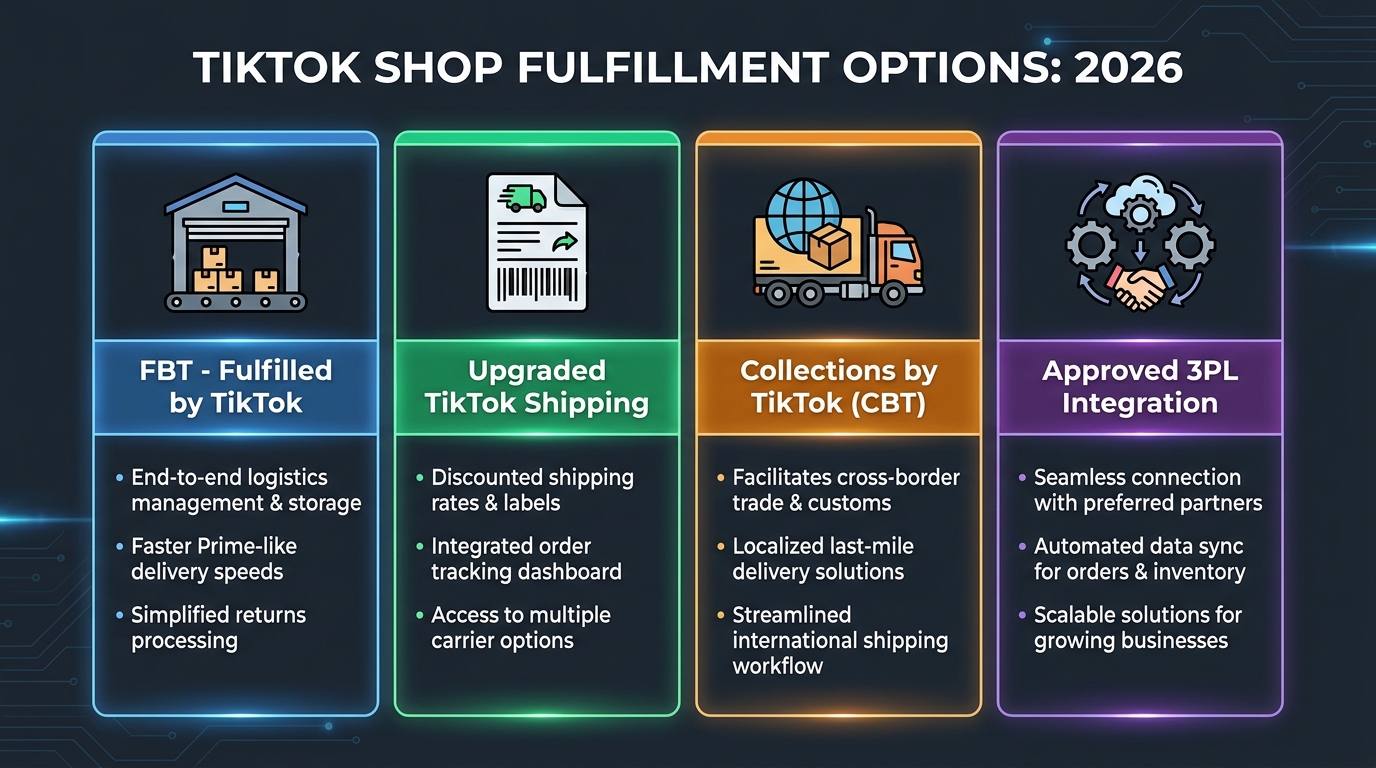
One of the most common mistakes sellers make right now is treating TikTok’s logistics options as a binary: FBT or nothing. The actual landscape has four distinct pathways, each with different economics, operational requirements, and ideal use cases. Understanding which lane fits which part of your catalog is more important than picking a single approach and applying it universally.
Lane 1: Fulfilled by TikTok (FBT)
FBT is TikTok Shop’s answer to Amazon FBA. You ship your inventory to TikTok’s fulfillment centers, and the platform handles storage, picking, packing, and last-mile delivery. In return, your listings receive the platform’s “Free 3-Day Delivery” badge, preferential algorithmic placement, and the operational simplicity that comes with handing the post-purchase experience to someone else.
FBT makes the most sense for: high-velocity SKUs with predictable demand, items that are compact and lightweight (the fee structure rewards these disproportionately), and products that are purchased as standalone units rather than in bundles you assemble yourself. It is less suited to oversized items, fragile goods requiring special handling, or products with significant SKU variation where inventory management at a third-party warehouse becomes complex.
The program’s per-unit fulfillment fees start at approximately $3.58 for single-unit orders in the lightest weight tier, with multi-unit pricing dropping to around $2.86 per unit for orders of four or more units. Standard inbound is fee-free when you comply with routing and packaging requirements, but hub placement fees and inbound exception charges apply when you don’t follow the rules.
Lane 2: Upgraded TikTok Shipping
This is the middle ground: you still hold and ship inventory from your own location or warehouse, but you use TikTok-generated shipping labels through platform-approved carriers. It preserves more operational control than FBT while still giving TikTok visibility into tracking data and allowing the platform to enforce dispatch SLAs.
Upgraded TikTok Shipping works well for sellers who aren’t ready to send inventory to TikTok’s warehouses but who need to keep their performance metrics clean. It’s also a practical bridge option during a migration to FBT, allowing you to maintain sales velocity while you prep and inbound FBT inventory in parallel.
Lane 3: Collections by TikTok (CBT)
CBT is TikTok’s international cross-border fulfillment pathway, designed for sellers outside the U.S. who want to sell into the American market without holding domestic inventory. Under CBT, TikTok manages the customs clearance, duties calculation, and domestic last-mile delivery after your product clears the border.
The economics of CBT are more complex than domestic options. Cross-border handling, duties, VAT, and currency conversion all eat into margins in ways that domestic sellers don’t encounter. CBT sellers typically see total platform and logistics costs consuming 30–55% of revenue, leaving net margins in the 15–25% range for well-run operations. This makes product selection and pricing strategy even more critical for CBT sellers than for their domestic counterparts.
Lane 4: Approved 3PL / ERP Integration
For sellers who operate at scale across multiple channels and can’t (or won’t) send inventory to TikTok’s fulfillment centers, the approved integration path allows you to use your existing 3PL — but only if that 3PL’s systems are on TikTok’s certified integration list. The integration must pass TikTok’s tracking, dispatch, and label requirements to count as compliant.
This lane is the most operationally flexible but carries the highest compliance risk. Any failure in the integration — missed tracking uploads, delayed dispatch signals, label non-compliance — flows directly into your performance metrics and can trigger account health consequences even if the physical fulfillment was perfectly executed.
The FBT Conversion Math: Why the Numbers Are Hard to Argue With
Sellers often evaluate FBT purely as a cost decision: what does it cost per unit versus what I’m currently spending? That framing misses the more important side of the equation — what FBT does to revenue, not just to costs.
The Badge Effect
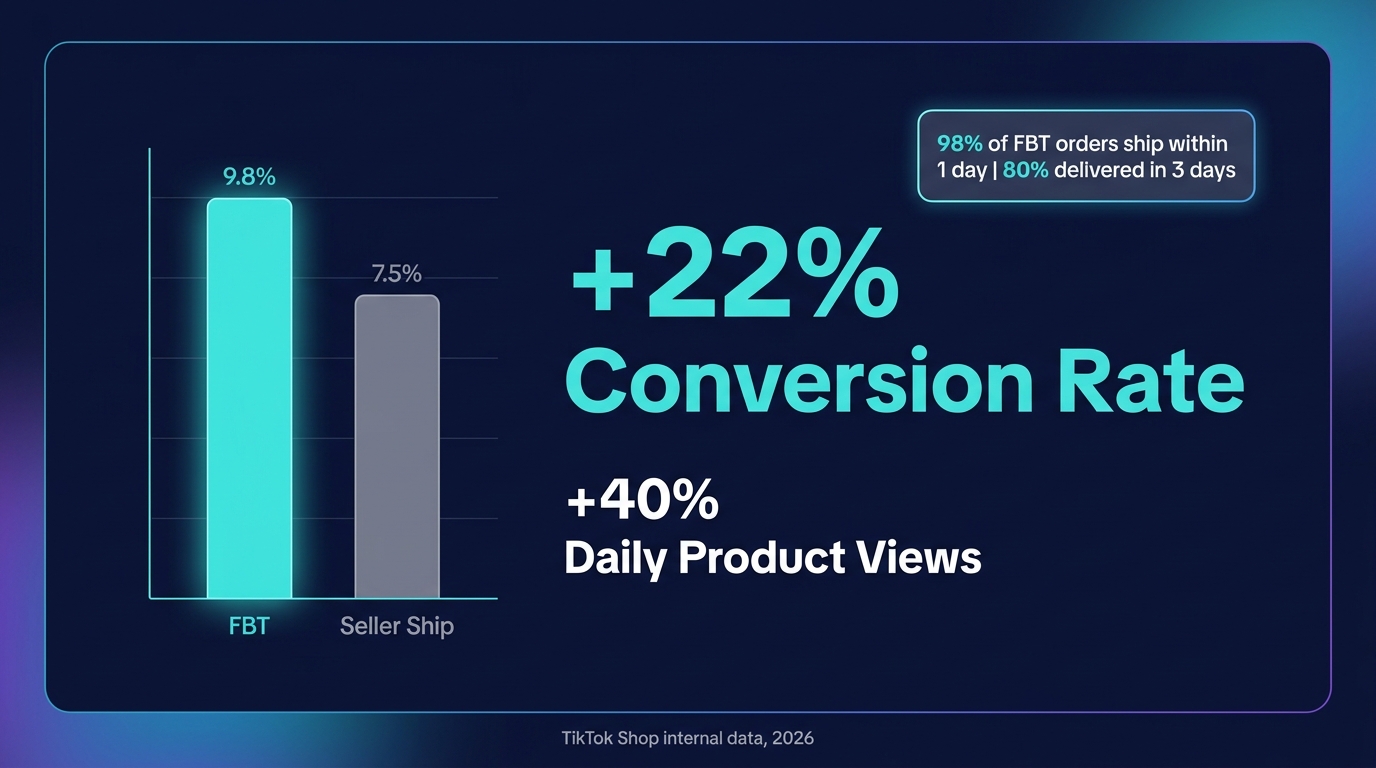
When a product is enrolled in FBT and qualifies for the “Free 3-Day Delivery” badge, it receives a visual trust signal that shoppers on TikTok Shop respond to measurably. According to TikTok’s own platform data, newly inbounded FBT products see an average 40% increase in daily product views and a 15–22% increase in conversion rate compared to the same products without the badge.
In a platform built around impulse purchase behavior driven by short-form video, these numbers compound quickly. If your current product generates 1,000 views per day and converts at 3%, you’re making 30 sales. Add the badge, and you’re potentially looking at 1,400 views converting at 3.6% — 50 sales. That’s a 67% GMV increase on the same product without changing a single word of your listing or spending an extra dollar on creator partnerships.
The Speed-Trust Loop
The conversion lift isn’t just about the badge aesthetics. It reflects a genuine operational improvement that buyers notice. FBT’s performance data shows that approximately 98% of FBT orders are shipped within one calendar day, and roughly 80% are delivered within three business days end-to-end. Sellers in the health and beauty category — one of TikTok Shop’s largest verticals — who have more than 30% of their orders on FBT report an average delivery time of just 83.65 hours.
Faster delivery translates to fewer post-purchase doubts, lower refund request rates, and higher likelihood of repeat purchase. On a platform where a creator’s mention can drive thousands of first-time buyers who have never heard of your brand before, a clean first purchase experience is the single biggest lever for building a sustainable customer base rather than a one-time GMV spike.
The Algorithm Multiplier
Beyond conversion, FBT enrollment influences where TikTok’s algorithm places your products in search, browse, and Shop recommendations. The platform’s ranking system explicitly factors in delivery promise and fulfillment reliability as signals of listing quality. An FBT product competing against an equivalent non-FBT product for the same search term starts with a structural advantage — and that advantage compounds over time as the FBT product accumulates more views, clicks, and purchases driven by better placement.
This is the part of the FBT equation that most cost-focused sellers undervalue. The ROI of FBT is not just fulfillment savings or avoided shipping hassles. It’s an algorithmic boost that accelerates every other growth lever you’re already investing in — creator content, paid promotion, and affiliate partnerships all perform better when they land on a listing that the algorithm is already favoring.
The Performance Metrics That Now Control Your Visibility
Whether you use FBT, Upgraded TikTok Shipping, or an approved 3PL integration, your account health is evaluated against the same set of logistics performance metrics. Understanding these thresholds is not optional — missing them triggers consequences that range from reduced listing visibility to order caps to account suspension.
The Core Four Metrics
TikTok Shop currently evaluates seller logistics performance against four primary metrics:
- Valid Tracking Rate (VTR): The percentage of dispatched orders with valid, carrier-confirmed tracking uploaded within the required time window. TikTok’s threshold is ≥95%. Falling below this signals that orders are being shipped either without tracking or with tracking that isn’t connecting to carrier systems in a way TikTok can verify.
- Late Dispatch Rate (LDR): The percentage of orders where the seller fails to dispatch within the required window after purchase. The acceptable threshold is ≤4%. A 5% or higher LDR is enough to trigger account health consequences in the current framework.
- On-Time Delivery Rate (OTDR): The percentage of orders delivered within the promised delivery window. TikTok’s minimum acceptable OTDR is ≥80%. Note that for FBT sellers, this metric is largely outside your control once inventory is in TikTok’s system — which is one of the less-discussed arguments for FBT from a risk management standpoint.
- Seller-Fault Cancellation Rate (SFCR): The percentage of orders cancelled due to inventory unavailability or seller-side failures. This is the metric most tightly connected to overselling risk, which becomes a critical issue when viral demand spikes hit faster than your inventory can absorb.
How These Metrics Connect to Your Shop Performance Score
TikTok’s Shop Performance Score (SPS) and its companion Account Health Rating (AHR) aggregate these logistics metrics alongside other operational signals like customer satisfaction ratings, policy compliance, and product quality disputes. The SPS is not just a dashboard number — it is the primary input into how aggressively TikTok’s algorithm surfaces your products and whether you’re eligible for promotional programs, flash sales, and creator matchmaking through the platform’s affiliate ecosystem.
Sellers with strong SPS scores see their products placed more prominently in search results, recommended more frequently in the For You feed’s shopping layer, and prioritized in the platform’s deals and campaign infrastructure. Sellers with weak SPS scores see the opposite — and the impact can be dramatic and difficult to reverse quickly.
The Enforcement Evolution
What’s changed in 2026 is not just the thresholds — it’s the speed and automation of enforcement. TikTok has moved from manual review of logistics problems to algorithmic enforcement that can trigger listing suppression, order volume caps, and promotional ineligibility automatically when metrics cross threshold levels. There’s no appeals grace period that buys you a month to fix things before consequences hit. The system acts first, and you appeal after.
This makes real-time monitoring of logistics metrics non-negotiable. Sellers who check their performance dashboard weekly are operating on a lag that the enforcement system has already run past. Daily monitoring — or automated alerts when metrics approach threshold levels — is now table stakes for anyone operating at meaningful volume on the platform.
The Real Cost Stack: Margin Math for Every Fulfillment Path
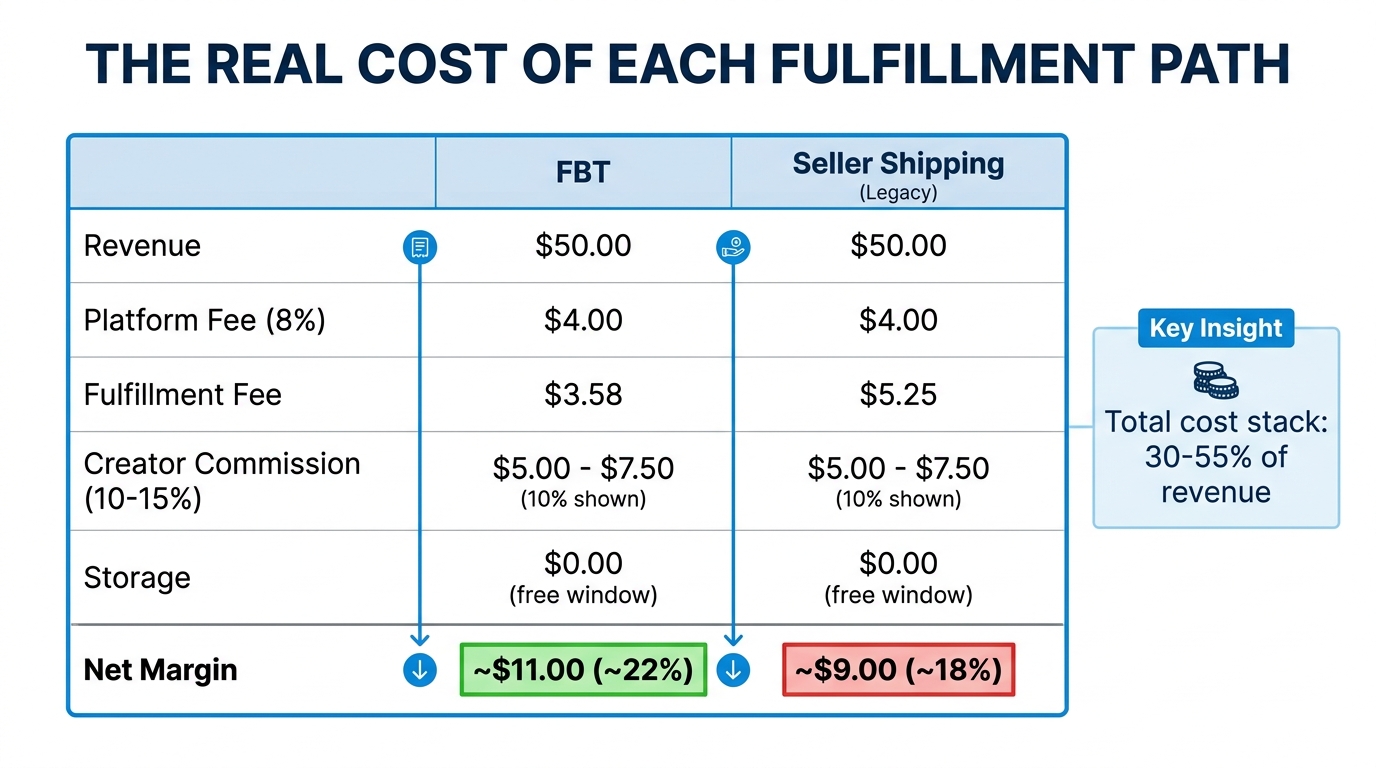
Before committing to any fulfillment path, sellers need an honest accounting of what every option actually costs when you add up all the layers. The headline fee — FBT fulfillment starts at $3.58 per unit — tells you very little about real economics. The full picture requires stacking every cost component and comparing the result against what it buys you in performance.
Building the True Cost Stack
A realistic margin model for a TikTok Shop product needs to include the following cost categories, regardless of which fulfillment path you choose:
- Platform referral fee: Typically 6–8% of GMV depending on category. Beauty tends to run higher; electronics lower.
- Creator/affiliate commission: The most variable line item. Creator partnerships on TikTok Shop commonly run 10–20% for micro-creators, with top performers negotiating 25–30% on fast-moving products. When you combine platform fee and creator commission, you’re often at 18–28% of revenue before you’ve touched a single fulfillment cost.
- Fulfillment cost (the path-dependent variable): FBT starts at $3.58/unit for light single-unit orders. Upgraded TikTok Shipping costs vary by carrier negotiation and weight but don’t benefit from TikTok’s volume-negotiated rates. Approved 3PL setups add integration maintenance costs on top of warehouse and shipping fees.
- Storage fees: FBT includes a free storage window, after which per-cubic-foot monthly storage charges apply. Sellers who overstock slow-moving inventory into FBT warehouses can see storage costs erode the program’s economics significantly.
- Return processing: TikTok Shop’s return rates vary by category but can run 8–15% in fashion and 3–6% in beauty. Returns generate reverse logistics costs and reprocessing fees in FBT that need to be modeled.
What the Math Actually Looks Like
For a $50 product selling via FBT with a 10% creator commission, the full cost stack might look like this: $4.00 platform fee (8%) + $5.00 creator commission (10%) + $3.58 FBT fulfillment + $2.50 COGS (approximate for illustrative purposes, scaled to a well-manufactured product) = roughly $15.08 in variable costs before accounting for returns. That leaves a gross margin in the $32–35 range, or roughly 64–70% gross margin before overhead — a strong outcome that explains why many fast-moving TikTok Shop brands are extremely profitable at scale.
The picture looks materially different for cross-border CBT sellers, who add customs handling, duty calculation, currency conversion costs, and longer delivery timelines that can suppress conversion. Across the board, TikTok Shop expert operators note that total platform and logistics costs run 30–55% of revenue, with the lower end achievable by well-optimized FBT sellers on high-margin SKUs and the upper end common among CBT sellers with complex supply chains.
Where FBT Actually Saves Money
The cost argument for FBT is not just about fulfillment fees in isolation. FBT benefits from TikTok’s negotiated last-mile rates with carrier partners, which are generally lower than what individual sellers can negotiate independently. For lightweight products under two pounds — the sweet spot for FBT economics — the per-unit cost of FBT is often lower than what a seller would pay using their own UPS or FedEx account, before you account for the conversion uplift, algorithm boost, or time saved managing carrier relationships.
The sellers who lose money on FBT are typically those who enrolled products that don’t fit the model: heavy items, slow movers that accumulate storage fees, or products with high defect and return rates. The solution is selective enrollment — treating FBT as the right tool for specific SKUs rather than a universal default for everything in your catalog.
Building a Supply Chain That Survives a Viral Spike
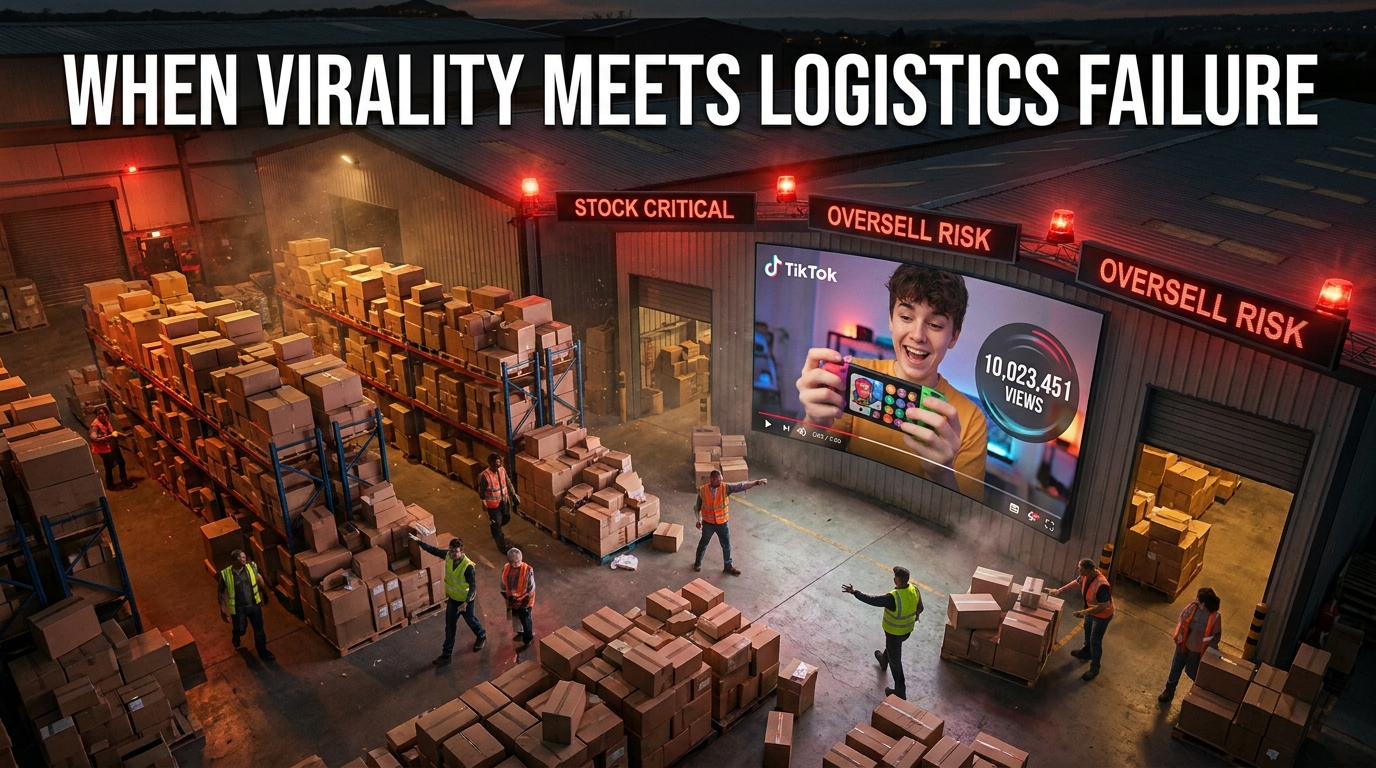
Social commerce logistics has a problem that traditional e-commerce rarely has to confront at the same intensity: demand can go from zero to extraordinary in less than 24 hours. TikTok’s content algorithm does not distribute viewership linearly. A product that a micro-creator posts about on Tuesday morning can be sold out by Tuesday afternoon if the video catches traction. This creates a category of operational failure — the viral stockout — that is specific to the platform and that directly attacks your most important performance metrics.
Why Viral Stockouts Are So Damaging
When you run out of inventory during a viral moment, the consequences compound across multiple dimensions simultaneously. First, you oversell — generating orders you can’t fulfill, which drives up your Seller-Fault Cancellation Rate. Second, the cancellations trigger account health consequences that suppress your listing precisely when demand is highest. Third, the creator’s content continues driving traffic to a listing that can’t convert, wasting the organic reach you can never buy back. Fourth, buyers who experience a cancellation after placing an order are unlikely to return.
TikTok Shop operators have noted that live shopping conversion rates on the platform average around 7.4% — significantly higher than most other shopping contexts. This means a single live session with a popular creator can generate an enormous volume of orders in a very short window. A product that sees 50,000 live viewers at a 7% conversion rate generates 3,500 orders in an evening. If your FBT inventory level was 2,000 units, you just created 1,500 cancellations and a SFCR problem that will follow your account for 30 days.
The Viral Buffer Strategy
The most operationally sophisticated TikTok Shop sellers operate what experienced operators call a “viral buffer” — a dedicated inventory reserve that sits above your normal safety stock level and is earmarked specifically for demand spikes. The buffer is sized based on your creator pipeline: if you have three active creator partnerships generating content in the next 30 days, your buffer should be calibrated to absorb the peak demand scenario for each of those creators’ audiences.
The mechanics vary by fulfillment path. For FBT sellers, the buffer lives in TikTok’s warehouse and requires proactive inbound planning — inbounding inventory three to four weeks before anticipated creator activations to account for receiving and processing time. For 3PL sellers, the buffer is held domestically with rapid-dispatch capability. The common thread is that the buffer is planned and funded in advance, not scrambled for reactively when a video starts trending.
Real-Time Inventory Sync as a Non-Negotiable
Viral spike management also requires real-time inventory visibility across every channel where you’re selling. Sellers who list the same product on TikTok Shop, Amazon, and their own DTC site must ensure that inventory levels sync across all three platforms within minutes — not hours — of each sale. The acceptable sync latency for TikTok Shop sellers operating at volume is generally considered to be 15 minutes or less. Any longer and you risk generating sales on TikTok Shop against inventory that was already sold on another channel.
This is where approved 3PL integrations and ERP systems earn their keep. A well-configured integration that syncs inventory in real time, automatically pauses listings when stock drops below a safety threshold, and alerts your team when buffer levels are breached is the difference between a viral moment being a windfall and a catastrophe.
Cross-Border Logistics: The Hidden Complexity Most Sellers Underestimate
For international sellers using Collections by TikTok to access the U.S. market, the logistics landscape has a different — and in many ways harder — set of challenges than domestic sellers face. CBT gives international brands access to American consumers without the need for domestic inventory, but it comes with cost and complexity layers that aren’t always visible until you run the actual numbers.
What CBT Actually Covers — And What It Doesn’t
Under CBT, TikTok manages customs clearance documentation and duty calculation on behalf of the seller, presenting U.S. buyers with a landed cost that includes import duties in a transparent, DDP (Delivered Duty Paid) structure. This removes one of the biggest friction points for international sellers — the risk of buyers receiving unexpected customs bills that generate disputes and refund requests.
However, CBT doesn’t eliminate duty costs — it just handles the mechanics. The actual duty is either absorbed into your product pricing or passed to the buyer in a way that needs careful testing to avoid killing conversion. For most categories, U.S. import duties on consumer goods from major sourcing countries run 5–25%, a line item that needs to be priced in from the beginning.
Delivery Time as a CBT Disadvantage
Cross-border fulfillment cannot match domestic FBT delivery speed. Where FBT delivers 80% of orders within three days, CBT orders typically take 7–14 business days. This not only prevents CBT sellers from earning the three-day delivery badge — it puts them at a structural conversion disadvantage against domestic FBT competitors on the same search term.
The solution is not necessarily to abandon CBT, but to design product strategy around categories where delivery speed is less of a conversion driver. Unique, hard-to-find products with strong creator storytelling can convert despite longer delivery windows. Commodity or near-commodity products that buyers can find from domestic sellers rarely can. CBT sellers who thrive are those who compete on product differentiation and content quality rather than on price and speed alone.
The Duty Policy Wildcard
International sellers also need to watch trade policy shifts more closely than domestic sellers. U.S. import duty structures have been volatile in recent years, and changes to tariff schedules can move CBT economics significantly in a short time. Sellers who have done margin modeling on CBT without stress-testing for a 10–15 percentage point duty increase are operating on fragile assumptions. Building pricing buffers and maintaining supplier relationships that allow for responsive cost renegotiation is part of responsible CBT operations, not a nice-to-have.
The 3PL Survival Play: Staying Flexible Without Losing Your Account
For sellers running multi-channel operations where sending inventory exclusively to TikTok’s warehouses would create supply chain rigidity that doesn’t work for the rest of their business, the approved 3PL integration path is the viable middle ground. But surviving on this path requires understanding exactly what TikTok requires from an integrated 3PL — and holding your provider to those standards aggressively.
What “Approved Integration” Actually Requires
TikTok’s approved integration list for 3PL and ERP systems is narrow by design. The platform is not trying to accommodate every warehouse management system on the market — it is trying to create a small set of deeply integrated partners who can guarantee the tracking, dispatch, and label compliance standards the platform needs to enforce its SLAs uniformly.
An approved integration means the 3PL’s WMS must be able to receive order data from TikTok’s system, generate TikTok-compliant shipping labels through approved carriers, push valid tracking data back to TikTok within the required time window, and communicate inventory levels in real time. Systems that route orders through middleware layers with latency, or that batch-process tracking uploads rather than pushing them event-by-event, create the kind of performance metric gaps that trigger account health consequences.
Selecting a TikTok-Compliant 3PL
Not all 3PLs that claim TikTok compatibility are genuinely integrated at the level TikTok requires. When evaluating 3PL partners for TikTok Shop compliance, operators should focus on a few specific questions:
- Is this 3PL on TikTok’s published approved integration list, or are they claiming general “TikTok support” through a generic API connection?
- What is their average tracking upload time after order dispatch — and can they document this from existing TikTok Shop client data?
- How do they handle viral spike capacity? Do they have overflow protocols, and what is their maximum throughput per day?
- What is their SLA for order cutoff times, and can they support same-day dispatch for orders received before noon?
- Do they have specific expertise in TikTok Shop packaging and labeling requirements?
The 3PLs who answer these questions with documented specifics rather than vague assurances are the ones worth building a relationship with. TikTok Shop’s performance enforcement system doesn’t grade on a curve — it grades against hard metric thresholds, and your 3PL’s operational quality is your account health performance.
The Hybrid Model Emerging Among Top Operators
The most sophisticated TikTok Shop sellers in 2026 aren’t treating this as an FBT-vs-3PL binary decision. They’re running hybrid models: core high-velocity SKUs enrolled in FBT for maximum conversion performance, while long-tail SKUs, oversized items, or multi-channel products are managed through compliant 3PL integrations. The hybrid approach maximizes the algorithmic benefit of FBT where it matters most while preserving operational flexibility for the rest of the catalog.
This model requires more coordination overhead — maintaining two fulfillment relationships, monitoring two sets of performance metrics, and managing inventory split across two locations — but for sellers with catalogs of 50+ active SKUs across multiple channels, it’s often the only configuration that works without sacrificing either TikTok performance or supply chain flexibility.
Your 90-Day Migration Roadmap for Sellers Still on Legacy Shipping
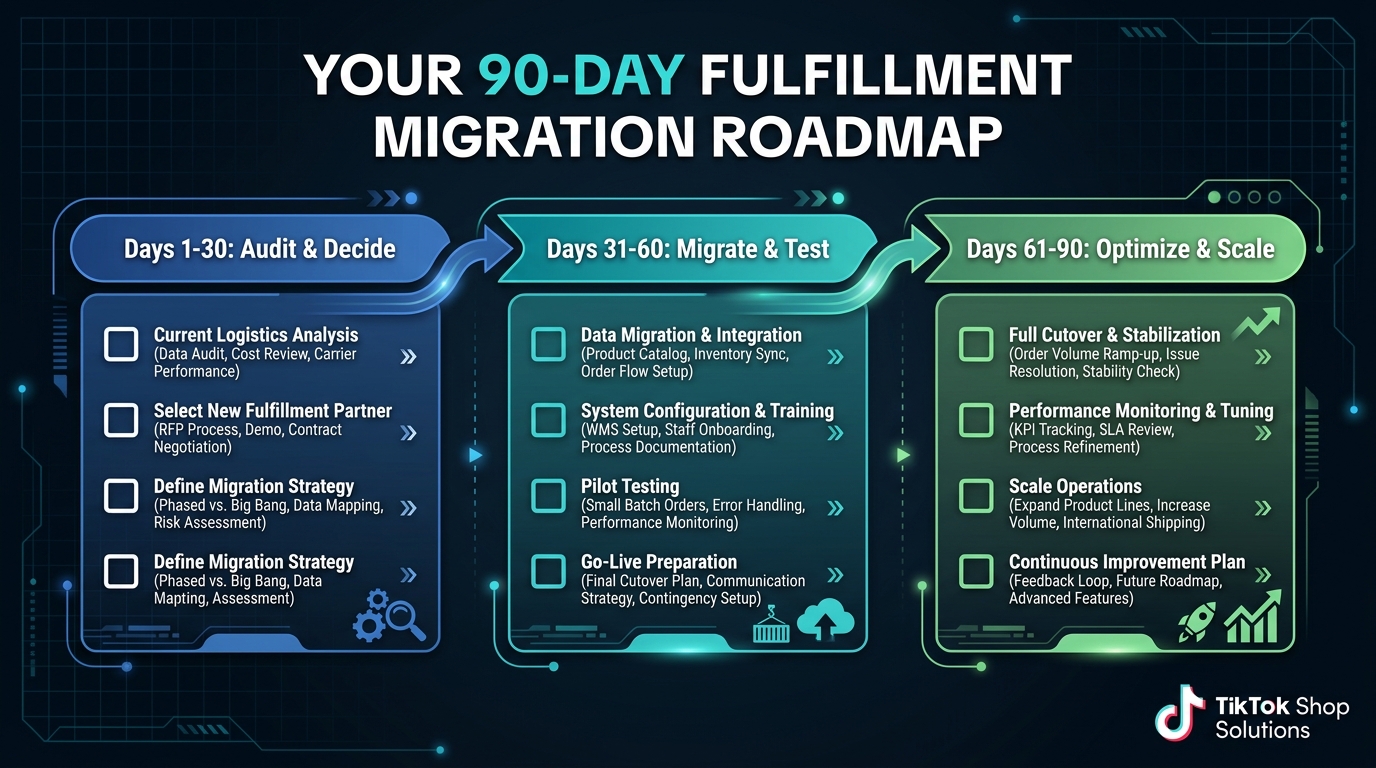
If your TikTok Shop operation is still primarily running on Seller Shipping and you haven’t yet built a transition plan, the window for an unhurried migration is narrowing. Here’s a practical 90-day framework that moves you from legacy shipping to a compliant, performance-optimized fulfillment setup without disrupting your existing sales velocity.
Days 1–30: Audit and Decide
The first month is about assessment, not action. Before you change anything in your fulfillment setup, you need clear answers to three questions:
Which SKUs should go to FBT? Pull your last 90 days of sales data and filter for products that are: lightweight (under 2 lbs), high-velocity (top 20% of units sold), relatively standardized (no complex assembly or fragile handling needed), and sold primarily as single-unit purchases. These are your FBT candidates. Everything else needs a different path.
What are your current performance metrics? Pull your VTR, LDR, OTDR, and SFCR from the seller dashboard and map them against TikTok’s published thresholds. Any metric within 2 percentage points of the danger threshold needs immediate attention before you add the complexity of a fulfillment transition.
What 3PL options are available? If your FBT candidate list is small and you need a 3PL path for the rest of your catalog, now is the time to research approved integration partners, request references from their existing TikTok Shop clients, and begin the onboarding conversation. 3PL onboarding typically takes 4–8 weeks even under ideal circumstances.
Days 31–60: Migrate and Test
In the second month, you execute the transitions you planned in month one — but you do it conservatively. Inbound your first FBT shipment with a subset of your highest-velocity SKUs, not your entire catalog. This gives you real performance data on FBT economics and operational requirements before you commit your whole inventory.
Monitor your listing metrics daily after FBT goes live. Look for the badge activation, track the views uplift, and compare conversion rates on FBT-enabled listings versus your non-FBT listings for the same 30-day window. This data is your proof of ROI — or your early warning that something in the setup needs adjustment.
For any SKUs remaining on Seller Shipping during this period, ensure you’re meeting performance thresholds without exception. A metric failure during your migration window is particularly costly because it creates account health headwinds precisely when you’re trying to stabilize a new setup.
Days 61–90: Optimize and Scale
The third month is about using real data from your migration to make permanent decisions about catalog structure. Expand FBT enrollment to additional SKUs that proved to be good candidates in the model. Finalize your 3PL integration for the products that can’t or shouldn’t go to TikTok’s warehouses. And build the operational monitoring infrastructure — dashboards, alerts, and daily reporting routines — that will sustain compliance without requiring manual heroics every week.
This is also the time to build out your viral buffer inventory for the products that are now in FBT. Identify your creator pipeline for the next quarter, estimate peak demand scenarios for each, and ensure your FBT inventory levels can absorb the highest-probability spikes without triggering oversell or cancellation problems.
Reading TikTok’s Long Game on Fulfillment
Beyond the immediate operational decisions, sellers benefit from stepping back and reading what TikTok’s logistics moves collectively signal about where the platform is heading over the next two to three years. The rollback of the Seller Shipping mandate was a tactical retreat, not a strategic reversal. The platform is building toward a logistics reality that looks very different from today’s landscape.
The Amazonification of TikTok Shop
Every major move TikTok Shop has made on logistics follows the same template Amazon executed over the 2006–2015 period: build fulfillment infrastructure, incentivize seller adoption through better placement, tie buyer trust signals (delivery speed, reliability) to platform-controlled fulfillment, then progressively disadvantage sellers who operate outside that infrastructure. Amazon’s success in building FBA into the de facto standard for serious marketplace sellers provides a clear precedent for where TikTok is headed.
The difference is time compression. Amazon took nearly a decade to make FBA the default choice for most third-party sellers. TikTok is moving faster and with more aggressive policy levers — platform-controlled labels, performance scoring directly tied to visibility, and algorithmic advantages that can’t be replicated outside FBT. The question is not whether TikTok’s logistics model eventually dominates seller operations on the platform. It’s how quickly that happens and whether sellers are positioned for it when it does.
Infrastructure Investment as a Signal
TikTok has been expanding FBT warehouse infrastructure in the United States at a pace that suggests the company views logistics control as a core long-term competitive asset, not a customer service enhancement. New fulfillment center footprint reduces average delivery time, which improves the delivery promise that drives badge qualification, which drives more seller enrollment, which drives more volume through the network. This is a flywheel that, once at sufficient scale, is self-reinforcing.
Sellers who read this investment pattern correctly will treat FBT enrollment not as a compliance decision but as early positioning in a network that becomes more valuable as it grows. The sellers already in FBT when TikTok’s fulfillment network reaches critical mass will have established performance histories, optimized inbound workflows, and algorithmic track records that new entrants won’t be able to replicate quickly.
What Policy Whiplash Actually Tells You
The early 2026 mandate-and-reversal sequence is actually informative for sellers who interpret it correctly. It tells you that TikTok doesn’t yet have sufficient FBT capacity and seller-readiness to absorb a forced migration of the entire U.S. seller base simultaneously. The reversal was capacity-constrained, not intent-constrained. As TikTok expands warehouse footprint and as the FBT enrollment rate grows organically through incentives, the conditions for a harder enforcement push improve. The next time TikTok announces a Seller Shipping deadline, it will be from a position of greater infrastructure readiness — which means it’s more likely to stick.
The Operators Who Win This Shift
Every significant platform logistics change creates a redistribution of competitive advantage. The sellers who win the TikTok Shop logistics transition aren’t necessarily the largest or the best-funded. They’re the ones who make the right structural decisions early enough to benefit from the advantages that flow to early adopters, rather than scrambling reactively when enforcement catches up with the laggards.
What the Winners Are Doing Differently
Across the operational patterns visible among high-performing TikTok Shop sellers in 2026, a few consistent behaviors stand out:
They treat fulfillment as a marketing function, not a cost center. The best operators understand that FBT enrollment, delivery speed, and account health scores are inputs to algorithmic performance — which means they’re inputs to every dollar of revenue they generate on the platform. The CFO frame of “how much does fulfillment cost” has been replaced by a growth frame of “what does fulfillment contribute to conversion and visibility.”
They plan for virality as an operational scenario, not a lucky exception. Viral demand spikes on TikTok are not improbable edge cases — they’re a routine feature of the platform’s content dynamics. The sellers who have viral buffer inventory, real-time sync across channels, and pre-planned escalation protocols for spike scenarios treat these events as business opportunities. The sellers who haven’t planned for them treat them as crises.
They monitor performance metrics daily, not monthly. The gap between a compliant account and a penalized one can close in 48–72 hours of poor logistics execution. Daily metric monitoring with automated alerts isn’t operational overhead — it’s the early warning system that keeps a growing business from an account health problem that can take weeks to resolve.
They select fulfillment paths by SKU, not by convenience. The hybrid model — FBT for high-velocity core products, compliant 3PL for everything else — is more work to manage than picking one path and applying it universally. But it consistently produces better economics and better performance metrics than either extreme in isolation.
The Structural Advantage of Moving Now
TikTok’s logistics shift is still in progress. The window in which early FBT enrollment delivers disproportionate algorithmic advantages — before the majority of sellers are enrolled and the baseline moves up — is not infinite. Sellers who complete their migration in the next 90 days are capturing an advantage that will be smaller in six months and smaller still in twelve.
The mandate may have been paused. The incentives have not. And on TikTok Shop, where algorithmic momentum is the foundation every other growth investment builds on, being ahead of the logistics curve is not a minor operational refinement. It’s a fundamental competitive position.
The bottom line: TikTok Shop’s logistics transformation is not over — it’s between acts. Use this window not to exhale, but to build the fulfillment infrastructure that makes the next policy announcement irrelevant to your operations because you’ll already be compliant, already be optimized, and already be collecting the algorithmic returns that early adoption delivers.
Key Takeaways for Sellers
- The Seller Shipping reversal was a timing adjustment, not an intent reversal. Plan for a harder enforcement cycle in the next 12–18 months.
- FBT’s conversion uplift (15–22% conversion increase, 40% more daily views) makes it a revenue driver, not just a logistics choice.
- The four core performance metrics — VTR ≥95%, LDR ≤4%, OTDR ≥80%, low SFCR — directly control your listing visibility and Shop Performance Score.
- Total TikTok Shop cost stack runs 30–55% of revenue across platform fees, creator commissions, and fulfillment. Model this accurately before setting prices.
- Viral buffer inventory is the single most underused operational tool among growing TikTok Shop sellers.
- The hybrid model (FBT for core SKUs + compliant 3PL for the rest) is the dominant pattern among sophisticated multi-channel operators.
- Cross-border (CBT) sellers need to model duty costs explicitly and stress-test against tariff changes — the margin cushion is thinner than it appears.
- The 90-day migration framework (audit, migrate and test, optimize and scale) gives sellers a structured path without disrupting current sales velocity.