


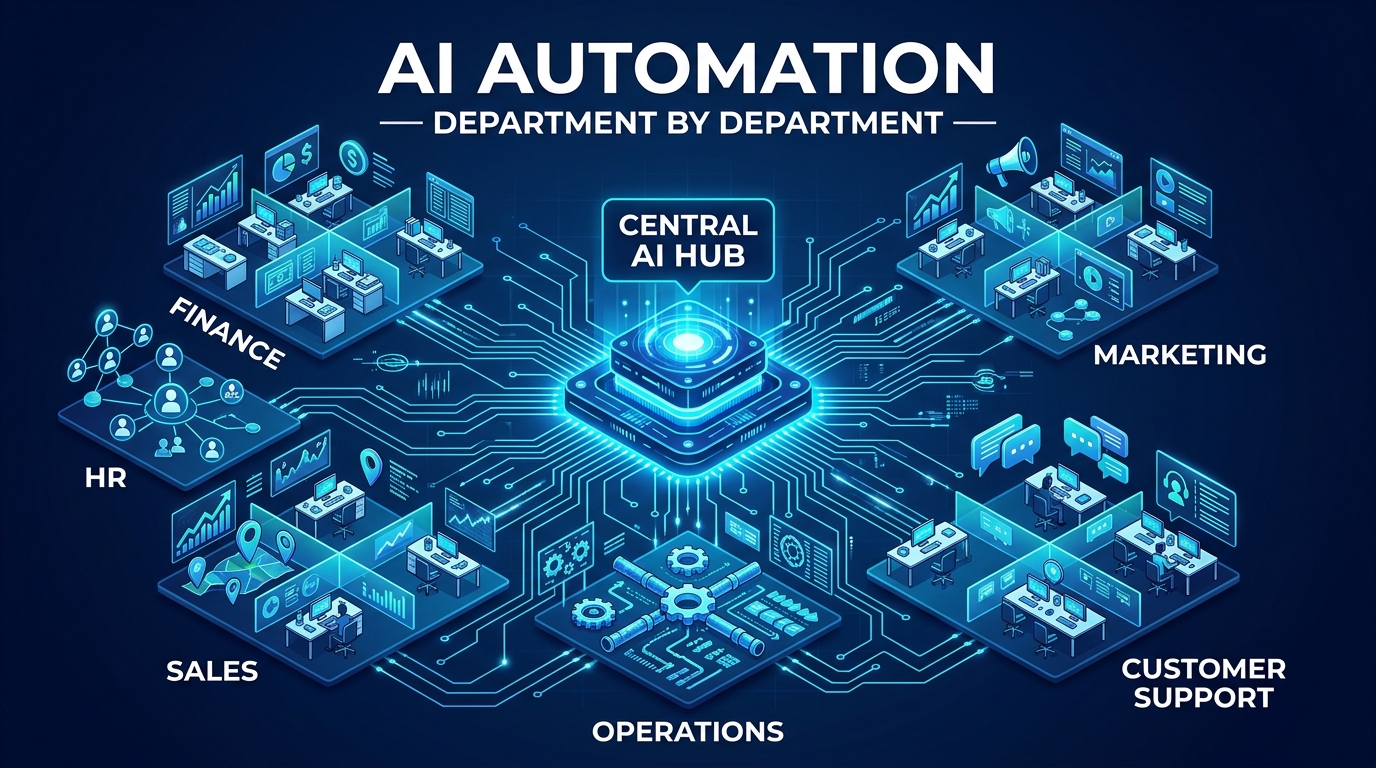

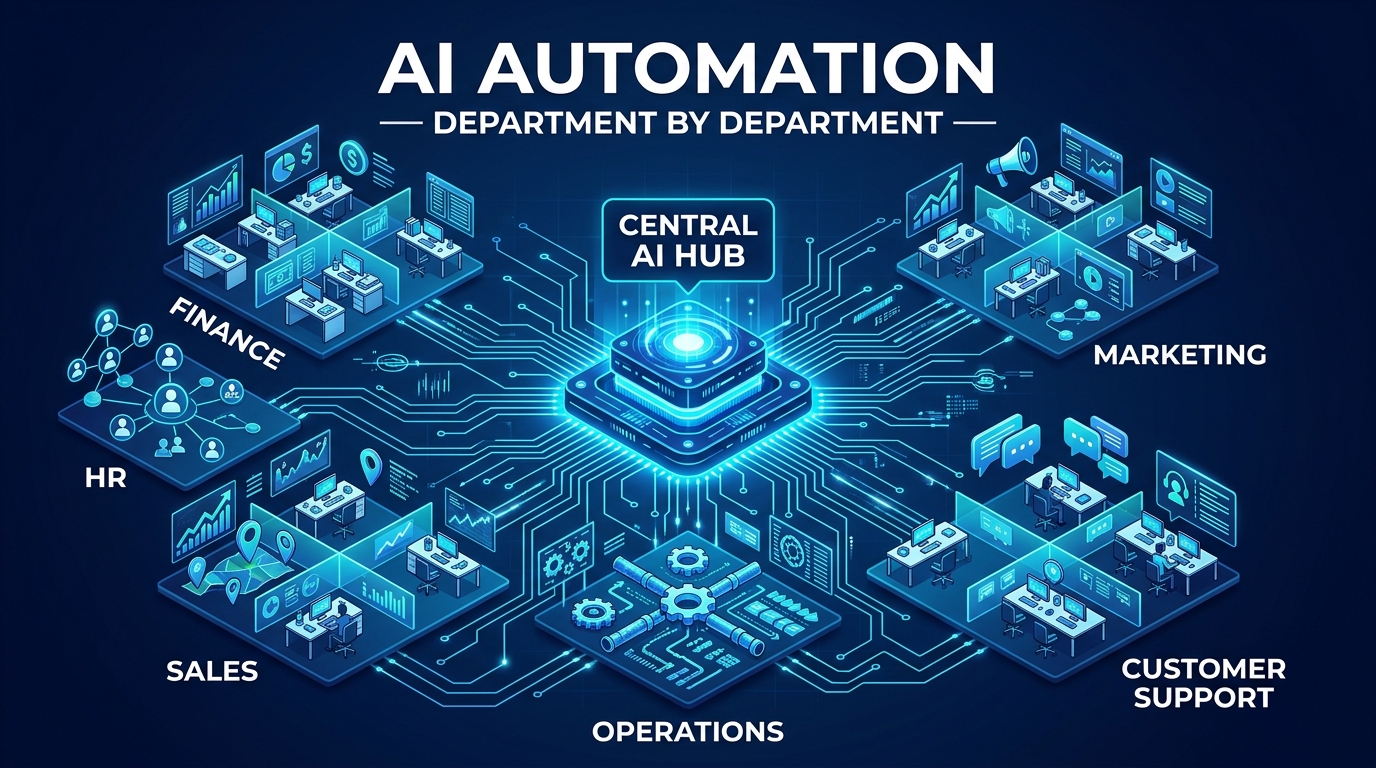
Every leadership team is talking about AI automation. The board wants a strategy, the CFO wants a business case, and the heads of every department want to know what it means for their team specifically. The conversation is everywhere — but the signal-to-noise ratio is terrible.
Most of the content on AI automation treats the subject as a single, undifferentiated blob of technology that a business either “adopts” or doesn’t. In practice, AI automation is not one thing. What it means in your finance team is categorically different from what it means in your customer support operation or your HR department. The use cases, the risks, the readiness requirements, and the realistic outcomes vary enormously depending on where in the organisation you apply it.
This post takes a different approach. Instead of talking about AI automation in the abstract — with vague promises of efficiency gains and cost savings — it goes room by room through a typical business and asks a more grounded question: what does AI automation actually change in this department, today, for a team that is genuinely trying to implement it?
That means being honest about where automation delivers quickly, where it requires significant groundwork before it delivers anything, and where the human layer remains non-negotiable regardless of what the technology can theoretically do. It also means addressing the governance and readiness questions that most organisations skip until something goes wrong.
By the end of this, you will have a realistic mental model of AI automation as it functions across the operational fabric of a real business — not as a single initiative, but as a set of department-specific decisions that each carry their own logic, their own risks, and their own timelines.
Why “AI Automation” Means Something Different in Every Room of Your Business
There is a fundamental category error that shows up repeatedly in AI automation conversations. Executives treat it as an enterprise-wide technology deployment — a single project with a single owner, a single budget line, and a single rollout plan. This framing makes sense for IT infrastructure or ERP systems. It does not make sense for AI automation, and the disconnect is one of the primary reasons so many initiatives stall after the pilot stage.
AI automation is better understood as a capability layer that expresses itself differently depending on the work being automated. Its value, its requirements, and its limitations shift dramatically based on three factors: the nature of the tasks being automated, the quality and structure of the data those tasks generate, and the tolerance for error in the department doing the work.
Three Axes That Determine AI Automation Fit
Task nature: Repetitive, rules-based tasks with clear inputs and outputs are the easiest entry point for automation — think invoice matching, appointment scheduling, or email routing. Tasks that require contextual judgment, stakeholder management, or ethical reasoning are significantly harder to automate, and attempting to do so prematurely carries real organisational and reputational risk.
Data quality: AI systems learn from historical data. A department that has been running structured, clean, consistently formatted data through its processes for years is in a fundamentally different position from a department whose records are spread across spreadsheets, email chains, and legacy systems. Automation amplifies the quality of your underlying data — which means it also amplifies the problems when that data is poor.
Error tolerance: In some departments, a 2% error rate from an automated system is an acceptable trade-off for speed and scale. In others — payroll, compliance, patient records, financial reporting — the same error rate is a regulatory or reputational catastrophe. Understanding which department you are in, on which tasks, is not a technical question. It is a risk management question that belongs in the business conversation before any system is deployed.
These three axes explain why the same technology platform — say, a machine learning model that classifies text — can be a high-return, low-risk deployment in one part of a business and a liability-generating mistake in another. The technology is not what determines the outcome. The context is.
The Automation Maturity Spectrum
It is also worth distinguishing between the different levels of automation maturity that departments reach over time. The first level is task automation: single, discrete actions are handled by software — a form is populated, a document is filed, a notification is sent. The second level is workflow automation: multiple tasks are connected into an end-to-end process that runs without human intervention at each step. The third level is intelligent automation: AI adds judgment to the workflow — classifying inputs, making conditional decisions, adapting to new patterns, and improving its own performance over time.
Most departments in most businesses are somewhere between levels one and two in 2026. Very few have reached level three in a meaningful, production-grade sense. Recognising where your departments actually sit — rather than where your vendor pitch materials suggest — is the starting point for any realistic AI automation strategy.
Finance and Accounting: The Department That Gets Automated First — and Why It’s Still Not Done
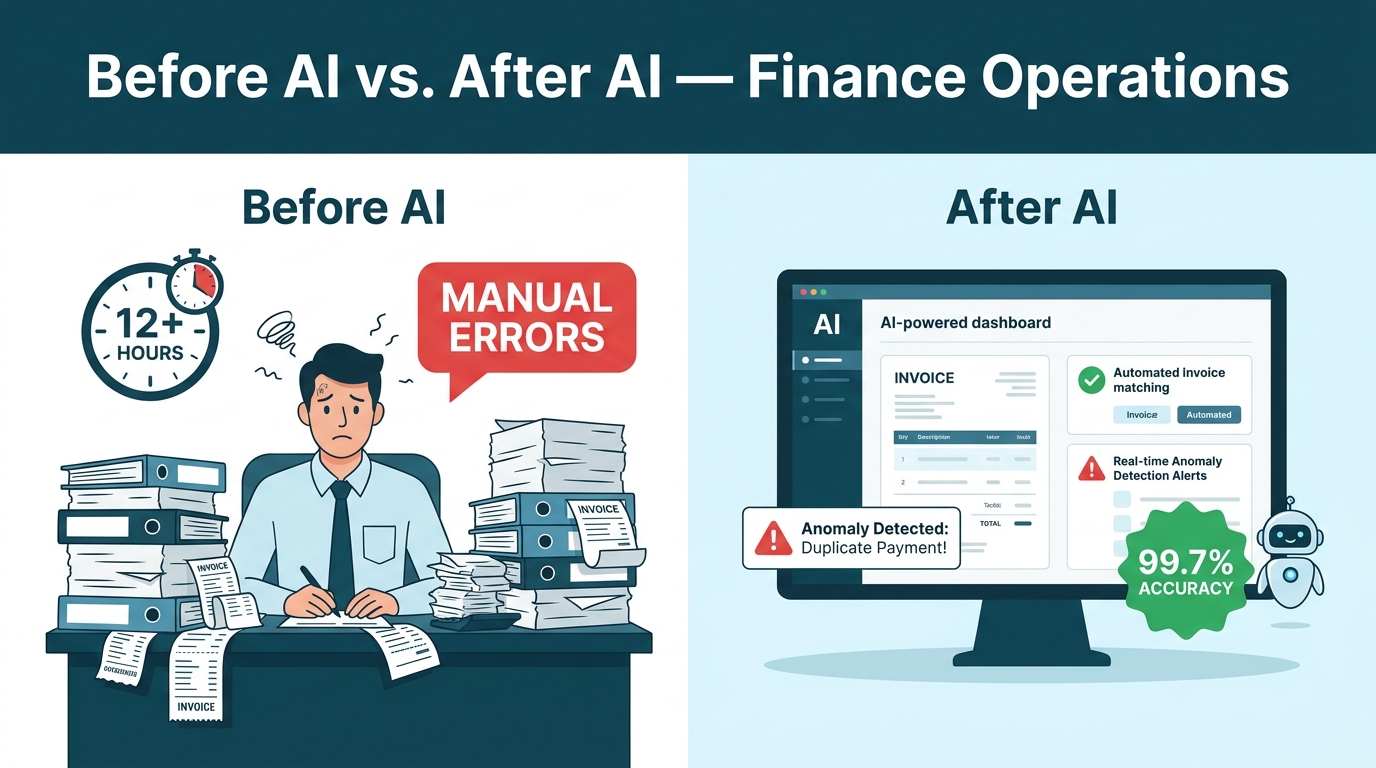
Finance was the first department where business automation took hold, and it remains one of the most heavily automated parts of most organisations today. Yet despite decades of technology investment, most finance teams still spend a disproportionate share of their time on manual data handling. The reason is not a lack of ambition — it is a structural problem with how financial data enters the business.
Where AI Is Delivering Real Results in Finance
Accounts payable and receivable automation is the most mature use case. AI-powered systems can now extract data from unstructured invoices — scanned PDFs, emailed attachments, supplier portal formats — match them to purchase orders, flag discrepancies, and route exceptions for human review. What used to take a team of AP clerks several days per month can be processed continuously, with straight-through processing rates of 70–85% on well-trained systems. The remaining 15–30% of exceptions still require human judgment, which is the correct place for human effort: not on the routine, but on the genuinely ambiguous.
Expense management has seen similar gains. AI models can categorise expenses, flag policy violations, identify duplicate claims, and generate audit-ready reports without anyone manually reviewing each receipt. The friction-reduction for employees filing expenses is significant; the time-saving for finance teams reviewing them is larger.
Financial close and reporting is where automation is still maturing. The monthly close process — reconciling accounts, consolidating reports, generating management packs — involves enough structured, repeatable steps that automation can compress timelines meaningfully. Some organisations have moved from a 10-day close to a 5-day close with the help of automated reconciliation and anomaly detection. Getting to a one-day close requires not just automation but a broader rethink of how data flows through the business, which is a multi-year infrastructure project, not an AI deployment.
Where Finance Automation Still Struggles
The harder problems in finance are not operational — they are analytical. AI can surface patterns in your financial data faster than any analyst. It can flag that a particular cost centre’s spend has deviated from trend, or that revenue recognition timing looks inconsistent with prior periods. What it cannot do is explain those patterns in the context of business decisions your team made six months ago, negotiate with a supplier about a disputed invoice, or decide whether an anomaly is a data entry error or a genuine business signal. Those tasks belong to finance professionals, and they are, if anything, more important when AI is handling the routine work.
There is also a significant data quality debt problem in most finance organisations. Legacy ERP systems, manual journal entries, and inconsistent coding practices create a substrate of messy data that AI models struggle to work with reliably. Before automation can deliver on its potential in finance, many teams need to invest in data cleaning and standardisation — work that is unglamorous but foundational.
Customer Support: From Cost Centre to Intelligence Engine
Customer support is where AI automation has made the most visible consumer-facing impact, and also where the gap between good implementation and bad implementation is most starkly felt. A well-deployed AI support system reduces cost, improves response times, and frees human agents for genuinely complex interactions. A poorly deployed one creates frustrated customers, high escalation rates, and a brand perception problem that takes years to recover from.
The Triage Model: Why AI in Support Works Best in Layers
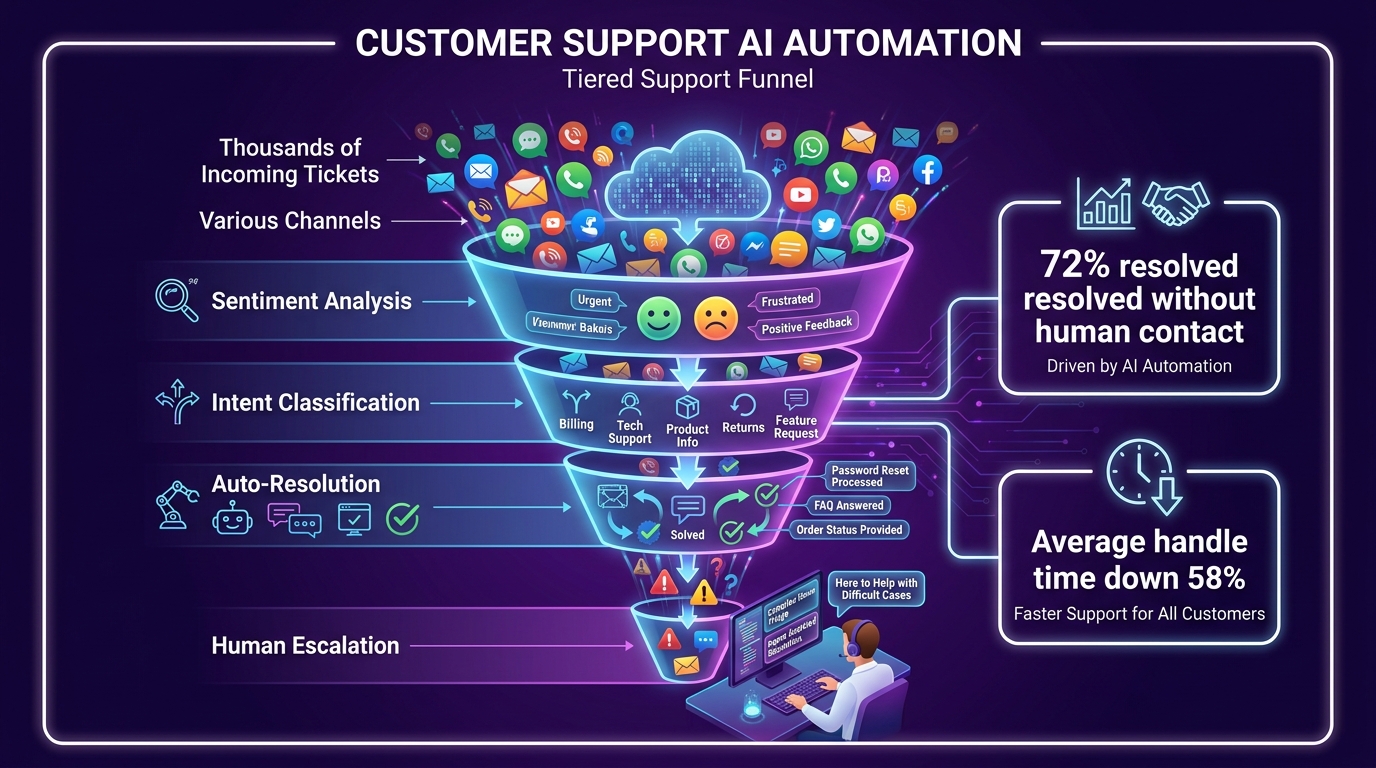
The most effective AI support deployments do not attempt to automate everything. They build a layered triage architecture where AI handles an increasing share of volume while human agents focus on a decreasing but higher-value slice of interactions.
At the top of the funnel, natural language processing classifies incoming tickets by intent, urgency, and sentiment. A customer asking “where is my order?” is categorically different from one writing “I’ve been waiting three weeks and I’m about to dispute this charge” — even though both technically relate to order status. AI can make that distinction reliably and route accordingly.
At the next layer, automated resolution handles queries that have clear, data-driven answers: order status lookups, account balance enquiries, FAQ responses, basic troubleshooting scripts. PayPal has publicly noted using AI to handle the majority of its message-based customer interactions at peak periods — not because it wanted to reduce staffing costs, but because it needed to maintain service levels at a scale no human team could match in real time.
At the bottom of the funnel, agent-assist AI supports human representatives during live interactions. Rather than fully automating the conversation, it surfaces relevant knowledge base articles, suggests response templates, pulls up customer history, and flags if the tone of the interaction is escalating. Agents who work with AI assist tools consistently handle more interactions per shift and receive higher customer satisfaction scores than those working without them — not because the AI writes their responses, but because it removes the search and retrieval burden that consumed so much of their time.
The Customer Experience Trade-off
The critical question in AI-powered support is not “how much can we automate?” — it is “at what point does automation damage the customer relationship?” The answer varies by industry, by customer segment, and by the nature of the enquiry. A customer asking a billing question for a $30 software subscription has different expectations from a patient trying to resolve a medical billing dispute or a business owner dealing with a service outage that is costing them money by the hour.
Organisations that have deployed AI support successfully have one thing in common: they have been deliberate about where the handoff to a human happens, and they have made that handoff fast and friction-free. The failure mode is the chatbot loop — where a customer cannot resolve their issue with the automated system, cannot get to a human, and experiences the automated system as a barrier rather than a service. This is an implementation design failure, not an AI capability failure, and it is entirely avoidable.
Support as an Intelligence Source
One of the underutilised benefits of AI in customer support is not speed or cost reduction — it is insight generation. Every support interaction is a signal about product quality, process gaps, communication failures, and unmet customer needs. AI systems that process thousands of tickets can identify patterns that no team of human analysts could spot in real time: a spike in complaints about a specific product batch, consistent confusion about a pricing page, a new class of customer arriving from an unfamiliar acquisition channel. Support is, in this sense, one of the richest feedback loops in a business — and AI is finally making it possible to actually listen to it at scale.
Sales and Revenue Operations: Where AI Earns Its Salary Fastest
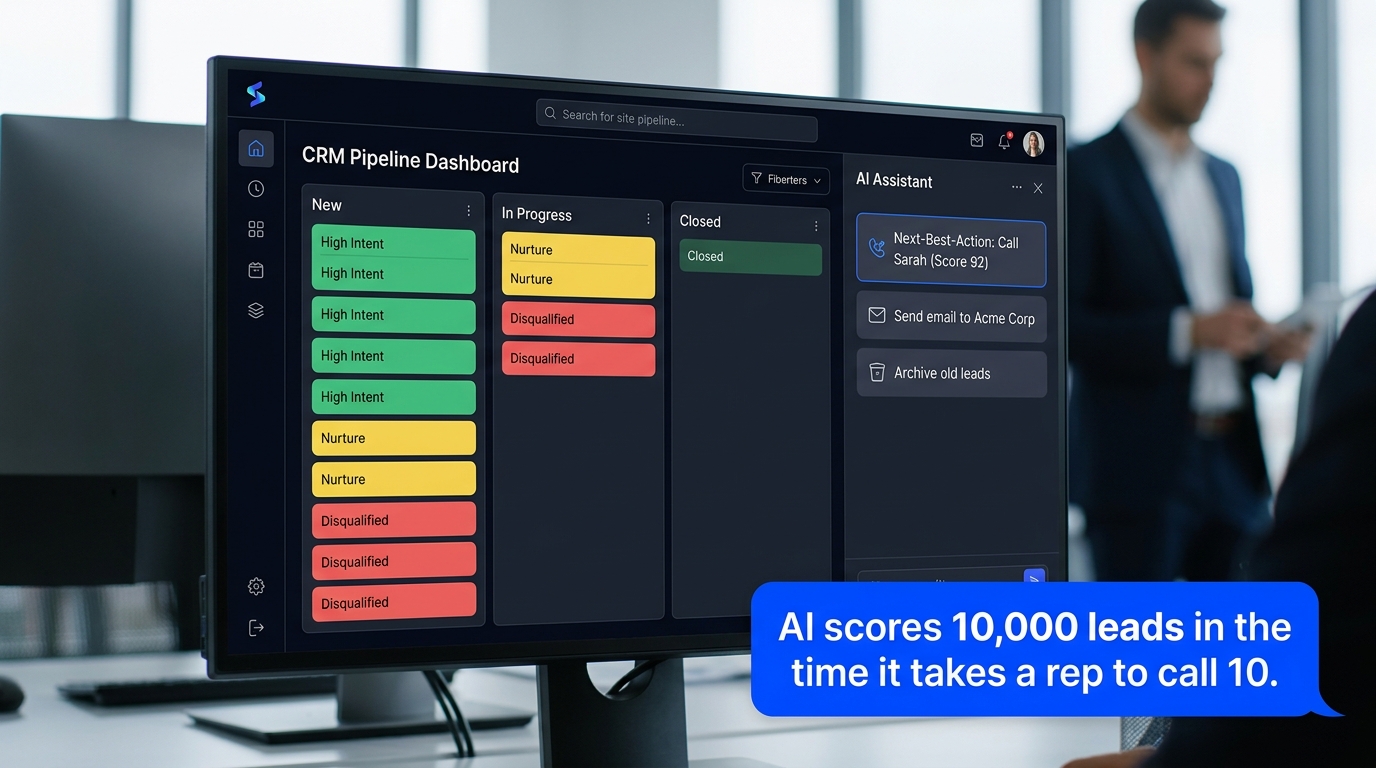
Sales is where AI automation generates the most directly measurable return, and where adoption friction from the team tends to be highest. These two facts are not unrelated. The tension between what AI can do for sales performance and what salespeople fear AI will do to their autonomy is one of the defining implementation challenges in revenue-focused automation.
Lead Scoring and Prioritisation
The most widely deployed AI application in sales is lead scoring — using machine learning models to rank inbound and outbound prospects by their probability of converting within a given timeframe. Traditional lead scoring was manual and rule-based: marketing qualified leads that hit certain thresholds (opened three emails, visited the pricing page, downloaded a whitepaper), and sales followed up in the order those leads arrived.
AI-powered scoring models work differently. They analyse a much larger feature set — CRM history, engagement patterns, company size, industry, technographic data, website behaviour, social signals — and generate probabilistic scores based on patterns learned from historical wins and losses. The output is a prioritised queue that tells a sales rep, with a reasonable degree of confidence, which prospects are most likely to close and which need to be nurtured further before a direct outreach attempt.
The business impact is significant. Sales teams working with AI-prioritised pipelines typically spend more of their time on conversations that have a genuine chance of converting, and less on prospects who are browsing with no near-term intent. This is not a small efficiency gain — time is a salesperson’s primary constraint, and routing their attention better is a direct revenue lever.
Sales Process Automation
Beyond lead scoring, AI is automating a range of administrative burdens that eat into selling time. Automatic CRM entry from call transcripts, AI-generated follow-up email drafts, automated meeting scheduling, and proposal template population are all now within reach of mid-market sales teams, not just enterprise organisations with large RevOps functions.
Research consistently shows that sales representatives spend less than a third of their working hours in direct selling activities. The rest is administration, coordination, and preparation. Automation does not make salespeople better at persuasion or relationship-building — those remain human skills. What it does is give them significantly more time to exercise those skills, which is the correct framing for any sales leader introducing AI tools to their team.
Forecasting and Pipeline Intelligence
Revenue forecasting is one of the highest-stakes processes in any business, and one where AI is adding meaningful value — with an important caveat. AI-powered forecasting models trained on historical pipeline data can be significantly more accurate than bottom-up manager estimates, particularly at aggregating across a large sales team where individual bias compounds. They can also flag pipeline risks in real time: deals that have stalled based on engagement patterns, rep performance deviations from trend, and territory gaps that are likely to show up in next quarter’s results.
The caveat is that AI forecasting models are backward-looking by construction. They are very good at predicting what will happen if conditions stay similar to how they have been. They are less useful when a major market event, a competitive product launch, or a significant pricing change disrupts the patterns they were trained on. Forecasting AI should be treated as a sophisticated starting point for the human conversation, not as a replacement for it.
Marketing: The Creative-Operational Split That Defines AI’s Real Role
Marketing is the department where AI automation conversations get the most confused, primarily because marketing does two fundamentally different types of work: creative and operational. AI’s role in each is very different, and conflating them leads to both over-investment in areas where AI adds little and under-investment in areas where it adds a great deal.
Operational Marketing: Where Automation Belongs
The operational side of marketing — campaign scheduling, audience segmentation, A/B test management, email sequence logic, ad placement and bid adjustment, performance reporting — is highly suitable for AI automation. These are data-intensive, rules-responsive, and repetitive tasks that benefit from the speed and consistency AI systems bring.
Marketing automation platforms have been handling some of these tasks for a decade. What AI adds is adaptive intelligence: the ability to adjust audience segments in real time based on engagement signals, to personalise email content at the individual level, to redistribute ad budget across channels as performance data shifts, and to flag performance anomalies before they become expensive problems. The difference between a rule-based automation that sends email sequence A to segment B, and an AI-powered system that dynamically selects the optimal sequence, cadence, and content for each individual based on their live behaviour, is not incremental — it is structural.
Creative Marketing: Where AI Assists but Doesn’t Own
The creative side of marketing — brand voice, campaign strategy, big creative concepts, audience insight, cultural relevance — is where AI’s role is more limited and more contested. Generative AI tools can produce copy, image variations, and video scripts at significant scale, and they are genuinely useful for drafting, ideating, and iterating. What they do not have is taste, cultural context, or strategic intent.
The practical implication is that marketing teams using AI for creative production need a clear human editorial layer. AI-generated content that goes to market without meaningful human review and judgment tends to be technically competent and strategically shallow — it reads as content for the sake of content, and audiences increasingly sense that. The best-performing marketing organisations use AI to dramatically expand their production capacity while maintaining human responsibility for the decisions that shape brand perception.
Attribution and Customer Journey Intelligence
One area where AI is genuinely changing the quality of marketing decisions — not just the speed — is multi-touch attribution and customer journey analysis. Understanding which combination of touchpoints drives conversion, across an increasingly fragmented digital landscape, is a problem that traditional analytics approaches handle poorly. AI models that can process the full event stream of customer behaviour — across channels, devices, and timeframes — and identify causal patterns give marketing leaders a much more reliable basis for budget allocation decisions. This is not glamorous automation, but it is high-value automation because it directly informs where the next marketing dollar goes.
HR and People Operations: The Quiet Automation Revolution No One Talks About
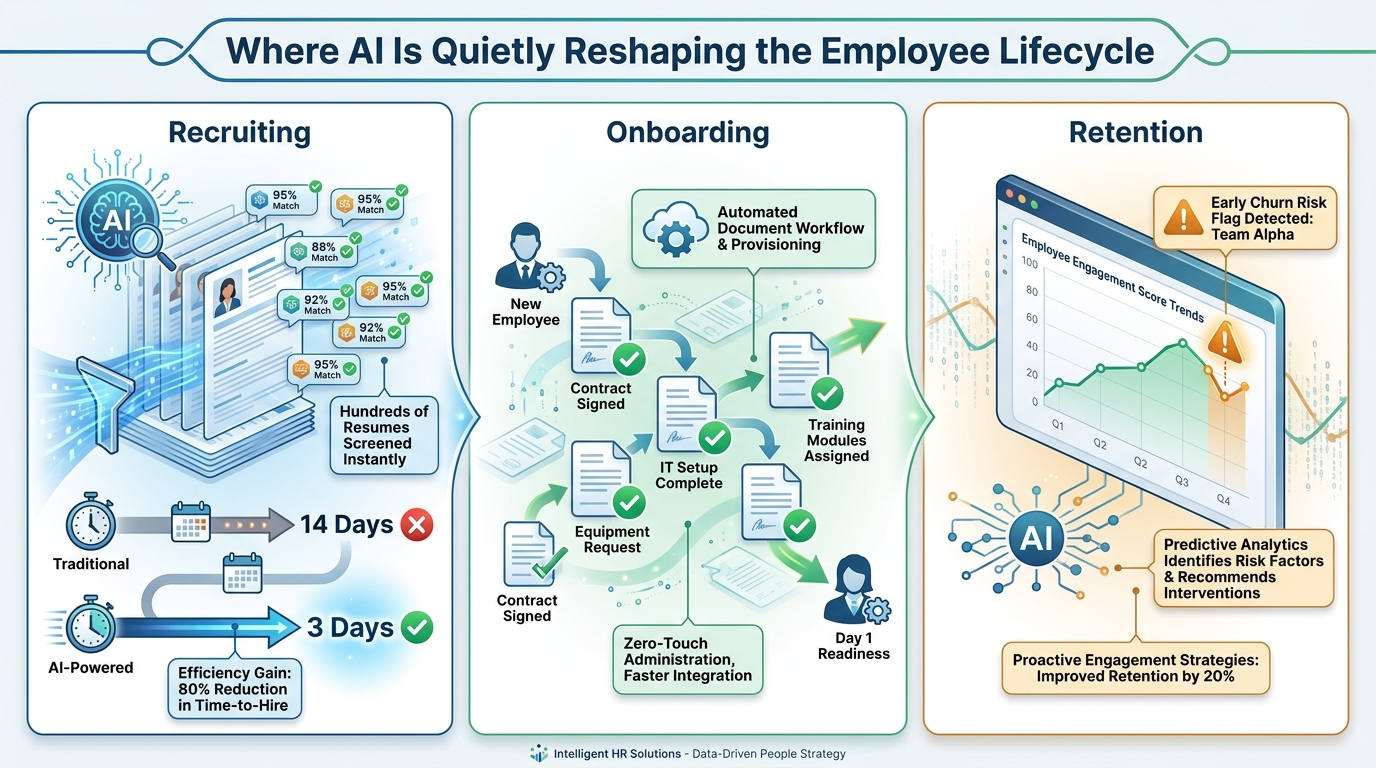
HR automation gets less attention in the executive conversation than finance or sales automation, partly because its ROI is harder to express in revenue terms and partly because the ethical questions it raises make organisations cautious about being too public. Both of these are understandable — but they mean that HR automation is developing in a piecemeal, under-governed way in many organisations, which is not a safe outcome.
Recruiting: The Most Automated Part of HR
AI has penetrated the recruiting process more deeply than any other HR function. Resume screening tools that use machine learning to score candidates against job requirements have been in use for several years at enterprise scale. Chatbot-based initial screening — where candidates answer qualifying questions through a conversational interface before reaching a human recruiter — is now common in high-volume hiring contexts. Interview scheduling automation, automated reference check workflows, and AI-generated job description templates are all widely deployed.
The productivity case is straightforward: a recruiter who previously spent two hours per day screening resumes can redirect that time to candidate relationship-building, hiring manager consultation, and the qualitative assessment work that genuinely requires human judgment. In high-volume recruitment — retail, logistics, seasonal hiring — the time compression is even more dramatic.
The ethical case requires more careful attention. AI recruiting tools trained on historical hiring data can encode historical biases — if a company has historically hired fewer women into technical roles, a model trained on that data may learn to deprioritise female candidates. This is not a hypothetical concern; it has been documented in real deployments. Responsible use of AI in recruiting requires regular bias audits, diverse training datasets, and a clear human review checkpoint before any candidate is rejected solely on the basis of an AI score.
Onboarding, Learning, and Development
Once an employee is hired, AI automation can significantly improve the onboarding experience — and the speed at which new hires become productive. Automated document collection and verification, AI-guided orientation sequences, personalised learning path recommendations based on role and skill profile, and chatbot-based FAQ handling are all now within reach of organisations that have invested in their HR technology stack.
Learning and development is an area where AI is beginning to add more sophisticated value. Adaptive learning platforms that adjust content difficulty and pacing based on individual performance data are demonstrably more effective at skill retention than one-size-fits-all training programmes. For organisations that need to reskill large workforces quickly — a frequent challenge in sectors undergoing rapid change — this matters considerably.
Retention Risk and People Analytics
One of the more sensitive applications of AI in HR is predictive attrition modelling — using engagement survey data, performance records, compensation benchmarking, and behavioural signals to identify employees who are at elevated risk of leaving before they resign. The technology works with meaningful accuracy when the underlying data is clean and sufficient. The ethical and cultural questions about whether and how to act on this intelligence are genuinely complex, and different organisations handle them differently.
What is clear is that people analytics — the use of data to understand workforce patterns — is maturing rapidly, and AI is making it accessible to mid-market organisations that previously lacked the analyst capacity to build these models internally. The question is not whether to use people data — every organisation already does — but how to use it in a way that respects employee privacy, complies with relevant regulations, and serves the interests of the organisation and its people simultaneously.
Supply Chain and Operations: Precision at a Scale Humans Cannot Replicate
Supply chain and operations is the domain where AI automation arguably has the most objectively significant potential, because the scale and complexity of the problems it is solving genuinely exceed human cognitive capacity. No human team can simultaneously monitor thousands of supplier relationships, model the inventory implications of a weather event in one geography while managing a demand spike in another, and adjust production schedules accordingly — in real time. AI systems are beginning to do exactly this, and the gap between organisations that have deployed them and those that haven’t is measurable in working capital efficiency, service level performance, and supply chain resilience.
Demand Forecasting and Inventory Optimisation
Traditional demand forecasting relies on historical sales data adjusted by human judgment about seasonal patterns, promotional activity, and market trends. AI-powered demand forecasting incorporates a much wider range of signals: weather data, economic indicators, social media sentiment, competitor pricing, and real-time point-of-sale feeds. The result is a significantly more accurate forecast, which translates directly into lower safety stock requirements (less working capital tied up in inventory), fewer stockouts (more revenue captured), and more efficient production planning (lower manufacturing and logistics costs).
The business case for AI-powered demand forecasting tends to be one of the most straightforward in the entire automation landscape, because the financial impact of forecast accuracy is directly visible in inventory levels, fill rates, and markdown rates. This is one of the reasons it has seen rapid adoption in retail, consumer goods, and distribution — sectors where those metrics are closely watched at the executive level.
Supplier Risk Management
AI is also beginning to change how organisations manage supplier risk. Automated systems can monitor supplier financial health indicators, news sentiment, regulatory compliance status, and operational performance data continuously — flagging early warning signs before they become supply disruptions. The COVID-19 pandemic exposed how brittle many organisations’ supply chain intelligence actually was; many businesses had limited visibility even one or two tiers below their direct suppliers. AI-powered supply chain mapping and risk monitoring tools are addressing this gap, though the data integration requirements are significant.
Logistics and Last-Mile Optimisation
Route optimisation, load planning, carrier selection, and last-mile delivery management are all areas where machine learning models consistently outperform rule-based approaches, because the number of variables involved is too large for static rule sets to handle efficiently. Major logistics operators have been using AI for route optimisation for years; the technology is now accessible to mid-market shippers through third-party platforms that do not require building proprietary models in-house.
IT and Security: Automation Eating Its Own Lunch
IT and security operations are in an unusual position with respect to AI automation: they are simultaneously among the most aggressive deployers of automation and among the most exposed to its risks. AI-powered monitoring, anomaly detection, and incident response tools are now central to how most enterprise IT operations run. And yet the same AI capabilities that enable defensive automation are being used by threat actors to generate more sophisticated, higher-volume attacks. The automation arms race in cybersecurity is real and accelerating.
IT Operations Automation
On the IT operations side, AI is primarily adding value through proactive monitoring and self-healing. AIOps platforms — systems that use machine learning to analyse IT event data, correlate alerts, predict infrastructure failures, and in some cases automatically remediate common issues — have matured considerably. The practical outcome is a reduction in mean-time-to-resolution for incidents, fewer outages caused by known failure patterns, and a shift in IT team focus from reactive firefighting to proactive system improvement.
Service desk automation is another well-established use case. Password resets, software provisioning, access request management, and routine troubleshooting queries can all be handled by AI-powered service desk tools, reducing ticket volumes and freeing IT staff for work that requires deeper technical judgment.
Security Operations
Security operations centres are drowning in alert volume. Most enterprise security tools generate far more alerts than any team can investigate manually — a reality that leads either to alert fatigue (human analysts stop taking alerts seriously) or to massive investment in analyst headcount. AI-powered security information and event management systems address this by triaging alerts, correlating events across systems, and surfacing only the patterns that are genuinely likely to represent threats. The result is not a smaller security team — it is a more focused one, spending time on real threats rather than on the noise that obscures them.
The adversarial dimension is important to acknowledge. AI-generated phishing emails are now indistinguishable from human-written ones at scale. Deepfake voice and video technology is being used in social engineering attacks. Automated vulnerability scanning tools are being run offensively faster than defenders can patch. The security automation conversation cannot be held in isolation from the threat automation conversation — they are the same conversation, running in both directions simultaneously.
The Human Layer: Why AI Automation Needs a People Strategy, Not Just a Tech Stack
The most common reason AI automation initiatives underdeliver is not technical — it is organisational. The technology performs within its design parameters. The human system around it does not adapt to work effectively alongside it. This is not a criticism of the humans involved; it is a systems design failure that can be anticipated and addressed.
The Adoption Gap
Automation that is not used is not automation — it is expensive software. The adoption gap between AI systems that get deployed and AI systems that actually change how work gets done is wide in most organisations. The reasons are well-documented: employees who fear that automation signals job elimination resist using it. Teams who were not consulted during the design process do not trust the outputs. Managers who do not understand how a system makes its recommendations cannot communicate its value to their teams. Workflows that were redesigned around automation without adequate change management revert to old habits under pressure.
The solution is not softer messaging or better training materials, though both help. It is involving the people who do the work in the design of the automation that affects them. Process knowledge in most organisations sits with frontline employees, not with the technology team. When automation design ignores that knowledge, it produces systems that technically work but practically fail because they don’t reflect the actual complexity of the work.
Role Redefinition, Not Role Elimination
The employment impact of AI automation is a legitimate subject, and organisations that refuse to discuss it honestly undermine their own implementation efforts. When employees believe automation is being deployed to reduce headcount, they will resist it — rationally and vigorously. When they understand that automation is being deployed to reduce the proportion of their time spent on tedious, repetitive, low-value tasks — and that the expectation is that they will redirect that time to higher-value work — the dynamic changes.
This reframing has to be specific, not generic. “AI will free you up to focus on more strategic work” is too abstract to be reassuring. “AI will handle the invoice matching so you can spend time on the cost analysis that actually influences our supplier negotiations” is concrete, credible, and motivating. The specificity of the message matters as much as its content.
In some cases, AI automation will reduce headcount — typically through attrition rather than redundancy, as organisations do not backfill roles that automation covers. Organisations that are honest about this — while being equally honest about where automation is creating new roles in data management, AI oversight, process design, and exception handling — tend to manage the transition better than those that avoid the conversation entirely.
Building AI Literacy Across the Organisation
One of the most durable investments an organisation can make in its AI automation programme is building baseline AI literacy across the workforce. This does not mean turning every employee into a data scientist. It means ensuring that employees at every level understand, in practical terms, what AI systems can and cannot do, how to interpret their outputs, when to trust them, and when to escalate concerns. Without this foundation, organisations end up with two failure modes: employees who trust AI outputs uncritically (and amplify errors), and employees who distrust them reflexively (and fail to capture the genuine value). Neither extreme serves the business.
How to Audit Your Business for AI Automation Readiness
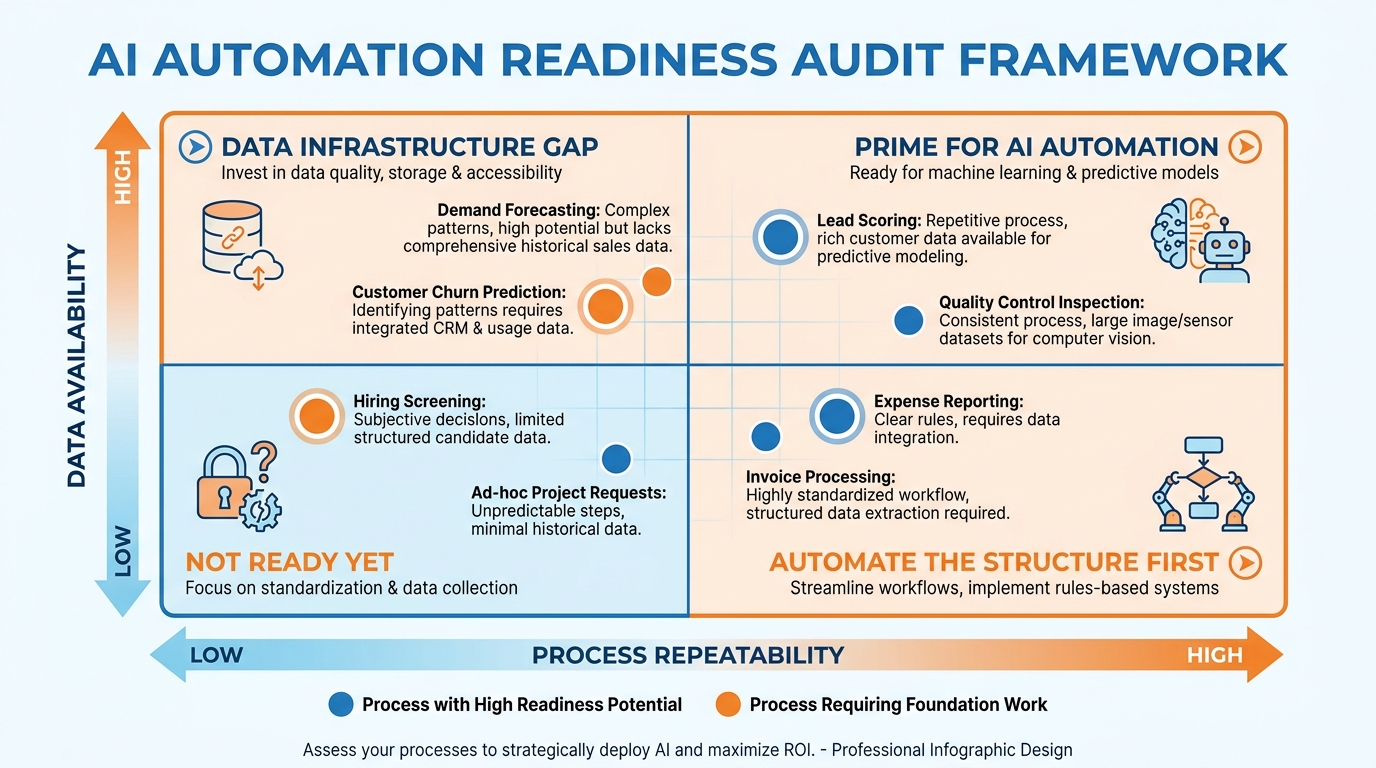
Before any technology decision is made, every automation initiative should begin with an honest audit of the processes being considered for automation and the environment in which they operate. The following framework provides a practical starting point.
Step 1: Map the Process in Detail
Start by documenting the process as it actually runs — not as it is supposed to run according to the procedure manual. Shadow the people who do the work. Capture every step, every decision point, every exception, every workaround, and every informal communication that keeps the process moving. Most processes, when mapped in detail, turn out to be significantly more complex than anyone thought. Some processes that seemed like automation candidates reveal themselves to be so exception-heavy that automation would deliver limited value. Others that seemed complex reveal a core of repetitive steps that could be automated immediately, with exceptions handled by a streamlined human review process.
Step 2: Assess Data Readiness
For each process, ask: What data does this process generate and consume? Is that data structured, consistently formatted, and accessible to a technology system? Is it stored in a place where an AI model can be trained on it? How much historical data exists? What does data quality look like — are there gaps, inconsistencies, or errors in the existing records?
This audit will often surface a data infrastructure gap that needs to be addressed before automation can be deployed effectively. Investing in data quality and data architecture is not the exciting part of an AI programme, but it is frequently the part that determines whether everything else works.
Step 3: Define the Error Tolerance Threshold
For each process or task, define explicitly: what is an acceptable error rate for an automated system? What are the consequences of errors — financial, regulatory, reputational, operational? At what error rate would a human review checkpoint be required? This conversation forces clarity about what “good enough” means in each context, and it prevents the common failure mode of deploying automation that meets a technical performance benchmark but violates the implicit quality standard of the business.
Step 4: Quantify the Value Case
Be specific about what value automation would deliver — in time saved, errors reduced, cost avoided, revenue protected, or employee experience improved. Vague estimates are not useful at this stage. A target of “hours saved per week” converted to a full-time-equivalent cost is more useful than “improved efficiency.” Quantification also forces the question of whether the problem being automated is actually worth the investment required to automate it.
Step 5: Identify the Human Checkpoints
Before deployment, define explicitly where human oversight occurs in the automated process, what triggers a human review, and who is responsible. Building the oversight layer into the design — rather than adding it as an afterthought when something goes wrong — is the difference between a well-governed automation and a liability.
The Governance Gap: What Happens When AI Automation Runs Without Rules
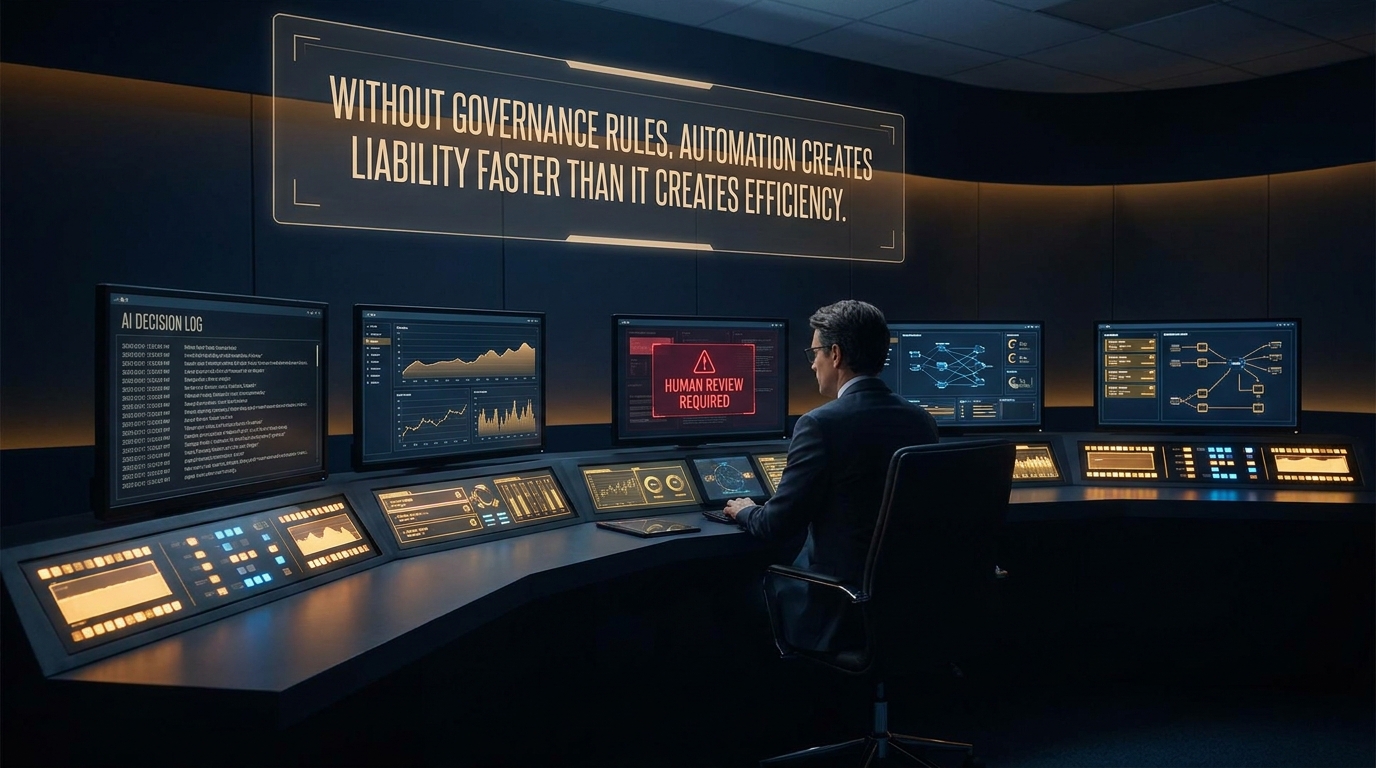
The governance conversation in AI automation is not as glamorous as the use case conversation, which is why it tends to happen late — often after something has gone wrong. This is a costly sequencing mistake. Governance structures that are designed alongside automation deployments are far cheaper to build than those that are retrofitted after an incident.
What Governance Actually Means in Practice
AI automation governance is not about creating bureaucratic approval processes that slow down deployment. It is about answering three questions clearly and maintaining those answers over time:
Who is accountable? For every automated process that makes decisions with business consequences, there must be a named human owner who is accountable for the quality and appropriateness of those decisions. “The algorithm decided” is not an acceptable answer to a regulator, a customer, or a board member. Accountability does not disappear when a process is automated — it shifts. Understanding where it shifts, and whether the person in that accountability position has the information and authority to exercise it, is a governance question.
What gets logged? Automated decision systems should maintain a complete audit trail of what decision was made, what inputs informed it, when it was made, and what the outcome was. This audit trail serves multiple purposes: it enables post-hoc review of individual decisions, it provides data for model performance monitoring, and it creates the evidentiary basis for demonstrating compliance with regulatory requirements.
What triggers a review? Define in advance the conditions under which automated processes are paused, reviewed, or overridden. Performance degradation below a defined threshold, a concentration of exceptions in a particular category, a regulatory change that affects the process, or an adverse outcome pattern — all of these should trigger a defined response protocol. Without this, organisations discover problems only when they have already become significant.
Regulatory Dimensions
The regulatory landscape for AI automation is evolving quickly, and the obligations vary significantly by jurisdiction, industry, and application. The EU AI Act, which is phasing in requirements through 2026 and beyond, classifies certain AI applications — including those that make consequential decisions about individuals — as high-risk, with corresponding obligations for transparency, human oversight, and documentation. Financial services regulators in multiple jurisdictions are developing AI-specific guidance. Employment law in many countries is beginning to address the use of AI in hiring decisions.
Organisations that approach governance as a compliance checklist will find themselves constantly reactive to regulatory developments. Those that build a principled governance framework — grounded in accountability, transparency, and human oversight — will find that it provides a durable foundation that accommodates regulatory evolution rather than being destabilised by it.
The Drift Problem
One of the less-discussed governance challenges in AI automation is model drift: the tendency of AI models to degrade in performance over time as the world they are modelling changes, while the model itself remains static. A demand forecasting model trained on pre-pandemic consumer behaviour will increasingly misfire as those patterns evolve. A fraud detection model trained on historical transaction data will become less effective as fraudsters adapt their methods. A lead scoring model trained on a previous market environment may systematically misrank prospects in a new competitive landscape.
Monitoring for drift and maintaining a regular cadence of model retraining and revalidation is not optional maintenance — it is the difference between automation that continues to deliver value and automation that is quietly generating bad outputs that no one is reviewing because everyone assumed the system was still working. This is an operational discipline that many organisations have not yet fully embedded, and it is one of the most common sources of automation failures that surface six to eighteen months after initial deployment.
Building a Business That Works With AI — Not One That Just Runs It
The department-by-department tour of AI automation reveals a consistent pattern: the technology creates the capability, but the organisation determines the outcome. Every example of AI automation delivering genuine business value has the same underlying structure — a well-defined process, a clean data foundation, a realistic performance expectation, a human oversight layer, and a workforce that understands what the system is doing and why.
Every example of AI automation failing or underdelivering has a corresponding failure in one or more of those dimensions. The automation ran on messy data. The performance expectations were set by a vendor demo rather than a realistic assessment of the organisation’s starting conditions. The human oversight layer was an afterthought. The workforce was not involved in the design and did not trust the outputs. Or governance was absent, and a problem that could have been caught early was allowed to compound.
The Most Important Mindset Shift
The most productive framing for AI automation is not “what can we automate?” — it is “what should humans be doing that they are currently not doing because routine work is consuming their time?” This question reorients automation from a cost-reduction exercise to a capability-investment exercise. When a finance team’s automation frees up two days per month that were previously spent on manual reconciliation, the question is not just how to reduce headcount — it is how to use that time to build the analytical capabilities that deliver better business decisions.
Organisations that answer that question well are building something more durable than an efficient automated operation. They are building a workforce whose skills and focus are concentrated at the level where human judgment creates the most value — and a technology layer that handles the volume, consistency, and speed requirements that human effort handles poorly at scale.
Starting Points That Actually Work
For organisations that are earlier in their AI automation journey, the most effective starting points are not the most ambitious ones. The use cases that tend to deliver the fastest and most credible returns are those with high process repeatability, structured data, clear success metrics, and low error-consequence thresholds: invoice processing, support ticket triage, lead scoring, recruitment screening, and IT service desk automation. These are not the most exciting automation stories to tell — but they build the organisational confidence, data infrastructure, and governance muscle that more complex automation initiatives require.
Starting small does not mean thinking small. The goal is not to automate a few processes and declare success — it is to build the competency, the culture, and the data foundation that makes increasingly sophisticated automation viable over time. The organisations that are furthest ahead in 2026 did not get there by launching a single large-scale AI initiative. They got there by deploying, learning, adjusting, and expanding repeatedly — building on each deployment to create the conditions for the next one.
The Competitive Reality
There is a straightforward competitive reality that underlies all of this. AI automation is not a technology experiment any more — it is a standard component of business operations in industries from financial services to retail to logistics to professional services. Organisations that are not building automation capabilities are not standing still relative to competitors who are — they are falling behind. The gap between the most and least automated organisations in any given sector is widening, and the compounding advantage accrues to those who started earlier and have been building operational expertise in deployment and governance over time.
The question is no longer whether AI automation belongs in your business. It does. The question is how you build it — department by department, process by process, with the discipline to do it right — so that it delivers the genuine value it is capable of, rather than the disappointing outcomes that tend to follow when it is deployed without the organisational conditions that make it work.
Key Takeaways
- AI automation is not one thing. Its value, risks, and readiness requirements differ significantly by department, process, and data environment. Treat it as a set of department-specific decisions, not a single enterprise initiative.
- Data quality is the foundation. No AI automation system performs well on poor data. Invest in data infrastructure before investing in AI models — the sequence matters.
- The human layer is not optional. Every automated process needs clearly defined human oversight, error thresholds, and exception handling. Build the oversight in, not on.
- Governance must be designed in, not added after. Define accountability, audit requirements, and review triggers before deployment, not after an incident.
- Adoption is an organisational design problem, not a communications problem. Involve the people doing the work in the design of the automation that affects them.
- Model drift is real. Establish a regular monitoring and retraining cadence for every AI system in production, or expect performance degradation over time.
- Start where the returns are clear. Build competency and confidence on high-repeatability, structured-data processes before tackling more complex, judgment-intensive ones.