

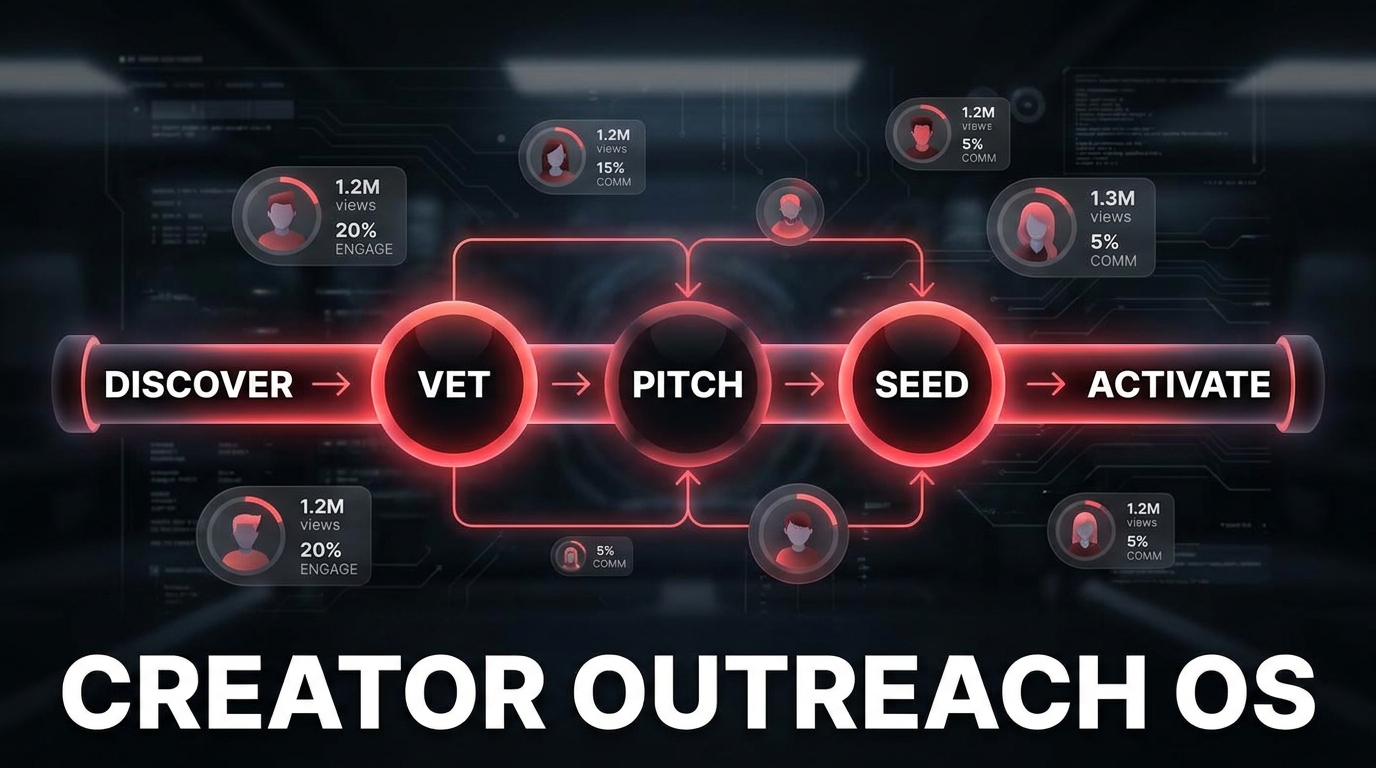
Most brands treat TikTok Shop creator outreach like a marketing campaign: a burst of activity, a flurry of DMs, a handful of gifted products, and then a wait to see what sticks. When it works, they repeat it. When it doesn’t, they blame the platform or the creators. What they rarely do is look at what they’re actually running — which, in most cases, is not a system at all.
This is the fundamental problem. TikTok Shop is a volume-and-velocity platform. The brands generating consistent, growing GMV from affiliate creators are not the ones with the best pitches or the biggest product budgets. They’re the ones who’ve built an operating system for creator recruitment — a repeatable pipeline that moves accounts from discovery to active affiliate status at a predictable rate, week after week.
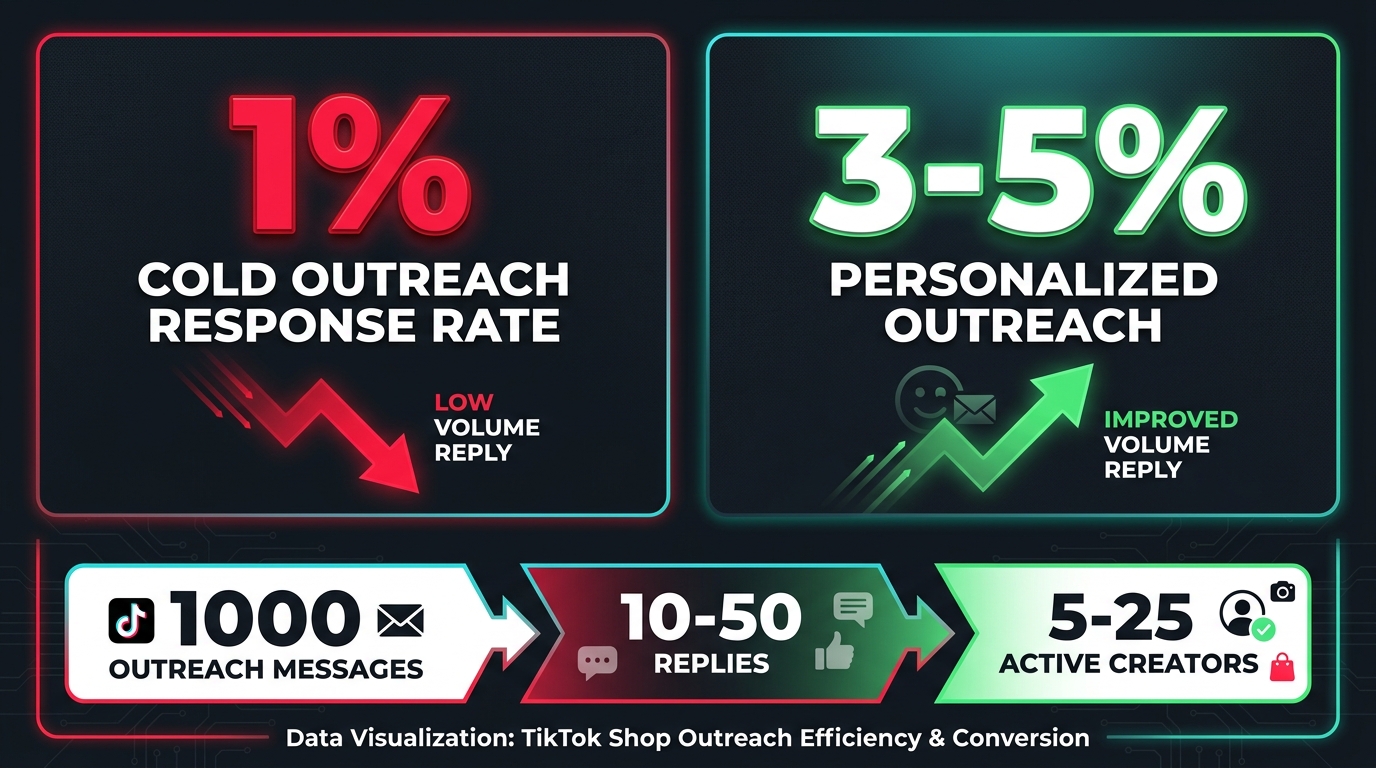
The economics demand it. Cold outreach on TikTok Shop converts at roughly 1% at scale. Even well-personalized outreach rarely breaks 5%. That means for every 100 creators you contact, you might get five replies. Of those five, maybe two send product. Of those two, perhaps one posts content that converts. A pipeline built on one-off effort and hope won’t survive those numbers. A pipeline built on system, process, and data will.
This post is the operational blueprint. Not the theory of why creator marketing works on TikTok Shop — that story has been told. This is the architecture of the machine itself: how to build discovery filters, tiered creator frameworks, outreach sequences, seeding programs, and CRM workflows that compound rather than reset every month.
Why TikTok Shop Creator Recruitment Is a Volume Game — And the Math Behind It
Before designing any outreach system, you have to accept an uncomfortable truth: the overwhelming majority of your creator outreach will go unanswered. This isn’t a failure of strategy or copy — it is the structural reality of the platform.
Cold creator outreach on TikTok Shop returns approximately a 1% response rate at volume. That’s one reply for every 100 messages sent. Personalized outreach — where you reference a creator’s recent content, their niche, or their audience specifically — can push that to 3–5%, but the higher effort per message naturally limits how many you can send each day. Both approaches have a place, and the smartest operators run them in parallel at different pipeline stages.
The Conversion Funnel in Numbers
Here’s what a realistic 30-day outreach cycle looks like when you run the math honestly:
- 1,000 outreach messages sent (a realistic volume using in-app tools and automation support)
- 10–50 replies (1–5% response rate)
- 5–25 creators agree to collaborate or request samples
- 30–40% of those who receive samples will post content (well-run seeding programs)
- A small subset of that posted content converts consistently
That funnel looks brutal until you account for what happens when a creator finds a winning hook and that content goes viral. TikTok Shop’s conversion rate from creator content to purchase averages 4.7% — meaningfully above the 2–4% typical of traditional e-commerce. During LIVE sessions, that rate can climb above 12%. The economics of even a handful of active, high-performing creators can justify an entire month’s outreach effort.
The Power Law Problem Every Brand Faces
What makes this harder — and more urgent to systematize — is the extreme Pareto concentration in creator programs. Data from TikTok Shop analyses consistently shows that the top 5–10% of a brand’s active creators drive 80–90% of affiliate GMV. A brand working with 100 creators may find that eight of them account for the majority of their monthly sales from the channel.
This concentration has two implications. First, you need to recruit broadly to find the winners — you cannot know in advance which micro-creator in a given niche will become your top performer. Second, once you identify those top performers, your retention and relationship management becomes every bit as important as your initial outreach volume. The pipeline doesn’t end when someone posts their first video. It ends when they stop posting.
The case of MySmile, which reached over $1M in GMV within three months using TikTok Shop’s Creator Affiliate Program, illustrates both points: they ran high-volume outreach to identify top affiliates, then doubled down on those relationships with custom commissions, early product access, and dedicated communication. Volume found the winners. System retained them.
Your Creator Discovery Stack: Building Filters That Find the Right Accounts
Random outreach produces random results. The first step in building a systematic pipeline is defining precisely which creators belong in your funnel before you send a single message. This sounds obvious, but most brands either cast too wide a net (any creator in the vague neighborhood of their category) or too narrow (only accounts their team personally knows about). Neither approach scales.
Defining Your Ideal Creator Profile
Your Ideal Creator Profile (ICP) is the equivalent of a B2B company’s Ideal Customer Profile — a set of quantified attributes that predict fit before contact. For TikTok Shop, these attributes cluster into four areas:
- Niche alignment: Does the creator post content in a category adjacent to your product? Relevant niches matter more than exact matches. A skincare brand might find as much success with wellness, fitness, or self-care creators as with pure beauty accounts.
- Posting frequency: Active posters (3+ times per week) are more likely to incorporate your product without their feed going cold. Frequency signals that content creation is a habit, not a hobby.
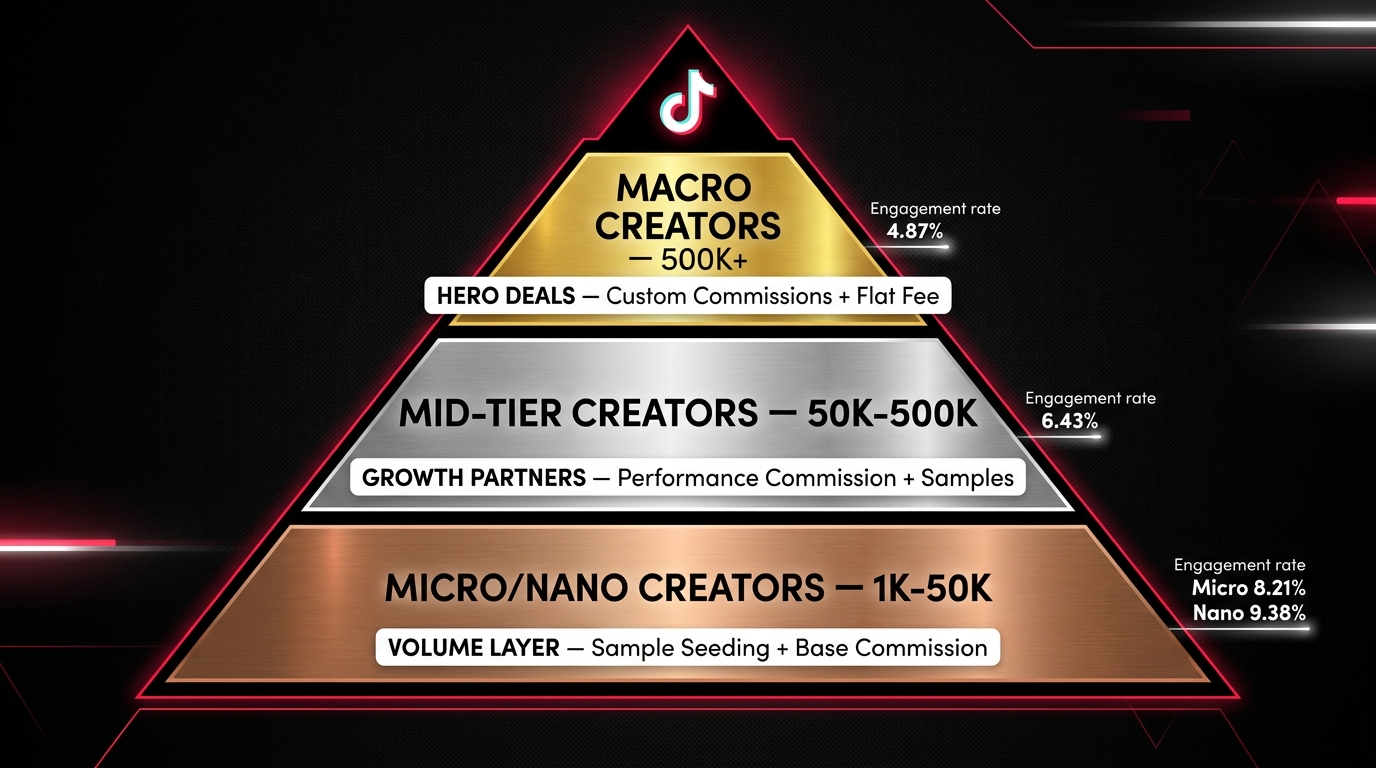
- Engagement rate: This is where data beats instinct. Nano creators (under 10K followers) average 9.38% engagement. Micro creators (10K–100K) average 8.21%. Mid-tier creators (100K–500K) drop to 6.43%, and macro creators (500K+) average 4.87%. The engagement-follower tradeoff is real and should inform your targeting.
- TikTok Shop activity: Has the creator posted Shop-tagged content before? Prior affiliate activity is the strongest predictor of future activation. Someone who has already navigated the platform’s affiliate interface once is far more likely to convert than a creator learning it for the first time on your dime.
Discovery Tools: Native and Third-Party
TikTok’s native creator marketplace within Seller Center offers basic filtering by follower count, category, and performance data. It’s a reasonable starting point for small programs but lacks the depth needed for systematic discovery at scale.
The third-party ecosystem has expanded rapidly to fill that gap. Tools like Reacher (with a database of over 2 million creators and claimed capacity for up to 7,500 daily outreach messages on their Pro tier), UpTk (which aggregates TikTok Shop-specific performance data), and Trendio (AI-assisted creator-product matching) give brands the filtering precision to build genuinely targeted prospect lists. Canal Affiliate offers AI-powered outreach automation natively connected to TikTok Shop’s infrastructure.
The key principle, regardless of which tool stack you use: filter before you prospect, prospect before you pitch. Building a list of 500 well-qualified creators will outperform blasting 5,000 broadly matched accounts — both in response rate and, critically, in quality of the creators who actually activate.
Manual Prospecting as a Signal Layer
No tool replaces the signal quality of manual prospecting for your top-tier outreach. Browse TikTok content tagged with relevant hashtags and product categories. Check who is already producing organic content in your space. Search competitor product reviews and see which creators are posting about similar items. These accounts have already demonstrated intent — they’re talking about your product type without being paid to. Converting them costs less and activates faster than cold accounts with no category familiarity.
The Three-Tier Creator Framework: Who Gets What Kind of Deal
One of the most common operational errors in TikTok Shop creator programs is offering every creator the same deal. A flat 10% commission offered uniformly to a nano creator with 8,000 followers and a macro creator with 800,000 followers is not equitable from either side — the nano creator needs a reason to try a new brand, and the macro creator needs to feel the deal reflects their audience value.
A tiered framework solves this. It creates clear, internally consistent logic for what different types of creators receive, makes your commission spending more defensible, and signals to creators that you understand the space.
Tier One: Micro and Nano Creators (1K–50K Followers)
This is your volume layer and your discovery engine. Micro and nano creators are where your pipeline starts, where most of your outreach effort concentrates, and — counterintuitively — where many brands find their highest GMV efficiency.
In a documented case study, 45 micro creators generated $28,000 in GMV over a campaign period versus $18,000 from just four macro creators — demonstrating that depth of creator relationships in the micro tier can outperform headline spending on large accounts. The engagement data supports the intuition: nano and micro creators maintain audience trust at rates that macro accounts simply cannot sustain at scale.
The appropriate deal structure for this tier centers on product samples plus base commission. Most creators in this range will not invest effort in content for a brand they haven’t tried. Free product lowers the barrier. A base commission (typically 10–15% on TikTok Shop) provides the financial incentive without requiring upfront cash spend.
Tier Two: Mid-Tier Creators (50K–500K Followers)
Mid-tier creators are your growth partners. They have established audiences, often niche-specific, with engagement rates that still outperform macro accounts. They’re experienced enough with content creation and platform mechanics to produce quality without hand-holding, but not yet at a scale where their rates are prohibitive.
Deal structures for mid-tier creators typically combine performance commission with enhanced samples or gifting packages, and occasionally a modest flat-fee component for specific deliverables (dedicated reviews, LIVE appearances, or first-to-market product features). This tier is where you begin investing in creator relationship depth — priority communication, early product access, and quarterly check-ins on performance.
Tier Three: Macro Creators (500K+ Followers)
Macro creators are your hero-moment plays. They drive reach, awareness, and GMV spikes — but they’re expensive to activate and have lower engagement rates, which means they’re rarely the most cost-efficient per-dollar-spent option for sustained GMV generation. Use macro creators strategically: to launch new SKUs, validate positioning, or accelerate a product that has already proven itself in the micro tier.
Macro creator deals typically involve custom commissions above standard rates, plus flat fees, clearly scoped deliverables, and sometimes exclusivity windows. These deals require real negotiation and legal clarity around deliverables. Don’t approach macro creators with templated outreach — it signals you don’t know how to work at their level.
Open Plan vs. Targeted Plan: Running Both Channels in Parallel
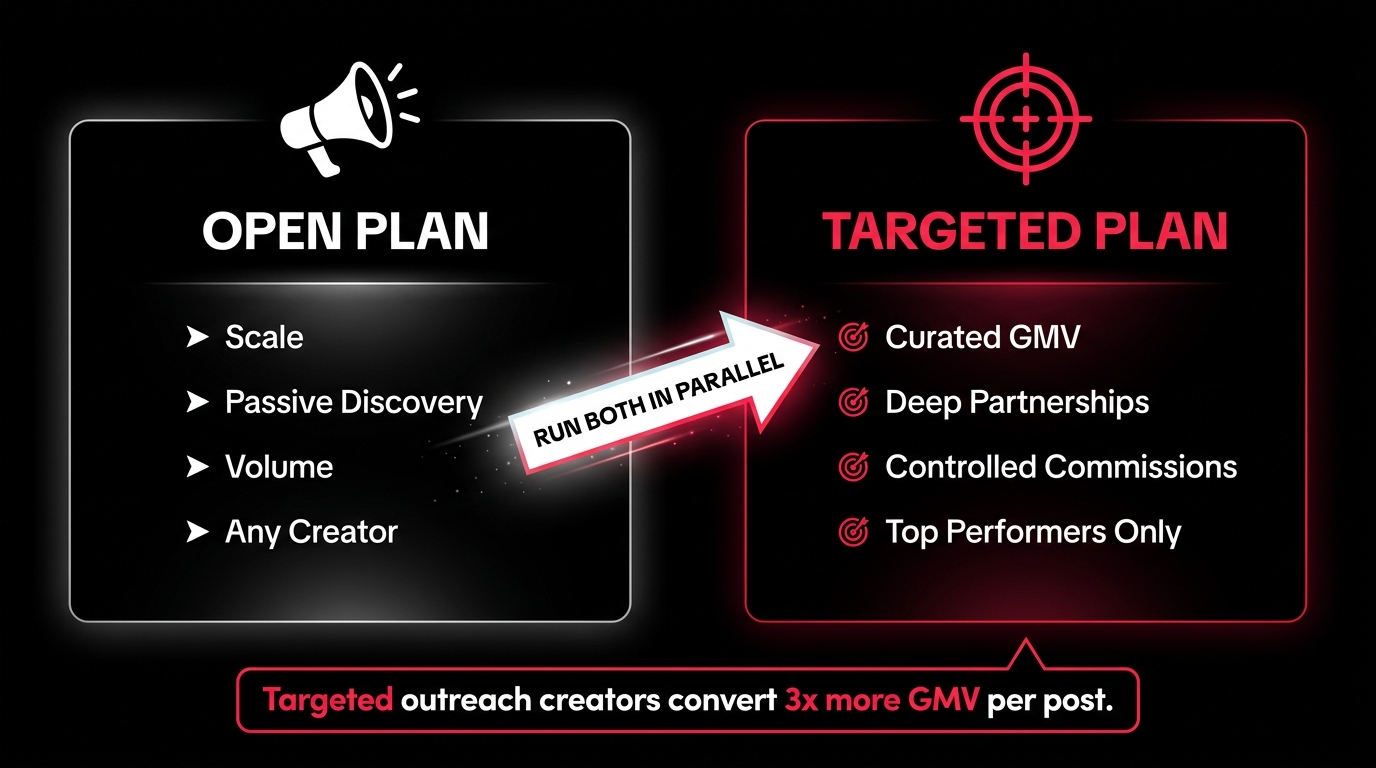
TikTok Shop’s affiliate architecture gives brands two distinct recruitment modes: the Open Plan (sometimes called Open Collaboration) and the Targeted Plan (Target Collaboration). Most brands default to one or the other. The brands generating consistent, compounding affiliate GMV run both simultaneously, treating them as different instruments in the same pipeline.
What the Open Plan Actually Does
The Open Plan is your passive discovery engine. You set your products, your base commission rate, and your eligibility criteria — and creators can find and apply to collaborate with you without individual outreach. It’s always-on, requires minimal management overhead once configured, and creates a constant trickle of inbound creator interest that you’d never generate through purely manual outreach.
The tradeoff is control. An Open Plan surfaces creators across a wide quality spectrum. You’ll get highly relevant applicants alongside creators who have no real fit with your product or audience. Without a solid vetting process for inbound applications, you end up seeding products to accounts that will never post — or worse, posting content that misrepresents your brand.
Best practice for Open Plans: set minimum eligibility thresholds (follower minimums, posting frequency requirements, category restrictions) that screen out obvious mismatches before human review. Review remaining applicants against your ICP before approving sample requests. The Open Plan is not an autopilot — it’s a qualified lead source that still requires a review layer.
What the Targeted Plan Does Differently
The Targeted Plan is your active outbound recruitment channel. You identify specific creators, reach out directly via TikTok’s in-app collaboration invite system, and set custom terms for each relationship. It requires more effort per creator, but the conversion quality is substantially higher — you’re approaching accounts you’ve already vetted as high-fit, and the message can be tailored to their specific content and audience.
Targeted Plans are particularly effective for mid-tier and macro creators who expect personalized contact, and for re-engaging micro creators who showed interest via Open Plan but never activated. The ability to set custom commission rates through the Targeted Plan also means you can override your standard Open Plan rate for creators you particularly want to win — without changing your baseline for everyone.
The Parallel Operation Logic
Running both simultaneously creates a self-reinforcing pipeline. The Open Plan generates a steady flow of inbound creator interest, surfacing accounts you might not have found through manual prospecting. The Targeted Plan lets you pursue your highest-priority targets with precision. When a creator who applied through Open Plan shows strong engagement or early conversion, you can transition them to a Targeted relationship with upgraded terms — essentially using Open Plan as a discovery tool and Targeted Plan as the retention mechanism for top performers.
The Outreach Sequence That Actually Gets Replies
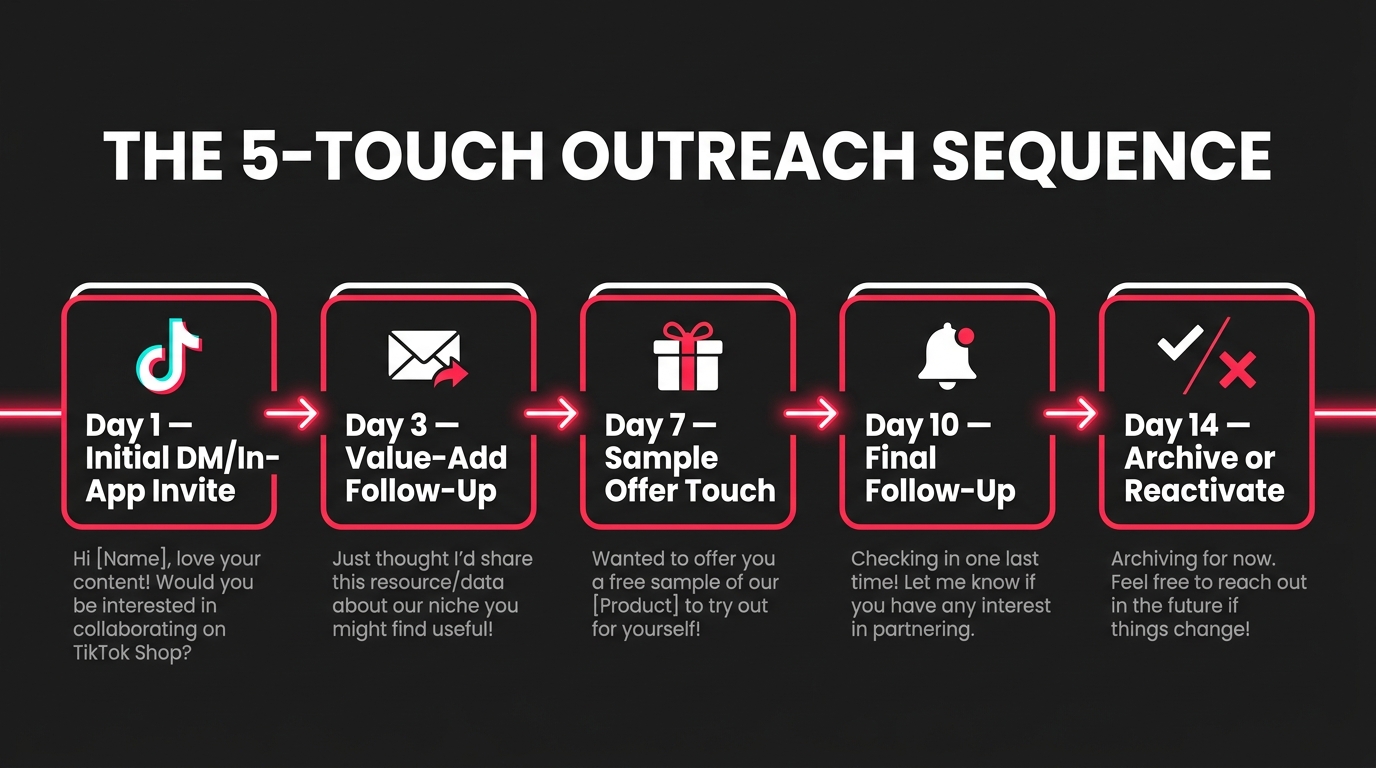
The single most common outreach failure is the single-touch pitch. A brand sends one message — usually a generic invitation to collaborate with a vague description of their product — and then waits. When there’s no reply, they assume the creator isn’t interested and move on. What the data actually shows is that the majority of replies to TikTok Shop creator outreach come on the second or third touch, not the first.
This is not a TikTok-specific insight. Multi-touch follow-up sequences outperform single messages in virtually every outreach context. On TikTok Shop specifically, the standard expert recommendation is a structured 5-touch sequence delivered over 14–21 days. Here’s how that looks in practice:
Touch 1 — Day 1: The Initial In-App Invite or DM
Keep this short and specific. Reference something real about the creator’s content — a recent video, a niche they own, a format they use well. The message should convey that you chose them deliberately, not that they’re one of a thousand people receiving the same text. Include the core offer clearly: free product, commission rate, no posting guarantee (at the micro level).
A template that works: “Hi [Name] — your recent [content type] content is exactly the audience we’re looking for. We’d love to send you [product] to try — no posting required, but we pay [X]% commission on any sales through your link if you decide to share it. Want to try it?”
Touch 2 — Day 3: The Value-Add Follow-Up
Don’t just bump your initial message. Add something: a specific detail about the product, a social proof element (a result, a review, a stat), or a piece of context about why this product performs well with audiences like theirs. This message serves two functions — it demonstrates that you’re still interested, and it gives the creator new information to act on if they were on the fence.
Touch 3 — Day 7: The Sample Offer Touch
If the creator hasn’t responded to the first two touches, a direct offer to send product (with no obligation) often converts where abstract commission pitches haven’t. Most creators who decline or ignore commission offers will respond to “can I just send you the product to try?” Physical product in hand changes the psychology of the relationship entirely — and well-run seeding programs see 30–40% post rates from gifted product even with no contractual requirement.
Touch 4 — Day 10: The Final Follow-Up
Short, direct, low-pressure. Something like: “Last note from me — if timing is off or you’re not the right fit, totally understand. But if you’re open to it, I’d love to send this over. Just let me know.” The explicit permission to say no often triggers replies from creators who’ve been passively procrastinating. It also preserves the relationship for future outreach — a creator who declines politely is still a potential future partner.
Touch 5 — Day 14: Archive or Reactivate Decision
At this stage, move non-responders into a dormant segment rather than deleting them. Creators cycle through phases of activity, and an account that was unresponsive in March may be actively looking for brand partnerships in June. Set a 60–90 day reactivation trigger in your CRM to re-approach with a fresh message that doesn’t reference the previous outreach.
Sample Seeding as a Performance Channel, Not a PR Exercise
Product gifting on TikTok Shop has an identity problem. Many brands still think of sample seeding as a brand-building or goodwill exercise — something you do to generate organic buzz without expecting direct returns. That framing leads to poor targeting, weak activation rates, and seeding budgets that are difficult to defend internally.
The brands generating consistent GMV from seeded content treat product gifting as a performance channel with its own input metrics, output targets, and optimization levers. The question isn’t “how many products can we send this month?” It’s “what is our cost per activated post, and what is the GMV per activated creator over a 90-day window?”
Structuring a Seeding Wave
Rather than continuous, rolling product sends, systematic seeding programs operate in discrete waves — typically monthly or bi-weekly cohorts of 20–50 creators per wave. This batching approach has several advantages:
- It makes activation tracking clean. You can measure the post rate and GMV from Wave 1 before committing product to Wave 2, which lets you improve targeting criteria based on actual results.
- It creates urgency for creators. A wave-based seeding structure gives you a natural reason to follow up — “our next seeding round closes Friday” is more compelling than “we’d love to send this whenever.”
- It manages inventory exposure. Uncontrolled seeding programs can become significant COGS line items without a clear GMV return. Wave-based batching keeps the commitment bounded.
Protecting Against Seeding Abuse
A real operational risk in any seeding program is creators who request samples with no genuine intent to post. Some brands have implemented a rebate model — creators pay a nominal amount at checkout that is refunded upon posting — to screen for low-intent requests. Others require a short application or brief content plan before approving sample requests through the Open Plan.
Neither approach is foolproof, but any friction layer between request and approval meaningfully reduces non-posting rates. A creator who fills out a two-minute form about how they plan to feature the product is substantially more likely to actually post than one who clicked a button.
What to Do When a Seeded Video Performs
This is where most brands leave serious money on the table. When an organic creator post generates strong views and conversion, the instinct is to congratulate the creator and move on. The operational play is to immediately amplify that content via Spark Ads — TikTok’s native paid amplification tool that lets you boost creator-generated content as a paid ad while preserving the authentic creator framing.
A seeded video that drives $500 in organic GMV can potentially drive $5,000+ if amplified intelligently. Your seeding program produces not just organic content but a library of tested creative assets. The brands treating every seeded post as a potential Spark Ad candidate are extracting significantly more value from the same product investment.
The Activation Gap: Why Onboarding Is Where Most Pipeline Value Gets Lost
Here’s a dynamic that doesn’t get discussed often enough: a meaningful percentage of creators who agree to collaborate and receive product never post. They confirmed interest. They accepted the sample. They acknowledged the commission structure. And then nothing happens.
This is called the activation gap, and it’s one of the most significant sources of wasted pipeline value in TikTok Shop creator programs. Understanding why it happens — and engineering the pipeline to close it — is as important as generating new outreach volume.
Why Creators Go Dark After Saying Yes
The reasons are mostly predictable and mostly addressable:
- Platform unfamiliarity: Many creators, especially in the micro and nano tier, have never used TikTok Shop’s affiliate interface before. They don’t know how to generate their tracking link, how commission attribution works, or what happens at checkout. If there’s no support at this moment, inertia wins.
- Content uncertainty: They have the product. They want to post. But they don’t know what angle to take, and blank-page paralysis kills momentum. A brief content brief — two or three suggested video angles, a key product benefit to highlight, a sample hook line — dramatically reduces activation time.
- Competing priorities: Micro creators are not full-time influencers. Their content calendar fills up. Without a gentle prompt at the right moment, your product sits on their shelf while they post about something else.
Building an Activation Protocol
A structured activation sequence should trigger the moment a sample ships, not the moment a creator posts. That means:
- Shipping confirmation + affiliate link setup guide (sent the day the package ships)
- Product-in-hand check-in at estimated delivery + 2 days (“Did it arrive okay? Any questions before you film?”)
- Content brief delivery with 2–3 suggested angles, a key talking point, and links to high-performing examples from similar creators
- Gentle posting reminder at day 10 post-delivery if no content has appeared
- Performance celebration within 24 hours of first post — a genuine, specific compliment on the content that reinforces the behavior and opens the door to the next collaboration
Brands that have implemented structured activation protocols report meaningfully higher first-post rates than those who rely on creators to self-activate. The investment is light — mostly templated messages triggered by CRM stage changes — but the compounding effect on pipeline conversion is substantial.
Your Creator CRM: Managing the Pipeline After the Yes
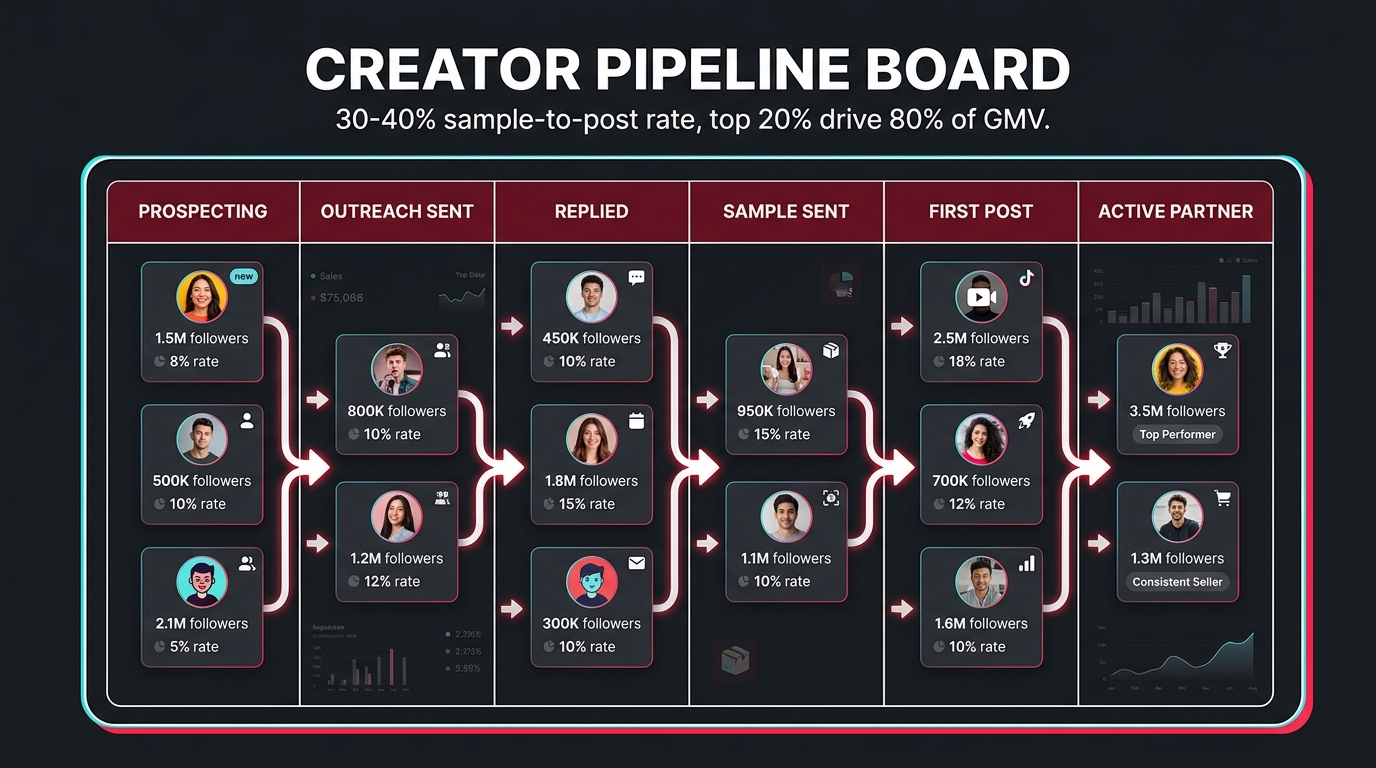
The operational backbone of a systematic creator outreach program is not the outreach tool — it’s the CRM layer that tracks every creator’s status across the entire lifecycle. Without it, you’re managing a set of disconnected conversations instead of a pipeline with clear conversion rates, bottlenecks, and optimization levers.
The Six Pipeline Stages
A functional creator CRM for TikTok Shop affiliate programs typically tracks six stages:
- Prospecting: Creator identified and qualified against ICP criteria. Not yet contacted.
- Outreach Sent: Initial message sent. Clock starts on follow-up sequence.
- Replied: Creator has responded — positive, neutral, or requesting more information. Human review required.
- Sample Sent: Product shipped. Activation protocol begins.
- First Post: Creator has posted content featuring the product and affiliate link. Performance tracking begins.
- Active Partner: Creator has posted multiple times or demonstrated consistent conversion. Relationship management and tier assessment ongoing.
Each stage transition should be logged with a date, so you can calculate the average time-to-move between stages and identify where your pipeline is experiencing friction. If the average time from “Sample Sent” to “First Post” is 45 days, that’s a signal that your activation protocol needs work. If conversion from “Replied” to “Sample Sent” is below 50%, your follow-up and persuasion messaging needs improvement.
What to Track in Your CRM
Beyond pipeline stage, a functional creator CRM captures:
- Creator tier (nano, micro, mid, macro)
- Niche/content category
- Follower count and engagement rate at time of contact
- Commission rate offered and agreed
- Products seeded and dates sent
- Posts created and links to each piece of content
- GMV generated per post and cumulative
- Last contact date and next scheduled touchpoint
- Notes on communication style, preferences, and any special deal terms
This data layer is what transforms creator outreach from a marketing activity into a measurable business function. When your leadership team asks what ROI your creator program is generating, this CRM is what allows you to answer with specificity rather than estimates.
Tools for the Stack
Many brands starting out manage their creator CRM in a well-structured spreadsheet — which works at low volume but becomes unwieldy beyond 50–100 active creators. Dedicated TikTok Shop creator management tools like Reacher and UpTk offer native CRM functionality alongside discovery and outreach automation. For brands with complex programs across multiple channels, integrating creator data into a general-purpose CRM (HubSpot, Notion databases, or Airtable) gives you more customization and reporting flexibility at the cost of native TikTok Shop data feeds.
Commission Architecture: Building a Structure That Scales and Retains
Commission design is one of the most underestimated levers in TikTok Shop creator program management. Most brands set a number — 10%, 15%, 20% — and apply it uniformly across their affiliate program. The brands with the most efficient creator programs treat commission as a dynamic, tiered, performance-linked variable that evolves as creator relationships mature.
Base Commission vs. Performance Commission
The most functional commission architecture distinguishes between a base rate (what every affiliate in your Open Plan earns) and performance-linked rates that increase as creators hit GMV thresholds. A structure might look like this:
- Base tier (Open Plan default): 10–12% commission — accessible to all affiliates
- Growth tier (first $1,000 GMV/month): 15–18% commission — requires targeted plan upgrade
- Partner tier ($2,500+ GMV/month): 20–25% commission — fully custom deal
- Elite tier ($5,000+ GMV/month): Custom commission + flat fee component + product exclusivity windows
This architecture rewards performance, gives creators clear milestones to work toward, and ensures your highest commission spend goes to creators who are actually generating returns. It also creates a natural retention mechanism — a creator who has reached the Growth tier has a concrete financial reason to stay with your program rather than switching to a competitor’s.
The Flat Fee vs. Pure Commission Tradeoff
For macro and high-performing mid-tier creators, purely commission-based deals often aren’t competitive. Creators at this level have enough options that they’ll prioritize guaranteed income. A hybrid model — a modest flat fee for specific deliverables (dedicated video, LIVE appearance, first post) combined with ongoing commission — often bridges the gap between what the creator needs and what you can justify without guaranteed performance.
The key is tying the flat fee to specific, measurable deliverables rather than vague “sponsored content” obligations. “One dedicated video featuring the product as the primary focus, minimum 60 seconds, posted within 14 days of receiving product” is enforceable. “Some posts about the product” is not.
Commission Review Cadence
In 2026, best-practice operator guidance is clear: commission rates should be reviewed and renegotiated on a quarterly cadence for active partners. A creator who started at 12% and has driven $15,000 in GMV over three months should be offered a rate increase before they ask for one — proactive recognition of performance is a more powerful retention tool than reactive response to a creator who’s already considering leaving.
Tracking the Metrics That Actually Matter
Creator programs that scale and sustain are built on a tight, agreed-upon set of metrics that the team reviews regularly. Not follower counts. Not view totals. Not the number of creators in the program. The metrics that directly connect creator activity to business outcomes.
GMV per Active Creator
This is your primary efficiency metric. Divide total affiliate GMV in a given period by the number of creators who posted at least once in that period. This number tells you the average value of an active creator and gives you a benchmark against which to evaluate your tiering, commission structure, and onboarding quality.
Tracking this number over time reveals program health. If GMV per active creator is declining, it could signal that you’re adding volume at the bottom of your ICP (lower quality creators) or that your commission structure isn’t incentivizing top performers to push harder.
Activation Rate
The percentage of creators who receive a sample and post at least one piece of content. A well-run seeding program should see 30–40% activation. Below 20% is a signal that your targeting criteria are off, your activation protocol is weak, or your product brief isn’t giving creators the direction they need.
Cost Per Activated Post
Total cost of samples seeded in a period divided by the number of posts generated. This gives you the true cost of each piece of creator content, which you can then weigh against the average GMV each post generates. If your average post drives $200 in attributed GMV and your cost per activated post is $30 (product cost plus shipping), your seeding economics are strongly positive. If your cost per activated post is $90 and average GMV per post is $80, you need to tighten your targeting or improve activation rates before scaling.
Pipeline Velocity
How long does it take a creator to move from first contact to first post? Track this across pipeline stages. Reducing the average from 45 days to 30 days means you’re extracting content and GMV from new creators a third faster — a compounding improvement that matters significantly at scale.
Creator Retention Rate
What percentage of creators who posted in Month 1 post again in Month 2? And Month 3? Creator churn is an undertracked problem. Building a 200-creator affiliate program and having 40% churn each month means you’re running hard just to stay in place. Retention rates above 60% month-over-month are a sign that your relationship management, commission structure, and product pipeline are working. Below 40% is a strong signal that something in the post-activation experience is failing.
Building the Full OS: Putting the Pipeline Together
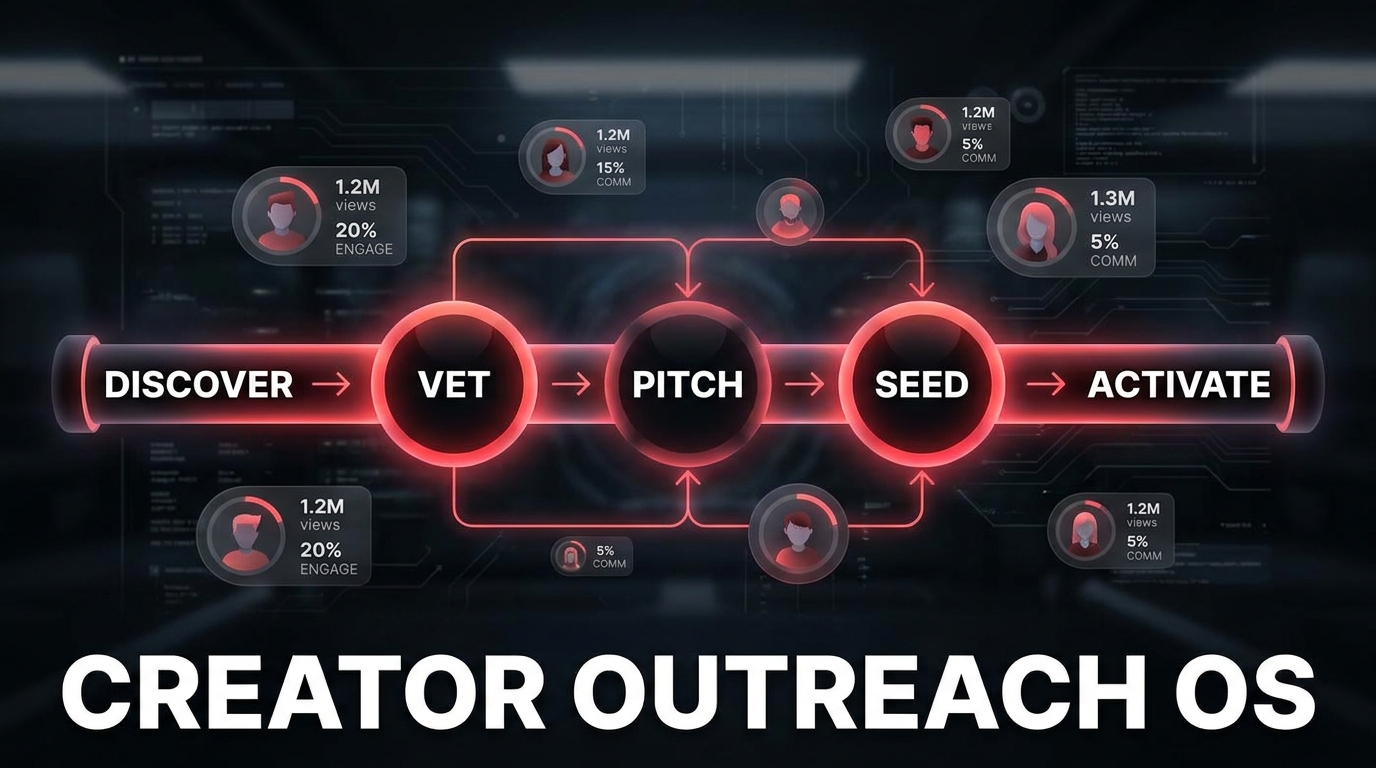
Everything above — the discovery filters, the tier framework, the parallel plan structure, the outreach sequences, the seeding waves, the activation protocols, the CRM, the commission architecture, the metrics — operates as a connected system. The mistake most brands make is implementing pieces of it in isolation and wondering why results are inconsistent.
Here’s how the full Creator Outreach OS operates as an integrated cycle:
Week 1–2 of Each Month: Discovery and Prospecting
Pull a fresh batch of 200–300 qualified creator profiles from your discovery stack. Filter against your ICP criteria. Segment into micro targets (high-volume outreach) and targeted prospects (personalized manual outreach). Flag any accounts showing prior TikTok Shop affiliate activity as priority.
Week 2–3: Outreach and Follow-Up
Launch your outreach sequences for the new batch while maintaining follow-up cadences for previous cohorts. Reply-management becomes a daily activity at this stage — every response from a creator, positive or negative, requires a logged, timely response and a CRM stage update.
Ongoing: Seeding Wave Management
Process sample requests from Open Plan applicants and approved Targeted Plan creators. Ship product in batches. Trigger activation protocols for each batch shipped. Review activation rates from the previous wave before approving the next one.
End of Month: Performance Review and Commission Updates
Pull GMV data by creator, calculate your core metrics, review which creators have crossed commission tier thresholds, and issue proactive upgrades or personalized outreach to top performers. Archive non-converting creators who’ve been through a full activation cycle without posting. Identify accounts for 90-day reactivation queues.
This cycle, run consistently for three to six months, produces something most brands don’t have: a creator program where performance is predictable, improvements are trackable, and scale doesn’t require proportional headcount increases.
Where to Start: Monday Morning Priorities
If you’re starting a TikTok Shop creator program from scratch — or rebuilding one that’s been running on instinct — here’s the priority sequence for your first 30 days:
- Define your ICP before touching a single outreach tool. Write down the follower range, engagement rate floor, niche qualifiers, and posting frequency requirements for each of your three creator tiers. This document becomes the filter for every future decision.
- Set up your CRM stage structure before sending any outreach. A spreadsheet is fine to start. The stages matter more than the tool. Tracking pipeline conversion from day one gives you data you’ll need to optimize.
- Launch Open Plan and Targeted Plan simultaneously. Set your base commission in the Open Plan. Build a list of 30–50 manually researched micro-creators for your first Targeted outreach wave.
- Write your outreach sequence templates before hitting send. Five touch points, 14 days, escalating value adds. Having these drafted means you’re not improvising follow-ups — and inconsistent follow-up is where most pipelines collapse.
- Run your first seeding wave as a learning experiment, not a performance event. Track everything but optimize nothing until you have data from at least 30 seeded creators. The first wave teaches you what your activation rate, cost per post, and GMV per creator actually are — and that data is worth more than any optimization you could make before you have it.
- Review metrics monthly, not quarterly. Creator programs compound fast when they’re working and bleed slowly when they’re not. Monthly reviews catch problems before they become expensive.
TikTok Shop creator outreach is not a mystery. The brands who make it look effortless have simply built the operational infrastructure that most brands never get around to building — clear criteria, documented sequences, systematic follow-up, and a CRM that tells them exactly what’s working and what isn’t. The technology and tools to do it at scale exist and are improving rapidly. The gap between brands that win this channel and brands that don’t is almost never creativity or budget. It’s almost always system.
Build the system. The results will follow.