

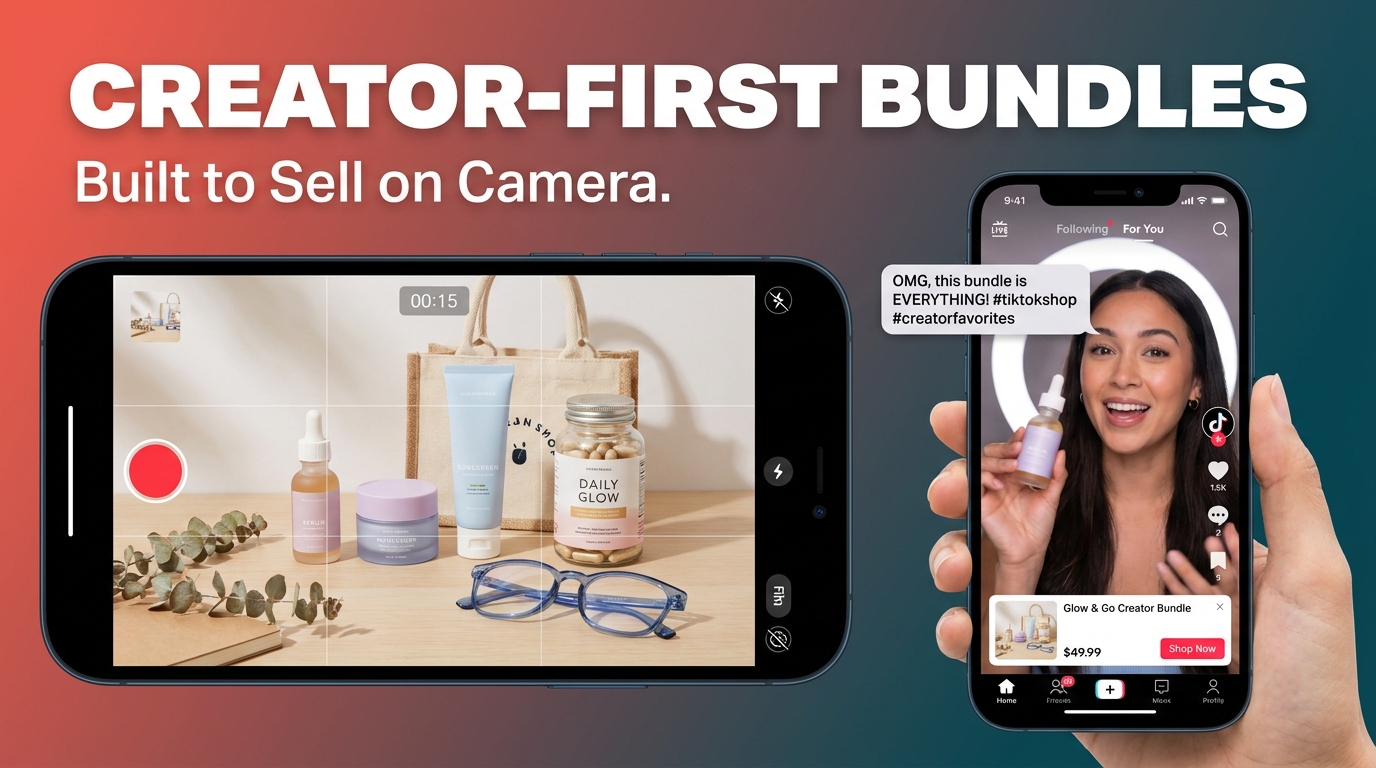

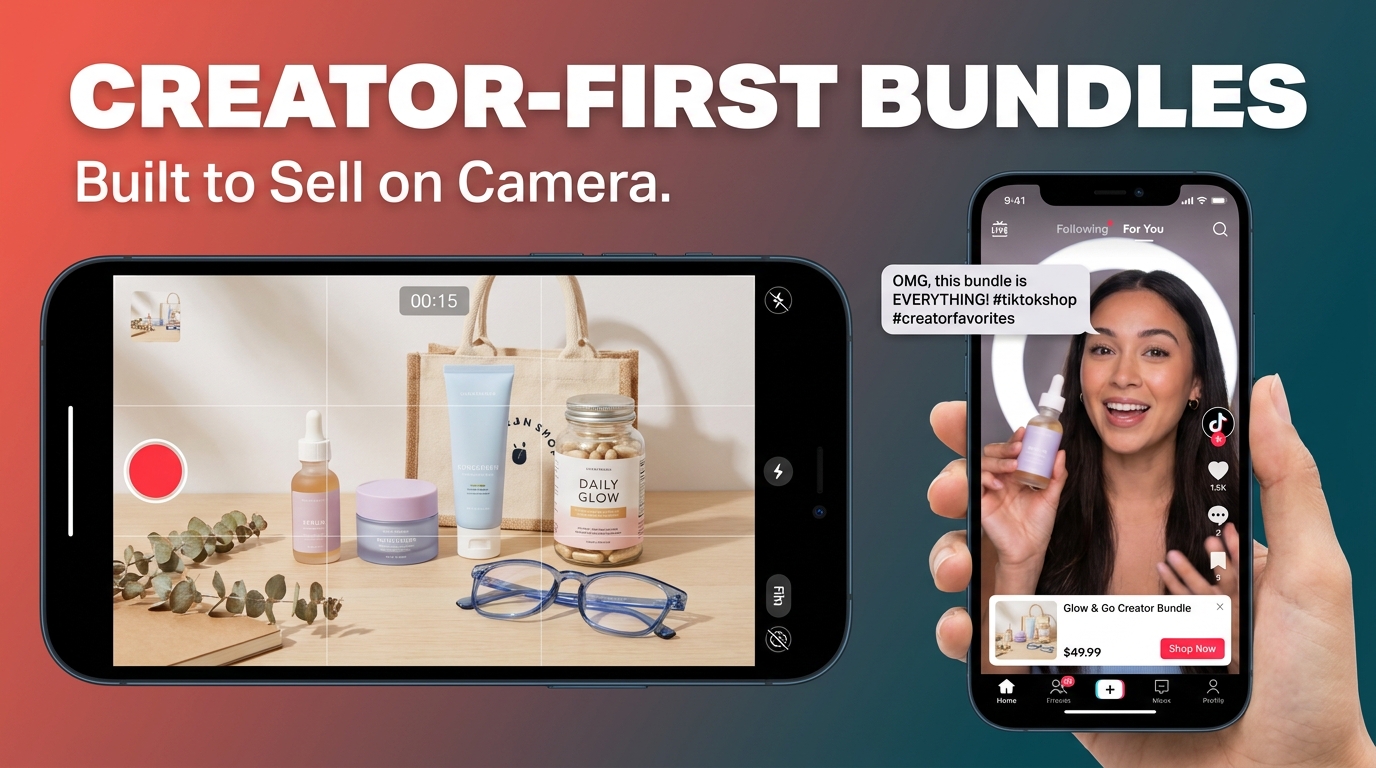
There is a particular kind of brand failure that plays out thousands of times a week on TikTok Shop. A seller assembles a bundle, lists it, sets a commission rate, opens it up to the affiliate marketplace, and then waits. The product samples ship. A few creators post. The videos land softly, if they land at all. Return on the bundle: negligible. Conclusion drawn: “Bundles don’t work on TikTok.”
The real diagnosis is usually simpler and more uncomfortable: the bundle was built for a product catalog, not for a camera. It was priced for margin with no headroom left for meaningful creator economics. The commission was set to whatever felt safe, not what a creator would choose over the dozen other open collaboration offers sitting in their affiliate dashboard.
This is the structural gap that “creator-first bundles” are designed to close — and it’s a gap that goes far deeper than commission percentage. Building a TikTok Shop affiliate offer that creators genuinely want to promote requires thinking through product composition, offer architecture, sample workflows, brief design, margin math, and creator relationship laddering as a single integrated system, not a sequence of separate decisions.
TikTok Shop’s affiliate channel is now one of the most conversion-efficient surfaces in e-commerce. Platform-wide conversion rates for affiliate creator content range between 3% and 6%, with tightly matched creator-product pairings reaching 8–12% — multiples above typical Instagram or standalone DTC rates. Average order value on the platform sits around $34 for affiliate-driven content, with bundles serving as the primary mechanism for pushing that figure toward the $50–65 range where seller economics start to work comfortably. The opportunity is real. But the mechanics are specific, and the margin for strategic error is thin.
What follows is a complete structural breakdown of how to build TikTok Shop affiliate bundle offers that are genuinely worth a creator’s time — from first product concept through to performance measurement and creator relationship management.
Why Most TikTok Shop Bundles Fail Before a Creator Even Posts
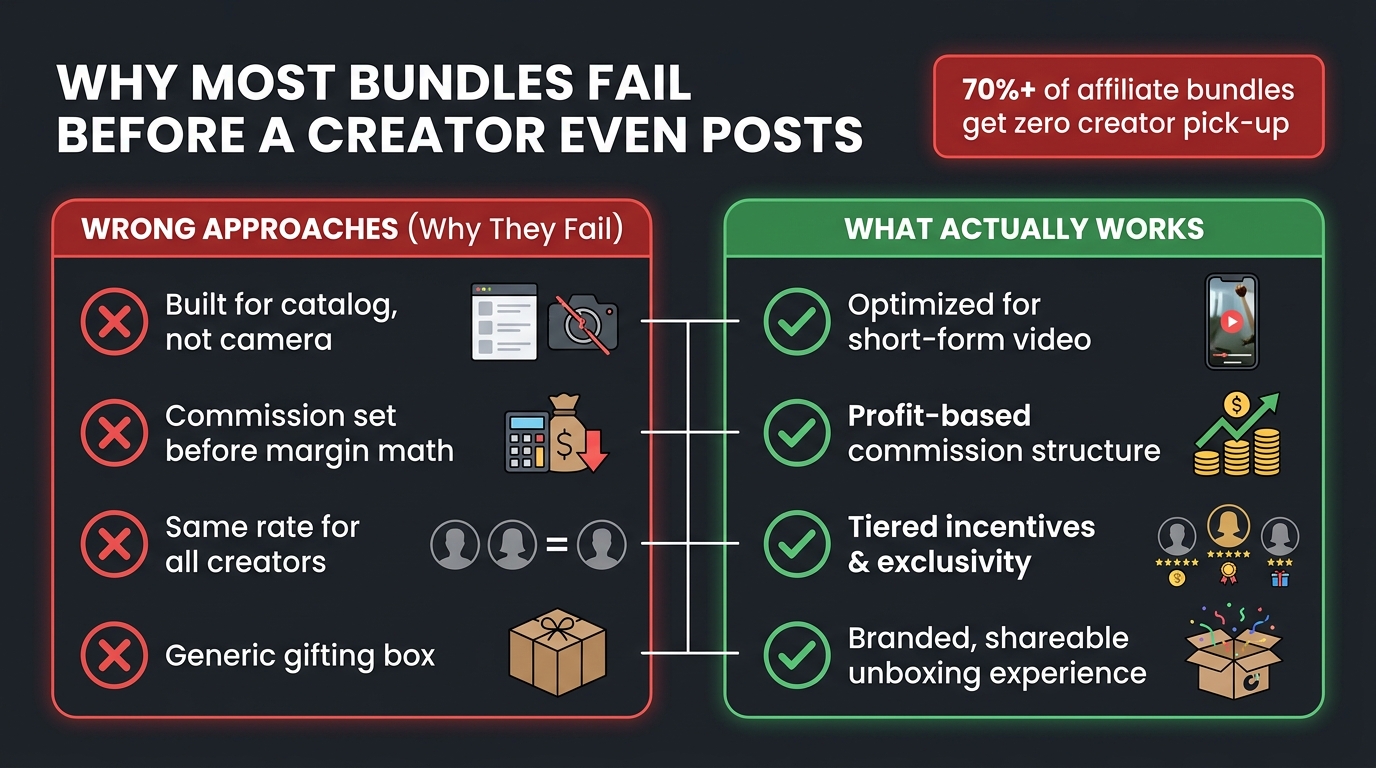
The failure modes for TikTok Shop bundles cluster around the same few structural errors, and most of them happen in the planning phase — before a single creator ever sees the offer. Understanding why bundles fail is the prerequisite to building ones that succeed.
The “Catalog Bundle” Problem
Most sellers build bundles by asking: “Which products can we group together for a higher ticket price?” This is a merchandising question, not a content question. The result is typically a collection of items that may be logically related but are visually incoherent, narratively flat, and difficult for a creator to build a compelling 30-second hook around.
A skincare brand that bundles a cleanser, a toner, a serum, an eye cream, and an SPF moisturiser into a “Complete Routine Kit” has logical product coherence. But a creator staring at five nearly identical white bottles faces a fundamental problem: how do you show five similar products delivering a transformation in 30 seconds? The bundle is built for a product description page. It is not built for a camera.
Contrast that with a “Wake Up Skin” bundle containing one dramatic overnight mask, one colour-balancing toner, and one vivid-packaging SPF — three visually distinct items that each have a clear, filmable moment. The same creator now has a natural three-part narrative: prepare, treat, protect. Each product earns its screen time. The bundle works as a content structure, not just a price point.
Commission Rates That Signal Disrespect
Creator economics on TikTok Shop are highly competitive. A strong micro-creator with 50,000–200,000 followers in a lifestyle niche is being approached by dozens of brands weekly. They are actively comparing open collaboration offers in the Affiliate Center, and they are doing quick mental math: commission rate × likely AOV × expected conversion = is this worth my time?
A brand that lists a $49 bundle at 8% commission is offering a creator roughly $3.92 per sale. If the creator’s content drives 20 sales per video — a realistic number for a tightly matched product — that’s $78.40 for a piece of content that took 45 minutes to film and edit. Against a competitor offering 18% on a $39 single SKU (generating $7.02 per sale and $140.40 for the same 20 sales), the bundle offer loses immediately, even though the bundle has the higher ticket price.
The mistake is treating commission rate as a margin protection tool rather than a market signal. Rates that make internal spreadsheets look comfortable are often rates that make your offer invisible in a creator’s dashboard.
No Clear Offer Identity
Creators don’t just sell products — they sell reasons to buy now. A bundle without a clear, specific offer identity (a thematic name, a defined use case, an exclusive aspect, or a visible price advantage over buying items individually) gives creators nothing to anchor their content around. “Save X% when you buy all three” is weak. “The 7-Day Reset Bundle — everything your skin needs to actually see a difference” is something a creator can build a hook, a story, and a call to action around.
The absence of offer identity forces creators to do positioning work that brands should have done first. Most creators won’t bother.
The Creator-First Bundle Framework: What It Is and Why It’s Different
A creator-first bundle is designed from the outside in. Instead of starting with product inventory and working toward an offer, you start with the creator’s content environment — the camera, the algorithm, the audience — and work backward to product composition, pricing, and commission architecture.
This is not a philosophical distinction. It produces materially different bundle configurations and, critically, different economic outcomes. Brands that apply creator-first bundle thinking consistently report 2–3x better creator uptake rates, stronger conversion performance, and higher repeat collaboration rates compared to catalog-first approaches.
The Four Design Principles
1. One clear narrative per bundle. Every creator-first bundle should answer a single question: what is the transformation or outcome this bundle delivers? Not a list of features. Not a category label. One specific, demonstrable outcome. “The no-bloat morning stack.” “The gym-bag recovery kit.” “The sleep-on-a-budget bundle.” The clearer this is, the easier it is for a creator to write a hook, frame a before/after, or build a day-in-the-life structure around it.
2. Three SKUs maximum. The research consistently shows that content complexity scales with SKU count — and not in a creator’s favour. Three products is the practical ceiling for a short-form affiliate video. One hero product that does the primary job, one supporting product that enhances or enables the hero, and one accelerator or bonus product that provides visible added value. More than three items and the creator is running a commercial, not a recommendation.
3. Visual diversity within the bundle. The items in a creator-first bundle should look different from each other on camera. Different shapes, different textures, different use-moments. This is not an aesthetic nicety — it’s a functional requirement for short-form video. Visual diversity gives the creator natural edit points, cuts, and close-up moments. A bundle of three white supplement bottles is a content nightmare. A bundle containing a powder, a gummy, and a sleek capsule format is a short-form video with built-in visual structure.
4. A built-in “aha moment.” The best creator-first bundles contain at least one product with a dramatic, demonstrable, or viscerally satisfying use moment — a mask that changes colour, a supplement that fizzes, a tool with a visible before/after effect. This is the content hook that drives shares, saves, and replays. Without it, the bundle competes on information alone, which is where TikTok is weakest as a selling channel.
Why It’s Different From Influencer Seeding
Creator-first bundles are not influencer PR boxes with a commission tag attached. Traditional influencer gifting is brand-centric: “here is everything we make, please mention us.” Creator-first bundle design is content-centric: “here is a specific offer built around a specific story, here is what you can earn from it, and here is enough creative direction that you can execute it without wasting time.” The economic relationship is explicit, the content brief is functional rather than restrictive, and the bundle itself does structural work that removes friction at every stage of the creator’s workflow.
Open vs. Targeted Collaboration — Choosing the Right Delivery Vehicle for Your Bundle
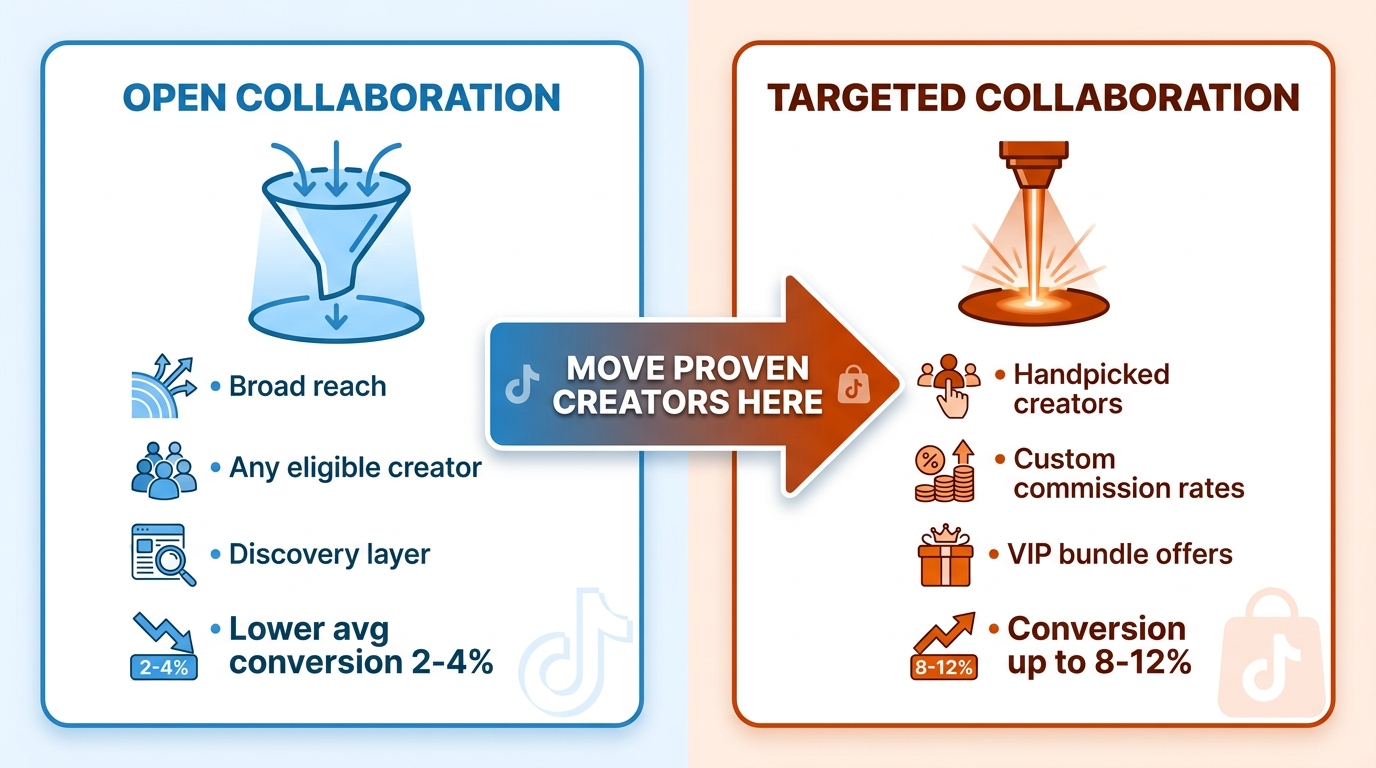
TikTok Shop’s affiliate infrastructure currently operates on two primary collaboration modes: Open Collaboration and Targeted Collaboration. Understanding the functional differences — and how each serves a different stage of bundle distribution — is essential for efficient offer architecture.
Open Collaboration: The Discovery Layer
Open Collaboration is TikTok Shop’s public marketplace for affiliate offers. Any creator who meets the platform’s affiliate eligibility requirements can browse available products and apply to promote them. For brands, Open Collaboration serves as a wide-net recruitment mechanism. Your bundle offer is visible to the entire eligible creator pool, which creates volume opportunity but minimal targeting precision.
The practical function of Open Collaboration for bundle campaigns is threefold: it generates initial content volume, surfaces unexpected creator-product fit matches that a brand wouldn’t have identified through manual targeting, and provides a baseline conversion dataset that informs smarter Targeted Collaboration decisions later.
Open Collaboration conversion rates for affiliate content average 2–4% across the platform, with bundle-specific performance typically sitting at the higher end of that range when the offer design is strong. The ceiling is relatively low, but the cost of acquisition at this stage is also low — the brand is paying on performance, not on reach.
The key configuration decision for Open Collaboration bundle offers is commission rate visibility. Because creators are comparing your offer against a dashboard full of competitors, the commission rate signal needs to be strong enough to stand out. A bundle that converts well but offers below-category commission rates will consistently lose creator attention to lower-AOV products with higher stated percentages.
Targeted Collaboration: The Performance Layer
Targeted Collaboration is a private invitation system. Brands identify specific creators and extend custom offers — which can include higher commission rates, exclusive product access, sample seeding, or supplementary cash fees — directly and confidentially. Targeted creators see an offer the general affiliate population doesn’t.
This is where creator-first bundle thinking pays its biggest dividends. A Targeted Collaboration bundle offer can be genuinely personalised: a rate calibrated to the creator’s audience size and niche, a product variant matched to their content aesthetic, a brief tailored to their existing formats (unboxing versus routine versus talking-head review), and a timeline built around their content calendar rather than a brand’s campaign deadline.
Targeted Collaboration conversion rates reach 8–12% for tightly matched creator-product pairs, roughly double to triple Open Collaboration benchmarks. The performance lift comes not just from creator quality but from the alignment specificity — when offer, creator, audience, and content format are all matched deliberately, the product recommendation lands as authentic rather than transactional.
Running Both in Parallel: The Recommended Structure
The most effective bundle distribution architecture is not a choice between Open and Targeted — it’s a deliberate sequence running both simultaneously for different strategic purposes. Open Collaboration fills the funnel with content volume and surfaces surprise performers. Targeted Collaboration concentrates high-value bundle offers on proven affiliates and priority creator relationships.
The operational cadence that works: launch a bundle in Open Collaboration for 3–4 weeks to generate initial content and conversion data. Identify the top 10–15% of performing creators by GMV contribution, video completion rate, and conversion rate. Pull those creators into Targeted Collaboration with upgraded bundle economics. The transition from Open to Targeted is the moment a one-off affiliate interaction becomes a sustained creator relationship.
Commission Architecture That Makes Creators Choose Your Bundle Over a Competitor’s Single SKU
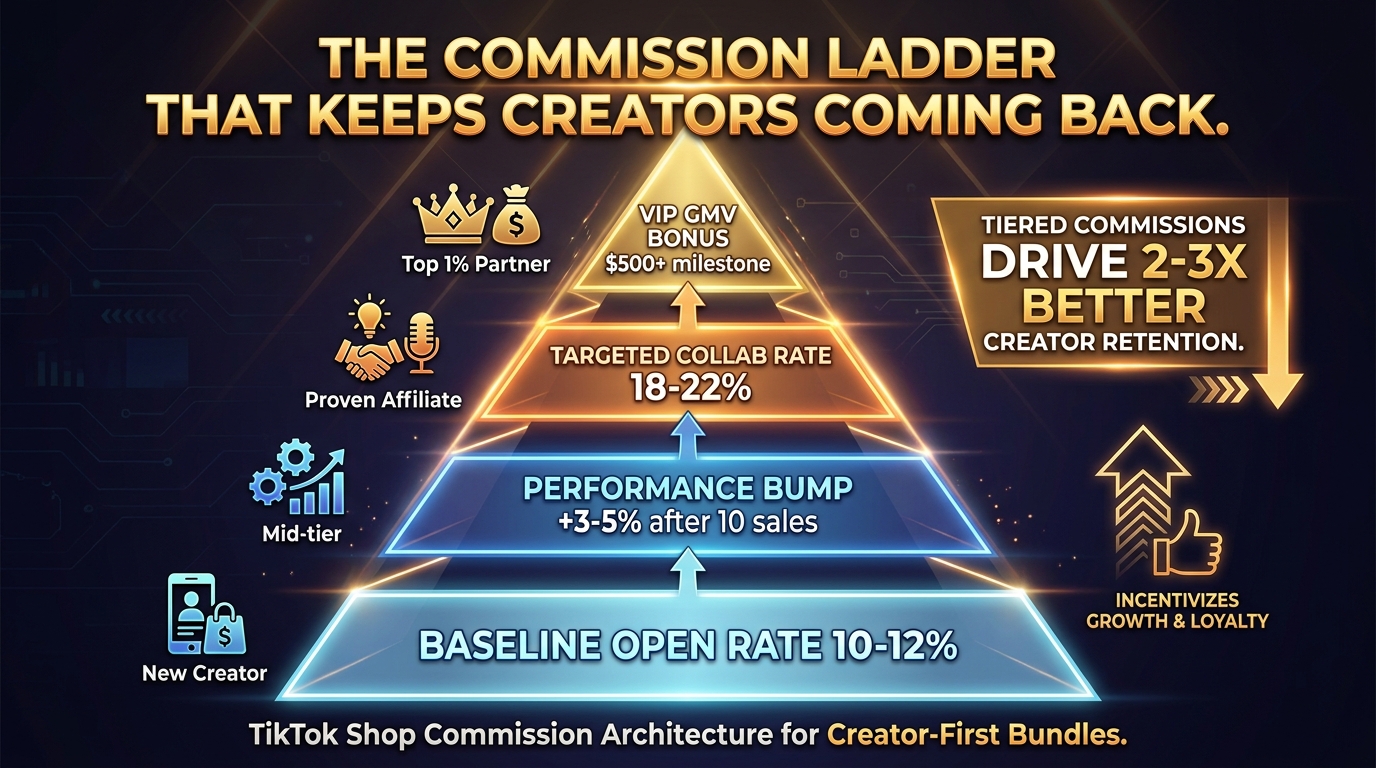
Commission architecture is where most brands make their most costly structural error. The instinct is to set a single rate that protects margin and post it uniformly across the creator pool. The result is an offer that is competitive for no one — too low to attract strong creators, too undifferentiated to build loyalty.
Creator-first commission architecture is not a single number. It is a layered incentive structure designed to accomplish four things: attract new creators at the discovery stage, reward performance improvement, create economic step-changes that make your bundle the obvious choice for a creator’s top-priority content slot, and build long-term relationship lock-in for your best affiliates.
The Four-Tier Commission Ladder
Tier 1 — Open Baseline Rate (10–13%). This is the rate visible on your Open Collaboration offer. For bundles in the $40–$70 price range, a 10–13% commission produces $4–9 per sale, which is competitive at the Open Collaboration level without destroying margin headroom. The goal at this tier is to be visible and credible — not to maximise earnings per creator, but to generate enough volume to surface your best performers.
Tier 2 — Performance Bump (Baseline + 3–5% after qualifying threshold). After a creator drives a defined number of sales — typically 10–15 in a 30-day window — their commission rate on the bundle automatically steps up. This creates an incentive to keep posting after the first piece of content lands, which is where most affiliate programs bleed value. The step-up is modest but psychologically significant: it signals that the brand is paying attention and rewarding output.
Tier 3 — Targeted Collaboration Rate (16–22%). When you move a proven creator from Open to Targeted Collaboration, the commission rate step-change should be substantial enough to feel meaningful. A jump from 12% to 20% on a $55 bundle is the difference between $6.60 and $11 per sale. For a creator driving 50 sales per month, that is a $220 monthly income difference from one brand relationship. That is the kind of economic signal that earns priority content placement.
Tier 4 — GMV Milestone Bonuses. For top-tier creators who have demonstrated sustained performance, overlay cash milestone bonuses onto the commission structure. Common structures: a $300–500 cash bonus for hitting $2,000 in monthly bundle GMV, or an additional percentage override (e.g., a 2% retroactive uplift on all sales in a month where GMV exceeds a threshold). These bonuses are not standard commission — they are relationship retention tools, and they should be framed explicitly as recognition of partnership status.
The “Open Rate Trap” — What to Avoid
One configuration that systematically fails is setting your Targeted Collaboration rate only marginally higher than your Open Collaboration rate. If a creator in your Targeted pool is earning 15% where they could earn 13% in Open, the economic differentiation is too thin to change their content prioritisation behaviour. The gap between Open and Targeted rates needs to feel like a meaningful upgrade. The target spread is at least 6–8 percentage points — enough that a creator can genuinely credit the Targeted relationship with a material income increase.
Commission Calculation on Bundles: The Mechanics
TikTok Shop calculates affiliate commission on the final paid price after all applicable discounts and seller promotions are applied. This matters considerably for bundles, where sellers often layer a bundle discount on top of a platform promotion. A bundle listed at $55 with a $5 bundle discount and a $3 seller coupon produces a commission base of $47, not $55. At 18%, that is $8.46 rather than $9.90. The difference compounds across high-volume creators.
The practical implication: before setting commission rates for any bundle offer, calculate them against the discounted price, not the listed price. Factor in all promotion layers that are active during the campaign period. Commission promises made on listed price that are actually paid on discounted price create creator trust problems that are expensive to repair.
The “Shootable Bundle” Standard — Designing Products and Offers That Film Well
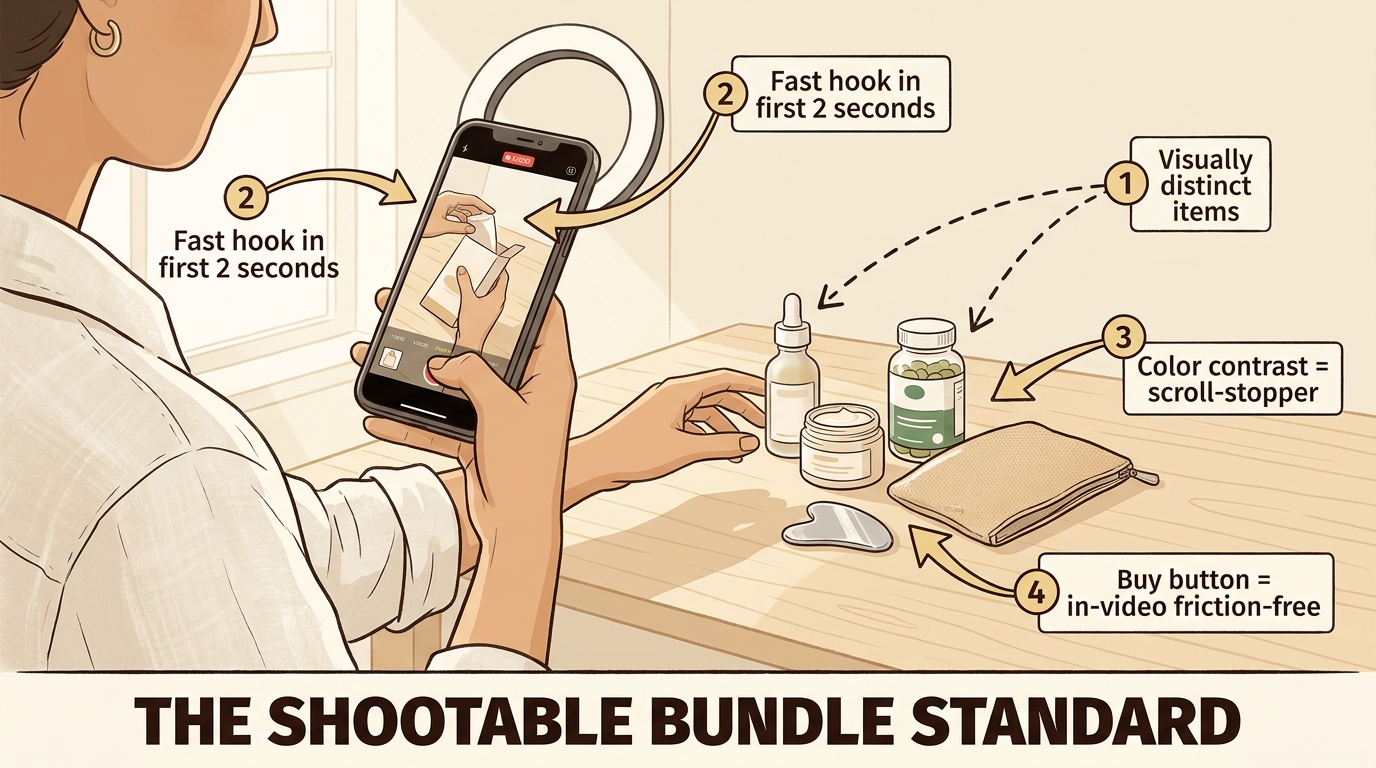
The “shootable bundle” concept treats product design and bundle composition as a pre-production decision, not a post-production problem. The question is not: “Can a creator make a video about this bundle?” It is: “What does the ideal 30-second video about this bundle look like, and does the bundle as designed enable that video?”
Working backwards from the content into the product configuration reveals specific, actionable design requirements that most brands have never articulated.
Visual Architecture of a Shootable Bundle
Colour contrast between items. When a creator lays three products flat on a surface for an opening shot, visual contrast between items makes the shot hold attention. A bundle of three black-packaged supplement bottles in different sizes is visually inert. A bundle containing a vibrant yellow gummy jar, a white powder canister, and a matte black capsule bottle has immediate visual interest. The scroll-stop moment happens before the creator even opens their mouth.
Size and shape variation. Varied physical formats create natural focal hierarchy in close-up shots and give the creator physical movement options — picking up, opening, pouring, applying. A bundle where everything is the same size and format eliminates these edit points. Creators working in 30-second formats need visual transitions baked into the product set itself.
At least one demonstrable product. The algorithm rewards watch time, and watch time is earned through tension and resolution. A product with a dramatic use-moment — a mask applied and removed, a supplement that produces a visible fizz, a tool with a before/after application — creates that tension and resolution arc within the video. Bundles that are all passive-use products (capsules you swallow, serums you pat in) are structurally challenging to build content hooks around because the visual payoff is delayed or invisible.
An unboxing moment. If the bundle is packaged as a unified kit — a box, a bag, a pouch — the act of opening it becomes content. The unboxing moment is one of TikTok’s most reliable format anchors: it structures the first 3–5 seconds of the video (the critical hook window), creates natural product reveal moments, and gives less experienced creators a low-friction opening format. Custom bundle packaging is an investment in creator content quality, not just brand presentation.
The Two-Second Rule for Bundle Hooks
The first two seconds of a TikTok video determine whether it gets watched. For affiliate bundle content, the hook is almost always a product-based visual — either a dramatic close-up of the most visually compelling item, or the bundle displayed in full before the creator speaks. Brands can meaningfully influence this moment by providing hero shot guidelines to creators: suggested angles, styling ideas, and lighting conditions that make the bundle’s best visual qualities immediately apparent.
This is not scripting. It is set design direction — analogous to a film production giving a location scout parameters before choosing a shooting location. It narrows the creative decision space just enough to improve average content quality without constraining the authentic creator voice that makes TikTok affiliate content convert.
Excluding Problematic SKUs From Bundle Configuration
Not every strong-selling product belongs in an affiliate bundle. Products with complex usage instructions that require lengthy explanation, items with packaging that doesn’t photograph or film well, or products where the primary benefit is felt over weeks rather than demonstrable immediately — these are all poor bundle candidates for affiliate content, regardless of their standalone sales performance. The selection criterion for bundle inclusion should be: does this product make the video better?
Sample Seeding at Scale — How to Get Bundles into Creator Hands Without Burning Budget
Sample seeding is the operational backbone of any TikTok Shop affiliate bundle program, and it is also where well-intentioned programs most frequently collapse under their own weight. Getting product into creator hands efficiently, tracking what was sent and to whom, and connecting samples to downstream content and conversion requires infrastructure that most brands underestimate.
The TikTok Shop Native Seeding Workflow
TikTok Shop’s Affiliate Center includes a built-in sample management system for both Open and Targeted Collaborations. Sellers can configure specific products as “free samples,” set allocation limits per creator, and track sample request status from application through fulfilment. For brands running structured bundle campaigns, this native workflow should be the primary seeding mechanism — it keeps sample distribution inside the platform’s data environment, which enables attribution between sample receipt and content creation.
The configuration decisions that matter: set clear sample allocation per creator (one bundle per creator for a first collaboration is standard; second-bundle allocation should require minimum performance milestones). Include a sample expiry window — a 14–21 day deadline from sample receipt to content posting keeps your pipeline moving and filters out creators who are accepting samples speculatively without genuine posting intent.
Seeding Tier Structure
Not every creator in your program should receive the same seeding treatment. A structured seeding tier prevents budget waste and creates natural upgrade signals that reinforce the broader creator relationship ladder.
Tier A (Open Collaboration applicants, <50K followers): Standard bundle sample, no supplementary materials, self-guided creation. These creators are being tested for organic fit and posting cadence before any deeper investment.
Tier B (Proven performers being upgraded to Targeted Collaboration): Full bundle sample plus a secondary product for additional content options, a brief PDF, and a direct outreach message acknowledging their previous performance. The seeding package signals that this is a step-change relationship, not just another sample drop.
Tier C (VIP/established partners): Full bundle, exclusive variant or upcoming SKU preview, packaging that reflects the relationship (a handwritten note, branded tissue paper, or a note from a brand founder). The physical seeding experience at this tier becomes content in itself — the unboxing of a premium VIP send is a format that consistently outperforms standard product shots in watch time and save rates.
The Address Collection Problem
One operational detail that creates disproportionate friction: creator address collection. Chasing shipping addresses through TikTok DM threads is slow, error-prone, and frustrating for both sides. The solution that most experienced TikTok Shop operators settle on is a brief creator onboarding form (hosted externally, linked in the Targeted Collaboration offer) that collects address, preferred contact, content timeline, and format preferences in a single step. Three minutes of creator friction upfront saves hours of operational back-and-forth later.
Brief Writing for Bundle Campaigns — Giving Direction Without Killing Creativity
The creator brief is the most frequently misexecuted element of a TikTok Shop affiliate bundle campaign. Brands that have never briefed affiliate creators tend toward one of two failure modes: the wall of text (a five-page document with approved language, prohibited claims, mandatory hashtags, and tone-of-voice guidelines that no creator has ever fully read) or the void (a product sample sent with no direction whatsoever, leaving the creator to guess what the brand actually wants).
Neither extreme serves the goal. The wall of text suppresses the authentic voice that makes TikTok content convert. The void forces creators to do positioning work they shouldn’t have to do, produces inconsistent messaging across the creator cohort, and frequently results in content that misses the bundle’s strongest selling angles entirely.
The One-Page Brief Structure
Effective affiliate bundle briefs for TikTok Shop are short, visually clean, and focused on outcomes rather than prescriptions. The structure that works:
Section 1: The Offer (2–3 sentences). What is this bundle? What problem does it solve? What is the one thing a viewer should walk away believing about it? This gives the creator the core positioning without dictating how to express it.
Section 2: The Key Claims (3–5 bullets). Facts about the product that are true, demonstrable, and compelling. Not marketing language — product truths. “Ships in 24 hours.” “The cleanser is fragrance-free, dermatologist tested.” “The bundle saves $22 versus buying individually.” Creators will naturally select from this list based on what resonates with their audience.
Section 3: Three Hook Ideas (optional starting points). Not scripts — opening lines or visual concepts that the brand knows have worked in other content or in their own testing. “What I wish I’d known before starting a skin routine.” “The starter pack nobody tells you about.” “I’ve been using this combo for 60 days — here’s what happened.” Creators often discard these entirely and use their own hooks, which is fine. The value is in shortcutting the blank-page problem, not in imposing a structure.
Section 4: The Clear Don’ts (3 bullets maximum). Regulatory or brand-critical restrictions only. “Do not make specific medical or health claims.” “Do not compare to [competitor brand] by name.” “Do not show usage in a car.” Three items. Anything beyond three is a brand prioritisation failure disguised as a compliance document.
Section 5: Commission and Timeline. The specific rate they are earning, the payment schedule, and the requested posting window. This should be the last section — but it should never be omitted. Creators who understand their economics are more motivated, more willing to follow up with additional posts, and more likely to invest time in higher-quality content.
Brief Format Matters
PDFs, Notion pages, and one-page Google Docs all work for brief delivery. The format that consistently underperforms is long email chains, where the information is buried in thread history and difficult to reference at the moment of content creation. Creators work from a phone. The brief should be viewable, navigable, and linkable from a mobile screen.
Bundle Margin Math: What Sellers Get Wrong Before Setting Commission Rates
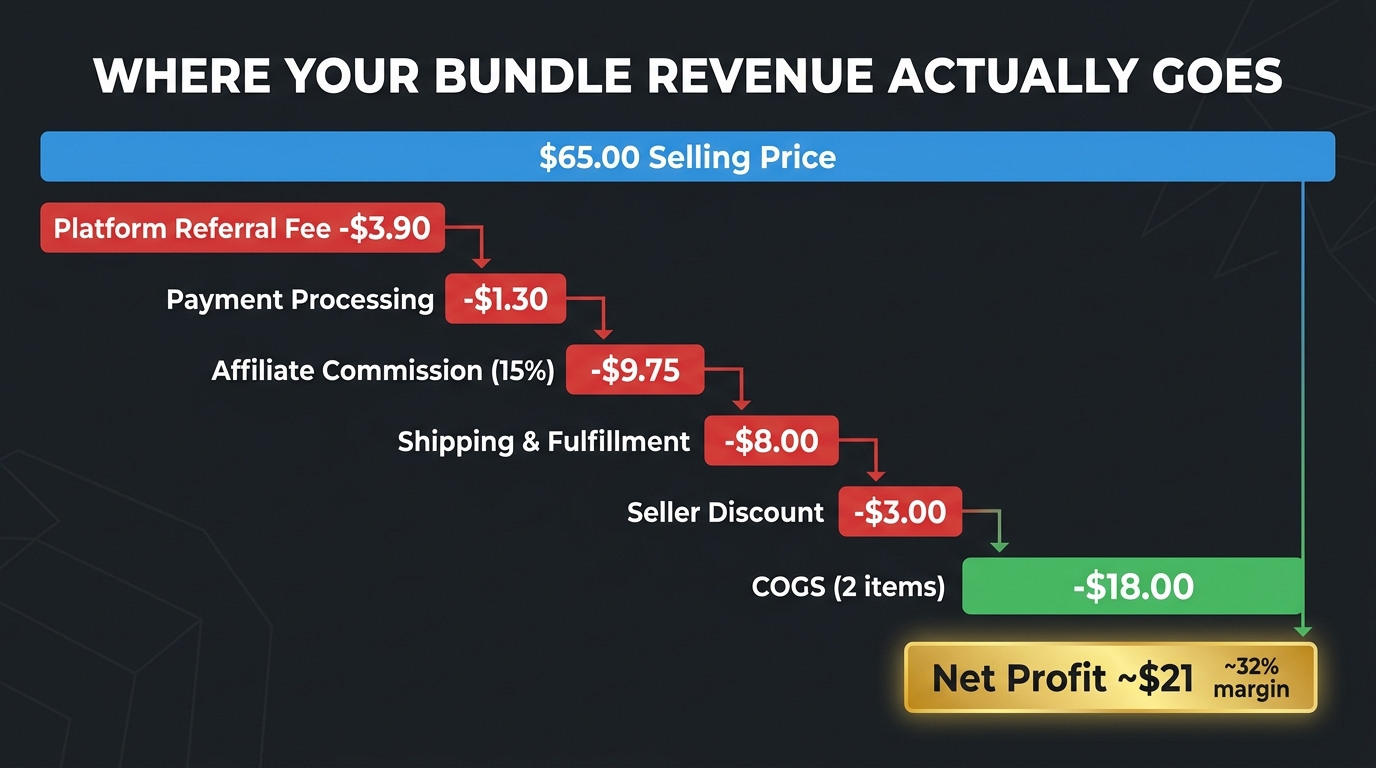
The single most common reason TikTok Shop bundle programs collapse is that sellers set commission rates based on listed price and surface-level margin calculations, then discover three months later that the actual net margin on bundle orders is negative. Understanding the full fee stack before designing bundle economics is not optional — it is the prerequisite for any other decision in this framework.
The Full Fee Stack on a TikTok Shop Bundle Order
Take a $65 bundle as the working example. Here is where that revenue actually goes before a seller records a profit:
- Platform Referral Fee: Typically 5–8% of the sale price depending on category. At 6%, that is $3.90 off the top.
- Payment Processing Fee: 2% of transaction value, approximately $1.30.
- Affiliate Commission: At a Targeted Collaboration rate of 18%, and assuming a $5 bundle discount brings the commission base to $60, the affiliate earns $10.80.
- Shipping and Fulfilment: For a multi-item bundle with combined weight of 400–600g, domestic US shipping and fulfilment costs typically land between $6.50 and $9.00 depending on carrier and location.
- Seller Promotion Discount: A $3–5 bundle promotional discount to support conversion, reducing seller revenue by $3–5.
- Cost of Goods (COGS): For a two-to-three item bundle at typical DTC margins, bundled COGS of $15–22 is common.
Running those numbers on the $65 bundle: $65 gross revenue minus $3.90 (referral) minus $1.30 (payment) minus $10.80 (affiliate) minus $8.00 (shipping) minus $4.00 (promo discount) minus $18.00 (COGS) leaves approximately $19.00, or a net margin of just under 30%. That is workable, but only barely — and only because the commission was modelled against the discounted commission base rather than the listed price.
The same bundle with a naive commission rate of 22% applied to listed price ($65 × 22% = $14.30 affiliate payout) reduces net profit to approximately $15.40, or 23.7%. Add a return rate of 8–12% (typical for bundled lifestyle goods) and the program economics deteriorate rapidly.
The Return Rate Factor
TikTok Shop’s return rates on bundles are frequently undermodelled. Unlike single-SKU returns, bundle returns can be driven by dissatisfaction with any one item in the package, meaning the return trigger threshold is lower for bundles than for single products. Modelling a return rate of 10–15% for initial bundle launches is conservative but appropriate.
Importantly, on returned orders, affiliate commissions may or may not be clawed back depending on platform configuration and timing. Sellers should verify their specific category’s return commission policy before publishing final rates.
The Pricing Implication: Build Commission Space Before Building the Bundle Price
The correct sequencing is: define your minimum acceptable net margin (typically 25–30% for a sustainable TikTok Shop bundle program). Then work backward through the full fee stack to determine what COGS, AOV, and commission rate combination makes that margin achievable. Build the bundle price around those constraints — not around what feels like an attractive round number or what competitor bundles are priced at.
The practical output of this exercise is usually a higher bundle price than a seller’s initial instinct would suggest. Bundles priced below $40 on TikTok Shop are structurally difficult to make profitable with meaningful affiliate commissions. The $50–75 range is where the math works most cleanly for most lifestyle and consumable categories.
Tiered Creator Ladders — Moving Creators From Open to VIP Over Time
The transactional model of TikTok Shop affiliate management — send sample, wait for content, track commission, repeat with new creator — produces consistent mediocrity. It extracts single pieces of content from each creator relationship and then abandons the relationship value that was built in the process.
The structural alternative is a creator ladder: a defined progression from first contact through to sustained VIP partnership, with clear criteria at each stage, meaningful economic upgrades at each transition, and explicit communication that a creator’s status within the program is something they are actively building.
The Four Rungs
Rung 1 — Discovery (Open Collaboration). Any eligible creator who finds your bundle and applies. Commission at the Open baseline rate. Sample provided after approval. No direct communication investment beyond the standard platform workflow. This rung is high volume and low touch — the goal is content at scale, not relationship depth.
Rung 2 — Proven (Post first qualifying performance milestone). Creators who drive a defined minimum GMV or content output threshold (e.g., 3+ posts and $500 in bundle GMV within their first 60 days) graduate to Rung 2. They receive a direct message from the brand acknowledging their performance, an invitation to the next level of the program, and a rate upgrade. The tone of this communication matters: it should feel like recognition, not a contract amendment.
Rung 3 — Priority (Targeted Collaboration, full bundle program). Priority creators receive the full Targeted Collaboration treatment: elevated commission rate, exclusive bundle access (including new SKU previews before public launch), a named brand contact they can communicate with directly, and a quarterly review of their performance and opportunities. The brand is now in a relationship, not a transaction.
Rung 4 — VIP Partner (Top 2–5% by sustained GMV). VIP creators are treated as brand co-creators, not just distributors. They may have input into bundle composition (“which products do your followers keep asking about?”), early access to campaign materials, co-branded content opportunities, and the highest commission tiers plus milestone bonuses. At this level, the creator is not a marketing channel — they are a business partner with a genuine stake in the bundle’s performance.
Creator Ladder Communication Cadence
The ladder only works if creators know it exists and can see where they stand on it. This requires active program communication: an onboarding message that explains the progression, performance update messages at key milestones, and upgrade notifications that feel celebratory rather than administrative. Brands that manage this communication well — treating creator tier upgrades the way a sales organisation treats territory promotions — consistently build stronger affiliate retention than those that manage it through automated emails alone.
Measuring What Actually Matters — Bundle Performance Metrics Beyond ROAS
Return on ad spend is a useful metric for paid amplification of affiliate content, but as a primary measure of TikTok Shop affiliate bundle program health, it misses most of what actually matters. Brands that optimise ROAS alone frequently optimise the wrong things: they scale paid amplification on content that converts in the short term but burns creator relationships, produces inconsistent brand positioning, and extracts no learning about what actually drives sustainable bundle performance.
The Metrics That Matter for Bundle Programs
Creator Uptake Rate. Of the creators who view your bundle offer in the Affiliate Center, what percentage actually apply to promote it? A strong Open Collaboration uptake rate is 8–15%. Below 5% typically indicates a commission rate, product, or offer presentation problem — not a creator quality problem. Uptake rate is the leading indicator for everything downstream.
Post-Sample Activation Rate. Of the creators who received a sample, what percentage posted content within the specified window? A healthy activation rate is 60–75%. Below 50% is a warning sign for brief quality, sample experience, or timeline friction. This metric catches program failures before they become GMV problems.
Video-to-Sale Conversion Rate by Creator. Not aggregate conversion rate — individual conversion rate per creator. This surfaces creator-product fit at the individual level and enables smarter Targeted Collaboration targeting. A creator with a 4% video conversion rate is performing at or below platform average. A creator with an 11% rate has a meaningful audience-product alignment that warrants immediate Targeted upgrade.
Repeat Post Rate. What percentage of creators who posted once about the bundle posted a second time, without additional prompting? Repeat post rate is the clearest signal of genuine creator enthusiasm — and it correlates strongly with long-term affiliate program health. Brands with strong creator-first bundle design consistently see repeat post rates 2–3x higher than those running catalog-first programs.
AOV vs. Single-SKU AOV. Is the bundle actually lifting average order value above what your single-SKU affiliate offers achieve? If not, the bundle isn’t functioning as an AOV lever — it’s just a different product configuration. The target is for bundle AOV to sit at least 30–40% above your highest-performing single-SKU affiliate item.
Creator Retention Rate at 90 Days. Of the creators who posted about your bundle in month one, what percentage are still actively posting at the 90-day mark? This is the ultimate measure of creator-first program health. A rate above 35% indicates that the program’s economics and experience are strong enough to sustain creator interest beyond novelty. Below 20% suggests the economics are insufficient or the post-sample experience is failing to maintain engagement.
Attribution Complexity in Bundle Programs
One measurement challenge specific to bundles: customers who discover a bundle through affiliate content frequently search the brand directly before purchasing, particularly for higher-ticket items. This creates a last-touch attribution gap where a creator-driven discovery is incorrectly credited to direct or organic search. Brands running bundle programs alongside Spark Ads (where affiliate content is boosted as paid inventory) should model blended attribution, not pure last-touch, when evaluating creator contribution to bundle GMV.
From Offer to Asset: Building a Bundle Program That Compounds Over Time
The brands that see the most sustained returns from TikTok Shop affiliate bundle programs are the ones that treat each bundle launch not as a standalone campaign but as a learning asset — a structured experiment that generates creator data, conversion data, content data, and audience feedback simultaneously, feeding forward into smarter subsequent bundle design.
The 90-Day Bundle Learning Cycle
A structured approach: launch a new bundle into Open Collaboration with a defined test commission rate. Run for 30 days to generate baseline content volume and conversion data. Analyse creator uptake rate, activation rate, and video-level conversion to identify the specific creators and content formats that are outperforming. In month two, pull the top performers into Targeted Collaboration with upgraded economics. Scale winning content as Spark Ads. In month three, begin designing the next bundle iteration — informed by which products in the current bundle generated the most organic mentions, questions, and saves in creator content.
The output of each 90-day cycle is not just GMV. It is a ranked list of creator partners worth investing in, a set of content templates derived from what actually performed (rather than what the brand thought would perform), and a product intelligence brief for the next bundle: what the audience is asking for, what the creator community finds shootable, and what the price point and commission structure needs to be to sustain creator interest at scale.
The Network Effect of a Creator-First Program
There is a compounding dynamic that creator-first bundle programs eventually unlock and catalog-first programs almost never do: creator-to-creator referrals. When a TikTok creator has a genuinely positive economic experience with a brand’s affiliate program — fair commission structure, responsive brand contact, product that their audience responds to, clear tier upgrade path — they mention it to other creators in their network. This word-of-mouth within creator communities is not measurable through TikTok’s analytics, but it is one of the most powerful recruitment mechanisms available to a growing brand’s affiliate program.
The economics are simple: a creator who was invited into a program by a peer they trust starts with a higher baseline of goodwill and motivation than one who found an offer in the Open Collaboration feed. They are more likely to post, more likely to produce quality content, and more likely to stay in the program long-term. The creator-first bundle is not just a marketing tool — it is a network-building instrument when the economics and experience are designed correctly.
Conclusion — The Structural Shift From “Bundle Offer” to “Creator Partnership Asset”
Building a TikTok Shop affiliate bundle that works is not primarily a product question or a commission question. It is a systems design question: how do you build a product configuration, offer structure, economics model, content brief, seeding workflow, and relationship progression that makes a creator’s life easier, their content better, and their income higher — and do all of that while protecting seller margin and generating compounding program data?
The answer requires rejecting the catalog-first instinct that produces bundles designed for spreadsheets rather than cameras. It requires accepting that commission rates are a market signal, not just a cost line — and that rates set for internal comfort rather than creator competitiveness produce programs that are invisible in the affiliate marketplace. It requires investing in the non-economic elements of the creator relationship: the brief quality, the sample experience, the communication cadence, the upgrade pathway.
None of these are complex ideas. But they require consistent, deliberate execution across functions that typically operate in isolation: product, finance, marketing, and creator relations. The brands that close that operational gap — that treat the bundle as a creator partnership asset rather than a promotional SKU — are the ones consistently generating the 8–12% conversion rates, the 2–3x creator retention, and the AOV lifts that make TikTok Shop’s affiliate channel one of the most efficient customer acquisition mechanisms in consumer e-commerce today.
Actionable Takeaways
- Audit your existing bundles for “shootability.” Can a creator build a 30-second video around this bundle with a clear hook, a demonstrable moment, and a natural narrative arc? If not, redesign before relaunching.
- Rebuild your commission architecture as a four-tier ladder, not a flat rate. Open baseline, performance bump, Targeted rate, and GMV milestone bonus — each tier should feel like a meaningful economic step-change.
- Run full fee-stack margin modelling against the discounted commission base (not listed price) before finalising any bundle economics. Build bundle pricing backward from minimum acceptable net margin.
- Implement a 90-day bundle learning cycle. Open Collaboration in month one for volume and creator discovery. Targeted Collaboration in month two for your top performers. Bundle iteration in month three informed by content and audience data.
- Measure uptake rate, activation rate, and repeat post rate alongside ROAS. These leading indicators tell you where the program is failing before GMV suffers.
- Write one-page briefs, not brand guidelines documents. The goal is orientation, not prescription — give creators the offer core, three key claims, three optional hooks, three hard don’ts, and the commission structure, then get out of their way.
- Build the creator ladder explicitly and communicate it actively. Creators who can see a clear path from Open to VIP are more motivated, more consistent, and more likely to bring other creators into your program through peer referrals.
The TikTok Shop affiliate marketplace is competitive enough that half-measures produce invisibility. Creator-first bundle design is not a higher standard for its own sake — it is the minimum viable standard for building an affiliate program that actually performs.