

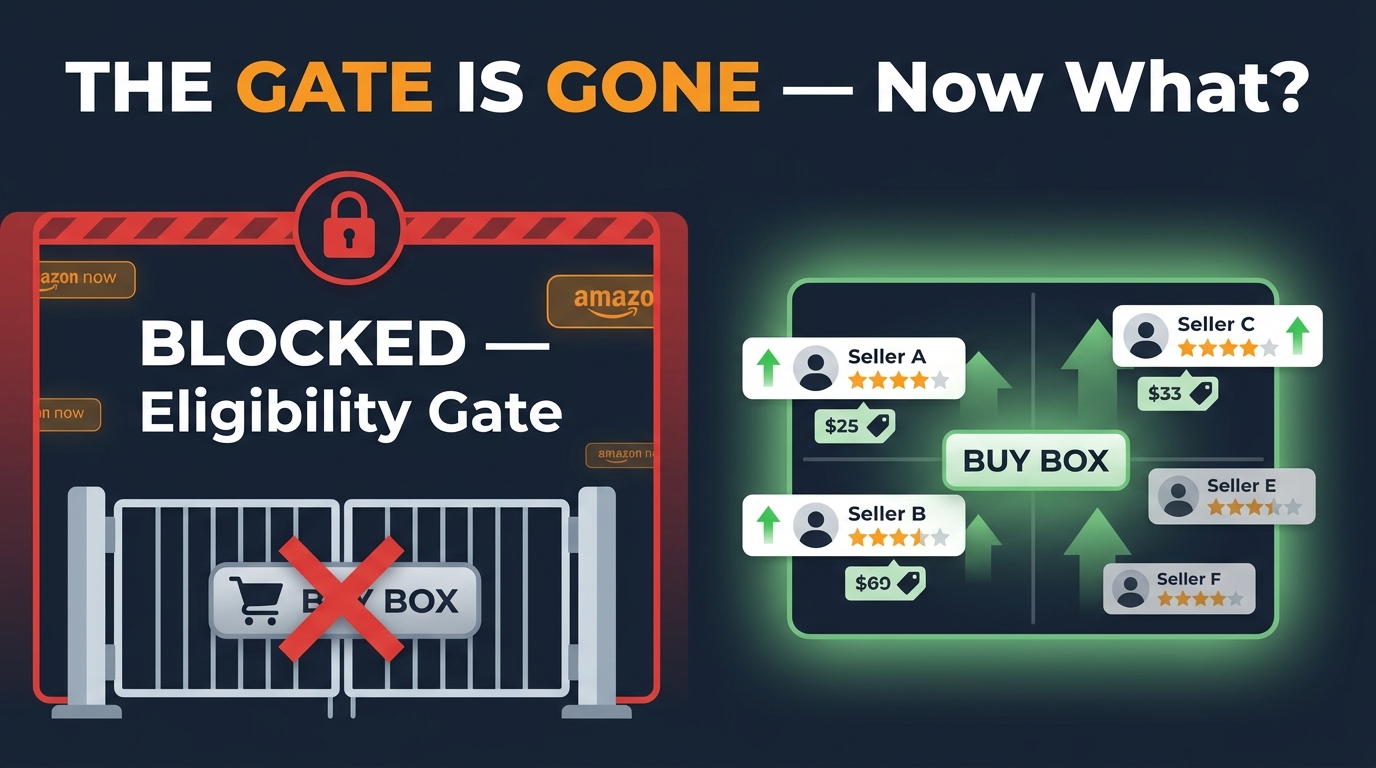

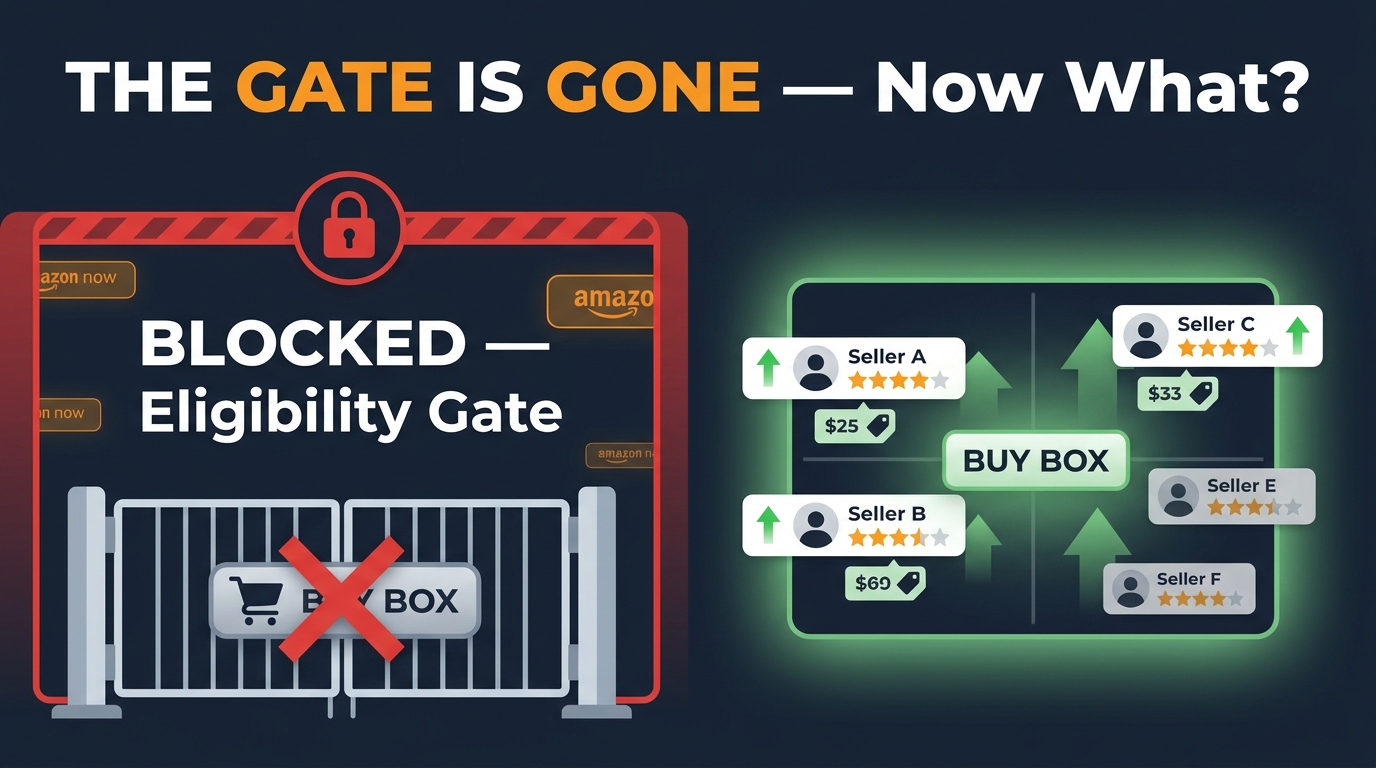
For years, Amazon sellers have operated under a well-understood rule: before your offer could even enter the race for the Buy Box, you had to pass a gate. That gate — the seller-eligibility check — was a binary pass/fail system running in the background of every product detail page. Sellers who cleared it competed for placement. Sellers who didn’t were invisible, locked out of the most valuable real estate in e-commerce regardless of how competitive their price or how fast their shipping.
In July 2026, Amazon removed that gate.
The change began rolling out to EU and UK marketplaces on July 20, 2026, with Amazon confirming via its Seller Forums that a phased global rollout would continue through the end of the year. The announcement was quiet — notably quiet, given its structural significance. Amazon framed it as the eligibility step “no longer delivering additional value to customers,” and stated that no seller action was required. Existing offers would be included automatically.
But the understated rollout has not stopped the questions from flooding seller communities. What does this mean for my FBA business? Are my listings at greater risk from hijackers? Do account health metrics still matter? Does this actually open the door for more sellers to win Featured Offer placement — or is it more complicated than that?
This article works through all of it: the mechanics of what changed, what stayed exactly the same, and — critically — how to position your catalog for the competitive landscape that has replaced the old gated model.
What the Buy Box Eligibility Gate Actually Was
To understand the significance of this change, it helps to understand what the gate actually did — and how most sellers misunderstood it.
The Amazon Buy Box (officially rebranded as the “Featured Offer” in recent years, though sellers still use both terms interchangeably) sits at the top right of any product detail page. It houses the “Add to Cart” and “Buy Now” buttons. Industry estimates consistently place 80–83% of all Amazon sales flowing through this single placement. On mobile, that figure is likely higher, given how little screen real estate is given to alternative offers.
The Old Two-Step Model
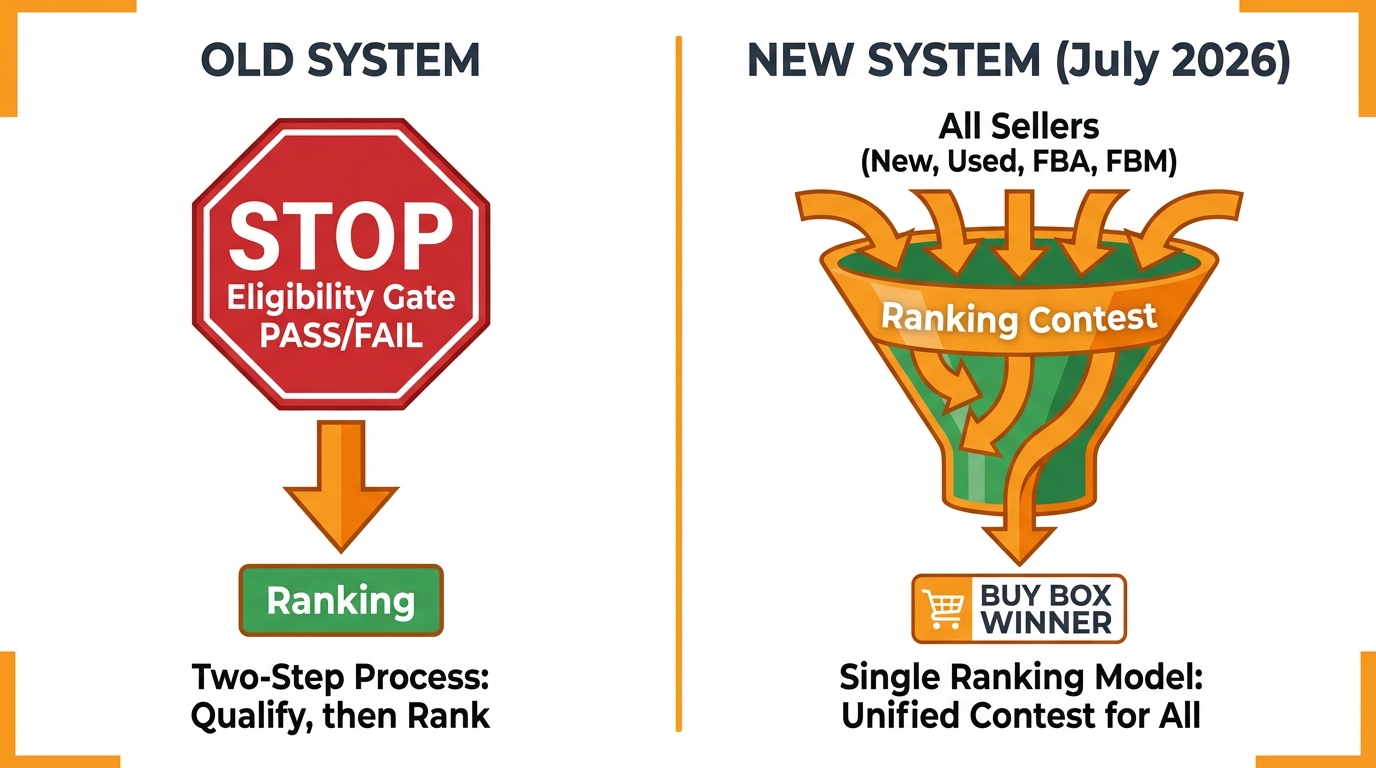
Under the system that operated until mid-2026, winning the Buy Box was a two-stage process. First, your offer had to clear the eligibility gate — a standalone check that evaluated seller performance against a series of minimum thresholds. These included metrics like Order Defect Rate (ODR), Late Shipment Rate (LSR), Valid Tracking Rate (VTR), and Cancellation Rate, as well as general account standing. If your metrics fell below the required floors, your offer was simply excluded from consideration, full stop.
Only after passing that gate did your offer enter the second stage: the ranking contest. Here, Amazon’s algorithm would evaluate competing offers on price, fulfillment speed, seller history, and other customer-facing factors, ultimately selecting one offer (or rotating among a small pool of eligible offers) for the Featured Offer position.
This meant the eligibility gate and the ranking formula were treated as separate systems. A seller could have excellent pricing and Prime-speed fulfillment but still be completely invisible in the Buy Box if a single metric — say, ODR creeping above the threshold — triggered exclusion.
Why This Created Problems
The binary nature of the gate created a cliff-edge problem that frustrated sellers in multiple ways. A small operational hiccup — a short-term spike in late shipments due to a carrier issue, for example — could briefly push a metric above threshold and shut an otherwise healthy seller out of Featured Offer competition entirely. The recovery process was slow, since the metrics typically looked back over rolling 60- or 90-day windows.
It also created an asymmetric playing field where sellers with borderline-acceptable performance could game the gate — just barely clearing the pass/fail threshold — while contributing minimal quality signals to the broader algorithm. A seller sitting at ODR 0.9% (just under the 1% gate) and a seller at 0.2% were both “eligible,” even though their actual performance and customer experience contribution were very different.
Amazon’s stated reasoning for removing the gate is consistent with this critique: the separate eligibility check was no longer adding value. The same signals it evaluated are now being fed directly into the ranking model, where they can be weighted on a continuous scale rather than functioning as an all-or-nothing filter.
What Amazon Changed — and Exactly When
The timeline here matters for sellers operating across multiple marketplaces, because the rollout is phased rather than simultaneous.
The July 2026 Announcement
Amazon’s Seller Forums announcement, dated July 6, 2026, confirmed that the standalone seller-performance eligibility step for the Featured Offer would be removed. The wording was specific: the check was being retired because it was “no longer delivering additional value to customers.” Amazon was explicit that the ranking factors themselves — price, delivery speed, seller performance — were not changing. What was changing was where and how those signals were evaluated.
EU and UK marketplaces went live on July 20, 2026. Amazon stated that no seller action was required and that existing offers would be included in the new model automatically.
The Global Rollout Timeline
The full global rollout is expected to complete by the end of 2026, proceeding marketplace by marketplace. As of the time of writing, US sellers should expect the same structural change to reach their accounts before Q1 2027. The practical implication is that sellers operating across Amazon EU, UK, and US should be preparing for the unified ranking model now, even if their primary marketplace hasn’t yet received the update.
The Key Structural Difference
The move is from a two-step architecture to a single unified ranking contest. Under the old model, you either cleared the gate or you didn’t — and only after clearing it did performance signals begin to affect your position in the competition. Under the new model, every offer enters the competition pool directly. Seller performance metrics — including the same ODR, LSR, VTR, and cancellation rate signals the gate previously evaluated — now function as continuous weighted inputs inside the ranking algorithm rather than a binary admission ticket.
This is a fundamental shift in how Amazon is applying performance data. Instead of using those metrics to decide whether you can play, the algorithm uses them to decide how well you play — a meaningful difference in how sellers should be thinking about metric management.
What Didn’t Change: The Ranking Factors Still Govern Everything
There is a critical misconception circulating in seller communities that the gate removal “opens up” the Buy Box in a way that fundamentally weakens the importance of performance metrics or makes it easier to win placement. This is incorrect, and acting on that assumption could damage your catalog performance significantly.
Amazon has been explicit: the factors that determine who wins the Featured Offer have not changed. Price, delivery speed, and seller performance are still the core signals. What changed is the architecture through which those signals are applied — not the signals themselves.
The Competitive Intensity Increases, Not Decreases
Removing the eligibility gate means more sellers are now competing for the Featured Offer on any given ASIN. This has the effect of making the ranking contest more competitive, not less demanding. A seller who previously benefited from competitors being excluded by the gate now faces those competitors directly inside the ranking algorithm.
In practical terms: if you were winning the Buy Box partly because other sellers on your ASIN weren’t eligible, that buffer is gone. Your pricing and fulfillment performance must now stand on their own merits against a larger pool of competing offers.
Price Competitiveness Is Still Non-Negotiable
Amazon evaluates total landed price — item price plus shipping — not just the listed item price. This means free shipping offers receive a structural advantage over equivalent-price offers that charge for shipping. Amazon’s help documentation has consistently identified competitive pricing as one of the heaviest signals in Featured Offer selection, and this has not changed under the new model.
The key nuance is that “competitive” does not always mean “lowest.” Amazon’s algorithm considers pricing relative to other offers on the listing, to Amazon’s own price history for the ASIN, and in some categories to broader market prices. Pricing that Amazon considers artificially high — even if it’s lower than other third-party offers — can still suppress your Featured Offer position.
Delivery Speed Has Gained Weight
Multiple 2026 seller analyses indicate that delivery speed — specifically the ability to deliver within one to two days — has become a more heavily weighted signal in the unified ranking model. This is consistent with Amazon’s broader customer experience focus: Prime-equivalent delivery expectations have become normalized for Amazon shoppers, and the algorithm appears to be tightening its weighting of delivery promise accordingly.
For sellers who rely on fulfillment methods that cannot reliably hit the one-to-two day delivery window, this weighting shift represents a real and growing competitive disadvantage.
The Metrics That Actually Matter Now — and at What Thresholds
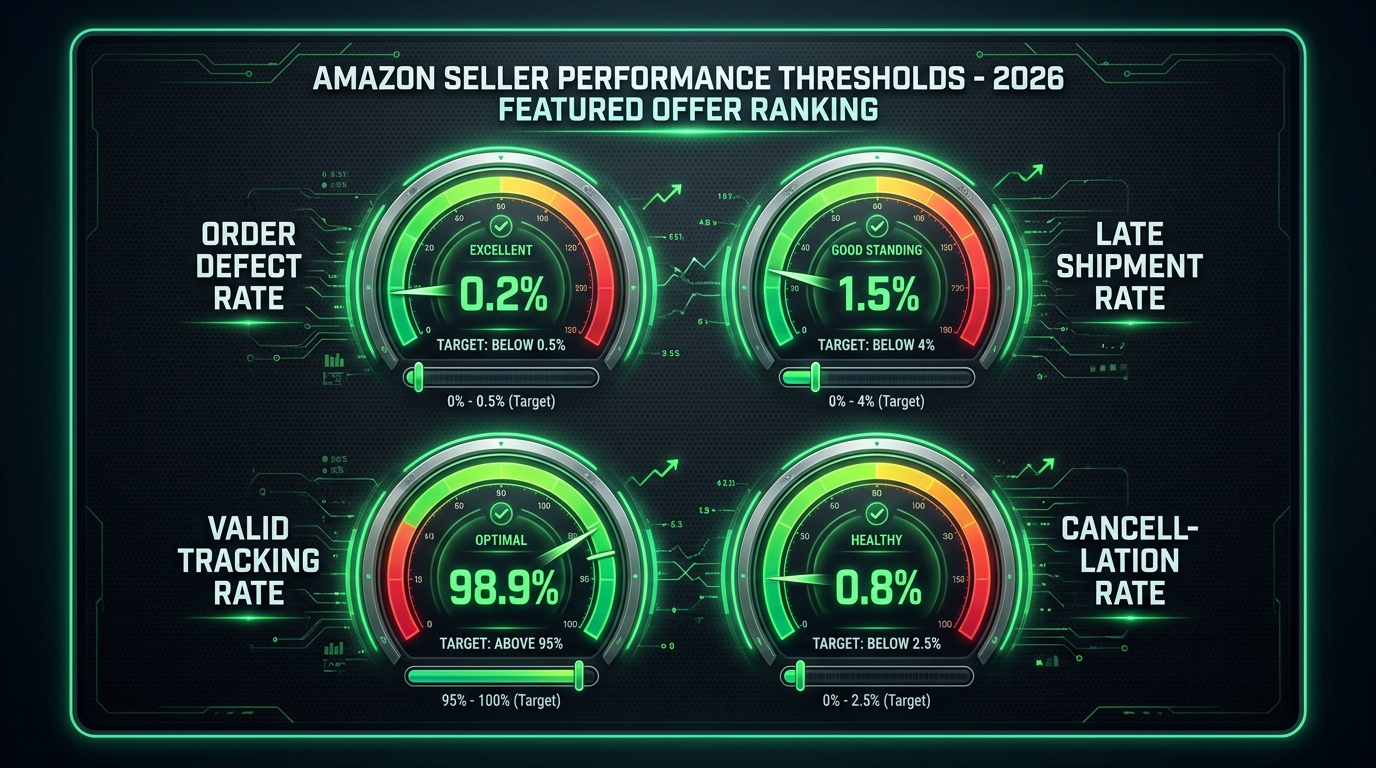
With seller performance metrics now functioning as continuous ranking inputs rather than pass/fail gates, the logic of how you manage them needs to shift accordingly. It’s no longer sufficient to think in terms of “am I above or below the threshold.” The question now becomes “how much headroom do I have above the threshold, and how is that headroom affecting my ranking score?”
Order Defect Rate (ODR)
ODR remains one of the most closely watched account health signals. The official Amazon threshold — the line that previously represented the eligibility gate — is 1%. But industry guidance for 2026 increasingly recommends targeting below 0.5% as your operational floor, not 1%. Under the unified ranking model, a seller running ODR at 0.9% (technically “eligible” under the old gate) is now likely ranked meaningfully below a seller running at 0.2%, rather than being treated as equivalently eligible.
ODR incorporates negative feedback rate, A-to-Z Guarantee claim rate, and credit card chargeback rate. Managing it requires attention across all three components — not just the overall score.
Late Shipment Rate (LSR)
LSR measures the percentage of seller-fulfilled orders shipped after the expected ship date. The threshold is 4%, but again, targeting well below that number — aiming for sub-2% — is the appropriate stance in a unified ranking environment where this metric contributes continuously to your Featured Offer position rather than just gating entry.
For FBM sellers, LSR is particularly critical because it’s one of the most direct signals of fulfillment reliability. Amazon’s algorithm has no Amazon-managed fulfillment data to fall back on for FBM offers, so your LSR carries proportionally more weight in evaluating your delivery promise.
Valid Tracking Rate (VTR)
VTR requires that 95% or more of your packages have valid tracking uploaded before the expected delivery date. This is a non-negotiable signal in the unified ranking model, particularly because it feeds into delivery promise accuracy — a signal Amazon uses to determine whether to display your estimated delivery window to customers. Without valid tracking, Amazon can’t credibly promise your delivery speed, which suppresses your ranking on that dimension.
Cancellation Rate
Pre-fulfillment cancellation rate — orders cancelled before shipment — needs to stay below 2.5%. Like LSR, it signals operational reliability and inventory management quality. Sellers with frequent cancellations are essentially communicating to the algorithm that their offers may not actually be available when promised, which is directly counter to the customer-experience signals Amazon is optimizing for.
Voice of the Customer (VOC) Signals
An important addition to the unified ranking model’s inputs is Voice of the Customer feedback — the aggregate of customer-reported product experience signals. Under the old model, VOC primarily affected listing health (triggering suppression warnings) rather than Buy Box eligibility directly. In the unified ranking model, VOC complaints appear to carry weight as a performance signal affecting Featured Offer position, not just listing status. Sellers with persistent VOC issues should treat this as a Buy Box problem, not just a listing compliance problem.
FBA vs. FBM vs. Seller Fulfilled Prime: How Fulfillment Choice Shifts
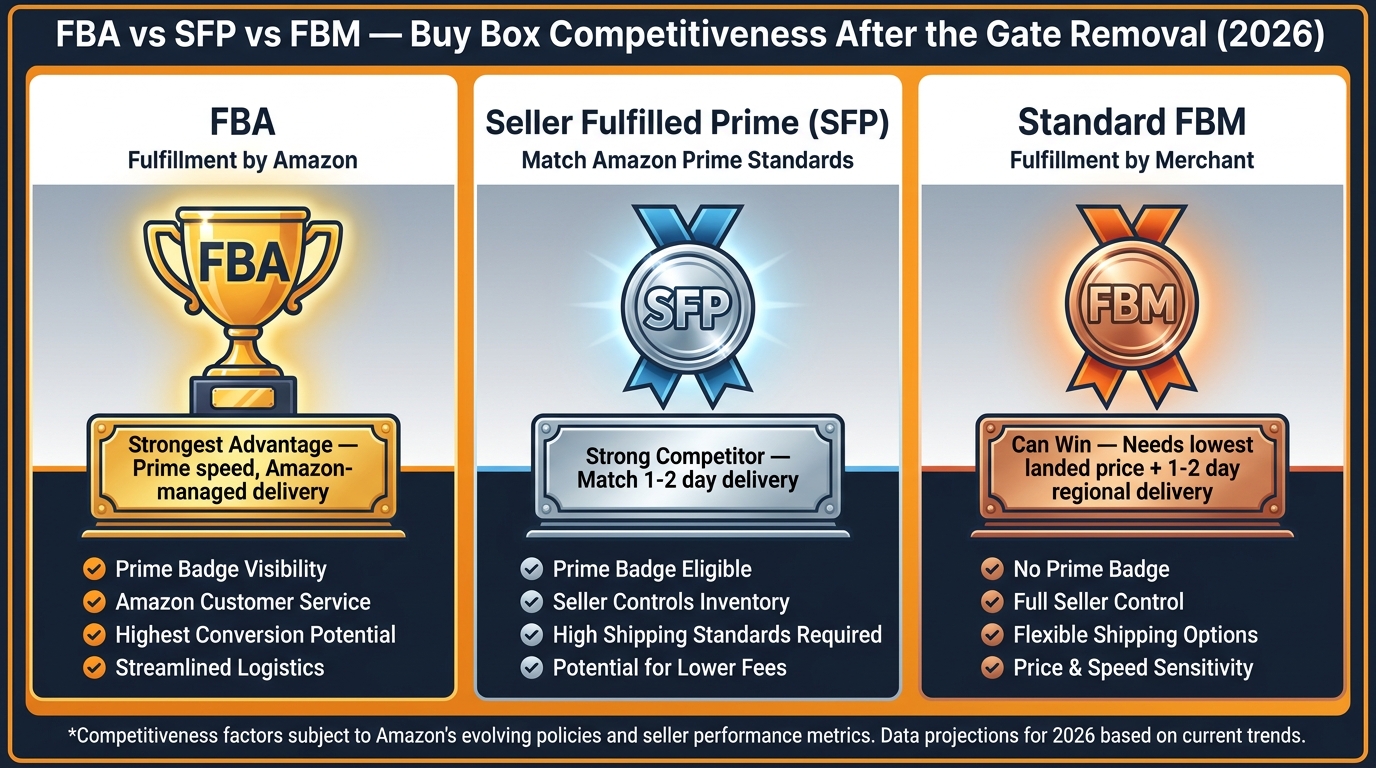
The removal of the eligibility gate does not change the fundamental structural hierarchy among fulfillment methods — but it does create some meaningful shifts in how the competitive dynamics play out within each tier.
FBA: Still the Strongest Default Position
Fulfillment by Amazon retains its structural advantage under the new model. When you use FBA, Amazon controls the delivery promise — and therefore the delivery speed signal in the ranking algorithm defaults to Amazon’s own network capability, which is reliably Prime-speed for the vast majority of catalog. This means FBA offers don’t have to earn delivery speed as a ranking signal; it’s essentially built in.
Additionally, FBA removes LSR, VTR, and cancellation rate as variables on the fulfillment side. These metrics become Amazon’s responsibility, not yours. For competitive ASINs where the unified ranking model is now weighing multiple performance signals simultaneously, having FBA handle the fulfillment dimension removes several potential ranking vulnerabilities at once.
That said, FBA’s advantage is most pronounced in categories with high competition and thin margin differences between offers. For categories where you hold a significant pricing advantage or where delivery speed is less decisive in the purchase decision, the FBA premium may not justify its cost structure relative to alternative fulfillment methods.
Seller Fulfilled Prime: The Closest FBM Path to FBA-Level Competitiveness
Seller Fulfilled Prime (SFP) allows qualified sellers to display the Prime badge on FBM orders, provided they can meet Amazon’s delivery speed and performance requirements. SFP’s standards are stringent — carriers must deliver on time at a rate Amazon considers Prime-equivalent, and sellers must consistently maintain the required metrics — but for sellers who can meet the bar, SFP now represents the most competitive non-FBA option in the unified ranking model.
The reason is straightforward: SFP offers the Prime badge (which carries both a customer trust signal and an implicit delivery speed signal in the algorithm) while potentially preserving more margin flexibility than FBA, depending on category, volume, and logistics setup. High-performing SFP sellers running clean account health metrics can meaningfully compete with FBA offers in the Featured Offer rotation — particularly if they’re pricing competitively and serving their region’s geographic demand efficiently.
Amazon has reportedly tightened SFP requirements through mid-2026, raising the performance bar for approval and continued participation. For sellers considering SFP as a path post-gate-removal, the investment in qualifying is significant but increasingly worthwhile given the competitive landscape changes.
Standard FBM: Viable But Narrower
Standard FBM without the Prime badge can still win the Featured Offer under the unified ranking model — but the conditions under which it can do so have narrowed. The primary levers are aggressive landed price (low enough to compensate for the delivery speed disadvantage relative to FBA and SFP offers) and regional delivery performance (particularly 1–2 day regional delivery windows that can close some of the gap with Prime-speed competition).
The gate removal doesn’t inherently help standard FBM sellers — if anything, it increases the competitive pressure on them by bringing more sellers into direct ranking competition on every ASIN. Standard FBM works best where your offer has a distinct price advantage or where FBA and SFP sellers are not present on your ASIN.
What This Means for Private Label Sellers Specifically

For private label sellers — those who own the brand and typically hold the only authorized offer on their ASINs — the gate removal creates a specific and underappreciated risk that deserves dedicated attention.
The Hijacker Risk Landscape Has Changed
Under the old eligibility gate model, an unauthorized seller who appeared on your listing still had to clear the performance gate before competing for the Buy Box. This provided a natural barrier: sellers with thin histories, low feedback counts, or borderline metrics were often self-limiting in their ability to capture your Featured Offer position even if they were technically present on your ASIN.
Under the unified ranking model, that self-limiting effect is reduced. An unauthorized reseller appearing on your listing can enter the Featured Offer competition more directly, particularly if they’re willing to undercut your pricing. The gate no longer acts as a buffer. The burden of protection shifts more heavily onto brand-level defensive measures.
Brand Registry Is More Important Than Ever
Amazon Brand Registry remains the primary tool for private label protection, and its importance has only grown in the context of the gate removal. Brand Registry provides access to reports of unauthorized sellers, intellectual property violation claims, and — critically — the ability to monitor and flag offers that appear on your ASINs without authorization.
Sellers who have delayed Brand Registry enrollment should treat the gate removal as a forcing function. The window in which an unauthorized seller sits on your listing and captures Featured Offer sessions is now potentially shorter to open than it was before July 2026.
Pricing Strategy as a Protective Layer
Private label sellers have more control over their ASINs’ pricing history than they often realize, and this becomes a defensive tool post-gate-removal. Amazon’s algorithm uses historical price data for an ASIN to evaluate whether current pricing is “competitive.” Maintaining a consistent, defensible price point — rather than frequently discounting — helps establish an ASIN price anchor that makes unauthorized sellers’ attempts to undercut appear as anomalies, which can affect how the algorithm treats their offers.
This doesn’t replace Brand Registry or active monitoring, but it adds a layer of structural resistance to unauthorized offer competition within the ranking model.
Monitoring Cadence Must Increase
Private label sellers running on a weekly listing review cadence should consider moving to daily or real-time monitoring for unauthorized offers on key ASINs, particularly high-revenue or high-margin products. The gate removal means unauthorized sellers can move from “present on the listing” to “capturing Featured Offer position” more quickly than before. Tools that alert on new offer appearances and Buy Box share changes should be a standard part of catalog management, not an optional add-on.
What This Means for Resellers and New Sellers
For resellers — sellers who source branded or wholesale products and list alongside other sellers on shared ASINs — the gate removal is genuinely more of an opportunity than a risk, provided they understand where the opportunity actually lies.
Lower Entry Barriers for Competitive Offers
The most direct benefit for resellers is that offers with strong pricing and fast fulfillment no longer need to survive a period of metric accumulation before entering the Featured Offer competition. Under the old model, a relatively new seller or a seller recovering from a temporary metrics dip faced an extended exclusion period even with excellent pricing. The unified ranking model allows those offers to enter the competition immediately — they simply rank lower on performance signals until their track record builds, rather than being excluded entirely.
This is particularly relevant for resellers entering new ASINs or operating in categories where competition is fragmented. Getting into the Featured Offer rotation earlier, even at a lower win rate initially, can accelerate the metric accumulation that improves ranking over time.
Performance Build-Up Is Now the Game
The corollary to lower entry barriers is that the path to sustained high Buy Box win rates now runs directly through continuous performance improvement rather than just clearing a minimum threshold. For resellers who treated the old gate as the primary metric management goal — maintaining metrics just above the eligibility floor — the new model requires a genuine shift in operating discipline.
Building and maintaining a strong performance profile across ODR, LSR, VTR, and cancellation rate is now the ongoing work of competitive positioning, not a one-time compliance hurdle. The sellers who will consistently win more Featured Offer share over the next 12 months are those who treat account health as a continuous competitive differentiator, not a minimum bar to clear.
The Repricing Game Becomes More Volatile
With more sellers entering the Featured Offer competition on any shared ASIN, Buy Box rotation patterns are likely to become more volatile in the short to medium term as the global rollout completes. For resellers using automated repricing, this creates both opportunity and risk: more competition can drive faster price movement, which can erode margins if repricers aren’t properly configured with floor-price guardrails.
Resellers who operate without repricing guardrails — or who have price floors set too loosely — are most exposed to margin compression as the expanded competition pool settles into its new equilibrium.
Repricing Strategy in a Post-Gate World

With 80–83% of Amazon purchases flowing through the Featured Offer, every percentage point of Buy Box win rate has a direct and measurable revenue impact. In the unified ranking model, repricing strategy becomes more nuanced — and more consequential — than it was when price was primarily evaluated as a ranking signal after the eligibility gate had already done its filtering work.
Guardrailed Dynamic Repricing Is the Standard Operating Model
The core repricing framework that works in the post-gate environment is guardrailed dynamic pricing: a per-SKU floor price set at your minimum acceptable margin (accounting for all costs including FBA fees, referral fees, cost of goods, and return rate), a per-SKU ceiling price set at the maximum defensible market price, and a dynamic pricing engine operating between those bounds in response to competitor offers.
The critical discipline here is that floors and ceilings must be set per-SKU based on actual unit economics — not set loosely or as a percentage of a reference price. Automated repricers that race to the bottom without true cost floors built in will destroy margin in a competitive field that now includes more participants than before July 2026.
Avoid Pure Lowest-Price Matching
One of the most common repricing mistakes — particularly for sellers who came of age under the old eligibility-gate model — is treating the Buy Box as purely a price competition. It isn’t, and this is even more true under the unified ranking model. Delivery speed, account health metrics, Prime status, and inventory depth all contribute to ranking. A seller with FBA, clean metrics, and a price fractionally above the lowest offer on a listing can still win the Featured Offer, because the algorithm weighs the full profile.
Repricing purely to match or slightly beat the lowest competitor price ignores the competitive advantage that strong performance metrics can provide. Sellers with genuinely strong account health can often price modestly higher than the lowest-price competitor and still win more than their proportional share of Featured Offer time — particularly on higher-velocity ASINs where the algorithm has more data to work with.
Inventory Depth as a Ranking Signal
A less-discussed but meaningful factor in Featured Offer selection is inventory depth — specifically whether your offer has sufficient stock to fulfill likely demand. An offer with two units in stock is treated differently by the algorithm than one with 200 units, particularly on high-velocity listings. Inventory scarcity signals potential fulfillment unreliability, which affects the delivery promise Amazon can display to customers.
Maintaining appropriate in-stock depth — particularly for FBA offers heading into high-demand periods — should be treated as a Buy Box strategy decision, not just an inventory management decision. Letting stock run thin in the week before a replenishment arrives can meaningfully affect your Featured Offer win rate during that period.
Monitoring Win Rate at the ASIN Level
The most actionable data for managing your Featured Offer position is your Buy Box Percentage (reported in Seller Central under Reports → Business Reports → Detail Page Sales and Traffic by Child Item). This metric shows the percentage of listing sessions during which your offer held the Featured Offer position. Tracking this at the ASIN level — not just the account level — lets you identify which specific listings are experiencing competitive pressure and diagnose whether the issue is price, performance metrics, inventory, or new competitor activity.
Best practice in the unified ranking environment is to monitor Buy Box Percentage with at least a weekly cadence on your top 20% of revenue-driving ASINs, and investigate any decline of more than five percentage points over a rolling 14-day period.
How to Monitor and Protect Your Featured Offer Position Going Forward
The gate removal is not a one-time event that sellers can respond to and then deprioritize. It represents a structural change in how the Featured Offer competition works, and the global rollout continuing through the end of 2026 means competitive dynamics will keep shifting as more marketplaces transition to the unified model. Sellers who treat this as a set-and-forget change will find themselves consistently behind sellers who adapt their monitoring and management processes to the new environment.
Build a Metrics Dashboard That Reflects the New Inputs
Most sellers’ existing Seller Central dashboards are organized around the old gate model — they surface the pass/fail thresholds and flag when metrics approach danger zones. In the unified ranking model, you need a view that tracks continuous metric performance, not just threshold proximity. Specifically:
- ODR trending over rolling 30 and 60-day windows — not just current status
- LSR by fulfillment method if you use both FBA and FBM across your catalog
- VTR by carrier to identify specific logistics partners creating tracking gaps
- Buy Box Percentage by ASIN correlated with recent metric and pricing changes
- New offer alerts on your key ASINs to catch unauthorized reseller entry early
Conduct a Fulfillment Audit Across Your Catalog
The gate removal is a logical trigger for a comprehensive fulfillment audit. The question to answer for each SKU is: given the unified ranking model’s weighting of delivery speed and performance metrics, is my current fulfillment method the most competitive option for this ASIN’s competitive landscape? This isn’t a blanket FBA-vs-FBM analysis — it’s a per-ASIN competitive positioning question.
For ASINs where you’re losing Featured Offer share despite competitive pricing, the likely culprit is fulfillment-related — either delivery speed or performance metrics associated with your fulfillment method. A fulfillment audit that maps each SKU to its Buy Box win rate and its competitive offer landscape will surface the mismatches more reliably than a top-down policy decision.
Treat Account Health as a Revenue Driver, Not a Compliance Function
Perhaps the most significant mindset shift the gate removal demands is treating account health metrics as a revenue optimization variable rather than a compliance checkbox. Under the old model, account health was primarily managed defensively — keep metrics above the thresholds or lose eligibility. Under the unified ranking model, the same metrics are now competitive ranking signals. A 0.2% ODR vs. a 0.8% ODR isn’t just “both eligible” — it’s a meaningful difference in how the algorithm ranks your offers against competitors.
This reframing has operational implications. It means investing in customer service quality, return process management, carrier performance monitoring, and listing accuracy not because Amazon might penalize you if you don’t, but because the ROI on those investments now shows up directly in Buy Box win rate — and Buy Box win rate translates directly to revenue share on your catalog.
The Bigger Picture: What This Change Signals About Amazon’s Direction
Stepping back from the operational specifics, the gate removal is worth understanding in the context of Amazon’s broader platform strategy. This isn’t an isolated policy tweak. It’s consistent with a pattern Amazon has been executing for several years: moving away from rigid rule-based systems toward more fluid, algorithm-driven selection models that optimize continuously for customer experience signals.
The old eligibility gate was a rule-based system — it evaluated sellers against defined thresholds and returned a binary answer. The unified ranking model is an algorithmic system — it evaluates all available signals on a continuous scale and produces a ranked output. Amazon has been making this shift across many dimensions of its platform, from search ranking to advertising to inventory management. The Buy Box is the latest and perhaps the most commercially significant system to make this transition.
The implication for sellers is that the platform is becoming less forgiving of one-dimensional optimization. You could previously win by simply clearing the gate and then offering the lowest price. Going forward, competitive Featured Offer positioning requires managing multiple signals simultaneously — pricing, fulfillment, account health, inventory depth — and doing so on a continuous basis rather than a compliance-driven schedule.
Sellers who invest in building genuinely strong operational profiles across all these dimensions will compound their competitive advantage over time in the unified ranking model. Sellers who treat any one of these signals as optional or secondary will find the algorithm reflecting that deficit in their Buy Box win rate — quietly, persistently, and at scale across their entire catalog.
Practical Takeaways for the Next 90 Days
The Buy Box eligibility gate removal is a structural platform change with concrete operational implications. Here’s what to act on in the next 90 days as the global rollout continues:
- Audit your account health metrics against a stricter internal standard. Stop targeting the old gate thresholds (ODR under 1%, LSR under 4%) as your goal. Set internal targets at ODR under 0.5%, LSR under 2%, VTR above 97%, and Cancellation Rate under 1.5%. The gap between these tighter targets and the old thresholds is now a competitive ranking advantage you’re leaving on the table.
- Run a Buy Box Percentage audit by ASIN. Pull your Featured Offer Percentage from Business Reports and rank your ASINs by win rate decline over the last 30 days. The ones with the sharpest declines likely have new competition entering the pool or pricing gaps that need addressing under the unified model.
- Rebuild your repricing floor and ceiling settings using true unit economics. If your price floors aren’t grounded in actual landed cost plus minimum acceptable margin per SKU, you’re exposed to margin compression in the more competitive post-gate landscape. Fix this before the US marketplace rollout completes.
- Enroll in Brand Registry if you haven’t already, and activate offer monitoring on your key ASINs. The gate’s removal reduces one of the natural barriers to hijacker activity on private label listings. Your response time to unauthorized offers now matters more than it did before July 2026.
- Conduct a per-ASIN fulfillment method review. For each of your top revenue-driving ASINs, evaluate whether your current fulfillment method is delivering a competitive delivery speed signal in the unified ranking model. Identify candidates for FBA migration or SFP qualification.
- Set up new-offer alerts on high-value ASINs. Whether through Seller Central’s notification settings or a third-party monitoring tool, you need near-real-time visibility into when new sellers appear on your listings. The window from “new offer appears” to “Featured Offer share captured” has shortened under the new model.
The gate is gone. The race is now more open — and more competitive — than it has ever been. The sellers who recognize the distinction between “more open” and “easier” will be the ones consistently holding the Featured Offer box while others wonder why their win rates are drifting.