

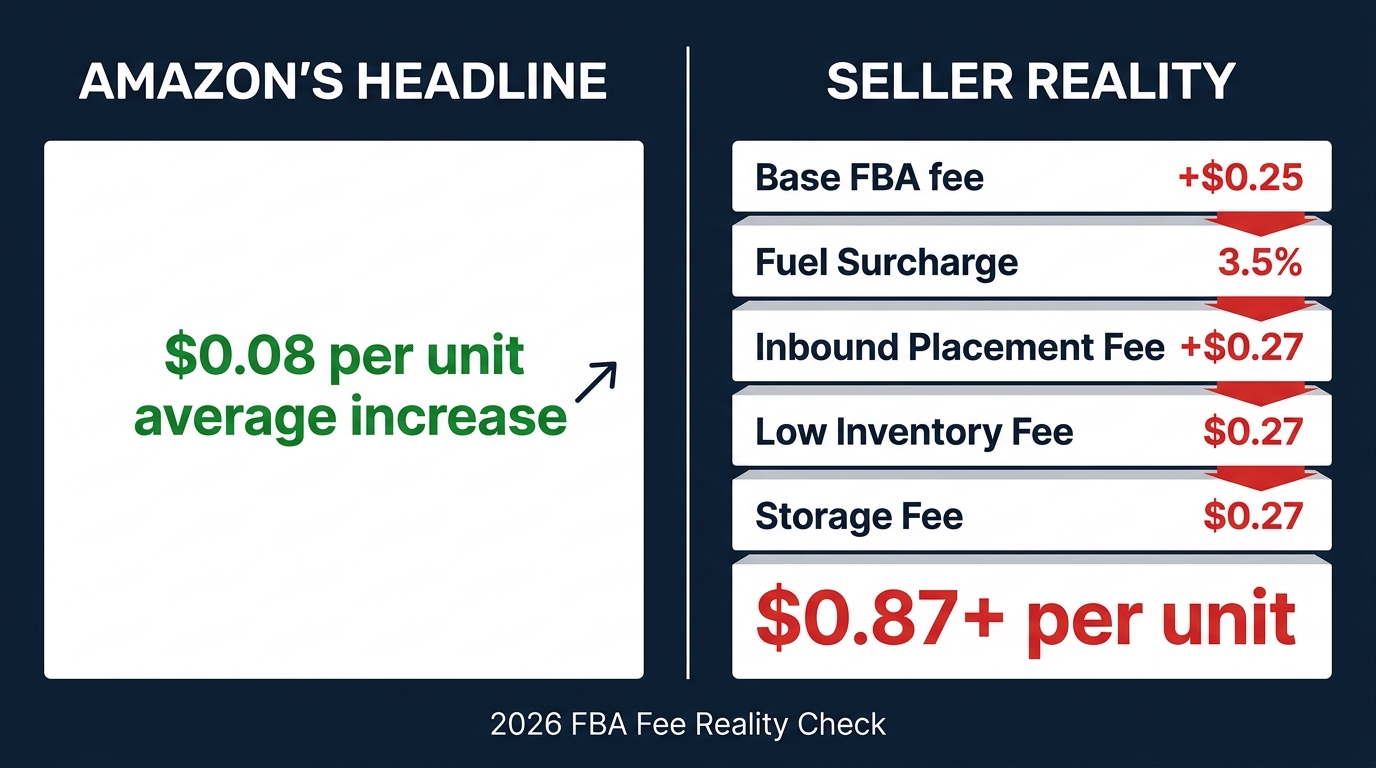

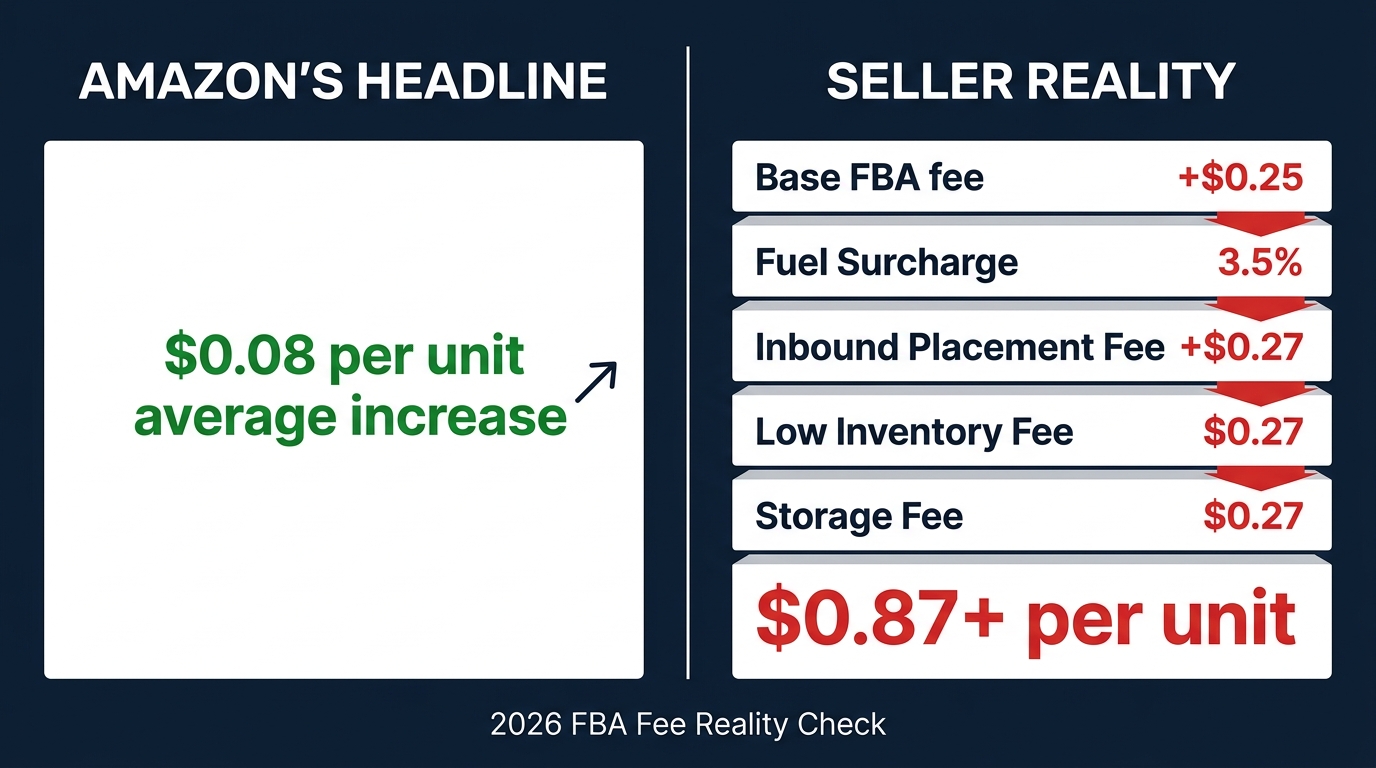
Amazon’s official communication about 2026 FBA fee changes was remarkably tidy. “Less than $0.08 per unit on average,” they said. “Under 0.5% of an average item’s selling price.” For a $30 product, that sounds like rounding error.
Sellers doing their actual P&L reviews told a different story.
The problem with Amazon’s headline figure is not that it’s wrong — it’s that it’s the best-case reading of a multi-layered cost shift. The $0.08 average masks fee increases of $0.25 or more for the most common SKU profiles in the $10–$50 price band. That average was then followed, just three months later, by a 3.5% fuel and logistics surcharge applied on top of every FBA fulfillment fee in the U.S. and Canada. Alongside those two moves, inbound placement fees ticked up further, Buy with Prime fulfillment costs rose by $0.24 per unit on average, and the multi-channel fulfillment (MCF) rates climbed roughly $0.30 per unit.
None of these individual line items are catastrophic in isolation. Together, they represent the most consequential reconfiguration of FBA economics in recent memory — not because of the size of any single change, but because of how they stack, compound, and disproportionately hit specific categories of product and seller.
This post is not a recap of what Amazon announced. It’s a ground-level accounting of what those changes actually cost, which sellers bear the most exposure, and what the businesses adapting fastest are doing differently.
Anatomy of the 2026 Fee Stack: What You’re Actually Paying Now
To understand the real pressure on seller margins, it helps to map the full fee stack rather than examine any single change in isolation. Amazon’s 2026 changes were introduced in two distinct waves, each applying to different cost layers.
Wave One: January 15, 2026 — Base Fulfillment Fee Increases
The first wave took effect on January 15, 2026, and adjusted base FBA fulfillment fees across all U.S. and Canadian sellers. Amazon’s stated average increase was $0.08 per unit, but the distribution of that increase was far from even. Small standard-size items in the $10–$50 price band saw increases closer to $0.25 per unit. Large standard-size items priced above $50 experienced average increases around $0.31. For sellers operating at volume — tens of thousands of units per month — that spread matters enormously.
The January changes also touched Multi-Channel Fulfillment rates, which rose by approximately $0.30 per unit on average. For brands using Amazon’s infrastructure to fulfill orders from their own DTC website or third-party channels, that’s a significant jump in off-Amazon fulfillment costs.
Wave Two: April 17, 2026 — The Fuel and Logistics Surcharge
The second wave arrived on April 17, 2026, in the form of a 3.5% fuel and logistics surcharge applied to all FBA fulfillment fees in the U.S. and Canada. Critically, this surcharge is calculated on the fulfillment fee itself — not on the item’s selling price — which means it compounds differently depending on the product’s size tier and existing fee level.
For a standard small-size item with a $3.22 fulfillment fee, the 3.5% surcharge adds approximately $0.11. For a large standard-size item with a $5.40 fulfillment fee, it adds $0.19. For large bulky or oversized items with fees ranging from $9 to $15+, the dollar impact is considerably higher. When you combine the January base increase with the April surcharge, most standard-size items are now absorbing roughly $0.25 more in all-in FBA costs per unit compared to mid-2025.
The Fees Most Sellers Aren’t Tracking Closely Enough
Beyond the headline changes, two additional cost layers deserve attention. First, Buy with Prime fulfillment fees rose by $0.24 per unit on average — meaningful for brands that have built their off-Amazon growth strategy around Amazon’s fulfillment infrastructure. Second, the inbound placement service fee, which governs how Amazon charges for distributing your inventory across its fulfillment center network, also increased as of January 15. These changes are often overlooked because they don’t appear on the Seller Central fee announcement in bold type, but they show up in landed cost calculations for sellers shipping into FBA at scale.
The Price Band Problem: Why the $10–$50 Segment Bears the Most Risk
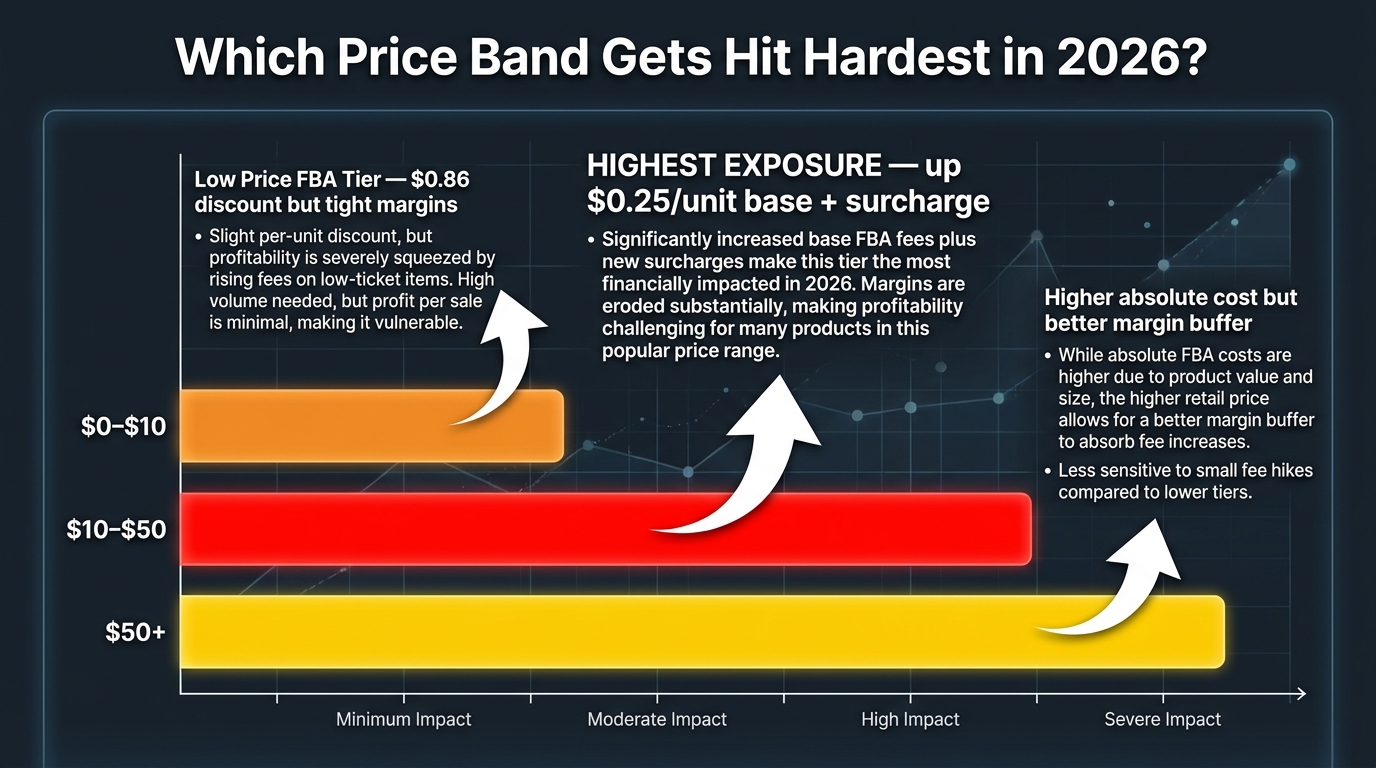
Amazon’s 2026 fee structure now uses three formal price brackets for standard-size items: under $10, $10–$50, and over $50. This tiering matters beyond the mechanics of the fee schedule — it tells you exactly which sellers are facing the most structural risk.
Why $10–$50 Is the Danger Zone
Products in the $10–$50 range are the most exposed for a straightforward reason: they sit in the intersection of meaningful absolute fee increases and constrained pricing flexibility. When a $12.99 kitchen accessory sees its FBA fee rise by $0.25 and then gets hit with the April surcharge, the seller faces a genuine dilemma. Raising the price by $0.50 may be mathematically correct but competitively risky — this price band is the most crowded on Amazon, with the thinnest margins between winning and losing the Buy Box.
The $10–$50 band also tends to be where most private-label Amazon brands operate. These are the products built on the classic Amazon playbook: find a niche, source from overseas, optimize the listing, drive early reviews, and compete on price and conversion. That playbook was already under pressure from rising PPC costs. The 2026 fee stack has now added a structurally new layer of margin compression that wasn’t baked into most sellers’ sourcing models.
Sub-$10 Items: The Low-Price FBA Tier Trade-Off
Items priced below $10 occupy a different — but equally complicated — position. Amazon introduced the Low-Price FBA tier specifically to make cheap, fast-moving products viable within its fulfillment network. The discount is real: low-price FBA items receive an average $0.86 per-unit discount versus standard FBA rates. For sellers moving high-velocity sub-$10 products, that discount can be the difference between profitability and loss.
However, sub-$10 items in the small standard-size category still saw an average $0.12 per-unit fee increase in 2026, even within the discounted tier. And because their sale prices leave almost no room for error — referral fees alone represent a larger percentage share of revenue — any cost increase hits proportionally harder than it would on a $30 or $40 product. The math simply leaves less buffer.
Above $50: Better Buffered but Not Immune
Products priced above $50 absorbed larger absolute fee increases — around $0.31 per unit on average for the January changes — but they have far more pricing flexibility and margin cushion. A 1% price increase on a $60 item adds $0.60 to revenue; the same percentage increase on a $15 item adds just $0.15. The asymmetry matters when you’re trying to pass cost increases through to the customer without triggering conversion drops.
Higher-priced products also tend to have lower referral fees as a percentage (many categories cap out at 15% or have tiered rates above certain thresholds), which means the non-FBA portion of Amazon’s take is slightly more manageable. They’re not immune to 2026’s fee environment, but they have meaningfully more room to maneuver.
Inbound Placement Fees: The Overlooked Cost That Compounds at Scale
Of all the 2026 fee changes, inbound placement service fees are the ones most likely to be underestimated — not because they’re small, but because they’re variable, depend on how sellers choose to ship, and don’t appear as a clean per-unit number in most analytical tools.
How the Inbound Placement Fee System Works
Amazon’s fulfillment network requires your inventory to be distributed across multiple fulfillment centers to enable fast Prime delivery to customers across the country. The inbound placement fee system charges sellers based on how they choose to handle that distribution. If you send inventory to a single location and let Amazon redistribute it (minimal shipment split), you pay more. If you accept Amazon-optimized multi-FC splits and send inventory to multiple locations yourself, you pay less — or in some configurations, nothing.
The 2026 updates increased the per-unit cost for minimal-split shipments on standard-size products by approximately $0.05. For large bulky items, that increase jumped to around $0.27 per unit. The range across all product types now runs from $0.21 to $1.58 per unit depending on size, weight, and split option chosen.
The Strategic Choice Hidden in the Fee Structure
The inbound placement fee is, in effect, Amazon charging sellers for their own logistics preferences. Sellers who choose simplicity — one shipment to one location — subsidize Amazon’s redistribution costs. Sellers who accept complexity — splitting shipments, managing multiple carrier bookings, optimizing prep across different destinations — are rewarded with lower fees.
For smaller sellers without sophisticated logistics operations, accepting the minimal-split fee is often the pragmatic choice even if it costs more. The operational complexity of managing multi-FC inbound shipments requires tools, bandwidth, and expertise that smaller operations simply may not have. For larger sellers shipping thousands of units per week, the math often inverts: the savings from optimized inbound splits can run into tens of thousands of dollars annually, making logistics investments clearly worthwhile.
Programs like Amazon’s Partnered Carrier Program (PCP) and the Sellers Inventory Placement Program (SIPP) offer additional paths for managing inbound costs, and 2026 has seen a notable uptick in sellers actually configuring these properly rather than defaulting to whatever Amazon’s system suggests at checkout.
Real Unit Economics: What $20, $30, and $50 Products Actually Net in 2026
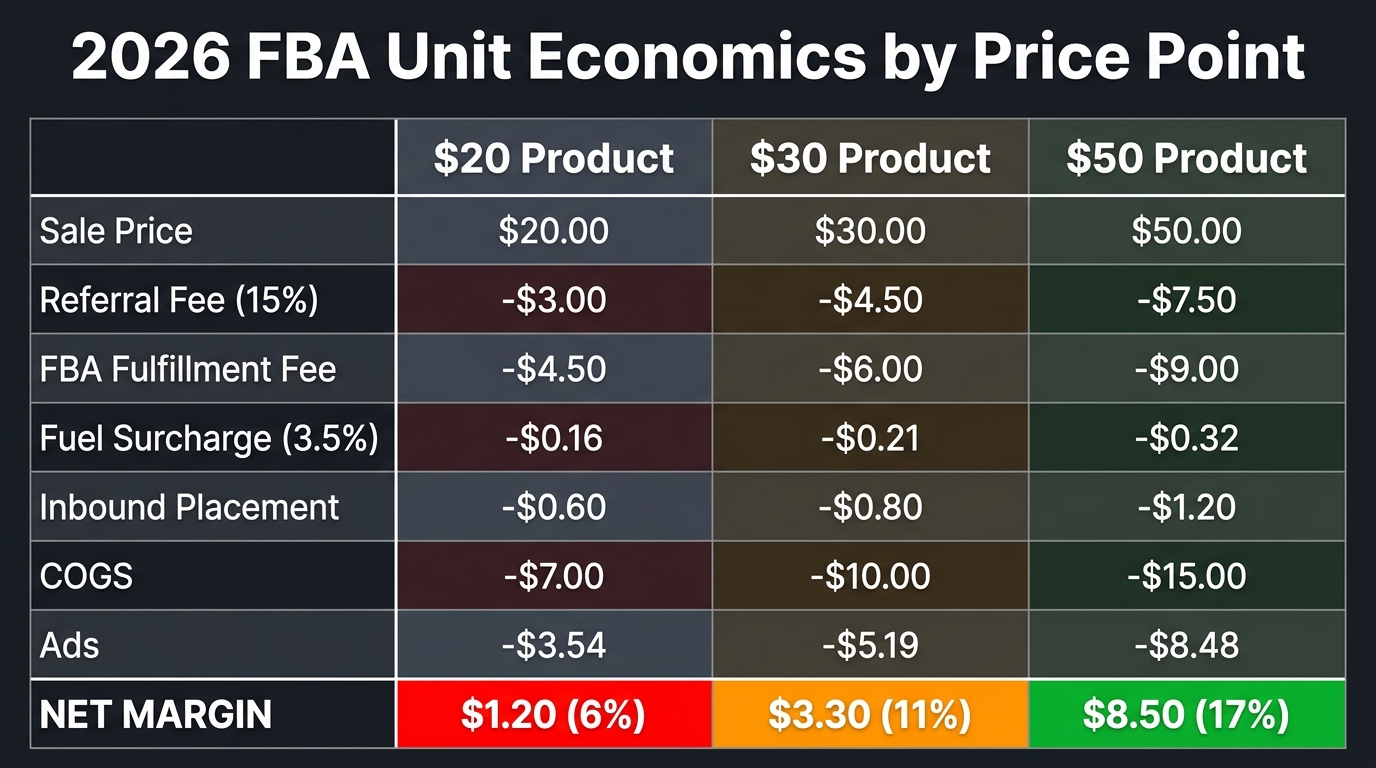
Abstract fee discussions are useful for understanding direction. Concrete unit economics models are useful for making decisions. Here’s what the numbers look like at three representative price points, using current 2026 fee data for a standard small-size item in a typical 15% referral fee category.
The $20 Product: Where Profitability Gets Fragile
Take a standard small-size product — think a fitness accessory, a kitchen gadget, or a pet product — sold at $20. After a 15% referral fee ($3.00), a base FBA fulfillment fee of roughly $3.22 (post-January increase), the April 3.5% surcharge ($0.11), and a modest inbound placement fee allocation of $0.15 per unit, you’re already at $6.48 in Amazon-side fees before touching COGS, PPC, or returns.
If that product costs $5.50 to source and ship to Amazon, and you’re running a typical 15–20% ACoS on advertising (call it $1.80 per unit in ad spend), your total costs hit roughly $13.78. On a $20 sale, that leaves $6.22 — a gross margin of just 31%. Factor in a 2% return rate, software subscriptions, photography, and account overhead, and many sellers on this profile end up at 10–15% net margin or below. The 2026 fee changes are estimated to have reduced net margins on this product profile by approximately 2–3 percentage points versus the pre-2026 fee environment — which, when you started at 13%, is consequential.
The $30 Product: The Market’s Sweet Spot — for Now
At $30, the economics improve meaningfully. Referral fees (15%) run $4.50. FBA fulfillment for a slightly heavier or larger small-standard item might be $3.90 post-increase, plus the $0.14 surcharge. Inbound placement at $0.15. COGS at $8.00. Ad spend at $2.50 (typical ACoS at this price point). Total costs: approximately $19.19. Net per unit before overhead: $10.81, or roughly 36% gross margin.
This profile is more resilient, but the 2026 changes have still shaved an estimated 1.5–2 percentage points off net margins. For sellers who were operating at 20–22% net, the slide to 18–20% is uncomfortable but survivable. For sellers who were at 15% going into 2026, it’s a real problem that demands a response.
The $50 Product: The Margin Cushion That Changes the Calculus
At $50, sellers have genuine breathing room. Referral fees at 15% run $7.50 but many categories cap below this rate above certain price thresholds. FBA fulfillment for a large standard-size item might be $5.40 post-increase, with the surcharge adding $0.19. Inbound at $0.20. COGS at $14. Ad spend at $4. Total: approximately $31.29. Net before overhead: $18.71, or roughly 37% gross margin — comparable in percentage terms to the $30 product, but with more absolute dollars to absorb cost increases without being forced to reprice.
This is why expert advice has consistently pointed toward the $40–$60 price band as the most defensible position for FBA sellers in the current environment. It’s not that the fees don’t hit — they do. It’s that the absolute margin buffer provides more options when you need to respond.
How the 3.5% Fuel Surcharge Compounds Everything Already Wrong
The April 17 fuel and logistics surcharge deserves its own analysis beyond the raw numbers, because its compounding effect is different from a flat per-unit increase — and that difference shapes how sellers should think about response strategies.
Why a Percentage-Based Surcharge Is Worse Than a Flat Fee for Some SKUs
A flat per-unit fee increase — say, $0.08 across the board — is regressive in one sense: it hits low-margin, low-priced products harder as a percentage of revenue. A percentage-based surcharge applied to the fulfillment fee itself creates a different problem: it amplifies the cost penalty for heavier, bulkier, and more expensive-to-fulfill products.
For a seller whose fulfillment fee is $3.22, the 3.5% surcharge adds $0.11 — manageable. For a seller whose fulfillment fee is $9.73 (a typical large bulky item), the same percentage adds $0.34. For products with fulfillment fees in the $12–$15 range — oversized goods, heavy items, complex packaging — the surcharge adds $0.42–$0.53 per unit. Those are not trivial numbers on products that may already have thin margins because of their size and return rates.
The Combined Impact When Both Waves Hit
When the January base increase and the April surcharge are modeled together, most analysts place the combined all-in additional cost for a typical standard-size item at approximately $0.25 per unit. For large standard-size and bulky items, that combined figure often exceeds $0.50 per unit. Across a catalog of 50,000 units per month moving through FBA, a $0.25 per-unit swing is $12,500 in additional monthly costs — or $150,000 annually — flowing straight out of what was previously margin.
The surcharge is also particularly frustrating to sellers because it arrives with no clear off-ramp. It’s nominally tied to fuel costs, but surcharges of this type have a well-documented history of becoming permanent structural costs with new branding applied over time. That uncertainty makes it harder to plan around as a temporary disruption — increasingly, sellers are treating it as a permanent cost of doing business within FBA.
The Hybrid Fulfillment Shift: How 40% of Mid-Market Sellers Are Restructuring
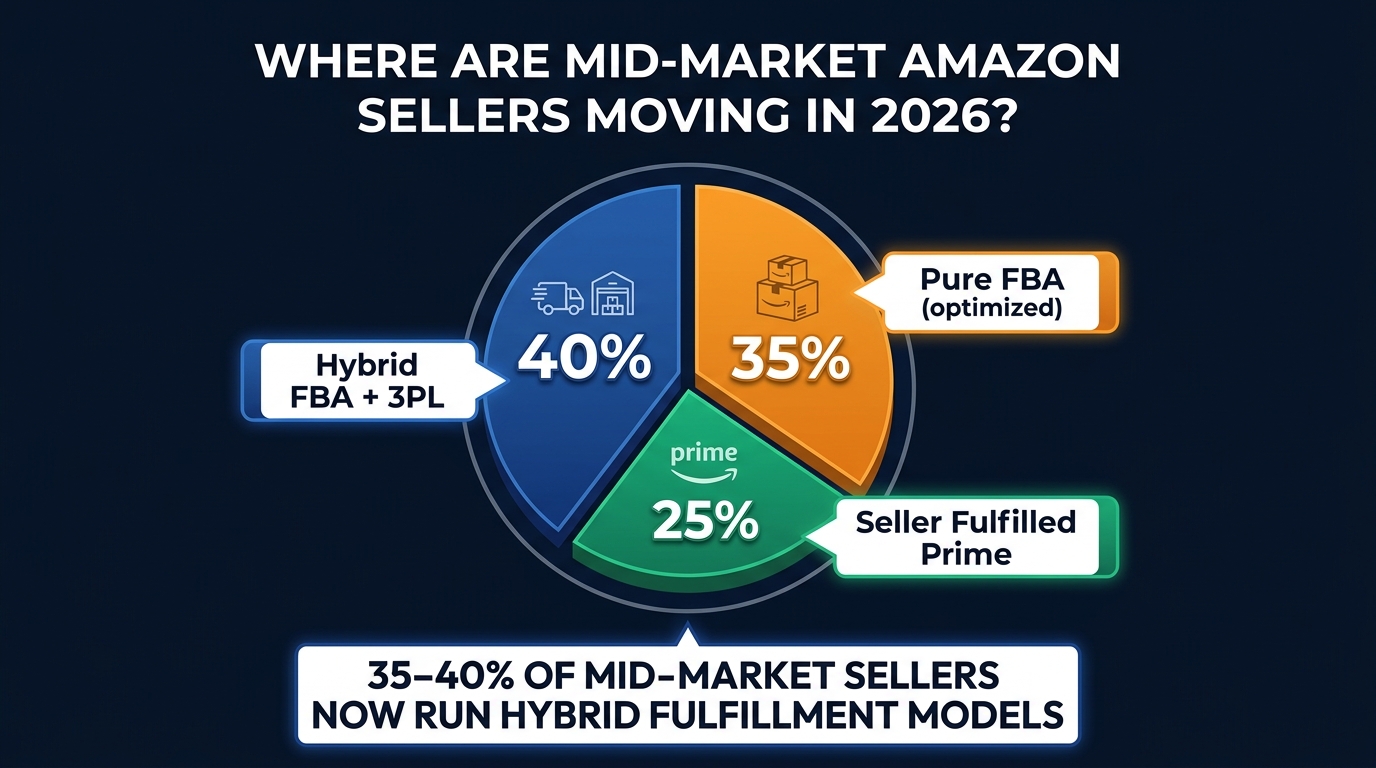
The most significant behavioral shift among professional Amazon sellers in 2026 is not a pricing adjustment or a catalog trim. It’s a structural change in how inventory is fulfilled — and it’s happening at a scale that suggests this isn’t a temporary workaround but a permanent reconfiguration of the FBA-dependent model.
What “Hybrid Fulfillment” Actually Means in Practice
Roughly 35–40% of mid-market Amazon merchants are now running some form of hybrid fulfillment, according to industry data from the past six months. That means maintaining FBA for a subset of SKUs while routing others through third-party logistics providers (3PLs) for merchant-fulfilled (FBM) delivery or for feeding into Seller Fulfilled Prime.
The logic of the hybrid model is straightforward: FBA provides the Prime badge, the conversion premium, and the operational simplicity of letting Amazon handle last-mile delivery. But those benefits come at a cost premium that not every SKU can justify. Hybrid fulfillment is the operational answer to that tension — keep the high-velocity, high-margin SKUs in FBA where they earn their fee burden, and move everything else to a more cost-efficient fulfillment path.
Which SKUs Are Moving Out of FBA
The SKUs being pulled out of FBA in 2026 follow a consistent profile. Slow-moving or seasonal products — items that sit in Amazon’s warehouses accumulating monthly and aged inventory fees — are the first to go. Oversized or heavy products where FBA’s fee structure is particularly punishing are second. Low-price items where the margin is so thin that any fee increase flips the unit economics negative are third. And experimental new SKUs — products that haven’t yet proven their velocity — are increasingly being launched through 3PL/FBM first to validate demand before committing to FBA inventory placement fees.
This last pattern is particularly interesting because it represents a change in launch strategy, not just operational optimization. Many sellers are now using FBM as a testing environment and FBA as a scale environment — a reversal of the approach that dominated the platform for years.
The 3PL Market Is Responding
The shift toward hybrid fulfillment has created measurable tailwinds for third-party logistics providers that cater to Amazon sellers. 3PLs with robust Amazon-integration capabilities — real-time inventory sync, FBM label generation, SFP compliance infrastructure — are seeing strong demand growth in 2026. For sellers evaluating 3PL options, the key criteria have shifted from cost-per-unit toward reliability of on-time delivery rates (critical for SFP compliance) and quality of Amazon integration tooling.
Seller Fulfilled Prime as the Escape Valve for Oversized Sellers
Seller Fulfilled Prime (SFP) has existed for years but never achieved mainstream adoption because the operational bar — two-day delivery from the seller’s own warehouse, premium packaging standards, strict cancellation rate thresholds — was too demanding for most businesses. The 2026 FBA fee environment is changing that calculus, particularly for sellers of oversized and heavier products.
Where SFP Makes Financial Sense Now
For oversized items, the case for SFP has become compelling. Amazon’s FBA fees for large bulky and heavy categories are substantial, and the 2026 surcharges pushed them higher. Sellers who can find 3PL partners with strong regional carrier relationships and two-day delivery coverage are finding that SFP can cut total fulfillment costs by 30–50% compared to FBA on qualifying product categories.
That range is significant. On a $75 oversized item with an FBA fulfillment fee around $11–$14 per unit, a 40% reduction in fulfillment cost represents $4–$6 of recovered margin per unit. At 5,000 units per month, that’s $20,000–$30,000 back in the seller’s pocket monthly. The operational overhead of maintaining SFP compliance — strict shipping timelines, packaging standards, customer service benchmarks — starts to look very reasonable against those numbers.
The SFP Compliance Requirement Is the Real Barrier
The challenge with SFP is not conceptual — it’s operational. Amazon’s SFP requirements are genuinely demanding: you must maintain a cancellation rate below 0.5%, a valid tracking rate above 99%, and an on-time delivery rate above 93.5% on a rolling basis. Missing these thresholds means suspension from the program, which means losing the Prime badge and the conversion premium it carries. For sellers without mature logistics operations or without a 3PL partner with strong compliance infrastructure, the risk of suspension is real.
The sellers succeeding with SFP in 2026 are those who have either invested in their own fulfillment infrastructure at scale or partnered with 3PLs that have specifically built SFP-compliant service offerings — real-time order routing, carrier rate shopping for two-day delivery windows, proactive exception management, and SLA reporting that mirrors Amazon’s own compliance monitoring.
SKU Rationalization: The Decision Framework Sellers Are Using
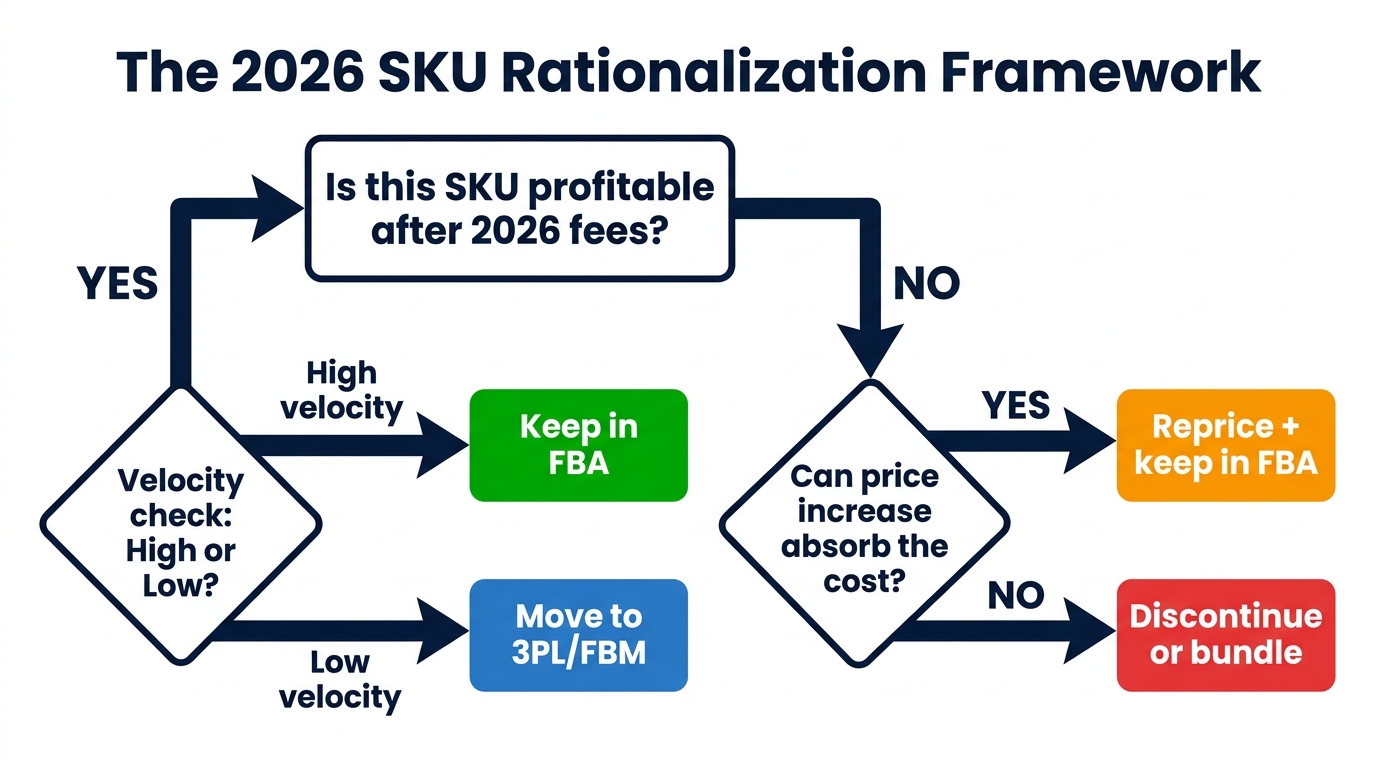
Fee increases expose something that many Amazon businesses have quietly been avoiding: a rigorous, SKU-level accounting of which products are actually profitable. The 2026 changes have functioned, in an uncomfortable way, as a forced audit — and many sellers are finding that the results reveal a catalog that was never as healthy as their aggregate numbers suggested.
The Four-Quadrant SKU Sort
The most effective SKU rationalization frameworks being used in 2026 map every product on two dimensions: margin (after all 2026 fees, COGS, and advertising) and velocity (units sold per month). This creates four quadrants:
- High margin, high velocity: Core FBA SKUs. These stay in FBA and receive prioritized inventory investment. These are your business engines, and the 2026 fee changes are unlikely to threaten them.
- High margin, low velocity: Candidates for 3PL-powered FBM or SFP. The margin justifies maintaining Prime status, but the low velocity doesn’t justify FBA’s monthly storage cost and inbound fees. Shifting these to a 3PL with FBM capability often saves $0.50–$2.00 per unit in combined storage and placement costs.
- Low margin, high velocity: The most critical and difficult category. These SKUs drive revenue but contribute little to profit. The 2026 fee changes may have pushed some of these negative. Each needs individual evaluation: can the price be raised 3–5% without destroying conversion? Can COGS be reduced through packaging optimization or supplier renegotiation? Can the product be bundled with a higher-margin complementary item to lift average order value?
- Low margin, low velocity: Prime candidates for discontinuation or liquidation. These SKUs are absorbing FBA storage fees, inbound placement costs, and capital — while contributing almost nothing to profitability. In a 2026 fee environment, the cost of keeping them is higher than the cost of removing them.
The Bundle Strategy as a Margin Lifeline
Bundling deserves particular attention as a response to 2026 fee pressure. A bundle that combines two $15 products into a $35 bundle doesn’t just raise the price — it changes the fee profile. The referral fee is still 15%, but the FBA fulfillment fee for a bundle that ships as one unit is typically lower than two separate fulfillment events. The net result is improved margin per dollar of revenue, which is exactly what fee-squeezed sellers need.
Effective bundles in 2026 are being designed with fee structure in mind from the beginning — not just as a way to move slow inventory, but as a deliberate product architecture choice that improves unit economics while also differentiating from pure-price competition.
Repricing Strategy: The 1–3% Rule and Its Limits
The default expert recommendation for handling the 2026 fee increases has been a selective price increase of 1–3% on key SKUs, combined with tighter automated repricing rules. This is generally sound advice — but it comes with important caveats that are often omitted from the headline guidance.
When the 1–3% Rule Works
A 1–3% price increase on a $30 product adds $0.30–$0.90 to revenue per unit. Against a $0.25–$0.35 all-in fee increase, that covers the cost and potentially improves margin slightly. The strategy works best when three conditions are met. First, the product has low price elasticity — customers are not highly sensitive to small price changes in this category. Second, the competition is experiencing the same cost pressures, meaning the market will move prices upward together rather than one seller absorbing costs to maintain share. Third, the seller’s repricing rules are tuned to avoid race-to-the-bottom dynamics that would negate the increase within days.
When It Doesn’t — and What to Do Instead
The 1–3% repricing strategy fails in highly commoditized categories where any price increase immediately shifts Buy Box share to lower-priced competitors. It also fails when the seller’s repricing automation is set to maintain competitiveness rather than protect margin — a configuration mismatch that causes the repricer to automatically undo any manual price increase within hours.
For SKUs where repricing isn’t viable, the alternative paths are cost reduction (packaging optimization to hit a lower weight or dimension tier, COGS reduction through supplier negotiation, or reducing advertising spend on unprofitable keywords) or fulfillment restructuring (moving the SKU out of FBA to reduce the fee exposure). Some sellers are also discovering that reducing Amazon’s referral fee through category-appropriate claims (some products qualify for lower referral rates under specific subcategories) adds up meaningfully at scale.
Repricing software that incorporates margin floors — minimum prices below which the system will not bid, regardless of competitive pressure — has seen a notable uptick in adoption in 2026, as sellers recognize that winning the Buy Box at a negative margin is worse than not winning it at all.
The Low-Price FBA Tier: What Sub-$10 Economics Look Like Now
For sellers operating below $10, the Low-Price FBA tier is the fee structure they live within — and 2026 has complicated the already-narrow math of sub-$10 selling in ways that deserve specific attention.
The Discount Is Real, but So Is the Pressure
The Low-Price FBA tier provides an average $0.86 per-unit discount versus standard FBA rates for qualifying items. That discount is the primary reason sub-$10 FBA selling is viable at all — without it, the fulfillment fee would consume an untenable percentage of sale price on a $7.99 item.
However, even within the discounted tier, small standard-size items under $10 saw an average fee increase of $0.12 per unit in 2026. And the April 3.5% surcharge applies equally to low-price tier fulfillment fees. When these two changes land on a $7.99 product with a paper-thin margin, the result is often a business that was marginal becoming a business that is unprofitable.
The Referral Fee Problem Doesn’t Go Away
Sub-$10 products face a structural challenge that fee tiers can’t fully address: the referral fee as a percentage of sale price is always punishing at these price points. A 15% referral fee on an $8 product is $1.20, which on a product that might only net $0.40 after fulfillment and COGS represents 75% of your gross profit. Any cost increase — fee, COGS, shipping — can flip the economics negative.
The sellers succeeding in the sub-$10 space in 2026 are almost universally operating on extreme velocity and extreme operational discipline: high-volume replenishment cycles to avoid low-inventory fees, shipments structured to minimize inbound placement costs, and relentless packaging optimization to maintain size tier qualification. It is, by any measure, a difficult model to operate profitably in a rising-cost environment.
What the Fee Trajectory Tells Us About Amazon’s Platform Direction
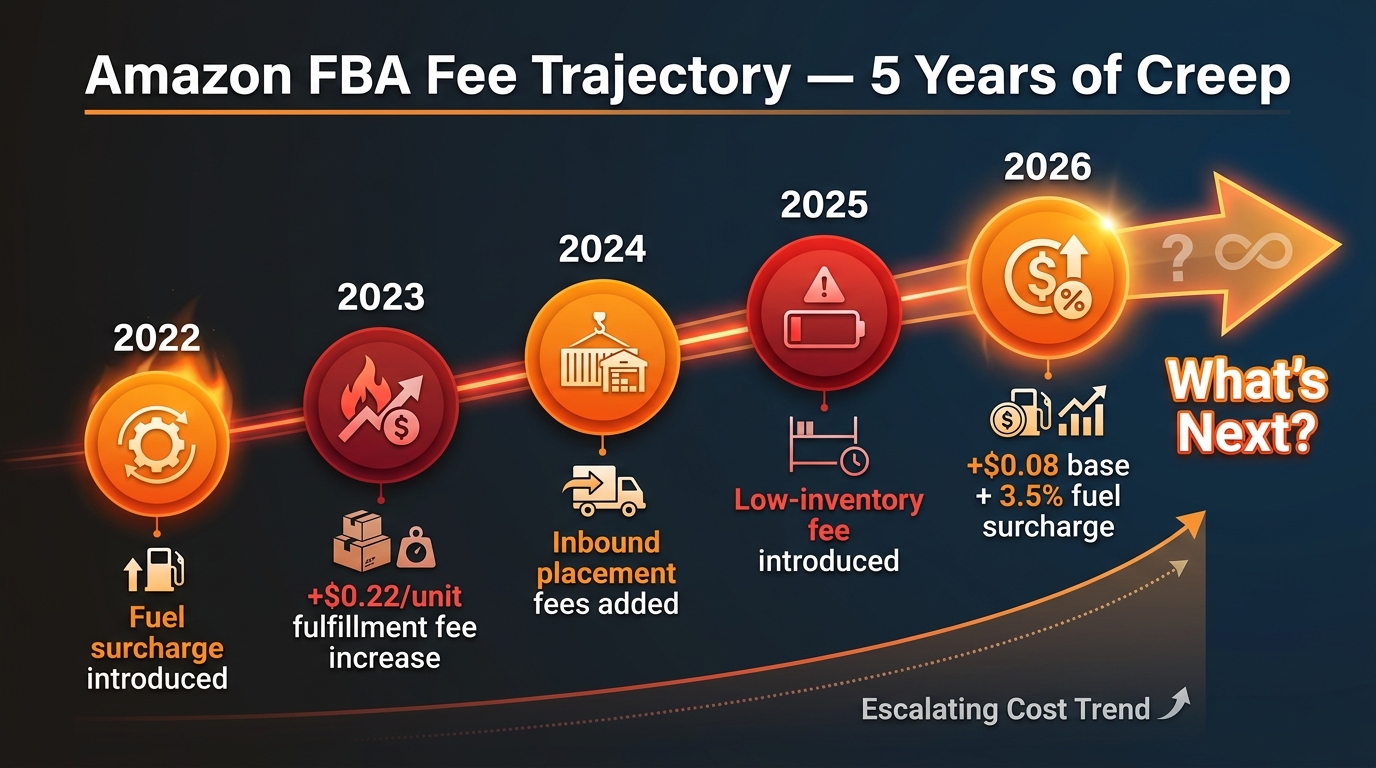
No individual fee change exists in isolation. Amazon’s 2026 updates are part of a multi-year pattern of FBA cost escalation that, when viewed as a trajectory rather than a series of events, reveals something important about where the platform is heading — and what kind of sellers it’s being optimized for.
Five Years of Compounding Fee Creep
Amazon introduced fuel surcharges in 2022 as a response to transportation cost inflation. In 2023, base fulfillment fees rose by an average of $0.22 per unit — one of the larger single-year increases on record. In 2024, Amazon introduced inbound placement service fees for the first time, adding an entirely new fee category that hadn’t previously existed. In 2025, the low-inventory level fee was introduced, penalizing sellers who didn’t maintain adequate in-stock levels relative to historical demand. And now in 2026, the base fees increased again while a new surcharge — structurally similar to the 2022 fuel surcharge but applied on a broader basis — was layered on top.
The cumulative effect of these annual changes is substantial. A seller paying FBA fulfillment fees in 2021 and the same seller paying in 2026 are operating with fundamentally different unit economics, even if their product, price point, and COGS have not changed. The cost of using Amazon’s fulfillment infrastructure has risen materially and consistently.
What Amazon Is Optimizing For
Reading the fee trajectory alongside Amazon’s stated strategic priorities reveals a coherent if uncomfortable picture. Amazon is building a fulfillment network that serves fewer, higher-value, higher-velocity products more efficiently. The fee structure increasingly penalizes behaviors that make the network more expensive to operate: storing slow-moving inventory, shipping low-value items that generate high per-unit logistics costs relative to revenue, using minimal shipment splits rather than accepting Amazon’s optimized distribution, and maintaining undersized stock that triggers last-minute replenishment.
This is not a surprising commercial orientation — it is entirely rational from Amazon’s logistics economics perspective. But it does mean that the FBA model as a low-barrier entry point for small sellers with diverse, low-velocity catalogs is under structural pressure that is unlikely to reverse. The businesses that the fee structure is being calibrated to serve are high-velocity, properly packaged, efficiently inbounded, and financially able to carry the inventory levels that Amazon’s network prefers.
The Strategic Implication for 2026 and Beyond
For sellers building long-term businesses on Amazon, the fee trajectory points toward a clear strategic imperative: reduce FBA dependency as a business variable, not just a cost. That means building fulfillment optionality — 3PL relationships, SFP capability, DTC infrastructure — that allows the business to continue operating if FBA costs rise further or if Amazon makes structural changes that affect specific product categories. It also means building more of the business off-Amazon: brand.com sites, wholesale relationships, retail partnerships that reduce the percentage of revenue that flows through FBA.
This is not a counsel of despair about FBA — it remains, for the right products, the most powerful retail fulfillment channel in the world. But treating FBA as a single-channel dependency in a rising-cost environment is a business risk that 2026 has made difficult to ignore.
Building a Fee-Resilient Business: What the Adapters Are Getting Right
Across the noise of 2026’s fee changes, the sellers navigating this environment most successfully share a set of operational and strategic characteristics that are worth examining closely — not because they’re secret, but because executing them requires genuine organizational commitment rather than a quick tactical adjustment.
SKU-Level P&L Visibility as a Foundation
The sellers adapting fastest are those who had, or quickly built, genuine per-SKU profitability visibility — not just revenue reporting, but a true accounting of referral fees, FBA fees, surcharges, storage, inbound placement, COGS, advertising spend, and return processing costs for each product in the catalog. Without this visibility, fee increases are invisible in the aggregate until they’ve already done serious damage. With it, you can see which SKUs were impacted, by how much, and what response is mathematically indicated.
Building this visibility requires either robust use of Amazon’s cost data exports combined with external analysis tools, or investment in purpose-built Amazon seller analytics platforms that model per-ASIN profitability in real time. The investment pays back quickly in a fee environment like 2026’s.
Packaging and Size Tier Optimization
One of the highest-ROI responses to FBA fee increases is often packaging redesign aimed at moving a product from a higher size or weight tier to a lower one. FBA fees are highly non-linear across size tiers — a product that barely qualifies as large standard-size might pay $1.50–$2.00 more per unit in fulfillment fees compared to the same product at the top of the small standard-size tier. A packaging redesign that achieves that tier shift can recover that entire gap.
This is a capital investment — new tooling, new packaging materials, sometimes new product configuration — but for high-velocity SKUs, the payback period is often measured in months rather than years. Several sellers have reported tier-shift packaging projects in 2026 that recovered $0.50–$1.50 per unit in fees on products moving 10,000+ units monthly, generating six-figure annual margin recovery.
Supplier Renegotiation as a Parallel Track
While fee optimization gets most of the attention, many of the sellers navigating 2026 most successfully are simultaneously running supplier renegotiation processes. The logic is simple: the fee environment is outside the seller’s direct control, but COGS are negotiable. A 5–10% COGS reduction on a high-volume SKU may fully offset the 2026 fee increases without requiring any customer-facing changes.
Effective renegotiation in the current environment involves presenting suppliers with a transparent cost analysis — showing the cumulative fee increases, the margin impact, and the alternative of sourcing from a competing supplier — and making a credible case for cost sharing. Suppliers who depend on a meaningful share of their revenue from a given Amazon seller have meaningful incentive to participate in that conversation.
Building Advertising Efficiency as a Margin Lever
With Amazon fees compressing margin on the cost side, advertising efficiency has become more valuable as a partial offset. A seller who reduces ACoS from 25% to 20% on their top ASIN reclaims meaningful per-unit margin without touching price or COGS. In 2026, this has driven greater investment in PPC management precision — tighter keyword matching, better negative keyword coverage, dayparting, and bid optimization at the ASIN and keyword level rather than at the campaign level.
This is not a new insight, but the 2026 fee environment has sharpened the urgency. A dollar saved in advertising directly offsets a dollar lost in fee increases, with no customer-facing side effects. Sellers who were running relatively loose PPC operations have strong incentive in 2026 to tighten them — and to measure the ROI of doing so against the fee increases they’re absorbing.
Conclusion: The Fee Environment Has Changed. The Fundamental Opportunity Hasn’t.
Amazon’s 2026 FBA fee changes — the January base increase, the April fuel surcharge, the inbound placement adjustments, the Buy with Prime cost shift — collectively represent the most substantive compression of FBA unit economics in recent years. For sellers who built their businesses on the assumption that FBA costs were relatively stable, the wake-up call has been jarring.
But it’s worth holding two truths simultaneously. The first: this fee environment is genuinely more challenging than what came before it, and the sellers who treat it as a rounding error are going to discover an unpleasant reality in their next quarterly P&L review. The second: Amazon still delivers something genuinely valuable — Prime eligibility, a fulfillment network that reaches nearly every U.S. household in two days, and access to the world’s largest product marketplace. That value doesn’t disappear because the price of accessing it went up.
The sellers who will thrive in this environment are not necessarily the ones who exit FBA, but the ones who use FBA more deliberately. They’ll know exactly which SKUs belong in the FBA network and which don’t. They’ll have fulfillment alternatives for the products that don’t clear the margin bar. They’ll maintain SKU-level P&L visibility precise enough to catch margin erosion in real time. And they’ll treat the fee environment not as a fixed constraint but as an ongoing optimization problem — packaging, COGS, advertising, fulfillment channel, price point — with multiple levers available at any given time.
The math of Amazon FBA in 2026 is harder than it was in 2023. The math of building a durable business remains the same: know your numbers, control what you can control, and build enough operational flexibility to respond when the rules change. Because in this environment, they always do.
Key Takeaways for Amazon FBA Sellers in 2026:
- The all-in fee increase for most standard-size items is approximately $0.25/unit — significantly more than Amazon’s stated $0.08 average.
- Products in the $10–$50 price band face the highest structural exposure due to the combination of meaningful absolute increases and limited pricing flexibility.
- The April 3.5% surcharge applies to the FBA fee itself, meaning it disproportionately hurts heavier, larger, and higher-fee products.
- 35–40% of mid-market sellers are now running hybrid FBA + 3PL models; SKU-level rationalization is the operational framework driving those decisions.
- Seller Fulfilled Prime can recover 30–50% of fulfillment costs for oversized products — but only with strong logistics infrastructure or a capable 3PL partner.
- Packaging optimization for tier reduction and supplier renegotiation are often higher-ROI responses than price increases alone.
- Building P&L visibility at the ASIN level is no longer optional — it’s the foundation of every other adaptation strategy.