


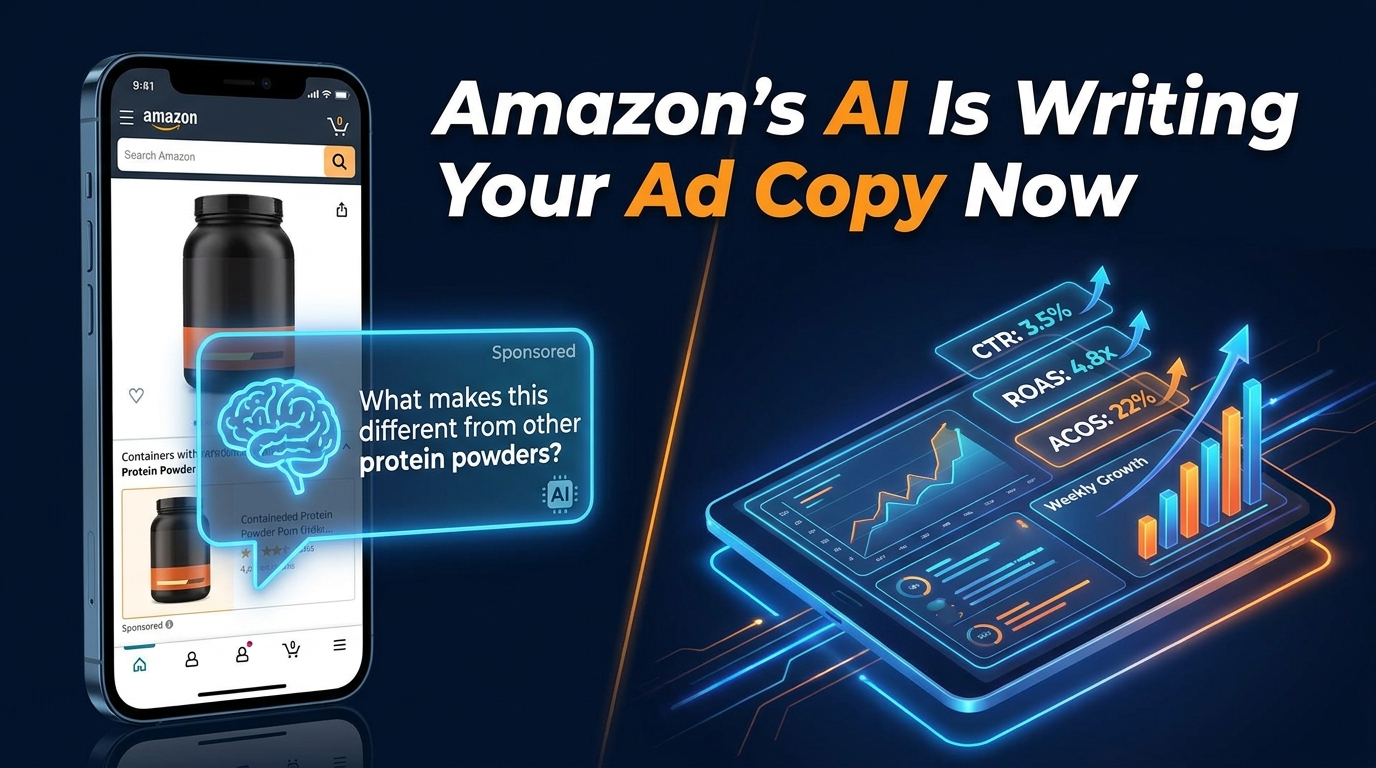

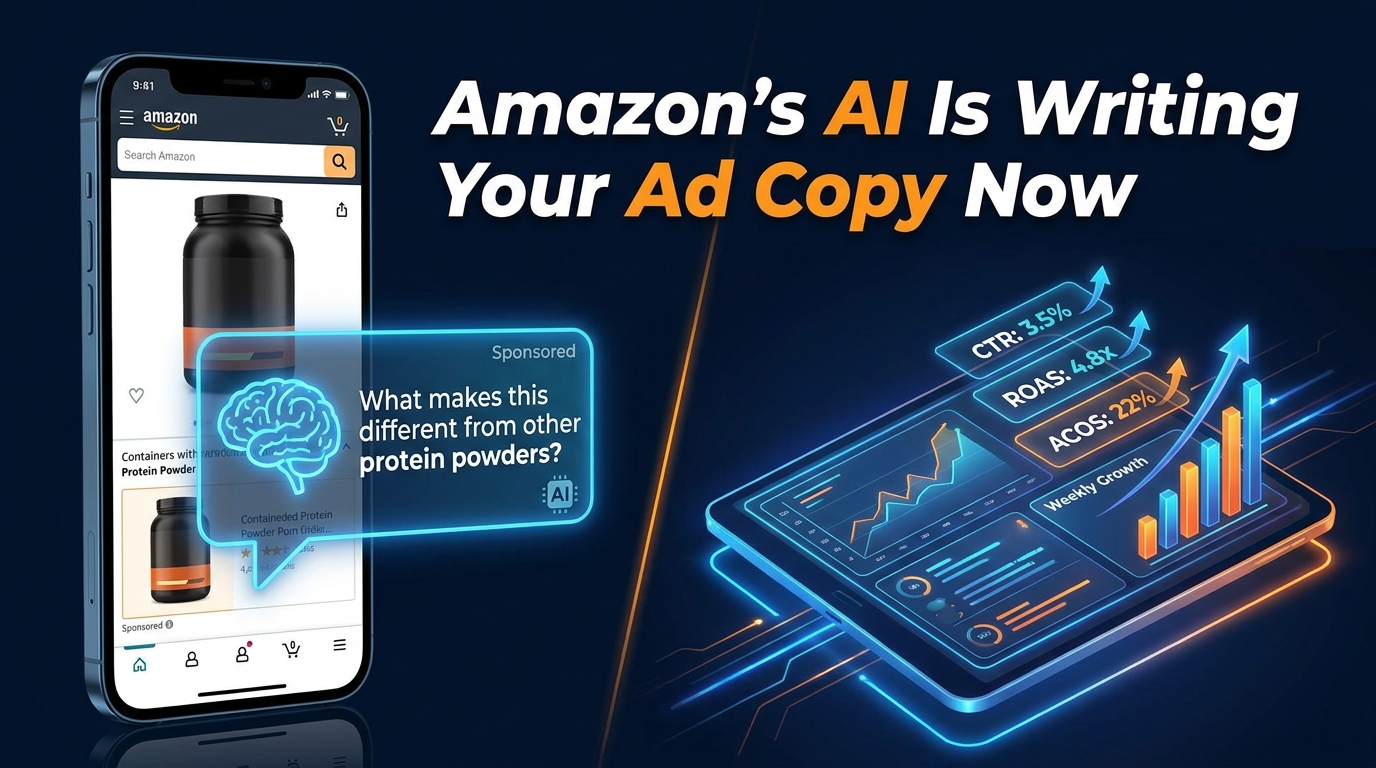
Somewhere in your active Sponsored Products campaigns right now, Amazon’s AI is generating questions it thinks your shoppers want answered — and attaching them to your ads without asking permission. That’s not a metaphor or a preview of something coming. Since March 25, 2026, Amazon’s AI-generated ad prompts moved from beta to full general availability across the U.S., and every existing Sponsored Products and Sponsored Brands campaign was automatically enrolled.
Most sellers found out through a notification. Some found out by checking their Ads Console and seeing a new “Prompts” tab in campaign reporting. A few found out when their ACOS moved and they went looking for why.
The coverage of this feature since launch has largely focused on the big headline numbers: a 12% average sales increase for AI creative tool users, a 10.3% ROAS lift from AI-generated images, a 20% continuation rate when shoppers engage with a brand prompt in Rufus. Those numbers are real. But they don’t tell you what the system is actually doing inside your specific campaigns, why it generates certain questions for certain products, or why the same feature that lifted one seller’s CTR by 83% produced near-zero engagement for another.
That’s what this article is about. Not the headline stats — the mechanics. We’re going category by category through how Amazon’s AI prompt engine behaves differently depending on what you sell, what signals your listings provide, and what campaign structure you’re running. If you want to understand what to actually do about this feature, rather than just acknowledge it exists, this is the breakdown.
How Amazon’s AI Prompt Engine Actually Decides What to Ask
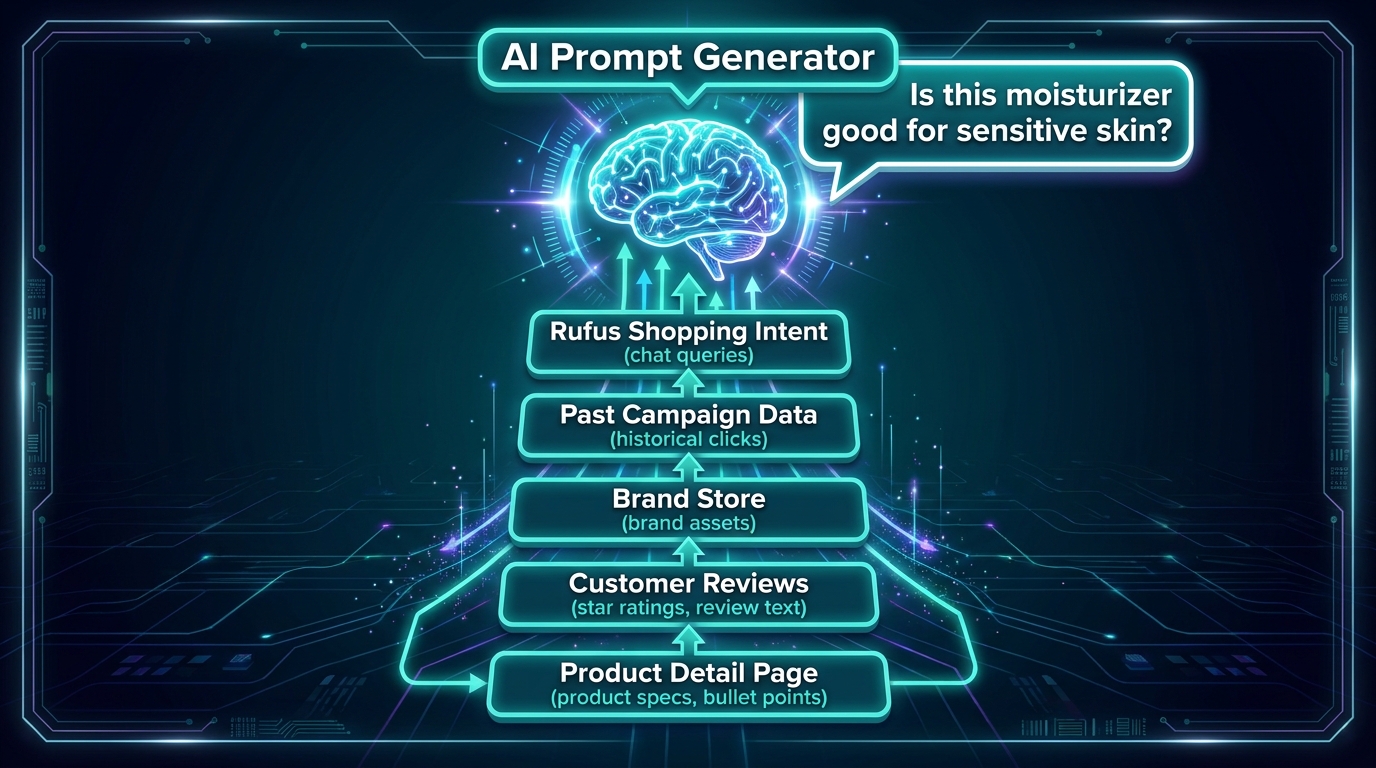
The prompts that appear in your ads are not randomly generated. They’re not pulled from a template bank. Amazon’s system reads multiple data layers about your product and your shoppers before it surfaces a question — and the quality and specificity of what it asks is a direct output of how rich those layers are.
The Five Signals the Prompt Engine Reads
Amazon has confirmed that the AI draws from five primary data sources when generating prompts for a campaign: your product detail page content, customer review text, Brand Store assets, historical campaign performance data, and Rufus shopping query patterns.
The product detail page is the foundation. The system parses your title, bullet points, and description looking for specific, answerable claims. A bullet that says “long-lasting formula” gives the AI something vague to work with. A bullet that says “clinically tested for 72-hour hold in humidity above 80%” gives it something it can turn into a shopper question: “Does this hold up in humid conditions?” Specificity in your listing copy directly correlates with prompt specificity.
Customer reviews add another critical layer. The AI reads review text — not just star ratings — to understand what questions shoppers had before purchasing, what surprised them, and what concerns came up repeatedly. If 40 reviews mention “I was worried it wouldn’t work for my skin type but it did,” the system learns that skin compatibility is a live pre-purchase question for that product, and it surfaces a prompt around it.
The Brand Store contribution is often underestimated. Sellers who have active, content-rich Brand Stores give the AI access to brand narrative, product comparisons, and category positioning that the PDP alone doesn’t carry. Amazon’s system can use Brand Store content to generate prompts that distinguish your product within a competitive category — prompts like “How does this compare to other options in the line?” — rather than just product-level Q&A.
Historical campaign performance data shapes which prompts the system prioritizes. Once prompts are live and accumulating click data, the engine observes which question types are driving engagement for your specific product and surfaces similar formulations more frequently. This is an important nuance: the system learns what works for your ASIN, not just what works for the category at large.
Finally, Rufus shopping query patterns are the most forward-looking signal. Rufus is Amazon’s AI shopping assistant, and it logs what shoppers are asking about products like yours in conversational searches. When a pattern emerges — say, a recurring question about a feature or use case — the ad prompt engine can preemptively surface that question in ad units before a shopper even gets to Rufus. This is where the conversational ad loop closes: Rufus asks on behalf of shoppers, prompts ask on behalf of Rufus.
Where Prompts Actually Appear
As of mid-2026, AI-generated prompts are surfacing in four distinct placements: within Sponsored Products units in search results, within Sponsored Brands headline ads, inside Rufus conversational search sessions, and in Responsive E-Commerce Creative (REC) display ads across the open web. Each placement has slightly different behavior — Rufus prompts tend to be more open-ended and exploratory, while search result prompts tend to be more specific and feature-comparison oriented.
Understanding which placement is generating your prompt data is crucial when reading your Prompts Report, because a prompt that performs well in Rufus may perform differently as an open-web display question, and vice versa.
Health & Beauty: Where AI Prompts Earn Their Keep — and Where They Backfire
Health and beauty is the category where AI prompts are performing most consistently well — and also where the gap between well-optimized and thin listings is most visible. The reason comes down to purchase complexity. Shoppers in this category have more pre-purchase questions than almost any other vertical: Will this work for my skin type? Is this fragrance-free? Does this interact with medications? Can I use this while pregnant?
That density of legitimate shopper questions is exactly what the AI prompt engine is built to exploit. A skincare brand with detailed ingredient callouts, A+ content explaining skin type compatibility, and a review base where shoppers describe their skin conditions will generate prompts that feel genuinely useful — because they are. Documented results from this category include the Oneisall case, where a full-funnel AI-powered campaign produced 50% year-over-year sales growth and a 22% ACOS reduction, with AI-generated creative playing a central role.
The Specificity-Performance Correlation
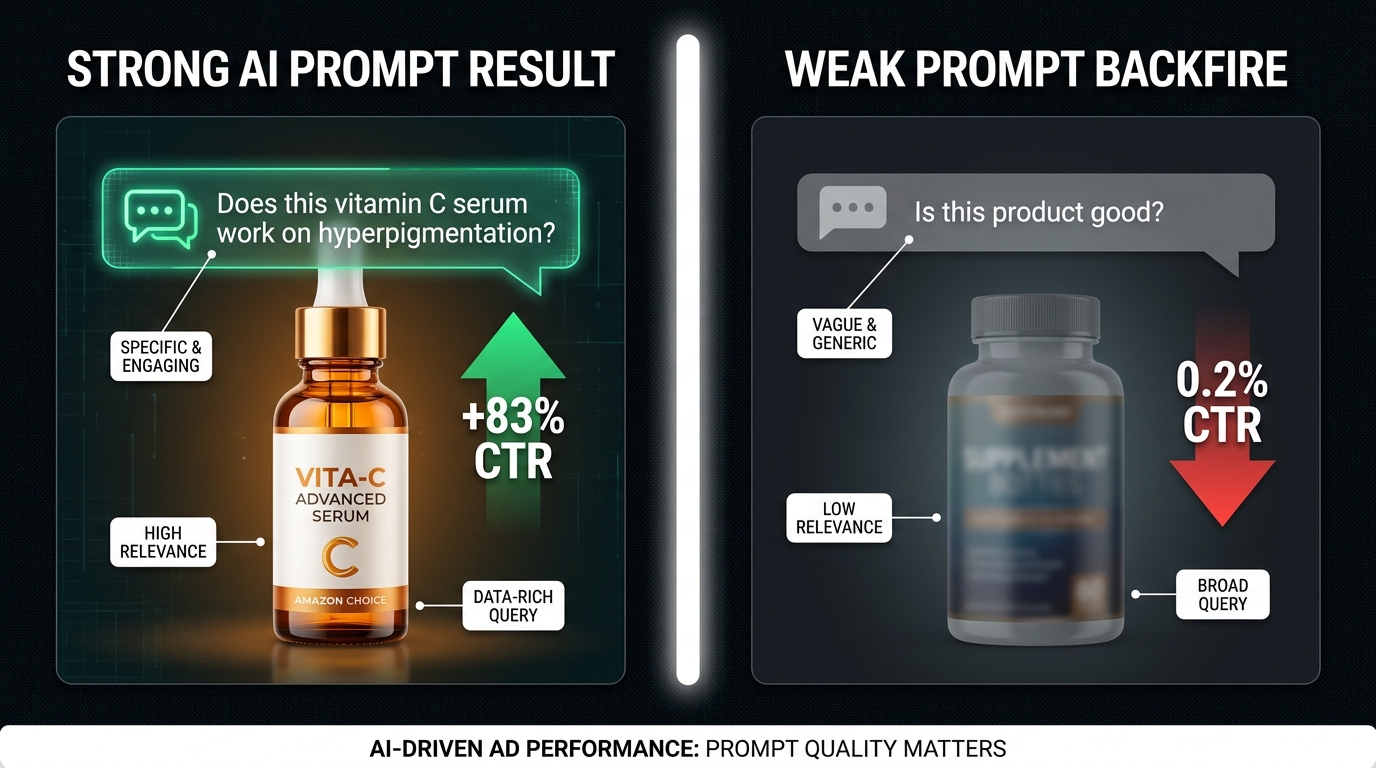
A separate case involving Dandy Blend saw AI-generated creative increase CTR by 83% — from 0.6% to 1.1% — while simultaneously lifting conversions 2.2 times. The distinguishing factor in both cases was listing richness. Products where the AI had enough detail to ask a specific question consistently outperformed products where it defaulted to vague formulations.
The backfire scenario is well-documented among mid-tier health and beauty sellers whose listings are technically complete but not genuinely informative. If your bullets read like keyword strings — “premium quality moisturizer best for face skin care anti-aging” — the AI can’t extract a real question from them. It will generate something like “Is this moisturizer effective?” which provides no informational value to the shopper and no click incentive. Low CTR, high CPC relative to volume, minimal order attribution.
The Sensitive Claim Problem
There’s a specific failure mode in health and beauty that sellers need to watch for: the AI will sometimes surface prompts touching on drug-like claims or health outcomes that your listing technically includes but that Amazon’s compliance guardrails flag as problematic in an ad context. A listing might describe a supplement as supporting “immune function” — compliant language on a PDP — but the same language in an AI-generated prompt can trigger a suppression in certain ad placements. Monitor your prompts for this pattern specifically, because it can quietly kill impression volume without surfacing as a disapproval in Campaign Manager.
Electronics & Tech Accessories: The High-Consideration Buyer Problem
Electronics is the second-strongest category for AI prompt performance, for a different reason than health and beauty. The purchase consideration cycle for electronics is longer. A shopper looking at wireless earbuds doesn’t just want to see the product — they’re already in research mode when they hit the search results page, often with three to six specific technical questions they need answered before they’ll commit to a purchase.
AI prompts can intercept that research phase directly inside the ad unit. When a shopper sees a Sponsored Products listing for a Bluetooth speaker and the AI surfaces the question “Does this pair with two devices simultaneously?” that prompt isn’t just generating a click — it’s positioning your product in the exact consideration context the shopper is already in. For electronics, the most effective prompts tend to be compatibility and specification questions: connectivity, battery life, compatibility with specific devices, waterproofing ratings.
What Electronics Listings Need to Enable Good Prompts
The challenge in electronics is that the signal the AI most needs — specific technical specifications — is often buried in product description or in a “tech specs” table that structured parsing handles inconsistently. Sellers who surface their key specs in bullet points, not just the specs table, give the AI much more reliable material to generate from.
If your listing has “Bluetooth 5.3, 40-hour battery life (buds) + 200-hour case, IPX7 waterproof, compatible with Android and iOS” in a bullet rather than only in the specs table, the AI has a richer pool of specific, answerable claims. The resulting prompts are correspondingly more specific: “How long does the battery last on a full charge?” rather than “Is the battery good?”
Warranty and Trust Signals
Electronics prompts also tend to surface trust questions — warranty coverage, return policy clarity, brand reputation signals — more than other categories. This is consistent with Rufus query patterns, where electronics shoppers ask about brand reliability and post-purchase support at a higher rate than other verticals. If your listing doesn’t explicitly address warranty terms, the AI may surface that question and your product detail page won’t answer it — which creates a click that converts poorly. Make sure your warranty, return window, and support commitment are explicitly stated in your listing content before your prompts go live at scale.
Home & Kitchen: Lifestyle Context vs. Feature Matching
Home and kitchen is where the dual nature of the AI prompt system becomes most visible. This category splits cleanly into two types of shopper intent: shoppers who know exactly what feature they need (a pan that’s oven-safe to 500°F, a coffee maker with a programmable timer) and shoppers who are shopping on lifestyle vision (a kitchen that looks a certain way, a hosting setup that creates a specific experience).
The AI prompt engine handles these two intent types differently — and the prompts it generates reveal which mode it’s operating in for your specific product.
Feature-Matching Prompts vs. Lifestyle Prompts
Feature-matching prompts are direct and specification-oriented: “Is this pan compatible with induction cooktops?” “Does this fit a standard 30-inch cabinet opening?” These prompts are generated when your listing is rich in technical specifications and when your review base includes comments about functional fit.
Lifestyle prompts are more exploratory: “What kind of aesthetic does this work with?” “Can this be used for outdoor entertaining?” These surface when your Brand Store and A+ content carries strong visual and lifestyle narrative. Amazon’s system is reading image alt text, Brand Store section headers, and product description lifestyle language to infer that a shopper might want to understand how the product fits into a broader context, not just whether it has a specific feature.
Both prompt types can perform well — but they perform for different products and different shopper moments. If you’re running Sponsored Brands for a premium kitchen collection and your Brand Store emphasizes a lifestyle aesthetic, you’re likely already generating lifestyle prompts. If you’re running Sponsored Products for a single utilitarian item, the AI will default to feature-matching. The issue is when these get crossed: a premium product generating only feature prompts because the lifestyle content isn’t accessible to the AI, or a commodity product generating aspirational lifestyle prompts that don’t match actual purchase intent.
Category Competition and Prompt Differentiation
Home and kitchen is one of the most crowded categories on Amazon. The AI prompt system creates an interesting competitive dynamic here: products with nearly identical feature sets can generate meaningfully different prompts based on how their listings are differentiated. If your cast iron skillet listing emphasizes its pre-seasoning process and the AI surfaces “Is this pre-seasoned and ready to use?” while your competitor’s identical-spec pan generates “Is this a good pan?” — you’ve created a real differentiation moment at the ad impression level.
This makes listing differentiation in home and kitchen more valuable than it’s ever been — not just for organic ranking, but because richer, more specific listing content directly produces more specific, more clickable AI-generated prompts.
Supplements & Wellness: Compliance Guardrails and What Gets Auto-Filtered
Supplements and wellness products are the category where AI ad prompts create the most friction — and where sellers need to be the most operationally attentive. The compliance environment around supplement advertising on Amazon is already complex. Add an AI system that auto-generates questions from your listing copy, and you have a new vector for compliance issues that most sellers haven’t mapped yet.
What the Auto-Filter Catches
Amazon’s AI prompt system applies a content filter to generated prompts in sensitive product categories, and supplements are explicitly in scope. The filter is designed to prevent prompts that imply disease treatment claims, suggest guaranteed health outcomes, or reference drug-like effects — even when the underlying listing language is technically compliant under FTC supplement advertising guidelines.
The practical result is that prompts for supplements tend to be narrower and more conservative than prompts in other categories. A protein powder listing might contain detailed performance claims in its bullets, but the AI will more commonly generate questions around practical use (“How does this taste mixed with water?”) than efficacy (“Will this help me build muscle faster?”). This is deliberate. The guardrail exists because efficacy claims in an ad unit carry different regulatory weight than the same claim on a PDP.
The Impression Suppression Problem
What’s less well understood is that when the AI generates a prompt that hits the compliance filter, the resulting prompt suppression doesn’t just mean that prompt doesn’t show — it can reduce overall impression volume for the ad unit while the system cycles through alternative prompt formulations. For supplements sellers running campaigns where prompt impressions are a meaningful volume source, this suppression cycle can cause unexplained dips in impression delivery that don’t correspond to budget or bid changes.
The operational fix is to audit your listing copy specifically for language that would fail the AI’s prompt-level compliance check — stricter than PDP compliance — and remove or rephrase it. Phrases like “clinically proven,” “guaranteed results,” “treats,” or “eliminates” in your listing will generate prompts the system then filters. Replacing them with usage-context language (“formulated for daily use,” “developed with certified nutritionists”) gives the AI material it can generate compliant prompts from.
What Actually Performs Well in This Category
Supplements prompts that consistently perform well tend to be format and usage questions: “Is this third-party tested?” “Does this contain artificial sweeteners?” “Is this appropriate for vegans?” These are specific, compliance-safe questions that represent genuine pre-purchase concerns. If these are answered explicitly in your listing, the AI will find them, surface them as prompts, and drive clicks from shoppers who have exactly those concerns — which makes for higher conversion rates than broader, vaguer prompts.
Apparel & Seasonal: The Prompt Timing Problem Most Sellers Miss
Apparel presents a structural challenge for AI ad prompts that doesn’t exist in the same way in other categories: the inventory and relevance window is often shorter than the time it takes the prompt engine to learn what works for a given ASIN. Seasonal products — a Halloween costume, a summer dress, a winter coat — may have a two-to-four month peak window. The AI prompt engine’s learning cycle, where it observes engagement data and optimizes toward better-performing formulations, can take four to eight weeks to reach meaningful signal volume for a single ASIN.
The Learning Cycle Timing Problem
This means a Halloween costume seller who launches a campaign in late September is feeding prompt data to the AI through October — and the engine may be close to optimizing when the season ends. The following year, that campaign data doesn’t simply transfer to a re-listed or refreshed version of the same ASIN.
The practical implication is that for seasonal apparel, prompt performance needs to be managed actively rather than left to the optimization cycle. Rather than waiting for the engine to learn what works, sellers in this category should spend time in advance ensuring their listings are loaded with the specific signals that drive strong prompts from day one: detailed sizing guides that generate fit questions, material composition callouts that generate care and comfort questions, and lifestyle descriptions that generate occasion-use questions (“Is this appropriate for outdoor weddings?”).
Fit and Sizing: The Dominant Prompt Theme
Across apparel more broadly, the prompts that drive the highest engagement are consistently fit and sizing questions. “Does this run true to size?” is the archetype — it’s the question virtually every apparel shopper has before purchasing, and the AI will surface it reliably if your reviews contain sizing feedback. The issue is that fit prompts only convert well when your listing actually answers the question. A prompt asking about sizing that clicks through to a listing with no size guide, no model measurements, and no review-based sizing callout is a click that bounces.
Apparel sellers who want to make AI prompts work as a performance lever need to ensure the PDP closes the loop the prompt opens. That means adding structured sizing content to A+ Content, including model dimensions in image captions, and explicitly tagging your brand’s “runs small / true to size / runs large” guidance in a bullet point where the AI can read it.
How Creative Agent Changes Campaign Setup at the Prompt Level
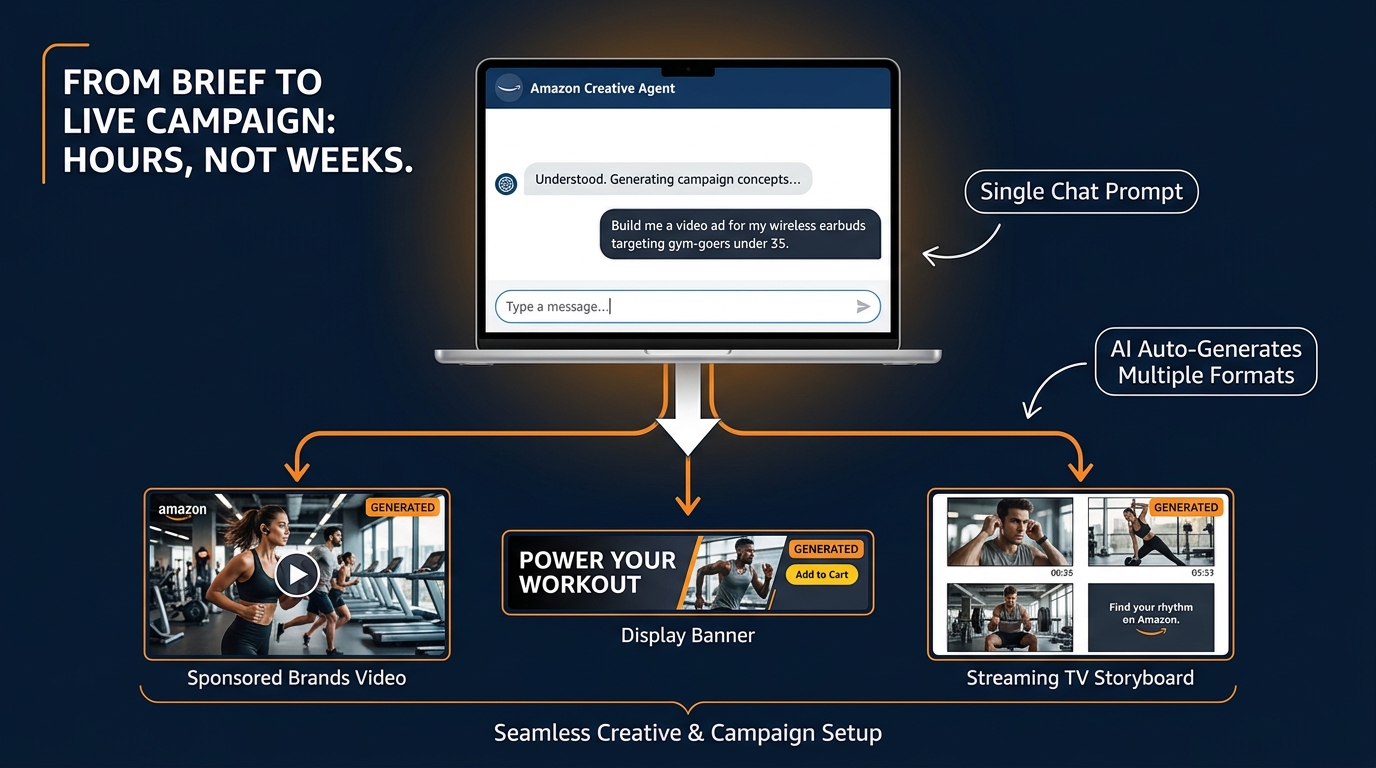
Understanding AI ad prompts as an output means understanding Creative Agent as the input layer. Creative Agent is Amazon’s agentic AI campaign builder inside Creative Studio — a chat-based interface where sellers brief a campaign in natural language and the AI researches the product, the target audience, and the competitive landscape, then generates multi-format creative assets: display ads, Sponsored Brands video, audio ads, and Streaming TV storyboards.
The connection to prompts is direct but often missed. The creative assets Creative Agent builds — particularly the copy and visual framing it chooses for display and Sponsored Brands ads — feed directly into the signal pool the prompt engine reads. A Creative Agent-built campaign that emphasizes specific product benefits in its ad copy is giving the prompt engine richer, more specific material to generate questions from. The creative layer and the prompt layer are not separate systems — they inform each other.
How Creative Agent Handles Brief Specificity
The quality of Creative Agent output scales with the specificity of the brief you give it. A brief like “create ads for my wireless earbuds” produces generic creative. A brief like “create video ads for my wireless earbuds targeting gym-goers under 35 who care about sweat resistance and long battery life, using a high-energy visual style” produces creative that’s specific enough to generate useful downstream prompts about sweat-proofing and battery life.
Amazon’s own framing here is that Creative Agent can go from brief to finished multi-format campaign in hours rather than the weeks a traditional agency or in-house creative workflow would require. Independent sellers and smaller brands are the clearest beneficiaries — a solo operator with no creative team can now brief a campaign in a chat interface and receive finished Sponsored Brands Video assets, display banners, and audio ad scripts from a single session.
The Prompt Feedback Loop in Creative Agent Campaigns
For brands running at scale, the most sophisticated use of Creative Agent is to treat it as part of a prompt optimization cycle. Once your initial prompts are live and accumulating data in the Prompts Report, you can take the highest-performing prompt questions back into Creative Agent and brief new creative that specifically addresses those questions visually and in copy. A prompt that’s driving strong CTR because shoppers are asking about a specific feature is a signal that feature should be foregrounded in your creative — not just answered in your listing.
This bidirectional loop — prompts informing creative, creative informing prompts — is the most advanced use of the AI advertising stack currently available to Amazon sellers, and very few are running it intentionally.
AMC Natural Language Audiences: The Overlooked Companion to Prompt Targeting
While AI ad prompts are generating the most attention, Amazon Marketing Cloud’s new natural language audience builder is quietly changing how sophisticated advertisers define who sees their ads in the first place — and it’s a natural complement to the prompt strategy described above.
AMC’s generative AI text-to-SQL tool lets advertisers describe a target audience in plain English — “shoppers who viewed my product page but didn’t purchase in the last 30 days, and who also bought from a competitor brand in the same category in the last 60 days” — and receive executable SQL that builds that audience for activation across Amazon DSP and the ads console. Previously, building an audience like that required a data analyst comfortable with AMC’s SQL environment. Now it requires a description.
Why This Matters Specifically for Prompt Campaigns
The relevance to AI prompts is audience-prompt alignment. If the AI prompt engine generates questions based on what shoppers in general ask about your product, AMC audience targeting lets you layer on specificity about which shoppers see those prompts. A natural language audience of “high-intent browsers who viewed your ASIN in the last 14 days and have a purchase history in premium home goods” is a meaningfully different audience to target with a lifestyle prompt than a broad interest-based segment.
The combination of AI-generated prompts (optimized for the question that drives engagement) and AI-built audiences (optimized for the shopper most likely to be asking that question) is where the measurable performance delta lives — and Amazon’s reported query development time reduction from hours to minutes makes this combination accessible without requiring a dedicated analytics team.
Practical AMC Audience Examples for Prompt Campaigns
Sellers running Sponsored Products with AI prompts can use AMC audiences to run companion DSP campaigns that target the same high-intent segments with display ads featuring the same prompt questions as interactive elements. A shopper who clicked on a Sponsored Products prompt asking about fragrance-free formula can then be re-served a display ad on the open web featuring that same question — creating a consistent conversational thread across placements. This is the open-web expansion of the AI prompt system that Amazon began extending in early 2026, and it’s currently where the most sophisticated advertisers are building structural advantages.
Reading Your Prompts Report: Metrics That Actually Tell You Something
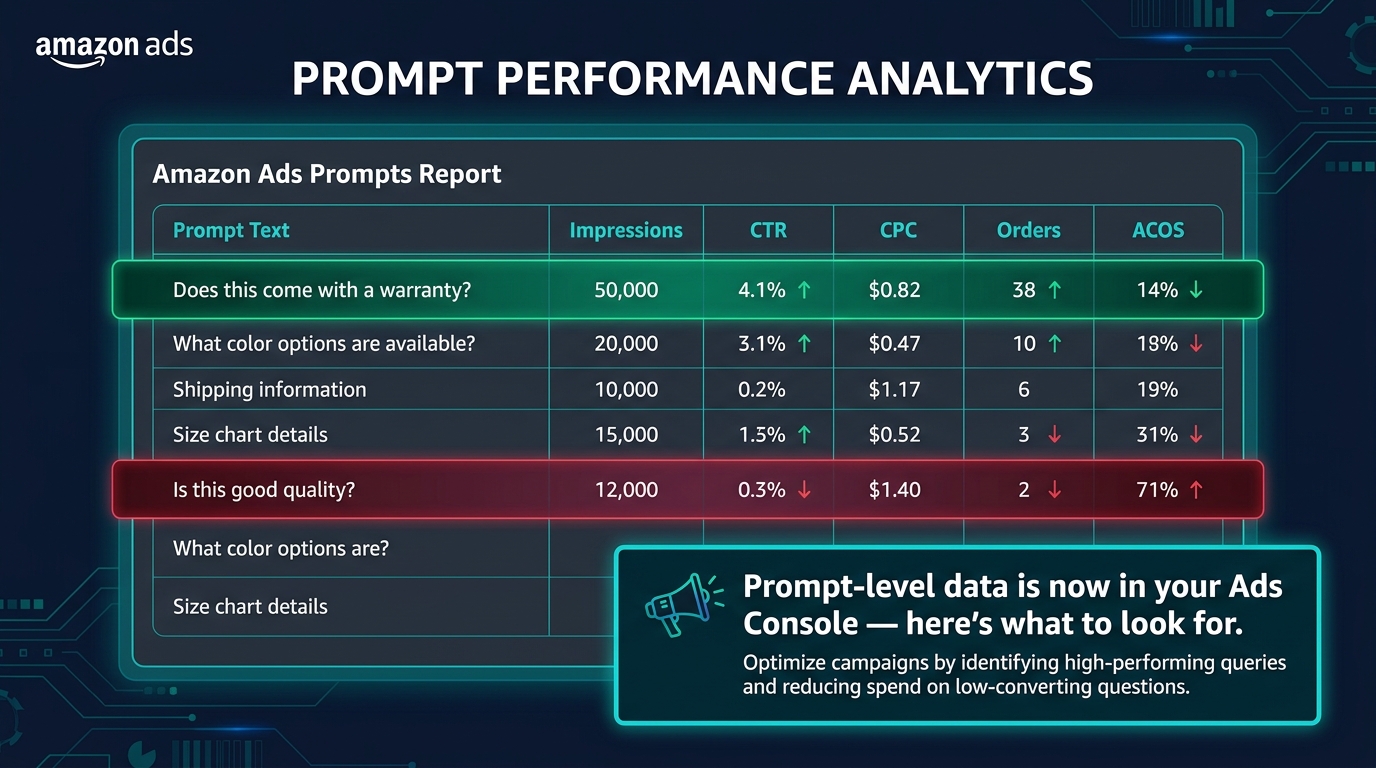
The Prompts Report is available in your Amazon Ads Console under the Reports section, and it’s accessible via API for sellers using programmatic campaign management. It breaks down performance at the individual prompt level — meaning you can see exactly which AI-generated question is generating impressions, clicks, orders, and spend. This is genuinely new visibility that didn’t exist before general availability in March 2026.
The Metrics Worth Tracking (and the Ones That Mislead)
The report surfaces impressions, clicks, CTR, CPC, spend, sales, ACOS, ROAS, and 7-day orders and units per prompt. Not all of these metrics carry equal weight at the current scale of prompt placements.
CTR at the prompt level is the first diagnostic metric to check. Industry observers who’ve been tracking prompt performance since the beta period note that strong prompts in data-rich categories are reaching CTRs in the 3–4% range, while weak prompts — typically those generated from thin listing content — cluster below 0.5%. A prompt sitting below 1% CTR consistently is a signal that the question being asked isn’t resonating, which usually means the prompt is too vague, not that the placement itself is a problem.
ACOS at the prompt level is a useful efficiency signal but requires careful interpretation. Prompts are a high-intent placement — shoppers who click a specific question are further into their consideration process than average search result clickers. This means prompt ACOS can appear relatively high on a per-click basis while still delivering positive economics when viewed against the full-funnel purchase outcome. If your prompt ACOS is high but your 7-day order rate per prompt click is healthy, the spend may still be justified.
Impression volume is the metric most likely to mislead. Because prompts are still a relatively new and expanding placement, absolute impression numbers are lower than Sponsored Products headline placements. Sellers who judge prompt performance purely on impression volume will undervalue high-CTR, high-CVR prompts that are generating fewer impressions but driving disproportionate order value. Sort your Prompts Report by ROAS, not impressions, to find your actual best-performing questions.
The Signal You Shouldn’t Ignore
The most actionable signal in the Prompts Report is the intersection of high CTR and low conversion. A prompt that’s getting clicked at 3%+ but not converting tells you exactly what you need to fix: the question is resonating, but the landing experience — your product detail page — isn’t answering it. That’s a listing problem, not an ads problem. Every high-CTR, low-conversion prompt in your report is a direct editorial brief for where your PDP needs improvement.
What to Fix in Your Listings Before AI Prompts Go Wide
If you’re running Sponsored Products or Sponsored Brands campaigns, you already have AI prompts active. The question isn’t whether to opt in — it’s whether your listings are set up to generate good ones. The gap between sellers who are benefiting from the prompt system and those who are seeing neutral or negative impact comes down almost entirely to listing quality as the AI reads it.
Bullet Points: Answer the Questions Before the AI Has to Ask Them
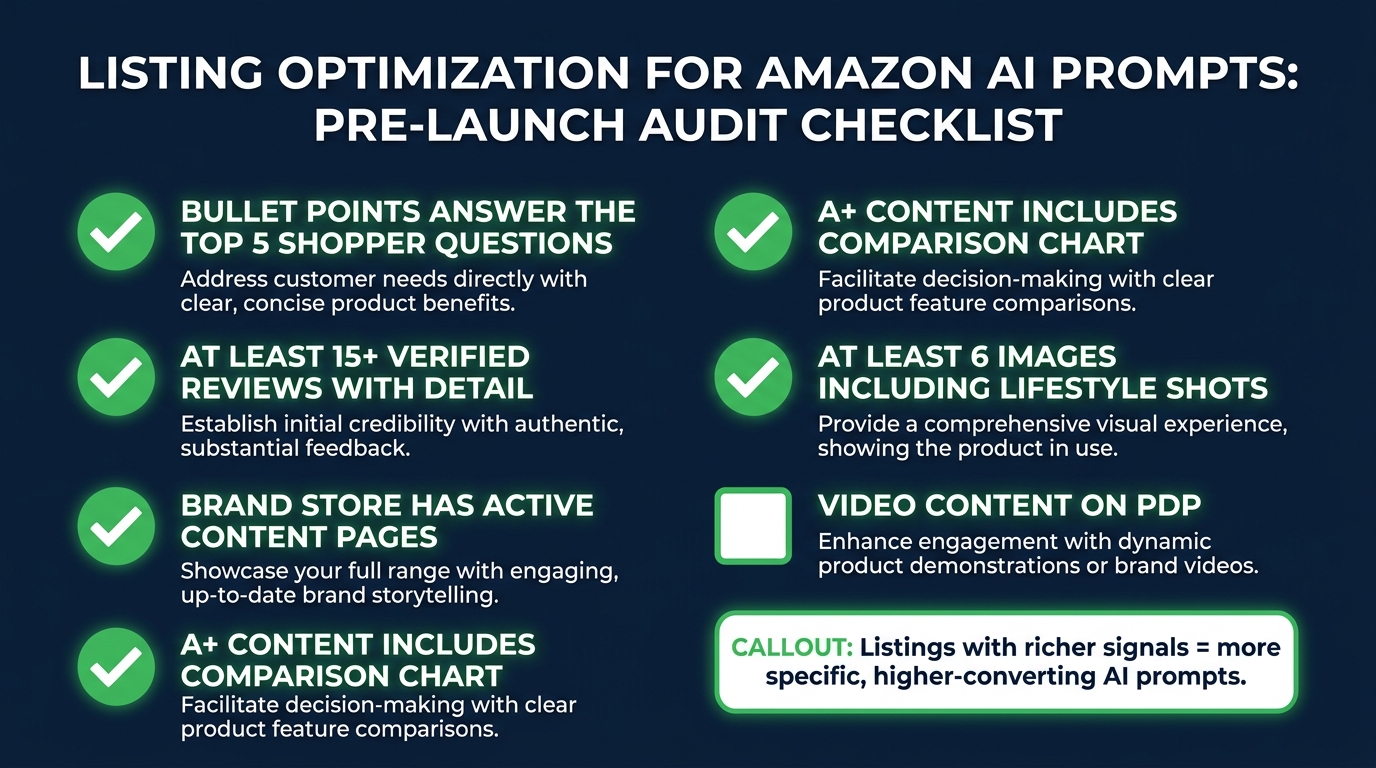
Your five bullet points are the single highest-weight input to the prompt engine. Rewrite them with this frame: if a shopper had one question about each of the five most important things about your product, what would those questions be, and how would you answer them in one sentence?
That frame produces bullet points that are simultaneously SEO-useful, conversion-useful, and prompt-useful. “STAY-PUT 72-HOUR FORMULA: Our oil-control technology keeps your look intact through workouts, humidity, and long days without touch-ups” is a bullet that answers the question “How long does this last?” before it becomes a prompt — and also gives the AI material to generate “Does this hold up through a workout?” as an ad prompt that will click through and find its answer immediately on the PDP.
Reviews: The Unprompted Prompt Research Database
Your review base is one of the AI’s primary sources for understanding what shoppers are actually uncertain about before buying. Sellers with fewer than 15 reviews, or with reviews that are vague (“Great product, love it!”), are giving the AI almost nothing to work with for prompt generation. This is a reason — beyond organic ranking and conversion rate — to actively pursue detailed, specific reviews that describe the problem the product solved, the shopper’s initial hesitation, and the specific feature that resolved it.
If your review solicitation strategy only asks shoppers to “leave a review,” consider adding context prompts that encourage specificity: “Did this work for a specific occasion or use case? We’d love to know.” More specific reviews produce more specific AI prompts produce more specific ad clicks produce more converting traffic.
Brand Store: The Narrative Layer the AI Can Reach
Many sellers treat their Brand Store as a passive brand presence — something that exists because Amazon offers it, not something that actively contributes to performance. In the AI prompt era, that calculus changes. Your Brand Store is one of only five data sources the prompt engine reads. A Brand Store with a dedicated “Why Choose Us” page, a product comparison section, and content explaining your product’s origin, development process, or unique positioning gives the AI material it can turn into differentiating prompts that your competitors — with no Brand Store or thin Brand Stores — cannot generate.
A Brand Store overhaul is not a quick task, but the return on investment is now multi-layered: it contributes to Brand Store traffic via Sponsored Brands, it improves organic discovery, and it directly feeds better AI prompts into your Sponsored Products campaigns. That’s three performance levers from one content investment.
A+ Content: The Comparison Chart Is Now Prompt Fuel
A+ Content comparison charts — where you list your product alongside variant or competitor-category options with feature checkmarks — are particularly useful for the prompt engine because they encode the exact comparison questions shoppers ask. “Does this have X feature that Product B doesn’t?” is a category of shopper question, and if your A+ Content explicitly addresses it, the AI can surface it. Build your A+ comparison chart around the three to five questions that differentiate you from the next most popular option in your category.
Campaign Strategy in the Prompt Era: What Changes and What Doesn’t
Amazon’s AI ad prompts represent a genuine structural shift in how ads on the platform interact with shoppers — but they don’t make the fundamentals of Amazon advertising less important. If anything, they make certain fundamentals more important and add new levers that weren’t available before.
What Changes
The ad impression is no longer a static moment. Before prompts, a Sponsored Products impression was an image, a title, a price, a star rating. A shopper either recognized intent match or scrolled. Now an impression can include an interactive question that invites the shopper into a conversational consideration process. That’s a different kind of impression requiring a different kind of downstream content strategy. Your PDP can no longer be a passive landing page — it needs to be a designed answer to the questions your AI prompts are surfacing.
Measurement also changes. The Prompts Report introduces a new level of granularity — question-level performance data — that creates feedback loops between advertising and listing management that didn’t exist before. A high-CTR, low-conversion prompt is a precise editorial brief. A prompt that’s generating zero impressions despite your ASIN being active tells you the AI can’t find enough signal in your listing to ask a coherent question. Both are actionable, specific information.
What Doesn’t Change
Bid management, budget allocation, keyword targeting, and negative keyword discipline are unchanged in their importance. AI prompts are an additional layer on top of your existing Sponsored Products and Sponsored Brands infrastructure — they don’t replace or modify your campaign bidding logic. A poorly structured campaign with weak keyword targeting will still underperform with prompts active. A well-structured campaign with rich listings will compound its existing advantage through better prompt quality.
The fundamentals of listing quality — specific, shopper-focused copy, detailed imagery, a robust review base, accurate categorization — have not diminished in importance. They’ve increased. The AI ad prompt system is, in a meaningful sense, an automated audit of your listing’s informational density. Listings that pass that audit generate strong, specific, high-performing prompts. Listings that don’t generate vague prompts that underperform or get suppressed.
The Strategic Priority Order for 2026
For sellers trying to prioritize across everything this system asks of them, a reasonable order is: First, audit your top 10 ASINs by Sponsored Products spend and ensure bullet points are specific, question-answering, and free of keyword-stuffed language the AI can’t parse. Second, check your Prompts Report and sort by high CTR / low conversion to identify your immediate PDP fix list. Third, build or refresh your Brand Store with the narrative and comparison content the AI can access. Fourth, brief one campaign per category in Creative Agent and observe whether the resulting creative generates different (more specific) prompts than your existing campaigns. Fifth, once you have three months of prompt data, begin using AMC natural language audiences to build companion targeting that aligns high-intent audience segments with your best-performing prompt questions.
None of these steps require new budget. They require attention to systems that are already running inside your campaigns — and that are already influencing your performance whether or not you’re managing them deliberately.
The honest assessment of where AI ad prompts sit in mid-2026: they are a real, measurable feature with documented performance upside in data-rich categories and documented underperformance in thin-listing, vague-copy contexts. They are not yet a major volume driver for most sellers — the placement is still relatively new and impression scale is limited compared to core Sponsored Products inventory. But the trajectory of the feature, the rate of expansion from beta to GA to open-web display to Alexa integration, suggests this will become a primary ad interaction surface within the next 12 to 18 months. Sellers who build the listing infrastructure now will enter that period with a structural advantage over sellers who start optimizing when the volume is already there.
Key Takeaways
- AI prompts are already live in your campaigns. Every Sponsored Products and Sponsored Brands campaign in the U.S. was automatically enrolled as of March 25, 2026. You have a Prompts Report available in Ads Console now — check it.
- The quality of your prompts is a direct output of your listing quality. The AI reads five signals: PDP content, reviews, Brand Store, campaign history, and Rufus query patterns. Each one is optimizable.
- Category context determines which prompt types perform. Electronics drives specification prompts. Health and beauty drives compatibility and ingredient prompts. Home and kitchen splits between feature-matching and lifestyle prompts. Supplements face compliance filtering. Apparel has a timing problem with the learning cycle.
- The Prompts Report is actionable data, not just reporting. High CTR / low conversion is a PDP brief. Low impression volume on an active ASIN is a listing signal audit brief. Sort by ROAS, not impressions.
- Creative Agent and AMC audiences are the surrounding infrastructure. Creative Agent feeds richer copy signals to the prompt engine. AMC natural language audiences let you match high-intent segments to your best-performing prompt questions. Together they create the most sophisticated use of Amazon’s AI advertising stack currently available.
- The fundamentals remain intact. Bid management, keyword strategy, and negative targeting are unchanged. Prompts compound your existing campaign quality — they don’t replace it.