



You go live. The viewer count climbs. The chat buzzes. Then the stream ends and the sales numbers are… underwhelming. Maybe $800 in GMV from a two-hour session. Maybe fewer than a dozen checkouts from 2,000 viewers who showed up.
This is the live room paradox: enormous apparent engagement, disappointing actual revenue. And if you’ve experienced it, you’ve probably blamed the wrong things — the product, the algorithm, the time slot, the host’s energy. Rarely does anyone zoom out and ask the question that actually matters: where, precisely, did viewers exit the funnel?
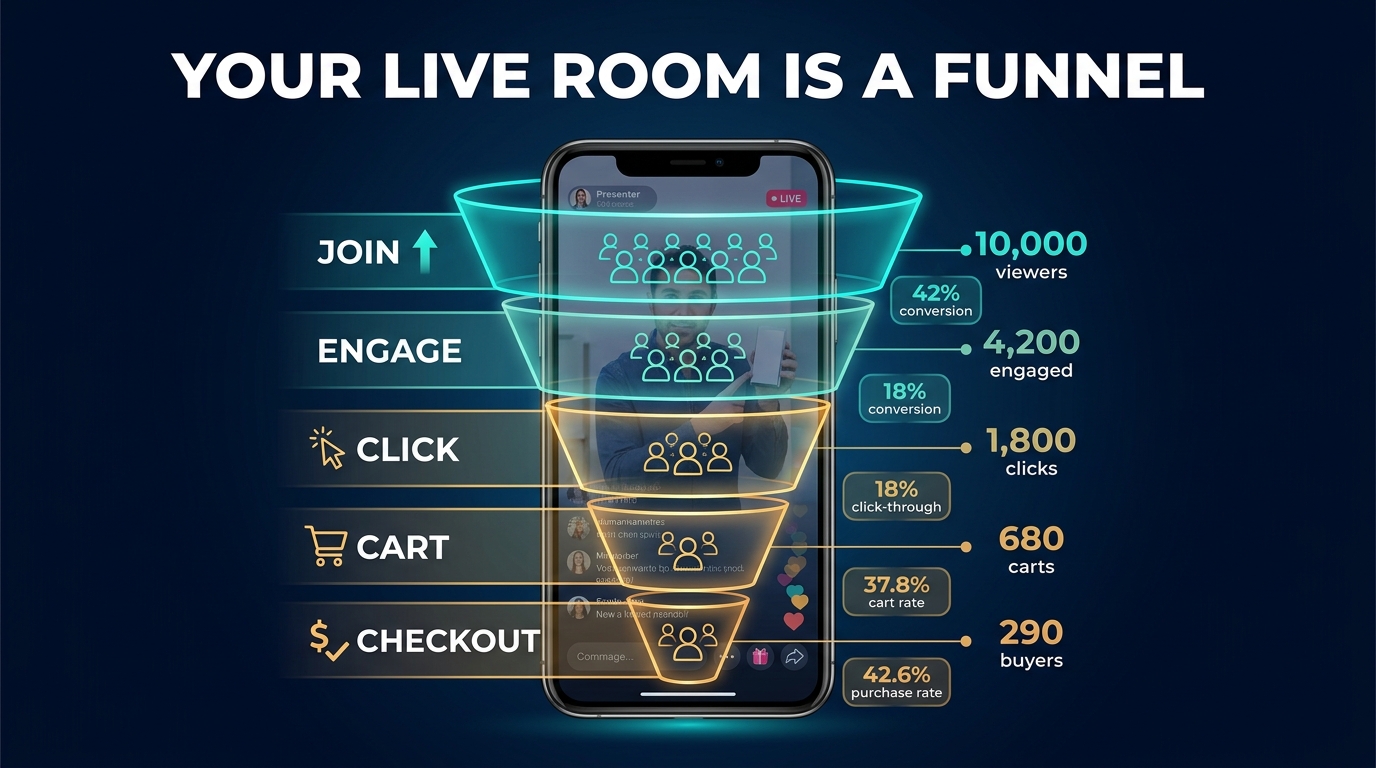
Because that’s what a live room is. Not a show. Not a broadcast. Not a content format. It’s a funnel — a multi-stage conversion architecture where viewers move (or fail to move) through a defined sequence: join, engage, click, add to cart, and check out. Most streams lose the majority of their potential revenue not from bad products, but from leaks at predictable, fixable moments in that sequence.
The live commerce market in the US alone is projected to hit $67.8 billion in 2026, roughly double its 2024 size. Top-performing live rooms on TikTok Shop are converting at 8–12%, sometimes higher — compared to the 1.9–3% typical of standard ecommerce. But the average live shopping stream converts well below even that baseline. The gap between what live commerce can do and what most brands are actually capturing is staggering.
This article is about that gap. Not the obvious advice — “be authentic,” “use urgency,” “engage your audience.” Instead, it’s a stage-by-stage diagnostic of where live room revenue bleeds out, why it happens at those specific moments, and what high-converting operators do structurally differently at each stage. From pre-live traffic architecture to post-live GMV recovery, every section covers a real, measurable conversion point — because fixing one leak in your funnel is worth more than any amount of production polish.
The Five-Stage Live Room Funnel Most Brands Ignore
Before diagnosing what goes wrong, it helps to be precise about the structure of a live room funnel. Most sellers treat a live stream as one event. High-performing operators treat it as five consecutive conversion events, each with its own audience, its own friction points, and its own optimization levers.
The funnel defined
The five stages are:
- Join: A viewer discovers the live room — through a notification, an algorithmic push, a pre-live post, or a paid placement — and enters the stream.
- Engage: The viewer watches, interacts with chat, responds to polls, asks questions, or reacts to the host. They transition from passive viewer to active participant.
- Click: The viewer taps or clicks on a pinned product card, a product link, or a CTA button. They express purchase intent.
- Add to Cart: The viewer adds a product to their cart. This is where intent becomes near-purchase behavior.
- Checkout: The viewer completes the transaction. This is the only stage that generates revenue.
Each stage has a conversion rate that compounds. If 10,000 people join your live and only 42% engage meaningfully, only 18% click a product, only 6.8% add to cart, and only 2.9% complete checkout — you’ve generated 290 sales from 10,000 viewers. A 2.9% overall conversion rate sounds respectable until you realize that top performers operating with the same 10,000-viewer count are generating 800–1,200 sales from the same starting pool by running tighter transitions between stages.
Why stage-by-stage thinking changes everything
Most brands that underperform in live commerce try to fix their results by increasing viewer count — spending more on paid traffic or creator distribution to get more people in the room. That’s the most expensive possible fix. Doubling your Join count while losing viewers at the same rate through every subsequent stage just costs twice as much to produce the same underwhelming result.
The more precise lever is identifying which stage-to-stage transition has the worst drop-off rate and engineering a specific fix for that one bottleneck. Improving the Join-to-Engage rate by 15% costs nothing. Reducing cart abandonment by 10% through a checkout UX adjustment costs almost nothing. These interventions compound — and their impact shows up in every future stream you run.
This is the core mental model: your live room is a leaky funnel. Your job isn’t to pour more water in from the top. It’s to patch the holes.
Stage 1 — Pre-Live Traffic: The Warm Audience Trap
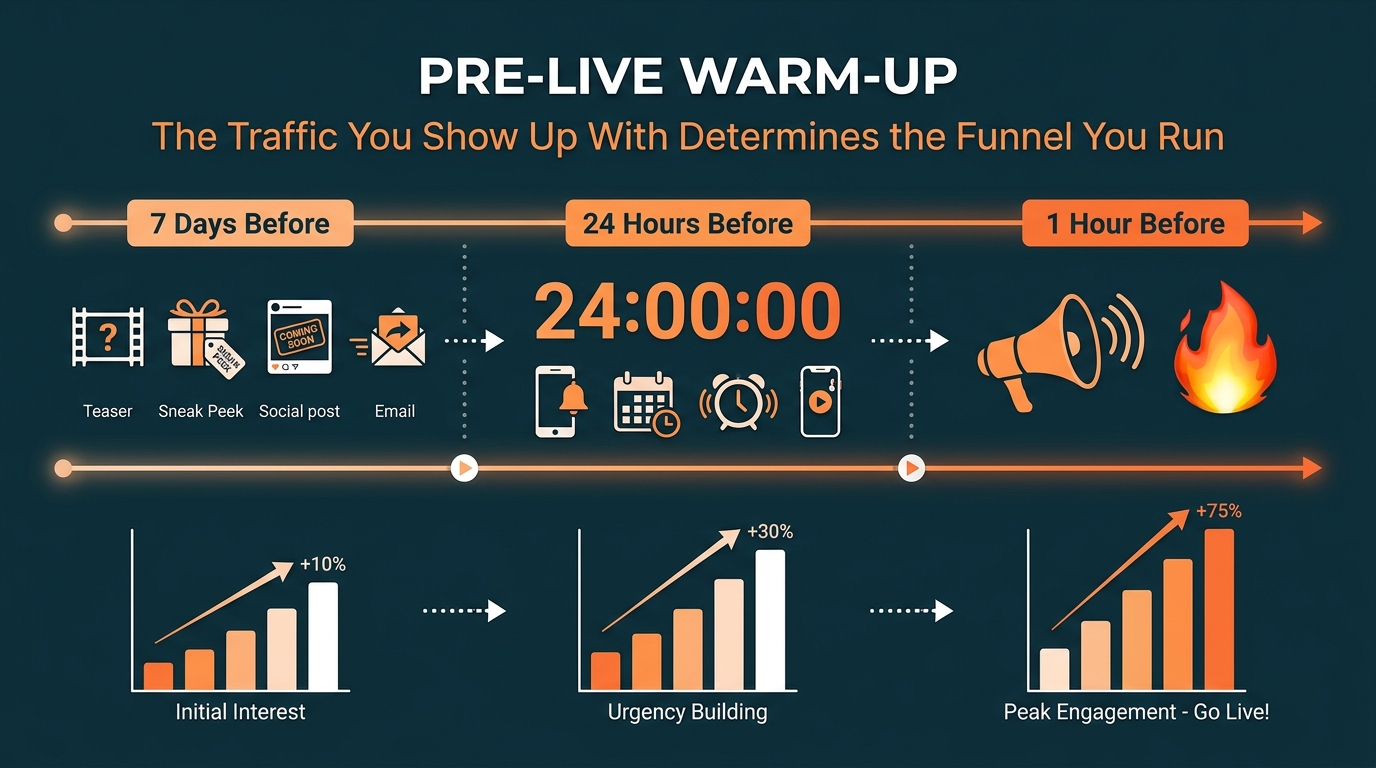
The traffic you show up with at the start of a live stream fundamentally determines what your funnel looks like for the next two hours. This isn’t just about volume — it’s about temperature. Cold traffic and warm traffic behave like completely different audiences once inside the room, and most brands fail to distinguish between them.
What “warm audience” actually means in live commerce
A warm audience, in this context, is someone who has already been primed about the live event before it happens. They know what the stream is about, they know what product category is being featured, and they’ve had at least one prior touchpoint — a teaser clip, a notification, a story post, a short video — that created anticipation. They arrive at the room with intent, not just curiosity.
A cold audience is algorithmically surfaced to the live room with zero prior context. They land mid-stream with no understanding of the product, the host, or the offer. They’re far more likely to exit in the first 90 seconds, suppressing engagement signals and causing the algorithm to reduce the room’s further distribution — a downward spiral that compounds quickly.
The three-phase pre-warm sequence
High-converting operators build pre-live traffic in three distinct phases, each serving a different function in the overall funnel:
Phase 1 — Seven Days Before (Awareness): Short-form teaser content — a 15–30 second clip of the host using the hero product, a “coming soon” story with a poll, a countdown post. The goal here is not conversion. It’s cognitive priming. You want the eventual live viewer to recognize the product the moment it appears on screen, because familiarity accelerates trust.
Phase 2 — 24 Hours Before (Anticipation): A more explicit “tune in tomorrow” push across every owned channel — email, SMS, push notification for apps, community posts, and a pinned story or video on the platform where the live will run. This is where you share the specific offer hook: not just “we’re going live” but “we’re going live and the first 100 viewers get a 30% exclusive discount.” Give people a reason to mark the time.
Phase 3 — One Hour Before (Activation): A final reminder through high-deliverability channels (SMS and push notifications outperform email for last-hour activation). Include a direct link if the platform supports deep-linking into the live room. This phase converts the people who registered intent in Phase 2 into actual viewers at the open.
The compounding error of skipping pre-warm
Brands that skip pre-warming essentially absorb the cost of audience education inside the live room itself — using precious engagement-critical minutes to explain who they are and what they sell to an audience that just arrived cold. Every minute spent on context that could have been handled in teaser content is a minute not spent driving the action that feeds the next funnel stage.
Pre-warm content also does double duty: the engagement signals on teaser posts (saves, shares, comments) signal to the algorithm that this creator and these products have an interested audience, which typically improves the algorithmic distribution of the live event when it begins. You’re not just warming your audience — you’re warming the algorithm.
Stage 2 — The First 90 Seconds: Your Hardest Conversion Moment
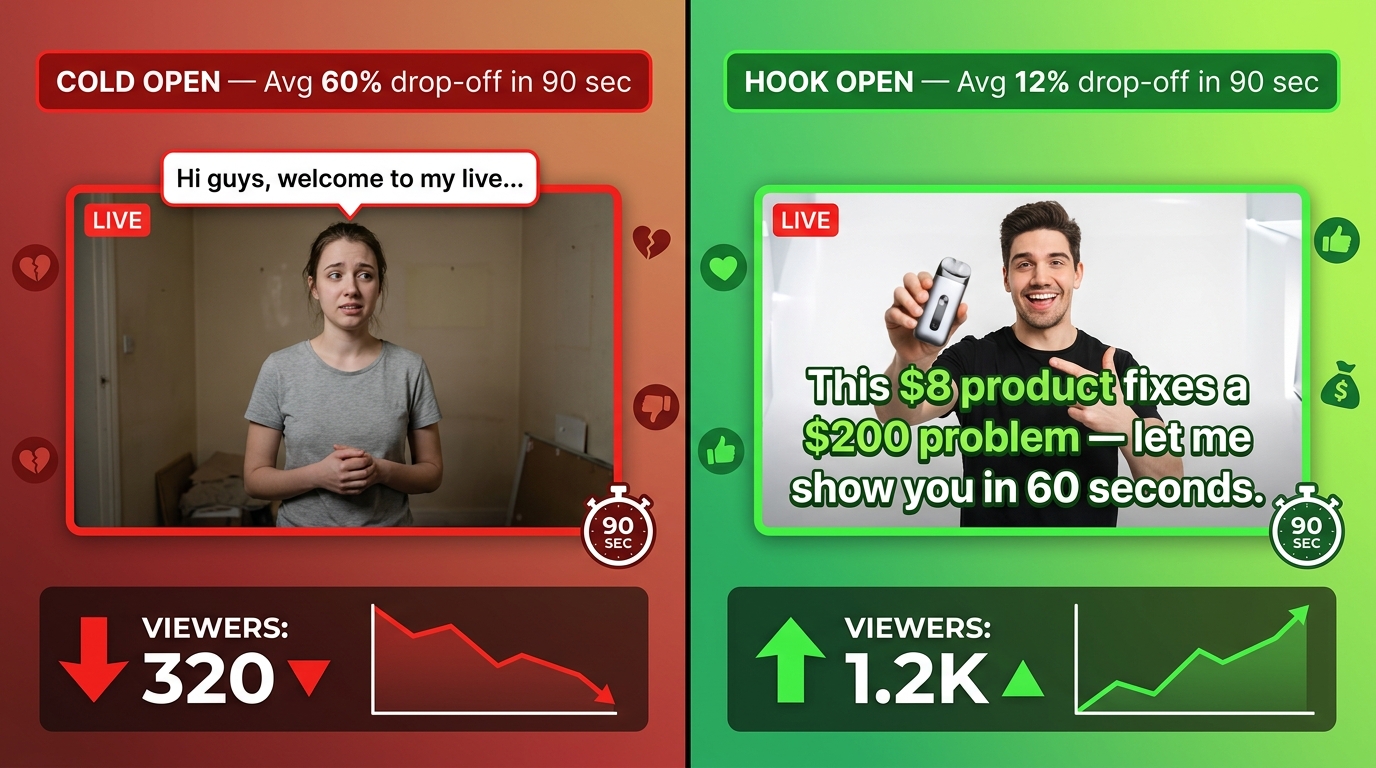
Platform data consistently identifies the first 60–90 seconds of a live stream as the period of steepest viewer drop-off. Most live rooms lose between 40–60% of their peak concurrent viewers in this window. That’s not a content quality problem. It’s a structural problem — specifically, a hook architecture problem.
Why the cold open is the most expensive mistake in live commerce
The default live room opening — “Hey guys, welcome! We’re just getting started, let’s wait for a few more people to join” — is the single most damaging thing a host can do for funnel performance. It signals to new arrivals that nothing important is happening yet, that there’s no reason to stay, and that the valuable content is future-tense. The algorithm, which measures real-time engagement signals including average view duration, immediately gets a negative signal and throttles distribution.
Research on live shopping retention shows that the average buyer watches approximately 22 minutes per live session. But they have to make it through the first 90 seconds to get there. The drop-off curve is steepest at the opening, then flattens dramatically — meaning if you can hold viewers through the initial two minutes, you’re statistically likely to retain a significant portion through to a purchase decision.
What a high-converting open actually looks like
The most effective live openings share a common structure: they lead with a specific, concrete value promise delivered in the first 15 seconds, followed immediately by a demonstration or proof element, followed by an explicit CTA for what to do next.
An example of a weak open: “Hey everyone, welcome to our live, we’re going to be showing you some amazing products today, so stick around!”
An example of a strong open: “This $18 serum completely replaced my $120 moisturizer — I’m going to show you exactly why in the next 60 seconds, and then I’m dropping it at the live-only price.”
The second version does four things the first doesn’t: it states a specific claim (not a vague promise), it anchors a price comparison that creates immediate perceived value, it sets a defined time expectation that makes staying feel low-cost, and it previews a specific incentive. A viewer who hears this in the first 15 seconds has already received a reason to stay — which is the only thing that matters at this funnel stage.
The “loop close” technique for extending retention past the hook
High-converting hosts don’t just hook viewers once at the open. They create a series of anticipation loops throughout the stream — telegraphing the next valuable moment before it arrives. “In about five minutes I’m showing you the one product we keep selling out — watch for it.” This loop structure keeps viewers in a persistent state of anticipation, which is one of the most powerful psychological drivers of content retention. Every time a viewer is about to leave, the next loop re-anchors them.
The combination of a strong cold open and regular loop closures can reduce early drop-off from the 40–60% range to 10–15% — a change in retention that cascades through every subsequent funnel stage. More engaged viewers at Stage 2 means more clicks at Stage 3, more carts at Stage 4, more checkouts at Stage 5.
Stage 3 — Engagement Architecture: Turning Passive Viewers Into Active Participants
Watching and engaging are not the same funnel stage. A viewer who is passively consuming the live stream has not yet committed any behavioral signal that predicts purchase. A viewer who comments, reacts, uses a poll, asks a product question, or taps a pinned item is demonstrating engagement — and engagement is the best behavioral predictor of conversion available in a live room.
The engagement-conversion link in the data
The conversion data here is meaningful. Live webinar research shows that events using interactive elements — polls, Q&A, and live chat engagement — convert at an average of 33%, compared to 22% for passive broadcast formats. While webinar and live shopping audiences differ, the underlying psychology is the same: participation creates ownership. When viewers invest active attention, they’re more cognitively committed to the outcome — including the purchase decision being presented to them.
On TikTok Shop specifically, the algorithm weights real-time engagement signals heavily in determining how widely it distributes a live room during the broadcast. Comments, shares, product taps, and gift sends all contribute to a live room’s algorithmic reach score. Engagement architecture is simultaneously a conversion tactic and a distribution tactic — the two reinforce each other.
Structural engagement mechanics that work
The comment-to-pin sequence: Ask viewers a simple question that generates comments (“Comment ‘YES’ if you’ve ever had this problem”), then immediately pin the responding product. The comment flood triggers algorithmic signals; the immediate pin captures the intent those comments generated. This sequence typically produces a click spike on the pinned product within 60–90 seconds of the comment prompt.
Live polls for social proof by proxy: Polls that ask “Have you tried this?” or “Who wants the deal on this?” create visible consensus in the room. New viewers entering a room where the poll shows 847 people said “yes” are immediately socially calibrated toward the product — they see a community of buyers, not a seller pitching them.
Repeated recap segments: Every 10–15 minutes, the host should run a brief recap of what’s been shown and what’s coming. This serves new viewers who joined mid-stream (who are perpetually entering the room as others leave), and it re-activates viewers who drifted into passive consumption. The recap is not filler — it’s a re-onboarding mechanism for the rotating audience in a live room.
The Q&A as a conversion mechanism, not a service function
Most hosts treat viewer questions as interruptions from the main content. High-performing operators treat Q&A as one of the highest-converting moments in the entire session. When a viewer asks “Will this work for oily skin?” and the host answers specifically and immediately with demonstrable knowledge, every viewer watching who has oily skin receives a personalized persuasion moment in a group setting — an experience that’s impossible to replicate with a static product listing or a video ad.
The key is handling Q&A in a way that benefits the whole room, not just the questioner. Rather than answering privately or in a sidebar, skilled hosts read the question aloud, answer it in full view, and connect it back to the product demonstration. One well-answered question can convert dozens of silent viewers who had the same concern but didn’t ask.
Stage 4 — Offer Sequencing: How to Stack Products So Each One Sells the Next
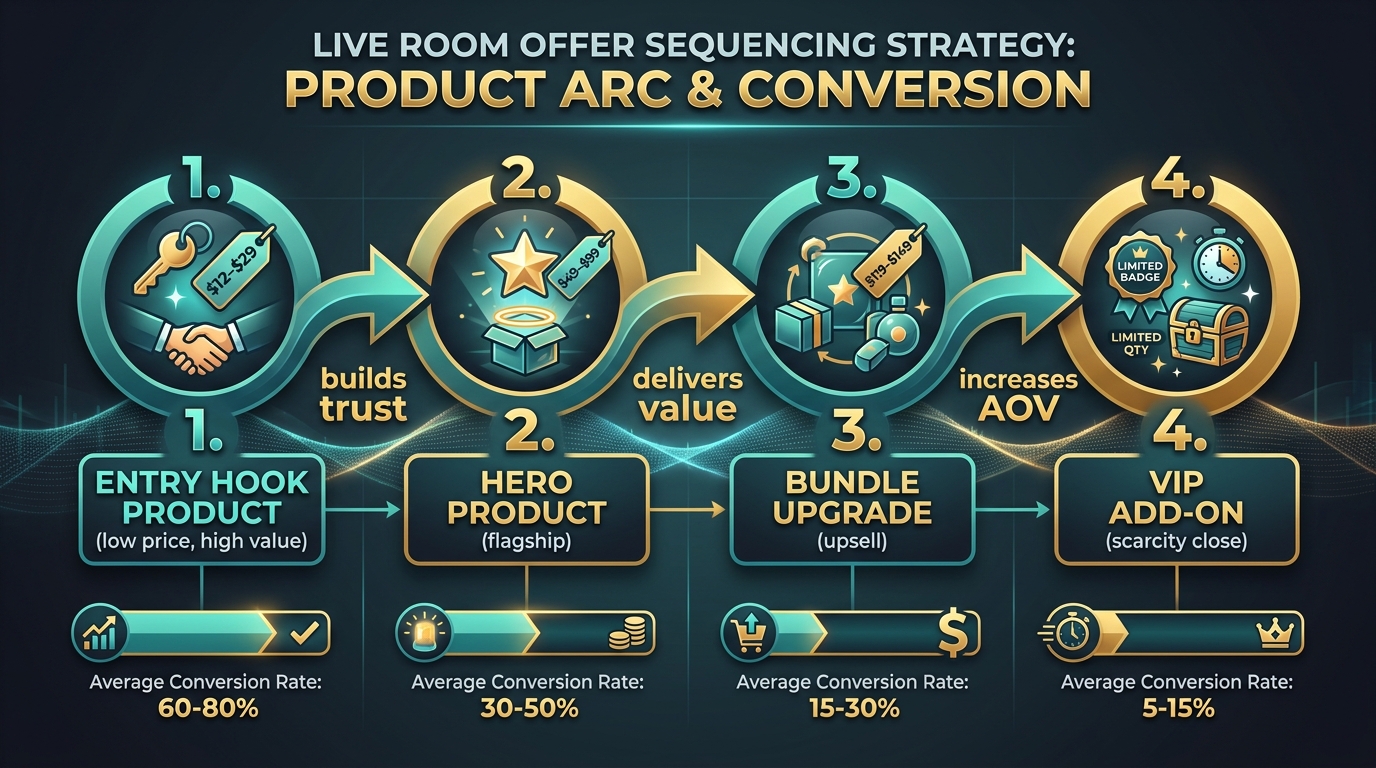
The order in which products appear in a live room is not a logistical decision. It’s a conversion architecture decision. Product sequencing determines the trust trajectory of the session, the average order value, and whether the psychological momentum of the room builds or collapses as the stream progresses.
The four-product live room arc
Experienced live commerce operators have converged on a four-tier product arc as the baseline offer structure for a standard live session. Each tier serves a different conversion function:
Tier 1 — The Entry Hook Product ($12–$29): This is the first product presented and typically the lowest-priced item in the lineup. Its job is not to generate significant revenue. Its job is to generate first purchases. An affordable, high-perceived-value product removes the buying barrier for the most hesitant segment of the audience. Each person who completes a transaction — even a small one — shifts psychologically from “viewer” to “buyer.” Buyers in a live room convert on subsequent offers at dramatically higher rates than viewers who haven’t yet purchased.
Tier 2 — The Hero Product ($49–$99): The flagship item — the product you could build the entire session around. This is presented after trust has been established with the entry hook, when the audience that remains is self-selected for engagement and purchase intent. The hero product demo should be the longest and most detailed of the session, incorporating Q&A, demonstration, comparison to alternatives, and social proof from reviews or testimonials.
Tier 3 — The Bundle Upgrade ($119–$149): Once the hero product has been presented, a bundle that includes the hero product plus complementary items at a combined discount serves as an upsell mechanism. Viewers who were going to buy the hero product anyway now have a clear reason to add the bundle — better value for items they already want. This tier increases average order value without requiring an entirely new purchase decision, because the core decision was already made at Tier 2.
Tier 4 — The VIP Add-On (Limited Quantity): A scarcity-based close near the end of the session. Limited quantities remaining, a special bonus for the final 50 buyers, or an exclusive color or configuration available only during this live event. This tier functions as both a conversion accelerator for fence-sitters and a retention mechanism for viewers who’ve been waiting — the scarcity signal gives them a specific reason to act now rather than continue deliberating.
Timing the transitions between tiers
The duration spent on each tier matters as much as the sequence itself. A common mistake is rushing through the entry hook product too quickly to get to the “real” hero product — undermining the trust-building function of Tier 1. A good rule of thumb is to spend roughly 15–20 minutes on Tier 1 (enough to generate initial transactions and build room energy), 25–35 minutes on Tier 2 (enough for deep demonstration and Q&A), 10–15 minutes on the Tier 3 bundle pivot, and 10 minutes on the Tier 4 close.
The transitions between tiers should be announced and framed as transitions, not buried. “Okay, we’re about to move to the main event — this is the one I’ve been talking about all week” signals to viewers that a new chapter is beginning, which functions as an internal loop close that keeps viewers engaged across the shift.
The role of live-only pricing in offer architecture
Live-exclusive pricing — offers that are explicitly unavailable anywhere else — is one of the highest-leverage elements of offer architecture. When a viewer knows they cannot get this price by closing the app and going to the website, the platform performs a powerful funnel function: it eliminates delay. The psychological pressure of loss aversion (the deal disappears when the stream ends) compresses the decision cycle in ways that no static promotion can replicate. The most successful live rooms make this constraint visible and credible — displaying regular prices alongside live prices and verbally reinforcing the exclusivity at regular intervals.
Stage 5 — Checkout Friction: The Silent Revenue Killer
Most sellers who analyze their live room performance focus on viewer count, engagement rate, and click-through on product pins. Very few look carefully at the gap between add-to-cart and completed checkout — which is often where the largest proportion of identifiable revenue disappears.
How checkout friction accumulates in a live room context
In standard ecommerce, the average cart abandonment rate sits around 70–75%. In live commerce, the abandonment pattern is different but still significant: viewers who add to cart during a live stream are in a high-stimulation, high-distraction environment. They’re simultaneously watching the stream, participating in chat, and processing purchase information. Any friction in the checkout flow — extra required fields, loading delays, unclear shipping information, an unexpected final price — creates a decision pause that the distracting environment then fills with doubt.
Additionally, live shopping checkout events are time-compressed. A viewer adding to cart during a fast-paced product demo moment doesn’t want to pause the stream to complete a multi-step purchase flow. Every additional tap or click between cart and confirmation is a dropout risk.
Checkout optimization levers inside the live room
In-stream checkout UX: Platforms with native in-stream checkout (TikTok Shop’s embedded checkout, Amazon’s in-app purchase) consistently outperform streams where checkout requires leaving the live room entirely. If your platform supports native checkout, ensure your product listings are fully optimized for it — complete size/variant information, clear shipping preview, and a single-tap payment option for returning customers.
Host-guided checkout language: Skilled hosts walk viewers through the checkout process verbally during the session — not once at the end, but multiple times, briefly, after each product feature. “Hit the orange button right now, it’s the pinned product at the bottom of your screen — takes about 20 seconds to check out.” This removes uncertainty about how to buy and reduces the cognitive load of the checkout decision.
Guest checkout and saved payment: Any stream architecture that requires account creation before purchase will see significantly elevated dropout. If your store’s checkout flow requires a login, the live room environment — where the average viewer is on mobile, mid-engagement — will punish this friction harder than any other channel.
The cart recovery window during the live
Viewers who add to cart but don’t check out during the live session are high-intent signals that deserve immediate follow-up. Within the live room itself, a well-timed “checkout reminder” moment — “If you’ve got something in your cart from earlier, now’s the time to lock it in before tonight’s deal expires” — serves as an in-stream cart recovery nudge. Some advanced operators sync their cart data with chat automation tools to send direct messages to cart-adders who haven’t purchased, with a gentle reminder and the remaining session time.
The Post-Live Funnel: Where 40–60% of GMV Actually Hides
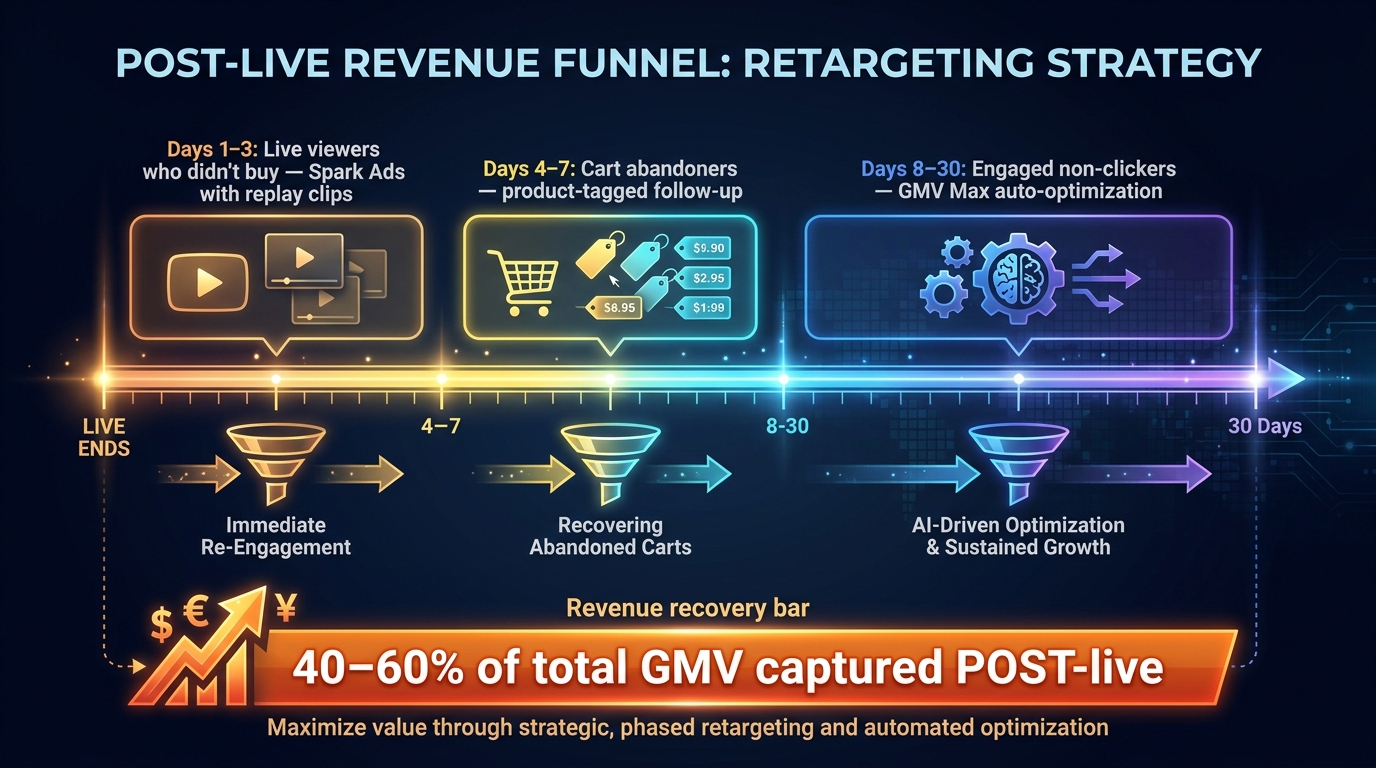
Here is one of the most consistently underappreciated facts in live commerce: a significant portion — typically 40–60% — of the total GMV attributable to a live session is generated after the stream ends. Not during. After. This isn’t a marginal revenue recovery play. It’s a fundamental structural feature of how live shopping economics actually work, and most brands are leaving the majority of it on the table.
Why post-live revenue is so large
Several dynamics converge to make post-live revenue substantial. First, the live room generates more purchase intent than it has time to convert. Viewers who engaged, clicked, even added to cart but didn’t complete the transaction have already crossed most of the psychological barriers to purchase — the product resonated, the price was considered acceptable, the host built enough trust. The only thing missing was the final conversion moment, which the post-live funnel can provide.
Second, live streams generate algorithmic amplification that extends well beyond the broadcast window. Replay views, algorithm-pushed clips, and Spark Ads built from live content continue surfacing the product to new audiences for days after the session. These viewers haven’t seen the live room funnel from Stage 1 — they’re entering at a different point, but still moving through the same downstream stages (click, cart, checkout).
Third, the data signals generated during the live — who watched, who clicked, who carted, who bought — create the highest-quality custom audiences available for retargeting. These are behavioral signals, not demographic approximations, and they feed retargeting systems with precision that cold prospecting can’t match.
The three-window post-live retargeting structure
Window 1: Days 1–3 (High-Intent Recovery). Target live viewers who watched but didn’t purchase, with Spark Ads built from the highest-converting clips of the live session — typically the moments of strongest product demonstration or highest chat activity. The creative here should feel like a “best of” from the live, not a separate ad. The audience already has familiarity with the content, which reduces creative friction and improves click-through. On TikTok Shop, this window typically delivers a click-through rate 3–4x higher than cold prospecting ads.
Window 2: Days 4–7 (Cart Abandonment Recovery). Target specifically the cart-adder segment — viewers who got all the way to add-to-cart and stopped. This audience is the warmest segment in your entire post-live pool. The messaging here can be more direct: a product-tagged follow-up video or a dynamic product ad showing the specific item they added, with a clear reminder of availability and any remaining offer window. Some operators pair this with a small additional incentive (free shipping, a small percentage discount) to complete the conversion.
Window 3: Days 8–30 (Broad Recovery via GMV Max). For the broader pool of engaged non-purchasers, GMV Max (TikTok Shop’s automated performance campaign type) can auto-optimize across creative variations, placements, and audience segments to recover incremental GMV at scale. This phase functions more like ongoing performance advertising than retargeting in the traditional sense — you’re feeding the algorithm the live-generated data signals and letting it find the most efficient path to additional conversions.
The replay as a second live room
One of the most overlooked post-live assets is the replay itself. On TikTok Shop and YouTube Shopping, live replays with product tags remain shoppable after the broadcast ends — meaning a viewer who discovers the replay a week later can still complete the same purchase journey the live room was designed to enable. High-performing operators don’t let replays sit passively. They clip the best performing segments into short-form content, embed product links in each clip, and distribute them as standalone content pieces. A two-hour live session can generate 8–12 short clips, each of which functions as an independent product discovery touchpoint with a direct path to checkout.
Platform-Specific Funnel Logic: TikTok Shop vs. Amazon Live vs. YouTube Shopping
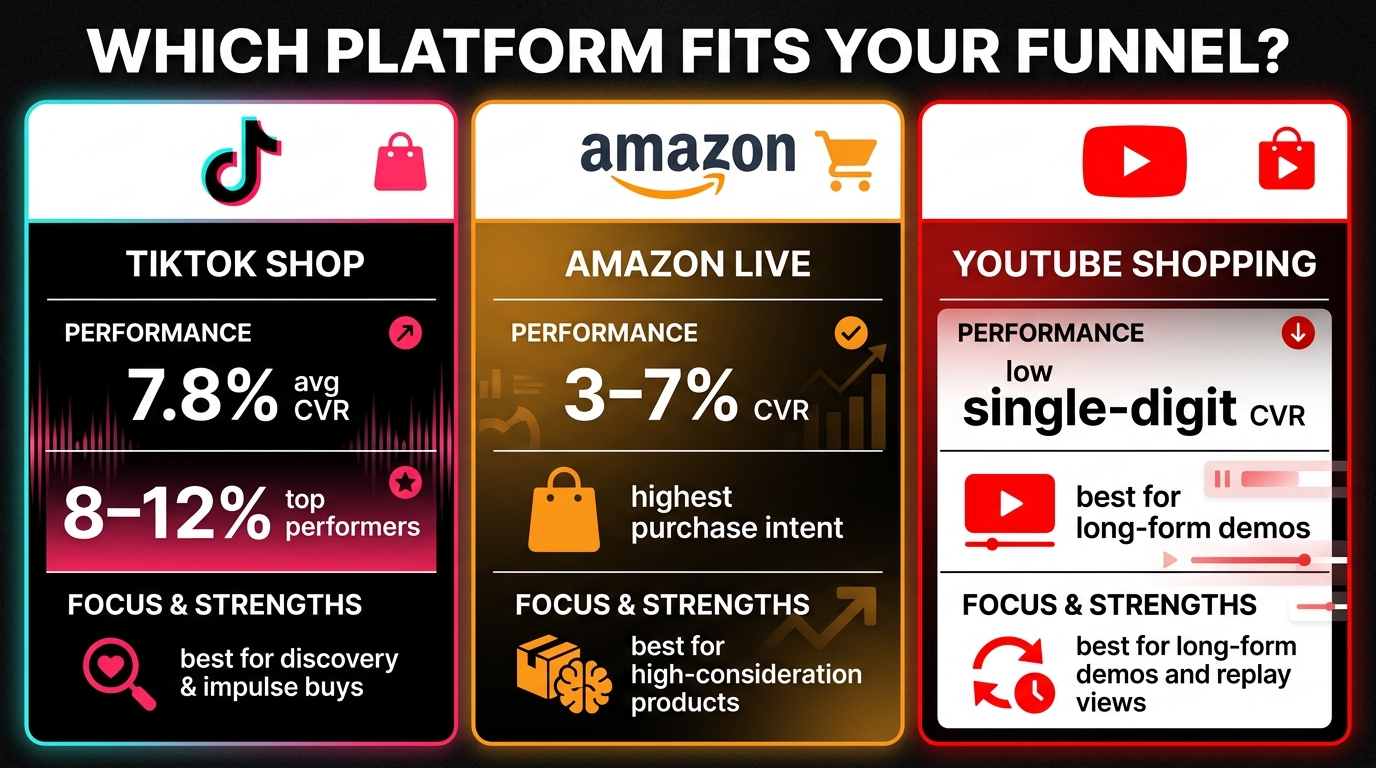
The five-stage funnel framework applies across all live shopping platforms, but the mechanics of each stage — and where the most critical drop-off points sit — differ meaningfully by platform. Running the same funnel strategy across TikTok Shop, Amazon Live, and YouTube Shopping without adjusting for platform-specific dynamics is a reliable way to underperform on all three.
TikTok Shop: Discovery-first, conversion-fast
TikTok Shop’s live commerce environment is built for discovery. Viewers arrive from the For You Page — they didn’t search for a product, they were algorithmically served a live room while scrolling. This means the Join-to-Engage transition is the most critical funnel moment on TikTok. A viewer who landed cold from FYP needs to understand within seconds why this live room is worth staying in, or they’ll scroll on.
The average TikTok Shop live room conversion rate sits around 7.8% across all sellers, with top performers in high-engagement categories reaching 8–12%. The platform’s native checkout — fully integrated within the TikTok app — significantly reduces checkout friction compared to off-platform purchase flows, which is a structural advantage. The challenge is that TikTok’s discovery-first audience is higher-volume but lower initial intent than platforms where viewers arrive with explicit purchase mindset.
TikTok Shop’s algorithm also rewards session length and consistency. Rooms that stream for two hours or more, on a regular schedule, receive algorithmic promotion advantages that shorter or infrequent streams don’t. This means the funnel economics of TikTok Shop improve substantially as a brand establishes a live room cadence — the algorithm learns your audience and gets progressively better at distributing your streams to people likely to convert.
Amazon Live: High-intent, high-consideration
Amazon Live operates in a fundamentally different funnel context. Viewers typically arrive from Amazon’s search and recommendation ecosystem — they’re already in purchase mode when they encounter a live stream. This means the Join-to-Engage rate tends to be higher (the viewer showed up with intent, not just curiosity), but it also means the bar for the live room itself is different. An Amazon Live viewer who came from a search results page is comparing the live room experience against the static product listing, customer reviews, and competitor products — all simultaneously available to them in the same interface.
Conversion rates on Amazon Live typically range from 3–7%, lower than TikTok Shop’s averages, but with an important nuance: Amazon Live converts on higher average order values, and its buyers tend to be higher lifetime-value customers who are already Amazon Prime members with one-click purchase capability. The funnel strategy for Amazon Live should therefore prioritize depth of product information and trust-building over speed, and lean into the product demonstration format that converts high-consideration buyers — detailed comparisons, Q&A, before/after demonstrations, and review citation.
YouTube Shopping: Long-form depth, replay strength
YouTube Shopping’s live commerce funnel differs from both TikTok and Amazon in its time architecture. YouTube’s audience is accustomed to longer content — they came to the platform expecting to spend 10, 20, or 60 minutes with a creator. This extended attention window creates a different kind of funnel dynamic: less emphasis on rapid conversion in the first 90 seconds, more emphasis on building deep product trust over the course of a longer session.
YouTube Shopping’s live commerce conversion rates are generally lower than TikTok Shop and Amazon Live in the real-time context, sitting in the low single digits for most implementations. Where YouTube Shopping dramatically outperforms the others is in replay value. YouTube’s recommendation algorithm surfaces live shopping replays to new viewers for weeks or months after the broadcast, creating a long-tail conversion funnel that’s structurally different from TikTok’s or Amazon’s post-live dynamics. For brands with products that benefit from detailed educational content — tech, beauty, home goods — YouTube Shopping’s replay funnel can generate more total revenue than the live event itself over a 60-day horizon.
Measuring the Right Metrics at Each Funnel Stage
Most live commerce analytics dashboards surface the wrong numbers in the wrong order. Peak concurrent viewers and total stream duration are the headline metrics most platforms default to showing — but neither metric is actionable for funnel optimization. The metrics that actually let you diagnose and fix conversion problems are stage-specific, and they require deliberate tracking rather than accepting the default dashboard view.
The metrics that matter at each stage
Join: Total unique viewers, traffic source breakdown (organic algorithm, paid promotion, notifications, direct link). This tells you how your pre-warm strategy performed and which traffic sources deliver the highest-intent initial audience. Organic algorithm viewers and notification-triggered viewers behave very differently once in the room.
Engage: Average watch time per viewer, comment volume per viewer-minute, poll participation rate, and — critically — the watch time curve over the first five minutes. A sharp early drop in the curve is diagnostic of a hook problem. A flat curve that degrades gradually is diagnostic of a content pacing problem. The shape of the curve tells you which stage to fix.
Click: Product click-through rate (total product taps divided by total viewer-minutes), click spike timing relative to host actions. This tells you which types of prompts — specific language, demonstrations, price reveals, urgency statements — drive actual product engagement. Tracking click spikes against the transcript or recording of the live session lets you identify the most conversion-effective host behaviors.
Add to Cart: Cart rate by product, cart rate by funnel position (which product generated the most cart additions), time-from-click-to-cart. A long time-from-click-to-cart suggests friction in the product detail page — unclear information, missing size/variant options, or a confusing price structure.
Checkout: Checkout completion rate (of cart additions, what percentage completed payment), payment method breakdown, checkout abandonment timing. If abandonment clusters at the shipping cost reveal, that’s a pricing transparency problem. If it clusters at the address entry step, that’s a UX problem. Stage-specific abandonment timing tells you exactly where to intervene.
The post-live attribution gap
One of the persistent measurement challenges in live commerce is post-live attribution — determining what share of the GMV generated in the 30 days after a live session was actually caused by the live session versus other marketing activities. Most platforms apply a conservative attribution window (typically 7–14 days) that likely understates the true post-live revenue impact.
The most defensible approach is to treat live sessions as experiments: compare the post-live revenue performance of products featured in the stream against their pre-live baseline, controlling for other promotional activity. Products that spike after a live room appearance — even days or weeks later — are showing post-live funnel effects that attribution models might not fully capture.
The Most Common Funnel Mistakes Killing Live Room ROI
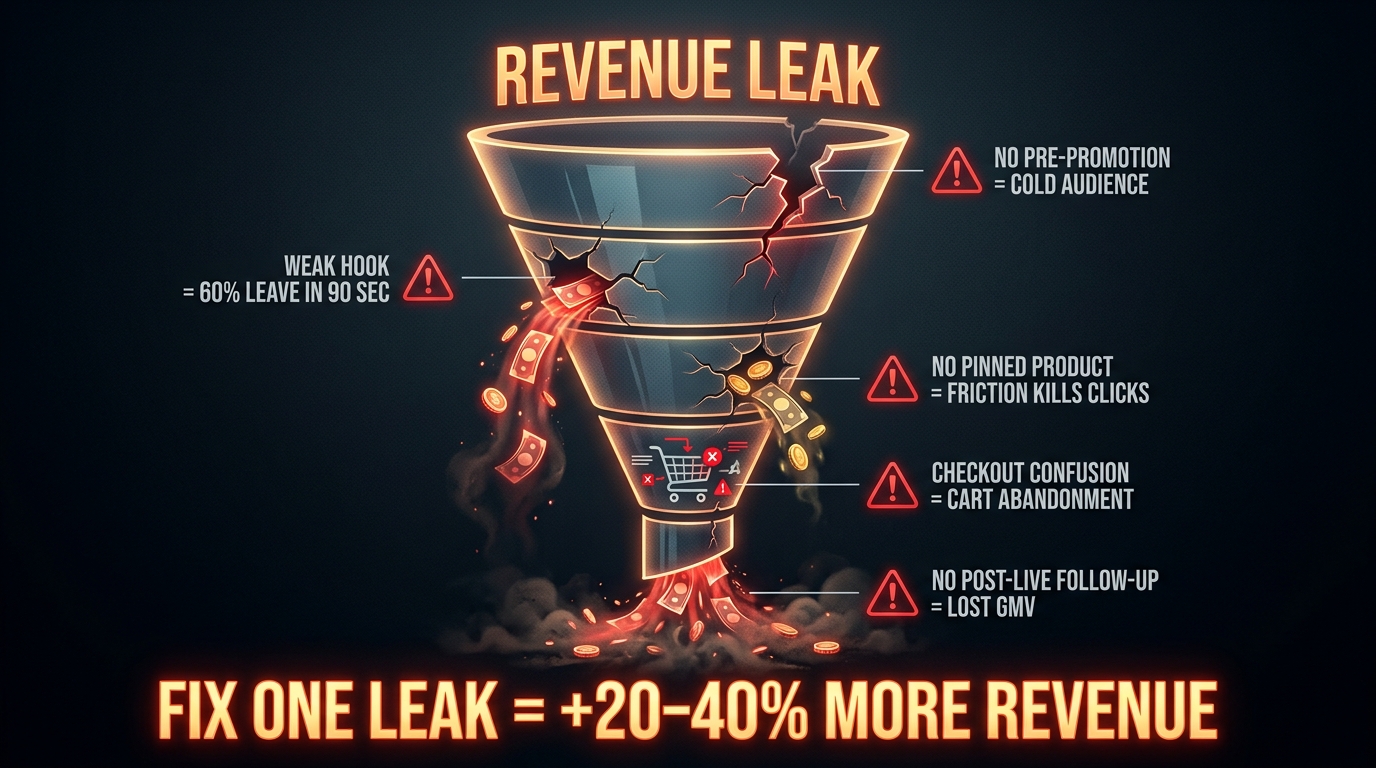
Having mapped the funnel in full, it’s worth being direct about the patterns that recur most consistently among underperforming live rooms. These aren’t obscure edge cases — they’re the same mistakes appearing across brands, categories, and platforms, often simultaneously.
Mistake 1: Treating every live as a standalone event
The single most common structural error in live commerce is treating each live session as a self-contained event rather than a stage in an ongoing relationship with an audience. Brands that think “we did a live last month” are not building a live commerce channel — they’re running live commerce experiments that can’t compound. The platforms that drive the best live commerce outcomes — TikTok Shop’s LIVE algorithm, Amazon’s creator dashboard — explicitly reward consistent streaming schedules with algorithmic preference. One-off streams get one-off results. Recurring streams build an audience, an algorithm relationship, and a data set that improves funnel performance over time.
Mistake 2: Optimizing for views instead of funnel stage transitions
Brands that judge live room performance by peak concurrent viewers are measuring the wrong thing. A stream with 50,000 viewers and 0.5% conversion is worse than a stream with 5,000 viewers and 8% conversion — in revenue, in cost efficiency, and in audience quality. The obsession with viewer count is an inheritance from broadcast media metrics that don’t translate to live commerce economics. Funnel performance — the percentage of viewers transitioning through each stage — is the only metric that maps to actual revenue outcomes.
Mistake 3: Misaligning the host’s expertise with the product category
The host is the funnel’s trust architecture. A host who can’t answer detailed product questions, doesn’t know the competitive landscape, and doesn’t use the product naturally on camera destroys conversion at the Engage stage — the moment when viewers are evaluating whether the person presenting the product is credible enough to influence their purchase decision. This mismatch is especially common when brands assign their cheapest or most available creator to a live room without evaluating whether that creator’s credibility in the category matches the product’s complexity. Trust is not a production value. It’s a conversion driver.
Mistake 4: Presenting too many products
More products per live session does not mean more revenue. It typically means less revenue per product, weaker demonstrations, diluted viewer attention, and a fragmented funnel. The most effective live rooms feature between two and five products — enough for a sequenced offer arc, not so many that each product receives insufficient focus to build the purchase conviction that drives conversion. Every product added beyond five is competing for attention against the others and reducing the depth of engagement any individual product receives.
Mistake 5: Abandoning the funnel at the end of the stream
Ending a live session with “thanks for joining, see you next time” — and then doing nothing with the data, the audience, or the content — is abandoning the funnel at its most productive post-live moment. The 24 hours after a live stream ends represent the highest-intent retargeting window in the entire customer lifecycle for that session’s audience. Brands that fail to activate this window — with Spark Ads, cart recovery sequences, reply clips, or community follow-ups — are consistently leaving the largest proportion of their potential GMV uncaptured.
Building a Live Room Funnel That Gets Better Every Stream
The final, most important concept in live room funnel design is iteration velocity. A single well-executed live session is valuable. A live room funnel that systematically captures learnings, applies them, and improves measurably with each iteration is a compounding revenue asset.
The post-live debrief as a product improvement process
Within 24 hours of every live session, high-performing operators run a structured debrief against the stage-by-stage metrics described earlier. Which stage had the worst transition rate? Where did the watch time curve break? Which product drove the most click spikes? Which host language produced cart additions? These questions, answered from data rather than gut feel, generate specific, testable hypotheses for the next session.
This is the structural difference between brands that run live commerce as a channel and brands that dabble in it. The former have an improvement loop. The latter have a content calendar. The former get progressively better at converting their audience. The latter repeat the same conversion rates — and the same post-stream disappointment — indefinitely.
The 90-day live room maturation curve
Data from established TikTok Shop sellers consistently shows that live room performance improves materially over the first 90 days of consistent streaming, with conversion rates often doubling or tripling from the first stream to the twelfth or fifteenth. This isn’t simply because hosts get more comfortable on camera (though that’s a factor). It’s because the algorithm gets smarter about distributing the stream, the audience self-selects toward higher-intent viewers, the operator gets better at reading and responding to funnel signals in real time, and the post-live retargeting audiences get larger and more precisely segmented.
Live commerce has a compounding structure that rewards persistence and systematic improvement over one-time execution quality. A mediocre stream run by an operator who debriefs, tests, and improves will outperform an excellent stream run by an operator who doesn’t — consistently, and by an increasing margin over time.
Actionable takeaways for your next live session
- Map your funnel before you go live. Define the five stages, assign a target conversion rate to each transition, and know in advance what metric you’ll track as the primary diagnostic for each stage.
- Start your pre-warm seven days before, not the morning of. Build teaser content, schedule push notifications, and give your audience a specific reason to show up — not just a reminder that you’ll be live.
- Write your first 90 seconds in advance and practice it. It’s the most important conversion moment in your entire live session. It should not be improvised.
- Use a four-tier product sequence with an entry hook product, a hero product, a bundle upgrade, and a scarcity close. Don’t present more than five products in a single session.
- Activate your post-live retargeting within two hours of stream end. Launch Spark Ads or equivalent retargeting for live viewers, segmented separately from cart-adders. Don’t wait 24 hours — intent decays fast.
- Run a structured debrief within 24 hours. Pull the stage-by-stage metrics, identify the worst-performing transition, form one specific hypothesis, and test it in the next session.
- Commit to a consistent streaming schedule for 90 days. Algorithm learning, audience development, and operator skill all improve on a curve that rewards consistency. The brands extracting serious revenue from live commerce are the ones who showed up consistently enough for all three to mature.
The live room funnel is not complicated. It is, however, specific. Every stage has a defined input, a defined output, and a defined set of levers that determine the transition rate between them. The brands that understand this — that approach their next live session with a stage-by-stage diagnostic mindset rather than a “let’s see how it goes” broadcast mindset — are the ones who will be on the right side of that 8–12% conversion rate that separates live commerce’s top performers from the rest of the field.
The funnel is already there. Your job is to stop leaking out of it.