


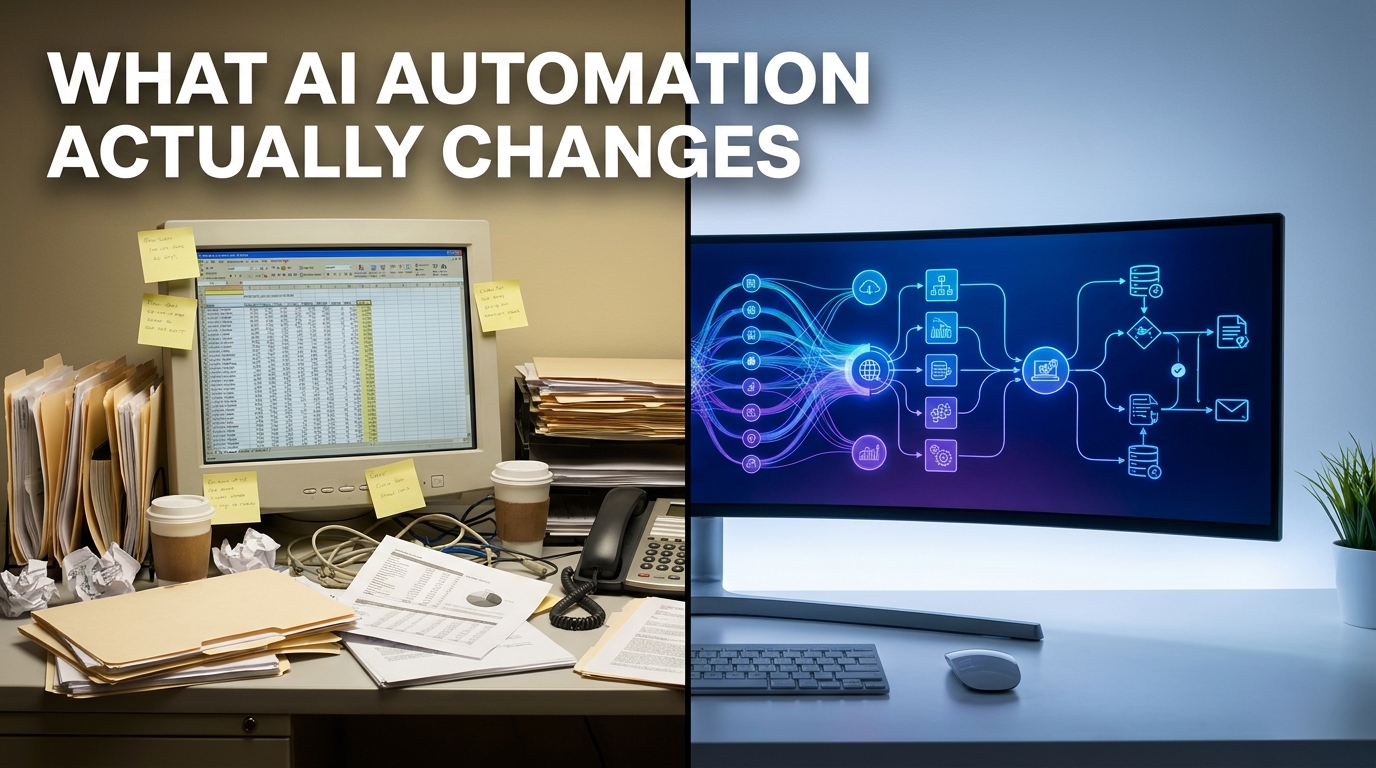

There is a version of the AI automation story that most businesses are telling themselves, and it goes like this: deploy the tools, connect the workflows, watch the productivity numbers climb. It is clean, logical, and almost entirely disconnected from what is actually happening on the ground inside companies that have been doing this for two or three years.
The real story is messier. AI automation is genuinely changing business operations — but not always the parts companies expected, not always in the ways vendors promised, and almost never on the timelines that were budgeted. The businesses pulling ahead are not necessarily the ones that spent the most or moved the fastest. They are the ones that understood what layer of their organisation automation actually touches — and designed accordingly.
This article is not about whether to automate. That question is settled for most businesses in 2026. It is about something more specific: what AI automation actually changes when it lands inside a real organisation, where it reliably delivers, where it consistently breaks down, what the infrastructure investment wave means for the companies buying AI services, and how to build automation that survives contact with real-world complexity rather than collapsing the first time conditions change.
The goal here is a clear-eyed view — not pessimistic, not breathless — of what the evidence actually shows.
What “AI Automation” Actually Means in 2026 — It’s Three Different Things
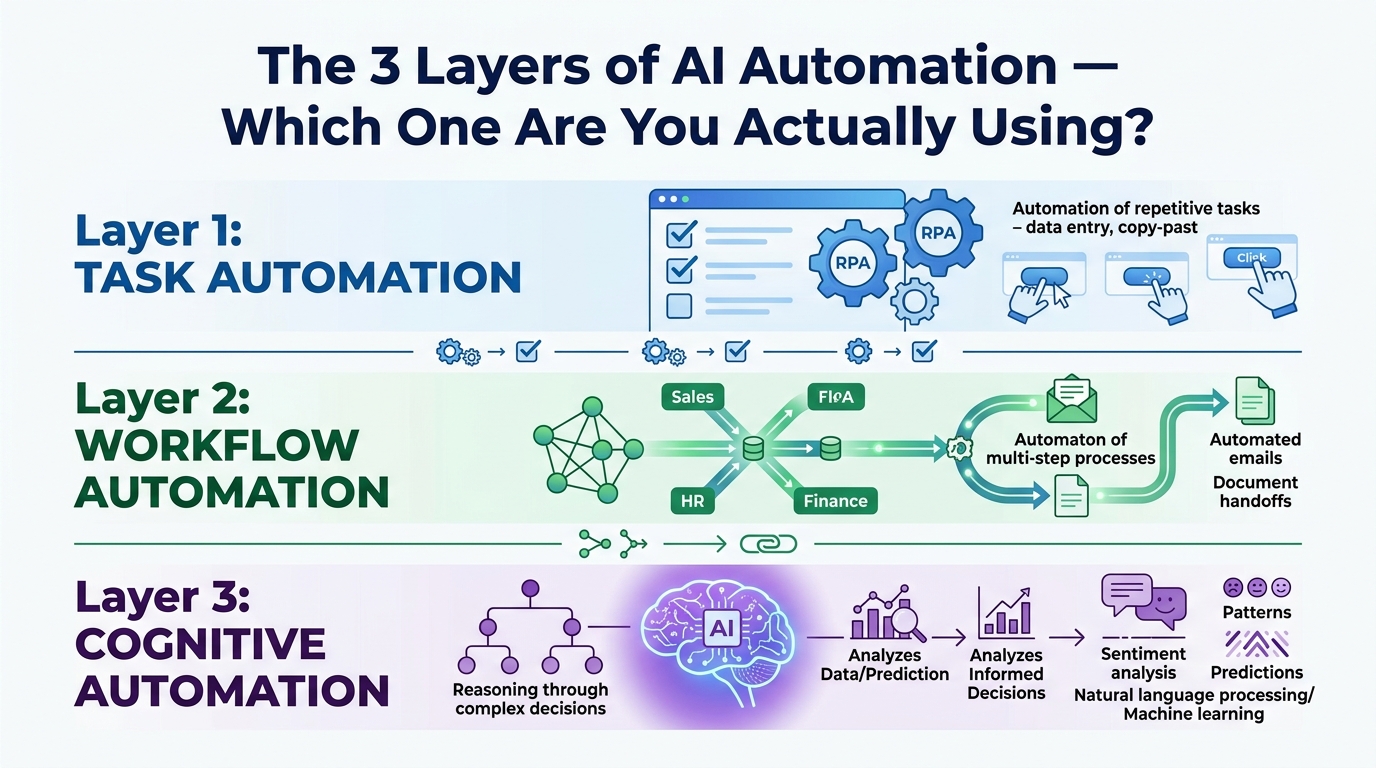
Before any productive conversation about AI automation can happen, the term itself needs to be disaggregated. “AI automation” in 2026 refers to at least three meaningfully different things, and conflating them is one of the most common ways businesses end up with mismatched expectations and disappointing results.
Layer 1: Task Automation
This is the oldest and most mature layer. Task automation covers the replacement of discrete, repeatable human actions — data entry, invoice processing, form completion, report generation from fixed templates, email triage based on predefined rules. The AI component here is often relatively modest: pattern recognition, classification, and extraction. Robotic Process Automation (RPA) platforms like UiPath and Automation Anywhere have been doing this for years, and the addition of LLM-based document understanding has significantly expanded the range of tasks that qualify.
Task automation has a high success rate precisely because the scope is narrow. You are not asking an AI to reason or make decisions — you are asking it to do a specific thing, repeatedly, at scale. When businesses report quick wins from AI automation, this is almost always what they are describing. The ROI is real, it is measurable, and it arrives quickly.
Layer 2: Workflow Automation
The second layer is where complexity starts to enter. Workflow automation connects multiple tasks, systems, and decision points into end-to-end processes. Instead of automating invoice entry alone, you automate the entire accounts payable cycle: ingestion, validation, exception flagging, approval routing, payment scheduling, and reconciliation. The AI has to coordinate across systems, handle branching logic, and manage the handoff points between automated steps.
This is also where most of the serious integration work lives. Workflow automation requires your systems to talk to each other — and in most organisations, they were never designed to. The success rate at this layer is lower, the build time is longer, and the maintenance burden is substantially higher. But the payoff, when it works, is proportionally larger.
Layer 3: Cognitive Automation
The third layer is the one vendors spend the most time selling and the one businesses spend the most time struggling with. Cognitive automation asks AI to handle tasks that require reasoning, context, judgment, and adaptation — things like interpreting an ambiguous customer complaint, making a pricing recommendation based on multiple competing signals, or synthesising information from unstructured sources into a defensible decision.
Modern LLMs are genuinely capable of impressive things at this layer. But cognitive automation has a fundamental challenge that the other two layers do not: failure modes are opaque, edge cases are everywhere, and the cost of getting it wrong is often higher than the cost of having a human do it. Businesses that treat layer-3 automation like layer-1 automation — deploy and move on — are the ones that end up with the horror stories.
Understanding which layer you are actually operating at changes everything: what you build, how you measure it, what governance you need, and how much margin of error you can tolerate.
The Data Layer Problem Nobody Warns You About
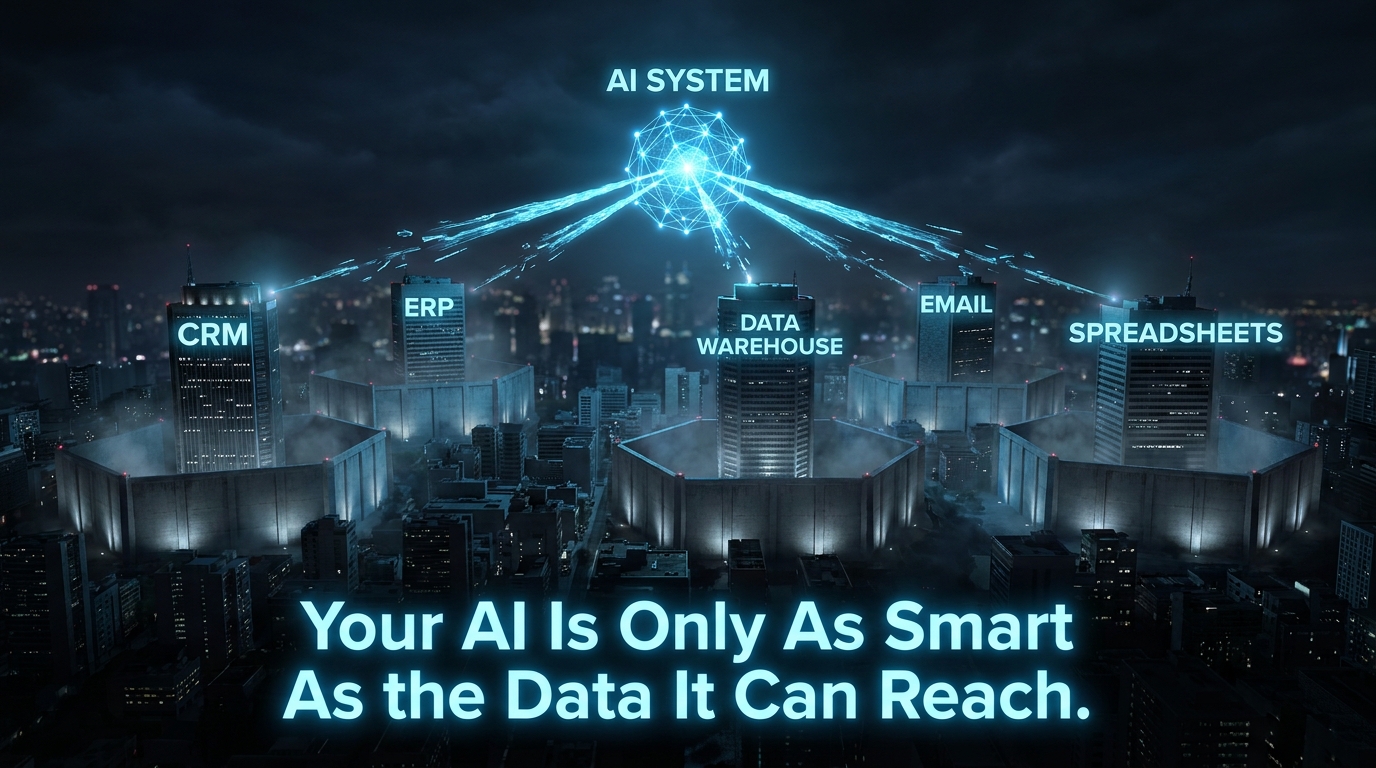
Ask almost any enterprise data engineer what the biggest obstacle to meaningful AI automation is and you will get a version of the same answer: it is not the models. It is the data.
Modern LLMs are extraordinarily capable when given access to clean, complete, relevant information. The problem is that in most organisations, the information an AI would need to do genuinely useful work is scattered across a dozen systems that have never been designed to share data with each other — and in many cases, actively resist it.
The Fragmentation Reality
A typical mid-sized business in 2026 might have its customer data in a CRM, its financial data in an ERP, its project data in a project management tool, its communication data across email and Slack, its product data in a separate PIM, and its operational data in yet another system. Each of these was purchased and configured independently. Each has its own data model, its own access controls, and its own update cadence. Getting an AI system to reason coherently across all of them is not a software problem — it is an organisational and architectural problem that often requires years of foundational work before any AI layer can sit on top of it.
Nitesh Khapekar, writing for O’Reilly Radar in September 2026 after 17 years of building enterprise data platforms, frames the challenge precisely: “I’ve watched every organization eventually ask the same question: ‘Can I ask one question and get one answer across everything my company knows?’ A finance analyst wants actual revenue from the warehouse, pipeline data from the CRM, commentary from planning documents, and market signals from external providers. The information already exists, but it lives across systems that were never designed to reason together.”
Why Centralisation Has Failed as a Solution
The traditional response to data fragmentation was consolidation: build a bigger data warehouse, create a unified semantic layer, pipe everything into one place. This approach has been pursued for decades, and it has produced partial solutions at enormous cost. The problem is structural. The number of possible queries grows exponentially with the number of data sources. You cannot build connectors for every possible cross-system question in advance.
What is actually changing in 2026 is the emergence of intelligent orchestration as an alternative to consolidation. Rather than moving all data to a central store, modern AI architectures are beginning to deploy LLMs as an orchestration layer — one that can dynamically reason across specialised systems, translate natural-language questions into appropriate queries against each source, and synthesise the results. The data stays where it lives; the reasoning layer becomes the interface.
This is a genuinely different approach, and it has real promise. But it also requires careful architecture: security controls at each data source, audit trails for AI-generated queries, fallback mechanisms when a source is unavailable, and governance frameworks that prevent the orchestration layer from making inferences it is not qualified to make.
What This Means in Practice
For businesses considering AI automation, the data readiness question should come before almost everything else. If your customer data is incomplete, inconsistent, or inaccessible, you cannot automate customer-facing workflows effectively regardless of how good the AI model is. If your operational data is locked in systems with no APIs, workflow automation will stall at integration. If your financial data requires manual reconciliation before it can be trusted, cognitive automation on top of it will compound the errors, not eliminate them.
A practical starting point: map the data touchpoints for any process you intend to automate. Identify which systems hold the relevant data, whether APIs exist, how current and accurate the data is, and what access controls apply. That map will tell you more about your automation readiness than any vendor demo.
Where AI Automation Genuinely Delivers — The Functions That Are Already Changed
Despite the caveats above, there are domains where AI automation has delivered durable, measurable results across organisations of different sizes and sectors. These are not edge cases or pilot projects — they represent genuine, repeatable wins that have survived long enough to count as evidence.
Customer Support: The Clearest Win
Customer support was one of the first enterprise functions to see serious AI automation, and it remains one of the most consistent success stories. The mechanics are well understood: a large fraction of customer queries — estimates typically range from 40% to 70% depending on the industry — are high-volume, low-complexity questions that follow predictable patterns. Password resets, order status, return initiation, plan changes, account information. An AI system that can handle these reliably, around the clock, without requiring human involvement, delivers immediate and visible value.
The maturation of this use case in 2026 is in the sophistication of how it is implemented, not the basic concept. The businesses doing this well have moved beyond simple chatbots to multi-turn conversational systems that maintain context, access live data from order management and CRM systems, and escalate gracefully when they reach the edge of their competence. The escalation design — when the AI hands off, what it hands off, and what context it passes to the human agent — is where most of the meaningful product work now lives.
Finance and Accounting: High Readiness, High ROI
Finance and accounting automation has become one of the highest-ROI applications of AI in the enterprise, for a structural reason: financial data tends to be more standardised, more consistently formatted, and more reliably available than data in most other functions. Accounts payable automation, expense processing, bank reconciliation, financial close acceleration, and regulatory reporting are all areas where the combination of improved document understanding and workflow automation has produced genuine, sustained efficiency gains.
The nuance here is that the gains accrue most clearly to transactional finance work. Strategic finance — forecasting, scenario modelling, capital allocation — remains substantially human-led, with AI serving as a tool for analysis rather than a decision-maker. The companies that have tried to fully automate financial strategy have generally found that the cost of errors in those domains far outweighs the efficiency savings.
Sales Development and Outreach
AI automation in sales development — specifically the tasks of prospecting, research, personalisation, and initial outreach — has become standard practice for B2B sales organisations. AI can research a prospect across multiple sources, synthesise relevant context, draft personalised outreach that references specific details about the recipient’s business, and schedule follow-up sequences. What used to take a sales development rep several hours per prospect now takes minutes.
The honest caveat: the automation of outreach at scale has also produced a saturation effect. Because AI-powered outreach is now widespread, buyers are increasingly adept at recognising it — and increasingly unresponsive to it. The differentiated strategy in 2026 is not automating outreach volume, it is using AI to enable more selective outreach that is genuinely relevant, not simply personalised at the surface level.
Content Operations
The production and distribution of content — blog posts, product descriptions, email campaigns, social copy, internal documentation, knowledge base articles — has been substantially accelerated by AI automation in most marketing and communications functions. This is one of the highest-adoption areas, and the productivity gains are real. What has not changed is the need for editorial judgment in determining what content to create, what quality bar it should meet, and whether a particular piece of AI-generated content actually serves the business goal it is meant to serve.
The Protocol Wars Are Over: What MCP and Agent2Agent Mean for Business Automation
One of the most consequential and least-discussed developments in AI automation infrastructure happened at the standards layer in late 2025 and has been accelerating through 2026. It has enormous practical implications for businesses building on AI, even if it sounds obscure.
The Standardisation Moment
In December 2025, Anthropic donated the Model Context Protocol (MCP) to the newly formed Agentic AI Foundation — a directed fund under the Linux Foundation, cofounded by Anthropic, Block, and OpenAI, with participation from Google, Microsoft, AWS, Cloudflare, and Bloomberg. Google had donated its Agent2Agent protocol to the same foundation family six months earlier.
What matters about this is not the technical specifics — it is the competitive signal. Companies that compete aggressively on AI model capability have chosen to cooperate, formally and under neutral governance, on the interfaces between AI systems. Tommy Tran, writing for O’Reilly Radar in September 2026, puts it plainly: “For three years, the agent story has centered on capability. Models got better at planning, tool use, and long tasks. Integration improved more slowly.”
The MCP standardises how an AI application connects to tools and context data. Before MCP, every agent integration required custom glue code — a separate connector for every combination of AI model and data source or tool. The Language Server Protocol analogy is instructive: before LSP, every code editor needed a separate integration for every programming language. LSP replaced that with one interface on each side, and it turned a fragmented ecosystem into a functioning one. MCP is attempting the same thing for AI agents and their integrations.
Why This Matters for Business Buyers
If MCP adoption continues at its current pace — the December 2025 announcement cited more than 97 million monthly SDK downloads and over 10,000 active MCP servers — it changes the economics of enterprise AI automation meaningfully. Today, a significant share of the cost of building automated AI workflows is the integration work: connecting the AI to the data sources and tools it needs. Standardised protocols dramatically reduce that cost, making it possible to build and reuse integrations across different AI systems rather than rebuilding from scratch each time.
Practically, this means businesses should be evaluating AI automation platforms not only on their current feature set but on their compatibility with emerging interoperability standards. A system that is deeply proprietary today may become a stranded asset as the ecosystem standardises around open protocols. Portability matters.
The Agent Knowledge Problem
A related challenge that standardisation is beginning to address is agent memory and context sharing. Today, if you use multiple AI agents — a coding assistant in the morning, a research agent in the afternoon, an operations agent later — each starts from scratch. They have no shared understanding of your business context, your current priorities, or decisions made in previous sessions. Every interaction begins at zero.
Solutions to this are emerging rapidly in 2026 — shared knowledge bases, AGENTS.md files that give multiple agents a common workspace map, persistent context stores that sync across tools. These are still early-stage patterns, but they point toward a near-future where a portfolio of AI agents can operate with coherent shared context rather than as isolated, amnesiac tools.
The Human Handoff Problem — Why Automation Breaks at the Edge of Judgment
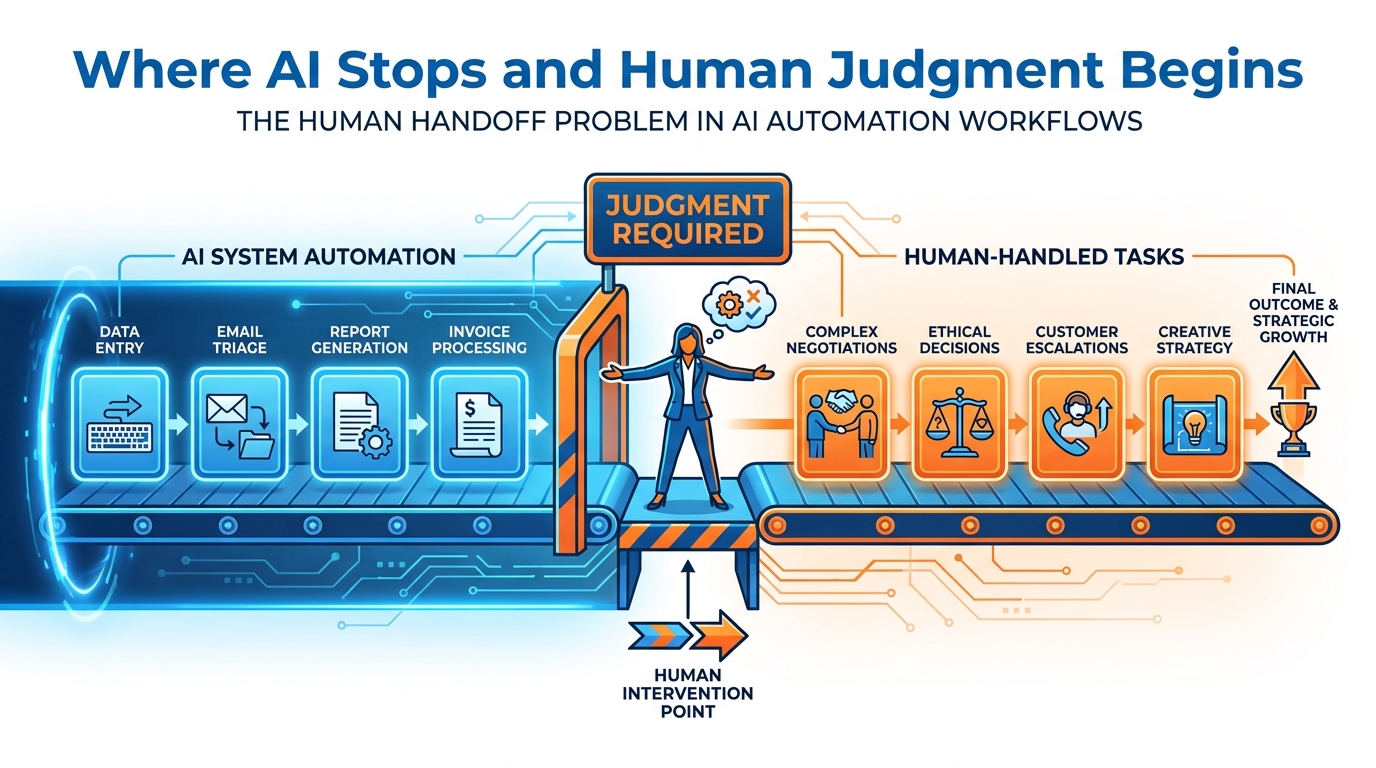
There is a failure mode in AI automation that almost every organisation encounters but few discuss openly. It happens at the boundary between what the AI can handle and what requires human judgment. Call it the handoff problem — and it is responsible for more failed automation projects than any model limitation or data quality issue.
Why Handoffs Fail
Automated workflows tend to be designed for the common case. Engineers and process designers build the system to handle the 80% of scenarios that are predictable, repeatable, and well-understood. The other 20% — the edge cases, the exceptions, the situations that don’t fit the template — are supposed to route to a human. This sounds reasonable. In practice, it goes wrong in several ways.
The handoff is too abrupt. The AI handles a process up to a certain point and then drops it in a human’s lap with no context, no explanation of why the escalation happened, and no information about what has already been done. The human has to start nearly from scratch to understand the situation — which often takes longer than handling the original case would have. The automation has created extra work, not less.
The escalation threshold is wrong. Because most automated systems are designed to be conservative, they escalate too often. A customer support system that routes any query containing the word “complaint” to a human agent is not intelligently automating — it is creating a classification bottleneck. Conversely, systems calibrated to escalate too rarely will push genuinely complex cases through automated handling, producing wrong or damaging outcomes that undermine trust in the entire system.
The human side is not designed to receive handoffs. The biggest oversight in most automation projects is that they focus entirely on the AI’s portion of the workflow and treat the human as a passive recipient. In reality, the human has to be given the right information, at the right time, in the right format, with the right decision authority, and with a clear understanding of what the AI has already done and why it stopped. Designing this side of the handoff is equally complex — and equally important.
What Well-Designed Handoffs Look Like
The organisations that have solved the handoff problem share several design patterns. They create explicit “confidence thresholds” for their AI systems — quantifiable criteria that determine when a task is eligible for fully automated handling versus when it requires human review. They pass structured context packages with every escalation: the full history of the automated steps, the specific reason for escalation, the relevant data the human will need, and a recommended next action. They treat the human’s response to escalations as training signal — using patterns in human decisions to refine the confidence thresholds over time.
Perhaps most importantly, they involve the people who will receive handoffs in the design of the automation. Process designers who build AI workflows without consulting the people on the other side of the escalation are consistently surprised by how those handoffs actually land in practice.
The Judgment Boundary Is Not Fixed
There is a tendency to think of the line between AI-appropriate tasks and human-required tasks as permanent. It is not. As models improve, as more training data accumulates, and as organisations build more context into their systems, tasks that required human judgment 18 months ago can often be safely automated today. The corollary is also true: as business conditions change, regulatory requirements shift, or edge case volumes increase, tasks that seemed safely automatable may need more human oversight. Building mechanisms to monitor and adjust the judgment boundary over time is not optional infrastructure — it is core to any automation that expects to remain effective.
Automation and the Org Chart — How Roles Are Actually Shifting
One of the most fraught conversations in business AI is the one about employment. There is a version of that conversation that is largely political and a version that is useful. The useful version focuses not on macro-level job destruction or creation numbers — which are genuinely uncertain — but on what is happening at the role and function level inside organisations that have deployed serious AI automation.
What Is Actually Disappearing
The roles most directly affected by AI automation are those defined primarily by volume of repeatable cognitive tasks. Data entry roles, certain categories of junior analyst work, basic document processing, first-line customer support for common queries, and template-based content production are all areas where headcount has either been reduced or where organisations have been able to grow revenue without proportionally growing staff. This is real, it is happening, and it would be dishonest to pretend otherwise.
The more nuanced reality is that very few of these roles are being eliminated cleanly. What is more often happening is that the tasks within a role are being redistributed — the automated parts disappear, but the remaining tasks expand in scope. A financial analyst who spent 60% of their time pulling and formatting data now spends that time on interpretation, modelling, and communication. Whether that is experienced as a more interesting job or an unreasonable workload increase depends heavily on how the transition is managed.
What Is Expanding
Certain skill categories are in sustained high demand precisely because of AI automation, not despite it. Prompt engineering and AI system design — the ability to specify what you want an AI system to do with enough precision that it actually does it correctly — has become a legitimate, valued professional capability. Process architecture — the ability to map, redesign, and govern automated workflows — is in similarly high demand. Data governance, AI audit, and model evaluation roles are growing in organisations that are taking responsible automation seriously.
Perhaps more surprisingly, certain interpersonal and communication roles have become more valuable, not less, as AI takes over more of the routine work. The work that requires genuine human relationship — complex sales, senior client management, leadership, creative direction, ethical reasoning — is becoming a larger share of what humans are actually asked to do. Whether the workforce has the skills to fill these roles, and whether businesses are investing in developing them, is a separate and urgent question.
The Middle-Management Stress Point
The organisational layer experiencing the most disorientation from AI automation is middle management — specifically the layer responsible for coordinating and supervising repeatable work. When AI systems can coordinate workflow automatically, generate progress reports without human compilation, and flag exceptions without human monitoring, the traditional coordination functions of middle management become thinner. This does not mean middle management is being eliminated, but it does mean the role is changing faster than most middle managers were trained to handle. The organisations navigating this most effectively are actively redefining what management means in an automated environment — shifting from coordination to coaching, from reporting to contextual judgment.
The Hidden Cost Stack: What Businesses Aren’t Accounting For
The business case for AI automation typically focuses on the savings side of the ledger: labour hours saved, error rates reduced, processing speed improved. What is systematically underaccounted for is the cost side — and not just the obvious costs of software licensing and implementation. There is a full cost stack in enterprise AI automation that most financial models at the proposal stage fail to capture.
Integration and Data Preparation
Integration work — connecting the AI system to the data sources it needs, cleaning and structuring that data, building the APIs and pipelines that keep it current — consistently runs over budget and over schedule. Organisations often discover during implementation that data they assumed was usable is in fact inconsistent, incomplete, or trapped in legacy systems with no straightforward extraction path. The cost to fix this is real and often unplanned. A rule of thumb from practitioners: assume integration and data preparation will cost at least as much as the AI tooling itself, and often more.
Governance and Compliance
In regulated industries — finance, healthcare, insurance, legal services — AI automation triggers compliance obligations that carry their own costs. Documenting model behaviour for audit purposes, maintaining records of AI-generated decisions, establishing human review processes for decisions above certain risk thresholds, and ensuring data processing complies with privacy regulations all require time, tooling, and sometimes external expertise. These costs are not optional and should not be treated as post-launch concerns.
Maintenance and Drift
AI systems that automate real business processes are not static. The business changes, the data changes, the regulatory environment changes, and the AI model itself may be updated by its provider. Automated workflows that were calibrated at launch can drift out of alignment with business reality without any single obvious failure point — they just gradually produce outputs that are less accurate or less relevant. Monitoring for this drift and maintaining systems against it is an ongoing operational cost that is almost never included in the initial business case.
Shadow AI: The Compliance Cost That’s Already Accumulating
Research from Salesforce found that more than half of generative AI adopters at work are using unapproved tools — meaning personal subscriptions to consumer AI products used for work purposes, outside of any organisational governance or data security controls. This is a cost that is already accumulating across most organisations, whether they have acknowledged it or not. The risk is not merely legal or compliance-related. When employees use external AI tools to process business data, that data may be used in training pipelines the organisation has no visibility into or control over. Managing the shadow AI problem requires explicit policy, accessible approved alternatives, and genuine engagement with why employees are reaching for unofficial tools in the first place.
The $1 Trillion Infrastructure Bet and What It Means for Business Buyers
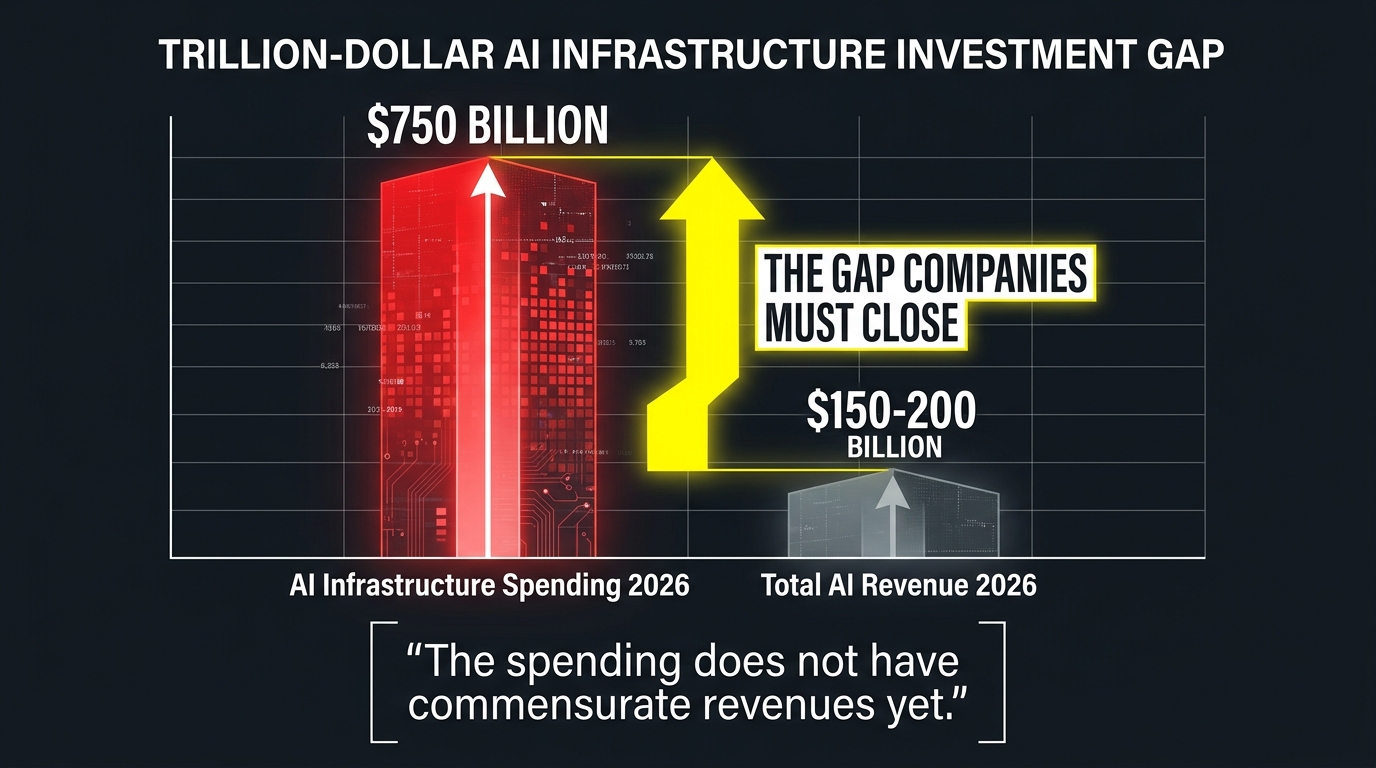
The context for all of this is an investment cycle of extraordinary scale. In 2026, the major AI hyperscalers — Alphabet, Microsoft, Amazon, Meta, and Oracle — are spending approximately $750 billion building AI data centres. Some projections put total AI capital investment from these companies at more than $5 trillion over the next four years. This is one of the largest capital buildouts in industrial history.
The Revenue Gap
The problem, as Gary Gensler — former SEC chair and now an MIT Sloan professor — has stated directly, is that spending is not matched by revenues. Total AI revenues across the industry in 2026 are estimated at around $150 billion to $200 billion. “The challenge is that the spending does not have commensurate revenues yet,” Gensler told MIT Technology Review. “And then the question is, is that an investment that will be paid off in the future?”
University of Pennsylvania finance professor Jessica Wachter has done some of the most rigorous analysis of this question. Working from first principles, she calculated that AI companies will need to increase their own productivity by a factor of 2.7 to break even by 2030, accounting for cost of capital, a 15% return, and depreciation. “That’s a lot of growth compressed into a few years,” she said. If that productivity growth fails to materialise, her research concludes, the current AI buildout risks being, in her words, “the largest misallocation of capital in history.”
What This Means for the Companies Buying AI Services
This does not mean business buyers should stop investing in AI automation. It means they should understand the market dynamics they are operating within. The hyperscalers have invested so heavily in AI infrastructure that they have a powerful incentive to drive adoption — which generally means more aggressive pricing, more capable free tiers, and more sales pressure. This is largely good for buyers in the near term.
The longer-term risk is vendor concentration and platform dependency. If the AI infrastructure market consolidates around a small number of dominant players, the leverage that currently favours buyers will shift. Building automation that is portable — that works with standardised interfaces, that does not embed deeply proprietary dependencies, that could be migrated to a different provider without rebuilding from scratch — is a form of strategic risk management that most businesses are not explicitly thinking about but should be.
The Efficiency Imperative Is Real
The inverse of the hyperscalers’ revenue problem is a pressure on every business buying AI to actually use it in ways that generate measurable returns. The era of AI exploration as a budget line item — spending on pilots, proofs of concept, and exploratory projects without clear commercial accountability — is closing. The businesses that survive the next phase of AI adoption are the ones that connect their AI investments to specific, measurable business outcomes and hold those investments to the same ROI standards as any other capital expenditure.
Building for Durability — What Automation That Lasts Actually Looks Like
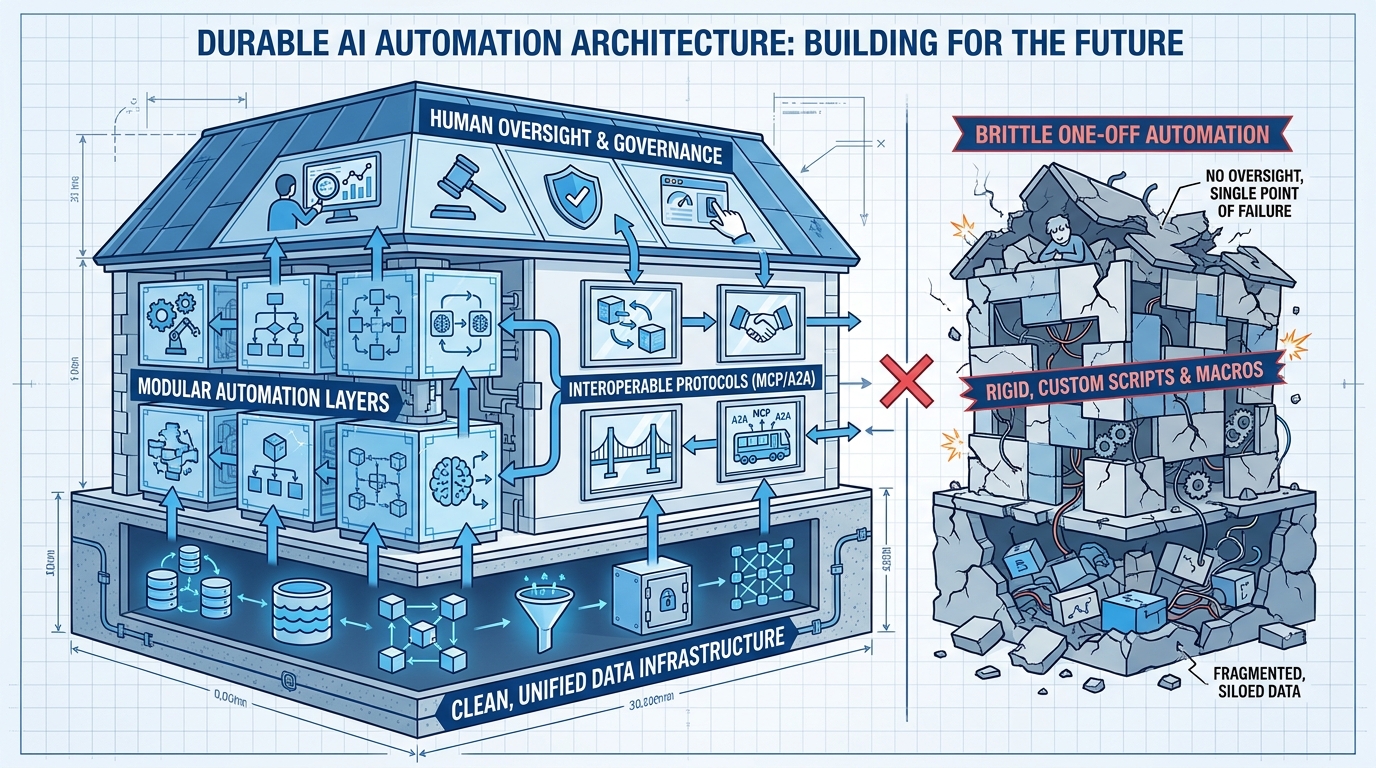
The pattern that distinguishes automation that holds up over two, three, and five years from automation that needs constant repair or eventually gets abandoned is not complexity or sophistication. It is a set of design principles that are easy to state and harder to consistently apply.
Principle 1: Automate the Process, Not the Workaround
Many business processes that get automated are themselves imperfect. They include manual steps, redundant checks, and workarounds that exist because of limitations in older systems. Automating these processes as-is bakes the imperfections into the automated system, making them permanent and harder to see. Before automating a process, it is worth asking whether the process itself is designed correctly for the intended outcome. Redesigning the process before automating it is more work upfront, but it produces automation that does not require the same workarounds as the manual version.
Principle 2: Build Modularity In from the Start
Automation built as a single monolithic workflow is brittle. When one component breaks — and something always does — the whole system breaks with it. Modular automation, where each step is an independent unit with clear inputs and outputs, is far easier to debug, update, and extend. It also ages better: individual modules can be upgraded or replaced as tools improve without requiring a full rebuild of the workflow.
Principle 3: Design Observability Before Deployment
You cannot manage what you cannot see. Automated systems running in production need instrumentation that shows, at a minimum: whether the automation is running; what inputs it is processing; what outputs it is generating; where it is failing or routing to exceptions; and how its performance is trending over time. Organisations that add monitoring after deployment as an afterthought consistently discover problems later and at greater cost than organisations that design observability as a core requirement from day one.
Principle 4: Own the Governance Layer
AI automation governance is not a compliance checkbox — it is an operational capability. It answers questions like: who has authority to change the automation’s behaviour? What is the process for reviewing and approving changes? How are AI-generated decisions documented? What is the escalation path when the automation produces an unexpected or concerning output? Organisations that let these questions answer themselves organically end up with governance that is inconsistent, ad hoc, and inadequate. Organisations that design explicit governance structures in advance have automation that is significantly more trustworthy and easier to defend internally and externally.
Principle 5: Treat Your AI Systems the Way You Treat Your People
The most durable automation programmes share a mindset that is easy to dismiss as rhetorical but has practical consequences: they treat their AI systems as operational capabilities that require ongoing investment, not infrastructure that gets deployed and forgotten. This means regular performance reviews, calibration against updated business requirements, retraining on new data where applicable, and explicit retirement processes for automation that is no longer fit for purpose. Systems that are treated as permanent once deployed become progressively less useful and progressively harder to change.
A Department-by-Department Audit — Where to Start and Where to Wait
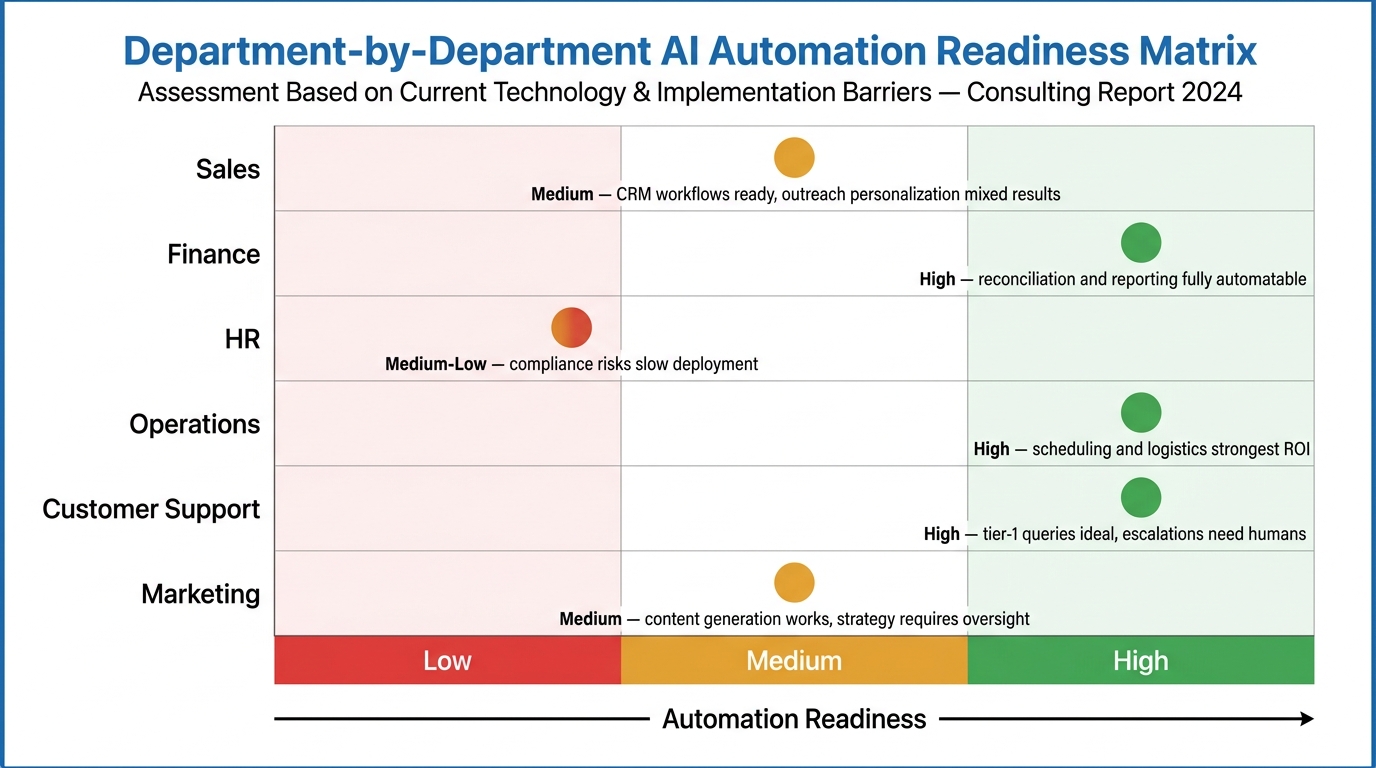
Given all of the above, where should businesses actually be deploying AI automation right now, and where should they be more cautious? The following is a realistic assessment by function, based on evidence rather than vendor claims.
Finance and Accounting — Start Here
Finance has the highest automation readiness of almost any business function. The data is relatively standardised and complete. The processes are well-defined. The outputs are measurable. Accounts payable, expense management, financial close, and regulatory reporting are all high-readiness targets. The caution: automate transactions, not strategy. AI-assisted financial planning tools have value as analysis aids; AI-driven capital allocation decisions without human oversight have a much less consistent track record.
Customer Support — Deploy in Tiers
The tiered approach to customer support automation is now well-established. Tier 1 — common queries, informational requests, simple transactions — is highly automatable with strong ROI. Tier 2 — complaints, complex inquiries, multi-step resolutions — benefits from AI assistance but requires human involvement. Tier 3 — escalations, VIP customers, sensitive situations — should remain predominantly human with AI serving as an information and context tool. Organisations that try to automate tiers 2 and 3 to the same degree as tier 1 consistently damage customer satisfaction scores.
Operations and Supply Chain — Strong Candidate
Scheduling optimisation, demand forecasting, inventory management, logistics coordination, and supplier communication all have strong automation cases in operations and supply chain functions. These domains typically have well-structured data, clear success metrics, and high volumes of repeatable decisions. The AI systems deployed in these functions tend to improve over time as they accumulate operational history. The risk is in over-reliance: supply chain conditions can change rapidly in ways that historical data does not predict, and automated systems need override mechanisms that are easily accessible and routinely tested.
Sales — Selective Deployment
Automating sales development activities — research, prospecting, outreach sequencing — is high-value and relatively low-risk. Automating CRM data entry and activity logging removes a significant administrative burden from salespeople. What is less reliably automatable is the sales conversation itself. AI-assisted selling tools that provide prompts, objection handling suggestions, and deal intelligence to human sellers have shown more consistent results than fully automated selling workflows, particularly for complex, high-value sales.
HR — Proceed Cautiously
HR automation carries a risk profile that is often underestimated. Automated resume screening, candidate ranking, and certain elements of onboarding are established and generally workable. But any automation that feeds into compensation decisions, performance management, promotion, or disciplinary processes requires exceptional care. AI systems in these domains are subject to bias risk, regulatory scrutiny, and — critically — tend to reduce the human judgment and accountability that makes these processes legitimate in the eyes of employees. HR automation should be implemented with legal counsel involved, with transparent documentation of how AI influences outcomes, and with meaningful human review at every decision point that affects an individual’s employment.
Marketing — Execution Yes, Strategy No
AI automation of marketing execution — content creation, distribution scheduling, personalisation, A/B testing, performance reporting — is widely adopted and generally effective. AI-driven decisions about marketing strategy — which audiences to prioritise, what positioning to pursue, what creative direction to take — are substantially less reliable. Marketing strategy requires an understanding of brand, competitive context, cultural moment, and customer psychology that AI systems in 2026 can assist with but cannot own. The organisations doing this best use AI to accelerate execution on strategies defined by humans with genuine market expertise.
The Automation Decisions Most Businesses Are Still Getting Wrong
After surveying the landscape across the dimensions above, some patterns of consistent error are worth naming directly. These are not theoretical risks — they are decisions that businesses make repeatedly, discover are mistakes, and then repeat again in a slightly different form.
Starting with Technology, Not Process
The most common error in AI automation is starting with a technology — a platform, a model, a tool — rather than starting with a process problem. “We’re going to automate with AI” is not a strategy. “We’re going to eliminate the 48-hour delay between contract signature and system provisioning by automating the handoff from our CRM to our provisioning platform” is a strategy. The latter has a clear starting point, a clear success metric, and a clear scope. The former leads to explorations that consume budget without producing outcomes.
Underestimating Change Management
The technical side of AI automation is hard. The human side is often harder. When automated systems change how people work — what tasks they do, what decisions they make, how they are measured — they require active change management: communication about why the change is happening, training on how to work with the new system, and time for genuine adaptation. Organisations that treat change management as a communication exercise at launch, rather than an ongoing programme of support, consistently see slower adoption, more workarounds, and more shadow AI than those that invest in sustained engagement.
Measuring Only the Upside
Automation business cases that track only the projected savings and ignore the costs of exceptions, errors, maintenance, governance, and human oversight are not business cases — they are optimism documents. Rigorous automation measurement includes the full cost of operating the automated system, the cost of exceptions that require human intervention, the cost of errors the automation makes, and the opportunity cost of engineering and operational time devoted to maintaining it. This full-cost view almost always shows positive ROI for well-chosen automation — it just shows a different number than the initial projection.
Conclusion — Building an Automation Strategy That Actually Ages Well
The conversation about AI automation in business has a long way to go before it matches the reality of what is actually happening inside organisations. The vendor narrative is relentlessly optimistic. The sceptic narrative is relentlessly catastrophising. The truth, as usual, is in the operational details — and the operational details reward people who pay attention to them.
The core takeaways from this examination of AI automation in 2026:
- Know which layer you are automating. Task, workflow, and cognitive automation have fundamentally different success rates, cost structures, and governance requirements. Treat them as different disciplines.
- Fix your data before you automate. More automation projects fail because of data access and quality problems than because of model limitations. Map your data landscape before building on top of it.
- Design the handoff as carefully as the automation. The edge where AI stops and human judgment starts is the most critical and most neglected part of any automated system. Design it with as much care as the automated portion.
- Account for the full cost stack. Integration, maintenance, governance, drift monitoring, and shadow AI management are not optional extras — they are the actual cost of operating AI automation in production.
- Watch the protocol layer. Interoperability standards like MCP and Agent2Agent are consolidating fast. Automation built on proprietary interfaces today may be expensive to migrate tomorrow. Portability is a strategic asset.
- Automate the right things for the right reasons. The best candidates for automation are high-volume, well-defined, data-rich processes where errors are recoverable. The worst candidates are low-volume, high-stakes decisions where errors are expensive and trust is fragile.
- Invest in people, not just tools. The organisations winning with AI automation are investing equally in the capability of the humans who work alongside automated systems — and in the change management required to make that work genuinely effective.
AI automation is not a technology problem with a technology solution. It is a business design problem that technology makes possible to solve in new ways. The businesses that understand the difference will be the ones whose automation is still running effectively — and still improving — when the current cycle of AI investment eventually settles into something more sustainable.