

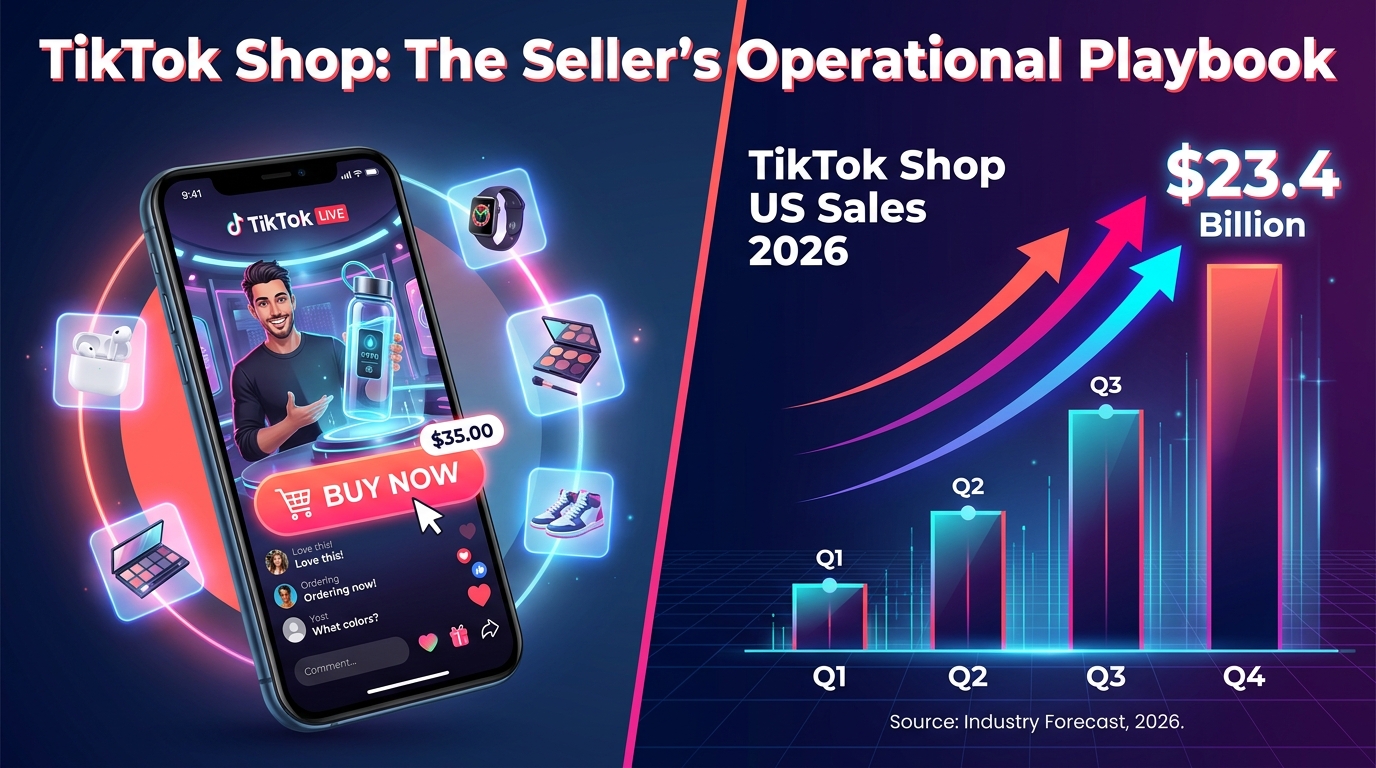

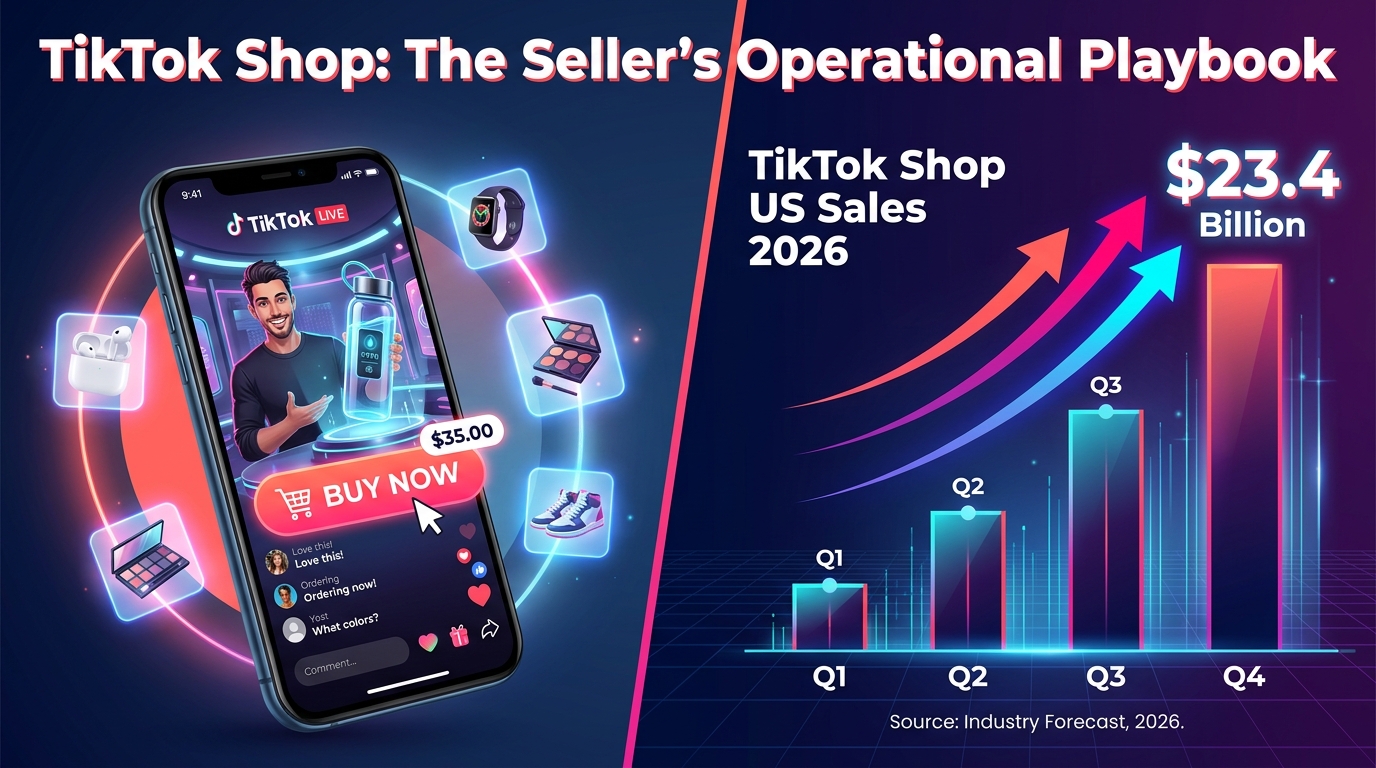
There’s a number that quietly upended a lot of assumptions about where e-commerce is heading: $23.41 billion. That’s TikTok Shop’s projected US gross merchandise value for 2026 — a figure that puts it in the same conversation as Costco and Target, two of the most established retailers on the planet. And it’s being driven almost entirely by a platform that most traditional retail operators still treat as a marketing afterthought.
But here’s the part that doesn’t make the headlines: the majority of sellers on TikTok Shop aren’t capturing a meaningful slice of that number. They’ve set up their accounts, uploaded a few products, maybe run one or two shoppable videos — and then wondered why the sales didn’t materialize. The gap between sellers who are growing quickly on TikTok Shop and those who are stagnant isn’t usually about product quality or price. It’s almost always about operations.
TikTok Shop is not a simpler version of Amazon or Shopify. It runs on entirely different logic. The discovery engine is content-first. The purchase cycle is impulsive and emotion-driven. The fulfillment standards are strict and carry real algorithmic consequences. The affiliate ecosystem requires active relationship management. And the live shopping channel — still massively underused by Western brands — is where some of the highest conversion rates on the entire platform live.
This post is about how the sellers who are growing fast actually operate: the decisions they make on product selection, content, creator partnerships, fulfillment, and account health — and why getting those decisions right, in the right order, is what separates a thriving TikTok Shop from one that quietly collects dust.
Understanding TikTok Shop’s Four Sales Channels — And Why Most Sellers Only Use One
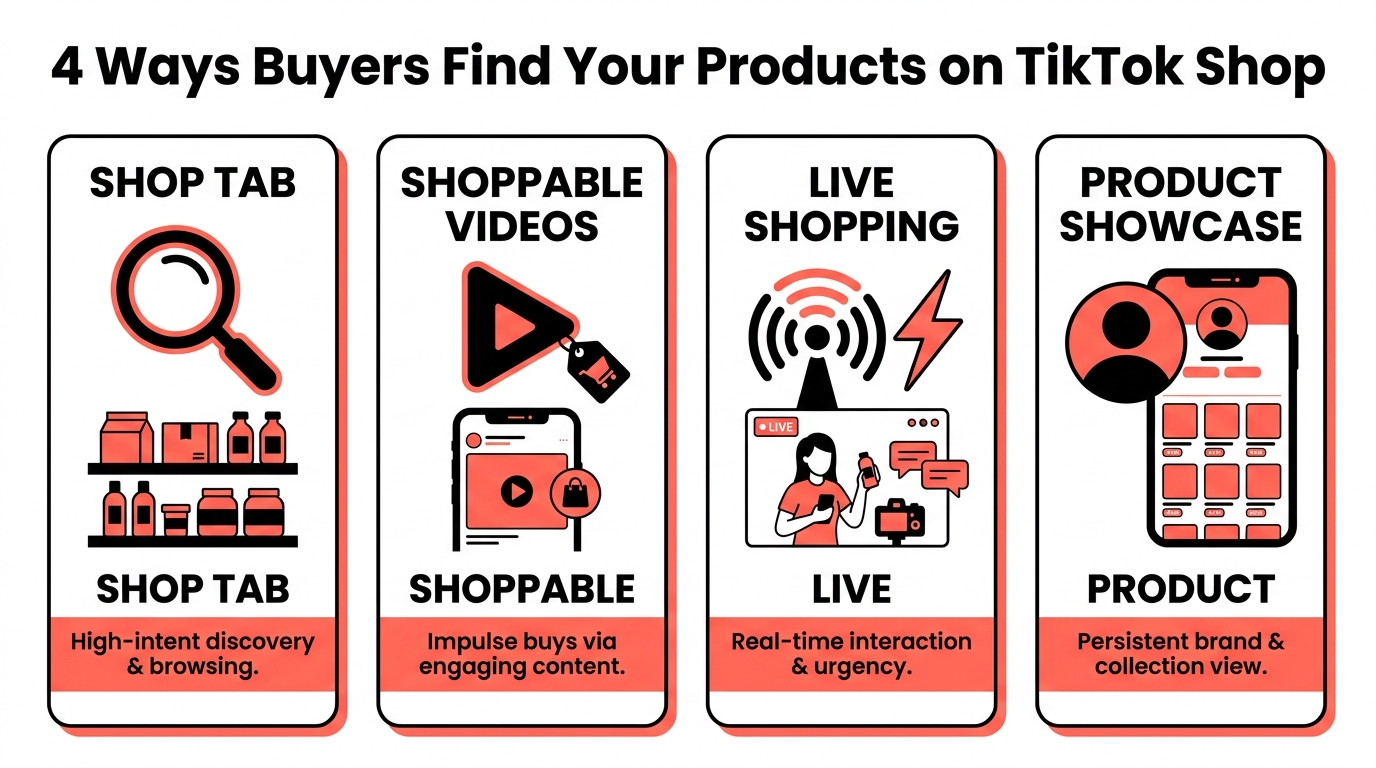
Most sellers who set up a TikTok Shop think of it as a single storefront. They list their products, maybe tag them in a video or two, and wait. What they’re missing is that TikTok Shop is actually four distinct sales channels operating simultaneously — and each one requires a different approach to unlock its full potential.
The Shop Tab
The Shop tab sits at the top of the TikTok app’s navigation and functions like a personalized marketplace. TikTok’s algorithm surfaces products here based on each user’s behavior — what they’ve watched, what they’ve searched, what they’ve purchased before. For sellers, this means your products can appear in front of buyers who have never seen your content and may never follow your account. It’s essentially organic SEO-driven discovery within TikTok’s own ecosystem.
Getting traction in the Shop tab is tied closely to your listing quality, review velocity, and sales history. Sellers with more orders, higher ratings, and well-optimized listings get preferential placement. Think of it as TikTok’s equivalent of the Amazon search results page — with similarly opaque ranking signals, but a much stronger tilt toward recency and engagement data.
Shoppable Videos
Shoppable videos embed product links directly into in-feed content. When a viewer taps the link, an expanded product view opens over the video — they can check specifications, read reviews, and complete a purchase without ever leaving the app. These videos appear both as organic content on a user’s For You Page and as paid TikTok ads.
This is the channel most sellers start with — and often the one they invest in exclusively. That’s a mistake, not because shoppable videos don’t work (they absolutely do), but because treating them as the only channel caps your ceiling significantly.
Live Shopping
Live Shopping is TikTok Shop’s most powerful and most underused channel in Western markets. Sellers or creators broadcast live video while embedding product links that viewers can buy in real time. A 2025 GlobalData survey found that 76% of consumers who used TikTok Shop bought an item from a livestream in the prior year — a statistic that should stop any seller in their tracks.
The conversion dynamics of live shopping are completely different from video or browse-based channels. The combination of real-time demonstration, social proof from other viewers commenting, and time-limited urgency creates a purchase environment unlike anything else in Western e-commerce.
The Product Showcase (Shop Page)
Your shop page — accessible directly from your TikTok profile — functions as a catalog for returning customers and anyone who discovers your brand through content. It’s the equivalent of a brand’s e-commerce homepage, but embedded in social media. This channel matters most for customer retention and repeat purchases, and its performance is directly tied to how well you’ve built a following and brand identity within TikTok.
The key insight here is that sustainable TikTok Shop revenue doesn’t come from going all-in on one channel. It comes from building a flywheel where each channel reinforces the others: shoppable videos drive traffic to your profile and live sessions, live sessions build a loyal customer base that returns via your shop page, and strong sales history lifts your Shop tab rankings so new customers keep discovering you organically.
Product Selection: What Actually Converts on TikTok vs. What Just Goes Viral
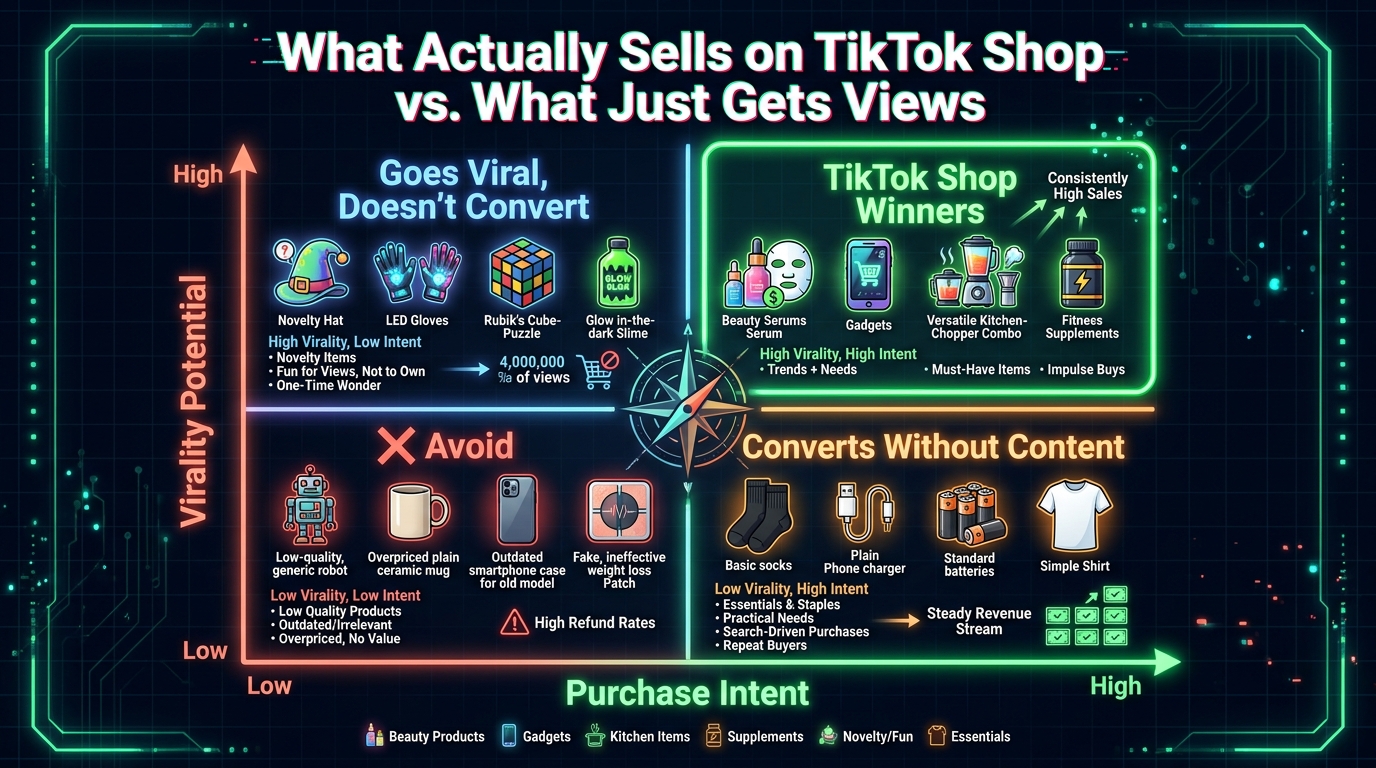
One of the most expensive lessons TikTok Shop sellers learn is that virality and revenue are not the same thing. A product can rack up millions of views and generate almost no sales. Conversely, some of the most consistent revenue-generating TikTok Shop products never go “viral” in the traditional sense — they just keep converting steadily because they fit the platform’s purchase psychology perfectly.
The TikTok Shop Purchase Psychology
Understanding why people buy on TikTok is fundamental to product selection. TikTok purchases are almost always impulse-driven. The user wasn’t searching for a solution when they encountered your product — they were scrolling for entertainment. Your product interrupted that scroll and triggered an “I need that” response before rational deliberation could kick in.
This means the most successful TikTok Shop products share a specific set of characteristics. They have an immediately visible and understandable benefit — you can see what the product does within three seconds of watching someone use it. They solve a problem people recognize instantly (“I’ve been annoyed by that exact thing”). They carry a price point low enough that the purchase decision doesn’t require much thought — typically under $50, though premium products can succeed with the right presentation. And they have strong “wow factor” — some visual element that makes viewers want to share or comment.
Categories That Consistently Outperform
The categories that deliver the best return on TikTok Shop investment in 2026 reflect these psychological dynamics. Beauty and personal care leads the pack — skincare tools, makeup, hair care products, and wellness items dominate because their results are demonstrable and visually compelling on camera. Kitchen gadgets that solve visible cooking problems (unusual peelers, slicers, compact appliances) convert extremely well for the same reason. Clothing and accessories perform strongly, particularly items with a clear aesthetic identity that fits TikTok’s visual culture. Health and fitness items, phone accessories, home organization products, and pet products round out the top-performing categories.
What to Avoid
Products that require complex explanation before the purchase makes sense tend to underperform badly on TikTok Shop. If a viewer needs to understand a technical context before they see the value, they’ll keep scrolling. Commodity products that compete purely on price are another trap — TikTok’s audience is drawn to novelty and storytelling, so a generic USB cable or basic phone case faces brutal competition with no differentiation leverage. High-consideration purchases (furniture, large appliances, complex electronics) also struggle, because the impulse-buy window closes before the viewer can complete their due diligence.
Using TikTok’s Own Data to Validate Products
Before committing inventory to TikTok Shop, smart sellers cross-reference multiple data signals. The TikTok Creative Center’s “Products” section (under the Sellers tab) shows trending items with GMV and unit sales data. Searching your target product category in TikTok with filters for “Most Liked” and “This Week” shows what content is driving engagement right now. And looking at the number of creators already making shoppable videos for a product tells you whether an affiliate ecosystem already exists around it — which dramatically accelerates your own launch.
Setting Up Your Seller Account and Listing Architecture for Maximum Discoverability
Getting approved for TikTok Shop is straightforward — individual sellers in the US need government-issued ID and the last four digits of their Social Security number; corporations need standard business documentation. The application takes up to three business days to review. But account setup and listing architecture are where most sellers make mistakes that cost them weeks of invisible effort.
Listing Quality Fundamentals
TikTok Shop product listings are similar in structure to other e-commerce platforms but have platform-specific requirements. Your primary product image needs to be high-resolution, bright, and show the product clearly against a clean background — TikTok’s algorithm uses image quality signals when determining organic placement. You need at least three to five product images that show the item from multiple angles, ideally including at least one lifestyle image that shows the product in use.
Product titles follow a structure similar to Amazon: primary keyword + key attributes + variant information. Unlike Amazon, however, TikTok Shop titles should be written with readability and emotional resonance in mind, because they display directly under shoppable video content where a human is reading them in context — not just scanning a search results list. Titles up to 255 characters are permitted, but the most effective ones front-load the most important information in the first 80 characters.
Category Selection and Attributes
Accurate category selection is not optional. TikTok Shop’s internal taxonomy determines which audiences your product gets shown to in the Shop tab. Misclassifying a product — even accidentally placing it in a broader category when a more specific subcategory exists — can significantly dampen your organic reach. Spend time drilling down to the most specific applicable category rather than defaulting to the broadest match.
Product attributes (color, size, material, function) should be completed in full. These attributes feed into TikTok’s personalization engine. A user who regularly buys “sustainable materials” products will be more likely to see your item if you’ve tagged that attribute correctly. The more attribute data you provide, the more precisely TikTok can match your product to interested buyers.
Pricing Your Products at Launch
Launch pricing on TikTok Shop follows a specific logic. Because the platform weights new listings heavily in the first 7-14 days (to gather conversion and engagement signals), pricing aggressively at launch — even slightly below your intended long-term price point — can significantly accelerate your early review accumulation and sales history. Many experienced sellers set their launch price 10-15% lower than their target price, run it for two weeks, then raise it once the listing has enough social proof. The algorithm takes that early momentum into account long after the launch window closes.
The TikTok Shop Affiliate Ecosystem: Building a Creator Network That Drives Consistent Revenue
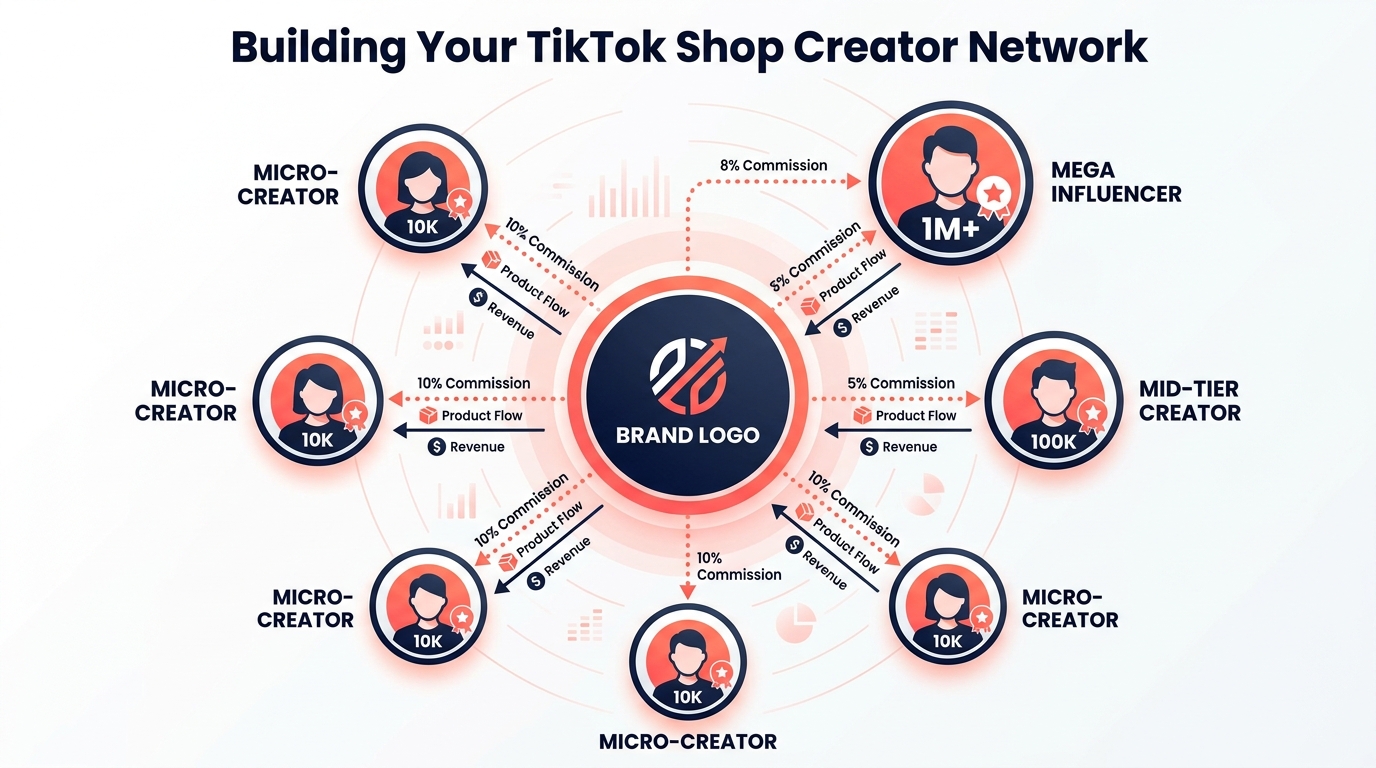
The TikTok Shop Affiliate Program is one of the most powerful growth levers available to sellers — and one of the most systematically under-leveraged. The mechanics are straightforward: creators browse the TikTok Shop marketplace, select products to feature in their content, and earn a commission on every sale generated through their videos or livestreams. Sellers set the commission rate and can either list products in the open marketplace (any creator can apply) or send targeted invitations to specific creators.
What makes this channel genuinely powerful is the economics. You pay nothing upfront. Commission only triggers when a sale is made. A single video from the right creator can drive hundreds or thousands of sales in 24 hours without any paid media spend. And because creators bring their own audiences and creative voices, the content they produce often outperforms anything a brand creates internally — because it doesn’t feel like an ad.
The Three-Tier Creator Stack
Sophisticated TikTok Shop sellers don’t think about creators as a single homogenous group. They build a tiered network that serves different functions simultaneously.
Micro-creators (5,000–50,000 followers) form the base of the stack. They’re easier to recruit, typically accept lower commission rates (5-8%), and often have tightly engaged niche audiences. A beauty product that sends samples to 30 micro-creators in the skincare niche will almost always generate more combined sales than a single mega-influencer post — because the combined reach is comparable but the audience trust is higher. Micro-creators also produce a higher volume of content, which feeds the algorithm more shoppable video signals.
Mid-tier creators (50,000–500,000 followers) drive consistent volume with better production quality. They typically require either higher commission rates (8-12%) or negotiated flat fees for dedicated posts. The best mid-tier creators for your category are worth identifying and building relationships with directly — over time, becoming their preferred brand in a category creates sustainable, recurring promotional content without constant outreach.
Macro and mega-creators (500,000+ followers) can deliver explosive short-term spikes but carry higher cost and lower predictability. They work best for hero product launches or seasonal campaigns where raw reach is the priority. They’re not a reliable recurring revenue driver for most sellers unless you have a formal, ongoing partnership with performance targets.
Commission Rate Strategy
Commission rates on TikTok Shop typically range from 5% to 20% depending on the product category, price point, and creator tier. Beauty and supplements often command higher rates (12-20%) because the products carry strong margins. Lower-margin items like electronics accessories or commodity household products typically sit at 5-8%.
The mistake most sellers make is setting a single flat commission rate for all creators and leaving it there. Competitive sellers use tiered commission structures: a public open-marketplace rate of 5-8%, and a private negotiated rate of 10-15% offered to their top performers. This creates an incentive structure where your best creators earn more, stay loyal, and prioritize your products over competitors.
Product Sampling and Creator Onboarding
The fastest way to activate a creator who’s interested in your product but hasn’t posted yet is to send a sample with zero strings attached. A brief, friendly message explaining the product’s key benefit, a suggested content angle, and a note that they’re free to share their genuine experience removes all friction. Creators who receive unsolicited, prescriptive briefs with heavy brand guidelines and mandatory talking points produce content that their audiences immediately identify as inauthentic — and ignore accordingly.
Shoppable Video Strategy: Making Content That Sells Without Feeling Like an Ad
Shoppable videos are the most accessible entry point for most TikTok Shop sellers — and the most crowded one. Millions of shoppable videos are published every day across the platform. The ones that convert aren’t necessarily the ones with the highest production quality or the biggest following behind them. They’re the ones that understand a specific creative formula that aligns with how TikTok’s algorithm distributes content and how TikTok’s users consume it.
The First Three Seconds Are the Only Seconds That Matter Initially
TikTok’s algorithm makes distribution decisions based heavily on early retention signals. If viewers swipe past your video in the first two seconds, the algorithm shows it to fewer people. If they watch past three seconds, it starts distributing more aggressively. This means the opening of your shoppable video has one job: make it impossible to scroll past.
The most effective hooks for shoppable content fall into a few consistent patterns. Visual disruption — something unexpected or visually striking happens in frame immediately. Problem declaration — the first words identify a specific frustration (“If your kitchen sponge smells after three days, this is why”). Outcome-first framing — you show the result before you show the product (“I lost 15 minutes trying to do this the old way — watch how I do it in 30 seconds now”). Social proof signals — text overlays referencing reviews or sales numbers (“47,000 sold this week”) trigger curiosity and credibility simultaneously.
The Authentic Demonstration Formula
The content format that consistently outperforms on TikTok Shop is the authentic product demonstration. Not a scripted ad. Not a celebrity endorsement. An ordinary person in an ordinary setting, using the product to solve a real problem in real time, with honest commentary about what they like and don’t like.
The structure that works: hook (0-3 seconds), problem setup (3-10 seconds), product introduction (10-15 seconds), demonstration (15-40 seconds), reaction/payoff (40-50 seconds), soft call to action with link mention (50-60 seconds). Sixty-second videos hit a sweet spot on TikTok — long enough to complete a demonstration, short enough to hold attention through to the product link.
Tagging Products Correctly in Videos
Product tags in shoppable videos should be placed precisely at the moment of peak interest — typically when the product’s benefit is most visually apparent. Tags placed too early (before viewers understand what the product does) get fewer taps. Tags that appear during the demonstration phase, when the product is actively in use and clearly delivering its benefit, perform significantly better. Some sellers test two to three different tag placement timings with the same video content and find meaningful variation in click-through rate.
Building a Content Calendar for Consistent Output
Consistency matters on TikTok. The algorithm rewards accounts that post regularly — not just once per week when a viral idea strikes. For TikTok Shop sellers who don’t have a large content team, a sustainable baseline is three to five shoppable videos per week, supplemented by creator-generated content from your affiliate network. Batch filming — shooting multiple videos in a single session, varying the hook and angle but keeping the product demonstration consistent — is how most solo operators maintain volume without burning out.
Live Shopping: The Underused Channel Where the Real Conversions Happen
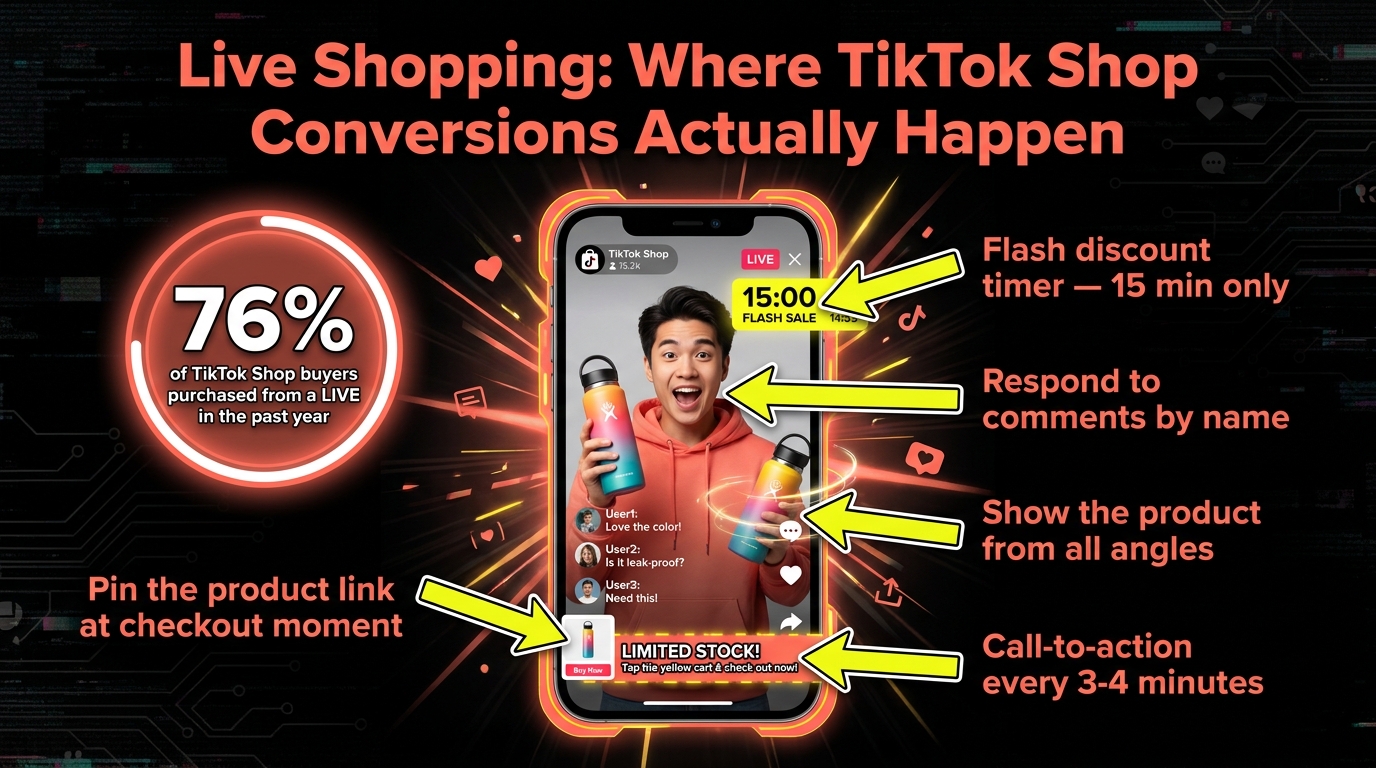
If shoppable videos are TikTok Shop’s bread and butter, live shopping is the secret weapon that most Western sellers haven’t fully picked up yet. In Southeast Asian markets — particularly Indonesia and Thailand — TikTok LIVE commerce has been the dominant revenue channel for years. In the US and UK, adoption is still catching up, which means sellers who move aggressively into live shopping now are operating in a lower-competition environment than they’ll face twelve months from now.
The 76% statistic from GlobalData’s 2025 survey bears repeating: three in four TikTok Shop buyers who used the platform made a purchase from a LIVE stream in the prior year. This isn’t a niche behavior. It’s the primary purchase mechanism for the platform’s most active buyers.
Why Live Shopping Converts So Differently
The conversion psychology of live shopping is fundamentally different from any other e-commerce format. Three factors converge that don’t exist in any other channel simultaneously:
Real-time social proof. When a viewer sees dozens of other people in the comments saying “ordered!” or asking questions about sizing, it creates immediate social validation. Purchases feel endorsed by the crowd, not made in isolation.
Time-compressed urgency. Live flash deals — discounts that expire in 15 minutes or limited-quantity offers available only during the stream — trigger loss aversion. Viewers who might spend three days deliberating over a product page checkout in seconds when they believe the deal disappears when the session ends.
Direct question resolution. The biggest friction point in any e-commerce purchase is unanswered questions. In a LIVE session, the host answers questions in real time. “Does this come in XL?” — answered immediately. “Is it easy to clean?” — demonstrated on screen in 30 seconds. Every question answered is a purchase barrier eliminated.
Running Your First TikTok LIVE Shopping Session
Starting with live shopping doesn’t require expensive equipment or professional hosting skills. A smartphone with a stable internet connection, good lighting (a basic ring light is sufficient), and a clean background showing your product space is enough to run a functional first session. What matters more than production quality is the host’s ability to stay engaged, knowledgeable, and responsive throughout the stream.
Preparation before the session is where the real work happens. Pin your two to three featured products before going live so they appear immediately when the session starts. Prepare a rough session arc: opening hook (who you are and what you’re selling today), lead product demonstration, viewer Q&A, flash deal announcement, secondary product demonstration, and close with a reason to return next time. Plan for a minimum 45-minute session — LIVE sessions shorter than 30 minutes rarely build the momentum needed for meaningful conversion volume.
Session Length and Scheduling
Successful TikTok Shop LIVE sellers typically run sessions of one to three hours, with peak traffic periods varying by market. In the US, early evening sessions (7-10pm local time) consistently draw higher viewership. Weekend afternoon sessions also outperform weekday mornings. Analyzing your TikTok analytics for when your existing followers are most active gives you a starting baseline, but expect to test different time slots for several weeks before finding your audience’s sweet spot.
Frequency matters as much as session quality. Sellers who run LIVE sessions three to five times per week build loyal viewer bases who return regularly, knowing when to expect the next session. Sporadic, once-a-month lives feel like events — which sounds good, but the reality is that irregular sessions don’t build the habitual viewing behavior that drives predictable recurring revenue.
Seller Scorecard and Account Health: The Back-End Metrics That Make or Break Your Shop
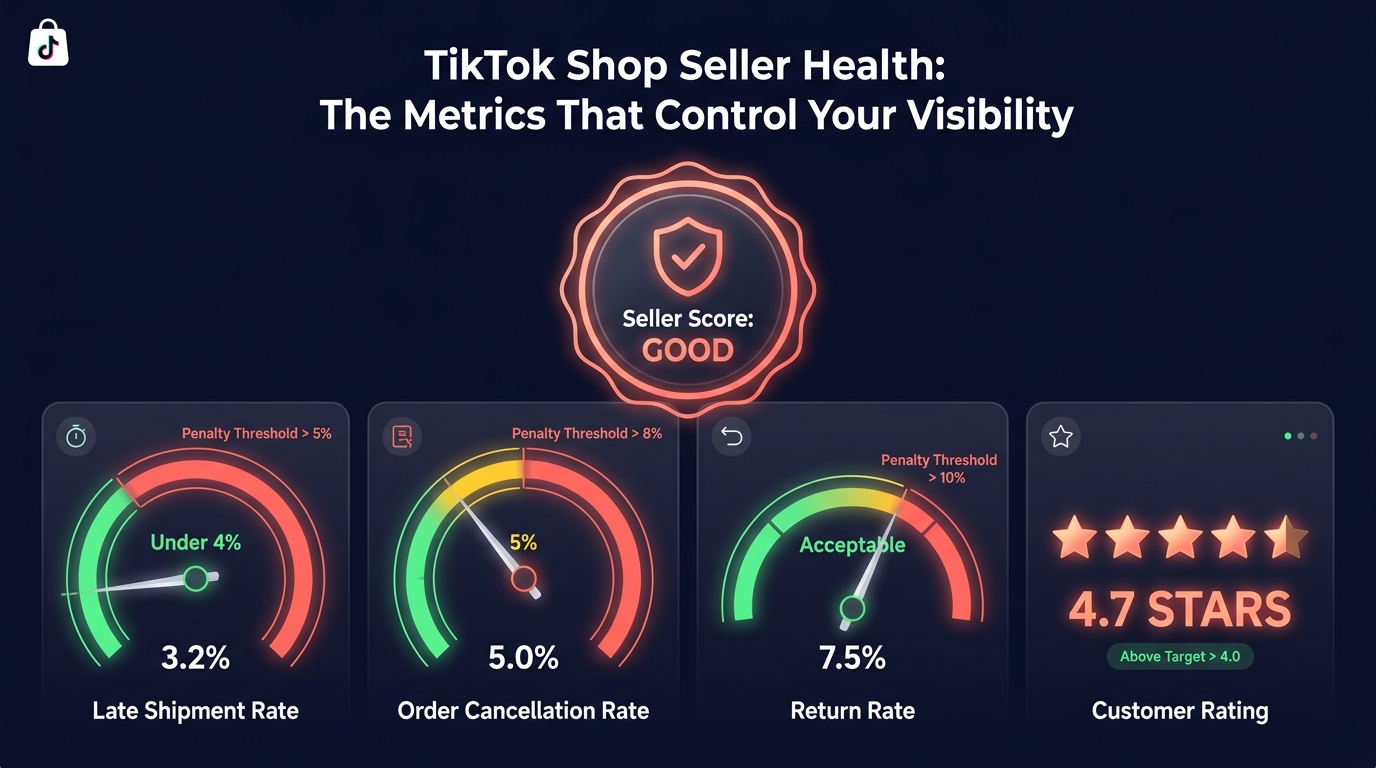
TikTok Shop runs a seller scoring system that most new merchants don’t pay close enough attention to until it’s already hurting their performance. The platform tracks a range of operational metrics and uses them to determine how much organic visibility your listings receive, whether you qualify for promotional campaigns, and in serious cases, whether your account can continue operating at all. Think of it as TikTok’s version of Amazon’s Seller Performance — equally consequential, but with its own specific thresholds and penalty structures.
The Core Metrics That Matter
The seller health metrics that carry the most weight in TikTok Shop’s system fall into four categories:
Late Shipment Rate (LSR). This measures what percentage of your orders are shipped after the stated handling time. TikTok expects sellers to ship orders within their stated handling window — typically 24 or 48 hours. An LSR above the platform threshold triggers warnings and can suppress your listings in organic search and Shop tab recommendations. Sellers who consistently meet their shipping commitments receive preferential placement signals from the algorithm.
Order Cancellation Rate. Sellers who cancel orders at high rates — because of inventory errors, pricing mistakes, or stock-out issues — accumulate negative scoring. This matters particularly for new sellers, who may not have fully reconciled their TikTok Shop inventory with their other sales channels.
Return and Refund Rate. High return rates signal product quality or listing accuracy issues. If buyers are regularly returning items because they didn’t match the listing description, TikTok Shop takes that as a signal of poor seller behavior, not just product performance. This creates a strong incentive for accurate, realistic product listings — overpromising leads to returns, which leads to algorithmic suppression.
Customer Rating. Your average star rating directly influences your Shop tab visibility. Products with fewer than 4.0 stars see meaningful drops in recommended placement. Encouraging genuine reviews through post-purchase packaging inserts, follow-up messaging (within TikTok’s allowed communication channels), and simply delivering an excellent product experience is the only sustainable path to maintaining a strong rating.
How Account Health Connects to Content Reach
Here’s the piece most sellers miss: TikTok Shop’s algorithm doesn’t just suppress your listings when your account health dips. It can also reduce the organic distribution of your shoppable videos. A seller with poor operational metrics will find that their content reaches fewer people, even if the video itself is excellent. The platform treats operational reliability as a proxy for overall seller quality — buyers who have bad delivery experiences lose trust in TikTok Shop as a whole, not just in the individual seller.
This creates a compounding dynamic in both directions. Sellers with strong account health scores get more organic distribution, which leads to more sales, which builds more review velocity, which further improves their placement — a genuine positive feedback loop. Sellers who let their metrics slip find themselves in the opposite spiral: suppressed listings, fewer sales, fewer reviews, increasing difficulty recovering organic reach.
Monitoring and Staying Ahead of Threshold Violations
TikTok Seller Center provides a dedicated account health dashboard. Checking it at minimum weekly — and ideally daily during high-volume periods or new product launches — is essential. Setting up automated alerts for order processing deadlines is one of the simplest operational habits that prevents LSR issues. And ensuring your inventory counts in TikTok Shop are always accurate (not relying on mental estimates) prevents the cancellation rate problems that catch many multi-channel sellers off guard.
Fulfilled by TikTok vs. Self-Fulfillment: Choosing the Model That Fits Your Operation
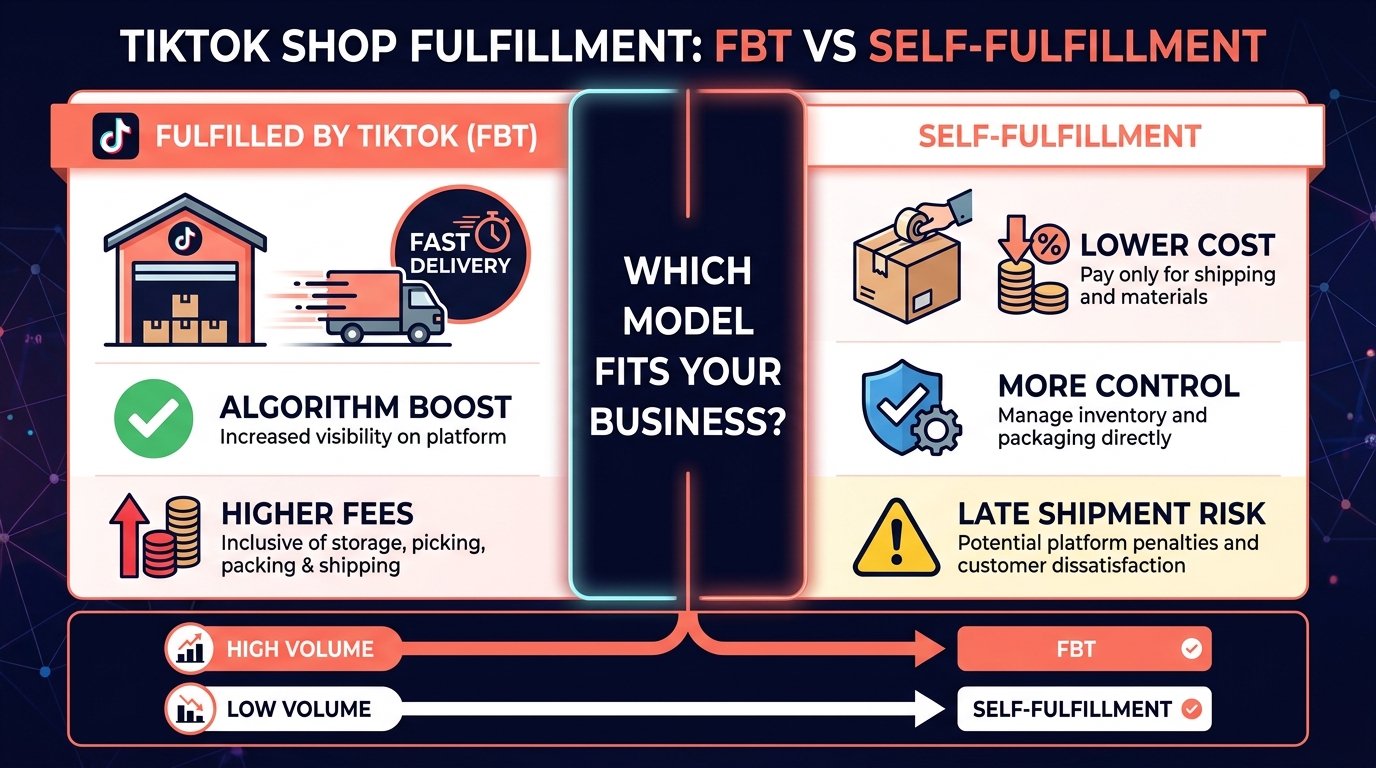
One of the most consequential structural decisions a TikTok Shop seller makes is their fulfillment model. TikTok Shop offers two primary options: Fulfilled by TikTok (FBT), where inventory is stored at TikTok’s partner logistics warehouses (including ShipBob in the US market) and orders are picked, packed, and shipped by the fulfillment partner; and seller-fulfilled shipping, where the seller manages the entire post-purchase logistics chain themselves.
How Fulfilled by TikTok Works
FBT operates as a fully outsourced logistics solution. Sellers ship inventory to TikTok’s designated warehouse partners, which handle storage, order picking, packing, and last-mile delivery. In the US, TikTok has partnered with fulfillment providers like ShipBob to power this infrastructure. The program is designed to remove logistics complexity from the seller’s plate entirely — similar to Amazon FBA in its operational concept, though at an earlier stage of maturity.
The most significant benefit of FBT beyond operational convenience is algorithmic. TikTok Shop’s platform gives preference in placement and promotional eligibility to FBT listings, because the platform can guarantee delivery speed and reliability standards. Listings that display a “TikTok Fulfilled” badge have been reported by sellers to receive higher click-through rates from buyers who associate the badge with reliable shipping — just as Prime eligibility influences buyer behavior on Amazon.
The Case for Self-Fulfillment
Self-fulfillment isn’t simply the fallback option for sellers who haven’t qualified for FBT. For many sellers, it’s the strategically correct choice — at least initially. If you’re selling a small product catalog with low order volume, the cost economics of FBT (including inbound shipping to warehouses, storage fees, and fulfillment fees per unit) may not pencil out favorably compared to managing shipping yourself or through an existing 3PL relationship.
Self-fulfillment also offers flexibility that FBT cannot. Custom packaging, inserts, thank-you cards, and branded unboxing experiences are typically not available through TikTok’s fulfillment partners. For brands where the unboxing experience is a genuine differentiator and content opportunity (and on TikTok, an unboxing video is always a content opportunity), maintaining control over packaging can be worth the added operational burden.
Making the Right Choice for Your Business Stage
A practical framework for deciding between FBT and self-fulfillment: if you’re processing more than 50 orders per day, if your team’s time spent on packing and shipping is meaningfully limiting your content and growth activities, or if your late shipment rate is creeping up because of fulfillment capacity constraints, FBT is worth the cost premium. If you’re under 50 orders per day, have an existing 3PL partnership with favorable rates, or are selling high-margin products where the custom packaging experience supports premium positioning, self-fulfillment is likely the better choice for now.
Many successful TikTok Shop sellers run a hybrid model: FBT for their hero products (highest volume, most price-sensitive, most time-critical for customer expectations) and self-fulfillment for lower-volume or high-margin items where customization matters more than speed optimization.
Pricing, Promotions, and Flash Sales: Working With TikTok Shop’s Deal-Driven Culture
TikTok Shop operates in a fundamentally deal-hungry environment. The Shop tab prominently features discounts and promotions. LIVE sessions are built around flash deals that expire during the broadcast. The platform regularly runs platform-wide sale events (similar to Amazon Prime Day or Black Friday events) where sellers who participate receive additional promotional placement in exchange for discounted pricing. Understanding how to participate in this deal culture without destroying your margins requires deliberate pricing architecture from the start.
Building Deal Room Into Your Pricing from Day One
The most common pricing mistake TikTok Shop sellers make is launching at their target margin price and then discovering they can’t participate in promotions without selling at a loss. Effective TikTok Shop sellers price with promotions in mind: they set their standard retail price with enough margin to offer 15-25% discounts during sale events and still operate profitably. This isn’t about inflating prices artificially — it’s about recognizing that promotional pricing is a standard cost of doing business on the platform, not an exception.
Platform Promotional Events
TikTok Shop runs a structured calendar of promotional events throughout the year — monthly deal days, seasonal campaigns (major US shopping holidays, back-to-school, Valentine’s Day, etc.), and periodic platform-wide sale events. Sellers who apply to participate in these events and qualify receive significantly elevated placement in the Shop tab and dedicated promotion in TikTok’s marketing materials for the event. The participation price is offering meaningful discounts during the event window — typically 20-30% off regular retail price.
Applying for these events early matters. TikTok typically opens applications several weeks before the event, and spots — particularly for featured product placement within the event page — are limited and competitive. Sellers with strong account health metrics and good review histories have a significant advantage in the selection process.
LIVE Flash Deal Architecture
Within your own LIVE sessions, the timing and structure of flash deals has a measurable impact on conversion rate. The standard approach that works: announce at the start of the session that a flash deal is coming at a specific time (“At the 30-minute mark, we’re doing a deal that’s live-exclusive”). This gives viewers a reason to stay engaged for the duration. When the deal goes live, set a visible countdown timer in your streaming setup, and create audible and visual urgency (“We have 40 units at this price — when they’re gone, they’re gone”). The combination of scarcity and time pressure converts viewers who are on the fence about a purchase into buyers before the window closes.
Scaling Across TikTok Shop Markets: US, UK, and Southeast Asia
TikTok Shop operates across eight markets as of 2026 — the US, UK, Indonesia, Malaysia, Thailand, Vietnam, the Philippines, and Singapore — and each market has distinct characteristics that affect seller strategy. Sellers who treat TikTok Shop as a single homogenous global marketplace and apply the same strategy across all markets typically underperform in every market they’re in.
The US Market: High Value, Earlier Stage
The US TikTok Shop market is the largest single-market opportunity on the platform, with the $23.41 billion 2026 projection reflecting its trajectory. But it’s also a market that is still maturing. Live shopping adoption is growing but not yet at the saturation levels seen in Southeast Asia. The affiliate creator ecosystem is robust but increasingly competitive. The biggest opportunity in the US right now is for sellers who establish strong affiliate networks and consistent LIVE schedules before the channel becomes as crowded as shoppable videos.
The UK Market: Similar Demographics, Different Regulatory Context
The UK was one of TikTok Shop’s first major Western markets, launching there before the US expansion. The UK buyer base shares many behavioral characteristics with US buyers — impulse-driven, social proof-sensitive, deal-hungry — but operates under stricter advertising standards that affect how products can be marketed. Sellers expanding to the UK need to review product claim standards (particularly for health, beauty, and wellness items) to ensure their content complies with Advertising Standards Authority guidelines, which are enforced differently than US FTC rules.
Southeast Asian Markets: The Proof of Concept
Indonesia, Thailand, Malaysia, and the Philippines are where TikTok Shop’s business model has been proven at scale. Live shopping is the dominant commerce format in these markets — not an emerging channel. Sellers entering Southeast Asia need to understand that the expectations around LIVE commerce are far more sophisticated than in Western markets: longer sessions (often four to six hours), higher frequency (daily or near-daily), and audiences who are highly experienced at live shopping and expect real-time demonstrations and interactions at a higher level of production quality than Western sellers typically start with.
The business case for multi-market expansion on TikTok Shop is compelling for sellers whose products translate across markets. The affiliate infrastructure, seller tools, and fulfillment partnerships differ by market but share the same underlying platform mechanics. A seller who has mastered the content and creator playbook in one market can apply those learnings with modifications in new markets faster than they initially built them.
What Durable TikTok Shop Businesses Actually Look Like in 2026
The sellers who are building TikTok Shop businesses that hold up over months and years — not just the ones who catch a viral moment and fade — share a set of operational characteristics that distinguish them from the flash-in-the-pan accounts that dominate “I made $X in Y days” content.
They Think in Systems, Not Spikes
A TikTok Shop business built on one viral video or one successful LIVE session is fragile. Durable sellers build systems: a consistent content production workflow, an active and growing creator network, a disciplined account health monitoring routine, and a promotional calendar planned at least 60-90 days ahead. The viral moments happen as a by-product of these systems — not as the strategy itself.
They Treat Customer Reviews as Infrastructure
Reviews on TikTok Shop compound over time. A product with 500 genuine 4.5-star reviews performs dramatically better in Shop tab placement than an identical product with 20 reviews. Sellers who prioritize review accumulation from their earliest sales — by delivering consistently on their listings’ promises, responding to negative reviews professionally and constructively, and making it easy for satisfied customers to leave feedback — build a competitive moat that becomes harder for new entrants to replicate over time.
They Diversify Across All Four Channels
The most resilient TikTok Shop sellers aren’t dependent on any single discovery or conversion channel. They have active shoppable video content feeding the For You Page. They run regular LIVE sessions for their most engaged buyers. Their Shop tab placement is strong enough to drive organic browse-based discovery. And their profile shop page converts returning visitors. When any one channel underperforms in a given week — because of algorithmic shifts, content variance, or platform changes — the others carry the load.
They Invest in the Affiliate Relationship, Not Just the Commission Structure
The difference between a TikTok Shop seller with 200 creators posting sporadically about their products and one with 20 creators consistently producing high-quality content is almost always relationship quality. The sellers who get the best creator output are the ones who communicate clearly, pay promptly, offer exclusive deals and early access to new products, and treat creators as genuine business partners rather than a promotional distribution mechanism. On a platform where creator authenticity is the primary currency, the brands that earn genuine enthusiasm from their creator partners generate content that no amount of commission structure engineering can replicate.
Practical Takeaways: Building Your TikTok Shop Operating Rhythm
Everything in this post is more useful as a system than as a checklist. The sellers who implement one or two tactics in isolation and wonder why they’re not seeing results are missing the point. TikTok Shop rewards the compounding effect of doing multiple things consistently well over time. Here’s how to frame your operating rhythm across the key dimensions:
Weekly minimums: Three to five shoppable videos published (mix of your own and creator-generated content), one to three LIVE sessions completed, account health dashboard reviewed, at least five new creator outreach messages sent, all orders shipped within your stated handling time.
Monthly priorities: Audit your top five listings for image quality, title optimization, and attribute completeness. Review your creator network performance — double commission rates for your top three performers, remove inactive creators from the roster, recruit 10-20 new micro-creators. Apply for any upcoming platform promotional events. Review your pricing relative to competitor listings in your categories.
Quarterly decisions: Evaluate your fulfillment model against your current order volume. Assess whether your current product catalog is performing across all four channels or whether you’re over-indexed on one. Plan your promotional calendar for the next quarter, including platform events and your own LIVE deals structure. Review your account health trajectory and identify any metrics that are trending in the wrong direction before they cross threshold levels.
TikTok Shop is genuinely one of the most significant shifts in e-commerce infrastructure that sellers have seen in years. The platform is growing faster than any comparable channel, its buyer behavior is unique and learnable, and the operational complexity — while real — is manageable for sellers who approach it systematically. The window where serious sellers can establish a durable position before competition intensifies is narrower than it was twelve months ago. But it’s still very much open.
The sellers who will own TikTok Shop’s next growth phase are the ones building operational muscle now: consistent content, active creator networks, clean account health, disciplined fulfillment, and a deep understanding of all four channels. That’s not a glamorous formula. But it’s the one that works.