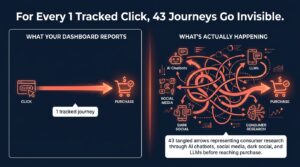



For most of the last decade, selling on Amazon came down to two ways of getting seen. You earned organic rank through sales velocity, reviews, and relevance. Or you paid for placement in the ad auction. Every dashboard, every agency report, and most seller strategy decks grew up around those two numbers.
In 2026 that picture has a hole in it. When shoppers ask Amazon’s AI assistant for a recommendation instead of typing a keyword, the products that come back often aren’t the ones sitting at the top of the search page. One large study of Amazon’s assistant found that nearly two-thirds of its picks came from outside the organic top 10 for the matching search term. Four in ten never showed up on the visible results page at all.
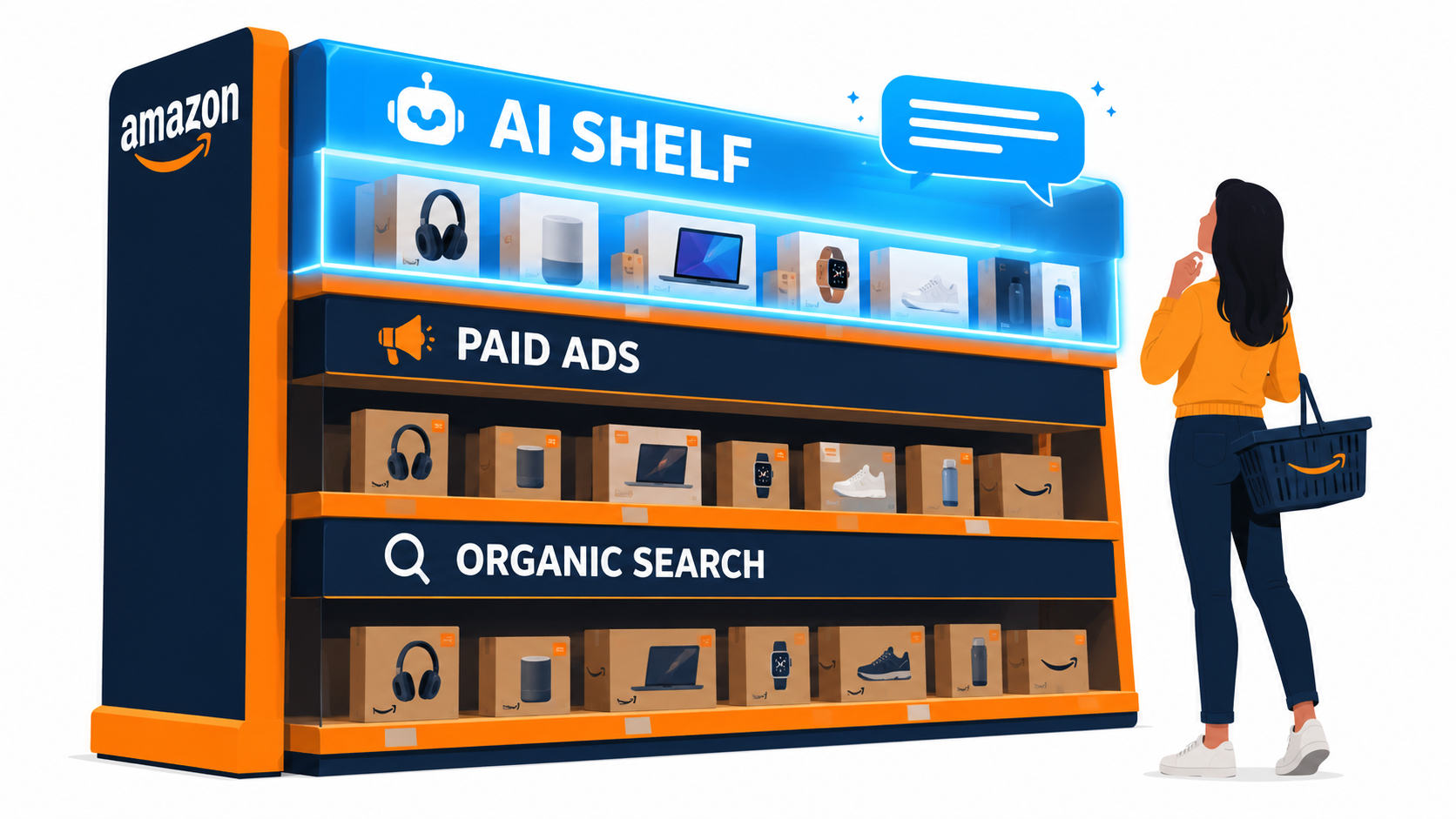
That’s a third shelf. It sits next to organic search and paid placement, and it plays by different rules. It isn’t the only thing that changed for Amazon sellers this year, either. Who holds Amazon’s top seller positions has shifted sharply. Margins are under more pressure than headline growth suggests. Amazon Business has grown into a $60 billion channel that most sellers barely manage. And Amazon has just turned Seller Central into a control panel for rival marketplaces.
This article pulls those threads together. It doesn’t repeat the usual listing checklist. It asks a structural question: where does demand on Amazon actually come from in 2026, and which of those sources is your business set up to capture? Most of the data comes from Marketplace Pulse research published through September 2026, Amazon’s own earnings disclosures, and a large study of Amazon’s AI recommendations. Where the evidence is thin or early, we say so.
If you sell on Amazon, whether you’re a seven-figure brand or still working toward your first consistent month, the goal is simple. Work out which shelves you’re stocked on, which ones you’re missing, and what to do about it over the next 90 days.
The Shelf Most Sellers Optimized For Is No Longer the Only One
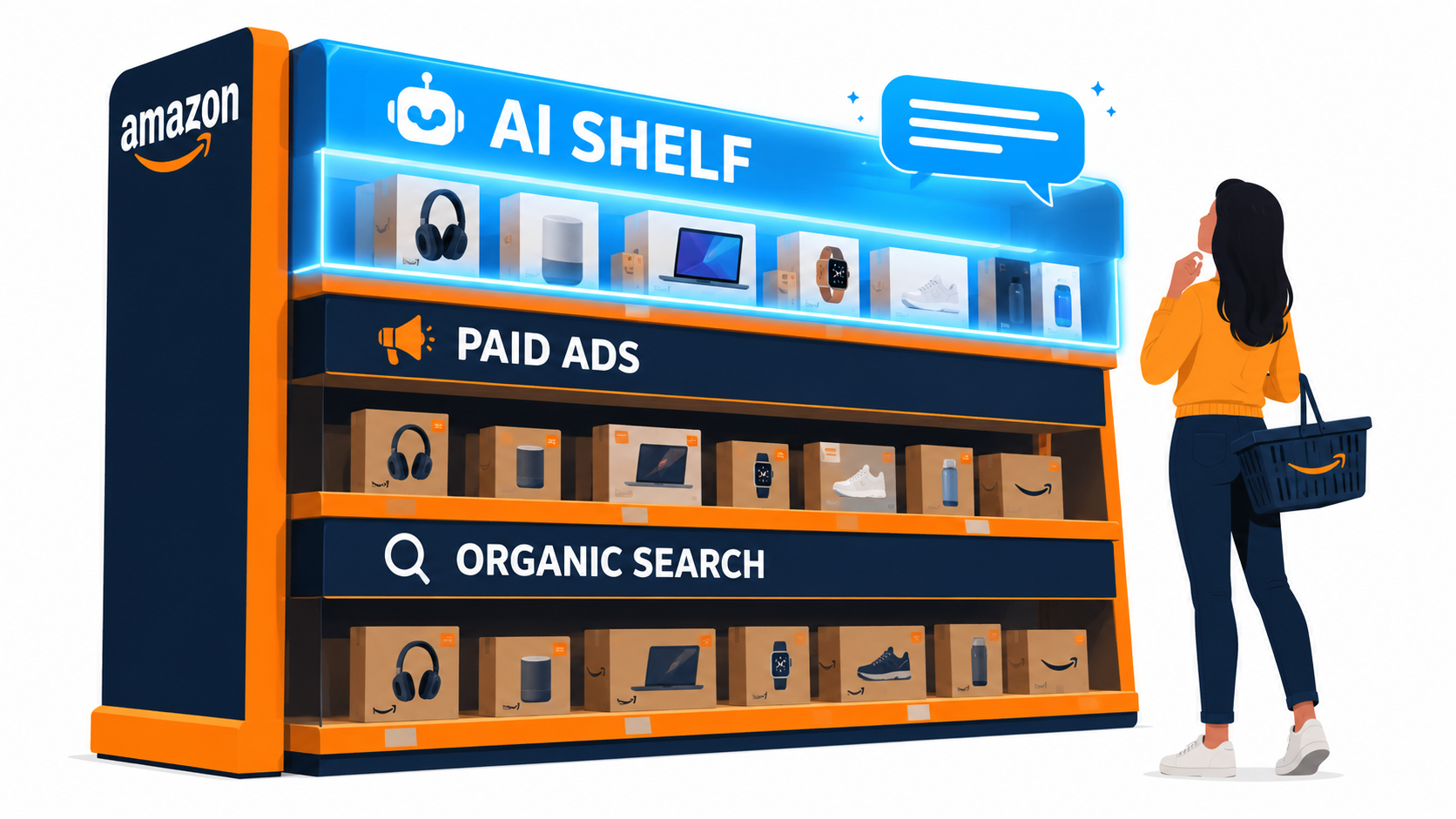
Amazon search has always worked like a physical shelf. Products sit in rank order, shoppers scan from the top, and attention falls off quickly as you scroll down. Sellers learned to fight for the first page and, ideally, the first row. The whole economics of an Amazon launch, from coupons to ad budgets to review programs, exists to push a product up that shelf.
Two routes, one destination
Marketplace Pulse describes the old model neatly. Rank and ads are the two routes to visibility on search. Rank is “earned slowly through the sales velocity that ad budgets are spent to manufacture.” Ads are “bought outright at auction.” Both lead to the same place: a spot on the search results page.
That setup has favored incumbents for years. A product with thousands of reviews and a long sales history holds its rank because the rank produces the sales that protect the rank. Newer products have to pay their way in. The cost of doing that keeps going up. Sellers paid $68.62 billion for Amazon advertising in 2025, and the ad load around organic results keeps growing.
The conversational shift
What changed is how shoppers ask. Amazon’s AI assistant, launched as Rufus and renamed Alexa for Shopping in May 2026, lets shoppers ask questions in natural language. “What’s the best queen mattress for a side sleeper who runs hot?” is a very different request from typing “queen mattress.”
When a shopper asks for a recommendation instead of a list, the assistant has to decide what fits. As the data below shows, it doesn’t just read out the search results. That makes it the first discovery surface on Amazon in years where a product’s standing on the search page doesn’t automatically carry over.
Why this matters now, not later
Adoption is no longer a side project. In its Q1 2026 earnings call, Amazon said Rufus monthly active users were up 115% year over year and engagement was up nearly 400%. Amazon estimated the assistant drove about $12 billion in incremental sales. Outside Amazon, McKinsey and ICSC say 68% of consumers used at least one AI tool for shopping in the past three months, and forecast U.S. agentic commerce reaching $1 trillion by 2030.
Those figures are forecasts and company-reported numbers, and they deserve some skepticism. But the direction is clear. A growing share of Amazon shopping starts with a question, not a keyword. Sellers who only watch keyword rank are measuring a shrinking part of the funnel.
What the Alexa for Shopping Study Actually Measured
The clearest data on the AI shelf so far comes from a study by Autopilotbrand.com, a vendor that sells AI-visibility services, reported by Marketplace Pulse in July 2026. The vendor has a commercial interest in the result, so it’s worth being precise about what was measured and what wasn’t.
The methodology
During May and June 2026, researchers ran 1,963 non-branded queries through Alexa for Shopping and captured 12,810 recommendations. For each one, they asked the assistant a “best-of” question, such as “what is the best queen mattress?” Then they compared its picks with the plain category search for the same term, such as “queen mattress.”
That design isolates something specific. It measures the gap between what Amazon recommends when asked to recommend and what Amazon lists when asked to search. It doesn’t measure conversion, and it doesn’t measure how often shoppers actually buy the AI’s picks.
The headline findings
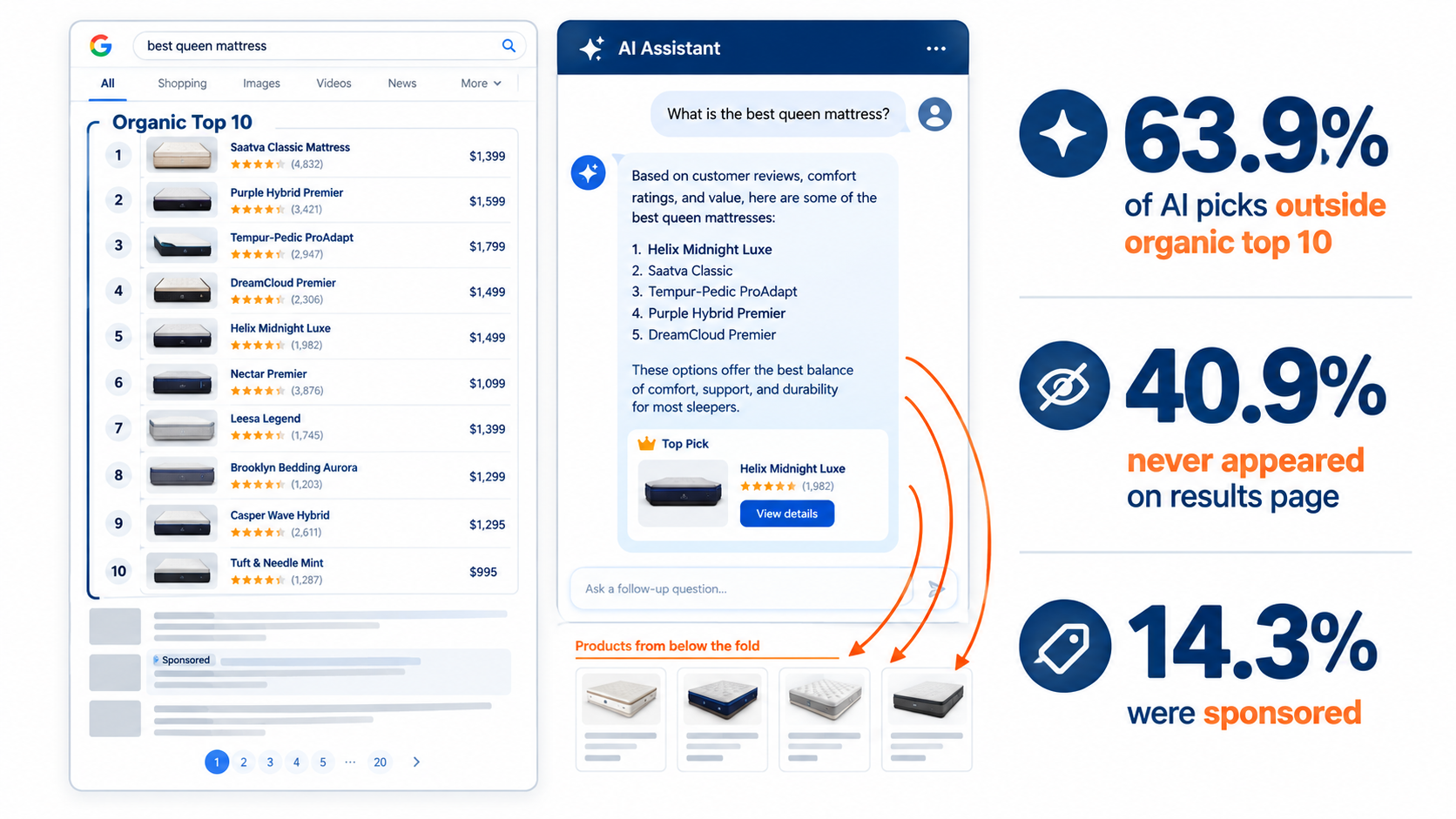
- 63.9% of the assistant’s picks fell outside the organic top 10 for the matching search term.
- 40.9% never appeared on the visible search results page at all.
- Only 14.3% of picks were products running a sponsored listing on that search page.
- Of those sponsored picks, 83% already ranked organically, which suggests the ad itself wasn’t what got them picked.
Put simply, neither organic rank nor ad spend reliably predicted what the assistant recommended. Marketplace Pulse called rank “the sharper omission.” It’s the metric Amazon teams build dashboards around, and it’s the one the assistant most clearly ignores.
The caveats sellers should take seriously
Marketplace Pulse notes that this is “a single snapshot from one US account, captured early.” AI recommendations can be personalized, can change from session to session, and can shift as Amazon retrains its models. A study run in November might look different.
The study also covered non-branded, best-of questions only. Shoppers who search for a brand by name, or who go straight to a keyword search, still see the traditional shelf. The AI shelf adds to organic search. It doesn’t replace it.
Christian Umbach, co-founder and CEO of Autopilotbrand.com, described the finding as “the emergence of a third shelf alongside organic search and paid placements,” adding that “brands cannot simply buy or rank their way onto it; they need to give Amazon’s AI Alexa enough context to understand when and why their product is the right recommendation.” Keep in mind that he sells services built on that idea. Even so, the underlying data supports the basic point.
Why Rank and Ads Don’t Carry Over to AI Recommendations
If you’ve spent years building rank, it’s fair to ask why the assistant would ignore it. Amazon hasn’t published how Alexa for Shopping picks products. But the logic of the two systems explains a lot of the gap.
Search ranks a list; assistants answer a question
Keyword search solves a sorting problem. Given “queen mattress,” which of thousands of matching products should appear first? Past sales and click behavior are strong signals for that, because they show what other shoppers picked when they typed the same words.
A recommendation question is different. “Best queen mattress for a side sleeper who runs hot” contains constraints that a keyword doesn’t. The best-selling mattress overall may not be the best fit for that specific need. An assistant built to answer the question has good reason to go deeper into the catalog to find a product whose attributes, descriptions, and reviews match the request.
The two-year change in the assistant’s behavior
This wasn’t always the case. Marketplace Pulse notes that two years ago, Amazon’s assistant “merely returned links to searches shoppers could have run themselves,” and later “grew more confident but not more intelligent.” A two-thirds split from search rank, in their words, “is the measure of a system that stopped reprinting its own results.”
For sellers, that change matters. When the assistant was mostly re-serving search results, rank carried over automatically. Now that it’s doing its own reasoning, rank is only one input, and perhaps a small one.
What incumbency no longer guarantees
On search, incumbency builds on itself. On the AI shelf, according to Marketplace Pulse, “rank incumbency is a weaker moat.” A product outside the top search results can show up where a category leader doesn’t.
That cuts two ways:
- For challengers: the AI shelf is a rare opening. A well-described, clearly positioned product can win recommendations without first winning a costly battle for keyword rank.
- For category leaders: rank no longer guarantees full visibility. If your listing is vague about who the product is for and what problem it solves, the assistant may pass you over for a smaller competitor whose listing answers the question better.
A practical diagnostic
You can test this yourself. Pick your five most important non-branded keywords. Search each one and note where your product ranks. Then ask Alexa for Shopping a best-of version of the same query, plus two or three versions with specific needs attached. Record whether your product appears and which competitors do.
Run the test from more than one account if you can, and repeat it monthly. One run proves nothing. A pattern across dozens of queries tells you whether you’re present on the third shelf or missing from it.
The Ad Layer Is Already Arriving on the AI Shelf
Any seller who has watched Amazon for long knows what usually happens next. A free discovery surface appears. Then Amazon monetizes it. Marketplace Pulse put it bluntly: “Search looked like that once too, before the ad load found it.”
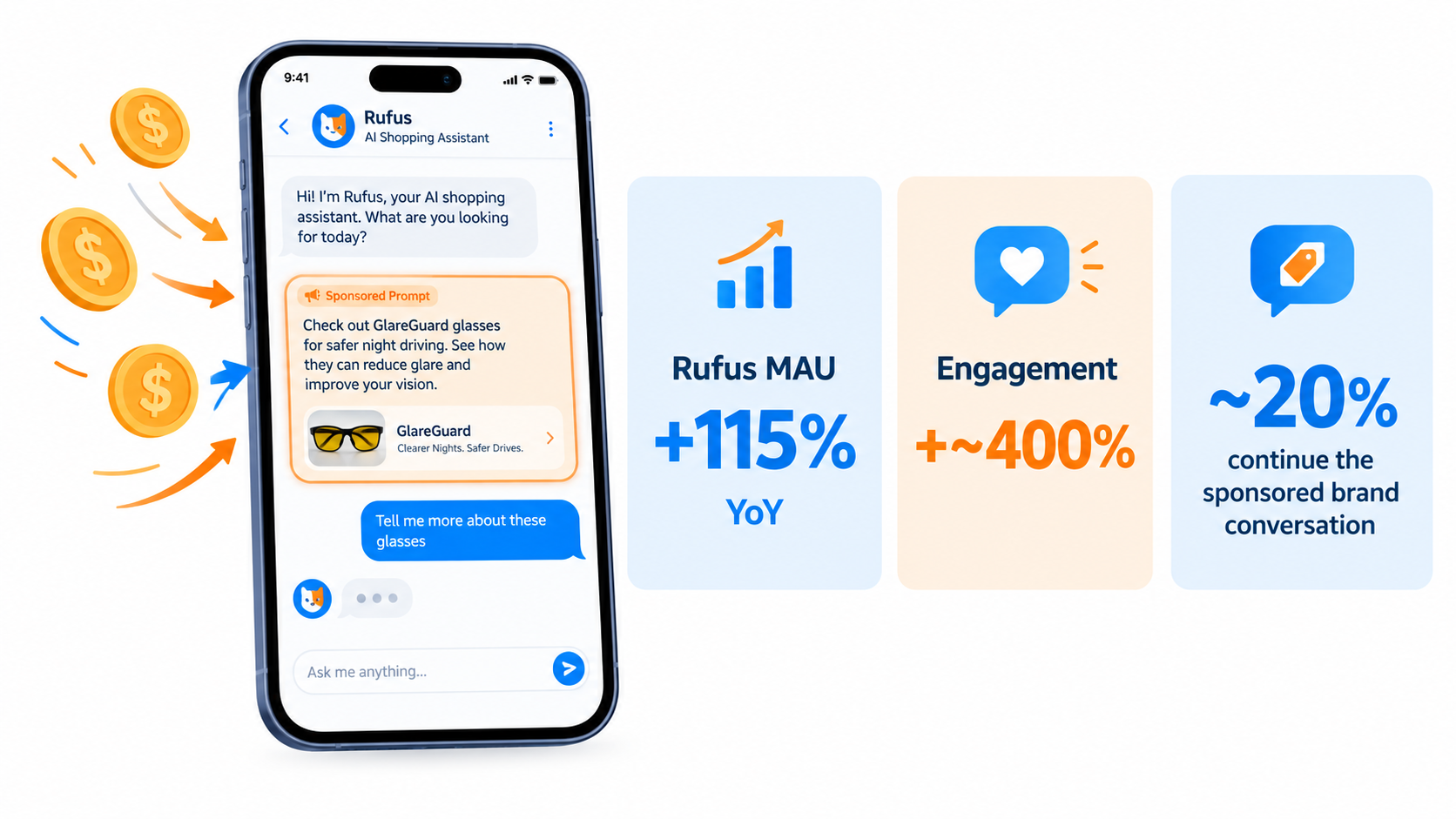
Sponsored Prompts are live
In Q1 2026, Amazon launched Sponsored Products and Brand Prompts inside Rufus. On the earnings call, Amazon said nearly 20% of shoppers who interact with a sponsored brand prompt continue the conversation about that brand. CEO Andy Jassy explicitly cautioned that “it is early.”
Note what that number measures. It tracks whether shoppers keep talking about the brand, not whether they buy. It’s an engagement metric, and a promising one for Amazon’s ad business. It isn’t yet proof of return on ad spend.
The broader industry went the same way
For a while, it looked like agentic commerce might support a non-ad model. ChatGPT’s Instant Checkout charged merchants a 4% transaction fee and offered broad access without advertising as the main way to get found. That alternative is gone.
According to Marketplace Pulse, OpenAI launched ads in ChatGPT in February 2026 with a select group of U.S. advertisers. It dropped Instant Checkout in March, citing execution problems. In May it opened its ads manager to all U.S. advertisers and removed the $50,000 minimum spend. Shopify, meanwhile, launched connector apps for ChatGPT and Claude so merchants can manage their stores from inside AI agents, but it chose not to build its own consumer discovery surface.
Marketplace Pulse concluded that “agentic commerce is settling into an ad-supported model,” and that Amazon “is currently alone with both the audience at scale and the disclosed data to show what that model looks like in practice.”
What this means for the organic AI shelf
Two things are true right now, and sellers should keep both in mind:
- The organic AI shelf exists today. The July study found that paid placement on search had little influence on AI picks. For now, AI recommendations are mostly organic.
- The window may not last. Sponsored Prompts are already live, and every past discovery surface on Amazon has picked up more ads over time. “The AI shelf’s economics are not yet written,” Marketplace Pulse wrote. “The sellers learning how it selects now are the ones who will notice the day that changes.”
The practical takeaway is to build organic AI visibility while it’s comparatively cheap. At the same time, run small, measured tests of Sponsored Prompts so you have your own baseline before costs go up. Track them separately from your search campaigns so the results don’t get lost in blended ACOS figures.
Who Actually Holds the Top of Amazon in 2026
The AI shelf is one structural shift. A second one is happening in the seller rankings. It affects anyone trying to break into or stay in Amazon’s top tier, and it helps explain why the old “build rank and hold it” approach is harder than it used to be.
Stable turnover, different occupants
Marketplace Pulse’s July 2026 analysis found that the top 10,000 sellers on Amazon.com turn over at almost exactly the same rate as seven years ago. 68.6% of today’s top sellers held that position a year ago, compared with 67% in 2019. Nearly half, 49.6%, were in the top tier three years ago, up from 41% in 2019.
So holding a top position has become slightly more durable. What changed is who holds those positions.
China won the count; America kept the summit
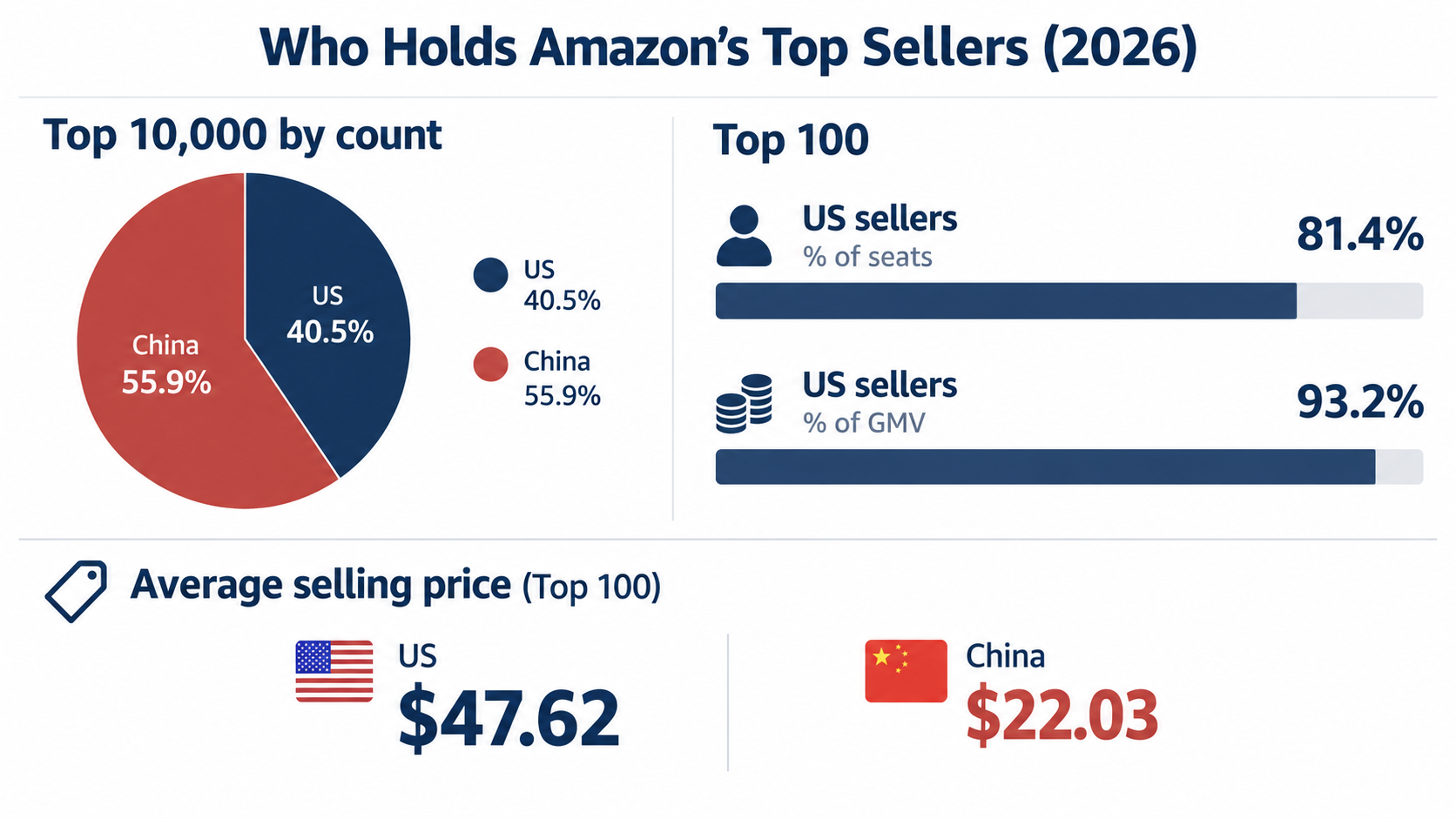
Since July 2020, Chinese sellers have gained 1,342 positions in the top 10,000, and U.S. sellers have lost 1,320. Chinese sellers made up 42.5% of the group in 2020 and 55.9% today. U.S. sellers dropped from 53.7% to 40.5%. In the past twelve months alone, 3.8 points of share moved.
Headcount only tells part of the story, though:
- U.S. sellers hold 65.3% of the GMV this top-10,000 group generates, against 28.6% for Chinese sellers.
- American sellers make up 81.4% of the top 100 and produce 93.2% of its GMV.
- In the 5,001–10,000 band, U.S. sellers hold only 34% of positions.
- In the top 100, the average selling price for U.S. sellers is $47.62, compared with $22.03 for Chinese sellers.
The squeezed middle and the pandemic cohort
Sellers who registered between 2019 and 2021, the pandemic group, hold just 17.5% of top positions. That’s the smallest share of any cohort. They came in at the marketplace’s peak and have been squeezed from both sides since. Pre-2016 sellers hold 21.9%, those from 2016–2018 hold 27.4%, those from 2022–2024 hold 26.9%, and sellers who arrived within the last eighteen months hold 6.3%.
Marketplace Pulse attributes the shift to newcomers who arrive “with manufacturing proximity, direct factory relationships, export subsidies, and AI tooling that erased the listing-quality gap once protecting domestic sellers.” Veterans built rank on organic position and review history. That space has given way to sponsored placement, where factory-direct entrants on thinner product margins can outbid them.
What to take from it
If you compete in the lower-priced middle of the top tier, you’re up against sellers with structural cost advantages, and bidding against them on price and ad spend is a hard fight. The sellers holding the most valuable positions win on higher price points, brand strength, and differentiated products. That’s also the kind of product an AI assistant can recommend with confidence when a shopper describes a specific need.
The Seller Squeeze: Growth Without Margin
Platform-level numbers make Amazon look healthy. Underneath, the seller economy looks different. Before deciding where to spend on new shelves, it helps to know which kind of seller business you’re running.
Four seller cohorts
The Marketplace Pulse Seller Index (2026) surveyed 181 marketplace sellers representing more than $2 billion in combined annual revenue. It sorted them into four groups:
- Thriving (23%): growing revenue and improving margins at the same time.
- Grinding (31%): revenue up, but margins flat or declining, which Marketplace Pulse calls “a potentially unsustainable treadmill.”
- Distressed (38%): at best no growth in sight, and at worst both revenue and margins falling.
- Consolidating: the remaining group, adjusting their businesses rather than pushing for growth.
These groups operate “on the same platforms under the same conditions.” Market conditions alone don’t explain the gap. Strategy does.
Where the margin goes
Sellers aren’t vague about what’s squeezing them. According to Marketplace Pulse, 49% of sellers name marketplace fees as their main margin concern, and 46% cite advertising. Both costs grow with sales. That’s why a grinding seller can add revenue every quarter and still end up with less profit.
Marketplace Pulse calls it “the paradoxical dependence” of Amazon and its sellers. Sellers are frustrated with fees but keep deepening their dependence on Amazon because nothing else offers comparable scale.
Amazon’s own retail is taking back unit share
Another signal: third-party sellers accounted for 60% of paid units sold on Amazon in Q1 2026. That’s down from 61% in Q4 2025 and 62% the quarter before. It’s the first time the metric has fallen for two quarters in a row since Amazon started reporting it in 2004. The drop is small, but it means Amazon’s first-party retail is competing for the same units.
Fewer sellers, more traffic each
There’s an upside in the data. Amazon’s average traffic per active seller rose 25% in the past year to 3,544 monthly visits, according to Marketplace Pulse. That’s faster than the 31% rise across the previous four years combined. Fewer active sellers are splitting the traffic. For sellers who stay and run efficiently, the competition for each shopper’s visit is, on average, a bit less crowded than it was.
The strategic question is how to capture more of that demand without paying for all of it through the ad auction. That leads to the shelves that don’t run on an auction yet: the AI shelf and Amazon Business.
Stocking the Third Shelf: Building Catalog Context for AI Discovery
Amazon hasn’t published a ranking guide for Alexa for Shopping. Anyone claiming to know the exact formula is guessing. What sellers can do is make it as easy as possible for any AI system to understand when and why their product is the right answer. The approach below follows the logic of the July study and Amazon’s stated direction. Treat it as a set of working hypotheses to test, not guaranteed ranking factors.
1. Write for use cases, not just keywords
Keyword-stuffed titles were built for a lexical search engine. A conversational assistant is working out whether a product fits a described situation. Look at your bullets and description and ask: does this copy say who the product is for, what situation it suits, and what trade-offs it makes?
For example, “Breathable gel-infused foam” is a feature. “Designed for side sleepers who overheat at night; medium-firm feel with cooling gel layer” is a use case an assistant can match to a question.
2. Fill every structured attribute
Backend attributes such as dimensions, materials, compatibility, age range, and certifications are clean, machine-readable facts. Many sellers leave optional fields blank because they don’t obviously affect keyword rank. For an AI answering a constrained question (“under 20 pounds,” “fits a 30-inch counter,” “BPA-free”), those fields may decide whether your product qualifies at all.
3. Treat reviews and Q&A as intent data
Reviews often describe exactly the situations shoppers ask about: “Bought this for my small apartment,” “works great for my toddler.” Read through your reviews and customer questions to find the recurring use cases. Then make sure your listing content states those use cases directly instead of leaving the AI to infer them from scattered comments.
4. Answer the comparison question honestly
Recommendation questions are really comparison questions. If your product is the best choice for a specific group, such as hot sleepers, small spaces, or heavy daily use, say so plainly in A+ content and comparison charts. Vague claims to be “the best” give an assistant nothing to work with. Specific positioning does.
5. Update seasonally
Umbach’s comments pointed to “continuous updates as seasonal use cases and product differentiators evolve.” A cooler bag’s use case in July (beach days) differs from its use case in November (holiday travel, tailgating). Refreshing listing content by season keeps what the AI sees in line with what shoppers are currently asking.
6. Measure it separately
Create a simple tracking sheet: 20–50 recommendation-style queries relevant to your category, tested monthly, recording whether your ASINs appear. Compare that with your keyword rank for the matching terms. Where you rank well but don’t get recommended, the listing context is probably weak. Where you get recommended but rank poorly, you’ve found a place where the AI shelf is doing work your ad budget isn’t.
The Overlooked Shelf: Amazon Business at $60 Billion
While sellers argue about search rank and AI prompts, one of Amazon’s largest demand channels runs mostly unmanaged. Amazon Business reached $60 billion in annualized gross sales in July 2026, up from $35 billion disclosed in 2023 and $25 billion in 2021.

The size of the opportunity
By Marketplace Pulse estimates, Amazon Business accounts for roughly 7% of Amazon’s $830 billion GMV. Amazon has said more than half of Amazon Business sales come from third-party sellers, so something like $30 billion of it flows to sellers. The segment has grown at roughly 18% a year, both from 2021 to 2023 and from 2023 to 2026. That’s well ahead of Amazon’s overall GMV growth of about 9% last year.
The buyers include hospitals, universities, governments, and 97 of the Fortune 100. They tend to place larger orders and buy more consistently than consumers.
Why sellers underuse it
Most of Amazon’s recent Business investment has gone to buyers, not sellers. Amazon has added an account assistant, Savings Insights for bulk-discount opportunities, Spend Anomaly Monitoring, dedicated delivery trucks across 13 states, and an expanded Prime Business bundle. The seller-side tools have “changed little,” according to Marketplace Pulse: business-only pricing, tiered quantity discounts, business-only listings, and custom quote responses.
Those tools aren’t new, which is exactly why many sellers ignore them. But Marketplace Pulse calls that imbalance “the opportunity.” B2B demand comes through listings sellers already maintain.
Demand you don’t buy at auction
Here’s the key point for margin-squeezed sellers. As Marketplace Pulse puts it, “incremental demand captured through quantity discounts on existing inventory is a different proposition than incremental demand bought through an ad auction.” Fewer than 8,000 sellers generate half of Amazon’s estimated $300 billion in U.S. third-party GMV. The sellers already at that scale are the ones most likely to have tuned their B2B pricing.
A B2B checklist
- Enroll in the B2B program and review which ASINs make sense for business buyers: office, janitorial, food service, lab, industrial, IT accessories, and packaging are natural fits, but many consumer products also get bought in bulk.
- Set tiered quantity discounts that reflect your real unit economics at volume, including lower per-unit fulfillment and ad costs.
- Offer business-only pricing where it makes sense, visible only to verified buyers.
- Respond to quote requests quickly. A single institutional buyer can become a recurring account.
- Adjust listing content for procurement: case pack counts, certifications, spec sheets, and tax-exempt eligibility all matter more to a purchasing manager than lifestyle images do.
TikTok as an Amazon Demand Engine, Not a Parallel Business
Many Amazon sellers have been told they need to “be on TikTok Shop.” The data suggests that’s the wrong way to frame it for most of them. The more useful question is how TikTok affects Amazon demand.
The one-way street
Marketplace Pulse matched the 10,000 largest sellers on Amazon and TikTok Shop by business name in September 2026. Only 498 appear on both lists, about 5% of either. One in five of TikTok Shop’s top 100 U.S. sellers also ranks in Amazon’s top 10,000. Only one in twenty-five of Amazon’s top 100 ranks in TikTok’s top 10,000.
In other words, a brand that succeeds on TikTok is five times more likely to also succeed on Amazon than the reverse. Among the 498 overlapping sellers, a seller’s rank on one platform had almost no relationship to its rank on the other.
Why the flow runs toward Amazon
Marketplace Pulse sums it up: “TikTok makes people want things. Amazon is where people buy things.” Prime has trained American shoppers to finish purchases on Amazon out of habit. The card is saved, the delivery date is promised, returns are easy, and the reviews are trusted. Many shoppers who see a product demonstrated on TikTok open Amazon, search the brand name, and buy there.
The traffic doesn’t flow the other way. Amazon’s attempts at discovery-first features, including Amazon Live and the Inspire feed, didn’t take off. Inspire was shut down in 2025.
The filmability test
TikTok works for a specific kind of product. Among TikTok Shop’s top 1,000 U.S. products by lifetime sales, more than two-thirds of revenue comes from items that are worn, applied, or consumed, the kind of “personal transformation” a creator can show on camera. A replacement charging cable, storage bins, or printer paper don’t pass that test.
How to measure TikTok’s value correctly
For an existing Amazon seller, Marketplace Pulse suggests TikTok’s value “is best measured in Amazon branded searches, not TikTok Shop orders.” Practically, that means:
- If your product can be filmed, fund creator content and track changes in branded search volume and branded conversion on Amazon, not just TikTok Shop sales.
- If it can’t be filmed, don’t force it. As Marketplace Pulse wrote, “TikTok is not a channel, and no listing will make it one.”
- Make sure your Amazon listing is ready for branded traffic: clear brand naming, consistent imagery with your social content, and a Brand Store that’s easy to find.
Branded traffic also helps on the AI shelf. A brand that shoppers ask about by name gives the assistant a strong signal about what people want.
Seller Central Becomes a Multichannel Hub: Convenience vs. Dependence
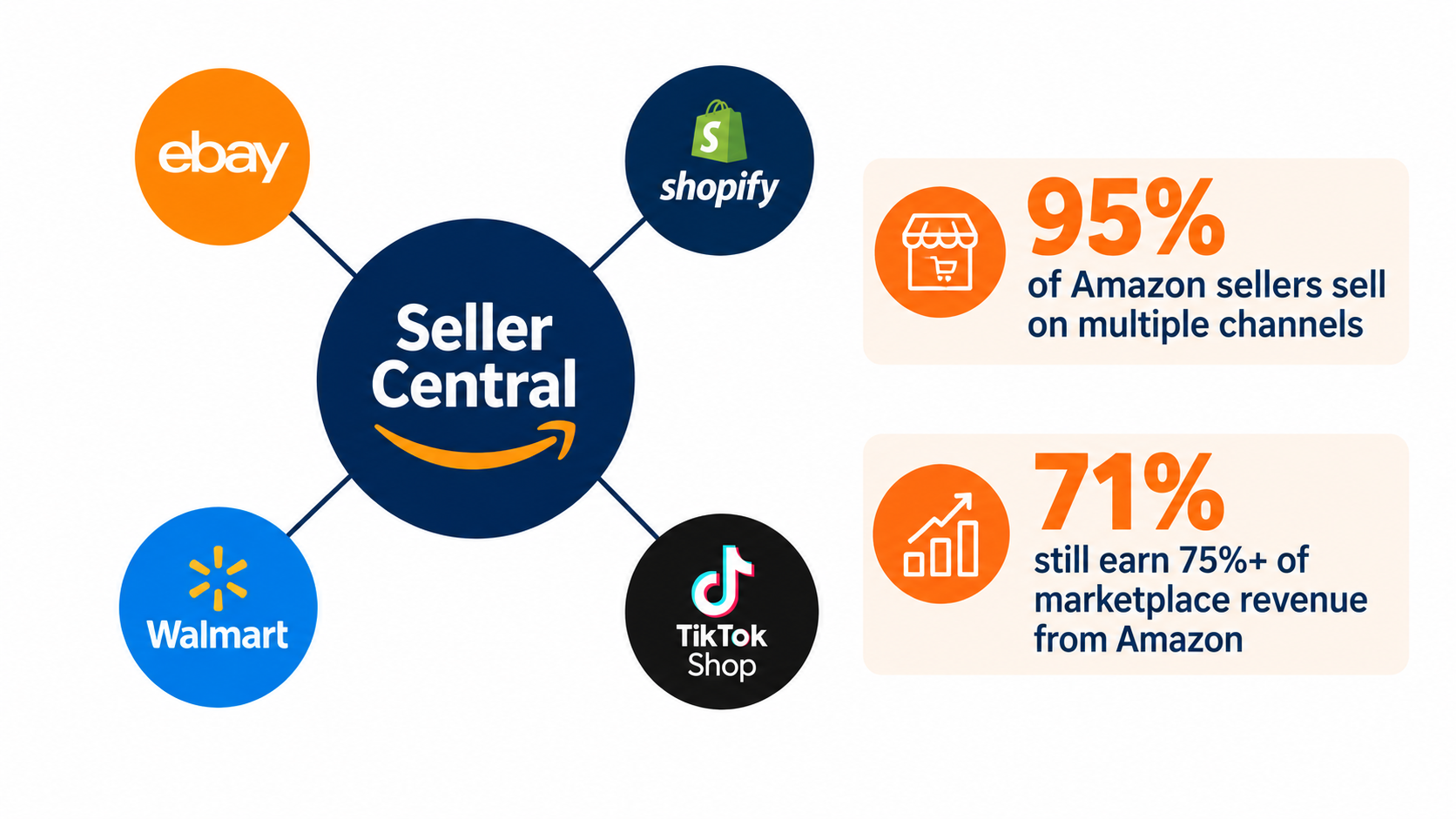
At its Accelerate seller conference in September 2026, Amazon announced that sellers will be able to manage their eBay, Shopify, TikTok Shop, and Walmart businesses from inside Seller Central. The tools are rolling out gradually to U.S. sellers at no extra cost.
What the tools do
- Edit a product description once, and Amazon reformats and publishes it to linked listings on eBay, Walmart, and Shopify.
- Shopify and Walmart orders appear alongside Amazon orders and can be fulfilled through Amazon in a few clicks.
- A profitability view shows what each product earns on each channel.
This is the latest step in a five-year change. Amazon used to charge more to ship off-Amazon orders through FBA and could suppress products priced lower elsewhere, which it still can. Then came Buy with Prime, Multi-Channel Fulfillment growth (more than 200,000 U.S. sellers by 2024, with order volume up 70%), and MCF integrations with Walmart and Shein in 2025.
Diversified in name, concentrated in practice
Amazon says more than 95% of its sellers sell on multiple channels. But the Marketplace Pulse Seller Index found that 71% of Amazon-primary sellers active on at least one other marketplace still earn three-quarters or more of their marketplace revenue from Amazon. Being on several channels rarely means being diversified.
The trade-off to think through
The tools earn Amazon nothing directly. Marketplace Pulse reads it as a bet that “owning the hub matters more than how a seller’s revenue splits across the spokes.” Amazon can now see how much sellers sell elsewhere, not just what they charge. It says that data won’t inform its retail business.
For sellers, the benefit is real: less operational work to run Walmart or Shopify alongside Amazon. The risk, per Marketplace Pulse, is “deeper dependence on a channel that the Seller Index shows many are working to rely on less.”
A sensible approach is to use the tools for efficiency while keeping a few safeguards:
- Keep an independent copy of your product data and customer records outside Seller Central.
- Watch price parity across channels closely. Amazon’s ability to suppress listings priced lower elsewhere hasn’t gone away, and now it has more visibility.
- Don’t let convenient tooling replace a real plan for each channel. Walmart’s U.S. marketplace grew nearly 50% in its fiscal Q1 2027. That channel deserves its own strategy, not just mirrored listings.
The Demand Backdrop: Growth Is Back, but It’s Concentrating
All of this is happening in a market that has picked up speed again. It helps to separate what’s actually growing from what only looks like growth.
The headline numbers
U.S. e-commerce grew 12.2% in Q2 2026, its fastest rate in five years, and reached a record 17.1% of all retail spending. It was the second straight quarter of double-digit growth, after Q1’s 9.8%. That followed a flat 2025, when tariffs and the end of the de minimis exemption hit the categories where online had been growing fastest.
The price caveat
Marketplace Pulse estimates that roughly a third of the recent acceleration comes from higher prices. That leaves real growth near 8%, about where it ran in 2024. It’s still the best market in three years, but it’s a return to the old trend rather than a break above it.
The big platforms are taking the gains
The largest platforms are growing faster than the market:
- Amazon’s online store sales grew 15%.
- Walmart’s U.S. online sales rose 24%, and its advertising business grew 38%.
- Shopify’s North American merchants sold 28% more.
Amazon is still the dominant U.S. marketplace, with an estimated $300 billion in third-party sales. That’s more than seven times eBay and roughly 20 times the next group of Temu, TikTok Shop, and Walmart, which sit in a $15–22 billion range. Amazon Haul, its direct-from-China section for items under $20, passed 3,000 sellers by March 2026.
The takeaway: demand is real and Amazon is capturing more than its share. But platform growth doesn’t turn into seller profit automatically, as the Seller Index shows. Which shelves you’re stocked on matters more than whether the market is growing.
A 90-Day Action Plan for Amazon Sellers
Here’s how to turn the analysis into work, split into three 30-day phases. Change the order based on which shelf you’re weakest on.
Days 1–30: Audit your shelves
- Run the AI shelf test. Build a list of 20–50 recommendation-style queries for your category. Test them in Alexa for Shopping and record whether your products appear. Compare with keyword rank.
- Classify your business. Using the Seller Index groups, decide honestly whether you’re thriving, grinding, consolidating, or distressed. Look at contribution margin after fees and ads, not revenue.
- Break down margin pressure. Calculate fees and ad spend as a percentage of revenue by ASIN. Find the products where growth isn’t turning into profit.
- Check B2B readiness. Find out whether you’re enrolled in Amazon Business and whether any ASINs have quantity discounts set.
Days 31–60: Stock the missing shelves
- Rewrite your top ASINs for use cases. Start with products that rank well but aren’t getting recommended. Add explicit use cases, fill structured attributes, and clarify positioning in A+ content.
- Launch B2B pricing. Set tiered quantity discounts on your ten most bulk-friendly ASINs and add procurement details such as case packs and certifications.
- Test Sponsored Prompts on a small budget. Keep them in their own campaigns and measure conversions, not just engagement.
- Decide on TikTok. Apply the filmability test. If your product passes, fund a small creator program and track Amazon branded search. If it doesn’t, move that budget elsewhere.
Days 61–90: Measure and adjust
- Re-run the AI shelf test and compare it with your first run. Note which listing changes lined up with new recommendations.
- Review B2B orders, including average order value and repeat buyers.
- Evaluate the multichannel tools as they reach your account. Use them for efficiency, and keep independent data backups and a separate strategy for each channel.
- Set a monthly cadence for AI shelf testing and seasonal listing updates, so you notice when Amazon adds more ads to this surface.
Conclusion: Selling on Amazon Now Means Stocking Every Shelf
For years, Amazon strategy came down to rank and ads. Those still matter a lot. Search remains the biggest source of demand, and the ad auction remains the fastest way to buy visibility. But in 2026 they’re no longer the full picture.
A third shelf, AI recommendations, now reaches deep into the catalog and mostly ignores search rank. For now it rewards clear positioning over incumbency and ad budget. That probably won’t last, because Sponsored Prompts are already live and Amazon has a long history of monetizing new surfaces.
Meanwhile, the top of the seller rankings keeps shifting toward factory-direct competitors in the middle tiers, while higher-priced, brand-led sellers hold the most valuable positions. Most sellers are either grinding or distressed, squeezed by fees and ad costs that grow with revenue. And some of the most practical opportunities get little attention: $60 billion in Amazon Business demand, TikTok treated as a way to drive Amazon branded search, and multichannel tools used carefully.
Key takeaways:
- Track AI recommendation visibility separately from keyword rank. They’re different measures and they don’t move together.
- Write listings around use cases and filled-in structured attributes, so an assistant can tell when your product is the right answer.
- Build organic AI visibility now, while Sponsored Prompts are still new and ad loads are light.
- Compete on differentiation and price point rather than trying to outbid factory-direct sellers on cost.
- Turn on Amazon Business pricing to capture demand you don’t have to win at auction.
- Measure TikTok by Amazon branded search, and only put money into it if your product can be filmed.
- Use Seller Central’s multichannel hub for efficiency, not as a substitute for real diversification.
The sellers doing well in 2026 aren’t necessarily the ones with the biggest ad budgets or the longest review histories. They’ve figured out where Amazon’s demand actually comes from now, and they make sure their products show up in each of those places.