


Most advice about TikTok Shop selling focuses on the front end: the hook, the creator, the algorithm, the first three seconds of the video. That advice isn’t wrong. It’s just incomplete, and in 2026 the gap has gotten expensive.
Here’s what the success stories share once you look past the headline numbers. Behave, the low-sugar candy brand, sold out its Super Sour Skulls in three days. Portland Leather Goods went from about $1,200 a day on TikTok Shop to more than $100,000 in one day after a seven-day affiliate push. Mavwicks Fragrances went from roughly $300,000–$400,000 in annual sales to $32 million in its first year on the platform. None of those outcomes happened because someone figured out a trick. They happened because the brand could keep product in stock, ship it on time, and keep the momentum going after the spike.
That second half of the job got harder this year. In early 2026, TikTok Shop told U.S. merchants it was ending independent shipping. Every order now has to move through TikTok-controlled logistics. At the same time, big brands like Samsung, Disney, Ulta Beauty and Ralph Lauren have arrived with deeper pockets and more mature supply chains. The platform is growing, but it’s also turning into an operations business that happens to run on video.
This article isn’t about ranking signals or reading Creative Center data. It covers the operational layer that decides whether a viral moment turns into a lasting business or a pile of refunds: fulfillment strategy, demand planning around affiliate surges, live selling as a daily routine, bulky and high-ticket goods, margin math under platform-controlled shipping, team structure, and how TikTok Shop now feeds retail and Amazon. Every figure below comes from reported data and on-the-record interviews, mostly from Modern Retail’s 2026 coverage of the platform.
TikTok Shop Is Now an Operations Business That Runs on Video
The quickest way to see how TikTok Shop has changed is to look at who’s selling and how much. According to eMarketer data cited by Modern Retail, TikTok Shop makes up roughly 20% of all social commerce sales, with Meta holding most of the rest. eMarketer projects TikTok Shop sales will pass $20 billion in 2026 and top $30 billion by 2028.
The platform brought in about $500 million over Black Friday through Cyber Monday in 2025. Compare that with the roughly $7 million a day in average sales reported shortly after the U.S. launch in late 2023. That’s a big jump in a little over two years.
Both ends of the market are growing
TikTok Shop told Modern Retail that U.S. small businesses (sellers with under $15 million in annual revenue) grew sales by 66% in 2025. More than 215,000 small businesses now sell actively in the U.S., up 25% year over year. Meanwhile, sales from big brands with at least $30 million in annual revenue rose 97% year over year.
That matters operationally. When established brands arrive, customers start expecting faster delivery, dependable tracking, and fewer order errors. Big brands already have warehouse contracts, EDI integrations and customer service teams. A founder-led brand going viral from a garage is now judged by the same shopper expectations.
The platform is choosing reliability over flexibility
TikTok’s platform decisions point the same way. The move to require TikTok-controlled logistics was framed as a way to improve delivery reliability, order tracking, and consistency for shoppers. From TikTok’s side, that makes sense: a marketplace built on impulse purchases can’t afford bad post-purchase experiences that make people stop buying.
For sellers, it changes the question. The old question was “Can I make a video that sells?” The 2026 question is “Can my operation absorb what happens when the video works?” Brands that answer the second question well are the ones still growing six months after their first viral hit.
Why “viral then vanish” keeps happening
The pattern is familiar. A product takes off, inventory runs out, orders get canceled or ship late, and performance metrics drop. Creators who were promoting the product move on to something they can actually sell. By the time stock comes back, the attention is gone. Superbloom founder Lily Comba summed up the platform’s nature when she told Modern Retail that TikTok Shop “fundamentally rewards transactions over relationships” and relies on “speed, volume, constant trend participation and aggressive discounting.” Every item on that list puts pressure on operations.
What the End of Independent Shipping Actually Changed
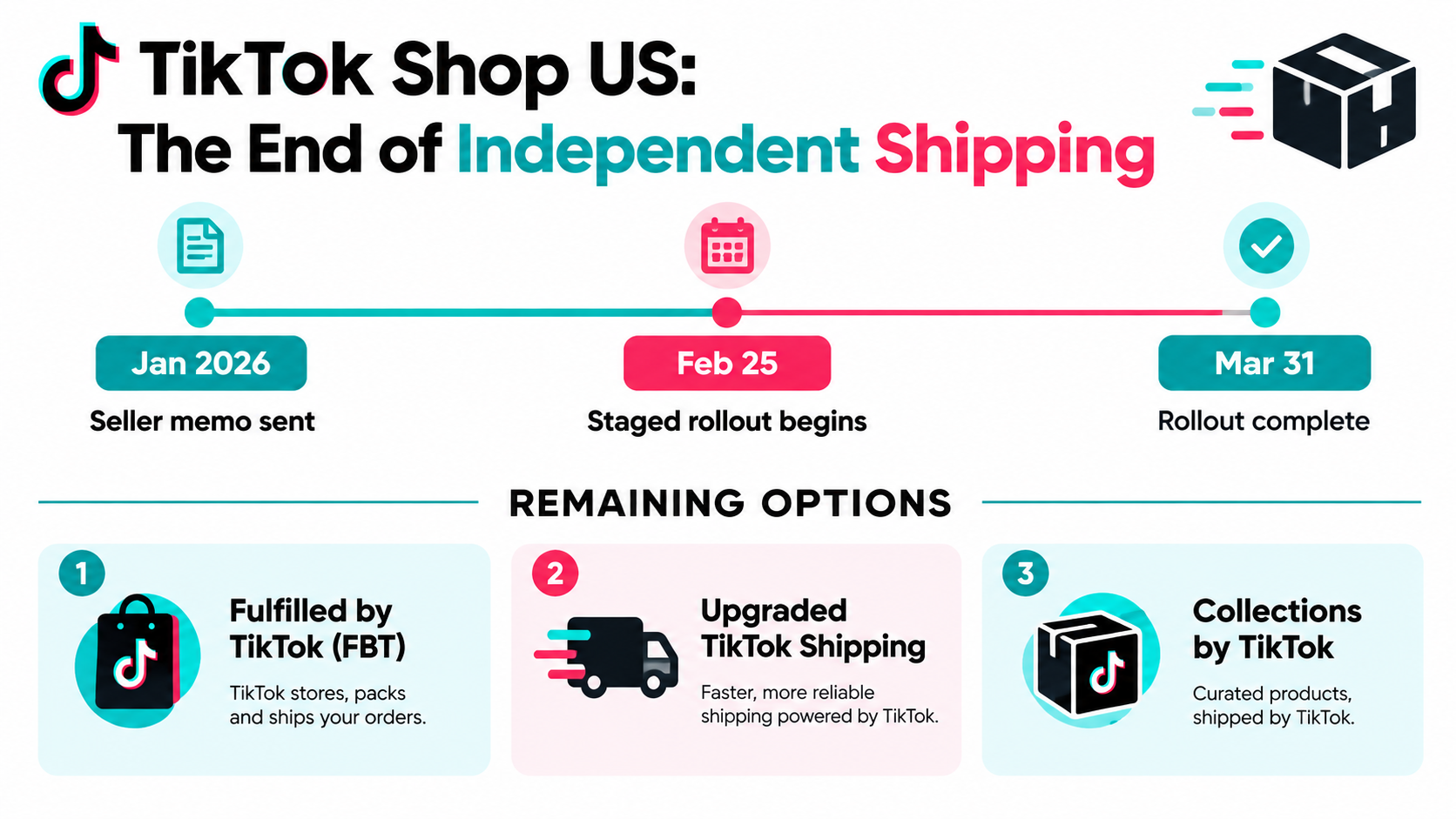
In January 2026, TikTok Shop emailed U.S. merchants to say it was discontinuing independent shipping. Modern Retail reviewed the memo. The rollout was staged from February 25 and set to finish by March 31. Sellers who hadn’t fully moved to TikTok’s logistics system by then risked losing access to a channel that reaches around 170 million U.S. users.
The three remaining paths
Under the new policy, sellers fulfill through TikTok’s own logistics services. The memo described three main options:
- Fulfilled by TikTok (FBT): Merchants send inventory to TikTok’s warehouses. TikTok handles storage, picking, packing and shipping for a fee based on the number of items sold and their physical size.
- Upgraded TikTok Shipping: The seller still packs orders, but TikTok automatically picks the carrier.
- Collections by TikTok: A door-to-door pickup service that collects packages from the seller.
TikTok is also allowing limited use of approved third-party software, including AfterShip, 4Seller and ShipHero, but only when those tools are fully integrated with TikTok’s logistics system. If your warehouse management setup can’t connect, it doesn’t count.
What sellers lost
Since the 2023 U.S. launch, brands could fulfill TikTok orders the same way they handled Shopify or Amazon merchant-fulfilled orders: their own carrier accounts, their own negotiated rates, their own packaging. That flexibility is mostly gone. Brands and consultants who spoke with Modern Retail said TikTok’s logistics had historically been uneven, pointing to operational errors, shipping delays and limited support when problems came up. Others worried that moving inventory into TikTok’s network would raise costs and make it harder to fund the steep discounts TikTok shoppers expect.
Who walked away
Some brands decided the channel wasn’t worth it anymore. Nadya Okamoto, whose period-care brand August has more than 410,000 TikTok followers, had launched a pajama brand called Matching and planned to sell it on TikTok Shop. After the mandate, she pulled back. “It just doesn’t make sense for the size of the business,” she told Modern Retail. “We would rather just have people go to our site than TikTok Shop.”
Five brands and three consultants who together advise hundreds of sellers told Modern Retail that some merchants were planning to cut SKUs, reduce promotions, or leave entirely. That’s worth noting, because it means there may be less competition in some categories for sellers who make the logistics work.
The practical reading
The mandate doesn’t make TikTok Shop a bad channel. It makes it a channel with a clearer operating model. You’re now selling on a marketplace that controls the last mile, more like Amazon with FBA than a social storefront. Sellers who plan around that do fine. Sellers who treat it as a side channel run from spare garage inventory are the ones getting pushed out.
The FBT Decision: A Framework for Choosing Your Fulfillment Mode
With independent shipping gone, each seller has to decide how much inventory to hand to TikTok and how much to keep. No single answer fits everyone, and the brands doing well are often running a hybrid.
When FBT makes sense
FBT tends to work best when a SKU has steady, predictable velocity, is small and light, and sells mostly on TikTok. Since FBT fees depend on units sold and physical size, compact products that move quickly get the most out of the model. The operational upside is also real: TikTok takes on the dispatch deadline, which removes one of the most common causes of seller performance penalties.
FBT is also a sensible choice for brands with no warehouse team. If the founder is packing boxes at midnight after a live stream, handing off pick-pack-ship frees up hours for content, which is what actually drives sales on the platform.
When to keep fulfillment in-house (through TikTok shipping)
Mellow Sleep, a sleep brand selling $50 pillows and comforters starting at $85, is a useful example. Founder Chad Keller told Modern Retail that because FBT “is still in its infancy, the experience is still somewhat choppy.” He noted that TikTok’s requirement to dispatch domestic orders within two business days isn’t always realistic for smaller brands shipping bulky goods. So Mellow Sleep fulfills some orders itself and sends others through FBT, depending on where the customer is.
That’s a smart setup. Positioning inventory by geography cuts transit time and lets the brand keep control over the orders most likely to cause trouble. Spreetail, which specializes in bulky home goods, still fulfills its own TikTok Shop orders because of its logistics experience, using TikTok-integrated shipping instead of FBT.
A simple decision matrix
- Small, fast-moving, TikTok-heavy SKUs: Default to FBT.
- Bulky, slow or high-value SKUs: Ship yourself through Upgraded TikTok Shipping or Collections, and keep packaging and inspection in your hands.
- Launch SKUs with unknown demand: Start by shipping yourself with a small FBT buffer. Move more stock into FBT once you have two to four weeks of real sales data.
- Brands already running a 3PL: Confirm your provider is on TikTok’s approved integration list before assuming you can keep your current workflow.
Questions to answer before sending inventory
- What’s the fully loaded cost per unit under FBT compared with your current 3PL, including inbound freight to TikTok’s warehouses?
- How much of the SKU’s total demand comes from TikTok? Stock sitting in FBT generally can’t serve your Shopify or Amazon orders.
- What’s your reorder lead time? Tying up inventory in a single-channel warehouse raises the stakes on forecasting.
- How will you handle returns, and who inspects returned units?
Okamoto’s decision is the other side of this framework. If a brand doesn’t have enough inventory depth to split across channels, the right move may be to stay off TikTok Shop until it does. Leaving isn’t a failure. It’s a legitimate operating decision.
Demand Planning for Viral Spikes: The Sell-Out Problem
Every operator knows the classic retail forecasting problem. TikTok Shop makes it much sharper. Demand doesn’t build gradually. It goes vertical when one video catches, and it can drop almost as fast.
What a spike actually looks like
Behave founder Mayssa Chehata described the moment her brand’s first viral video landed: “We did as many sales off of that video as we had done in the previous month.” That’s a month of volume compressed into a day or two. Later, the Super Sour Skulls launch sold out in three days. For Behave, the sellout helped: it caught a Target buyer’s attention and led to a rollout in almost 2,000 Target stores in April 2026. But most brands don’t get a retail deal out of a stockout. Most just lose the momentum.
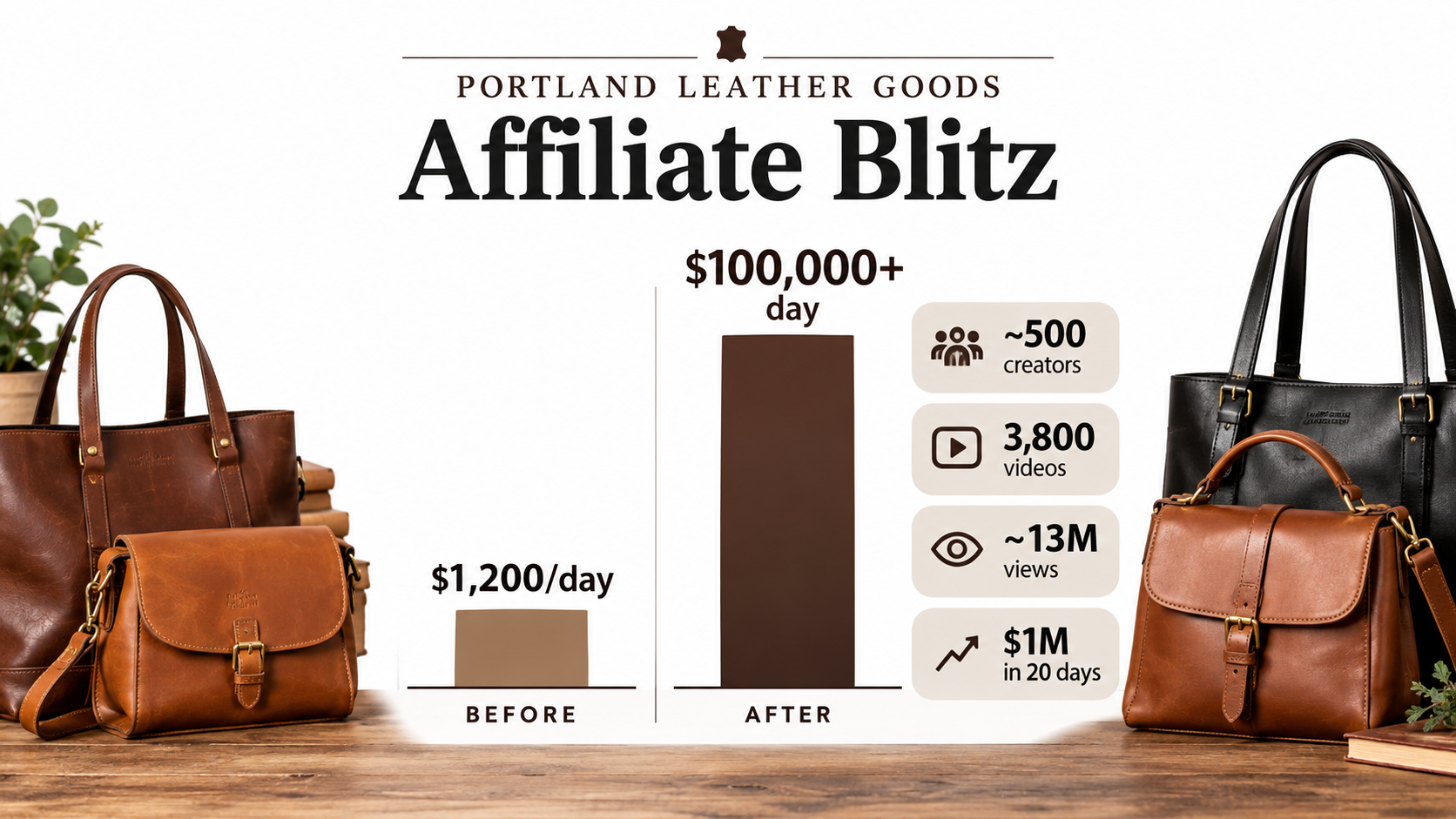
Portland Leather Goods saw a similar curve on purpose. Daily TikTok Shop sales went from about $1,200 to a $100,000 day. That’s close to an 80x jump, driven by a planned creator campaign.
Planning for a range, not a number
Because single-point forecasts don’t hold up on TikTok, experienced operators plan in scenarios:
- Base case: Normal daily run rate from organic and steady affiliate content.
- Lift case: A 5–10x spike from a mid-sized creator hit or a campaign push, lasting several days.
- Breakout case: A 30–100x spike like the Portland example, lasting one to three weeks.
The goal isn’t to stock for the breakout case, which would tie up a lot of cash. The goal is to know ahead of time what you’ll do in each case: how much safety stock you hold, how fast your supplier can turn a reorder, and when you’ll throttle demand.
Levers for throttling demand
When stock is short, you have more options than going out of stock:
- Pause or reduce paid amplification on the SKU while organic demand is already high.
- Pull back promotional discounts so you’re not subsidizing demand you can’t fill.
- Tell affiliates directly about restock dates so they can pause posts or pivot to another SKU instead of sending traffic to an out-of-stock listing.
- Offer bundles or substitute SKUs in live streams to shift demand toward inventory you have.
Supplier conversations to have before you need them
The brands that recover quickly from a sellout usually settled the terms beforehand. That means pre-agreed expedited production slots, raw materials or packaging stored at the factory, and a clear understanding of minimum reorder quantities and lead times. A TikTok spike doesn’t give you three weeks to negotiate. If your co-packer needs eight weeks for a reorder, your viral window will probably close before the stock arrives.
Affiliate Blitzes Are Supply-Chain Events
Affiliate marketing is where TikTok Shop is most different from other marketplaces, and where marketing and operations collide most directly. Delaney Del Mundo, SVP of account strategy for TikTok and Amazon at agency PLTFRM, told Modern Retail that affiliates drive 75–85% of sales for some brands on TikTok Shop. TikTok also reported that the number of creators earning commissions through the platform rose 146% year over year.
Anatomy of the Portland Leather Goods blitz
Portland Leather Goods joined TikTok Shop in February 2026 and ran a seven-day affiliate “blitz” in late March. The mechanics are worth studying:
- About 500 creators signed on as affiliates. Many already owned the bags. The brand gifted product to approved affiliates who didn’t.
- The first 20 creators to post 10 videos with at least 100 views each got $1,000.
- A GMV contest paid $2,000 to $10,000 to the top three creators by sales.
- The push produced nearly 13 million views across 3,800 videos.
- The brand passed $1 million in TikTok Shop sales 20 days after the blitz began.
CMO MacCoy Merkley described the content as unpolished on purpose: “We have people in their living rooms holding up bags they’ve had for years and talking about why they love their bags.”
Why this is an operations problem
Look at the blitz from a warehouse manager’s point of view. Before any sale comes in, you need enough product to gift to hundreds of creators, which is a mini fulfillment wave in its own right. Then 3,800 videos land in one week, and each one can trigger its own spike. Portland Leather Goods is a company with more than $100 million in annual revenue and 17 stores. It could absorb that. A $2 million brand running the same playbook could empty its warehouse in 48 hours.
Merkley said directly that succeeding on the platform requires “nurturing affiliate relationships and figuring out inventory needs.” Those two go together.
Running a blitz without breaking fulfillment
- Size the campaign to your inventory, not your ambition. Estimate the breakout-case volume and make sure you have that stock or a quick path to it.
- Stagger creator waves. Instead of 500 creators posting in the same week, run cohorts of 100 over five weeks. You give up some algorithmic density but get predictable demand.
- Send sample shipments early. Gifting delays compress the posting window and cause a bigger, sharper spike.
- Set up a direct channel with creators. Portland Leather Goods uses WhatsApp groups and one-on-one chats. Those same channels let you warn affiliates about stock levels right away.
- Put incentives in the budget as a cost of goods. Del Mundo said she has seen brands offer down payments on homes and Teslas as affiliate prizes. Whatever you offer, count it in your unit economics, not just your marketing line.
Live Selling as an Operating Rhythm, Not a One-Off Event
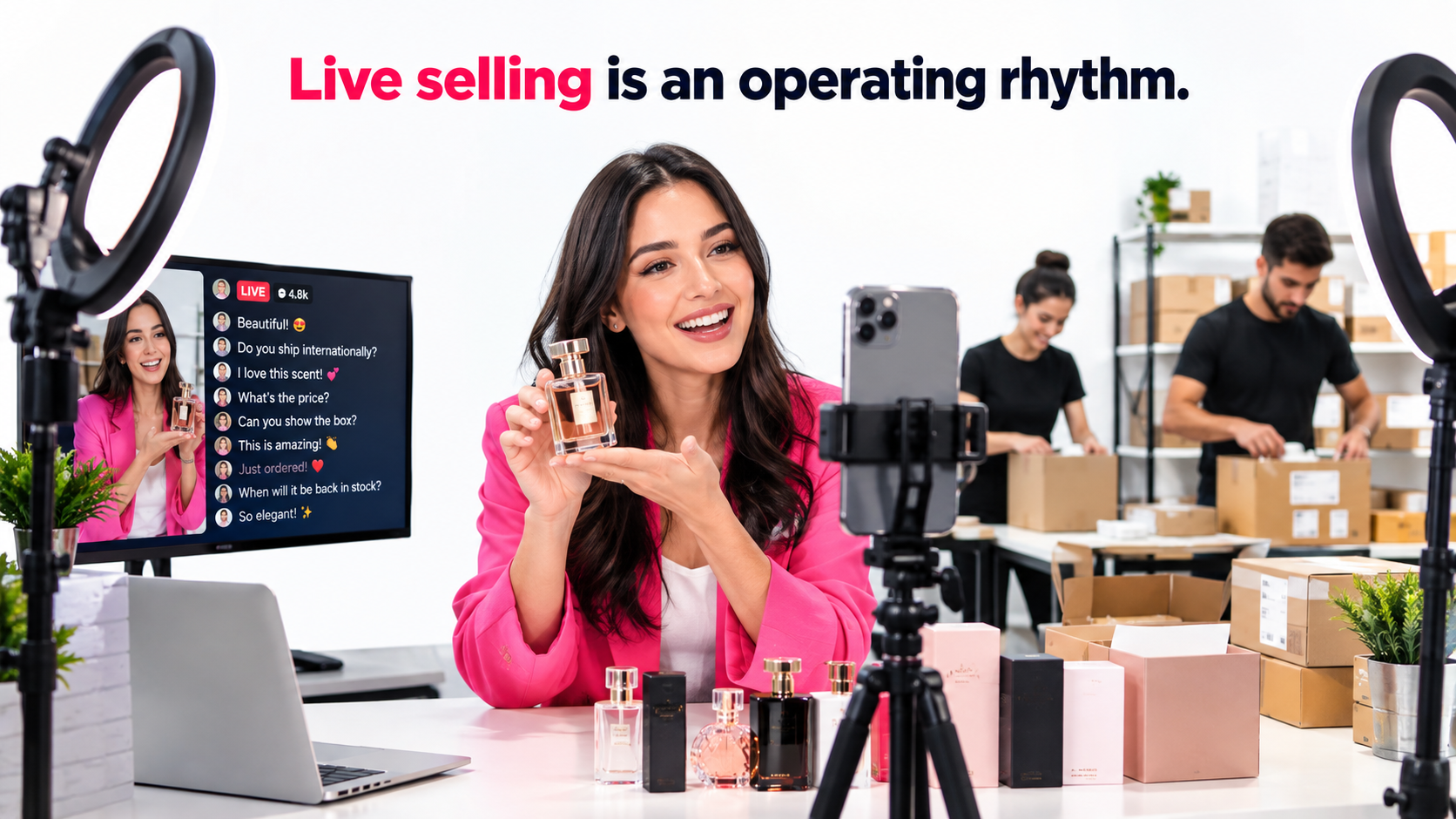
Short videos create spikes. Livestreams, when run consistently, create something closer to a schedule. That’s why more brands treat live selling as infrastructure rather than a campaign.
The case for going live every day
Look at how brands are committing. Crocs’ U.S. business went live on TikTok 24/7 for the entire month of October 2025. Stila Cosmetics built a livestream studio in its office. Fashionphile runs several live shows a day under the name “Fashionphile TV.” TikTok Shop accounts for a little over 25% of Fashionphile’s U.K. business.
In luxury resale, live selling is basically the whole channel. At its first Luxury Resale Summit, TikTok Shop said 94% of U.S. luxury resale revenue year to date came from lives, and luxury resale GMV rose 400% year over year. Rainee Walker, TikTok Shop’s U.S. head of category for luxury resale, explained why: “To convey trust, there needs to be a conversation… where is that conversation happening? It’s happening on live.”
Entertainment is part of the offer
Mavwicks Fragrances founder Megan Reep treats lives as entertainment. During one stream, the brand set up a dunk tank: every bundle sold meant her husband got dunked. “Keeping exciting things happening on screen” helps keep people watching, she said. Mavwicks’ growth from a few hundred thousand dollars to $32 million in its first year on TikTok Shop shows what that approach can do when the back end keeps pace.
What live selling demands operationally
Lives create a different demand pattern from short videos: concentrated bursts during scheduled windows, heavy on bundles and limited-time offers. That’s actually easier to plan for than viral spikes, as long as you set up for it:
- Pre-allocate inventory per stream. Decide how many units of each SKU you’ll offer in a session and cap the listing to match.
- Pre-build bundles as SKUs. Bundles put together on the fly cause picking errors. Set them up as their own SKUs in your system (and in FBT if you use it).
- Staff for the post-live wave. If you ship yourself, a two-hour evening stream can produce a day’s worth of orders due within the two-business-day dispatch window. Schedule packing shifts to match.
- Keep a live operations checklist. Stock checks before the stream, price and voucher checks, a moderator watching comments for product questions, and a post-stream reconciliation of orders against inventory.
A cadence that works for smaller brands
Not every brand can run 24/7 like Crocs. A realistic starting point is three to four scheduled lives a week at consistent times, hosted by a founder or a regular host, each with a clear theme: a new drop, a bundle night, a Q&A, a behind-the-scenes production tour. Behave found that behind-the-scenes factory footage was one of its earliest breakout posts, and that kind of content translates well to live.
High-Ticket and Bulky Goods: TikTok Shop’s Newer Frontier
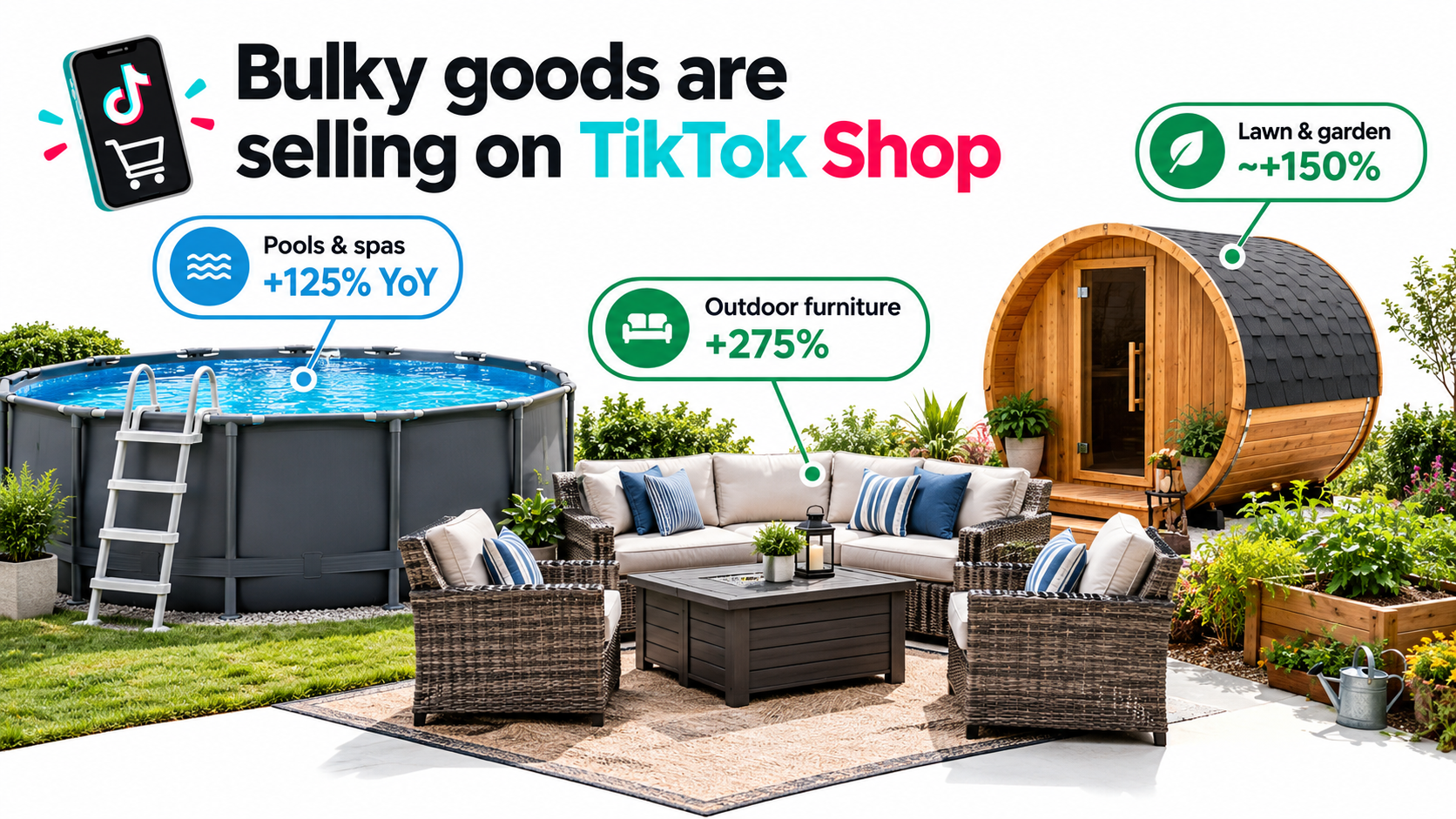
For its first couple of years, TikTok Shop was known for impulse buys: beauty, fashion, gadgets and wellness items under $30. That’s changing. Shoppers are now buying comforters, LED face masks, above-ground pools and saunas.
The numbers from bulky categories
Spreetail, a multi-brand seller and fulfillment partner, shared growth figures for its TikTok Shop home categories with Modern Retail:
- Above-ground pools and spas: up 125% year over year, which Spreetail says is five times the growth it sees on other marketplaces. Pools start around $150. Saunas start around $2,000.
- Outdoor furniture: up 275% year over year.
- Lawn and garden: up nearly 150% year over year.
Spreetail CMO Amit Dodeja said its price points are “probably four to five times higher than the average price point on TikTok Shop.” He credits two things: shoppers trusting the marketplace more as it matures, and the visual format helping people understand products that need more research. He also said “the biggest thing we’ve seen change in the past year is delivery speeds.”
Why bulky goods are harder to operate
Large items raise every operational risk. Dimensional weight pushes shipping costs up. Damage rates rise. Returns are expensive and sometimes not worth doing. The two-business-day dispatch requirement is harder to hit when items ship freight or need special packaging. Mellow Sleep’s Keller named that dispatch window as a real constraint for smaller brands shipping bulky products.
How to sell bulky goods on TikTok Shop without losing money
- Price with fulfillment built in. Bulky goods can’t support the deep discounts common in beauty. Build your price floor around delivered cost, not landed cost.
- Use creators to reduce returns. Video showing real dimensions, assembly and use cuts down on “not what I expected” returns. This is the same trust-building logic that drives luxury resale lives.
- Split fulfillment by geography. Follow Mellow Sleep’s approach and route orders to the node closest to the customer.
- Check packaging before scaling. Run drop tests and track damage claims for the first few hundred orders before pushing affiliate volume.
- Ask for rep support. Keller said TikTok gives early-adopter brands in these categories more direct rep support, which he noted has become harder to get on Meta. Use it to escalate logistics problems quickly.
Margin Math Under Platform-Controlled Logistics
This is where many TikTok Shop sellers get caught. Top-line GMV looks great while contribution margin quietly goes negative. The shipping mandate shifted more of the cost structure onto the platform’s terms, so the math needs a fresh look.
The cost stack you need to model
Fee rates change and vary by category and program, so check current numbers in Seller Center instead of relying on any published figure. The structure of the cost stack, though, is consistent. For every unit sold, account for:
- Cost of goods, including inbound freight.
- Platform referral or commission fee on the sale.
- Affiliate commission, which on affiliate-driven sales can be a large share of revenue.
- Fulfillment cost: FBT fees (by units and size) or your own packing labor plus TikTok-selected carrier charges.
- Storage for inventory in FBT, including aged stock.
- Discount and voucher funding: the part of each promotion you pay for.
- Samples and gifting spread across the units they generate.
- Creator incentives such as contest prizes, bonuses and flat fees.
- Paid amplification on top of organic and affiliate sales.
- Returns and refunds, including units that can’t be resold.
The discount trap
Consultants told Modern Retail that moving to TikTok’s logistics could “squeeze margins and make it harder to offer the steep discounts TikTok shoppers often expect.” That’s the core tension. TikTok’s shopping culture rewards aggressive pricing, and the platform has sometimes co-funded major discounts or free shipping through co-branded programs. Modern Retail’s reporting also suggests those incentives may become less common as the platform matures. Sellers who built their pricing around platform subsidies should expect to fund more of the discount themselves.
Three margin guardrails
- Set a contribution margin floor per SKU after every cost above, and don’t run promotions that push a SKU below it without a clear customer acquisition reason.
- Keep affiliate and ad costs separate. If an affiliate drives a sale, don’t also count the paid boost that amplified that affiliate’s video as though it drove the sale on its own. Blended numbers hide which lever is profitable.
- Track by fulfillment mode. Compare contribution margin for FBT orders against self-shipped orders every month. The hybrid split should follow the data, not habit.
When to accept a thin margin
Not every TikTok Shop sale needs to be highly profitable. Some brands knowingly treat the channel as customer acquisition or retail proof. A Modern Retail podcast discussion noted that companies can lose margin selling on another platform and need to make sure they can take the hit. That’s a legitimate strategy as long as it’s a deliberate choice and not something you find out about at quarter-end.
Staffing the Channel: Why Brands Are Hiring a “Head of TikTok Shop”
As TikTok Shop has grown up, so have the teams behind it. Modern Retail reported that more brands are looking for a dedicated head of TikTok Shop as they try to define their social commerce strategy. Luxury resale coverage noted that many companies are creating these roles because the channel has become important to their business.
Why a single owner matters
TikTok Shop covers areas that usually sit in separate departments: content (marketing), creator relationships (influencer or partnerships), live production (creative), promotions and pricing (ecommerce), and now fulfillment and inventory (operations). When no one owns the full picture, the failures covered above happen by default. Marketing launches a blitz while operations doesn’t know it’s coming.
Functions a TikTok Shop team needs
- Channel lead: Owns channel P&L, the promotion calendar and cross-team coordination.
- Affiliate manager: Recruits, samples, briefs and keeps in touch with creators. At Portland Leather Goods, that means WhatsApp groups and direct conversations.
- Live producer and host(s): Runs the streaming schedule, formats and on-screen talent.
- Content creator or editor: Makes brand-owned short-form video. Behave’s founder posted four to five videos a day for two weeks before her first viral hit.
- Operations and inventory planner: Manages FBT inbound shipments, self-fulfilled orders, forecasting and supplier coordination.
- Customer service: Handles buyer messages, returns and reviews within the platform’s response windows.
At a small brand, one or two people may cover all of these. The point isn’t headcount. Each function needs a clear owner.
Small brands vs. big brands
Modern Retail’s podcast discussion pointed out a real tradeoff. Early TikTok Shop winners were digitally native startups whose playbook of UGC, live shopping and flash sales depended on moving fast and posting authentically. Large multinationals often can’t post as often or as casually because of corporate approval processes. But they may win on price and see a halo effect on other channels.
GlobalData managing director Neil Saunders made the case for smaller brands: “One of the things that really helps the smaller brands on TikTok Shop is authenticity.” Founder-led content is still a real advantage. Operations is where small brands tend to fall short, so that’s where they should put their first operations-focused hire.
TikTok Shop as a Funnel to Retail, Amazon and DTC
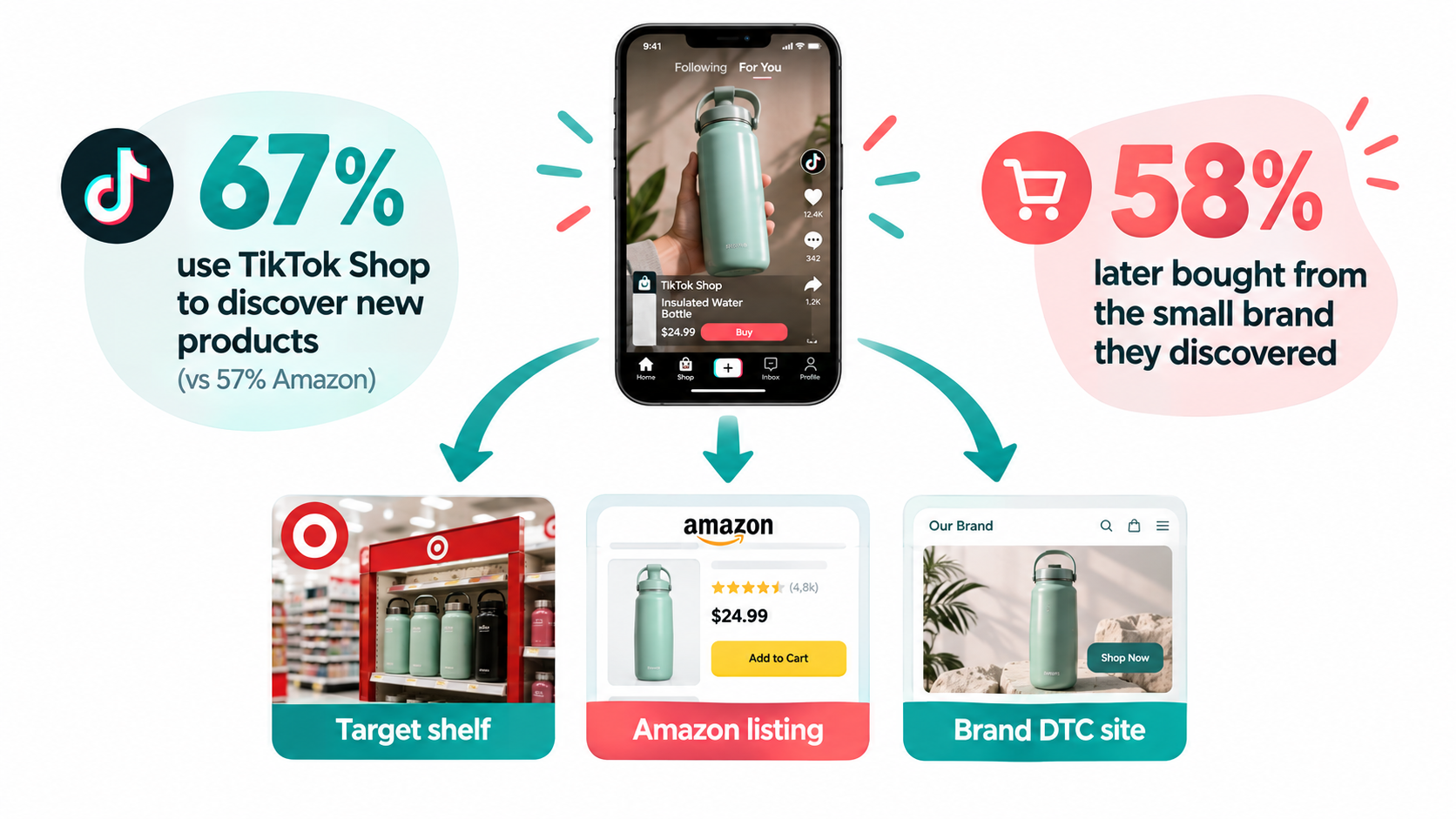
The last operational shift is thinking about TikTok Shop’s role in the whole business, not just as its own P&L. More brands see it as a discovery and validation engine that feeds other channels.
The discovery data
A GlobalData report commissioned by TikTok Shop, based on a survey of 6,000 U.S. consumers aged 16 and older, found:
- 67% of consumers go to TikTok Shop to discover new products and brands, compared with 57% for Amazon.
- 66% of TikTok Shop users discovered a new brand on the platform in the past year.
- 72% of brands discovered were businesses with under $15 million in annual revenue.
- 58% of consumers who discovered a small brand later bought from it on the platform. More than half did so within days, and about one-fifth bought the same day.
- 70% of TikTok Shop consumers have bought a product recommended by a creator.
Since TikTok commissioned the survey, read it as directional. Still, it lines up with what brands report.
From TikTok Shop to the shelf
Behave is the clearest example. Months of cold emails to Target’s candy buyer went unanswered until the Super Sour Skulls sold out in three days. By April 2026, Behave was rolling out in nearly 2,000 Target stores. Chehata said TikTok Shop will now also serve as a marketing channel pushing customers to Target. Ahead of launch, the brand “hammered home that ‘April 12’ date every single day in every video,” because retailers now expect brands to turn a launch into an event that brings shoppers into stores in week one.
Superbloom’s Comba said the platform “compresses the customer acquisition funnel,” putting discovery, validation and purchase in one place. Real-time sales data has become a way to prove demand that retail buyers pay attention to.
The Amazon halo
Modern Retail has also reported that some brands use TikTok Shop specifically to grow Amazon sales. Shoppers who see a product on TikTok but aren’t ready to buy often search for it elsewhere. That’s also why cannibalization is a real concern that the Modern Retail podcast raised: TikTok Shop sales could come at the expense of DTC or Amazon growth.
Operational implications of the funnel view
- Coordinate inventory across channels. A TikTok spike often lifts Amazon and DTC demand too. Stock stuck in FBT can’t cover that, so keep flexible inventory for the halo.
- Measure the halo. Track branded search volume and Amazon sessions before, during and after TikTok campaigns.
- Keep product and packaging consistent so shoppers recognize the item on a shelf or on Amazon. Behave redesigned its sour gummy packaging with warning tape based on customer comments, a change that helps recognition in every channel.
- Treat comments as research. Chehata read and replied to more than 10,000 comments in her first year. That feedback shaped product development and packaging.
A 90-Day Operator Plan for TikTok Shop Selling in 2026
Here’s a sequenced plan that pulls the above into a practical order. It assumes you’re either launching or resetting a TikTok Shop channel after the shipping mandate.
Days 1–30: Set the foundation
- Confirm your fulfillment setup meets TikTok’s logistics requirements: FBT, Upgraded TikTok Shipping, Collections, or an approved integrated tool like AfterShip, 4Seller or ShipHero.
- Build a SKU-level contribution margin model covering every cost in the stack above, and set a margin floor for each SKU.
- Sort SKUs using the fulfillment decision matrix: FBT, self-ship, or hybrid.
- Talk to suppliers about expedited reorder capacity and lead times, and get the answers in writing.
- Pick one owner for the channel, even if it’s a part-time role.
- Start posting brand-owned content every day. Behave’s experience suggests the first breakout can take a couple of weeks of steady posting.
Days 31–60: Build demand in controlled waves
- Recruit your first affiliate cohort, starting with existing customers and fans, the approach Portland Leather Goods used.
- Send samples in staggered batches and set up a direct communication channel with creators.
- Start a regular live schedule of three to four sessions a week with pre-allocated inventory and pre-built bundle SKUs.
- Write down your base, lift and breakout scenarios and the throttling steps for each.
- Move proven fast-moving SKUs into FBT based on real sell-through data.
Days 61–90: Scale what the numbers support
- Run a focused affiliate push with performance incentives, sized to the inventory you can actually deliver.
- Compare contribution margin by fulfillment mode and adjust the hybrid split.
- Measure halo effects on Amazon, DTC and retail sell-through.
- Review customer comments and return reasons for product, packaging and listing fixes.
- Decide on purpose whether TikTok Shop is a profit center, an acquisition channel, or a retail proof point, and set your promotion strategy to match.
Warning signs to watch throughout
- Late dispatches or cancellations climbing during spikes.
- Affiliates posting about SKUs that are out of stock.
- GMV rising while contribution margin falls.
- FBT inventory aging while other channels are short on the same SKU.
- Return rates rising on bulky or high-ticket items.
Conclusion: The Brands That Last Are Built Behind the Camera
TikTok Shop selling in 2026 isn’t the same channel it was when it launched in the U.S. in 2023. It’s bigger, with sales projected to pass $20 billion this year. It has more competition, with big brands nearly doubling their sales and joining a growing base of more than 215,000 small businesses. And after the end of independent shipping, the platform controls far more of the process.
None of that makes it a worse channel. It makes it a more demanding one. The front-end skills still matter: authentic founder content, strong creator relationships, entertaining live streams. But the difference between a viral moment and a durable business is now mostly decided behind the camera.
Key takeaways
- Treat fulfillment as a strategic choice. Use FBT where velocity and size make it worthwhile, ship bulky or uncertain SKUs yourself through TikTok shipping, and let the data guide the split, as Mellow Sleep does.
- Plan for spikes in scenarios. Know your throttling levers before you need them, and have supplier reorder terms settled in advance.
- Size affiliate campaigns to inventory. Portland Leather Goods’ blitz worked because the company could deliver. Stagger creator waves if your stock is limited.
- Run live selling on a schedule. Pre-allocate stock, pre-build bundles, and staff for the post-stream packing wave.
- Protect contribution margin. Model the full cost stack and expect platform-funded discounts to become less common.
- Give the channel one owner. Marketing, creators, live, pricing and operations all have to connect.
- Measure the whole funnel. TikTok Shop can feed Target shelves and Amazon listings. Track the halo and coordinate inventory to match.
The algorithm will keep changing, and trends will keep moving on. The operating system you build around the channel is what you actually keep. Brands that treat TikTok Shop as an operations business that happens to run on video are the ones still growing after the viral spike fades.