

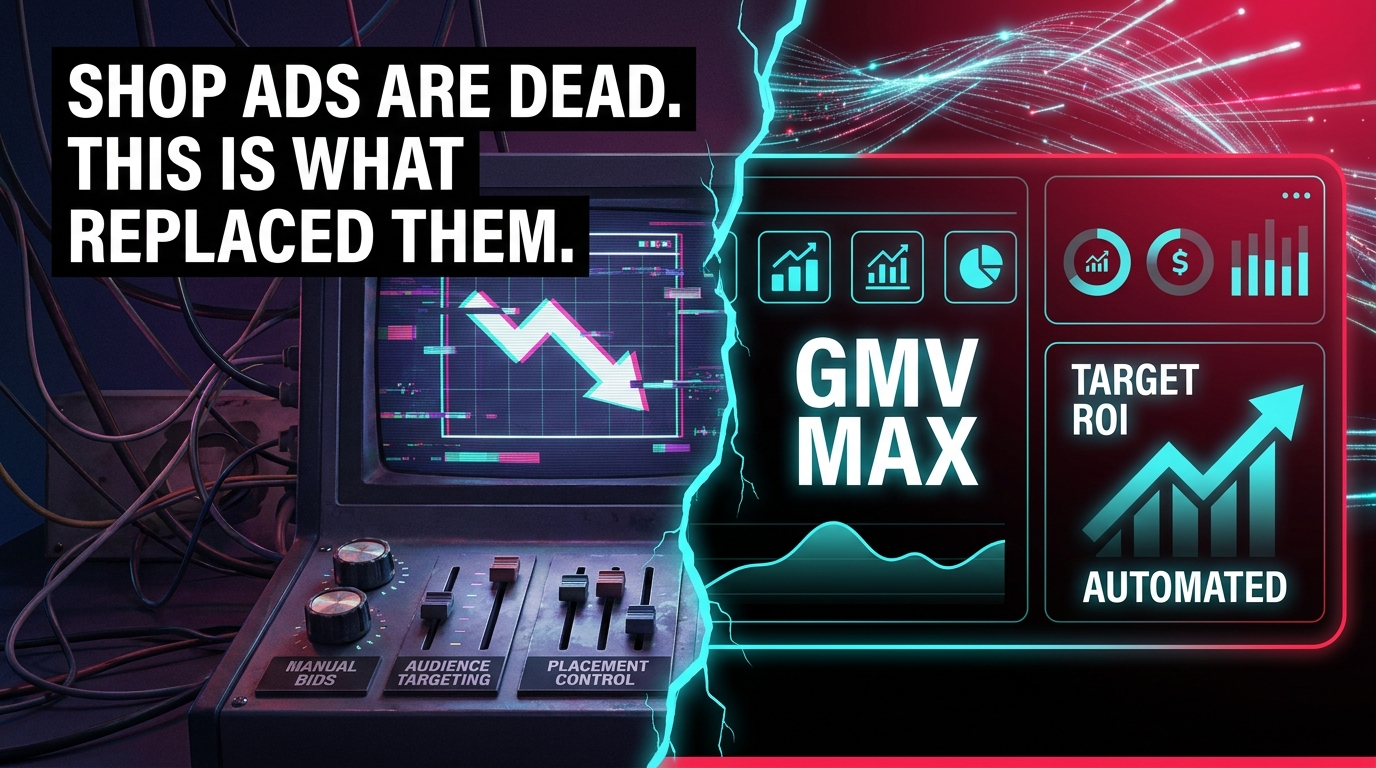

In July 2025, TikTok quietly dismantled its entire manual Shop Ads infrastructure. No big announcement. No transition campaign. Just a product policy update that told advertisers they could no longer create, edit, or duplicate LIVE Shopping Ads, Product Shopping Ads, or Video Shopping Ads when TikTok Shop was their sales destination. GMV Max was now the only supported campaign type under the Sales objective for TikTok Shop.
That change has been in effect for nearly a year, and the confusion hasn’t fully settled. Sellers still ask which ad type to run. Agencies still pitch “Shop Ads” strategies. And a surprising number of brands are running GMV Max without understanding what it actually optimizes for — or why their reported ROAS looks suspiciously good while their margins don’t reflect it.
This post is not a comparison of two equivalent formats. Manual Shop Ads no longer exist as a forward path. What this is instead is a full dissection of the TikTok Shop ad stack as it stands in 2026: what GMV Max is at an architectural level, what it replaced and why, how its two operating modes behave differently, where Search Ads and Spark Ads still fit into the picture, and — critically — where the system fails and why most advertisers don’t see it coming until it’s too late.
If you want to run TikTok Shop ads effectively this year, you need to understand the machine you’re feeding. Let’s start from the beginning.
What the Old Manual Shop Ads Stack Actually Was
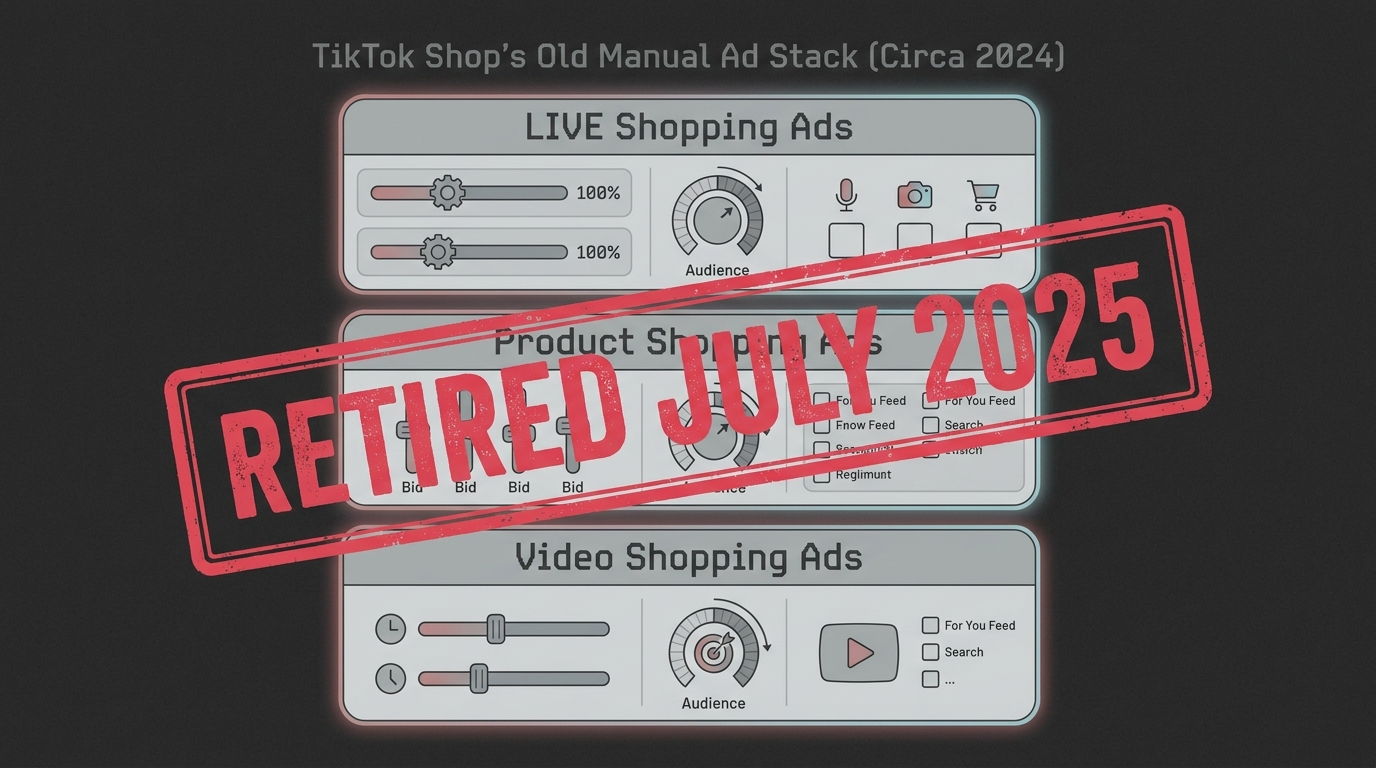
Before July 2025, TikTok’s Shop ad stack was built around three distinct campaign formats that sellers could configure and control manually through Ads Manager. Understanding what these formats were — and what control they offered — is essential context for understanding what GMV Max took away and what it replaced with automation.
The Three Retired Formats
Product Shopping Ads were catalog-driven ads that surfaced product listings in TikTok’s For You feed and shopping tab. Advertisers could select specific SKUs, set bids manually, define target audiences by interest and demographic, and choose placements. These were closest to Google Shopping in structure: keyword-adjacent, SKU-specific, and measurable at the ad-group level.
Video Shopping Ads allowed brands to attach a shoppable product link directly to a video creative. Advertisers wrote the creative, chose the audience, set the bid strategy (cost cap or bid cap), and decided where the ad appeared. The format gave brands full creative control and the ability to A/B test audiences against the same video at the campaign level.
LIVE Shopping Ads drove traffic into a brand’s ongoing TikTok LIVE stream. When live commerce was growing fast in 2024, this format was powerful — you could funnel a warm paid audience into a real-time selling environment with a host, product demos, and time-limited offers. But it required a live operation to feed it, making it the most operationally demanding format in the stack.
What Manual Control Actually Meant
All three formats shared a common structure: advertiser-defined audiences, manual bid settings, selectable placements, and campaign-level budget control. You could run a $50/day campaign targeting women aged 25–34 interested in skincare, with a $1.20 cost-cap bid, showing only in the For You feed, against a specific video creative. Every variable was a dial you turned.
That kind of granularity sounds appealing, but it came with real limitations. TikTok’s discovery algorithm is notoriously hard to outmaneuver with manual audience definitions. The platform’s native behavior — where content finds its audience rather than audiences finding content — sits in tension with traditional ad targeting logic. Manual bids often suppressed delivery when TikTok’s algorithm wanted to explore broader audiences. And creative performance on TikTok degrades faster than on almost any other platform, which meant constant creative iteration was required to keep manual campaigns efficient.
The result was a system that demanded a lot of operator skill for results that were often inconsistent. By mid-2025, TikTok had seen enough performance data across enough advertisers to make a call: manual control was holding brands back, and the algorithm could do better if given the keys.
Why TikTok Pulled the Plug on Manual Shop Ads
The transition to GMV Max wasn’t arbitrary, and it wasn’t purely altruistic. TikTok had both a performance argument and a commercial argument for forcing advertisers off manual formats.
The Performance Argument
TikTok’s ad delivery algorithm operates on an enormous amount of real-time behavioral signal. It knows what content people watch to completion, what they click, what they add to cart, and what they actually buy. When human advertisers manually defined audiences and bids, they were essentially putting guardrails on an algorithm that could route more efficiently without them.
The data TikTok had accumulated by 2025 showed a clear pattern: automated, objective-based campaigns that let the algorithm find buyers consistently outperformed manually targeted ones once sufficient conversion data was in the system. This isn’t unique to TikTok — Meta’s Advantage+ Shopping Campaigns and Google’s Performance Max both made the same bet on automation, and both have largely validated it in aggregate performance studies. TikTok was following a proven industry direction.
The Commercial Argument
There’s also a platform economics angle that shouldn’t be ignored. Manual campaigns with hard bid caps create pricing floors that protect advertisers but constrain TikTok’s auction revenue. A system optimized purely for GMV — where the platform takes a cut of sales rather than just selling clicks — aligns TikTok’s incentives more directly with seller outcomes. If the brand sells more, TikTok earns more. That shared-upside dynamic is structurally different from a CPM or CPC model, and it gives TikTok a strong reason to make GMV Max perform well.
What Discovery-Native Means for Ad Architecture
Perhaps most importantly, TikTok is structurally different from intent-based platforms. On Google, someone types “best moisturizer for dry skin” — there is a declared intent signal that manual targeting can leverage. On TikTok, the algorithm surfaces a moisturizer video to someone who never searched for it but whose behavior pattern suggests they’re likely to buy. That’s a discovery-native dynamic, and it rewards algorithmic decision-making over human categorization. Manual Shop Ads were a layer of intent-based thinking applied to a discovery-native surface. GMV Max drops that assumption and lets the system find buyers wherever they are.
GMV Max From the Ground Up: How the Engine Actually Works

GMV Max is not simply a renamed version of the old automated sales campaign. It’s a fundamentally different product with a different optimization objective, a different relationship to organic content, and a different accountability model than anything that came before it in TikTok’s ad stack.
The Core Optimization Target
The clue is in the name. GMV Max is optimizing for Gross Merchandise Value — total purchase revenue generated through your TikTok Shop. This is different from optimizing for clicks, impressions, or even ROAS in the traditional sense. The system is not asking “what’s the cheapest click that might convert?” It is asking “what combination of placements, creative, and audience will generate the most total purchase value at or above a target return threshold?”
That’s a fundamentally different objective function, and it changes which campaigns succeed and which don’t in ways that aren’t always intuitive. A campaign with a very high click-through rate but low average order value might score poorly under GMV Max. A campaign with a moderate CTR but high-ticket items and strong conversion might dominate the auction.
The Three Levers You Actually Control
Under GMV Max, the campaign setup is notably sparse compared to what manual Shop Ads offered. Advertisers set three primary inputs:
- Daily budget: The platform minimum is approximately $50/day, but most practitioners recommend $100/day or higher to exit the learning phase with statistically meaningful data within a reasonable timeframe. Underfunded campaigns tend to stall during learning and produce misleading results.
- Target ROI: This is your GMV-to-ad-spend ratio target. Set it at 3× and you’re telling the system you want $3 in sales for every $1 spent. The system will prioritize efficiency to hit this threshold before spending budget freely.
- Creative/product pool: The videos and products you make available for the system to use. This is arguably the most impactful input — more on this shortly.
Everything else — audience targeting, placements, bid prices, format selection — is handled algorithmically. You do not choose who sees your ads. You do not set a bid. You do not decide whether your ad appears in the For You feed, search results, or alongside a LIVE stream. GMV Max decides all of that, in real time, based on its objective function.
How It Differs from Meta Advantage+ and Google PMax
The natural comparison is to Meta’s Advantage+ Shopping Campaigns or Google’s Performance Max, both of which similarly consolidate creative inputs and let the algorithm handle distribution. GMV Max shares the same automation philosophy but has a key structural difference: it is explicitly Shop-native. It doesn’t drive traffic to a landing page or a website. It optimizes for in-app checkout on TikTok Shop. That means it has access to TikTok’s full commerce data stack — including purchase history, wishlist behavior, cart abandonment signals, and affiliate creator performance — in a way that neither Meta nor Google has within their own ad products.
GMV Max also has an unusual relationship with organic content. Unlike Performance Max, which operates purely on paid media, GMV Max explicitly surfaces and amplifies organic and affiliate-driven content alongside paid placements. A creator video that’s performing well organically can be picked up by GMV Max and given additional paid distribution — without the brand necessarily having greenlit that specific piece of content for paid promotion. This creates a blurry line between organic and paid that has significant implications for attribution, which we’ll address directly in a later section.
Target ROI Mode vs. Maximum Delivery Mode: The Decision That Defines Your Campaign
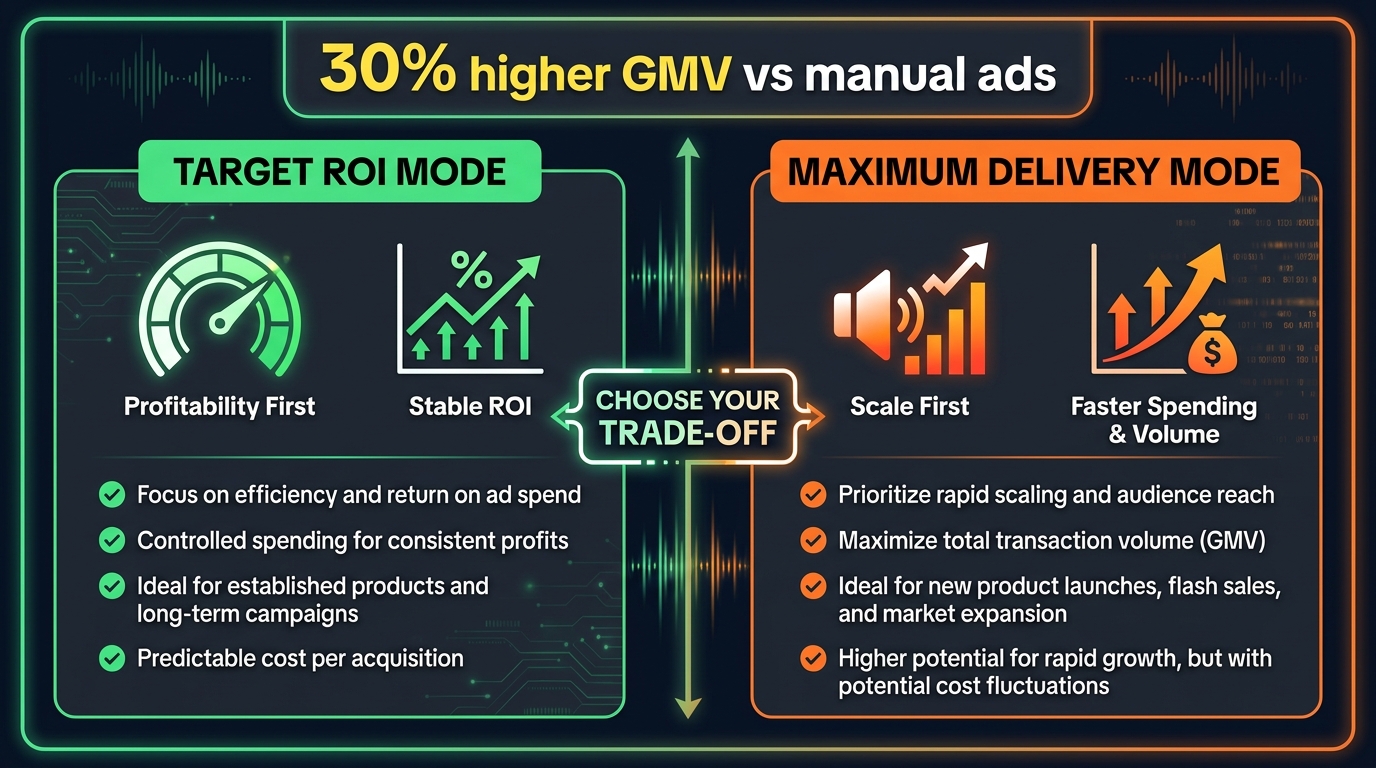
Within GMV Max, advertisers face one meaningful strategic choice: Target ROI mode or Maximum Delivery mode. These aren’t just labels — they produce structurally different campaign behaviors and serve different business objectives. Getting this wrong is one of the most common ways brands misread their GMV Max performance.
Target ROI Mode: Efficiency as the Constraint
When you set a Target ROI, you’re giving the system a profitability floor. The algorithm will throttle delivery and prioritize auctions where it’s confident your target can be met. This produces a more conservative spend curve — early in the campaign, you may see underdelivery as the system hunts for qualifying traffic. Once it finds efficient pockets of buyers, it accelerates.
The practical profile of a Target ROI campaign: lower initial GMV, slower spend, more stable and predictable margin performance over time. This mode works best when you have a clear break-even ROI target based on actual margin math, when you’re in a competitive category where undisciplined spending could easily go negative, and when you have enough historical data (usually from prior campaigns or organic performance) that the algorithm has some signal to work from on day one.
The risk is setting the target too high at launch. If your target ROI is more ambitious than the product’s actual conversion rate supports, the algorithm may be unable to find enough qualifying traffic to spend your budget at all. You’ll see underdelivery and assume the campaign isn’t working. Often, it’s simply that you’ve set a threshold the market can’t yet validate.
Maximum Delivery Mode: Volume as the Priority
Maximum Delivery removes the profitability floor. The system spends your budget aggressively to generate as much GMV as possible, regardless of whether each auction hit your ideal ROI target. This produces a higher-volume spend curve, faster data accumulation during the learning phase, and higher GMV numbers — at the cost of potentially inefficient early spending.
Experienced practitioners often recommend starting with Maximum Delivery for the first two to four weeks of a new GMV Max campaign specifically to accelerate learning. The algorithm needs conversion data to model your buyers effectively. Restricting it with a tight ROI target early on slows data collection and extends the learning phase — sometimes indefinitely for products with low daily conversion volumes.
The Recommended Transition Path
The pattern that consistently emerges from 2026 campaign data is a two-phase approach: launch on Maximum Delivery to exit the learning phase quickly (typically requiring 50+ conversions over a 7-day window for meaningful learning), then migrate to Target ROI once the campaign has a statistical baseline. From that point, adjust the target incrementally — no more than 10–15% at a time — to avoid triggering a new learning phase each time.
Making large changes to budget, target ROI, or creative pool during the learning phase is one of the most reliable ways to extend poor performance. Every significant edit resets the algorithm’s confidence in its delivery model. This is the core patience problem with GMV Max: the system asks advertisers to sit on their hands during a period when the data looks bad, and most advertisers can’t resist intervening.
The Content Pool Problem: Why GMV Max Runs on Creative, Not Cash
Here is the most underappreciated structural truth about GMV Max in 2026: your budget ceiling is not your real constraint. Your content pool is. An advertiser with $500/day and 10 mediocre videos will consistently underperform an advertiser with $150/day and 50 diverse, high-performing creator videos. The algorithm can only amplify what you give it, and it needs volume and variety to find what works.
Why Content Volume Matters at the Algorithm Level
GMV Max uses your available creative assets to run multivariate testing at a scale no human team could replicate manually. It’s simultaneously testing how different videos perform across different audience segments, placements, and time-of-day patterns. The more distinct creative inputs it has access to, the wider the optimization surface it can explore.
With 10 videos, the algorithm might find 2–3 solid performers and exhaust them quickly, leading to creative fatigue and declining performance within weeks. With 50+ videos across different hooks, formats, creators, and product angles, it has a much larger surface to work with — and the ability to rotate creatives as individual pieces burn out without campaign-level performance degrading.
The working benchmark in 2026 practitioner guidance is a minimum of 15–20 videos to launch a GMV Max campaign with any confidence, and a target of 50+ for accounts that want to scale sustainably. That’s not 50 polished brand productions — it’s 50 distinct pieces, most of which should be creator-led or affiliate-generated content that looks and feels native to TikTok rather than produced.
Affiliate Creators as Fuel
This is where TikTok Shop’s affiliate creator ecosystem becomes structurally significant rather than just a nice-to-have. Affiliate creators produce content independently and earn a commission on sales they drive. For GMV Max purposes, their videos become part of the brand’s addressable content pool — content the algorithm can amplify without the brand having to produce it.
In the U.S. market, affiliate and creator content accounts for approximately 42% of total TikTok Shop GMV. That number tells you something important: this content format isn’t supplementary to the commerce system, it’s load-bearing. Brands that build active affiliate programs are effectively crowdsourcing their content pool and letting GMV Max use the resulting volume to find winners at scale.
The practical implication is that your content strategy and your ad strategy are no longer separable. Brands that treat them as separate functions — a marketing team managing ads, a content team managing creators — consistently underperform brands that integrate the two into a unified creative pipeline feeding GMV Max.
LIVE as a Signal Multiplier
LIVE shopping contributes roughly 26% of TikTok Shop GMV in the U.S. market, and it converts at significantly higher rates than feed content. Within GMV Max, LIVE sessions act as signal multipliers: when a LIVE is performing well, the algorithm can route additional paid traffic into the session in real time, amplifying the conversion environment rather than a static ad. LIVE Shopping Ads as a standalone campaign type no longer exists, but the LIVE session itself remains one of GMV Max’s highest-performing targeting surfaces when the underlying operation is solid.
The caveat is that LIVE requires real operational infrastructure: a competent host, a production setup, product inventory on hand, and the ability to run sessions consistently (not just occasionally). Brands that run LIVE sessions once a month and expect GMV Max to amplify them will be disappointed. The algorithm rewards consistency and session quality, not one-off events.
The Attribution Trap: What GMV Max Tells You vs. What’s Actually True
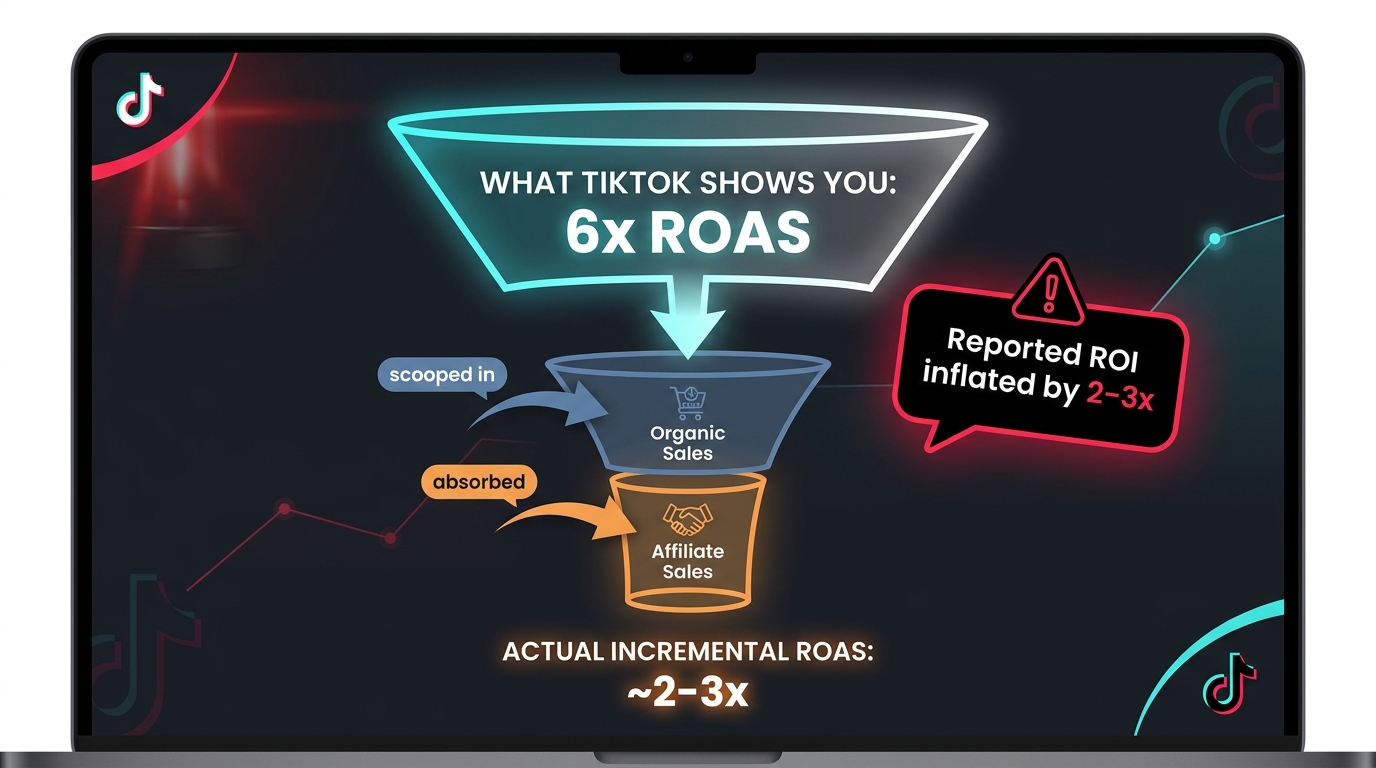
If there is one thing that experienced TikTok Shop advertisers consistently flag in 2026, it is this: your GMV Max ROAS in TikTok Ads Manager is not your actual ROAS. The gap between reported performance and true incremental performance is not a minor accounting difference — it can be 2–3× in either direction, and misreading it leads to both over-investment in underperforming campaigns and premature scaling of numbers that don’t reflect business reality.
How GMV Max Defines “Total Channel ROI”
TikTok explicitly positions GMV Max as an optimization solution for your TikTok Shop’s total channel ROI, not your paid-only ROAS. That distinction is critical. The reported ROI calculation includes GMV from:
- Direct paid ad clicks that led to purchases
- Organic views of content the algorithm amplified as part of the campaign
- Affiliate creator sales that GMV Max surfaced to additional audiences
- LIVE purchases that occurred during algorithmically-boosted sessions
In other words, GMV Max takes credit for sales that would have happened anyway through organic discovery or affiliate channels, as long as those sales occurred within a conversion window that the system attributes to campaign activity. The result is a reported ROI number that looks strong partly because it’s absorbing baseline organic performance and calling it incremental ad revenue.
The 2–3× Inflation Problem
Current practitioner analysis suggests that GMV Max’s reported ROI overstates true incremental performance by approximately 2–3× for mature shops with established organic and affiliate presence. A campaign reporting 6× ROAS might actually be driving 2–3× when you isolate only the purchases that would not have occurred without the paid campaign. For brands with strong organic baseline, the inflation factor is larger. For brands that are purely paid with no organic presence, the reported number is closer to reality.
This matters enormously for budget decisions. If you’re scaling a GMV Max campaign based on a 6× ROAS and your true incremental ROAS is 2×, you may be dramatically overspending relative to your actual cost per acquired customer. Conversely, brands that shut down GMV Max campaigns because “ROAS looked low at 3×” may actually be killing a campaign with 1.5× incremental performance that was still profitable.
Correcting for Attribution Inflation
Advanced brands are addressing this with three tactics. First, geo holdout tests: run GMV Max in a subset of regions and compare TikTok Shop performance in those regions versus control regions where ads are off. The GMV delta between test and control is your true incremental lift. Second, platform-level ROAS discounting: apply a consistent discount factor (typically 40–60%) to reported ROAS when making investment decisions, calibrated against any holdout tests you’ve run. Third, third-party attribution: tools like Triple Whale, Northbeam, or SourceMedium measure TikTok Shop’s contribution to revenue using independent data modeling rather than TikTok’s native attribution.
None of these are perfect solutions, but any of them is better than taking reported GMV Max ROAS at face value. The platforms that are winning in 2026 are the ones that have built measurement infrastructure that treats TikTok Ads Manager as one data source among several — not as the definitive answer.
Where Search Ads and Spark Ads Still Fit in the Stack
GMV Max is the core of the TikTok Shop ad stack, but it is not the entire stack. Two other formats remain viable and strategically important: TikTok Search Ads and Spark Ads. Understanding where each one adds value — and where it doesn’t — prevents both under-utilization and budget misallocation.
TikTok Search Ads: The Intent Capture Layer
TikTok Search Ads appear in TikTok’s search results when users query for specific terms. This is the closest thing TikTok has to Google’s keyword-intent model. Someone searching “viral lip gloss TikTok” or “best protein powder review” is in an active discovery or evaluation mode — higher purchase intent than the typical passive For You feed viewer.
In 2026, Search Ads have become meaningfully more capable. TikTok’s search volume has grown as the platform increasingly functions as a product discovery engine for younger buyers. Roughly 40% of Gen Z users use TikTok as their primary product research tool, which means search intent on the platform is real and commercially valuable.
Search Ads should be treated as a supplementary intent-capture layer, not a GMV Max replacement. Use them to protect branded keywords (competitors can bid on your brand name), capture high-intent category searches where your products are strong, and reach buyers who are already in purchase mode. Budget allocation for Search Ads typically runs 15–25% of total TikTok Shop ad spend for brands with meaningful search volume around their category.
Spark Ads: The Creative Amplification Tool
Spark Ads allow brands to put paid budget behind existing organic TikTok posts — either their own content or a creator’s post (with permission). When a piece of organic content is working — generating strong engagement, watch time, and organic conversions — Spark Ads amplify it to a broader audience while preserving the native, non-ad feel that makes TikTok content convert.
Spark Ads are not a campaign type in the way GMV Max is. They’re a creative format option. In practice, the most effective use of Spark Ads in 2026 is as a validation-then-scale workflow: let a video run organically, identify top performers by conversion rate and engagement data, then use Spark Ads to put meaningful budget behind those proven pieces before feeding them into GMV Max’s content pool. This produces a pre-validated creative library rather than a collection of untested assets that the algorithm has to sort through from scratch.
The Right Sequencing
The relationship between these formats works best when you think about them as sequential rather than parallel. Organic and affiliate content performs first. Spark Ads identify and amplify winners from that pool. GMV Max uses the proven content at scale, with Search Ads capturing any residual high-intent demand that GMV Max’s discovery-native model might miss. Running all four formats simultaneously from day one without the organic foundation in place is one of the most common expensive mistakes in TikTok Shop advertising.
What GMV Max Actually Breaks: The Failure Patterns to Know
GMV Max works. When it’s set up correctly, with the right inputs, at the right budget level, with adequate patience during the learning phase, it delivers results that manual Shop Ads couldn’t match. But it breaks in specific, predictable ways that are overwhelmingly the result of bad inputs and impatient management — not fundamental flaws in the system.
Failure Pattern 1: The Over-Tightened ROI Target
Setting a Target ROI too high relative to what your product can actually convert at is the single most common GMV Max failure mode. If your product’s realistic conversion rate supports a 3× ROI, launching with a 6× target means the algorithm can almost never find qualifying traffic, the campaign barely spends, and within a week or two the advertiser concludes that GMV Max “doesn’t work.” The fix is to set your initial Target ROI conservatively — slightly above break-even rather than at your aspirational target — and increase it gradually as the campaign accumulates conversion data that proves it can hit higher efficiency levels.
Failure Pattern 2: The Underfunded Learning Phase
GMV Max needs conversion data to model your buyers. Industry guidance suggests a minimum of 50 conversions within a 7-day window for the algorithm to exit learning with confidence. At a $50/day budget with a 1% conversion rate and a $30 average order value, you’d generate roughly $350 in daily GMV and perhaps 11–12 conversions per day. That’s a borderline learning budget — it might work, it might not. Brands that launch GMV Max at the absolute platform minimum and then evaluate it after one week are consistently making decisions on statistically insufficient data.
Failure Pattern 3: Constant Intervention
Every significant change to a GMV Max campaign — budget adjustment above a certain threshold, target ROI change, large additions or removals from the creative pool — can trigger a partial or full reset of the learning phase. Advertisers who check campaign performance daily and make adjustments in response to normal variance are inadvertently extending the period of poor performance they’re trying to fix. The discipline required to run GMV Max well is the discipline to not touch it. Set it up correctly, give it the learning window, and evaluate after a statistically meaningful period — typically 14–21 days minimum for a new campaign.
Failure Pattern 4: Launching Before Product-Creator Fit
GMV Max is a scaling tool. It amplifies what’s already working. If you don’t have organic content or affiliate videos that are generating meaningful engagement and some conversions, launching GMV Max gives the algorithm nothing good to amplify — it will test assets that haven’t been pre-validated by real audience behavior, spend budget inefficiently during this testing period, and produce weak results that look like platform failure. The correct prerequisite for GMV Max is a content pool that includes at least some pieces with demonstrated organic traction. GMV Max scales winners; it doesn’t create them from scratch.
Failure Pattern 5: Poor Margin Planning
This one is operational rather than algorithmic, but it contributes to GMV Max failures in ways that aren’t immediately obvious. GMV Max’s optimization goal is to maximize gross merchandise value. It doesn’t know what your unit economics look like. If you have products with very different margins in the same campaign, the algorithm may aggressively promote high-GMV but low-margin SKUs and under-promote high-margin SKUs — because it’s optimizing for revenue, not profit. Brands with complex catalogs should consider running separate GMV Max campaigns for different product tiers or margin profiles, rather than letting the algorithm select freely from the full catalog.
Building Your TikTok Shop Ad Stack for 2026: A Maturity-Based Framework
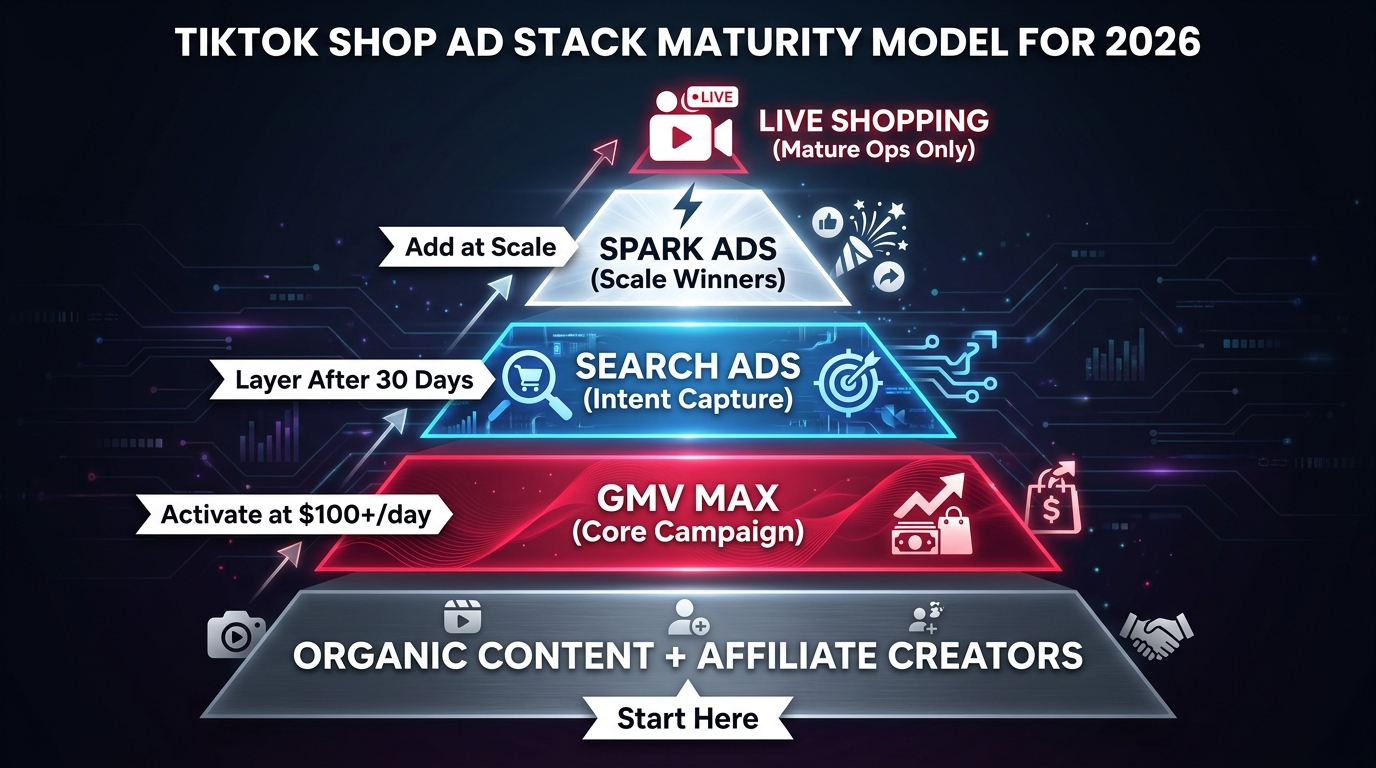
Given everything above, here is a practical, maturity-based framework for building your TikTok Shop ad stack in 2026. This is not a one-size-fits-all prescription — it’s a sequencing model that reflects how each component of the stack depends on the infrastructure below it.
Stage 1: Foundation (Months 1–2) — Build the Content Layer First
Before any paid ads, your priority is building the organic and affiliate content foundation that GMV Max will eventually amplify. This means seeding your TikTok Shop with at least 15–20 original videos across different product angles, hooks, and formats. Simultaneously, activate your TikTok Shop affiliate program and recruit at least 20–30 creators in your niche to produce their own content. Your target is 50+ distinct videos across your own content and creator contributions.
During this phase, monitor organic performance carefully. You’re looking for content with above-average view completion rates (above 50% completion is a positive signal) and any organic purchases. These early performance signals will tell you which product angles and creative styles resonate before you put paid budget behind them.
Stage 2: Activation (Month 2–3) — Launch GMV Max with Maximum Delivery
Once you have a meaningful content pool (minimum 15–20 videos, ideally 30+), launch your first GMV Max campaign on Maximum Delivery mode. Budget recommendation: $100/day minimum, $200/day if your product price point is above $50 and you want to exit the learning phase within two weeks.
Set no Target ROI for the first two weeks. Let the algorithm collect conversion data without a profitability constraint. Your job during this phase is to monitor learning phase indicators (TikTok will show you when the campaign is in or out of learning), keep your creative pool fresh with at least 5–10 new videos per week, and resist the urge to make substantive campaign edits.
After 14 days and at least 50 conversions, evaluate whether the GMV and cost per purchase align with your economics. If they do, introduce a Target ROI slightly below your break-even multiple. If they don’t, extend the Maximum Delivery phase and look at your content pool for weaknesses before adjusting the campaign.
Stage 3: Layering (Month 3+) — Add Search Ads and Spark Ads
With a functioning GMV Max campaign producing data, you now have enough signal to make informed decisions about supplementary formats. Run Search Ads against your strongest category and branded keywords, starting with a conservative $30–50/day budget and expanding based on ROAS data. Use Spark Ads to put additional weight behind your 3–5 best-performing organic or creator videos — the ones that have generated the highest conversion rates and engagement organically.
At this stage, your stack looks like: GMV Max as the primary demand-generation and conversion engine (60–70% of budget), Search Ads capturing high-intent queries (15–25% of budget), and Spark Ads amplifying proven creative (10–15% of budget). Adjust these proportions based on performance data, not convention.
Stage 4: LIVE Commerce (When Operationally Ready)
Add LIVE shopping to your stack only when you have a genuine live operation: a host or team capable of running sessions at least 3–4 times per week, a production setup that meets TikTok’s quality standards, and product inventory managed to handle real-time demand spikes. LIVE is not a plug-and-play addition — it’s a separate operational discipline. When it’s working, GMV Max’s ability to route paid traffic into live sessions makes it one of the highest-converting surfaces on the platform. When it’s not working (poor host performance, infrequent sessions, inventory problems), it drains budget without meaningful return.
Measurement Infrastructure Throughout
Regardless of which stage you’re at, establish independent measurement from the start. Set up at least one third-party attribution tool to track TikTok Shop’s contribution to revenue independently of TikTok’s native reporting. Run geo holdout tests every quarter if budget allows. Apply a consistent ROAS discount factor when making scaling decisions. The brands that scale TikTok Shop profitably in 2026 are those that treat measurement as a prerequisite, not an afterthought.
The Metrics That Actually Matter in a GMV Max World
The shift to GMV Max has made some traditional ad metrics less useful and elevated others that most advertisers haven’t historically prioritized. Knowing which numbers to track changes how you diagnose and improve campaigns.
Metrics That Lost Their Meaning
CPM and CPC are largely irrelevant in GMV Max. You don’t control placement or bid, so optimizing for a lower cost per click tells you nothing actionable. Similarly, CTR is a secondary signal at best — GMV Max optimizes for purchase, not click. A video with a modest CTR but high purchase conversion rate will outperform a high-CTR video that doesn’t convert.
Metrics That Now Matter Most
Cost per purchase and GMV per day are the primary campaign health indicators. Video view completion rate (particularly 50%+ completion) is the leading indicator of creative quality. Product video conversion rate (views-to-purchases on specific video/product combinations) helps you identify which creative assets the algorithm should be prioritizing.
At the account level, new customer ratio is critically important. GMV Max’s optimization can be satisfied by re-selling to existing customers, especially if they’re high-converting — but that’s retention revenue, not growth. Monitoring new vs. returning customer GMV tells you whether GMV Max is actually expanding your customer base or just mining the existing one.
Finally, track learning phase duration. A campaign that consistently struggles to exit learning despite adequate budget and conversion volume is signaling that the creative pool is insufficient, the Target ROI is too restrictive, or the product lacks the market demand needed for the algorithm to build confidence.
Conclusion: Working With the Machine, Not Against It
The transition from manual TikTok Shop Ads to GMV Max represents a genuine shift in what it means to advertise on TikTok. The old model rewarded advertisers who understood audience targeting and bid strategy. The new model rewards advertisers who understand creative systems, content operations, and measurement discipline.
The manual levers are gone. You don’t choose your audience. You don’t set your bid. You don’t select your placement. What you control is the quality and volume of content you feed the system, the budget you give it to work with, and the patience you bring to its learning process. Those inputs matter enormously — they’re just different from what advertising on TikTok used to require.
The brands succeeding with GMV Max in 2026 share a few consistent traits. They have active affiliate programs producing content at volume. They treat organic performance as a pre-validation layer before spending paid budget. They don’t touch campaigns during learning. They measure incrementally, not from TikTok’s native dashboard alone. And they add layers — Search Ads, Spark Ads, LIVE — sequentially as their foundation proves out, not all at once from the start.
The most common mistake isn’t setting the wrong Target ROI or launching with too little budget. It’s treating GMV Max like a faster, smarter version of the old Shop Ads — as a campaign to configure and tune with media-buying logic. It isn’t. It’s a system that amplifies good inputs. If the inputs are good, the system works. If they aren’t, no amount of campaign-level optimization will fix it.
Key Takeaways
- Manual TikTok Shop Ads are retired. LIVE Shopping Ads, Product Shopping Ads, and Video Shopping Ads for TikTok Shop cannot be created or edited as of July 2025. GMV Max is the only supported campaign type under the Sales objective.
- GMV Max has three real inputs: budget, target ROI, and creative pool. Everything else is algorithmic. Your leverage is in the quality and volume of the creative you provide.
- Start on Maximum Delivery, transition to Target ROI. Let the algorithm gather conversion data without constraints before introducing a profitability floor.
- Your content pool should have 50+ videos before you attempt serious GMV Max scaling. Affiliate creators are not optional; they’re the content engine.
- Reported ROAS is not incremental ROAS. GMV Max absorbs organic and affiliate sales into its attribution model. Discount reported ROI by 40–60% and test incrementality with geo holdouts.
- Don’t touch campaigns during learning. Every major edit resets the learning clock. Give GMV Max at least 14–21 days before drawing conclusions.
- Layer Search Ads and Spark Ads after GMV Max is working, not before. They are supplementary to a functioning core, not substitutes for one.
- LIVE shopping requires real operational infrastructure. Route GMV Max budget into LIVE only when sessions are frequent, high-quality, and consistently managed.