

There is a default state that most Amazon advertisers drift into, and it looks something like this: 85–90% of ad budget funneled into Sponsored Products, a handful of Sponsored Brands campaigns running on autopilot, and a vague sense that “display” is something to think about later. The ACOS looks acceptable. The ROAS holds steady. The account manager reports a green dashboard, and everyone calls it a win.
The problem is that this is not a full-funnel strategy. It is a bottom-funnel trap dressed up as performance advertising.
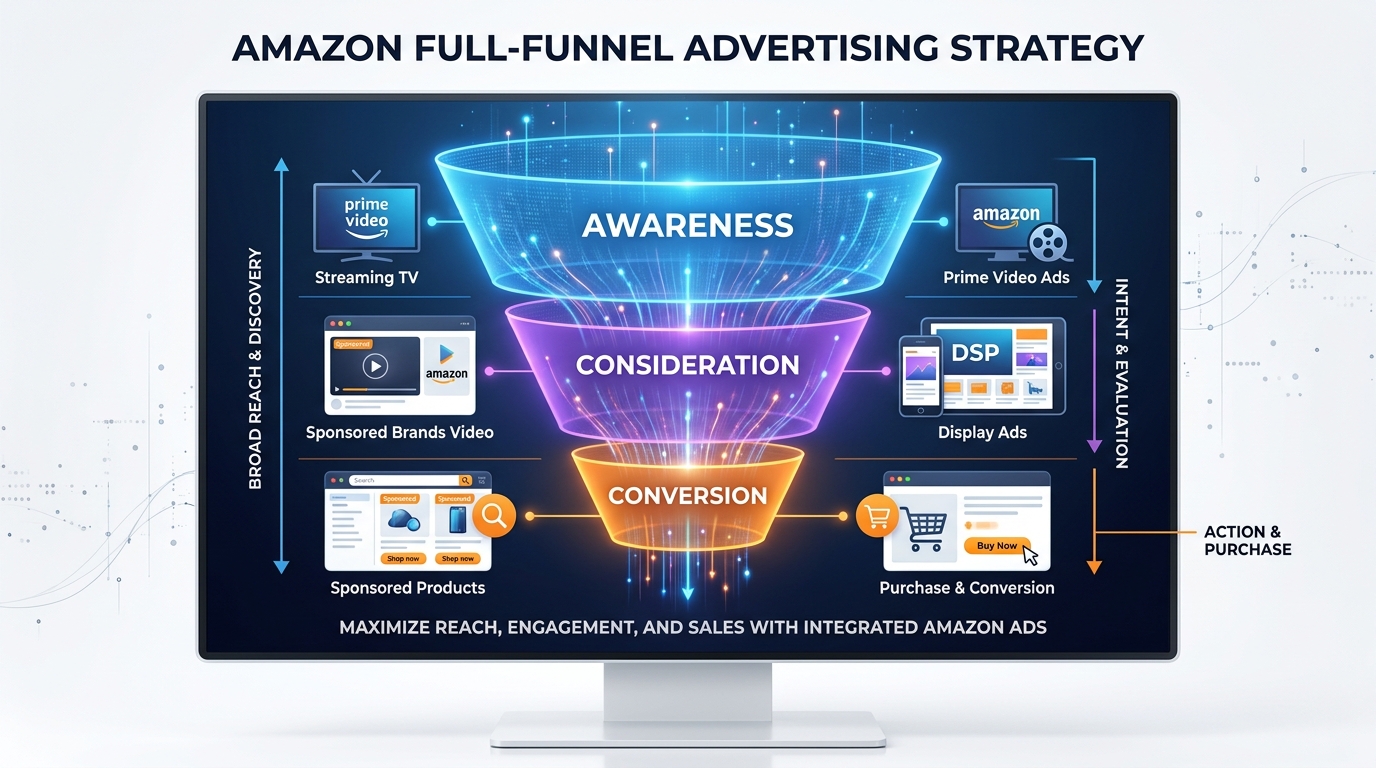
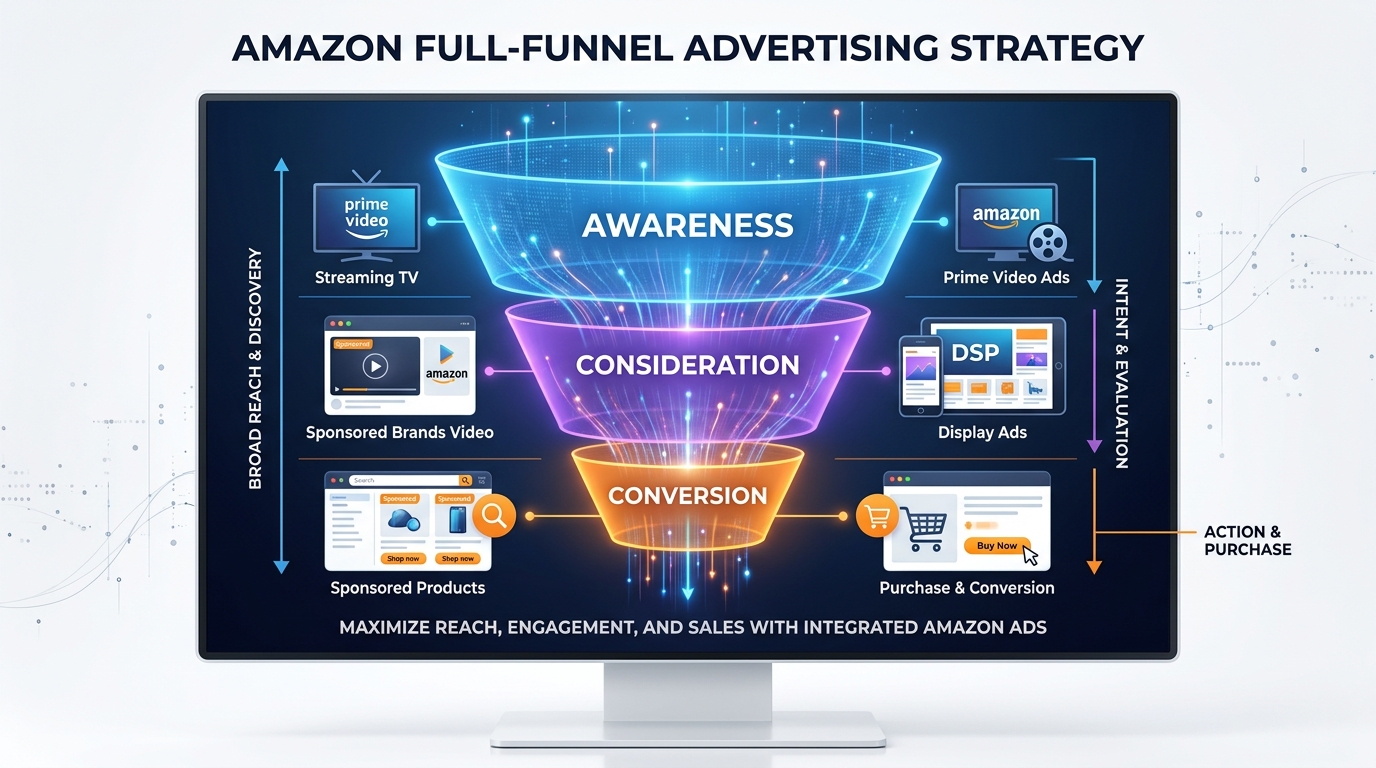
In 2026, Amazon has spent two years building the infrastructure to connect awareness, consideration, and conversion into a single, measurable system — Streaming TV and Prime Video ads at the top, Sponsored Brands Video and DSP Display in the middle, Sponsored Products and retargeting at the bottom, all stitched together through Amazon Marketing Cloud. That system exists and is available to most brands. Very few are actually using it correctly.
This post is not about the basics of what each ad format does. It is about the architecture: how the layers interact, how to measure the connections between them, why the halo effect on organic rank is real and significant, how to actually build AMC audience segments that activate across the funnel, and what a properly sequenced 90-day build looks like for a brand starting from a Sponsored Products-only baseline.
If you are already running across all five Amazon ad layers and using AMC for attribution — this will sharpen your approach. If you are still running a half-funnel, it will show you exactly what you are leaving behind.
Why Most Amazon Advertisers Are Running Half a Funnel
The evidence for the bottom-funnel trap is not anecdotal. Industry analysis consistently shows that the overwhelming majority of Amazon ad budgets are concentrated in Sponsored Products — the format that captures demand at the moment of search. This makes intuitive sense: Sponsored Products have visible, immediate attribution. You spend $100, you see attributed sales in the Campaign Manager dashboard, and the ROI calculation feels clean.
The issue is attribution window bias. Sponsored Products only get credit for conversions that happen in a relatively tight window after a click. The shopper who saw your Streaming TV ad two weeks ago, watched your Sponsored Brands Video last Tuesday, and then searched for your brand name and converted via Sponsored Products today — that Sponsored Products campaign looks like it did all the work. In a last-click or Sponsored Products-only reporting view, it did. In reality, two other touchpoints built the intent that made the conversion possible.
The Demand Creation vs. Demand Capture Problem
Every Amazon category has a pool of shoppers who are actively searching for products like yours right now. Sponsored Products captures that pool efficiently. The problem is that the pool has a fixed size — it is bounded by existing category demand. If you want to grow beyond that ceiling, you have to create new demand by reaching shoppers before they have started searching.
This is the fundamental tension in Amazon advertising: the formats with the best measurable ROAS (Sponsored Products) are entirely dependent on demand that already exists, while the formats that create new demand (Streaming TV, DSP, Sponsored Brands) are harder to measure in a clean last-click model and therefore get systematically underfunded.
In 2026, Amazon’s own messaging to advertisers is explicit about this. The platform recommends starting full-funnel campaign planning with premium streaming TV and audio, reinforcing with display and online video, and finishing with sponsored ads at conversion points. This is not a sales pitch for Amazon’s more expensive ad units — it is a reflection of how purchase decisions actually happen, and what the data from AMC-linked campaigns consistently shows.
What “Full-Funnel” Actually Means in Amazon’s Context
A true Amazon full-funnel stack in 2026 spans five ad format families, each serving a distinct role in the purchase journey:
- Streaming TV / Prime Video Ads: Awareness. Reach consumers in lean-back content environments before they enter the shopping mindset.
- DSP Display and Online Video (OLV): Awareness and early consideration. Reach audiences across Amazon-owned and third-party sites based on purchase signals.
- Sponsored Brands and Sponsored Brands Video: Active consideration. Intercept shoppers who are in-category but may not know your brand yet.
- Sponsored Display: Consideration and retargeting. Re-engage product detail page visitors and purchase-intent audiences across Amazon and beyond.
- Sponsored Products: Conversion. Capture high-intent, in-search demand and close the sale.
What makes 2026 different from prior years is that these layers are now connected through shared signal infrastructure. AMC pulls impression, click, and conversion data across all five layers into a single SQL-queryable environment, so you can actually trace the path a customer took across formats before converting — rather than guessing.
Stage 1: Awareness — Streaming TV, Prime Video, and Audio Ads
The upper funnel is where the growth ceiling of your Amazon business gets set. If you never reach shoppers before they enter active search, you are permanently competing for a share of existing demand rather than expanding the category share available to you. That is a winnable short-term game and a losing long-term one.
Prime Video and Streaming TV: The Scale Play
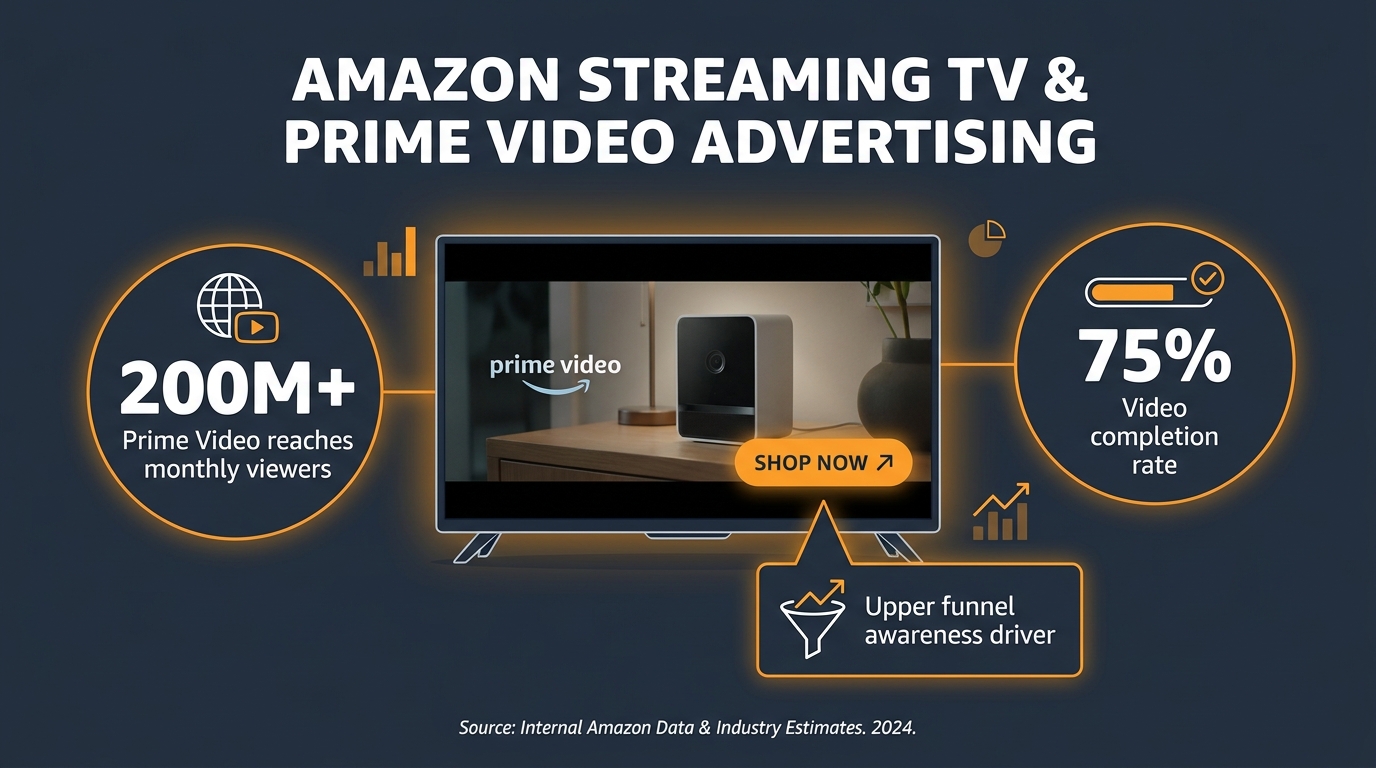
Prime Video’s advertising reach in 2026 is substantial. Amazon’s ad revenue from Prime Video is running at approximately $6 billion annually, a figure that reflects both the scale of the audience and the rate at which brands are shifting budgets toward the format. For advertisers, the meaningful number is reach — Prime Video and Streaming TV collectively give brands access to connected TV audiences at a scale that was previously only achievable through linear broadcast, but with targeting precision that broadcast cannot match.
The targeting is where Amazon’s advantage becomes concrete. Unlike generic CTV buys, Prime Video ads can be targeted using Amazon’s first-party retail data — purchase history, product category affinities, demographic signals, and in-market behavioral segments. A brand selling premium coffee equipment can reach households that have purchased specialty coffee beans on Amazon in the last 90 days. No other CTV platform has that level of commercial-intent targeting built natively.
What Streaming TV Ads Actually Deliver
Upper funnel formats should not be evaluated on direct conversion metrics, and streaming TV is no exception. The performance indicators that matter for Prime Video and Streaming TV campaigns are:
- Video completion rate: Strong campaigns in well-suited categories see completion rates that indicate genuine engagement with the ad creative rather than passive skip behavior.
- Brand lift (via AMC-linked studies): Measured as incremental increase in branded search volume, detail page views, and awareness survey responses following campaign exposure.
- New-to-brand conversion rate: The share of downstream purchases (within the AMC measurement window) that come from customers who had not purchased from the brand before. This is the critical metric for evaluating whether your upper funnel spend is actually growing your customer base.
- Detail page view rate: Traffic to product pages from shoppers exposed to the streaming ad, tracked via AMC path-to-purchase queries.
Amazon’s own case study data includes Clementoni, which saw a 1.7x higher conversion rate and 70% more new-to-brand sales from Prime Video ads when combined with lower-funnel formats. These figures illustrate the compounding dynamic: upper-funnel exposure does not produce conversions in isolation, but it measurably improves the efficiency of the conversion-focused formats further down the funnel.
Interactive and Shoppable Formats: The 2026 Addition
One of the most significant developments in Amazon’s awareness advertising in 2026 is the expansion of interactive Prime Video formats. Viewers can now respond to commerce prompts during ad breaks — adding products to cart, requesting more information, or scanning QR codes — without leaving the Prime Video environment. This compresses the distance between awareness and purchase intent in a way that traditional broadcast advertising never could.
For brands, this means upper-funnel creative now needs to be designed with a mid-funnel action in mind, not just brand visibility. The 30-second spot that ends with a URL is being replaced by the 30-second spot that ends with an “Add to Cart” prompt. The creative brief and the measurement strategy have to account for this.
Audio Ads: The Underused Awareness Channel
Amazon Audio ads — running on Amazon Music’s ad-supported tier and Alexa-enabled devices — remain underutilized by most brands in 2026, which creates a relative efficiency opportunity. Audio placements reach shoppers during activities (commuting, exercising, household tasks) when they are receptive but not actively shopping, making them effective for brand name and product category imprinting. Brands that incorporate audio as a complementary upper-funnel touch alongside Streaming TV typically see higher branded search volume in the 2–4 week window following a coordinated audio and video campaign.
Stage 2: Consideration — Sponsored Brands Video and DSP Display
The consideration stage is where Amazon’s advertising stack gets genuinely interesting in 2026. Shoppers who are in-category — actively researching products but not yet committed to a brand — are reachable through formats that intercept their research process rather than simply capturing their final search intent. This is the layer where brand preference gets built on Amazon, and where most brands are systematically underinvesting.
Sponsored Brands Video: The Mid-Funnel Workhorse
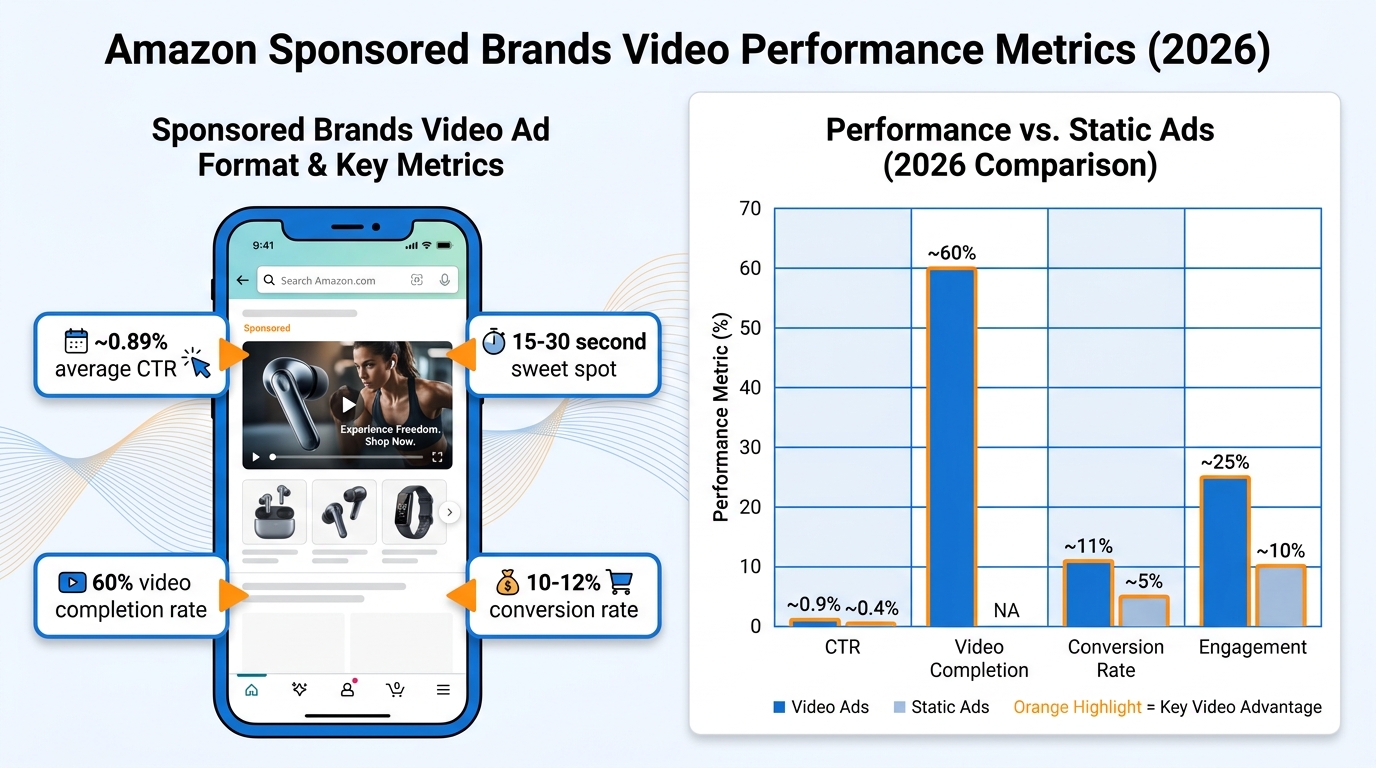
Sponsored Brands Video (SBV) has emerged as the highest-performing mid-funnel format on Amazon by a significant margin, and 2026 benchmark data confirms the gap over static formats. The key metrics:
- CTR: Average click-through rate for SBV campaigns sits at approximately 0.89% across categories — materially higher than static Sponsored Brands, which typically range from 0.2% to 0.4%. In well-optimized campaigns targeting high-intent categories, SBV CTR regularly exceeds 1.5%.
- Video completion rate: For creative cut to 15–30 seconds, completion rates of around 60% are achievable. Drop-off increases significantly past 30 seconds, making the 15–20 second format the practical sweet spot for most product categories.
- Conversion rate: SBV conversion rates average in the 10–12% range for well-optimized campaigns, a reflection of the format’s ability to attract higher-intent clicks versus passive impression-driven formats.
- CPC premium: Expect CPCs approximately 10–20% higher than equivalent Sponsored Products bids — a premium that is more than offset by the higher conversion rate and the consideration-stage audience quality.
What Makes SBV Creative Actually Convert
The most common SBV mistake is repurposing brand awareness video into a search-placement format. The placement context is fundamentally different: Sponsored Brands Video runs in search results, which means the viewer is actively looking at product options. The creative needs to lead with the product benefit, not the brand story.
High-performing SBV creative in 2026 follows a consistent pattern: the product appears in the first 3 seconds, a primary benefit is communicated in the first 5 seconds, a secondary differentiator appears in the 5–15 second window, and a clear visual call-to-action closes the ad. No voiceover is required — most viewers watch without audio. Text overlays carrying the key messages are not optional; they are load-bearing.
For physical products, demonstration-style creative — showing the product in use solving a specific problem — consistently outperforms lifestyle imagery. For consumables, before/after or results-based visual storytelling works better than abstract brand footage.
DSP Display: Audience-Led Consideration at Scale
Amazon’s Demand-Side Platform is the consideration and retargeting engine that operates both on and off Amazon properties. Where Sponsored Brands reaches in-search shoppers, DSP Display reaches audiences across the broader web using Amazon’s purchase data as the targeting foundation. In 2026, DSP Display plays three distinct roles in the full-funnel stack:
In-market audience targeting: Reaching shoppers who are actively browsing your product category but have not yet visited your listings. Amazon’s in-market segments are built from actual browsing and purchase behavior, not probabilistic modeled audiences, which gives them unusually high commercial intent precision.
Competitor conquest: Targeting shoppers who have viewed competitor product detail pages in the past 30 days. This is one of the most effective consideration-stage tactics available on Amazon, as it intercepts shoppers who are actively in the decision phase but have not yet made a purchase.
Product detail page retargeting: Re-engaging shoppers who visited your product pages but did not convert. DSP Display retargeting typically shows 2–3x higher conversion rates than cold audience display, reflecting the warm intent of the audience.
The Sponsored Brands Store Spotlight Format
One underused Sponsored Brands format deserving attention in 2026 is Store Spotlight — a variant that drives traffic directly to a brand’s Amazon Store rather than a single product listing. For brands with a product catalog wide enough to benefit from store-level discovery (think: a kitchen brand with 50+ SKUs), Store Spotlight performs meaningfully better for catalog-level growth metrics than single-ASIN SB ads. The format allows the shopper to self-select into the most relevant product from the full catalog, which improves average order value and reduces the friction caused by landing on a single listing that may not match their specific need.
Stage 3: Conversion — Sponsored Products and Sponsored Display Retargeting
At the bottom of the funnel, the goal shifts from building intent to capturing it. Sponsored Products remains the highest-volume, most efficient conversion format in Amazon’s stack — not because it outperforms other formats on quality, but because it intercepts shoppers at maximum purchase intent by appearing in keyword search results.
How Upper-Funnel Exposure Changes Sponsored Products Performance
One of the clearest signals to emerge from AMC-linked attribution analysis is that Sponsored Products campaigns perform measurably better when they are preceded by upper or mid-funnel touchpoints. Shoppers who were exposed to a Streaming TV or DSP Display impression in the prior 14–30 days before performing a category search convert at higher rates and show lower price sensitivity than cold search traffic with no prior brand exposure.
This creates a compound efficiency that most last-click attribution models completely miss. The brand that correctly reads AMC path-to-purchase data will see that its Sponsored Products campaigns appear to be the heroes of every conversion, when in reality they are closing sales that were set up by upper-funnel campaigns that received no attribution credit in Seller Central or Campaign Manager.
Sponsored Display: The Bridge Between Consideration and Conversion
Sponsored Display in 2026 operates across two distinct use cases that should be managed separately rather than conflated in a single campaign structure:
On-Amazon product detail page targeting: Placing display ads on competitor product pages and category browse pages to intercept shoppers mid-evaluation. This is a consideration-stage tactic with conversion-stage measurement — the shoppers it reaches are actively evaluating options, which is why response rates are higher than cold DSP Display but lower than search-triggered Sponsored Products.
Off-Amazon retargeting: Re-engaging previous product page visitors and add-to-cart abandoners across third-party websites and apps. This is the classic retargeting use case, and it remains one of the highest ROAS formats in the stack for brands with meaningful traffic to retarget. Conversion rates for off-Amazon SD retargeting consistently run 2–3x above cold audience benchmarks.
Keyword and Targeting Strategy at the Conversion Layer
At the bottom of the funnel, keyword strategy needs to be more precise, not broader. The brands that waste budget in Sponsored Products are typically running match types that are too loose, bidding on high-volume category terms where they lack competitive differentiation, and failing to isolate their best-performing exact-match terms into dedicated campaigns with separate budget controls.
A properly structured lower-funnel Sponsored Products setup in 2026 has three tiers: exact-match branded keyword campaigns (protecting your own brand search at maximum efficiency), exact-match non-branded keyword campaigns for top-converting category terms, and broad or phrase-match discovery campaigns for new keyword identification — with systematic harvesting of converting search terms into exact-match campaigns. These three tiers should never share budgets, because their cost structures, competition dynamics, and ROAS profiles are completely different.
Amazon Marketing Cloud: The Measurement Layer That Changes Everything
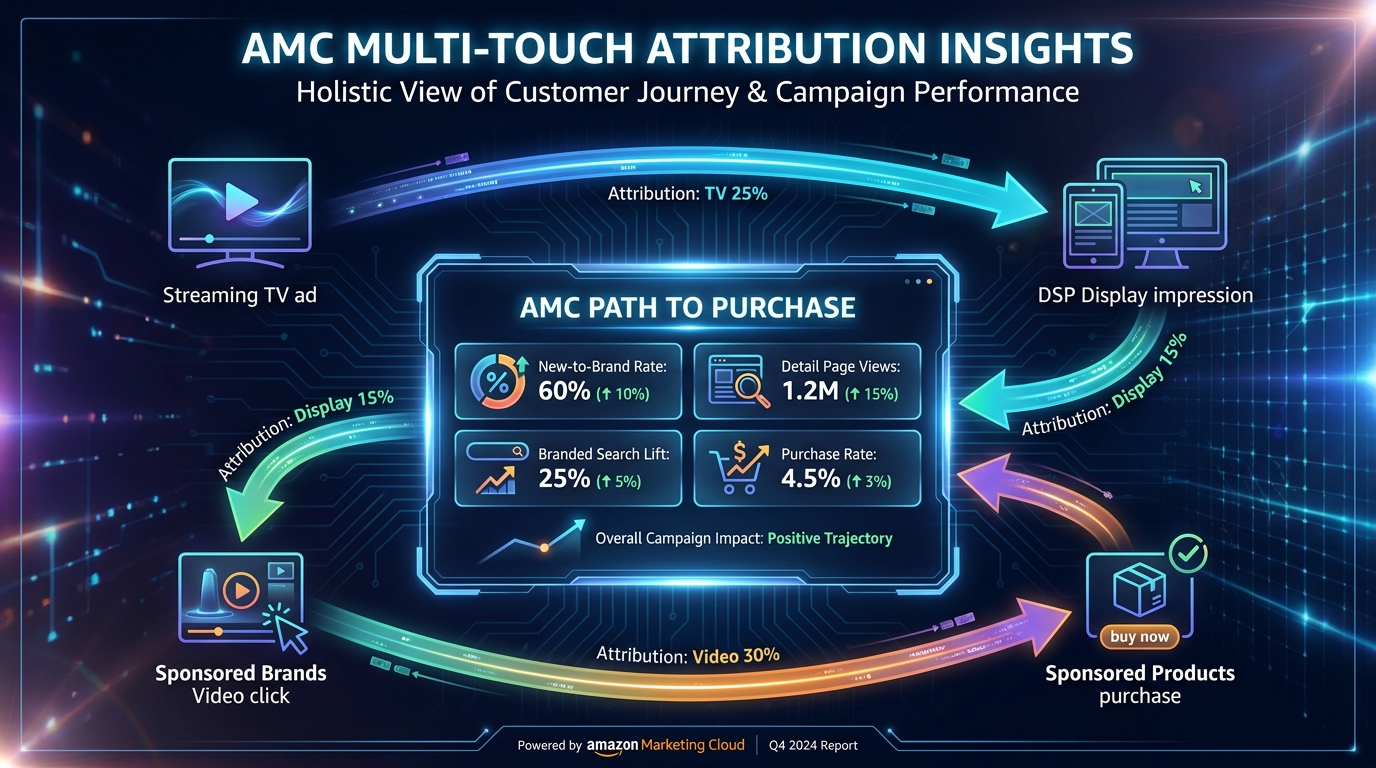
Amazon Marketing Cloud is the single most important tool for full-funnel advertising in 2026, and also the most underutilized one. It is available to any brand using Amazon DSP or Sponsored Ads, it is free to access at the basic tier, and the queries it enables — tracing shopper paths across every ad format in the stack — are simply not possible anywhere else in the Amazon advertising ecosystem.
What AMC Actually Is (and Isn’t)
AMC is a clean-room analytics environment. Amazon holds impression, click, and conversion data from every ad format in its stack — Sponsored Products, Sponsored Brands, Sponsored Display, DSP, Streaming TV, and Brand Stores. AMC allows you to query that data using SQL at the household level (not individual identity level — Amazon maintains privacy by aggregating below a certain threshold), across any combination of formats and time windows you specify.
What AMC is not: it is not a real-time optimization tool, and it is not a replacement for Campaign Manager for day-to-day bid and budget management. It is a strategic analytics platform that answers questions that no other Amazon tool can answer — specifically, how do multiple ad formats interact to produce a purchase?
The Five AMC Queries Every Full-Funnel Advertiser Needs
Getting value from AMC requires knowing which questions to ask. The five most strategically valuable query types for full-funnel advertisers are:
- Path-to-purchase analysis: What sequence of ad exposures typically precedes a purchase? Does DSP exposure before a Sponsored Products click increase conversion rate? By how much? This query reveals whether your upper-funnel investment is actually contributing to conversions or just adding to reach numbers.
- New-to-brand customer acquisition by format: Which ad formats are generating first-time buyers vs. driving repeat purchase from existing customers? This is critical for understanding whether you are growing your customer base or spending money to re-acquire people who would have bought anyway.
- Time-to-conversion analysis: How many days does the average customer journey span from first ad exposure to purchase, by category and format mix? This data is essential for setting realistic measurement windows and not writing off upper-funnel campaigns as ineffective simply because they don’t convert in a 7-day window.
- Overlap and frequency analysis: What percentage of shoppers who were exposed to your Streaming TV campaign also received a DSP Display impression and then converted via Sponsored Products? Are there diminishing returns at certain frequency levels that suggest waste?
- Competitive conquest efficiency: For DSP campaigns targeting competitor product page viewers, what is the conversion rate and time-to-convert compared with in-market audience targeting? This determines whether conquest targeting deserves more or less budget relative to in-market segments.
AMC Audience Activation: Turning Analytics Into Targeting
AMC’s most powerful 2026 capability is the ability to use your query outputs as audience seeds for live DSP campaigns. You can build an AMC-derived audience of shoppers who: viewed your product detail page, were exposed to your Sponsored Brands Video, but did not purchase within 30 days — and then activate that audience directly into a DSP campaign with customized creative. This is a degree of funnel-specific retargeting precision that was not available to most Amazon advertisers at this level until recently.
Similarly, AMC allows you to build lookalike audiences based on your highest-value customer segments (identified by AMC purchase behavior queries) and activate those lookalikes in DSP Display for new customer acquisition at the top of the funnel. You are essentially using the behavioral signature of your best customers to find similar shoppers before they have ever interacted with your brand.
The New-to-Brand Imperative: Why ROAS Is the Wrong Primary KPI
This section addresses the most consequential strategic mistake in Amazon advertising in 2026: optimizing for return on ad spend as the primary success metric across the entire funnel.
ROAS is a useful metric. It is not a useful north-star metric for a brand trying to grow its Amazon business. Here is why: ROAS is a measure of ad efficiency for demand that already exists. A brand with strong organic rank, high review count, and an established customer base will naturally have high ROAS on its bottom-funnel campaigns — not because its advertising is exceptional, but because it is capturing demand that its brand equity generates. A newer brand or a brand trying to grow category share will have lower ROAS on the same formats, not because its advertising is inefficient, but because it is trying to build demand rather than capture it.
New-to-Brand: The Growth Metric That Actually Matters
New-to-brand (NTB) metrics — available across Sponsored Brands, Sponsored Display, and DSP — track the percentage of purchases and associated revenue that come from customers who have not purchased from your brand on Amazon in the prior 12 months. This is a direct measure of customer base growth, which is the only reliable indicator of sustainable Amazon business expansion.
The strategic implication is significant: two brands can have identical ROAS numbers and completely different business trajectories. The brand with 70% of its attributed conversions going to repeat buyers is protecting its existing customer base. The brand with 55% new-to-brand conversion rate is growing its customer base at scale. In two years, the second brand will have dramatically more organic demand to capture, lower dependency on paid advertising for baseline sales, and stronger category authority signals feeding the A10 algorithm.
Setting the Right KPI for Each Funnel Stage
The practical fix is format-specific KPI assignment. Rather than applying ROAS uniformly across all campaigns, assign primary success metrics that match the role of each format:
- Streaming TV / Prime Video: Primary KPI = New-to-brand rate, brand search lift, detail page view lift. Secondary = video completion rate.
- DSP Display (cold audience): Primary KPI = New-to-brand rate, detail page view rate. Secondary = cost per new-to-brand customer.
- Sponsored Brands Video: Primary KPI = New-to-brand rate, CTR, video completion. Secondary = branded search volume trend.
- Sponsored Display (retargeting): Primary KPI = Return visitor conversion rate, cost per re-engaged purchase. Secondary = ROAS (appropriate at this stage).
- Sponsored Products: Primary KPI = Conversion rate, ACOS/ROAS, branded vs. non-branded split. Secondary = impression share on key terms.
This structure ensures you are not penalizing awareness campaigns for not driving immediate last-click conversions, while still maintaining rigorous performance standards at each stage of the funnel.
Budget Allocation: The Real Split High-Performing Brands Use
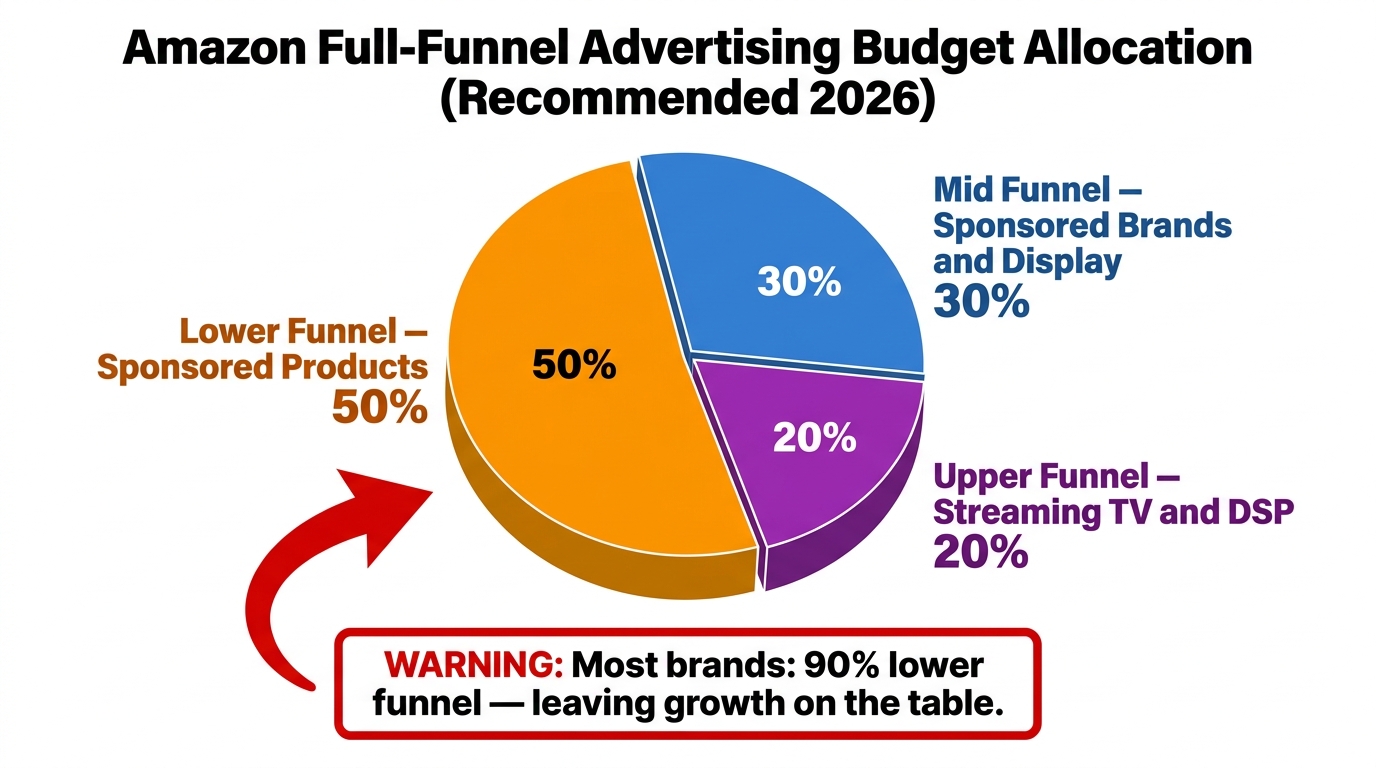
The single most common question about full-funnel Amazon advertising is how to split budget across the funnel. There is no universal answer — the right allocation depends on brand maturity, category competitiveness, organic velocity, and growth objectives. But there are patterns that consistently characterize high-performing accounts in 2026, and they look nothing like the default 90% Sponsored Products allocation that most accounts run.
The 50/30/20 Starting Framework
For brands in growth mode — meaning they have established catalog performance but are trying to expand category share and new customer acquisition — a commonly cited starting framework is approximately 50% lower funnel, 30% mid-funnel, and 20% upper funnel. This is not a rigid prescription; it is a starting point for conversations about budget that accounts for the value of each layer.
What changes this split:
- Brand maturity: Newer brands with low organic authority should weight more heavily toward lower funnel until they have enough review velocity and conversion history to support ROAS-positive search campaigns. Established brands with strong organic rank can afford to invest more heavily in upper funnel because their lower-funnel efficiency is already high.
- Category competitiveness: In highly competitive categories where Sponsored Products CPCs are inflated (meaning you are paying premium prices for commodity clicks), shifting budget toward DSP Display and SBV — where competition is less intense — can produce better blended ROAS despite the less direct attribution.
- Seasonality and event calendar: Upper-funnel investment has a lag effect on conversion. Awareness campaigns need 2–4 weeks of exposure before they meaningfully lift in-search conversion rates. Brands that try to ramp Streaming TV and DSP Display in the week before Prime Day are not building full-funnel campaigns; they are running poorly timed awareness buys that will not deliver results in the event window.
The Pre-Event Warming Strategy
One of the highest-leverage budget allocation tactics in 2026 is what practitioners call “pre-event warming” — deliberately running upper and mid-funnel campaigns 4–6 weeks before a major Amazon shopping event (Prime Day, Black Friday, Cyber Monday, major seasonal peaks). The logic is straightforward: shoppers who have been exposed to your brand through Streaming TV and DSP Display in the weeks leading up to a sale event have higher brand recall and are more likely to engage with your lower-funnel Sponsored Products campaigns when they are actively shopping during the event.
Amazon’s own data consistently shows that brands with coordinated full-funnel campaigns around major shopping events outperform brands running lower-funnel-only event campaigns. The conversion lift in the event window is measurably higher when shoppers have had prior brand exposure — and that exposure can only come from upper and mid-funnel investment in the pre-event period.
Dynamic Budget Rules vs. Static Allocation
One of the most significant efficiency improvements available in 2026 is the use of Amazon’s budget rules and automated campaign management to shift budget dynamically rather than maintaining static funnel splits. A well-configured budget rule can automatically increase lower-funnel Sponsored Products budgets during high-conversion hours and events, while maintaining steady upper-funnel spend that builds the audience for future conversion opportunities. Static allocation treats the funnel as a fixed structure; dynamic allocation treats it as a living system that responds to actual market conditions.
The Brand Halo Effect: How Full-Funnel Ads Lift Organic Rank
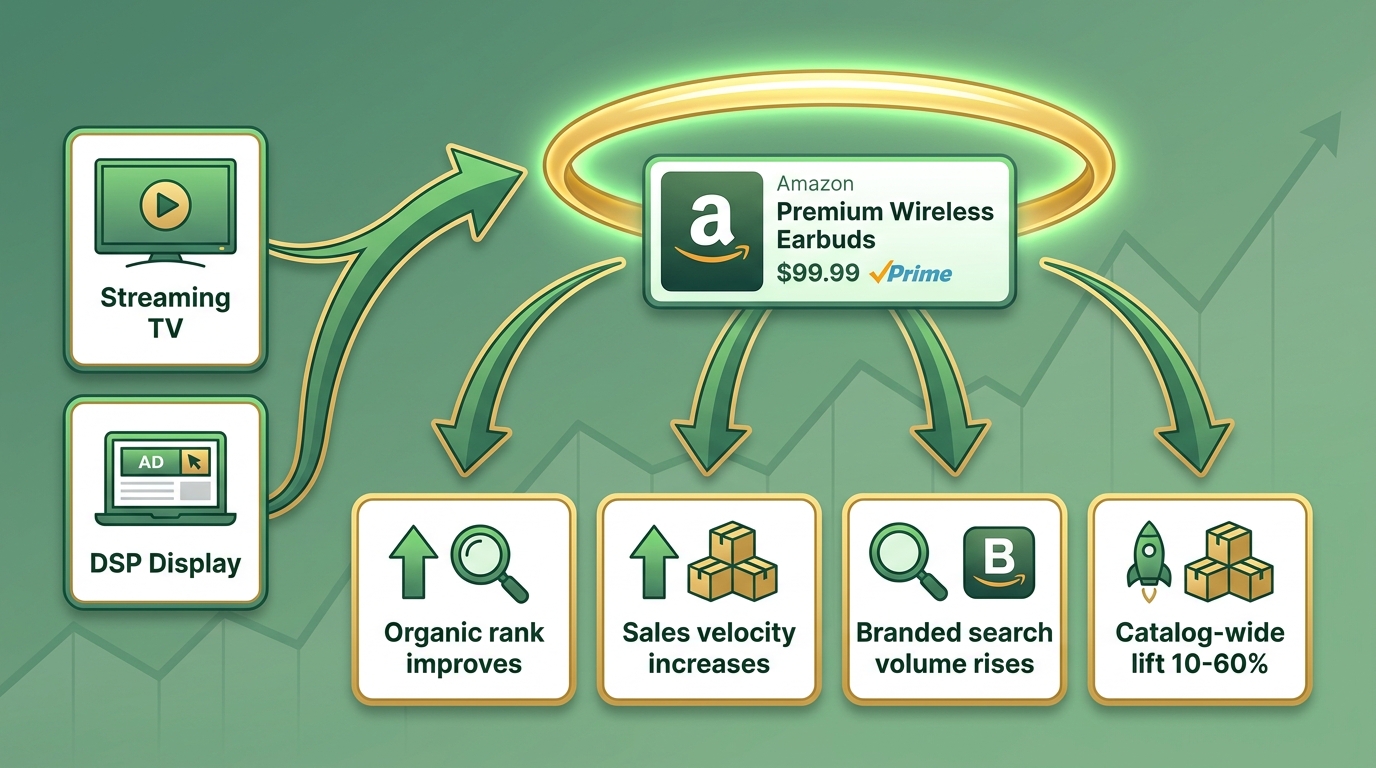
Perhaps the most underappreciated dimension of full-funnel Amazon advertising is its effect on organic performance — specifically, how upper and mid-funnel ad investment creates improvements in organic ranking and sales velocity that persist beyond the advertising window itself.
How the Halo Works Mechanically
Amazon’s A10 algorithm weights sales velocity and conversion rate heavily as ranking signals. When upper-funnel advertising drives incremental detail page views and conversion events — even at lower rates than pure search-intent traffic — those events register as positive ranking signals. Over a 30–60 day period, a brand running coordinated full-funnel campaigns will typically see organic keyword rank improvements on its primary terms, driven by the compounding effect of increased traffic and conversion signals across multiple channels.
Fospha’s research on the halo effect between off-Amazon and Amazon sales found that up to 42% of a brand’s Amazon sales can be influenced by non-Amazon media exposure. This is not a marginal effect — it suggests that for brands with significant off-Amazon media investment, a substantial portion of what looks like organic Amazon performance is actually being driven by external brand awareness building. The same dynamic applies within the Amazon ecosystem: upper-funnel Amazon ads create awareness that converts into organic search behavior, which then feeds the algorithm’s positive signals without requiring paid click spend at the point of conversion.
The Branded Search Flywheel
One of the most durable outcomes of sustained full-funnel advertising is the growth of branded search volume. When shoppers who were exposed to your Streaming TV or DSP Display campaign go to Amazon and search for your brand name directly, several things happen:
First, branded searches are typically the highest-converting traffic on Amazon — shoppers searching by brand name have already made a partial purchase decision, which dramatically reduces the friction of conversion. Second, branded search conversions register as strong positive signals to the A10 algorithm, reinforcing organic ranking on category terms. Third, as branded search volume grows, you can reduce your spend on expensive non-branded keyword campaigns (where you are competing against everyone in the category) and redirect that budget toward upper funnel investment that continues to grow branded search — creating a self-reinforcing flywheel.
Catalog-Level vs. ASIN-Level Halo
The brand halo effect operates at two levels. ASIN-level halo is the direct benefit to the advertised product’s organic ranking from paid traffic and conversion signals. Catalog-level halo is the lift that advertising one hero product generates across other products in the same brand’s catalog — as shoppers who discover the brand through an advertised product explore other listings, generating traffic and conversion signals for products that received no direct advertising investment.
Catalog-level halo is why advertising strategy for multi-product brands should center on the products with the strongest organic performance and review velocity — not necessarily the products with the highest advertising ROAS. The hero product that gets advertised acts as a gateway to the catalog; its halo lifts the whole portfolio.
Building Your AMC Audience Segments From Scratch
Setting up AMC correctly is a prerequisite for running a genuine full-funnel strategy in 2026. The good news is that the technical barrier to entry is lower than it was two years ago — Amazon has added pre-built query templates and simplified the activation pathway from AMC audiences to DSP campaigns. Here is how to approach the build systematically.
Step 1: Establish Your Data Foundation
Before you can run meaningful AMC queries, you need at least 30 days of data flowing into AMC from your active ad formats. If you are only running Sponsored Products today, you need to add at least Sponsored Brands and Sponsored Display before AMC cross-format path analysis becomes useful. AMC can only show you paths across formats that are active in your account.
Connect your Amazon Ads data to AMC and, if possible, your first-party CRM or customer database. AMC supports first-party data uploads (in hashed, privacy-safe format) that allow you to link your existing customer list to Amazon shopper behavior — enabling analysis of which AMC audience segments correspond to high-LTV customers in your own data.
Step 2: Run the Foundational Queries
Start with three baseline queries before building any audience segments. First, run a time-to-conversion query to understand your category’s average purchase journey length — this calibrates your measurement windows. If your average path to purchase is 21 days, evaluating upper-funnel campaigns on a 7-day attribution window will consistently undervalue them.
Second, run a new-to-brand rate by format query to establish your baseline. This tells you which of your current formats are growing your customer base versus recapturing existing buyers. Third, run a campaign overlap query to see how many of your converters were exposed to multiple formats before purchasing — this quantifies the multi-touch contribution that last-click attribution is ignoring.
Step 3: Build and Activate Your Segments
With baseline data in hand, build four foundational audience segments for DSP activation:
- High-intent non-converters: Shoppers who visited your product detail page 2+ times in the past 30 days but have not purchased. These are your warmest non-customer audience and should be the first retargeting priority.
- Competitor page visitors: Shoppers who viewed competitor product pages in the past 30 days. Available through DSP in-market targeting rather than direct AMC query, but AMC can help you estimate the size of this opportunity in your category.
- Lapsed brand customers: Customers who purchased from your brand 90–180 days ago but not in the past 90 days. These are re-engagement targets for Sponsored Display and DSP campaigns with product education creative.
- High-LTV lookalikes: AMC-generated audience based on behavioral signatures of your top 20% highest-LTV customers, activated into DSP Display for new customer acquisition.
The 90-Day Full-Funnel Activation Roadmap
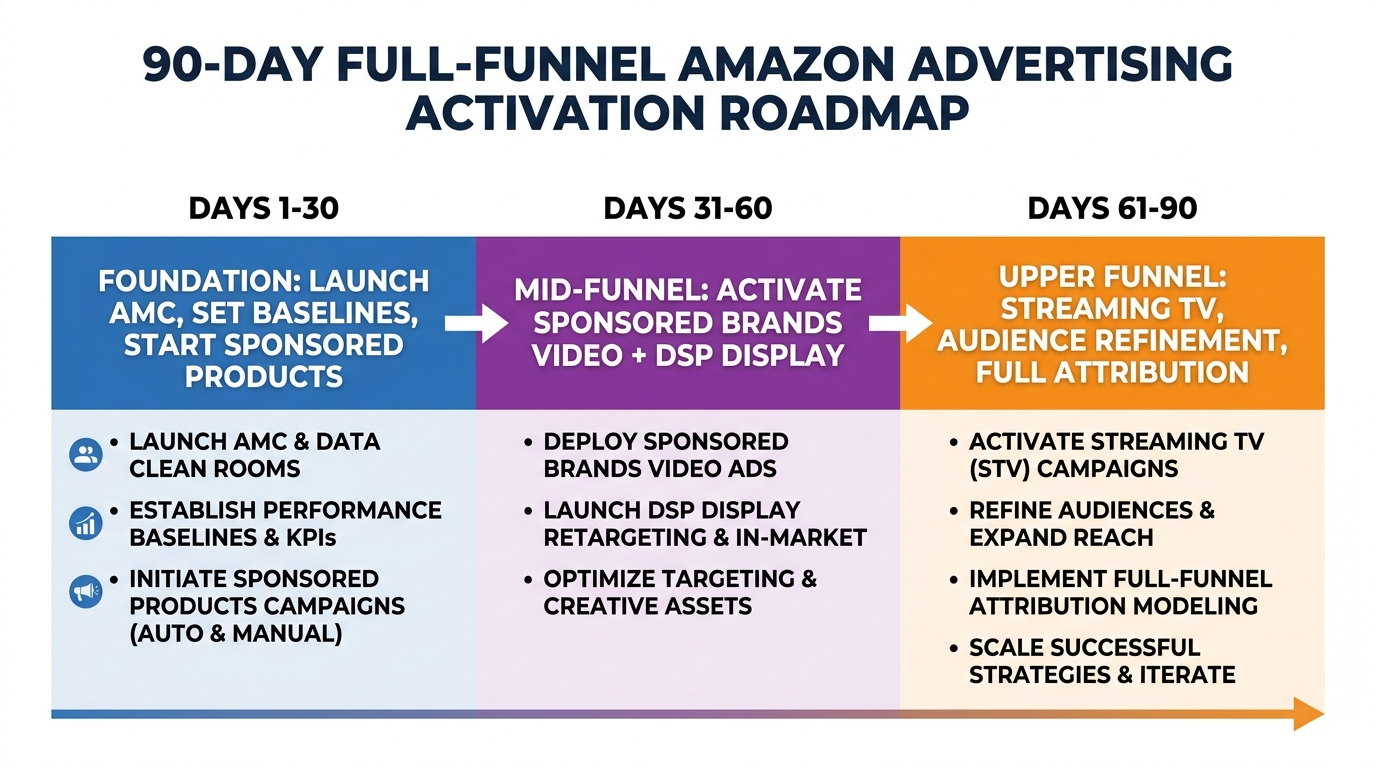
For brands transitioning from a Sponsored Products-only approach to a genuine full-funnel architecture, the sequencing of the build matters as much as the individual tactics. Launching everything simultaneously typically results in poor performance across all layers because there is no foundational audience data to inform targeting, no baseline metrics to benchmark against, and no measurement infrastructure to attribute results correctly. Here is a sequenced roadmap that builds each layer on the performance of the previous one.
Days 1–30: Foundation — Lower Funnel Optimization and AMC Setup
The first 30 days are not about launching new formats. They are about ensuring that the foundation you are about to build upper-funnel investment on top of is solid.
Audit and restructure Sponsored Products: Implement the three-tier campaign structure (branded exact, non-branded exact, discovery broad/phrase). Establish clean ACOS baselines by keyword category. Identify your top 5 hero ASINs by organic ranking, review count, and conversion rate — these are your full-funnel focus products.
Launch Sponsored Brands and Sponsored Display: Start Sponsored Brands on your top keyword terms (both product collection and Store Spotlight format). Launch Sponsored Display in product targeting mode on your own ASINs (defensive placement) and competitor ASINs (conquest). Establish click, CTR, and conversion baselines for both.
Set up AMC: Connect your Amazon Ads account to AMC. Run your three baseline queries (time-to-conversion, NTB by format, campaign overlap). Document your baseline metrics.
Days 31–60: Mid-Funnel — Sponsored Brands Video and DSP Display
With baseline data from the first 30 days, you now have meaningful performance benchmarks to optimize against. Add Sponsored Brands Video and DSP Display in this phase.
Launch Sponsored Brands Video: Start with one 15–20 second creative per hero ASIN. Target a mix of branded keywords and top non-branded category terms. Optimize based on CTR and new-to-brand rate (not ROAS). Test second creative variant at Day 45.
Launch DSP Display: Start with product detail page retargeting (warmest audience, fastest learning curve) and in-market category targeting (cold acquisition). Set optimization objective to detail page views, not direct conversion, for the cold audience campaign. Measure brand lift and NTB rate via AMC queries at Day 45 and Day 60.
Run overlap query at Day 45: Check whether shoppers exposed to SBV and DSP Display before converting via Sponsored Products are showing higher conversion rates than pure search traffic. This is the first real-world validation of your full-funnel thesis.
Days 61–90: Upper Funnel — Streaming TV, Audience Refinement, Full Attribution
With mid-funnel data in hand and an AMC audience library being built, add the awareness layer in the final phase.
Launch Streaming TV / Prime Video campaign: Start with your strongest hero product. Use in-market and lifestyle targeting (not broad demographic only). Set a 30-day measurement window before evaluating performance — you are measuring branded search lift, NTB rate downstream, and detail page view lift, not immediate ROAS.
Activate AMC-derived audiences in DSP: Build your four foundational audience segments from your 60 days of AMC data. Launch retargeting and lookalike DSP campaigns using these segments. Compare conversion rates from AMC-derived audiences versus standard in-market segments — the performance gap validates the value of your AMC investment.
Build your full-funnel measurement dashboard: At Day 90, pull AMC data to construct a complete picture of your funnel: reach and NTB rate from Streaming TV, engagement and consideration rate from SBV and DSP Display, conversion rate and ROAS from Sponsored Products. Calculate blended cost-per-new-customer across the full funnel — not per format. This is your benchmark for evaluating Phase 2 of the build.
The Common Full-Funnel Mistakes That Kill ROI
Understanding the right approach is only half the picture. Knowing where well-intentioned full-funnel strategies go wrong is equally important, because the failure modes are specific and surprisingly consistent across brand types and categories.
Mistake 1: Judging Upper-Funnel on Lower-Funnel Metrics
The most common cause of abandoned full-funnel strategies is evaluating Streaming TV or DSP Display campaigns on ROAS after a 7-day window and declaring them underperforming. Upper-funnel campaigns should not show strong direct ROAS in a 7-day window — that is not what they are for. Evaluating awareness investment on direct ROAS is like judging a billboard by how many people walked from the billboard directly into the store. Most did not. That does not mean the billboard did not work.
Mistake 2: Running All Formats at Once Without Sequential Logic
Brands that launch Sponsored Products, Sponsored Brands Video, DSP Display, and Streaming TV simultaneously, without sequential audience building, get scattered results. Each layer of the funnel needs to be informed by the behavior data from the layer below it. Launching everything at once means your DSP and Streaming TV targeting is based on generic Amazon segments rather than behavioral data from your own customers — which dramatically reduces efficiency.
Mistake 3: Undifferentiated Creative Across Formats
Using the same creative asset across all ad formats is a significant performance drag. A 30-second lifestyle video that works on Prime Video is not appropriate as Sponsored Brands Video creative (too long, wrong pacing for search intent context) and is not appropriate as a static DSP banner (wrong format entirely). Each funnel layer needs creative that is specifically designed for its placement context, viewer intent state, and measurement objective. Building a full-funnel creative brief that accounts for format-specific requirements from the outset saves significant time and budget compared with adapting assets after the fact.
Mistake 4: No Budget Ringfencing for Upper-Funnel Investment
In accounts where all budgets are pooled, upper-funnel investment is always the first to be cut when ROAS pressure appears. When a Sponsored Products campaign has a bad week, the instinct is to reallocate budget from display or video (which don’t show direct ROAS) to the format with the cleanest conversion attribution. This creates a cycle where the funnel is perpetually bottom-heavy, upper-funnel audiences never reach the scale needed to be effective, and the brand remains trapped in demand-capture-only mode. Ring-fencing upper-funnel budgets — treating them as a separate line item that is not available for lower-funnel optimization — is a structural fix, not a philosophical one.
What to Expect: Realistic Timelines and Performance Benchmarks
Setting realistic expectations for full-funnel performance is essential for maintaining internal alignment and budget support through the build phase. The results from a properly architected full-funnel strategy are significant, but they are not immediate — and teams that expect Streaming TV spend to show campaign manager ROAS within a 30-day window will pull the plug before the strategy has time to deliver.
Weeks 1–4: The Quiet Phase
In the first four weeks of running upper-funnel formats, you will see impression delivery, video completion rates, and some initial detail page view lift. You will not see meaningful conversion attribution from upper-funnel formats in Campaign Manager. This is expected. The AMC data you are building during this period is more valuable than any metric in the standard reporting dashboard — it is showing you reach, frequency, and audience overlap that you will use to optimize the next phase.
Weeks 5–8: Early Signal Emergence
By weeks five through eight, several signals should begin to emerge. Branded search volume (visible in your Sponsored Products search term reports) should show a measurable uptick from shoppers who have been exposed to your Streaming TV or DSP campaigns and are now searching for your brand. New-to-brand rate on Sponsored Brands and Sponsored Display should be improving as the audience targeting becomes more refined from AMC data. Detail page view counts on hero ASINs should be increasing as DSP and SBV drive consideration-stage traffic.
Weeks 9–12: Full-Funnel Attribution Becomes Clear
At the 90-day mark, AMC path-to-purchase queries will show clear evidence of multi-touch attribution: the percentage of your converters who were exposed to at least two formats before purchasing, the average journey length for full-funnel vs. single-touch converters, and the conversion rate lift for shoppers who received upper-funnel exposure. In well-run campaigns, the multi-touch conversion rate is typically 15–30% higher than single-touch conversion rate — reflecting the value of the consideration and awareness stages in preparing the shopper for the final purchase decision.
Conclusion: The Full-Funnel Shift Is a Business Decision, Not Just an Advertising One
The case for Amazon full-funnel advertising in 2026 is not primarily about ad format diversity or creative variety. It is about sustainable business growth. Brands that rely exclusively on bottom-funnel Sponsored Products are building a business on a foundation of borrowed demand — capturing shoppers whose intent was created by other forces (organic awareness, word-of-mouth, competitor category growth) and attributing all the value to the last click before purchase.
That approach works well when category demand is growing faster than competition. It starts to fail when category demand plateaus, when CPCs inflate as more brands compete for the same search terms, or when organic ranking is challenged by better-capitalized competitors who are winning on category share rather than keyword share.
Full-funnel advertising — properly architected with AMC measurement, format-specific KPIs, sequential audience building, and ringfenced upper-funnel budgets — is how you move from capturing demand to creating it. It is how you build a branded search flywheel that reduces long-term dependence on paid click spend. It is how you turn paid advertising investment into durable organic ranking improvements that persist beyond the campaign window.
The infrastructure to do this exists right now. Amazon has built Streaming TV reach, AMC measurement, DSP Display targeting, and AI-assisted full-funnel campaign orchestration into a single connected system. The question in 2026 is not whether full-funnel advertising on Amazon works — the data is clear that it does. The question is whether your advertising strategy is built to take advantage of it.
Key Takeaways:
- Most Amazon brands run 85–90% of budget in Sponsored Products, creating a demand-capture trap with a growth ceiling.
- A true full-funnel stack spans five layers: Streaming TV, DSP Display, Sponsored Brands Video, Sponsored Display, and Sponsored Products — each with distinct KPIs.
- Sponsored Brands Video delivers ~0.89% average CTR, 60% video completion (at 15–30s), and 10–12% conversion rates — the strongest mid-funnel format available.
- Amazon Marketing Cloud is the only tool that can show you multi-touch path-to-purchase data across all Amazon ad formats. Running it is no longer optional for serious full-funnel advertisers.
- New-to-brand rate — not ROAS — is the correct primary KPI for upper and mid-funnel campaigns.
- Upper-funnel advertising creates measurable organic rank lift via the brand halo effect — generating ranking signals that persist beyond the ad window.
- The 90-day sequential build (Foundation → Mid-Funnel → Upper Funnel) outperforms simultaneous launches because each layer informs the targeting of the next.
- Pre-event warming (4–6 weeks before major shopping events) is one of the highest-leverage budget allocation tactics available in 2026.