

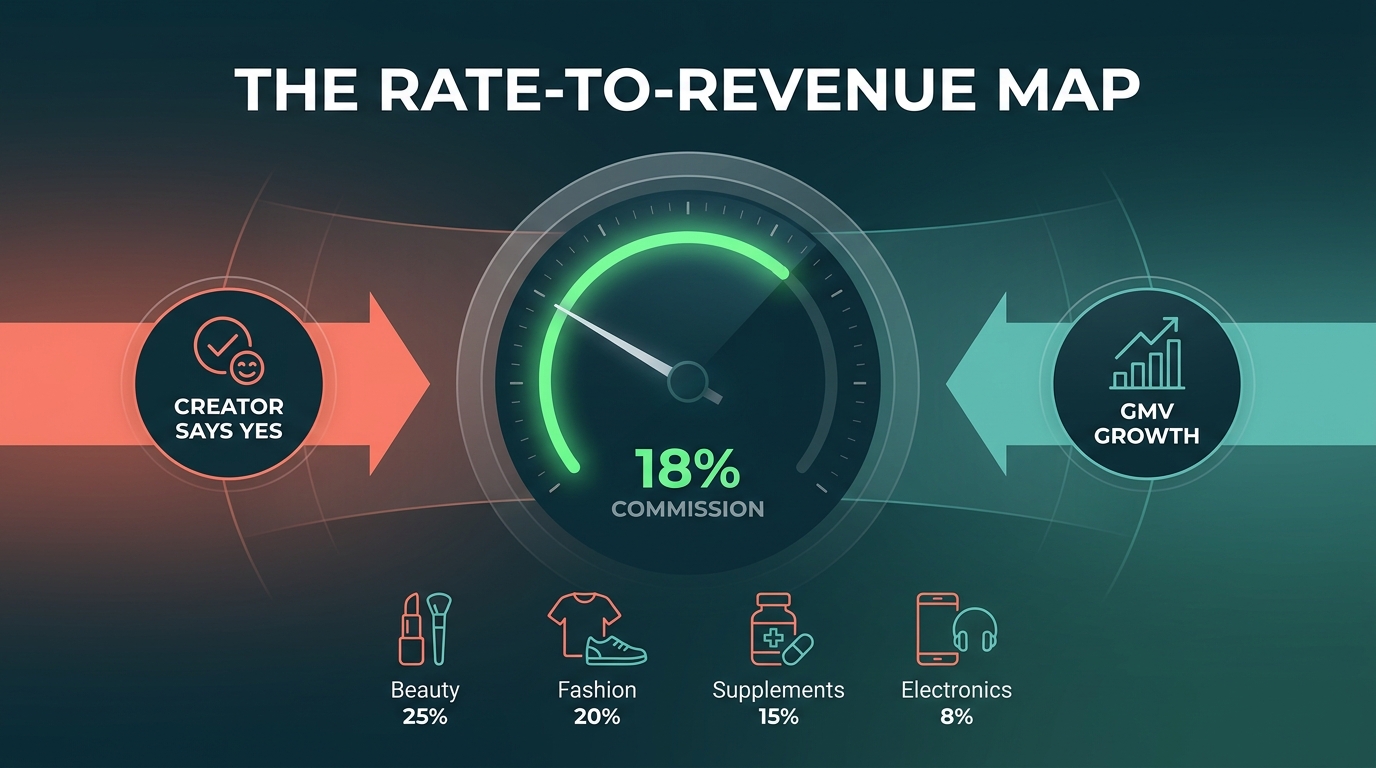
Every brand manager who has set up a TikTok Shop affiliate program has gone through the same ritual: they open Seller Center, navigate to the affiliate commission field, and type in a number. Usually it is somewhere between 10% and 15%. Then they hit save, wait a week, and wonder why more creators are not posting about their products.
The assumption underneath that ritual is that commission is a cost — a percentage you pay out for sales that come in. Set it low enough to protect margin, set it high enough to seem attractive, and the math works. Except it often does not. Not because the number was wrong per se, but because commission rate on TikTok Shop does something far more important than determine your payout: it signals to creators whether your product is worth their time before a single sale ever happens.
That framing changes everything. A commission rate is not a transaction fee. It is a recruitment tool, a filtering mechanism, a credibility signal, and a competitive positioning statement — all expressed as a single percentage. Get it right and you get creators. Get it wrong and you get silence. This post maps the full relationship between the number you set and the revenue you actually generate, using 2026 data across categories, collaboration types, price points, and creator tiers.
Why Most Brands Are Reading Commission Rates Backwards
The instinct to set commission rates as low as possible is not irrational — it comes from a reasonable place. Margin is real, and every percentage point paid out is a percentage point not kept. But that logic only holds once you already have creator traffic and content volume. Before that point, a commission rate that is “efficient” is just invisible.
Here is the problem in concrete terms: TikTok Shop’s affiliate marketplace in 2026 has thousands of products listed by thousands of brands. Creators who browse open plans — and many do, systematically — are making micro-decisions about where to put their effort. They can record one video or five videos today. Every additional video costs time, creative energy, and audience trust. So they are not looking for the lowest acceptable commission. They are looking for the highest plausible earnings per unit of effort, which means a combination of rate, product fit, and the likelihood that the product will actually convert their audience.
The Invisible Program Problem
Industry data from 2026 shows that commissions below 10% attract almost no serious creator interest in competitive categories. Some guides put the effective invisibility threshold even higher — at 12% — for categories like beauty, supplements, and fashion where creators have dozens of comparable products to choose from. Below that floor, your listing exists but functionally does not. Creators scroll past it the same way a consumer scrolls past a product with two reviews and no photos.
The backwards reading is this: brands set low rates to protect margin assuming sales will come. But without creator content, there are no sales to protect margin on. The commission rate needs to be high enough to generate the content that generates the sales that make the commission sustainable. Sequence matters enormously here. Margin optimization is a second-order problem. Creator recruitment is a first-order one.
Commission as Competitive Positioning
When a creator in the beauty niche browses the affiliate marketplace, they are not seeing your brand in isolation. They are seeing your commission rate next to every other beauty brand’s commission rate. If the category average for targeted beauty collaborations sits at 20–25% and you are offering 12%, you are not being thrifty — you are being outbid. The creator’s mental math is fast and unsentimental: brand A pays 22%, brand B pays 12%, both products look roughly equivalent. Brand A gets the video.
This does not mean you need to win a commission rate arms race. It means you need to know where you sit relative to your specific category’s norms, and make a deliberate decision about how to use rate as a positioning tool — not just a cost to minimize.
The Real Commission Floor by Category in 2026
TikTok Shop allows sellers to set affiliate commissions anywhere from 1% to 80%. In practice, the market has established much tighter functional ranges by product category. These are not official TikTok rates — they are emergent norms based on what creators actually respond to, what brands compete at, and what margin structures make product economics viable.
The following benchmarks reflect 2026 market conditions across the US TikTok Shop ecosystem:
Beauty, Skincare, and Cosmetics
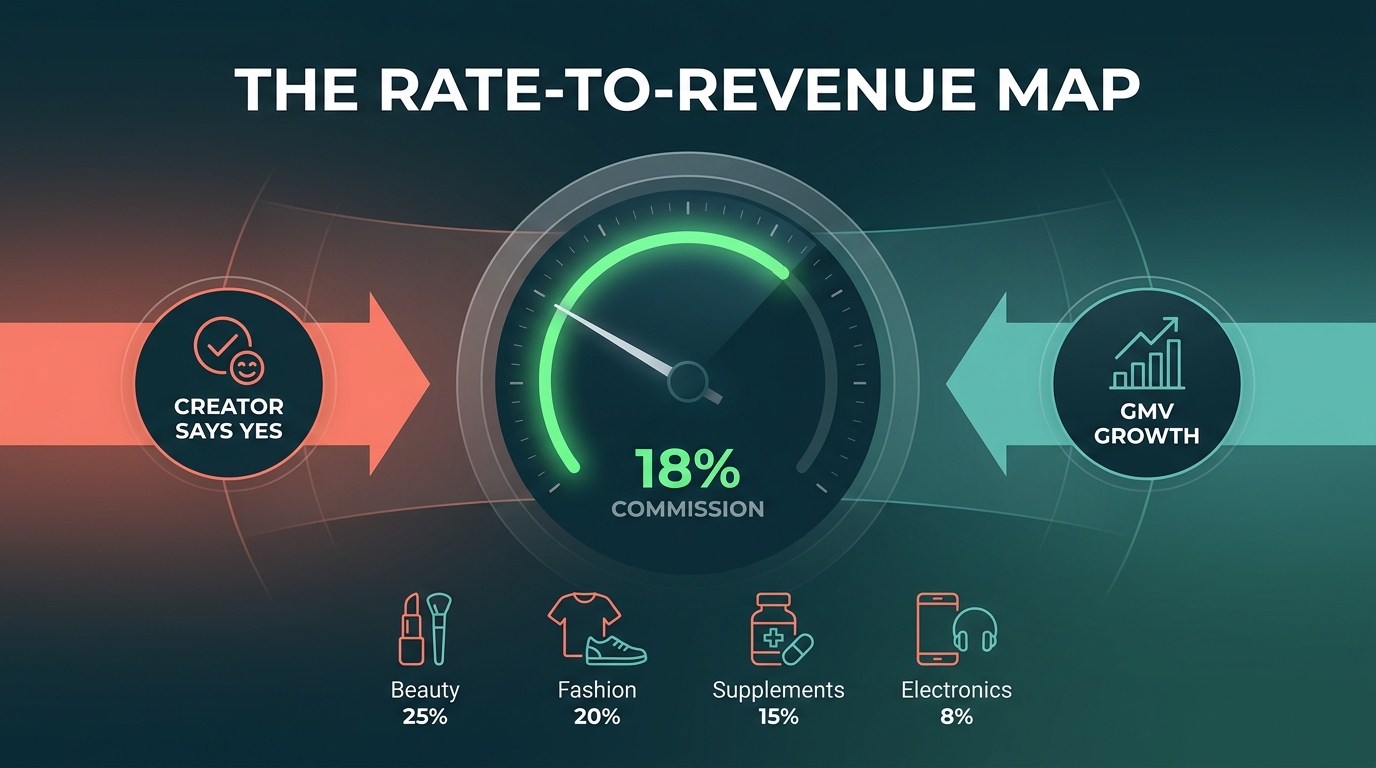
This is the highest-commission category by a significant margin. Open plan rates typically run 15–20%, with targeted collaborations and top-creator deals frequently reaching 20–30%. Some high-margin brands — particularly those with hero SKUs priced under $40 — push rates to 30–35% for VIP creator relationships. The economics work because gross margins on beauty products are often 70–80%, making a 25% affiliate commission genuinely sustainable. The US cross-category average sits at approximately 13.02%, but beauty pulls that number up considerably from the bottom end.
Health, Supplements, and Wellness
Similar in structure to beauty, with open plans at 15–25% and targeted deals at 20–30%+. Supplements in particular benefit from strong repeat-purchase behavior that makes the first affiliate acquisition more valuable to brands, which translates into willingness to pay higher commission on the initial sale. Creators in this space are also more selective — they are concerned about brand credibility and product safety — which means higher rates alone will not win them, but below-category rates will definitely lose them.
Fashion and Apparel
Open plan rates typically range from 10–20%, with competitive targeted deals at 18–25%. Fashion is nuanced because margin varies dramatically by price point and product type. Fast-fashion items with high margins can sustain 20%+; premium fashion brands with thinner margins often operate closer to 12–15%. Return rates in fashion are also higher than average, which brands need to factor in because affiliate commissions are typically netted against returns on TikTok Shop.
Home and Kitchen
Rates cluster around 8–15% for open plans, with targeted deals at 12–20%. This is a category where demonstrable products — gadgets, tools, clever organizers — can perform exceptionally well on TikTok despite moderate commission rates, because the content itself is inherently engaging (demos, before-and-after). Creators in home and kitchen are often willing to accept slightly lower rates for products with high viral potential.
Food and Beverage
Typically 10–20% across both open and targeted plans. Viral food products — unusual snacks, trending drinks, novelty items — can attract significant creator interest even at 10–12% because the content creation is easy and entertaining. Standard packaged food with lower margins sits closer to 8–10%.
Electronics and Tech Accessories
The lowest-commission category, with typical rates of 5–10% for open plans and 8–15% for targeted. Lower gross margins on electronics drive this structure. Creators who specialize in tech do work at these rates because they have audiences specifically calibrated for tech purchases, which drives higher absolute earnings per sale even at lower percentage rates — particularly on higher-ticket items.
What the Average Actually Means
The US cross-category average of approximately 13% is a useful benchmark for understanding market scale, but it is almost useless for making a specific rate decision. The average blends electronics and beauty, mass-market brands and DTC specialists, open plans and targeted deals. What matters is where your category sits, what your specific competitors are offering, and how your rate reads relative to those reference points. The average tells you what the market pays. Your benchmarking tells you what creators in your niche expect.
The Creator Decision Tree: What Happens Between Seeing a Rate and Posting Content
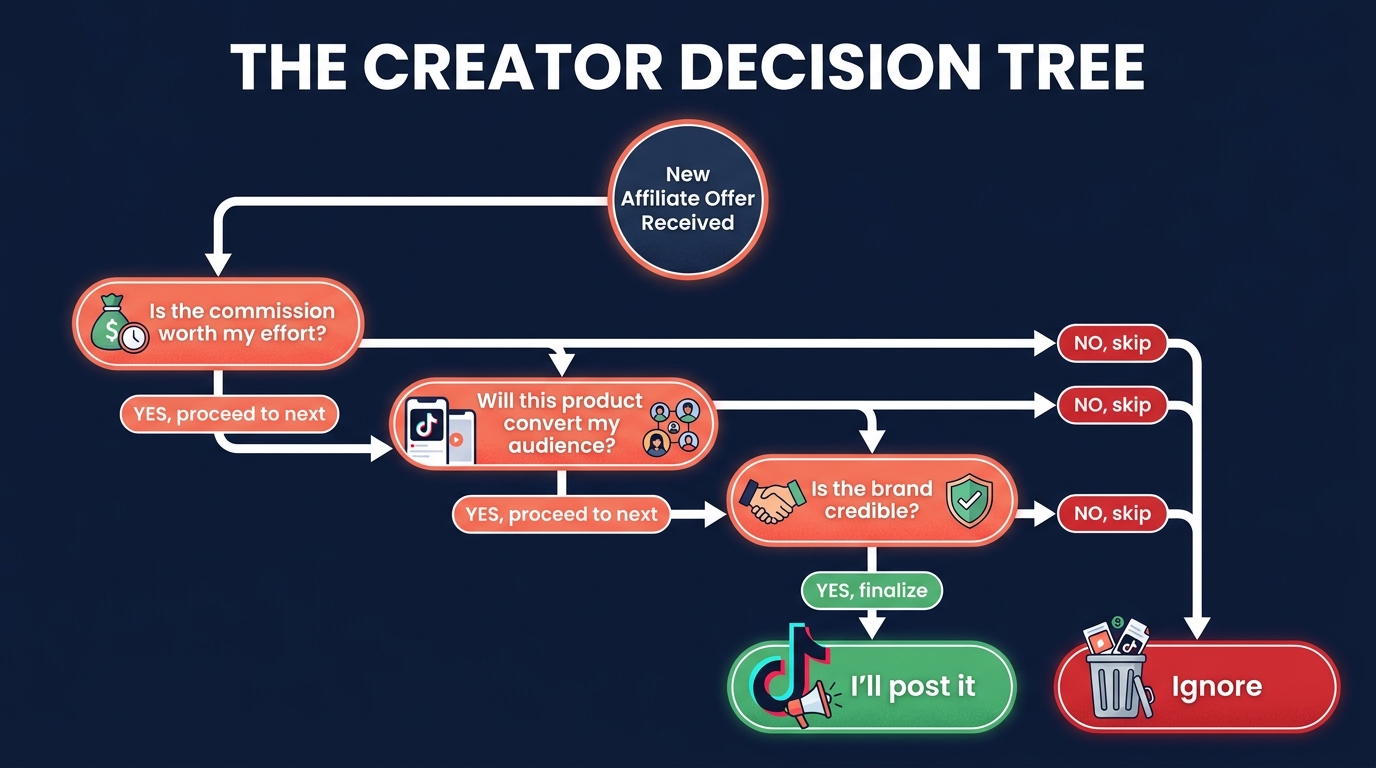
Understanding why creators post — or do not post — about your product requires understanding a decision process that is both rational and instinctive. Creators are running a small business with their content output. Every post is an investment of time and reputation. The question they are answering is not just “is this commission high enough?” It is “what is the expected return on the time and reputation I put into this post?”
That calculation runs through three filters in sequence. Commission rate is only one of them — and it does not always come first.
Filter 1: Is the Commission Worth the Effort?
The first filter is earnings potential, which is commission rate multiplied by expected sales volume. A creator with 50,000 followers thinking about a beauty product priced at $35 with a 20% commission is doing a rough calculation: if the post drives 100 sales, that is $700. If the post drives 20 sales, that is $140. The rate alone does not determine this — the product’s likely conversion rate and the creator’s sense of audience fit both factor in. But rate sets the ceiling on what good performance can earn, which means low rates reduce peak-case earnings and therefore reduce motivation to prioritize that product over others.
Most experts in 2026 identify approximately 15% as the threshold where creators start treating an offer as meaningfully attractive rather than marginal. Below 10% in most categories, serious creators — those with established audiences who know what their content is worth — tend to pass. Not always out of principle, but because there are simply better opportunities for the same effort.
Filter 2: Will This Product Convert My Audience?
Even with a compelling commission rate, creators are thinking about whether their specific audience will buy. A creator whose followers are primarily urban women aged 25–35 interested in clean beauty is not going to enthusiastically promote a supplement brand that skews toward male athletes, regardless of commission percentage. This filter is about audience fit, and it is where many brands fail even when their commission rates are competitive.
This is why targeted collaboration outperforms open plan so consistently — not just because rates are often higher, but because the product-creator match is deliberate rather than random. Creators who are handpicked because their audience profile aligns with the product are already past Filter 2 before the collaboration begins. Open plan creators are still running this filter when they browse the marketplace, and many will fail it.
Filter 3: Is the Brand Credible?
The third filter — often underestimated by brands — is credibility and reliability. Creators in 2026 have become significantly more sophisticated about which brands they affiliate with. They have seen clawbacks, delayed payments, products that arrived poorly packaged or failed quality expectations, and brands that disappeared after poor sales. They are looking at seller reviews, checking how long the brand has been on TikTok Shop, reviewing whether products have solid ratings, and in some cases researching the brand’s overall reputation.
A new TikTok Shop seller with 50 reviews and a 3.8-star average competes very differently for creator attention than an established brand with thousands of reviews and a 4.6-star average — even if both offer the same commission. Credibility is part of the offer, whether brands think about it that way or not.
The Sequence Matters
These three filters are not weighted equally and are not evaluated in isolation. A creator might overlook a slightly below-average rate if the product-audience fit is exceptional. They might decline an above-average rate if the product has credibility red flags. The rate needs to clear Filter 1 to get evaluated at all, but Filters 2 and 3 are what determine whether a creator who is interested actually commits to making content.
This explains a frustrating pattern many brands experience: they raise their commission rate, see a modest uptick in creator applications, but do not see a proportional increase in content volume or sales. Often the problem is Filter 2 or Filter 3 — creators are interested but not confident enough to post. Rate optimization without addressing product-audience fit and brand credibility leaves significant commission spend on the table.
Open Plan vs. Targeted Collaboration: The Conversion Math No One Shows You
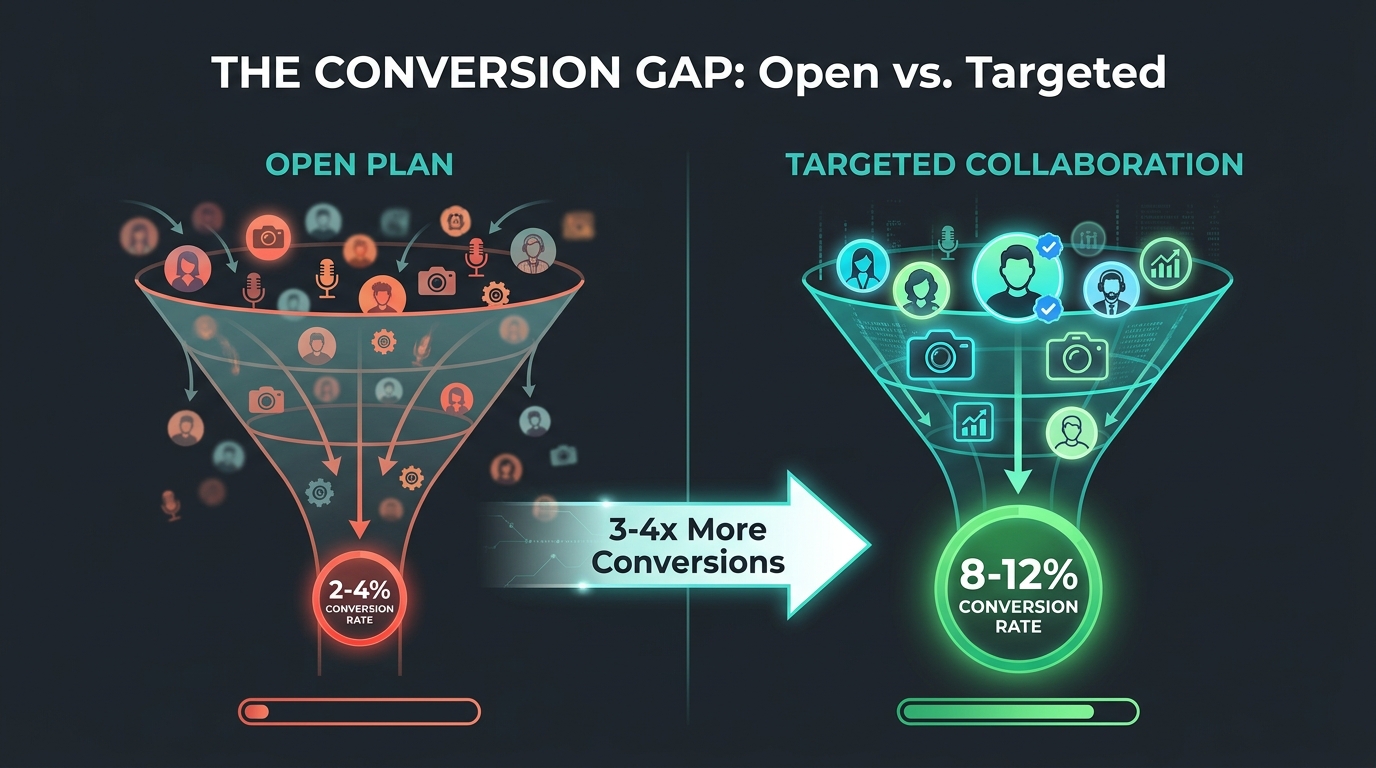
TikTok Shop’s affiliate system offers brands two primary collaboration structures, and the difference between them in conversion performance is far more dramatic than most brands initially appreciate. The choice is not simply between “broad reach” and “narrow reach.” It is between two fundamentally different conversion models.
How Open Plan Works
The Open Plan — sometimes called Open Collaboration — is TikTok Shop’s default affiliate structure. Brands set a single commission rate and list their products in the public affiliate marketplace. Any eligible creator can browse and apply to promote the product. It is self-service, scalable, and requires minimal ongoing management from the brand side once set up.
The conversion data for open plans, however, is sobering. Creator-generated content through open plans typically converts at approximately 2–4% in 2026. This is not a reflection of poor creative quality across the board — it is a structural outcome of how open plans attract creators. When any creator can promote any product, the fit between creator audience and product is largely accidental. Some creators will be well-matched, most will not be. The content volume goes up, but the average quality of audience-product fit goes down, which is why the conversion rate is relatively low.
How Targeted Collaboration Works
Targeted Collaboration is the invitation-based alternative. Brands identify specific creators they want to work with and send direct invitations with customized commission rates, flat fees, or both. The rate offered in targeted collaborations is typically higher than the open plan rate — usually by 5–10 percentage points — which reflects both the selective nature of the arrangement and the expectation of higher-quality content.
The conversion difference is substantial. Creator content through targeted collaborations converts at approximately 8–12% in 2026 — roughly 3–4 times the open plan average. That gap has two sources: better audience-product fit (because creators are selected for relevance) and higher creator investment in the content (because the deal is deliberate, often better compensated, and sometimes includes product briefing or creative direction).
The Actual Math
Consider what these numbers mean for a brand comparing the two approaches on a $40 product with a 20% commission:
- Open Plan: 1,000 people see a creator’s video → 30 purchases at 3% CVR → $1,200 GMV → $240 commission paid
- Targeted: 1,000 people see a creator’s video → 100 purchases at 10% CVR → $4,000 GMV → $800 commission paid
The targeted collaboration pays more commission in absolute dollars, but generates more than 3x the revenue. The open plan looks cheaper per deal, but delivers a fraction of the output per 1,000 viewers reached.
This does not mean open plan is without value. Open plans serve a different purpose: content volume, brand discovery, and passive coverage across a broad creator pool. The highest-performing TikTok Shop affiliate programs in 2026 typically run both in parallel — an open plan for breadth and discoverability, and a targeted program for conversion efficiency. They set different commission rates for each and manage them with different expectations.
The Rate Implication
Because targeted collaboration is where conversion actually happens, the commission rate in targeted deals deserves more attention and more investment than the open plan rate. Many brands treat both as the same decision — they set an open rate and then offer targeted creators a modest increase on top of it. The brands getting the best results tend to think about these as separate budgets with separate strategic purposes, and they are willing to pay materially more (sometimes 25–30%) in targeted deals for the conversion premium that structure delivers.
The Price Point Equation: How AOV and Commission Rate Multiply (or Cancel) Each Other
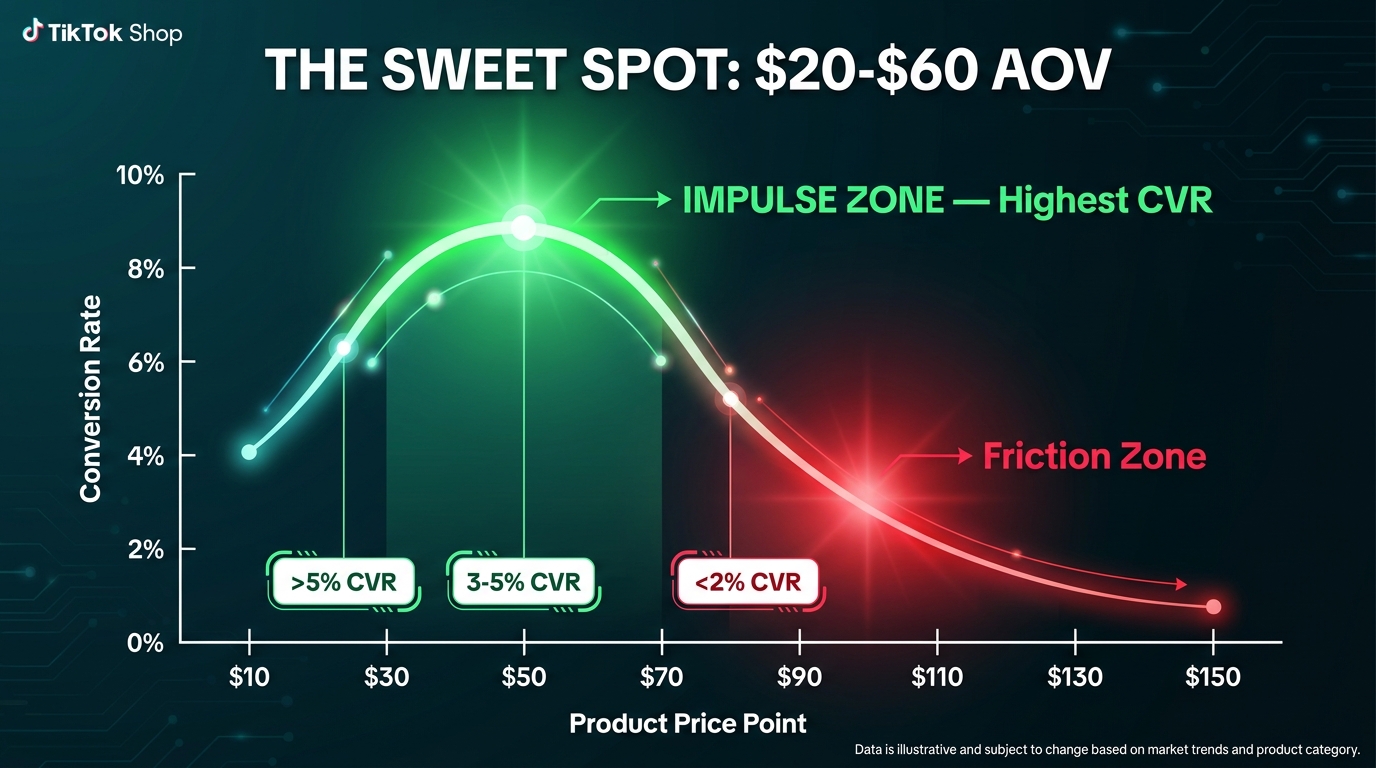
Commission rate and product price point are not independent variables. They interact in ways that can either amplify creator earnings — making your program highly attractive — or cancel each other out — producing offers that look reasonable on paper but disappoint in practice.
Where TikTok Shop Converts Best by Price
TikTok Shop is, at its core, a discovery-to-impulse commerce platform. The shopping experience is embedded in short-form video content designed to generate emotional response quickly. That environment is most powerful for products where the decision to buy does not require significant deliberation. Price point is the single largest determinant of how much deliberation a purchase requires.
The 2026 data on conversion rate by price tier is fairly consistent across sources:
- Sub-$20 products: Highest conversion rates, often exceeding 5–6% for well-executed content. Low friction, high impulse. The limitation is that even with a generous commission rate, the absolute dollar earnings per sale are small.
- $20–$60 products: The optimal zone for most affiliate programs. Conversion rates typically run 3–5% for average content, higher for excellent targeted content. At a 20% commission on a $40 product, a creator earns $8 per sale — meaningful at volume.
- $60–$80 products: A transition zone where conversion starts to decline and audience consideration time increases. Still workable for products with strong visual appeal or demonstrable value, but requires more sophisticated content to convert.
- $80+ products: Conversion rates typically fall below 2% in the affiliate content environment. Not impossible to sell at these price points — but the economics of commission selling shift significantly. Brands in this tier often need to use LIVE shopping, where dwell time and real-time Q&A can compensate for the higher price barrier.
The Creator Earnings Calculation
From the creator’s perspective, the relevant number is not commission rate — it is expected earnings per 1,000 views (eCPM, in effect). A 25% commission on a $15 product yields $3.75 per sale, and at a 5% conversion rate that is roughly $187.50 per 1,000 viewers who click through. A 15% commission on a $45 product yields $6.75 per sale, and at a 4% conversion rate that is $270 per 1,000 clickthroughs. The higher-AOV product with the lower commission rate produces better absolute creator earnings — even though the rate looks less generous.
This is why brands with products in the $30–$60 range often have more room than they think to set commission rates at 15–20% and still win creator interest. The combination of AOV and conversion rate in that zone produces strong absolute earnings for creators. Conversely, brands with very low-AOV products need to be more aggressive on rate just to make the math interesting for creators.
Building the Commission Rate Around AOV
A practical rule of thumb from 2026 practitioner guidance: calculate the expected creator earnings per 1,000 video views at different commission rate scenarios, using realistic conversion rate estimates for your price tier. If that number falls below $100–$150 per 1,000 views in a competitive category, your offer will struggle to attract engaged creators regardless of how competitive the rate looks in percentage terms. The goal is to structure the offer so that a creator who performs well earns meaningfully, because creators talk to each other — and a reputation for strong earnings per post is worth more than any listing optimization.
Hybrid Deals: Flat Fee + Commission Structures That Actually Recruit Top Creators
The traditional affiliate structure — commission only, no upfront guarantee — works reasonably well for broad creator recruitment. But for creators with established audiences who produce consistent, high-quality content, it has a fundamental problem: it puts all the risk on the creator.
A creator who spends three hours researching a product, writing a script, filming, editing, and posting a video has no guarantee of earning anything. If the product does not convert for any reason — product quality issues, bad product-page photos, a confusing checkout flow on TikTok Shop — the creator earns nothing for significant work. The bigger the creator’s audience and the more sophisticated their content operation, the more unacceptable that risk profile becomes.
What Hybrid Deal Structures Look Like in 2026
The market has responded with hybrid deals: a guaranteed flat fee per video plus an affiliate commission on sales generated. This structure has moved from a negotiation exception to something closer to a standard expectation for targeted collaboration with mid-to-top-tier creators in 2026.
Typical ranges in the current market:
- Micro-creators (10K–100K followers): Flat fees of $50–$300 per video, plus 15–25% commission on sales. Total expected earnings are roughly comparable to commission-only deals when products convert well, but the flat fee significantly reduces risk and increases willingness to participate.
- Mid-tier creators (100K–500K followers): Flat fees of $300–$1,500 per video, plus 15–25% commission. At this level, brands are paying for both the content creation and the audience access, and the flat fee reflects both.
- Macro creators (500K–1M+ followers): Flat fees of $1,000–$5,000+ per video, plus 10–20% commission. The flat fee dominates the economics; commission becomes an upside incentive rather than the primary earnings mechanism.
Why Flat Fee Alone Does Not Work
Some brands, particularly those with previous influencer marketing experience, are tempted to shift entirely to flat fees and eliminate commission. This is increasingly a mistake for TikTok Shop specifically. The affiliate commission structure is what creates sales-driving behavior — a creator who earns commission on every sale has an ongoing incentive to keep the content up, to respond to comments, to mention the product in subsequent content, and to care about conversion rate rather than just view count. Remove the commission and you often get a single post that performs as well as any flat-fee placement — which is to say, not as well as commission-motivated content.
The hybrid model works precisely because it combines the creator’s need for risk mitigation (addressed by the flat fee) with the brand’s need for sales-motivated behavior (addressed by the commission). It recruits creators who flat-fee-only deals or commission-only deals could not.
TikTok Shop’s Mechanics for Hybrid Deals
TikTok Shop’s seller platform supports hybrid structures within the Targeted Collaboration framework. Sellers can set a flat fee (ranging from $20 to $10,000 per creator, per TikTok’s published range) and a commission percentage (0% to 80%) within the same collaboration invitation. This flexibility means hybrid deals can be structured precisely rather than approximated through off-platform arrangements, which also means proper attribution and payout tracking. Understanding these mechanics is foundational to building a repeatable targeted creator program rather than one-off deals managed through spreadsheets and manual Venmo payments.
Tiered Commission Architecture: Building a Program That Earns Creator Loyalty
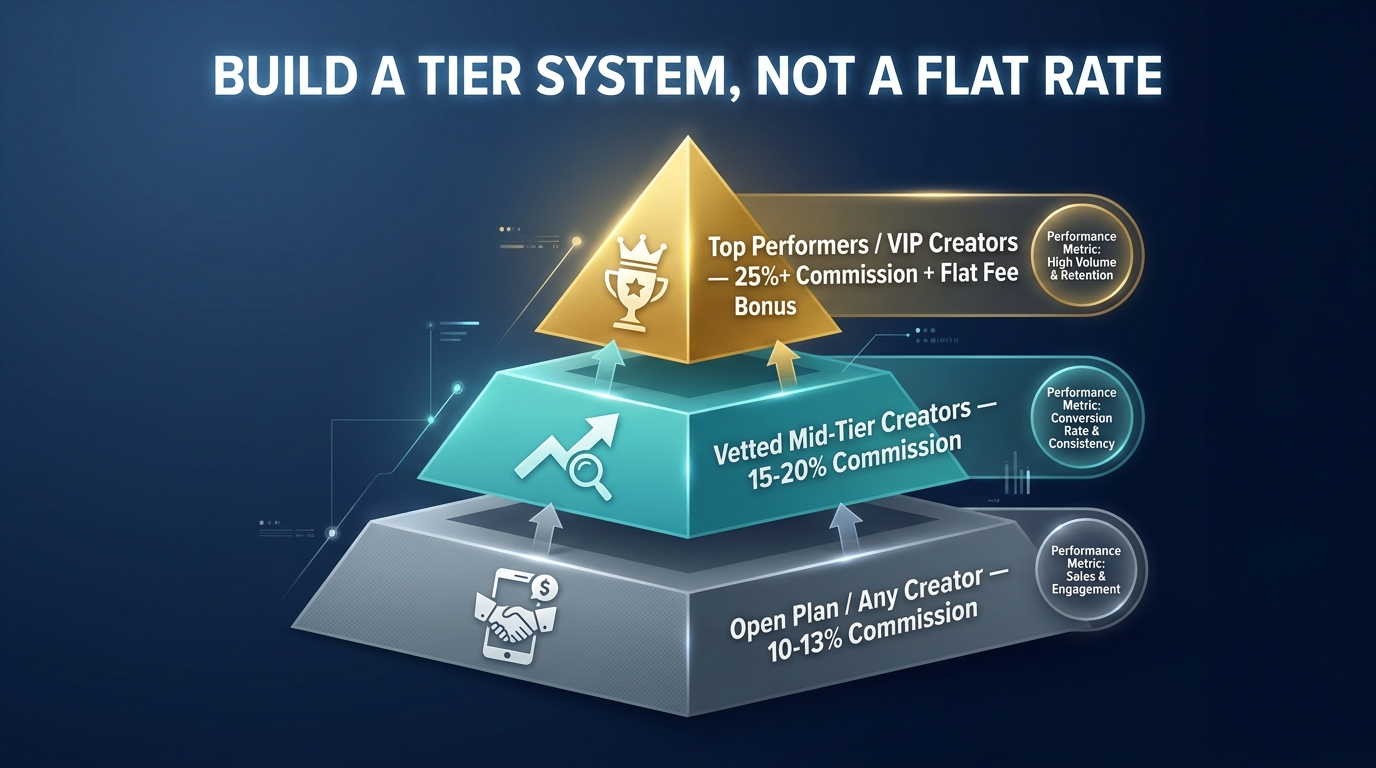
Flat commission rates — the same percentage paid to every creator on every product — are the most common affiliate program structure among brands new to TikTok Shop, and they are also one of the most limiting. A flat rate is a compromise: too high to be sustainable at scale, or too low to be competitive for quality. A tiered structure resolves this by matching commission investment to creator performance and value.
The Logic of Tiering
A well-designed tier system does several things simultaneously. It uses a lower baseline rate for broad, open-plan discovery — which keeps cost manageable for the long tail of creators who may generate occasional sales. It reserves higher rates for vetted mid-tier and top creators who deliver consistent, high-converting content — where paying more per sale is justified by volume and quality. And it creates an aspirational ladder that incentivizes creators to increase their performance in exchange for better rates, building ongoing engagement rather than one-and-done posts.
One brand-level example from mid-2026 illustrates this structure well: a wellness brand ran a three-tier model with an 8% base rate on open plans, a 12% rate unlocked at $10,000 in monthly GMV, and a 15% rate at $25,000 in monthly GMV. The tiering created meaningful incentive for creators who were already performing well to prioritize the brand’s products in their content schedule — because the incremental commission at higher tiers was worth the incremental effort of posting more frequently.
Building Your Own Tier Architecture
A practical three-tier structure for most mid-size DTC brands in 2026 looks like this:
- Tier 1 — Open Plan: 10–13% commission. Available to any eligible creator through the marketplace. Goal is discovery, content volume, and passive coverage. Expectations should be low per creator; cumulative volume is the metric that matters.
- Tier 2 — Vetted Creators: 15–20% commission, typically through targeted collaboration invitations. For creators you have researched, whose audience profile fits your product, and who have a track record of affiliate sales. This is where the bulk of your conversion-driven GMV should originate.
- Tier 3 — VIP or Top Performers: 22–30%+ commission plus flat fee where applicable. Reserved for your highest-performing creators — those who have demonstrated specific ability to convert your audience. These are partnership relationships, not transactional deals. The higher commission rate reflects their proven value, not just their follower count.
Performance-Triggered Rate Increases
Some brands add a dynamic element: commission rates that increase automatically once a creator reaches certain GMV thresholds in a given period. TikTok Shop’s Indonesia market implemented a formal platform-level version of this in May 2026, where creators below certain monthly GMV thresholds received the base rate, with bonus additions of 1.5%, 3%, and 5% at successive GMV tiers. US brands can implement equivalent logic through targeted collaboration terms, even without platform-enforced mechanics. The effect is that your best creators are continuously rewarded for their performance, and the program has natural built-in retention.
Managing the Tier System Over Time
A tiered structure requires more active management than a flat rate. Creators need to be evaluated, moved between tiers when their performance warrants it, and communicated with clearly about how the tier system works and what they need to do to advance. This overhead is real. But the payoff — a creator base that is invested in the brand’s success, not just passively listing the product — is substantial. Affiliate programs that operate on relationship logic consistently outperform those that operate on listing logic, and tiering is one of the primary mechanisms that creates that relationship dynamic.
The Margin Math: How to Set Rates Without Destroying Profitability
Every commission discussion eventually collides with margin reality. A 25% affiliate commission in beauty sounds competitive and may well win creators — but if your product costs 45% of the retail price to make and deliver, you are paying out more than you can sustain. Commission rate decisions cannot be made in isolation from unit economics. The brands that run sustainable affiliate programs have done the math explicitly; those that have not tend to discover the problem after paying out commissions they cannot afford.
The Basic Margin Formula
Working backwards from gross margin to maximum sustainable commission rate:
- Start with your retail price per unit (e.g., $40)
- Subtract your landed cost including manufacturing, shipping to warehouse, and TikTok fulfillment fees (e.g., $12 = 30% of retail)
- Subtract TikTok Shop’s platform commission (typically 2–8% of GMV depending on category, e.g., 6% = $2.40)
- Your gross margin before affiliate commission: $40 – $12 – $2.40 = $25.60 (64%)
- Your maximum sustainable affiliate commission at 50% gross margin target: $25.60 × 0.5 = $12.80 → $12.80/$40 = 32%
In this example, you could theoretically offer up to 32% affiliate commission and still achieve a 50% gross margin on the commission-driven sale. That ceiling gives you genuine room to compete aggressively in a high-commission category. Brands that have done this math — and know their ceiling — negotiate from a position of informed confidence. Brands that have not done this math often either leave commission headroom unused (offering 12% when 22% is viable) or accidentally run affiliate campaigns that erode margin past acceptable levels.
Accounting for Returns
TikTok Shop affiliate commissions are typically applied to net sales after returns, but the timing matters. If a product has a high return rate — common in fashion and electronics — the gross GMV driven by creators can look impressive while net-of-returns GMV is much lower. When modeling your sustainable commission rate, use realistic return-adjusted revenue figures rather than gross sales. A 15% return rate on a $40 product effectively reduces the average revenue per sale to $34, which changes the maximum sustainable commission calculation accordingly.
Contribution Margin vs. Gross Margin
More sophisticated brands track contribution margin per affiliate sale: gross margin minus all variable costs associated with the channel, including platform fees, affiliate commission, any flat fees paid, and incremental customer service costs for that acquisition channel. This number gives a clearer picture of what the affiliate channel actually earns per sale versus what it appears to earn at the gross margin level. For most well-run programs, contribution margin per affiliate sale should comfortably exceed the cost of traditional paid social acquisition — if it does not, the program needs either rate adjustment, product selection optimization, or both.
Where Brands Go Wrong: The 5 Most Costly Commission Mistakes
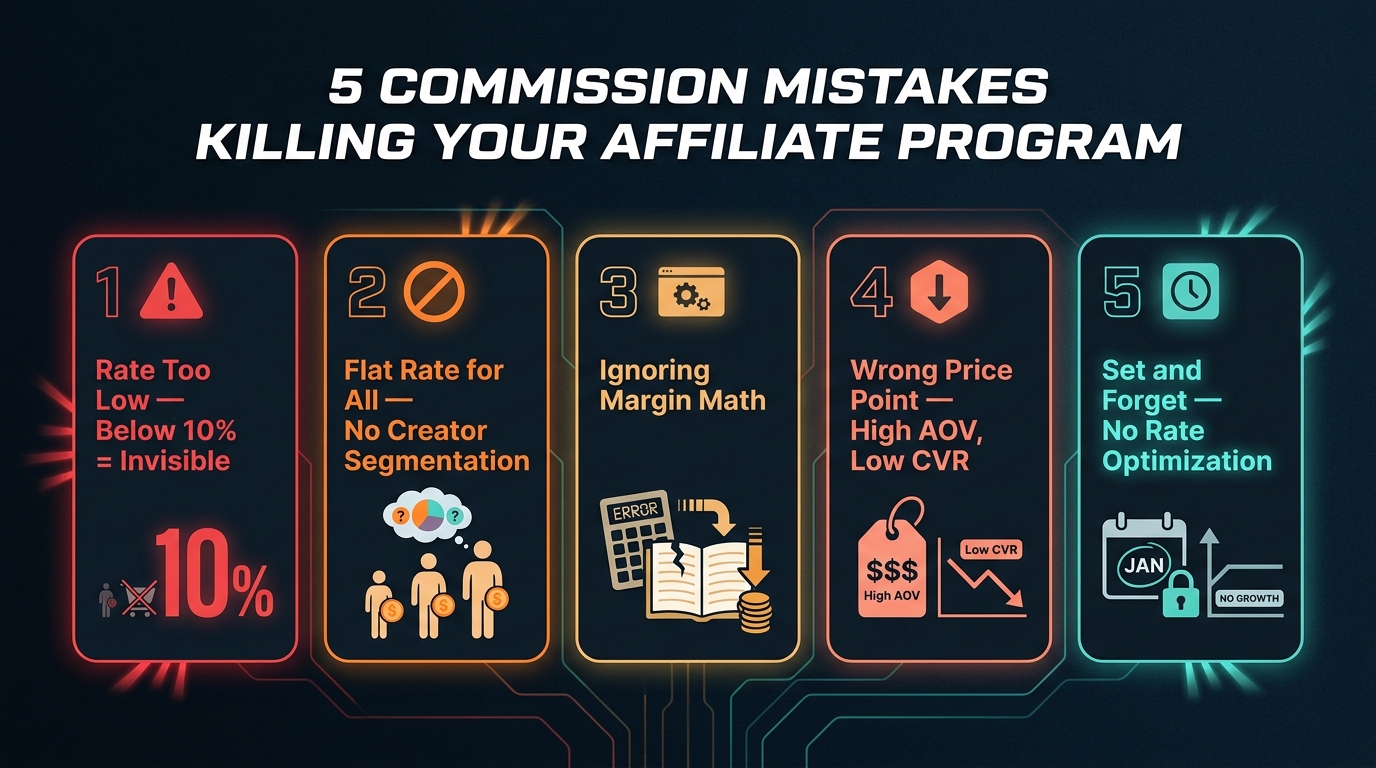
After reviewing how commission structure works in theory, it is worth cataloguing how it fails in practice. These are the five most common and most costly mistakes brands make when designing TikTok Shop affiliate programs, based on 2026 practitioner patterns and platform data.
Mistake 1: Setting the Rate Below the Category Noise Floor
The most elementary error. Brands that set open plan rates at 5–8% in categories where the functional minimum for creator interest is 12–15% are not being conservative — they are simply not visible. Their product appears in the marketplace but generates almost no organic creator uptake. The fix is straightforward: benchmark your category, identify the functional floor (not the average), and start at or slightly above it. Below-floor rates are not a savings — they produce zero-return commission spend on a program that generates no content.
Mistake 2: Using One Flat Rate for Every Creator and Every Product
A single commission rate across all creators and all products is the single biggest structural inefficiency in most affiliate programs. It overpays unproven creators (who may or may not post) and underpays proven creators (who could drive substantial GMV if properly incentivized). It also ignores the fact that different products have vastly different margin profiles — a hero product with 75% gross margin can support a 25% commission rate, while a lower-margin product may top out at 12%. Segmenting rates by both creator tier and product group is not complexity for its own sake; it is how you allocate commission budget where it generates the most return.
Mistake 3: Ignoring the Creator Earnings Math
Brands set commission rates as a percentage of revenue without modeling what that percentage means in absolute earnings for a typical creator. If a creator with 30,000 engaged followers posts a video about your product, drives 50 clicks, and 2 of those convert (a realistic 4% CVR on a $35 product), they earn $1.40 at a 10% commission rate. That is not enough to justify the effort. At 25%, they earn $8.75 — still modest, but meaningful if repeated across several posts. Understanding what creators actually earn per post drives better rate-setting than any percentage benchmarking exercise alone.
Mistake 4: Treating Open Plan and Targeted Collaboration as the Same Budget
Many brands allocate a single commission rate across both structures. As the conversion data makes clear, these are different programs with different economics and different purposes. Running targeted collaboration at the same rate as open plan is systematically underpaying your best creators. The most productive targeted creators should be receiving rates and deal structures that reflect the 3–4x conversion premium they deliver over the open plan average. Conflating the two in the budget is a category error that caps performance.
Mistake 5: Set-and-Forget Commission Management
Perhaps the most widespread mistake: setting commission rates at launch and never revisiting them. Commission rates are a dynamic competitive signal in a dynamic marketplace. Category norms shift. New competitors enter with aggressive rates. Your own product portfolio changes — new SKUs launch, some products reach peak velocity and others decline. Creators who were marginal performers at launch may have grown their audiences significantly. Running quarterly reviews of commission rates by product group and creator tier — benchmarked against current category norms — is table stakes for programs that want to remain competitive over time. The “set it and forget it” approach is how programs that started well gradually become invisible as competitors iterate and you do not.
Building Your Rate-to-Revenue Map Step by Step
Everything above becomes most useful when assembled into a process — a systematic way to decide what commission rates to set, for which products, for which creators, and how to evaluate whether those decisions are working. This is what a functional rate-to-revenue map looks like in practice.
Step 1: Audit Your Current Cost Structure
Before setting any rate, know your numbers. Calculate the landed cost, TikTok platform fees, and gross margin for each product group you plan to affiliate. Establish the maximum sustainable commission rate at your target margin. This gives you a ceiling — the rate you can offer without the channel becoming loss-making — which is equally important as the floor (the minimum creators will accept).
Step 2: Research Category Commission Norms
Browse TikTok Shop’s affiliate marketplace as a creator would. What rates are competing brands offering in your category? What rates are products with strong creator uptake and review volume showing? This gives you a real-world picture of competitive positioning rather than relying on aggregate averages that may not reflect your specific niche.
Step 3: Set Differentiated Rates by Product and Creator Tier
Using your margin ceiling and competitive benchmarks, set three distinct rate levels: your open plan rate (competitive with the category norm), your targeted/vetted creator rate (5–8 percentage points above open), and your VIP creator rate (the maximum you can sustain while still achieving target margin). Apply these across your product groups, adjusting for margin differences between high- and low-margin SKUs.
Step 4: Build the AOV-Commission Optimization Table
For each product group, calculate the expected creator earnings per 1,000 views at each tier rate, using realistic CVR estimates for your price point. If any combination produces expected creator earnings below $100–$150 per 1,000 views in a competitive category, flag it as undercompetitive and consider whether rate increases, price point adjustments, or better creator matching can improve the equation.
Step 5: Implement Targeted Collaboration Actively
Do not rely on open plan as your primary conversion driver. Allocate a meaningful portion of your affiliate budget to targeted creator identification, outreach, and relationship management. Focus the highest commission rates and any flat fee offers on this tier. Track these collaborations separately from open plan performance to understand their true contribution to GMV.
Step 6: Review and Rebalance Quarterly
Set a calendar reminder every quarter to review: category commission benchmarks, your top-10 creator performance by GMV contribution, return rates by product, and margin by affiliate sale. Adjust rates and tier assignments based on what the data shows. This is not a fire-and-forget program — it is an active commercial relationship that requires iteration to stay competitive and sustainable.
Step 7: Track the Right Metrics
The vanity metrics in affiliate management are creator count and total GMV. The useful metrics are: GMV per active creator, commission cost as a percentage of net revenue (after returns), conversion rate by collaboration type, average creator earnings per post (which predicts future creator behavior), and new-customer rate among affiliate-driven purchases (which distinguishes acquisition value from repeat purchase). Brands that track these metrics catch problems early and optimize continuously; those that focus only on top-line GMV often discover margin problems only after they have accumulated.
The Number Is a Strategy, Not a Setting
The insight that ties everything in this analysis together is simple but often missed: a TikTok Shop affiliate commission rate is not a transaction parameter. It is a strategic instrument with multiple simultaneous functions — recruiting creators, positioning against competitors, shaping creator behavior, and determining program sustainability.
When brands set rates with only one of those functions in mind — usually cost minimization — they get programs that are either invisible (too low), unsustainable (too high), or mediocre (uniform and unresponsive to creator performance variation). When brands set rates with all four functions in mind, they get programs that recruit the right creators, motivate sustained content output, stay competitive over time, and generate GMV at a cost structure the business can support indefinitely.
The 2026 TikTok Shop affiliate environment is more competitive and more sophisticated than it was two years ago. The US cross-category average of approximately 13% masks wide variation — beauty and wellness brands competing at 25–30% for top creators, electronics brands making economics work at 8–12%, and everything in between calibrated to category norms, margin structures, and creator tier expectations. There is no universal right number. There is a right process for finding your number, monitoring it, and updating it as conditions change.
Actionable Takeaways
- Know your margin ceiling before setting any rate. Calculate how high you can go on commission before the channel becomes unprofitable. Then compete within that ceiling, not below it by default.
- Benchmark your category specifically, not the platform average. Your competition is other brands in your niche, not the aggregate TikTok Shop market.
- Treat open plan and targeted collaboration as separate programs with separate budgets, separate commission structures, and separate performance metrics.
- Model creator earnings per post, not just your own payout percentage. If the math is not compelling for creators, the content will not come.
- Move toward tiered commission structures that reward performance and create ongoing creator loyalty, rather than flat rates that treat every creator identically.
- Consider hybrid deals (flat fee + commission) for targeted creator relationships — particularly with creators who have established audiences and more options than your product alone.
- Review and update rates quarterly. Commission rates are not a launch setting — they are an active competitive tool that degrades in value if left static while the market moves.
Affiliate creator content now drives approximately 42% of all US TikTok Shop GMV. That is not a marginal channel — it is the dominant one. The brands that approach commission rate-setting with the same rigor they apply to paid media bidding, pricing strategy, and product development will have a structural advantage over those that treat it as an afterthought. The commission rate is the first thing a creator sees. Make it count.