


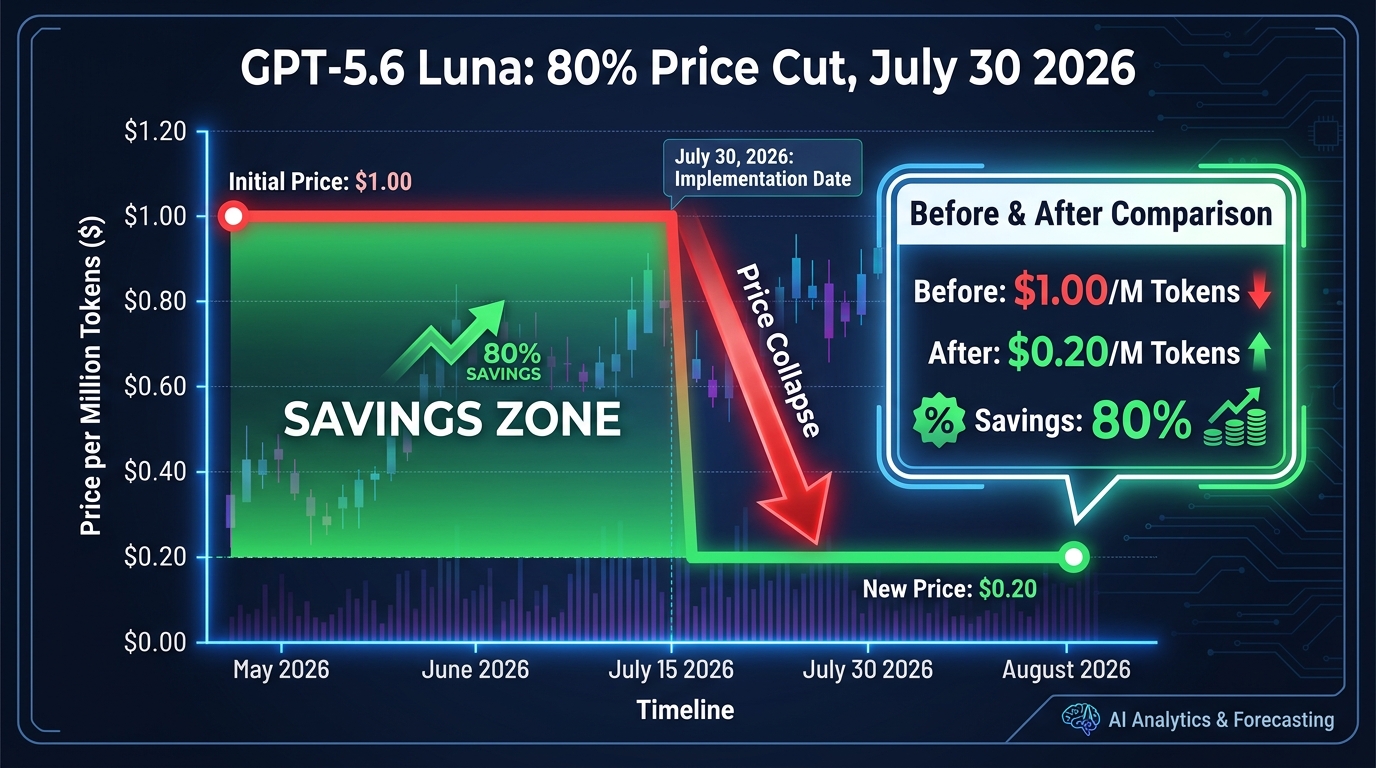
On July 30, 2026, OpenAI cut the price of GPT-5.6 Luna by 80%. Most teams running production automation workflows found out about it from a Slack message or an industry newsletter, not from an urgent board meeting. That’s the problem.
A price cut of that magnitude isn’t just a vendor discount. It’s a signal that the economic logic behind your entire model selection strategy may now be outdated. If you designed your automation stack six months ago — routing everything through a GPT-4-class model because it was the cheapest thing that could reliably do the job — you’re probably overpaying by a factor of three to five compared to what’s now available.
But the opportunity here isn’t simply “switch to Luna and save money.” It’s more nuanced than that, and teams that treat it as a drop-in replacement are going to hit quality problems they didn’t anticipate. The real work is in understanding what GPT-5.6’s three-tier architecture actually means for task routing, where caching and token governance multiply the savings, how to stage a migration without breaking what’s working, and critically — where the cheaper tiers will fail you and Sol still earns its price tag.
This guide is for practitioners who are actually responsible for automation budgets and model selection. It’s structured around what you need to do, not just what you need to know. We start with the architecture, move into the rebuild sequence, and end with the guardrails that keep a cost-optimized stack from becoming a quality disaster.
Understanding the GPT-5.6 Tier Architecture: Sol, Terra, and Luna
GPT-5.6 is not a single model. It’s a family of three models with meaningfully different capability profiles, latency characteristics, and price points. Treating the family as interchangeable — or defaulting to one tier for everything — is exactly the kind of architecture decision that creates unnecessary cost.
Sol: The Flagship
Sol is GPT-5.6’s highest-capability tier. It’s designed for frontier reasoning tasks — long-horizon coding, multi-step agentic work, cybersecurity research, science problems, and any workflow that requires sustained logic across extended context windows. OpenAI reports that Sol uses roughly one-third of the output tokens of comparable frontier systems on complex benchmarks, which speaks to its efficiency at the top end.
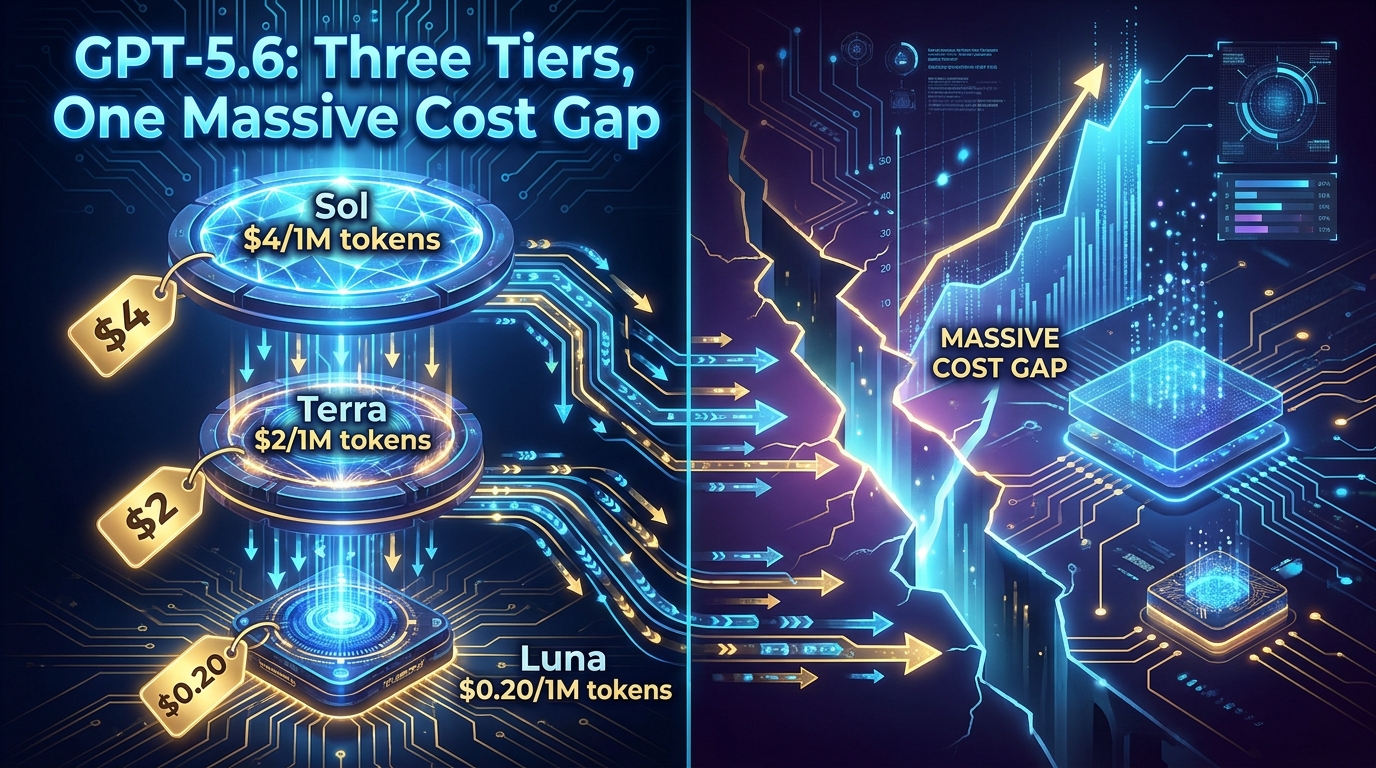
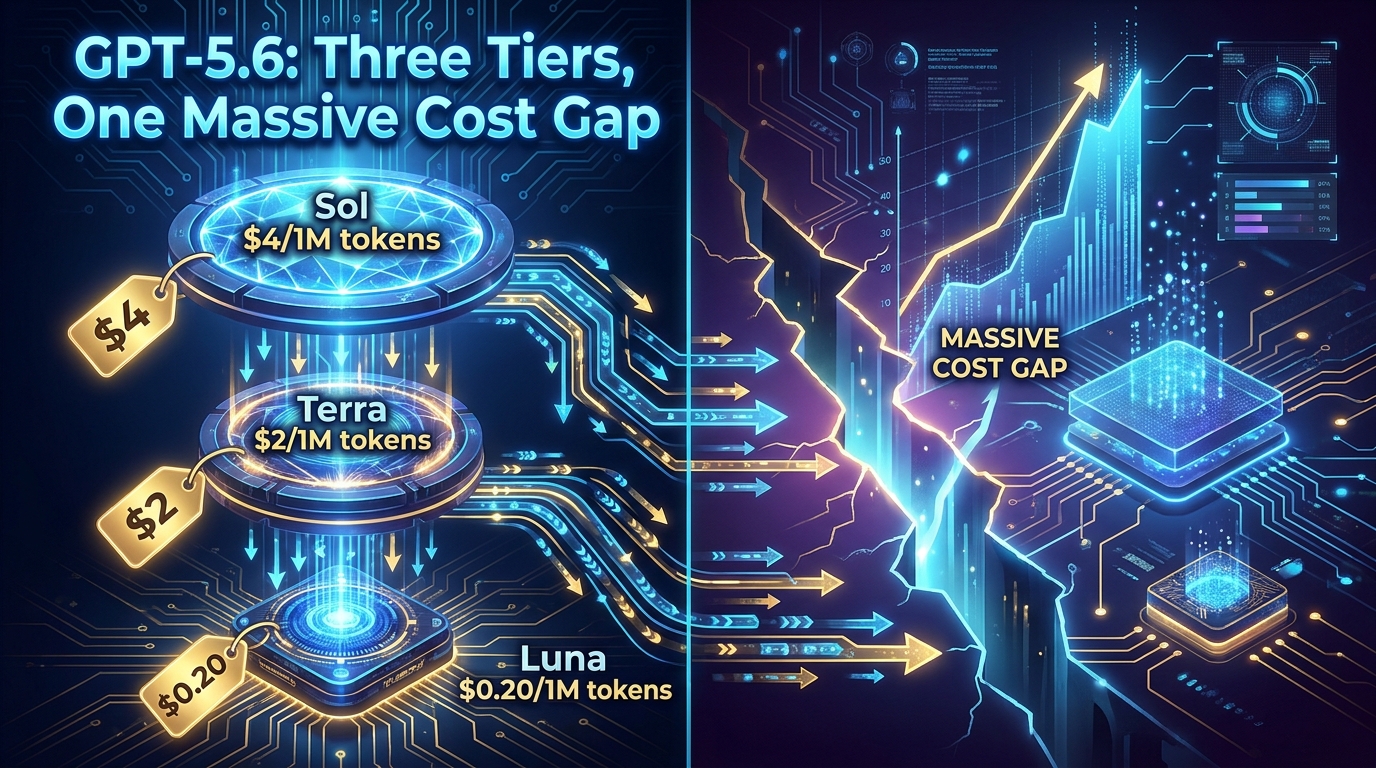
Standard short-context pricing for Sol is $4 per million input tokens and $20 per million output tokens, after a 20%-plus cut OpenAI applied in August 2026. That’s still the most expensive tier in the family by a significant margin, but for genuinely hard tasks the cost-per-correct-answer calculus changes substantially. A Sol response that gets the reasoning right in one pass is cheaper than three Luna attempts that require human review.
Terra: The Production Workhorse
Terra is the balanced mid-tier. OpenAI positions it as competitive with GPT-5.5 on general-purpose production workloads — documentation generation, code review support, business process automation, and most customer-facing tasks. The pricing is $2 per million input tokens and $12 per million output tokens after a 20% cut on July 30, 2026.
For most mature automation workflows that were previously running on GPT-4 or GPT-4o, Terra is the correct default landing point. It delivers near-frontier general capability at roughly half the cost of Sol, and the performance gap on everyday tasks — well-structured summarization, entity extraction, classification, templated drafting — is narrow enough that quality regressions should be minimal with proper prompt tuning.
Luna: The Volume Engine
Luna is where the pricing story gets genuinely interesting. At $0.20 per million input tokens and $1.20 per million output tokens, Luna is 95% cheaper than Sol and 90% cheaper than Terra on input. OpenAI cut Luna’s price by 80% on July 30, 2026 — a cut so large it shifts the break-even math on entire categories of workflows that were previously marginal.
Luna is optimized for speed and throughput. It’s not trying to win reasoning benchmarks. Where it excels is in high-volume, well-defined tasks: classification with clear schemas, extraction from structured or semi-structured input, routing decisions, first-pass summarization, template population, and sentiment analysis. If a task can be reduced to a clear specification with narrow output variance, Luna can handle it reliably at a fraction of what you were paying before.
What the Tier Gap Actually Means in Practice
Consider a workflow processing 100 million input tokens and 20 million output tokens per month — a mid-sized automation pipeline. The cost comparison across tiers is stark:
- Sol: $400 input + $400 output = $800/month
- Terra: $200 input + $240 output = $440/month
- Luna: $20 input + $24 output = $44/month
The gap between Sol and Luna for this workload is $756 per month. Multiply that across multiple pipelines and the annual savings opportunity runs well into six figures for any organization with meaningful automation volume. That’s why the tier architecture deserves careful attention — not as a vendor marketing exercise, but as a core infrastructure decision with direct P&L impact.
Why the Luna Price Cut Changes the Math on Entire Workflow Categories
The 80% Luna price cut isn’t just a discount on the same value proposition. It crosses several economic thresholds that matter for automation strategy. Understanding which thresholds it crosses helps you identify which workflows should be re-evaluated immediately.
Workflows That Were Previously Marginal Are Now Economical
Before the July 30 cut, high-volume classification and extraction workloads had to clear a relatively high cost bar to justify LLM-based processing over simpler rule-based or traditional ML approaches. At the old Luna pricing, running 500 million input tokens per month through the model cost approximately $500 in input alone. At $0.20 per million, the same volume costs $100. That’s the difference between a workflow that barely pencils out and one that delivers strong ROI even at modest accuracy gains over legacy approaches.
The automation categories that cross into clearly viable territory at Luna’s new pricing include:
- Support triage at scale: Classifying and routing thousands of daily support tickets using a schema-constrained Luna call, with only escalations hitting a stronger model.
- Document extraction pipelines: Pulling structured fields from invoices, contracts, and forms where the schema is known and the output format is narrow.
- Content moderation at volume: Running first-pass moderation on user-generated content before human review or higher-accuracy model review.
- Background summarization: Generating summaries of product reviews, meeting transcripts, or customer feedback at a scale that previously required sampling rather than full coverage.
- Data enrichment pipelines: Adding classification tags, sentiment signals, or structured metadata to large datasets where full coverage wasn’t cost-justified before.
The Broader Pricing Context: An 88% Collapse From 2023
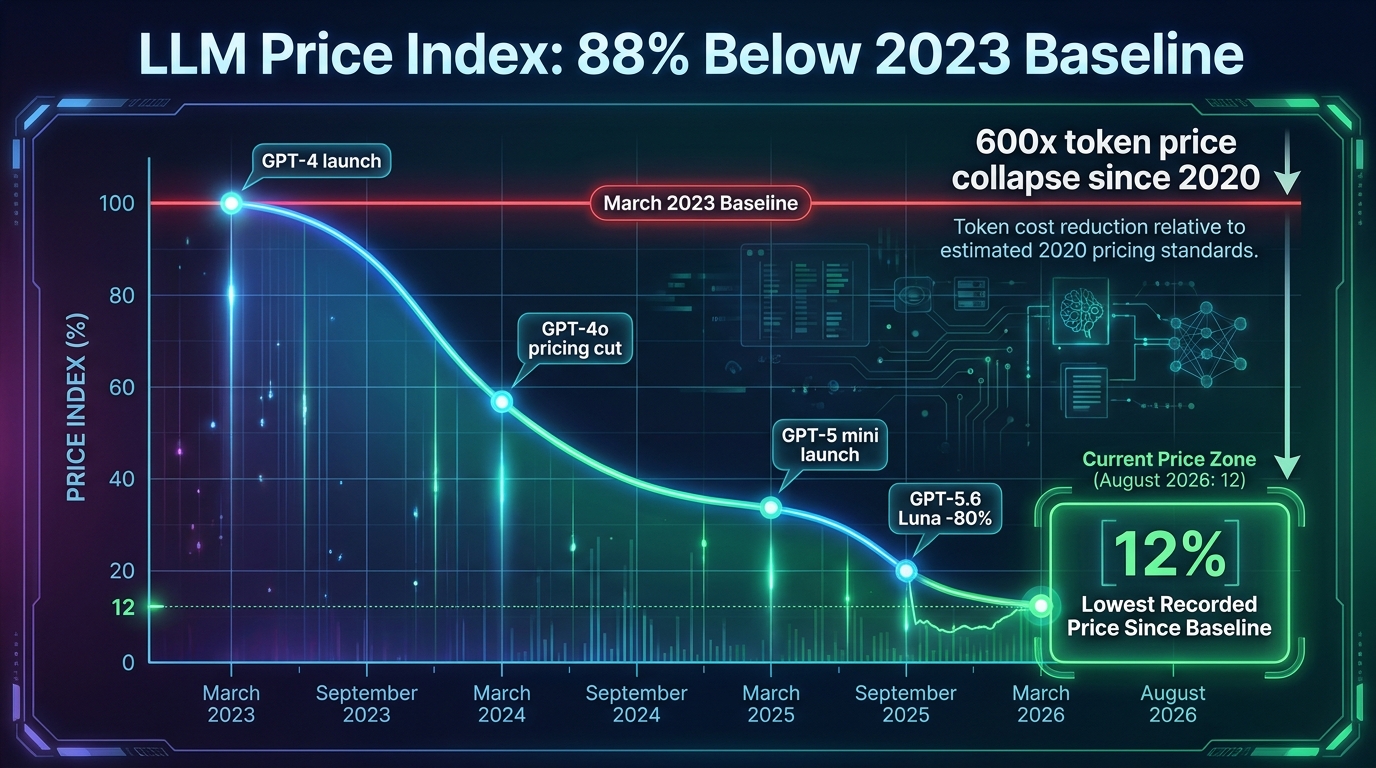
Luna’s cut is dramatic but it’s part of a larger trend. The BenchLM frontier LLM price index was at 12 in August 2026 — 88% below its March 2023 base. The cheapest model clearing a GPT-4-class benchmark fell from $1.93 per million tokens to $0.11 per million tokens between February and August 2026 — a 17x collapse in under six months. Researchers tracking the broader market estimate a roughly 600-fold token price decline from 2020 to 2026, driven primarily by software and architectural improvements rather than hardware costs.
The practical implication is that automation economics are resetting faster than most infrastructure cycles. A stack designed in late 2025 may already be overbuilt for its actual task requirements, and the right response isn’t to wait for the next pricing cycle — it’s to audit and route now.
The Risk of Not Acting
Teams that ignore the Luna price cut aren’t just leaving money on the table. They’re also setting a precedent for how AI cost management works inside their organizations. Every month of avoidable overspend is a month of budget that could fund more automation coverage, faster iteration, or simply better unit economics on existing products. The technical debt here isn’t in the code — it’s in the model selection layer.
Auditing Your Current Stack Before You Touch Anything
The single most common mistake in an automation stack rebuild is moving too fast. Teams see the price numbers, immediately reroute traffic to Luna, and then spend three weeks debugging quality issues they could have anticipated with a proper audit. The right starting point is observability, not migration.
Build a Complete Call Inventory
Before any routing decision, you need a full inventory of every LLM call in your automation stack. For each call, you want to capture:
- Model being used (including version, if tracked)
- Input token count (prompt + context)
- Output token count
- Latency (P50, P95, P99)
- Monthly call volume
- Cost per call and monthly total
- Task type (classification, extraction, generation, reasoning, etc.)
- Output structure (free text, JSON schema, binary decision, ranked list)
- Current error / quality rate (if measured)
If your stack lacks this instrumentation, that’s the first build item — not model routing. You cannot make sound routing decisions without knowing what your calls actually cost, how they’re distributed, and what quality looks like today. LLM observability tools like Langfuse, Helicone, or custom logging middleware can surface this data without requiring architectural changes to the underlying workflows.
Classify Tasks by Complexity
Once you have the call inventory, classify each task type along two dimensions: output complexity (is the correct answer narrow and verifiable, or does it require creative judgment?) and reasoning depth (does the task require multi-step inference, or is it a single-pass pattern match?).
A useful heuristic framework:
- Luna candidates: Binary or narrow-categorical outputs; fixed schema extraction; repetitive structured tasks; tasks where the “correct” answer can be verified against a schema or lookup table.
- Terra candidates: Open-ended but well-scoped generation; moderate reasoning steps; tasks that require some judgment but have clear quality criteria; customer-facing text generation where tone matters.
- Sol candidates: Multi-step reasoning chains; long-horizon planning; tasks where errors cascade; code generation in complex codebases; any task where getting it right first time has high downstream value.
Calculate the Cost of Your Current Misrouting
For each task in the Luna-candidate bucket, calculate what you’re currently spending versus what you’d spend at Luna pricing. This becomes your migration priority list. Tasks with the highest volume and widest cost gap go first. Tasks with complex output requirements or unclear quality criteria go last, after you’ve validated Luna’s performance on simpler cases.
This audit typically takes one to two weeks for a mid-sized automation stack. It’s not optional — it’s the foundation for every decision that follows.
The Three-Tier Routing Model — Sending the Right Task to the Right Model
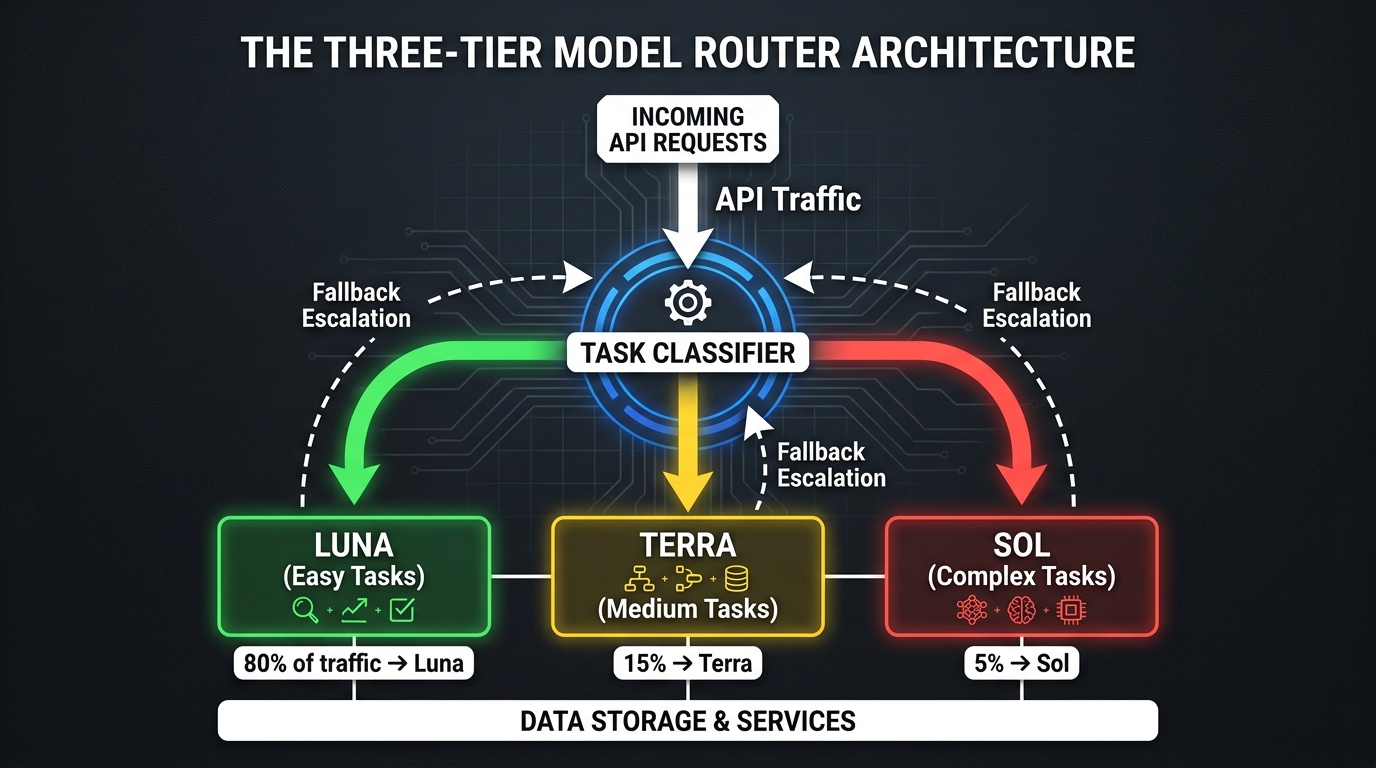
Model routing is no longer an advanced optimization. In 2026, it’s a standard cost-control layer that any team running material LLM spend should have in production. The concept is straightforward: instead of selecting a model once and using it for everything, you classify each incoming request by its complexity requirements and route to the cheapest model capable of handling it reliably.
Implemented well, routing plus caching can reduce blended inference spend by 40 to 85 percent on mixed workloads. The variance depends on how concentrated your traffic is in the easy-task bucket and how cleanly your task classification performs.
Building the Task Classifier
The classifier sits at the entry point of your inference pipeline. For each incoming request, it evaluates a set of signals to determine which tier should handle it:
- Request type signal: Hardcoded routing for known task types. If a request comes from your support-ticket-classification service, it goes to Luna. Period. No classifier needed for stable, high-volume single-type pipelines.
- Complexity heuristics: For general-purpose or mixed-traffic pipelines, use lightweight rules: output schema complexity, context window length, presence of multi-step instructions, and task keywords. A request that includes “analyze and compare” behaves differently from one that says “extract the company name from.”
- Learned routing: For mature pipelines, train a small classifier on historical call data — inputs mapped to quality scores by tier — to predict which tier will meet quality requirements at lowest cost. This takes more setup but produces better routing decisions at scale.
Traffic Distribution Targets
A well-routed mixed workload typically distributes something like 75 to 85 percent of traffic to Luna, 12 to 20 percent to Terra, and 3 to 8 percent to Sol. The exact split depends on your task mix, but if you’re sending more than 20 percent of traffic to Sol, you should examine whether all of that is genuinely Sol-required work or whether some of it is a routing gap.
Fallback Escalation Logic
Routing isn’t a one-shot decision. An effective router includes a fallback path that escalates to a stronger model when the cheaper model’s output fails a quality gate. The escalation trigger should be specific:
- Schema validation failure: Luna returned output that doesn’t match the expected JSON schema. Escalate to Terra.
- Confidence threshold: The output includes a low-confidence signal (if you’re prompting for structured confidence scoring) or passes below a similarity threshold to known-good examples. Escalate.
- Length anomaly: The output is significantly shorter or longer than expected for this task type. Flag for review or escalate.
- Hard task signals detected post-hoc: If output analysis suggests the request was more complex than the classifier estimated, log the example and retrain the classifier.
The critical design principle is that escalation should be automated, logged, and cheap in latency terms. A Luna-first attempt that takes 200 milliseconds and escalates to Terra is still faster and cheaper on average than sending every request to Terra or Sol by default.
Implementation Stack Options
Router implementation depends on your existing infrastructure. Common approaches include a lightweight Python gateway using an LLM orchestration library (LangChain, LlamaIndex, or a custom request handler), an API gateway plugin that intercepts calls and rewrites the model parameter based on routing rules, or a purpose-built LLM router service that maintains routing state, logs decisions, and handles fallback chains. For teams using n8n, Temporal, or similar workflow orchestration tools, routing logic can be embedded at the workflow level with model selection as a configurable node parameter per task step.
Prompt Caching and Semantic Caching: The Two Levers Most Teams Leave Untouched
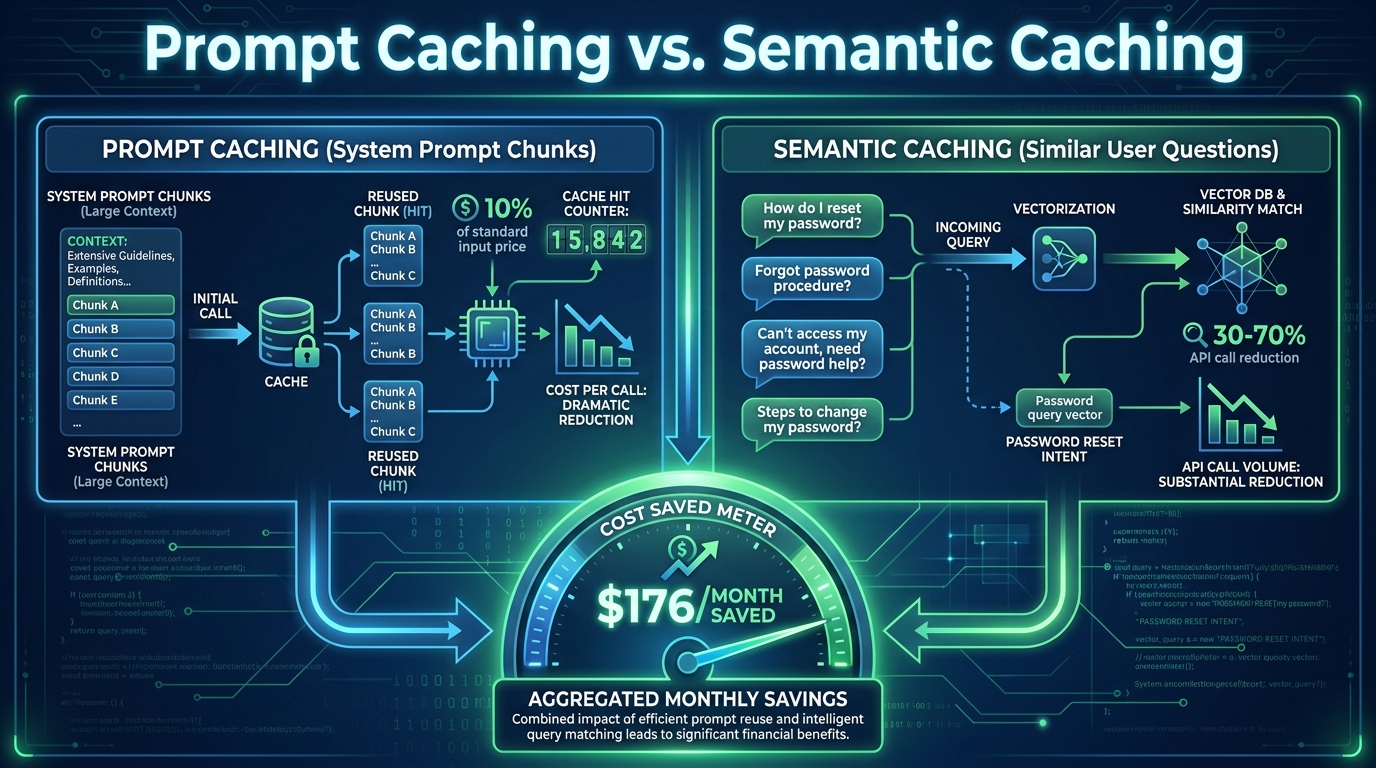
Routing sends work to cheaper models. Caching eliminates work entirely. The two strategies compound — and yet most teams implement neither until they’re staring down a surprising inference bill. The 2026 caching landscape has matured considerably, and both provider-level prompt caching and application-level semantic caching are now mature enough to deploy without significant infrastructure overhead.
Prompt Caching: Provider-Level Savings on Repeated Context
Prompt caching works at the provider level. When a request contains a repeated prefix — a system prompt, a document reference, a long instruction block — the provider caches the key-value computation for that prefix and bills subsequent requests that reuse it at roughly 10 percent of standard input price. No code change beyond ensuring your repeated context appears at the start of the prompt.
The savings are most significant for use cases where a large, stable context block precedes variable user input: RAG pipelines that prepend the same document or knowledge base across many queries; agent systems with long, stable system prompts; support tools that always include the same product documentation context; and code assistants that repeatedly read the same codebase context. In these scenarios, prompt caching alone can reduce effective input costs by 40 to 70 percent on the cached portion of each request.
To maximize cache hit rates, structure your prompts so that the most stable content comes first and the variable content comes last. Avoid inserting dynamic elements (timestamps, user IDs, request-specific metadata) into the middle of long stable prefixes — this breaks the cache match. Build a discipline around prompt structure and you’ll see cache savings compound over time as call volume grows.
Semantic Caching: Application-Level Savings on Similar Queries
Semantic caching operates at the application layer. Instead of caching based on exact string match, it embeds incoming queries into a vector space and checks whether any sufficiently similar past query already has a stored response. If the similarity score exceeds your configured threshold, it returns the cached response without making an API call at all.
Practical savings from semantic caching depend heavily on workload duplication. For support and FAQ workflows, where many distinct users ask functionally identical questions with different phrasing, semantic caching can eliminate 30 to 70 percent of API calls. A 2026 benchmark evaluating GPT Semantic Cache implementations reported up to 68.8 percent fewer API calls on representative support query datasets.
For less repetitive workloads — unique document processing, bespoke code generation, one-off analysis tasks — semantic caching hit rates are lower, and the infrastructure overhead may not justify the savings. The heuristic is: if your task traffic clusters around a manageable number of query intents, semantic caching is worth implementing. If every request is genuinely unique, prompt caching and routing will serve you better.
Implementation Architecture for Both Layers
A production caching layer for an LLM pipeline typically looks like:
- Incoming request → semantic cache lookup (vector similarity, threshold ~0.92)
- Cache hit → return cached response, log hit, skip API call
- Cache miss → apply routing logic, select model tier
- Model response → validate output, store in semantic cache with TTL and metadata
- Provider-level prompt caching is automatic if prompt structure is optimized
Key implementation decisions include setting an appropriate similarity threshold (too low and you’ll return semantically wrong responses; too high and cache hits will be rare), enforcing tenant and context isolation in the cache (a cached response for one customer’s data should not surface for another), and managing cache invalidation when underlying knowledge or data changes. Redis with vector search extensions, Pinecone, or purpose-built LLM caching layers like GPTCache or Helicone’s semantic caching are the most common infrastructure choices in 2026.
Context Compression and Token Governance
Model routing and caching reduce the cost of the calls you make. Context compression reduces the size of those calls. Token governance ensures your automation doesn’t silently grow its own spend without anyone noticing. Together, these two disciplines close out the cost optimization picture.
Why Context Bloat Happens
Context bloat is the gradual accumulation of unnecessary tokens in your prompts. It happens in several predictable ways: system prompts that started as five sentences and are now three pages because every edge case got a new instruction; RAG pipelines that retrieve the top-10 most similar chunks regardless of whether all ten are relevant; conversation threads that include the full history even when only the last two turns are needed for the current task; and code generation prompts that include entire file trees when only three functions are relevant.
The impact of context bloat compounds at scale. If your average prompt is 30 percent larger than it needs to be, you’re paying 30 percent more on input costs across every call in the pipeline. At Luna pricing of $0.20 per million tokens, that might sound trivial — but at Terra pricing of $2 per million or Sol at $4 per million, 30 percent unnecessary context on a high-volume pipeline is real money.
Practical Compression Techniques
Effective context compression strategies include:
- Prompt auditing: Systematically review every system prompt in production for redundancy, repetition, and instructions that have been superseded by model capability improvements. The 2026 models handle many edge cases implicitly that required explicit instruction in 2023-era prompts.
- Selective RAG retrieval: Instead of retrieving a fixed top-k chunks, use relevance scoring to retrieve only chunks above a confidence threshold. Add a reranker step to cut marginal chunks before they hit the prompt.
- Conversation summarization: For multi-turn agents, implement rolling summarization: after N turns, compress prior conversation history into a structured summary and continue from the summary rather than the raw transcript.
- Context pruning: For code and document analysis tasks, use a smaller, fast model (Luna is ideal here) to first extract the relevant sections, then send only those sections to the primary task model. The preprocessing cost is minimal; the context savings are often 50 to 80 percent.
- Structured prompt templates: Replace prose instructions with structured JSON or YAML instruction blocks where the model supports it. These are typically more token-efficient than free-form English for specifying output schemas and constraints.
Token Governance: Budget Controls and Anomaly Detection
Token governance means treating LLM token spend like any other operational cost — with budgets, alerts, and circuit breakers. In 2026, this is enabled at several layers:
- Per-call token limits: Set explicit max_tokens limits on all API calls. Default to conservative limits and increase only for tasks that demonstrably need more output length. An agent that silently generates 3,000 tokens when 500 would suffice is a governance failure.
- Budget caps per workflow: Implement spending limits at the workflow level using your LLM gateway or orchestration layer. When a workflow crosses its monthly budget threshold, trigger an alert and switch to a cheaper model tier rather than cutting access entirely.
- Anomaly detection: Monitor per-call cost distributions. If a workflow that normally costs $0.002 per call starts averaging $0.008, that’s a signal worth investigating — usually it means context has grown, a retry loop is misfiring, or a schema change caused unexpected output expansion.
- Agent loop circuit breakers: For agentic workflows, implement hard limits on the number of tool calls or model invocations per task. Runaway agent loops are one of the fastest ways to generate unexpected spend, and a simple iteration counter with a break condition is far cheaper than the alternative.
Fallback Logic and Quality Gates — Keeping Standards Up While Costs Drop
The most common objection to cost optimization in automation stacks is quality risk. It’s a legitimate concern. Moving from Sol to Terra or from Terra to Luna isn’t free — there are real capability differences, and if you don’t manage the transition carefully you will see quality regressions in production. The solution isn’t to avoid routing; it’s to build quality gates that catch problems before they affect downstream systems or end users.
What Quality Gates Look Like in Practice
A quality gate is an automated check that runs on model output before it’s passed to the next step in the workflow. The gate’s job is to catch output that doesn’t meet requirements — either by schema, content, or confidence — and trigger either a retry, an escalation, or a human review flag.
Effective quality gates in production automation pipelines include:
- Schema validation: If the model is supposed to return structured JSON, validate the schema before using the output. Pydantic, Zod, or similar validators handle this cleanly. Validation failure triggers an escalation to Terra or Sol.
- Completeness checks: Verify that required fields are populated, required entities are present, and required conditions are met. A support ticket classification that returns null for the priority field is not a valid output.
- Golden-set comparison: Maintain a small set of labeled examples for each task type. Periodically run new model outputs through a similarity comparison against golden-set answers. Significant drift signals a routing or prompt issue.
- Downstream signal monitoring: Track quality signals from downstream consumers of model output — downstream system error rates, human review rejection rates, escalation rates from customers. These lag indicators complement the direct output quality checks.
Calibrating Escalation Thresholds
The challenge with fallback logic is that an overly aggressive escalation threshold eliminates your cost savings. If Luna fails 30 percent of quality gates and escalates to Terra, you haven’t really moved to Luna — you’ve just added latency to Terra. The goal is to configure Luna for tasks where it fails less than 5 to 10 percent of the time, so the blended cost of Luna-first with occasional Terra escalation still beats sending everything to Terra.
This calibration requires a testing phase during migration. Before routing production traffic to Luna for a task type, run a parallel evaluation: send the same inputs to both Luna and the current model, compare outputs against your quality criteria, and measure Luna’s failure rate. If it exceeds your escalation cost tolerance, either improve the prompt (often Luna’s failures are fixable with clearer schema instructions), lower the task complexity (break the task into simpler Luna-compatible steps), or accept that this task type belongs on Terra.
Migrating Off GPT-4-Era Defaults: A Staged Rollout Approach
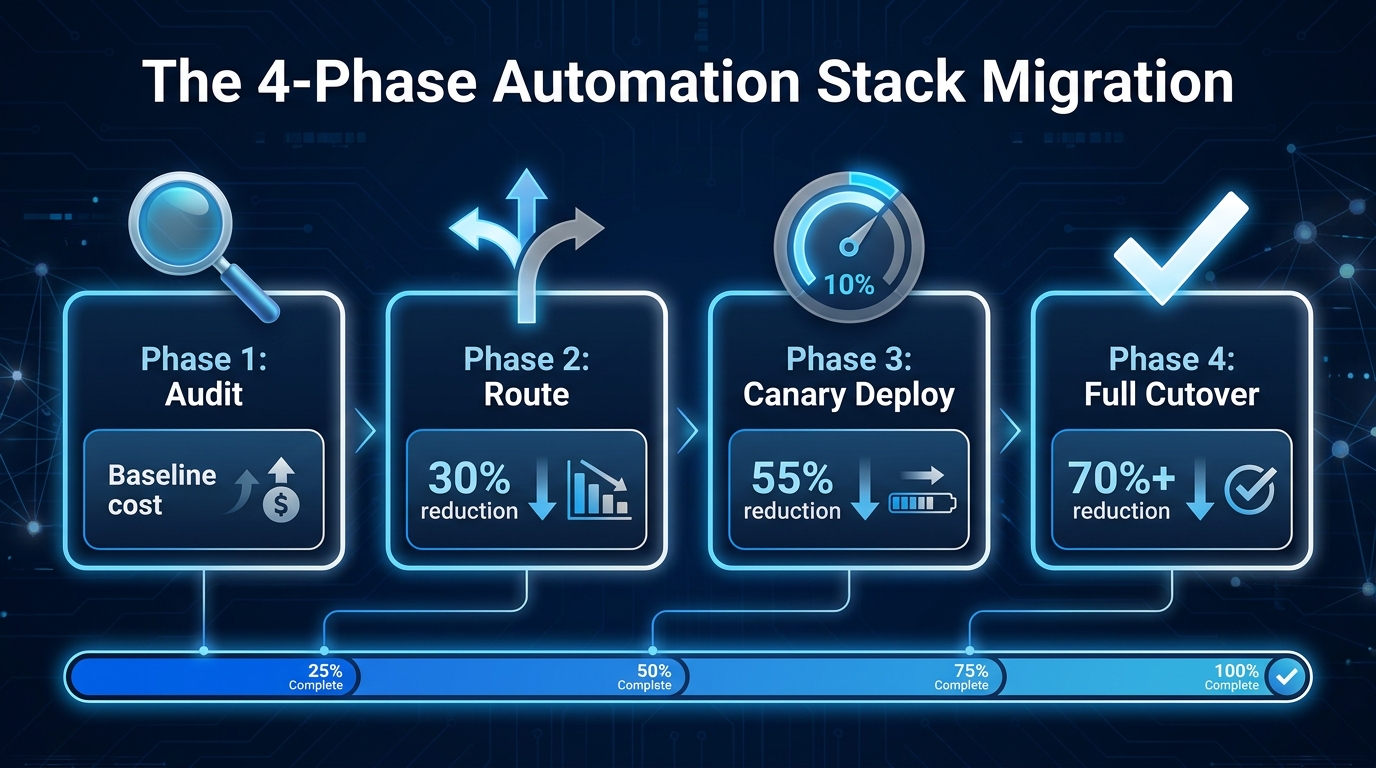
Many production automation stacks still have hardcoded model identifiers pointing at GPT-4, GPT-4o, or GPT-4.1. They were set when those models were the best available option, and they haven’t been revisited because “if it’s not broken, don’t fix it.” The problem is that the economics have broken, even if the functionality hasn’t. Here’s how to stage the migration without risking the workflows that matter.
Phase 1: Audit and Instrument (Week 1-2)
As described in the audit section, the first phase is purely observational. Deploy logging across all LLM calls, build the call inventory, classify task types, and calculate the current spend distribution. No model changes. The output of this phase is a prioritized migration list with cost impact estimates attached to each task type.
Phase 2: Shadow Testing and Parallel Evaluation (Week 2-4)
For each task type on the migration list, run a parallel evaluation against the target tier. Send real inputs to both the current model and the candidate cheaper model, log both outputs, and score them against your quality criteria offline. This doesn’t affect production — it’s purely evaluative. Shadow testing builds the evidence base that determines whether each task is ready to migrate and what prompt adjustments are needed.
Phase 3: Canary Rollout (Week 3-6)
For task types that pass shadow testing, begin a canary rollout at low traffic volume — typically 5 to 10 percent of requests routed to the new model. Monitor quality gates, escalation rates, latency, and downstream error signals closely during this phase. Hold the canary percentage steady for at least one week before increasing, so you have enough volume to detect low-frequency failure modes.
If quality signals hold, step the canary from 10 percent to 25 percent, then to 50 percent, then to full cutover. If quality signals deteriorate at any step, roll back to the previous model, analyze the failure cases, adjust the prompt or the quality gate threshold, and retry the canary after corrections.
Phase 4: Full Cutover and Continuous Monitoring
Full cutover is not the end of the work — it’s the beginning of the steady-state monitoring phase. After migrating a task type to a cheaper tier, you want ongoing monitoring of quality signals, cost per task, and escalation rates for at least 60 days. Model behavior can drift subtly as OpenAI updates the underlying model, and your quality gates need to catch any regression early.
The full migration across a mid-sized stack — perhaps 15 to 20 distinct task types — typically takes six to ten weeks from audit start to full cutover, assuming one or two engineers working on this alongside their other responsibilities. The expected cost reduction, based on the routing patterns described above, falls in the 40 to 70 percent range on blended inference spend.
Cost Monitoring, FinOps, and Budget Guardrails for AI Automation
Cutting costs in a one-time migration is table stakes. The harder and more valuable capability is building the infrastructure to continuously monitor, govern, and optimize AI spend as your stack evolves, your usage grows, and model pricing continues to shift. Organizations that build this capability treat AI inference spend with the same discipline they apply to cloud infrastructure — tracked, tagged, budgeted, and continuously right-sized.
The Core FinOps Metrics for AI Automation
Effective AI cost governance requires a small but consistent set of operational metrics tracked at the workflow and task-type level:
- Cost per task: The fully loaded inference cost for each completed task, including escalations. This is the number that should trend down over time as routing matures.
- Blended model distribution: The percentage of traffic going to each tier across your stack. If this shifts unexpectedly toward higher tiers, something in your routing or escalation logic has changed.
- Cache hit rate: For both prompt and semantic caching layers. Declining hit rates signal structural prompt changes or shifting traffic patterns that need investigation.
- Escalation rate by task type: How often each task type’s Luna-first attempt escalates to Terra or Sol. Rising escalation rates indicate prompt drift, task complexity increase, or quality gate miscalibration.
- Token efficiency ratio: Output tokens generated per task versus expected. Unexpectedly verbose outputs are a governance signal.
Budget Controls and Spend Alerts
At the infrastructure level, implement spend controls at multiple granularities: per-API-key daily limits to catch runaway loops early; per-workflow monthly budget caps that trigger model downgrades rather than complete shutdowns; and organizational-level spend anomaly alerts at 20 percent above the rolling 30-day average. Most LLM gateway solutions (LiteLLM, Portkey, OpenRouter) support these controls natively in 2026. For teams using OpenAI’s API directly, the platform’s Usage Limits and Spending Caps features provide the baseline, though they operate at the account level rather than per-workflow.
Tagging and Attribution
One of the least glamorous but highest-value investments in AI FinOps is consistent cost tagging. Every LLM call should carry metadata identifying the product feature, workflow, customer segment, or team responsible for the cost. Without this attribution, AI spend becomes an opaque line item that’s impossible to allocate, justify, or optimize at a feature level. With it, you can answer questions like “what does it cost us to process one customer support ticket end-to-end?” or “which product feature is generating 40 percent of our model spend for 5 percent of our users?” These are the questions that lead to defensible budget conversations and prioritized optimization work.
When Cheaper Isn’t Better — Where Sol Still Earns Its Price Tag
This entire guide has been about driving costs down. But a responsible cost optimization strategy also requires clarity about where cheaper models will cost you more than they save — through errors, rework, escalations, or downstream failures. Sol’s price premium is real, and in the right contexts, it’s worth paying.
Long-Horizon Agentic Tasks
For autonomous agents that execute multi-step plans over extended contexts — code review agents that analyze a full repository, research agents that synthesize dozens of documents, workflow agents that coordinate multiple tool calls — the reasoning quality gap between Sol and cheaper tiers is material. An agentic task that requires Sol to complete correctly in one pass, but requires Terra two passes and Luna three passes (with escalations), ends up cheaper on Sol when you account for total token spend, latency, and the cost of error recovery.
The heuristic: if the task involves more than five sequential reasoning steps, requires maintaining a complex state across those steps, or if errors compound (each wrong step makes the next step harder to correct), Sol is the appropriate default.
High-Stakes Single-Pass Decisions
Some automation tasks produce outputs that are expensive to review or reverse — contract drafting, regulatory compliance checks, financial analysis, medical information summaries, security vulnerability assessments. In these cases, the cost of a wrong answer includes human review time, potential liability, and reputational risk that dwarfs the marginal cost difference between Sol and Terra. Use Sol for tasks where the error cost is high and the task volume is low enough that the premium is manageable.
Complex Code Generation in Large Codebases
Code generation for well-defined, isolated functions works reasonably well at Terra and sometimes Luna. Code generation that requires understanding complex dependencies, navigating large existing codebases, maintaining architectural consistency, or reasoning about subtle concurrency or security constraints is squarely in Sol territory. The cost of a subtle bug introduced by a cheaper model in production code is orders of magnitude higher than the input token savings.
The Correct Mental Model
Think of the tier selection decision not as “cheapest model that can do the task” but as “cheapest model where the total cost of ownership — including errors, escalations, and downstream consequences — is lowest.” For most high-volume, well-defined automation tasks, that’s Luna or Terra. For complex, high-stakes, or long-horizon tasks, that calculation often still favors Sol.
Putting It Together: The Cost-Optimized Stack in 2026
The rebuild this guide describes isn’t a one-time project. It’s a capability — a set of practices, tools, and disciplines that compound in value as your automation footprint grows and as model pricing continues its downward trajectory. The teams that build this capability now will be operating at dramatically different economics than those who wait for the next pricing cycle to force the issue.
The Rebuild Sequence in Summary
If you’re starting from scratch on this work, the sequence that consistently produces the best results is:
- Instrument first. Deploy observability across all LLM calls before making any changes. You cannot optimize what you cannot measure.
- Audit and classify. Build the full call inventory, classify tasks by complexity, and calculate the cost impact of your current model selection across each task type.
- Implement routing. Build the task classifier and routing layer. Start with hardcoded rules for known task types before investing in learned routing.
- Add caching. Implement prompt caching by restructuring prompts for stable prefixes. Evaluate semantic caching for high-repetition workloads.
- Compress context. Audit system prompts, RAG retrieval depth, and conversation history handling for unnecessary token bloat.
- Stage the migration. Shadow test, canary rollout, and full cutover task by task, with quality gates active at each stage.
- Build governance. Implement cost tagging, budget controls, anomaly alerts, and ongoing monitoring dashboards.
- Iterate. As model pricing shifts, as your task mix evolves, and as quality data accumulates, revisit routing thresholds and tier assignments regularly.
What This Actually Delivers
Teams that execute this rebuild fully — routing, caching, compression, governance — typically report blended inference cost reductions in the 50 to 75 percent range on mixed automation workloads. At scale, that’s not a marginal improvement. It’s the difference between an AI automation program that strains its budget to justify its existence and one that demonstrates clear, compounding ROI that earns continued investment.
GPT-5.6 Luna at $0.20 per million input tokens is a fundamentally different economic environment than what existed 12 months ago. The models that used to be the cheapest viable option are now the expensive default. The automation stacks that were designed for the old economics need to be redesigned for the new ones. The work isn’t technically complex — but it requires deliberate attention, structured execution, and the operational discipline to monitor and maintain what you’ve built.
The teams that treat the July 2026 price cuts as a signal to act — rather than background noise to file away — will be operating with significantly better economics heading into 2027. That’s the real opportunity in the GPT-5.6 Luna price cut. Not just a cheaper API call. A mandate to rebuild the stack properly.