
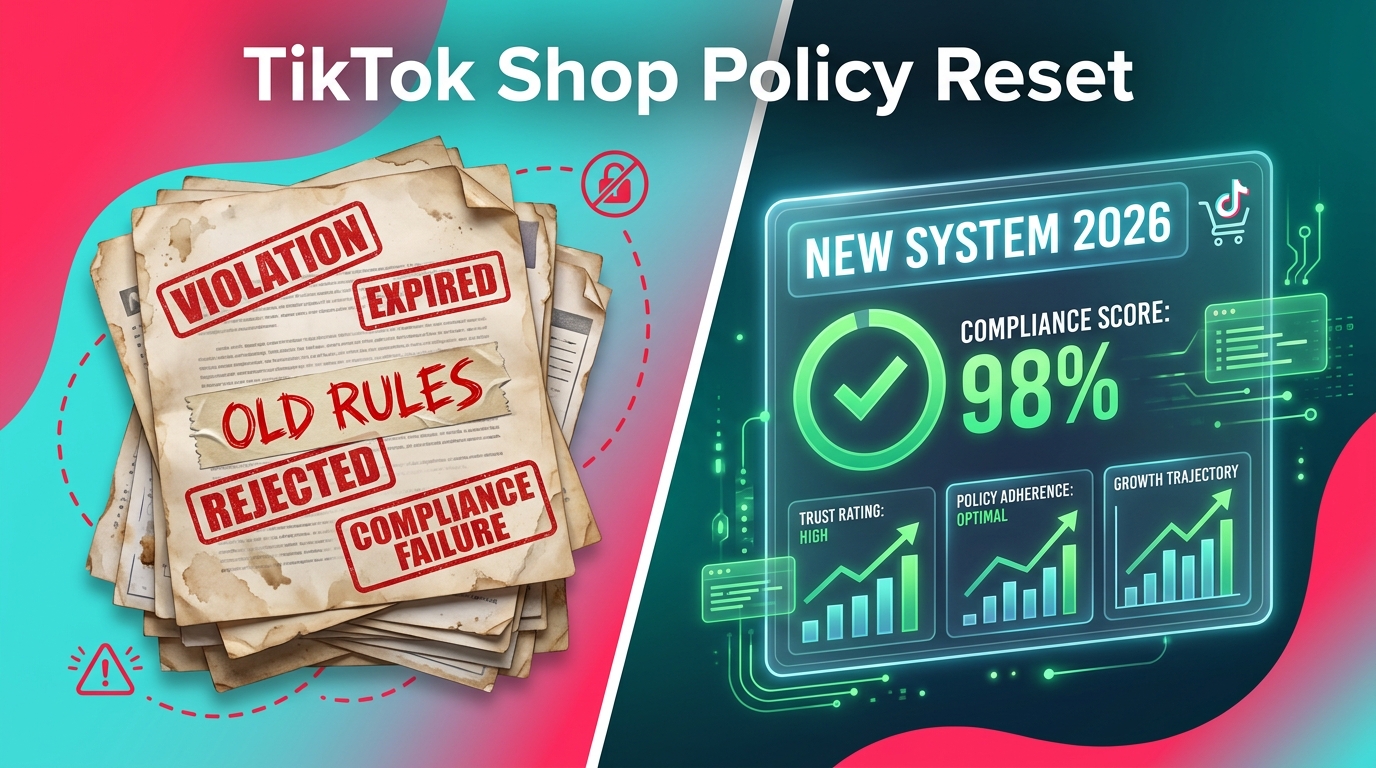

Somewhere between Q1 and Q3 of 2026, TikTok Shop quietly became a different kind of marketplace. Not different in the sense of new features or a redesigned interface — different in the sense that the underlying rules by which sellers, creators, and affiliates operate were fundamentally restructured. Some changes were announced with fanfare and then reversed within days. Others were buried in Seller Center policy pulse updates that most merchants never opened. A few arrived with no warning at all.
The coverage that followed tended to focus on individual changes in isolation: the commission hike, the algorithm update, the SEO ranking mechanics. What got far less attention was the bigger pattern — a systematic compliance architecture overhaul that replaced a relatively simple strike-based system with a multi-signal, multi-layered enforcement model that affects sellers, creators, and affiliated brands simultaneously.
This post maps that overhaul in full. Not just what changed, but how the changes interact with each other, which announced policies got walked back, what the reversal timeline actually looked like, and — critically — what the new system means in practice for anyone building a business on TikTok Shop in the second half of 2026. If you only followed the headlines, you missed a lot. Here is what the headlines missed.
From Violation Points to Account Health Rating: The Scoring Overhaul Nobody Explained Properly
The most consequential structural change TikTok Shop made in 2026 was replacing its older Violation Points framework with the Account Health Rating system — known inside Seller Center as AHR. Most sellers know the name. Far fewer understand how it actually works, and fewer still understand why the switch matters beyond a surface-level rebrand.
What the Old System Did (and Why It Failed)
The previous Violation Points model worked on a simple deduction logic: commit a policy violation, lose a set number of points, hit a threshold, face a consequence. It was transparent in its simplicity, but it created a structural problem. Sellers could absorb a predictable number of violations before facing real consequences, which meant the framework functioned more like a quota than a deterrent. Once sellers knew the thresholds, some treated minor violations as an acceptable operating cost.
The model also had no memory of improvement. A seller who had a disastrous January but ran a clean operation from February onward was still carrying the dead weight of those January points indefinitely, with no mechanism to demonstrate rehabilitation. The fixed-point system could not distinguish between a bad month and a chronically non-compliant operation.
How AHR Actually Works
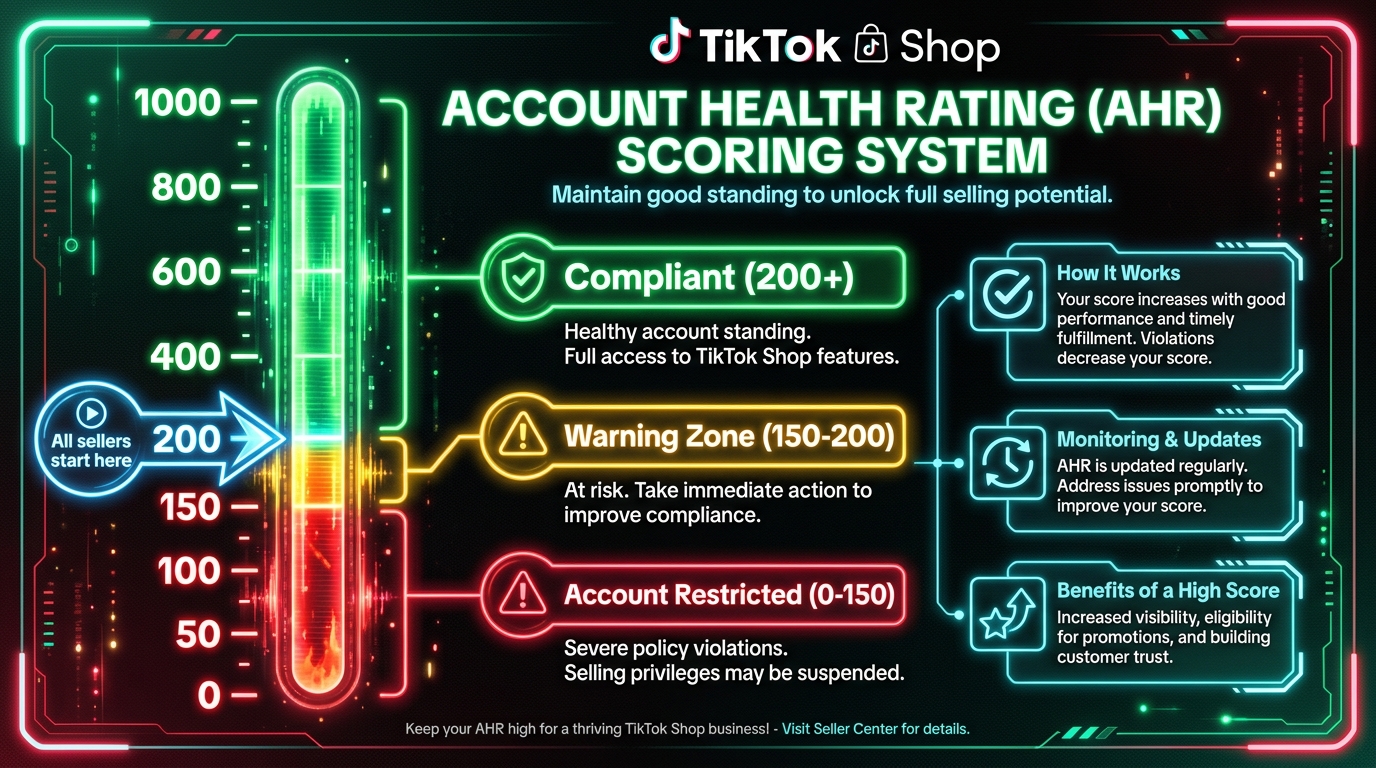
The Account Health Rating operates on a 0–1,000 scale, but sellers start at 200 — not 1,000. That is a psychologically and practically important distinction. You are not starting near the top and getting deducted down. You are starting in the lower quarter of the range, with the primary path upward being consistent compliant activity over time.
The score updates on a rolling 180-day window. Completed orders add points. Passing policy compliance quizzes in Seller University adds points. Policy violations deduct points. Performance failures — delayed shipments, high complaint rates, after-sales handling failures — also deduct points. The rolling nature means the score is always a reflection of recent behavior rather than historical records, which theoretically rewards genuine compliance improvement.
The Enforcement Threshold That Matters Most
TikTok Shop’s published guidance sets 150 as the critical enforcement threshold. At or below 150, sellers begin losing key account privileges: the ability to add new listings, the ability to enroll in promotional campaigns, and in some cases broader selling restrictions. The 50-point band between 150 and the 200 starting point functions as a warning zone — not technically restricted, but close enough to restriction that a few bad weeks can tip a seller over the edge.
This design creates a different kind of pressure than the old system. Rather than counting strikes, sellers now need to manage a continuous metric that responds to both positive and negative inputs. The practical implication is that you cannot simply stop doing something wrong. You also need to actively do things right — fulfilling orders, maintaining response times, passing compliance training — to protect and build your score. That is a meaningful shift in the compliance posture the platform is demanding.
What AHR Does Not Tell You
The AHR framework also has limits that TikTok’s own documentation acknowledges indirectly. The score reflects aggregate shop behavior, not individual listing-level issues. A single high-performing product does not protect you from account-level AHR damage caused by problems elsewhere in your catalog. And because the inputs are multi-dimensional — policy violations, performance metrics, training completions — sellers cannot always pinpoint exactly which activity drove a score change. That opacity is a source of genuine frustration for sellers who manage large or diverse catalogs.
The Shipping Policy That Was Announced, Then Reversed in 11 Days
If the AHR switch was the most consequential structural change of 2026, the shipping policy episode was the most revealing. It exposed how TikTok Shop makes and unmakes decisions — and it has implications for how sellers should respond to future announcements.
What Was Announced
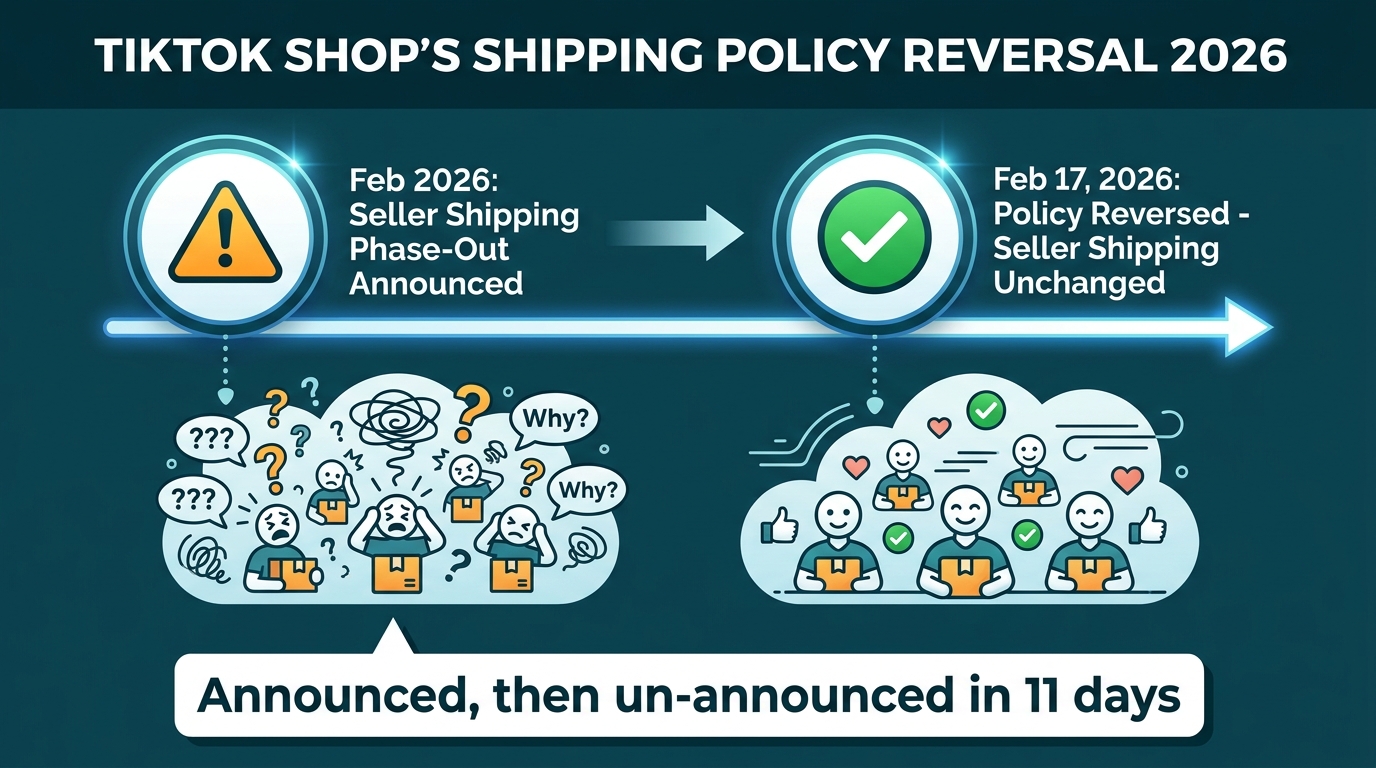
In early February 2026, TikTok Shop notified U.S. sellers that independent seller-fulfilled shipping — where the merchant handles their own carrier arrangements, labels, and logistics — would be phased out. The platform told sellers they would need to transition to one of three TikTok-controlled logistics paths: Fulfillment by TikTok (FBT), Upgraded TikTok Shipping, or Cross-Border TikTok shipping. The enforcement date was set for February 25, 2026, with full cutoff by March 31, 2026.
For sellers who had built their operations around independent logistics — particularly those with established carrier rates, specific fulfillment partners, or products that required non-standard shipping arrangements — this was a significant operational disruption with very little transition time. The seller community response was immediate and largely negative.
What Happened Next
On February 17, 2026 — eleven days after the announcement — TikTok reversed course. A Seller Center notice informed merchants that “Seller Shipping remains unchanged” and that the previously communicated deadlines would not go into effect. No detailed explanation was offered for why the policy was reversed. No new timeline was announced. The platform simply walked the change back.
Reporting from Retail Brew and Digiday confirmed the reversal, with both publications noting that TikTok communicated the about-face directly to merchants. What remained unclear was whether the reversal was permanent, a pause pending revised logistics infrastructure, or a response to specific feedback from large-volume sellers.
What the Episode Reveals About TikTok Shop’s Policy Process
The shipping reversal matters beyond its immediate operational implications for two reasons. First, it demonstrates that TikTok Shop is still navigating a tension between the centralized logistics control that would make the platform more like Amazon’s FBA model and the seller flexibility that helped attract a diverse merchant base in the first place. Resolving that tension is not a simple policy choice — it requires logistics infrastructure, carrier relationships, and seller trust that cannot be built overnight.
Second, the episode is a lesson in how sellers should calibrate their response to TikTok Shop policy announcements. A blanket rule of “wait for confirmation before making operational changes” is probably too passive. But the shipping reversal suggests that major structural announcements, especially those with aggressive timelines, are worth monitoring closely rather than acting on immediately. Some announced policies are test balloons as much as firm mandates.
For now, Seller Shipping remains a live option for U.S. merchants. FBT is excluded from On-Time Delivery Rate calculations under the current SPS framework, which does create a mild incentive structure toward TikTok-controlled logistics — but it is an incentive, not a requirement.
The VoC Index Takeover: How Affiliate Eligibility Changed on May 7
While the AHR system change affects sellers at the account level, the switch from Negative Review Rate to Voice of Customer indexing as the primary affiliate eligibility metric operates at the product level — and it fundamentally changed which products can participate in TikTok Shop’s affiliate marketing program.
What the Old System Measured
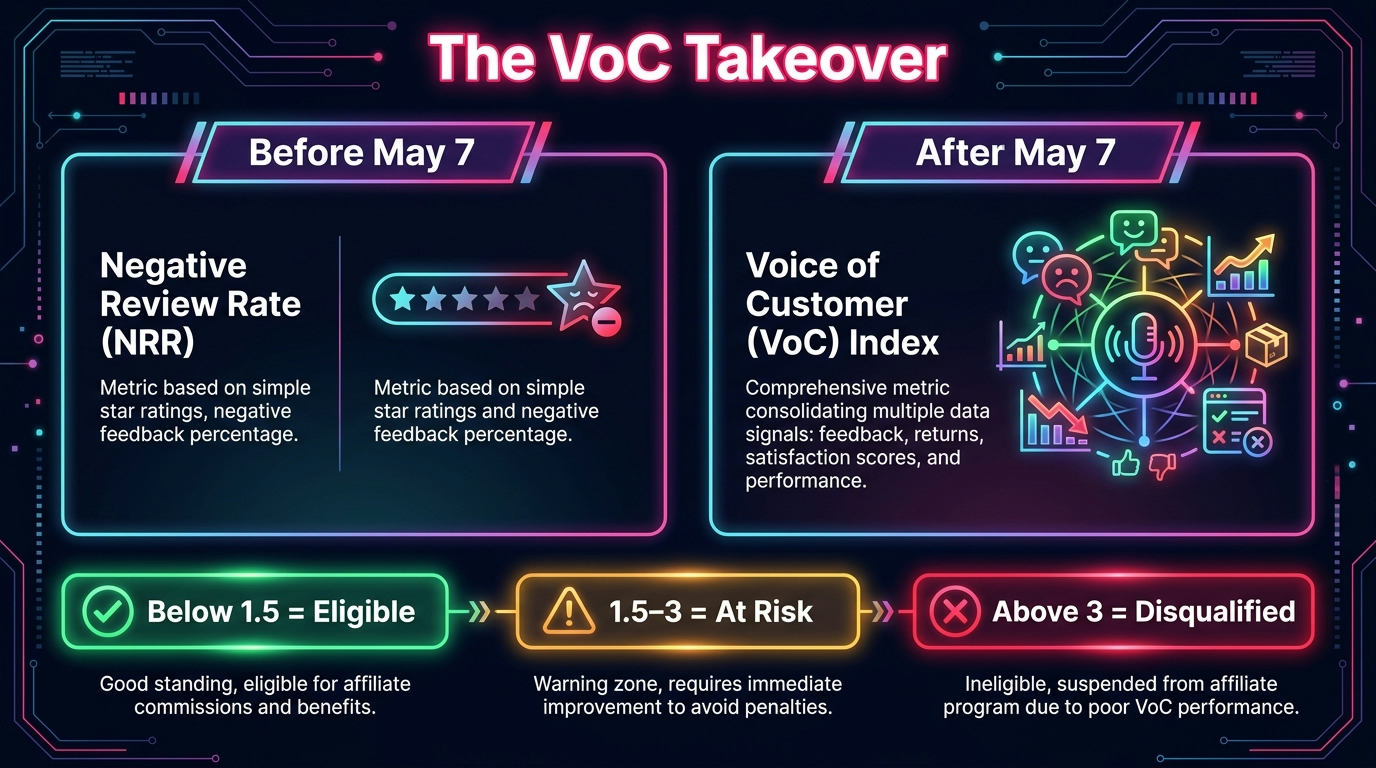
Before May 7, 2026, affiliate product eligibility was governed primarily by the Negative Review Rate (NRR). The logic was straightforward: if too many buyers left negative reviews, the product lost affiliate eligibility. This approach had an obvious flaw. Negative reviews are a lagging indicator. By the time a product’s NRR reached a problematic level, it had typically already generated significant creator and buyer friction. The metric also treated all negative feedback as equivalent, regardless of whether the issue was the product itself, the shipping experience, or a mismatched expectation set by the listing description.
What VoC Measures Instead
The Voice of Customer Index is a composite signal that aggregates multiple post-purchase feedback inputs — not just star ratings and written reviews, but also return rates, dispute rates, customer satisfaction indicators, and service interaction quality. It is, in essence, a more granular and more predictive measure of whether a product is creating a satisfying end-to-end purchase experience.
The scoring thresholds TikTok has communicated in Seller Center guidance establish three operational zones. Products with a VoC Index below 1.5 are considered eligible for affiliate programs and face no restrictions. Products between 1.5 and 3 enter a warning band — they remain technically eligible but may face new-listing restrictions and are flagged for monitoring. Products above 3 risk disqualification from affiliate eligibility entirely, which means no creator can tag or link to those products in affiliate-tracked content.
Why This Matters More Than It Looks
The shift to VoC changes the economics of affiliate marketing on TikTok Shop in ways that many sellers have not fully processed. Under the old NRR model, a seller could maintain affiliate eligibility by managing reviews — sometimes through review incentive programs, response optimization, or simply by having a product with strong baseline satisfaction. Under VoC, you cannot manage your way to compliance the same way. The metric captures the full post-purchase arc, including things sellers have limited control over, such as carrier delays that generate complaints even when the product itself is excellent.
For brands that rely heavily on affiliate-driven discovery — which is a significant portion of TikTok Shop’s top-performing product categories including beauty, wellness, and fashion — losing affiliate eligibility is not just a policy problem. It is a direct revenue impact. The product loses access to the creator traffic that drives a material share of TikTok Shop’s discovery and conversion. A product with a VoC Index above 3 is, in practical terms, invisible to the affiliate creator ecosystem.
The Operational Response Sellers Need
The transition to VoC requires sellers to monitor product-level quality signals much more granularly than before. Aggregate review scores are no longer enough. Sellers need visibility into return rates by SKU, dispute frequency by product, and customer service satisfaction data — and they need to act on that data proactively, before the VoC Index crosses the warning threshold. For catalog-heavy sellers, this is a significant operational lift that some are only now beginning to resource properly.
The SPS Lookback Extension and Metric Refresh: July 22, 2026
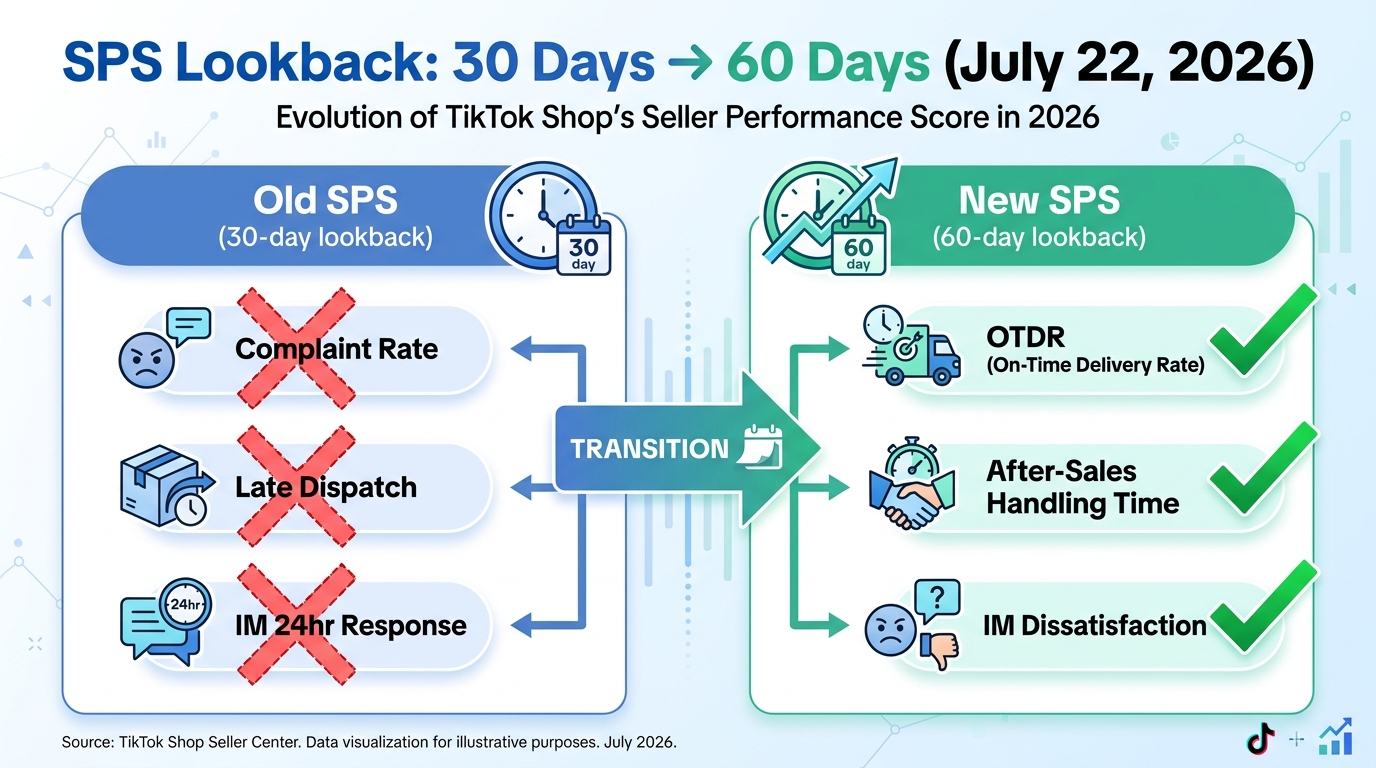
On July 22, 2026, TikTok Shop extended the Seller Performance Score lookback period from 30 days to 60 days. The announcement landed quietly in the Policy Pulse update and generated relatively little coverage despite its practical significance for how sellers manage their operational performance.
What the SPS Actually Measures
The Seller Performance Score is a composite rating that evaluates seller quality across three dimensions: product satisfaction, fulfillment and logistics performance, and customer service quality. Unlike the AHR — which functions as a compliance health indicator — the SPS is more specifically an operational performance metric. It determines a seller’s standing in areas like campaign eligibility, search visibility weighting, and some promotional access decisions.
To receive an SPS, a seller needs at least 30 delivered orders in the preceding 90 calendar days. That threshold is unchanged. What changed is the window over which the score’s underlying metrics are evaluated.
What Changed and What Was Removed
The 60-day lookback period replaces the previous 30-day evaluation window. TikTok’s stated rationale is to reduce score volatility — a 30-day window can swing significantly based on a single bad week, a carrier disruption, or a temporary inventory issue. A 60-day window smooths those short-term fluctuations and, in theory, produces a more stable and representative picture of a seller’s overall quality.
Alongside the lookback change, TikTok refreshed the specific metrics that feed into the SPS calculation. Three metrics were removed from the evaluation: Complaint Rate, Late Dispatch Rate, and IM 24-hour Response Rate. Three metrics were added or elevated: On-Time Delivery Rate (OTDR), After-Sales Handling Time, and IM Dissatisfaction Rate. The metric refresh signals a philosophical shift — from measuring what sellers do (dispatch quickly, respond within 24 hours) toward measuring what customers actually experience (packages that arrive on time, after-sales issues resolved satisfactorily).
The FBT OTDR Exemption
One operational detail buried in the SPS update deserves more attention than it has received: products fulfilled through FBT (Fulfillment by TikTok) are excluded from OTDR calculations. Since OTDR is now one of the three primary SPS metrics, this means FBT sellers are insulated from one of the most heavily weighted components of the score. For sellers considering whether to adopt FBT, this is a meaningful structural incentive — not because FBT is required, but because it removes OTDR risk from the SPS calculation entirely. That exclusion effectively lowers the operational floor that FBT sellers need to maintain to achieve a given SPS outcome.
What the Metric Shift Demands From Sellers
The replacement of IM 24-hour Response Rate with IM Dissatisfaction Rate is subtle but significant. The old metric measured inputs — did you respond within 24 hours? The new metric measures outcomes — were customers satisfied with your responses? Responding quickly to customer messages no longer earns SPS credit on its own. The quality and resolution effectiveness of those responses now matters more than the speed. Sellers who have built their customer service workflows around response-time targets without attention to resolution quality will find their SPS behavior changing in ways that do not match their operational expectations.
GLP-1 Product Restrictions and the Health Category Compliance Squeeze
The health and wellness category on TikTok Shop had already been tightening through 2025. In 2026, the compliance pressure intensified specifically around GLP-1 adjacent products and weight-loss marketing claims — creating one of the most nuanced category-level policy situations on the platform.
What TikTok Shop Actually Prohibits
The platform’s position is not a blanket prohibition on all weight-loss or wellness products. The specific targets are more precise. Products that use “GLP,” “GLP-1,” or equivalent pharmaceutical terminology in their product titles, descriptions, or branding are prohibited outright. Products that make efficacy claims implying equivalence to prescription medications — particularly semaglutide drugs like Ozempic and Wegovy — face removal regardless of how those claims are worded in the listing.
Beyond the GLP-1 terminology rules, the broader weight-management policy restricts what kinds of outcome claims sellers and creators can make. Rapid weight loss promises, guaranteed results, and claims about appetite suppression that imply a drug-like mechanism are all problematic under the current framework. What the policy allows — under tightly defined conditions and primarily for adult audiences — are lower-risk general wellness claims that do not imply pharmaceutical efficacy.
The Enforcement Gap Problem
Multiple reports in mid-2026 documented a significant gap between the GLP-1 prohibition and actual marketplace enforcement. Products explicitly branded with “GLP-1 patch” terminology continued to circulate in active listings despite the policy’s clear language. This enforcement gap creates a genuine compliance risk for legitimate sellers. When a prohibited product category is visible in the marketplace, compliant sellers face pressure to match competitor claims to remain competitive — and doing so puts them at heightened violation risk while the violating competitors continue operating.
TikTok’s expanded listing-level screening, announced as part of the broader July 2026 policy updates, is designed to close this gap through more automated front-end review rather than relying solely on reactive enforcement. The practical timeline for that automated screening reaching full effectiveness across the health category remains unclear.
What Health Category Sellers Need to Audit Now
For any seller operating in the supplements, wellness, or beauty-wellness space, three areas require immediate audit. First, product titles and listing descriptions should be checked for any GLP, GLP-1, or drug-equivalence language — including indirect references like “works like Ozempic” in any form. Second, affiliate creator content associated with your listings should be reviewed for claims that your listing itself does not make but that a creator may have added in their video script. Creator-generated claims can create compliance risk for the bound seller account. Third, any paid promotional copy running through TikTok Ads for health products should be reviewed against the current weight-management advertising guidelines, which have their own distinct set of claim restrictions separate from the Shop listing policies.
The 6-Violation Rule: The Creator Compliance Change with the Highest Stakes
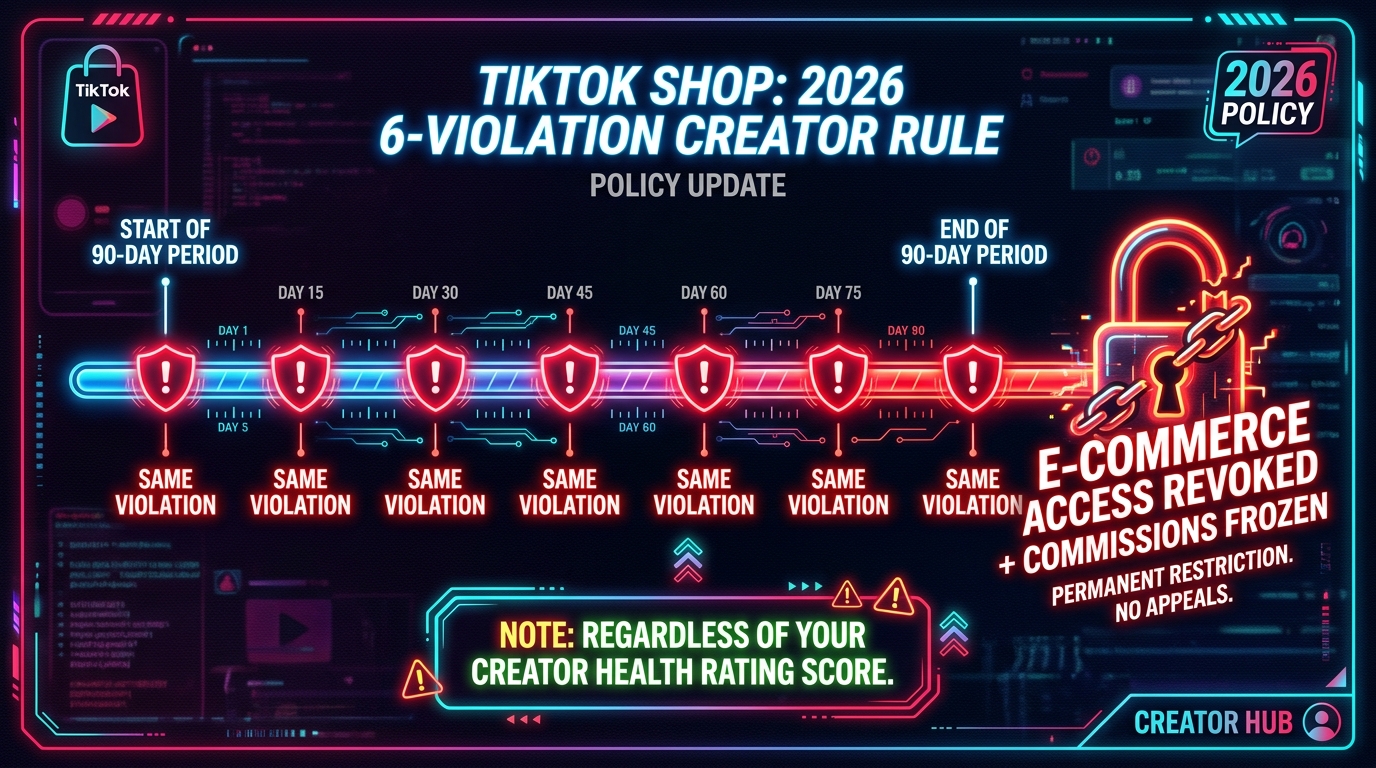
One of the least-discussed but highest-stakes changes in TikTok Shop’s 2026 compliance framework is the introduction of a specific creator enforcement threshold that operates entirely independently of the Creator Health Rating score.
What the Rule States
Under TikTok’s current creator policy for e-commerce, any creator who commits the same policy violation six times within a 90-day period faces immediate removal of e-commerce permissions. This includes the loss of product-tagging capabilities, commission eligibility, and in some interpretations broader shopping feature access. Critically, this enforcement action can occur even if the creator’s Creator Health Rating (CHR) score is otherwise within acceptable parameters.
That last clause is the part that matters most. CHR was previously the primary metric through which creator compliance was assessed. A creator with a healthy CHR score had implicit protection from enforcement escalation — their overall account health indicated good standing. The 6-violation rule creates a separate, parallel enforcement track that bypasses CHR entirely. It means creators can look healthy on paper while simultaneously being one violation away from losing their e-commerce access permanently.
Why “Same Violation” Is More Specific Than It Sounds
The 6-violation threshold applies to the same violation type repeated — not six violations of any kind across different policy areas. This means a creator who repeatedly promotes products with misleading efficacy claims, for example, is more exposed to this rule than a creator who commits six different types of minor infractions across different policy categories. In practice, this most clearly targets patterns of systematic non-compliance in a specific area: a creator who continues to make unsubstantiated health claims despite prior warnings, or one who repeatedly fails to disclose paid partnerships in a required format.
The commission freeze component adds a financial dimension that makes the enforcement meaningful beyond access loss. Frozen commissions mean previously earned payments may be withheld during the enforcement period. For creators whose primary income stream runs through TikTok Shop affiliates, this is not a minor inconvenience — it is a cash flow disruption that can be severe depending on volume.
The Spillover Risk for Sellers
The 6-violation rule creates a spillover risk that sellers often do not account for when managing their affiliate creator relationships. If a creator your shop is bound to incurs violations related to how they promote your products — making claims your listing does not authorize, using restricted terminology, or failing to disclose the affiliate relationship — those violations can create compliance risk that affects your shop’s standing as well as the creator’s account. TikTok’s 2026 policy updates explicitly recognize that creator-bound violations can have account-level implications for sellers.
The practical implication is that seller-creator relationship management in 2026 needs to include compliance monitoring, not just performance monitoring. Knowing that a creator is driving strong GMV is no longer enough. Knowing how they are generating that GMV — what claims they are making, what disclosure practices they are following, whether the content they are producing complies with the policies governing your product category — is now a seller responsibility as much as a creator responsibility.
The July 2026 Policy Pulse: After-Sales, Refunds, and UPO Enforcement Expansion
TikTok Shop’s July 2026 Policy Pulse update was less of a single announcement than a cluster of operational changes across after-sales handling, shipping fraud enforcement, and seller self-service features. Taken individually, most of the changes are incremental. Taken together, they represent a tightening of the post-purchase process that has meaningful operational implications.
Returns and Refunds: The New Wait Requirement
The most significant after-sales change in the July update involves how sellers handle in-transit returns and “I didn’t receive the package” refund claims. Under the revised rules, sellers must now wait until a returned package is marked as delivered before reviewing certain refund requests or submitting appeals on refunded orders. Previously, sellers had more flexibility in the timing and sequence of refund review actions.
The practical effect is a longer post-dispute resolution cycle for some return types. Sellers who have automated their refund review workflows based on the previous timing rules will need to update those automations to avoid compliance violations from premature review actions — which ironically creates a new compliance risk in the process of managing existing compliance obligations.
Forward Shipping Fee Standardization
The July update also standardized the handling of forward shipping fee refunds — the outbound shipping cost from seller to buyer — in return scenarios. The new rule creates a clear split: buyer-responsible returns (where the buyer changed their mind, ordered the wrong item, or is returning for preference reasons) no longer generate a forward shipping fee refund for the seller. Seller- or logistics-fault returns (where the product arrived damaged, was incorrect, or was significantly not as described) continue to qualify for forward shipping fee refunds.
This is a logical standardization that aligns shipping cost responsibility with fault responsibility. But for sellers with high return rates in buyer-preference categories — fashion, lifestyle goods, and some consumer electronics — the change increases the effective cost of returns and creates additional incentive to improve listing accuracy and set expectations precisely to reduce preference-based returns.
UPO Enforcement Expansion
Shipping Postage Fraud — referred to internally as Unexpected Postage Overcharge (UPO) — had previously been enforced selectively. The July update expanded UPO enforcement to all cross-border and local managed sellers. UPO involves charging shipping fees that exceed actual postage costs, misrepresenting package dimensions or weights to generate higher shipping revenue, or using platform shipping subsidies in ways that generate profit rather than covering genuine logistics costs.
The enforcement expansion means that sellers who had previously operated in categories or market segments where UPO enforcement was less active can no longer assume that latitude continues. The platform has confirmed that UPO violations under the expanded enforcement regime carry the full range of consequences available in the compliance framework: listing restrictions, fund holds, and in repeat cases account-level actions.
Pre-Order and Made-to-Order Self-Serve Access
On a more positive note for eligible sellers, the July update opened self-serve activation of Pre-Order and Made-to-Order listing types in Seller Center. Previously, these listing types required platform-side approval or configuration. Making them self-serve reduces friction for sellers with legitimate pre-order business models — artisan goods, custom products, limited releases — who had been unable to use these listing types efficiently due to the manual approval process. This is a genuine operational improvement, even if it received less attention than the enforcement-focused changes in the same update.
The Daily Shoppable Content Posting Cap: The Change That Flew Under the Radar
Effective May 11, 2026, TikTok Shop introduced daily posting limits for shoppable content for all U.S. merchants and creators. This change arrived with minimal fanfare in the seller community, but it has structural implications for content-heavy sellers and high-volume affiliate creators whose strategies depend on volume-based content production.
What the Cap Does
The daily posting limit constrains how many shoppable posts — videos or live streams with tagged products and active commerce links — a seller or creator can publish in a single day. TikTok’s stated rationale centers on content quality: an uncapped environment incentivizes volume over quality, and high-volume low-quality shoppable content can degrade the discovery experience for buyers.
This reasoning is consistent with changes other platforms have made as they mature their commerce ecosystems. Instagram moved away from aggressive post-volume strategies as its algorithm evolved. YouTube progressively deprioritized upload frequency as a ranking signal in favor of watch time and engagement. TikTok Shop’s posting cap represents a similar maturation signal — the platform is telling sellers and creators that producing more content is no longer the primary lever for growing commerce performance.
Who Is Most Affected
The sellers most affected by the daily cap are those who had built their TikTok Shop strategy around high-frequency content posting as a substitute for content quality investment. In some categories — particularly commoditized product spaces where differentiation is difficult — volume had become the primary competitive strategy: post enough content, and some portion of it will generate sales through sheer visibility. The posting cap makes that strategy structurally less viable.
Affiliate creators are similarly affected, particularly those who manage large portfolios of affiliate products and had been rotating through product promotions at high daily frequencies. The cap forces a prioritization decision: which products and which content formats deserve the limited daily posting slots, and how should promotional calendars be restructured to maximize impact within the constraint.
The Quality Shift This Enforces
The practical response to the posting cap is a shift in how sellers and creators need to think about content production investment. With volume constrained, each post carries more relative weight. Content that underperforms wastes a significant portion of the day’s allowable impact. This changes the economics of TikTok Shop content production: it increases the value of pre-production creative testing, better scripting, and stronger calls to action, while reducing the return on high-volume production pipelines that relied on quantity to generate aggregate results.
Affiliate Eligibility Tightening: The 30-Day Pilot, Follower Floors, and Verification Gates
Beyond the VoC Index change, TikTok Shop’s broader affiliate eligibility framework tightened on several dimensions through mid-2026. The cumulative effect is that the path into TikTok Shop’s affiliate creator program is more structured and credentialed than it was a year ago.
The Standard Eligibility Requirements
U.S. affiliate creators currently need a minimum of 1,000 followers to access the basic affiliate program. Some marketplace features and higher-tier affiliate access require 5,000 followers. Beyond follower counts, creators need identity verification — a two-step verification process that TikTok tightened in its mid-2026 seller center updates — an account in good standing, and confirmation of no prior e-commerce permission revocations.
The age requirement (18+) and account-standing conditions were already in place, but the enforcement of identity verification became notably stricter in early 2026 as part of the broader compliance architecture overhaul. This was driven in part by fraud concerns: the stronger the creator ecosystem’s compliance profile, the lower the risk of coordinated manipulation of affiliate traffic and commission generation.
The 30-Day Affiliate Creator Pilot
One notable addition to the affiliate access framework is a 30-day pilot structure for some new or lower-tier creators entering the program. Rather than immediately granting full affiliate access, TikTok is in some cases staging creator access through a trial period — allowing the platform to assess early compliance and performance behavior before unlocking the full range of affiliate capabilities.
This pilot structure is consistent with the platform’s broader move toward behavior-based credentialing rather than threshold-based access. Rather than simply asking “does this creator meet the follower count?” the platform is increasingly asking “how does this creator behave when given access, and does that behavior warrant expanded access?” It is a more sophisticated onboarding model — and one that creates a different experience for new creators entering the ecosystem.
How Seller-Creator Binding Now Works in Practice
The tightening of creator eligibility has a practical effect on how brands and sellers manage their affiliate creator relationships. Sellers who previously worked with a broad slate of creators — including newer, smaller creators as part of a volume-based affiliate strategy — may find that some of those creators no longer qualify for affiliate access under the tighter eligibility criteria. This compresses the available creator pool for some product categories and increases competition for access to the qualified creator community.
The operational implication is that seller affiliate management in 2026 needs to include eligibility status monitoring, not just performance tracking. A creator who was active in your affiliate program in January may no longer be eligible in June if their account encountered issues that triggered an e-commerce access review. Building manual or automated checks into your affiliate relationship management process to flag eligibility status changes is increasingly a baseline operational requirement rather than a nice-to-have.
How the Pieces Connect: TikTok Shop’s New Compliance Architecture
Viewed individually, the changes described in this post look like a series of uncoordinated policy updates — some proactive, some reactive, at least one reversed. Viewed together, they reveal a coherent compliance architecture that TikTok Shop is building toward, even if the building process has been messier than the platform would prefer.
The Multi-Signal Model
The unifying principle across the AHR, SPS, VoC, and creator compliance changes is a shift from single-metric enforcement to multi-signal evaluation. The old system asked one question: how many violations has this seller committed? The new system asks a constellation of questions: how is the seller’s order completion rate? What is the post-purchase satisfaction profile of their catalog? How do their creators behave? Are their shipping practices accurate? What is the refund and dispute rate by product?
Multi-signal evaluation is harder to game than single-metric systems. It is also harder to manage. Sellers who were competent at avoiding violations under the old system may find that competence insufficient under the new one, because the new system evaluates dimensions of their operation they were not previously being judged on.
The Interconnection Between Seller and Creator Risk
One of the more consequential design choices in the new compliance architecture is the explicit linkage between creator compliance risk and seller account standing. When a creator violates policy in the context of promoting your products, that violation does not stay on the creator’s record in isolation. It creates compliance exposure for the bound seller as well. This means sellers are now, in a meaningful sense, compliance co-owners of the content their affiliate creators produce.
That is a significant responsibility expansion. It requires sellers to think about creator selection, onboarding, content briefing, and ongoing monitoring through a compliance lens in addition to a performance lens. The seller who sees a creator driving strong GMV but making borderline claims in their content is no longer just facing a brand risk — they are facing a direct compliance and account-health risk.
The Direction of Travel
The direction of TikTok Shop’s compliance evolution in 2026 is clearly toward tighter, more automated, and more outcome-focused enforcement. The platform is adding credentialing gates, quality thresholds, and multi-signal evaluation precisely because it is trying to mature from a fast-growth marketplace with flexible rules into a trusted commerce destination with dependable quality standards. That maturation is structurally necessary for TikTok Shop to compete at scale with more established e-commerce channels.
The cost of that maturation is real for sellers who have operated in the more permissive environment. The benefit — for those who adapt — is participation in a marketplace with higher quality baselines, stronger buyer trust, and a less crowded field of compliant competitors.
What Sellers, Affiliates, and Brands Need to Do Right Now
The policy landscape described in this post creates a clear action agenda. The specifics differ by role, but the underlying priority is the same: the 2026 compliance architecture rewards proactive management and punishes reactive firefighting.
For Sellers
Audit your AHR trajectory, not just your current score. Log into Seller Center and check your AHR score, but more importantly look at its trend over the past 60–90 days. A score at 210 that has been declining steadily is a bigger concern than a score at 185 that is recovering. Understand what is driving the movement before it reaches the 150 threshold where feature restrictions begin.
Run a VoC Index review across your full catalog. Identify any products approaching or above the 1.5 warning threshold. For products above 1.5, diagnose the underlying cause — is it the product quality, the listing accuracy, the shipping performance, or the post-purchase service experience? Each cause has a different fix, and treating them as equivalent will produce ineffective responses.
Check your health category listings against the updated GLP-1 and weight-management rules. Even if you are not in the health space directly, any product making wellness or wellness-adjacent claims should be reviewed against the current policy language. The enforcement gap in the marketplace does not protect you from enforcement action.
Update your SPS-related operational workflows. With the metric shift from Late Dispatch to OTDR and from IM 24-hour Response to IM Dissatisfaction, your operational targets need to change. If your customer service team is measured on response time rather than resolution quality, the SPS will no longer reflect those efforts correctly.
For Affiliate Creators
Track your violation type and frequency, not just your CHR score. The 6-violation rule operates independently of your Creator Health Rating. If you have received two or three warnings of the same policy type in the past 90 days, you are in a risk zone regardless of what your CHR displays. Understanding your violation pattern is now as important as understanding your overall account health.
Review your disclosure practices against the current requirements. Disclosure enforcement has become more automated and more consistent in 2026. Content that passed review in previous months may not pass now. This is particularly relevant for creators who promote products in multiple categories with different disclosure requirements.
Verify your VoC eligibility status for products in your active portfolio. If a product you regularly promote has crossed the VoC threshold and lost affiliate eligibility, continuing to link to it in your content creates a compliance risk and will not generate tracked affiliate revenue even if buyers click through. Regular portfolio audits are now a baseline operational requirement.
For Brands Managing Affiliate Programs
Build creator compliance monitoring into your affiliate management workflow. This does not require reviewing every video manually. It does require establishing clear content guidelines, providing creators with explicit claim-level guidance for your product category, and having a process for flagging and addressing non-compliant creator content before it generates violations that reach your shop account.
Reassess your creator portfolio against updated eligibility criteria. Identify which creators in your active affiliate roster meet the current eligibility requirements — follower thresholds, verification status, account standing, no prior revocations — and update your outreach strategy for categories where eligible creators are harder to find.
Treat the VoC Index as a product development signal, not just a compliance metric. A product approaching the 1.5 VoC threshold is telling you something specific about the post-purchase experience it delivers. Products that consistently generate return disputes, satisfaction complaints, or service escalations have a product or positioning problem that compliance management alone cannot fix. The VoC data is actionable product intelligence — use it that way.
Conclusion: Compliance as a Competitive Moat
TikTok Shop’s 2026 policy reset is, ultimately, a maturation event. The platform is raising the compliance floor across seller operations, creator behavior, product quality, and fulfillment standards simultaneously. Some of the specific changes — the shipping reversal, the enforcement gaps in the health category, the opacity of some AHR inputs — reflect the imperfection of that maturation process. Policy-making at scale is messy, and TikTok Shop has not been exempt from that messiness.
But the direction of travel is clear. The platform is moving toward a multi-signal, outcome-focused compliance architecture that rewards genuine quality and consistent operational standards rather than threshold management and violation avoidance. That is a different kind of challenge than the old system presented — and it requires a different kind of operational response.
The sellers and creators who treat 2026’s policy changes as an obstacle to manage around will find the new system frustrating and difficult. Those who treat compliance as a structural investment — building the operational systems, the monitoring infrastructure, and the creator relationship management practices that the new framework demands — will find that the rising compliance floor creates exactly the kind of competitive differentiation that a crowded marketplace otherwise makes impossible to achieve.
The rules changed. The question is whether your operation changed with them.