


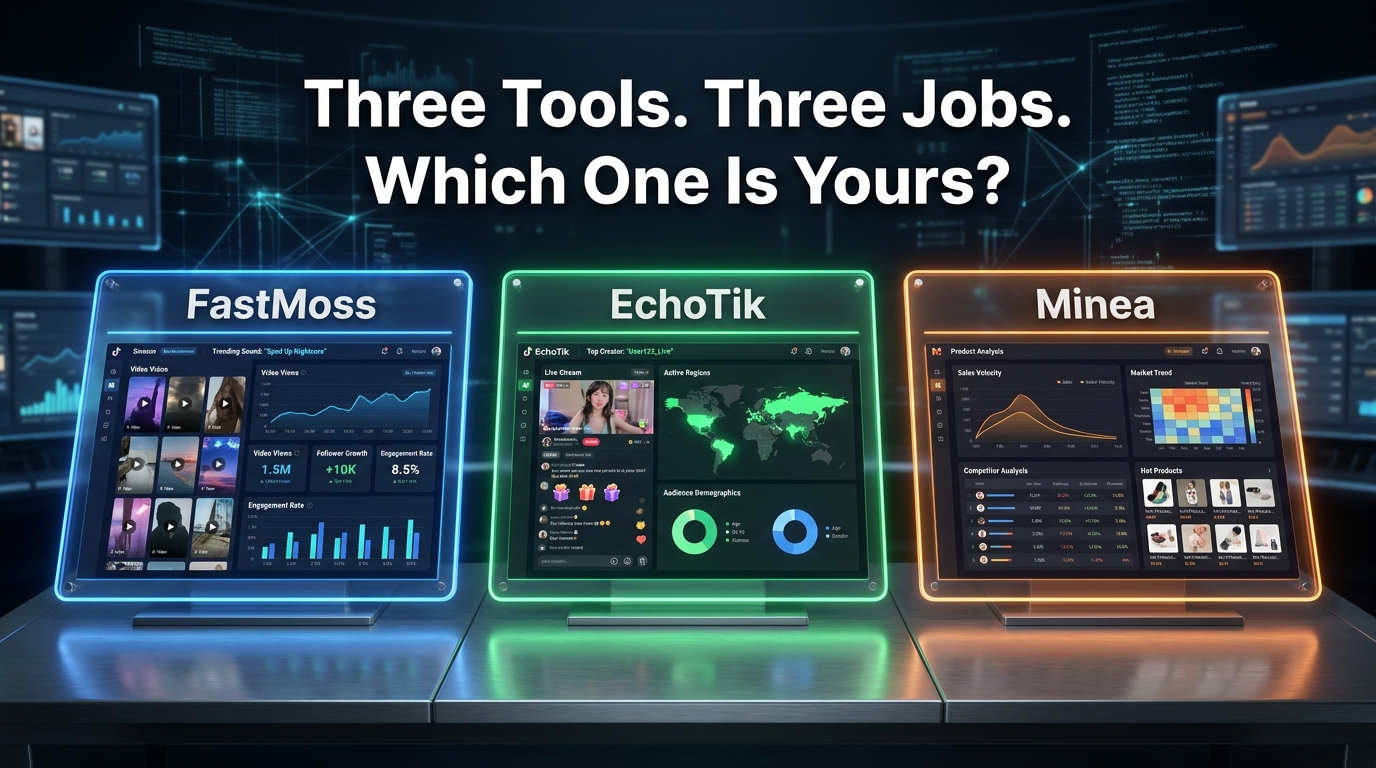

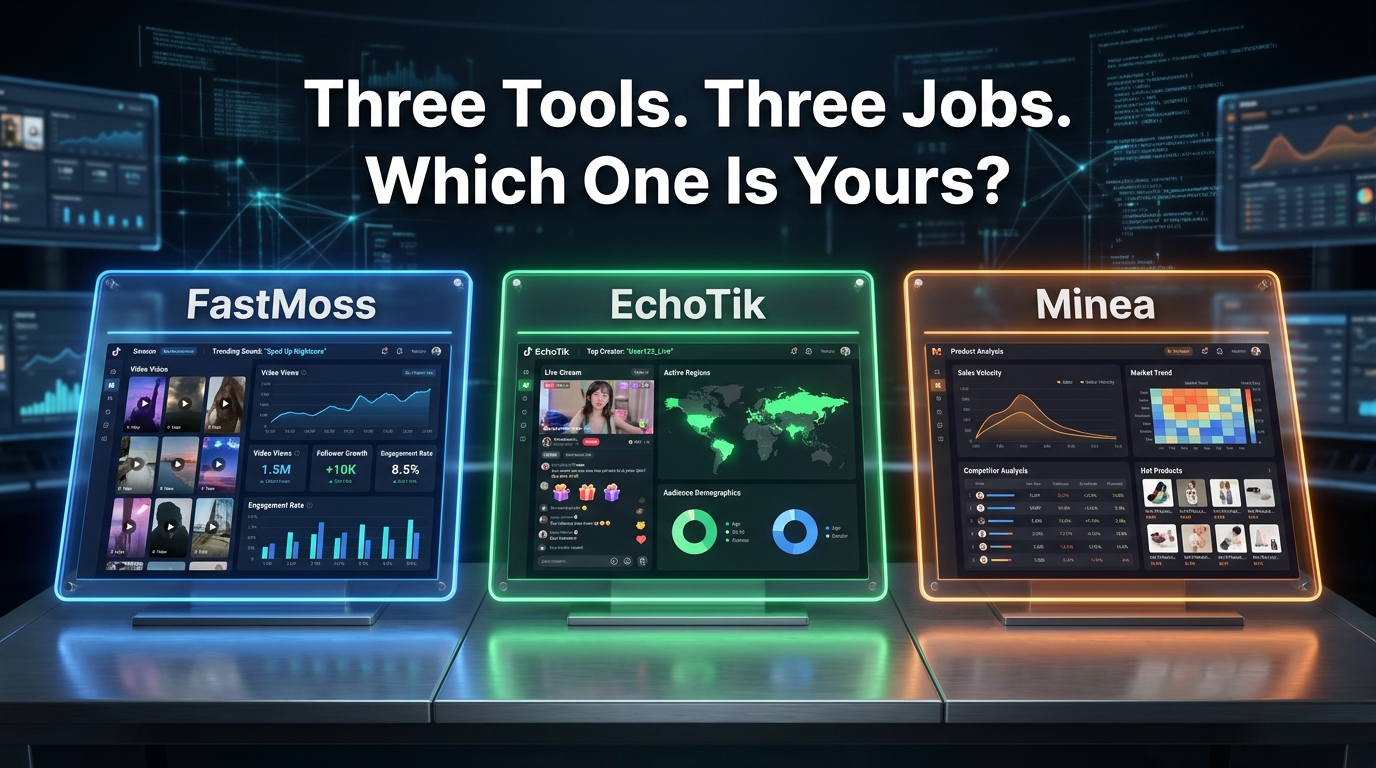
There is a version of this question that gets asked constantly in TikTok seller communities: “Which is better — FastMoss, EchoTik, or Minea?” And the honest answer is that the question itself is slightly broken. All three tools are often grouped together because they all appear in “TikTok product research” searches, but they are not the same category of tool doing the same job at different price points. They are built around different core assumptions about what their users are actually trying to accomplish.
FastMoss is a deep TikTok-native intelligence platform built for scale. EchoTik is a precision analytics and product-tracking engine optimised for accuracy and daily operational use. Minea is a cross-platform ad spy and product validation tool that happens to cover TikTok — among several other channels. Buying the wrong one for your workflow is not just a wasted subscription; it means you are flying blind on the dimensions that actually matter to your operation.
This comparison cuts through the feature-list noise and focuses on what each tool is genuinely good at, where each one has real structural limitations, and — most importantly — which user roles each one was clearly built for. If you are an affiliate hunting creator-driven GMV opportunities, your answer looks different from a brand managing a multi-SKU TikTok Shop or a dropshipper testing products across multiple ad channels. This breakdown maps all three scenarios against all three tools.
Pricing, data accuracy, freshness, depth of historical coverage, and the hard tradeoffs that rarely show up in marketing copy are all covered below.
What Each Tool Actually Is: A Grounded Starting Point
Before diving into feature-by-feature analysis, it is worth establishing what each tool is fundamentally trying to do — because the design philosophy shapes everything from what data gets prioritised to how pricing is structured.
FastMoss: TikTok-Native Intelligence at Scale
FastMoss is purpose-built for TikTok Shop. Its database covers over 500 million products, more than 300 million creators, and maintains over 1,200 days of historical data across 19 countries and regions. The platform is trusted by over 3.8 million sellers and creators globally, according to its own reported user base, and has received SourceForge and Slashdot Top Performer recognition in both 2024 and 2025.
The core product cluster includes product research, creator and affiliate discovery, competitor shop tracking, TikTok ad analytics, LIVE sales monitoring, and an AI script generator for content production. FastMoss also operates several adjacent products in its broader suite — YooFinds (an affiliate platform connecting merchants with U.S. creators), MossCreator (a creator outreach layer reaching 250 million TikTok creators), and Oumomo (an AI video generator for TikTok Shop sellers). The main platform is the data layer that underpins all of these workflows.
EchoTik: Precision Analytics for TikTok Shop Operators
EchoTik occupies a different position. It is also TikTok-only, but its design emphasis is on data accuracy and verification rather than raw scale. The platform claims 95%+ verified GMV accuracy, achieved through what it calls “Cross-Validation Logic” — triangulating TikTok’s own API data against social signals and logistics data to produce estimates that are more reliable than raw API pulls. Refresh rates on its product-tracking dashboards run between 15 minutes and 2–4 hours depending on the data surface.
EchoTik covers product research, influencer discovery, competitor and shop tracking, live-commerce analytics, and API access for teams that need to push data into their own reporting infrastructure. It is designed to serve TikTok Shop sellers, brands, agencies, and MCNs (Multi-Channel Networks), and its pricing — which starts around $9.90–$10/month with a permanent free tier — makes it accessible to solo operators who would find FastMoss’s higher entry cost a barrier.
Minea: Multi-Platform Ad Spy with TikTok Coverage
Minea comes from a different tradition altogether. It is an ad intelligence and product validation platform built primarily for dropshippers and ecommerce brands who run paid acquisition across multiple channels. The platform indexes ads and products across TikTok, Meta (Facebook and Instagram), Pinterest, and Snapchat, and connects ad creative data to the Shopify stores running those ads — a feature set that has no equivalent in either FastMoss or EchoTik.
The critical structural difference is Minea’s credit-based model. Unlike FastMoss and EchoTik, which operate on flat subscription access, Minea charges credits per action taken within the platform. Monthly credit allowances vary by plan, and intensive research sessions can exhaust them quickly. TikTok-specific data is only available on the Premium plan ($99/month) and above — the Starter tier ($49/month) does not include TikTok Shop data or influencer database access. The Business tier runs $399/month.
FastMoss in Depth: What Serious Scale Actually Looks Like
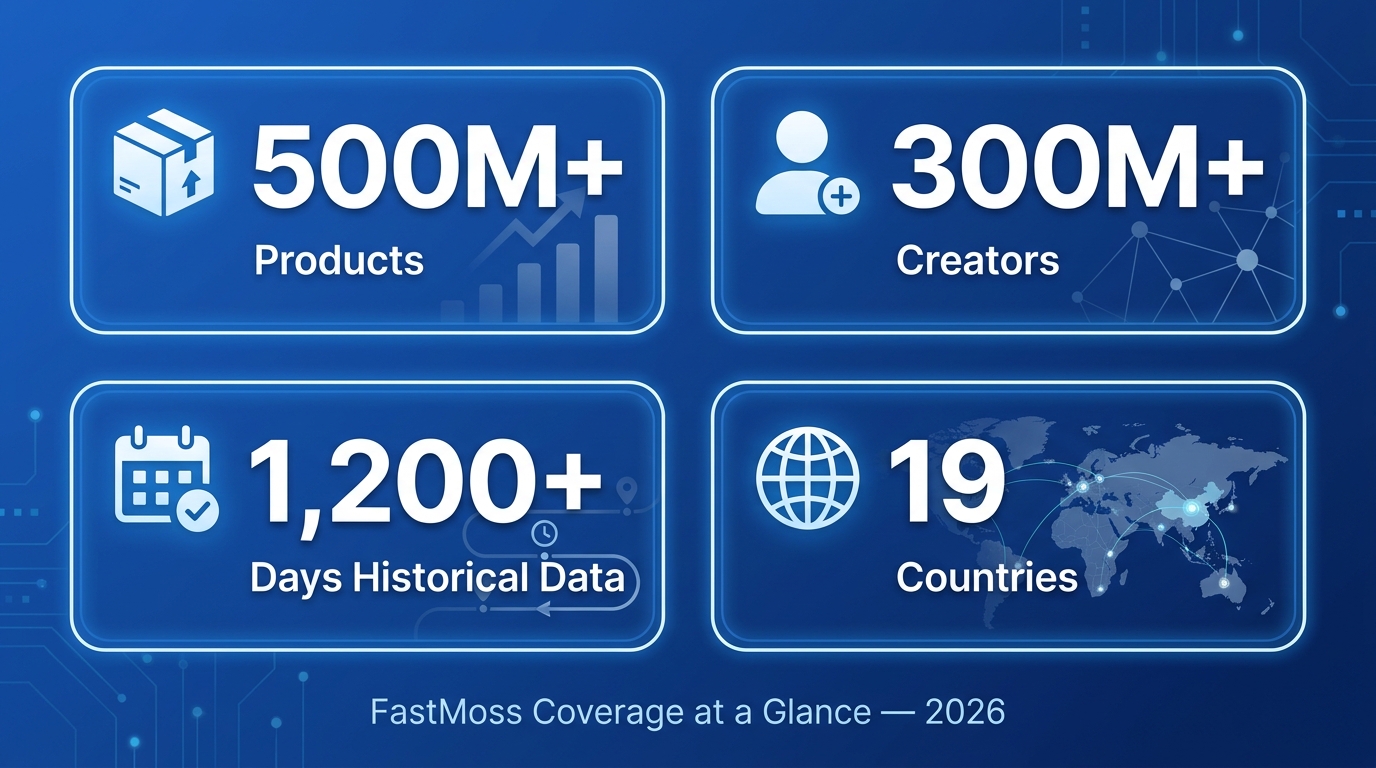
FastMoss’s core value proposition is breadth and depth inside the TikTok Shop ecosystem. Its 500 million+ product database and 300 million+ creator index are among the largest in the category, and its 1,200+ day historical data window gives it a longer lookback period than most competitors can match. For a brand manager trying to understand whether a product category is in structural decline or just experiencing a seasonal trough, that depth changes the quality of the decision.
Product Research and Trend Spotting
FastMoss tracks product-level GMV, order volume, price history, fee structures, and ranking positions with daily updates. The product research module is organised around surfacing items with upward velocity before they peak — the platform’s positioning is explicitly about finding opportunities “one step ahead” of the broader market. Users can filter by category, region, price band, seller type, and growth trajectory to surface rising products alongside proven bestsellers.
The trend-spotting layer is particularly valued by teams operating in fast-moving categories such as beauty, electronics accessories, and seasonal goods, where a product’s window of peak performance can be short. FastMoss’s breadth of coverage means it often surfaces movement in a category before smaller, narrower tools register the signal.
Creator and Affiliate Discovery
The creator discovery module is one of FastMoss’s strongest differentiators. With over 300 million creator profiles indexed, the platform lets sellers filter creators by category, GMV performance, commission rates, audience size, engagement rates, and regional focus. The companion MossCreator product extends this into outreach automation, giving users direct contact access to creators within the database.
For affiliate-heavy operations — brands running TikTok Affiliate Programs (TAP) or working with multi-creator networks — FastMoss’s creator discovery engine is genuinely difficult to replicate with manual research. The ability to identify which specific creators in a given niche are driving actual GMV (rather than just views) is a workflow that would otherwise require hours of manual cross-referencing inside TikTok Seller Center.
LIVE Analytics and Competitor Shop Tracking
TikTok LIVE commerce is a significant revenue driver in several key markets, particularly the UK, Southeast Asia, and increasingly the US. FastMoss provides LIVE-specific analytics that track which hosts are generating what GMV in real time, which products are converting during live events, and how live-stream performance compares to video-driven sales for the same SKU. This level of granularity is rare in the category and is particularly valuable for brands deciding whether to invest in a live-stream strategy.
The competitor shop tracking module has expanded significantly in recent months, with SKU-level competitor store data now available — including sales volume estimates, pricing change history, ranking movement, and which creators a competitor shop is working with. For brands doing category research or competitive positioning work, this is a high-quality data source.
AI Tools: Script Generation and Review Analysis
FastMoss has layered AI-powered tools onto its analytics core. The AI Script Generator transcribes and rewrites successful video scripts from top-performing content, giving sellers a starting point for content production that is grounded in what is actually working in their category. The AI Review Analysis module aggregates customer feedback from TikTok Shop products and surfaces recurring themes — useful for both product improvement and messaging refinement.
These AI tools are not the primary reason to buy FastMoss, but they add real operational value for teams producing volume content for TikTok Shop. The Chrome extension further extends the platform’s utility by surfacing competitor data and product insights while users browse TikTok’s interface directly.
EchoTik in Depth: When Accuracy Matters More Than Volume
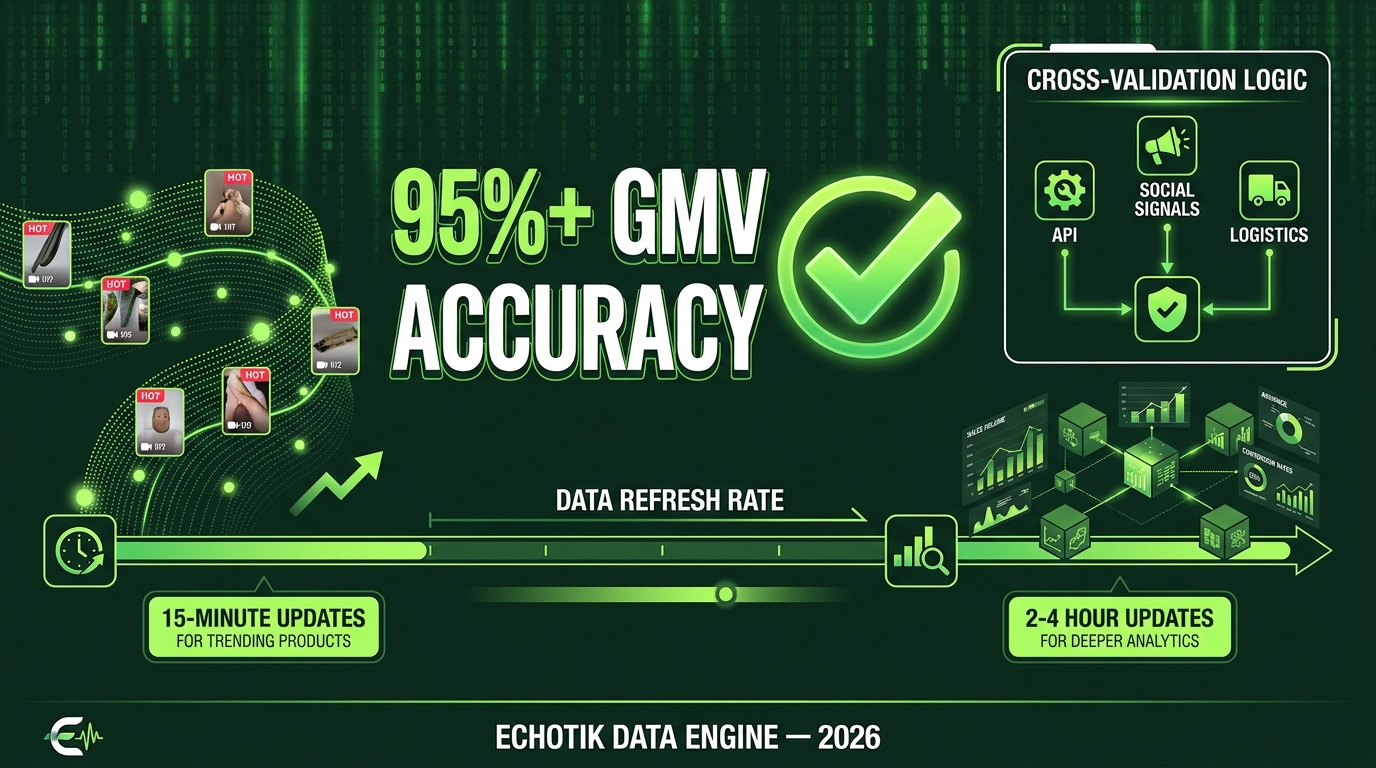
EchoTik’s design philosophy is fundamentally different from FastMoss’s. Where FastMoss optimises for breadth — the largest possible product and creator database — EchoTik optimises for the quality and reliability of the numbers it presents. This is not a minor distinction. In TikTok Shop analytics, the gap between “estimated GMV” and “verified GMV” can be substantial, and decisions made on inaccurate revenue figures lead directly to wrong product bets, inflated competitor assessments, and wasted ad spend.
The Cross-Validation Accuracy Engine
EchoTik’s claimed 95%+ GMV accuracy figure is achieved through what the company describes as Cross-Validation Logic — a methodology that triangulates three independent data streams: TikTok’s official Shop API data, social signal data (engagement, comment velocity, share patterns), and logistics and fulfilment data. By requiring agreement across multiple signals before publishing a revenue estimate, EchoTik filters out the noise that makes raw API-pull data unreliable.
In practical terms, this matters most when a seller is trying to validate whether a competitor’s apparent success is real sustained demand or a promotional spike. FastMoss’s approach, which prioritises real-time breadth, is better suited to catching early movement. EchoTik’s approach is better suited to confirming whether movement has converted to settled revenue. Independent 2026 reviews consistently describe EchoTik as “deeper on verified revenue” and FastMoss as “better for early trend spotting” — a meaningful distinction for different stages of the research workflow.
Product Analytics: Depth Over Breadth
EchoTik’s TikTok Shop product analytics module covers GMV, sales volume, price history, fee structures, 30-day and 1,000-day trend lines, and a TikTok Shop Library with over 60 tracked indicators per product. For a seller doing serious category analysis, the 1,000-day trend window (roughly equivalent to FastMoss’s 1,200-day claim) provides the historical context needed to distinguish genuine category growth from trending moments.
The platform tracks SKU-level store data, sales volumes, pricing changes, rankings, and market-level dashboards. Category-level views aggregate this data to surface market trends and identify white-space opportunities — areas where demand appears to be growing but supply-side competition remains thin. This is exactly the type of strategic intelligence that justifies a data subscription for a brand team evaluating whether to enter a new product category on TikTok Shop.
Influencer Discovery and Live Commerce
EchoTik’s influencer discovery module tracks creator performance at a GMV level, which means it can surface not just which creators have large audiences but which creators are actually generating commerce transactions. This distinction is undervalued: in TikTok Shop, a creator with 200,000 highly engaged followers in a relevant niche frequently outperforms a creator with 2 million general-audience followers. EchoTik’s revenue-linked creator data makes this comparison tractable.
Live commerce analytics cover creator-driven live stream performance, product-level conversion rates during live events, and comparative analysis against non-live video-driven sales. For brands operating in markets where TikTok LIVE is a meaningful revenue channel, this data directly informs scheduling, product selection, and creator selection decisions for live events.
API Access and Integration
EchoTik offers API access for teams that need to push its data into their own reporting infrastructure — BI tools, custom dashboards, or internal analytics pipelines. This is a feature more commonly seen at higher tiers of FastMoss or specialist agency tools, but EchoTik makes it available to qualifying users, making it a viable data source for technically sophisticated teams that want verified TikTok Shop GMV data feeding into broader business reporting.
Pricing: The Real Differentiator
EchoTik’s pricing structure is genuinely unusual in this market segment. A permanent free tier provides core features without requiring a credit card. Paid plans start at approximately $9.90–$10/month on annual billing, with higher tiers running up to roughly $29/month. These figures, reported across multiple independent 2026 reviews, make EchoTik by far the most accessible of the three tools in terms of entry cost.
For solo sellers, small teams, and creators who need solid TikTok Shop intelligence without a significant monthly software budget, EchoTik’s pricing removes a barrier that FastMoss does not. This is one of the core reasons why multiple 2026 tool roundups recommend EchoTik as the default choice for most independent TikTok Shop operators.
Minea in Depth: Ad Spy First, TikTok Second

Minea exists to solve a problem that neither FastMoss nor EchoTik are designed to address: understanding what is winning across paid advertising channels on multiple platforms simultaneously. If your ecommerce operation runs paid traffic on TikTok, Facebook, Instagram, and Pinterest at the same time — or if you are in the product discovery phase and want to validate whether a product concept is proving itself across multiple channels before committing to it — Minea has a role to play that no TikTok-native tool can replace.
Multi-Platform Ad Intelligence
Minea’s ad indexing capability covers TikTok, Meta (Facebook and Instagram), Pinterest, and Snapchat. For each ad it indexes, the platform tracks creative performance data, engagement signals, the duration the ad has been running (a proxy for profitability — ads kept live for weeks or months are generally being sustained because they are working), and the Shopify store running the ad. The Shopify store connection is a significant intelligence layer: it allows users to see not just which ads are running but what the destination store looks like, what its product range is, and in some cases estimate sales volumes.
For a dropshipper building a product hypothesis, this multi-platform view answers a question that TikTok-native tools cannot: Is this product being successfully sold via paid advertising on channels other than TikTok? A product that is performing well across Facebook, Instagram, and TikTok simultaneously is a significantly stronger validation signal than one performing on a single platform.
The Credit System: Operational Reality
Minea’s credit model is the most important thing to understand before purchasing any plan. Credits are consumed by most meaningful actions on the platform — running searches, applying filters, viewing detailed analytics, scrolling through results, and downloading data. For a user conducting light, targeted research, monthly credit allowances may be sufficient. For a user running intensive product validation across multiple categories, credits deplete rapidly.
This credit structure is increasingly cited by 2026 reviewers as the primary friction point with Minea for dropshippers who need to run broad exploratory research. The “credit anxiety” problem — where users constrain their research behaviour to preserve credits — directly undermines the kind of open-ended exploration that produces the best product discoveries. Teams that hit their credit limits mid-month and cannot afford to upgrade to the next tier face a productivity gap that has no equivalent in either FastMoss or EchoTik’s flat-subscription models.
TikTok-Specific Capabilities and the Premium Paywall
Minea’s TikTok features are locked behind the Premium plan at $99/month. The Starter plan at $49/month covers Meta-focused research but provides no access to TikTok Shop data or TikTok ad intelligence. This means a seller who signs up for Minea primarily for TikTok coverage is effectively committed to $99/month minimum — the same price range as a solid FastMoss or EchoTik subscription.
At the Premium tier and above, Minea adds TikTok ad research, TikTok Shop product data, and access to an influencer database for creator seeding campaigns. These are functional but are not the platform’s core competency. Independent comparisons consistently note that Minea’s TikTok-specific data lacks the depth and granularity of either FastMoss or EchoTik at equivalent price points. You are paying Premium pricing primarily to access Minea’s cross-platform validation capability — and the TikTok layer is a valuable but secondary feature of that package.
Where Minea Genuinely Excels
The use case where Minea has no real competition among these three tools is multi-channel product validation for new market entrants. A brand considering launching a new product category that it intends to sell via multiple ad channels needs to know whether that product concept has been validated by other operators running paid traffic at scale. Minea’s cross-platform ad library answers that question directly. The Shopify store connection layer then allows users to assess how competitors are merchandising and positioning the product, what price points are being tested, and how long stores appear to have been running these campaigns.
For established TikTok-native operators who are already inside the platform and optimising day-to-day operations, Minea adds less incremental value. The gap between what Minea tells you about TikTok and what FastMoss or EchoTik tell you about TikTok is substantial and generally goes in the latter tools’ favour.
Data Freshness and Accuracy: The Numbers Behind the Numbers
One of the most consequential differences between these three tools is how they handle data freshness and accuracy — and the tradeoffs involved are not always clearly communicated in marketing copy. All three platforms present their data as “real-time” or “accurate” in promotional materials. The operational reality is more nuanced.
FastMoss: Freshness as a Feature
FastMoss’s data architecture prioritises freshness. Its positioning is explicitly around catching products and trends before they peak, which requires data that is as current as possible. For products showing upward velocity in the last 24–72 hours, FastMoss’s real-time orientation is a genuine advantage. Category-level trend dashboards and LIVE analytics both benefit from this approach.
The tradeoff is accuracy. FastMoss’s GMV estimates are based on TikTok intent and engagement signals — they track what is generating activity rather than what has generated verified sales. In a fast-moving live-selling environment, this distinction matters: a product might generate enormous engagement during a LIVE event without converting at the rates the raw engagement signals would suggest. FastMoss’s data tends to be directionally correct but requires interpretation. Users treating FastMoss GMV figures as precise revenue estimates are reading the data at a higher confidence level than the methodology justifies.
EchoTik: Accuracy as a Feature
EchoTik takes the opposite design approach. Its cross-validation methodology sacrifices some real-time speed in exchange for higher confidence in the numbers it publishes. The claimed 95%+ accuracy figure — triangulated across API data, social signals, and logistics data — is designed to produce estimates that are reliable enough to use in comparative analysis and trend identification without constant caveating.
Data refresh rates of 15 minutes to 2–4 hours mean EchoTik is not the right tool for catching products in the first hour of a viral moment. But for the more common use case — understanding which products and creators are generating sustained, verified demand over days, weeks, and months — EchoTik’s accuracy emphasis produces better inputs for the decisions that matter most. The 1,000-day trend window also means that EchoTik’s historical accuracy extends further back than most tools in the category, useful for seasonality analysis and category lifecycle assessment.
Minea: Cross-Platform Consistency Over TikTok Depth
Minea’s accuracy picture is harder to assess because it covers multiple platforms. For Meta ad intelligence, Minea has been a well-regarded data source for several years and its Facebook/Instagram coverage is generally considered reliable for the use case of identifying which products and ad creatives are being sustained in the market. For TikTok, the depth of data is thinner than either FastMoss or EchoTik, and the accuracy of TikTok-specific figures has not been independently documented to the same degree as EchoTik’s cross-validation claims.
The honest framing for Minea’s data is that it excels at helping users answer binary validation questions — Is this product being advertised at scale? — rather than continuous quantitative tracking questions — How much GMV did this product generate this week? For the former question, Minea is excellent. For the latter, it is outperformed by the TikTok-native tools.
The Real Pricing Picture: What Each Tool Costs at Different Scales
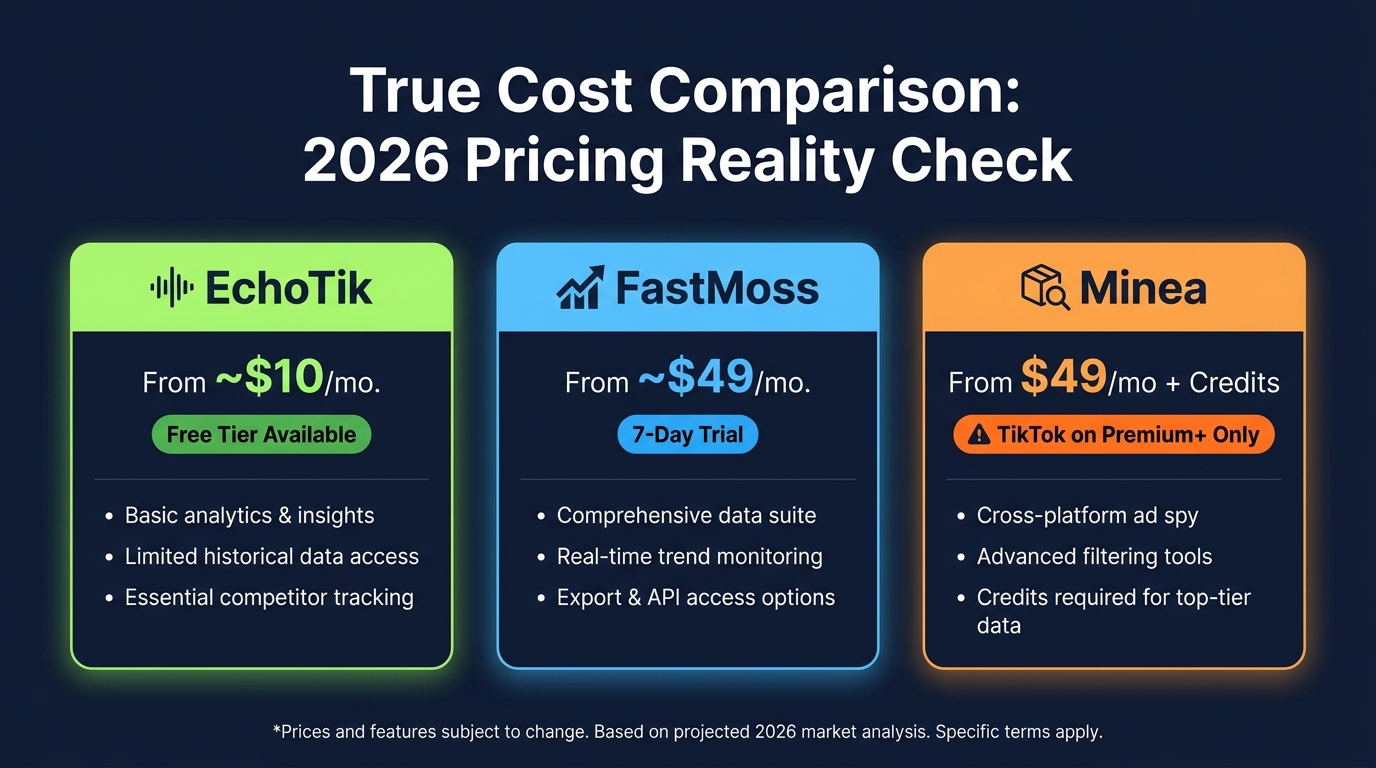
Pricing for all three tools is somewhat inconsistently reported across third-party review sites, partly because all three run promotional pricing, regional variations, and annual-versus-monthly billing structures that create different effective costs depending on when and where you sign up. The following represents the most consistently reported 2026 figures from independent reviews, and should be verified directly with each platform before purchasing.
EchoTik Pricing
EchoTik offers a permanent free tier that provides access to core features without a credit card requirement. Paid plans on annual billing are reported at approximately $9.90–$10/month at the base tier, scaling to around $29/month for higher-tier access. This makes EchoTik’s annual cost somewhere between $120 and $350 for most users — the lowest cost of entry by a significant margin among the three tools.
The free tier is functional enough to give potential users a genuine sense of the platform’s capabilities before committing. For teams with constrained software budgets, EchoTik’s pricing means it can often be trialled alongside an existing toolstack without displacing something else. The API access available on higher tiers adds further enterprise-grade utility that would typically carry a substantial premium at competing platforms.
FastMoss Pricing
FastMoss operates a tiered structure — commonly reported as Basic, Pro, and Ultimate/Team — with 2026 pricing converging across independent sources at approximately $47–$59/month for Basic, $89–$139/month for Pro, and $139–$399/month for the highest tier. A 7-day free trial is available. Enterprise and API pricing is custom.
The Basic plan covers core product research and creator discovery with limited historical data depth and restricted export quotas. To access full creator contact information, extended historical data, and higher search and export limits, Pro or above is required. For agency users and larger teams working across multiple brands or clients, the top tier can be justified by the workflow automation and team collaboration features, but the price jump is material. FastMoss is notably more expensive than EchoTik at every tier, and for solo operators the monthly cost can be hard to justify against EchoTik’s substantially lower entry point.
Minea Pricing
Minea’s publicly listed 2026 tiers are Starter at $49/month, Premium at $99/month, and Business at $399/month. This headline pricing understates the true cost for intensive users because of the credit consumption model. Users doing broad exploratory research — running dozens of searches, applying multiple filter combinations, viewing detailed analytics for dozens of products — will exhaust monthly credit allocations faster than lighter users, effectively increasing the per-research-session cost.
For TikTok-specific coverage, the Premium plan at $99/month is the minimum viable tier. Compared to EchoTik’s $10–$29/month for strong TikTok Shop analytics, the cost premium for Minea’s TikTok features only makes sense if the cross-platform validation capability of Meta, Pinterest, and Snapchat coverage is generating actionable intelligence that justifies the gap. For pure TikTok operators, this rarely adds up to a compelling case.
Use Case Matrix: Which Tool Wins for Which Role
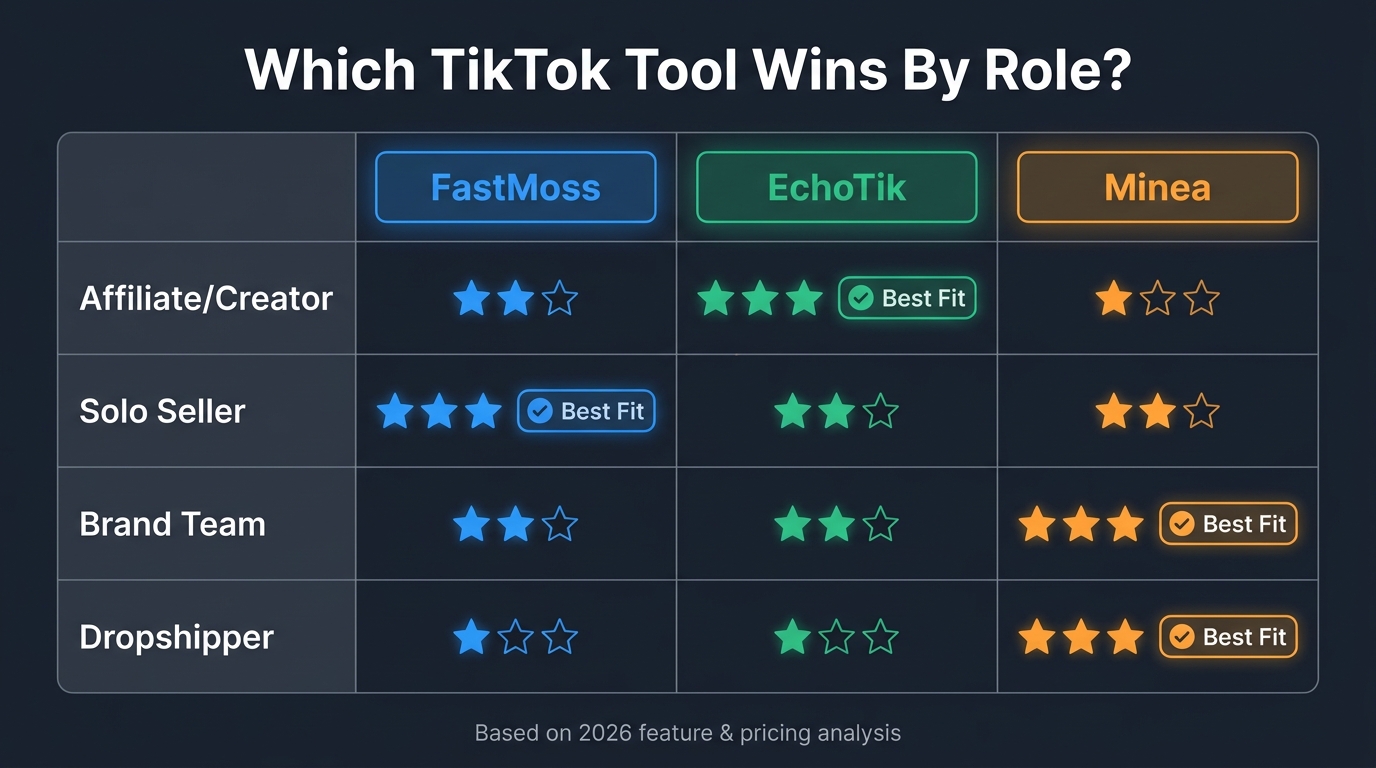
The most useful way to approach this comparison is by starting with the job to be done — your specific role and operational context — and working backward to the tool that best fits it. The following breakdown covers the four primary buyer profiles that dominate TikTok Shop analytics subscriptions.
Affiliates and Content Creators
Affiliates and creators need to identify which products are genuinely converting for other creators in their niche, discover which commission structures are worth promoting, and track the performance of content they produce against actual GMV outcomes. Both FastMoss and EchoTik serve this use case well, but from different angles.
FastMoss wins for large-scale affiliate teams and creator networks that need to scan thousands of products and identify the top-performing creator-product combinations across the market. The creator discovery database at 300 million+ profiles, combined with GMV-linked performance data, makes it the most comprehensive tool for agencies managing creator portfolios. The YooFinds affiliate platform adds direct merchant-creator matching for US-focused operations.
EchoTik wins for individual creators and small affiliate teams that need reliable GMV data without a high monthly spend. Its free tier and low-cost paid plans make it the most accessible tool for a creator who wants to validate product selection before committing to content production. The GMV accuracy advantage also matters here: affiliates making promotion decisions based on inflated revenue estimates risk selecting products with weaker actual conversion than the data suggests.
Minea has limited relevance for pure affiliates unless they are also running paid acquisition to supplement organic content, in which case its ad creative intelligence adds value for optimising paid campaigns.
Solo Sellers and Small Teams
Solo sellers running one or two TikTok Shop stores typically need solid product research, competitive intelligence, and enough creator discovery capability to build modest affiliate programmes. For this profile, EchoTik is the strongest default recommendation in 2026. The accuracy of its GMV data, the depth of its product analytics, and its low pricing make it the best all-round value for operators who need reliable daily intelligence without the overhead of FastMoss’s higher-tier feature set or Minea’s credit-based friction.
FastMoss becomes relevant for the solo seller who has outgrown EchoTik’s creator discovery capabilities and needs to run systematic affiliate recruitment at scale. The threshold is roughly when creator discovery and outreach become a primary growth lever rather than an occasional activity — at that point, FastMoss’s depth justifies the cost premium.
Brand Teams and Agencies
Brand teams and agencies managing TikTok Shop at a multi-SKU, multi-creator scale need a different configuration. For market intelligence, competitive positioning, and category analysis, FastMoss’s breadth and 1,200-day historical window make it the stronger choice. Its competitor shop tracking module — with SKU-level data on rivals’ product portfolios, creator relationships, and pricing strategies — provides the strategic intelligence layer that brand managers need.
EchoTik remains relevant for brands that need its verified GMV accuracy to feed into financial reporting or business case development. In organisations where TikTok Shop performance needs to be reported to finance or procurement teams, EchoTik’s cross-validated figures carry more defensible authority than estimates with wider confidence intervals.
Minea adds value for brand teams running multi-channel paid acquisition strategies. A brand simultaneously running TikTok ads, Meta ads, and Pinterest Shopping campaigns benefits from Minea’s cross-platform creative intelligence — understanding which ad angles are sustaining across all channels, not just on TikTok.
Dropshippers Testing New Products
Dropshippers have a specific workflow: rapid product discovery, fast validation, quick testing, and rapid scaling or killing of product bets. The ideal toolstack for this workflow is somewhat counterintuitive relative to the marketing copy for all three tools.
For initial discovery and cross-platform validation, Minea at the Premium tier provides a signal that no TikTok-native tool can match: confirmation that a product is generating paid ad spend across multiple platforms simultaneously. A product being actively advertised on Facebook, Instagram, and TikTok at the same time is an extremely strong signal that someone has found a working unit economics formula. Minea surfaces this in minutes.
Once a product concept has been validated across platforms, EchoTik becomes the daily operational tool for monitoring TikTok-specific performance, tracking which creators are promoting it organically, and assessing how quickly the competitive landscape is filling in. FastMoss enters the picture when affiliate recruitment becomes the primary scaling mechanism — using its creator discovery engine to identify and approach the right creators for an aggressive launch campaign.
The dropshipper who runs all three tools in sequence — Minea for initial validation, EchoTik for operational monitoring, FastMoss for affiliate-led scaling — is paying approximately $150–$200/month at minimum, but running a significantly more defensible research and execution process than any single-tool approach allows.
Where Each Tool Falls Short: Honest Weaknesses
Marketing copy for all three platforms emphasises strengths. The limitations listed here are drawn from independent user reviews and analytical comparisons published in 2026, and represent recurring themes rather than edge cases.
FastMoss Weaknesses
TikTok-only scope. FastMoss has no data for Amazon, Shopify, AliExpress, Meta ads, YouTube, or any channel outside TikTok. For brands that run omnichannel operations, this creates a blind spot that requires additional tooling to fill. There is no supplier or sourcing intelligence — FastMoss cannot connect a product to its AliExpress source listing, check fulfilment timelines, or flag supplier risk.
Learning curve and complexity. FastMoss is a data-dense platform. New users frequently report that the depth of features requires meaningful time investment before they can extract actionable insights efficiently. For teams without a dedicated analytics operator, the platform can feel overwhelming before it becomes useful.
Cost at scale. For smaller operations, FastMoss’s pricing is hard to justify. The Basic tier is limited enough that it can feel like a loss-leader rather than a genuinely functional plan, and the jump to Pro adds meaningful cost. Teams that need the full feature set will find the annual commitment substantial.
GMV accuracy caveats. FastMoss’s emphasis on real-time freshness comes with an accuracy tradeoff. Revenue figures should be treated as directional estimates rather than verified sales data. Teams that need auditable numbers for reporting purposes should not use FastMoss as their source of record.
EchoTik Weaknesses
TikTok-only focus. Like FastMoss, EchoTik has no visibility outside the TikTok ecosystem. For cross-channel operators, this is a structural limitation rather than a missing feature — the platform was not designed to be omnichannel.
Creator discovery depth vs. FastMoss. EchoTik’s influencer database is solid but smaller than FastMoss’s 300 million+ creator index. For large-scale affiliate recruitment programmes, FastMoss typically surfaces a larger pool of actionable creator matches. EchoTik’s advantage is accuracy within its coverage, not the breadth of the coverage itself.
Regional coverage gaps. Some markets — particularly emerging TikTok Shop territories — have thinner coverage in EchoTik’s data than in FastMoss’s, which has invested more in its multi-region (19 countries) infrastructure. Teams operating in newer TikTok Shop markets may find FastMoss’s coverage better suited to their geography.
Minea Weaknesses
Credit depletion under intensive use. This is Minea’s most consistently cited limitation across 2026 reviews. The credit model constrains research behaviour and introduces a cost-per-action structure that is fundamentally at odds with the open-ended, exploratory style of research that produces the best product discoveries. Heavy users regularly find themselves out of credits before month end.
Weak TikTok-specific depth. Even at the Premium tier, Minea’s TikTok Shop analytics are not as granular or reliable as either FastMoss or EchoTik. Users who subscribe to Minea expecting FastMoss-level TikTok intelligence will be disappointed. The TikTok layer is a valid secondary feature of a cross-platform tool, not a best-in-class TikTok analytics solution.
TikTok locked behind Premium. The Starter plan at $49/month providing no TikTok access is a structural frustration for TikTok-focused operators who were attracted by Minea’s brand awareness in the product research space. New users who do not read the feature matrix carefully before subscribing can find themselves having paid for a plan that does not cover their primary use case.
No TikTok Shop GMV verification. Minea’s TikTok figures are not verified through the kind of cross-validation methodology EchoTik applies. For teams needing defensible revenue estimates, this gap matters.
Stacking Tools: When One Subscription Is Not the Full Answer
For most individual sellers and creators, a single tool is the right economic choice. But for brands, agencies, and active dropshippers operating at scale, the most effective intelligence configurations in 2026 typically involve two tools working in complementary roles rather than one tool trying to cover everything.
The Validation + Operations Stack
Minea (Premium) + EchoTik covers the full product research and daily monitoring workflow for dropshippers. Minea provides cross-platform validation at the product discovery stage — confirming that a product concept is generating paid ad spend at scale across multiple channels. EchoTik then takes over as the daily operations tool once the product is live on TikTok Shop, providing verified GMV tracking, competitor monitoring, and creator performance data. The combined cost at roughly $100–$130/month is meaningful but justifiable for a dropshipper running multiple active products.
The Intelligence + Scale Stack
For brands and agencies, EchoTik + FastMoss (Basic or Pro) addresses the complementary need for verified daily accuracy alongside deep strategic intelligence. EchoTik handles verified GMV reporting and operational monitoring. FastMoss powers creator discovery and affiliate recruitment, category analysis across the full 1,200-day history, and competitor shop intelligence at a depth EchoTik does not match. This is the configuration most commonly recommended by 2026 tool comparison guides for TikTok Shop teams at the brand level.
The Single-Tool Default
If budget constraints require a single-tool choice, the decision reduces to: Am I primarily TikTok-native, or do I need cross-platform intelligence? If TikTok-native, EchoTik is the default recommendation for most sellers — it covers the core analytical needs at the lowest cost, with sufficient accuracy for daily operational decisions. If cross-platform validation is genuinely needed, Minea Premium makes sense as the single subscription, accepting that TikTok depth will be limited. FastMoss as a solo subscription makes most sense for larger operations where creator discovery and affiliate recruitment are primary growth levers.
The Decision Framework: Picking Your Tool in Under Five Minutes
Based on the analysis above, the following decision framework provides a fast routing to the right tool for most operators. The questions are sequential — answer each one until you reach a clear recommendation.
- Do you sell or advertise on any channel other than TikTok? If yes, Minea Premium belongs in your stack as your cross-platform validation layer, regardless of what else you run. Move to question 2 for your TikTok-specific tool.
- Is creator discovery and affiliate recruitment a primary growth driver for your TikTok Shop? If you are running systematic outreach to dozens or hundreds of creators per month, FastMoss (Basic minimum, Pro for full contact access) is worth the premium over EchoTik for this specific capability.
- Do you need verified, reportable GMV figures — for finance, for investors, or for client reporting? EchoTik’s cross-validation methodology produces the most defensible estimates in the category. If the numbers need to hold up to scrutiny, EchoTik should be your source of record.
- Are you a solo seller, creator, or small team with a limited monthly software budget? Start with EchoTik’s free tier. Upgrade to a paid plan when you need deeper historical data or higher usage limits. Only consider FastMoss when EchoTik’s creator discovery becomes the binding constraint on your growth.
- Are you a new dropshipper in the product discovery phase with no existing TikTok Shop presence? Minea Premium first, for cross-platform validation of product concepts. Add EchoTik once you have a product live and need daily TikTok performance monitoring.
The Bottom Line: Three Different Tools Serving Three Different Jobs
The mistake most people make when evaluating FastMoss, EchoTik, and Minea is treating them as three versions of the same product competing on price. They are not. They are built around different assumptions about who their users are and what problems those users are trying to solve, and that shapes everything from how their data is collected and verified to how their pricing is structured.
FastMoss is the platform for operators who have outgrown general-purpose analytics and need the deepest possible intelligence layer on TikTok’s creator and product ecosystem. Its scale — 500 million products, 300 million creators, 1,200 days of history — is a genuine competitive advantage for brands and agencies that can absorb the cost and complexity. The AI tools and competitor shop intelligence layer make it the strongest single-tool choice for large-scale TikTok operations where the data is driving high-stakes decisions about product launches, creator relationships, and market positioning.
EchoTik is the platform for operators who need TikTok Shop intelligence they can trust — numbers accurate enough to run comparative analysis on, delivered at a price that makes sense for sellers and creators at every scale. Its free tier removes the barrier to trying it; its verified GMV methodology removes the second-guessing that comes with less rigorous platforms. For the majority of TikTok Shop sellers in 2026, EchoTik is the right default choice.
Minea is the platform for operators who live in a multi-platform world and need to understand what is working across paid acquisition channels simultaneously. Its credit-based model and Premium-tier TikTok paywall create real friction for TikTok-native users, but for dropshippers and brands running paid ads across Facebook, Instagram, Pinterest, and TikTok, the cross-platform validation capability it provides has no equivalent in this comparison set.
The right question is not which tool is best — it is which tool was built for your job. Get that alignment right and the subscription pays for itself. Get it wrong and you end up with an expensive dashboard you barely use because it was never designed for the workflow you are actually running.
Key Takeaways
- FastMoss: Best for large-scale TikTok operations, affiliate networks, and brands needing deep creator discovery. Entry pricing ~$47–$59/month.
- EchoTik: Best default for most TikTok Shop sellers, creators, and small teams. Verified GMV accuracy, permanent free tier, paid plans from ~$10/month.
- Minea: Best for multi-platform ad validation and dropshippers needing cross-channel product intelligence. TikTok access requires Premium at $99/month.
- For serious operators, EchoTik + FastMoss (intelligence stack) or Minea + EchoTik (validation + operations stack) outperforms any single-tool approach.
- No single tool covers everything — honest self-assessment of your primary use case is the most important step before subscribing to any of them.