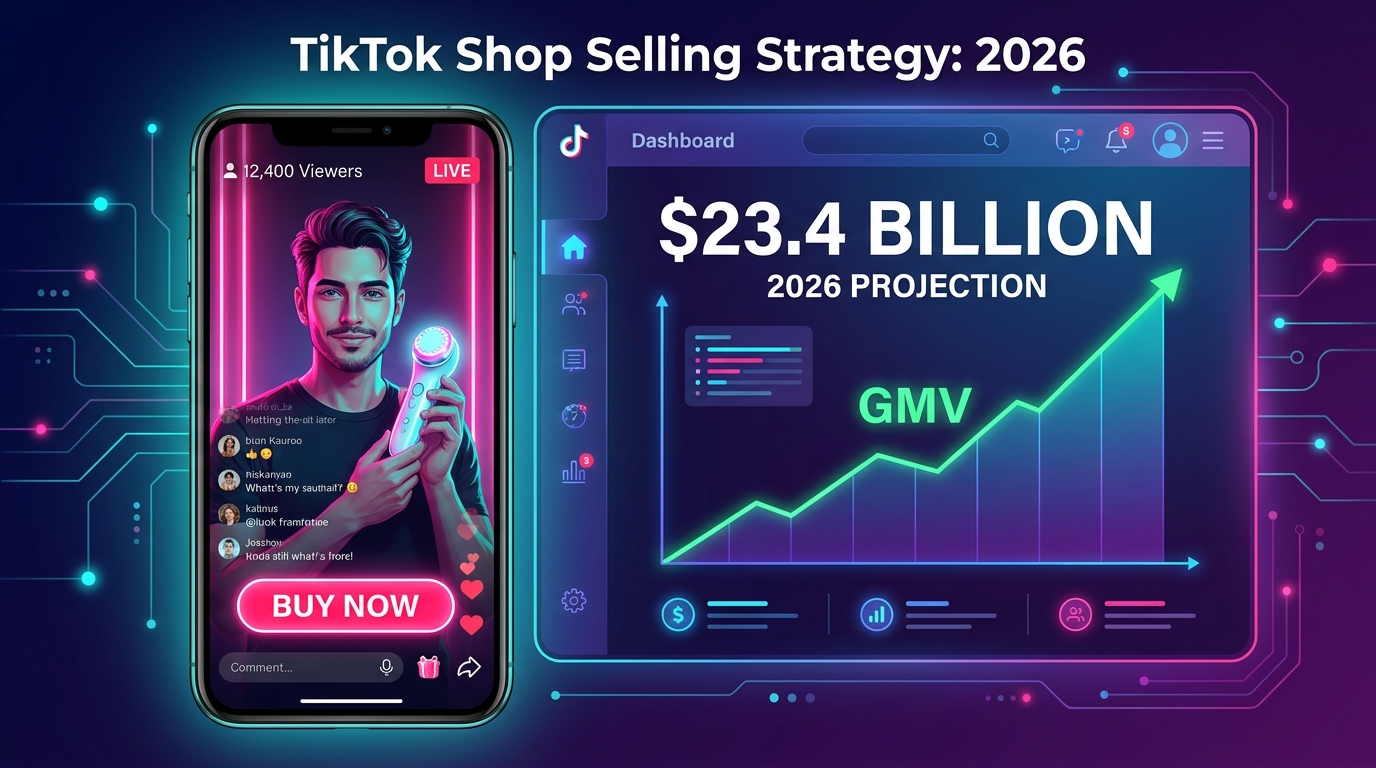

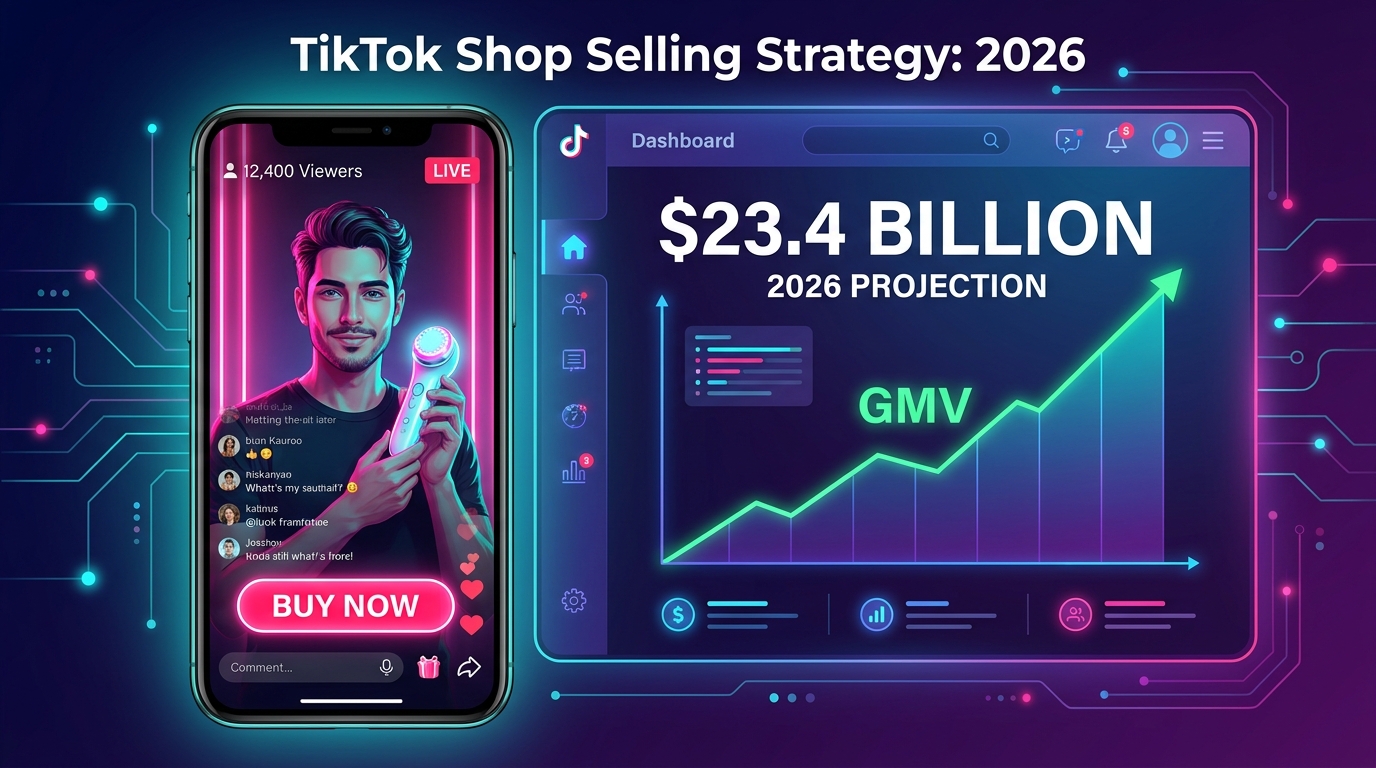
TikTok Shop is projected to generate $23.41 billion in US sales in 2026 — a figure that would put it ahead of massive brick-and-mortar retailers like Costco and Target in terms of e-commerce channel volume. The platform now hosts more than 70 million products, processes transactions across eight countries, and has fundamentally changed how new brands find their first customers.
But here’s the problem with almost every TikTok Shop guide available right now: they focus on setup. Create an account. Upload your products. Link your Shopify store. Done. What they rarely address is the operating model — the strategic, operational, and content architecture that separates the sellers generating consistent monthly revenue from the ones who listed products in January and haven’t made a sale since March.
This article isn’t a step-by-step setup tutorial. It’s a deep-dive into how TikTok Shop actually works as a business engine: the four discovery channels you need to activate (not just one), the concept of product-content fit that most sellers have never heard articulated clearly, the live shopping opportunity that the majority of US sellers still leave completely untouched, and the retention mechanics that turn a single viral moment into a sustainable sales channel.
Whether you’re building your first TikTok Shop from scratch or trying to understand why your existing catalog isn’t gaining traction, this is the operating framework you need to think through before your next product drop.
Why Most TikTok Shop Sellers Stall Before They Find Their Footing
The narrative around TikTok Shop skews heavily toward success stories — the skincare brand that went from zero to $200,000 in monthly revenue on the back of a single viral creator post, the kitchen gadget that sold 40,000 units in a week after a TikTok live. These stories are real, but they represent a tiny fraction of the seller population and almost never come with a clear explanation of what actually produced that outcome.
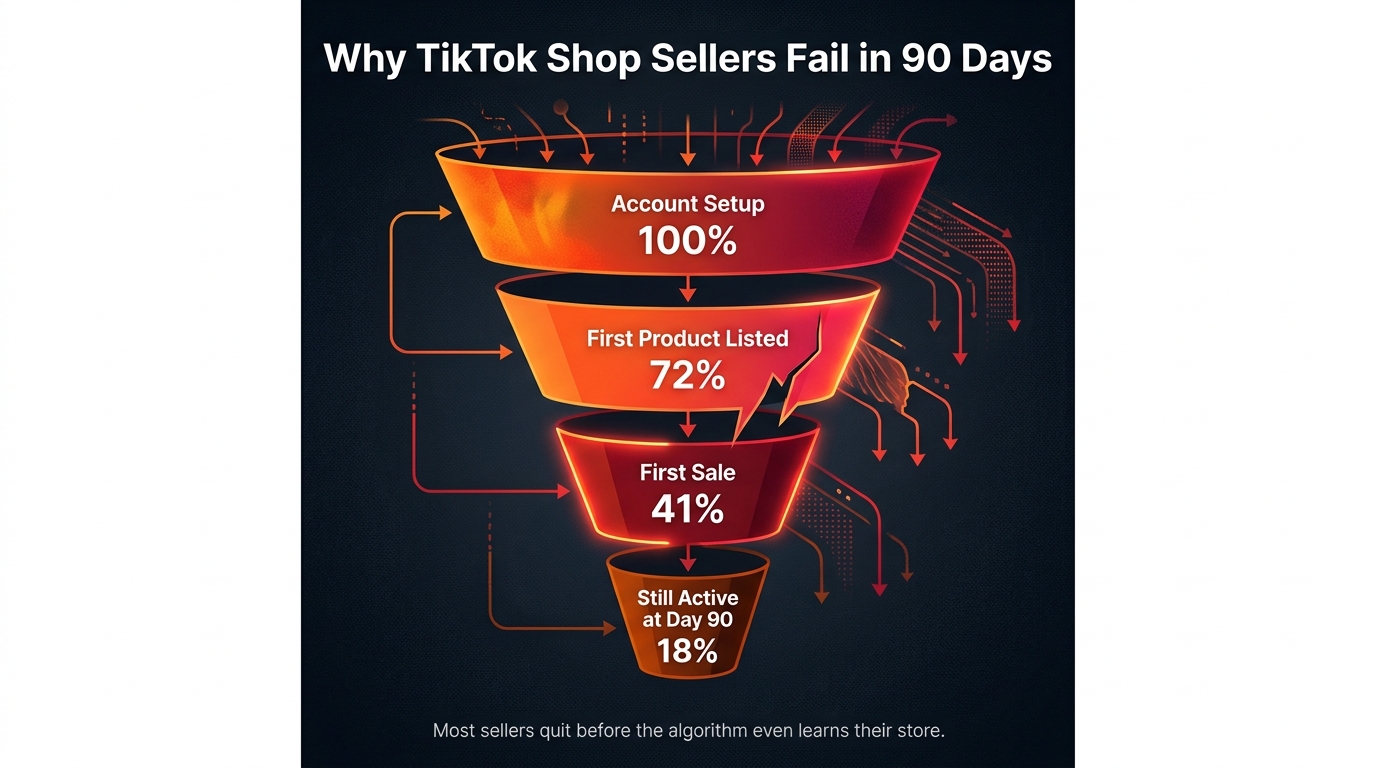
The majority of new TikTok Shop sellers follow a predictable pattern: they open the account, upload products, wait for organic traffic, see very little of it, and quietly abandon the channel within 60 to 90 days. The reasons are almost always the same.
The Passive Listing Trap
TikTok Shop is fundamentally not a passive marketplace. Unlike Amazon — where a well-optimized listing can attract purchase-intent traffic from search without any ongoing effort — TikTok Shop requires active content to drive discovery. Products sitting in your catalog without associated video content, live events, or creator affiliate links are essentially invisible. The platform’s algorithm surfaces products inside video content and livestreams; a listing page without that upstream content funnel generates near-zero impressions.
New sellers frequently treat TikTok Shop the way they’d treat a Shopify storefront — as a destination where people come to browse. It isn’t. It’s closer to a TV shopping network where the content comes first and the purchase second. Sellers who don’t produce (or commission) content tied to their products within the first two weeks of launching rarely see meaningful traction.
The Single Channel Mistake
TikTok Shop has four distinct discovery surfaces, and most new sellers only activate one — usually shoppable in-feed videos. But the sellers who generate consistent GMV typically operate across all four surfaces simultaneously: the For You Feed, the Shop Tab, live shopping, and creator affiliate placements. Each channel has a different audience behavior profile, a different conversion dynamic, and a different operational requirement. Treating TikTok Shop as a single channel rather than a multi-surface commerce ecosystem is one of the most common structural mistakes in the seller community.
Misreading the Algorithm’s Intentions
TikTok’s recommendation engine is optimized for entertainment engagement first and shopping intent second. That distinction matters enormously for how sellers should position their content. A product demonstration video that prioritizes being interesting to watch will consistently outperform one that is clearly a sales pitch — even if the sales pitch has better production quality. The sellers who struggle longest on TikTok Shop are usually the ones who come from a traditional direct-response advertising mindset, where the goal of every piece of content is to close the sale immediately.
TikTok’s algorithm rewards watch time, saves, shares, and engagement before it rewards click-through. A new seller who creates genuinely engaging product content — even at the cost of some immediate purchase urgency — will build algorithmic momentum faster than one who runs hard-sell video ads from day one.
The Four Discovery Channels — and Why Each One Needs Its Own Strategy
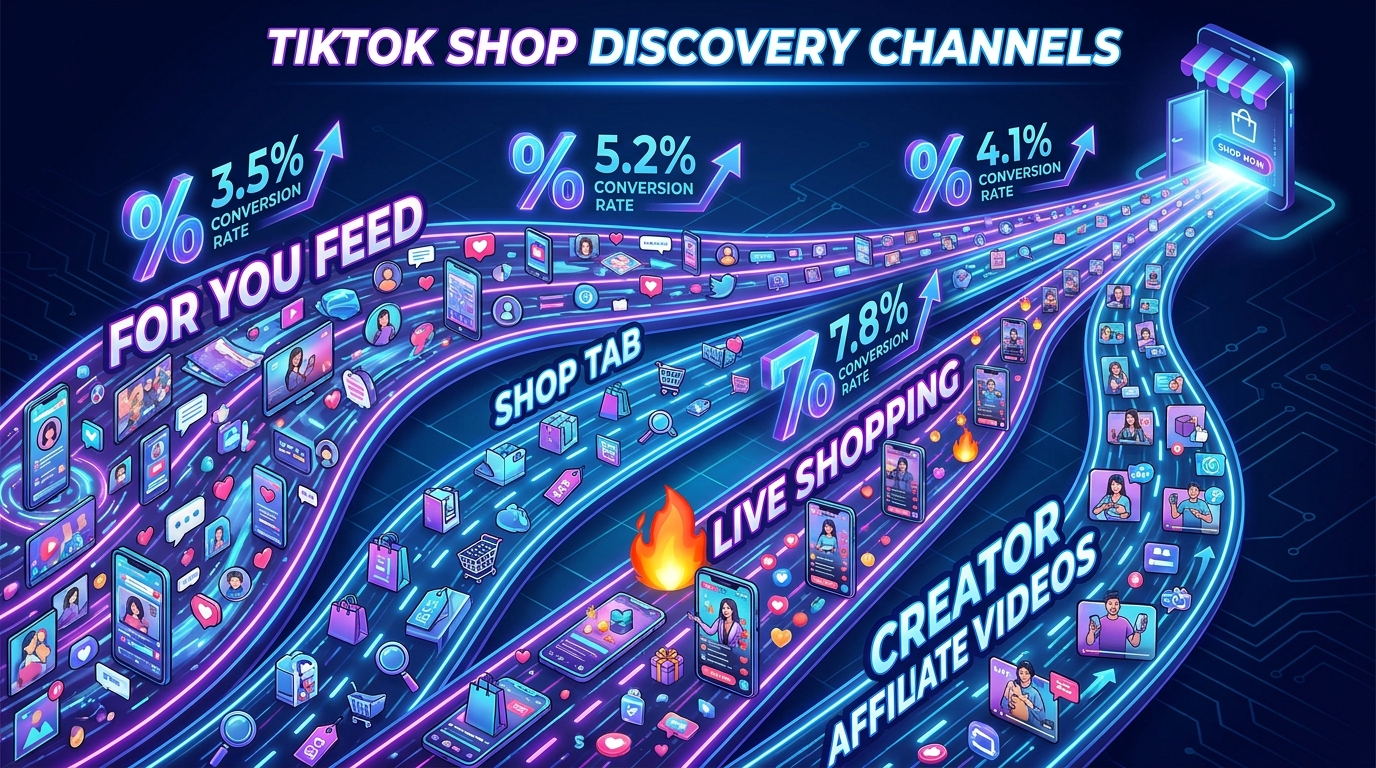
Most sellers think of TikTok Shop as one place. In practice, it’s four distinct commerce surfaces, each with its own discovery logic, buyer behavior, and content requirements. Treating them as interchangeable — or only activating one — means leaving the majority of potential GMV on the table.
1. The For You Feed (Shoppable In-Feed Videos)
This is TikTok’s core discovery engine — the algorithmically curated scroll of short-form video that users spend the majority of their in-app time on. Shoppable in-feed videos embed product links directly into the video frame, appearing at the bottom of the screen as the user watches. When a user taps the link, they see an expanded product view without leaving TikTok, and can add to cart or buy immediately.
The For You Feed is the highest-volume discovery surface for new products, but it requires the highest investment in content quality. Videos need to hook the viewer in the first two seconds, demonstrate clear value, and create an organic reason to tap the product link — without feeling like an advertisement. The most successful formats here are transformation videos, problem-solution demos, and “I didn’t expect this to work” style testimonials. Both organic seller-created content and paid Shop Ads run through this surface.
For new sellers, the FYF is both the highest-potential and highest-effort channel. The conversion rate on FYF placements varies widely, but sellers report that authentically produced videos with clear product demonstrations consistently outperform polished ad-style content when it comes to organic reach.
2. The Shop Tab
TikTok’s dedicated shopping tab is closer to a traditional e-commerce marketplace in behavior — users who land here already have purchase intent, browsing products across categories, deals, and trending items. The Shop Tab surfaces products through a personalized recommendation system, so sellers whose products have strong engagement signals from the FYF or live sessions are more likely to appear prominently here.
This is where product listing quality matters most. Since users on the Shop Tab are in a browsing mindset rather than a content consumption mindset, your product images, titles, price points, and reviews carry far more weight than on any other surface. Sellers who invest in strong product page fundamentals — clear images, compelling titles, competitive pricing, and early review generation — see disproportionate benefit on the Shop Tab.
3. Live Shopping
Live shopping is TikTok Shop’s most powerful and most underutilized channel among US sellers. During a live session, sellers can pin product listings to the stream and viewers can add items to cart in real time as they watch the presentation. A 2025 GlobalData survey found that 76% of consumers who used TikTok Shop bought an item from a livestream in the prior year — a figure that underscores just how purchase-ready live audiences are. This surface gets its own dedicated section below, given how much operational depth it deserves.
4. Creator Affiliate Videos
Through TikTok Shop’s affiliate program, independent creators can browse your product catalog, apply to promote specific items, and earn a commission on each sale they drive. When a creator posts a video featuring your product, their audience discovers it through the creator’s organic reach — and the shoppable link in that video drives traffic directly to your listing.
This is a fundamentally different traffic model from the other three channels because it decouples distribution from your own content production capacity. A brand with a small in-house team can deploy dozens of creator-produced videos simultaneously, each reaching different audience segments, without creating that content itself. The best-performing TikTok Shop brands in 2026 typically have 15 to 50+ active affiliate creators running at any given time, generating a persistent background level of video discovery across the platform.
Product-Content Fit: The Concept That Separates Breakout Sellers from the Rest
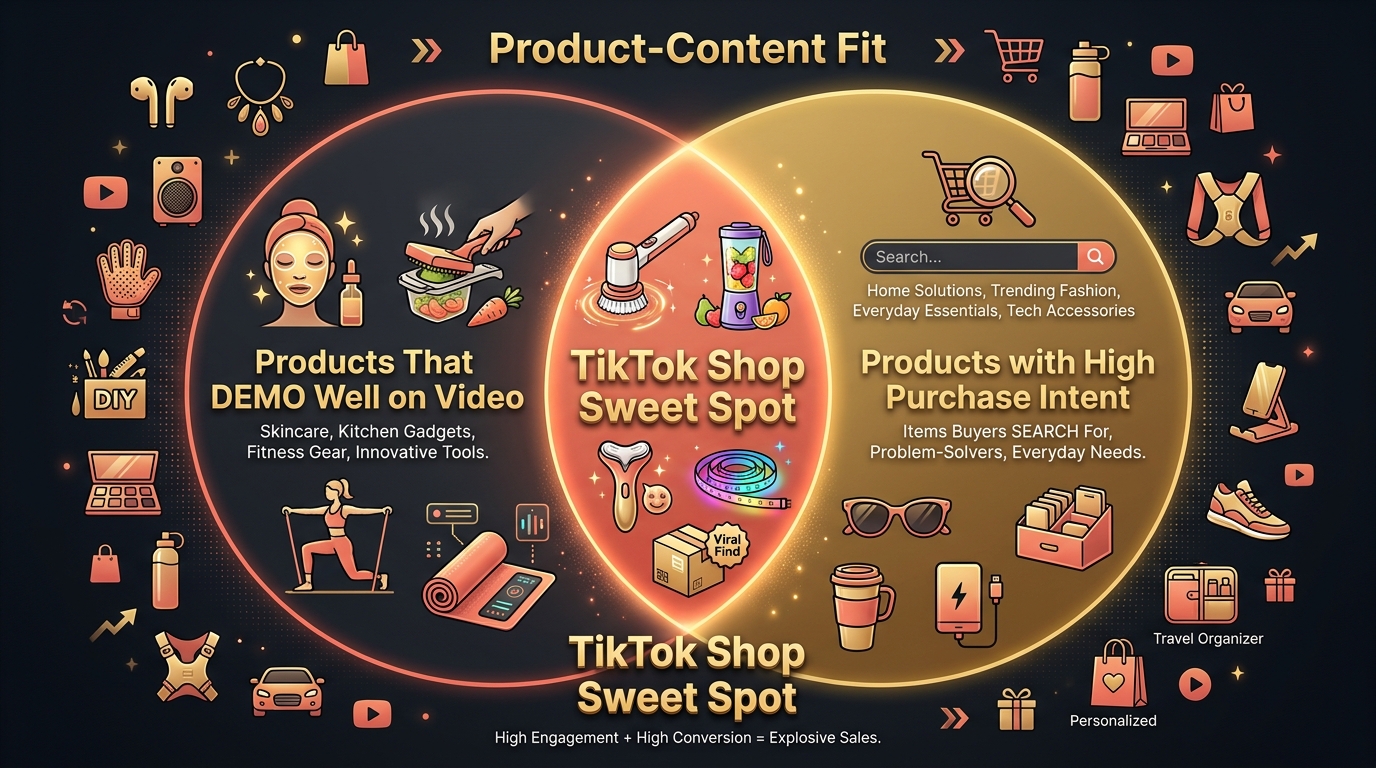
Startup investors talk about product-market fit — the degree to which a product addresses a genuine market need. TikTok Shop requires sellers to think about an additional concept: product-content fit. This is the degree to which a product is inherently suited to short-form video demonstration and the specific discovery behavior of TikTok’s audience.
Not every good product has strong product-content fit on TikTok. And not everything that makes for compelling video content converts well at the checkout stage. The sweet spot — the product-content fit zone — sits where both conditions are true: the product demos visually and emotionally in a 30 to 60 second video, and it triggers enough purchase intent to generate a conversion during or immediately after that video.
What Makes a Product Demo Well on TikTok
Products with strong TikTok content fit share certain characteristics. They produce a visible transformation — the before-and-after dynamic that TikTok’s audience is conditioned to find satisfying. Skincare products, hair tools, cleaning products, and kitchen gadgets are perennial TikTok Shop categories for exactly this reason. A carpet cleaning device that turns grey carpet white, a serum that visibly plumps skin in 30 seconds of timelapse — these products are practically advertising themselves through the demonstration itself.
They also tend to have a problem-awareness hook that doesn’t require much setup. “You know that feeling when your kitchen scissors won’t cut through anything?” hooks a broad audience immediately. Compare that to a product requiring two minutes of technical context before the value proposition lands — that’s a product with weak content fit, regardless of how genuinely useful it is.
Price point matters here too. Products priced between $15 and $60 tend to have the strongest impulse purchase dynamics on TikTok Shop. Below $15, the perceived value often doesn’t justify the friction of checkout. Above $60, buyers increasingly want to research, compare, and consider — behaviors that push them off-platform before they convert.
The High-Purchase-Intent Side of the Equation
Content fit alone isn’t enough. Some products make for incredibly entertaining videos but generate almost no sales — novelty items that are fun to watch but that viewers don’t actually want to own, or products with a very narrow target audience that the algorithm can’t efficiently find. Strong product-content fit requires that the demonstration trigger genuine desire to own, not just appreciation for the content.
The most reliable signal for this is whether the product addresses a common, recurring pain point. Sellers who identify a genuine everyday frustration and then demonstrate a clean solution tend to find the For You Feed algorithm works in their favor — because engagement signals (comments like “I need this,” “sending this to my husband,” “where do I get this”) are strong and the algorithm quickly learns who to show the content to next.
Auditing Your Catalog for Content Fit
Before launching products on TikTok Shop, run each SKU through a quick content-fit audit:
- Can I demo this compellingly in under 60 seconds? If you need more than a minute to show why the product is valuable, the content fit is weak.
- Does the demo produce a visible result or emotional reaction? Transformation, surprise, or satisfaction — one of these needs to be present.
- Is the price point in the $15–$60 impulse range? Outside this window, your content strategy needs to compensate for lower impulse conversion.
- Does this product solve a problem a large audience recognizes immediately? Niche products can work, but they require more precise audience targeting.
Products that pass all four checks are prime TikTok Shop candidates. Products that fail two or more should be evaluated carefully before investing in content creation and creator recruitment.
Building Your Affiliate Engine: The Scalable Sales Channel Most Brands Underinvest In
TikTok Shop’s affiliate program is arguably the platform’s single most efficient growth lever for product brands — yet most sellers either skip it entirely or run it at a scale so small it produces little measurable impact. The brands generating meaningful affiliate GMV are operating it as a structured, ongoing program, not a one-time experiment.
How the Affiliate Program Actually Works
Once you list products on TikTok Shop, you can set an affiliate commission rate for each SKU — typically between 5% and 25% of the sale price, depending on your margin and category competition. Creators browsing the TikTok Shop affiliate marketplace can find your products, apply to promote them, and when approved, begin featuring them in their own organic content.
The fundamental advantage of this model is that you only pay on performance. Unlike influencer marketing arrangements that involve flat fees regardless of results, affiliate commissions are tied directly to actual sales. A creator who drives 500 units at a 15% commission has earned their fee. A creator who drives zero sales costs you nothing.
Open vs. Targeted Affiliate Structures
TikTok Shop offers two modes of affiliate operation. Open collaboration allows any creator meeting minimum eligibility requirements to apply to promote your products. Targeted collaboration lets you proactively reach out to specific creators with custom commission offers and collaboration terms.
Both have a role in a mature affiliate program. Open collaboration generates volume — you’ll attract a wide range of creators at your listed commission rate, and some percentage of them will produce content that performs. It’s a numbers game, and having 40 creators each trying your product produces more total impressions than having three hand-picked ones.
Targeted collaboration is where you find your breakout moments. If a mid-tier creator in your specific niche — 50,000 to 500,000 followers, highly engaged audience, content style that matches your product — is willing to feature your product with a custom arrangement, that single collaboration can drive more GMV than your entire open network combined.
What a Functioning Affiliate Program Looks Like
The brands running effective TikTok Shop affiliate programs are doing several things consistently:
- Setting competitive commission rates from day one to attract quality creators (going below 10% in most categories produces very low application rates).
- Sending product samples proactively to targeted creators rather than waiting for them to discover the listing organically.
- Monitoring affiliate video performance weekly and doubling down on creators whose content is gaining traction — increasing commission rates, sending more inventory, and building a direct communication channel.
- Maintaining a library of product talking points, key benefits, and suggested video hooks that creators can use as inspiration — reducing the effort barrier for creator participation.
- Running dedicated affiliate promotions aligned with TikTok Shop flash sale events, where the platform’s promotional infrastructure amplifies traffic during the event window.
A common benchmark for brands who have built their affiliate programs to scale: somewhere between 20 and 60 active affiliate creators producing ongoing content, with the top 5 to 10 creators driving the majority of affiliate GMV. This distribution is consistent with Pareto dynamics in influencer programs across all platforms.
Live Shopping: The Channel Most US Sellers Still Leave Untouched
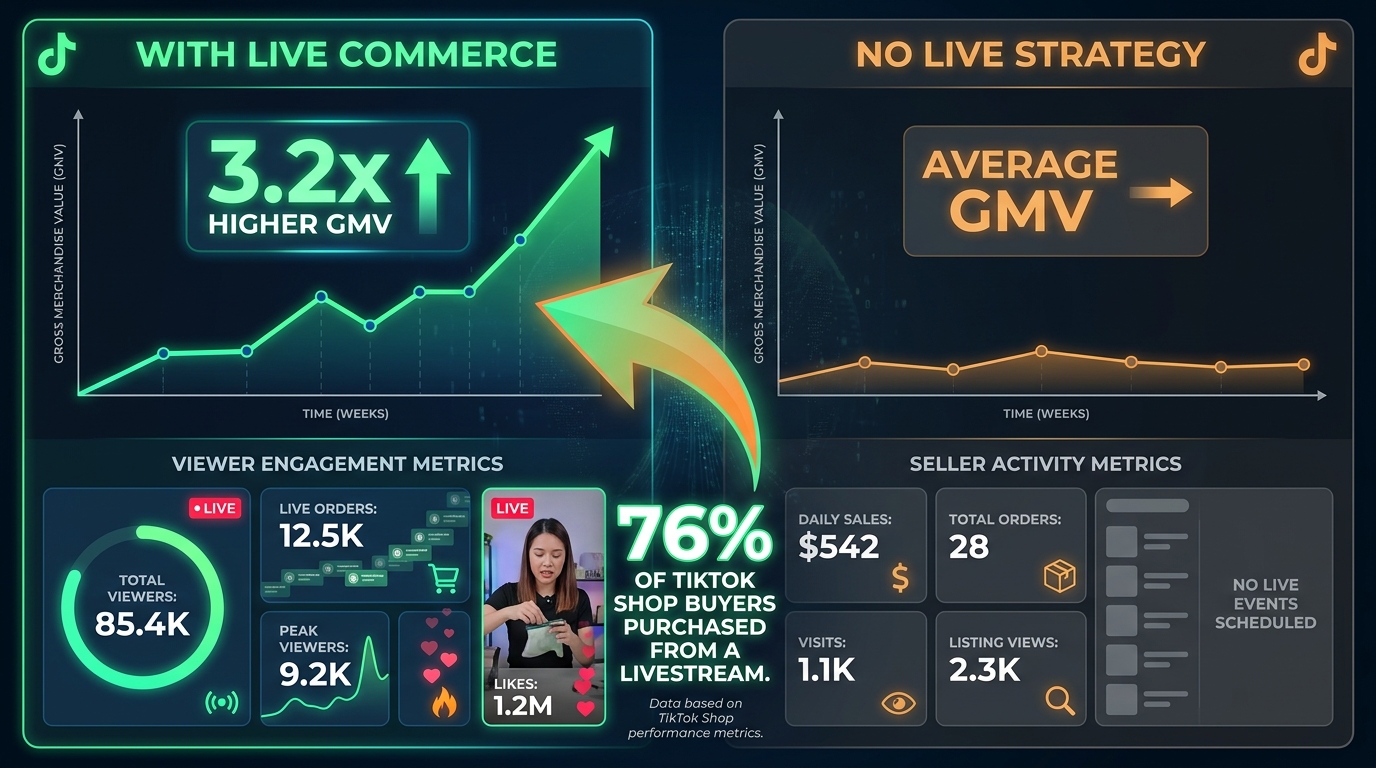
Live shopping is the most mature TikTok commerce format in Southeast Asia, where brands in markets like Indonesia and Thailand have built entire business models around daily live selling sessions that generate thousands of orders per stream. In the US, the format is still developing — but the early adoption gap creates a significant opportunity for sellers willing to invest in the format before it becomes standard practice.
The 76% figure from GlobalData — the share of TikTok Shop buyers who purchased from a livestream in the prior year — tells you something important about the purchase psychology of TikTok’s audience. Live shopping works not despite the real-time format but because of it. The combination of live demonstration, audience interaction, time-limited offers, and social proof from other viewers creates a buying environment that static product pages simply cannot replicate.
Why Live Converts So Differently Than Video
When a seller goes live on TikTok, several conversion dynamics activate simultaneously that don’t exist in pre-recorded content:
Authenticity signals are stronger. Viewers of live content know the seller can’t edit out unflattering moments or carefully script every word. The imperfection of live presentation paradoxically makes the product demonstration more credible. When something goes wrong on a live — a product takes longer to demonstrate than expected, a viewer asks a difficult question — and the seller handles it transparently, trust builds in real time.
Social proof is visible and immediate. Other viewers’ purchases, comments, and questions appear live on screen. A comment that says “just ordered two of these!” influences the purchase decision of every other viewer watching at that moment. This communal buying psychology is one of the core reasons live shopping drives higher conversion rates than any other TikTok surface.
Time-limited offers create genuine urgency. Flash pricing available only during the live session, limited-quantity deals that count down visibly, and exclusive bundles only purchasable while the stream is active — these mechanisms create real urgency that video ads can only simulate. Viewers who might have added a product to a wishlist and forgotten about it make purchase decisions in minutes during a compelling live session.
The Operational Requirements of Live Selling
Running effective TikTok live shopping sessions requires more operational infrastructure than sellers often anticipate. It’s not simply turning on a camera and talking about products. The most effective sellers approach each live with a structured session plan:
- A defined product lineup for the session, typically three to seven SKUs, ordered from highest engagement to conversion probability.
- Live-specific pricing and promotions pre-configured in the Seller Center before the stream begins.
- A moderation strategy — either a co-host who manages viewer questions and comments while the presenter focuses on demonstration, or a defined approach to fielding questions during transitions.
- A consistent schedule, because TikTok’s live discovery surfaces favor accounts that stream regularly. Sellers who go live once a week build audience habits; those who go live sporadically reset their algorithmic momentum each time.
For brands without in-house live hosting talent, partnering with a creator who specializes in live selling is a viable path. Creator-hosted live sessions where the creator manages the stream and demonstrates the seller’s products have become a recognized format, with some live commerce specialists commanding significant commissions per session in exchange for established audience reach and conversion expertise.
TikTok Shop Fulfillment: The Infrastructure Decision That Affects Everything Downstream
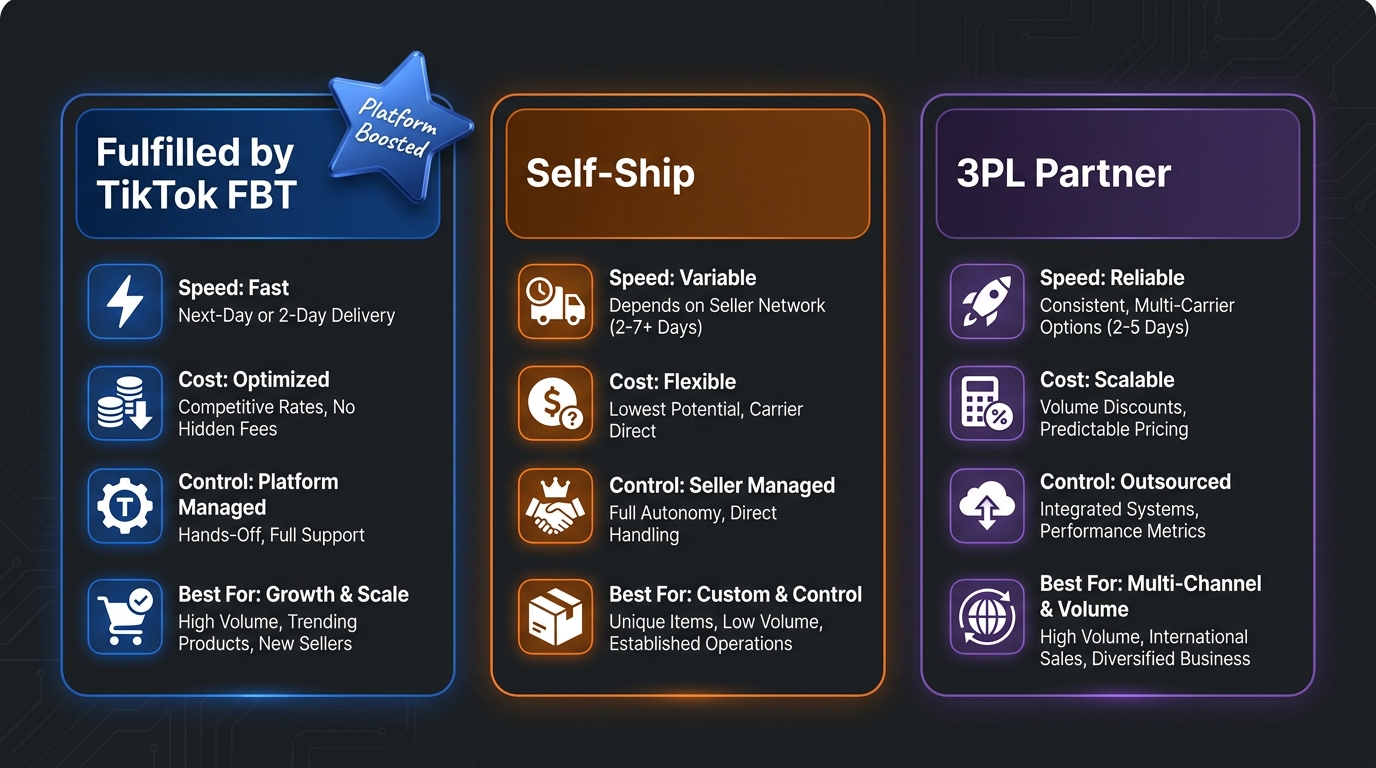
How you fulfill TikTok Shop orders is not a back-end logistics decision — it’s a front-end business decision that affects your seller health score, your visibility in search and discovery, and your customer experience ratings. TikTok Shop sellers currently have three primary fulfillment paths, each with meaningfully different trade-offs.
Fulfilled by TikTok (FBT)
FBT is TikTok Shop’s managed fulfillment service, operated in partnership with third-party logistics providers including ShipBob. Under this model, you send inventory to TikTok-designated fulfillment centers, and TikTok handles storage, picking, packing, and last-mile delivery. The critical advantage beyond operational convenience is that FBT products receive a platform-side visibility boost — they’re more likely to appear in the Shop Tab’s “Deals” sections and promotional placements because TikTok has a direct interest in ensuring reliable delivery on orders it’s fulfilling.
FBT also directly impacts your seller health score. Products fulfilled through the program tend to have more consistent on-time delivery rates, lower cancellation rates, and better return processing — all of which feed into the metrics TikTok uses to determine shop credibility and promotional eligibility.
The trade-offs: FBT involves preparation costs (inventory needs to arrive at fulfillment centers in compliant condition), there is less flexibility for custom packaging or unboxing experiences, and lead times for restocking during a sales spike can create stockout risk.
Self-Ship
Under the self-ship model, sellers handle fulfillment from their own warehouse or storage facility. This preserves full control over packaging, presentation, and the customer unboxing experience — important for brands for whom that experience is part of the product value. It also means faster response to inventory issues, returns, and order irregularities.
Self-ship is the right choice for sellers with established 3PL relationships, brands for whom custom packaging is non-negotiable, and operations with sufficient team capacity to manage order volume spikes. The challenge is that self-ship sellers carry full responsibility for meeting TikTok Shop’s delivery time requirements — typically a shipping confirmation within 24 hours of order placement and delivery within specified windows. Missing these targets damages seller health scores, which affects discoverability.
Third-Party Logistics (3PL) Integration
Sellers already using 3PL providers — ShipBob, ShipHero, Deliverr, and others — can integrate those services with TikTok Shop for an operational middle path. This keeps fulfillment in established infrastructure while meeting TikTok Shop’s delivery standards through proven logistics partners. For multi-channel sellers (those operating on Amazon, Shopify, and TikTok simultaneously), 3PL integration that handles orders from all channels through a single inventory pool is typically the most operationally efficient approach.
How to Choose
For sellers just starting on TikTok Shop with limited inventory and low initial order volume, self-ship typically makes the most sense — it preserves capital and flexibility while you establish product-market fit on the platform. As volume grows and products prove themselves, transitioning hero SKUs into FBT makes sense to capture the platform’s promotional visibility benefits. Sellers running multiple channels simultaneously with existing 3PL relationships should explore integration options before building new infrastructure.
Pricing Strategy on TikTok Shop: Why Your Amazon Playbook Doesn’t Transfer
Sellers with Amazon experience often arrive on TikTok Shop expecting to run a similar pricing playbook — competitive analysis, keyword optimization, algorithmic ranking factors, and steady-state pricing with occasional promotions. TikTok Shop operates on different pricing psychology entirely, and the strategies that work on Amazon frequently underperform here.
The Promotion-Dependence Dynamic
TikTok Shop buyers are, by behavior profile, promotion-responsive. The platform’s promotional infrastructure — daily deals, flash sales, new seller coupons, and event-based discounts tied to TikTok shopping campaigns — has conditioned buyers to expect promotional pricing as part of the experience. Products that never carry a promotion or discount mechanic frequently underperform their potential, not because the price is too high in absolute terms, but because the absence of a visible deal signal reduces perceived value.
This doesn’t mean perpetually discounting your products into margin destruction. It means building promotion into your pricing architecture from the start. If your target sale price is $29.99, listing at $39.99 with a persistent coupon for 25% off creates a promotional framing that performs better than simply listing at $29.99 with no discount narrative — even though the final price to the buyer is identical.
The Role of TikTok Shop’s Event Calendar
TikTok Shop runs a dense calendar of platform-wide shopping events — Double Day sales (11/11, 12/12), seasonal campaigns, category-specific events, and ad-hoc flash sale windows. These events generate meaningful spikes in platform-wide traffic and conversion rates, and sellers who participate with event-specific pricing and promotions capture disproportionately high GMV relative to non-participating periods.
Planning your inventory and pricing strategy around the TikTok Shop event calendar — rather than treating it as an optional promotional enhancement — is a structural advantage. The sellers who consistently outperform during these events tend to prepare weeks in advance: pre-building inventory buffers, configuring promotions in the Seller Center, and coordinating affiliate creator posts to land during the event window.
Price Point Windows and Category Dynamics
Different product categories have different optimal price windows on TikTok Shop, driven by the audience demographics and purchase behavior of TikTok’s user base. Beauty and personal care products see strong conversion in the $15 to $45 range. Home and kitchen perform well from $20 to $65. Fashion and accessories tend toward the $12 to $35 window. Going significantly above these ranges within a category requires either strong brand equity (which new sellers rarely have on TikTok) or a content strategy that pre-sells the premium positioning before the buyer reaches the listing.
Below these ranges, the math often doesn’t work — especially when factoring in TikTok Shop’s referral fees (currently ranging from around 2% to 8% depending on category and seller tier), shipping costs in a self-ship model, return handling, and creator affiliate commissions. Sub-$10 products on TikTok Shop face a very narrow path to healthy margin unless volume is extremely high and all costs are ruthlessly managed.
Turning TikTok Shop Buyers into Repeat Customers
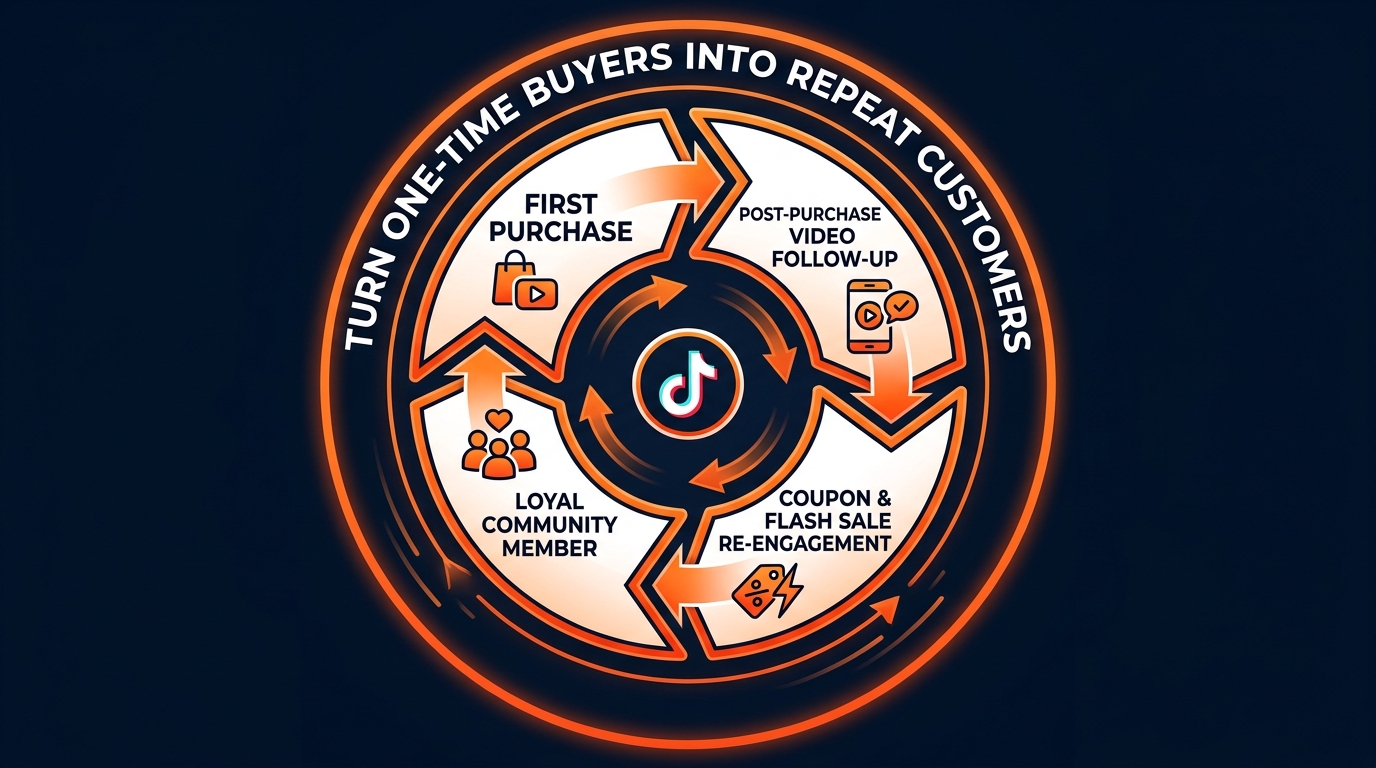
TikTok Shop’s discovery model is extremely efficient at generating first purchases. It is significantly less evolved at generating second and third ones. This is the retention problem that most TikTok Shop sellers don’t talk about: the platform’s infrastructure is built around acquisition, and the tools for post-purchase engagement are still limited compared to what sellers have access to on email-based e-commerce platforms.
That gap is a structural challenge — but it’s also an opportunity for sellers who build retention into their operating model from the start.
Following Up Within the App
TikTok Shop gives sellers the ability to send direct messages to customers who have purchased, subject to the buyer’s messaging preferences. This in-app messaging capability is underutilized as a retention tool. A timely, genuine follow-up message — not a template that reads like a mass email — that thanks the buyer, answers any potential post-purchase questions preemptively, and mentions that more products are available in the shop creates a touchpoint that the majority of TikTok Shop sellers never bother with.
For live selling sessions, the audience interaction during the stream itself creates a relationship dynamic that increases the probability of a return purchase. Sellers who build regular live schedules develop viewer communities who show up repeatedly — not just to buy, but to engage with the content. These returning live viewers convert at dramatically higher rates than first-time visitors to the stream.
Coupon and Discount Re-engagement
TikTok Shop’s seller tools include the ability to issue post-purchase coupons — discount codes or vouchers distributed to buyers after their first order. When configured correctly in the Seller Center, these vouchers arrive in the buyer’s TikTok Shop coupon wallet immediately after purchase and can be set to expire within a defined window, creating a follow-up purchase incentive. Sellers who actively use post-purchase coupon issuance as a retention mechanic report meaningful lifts in 30-day repeat purchase rates relative to sellers who rely on organic discovery for returning buyers.
Content as a Retention Channel
Perhaps the most underappreciated retention mechanic on TikTok Shop is simply continuing to produce content on your TikTok account that is interesting to past buyers. Buyers who followed your account after a purchase (a behavior that TikTok Shop encourages through its order confirmation flow) will see your subsequent content in their For You Feed. This creates a natural re-exposure loop: if your ongoing content is entertaining and product-relevant, past buyers become a captive organic audience for your next launch, your next live session, and your next promotional event.
This is a dynamic that has no real equivalent on Amazon — an Amazon buyer who purchases your product is essentially a one-time transaction with no natural re-exposure path. The TikTok Shop model, when sellers use it correctly, allows you to build a genuine brand audience that compounds over time.
Account Health, Policy Compliance, and the Rules That Catch Sellers Off Guard
TikTok Shop’s seller policy framework is more complex than many new sellers expect, and account health issues are a common source of disruption for businesses that are otherwise growing well. Understanding the compliance landscape before you run into a violation — rather than after — is one of the most valuable investments a new seller can make.
Seller Health Score and What It Controls
TikTok Shop maintains a health scoring system for sellers that aggregates performance across multiple dimensions: on-time shipping rate, order cancellation rate, buyer dispute rate, product policy compliance, and content policy adherence. This score has real consequences: it affects your eligibility for promotional placements, your access to certain seller features, and in extreme cases your account standing on the platform.
The metrics that trip up new sellers most frequently are shipping-related. TikTok Shop’s shipping confirmation requirements — typically within 24 hours of order placement — are strict by comparison to many sellers’ existing fulfillment workflows. Sellers who are accustomed to two or three-day processing times on their Shopify or Amazon operations need to significantly tighten their fulfillment speed to avoid shipping metric violations.
Product Listing Compliance
TikTok Shop’s prohibited and restricted product categories are extensive and enforced through a combination of automated review and manual inspection. Beyond the obvious prohibitions (alcohol, tobacco, weapons, illegal items), the restricted list includes many categories that catch sellers by surprise: certain supplements and health products require specific certification documentation; some electronics require compliance documentation; beauty products with cosmetic claims may trigger review requirements.
New sellers are advised to review the TikTok Shop prohibited items list thoroughly before uploading their catalog — not just for the obvious categories, but for the gray areas in their specific product vertical. A product that is sold freely on other platforms may require additional documentation or simply be ineligible on TikTok Shop.
Content Policy Considerations for Shoppable Videos
Videos tied to TikTok Shop listings are subject to both TikTok’s standard community guidelines and additional commerce-specific content policies. Claims made in shoppable video content are held to a higher standard than standard TikTok content — health claims, before-and-after comparisons, and testimonials all require care to ensure they don’t trigger a content review that temporarily removes your product from discovery surfaces.
The practical guidance here is straightforward: avoid making specific health or medical claims in shoppable video content, let the visual demonstration speak for itself wherever possible, and build your content on the foundation of authentic user experience rather than advertised outcomes. This approach both reduces policy risk and tends to produce better-performing content anyway, since audiences respond more favorably to genuine demonstrations than to marketing language.
Scaling From a Single Hero Product to a Multi-SKU Catalog
Almost every successful TikTok Shop business starts with a single product — one SKU that achieves strong product-content fit, generates solid affiliate traction, and builds an initial seller reputation. The question of how and when to expand that initial success into a broader catalog is one that many sellers navigate poorly, either expanding too fast before the foundation is solid, or staying too narrow too long and missing the compounding benefits of a deeper catalog.
The Case for Going Deep Before Going Wide
The temptation when a first product gains traction is to immediately add more products to capitalize on the shop traffic. In practice, the sellers who scale most effectively use initial traction to go deeper with their hero product before diversifying — adding more variants (sizes, colors, bundles), optimizing every aspect of the listing, building a larger affiliate network around that SKU, and running live sessions that center on it.
The reason for this sequencing is that TikTok Shop’s discovery algorithm assesses your shop’s overall performance signals when determining how much promotional exposure to give new listings. A shop with a strong health score, consistent sales velocity, and high review ratings is a better launch platform for a second product than a shop that has mediocre performance across multiple products simultaneously.
Catalog Expansion Signals to Watch For
Before expanding to additional SKUs, experienced TikTok Shop sellers typically look for a set of performance thresholds being met consistently on their existing catalog:
- Stable daily sales velocity rather than spike-and-crash patterns.
- A review count above 50 with an average rating of 4.5 stars or higher.
- An affiliate creator network with at least 10 to 15 consistently producing creators.
- Seller health score in the “Good” or “Excellent” range for at least 60 consecutive days.
- A clear demand signal for an adjacent product from buyer comments, creator feedback, or affiliate messaging.
When these thresholds are met, the second product can be launched with the benefit of an established shop reputation, an existing affiliate network that can be extended to new SKUs, and a buyer base already familiar with your brand.
Category Strategy in a Multi-SKU Catalog
There’s a meaningful strategic difference between sellers who expand within a single category (a skincare brand adding more skincare products) and those who diversify across categories (adding home goods to a fashion shop). The former approach benefits from category authority — TikTok Shop’s algorithm recognizes subject matter expertise, and a shop known for quality within a specific category tends to see its new listings in that category surface more quickly. Cross-category expansion can work, but it requires building effectively separate traffic and affiliate ecosystems for each vertical.
What the Top TikTok Shop Sellers Actually Operate Like
After examining the individual components of a TikTok Shop operation — discovery channels, product-content fit, affiliate programs, live selling, fulfillment, pricing, retention, and compliance — the picture that emerges of high-performing sellers is one of deliberate operational architecture rather than viral luck.
The sellers generating consistent, scalable TikTok Shop revenue in 2026 share a recognizable operating profile:
They Think in Systems, Not Campaigns
Top TikTok Shop sellers don’t think of their business as a series of one-off viral moments. They’ve built systems: a recurring live schedule, a standing affiliate network that produces new content weekly, a content production calendar, a promotion cadence aligned with the TikTok event calendar, and a fulfillment operation that maintains their seller health score without daily firefighting. Each element reinforces the others — consistent live sessions build a return audience that boosts FYF content; strong affiliate video traffic improves Shop Tab visibility; high seller health score unlocks promotional placement that drives affiliate creator recruitment.
They Treat Creators as Business Partners
The top sellers have moved beyond treating creator relationships as transactional marketing placements. They maintain ongoing communication with their best-performing affiliates, provide early access to new products, offer enhanced commission rates for top performers, and share performance data with creators so they can optimize their own content. This partnership approach produces creator loyalty — and creators who are invested in a seller’s success produce better content and promote more actively than those who are simply fulfilling a commission arrangement.
They Use Data at Every Decision Point
TikTok Shop’s Seller Center provides a robust analytics dashboard covering video performance, traffic sources, conversion rates by channel, affiliate GMV attribution, customer demographics, and more. Top sellers review this data weekly — sometimes daily during peak periods — and make rapid adjustments. If a product’s conversion rate on the Shop Tab is underperforming, they investigate whether listing imagery, pricing, or review count is the constraint. If an affiliate creator’s video is dramatically outperforming expectations, they act immediately to amplify it — through boosting the video with Spark Ads, extending the creator’s commission rate, and recruiting similar creators in the same audience segment.
They Protect Their Downside
The most experienced TikTok Shop operators also maintain careful attention to risk management: maintaining buffer inventory to avoid stockouts during viral spikes (which are often unpredictable), ensuring compliance documentation is current and accessible, diversifying their channel mix so that a single content policy flag or algorithm shift doesn’t eliminate their entire traffic stream, and building enough presence on other platforms (their own website, email list, or Amazon store) that TikTok Shop represents a significant but not sole revenue channel.
Key Takeaways: Building a TikTok Shop Operation That Lasts
TikTok Shop’s $23.41 billion US GMV projection for 2026 represents genuine market opportunity — but that opportunity is not distributed evenly. The sellers who capture a meaningful share of that number are operating with deliberate strategy and operational infrastructure, not waiting for algorithms and viral luck to do the work.
Here are the core principles that distinguish sustainable TikTok Shop operations from those that stall:
- Activate all four discovery surfaces. For You Feed, Shop Tab, Live Shopping, and Creator Affiliates each require dedicated strategy. Treating TikTok Shop as a single channel caps your potential from day one.
- Audit products for content fit before investing in creation. Products that demo well in 60 seconds, produce a visible result, and are priced between $15 and $60 have the highest probability of TikTok Shop success.
- Build your affiliate network as an ongoing program, not a one-time outreach. Consistent GMV from affiliates comes from having 15 to 50+ active creators, not from a handful of one-off arrangements.
- Go live regularly. The 76% live purchase statistic is a strong signal about where TikTok Shop’s most conversion-ready buyers are spending their time. Ignoring live selling is leaving your highest-converting surface completely dormant.
- Match your fulfillment strategy to your growth stage. Self-ship while proving product-market fit, transition hero SKUs to FBT as volume grows, and maintain seller health scores as a first-priority operational metric.
- Build promotion into your pricing architecture from the start. TikTok Shop buyers expect promotional framing. Work with that expectation, not against it.
- Think about retention from day one. Post-purchase coupons, in-app follow-up, and content that keeps past buyers engaged are the tools available to you — use them deliberately.
- Scale your catalog from strength, not from momentum. A second product launched from a healthy, stable first product outperforms one launched prematurely from a shaky foundation.
TikTok Shop rewards sellers who respect its nature as an entertainment-first, commerce-second platform. The brands and entrepreneurs who build content authenticity, creator relationships, and operational discipline into their foundation — rather than looking for shortcuts to the top of the Shop Tab — are the ones who will compound their advantage as the platform continues its growth trajectory through 2026 and beyond.