

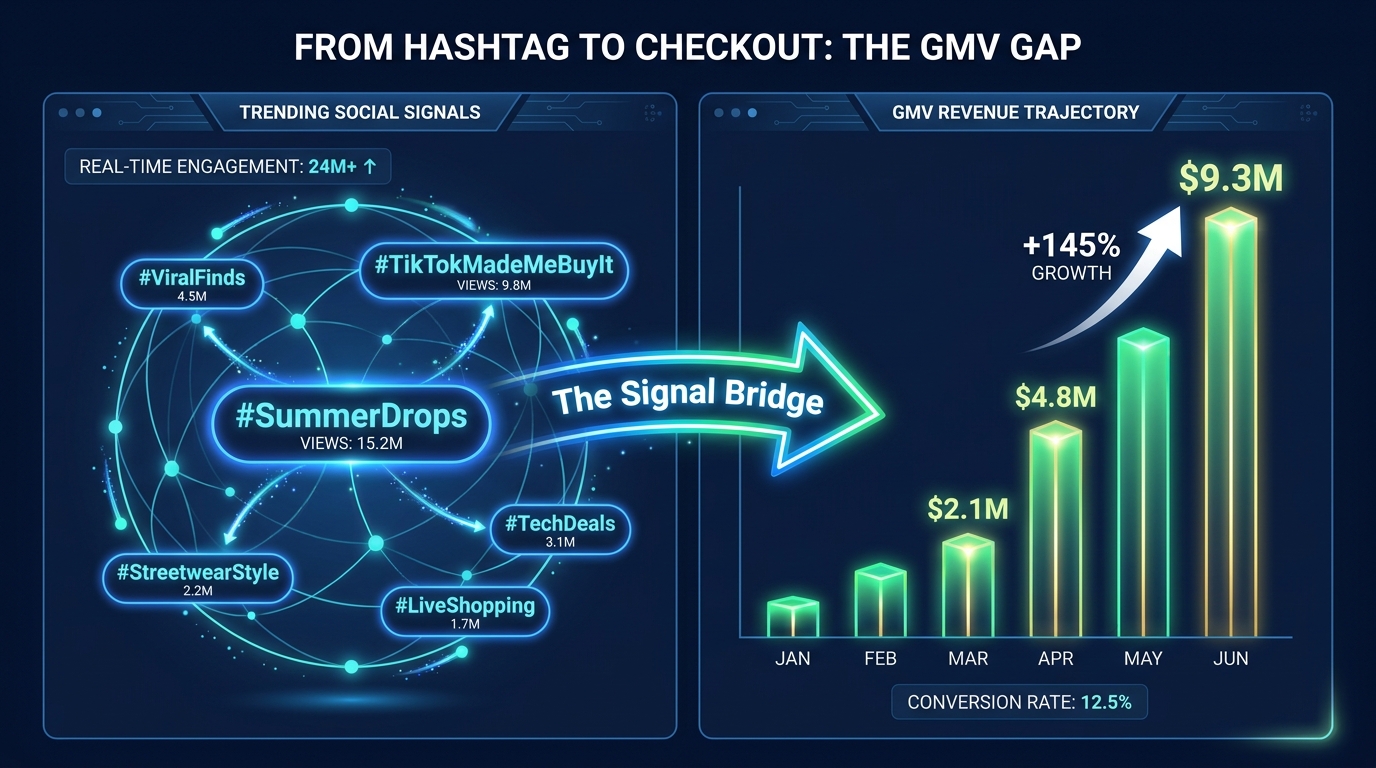

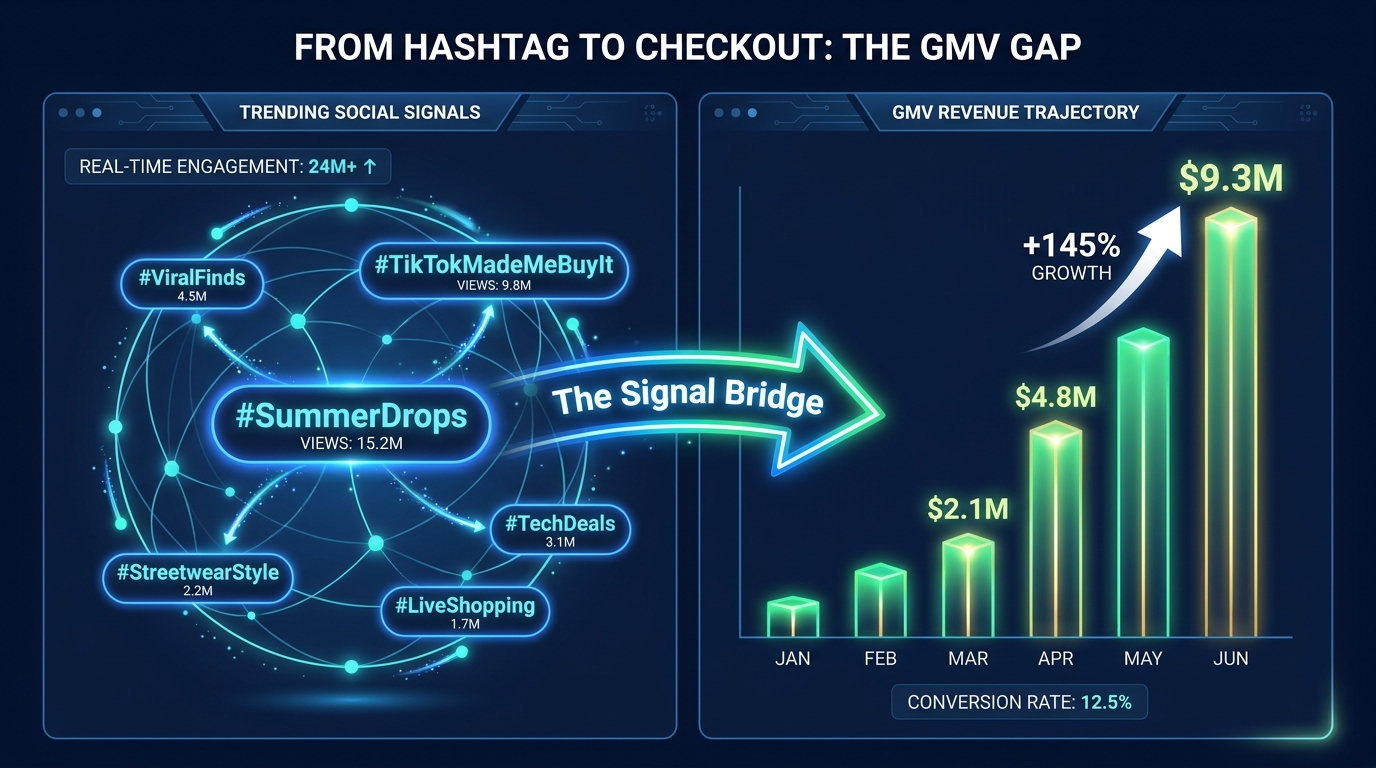
Every brand marketing team has sat through some version of the same post-campaign debrief: the hashtag trended, the video racked up tens of millions of views, the influencer’s comment section lit up — and then someone asks the inevitable question. But how much did we actually sell?
The silence that follows is the central problem of modern social commerce. Hashtag campaigns generate enormous awareness signals, but most brands have no systematic way of tracing that energy forward to a purchase event and a real dollar figure. They’re measuring virality when they should be measuring velocity — the speed at which a social signal converts into gross merchandise value.
In 2026, global social commerce is projected to reach $2.1 trillion, with the US market alone surpassing $100 billion. TikTok Shop’s trailing twelve-month GMV hit approximately $33 billion by Q1 2026. Live shopping accounts for roughly 41% of that total. These are not small numbers — they represent a fundamental shift in how products move from warehouse to customer. And increasingly, hashtags are the starting pistol for that journey.
But the mechanics of how a hashtag generates GMV are more nuanced — and more actionable — than most campaign briefs acknowledge. This post breaks down the actual data, the platform mechanics, the attribution models that work, and the measurement frameworks that separate brands generating real commerce outcomes from those still celebrating view counts.
What TikTok’s Campaign Trends Feature Actually Does
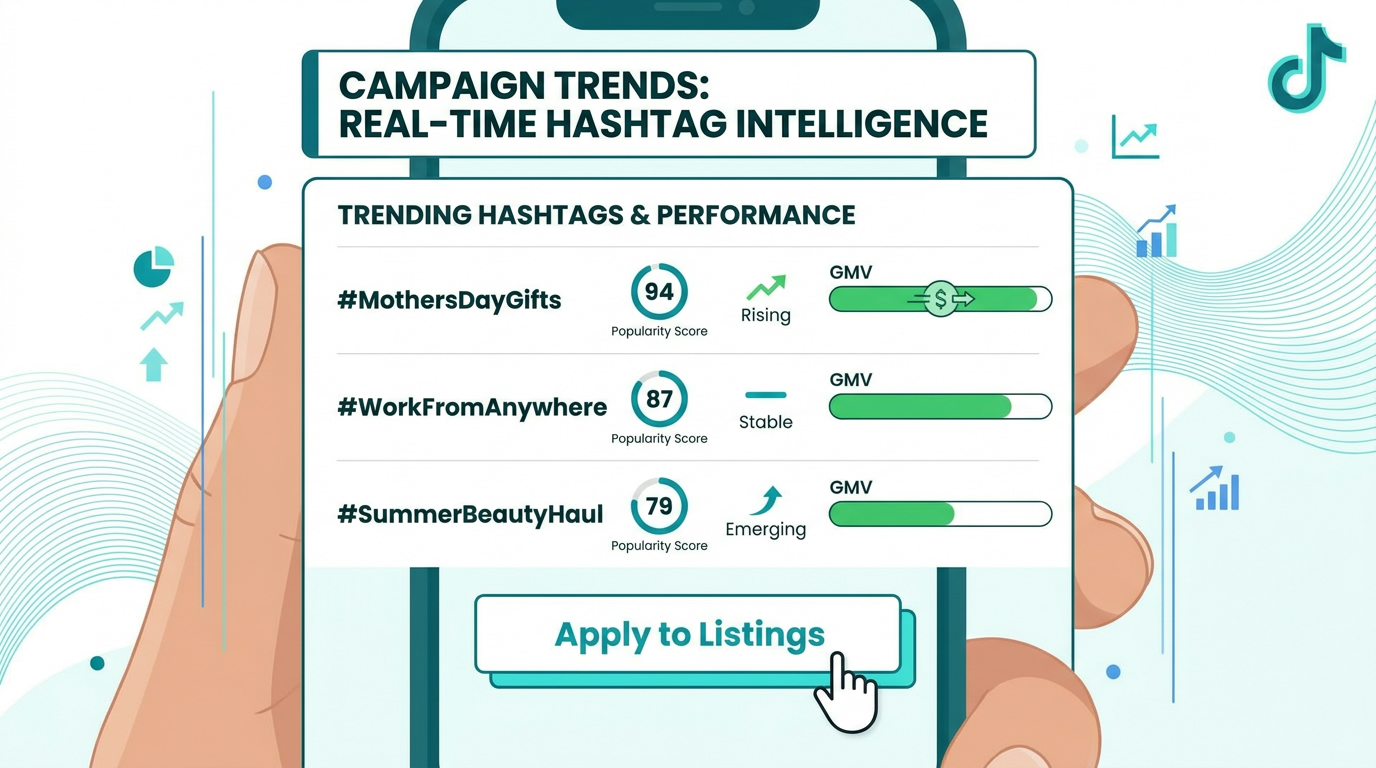
TikTok’s Campaign Trends tool, housed inside Seller Center, is one of the most underused features in social commerce. Most sellers treat it as a keyword research tool — a way to find trending hashtags to paste into video captions. That’s a significant misreading of what the feature actually provides.
The Four Data Layers Campaign Trends Surfaces
Campaign Trends surfaces real-time hashtag intelligence across four distinct dimensions. First, it shows trend trajectory — whether a hashtag is emerging, growing, peaking, or declining. This is critical context that raw view counts don’t provide; a hashtag with 800 million views might be past its peak, while a tag with 40 million views and a steep growth curve is actually the more valuable opportunity.
Second, Campaign Trends provides a popularity score — a normalized index that lets sellers compare hashtag momentum across categories without being misled by absolute volume. A fashion hashtag at score 87 and a home goods hashtag at score 87 represent equivalent opportunity within their respective verticals.
Third, and most importantly for GMV-focused operators, the feature surfaces GMV performance data — an indication of how much actual commerce is flowing through content tagged with that hashtag. This is the layer most sellers skip entirely, and it’s the one that turns Campaign Trends from a content ideation tool into a commerce intelligence tool.
Fourth, Campaign Trends provides example videos and example products, showing sellers which content formats and which SKU types are currently performing against a given hashtag. This matters because the same hashtag can have radically different GMV profiles depending on category. #GiftIdeas in May drives candles and skincare. #GiftIdeas in November drives electronics and premium goods.
The One-Click Application Mechanic
Once a seller identifies a high-GMV hashtag, Campaign Trends allows them to apply that hashtag to product titles and campaign metadata with a single click — including batch operations across multiple SKUs simultaneously. This creates a direct pipeline from trend intelligence to listing optimization that previously required manual product-by-product updates.
The practical implication is that sellers who check Campaign Trends regularly and apply trending hashtags to relevant listings before a trend peaks are essentially front-running the algorithm’s organic distribution. Content and products tied to an emerging hashtag benefit from TikTok’s preferential distribution of trending-topic content during the growth phase — before saturation drives down per-post value.
What Campaign Trends Doesn’t Do
It’s worth being explicit about the feature’s limits. Campaign Trends does not provide conversion rate data at the hashtag level — it shows GMV performance signals, not GMV attribution. It does not tell you which specific creators are driving commerce through a tag, or what product-content combinations are converting best. For that depth of analysis, brands need to layer Campaign Trends data with Affiliate Center data and their own first-party tracking.
The Hashtag-to-Purchase Funnel Nobody Draws Correctly
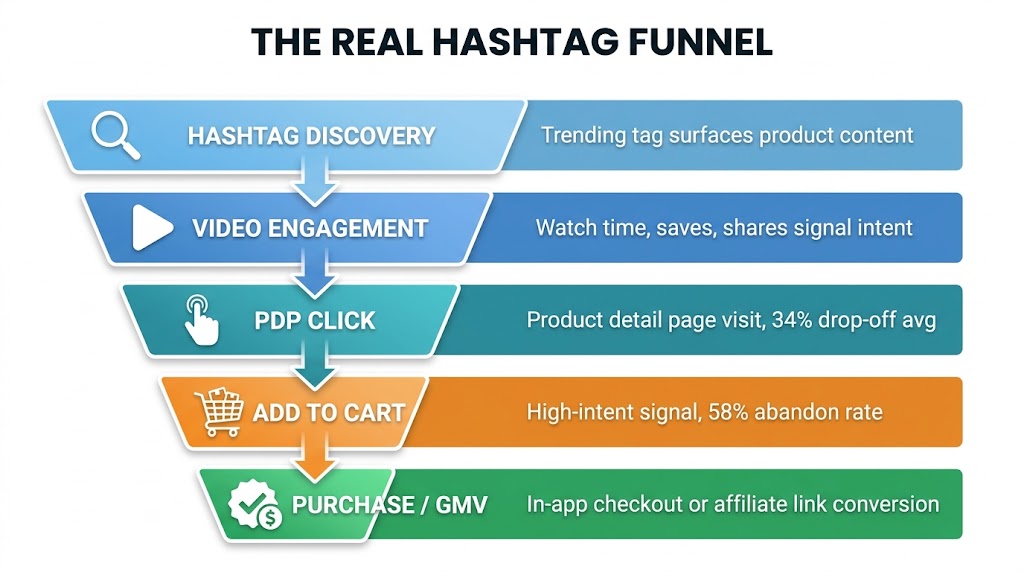
The standard way brands visualize a hashtag campaign looks like this: impressions at the top, engagement in the middle, conversions at the bottom. It’s clean, it’s familiar, and it’s largely wrong for how social commerce actually works in 2026.
Stage 1: Hashtag Discovery — The Surface-Level Signal
When a consumer encounters a hashtag in a TikTok video — whether through their For You Page, a search query, or a creator’s tagged post — that hashtag serves as a navigation layer. Tapping it opens a discovery feed populated with other content using the same tag. This is where hashtag traffic diverges from standard ad traffic: the consumer is actively choosing to see more content in a category, rather than being served an ad.
That opt-in characteristic is important. Consumers who tap through on a hashtag are expressing category intent, not just passive scrolling behavior. Research across social platforms in 2026 consistently shows that hashtag-initiated sessions have higher downstream save rates and longer video completion times than algorithmically served impressions — both of which are upstream signals of purchase intent.
Stage 2: Video Engagement — Where Intent Separates from Curiosity
Not all engagement signals carry equal weight in the funnel. The signals that actually predict purchase behavior at this stage are saves, shares, and comment interactions — not likes and watch counts. A video that accumulates 200,000 views and 8,000 saves has a fundamentally different commerce profile than one with 200,000 views and 45,000 likes but 800 saves.
Saves are particularly important because they represent deferred purchase intent — the consumer wants to return to this product. On TikTok, saved videos are revisited at dramatically higher rates than bookmarked content on other platforms, partly because TikTok’s notification ecosystem prompts re-engagement. Brands tracking their video save rates as a leading GMV indicator tend to forecast campaign revenue more accurately than those looking at engagement rates broadly.
Stages 3–5: The Leaky Middle
The transition from video engagement to Product Detail Page (PDP) click is where most campaigns lose the majority of their potential GMV. Industry estimates put the drop-off at approximately 34% of engaged viewers clicking through to the product page — meaning two-thirds of people who save or meaningfully engage with a product video never make it to the listing.
From PDP to add-to-cart, brands face another significant drop: average cart abandonment on social commerce platforms runs around 58%. The final step — checkout completion — depends heavily on friction factors: payment method availability, shipping cost transparency, and the quality of the listing itself.
The critical insight here is that hashtag optimization and campaign trend targeting can fill the top of this funnel very efficiently. But if the PDP, pricing structure, or checkout experience is weak, all of that signal-driven traffic generates awareness without GMV. The hashtag is the promise; the listing is the delivery.
Why “Views” Lie — The Vanity Metric Problem
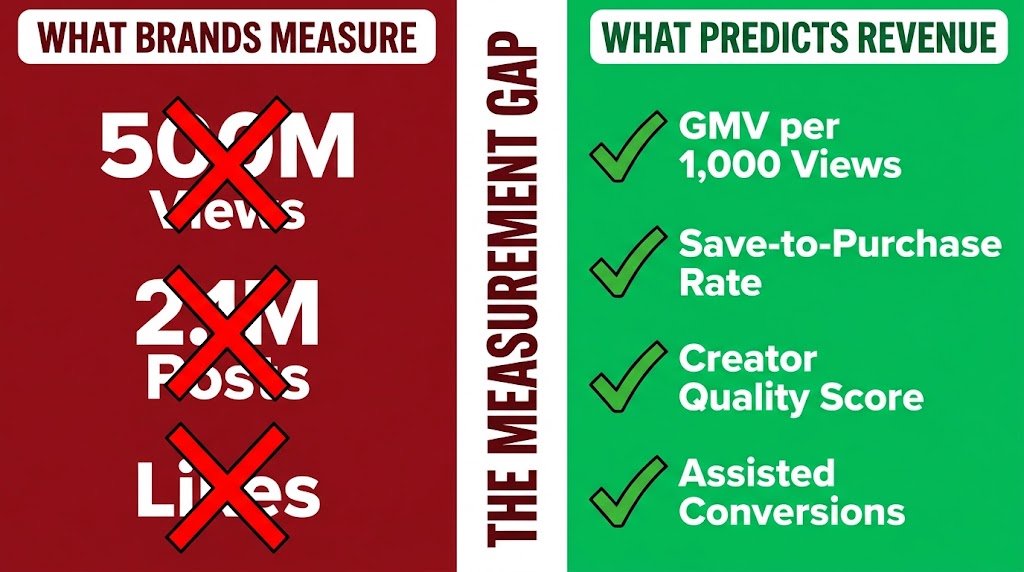
Hashtag campaigns are uniquely susceptible to metric inflation. A single trending hashtag can aggregate hundreds of millions of views across thousands of videos, with no meaningful connection to whether any of those views drove a transaction. Yet most post-campaign reports still lead with total hashtag views as the primary success indicator.
The Specific Ways View Counts Mislead
Platform view counting methodologies vary significantly. TikTok counts a view after approximately two to three seconds of playback. A video that appears in 10 million users’ feeds and autoplays for three seconds counts as 10 million views, regardless of whether any viewer ever consciously watched it. This creates view counts that are partly a function of algorithmic distribution rather than genuine audience interest.
Hashtag aggregation amplifies this further. When a hashtag trend goes viral, a large proportion of the videos tagged with it are watching the trend, not the products. Someone posting #SummerVibes isn’t necessarily watching product content — they might be consuming beach vlogs, music videos, or lifestyle content that happens to share the tag. The brand that counts #SummerVibes views as campaign impressions is measuring noise as signal.
What Predicts Revenue Instead
The metrics that actually correlate with downstream GMV in hashtag-driven campaigns, based on 2026 measurement frameworks from performance agencies, fall into four categories:
- GMV per 1,000 views (GMV/M): Calculated by dividing campaign-attributed revenue by video views in thousands. This normalizes for scale and allows direct comparison across campaigns, creators, and hashtags.
- Save-to-purchase rate: The proportion of saves that eventually result in a transaction. Tracked cohort-by-cohort via platform analytics and affiliate codes. Industry benchmarks in beauty and home goods currently run between 5–9%.
- Creator participation quality score: Not the number of creators using a hashtag, but the ratio of unique, organic creators to brand-owned posts, and the average engagement rate per creator. A hashtag used authentically by 200 micro-creators outperforms one saturated by a handful of brand accounts.
- Assisted conversions via hashtag cohort: The share of purchases within a given timeframe that involved at least one hashtag-driven touchpoint in the customer journey, regardless of whether the hashtag was the last click. This requires multi-touch attribution and is the most commercially accurate view of hashtag contribution.
Brands making the switch from view-count reporting to these metrics typically find that their highest-viewed campaigns are not their highest-GMV campaigns. The redistribution of budget and creative emphasis that follows from this realization is usually significant.
GMV Max and the Signal Stack: How the Algorithm Reads Your Hashtags
TikTok’s GMV Max has become the default campaign type for TikTok Shop sellers in 2026, and understanding how it interacts with hashtag signals is essential for any brand trying to build a coherent social commerce strategy. GMV Max is an automated campaign that optimizes across paid ads, organic content, affiliate videos, and live shopping sessions simultaneously — all toward a single GMV objective.
Behavioral Signals Trump Hashtag Selection
One of the most important things to understand about GMV Max is that it does not optimize primarily on the basis of hashtag selection. The system optimizes off behavioral and purchase data — specifically, which users are most likely to complete a purchase based on their historical actions on the platform. A hashtag matters insofar as it contributes to that behavioral signal stack; it does not function as a targeting parameter in the traditional ad-tech sense.
This means that a video with the perfect hashtag but poor engagement signals — short watch time, low saves, minimal comments — will not be surfaced to high-purchase-intent audiences by GMV Max. Conversely, a video with organic, genuine engagement will be amplified by GMV Max toward purchase-ready audiences even if the hashtag selection is imperfect.
The practical implication for brands is that hashtag strategy and content quality are not independent variables. Hashtags that attract genuine engagement — because they connect the product to real trending conversations, authentic communities, or high-intent shopping moments — contribute meaningfully to GMV Max’s optimization loop. Hashtags chosen purely for volume, with no connection to purchase intent, contribute noise.
How GMV Max Attributes Orders
TikTok’s official attribution for GMV Max is notably broad. The system attributes “all relevant conversions” during the campaign window, including paid and organic orders for the selected products, and LIVE orders during active sessions. Orders placed after the campaign window closes, or after a viewer exits a live event, are not attributed — which means GMV Max ROAS figures are typically higher than equivalent ad-platform metrics and should not be compared directly to Meta or Google ROAS without adjustment.
This has real implications for how brands should interpret their GMV Max results. The campaign may be “claiming credit” for organic purchases that would have happened anyway, inflating apparent ROAS. Brands running incrementality tests alongside GMV Max campaigns consistently report a 15–25% overstatement in attributed GMV compared to the incremental lift measured by holdout groups.
The Hashtag’s Role in the Signal Stack
Within GMV Max’s optimization framework, hashtags contribute to what agencies are calling the “signal stack” — the accumulated behavioral evidence that tells the algorithm a given piece of content is relevant to a purchase-ready audience. The components of this stack include: video completion rate, share rate, save rate, comment sentiment, affiliate link click rate, and — importantly — the purchase history of users who engaged with similar hashtag-tagged content in the past.
This is why trending hashtags with strong GMV performance history (as surfaced by Campaign Trends) are more valuable than trending hashtags driven purely by entertainment content. The former have an established signal stack connecting them to purchase behavior; the latter have signal stacks connecting them to passive entertainment consumption.
The Three-Layer Hashtag Strategy That Actually Moves Product
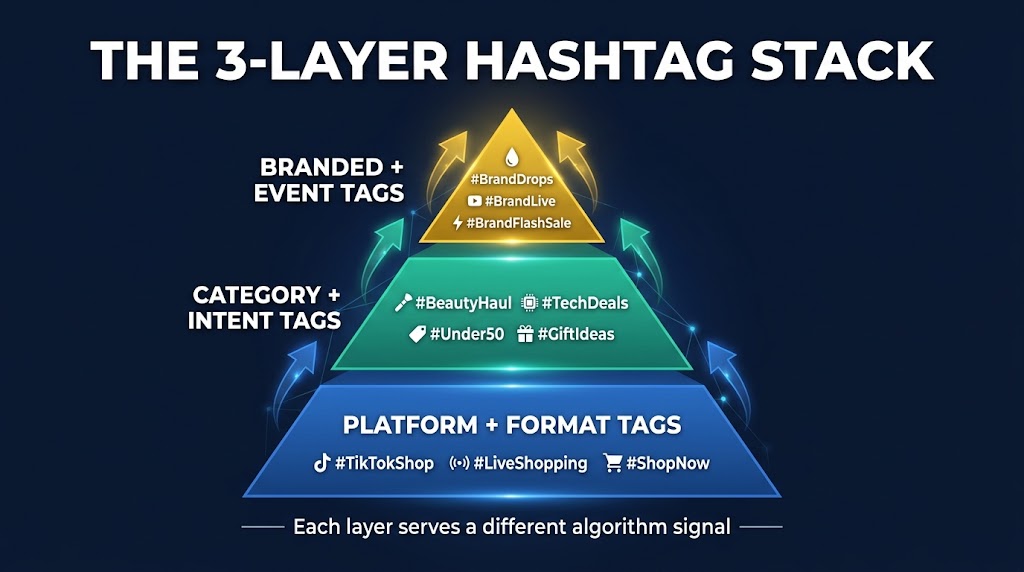
If view maximization is the wrong goal, and signal quality is what actually matters, the question becomes: what does a high-signal hashtag strategy look like in practice? The most consistently effective framework, used by agencies managing eight-figure TikTok Shop GMV in 2026, operates on three distinct layers — each serving a different algorithmic purpose.
Layer 1: Platform and Format Tags
These are the foundational tags that tell the platform what kind of content this is and what native shopping behavior it should be associated with. Tags like #TikTokShop, #LiveShopping, #ShopNow, and #TikTokMadeMeBuyIt fall into this category. Their function is not primarily discovery — most consumers aren’t browsing #TikTokShop as an interest category. Their function is algorithm classification: they signal to TikTok’s content distribution system that this video is commerce-oriented and should be surfaced to users with shopping behavior patterns.
These tags should be treated as infrastructure, not strategy. Every piece of commerce content should include one or two Layer 1 tags. They’re table stakes, not differentiators.
Layer 2: Category and Intent Tags
This is where genuine discovery happens and where most GMV-driving hashtag strategy should be focused. Category intent tags like #BeautyHaul, #TechDeals, #Under50, #GiftIdeas, #SkincareTips, or #HomeDecor attract users who are actively browsing for products in a category. These consumers are in an exploration mindset — they’re not responding to a specific ad, they’re self-navigating a product discovery experience.
The key principle for Layer 2 is specificity over reach. A hashtag with 50 million views and a clear purchase-intent community will consistently outperform a hashtag with 2 billion views and a diffuse audience. #CleanBeauty at 800 million views reaches a more committed, purchase-oriented community than #Beauty at 40 billion views. The former has established purchase-signal history; the latter is mostly entertainment.
Within Layer 2, seasonal and event-driven tags are particularly powerful precisely because they create time-bound urgency. Campaign Trends data consistently shows that hashtags tied to specific moments — #MothersDayGifts, #BackToSchool, #TaxRefundSeason — achieve 3–5x higher GMV per view during their relevant windows compared to their baseline performance. The algorithm amplifies them; the audience is primed to transact.
Layer 3: Branded and Event Tags
Branded hashtags like #BrandDrops, #BrandLive, or #BrandFlashSale serve a different function than discovery tags. They build a navigable content archive for engaged community members, create a traceable attribution layer for brand-specific GMV, and signal ongoing campaign presence to creators considering affiliate partnerships.
The mistake most brands make at this layer is launching branded hashtags without seeding them first. A branded hashtag with ten posts does nothing. It needs to hit critical mass — typically 50–100 pieces of creator content — before it becomes self-reinforcing. The most effective approach is to brief a cohort of affiliate creators to use the branded hashtag simultaneously, creating the appearance of organic community adoption even when the initial participation is managed.
The Optimal Tag Count
Despite the persistent myth that more hashtags equals more reach, 2026 benchmark data is fairly clear: posts with 3–5 highly relevant hashtags consistently outperform posts with 10 or more generic tags. Each additional hashtag beyond the optimal range dilutes the signal specificity the algorithm uses to identify the right audience. A video tagged with 15 hashtags spanning beauty, fitness, food, and travel is algorithmically ambiguous — it doesn’t know who to show it to. A video with four tightly focused hashtags is algorithmically legible, and legibility drives distribution to the right audience.
Live Shopping and Hashtags: Where Conversion Rates Hit 7–30%
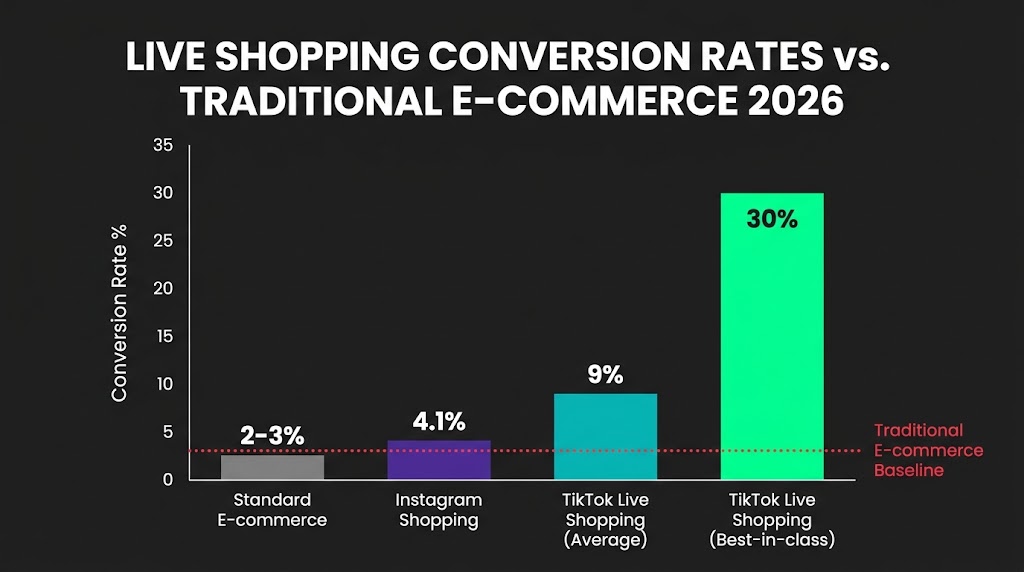
The most dramatic hashtag-to-GMV story in 2026 social commerce is happening in live shopping. Traditional e-commerce conversion rates run 2–3%. Instagram Shopping with product tags converts at approximately 4.1% for optimized storefronts. TikTok live shopping averages 7–10% conversion, with best-in-class events reaching 30% — roughly ten times the standard benchmark. Understanding how hashtags function specifically in the live shopping context reveals a materially different conversion dynamic.
Pre-Event Hashtag Traffic Drives the Audience Quality
The conversion differential in live shopping is driven partly by audience self-selection: people who join a live event are already further along in the purchase journey than people passively scrolling a feed. But the channel through which they arrived at the live event matters enormously for conversion rate. Viewers who arrive via a pre-event hashtag campaign — one that primed them with product content, used event-specific tags, and built anticipation over 3–7 days — convert at significantly higher rates than cold traffic driven by paid promotion.
The pre-event hashtag strategy for a live shopping session typically involves a three-to-seven day teaser campaign using short-form videos that feature the host, tease featured products, and carry a consistent branded event hashtag. This creates a navigable content library that prospective viewers can explore before committing to attend. Brands that run structured pre-event hashtag campaigns report 25–40% higher average order values during live sessions than those that drive traffic purely through same-day promotion.
In-Event Hashtag Prompts Create Real-Time UGC
During a live session, prompting viewers to comment with a specific hashtag serves dual purposes. It creates a UGC signal that the algorithm reads as engagement, extending the session’s organic distribution in real time. And it functions as a social proof mechanism — a comment feed full of #GlowingReview or #JustBought responses creates visible purchase momentum that influences undecided viewers.
This real-time social proof effect is one of the structural reasons why live shopping converts at higher rates than recorded shoppable videos. The purchase decision is influenced not just by the host’s demo, but by the visible activity of other buyers in the same moment. Hashtag-driven comment participation makes that activity legible.
Post-Event Clip Recycling
One of the highest-ROI post-live strategies is clipping key moments from the live session and posting them as short-form videos with the original event hashtag plus category intent hashtags. This extends the GMV window well beyond the event itself, recycling the social proof signals generated during the live session into a discovery format that reaches audiences who missed the live event.
TikTok’s algorithm treats live clip content favorably during the first 24–48 hours post-event, particularly when it carries engagement signals from the live session. Clips with substantial comment activity typically receive initial distribution boosts before the algorithm evaluates their standalone performance. Brands systematically recycling live content report that post-event clips generate an additional 15–30% of the GMV produced during the live session itself.
Creator Seeding and the UGC Loop: Building Compounding GMV
Individual hashtag campaigns generate GMV spikes. The brands generating consistent, compounding GMV from social commerce have built systems where hashtag activity creates UGC, UGC feeds more hashtag content, and that content loop continuously fills their top-of-funnel without requiring proportional increases in paid spend.
The Creator Seeding Moment
Creator seeding — sending products to a curated set of creators with a loose brief and a campaign hashtag — is the ignition mechanism for this loop. The key variable is not the size of the creator’s audience but the authenticity and purchase-influence of their content. Mid-tier creators (100K–500K followers) and micro-creators (10K–100K) consistently outperform mega-influencers in GMV-per-creator metrics for hashtag campaigns, largely because their audiences have higher trust levels and more relevant category interest.
The most effective seeding programs in 2026 brief creators on the campaign hashtag and the product benefit story, then give them complete creative latitude. This produces a range of content formats — tutorials, comparisons, aesthetic showcases, comedy sketches, lifestyle integrations — that collectively reach different audience segments and generate diverse hashtag associations. Uniformity of creator content is the enemy of hashtag campaign longevity.
How the UGC Loop Compounds
When genuine creator content generates purchases, those purchases create review posts, unboxing videos, and “TikTok made me buy it” content — all of which naturally carries the campaign hashtag if the original seeded content did. This second wave of UGC is qualitatively different from branded content: it’s social proof from real buyers, and it carries corresponding credibility signals that the algorithm interprets as high-trust commerce content.
The compound mechanism is: seeded creator content generates purchases → purchases generate buyer UGC → buyer UGC generates more discovery → more discovery generates more purchases. When this loop is functioning, a brand’s effective hashtag footprint grows organically at a rate that exceeds their seeding investment. The brands that have cracked this consistently on TikTok Shop tend to have ongoing seeding programs — continuously refreshing their creator base and hashtag content — rather than discrete campaign bursts.
Community Challenge Mechanics
The Branded Hashtag Challenge remains a potent format for triggering mass UGC when designed around genuinely low-barrier participation. Chipotle’s #GuacDance remains the enduring benchmark case study: a simple dance mechanic tied to a cultural moment (National Avocado Day), seeded by influencers, achievable by anyone with no skill requirement. In CPG, similar mechanics have been deployed by brands like Doritos (#TriangleTracker), Pepsi (#ThirstyForMore), and Pringles’ stacking challenges — all driving measurable sales lift during campaign periods.
The success factors for challenge-based hashtag campaigns that actually drive GMV rather than just participation are consistent: the challenge must be directly tied to a product interaction (not just a brand aesthetic), the barrier to participation must be genuinely low, the audio component must be shareable and repeatable, and the challenge must be seeded by creators whose audiences have category purchase intent — not just general entertainment audiences with no product relevance.
Attribution Without Illusions: Multi-Touch Models for Social Commerce
The attribution problem in social commerce is not a technology problem — it’s a philosophy problem. Most brands default to last-click attribution because it’s the metric their analytics platforms produce automatically. Last-click attribution is structurally incapable of capturing hashtag contribution to GMV, because hashtags almost never generate the final click in a purchase journey. They generate the first touchpoint, the community reinforcement signal, or the re-engagement trigger. Measuring them on a last-click basis is the equivalent of not measuring them at all.
The Four-Layer Signal Stack Framework
The measurement framework gaining traction among social commerce performance teams in 2026 operates in four layers, each capturing a different dimension of the hashtag-to-GMV journey:
- Awareness measurement: Brand-lift surveys among audiences exposed to hashtag-tagged content, measuring aided recall, sentiment, and category consideration. This quantifies the upper-funnel value of hashtag exposure even when no click is captured.
- Intent signals: Saves, shares, comment quality, completion rate, and DM inquiries as proxies for purchase intent. These are the mid-funnel indicators that predict which segments of the hashtag-exposed audience will convert.
- Direct attribution: Affiliate codes, UTM-tagged links, and promo codes embedded in creator content and hashtag-linked bios. These capture the cleanest direct-response signal from hashtag campaigns and are essential for calculating creator-level ROAS.
- Incrementality testing: Holdout group experiments that measure the difference in purchase rate between audiences exposed to hashtag campaigns and comparable unexposed audiences. This is the gold standard for isolating the genuine GMV contribution of a campaign from organic demand that would have converted anyway.
Platform-Native Tracking and Its Limits
TikTok Shop and Instagram Shopping both provide in-app funnel metrics — impressions to product views to add-to-cart to purchase — tied to posts, hashtags, and creators. This native tracking is useful for within-platform optimization but has significant limits for cross-channel attribution. TikTok Shop’s in-app orders don’t hit website pixels, meaning that brands trying to reconcile TikTok-attributed GMV with website analytics are comparing fundamentally different measurement systems.
Meta announced an “engaged-through attribution” approach in 2026 that counts conversions influenced by non-click engagements — shares, saves, comments, likes — as engaged-through conversions. This represents a meaningful shift toward capturing social proof signals in formal attribution, but it also introduces the risk of over-attribution when engagement doesn’t reflect genuine purchase intent.
The Honest ROAS Calculation
For social commerce brands serious about measuring hashtag campaign ROI, the most honest approach is to calculate GMV after deducting: creator seeding costs, affiliate commissions paid on attributed sales, platform advertising spend on GMV Max or equivalent, and the cost of goods sold for returns driven by campaign-generated purchases. What remains is a net GMV contribution figure that can be compared directly to the total campaign investment.
Brands running this calculation for the first time frequently discover that their reported ROAS and their actual net return on investment differ by 30–50%. This isn’t evidence of fraud or waste — it’s evidence that social commerce attribution has been systematically optimistic. Correcting for it produces a more accurate picture and, more usefully, reveals which specific campaign elements (creator tiers, hashtag layers, live vs. recorded content) generate the strongest honest return.
Platform Benchmarks: TikTok, Instagram, and Emerging Channels
Understanding where hashtag campaigns convert differently across platforms matters for budget allocation and strategic priority. The platforms are not equivalent commerce channels, and the same hashtag strategy will produce materially different results depending on where it runs.
TikTok: The Volume and Velocity Leader
TikTok Shop’s scale and velocity metrics make it the dominant hashtag-to-GMV platform in 2026 for most consumer categories. The platform’s native shopping infrastructure — in-app checkout, affiliate center, live commerce, shoppable video — creates a closed-loop commerce system that other platforms haven’t fully replicated. TikTok’s social commerce revenue is estimated around $33 billion TTM as of Q1 2026, with live shopping accounting for approximately 41% of that.
Average TikTok live shopping conversion: 7–10%. Best-in-class events: up to 30%. Product tags in short-form video: approximately 2–3% conversion, rising to 4–5% with strong creator-driven content. The hashtag’s role in this ecosystem is primarily as a discovery and audience-priming mechanism, with conversion happening at the product listing and live session layers.
Instagram: High Average Order Value, Lower Volume
Instagram’s social commerce trajectory shifted in late 2025 when Meta moved away from in-app checkout for Facebook and Instagram, redirecting commerce traffic to brand websites. This has reduced Instagram’s position as a direct-purchase platform, but it hasn’t diminished its role in the hashtag-to-GMV journey. Instagram Shopping drove approximately $37.7 billion in annual commerce in 2026, with native checkout conversion running around 3.1%.
Product tags in Instagram Reels convert 2.7 times higher than equivalent tags in feed posts — a direct reflection of the engagement premium that video format commands versus static imagery. Instagram Live Shopping conversion runs approximately 4.1%, lower than TikTok but with a notably higher average order value ($92 for Live Shopping versus $68 for standard referrals).
Posts with 3–5 well-targeted hashtags on Instagram generate approximately 25% higher engagement than posts with 10 or more generic tags. Instagram’s algorithm has deprioritized hashtag-driven discovery in favor of interest-graph signals, making hashtag specificity more important — and volume less relevant — than it was three years ago.
Emerging Channels: Pinterest, YouTube Shopping, and Xiaohongshu
Pinterest’s shopping ads and shoppable pins continue to demonstrate strong purchase intent signals — 85% of weekly Pinners report having made a purchase based on Pin content — but Pinterest’s hashtag functionality is less central to its discovery algorithm than on TikTok or Instagram. YouTube Shopping, integrated with Google’s product catalog and leveraging YouTube Shorts, is a growing player in short-form shoppable content but lacks the real-time social proof dynamics of live shopping platforms.
For brands targeting Chinese consumer markets, Xiaohongshu (Little Red Book) represents the most sophisticated hashtag-commerce integration currently operating anywhere globally. The platform’s hashtag system is deeply integrated with product pages, community reviews, and in-app purchasing in a way that TikTok’s ecosystem is still maturing toward for Western markets. Xiaohongshu hashtag-driven commerce benchmarks frequently cited in global reports — conversion rates of 8–12% for interest-category tags — set a plausible ceiling for what the Western platforms may eventually achieve.
Building a Measurement Framework That Connects Hashtag Activity to Real Revenue
All of the strategic and tactical guidance above is only useful if brands have a measurement infrastructure capable of capturing the signals that matter. Most brands’ current measurement stacks were built for a world of website clicks and ad impressions. Social commerce in 2026 requires a different architecture.
The Five-Metric Dashboard
A practical minimum measurement framework for hashtag campaign GMV connects five core metrics into a coherent reporting view:
- Hashtag-attributed sessions: Sessions initiated through a hashtag tap, measured through platform analytics. Track separately for each active hashtag. This is the population-of-record for the campaign’s top-of-funnel audience.
- GMV per hashtag session: Divide campaign-attributed GMV by hashtag-attributed sessions. This single number normalizes across campaign phases and hashtag sizes, making true performance comparison possible.
- Creator-level efficiency: For each creator participating in the campaign, track GMV generated via their affiliate codes as a multiple of seeding cost plus commission. This identifies which creator tier and content format generates the strongest return.
- Save cohort conversion rate: Track the percentage of users who save a tagged video and subsequently purchase. This requires affiliate code matching or platform-level cohort analysis, but it’s the most accurate mid-funnel measurement available.
- Incremental GMV lift: The output of holdout testing, measuring the genuine sales lift attributable to the campaign versus what would have occurred organically. This is the number that actually tells you whether the campaign was worth running.
The Weekly Review Cadence
Hashtag campaign measurement requires a weekly review cadence — not monthly, not post-campaign. TikTok’s trending hashtag cycles move fast; a hashtag that was in the growth phase on Monday can be past peak by Thursday. Brands checking their Campaign Trends data and adjusting hashtag applications weekly capture significantly more GMV from trend windows than those making one-time campaign configurations and leaving them unchanged.
The weekly review should cover: which hashtags are in growth vs. decline phases, which creator content is generating the highest GMV per view, which product listings are benefiting from current hashtag associations and which are falling off, and whether live session timing aligns with trending hashtag peaks. This isn’t laborious work — it’s the operational discipline that separates brands generating consistent four-figure weekly GMV per product from those experiencing random peaks and long flatlines.
Connecting Hashtag Data to Inventory Planning
One of the most underexplored applications of hashtag GMV data is inventory forecasting. When Campaign Trends surfaces an emerging hashtag with a strong GMV trajectory, that’s also a demand signal for the product categories associated with that trend. Brands that build the connection between their Campaign Trends monitoring and their inventory replenishment processes can pre-position stock ahead of trend peaks — rather than selling out during the peak and losing GMV to out-of-stock conditions.
This is particularly relevant for seasonal trend hashtags. The spike in #BackToSchool GMV that starts in late June has been predictable and consistent for multiple years. Brands that pull Campaign Trends data in May, see the hashtag beginning its growth trajectory, and accelerate replenishment orders accordingly are capturing a portion of GMV that brands waiting for the trend to peak before responding will miss entirely.
From Hashtag Marketing to Commerce Signal Engineering
The fundamental reframe that separates top-performing social commerce brands from the rest in 2026 is this: they don’t think of hashtags as marketing tools. They think of them as commerce signal infrastructure — the mechanism through which the platform’s algorithm identifies, qualifies, and routes purchase-ready audiences to their products.
This reframe has operational consequences. It means hashtag selection is a data task, not a creative task. It means Campaign Trends monitoring is a weekly operational process, not an occasional inspiration check. It means campaign success is measured in GMV per view and save-to-purchase rate, not in total hashtag views and impressions. It means creator briefings specify the signal quality required — genuine engagement, high save rates, category-relevant audiences — rather than the aesthetic preferences of the brand team.
The Four Principles of Signal-First Hashtag Strategy
Operationally, this means maintaining four disciplines consistently:
- Trend-to-listing velocity: The time between a hashtag appearing in Campaign Trends as emerging and the brand applying it to relevant product listings and creator briefs should be less than 48 hours. Trend windows are narrow. Speed of application is a competitive advantage.
- Signal over volume: Every hashtag decision should be made by asking “does this tag attract an audience with purchase history in this category?” not “does this tag have high view counts?” The algorithm knows the difference even when the brand doesn’t consciously make it.
- Creator-hashtag alignment: Each creator in a seeding program should be matched to hashtag layers where their audience already has demonstrated category engagement. A skincare creator seeded to use a food hashtag is signal pollution — it degrades both the creator’s relevance signals and the hashtag’s commerce association.
- Measurement as a feedback loop: GMV per hashtag data should feed back into content briefs, creator selection, and listing optimization on a weekly cycle. Brands treating measurement as an end-of-campaign exercise are missing the optimization window that exists during a campaign’s active phase.
What This Looks Like at Scale
At scale, this operational discipline produces a social commerce flywheel: Campaign Trends data feeds hashtag selection, hashtag selection informs creator briefs, creator content generates engagement signals, engagement signals are amplified by GMV Max, amplified content drives product page visits, product page quality drives conversion, conversions generate buyer UGC, and buyer UGC adds fresh signal to the hashtag ecosystem. Rinse. Repeat.
The brands generating eight-figure annual GMV from TikTok Shop in 2026 are not the brands with the biggest seeding budgets or the most creative hashtags. They’re the brands that have built operational systems to run this flywheel consistently, measure it accurately, and adjust it weekly.
Actionable Starting Points
For teams beginning this transition, the most impactful immediate steps are:
- Open Campaign Trends in Seller Center and identify the top three hashtags currently in growth phase for your category. Apply them to your top five listings today.
- Audit your last three campaigns’ metrics. Replace view count with GMV per 1,000 views as the lead performance indicator. The shift in what looks successful will be instructive.
- Build a three-layer hashtag stack for your next campaign: two platform tags, three category intent tags, one branded event tag. Remove everything else.
- Run a holdout test on your next GMV Max campaign: exclude 20% of your audience from exposure and compare their purchase rate to exposed audiences. The difference is your honest campaign lift.
- Track save-to-purchase rates for your top-performing creator content over 30 days. The creators with the highest save-to-purchase rates — not the highest view counts — should receive the largest seeding investment in the following cycle.
The gap between hashtag hype and GMV reality is not a mystery. It’s a measurement problem with a solvable methodology and a signal engineering discipline that produces consistent, compounding returns when applied systematically. The brands that treat it as such are the ones that, twelve months from now, will have data-backed answers when someone asks: but how much did we actually sell?