

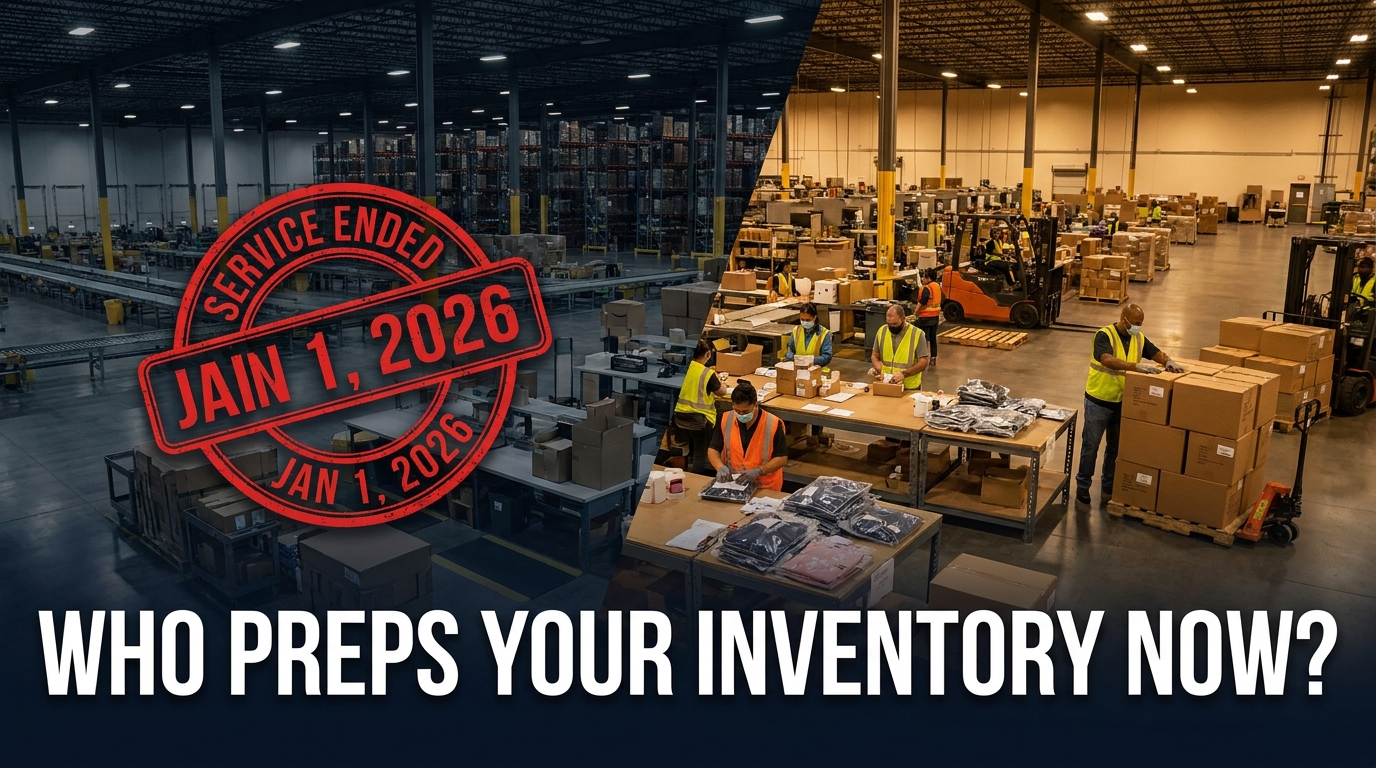

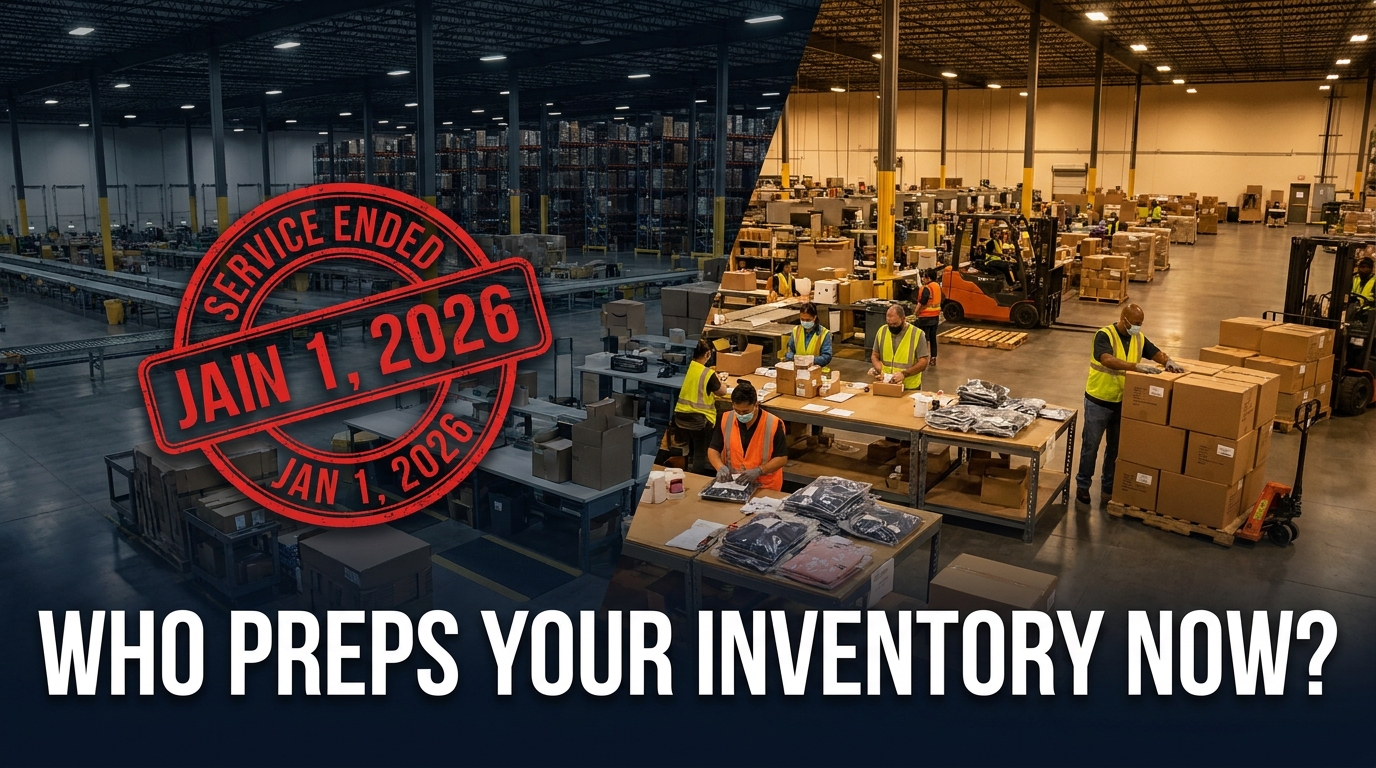
On July 28, 2025, Amazon sent a notice that landed like a quiet earthquake in seller inboxes: effective January 1, 2026, it would permanently discontinue all FBA prep and labeling services in the United States. No more poly-bagging at the fulfillment center. No more FNSKU stickering. No more bubble-wrapping, boxing, kitting, or opaque-covering handled on your behalf. Every unit arriving at an Amazon FC would need to be 100% compliant before it left your dock — or your supplier’s dock.
For years, Amazon’s in-house prep services had been a quiet crutch for a wide swathe of sellers. You paid a fee, flagged items as needing prep, and Amazon’s warehouse staff handled the rest. It was expensive, yes, and the margins on prep weren’t great, but it was an operational safety net. You could move fast, ship imperfect inventory, and let Amazon clean up the gaps.
That safety net is gone. Six months into the new reality, sellers are discovering that the transition is more nuanced — and more expensive — than Amazon’s terse policy update suggested. Some are thriving. Many are scrambling. A small subset are quietly exiting SKUs that can no longer carry the added cost. And the third-party prep center industry has been pushed into a capacity crunch that is rewriting pricing across the board.
This article is a ground-level look at what’s actually happening since the cutoff: what the real costs are across every prep model, who is absorbing those costs well, and how to build a prep strategy that doesn’t erode your margins or put your inbound metrics at risk.
What Amazon Actually Switched Off — and What Remains
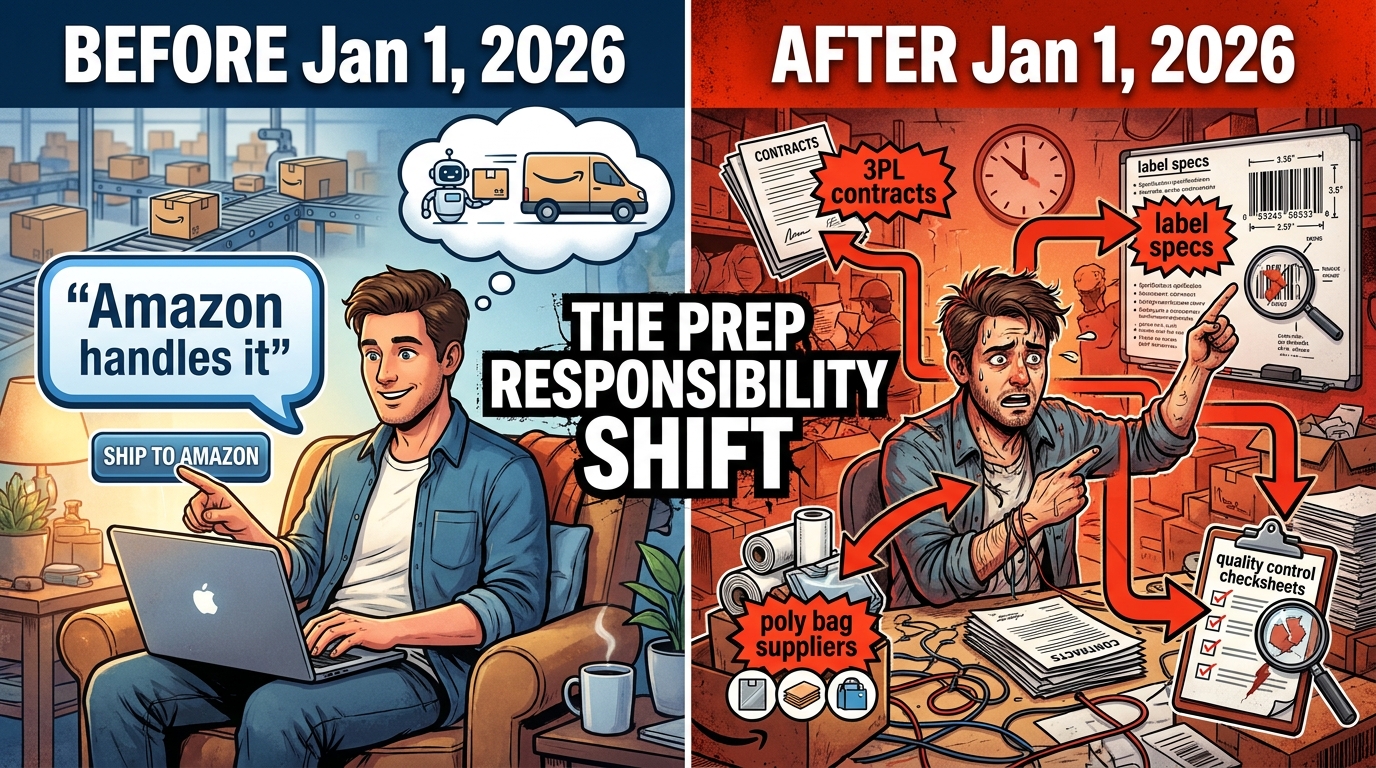
There is a lot of confusion in seller communities about what, exactly, changed on January 1, 2026. Let’s be precise: Amazon ended its own in-house FBA prep and item-labeling services. FBA itself — the fulfillment model, the two-day Prime badge, the storage network — is unchanged. Amazon is still fulfilling your orders. It just won’t be doing any of the work required to make your inventory ready for fulfillment.
The full list of discontinued services
The services Amazon officially discontinued as of January 1, 2026, cover every prep task that previously could be requested during the inbound shipment creation process:
- FNSKU / barcode labeling — Amazon will no longer apply Fulfillment Network Stock Keeping Unit labels to individual units.
- Poly-bagging — Loose, soft, or hazardous-to-children items that previously could arrive unbagged for Amazon to bag are now rejected without pre-applied bagging.
- Bubble wrapping and foam protection — Fragile items requiring wrap were previously eligible for Amazon-applied protection; no longer.
- Opaque covering — Items with adult-content packaging needed to be covered before reaching consumer-accessible storage areas; Amazon previously handled this on arrival.
- Kitting and bundling — Multi-unit bundles that needed to be assembled from component inventory could previously be handled by Amazon’s receiving teams.
- Box-content services — Amazon’s box-content reconciliation and stickering service for FBA shipment boxes is also discontinued.
Critically, this shutdown applies across the entire U.S. fulfillment network — not just standard FBA, but also Amazon Warehousing and Distribution (AWD), Amazon Global Logistics (AGL), Amazon SEND, and the Supply Chain Portal. If inventory flows through any U.S. Amazon facility, it must arrive fully compliant.
What Amazon hasn’t changed
It’s worth being clear about what isn’t ending. Amazon is not removing FBA as a fulfillment model, not shuttering its warehousing capacity, and not changing its core storage or fulfillment fee structure in conjunction with this decision. The Ships in Product Packaging (SIPP) program — which allows certain pre-certified products to ship without added Amazon packaging — remains available for eligible sellers. Amazon’s Partnered Carrier Program for inbound shipping is also unchanged.
The change is narrowly but significantly focused on one thing: anything that was once a prep or labeling service option you could select in Seller Central when creating a shipment plan is gone. From here forward, compliance is a seller responsibility — completely and exclusively.
Who Gets Hit Hardest by This Shift
Not every seller feels this the same way. Understanding where you sit in the impact spectrum is the first step to choosing the right response. The most exposed sellers tend to cluster into three groups.
Small-volume sellers relying on per-unit convenience
If you were shipping fewer than 500 units per month and using Amazon prep as a way to avoid building any operational infrastructure, this change hits hardest. The math that worked when Amazon charged you a per-unit prep fee — even if it was expensive — no longer applies. You now have to choose between building an in-house setup that won’t be used efficiently at low volume, or paying 3PL minimums that assume a certain throughput. Neither option is cheap at small scale.
Per-unit costs at low volume with a third-party prep center often run $1.00–$1.50 per unit for standard items when you factor in receiving, inspecting, labeling, poly-bagging, and outbound shipping preparation. Some prep centers also charge monthly storage or minimum volume fees that further compress margins for small sellers. Many small sellers in community forums report that the change is prompting hard SKU-level reviews — products that were marginal before are now definitively unprofitable.
International sellers without a U.S. logistics footprint
Sellers based outside the U.S. who sourced from Asia and routed inventory directly to Amazon FCs — relying on the prep safety net to catch any non-conformance — are in a particularly difficult position. They can’t easily set up in-house U.S. prep operations, and many are now forced to build relationships with U.S.-based prep centers or, alternatively, negotiate supplier-level FBA-ready prep with their manufacturers. Both options require time, documentation, and a learning curve that didn’t exist before January 1, 2026.
Fragile and complex-product sellers
Sellers of breakable, irregular-shaped, or otherwise complex products — glass, ceramics, electronics kits, multi-component bundles — relied disproportionately on Amazon’s bubble-wrap and protection services. These are also the product categories where in-house prep quality is hardest to standardize and where prep errors create the most expensive downstream consequences. A poorly bubble-wrapped unit that arrives at a customer damaged doesn’t just cost you the refund; it generates an A-to-Z claim, a defective return, and a hit to your product’s review rating.
Who actually benefits
The change is not uniformly negative. High-volume sellers with existing operational infrastructure are relatively insulated — they were already doing most of their own prep or using dedicated 3PLs, and the policy change simply removes a competitor (Amazon’s own prep service) from the cost comparison. Third-party prep centers are experiencing a surge in inbound volume and, in many markets, are raising prices accordingly. Manufacturers and suppliers in Asia who can credibly offer “FBA-ready” shipping are gaining leverage with their customers.
The Three Routes Forward: A Realistic Framework
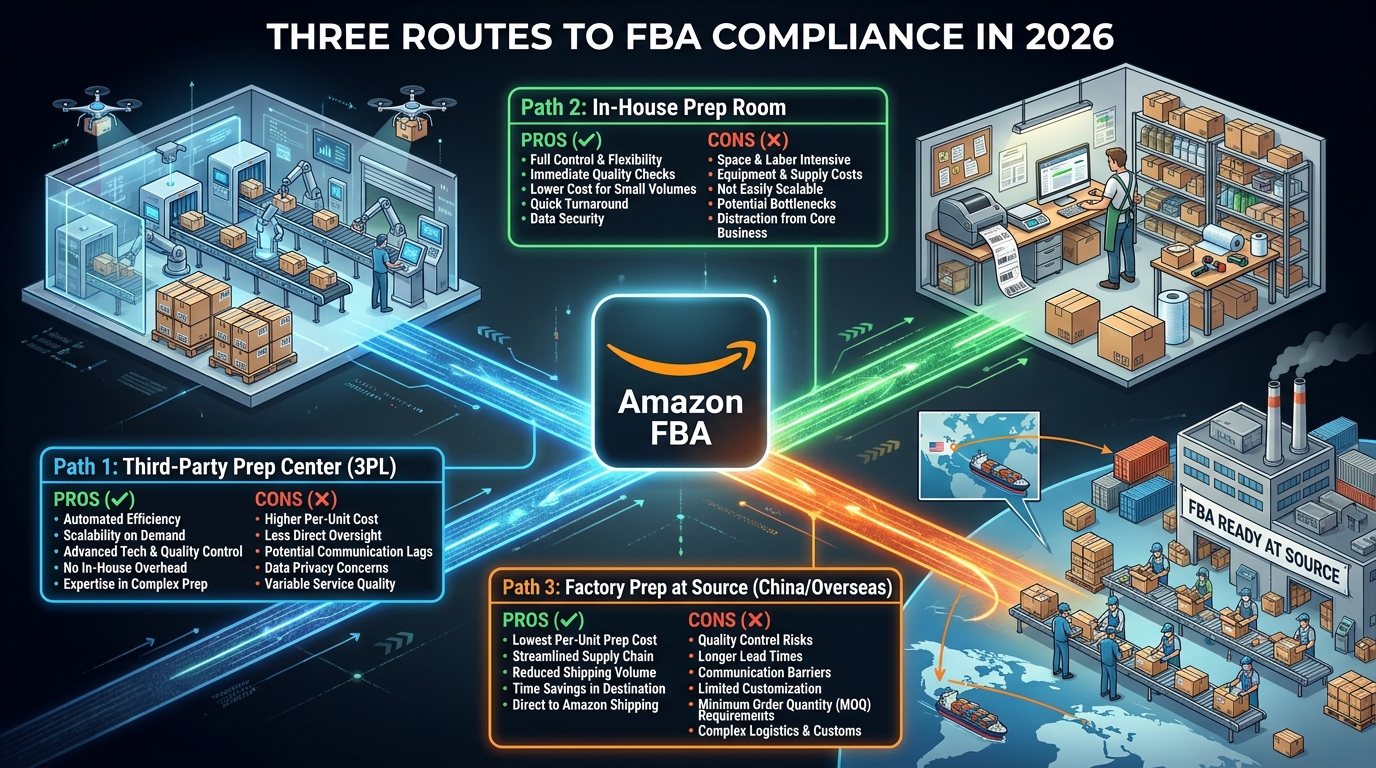
There are exactly three places where FBA prep can now happen: at a third-party prep center or 3PL, within your own operation, or at the supplier’s facility before goods leave the factory. Every seller needs to pick at least one of these paths — or combine them into a hybrid model.
The right choice depends on your monthly unit volume, your product characteristics, your supply chain geography, and your operational capacity. There is no universal answer. What follows is a clear-eyed breakdown of each path: what it costs, when it makes sense, and what it demands from your operation.
Path 1: Outsourcing to a Third-Party Prep Center
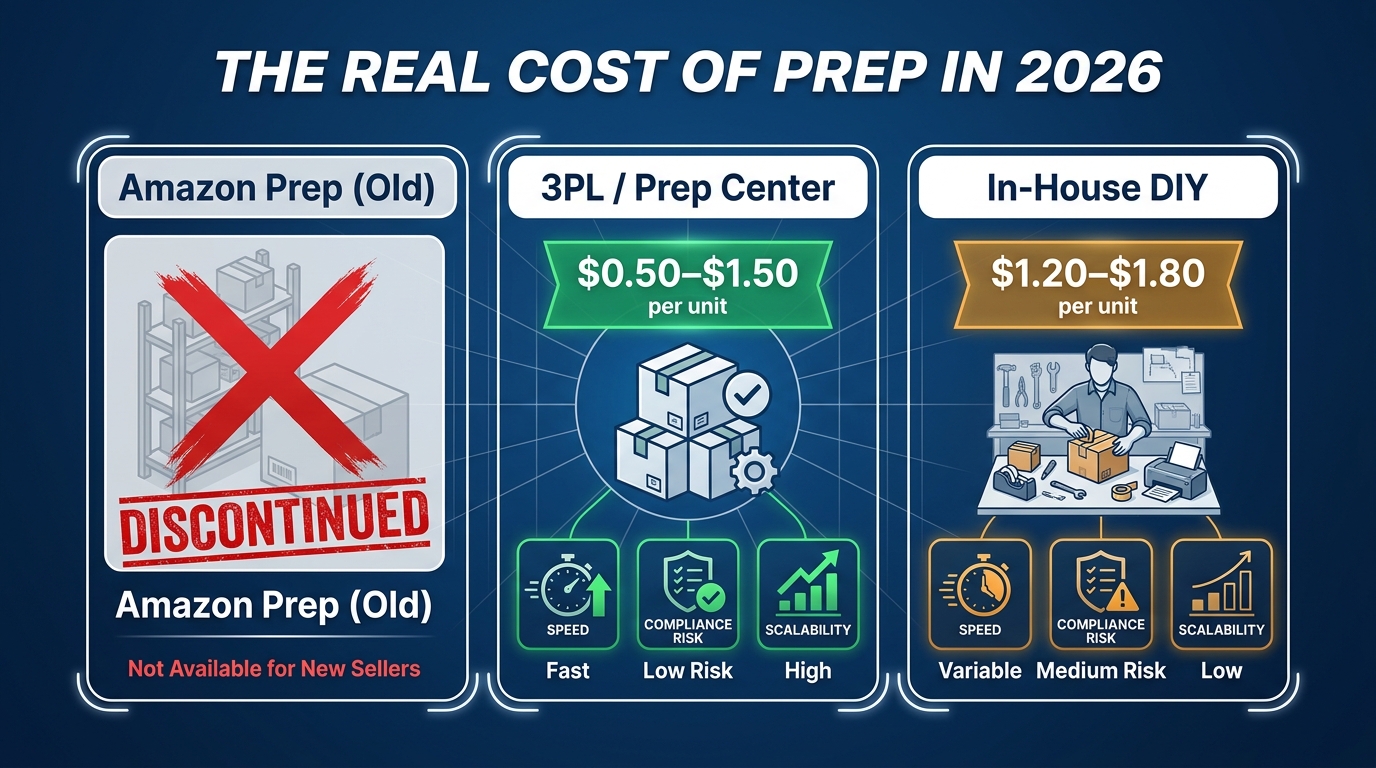
Third-party FBA prep centers — also called 3PL prep services or simply prep centers — have been the immediate beneficiary of Amazon’s policy change. These are facilities that receive your inventory, perform all required prep tasks, and then create and ship inbound FBA shipments on your behalf. They absorb the operational complexity; you pay a per-unit service fee.
Current pricing reality
As of mid-2026, the standard all-in cost for a third-party prep center handling a typical standard-size item in the U.S. runs approximately $0.50–$1.50 per unit — considerably below the frequently cited in-house all-in cost of $1.20–$1.80 per unit. However, those headline rates are for standard items at moderate to high volumes. The real picture is more granular:
- Under 500 units/month: Expect $1.00–$1.50 per unit at most prep centers, with possible minimum monthly fees of $100–$300.
- 500–2,500 units/month: Typical range of $0.75–$1.25 per unit.
- Over 2,500 units/month: Negotiated rates often drop to $0.40–$0.75 per unit for standard items.
Add-on fees are where the real pricing variation lives. Poly-bagging typically adds $0.20–$0.50 per unit. Bubble-wrapping runs $0.25–$0.50. Bundling additional units into a multi-pack set costs $0.20–$1.00 per extra unit. Oversized or heavy items can attract handling surcharges of $2.00–$5.00 per unit. Storage fees at many prep centers run $15–$40 per pallet per month for holding inventory before it ships to Amazon.
The capacity problem nobody advertised
Here’s the thing the industry wasn’t publicly discussing as loudly as it should have been: Amazon’s shutdown didn’t create new prep capacity — it simply redirected existing demand. The same volume of goods that Amazon was prepping in-house now needs to be prepped somewhere else, and the U.S. prep center industry does not have unlimited surge capacity.
The result, visible since January 2026, is a tightening of availability at established prep centers in high-demand regions. Some prep centers near major import hubs — Los Angeles, Chicago, New Jersey — are reporting lead times of two to three weeks for new client onboarding and tighter turnaround windows for existing clients during peak periods. Sellers who waited until after January 1 to find a prep partner have faced higher prices and longer wait times than those who locked in relationships in Q4 2025.
What to look for when choosing a prep center
Not all prep centers are equal. The pricing difference between a well-run prep center and a mediocre one is small compared to the cost difference between zero defects and a 3% labeling error rate across 5,000 units. Here are the criteria that matter most in 2026:
- Amazon-specific expertise: Some 3PLs handle general e-commerce prep but have minimal Amazon-specific experience. FNSKU label placement, poly bag specifications, carton content requirements, and shipment creation rules are all Amazon-specific. Make sure your prep center knows them cold.
- Turnaround time SLAs: What is the guaranteed window between receiving your inventory and creating an inbound shipment? Industry standard is 3–7 business days for standard items; ask what happens during Q4.
- Error rate and accountability policy: What happens when they label the wrong FNSKU on a unit and it creates an inbound defect? Who absorbs the penalty fee? A prep center that won’t put accountability language in their agreement is a risk.
- Inventory management software integration: Can they integrate with your inventory management system — Linnworks, Skubana, RestockPro, or similar — to sync SKU data and shipment records? Manual reconciliation at scale is expensive and error-prone.
- Geographic positioning: A prep center located in a state without sales tax may simplify your accounting. One located near a major Amazon fulfillment center cluster (e.g., Phoenix, Inland Empire in California, Central Ohio) can reduce inbound shipping costs significantly.
Path 2: Building an In-House Prep Operation
Some sellers look at the per-unit math on 3PLs and decide they can do it cheaper themselves. At sufficient volume and with the right setup, they’re not wrong — but the calculus is more complex than a simple cost-per-unit comparison, and underestimating that complexity is one of the more expensive mistakes in the current environment.
The real startup cost
Building a functional in-house FBA prep operation requires a genuine capital commitment. Conservative estimates from sellers who’ve done it in 2026 put the initial setup cost at $2,000–$5,000 for a small operation, covering:
- Label printer: A thermal label printer compatible with FNSKU label generation (Dymo 4XL, Zebra ZP450, or similar). Cost: $200–$600.
- Barcode scanner: For verifying label accuracy and product matching before shipping. Cost: $100–$400.
- Poly bag inventory: You need a range of sizes and need to maintain adequate stock. Amazon’s minimum poly bag thickness requirement is 1.5 mil; many sellers go to 2 mil for safety. Cost: $200–$600 per initial order.
- Packing tables and ergonomic station setup: $300–$800.
- Shipping scale (certified for carrier compliance): $100–$300.
- Bubble wrap, packing tape, dunnage, box cutters, etc.: $300–$600 initial stock.
Beyond equipment, you need space. A bare-minimum in-house prep operation requires roughly 1,000–1,500 square feet of usable floor space — more if you’re handling significant inventory volumes or large items. For many small sellers, this means dedicating part of a home garage or small warehouse lease. The loaded monthly cost of that space — whether allocated rent in a warehouse or the opportunity cost of home space — typically runs $500–$2,000/month depending on location.
The labor reality
This is where the in-house math gets complicated. The visible cost per unit in an in-house setup — tape, labels, poly bags — is genuinely low, often $0.20–$0.50 per unit in materials. But labor is the invisible variable that makes in-house prep more expensive than it appears on a spreadsheet.
At a skilled prep worker throughput of approximately 60–80 standard units per hour (labeling, poly-bagging, and boxing), and a U.S. labor cost of $15–$20/hour including overhead, each unit carries a labor cost of roughly $0.19–$0.33. That sounds competitive — until you account for downtime, prep errors, retraining, and the manager’s time spent overseeing the operation and troubleshooting shipment issues.
In-house all-in costs including space, labor, and materials consistently land in the $1.20–$1.80 per unit range for sellers who account for everything honestly. At volumes under 2,500 units per month, outsourcing almost always comes out cheaper when total loaded costs are compared fairly. Above 5,000 units per month, in-house can become cost-competitive — but only if the operation is well-managed and error rates are controlled.
When in-house makes actual sense
In-house prep is genuinely the right choice when you need maximum quality control over complex or fragile products, when your SKU mix is unusual enough that no prep center can reliably handle it without expensive custom arrangements, or when you’re at sufficient volume (typically 5,000+ units/month) to justify dedicated staff and space. It also makes sense for sellers who are building an operational team anyway — if you have warehouse staff handling other tasks, adding prep work to their workflow can be efficient. But building an in-house prep operation solely to replace what Amazon provided is almost never the most economical choice at moderate volumes.
Path 3: Factory-Ready — Moving Prep Upstream to Your Supplier
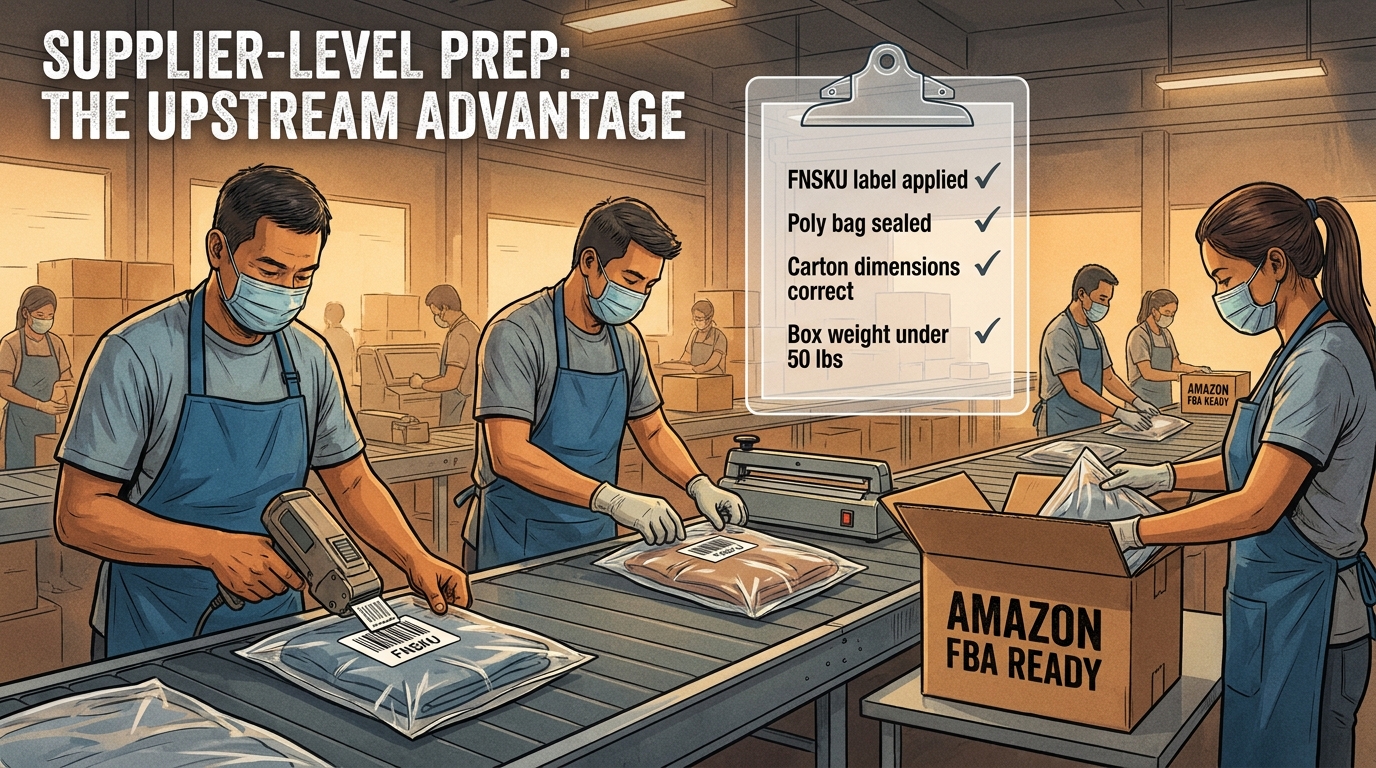
The most underutilized but increasingly important response to Amazon’s prep shutdown is moving prep work upstream — to the manufacturer or supplier level. “Factory-ready” means that inventory leaves the production facility already labeled, poly-bagged, and packed into cartons that meet Amazon’s inbound requirements. When done correctly, goods go from factory floor directly to Amazon FC without touching a prep center or your own operation at all.
This is not a new concept in Amazon logistics, but it’s becoming table stakes for high-volume private label sellers who source from overseas manufacturers. The economics are compelling: supplier labor costs in manufacturing regions are a fraction of U.S. prep labor costs, and if your factory can do the prep at the point of production rather than as a separate downstream step, you eliminate an entire logistics node from your supply chain.
What factory-ready actually requires
The key challenge with factory-ready prep is documentation and quality control. Suppliers who haven’t done Amazon prep before will make mistakes — label misplacements, wrong FNSKU on wrong units, incorrect poly bag thickness, boxes that exceed 50 lbs, carton dimensions that violate Amazon’s inbound specs. These mistakes don’t show up until inventory arrives at the FC, by which point the defect fees have already started.
To make factory-ready work, you need to provide your manufacturer with a comprehensive, SKU-specific prep specification document. This should include:
- FNSKU label template and placement: Exact dimensions (2″ × 1.25″ standard), exact placement location on the unit (typically on a flat surface, not over seams or curves), and the rule that any existing manufacturer barcode must be covered.
- Poly bag specifications by SKU: Which SKUs require poly-bagging, what bag size maps to each unit, minimum thickness (1.5 mil, more commonly 2 mil for safety margin), and suffocation warning label requirements for bags over 5 inches in any dimension.
- Carton requirements: Maximum weight (50 lbs), maximum dimensions per Amazon’s inbound guidelines, required carton labeling (shipment label, box number, total units in box), and packing density guidelines.
- Barcode scanning QA protocol: The factory should scan each FNSKU label after application to confirm scannability. Unscanned or misread labels are a primary cause of inbound defects.
- Photo documentation: Require your supplier to provide photos of labeled units, packed cartons, and completed pallets before loading. This creates accountability and allows you to spot errors before the container ships.
Negotiating factory-ready with your supplier
Most manufacturers in China, Vietnam, and other major sourcing regions are accustomed to custom packaging and labeling requests from their clients — this is not an unusual ask. However, they will typically charge for it: expect a per-unit fee of $0.05–$0.20 for standard labeling and $0.10–$0.30 additional for poly-bagging at the factory. Even with these charges factored in, the total cost of factory-ready prep in Asia typically runs well below U.S.-based prep center rates.
The critical success factor is building a supplier relationship where quality errors in prep have clear consequences. Some sellers include prep error penalties in supplier contracts — essentially holding back a portion of payment if defect rates on arrival at the FC exceed a threshold. This aligns incentives and tends to improve quality dramatically on second and subsequent purchase orders.
2026 Compliance Requirements: FNSKU, Poly Bags, and the New Penalty Structure
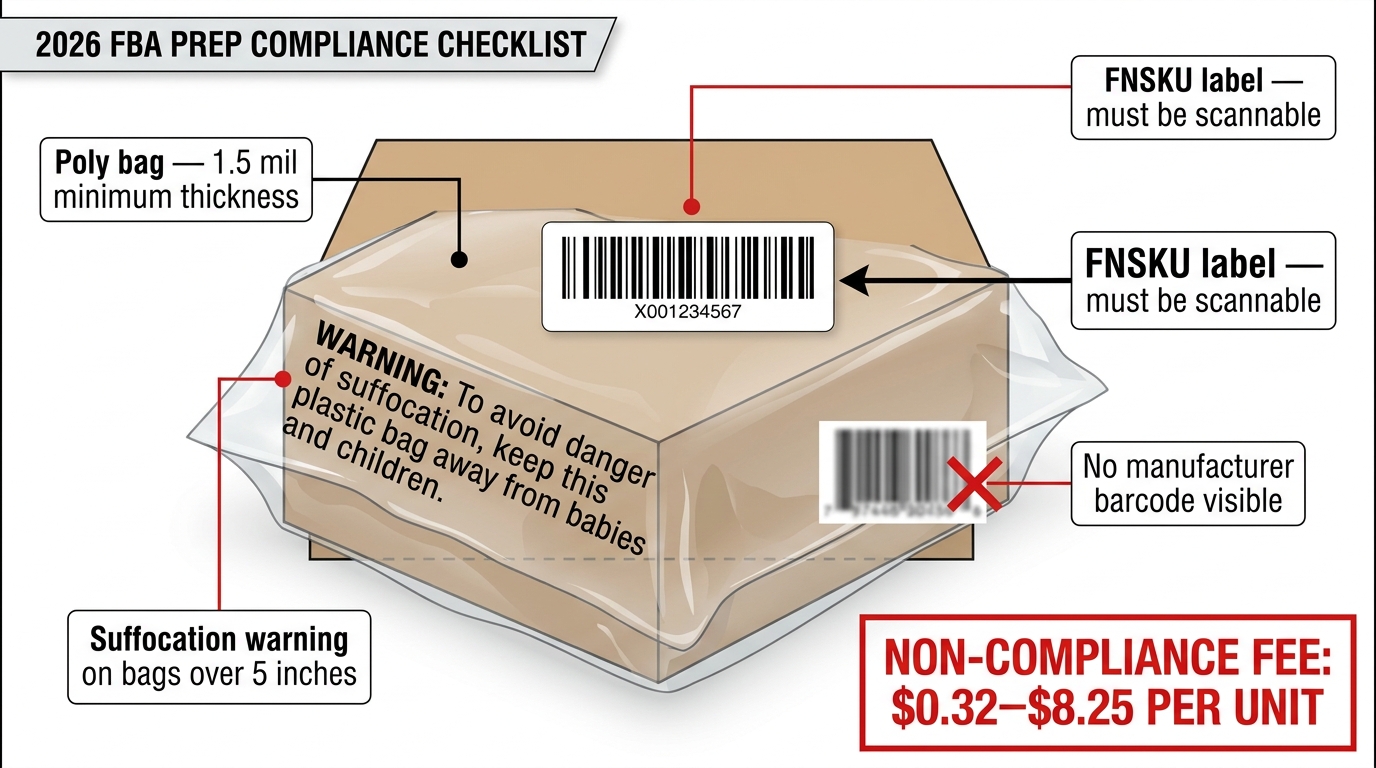
With Amazon no longer acting as a last-resort correction facility, the stakes of non-compliance have risen sharply. Previously, if a unit arrived without an FNSKU label, Amazon might apply one (at a fee). Now, non-compliant units trigger a chain of consequences that can escalate quickly in cost and complexity.
The FNSKU labeling rules
Every unit entering FBA must have exactly one scannable FNSKU barcode. The label must be the correct FNSKU for that ASIN — a seemingly obvious requirement that is violated surprisingly often when prep is rushed or when multiple SKUs are being prepped simultaneously. Key requirements:
- One label per sellable unit — no stacking multiple labels, no label over existing labels in ways that leave old barcodes partially visible.
- Manufacturer barcode must be covered — if the unit is being sold under an FNSKU (not the manufacturer barcode), any existing scannable barcode on the product packaging must be obscured so the FC scanner can’t read it instead of the FNSKU.
- Label placement on a flat, scannable surface — not over seams, curves, clear film windows, or glossy surfaces that cause reflection. Labels that don’t scan cleanly at the FC generate inbound defects.
- Label size: Standard FNSKU label size is 2 inches × 1.25 inches. Thermal printing is preferred; inkjet-printed labels fade under warehouse lighting and temperature conditions.
Poly bag requirements in detail
Poly-bagging requirements in 2026 are specific and enforced. Products that require poly-bagging include soft goods, loose small items, plush toys, items with loose parts, and any item that Amazon designates as needing bagging for safety or containment reasons. The requirements:
- Minimum 1.5 mil thickness — most experienced sellers and prep centers use 2 mil as a standard to avoid edge-case rejections.
- Suffocation warning on bags over 5 inches in any dimension — the warning text must meet specific size and wording requirements per Amazon’s guidelines.
- Bag sealed completely — heat-sealed or sealed with no opening; not simply folded or tucked.
- FNSKU label applied on top of the sealed bag or on the product inside the bag such that it’s clearly visible and scannable through the bag material — this is a common prep error; labels placed under opaque bag material fail to scan.
The penalty structure
Amazon’s 2026 inbound defect fee schedule applies a per-unit charge to any unit that arrives non-compliant and requires remediation — or is rejected outright. Published fee ranges for inbound defects run from $0.32 to $8.25 per unit, depending on the nature and severity of the non-compliance. The lower end of that range applies to relatively minor issues (minor label placement corrections on units Amazon can still receive); the upper end applies to items requiring significant remediation or that must be returned to the seller at Amazon’s discretion.
Beyond the per-unit fee, non-compliant shipments carry secondary consequences: delayed receiving, which pushes back your inventory available date and can cause stockouts; shipment defect rate increases, which are tracked at the account level; and potential shipment blocks if defect rates cross threshold levels that trigger Amazon’s automated review systems.
The math is straightforward: at $0.32–$8.25 per non-compliant unit, even a 2% error rate on a 5,000-unit shipment generates $32–$825 in direct penalty fees plus the downstream effects on velocity and account health. That’s real money — and it’s entirely avoidable with proper prep protocols.
The Hidden Cost Nobody Talks About: Error Rates and Their Downstream Effect
Every discussion of FBA prep costs focuses on the per-unit prep fee. Very few discussions quantify the cost of prep errors — which is strange, because prep errors are arguably more expensive than the prep itself.
How prep errors compound
Consider a scenario: a prep center applies the wrong FNSKU label to 50 units out of a 1,000-unit shipment. Those 50 units arrive at the FC under the wrong ASIN. Amazon receives them into the wrong listing’s inventory, which means your actual listing is 50 units short (potential stockout), while some other listing — possibly a competitor’s ASIN if the FNSKU collision is severe — has excess phantom inventory. Resolving this requires opening a case with Seller Support, documenting the error with documentation the prep center may or may not have provided, and waiting days to weeks for investigation and correction.
Meanwhile, those 50 units may be sold as the wrong product, generating returns, A-to-Z claims, and negative reviews — none of which trace back to the prep center’s error in any automated system. The entire cost lands on your account.
Quantifying error cost
A reasonable framework for estimating the true cost of prep errors considers four buckets:
- Direct inbound defect fees: $0.32–$8.25 per non-compliant unit (Amazon-assessed).
- Remediation and returns shipping: If shipments are rejected or must be returned, the inbound shipping cost is lost and return shipping must be paid. On a 1,000-unit shipment, this could run $150–$500.
- Velocity and ranking impact: Stockouts caused by delayed receiving or rejected inventory directly affect your Best Seller Rank and advertising efficiency — costs that are real but hard to isolate on a P&L.
- Seller time: Resolving FBA inbound problems is a substantial time sink. Case resolution at Amazon Seller Support routinely takes 5–15 business days and requires documentation, follow-ups, and escalations. At any realistic hourly cost for your time, this is expensive.
The actionable implication: when comparing prep options, do not evaluate them solely on per-unit price. Evaluate them on per-unit price plus error rate times your estimated error cost per incident. A prep center charging $0.80/unit with a 0.5% error rate is almost certainly cheaper than one charging $0.60/unit with a 2.5% error rate once downstream costs are included.
How to Vet a Prep Center in a Capacity-Constrained Market
Finding a good prep center in the current environment — where established ones are at or near capacity and new ones are opening rapidly to capture demand — requires more diligence than it would have in 2024. The market is crowded with new entrants who have the equipment but not the experience. Here’s how to evaluate candidates with rigor.
The questions that actually matter
Before signing with any prep center in 2026, ask these questions and require specific, documented answers:
- “What is your average inbound defect rate for FBA shipments, and how do you track it?” — Any prep center that doesn’t track this metric is not operating professionally. The answer should be a number (ideally under 0.5%) and should include a description of the tracking method.
- “What is your liability policy when your prep error causes an Amazon penalty fee?” — This should be in their service agreement. If it isn’t, that tells you something important.
- “How do you handle FNSKU verification — do you scan every label after application?” — Scanning after application is the minimum professional standard. Some centers verify against your SKU manifest as well. Centers that eyeball without scanning are a liability.
- “What is your current average turnaround time, and how does it change in Q4?” — Get this in writing. Q4 capacity is where many prep centers fail their clients.
- “Can I speak to three current clients with similar volume and product categories?” — A prep center confident in its service quality will provide references readily.
Red flags to walk away from
In the rush to capture newly displaced Amazon-prep volume, some prep centers have overpromised on capacity and underinvested in quality controls. Walk away from any prep center that: refuses to put error liability in writing; cannot provide verifiable references from current Amazon-specific clients; is unwilling to quote turnaround time SLAs in the contract; doesn’t have a documented FNSKU verification process; or whose pricing seems dramatically below market rates without an explanation that makes operational sense (below $0.40/unit for standard items at moderate volumes is a signal worth investigating).
Building a Hybrid Model When One Path Isn’t Enough
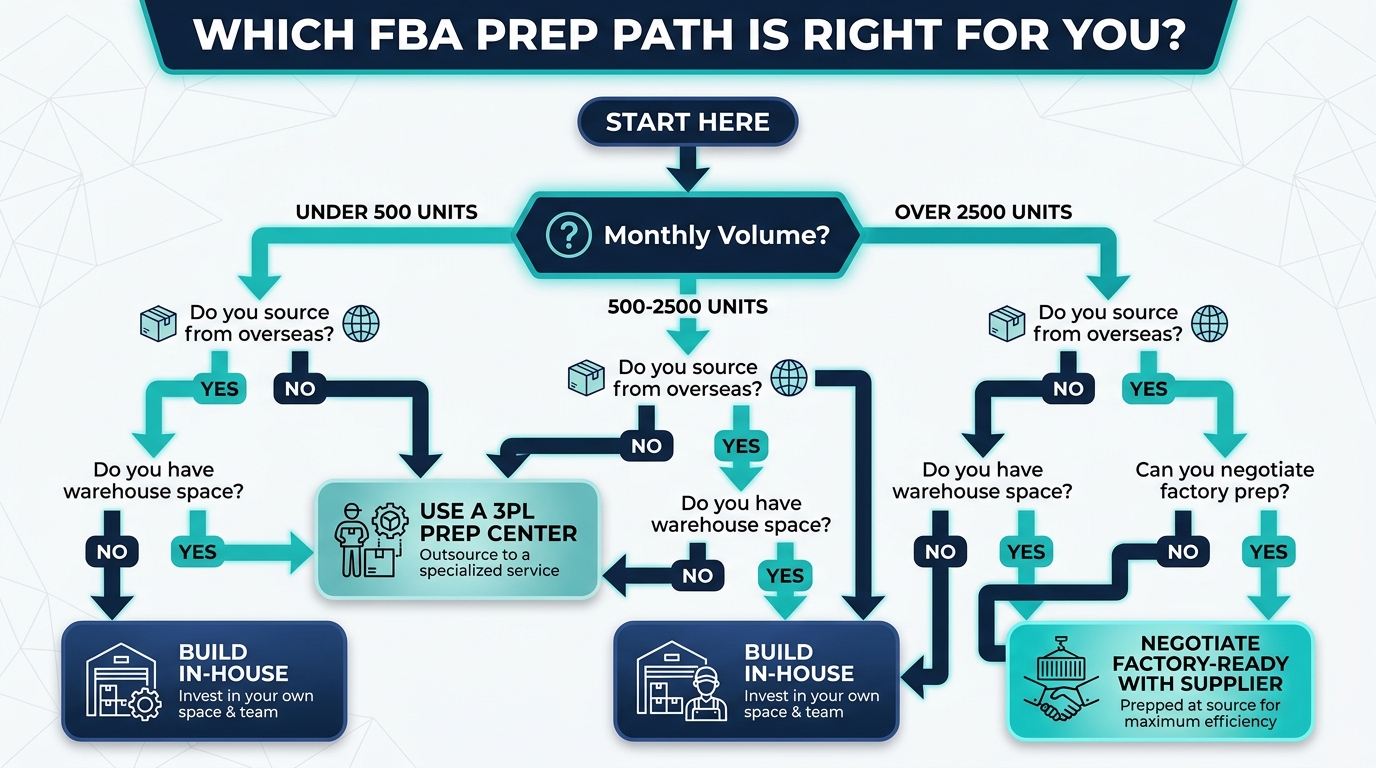
Most sellers with a diverse product catalog or complex supply chain situation will find that no single prep path covers everything cleanly. The most resilient approach in 2026 is a deliberately designed hybrid model — one that assigns each SKU or product category to the prep path that makes the most sense for that specific situation.
A framework for routing SKUs
Think of your SKU catalog in terms of three dimensions: complexity (how much prep work does each unit require?), volume (how many units ship per month?), and origin (where does the inventory come from, and what prep options exist at the source?).
High-volume, simple SKUs sourced from overseas manufacturers are strong candidates for factory-ready prep — negotiate the spec with your supplier, add a quality control step, and eliminate a logistics node. Standard-complexity SKUs at moderate volumes (500–5,000 units/month) typically route cleanly to a reliable 3PL prep center. Complex, fragile, or highly variable SKUs — those requiring careful inspection, custom kitting, or specialized handling — are candidates for in-house prep where you have direct control over quality.
Managing multiple prep relationships
Running a hybrid model means managing multiple vendor relationships, which adds coordination overhead. A few practices make this significantly more manageable:
- Centralize your FNSKU and SKU data in a single system of record — Inventory management software like Linnworks, Skubana, or InventoryLab should hold your definitive FNSKU-to-product mapping. Any prep center or supplier receiving your product should pull label data from this system, not from manual spreadsheets.
- Standardize your prep specification documents — Create a single, version-controlled prep spec document per SKU that you send to all prep partners. This eliminates version drift where different partners are working from different instructions.
- Run parallel shipment tracking across all channels — When inventory is moving through multiple prep paths simultaneously, you need visibility across all of them to anticipate receiving timelines and manage reorder points accurately.
- Audit each partner quarterly — Pull your inbound defect report from Seller Central and attribute errors by shipment to the prep source. This creates accountability data that drives informed decisions about which prep partners to grow with and which to replace.
Repricing and Margin Recovery: The Business Case for Acting Now
One aspect of the prep shutdown that deserves direct attention is its effect on product pricing strategy. The change has added real cost to nearly every FBA operation — some sellers are absorbing it, some are passing it on to customers, and the smartest operators are using it as a catalyst to rationalize their SKU mix.
The SKU rationalization opportunity
Every product you sell should now be evaluated against a prep-inclusive cost model. The calculation is straightforward: take your current unit economics (landed cost + FBA fees + advertising spend + overhead allocation + historical return rate cost), add your new all-in prep cost per unit, and recalculate your margin. Products that were marginal before the prep cost increase are likely now negative-margin. Continuing to sell negative-margin products depletes cash and ties up FBA storage capacity better used by products that are actually profitable.
The prep shutdown, unpleasant as it is, provides a clean forcing function for a SKU rationalization exercise that most sellers should have been doing anyway. Use the new cost structure as the reason to finally exit SKUs you’ve been holding onto out of inertia.
Price increase calculus
For products that remain viable after the new prep cost is applied, the question is whether the incremental cost can be passed to customers. The answer depends on your competitive position. If you sell a differentiated private label product with strong reviews and limited direct competition, a $0.30–$0.75 price increase is often fully absorbable by customers without significant volume impact — particularly at this stage of the year when Amazon’s search rankings continue to favor established ASINs with strong sales history.
If you’re in a commoditized category where multiple sellers are competing primarily on price, the margin from prep costs is largely non-recoverable through pricing. In that case, the focus should be on reducing prep costs as aggressively as possible through volume consolidation, supplier-level prep negotiation, or process efficiency in-house.
What the Next 12 Months Look Like for FBA Prep
The preparation industry is in a rapid-evolution phase that will continue reshaping itself through 2026 and into 2027. Understanding the trajectory helps you make decisions today that will hold up as the landscape changes.
Prep center consolidation is likely
The influx of demand has prompted many small operators to enter the prep center market in 2026. Not all of them will survive. Prep centers that thrive will be those that invest in operational software, process standardization, and scale-efficient staffing. Those operating on manual processes and thin margins will struggle as labor costs continue to rise and client tolerance for errors decreases. Expect meaningful consolidation among prep centers over the next 18 months, with survivors being either large-scale regional operators or highly specialized niche services (e.g., centers that specialize exclusively in hazmat or fragile goods).
Software integration becomes a differentiator
The prep centers gaining the most traction in 2026 are those with robust software integration capabilities — bidirectional data sync with seller inventory systems, automated FNSKU label generation from shipment manifests, real-time receiving and status updates, and digital audit trails for every unit handled. Sellers should be actively choosing prep partners based on software capability, not just per-unit pricing.
Supplier prep becomes a standard expectation
As more sellers negotiate factory-ready prep with their overseas manufacturers, it will gradually shift from a competitive differentiator to a baseline expectation. Suppliers who invest in the staff training, equipment, and QA processes to do reliable FBA prep will become more attractive vendors. Those who cannot or will not offer this service will find their clients shifting volume to suppliers who can.
The Practical Checklist: Your Next 30 Days
If you’re reading this and haven’t yet fully resolved your prep situation, here is a prioritized 30-day action list based on what’s actually working for sellers in mid-2026:
- Audit your current inbound defect rate in Seller Central — Go to Shipping Queue → Shipment Performance. If your inbound defect rate has risen since January 2026, you have a prep problem that needs to be addressed immediately. Every shipment with elevated defects is costing you money and account health.
- Run your SKU-level prep cost analysis — For each active ASIN, calculate total prep cost per unit under your current method and recalculate your unit margin. Identify SKUs that are now unprofitable and create an exit plan for each.
- If using a 3PL: request a formal error rate report — Ask your prep center for their FNSKU verification process documentation and their reported error rate for your shipments. If they can’t provide either, start evaluating alternatives.
- If sourcing overseas: send your top-3 suppliers a factory-ready prep spec — Even if you’re not ready to fully implement supplier-level prep, having the conversation now positions you to negotiate it into your next purchase order. Start with your highest-volume SKUs.
- Identify Q4 capacity — Contact your current prep partners (or candidates) to confirm Q4 availability and lock in capacity commitments. The sellers who didn’t do this last year paid for it in delayed receiving timelines during peak season.
- Standardize your SKU prep documentation — Create a single-source prep spec document for every ASIN in your catalog. Include FNSKU, poly bag requirements, fragility designation, bundling rules, and carton specifications. Store this in a shared system accessible to all prep partners.
- Set up quarterly prep partner audits — Put a recurring quarterly review in your calendar now. Use your inbound defect data to hold prep partners accountable and create a documented basis for relationship decisions.
Conclusion: The Prep Shutdown as a Strategic Reset
Amazon’s decision to exit the prep and labeling business is, at its core, a business decision about what Amazon wants to be: a fulfillment network, not a prep facility. That repositioning is permanent — there is no credible scenario in which Amazon reverses course on this. The sellers who will come out ahead are those who treat the adjustment not as a temporary disruption to navigate but as a permanent structural change that warrants a permanent strategic response.
The sellers already thriving six months in share a common profile: they made prep decisions early, they chose partners based on quality metrics rather than just price, they moved prep upstream to suppliers where the economics supported it, and they built multi-source redundancy so that no single prep failure can halt their operation. None of these are complicated moves. All of them require intentional action rather than reaction.
The cost of prep is now yours to manage. The upside of managing it well — lower error rates, better margin visibility, more resilient inbound logistics — is also yours to capture. That is, ultimately, a better position than having Amazon manage it for you at whatever price they chose to charge on a given day.
The sellers who will win on FBA in 2026 and beyond are not the ones who waited for Amazon to solve their logistics problems. They’re the ones who built their own.