

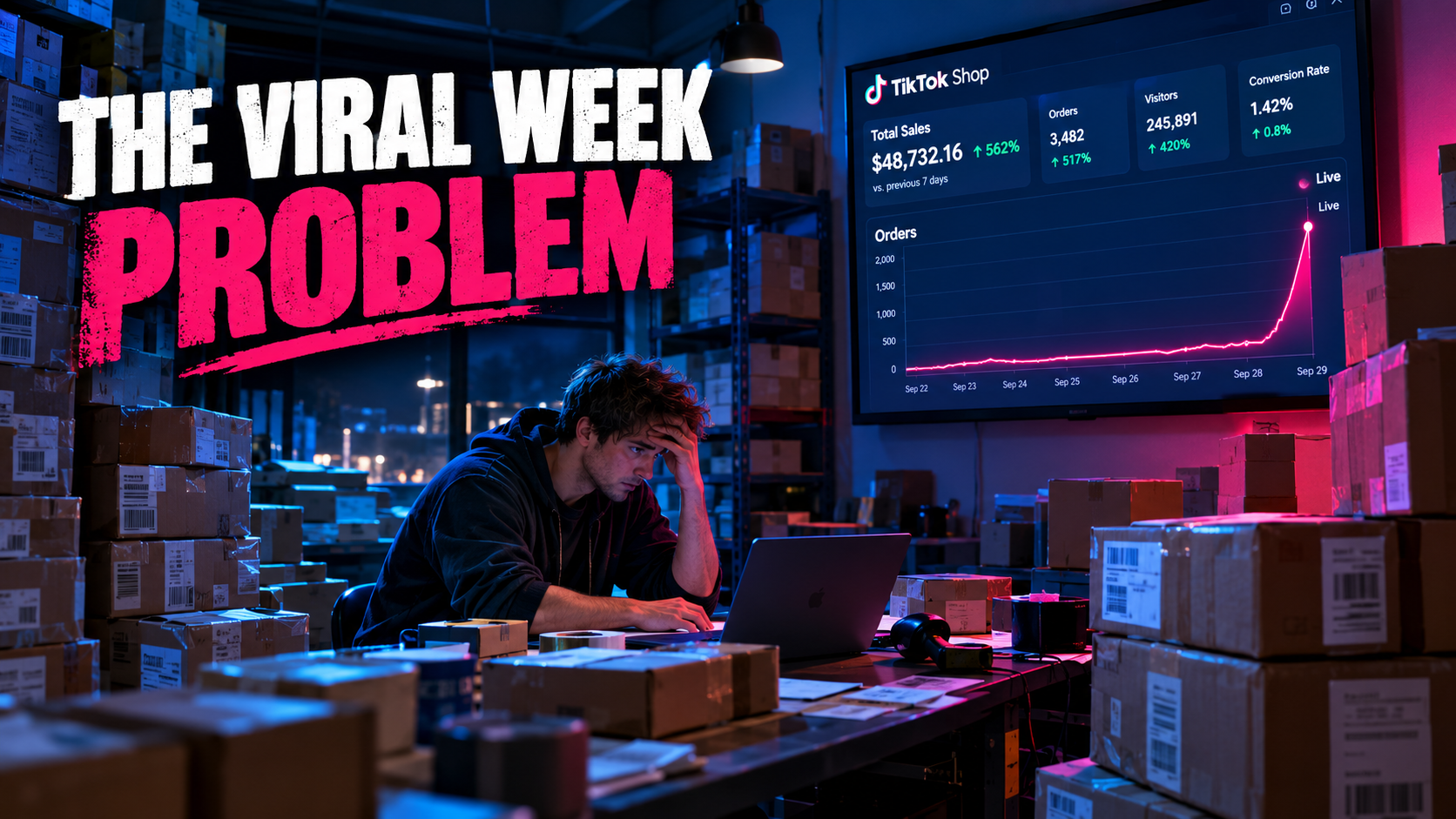

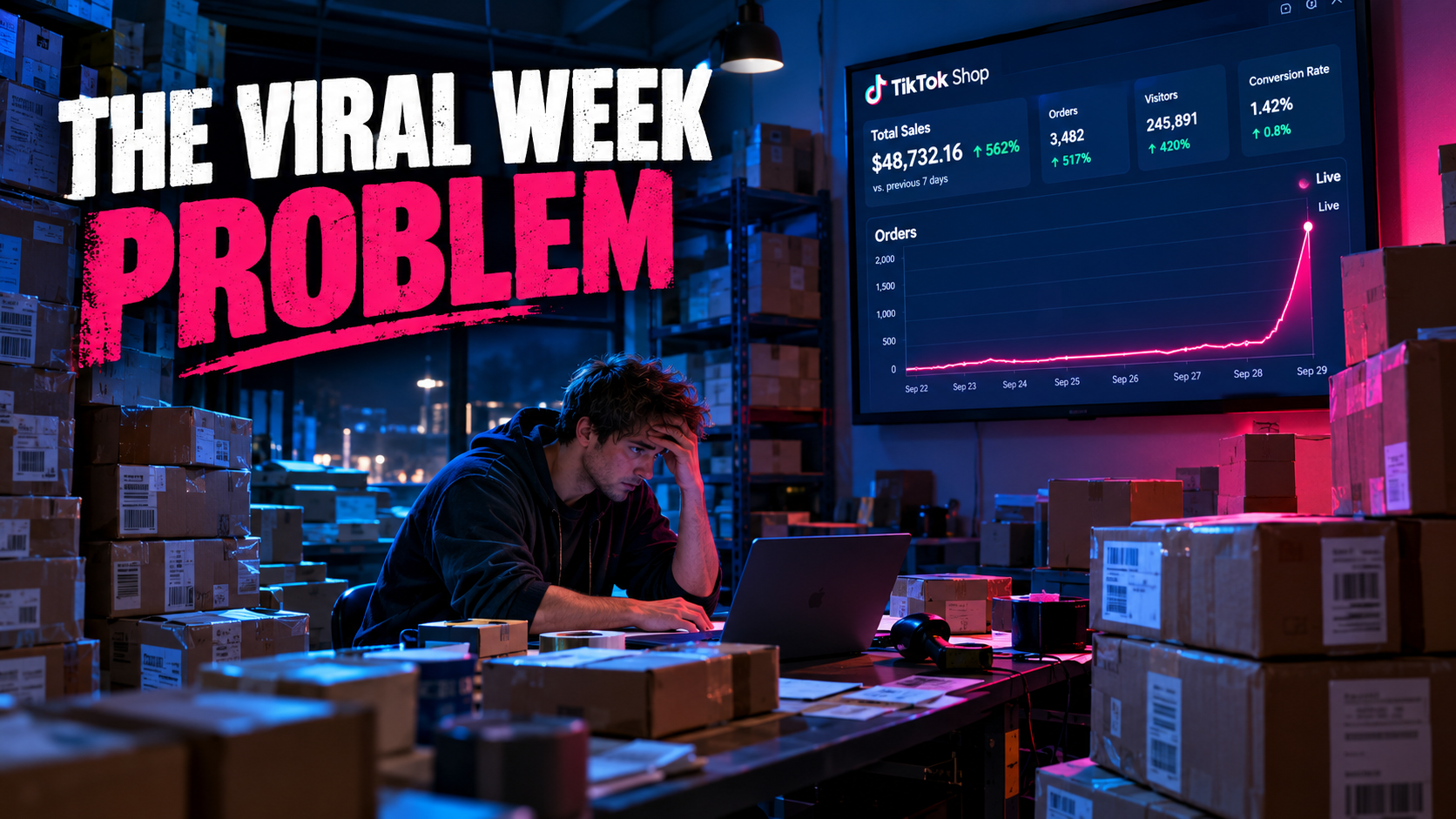
Every TikTok Shop seller dreams about the same moment. A creator posts a video, it catches, and the orders dashboard starts refreshing faster than anyone can read it. By the end of the day, you’ve done a month of sales. By the end of the week, you’ve done a quarter.
Then the other side shows up. Stock runs out on day three. Orders ship late. Cancellations pile up. Buyers who waited nine days leave one-star reviews. Your account health indicators turn red, and the platform starts showing your products to fewer people just as you finally have inventory again. A few weeks later, the payout arrives, and it’s smaller than the chaos suggested it would be.
This is the viral week problem. It’s one of the most common ways TikTok Shop sellers lose money, and it has little to do with content, hooks, or the algorithm. It’s an operations problem. TikTok Shop creates demand in a shape that traditional e-commerce operations were never designed to handle.
A lot of TikTok Shop advice focuses on getting the spike: finding creators, writing hooks, reading trends. This article covers what happens after the spike. We’ll look at why demand on TikTok behaves differently, how to plan inventory for demand you can’t forecast, how to choose a fulfillment model, how account health breaks under pressure, why affiliate samples are really a logistics job, and how to manage the cash gap that catches so many growing shops out.
The goal is simple. When your viral week comes, it should be the start of a bigger business, not the start of a recovery project.
Why TikTok Shop Demand Doesn’t Behave Like Normal E-commerce Demand
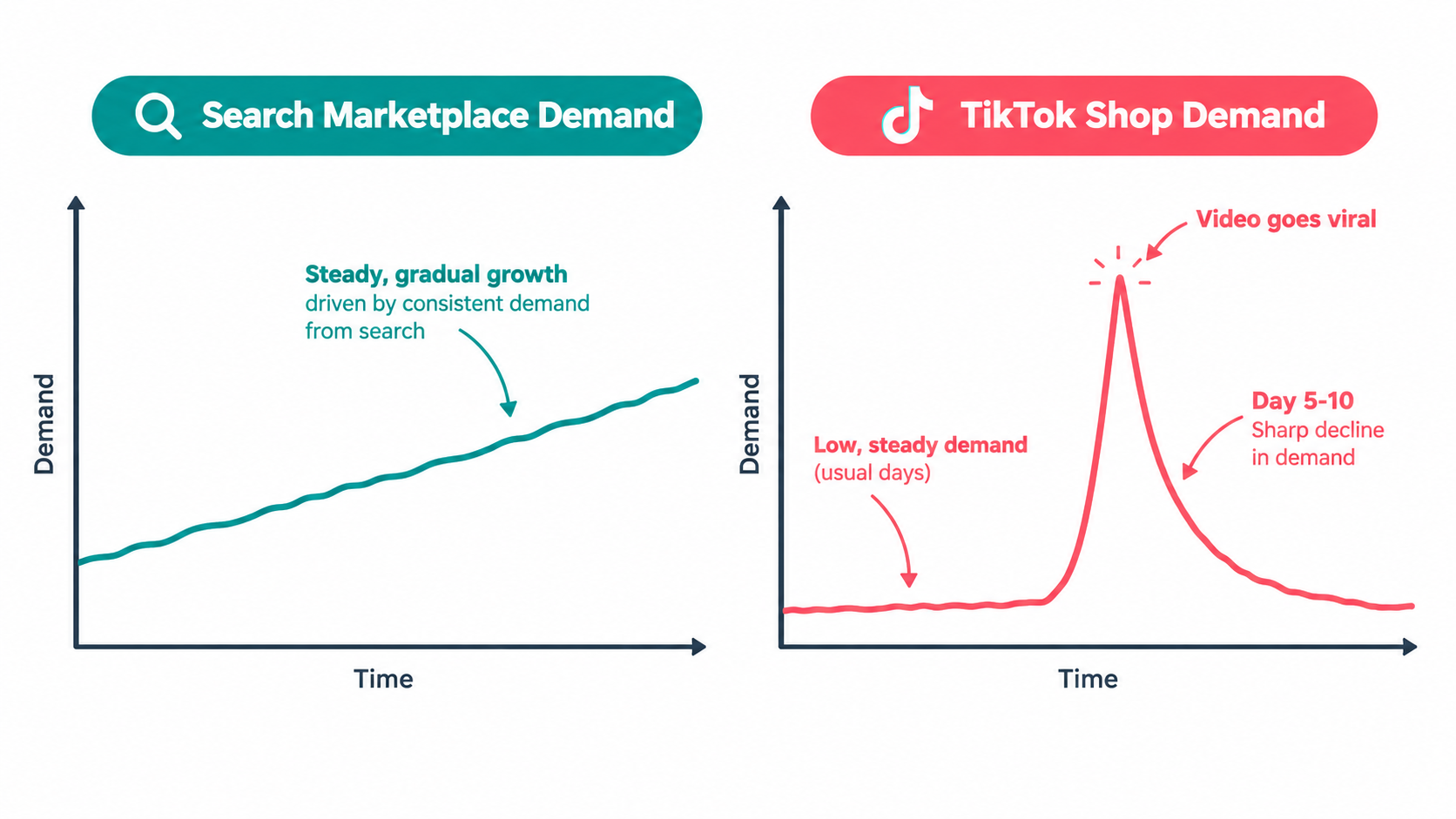
To plan operations for TikTok Shop, you first need to see how different its demand curve is from what most sellers know. On search-driven marketplaces, demand is mostly intent-led. Someone types “stainless steel water bottle,” sees options, and buys. That demand is fairly steady, it moves with the seasons, and you can forecast it from past sales and keyword volume.
TikTok Shop runs on discovery. Most buyers weren’t looking for your product before they saw it. They were scrolling, a video showed up in their feed, and it made them want something they hadn’t thought about five seconds earlier. This is what makes the platform so strong for new products, and it’s also why its demand is so hard to predict.
The scale behind the spikes
The platform is big enough that one piece of content can push huge volume. TikTok Shop launched in the US in September 2023, and daily sales averaged about $7 million within the first month. In 2024 it did more than $100 million in sales over Black Friday. Nico Le Bourgeois, TikTok Shop’s head of US operations, has cited an audience of about 150 million US users, and said the number of people shopping on the platform nearly tripled after launch.
Because distribution is algorithmic and not follower-based, a creator with a modest audience can still reach millions of viewers if a video performs well. That’s why a seller can go from 20 orders a day to 2,000 with no warning.
The shape of a viral curve
A typical viral product curve on TikTok Shop looks roughly like this:
- Baseline: Low, steady sales from organic listings, a few affiliates, and maybe some ads.
- Ignition: One video (or a cluster of videos) starts getting outsized distribution. Orders jump sharply within hours.
- Amplification: Other creators see the product working and post their own videos. The spike can grow for days, even after the first video cools off.
- Decay: Views drop, copycat content saturates feeds, and demand falls, often steeply.
- New baseline: If things were handled well, sales settle at a level well above where they started. If not, they can fall below the old baseline.
The last stage is the one that matters. The new baseline is set largely by how well you ran operations during the spike. Sellers who stayed in stock, shipped on time, and kept reviews healthy tend to come out with a bigger steady-state business. Sellers who stumbled often find their products get less distribution afterward.
Why this breaks traditional planning
Standard inventory planning uses historical averages, reorder points, and safety stock calculated from demand variability. Those methods assume variability sits within a reasonable band. TikTok Shop demand can produce a single day that’s 50 or 100 times your average, so the normal statistical approach stops being useful. You can’t hold safety stock for a spike that size on every SKU. You’d tie up all your cash in inventory that mostly sits there.
The answer isn’t better forecasting. It’s building an operation that can respond quickly to demand it couldn’t predict. The rest of this article is about how.
Inventory Planning for Demand You Can’t Forecast
If you can’t forecast a spike, you plan for a range of outcomes and decide ahead of time what you’ll do in each one. Experienced TikTok Shop operators tend to plan inventory in scenarios instead of single-point forecasts.
Tier your catalog by spike potential
Not every SKU needs the same inventory strategy. Start by sorting your catalog into three rough tiers:
- Hero SKUs: Products with strong visual demos, impulse price points, and active affiliate content. These are the most likely to go viral and deserve the most contingency planning.
- Supporting SKUs: Bundles, variants, and add-ons that sell alongside hero products. Demand for these rises when a hero spikes, often in predictable ratios.
- Long-tail SKUs: Products that sell steadily but are unlikely to spike. These can be managed with conventional reorder points.
A common mistake is planning the hero SKU and forgetting the supporting SKUs. If your hero product sells out a bundle component, you may be forced to cancel bundle orders even though the hero itself is still in stock.
Think in “days of coverage at spike velocity”
A useful planning measure is to ask: if this SKU hit spike velocity tomorrow, how many days of inventory would I have? Take a realistic spike multiplier based on your category and past performance, apply it to your baseline sales, and divide on-hand inventory by that number.
Here’s an illustrative example. Say a hero SKU normally sells 40 units a day and you hold 1,200 units, which is 30 days of coverage at baseline. If a spike takes it to 800 units a day, you now have 1.5 days of coverage. If your supplier lead time is five weeks, you’ll be out of stock for most of the spike.
That number doesn’t mean you should hold 30 days of spike-level inventory. It means you should know, before anything happens, exactly how you’ll respond when coverage drops below a threshold.
Pre-negotiate your surge options
The fastest restocks are the ones you arranged before you needed them. Ways to build surge capacity without holding excess stock include:
- Buffer stock at the supplier: Agree with your manufacturer to keep finished goods or components ready for a faster turnaround, sometimes in exchange for a larger annual commitment.
- Domestic backup inventory: Keep a reserve of hero SKUs in a domestic warehouse separate from your main fulfillment stock, so you can move it quickly.
- Air freight plans: Know your air freight costs and lead times ahead of time. Air shipping hurts margins, but losing a spike can hurt more.
- Pre-approved purchase orders: Have a draft PO with quantities, prices, and terms ready so you can send it the same day a spike starts.
Know when to throttle
Sometimes the right move is to slow demand down on purpose. If you can’t restock in time, cutting promotions, pausing ad spend, or asking affiliates to hold new content can protect your account health. That’s better than taking orders you can’t ship. Selling fewer units on time usually does less long-term damage than selling more units late.
This decision is uncomfortable because it feels like leaving money on the table. But the cost of late shipments, cancellations, and bad reviews tends to outlast the spike. Decide your throttling rules before the spike, not in the middle of it.
Choosing a Fulfillment Model: Self-Fulfill, Fulfilled by TikTok, or a 3PL
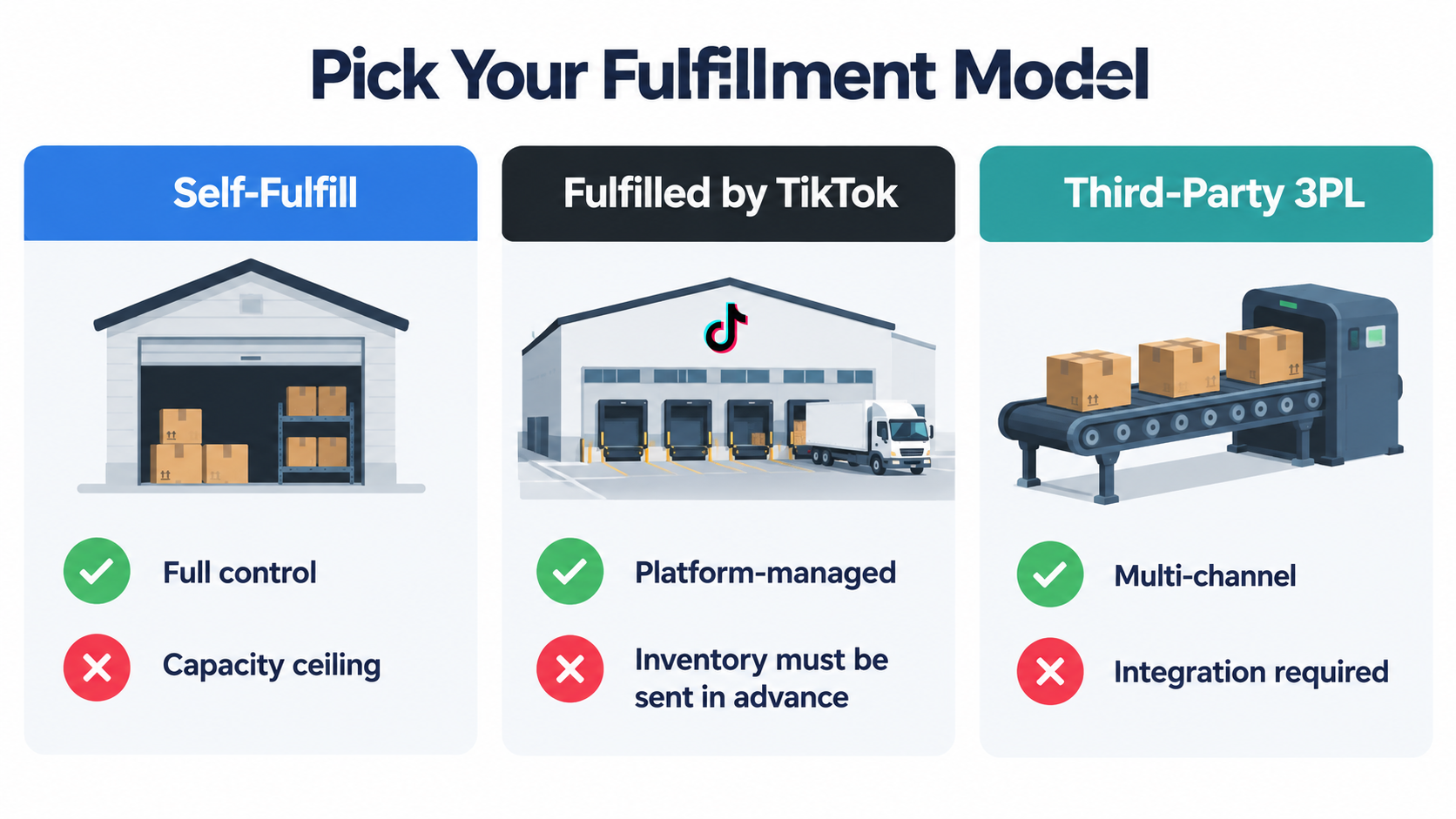
How you get orders to customers decides how much volume you can handle, how fast you can ship, and how much control you keep. TikTok Shop sellers generally have three options, and plenty of shops end up mixing them.
Option 1: Self-fulfillment
Many sellers start by packing orders themselves, from a home office, garage, or small warehouse. The upside is full control over packaging, inserts, quality checks, and costs. There’s no third party standing between you and the customer.
The downside is a hard capacity ceiling. A two-person team might pack a few hundred orders a day comfortably. At a few thousand, things fall apart: packing errors go up, dispatch deadlines slip, and the team burns out. Self-fulfillment works fine for steady baseline volume, but it’s the model most exposed to the viral week problem.
If you self-fulfill, have a surge plan ready: temporary staff you can call in, extra packing stations, pre-assembled packaging, and a list of which orders get priority when you can’t ship everything in one day.
Option 2: Fulfilled by TikTok (FBT)
TikTok runs its own fulfillment program in the US, where sellers send inventory to TikTok-operated warehouses and the platform handles picking, packing, and shipping. The idea is similar to other marketplace fulfillment programs: hand off logistics to the platform and get more consistent delivery performance in return.
The main advantages are capacity and platform alignment. A platform-run warehouse can absorb volume spikes a small team can’t, and platform-fulfilled orders are designed to meet the platform’s own delivery standards. The trade-offs are that inventory has to be placed ahead of time, you give up some control over packaging and presentation, and fees and program rules can change. Check current FBT terms, fees, and eligibility in Seller Center before committing, because these programs change often.
FBT also doesn’t fix the core inventory problem. If you send 1,000 units and a spike demands 10,000, the warehouse still runs out. It solves the capacity to ship, not the supply of product.
Option 3: Third-party logistics (3PL)
A 3PL is an independent fulfillment provider that stores your inventory and ships orders across all your sales channels. For brands selling on TikTok Shop, their own website, and other marketplaces, a 3PL means you can keep one pool of inventory instead of splitting stock across programs.
The key questions when choosing a 3PL for TikTok Shop are:
- Integration: Does it connect directly with TikTok Shop so orders flow in automatically and tracking syncs back quickly?
- Surge capacity: Can it handle a 10x or 50x volume jump with short notice? Ask for specific examples.
- Cutoff times: What’s the daily order cutoff for same-day shipping? Late cutoffs matter a lot during spikes.
- Minimums and pricing: Are there monthly minimums that make it expensive during slow periods?
The hybrid approach
Many established sellers combine models. Hero SKUs might sit in FBT or a surge-ready 3PL, while long-tail products are self-fulfilled. Or the main stock sits with a 3PL, with a smaller allocation in FBT for platform-specific benefits. A hybrid setup adds some complexity, but it spreads risk. If one channel hits capacity, you have somewhere else to route orders.
Account Health Under Pressure: How Spikes Break Your Metrics
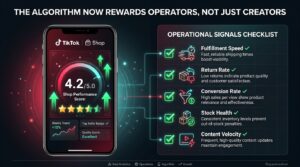
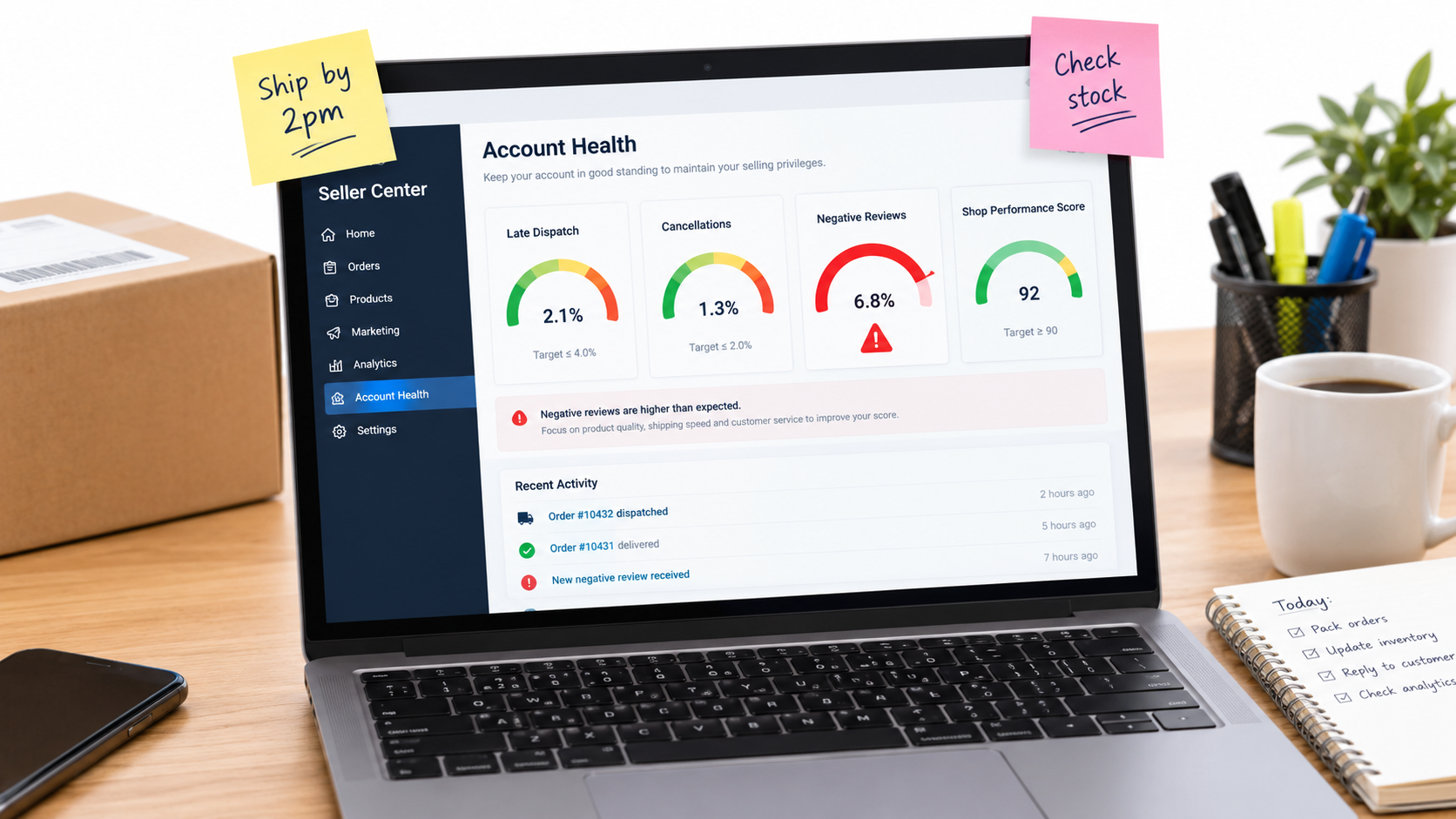
This is where the viral week problem does its most lasting damage. TikTok Shop tracks seller performance through a set of account health and shop performance measures, including a Shop Performance Score shown in Seller Center. These metrics affect how much the platform trusts your shop, and that trust can influence visibility, access to programs, and in serious cases whether you can keep selling.
The metrics that break first
Exact thresholds and formulas change over time, so check Seller Center for current definitions. In general, though, these are the areas that suffer during a spike:
- Late dispatch: Orders not shipped within the required handling window. This is usually the first thing to break when volume outruns packing capacity.
- Seller-initiated cancellations: Orders you cancel because you can’t fulfill them, usually because stock ran out. These tend to be treated harshly because the customer did nothing wrong.
- Delivery performance: Orders that arrive late or never get valid tracking.
- Negative reviews and ratings: Delays and quality problems lead directly to lower product and shop ratings.
- Customer service response: Message volume jumps with order volume. Slow replies hurt response metrics and make buyers more likely to escalate.
Why the denominator works against you
Most account health metrics are percentages: late orders divided by total orders, cancellations divided by total orders, and so on. That can seem like it should be fine during a spike, since more orders means a bigger denominator. The problem is that during a spike, the numerator tends to grow faster than the denominator.
If you normally ship 50 orders a day with one late order, your late rate is 2%. If you get 1,500 orders in a day and can only ship 600 on time, your late rate for that period is 60%. Depending on how the platform calculates rolling windows, a few bad days can drag down your metrics for weeks after.
Protecting account health during a spike
Practical steps sellers use to protect their metrics include:
- Keep inventory counts accurate in real time. Overselling is the main driver of cancellations. If your inventory sync lags, you’ll take orders for stock you don’t have. Some sellers deliberately list slightly less than true on-hand stock as a buffer.
- Adjust handling time if the platform allows it. Where settings allow, a realistic handling time is better than promising fast dispatch you can’t deliver.
- Ship oldest orders first. Work orders in dispatch-deadline order so the ones closest to breaching go out first.
- Set up customer service templates ahead of time. Prepared replies for “where is my order,” shipping delays, and product questions let a small team keep up with message volume.
- Watch metrics daily during spikes. Don’t wait for a warning notification. Check Seller Center performance data every day while volume is elevated.
The trust feedback loop
The reason account health matters so much is that it feeds back into distribution. A shop that performs well during a spike shows the platform it can be trusted with more traffic. A shop that fails during a spike gives the opposite signal. Two sellers can have the same viral video, and the one with clean operations may end up with far more long-term sales, simply because the platform keeps sending buyers their way.
Affiliate Samples Are a Logistics Function, Not Just a Marketing One
On TikTok Shop, affiliate creators drive a large share of sales. Through the Creator Affiliate Program, sellers connect with creators who make shoppable content in return for commission. Most discussion of affiliates focuses on picking creators and setting commission rates. What gets less attention is that the sample pipeline is a logistics operation, and it can fail in ways that quietly drain inventory and money.
Samples compete with customer orders for the same stock
Every sample you send comes from the same inventory as customer orders. When a product starts to take off, creator interest jumps too. Suddenly you have hundreds of sample requests while customer orders are also climbing. If you don’t plan for it, sample fulfillment can eat the stock you needed for paying customers, or sample requests can sit unshipped while you prioritize orders, which frustrates creators just when you need more content.
The fix is to allocate a sample budget in units, not just dollars. Set aside a specific number of units per SKU for samples each month and track it separately from sellable inventory. When a spike hits, you’ll know exactly how many samples you can afford to send without putting customer orders at risk.
Measure sample return on content
Not every sample leads to content, and not all content leads to sales. Operators who treat samples as a cost center tend to track a few simple measures:
- Content rate: The share of samples sent that produce at least one posted video within a set time window.
- Time to post: How long after delivery creators typically post. This affects how quickly new content can support a product.
- Revenue per sample: Attributed GMV divided by samples sent, reviewed by creator tier.
- Repeat creators: Creators who post more than once after a single sample are much more valuable than one-off posters.
These measures let you shift sample spend toward the creators and creator profiles that actually produce results, and cut back on requests that tend to go nowhere.
Sample timing around spikes
Here’s an operational detail that matters: creator content often lands one to three weeks after a sample ships, because of delivery time and creators’ own schedules. If you send a wave of samples during a spike, that content may arrive during the decay phase, which can actually help extend the spike. But it only works if you still have inventory at that point. Plan your restock timing around your sample waves so fresh content doesn’t send traffic to an out-of-stock listing.
Commissions and margin planning
Affiliate commission, platform fees, and any seller-funded discounts all come out of the same margin. TikTok has moved away from heavily subsidizing discounts. In 2024 Modern Retail reported that the platform had raised its cut of sales to as much as 8%, and Le Bourgeois described a shift toward “more brands funding their own discounts.” That means every spike needs a margin check: at your current commission rate, fee structure, and promotional pricing, does each extra unit actually make money once shipping, samples, and returns are counted?
Returns, Refunds, and the Post-Spike Review Hangover
Spikes don’t just bring more orders. They bring a different kind of buyer. Discovery-driven purchases are often impulse purchases, and impulse purchases tend to have higher regret. If the product arrives late or doesn’t match what the video showed, returns and refund requests go up.
Why spike buyers return more
Several factors push return rates up during and after a viral spike:
- Expectation gap: Creator videos may show the product in the best possible light. Buyers who expected the video version and got something ordinary are more likely to return it.
- Delivery delays: An impulse buyer who waits too long may have lost interest by the time the package shows up.
- Quality drift: Rushed restocks, especially from new or backup suppliers, can bring in quality problems that weren’t in the original batch.
- Wrong fit: For apparel and sized products, broad viral reach brings in buyers outside your usual customer base who are less familiar with how your sizing runs.
Managing the review hangover
Reviews from spike buyers arrive after the spike, sometimes weeks later. That means your product rating can drop during the decay phase, just when you need it to hold up the new baseline. A product that goes viral at 4.7 stars and falls to 4.1 because of late deliveries may never fully recover its conversion rate.
To limit the damage:
- Tighten quality control on rush restocks. Inspect incoming batches, especially from backup suppliers, before they go to customers.
- Set accurate expectations in listings. Make sure product images, descriptions, and sizing information match what customers actually get. If creator content exaggerates, your listing is the corrective.
- Include clear inserts. A simple card with usage instructions, care tips, or a customer service contact can head off returns caused by confusion.
- Handle refund requests quickly. Fast, fair resolution of problems turns some potential negative reviews into neutral or even positive ones.
Price returns into your spike economics
When you work out whether a spike was profitable, include returns and refunds from the spike period, even if they come in weeks later. A spike that looks strong on GMV can look very different once return costs, return shipping, unsellable returned stock, and refunds are subtracted. Track net revenue by spike period, not just gross sales.
The Cash Gap: Why Profitable Spikes Can Still Break Your Business
Here’s a situation that catches many growing TikTok Shop sellers: the business is profitable on paper, but it runs out of cash. The viral week makes this worse because it compresses months of cash needs into a few days.
How the cash gap forms
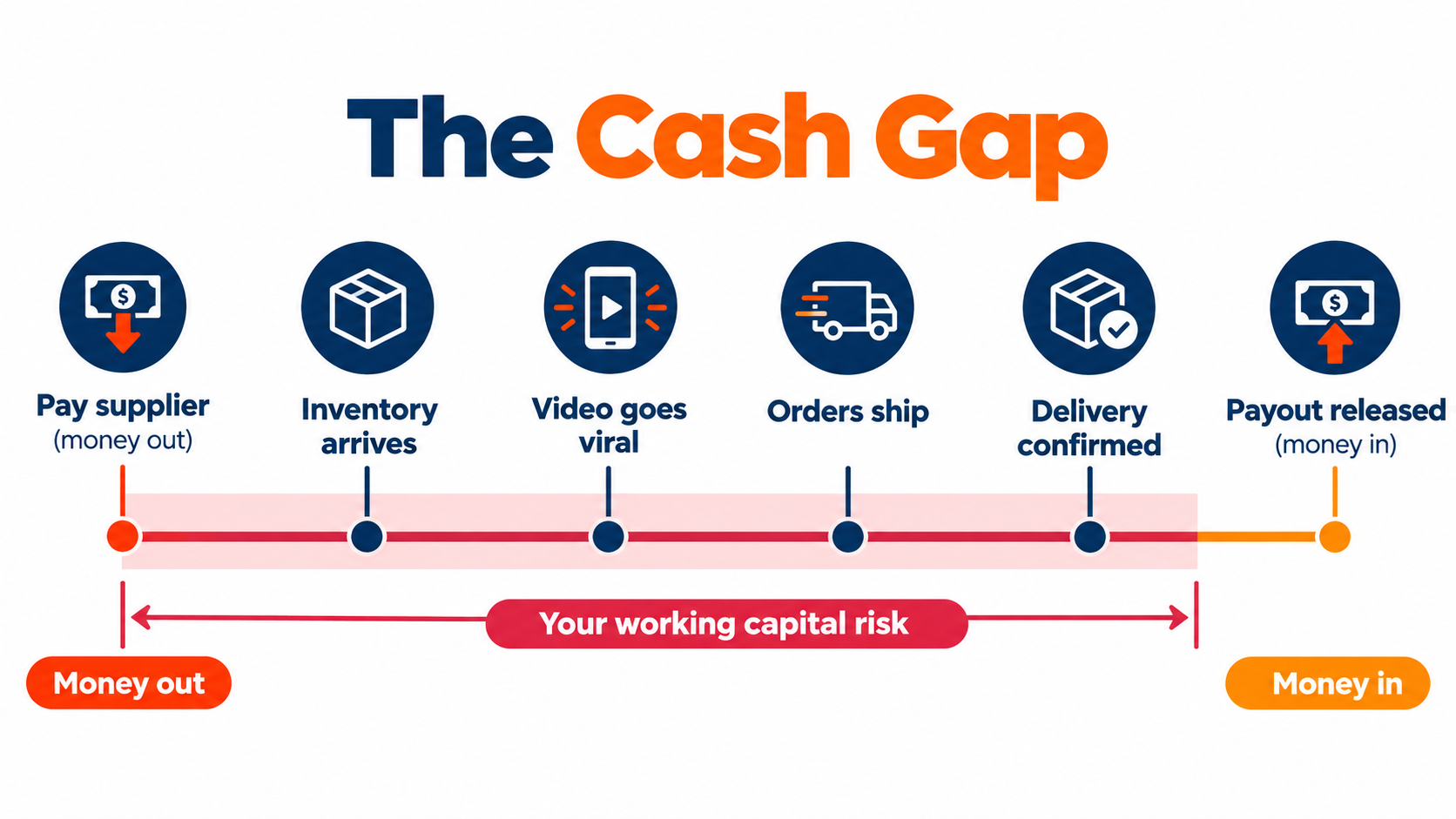
Follow the money through a spike:
- You paid for your current inventory weeks or months ago.
- The spike sells through that inventory in days.
- You need to place a large restock order right away, often with a deposit or full payment upfront, and possibly pay for air freight.
- Sales revenue from the spike isn’t available yet, because platform payouts are typically released after orders are delivered or after a settlement period.
- Meanwhile, you may be spending more on ads, samples, and temporary labor to handle the spike.
The result is a period, sometimes several weeks, where money is going out much faster than it’s coming in. A seller who doubled revenue can find they can’t pay for the restock that would let them keep selling.
Understand your payout timing
The first step is knowing exactly when TikTok Shop releases funds for your account. Payout schedules can depend on seller tenure, account standing, and fulfillment method, and they can change. Look up your current settlement terms in Seller Center and build them into your cash flow model. Don’t assume revenue turns into cash on the day of the sale.
Build a spike cash plan
Ways sellers manage the cash gap include:
- Cash reserve targets: Keep enough cash or available credit to fund at least one emergency restock of your top hero SKU.
- Supplier terms: Negotiate net payment terms or lower deposits with suppliers once you have a track record. Even partial terms shrink the gap.
- Revenue-based financing: Some e-commerce lenders offer financing tied to marketplace sales history. Compare costs carefully. Fast capital is often expensive capital.
- Ad spend discipline: Don’t pour ad money into a product you can’t restock. Scaling paid traffic toward limited inventory speeds up the stockout and deepens the cash crunch.
Model the spike before it happens
Build a simple spreadsheet model with scenarios for 5x, 20x, and 50x baseline demand. For each one, estimate revenue, restock cost, extra fulfillment cost, sample cost, ad spend, expected returns, and the timing of each cash inflow and outflow. The point isn’t precision. It’s knowing ahead of time which scenario would put you under water, so you can arrange financing or throttling rules before you need them.
LIVE Selling: Where Operations Happen in Real Time
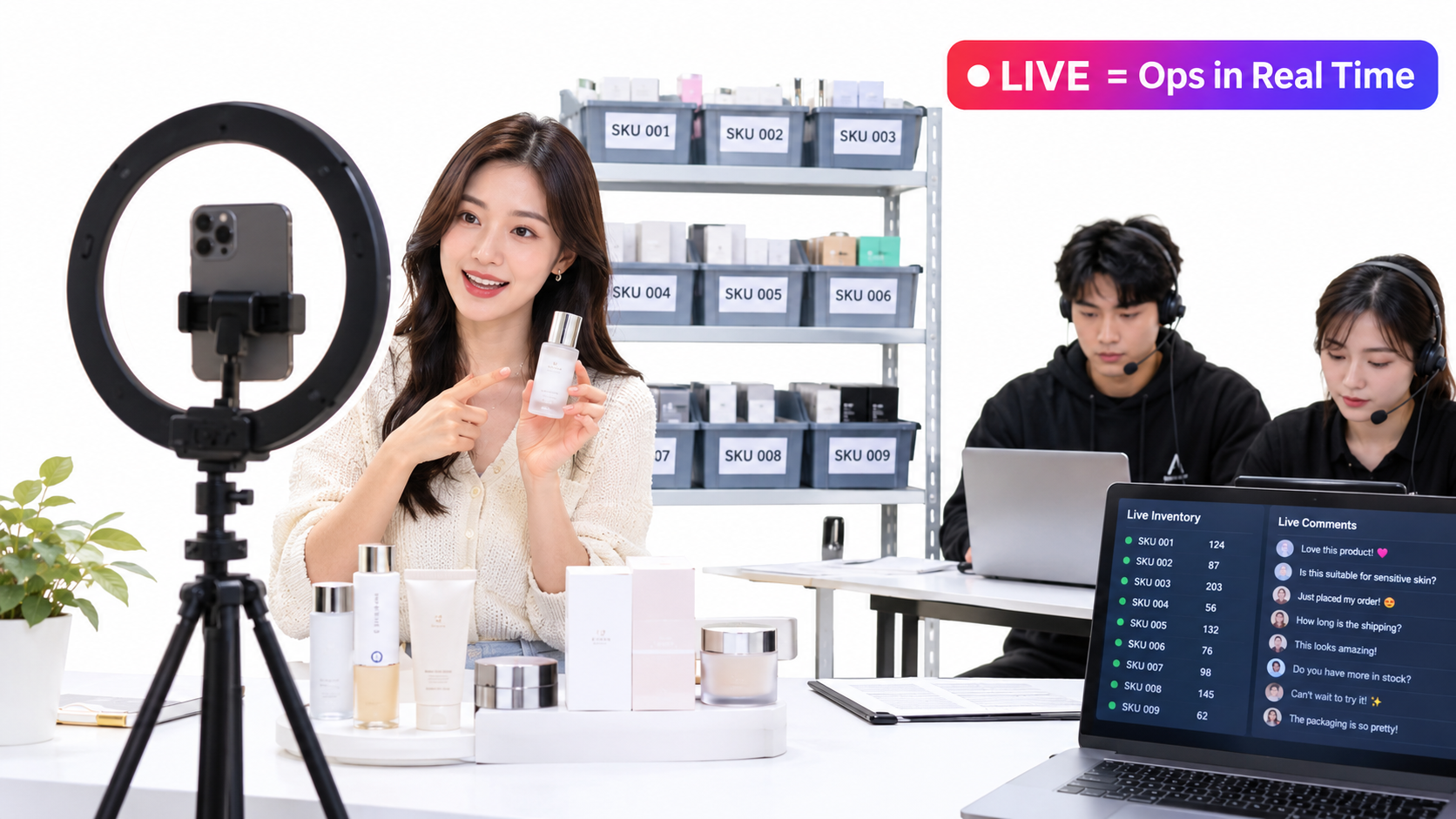
TikTok has invested heavily in live shopping. Ahead of the 2024 holiday season, the company described its live push as building “a full ecosystem because going live is not easy,” covering training for brands, agencies, and hosts. Adoption among US consumers is still developing. eMarketer data cited at the time found only 14% of US adults had bought something from a livestream. For sellers who run LIVE well, though, it’s a concentrated sales channel, and it’s an operations test that happens in real time.
LIVE is a mini-spike you schedule
A successful livestream creates a burst of orders in a short window, basically a small, planned viral moment. The difference is that you know when it’s coming. That makes LIVE a good training ground for spike operations. The same inventory, fulfillment, and customer service systems you build for LIVE will help you when an unplanned viral moment arrives.
Staffing a LIVE properly
Strong live sessions are usually run by a small team, not one host alone. Common roles include:
- Host: Presents products, demonstrates use, and keeps energy up.
- Producer or operator: Manages product pinning, flash deals, and timing from the back end.
- Moderator: Answers comment questions, removes spam, and passes important questions to the host.
- Inventory watcher: Tracks stock levels live and warns the team before a SKU sells out, so the host can pivot instead of promoting a product that’s gone.
That last role is often skipped, and it’s one of the most important for account health. Overselling during a live flash deal can create a burst of cancellations.
LIVE-specific inventory rules
Before each LIVE, set a clear allocation for each featured SKU. Decide how many units you’ll offer at the live price, what happens when they run out (end the deal, move to another product, or open a waitlist), and make sure inventory in the system matches what’s physically available. Limited quantities also create real urgency, which can help conversion, as long as the limits are honest and enforced.
Post-LIVE fulfillment
A two-hour LIVE can generate a day’s worth of orders or more. Make sure your fulfillment team or provider knows a LIVE is scheduled so they can staff up. Orders from a Friday evening LIVE that sit in a queue until Monday may put dispatch metrics at risk.
Turning a Spike Into a Higher Baseline
Surviving a viral week is one goal. Coming out of it with a permanently larger business is the bigger one. What happens during the decay phase decides whether a spike was a one-off or a step up.
Keep content supply going
Spikes fade when content runs dry. Sellers who build lasting baselines keep a steady stream of new affiliate content going after the peak. That means ongoing sample sends, re-engaging creators who performed well, and encouraging repeat posts. Your best-performing creators from the spike are your most valuable relationships. Consider better commission rates or exclusive offers to keep them posting.
Capture what worked
Right after a spike, while the details are still fresh, write down what happened:
- Which video or creator started it, and what made the content work?
- Which operational bottleneck hit first: inventory, packing, customer service, or cash?
- How long did each phase of the spike last?
- What was the net profit after returns, samples, fees, and extra costs?
- What would you do differently next time?
This post-mortem becomes the basis for your next spike plan. Sellers who go viral repeatedly usually have written playbooks built from earlier spikes.
Expand around the hero
A viral hero product is a customer acquisition channel for the rest of your catalog. Use the attention to introduce bundles, complementary products, and variants. Buyers who had a good experience with the hero, meaning it arrived on time and matched the video, are much more likely to come back. Buyers who had a bad experience won’t be.
Use the spike as a testing signal
TikTok Shop’s discovery-driven reach has made it a place where some companies test new products before sending them to other retail channels. A spike is market research at scale. It tells you which product features, price points, and messaging connect with a broad audience. Feed those findings into product development, packaging, and how you position the product on other channels.
The TikTok Shop Operational Readiness Checklist
Here’s a practical checklist that brings together everything above. Work through it before you need it. The best time to prepare for a viral week is during a slow one.
Inventory
- Catalog sorted into hero, supporting, and long-tail tiers.
- “Days of coverage at spike velocity” calculated for every hero SKU.
- Supplier surge terms negotiated, with draft emergency POs ready.
- Air freight costs and lead times known in advance.
- Throttling rules written down: at what coverage level do you pause ads or promotions?
Fulfillment
- Primary fulfillment model chosen, with a backup option identified.
- Surge staffing plan (for self-fulfillment) or surge capacity confirmed (for 3PL or FBT).
- Real-time inventory sync tested between your systems and TikTok Shop.
- Packaging materials stocked for at least a week of spike-level volume.
Account health
- Current performance thresholds reviewed in Seller Center.
- Daily metrics check scheduled during high-volume periods.
- Customer service reply templates written and ready.
- Order prioritization rules (oldest first, closest to deadline first) documented.
Affiliates and samples
- Monthly sample allocation set in units per SKU.
- Sample performance tracked: content rate, time to post, revenue per sample.
- Top creators identified, with a retention plan in place.
Returns and quality
- Quality control process for rush and backup-supplier restocks.
- Listing accuracy reviewed against actual product.
- Package inserts with usage guidance and a support contact.
- Net revenue tracked by spike period, including delayed returns.
Cash
- Current payout timing confirmed in Seller Center.
- Cash reserve or credit line sized for at least one emergency hero restock.
- Spike scenarios (5x, 20x, 50x) modeled for cash flow.
- Financing options researched and compared ahead of time.
LIVE
- Team roles assigned, including a dedicated inventory watcher.
- Per-SKU LIVE allocations set before every session.
- Fulfillment team told about LIVE schedules in advance.
Conclusion: Build the Operation Before You Need It
TikTok Shop has become one of the most powerful demand engines in e-commerce. The broader social commerce market is projected to pass $1 trillion by 2028, and TikTok Shop is widely expected to be a major part of that growth. But the thing that makes the platform so valuable, its ability to create sudden, huge demand through discovery, is also what makes it hard to run a business on.
The sellers who build lasting businesses on TikTok Shop aren’t always the ones with the best content. They’re often the ones whose operations can absorb a spike without breaking. They stay in stock or throttle on purpose. They ship on time. They keep account health clean, which keeps the platform sending them traffic. They manage cash so a profitable week doesn’t turn into a cash crisis.
If you take away a few things from this article, make it these:
- Plan for scenarios, not forecasts. You can’t predict a viral spike, but you can decide in advance how you’ll respond to one.
- Treat account health as a growth asset. Clean metrics during a spike help decide the size of your new baseline afterward.
- Run samples like inventory. Allocate them in units, track their returns, and time them around restocks.
- Count the full cost of a spike. Returns, samples, commissions, fees, and rush freight all belong in the profit calculation.
- Close the cash gap before it opens. Know your payout timing and have restock funding ready.
- Use LIVE as practice. Scheduled live sessions are low-risk rehearsals for unplanned viral moments.
The viral week will come for any seller with a good product and active creators. You can’t control when. You can control whether your operation is ready for it.