


Most TikTok Shop sellers who hear “GMV Sprint” picture a sale event: drop prices, push products, move units, done. That mental model is wrong — and it costs sellers real money in misallocated budget, burnt creator relationships, and disqualification from reward tiers they could have reached with better sequencing.
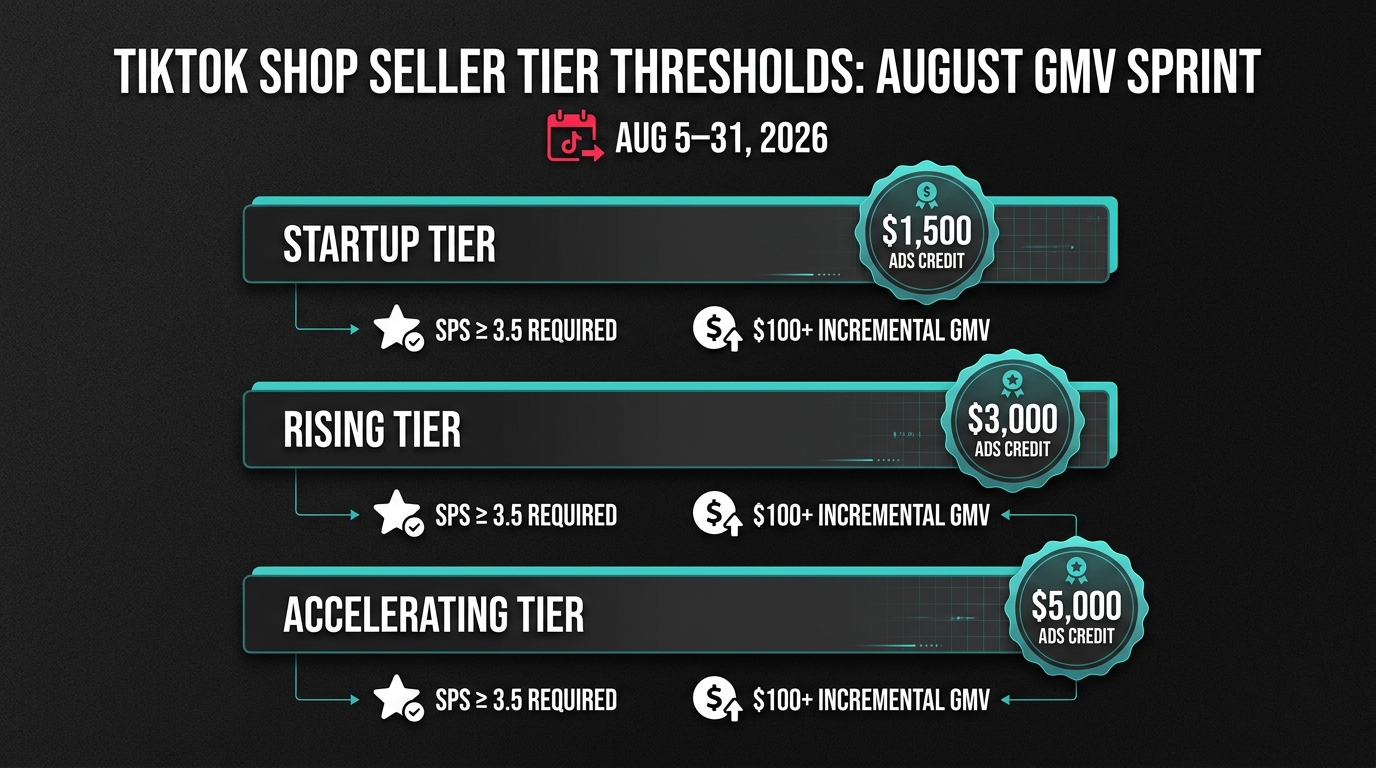
The August 2026 GMV Sprint runs from August 5 to August 31 and awards invited U.S. sellers up to $5,000 in TikTok Ads credit based on where they rank within their assigned seller group: Startup, Rising, or Accelerating. The prize isn’t attached to your gross sales number. It’s attached to your incremental GMV versus what you did in July. That one structural detail changes everything about how you should plan the month.
This article breaks down the mechanics that actually govern sprint eligibility, the product and channel decisions that produce outsized incremental lift, and the operational sequencing that separates sellers who collect their ads credit from sellers who leave it on the table. There’s no fluff here — just the math, the mechanics, and the execution decisions that matter inside a 27-day window.
TikTok Shop’s global trajectory provides useful context for why this sprint matters beyond its immediate reward: the platform crossed $50.3 billion in H1 2026 GMV, up 92% year-over-year, with U.S. GMV exceeding $7.5 billion in Q2 2026 alone. Full-year 2026 projections range from $112.2 billion to $123.5 billion globally. The platform is not a niche experiment anymore. August is one of the highest-demand months of the year, and the sprint structure is explicitly designed to reward sellers who attack it with a plan.
The Sprint Is Not a Sale Event — It’s a Structured Competition
The framing of the August GMV Sprint matters before any tactical decision gets made. TikTok has structured this as a ranked competition within tiers, not a participation reward. Sellers are sorted into groups — Startup, Rising, and Accelerating — and only the top performers within each group receive the maximum ads credit. That means your strategy isn’t just “sell more.” It’s “sell more than the other sellers in your tier bracket.”
This competitive framing has real tactical consequences. If you’re in the Rising tier, your primary question should not be “how do I hit my revenue target?” It should be “how do I generate more incremental GMV than the other Rising-tier sellers competing against me this month?” Those are different optimization problems with different answers.
What TikTok Is Actually Measuring
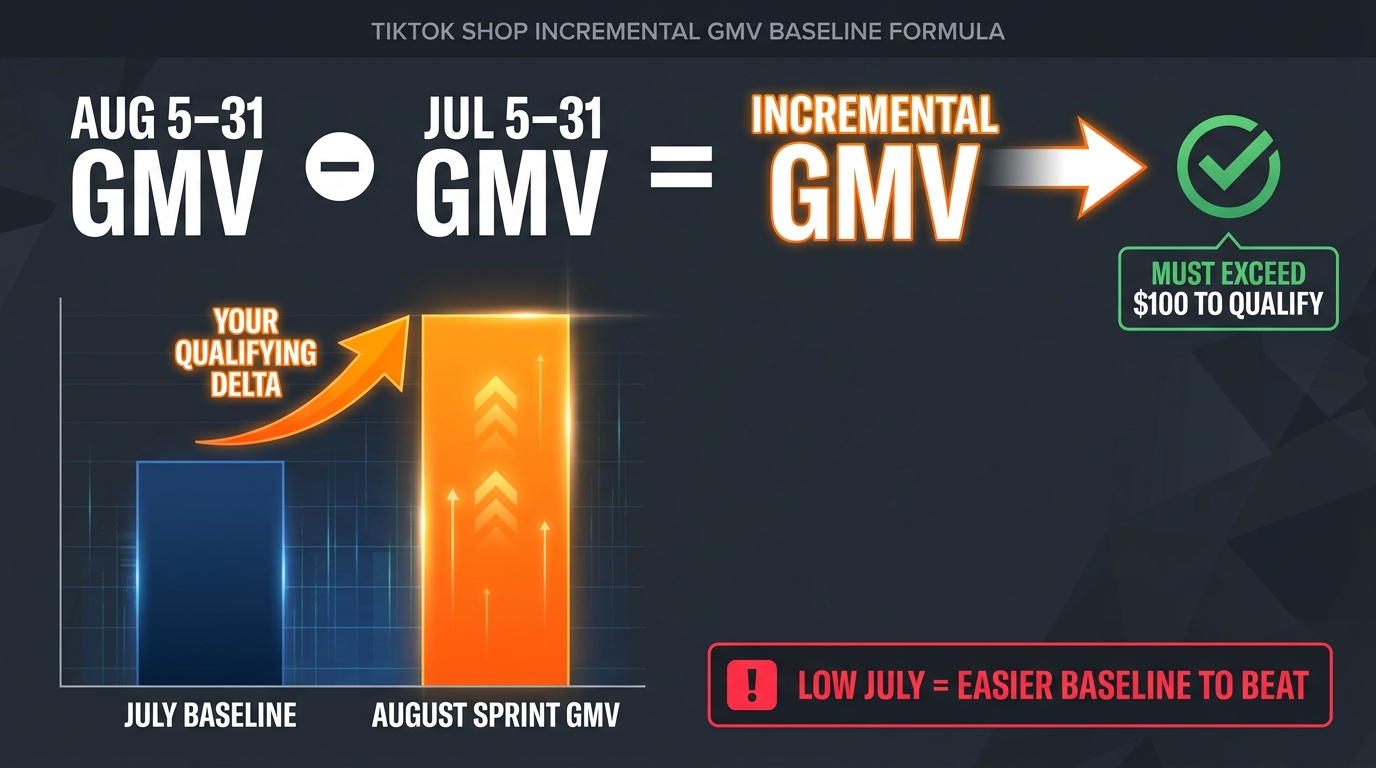
The sprint measures incremental GMV — specifically, the difference between your August 5–31 GMV and your July 5–31 GMV. Sellers need at least $100 in incremental GMV above the July baseline to qualify for any reward, and they must maintain an SPS (Seller Performance Score) of 3.5 or higher at campaign end. Ads credits are deposited to the linked primary ads account within 10 business days of the sprint’s close.
This design makes the sprint simultaneously accessible for smaller sellers (the $100 minimum is not a high bar) and deeply competitive at the top (the sellers who generate the largest relative lifts win the best credit tiers). It also means sellers who had a strong July face a tougher incremental baseline than sellers who had a quiet July — an asymmetry that experienced sprinters learn to factor into their pre-sprint July management.
The Tier Structure and What Each Bracket Signals
The Startup, Rising, and Accelerating groupings reflect a seller’s current scale and trajectory, not just their historical GMV. Being placed in Accelerating means TikTok already sees meaningful momentum in your shop — you’re competing against sellers who are also already growing fast. Being placed in Startup means you have less baseline drag to overcome but also less existing infrastructure (creator relationships, LIVE experience, ad account history) to deploy.
The smartest approach to tier positioning is to treat your bracket as a constraint and optimize within it, rather than trying to “punch up” by racing to a higher GMV tier mid-sprint. The platform calculates rank daily, but reward eligibility is determined at sprint close — which means steady, compounding daily incremental GMV beats erratic spikes that create unsustainable baselines for future sprints.
Decoding the Incremental GMV Formula Before You Touch a Single Setting
Before any seller opens their GMV Max dashboard, recruits a creator, or builds a flash sale, they need to sit with the incremental GMV formula and work through its implications clearly. The formula is simple: August 5–31 GMV minus July 5–31 GMV equals your qualifying incremental GMV. But the implications are not simple at all.
The Baseline Asymmetry Problem
The July 5–31 baseline period was set before most sellers knew this sprint was being planned. That means your July performance was largely unmanaged from a sprint-optimization standpoint. Sellers who had a heavy July promotional push — maybe they ran their own flash sales, over-indexed on paid ads, or had an organic video go viral — now face a higher baseline to beat. Sellers who had a quiet July have a much lower bar.
This creates a real planning insight for sellers who participate in recurring TikTok Shop sprints: how you manage the month before a sprint matters as much as how you manage the sprint itself. Sellers who understand TikTok’s sprint calendar in advance can deliberately moderate promotional activity in the baseline window to lower the threshold they need to beat — without compromising their core business health.
The Math Behind Minimum Qualification vs. Tier-Winning Performance
Qualifying for any reward requires $100 in incremental GMV. That’s a low bar — most sellers operating at meaningful scale will clear this without a dedicated strategy. The real question is how far above the baseline you need to go to rank in the top tier of your group.
While TikTok doesn’t publish exact percentile cutoffs for tier rankings, the structure implies that the sellers who win maximum credit are those who generate the highest percentage increase relative to their July baseline, not just the highest absolute GMV number. A seller generating $50,000 in August GMV against a $10,000 July baseline (400% increase) will likely outrank a seller generating $200,000 against a $180,000 July baseline (11% increase), even though the second seller has much higher gross revenue. This percentage-increment logic is important for mid-sized sellers who often underestimate their competitive position.
Channel Attribution in the Sprint Window
TikTok’s attribution model for sprint GMV counts sales from all channels: organic video, LIVE, paid GMV Max, and affiliate-driven sales. This is a crucial detail because many sellers over-invest in paid ads during sprints and underinvest in affiliate and LIVE channels, which often produce the highest incremental GMV at the lowest incremental cost. The sprint rewards GMV regardless of how it was generated — so channel mix should be decided based on cost efficiency, not comfort.
The SPS Floor: Why 3.5 Is the Real Entry Ticket to Everything That Matters
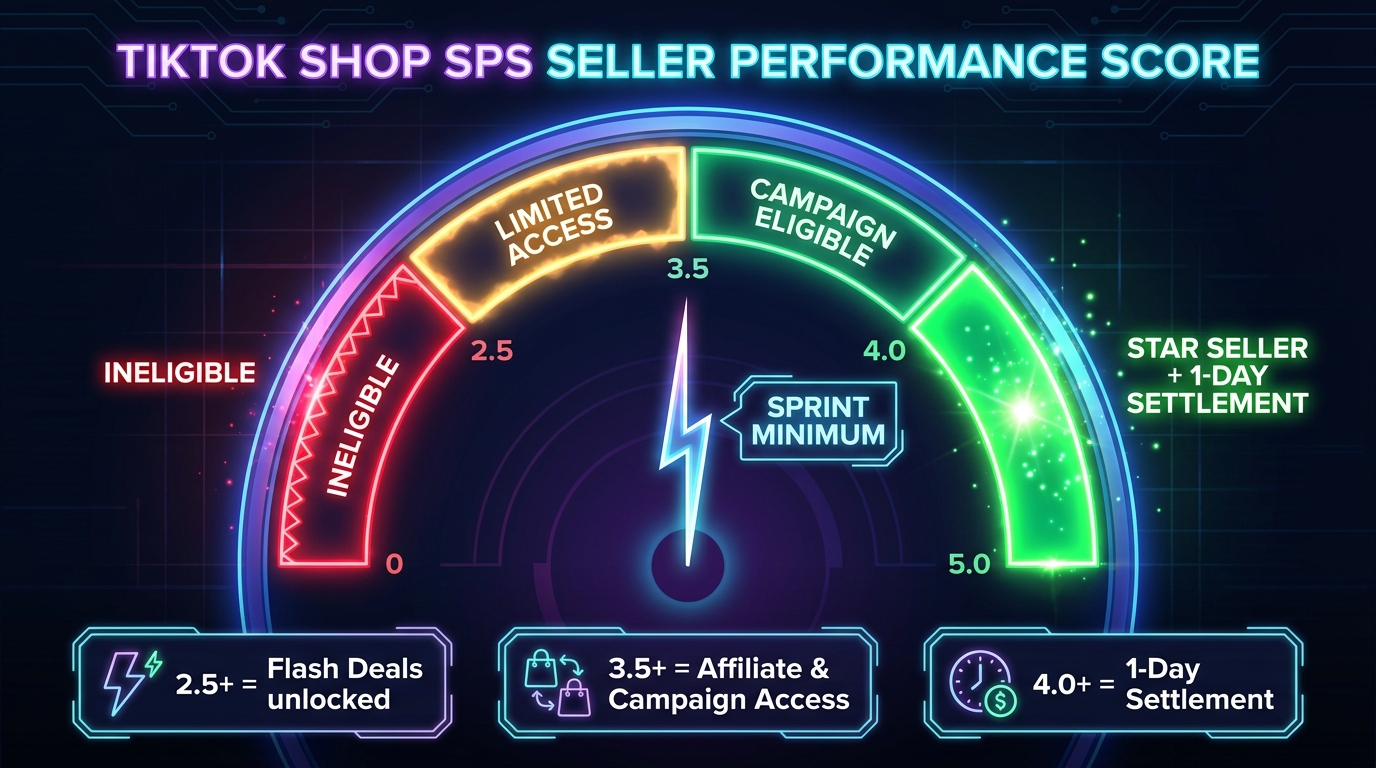
The Seller Performance Score is not a vanity metric. In the context of the August GMV Sprint, it is a hard eligibility gate — and it affects far more than sprint participation alone. Understanding what the SPS governs, how it’s calculated, and where most sellers bleed points is foundational to sprint preparation.
What SPS Actually Unlocks at Each Threshold
TikTok’s official thresholds in 2026 are structured as follows:
- SPS 2.5+: Unlocks access to Flash Deals. Below this level, you cannot run the promotional format that drives the concentrated velocity most sprint strategies depend on.
- SPS 3.5+: Required for Affiliate Marketing access, Campaign participation (including the August sprint), and qualifies the seller for 5-day settlement. This is the minimum viable threshold for a competitive sprint strategy — sellers operating below 3.5 at sprint launch are functionally excluded from the highest-leverage tools available.
- SPS 4.0+: Unlocks 1-day settlement and Star Seller eligibility. While not required for sprint participation, this level of SPS signals operational health that typically correlates with stronger organic visibility and affiliate creator confidence.
- Below 3.0: Existing campaign and affiliate benefits can pause or be removed. This is the floor that should trigger immediate remediation work before August 5.
How SPS Is Calculated and Where Sellers Lose Points
The SPS is a rolling score from 0 to 5, updated continuously, and built on three primary signal categories: product satisfaction (reviews, return rates, accurate descriptions), fulfillment and logistics (on-time shipping, order cancellation rate, tracking upload compliance), and customer service (response time, dispute resolution, complaint rate).
The most common SPS vulnerabilities among sellers preparing for a sprint are:
- Shipping lag on high-velocity SKUs: When a flash sale or viral video creates a sudden spike in orders, fulfillment timelines stretch. TikTok’s platform tracks this, and a single week of shipping delays can materially impact an SPS that looked healthy in a baseline period.
- Unresolved customer disputes: Sprints involve higher order volumes and often faster buying decisions, which can elevate dispute and return rates. Sellers who don’t have a proactive customer service protocol going into a sprint often find their SPS deteriorating during the exact window they need it most.
- Description accuracy gaps: When sellers add new SKUs quickly for sprint inventory, product descriptions are often rushed. Inaccurate descriptions produce returns and complaints that flow back into SPS calculations weeks later.
Pre-Sprint SPS Audit: What to Check Before August 5
Any seller planning to participate seriously in the sprint should run a five-point SPS audit in the week before the window opens: check open disputes and close or escalate them before the sprint begins; review shipping carrier performance over the previous 30 days and switch or add carriers if on-time rates are below platform benchmarks; audit the product descriptions on every SKU being promoted during the sprint; verify that tracking upload timelines meet TikTok’s requirements; and review customer message response times to ensure they meet TikTok’s thresholds. An SPS drop from 3.5 to 3.4 mid-sprint doesn’t just cost you comfort — it can cost you campaign access entirely.
Category Intelligence: Matching August Demand to Sprint Timing
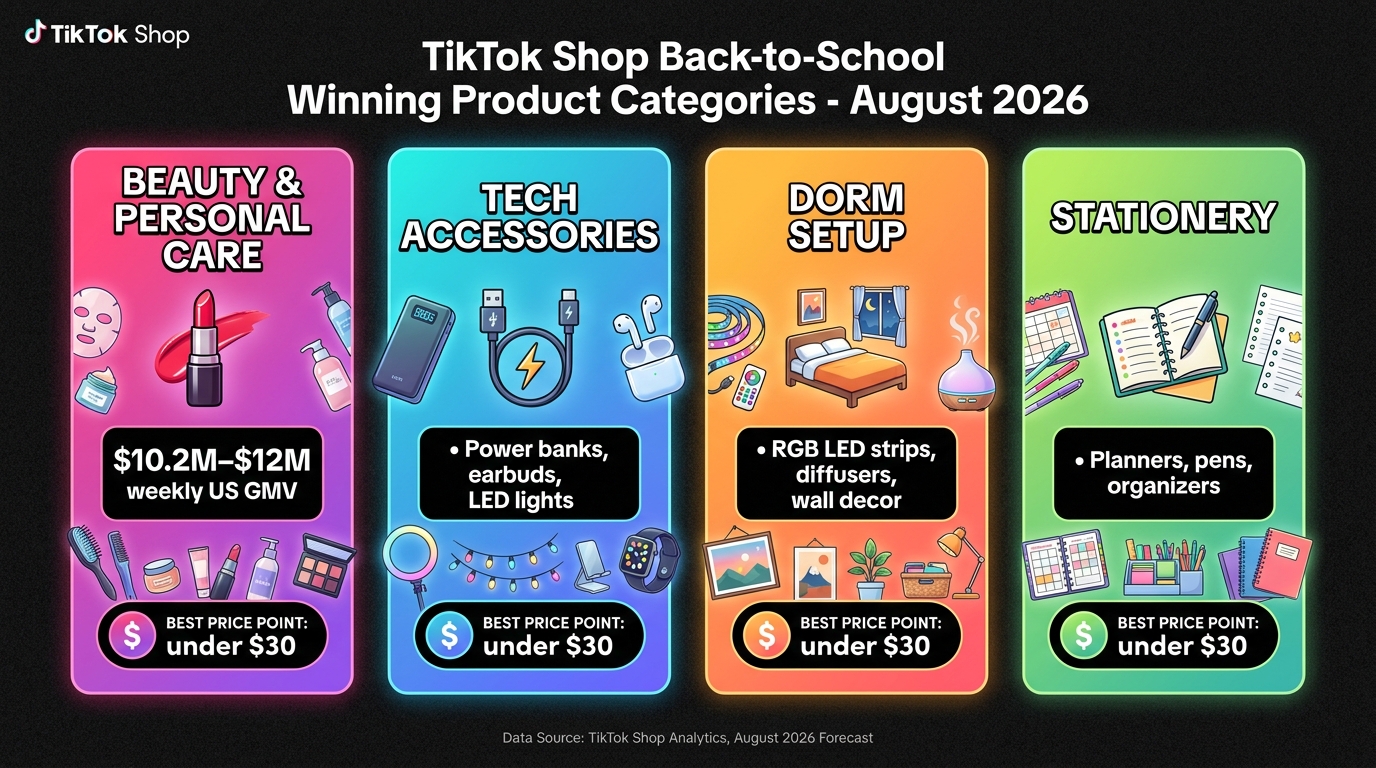
The August GMV Sprint runs inside one of TikTok Shop’s most predictable demand windows: the back-to-school and campus move-in season. TikTok’s own campaign data from the back-to-school push shows 6.3 million orders placed over five days, with 2.1 million users purchasing and 293,000 buying directly through livestreams. That demand concentration creates a product selection opportunity that smart sprint entrants exploit systematically.
The Four Categories with the Strongest August Demand Signals
Beauty and Personal Care is the strongest-performing category on TikTok Shop’s U.S. weekly rankings, generating an estimated $10.2 million to $12 million in weekly U.S. GMV and showing particular strength during back-to-school season. Skincare routines, lash products, hair tools, and grooming kits all index well with the 18-to-25 demographic that drives late July and early August campus prep purchases. These products have strong demo value in short-form content, are priced accessibly (most top-performers fall under $35), and generate high review velocity when they work.
Tech Accessories peak during the campus move-in window, with particular strength in power banks, USB-C hubs, cable organizers, earbuds, and LED lighting. These are considered purchases that college students plan in advance — meaning demand peaks in early August before move-in dates, not after. The implication for sprint timing is that tech accessory campaigns should be front-loaded into weeks one and two of the sprint window.
Dorm Setup and Room Decor — LED strip lights, motion-sensor night lights, diffusers, wall tapestries, laundry helpers — is a category defined by visual transformation. These products perform extraordinarily well on LIVE because the “before and after” room setup format is inherently watchable. They’re also affordable, often under $25, which means impulse purchase rates are high when urgency is created correctly.
Stationery and Organization — planners, notebooks, desk organizers, highlighter sets — is a lower-GMV-per-unit category but one with remarkable volume potential. Sellers who bundle stationery items (e.g., a study bundle with a planner, pens, and a wall calendar) can increase average order value while serving a category with clear, searchable intent. Back-to-school search traffic for organizational products peaks in the first two weeks of August, aligning neatly with the sprint window’s opening phase.
Price Point Strategy for Sprint Velocity
Across all four categories, the $20–$35 price band consistently produces the highest conversion rates on TikTok Shop’s in-app checkout. Products in this range clear the impulse-purchase threshold without requiring significant deliberation, especially when a creator demo or flash sale discount creates urgency. For sprint purposes, this means sellers with products outside this range should consider whether bundle pricing or limited-time discount structures can bring the effective purchase price into this window for the August period.
Products priced above $75 typically require more consideration time, longer creator content, and more social proof — all of which take longer to generate than the 27-day sprint window allows. Higher-ticket items can certainly contribute to sprint GMV, but they are harder to ramp quickly and should not be the primary vehicle for generating incremental volume during a short competitive window.
GMV Max During a Sprint: Feeding the Machine Without Burning Budget
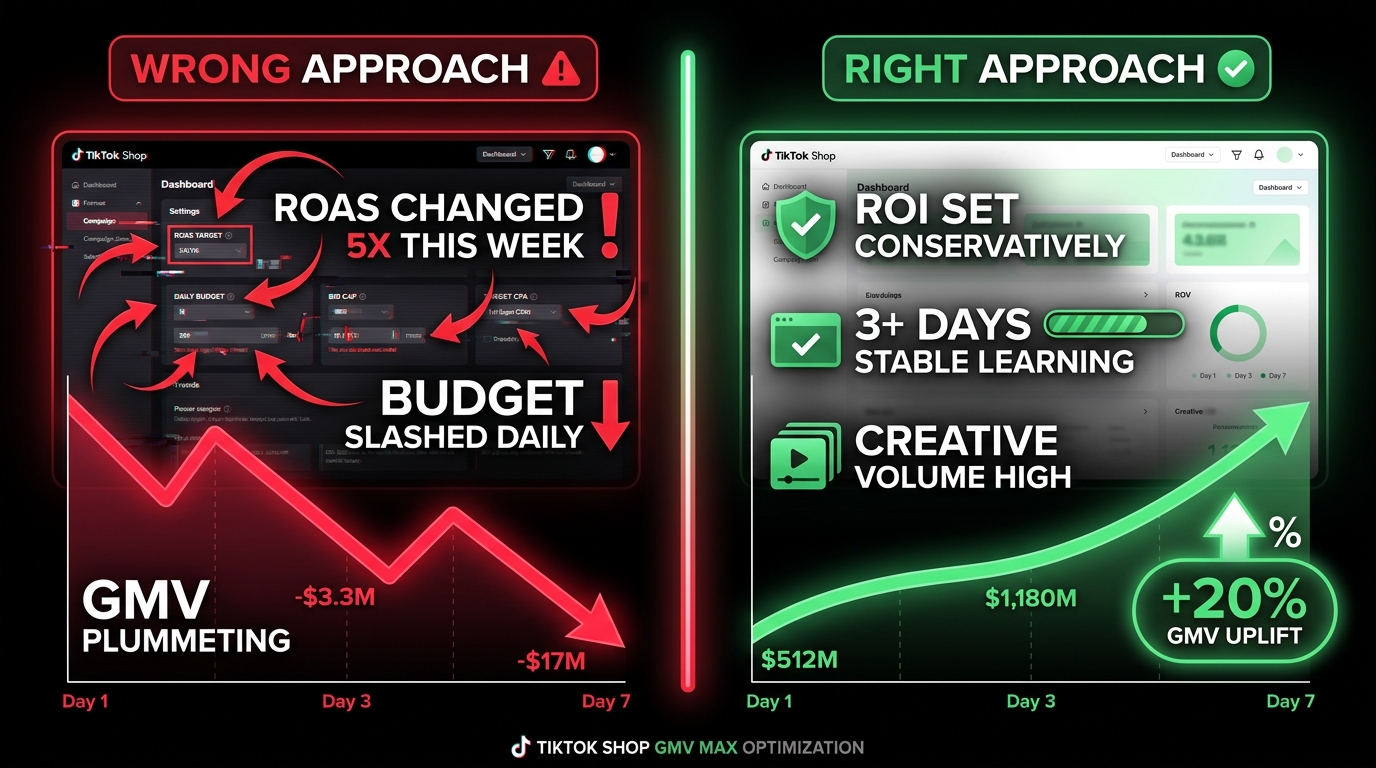
GMV Max is TikTok’s automated ad format that allocates budget across organic video, paid placements, and affiliate content simultaneously — using a single ROI target to govern how aggressively it bids. It is the highest-leverage paid lever available during a sprint, and also the easiest to mismanage in ways that compound negatively over the 27-day window.
How GMV Max Works Under Sprint Conditions
The system’s core behavior is straightforward: set a target ROI, give it budget and eligible products, and it distributes spend to the placements most likely to generate purchases at or above your target return. TikTok’s own early test data reported approximately a 20% GMV uplift from GMV Max in controlled conditions — but that figure comes with important asterisks that sellers frequently miss.
The 20% uplift appears in scenarios where sellers gave the system adequate learning time (at least 3 full days of stable ROI settings), sufficient budget to avoid throttling, and a meaningful library of creative assets (affiliate and creator videos) for the system to optimize across. When any of these conditions aren’t met, the system underperforms significantly.
The Three GMV Max Mistakes That Kill Sprint Performance
Frequent ROI target changes: TikTok’s official guidance explicitly warns against changing the ROI target more often than every three days. Every time you modify the target, the system resets its learning and begins reallocating from scratch. In a 27-day sprint, a seller who adjusts their ROI target weekly creates roughly four distinct learning restarts — meaning the system may never fully optimize before the sprint closes. Set your opening ROI conservatively (below your actual profitability goal), let it learn for at least three days, then make a single modest adjustment if needed.
Budget restrictions that cause delivery gaps: A campaign that runs out of daily budget by 2 PM loses the evening window — which is TikTok Shop’s highest-conversion time of day. Sellers who set budgets based on average daily spend from non-sprint periods routinely under-budget for the higher-demand August environment. The practical fix is to increase daily budget by 30–40% at sprint launch and monitor delivery rates in the first 48 hours. If the system is not spending close to the full budget, that usually signals an overly restrictive ROI target, not excess budget.
Thin creative libraries: GMV Max performs best when it has a variety of video assets to test — different creators, different formats, different product angles — and can learn which performs best for each audience segment. Sellers who enter the sprint with two or three creator videos give the system very limited optimization surface. The practical threshold is a minimum of eight to ten distinct video assets across at least three to four different creators. More is genuinely better here, and this is a strong argument for starting affiliate creator recruitment well before August 5.
Sprint-Specific GMV Max Sequencing
A structured GMV Max approach for the sprint looks roughly like this: launch on August 5 with a conservative ROI target and at least eight creative assets loaded. Review delivery data on days 3 and 4. If spend is healthy and GMV is tracking, hold settings and add new creative assets (not change settings). If spend is significantly under budget, reduce the ROI target slightly on day 4. Allow the campaign to run without further changes until the midpoint (approximately August 17), then review overall performance and make a single ROI adjustment if cost efficiency has improved. Do not touch settings in the final five days of the sprint — the system needs stability to capture the late-August demand peak.
The Creator Flash Sale Architecture: Structuring LIVE Moments for Velocity
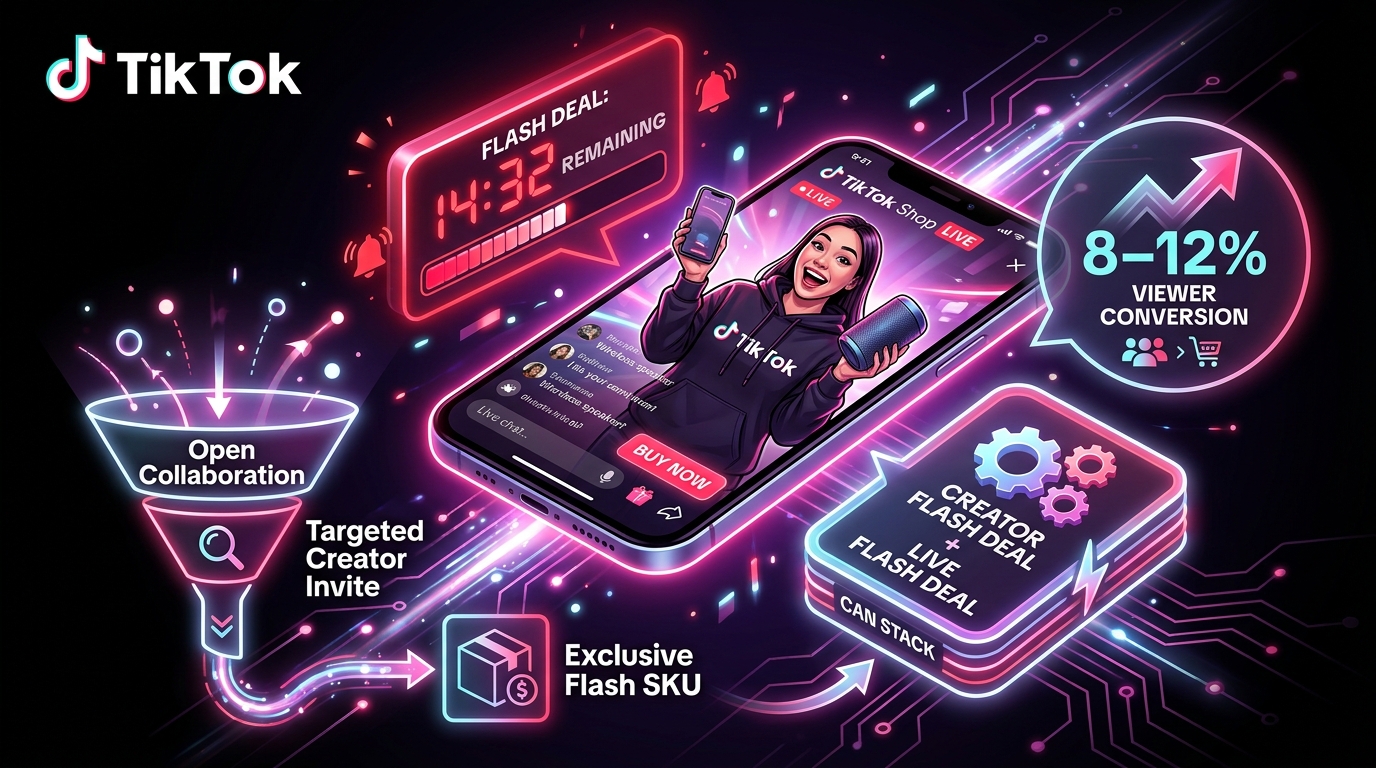
LIVE shopping is TikTok Shop’s highest-converting format, and its conversion advantage over standard in-feed or shop-tab traffic is not marginal — it’s structural. Well-run TikTok Shop LIVE sessions convert 8% to 12% of unique viewers into buyers, compared to the platform’s broader average conversion rate of approximately 3.2% to 4.7%. Inside a sprint window where every incremental GMV dollar counts, this gap is enormous.
How Creator Flash Deals Work in 2026
TikTok’s Creator LIVE Flash Deal mechanic allows sellers to create exclusive time-limited deals triggered during a creator’s live session. These can run from as short as 10 minutes to as long as 10 days, but the highest conversion events are the short, high-urgency windows. The feature requires a Targeted invitation — you can only invite one creator per flash deal — and that creator must have LIVE access enabled on their account.
The most important update to this mechanic in 2026 is the stacking allowance: Creator LIVE Flash Deals can now be combined with platform-level LIVE Flash Deals, with the creator’s deal applied first and the platform’s deal layered on top. This means a well-structured flash sale can apply multiple discount layers simultaneously, creating an effective price reduction that appears dramatically more compelling to viewers without each individual discount being deep enough to destroy margins.
Building an Effective LIVE Flash Sale for a Sprint Window
The anatomy of a high-converting sprint LIVE session involves more than just showing up on camera with a product. The structural elements that consistently drive conversion are:
- Urgency architecture: The countdown timer is the single most important conversion tool in LIVE shopping. Sessions that feature an active, visible countdown for a Flash Deal running in real time consistently outperform sessions that describe deals verbally. Set up the Flash Deal before the session begins so the countdown is visible from the moment viewers join.
- Product-host fit: The creator demonstrating the product needs to be a credible user of the product, not a general entertainer. Skincare sold by a creator whose audience follows them for skincare content converts dramatically better than the same product sold by a lifestyle creator with a tangentially related audience. This is the most under-weighted variable in creator selection for flash sales.
- Social proof concentration: During the LIVE session, surface your best reviews, show real photos from customers, and — if available — display a running unit count to create social validation. Viewers who see that 847 other people have already purchased convert at higher rates than those who see no purchase signal at all.
- Session timing: TikTok Shop’s highest-engagement windows are early evening on weekdays (approximately 7–9 PM local time) and mid-afternoon on weekends. For the back-to-school demographic, late afternoon sessions on school preparation days (particularly Sundays in August) align well with the shopping mindset of campus-bound buyers and their parents.
Scheduling LIVE Flash Events Across the Sprint Window
For a 27-day sprint, the optimal LIVE flash sale schedule is not daily sessions — that creates creator fatigue and audience desensitization to urgency signals. A more effective cadence is two to three high-intensity LIVE events per week, each structured around a specific product focus or back-to-school theme (dorm setup week, campus beauty week, study organization week). This allows each event to feel distinct, drives fresh audience participation, and gives the GMV Max system meaningful LIVE traffic spikes to amplify with retargeting.
Affiliate Recruitment at Sprint Speed: Open vs. Targeted Collaboration
Affiliate-driven sales account for approximately 42% of U.S. TikTok Shop GMV — which means any sprint strategy that relies primarily on paid ads without a parallel affiliate arm is leaving nearly half of the platform’s GMV engine idle. The sprint window is short, but affiliate recruitment doesn’t have to be slow if it’s approached with the right framework.
The Two Collaboration Tracks and When to Use Each
TikTok Shop’s affiliate system offers two primary collaboration structures: Open Collaboration and Targeted Collaboration. Understanding when to deploy each is foundational to sprint-speed affiliate recruitment.
Open Collaboration makes your products available for any qualifying creator to pick up and promote without individual negotiation. It’s the volume play: it generates a long tail of creator content across many micro-creators, distributing reach broadly and producing consistent baseline affiliate GMV. For sellers who are new to TikTok Shop affiliates or who have not built a creator roster, Open Collaboration is the right starting point — it should be activated before the sprint begins and maintained throughout.
Targeted Collaboration is where sprint-specific performance is won. This allows you to personally invite specific creators, offer higher commission rates, provide product samples, and negotiate exclusive flash sale participation. The mechanics require individual invitations, but the return on investment for the right creator pairing can be 10 to 20 times higher than the same budget spent on Open Collaboration commissions alone.
How to Build a Sprint Creator Roster in Under Two Weeks
Sprint affiliate recruitment has a practical timeline: creators selected via Targeted Collaboration need time to receive samples, create content, and schedule their LIVE sessions. For an August 5 sprint start, creator recruitment should begin no later than July 22. By July 25, sample shipment should be confirmed. By August 1, initial content should be reviewed and approved. By August 5, the first creator campaigns should be live.
Selection criteria for sprint creators should weight three factors above all others: recent LIVE conversion history (ask for or research their average LIVE session conversion rate), audience-product fit (not just niche overlap but specific purchase behavior evidence), and reliability on timing (a creator who consistently goes LIVE on schedule is worth more during a short sprint than one with higher follower counts but erratic scheduling). Commission rates for sprint-specific targeted creators should be set 3–5 percentage points above your standard open rate to incentivize prioritization during the high-volume August window.
Commission Structure for Sprint Velocity
A tiered commission structure works well during sprint windows. Offer a base commission (your standard rate) for any sale, a performance bonus commission for creators who generate more than a defined threshold in August GMV (e.g., 5% bonus for creators who drive $2,000+ in sprint GMV), and a bonus sample or exclusivity arrangement for the top one or two creators who generate the most sprint-period revenue. This creates competitive incentives among your creator roster without locking in permanently elevated commission structures that hurt margins after the sprint ends.
Listing Conversion Hygiene: The Pre-Sprint Audit Most Sellers Skip
Sellers who focus entirely on traffic acquisition during a sprint often overlook the fact that conversion rate is equally important to GMV. If your listing converts at 2% and a competitor’s listing converts at 5%, they generate 2.5x your GMV from the same traffic volume — meaning they’re winning the sprint competition while spending the same amount on creator and ad activation. Pre-sprint listing optimization is the highest-leverage, lowest-cost work available, and it takes two to three days, not two to three weeks.
The Listing Elements That Actually Move Conversion
TikTok Shop’s current conversion benchmarks establish a useful baseline: listing-level conversion below 3% is a warning sign warranting immediate attention; 5–8% is considered strong for in-app checkout listings; 8–12% is the high-end benchmark specifically for LIVE traffic. The gap between these ranges is largely determined by a handful of listing elements that sellers can control directly.
Title optimization: TikTok’s own guidance recommends keeping titles under 80 characters and front-loading the primary keyword and key benefit in the first 30–40 characters. On mobile, titles are truncated quickly — the first few words need to communicate both what the product is and why it’s relevant. Titles that lead with the product type and its primary differentiator consistently outperform titles that lead with brand names or generic descriptors.
Hero image quality: The first image in your product listing is the primary conversion driver for browse and search traffic. It should show the product in use, not in isolation on a white background. Lifestyle hero images that demonstrate the product’s benefit in a recognizable context (a clean dorm room setup, a makeup look, an organized study desk) consistently outperform white-background product shots on TikTok Shop, where visual context drives emotional purchasing decisions more than specification comparison.
Review count and recency: TikTok Shop’s algorithm weights review volume and recency in product visibility calculations. Sprinting into August with zero reviews on a newly added SKU puts that product at a structural conversion disadvantage versus competitors with established review histories. If you’re adding new products for the sprint, prioritize getting initial review coverage — via your existing customer base, early sample recipients, and creator partners — before the sprint window opens.
Video content on the listing page: Product listing videos that show a 15–30 second demo of the product in use drive measurably higher add-to-cart rates than listings with images only. For sprint products, this video is worth creating specifically — it doesn’t need production value, it needs demonstrability. Show the product being used, the result it produces, and — ideally — a brief reaction from a real user.
The Incremental GMV Trap: Avoiding the Mistakes That Shrink Your Qualifying Delta
The incremental GMV model contains several traps that sellers walk into without realizing it. Understanding them in advance is the difference between running a high-effort sprint that qualifies for minimal reward and running a focused sprint that maximizes your position within your tier.
The Over-Discount Trap
When sellers apply heavy discounts to drive unit volume, they increase order count and reduce average order value simultaneously. In a GMV competition, discounts are a double-edged instrument: they can increase units sold, but if average order value falls faster than units rise, net GMV can actually decline. Sprint strategies that rely on deep discounting across the entire catalog — rather than targeted flash sale discounts on specific SKUs — often produce disappointing incremental GMV results because the discount-to-volume math doesn’t favor broad price cuts.
The more effective approach is to run targeted flash discounts (15–25% off) on a small number of high-velocity SKUs during specific LIVE windows, while maintaining or even slightly increasing prices on your catalog’s other products during the sprint period. This concentrates volume without compressing overall GMV per order.
The Traffic-Without-Conversion Trap
Paid advertising that drives product page visits without purchasing creates impression costs without incremental GMV credit. During a sprint, sellers should monitor their store-level conversion rate daily. If traffic is rising but conversion is flat or declining, the marginal spend on additional traffic is not generating proportional GMV — and would be better redirected to listing quality improvements or creator-driven LIVE sessions that convert at higher rates inherently.
TikTok’s Seller Center should be your attribution source of truth during the sprint, not Ads Manager alone. Seller Center captures organic, affiliate, and paid-attributed GMV in a unified view that gives a more accurate picture of which channels are actually contributing to the incremental GMV that determines your sprint rank.
The New SKU Ramp Trap
Launching brand-new SKUs during a sprint feels intuitively correct — new products, new revenue. In practice, new SKUs take 7–14 days to accumulate the review signals, search index positions, and creator content volume needed to convert at competitive rates. A new product launched on August 5 will still be in its ramp phase at August 31, which means it may contribute minimal sprint GMV despite significant activation investment.
New SKU launches are better timed for early July — before the sprint baseline period closes — so that the product has already accumulated some initial performance history, review coverage, and creator content by the time August 5 arrives. Products with 3–4 weeks of history convert meaningfully better than day-one launches, particularly in competitive back-to-school categories where established listings with reviews have a clear search visibility advantage.
Post-Sprint Asset Capture: Turning 27 Days of Velocity into 90 Days of Compounding
The August GMV Sprint ends on August 31, but the assets it produces — creative content, creator relationships, review volume, ad account learning, and algorithm signals — have value that extends well into Q4. Sellers who treat the sprint as a standalone event and then disengage from its infrastructure after the close date lose the majority of the sprint’s long-term value. Sellers who deliberately capture and redeploy sprint assets build a compounding advantage that makes each subsequent sprint more efficient.
Creative Asset Inventory After the Sprint
By August 31, a well-executed sprint will have generated a library of creator videos, LIVE session recordings, product demo clips, and customer-generated content. This library is worth systematically cataloging. Sort the content by conversion rate (which videos drove the highest click-through and purchase rates during the sprint), by creator, and by product. The top-performing 20–30% of this content should be kept in active rotation in GMV Max creative through September and October, when the algorithm can continue learning from high-performing assets without the cost of new production.
Creator Relationship Formalization
Sprint creators who performed well — defined as driving consistent GMV through the 27-day window with reliable scheduling and professional content — should be transitioned from sprint-specific Targeted Collaboration arrangements to ongoing longer-term partnership agreements before September 1. The leverage to negotiate favorable ongoing terms is highest immediately after the sprint closes, when both parties have fresh performance data and the relationship momentum is active. Waiting until October to have this conversation means recreating context that was available for free in early September.
Review and Social Proof Consolidation
A high-GMV sprint generates proportionally high review volume. The weeks immediately following August 31 are when sprint-period orders complete their experience and leave reviews. This is the highest-review-velocity period your sprint products will see until the next major campaign. Prioritize customer follow-up during September to capture these reviews actively — even a modest increase in review response rate from post-sprint buyers can create lasting listing quality improvements that benefit organic search visibility through the holiday season.
Ad Account Learning Retention
One of the least-discussed sprint benefits is what GMV Max learns during the sprint period. After 27 days of accelerated data — more conversions, more creative assets tested, more audience segments explored — the ad account contains valuable optimization intelligence. Sellers who dramatically reduce budget after the sprint closes effectively waste this intelligence by starving the account of the conversion volume needed to maintain its learned optimization state. A more effective approach is to maintain 60–70% of sprint-level spend through September, then ramp deliberately for Q4 peak season from an account that never lost its sprint-trained performance baseline.
A Realistic Sprint Week-by-Week Schedule
Turning these principles into operational reality requires a concrete schedule. The following framework assumes a seller in the Rising tier with an existing creator roster, an active GMV Max account, and at least five sprint-eligible SKUs. It’s not a template to copy blindly — it’s a structure to adapt based on your specific baseline GMV, category, and creator relationships.
Pre-Sprint: July 22 – August 4
Run SPS audit and remediate any gaps. Lock in Targeted Collaboration creator invitations and confirm sample shipment dates. Configure Flash Deals for sprint launch SKUs. Load minimum eight creative assets into GMV Max. Review and update listing titles, hero images, and video content for all sprint-featured SKUs. Confirm fulfillment capacity for an expected 2–3x volume increase versus July baseline.
Week One: August 5–11
Launch GMV Max with conservative ROI target. Run the first LIVE flash sale event (targeting back-to-school dorm setup angle). Monitor daily incremental GMV versus July baseline. Do not adjust GMV Max settings. Activate Open Collaboration for all sprint SKUs if not already active. Begin collecting early session data to identify highest-converting products.
Week Two: August 12–18
Review GMV Max delivery rates and make a single ROI adjustment if under-delivering. Run two LIVE flash sale events (beauty and tech accessories angles). Add any new creator content to GMV Max creative library. Push incremental review follow-up for week-one buyers. Assess mid-sprint incremental GMV position versus tier competition and adjust budget allocation accordingly.
Week Three: August 19–25
Hold GMV Max settings stable. Run two LIVE events with highest-converting creators from weeks one and two. Begin creator performance review to identify post-sprint retention targets. Concentrate stacked discount offers (Creator LIVE Flash Deal + platform LIVE Flash Deal) in this window to maximize late-sprint conversion rate. Continue monitoring SPS daily.
Final Days: August 26–31
Do not change any GMV Max settings. Run a final LIVE flash sale event with maximum creator involvement and urgency positioning. Monitor SPS to ensure it stays above 3.5 through campaign close on August 31. Confirm that active shop status is maintained. Begin drafting post-sprint asset capture plan for September activation.
Conclusion: The Sprint Rewards Preparation, Not Panic
The August 2026 GMV Sprint is a structured competition with clear rules, clear eligibility gates, and clear reward tiers. But it punishes sellers who approach it as a reactive sale event and rewards those who treat it as a 27-day execution against a pre-built operational plan.
The sellers who will collect $5,000 in ads credit from the Accelerating tier are not the ones who launch the most products or run the deepest discounts. They’re the ones who entered August 5 with a clean SPS above 3.5, a loaded GMV Max creative library, a scheduled LIVE calendar with confirmed creator partners, and a clear understanding of their July baseline — so they knew exactly how much incremental GMV they needed to generate and in which channels to generate it most efficiently.
The back-to-school demand window, the 92%-YoY platform growth trajectory, and the $112 billion global GMV backdrop all point in the same direction: this is a high-leverage moment on a high-growth platform. The structural details — incremental measurement, SPS gates, tier competition, attribution across channels — exist not to create obstacles but to reward sellers who do the preparation work that less attentive competitors skip.
The playbook is not complicated. The execution is. And the 27-day window is already running.
Key Takeaways
- The sprint measures incremental GMV (August minus July), not gross sales — your July baseline is as important as your August execution.
- SPS 3.5 is a hard eligibility gate — run an audit before August 5 and remediate any gaps in fulfillment, disputes, or response times.
- GMV Max needs stability — set a conservative ROI, load minimum 8 creative assets, and avoid changing settings more often than every 3 days.
- LIVE converts 2–4x better than standard listings — run 2–3 structured LIVE flash events per week, not daily.
- Affiliates drive 42% of U.S. TikTok Shop GMV — start Targeted Collaboration recruitment two weeks before the sprint opens.
- Back-to-school demand peaks in early August — front-load tech and dorm setup category campaigns into weeks one and two of the sprint.
- Post-sprint asset capture is not optional — the creator relationships, creative library, and ad account learning built during 27 days of accelerated spend are worth more than the ads credit reward itself if retained and redeployed correctly.