




Here is the pitch TikTok gives you about GMV Max: connect your catalog, set a budget, choose a target ROI, and the algorithm does the rest. It maximizes your Gross Merchandise Value automatically. No bidding decisions, no placement juggling, no manual audience work. Just results.
Here is the reality: GMV Max is not a campaign type. It is a data collection and signal-ranking machine that decides — entirely on its own — which of your products deserve distribution, which creatives are worth amplifying, and which sellers have earned the algorithm’s trust. If you do not understand what it is actually measuring, you are essentially renting a car you do not know how to drive and blaming the road when you crash.
By mid-2026, GMV Max became the default and only supported campaign type for TikTok Shop advertising, replacing Video Shopping Ads, Product Shopping Ads, and manual bidding structures entirely. This was not just a product update — it was a fundamental repositioning of how commerce works on TikTok. The platform is no longer asking advertisers to manage media. It is asking them to feed a system that has its own logic, its own priorities, and its own definition of what a “good” product looks like.
This article is a practical dissection of that logic. Not the version TikTok publishes in its help center, but the version you reconstruct by studying how the system actually behaves — what it rewards, what it penalizes, where it over-reports performance, and how sophisticated operators structure their accounts to work with the algorithm rather than against it.
If you have already read primers on TikTok Shop SEO or basic algorithm overviews, this goes significantly deeper. The goal is to give you a working mental model of GMV Max’s signal architecture so you can make better decisions at every layer — catalog, creative, campaign, and budget.
What GMV Max Actually Is (And What It Is Replacing)
Before diving into the mechanics, it helps to understand what came before. Prior to GMV Max’s dominance, TikTok Shop advertisers could run Video Shopping Ads and Product Shopping Ads with manual bidding, defined audiences, and explicit creative selections. It was a media-buying model — one where human decisions drove most of the optimization work.
GMV Max dismantles that structure almost entirely. It operates more like Google’s Performance Max than any traditional social ad format: you provide inputs (catalog, budget, creative assets, target ROI), and the system controls everything else — which audiences see your ads, which placements get budget, which products are pushed at any given moment, and which creative variations are served.
The Three Inputs That Actually Matter
Despite the “automated” framing, GMV Max is not truly a black box. It has inputs, and those inputs are highly consequential. The three that matter most are:
- Your product catalog and its health signals: This is the raw material the algorithm works with. A catalog full of out-of-stock SKUs, thin listings, or products with poor conversion history constrains what GMV Max can do before a single dollar is spent.
- Your creative supply: GMV Max uses all available video and image content — brand videos, affiliate creator content, Spark Ads — as its creative inventory. The quality, volume, and diversity of this content is the single biggest lever most brands underestimate.
- Your target ROI setting: This is your constraint dial. Set it too tight and the algorithm has no room to explore. Set it too loose and you scale volume at unsustainable economics. This number determines how aggressively the algorithm can bid and how much of the market it can access.
Everything else — audiences, placements, bid levels — happens inside the machine. Your job is to make those three inputs as strong as possible, then give the algorithm enough time and stability to do its work.
Where GMV Max Sits in the Broader TikTok Commerce Stack
It is worth being clear about what GMV Max is not. It is not an organic growth tool. It is not a substitute for affiliate strategy. It is not a replacement for strong product fundamentals. It sits on top of all of those things as an amplification layer. Brands that treat it as a standalone growth engine, divorced from their organic and affiliate performance, consistently underperform relative to those who understand that the three traffic streams — organic, affiliate, and paid — all feed the same algorithm and generate signals that affect each other.
This interconnection is one of the most important and least-discussed aspects of how GMV Max actually functions in 2026, and it will come up repeatedly in this article.
The Learning Phase: What the Algorithm Is Collecting, Not Just “Learning”
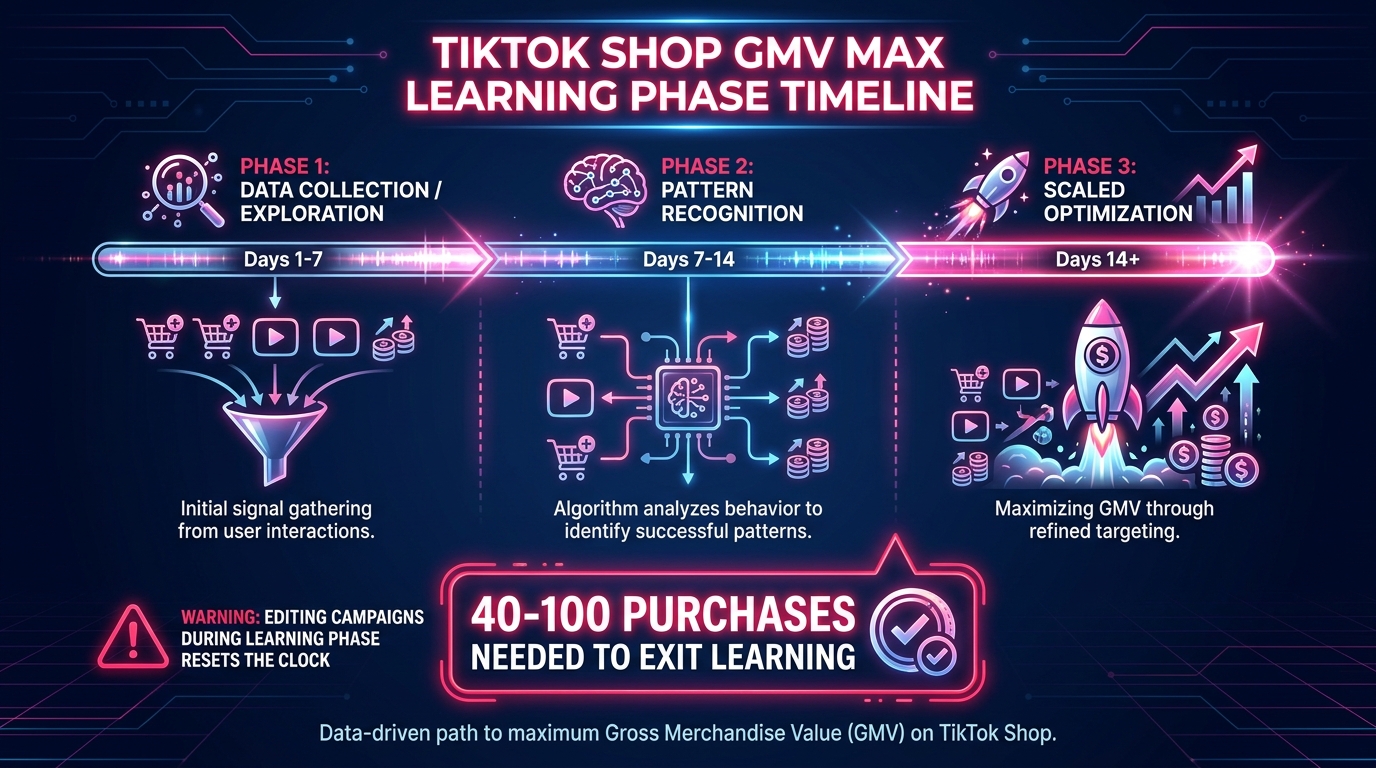
Every GMV Max campaign enters a learning phase when it launches or is significantly modified. TikTok’s documentation describes this as a period when the algorithm is “learning” which audiences and placements will perform best. That framing is technically accurate but strategically misleading, because it implies the algorithm is gaining abstract knowledge. What is actually happening is more specific: the system is collecting conversion events in sufficient volume to build a reliable statistical model for your product, your creative, and your audience.
The conventional wisdom is that this takes 7 to 14 days. But by 2026, practitioners have shifted how they think about this timeline. The learning phase is less about a fixed calendar window and more about a purchase volume threshold. Most expert operators now target 40 to 100 completed purchases as the minimum data set needed for the algorithm to move from exploration mode to optimization mode. Time matters less than transaction volume.
What the Algorithm Is Actually Measuring During Learning
During the learning phase, GMV Max is running something closer to a controlled experiment than a revenue campaign. It is deliberately serving your ads and creative to diverse audience segments — some likely to convert, some not — in order to build a signal map. The key data points it is collecting include:
- Which audience segments generate add-to-cart and purchase events at statistically meaningful rates
- Which creative executions drive the click-through-to-purchase journey most efficiently
- Which products in your catalog generate the highest GMV per impression across different audience types
- The conversion rate pattern at different stages of the funnel — from view to product page visit, from visit to add-to-cart, from cart to checkout
This is why the algorithm behaves erratically during learning. You may see days with strong ROAS followed by days with poor performance, significant daily budget fluctuations, and apparently random creative rotations. These are not errors. They are the system’s exploration behavior — it is deliberately testing range before it commits to exploitation.
The Most Common Ways Brands Destroy Their Own Learning Phase
The single most damaging thing a brand can do during the learning phase is make significant changes to the campaign — increasing or decreasing the budget by more than 20%, adjusting the target ROI, adding or removing creative assets, or changing the product catalog. Any of these actions can force the algorithm back to the beginning of its exploration cycle, effectively wasting whatever purchase data it had already collected.
Experienced operators treat the learning phase like a surgical recovery period: maintain stability, resist the urge to intervene based on early performance numbers, and focus on ensuring the inputs are correct rather than constantly adjusting the dials. The temptation to tinker is strongest exactly when it causes the most damage — during the first seven days, when performance looks unstable and early ROAS numbers are almost certainly not representative of what the campaign will deliver at maturity.
A practical rule of thumb: if you would not make a significant change to a Meta or Google campaign in its first week of running, apply the same discipline here. The difference is that TikTok’s learning phase is arguably even more sensitive because the algorithm is starting from a colder data state — it has less historical context for many sellers than established platforms.
Product-Level Signal Architecture: The Hidden Ranking Layer
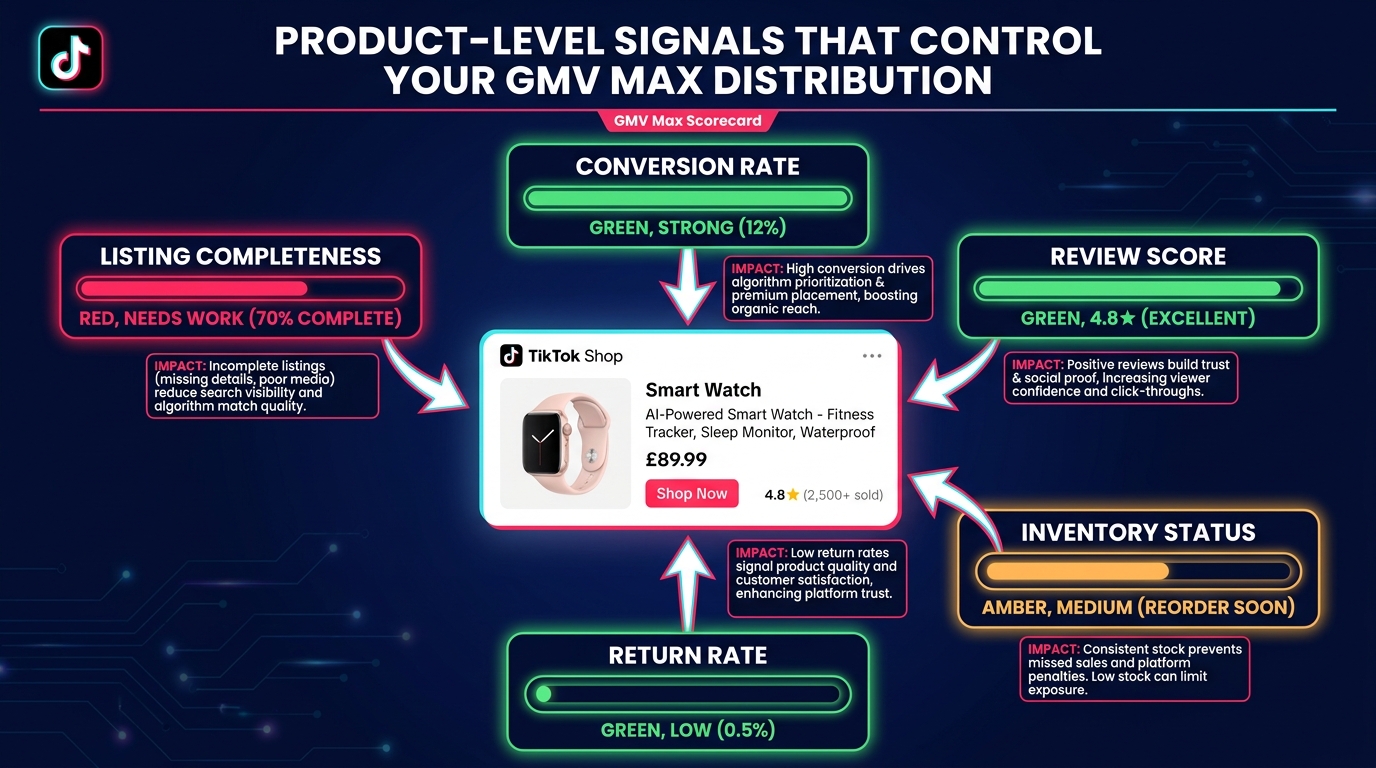
One of the most consequential shifts in how GMV Max operates in 2026 is the increased weight placed on product-level signals — individual SKU-level data that determines which products in your catalog get meaningful budget allocation and distribution reach. Most discussions of GMV Max focus on campaign-level variables (budget, target ROI, creative), but the product-level layer is where the algorithm makes its most fundamental decisions.
GMV Max does not distribute budget evenly across your catalog. It identifies products with strong performance signals and concentrates spend there. This means sellers with mixed-quality catalogs will see highly uneven distributions — their best performers get amplified, while weaker SKUs receive minimal exposure regardless of how much budget is available.
Conversion Rate: The Dominant Signal
Among product-level signals, conversion rate — measured from product page visit to completed purchase — appears to carry the heaviest weight. The algorithm treats a high conversion rate as evidence that a product is well-matched to audience intent, priced correctly, and presented effectively. Products with conversion rates significantly above category benchmarks tend to receive disproportionate budget allocation relative to their listing volume.
The implication is important: improving a product’s page quality (better images, more complete descriptions, clearer pricing, stronger social proof) has a direct effect on its GMV Max distribution reach. This is not just a CRO play — it is a distribution signal. Sellers who think of product page optimization as separate from their paid strategy are missing a structural leverage point.
Review Score and Review Velocity
Review quality — specifically the combination of star rating and review count — functions as a trust signal in the algorithm’s product ranking model. Products with consistently high ratings (4.5 stars and above) and meaningful review volume are systematically favored over equivalent products with lower scores or thin review histories. This is partly because review data correlates with return rate and customer satisfaction signals that feed back into the algorithm’s model of product quality.
Review velocity matters as well as absolute score. A product accumulating new reviews regularly signals ongoing commercial activity and customer engagement, which the algorithm reads as evidence of continued product-market fit. Stagnant review counts on older products can cause their distribution weight to gradually erode even if their historical rating is strong.
Inventory Reliability and Out-of-Stock Penalties
Inventory status is a binary signal with asymmetric consequences. When a product goes out of stock, GMV Max immediately reduces or halts budget allocation to that SKU. When inventory is restored, the product does not automatically return to its previous distribution level — it may need to rebuild algorithmic trust through a short re-learning period. Frequent stockouts create cumulative negative signals that can persistently suppress a product’s reach even during periods when inventory is available.
The operational implication is significant: inventory management is not just a logistics function for TikTok Shop sellers. It is an algorithm management function. Brands running thin inventory buffers are effectively accepting periodic distribution suppression as a cost of their inventory strategy, even if they do not recognize it that way.
Return Rate as a Quality Filter
Return rate data feeds back into the algorithm’s assessment of product quality and customer satisfaction. Products with elevated return rates — relative to category benchmarks — face both direct penalties in distribution weighting and indirect penalties through the effect on shop-level health scores. The algorithm interprets high returns as a signal that the product is misrepresented, mismatched to audience expectations, or genuinely defective. Any of those interpretations leads to reduced distribution priority.
Listing Completeness as a Table-Stakes Requirement
Catalog completeness — full product titles, rich descriptions, all variant options, multiple high-quality images, accurate pricing — functions less as a ranking signal and more as a floor requirement. Products with incomplete listings are significantly limited in how much the algorithm can do with them, because the system lacks sufficient data to match them effectively to relevant audience segments. A budget increase will not save a thin listing. The catalog work has to come first.
The Attribution Trap: Confronting the ROAS Number TikTok Shows You
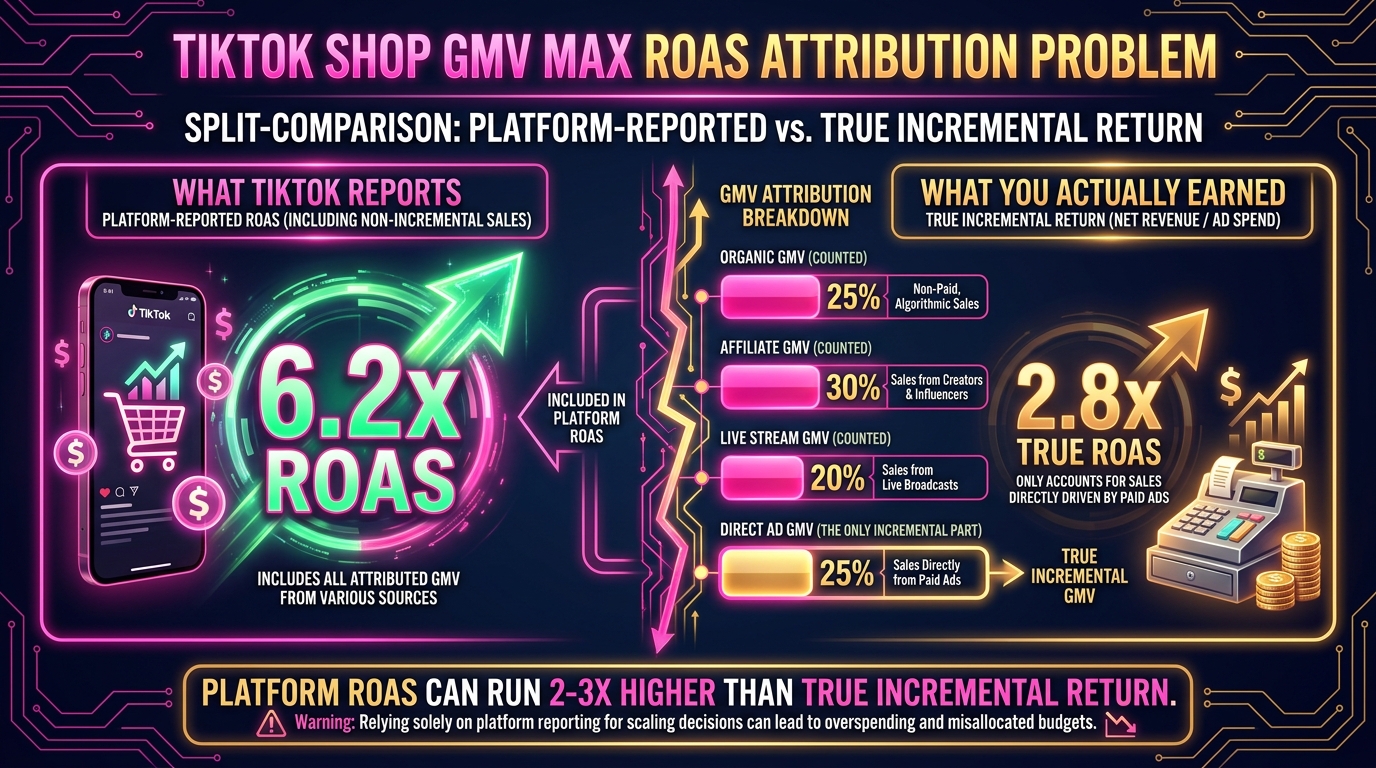
Perhaps the most practically dangerous aspect of GMV Max for operators who have not studied it closely is its attribution model. The ROAS or ROI number you see in TikTok Ads Manager is not what most advertisers intuitively assume it to be. Understanding this is not a minor technical detail — it is fundamental to whether your account economics actually work or just appear to work.
What the Platform ROAS Is Actually Counting
GMV Max uses a default attribution window of 7-day click and 1-day view. Within that window, it attributes to the campaign any completed purchase for a product that the campaign is actively promoting — regardless of whether that purchase was directly driven by an ad impression. This means the reported GMV (and therefore reported ROAS) includes:
- Sales directly driven by paid ad impressions — the only truly incremental category
- Organic sales from users who found the product through search or the For You Page, not through an ad
- Affiliate-driven sales from creator content that was not part of the paid campaign
- Live stream sales from the brand’s own TikTok Live sessions
The result is a blended metric that practitioners describe as closer to a Marketing Efficiency Ratio than a true return on ad spend. And the gap can be substantial. Multiple agency analyses from 2026 suggest that GMV Max platform ROAS commonly runs two to three times higher than true incremental, ad-driven return. A reported 6x ROAS might represent a real incremental ROAS closer to 2.5x to 3x.
Why This Is Not Simply a Bug
It is tempting to frame the GMV Max attribution model as a flaw or a deliberate distortion designed to make the platform look better. But that framing misses something important. TikTok’s position — which has some validity — is that GMV Max genuinely influences your organic and affiliate performance by increasing the prominence and signal strength of your products across the platform. Running paid campaigns does lift organic visibility for promoted products, and that organic lift has real value.
The problem is not that TikTok attributes blended GMV. The problem is that many advertisers read the blended number as if it were an incremental number, and make budget decisions accordingly. If you scale spend based on a 6x reported ROAS without accounting for the blended nature of that figure, you can easily end up dramatically overspending against what your unit economics actually support.
How Sophisticated Operators Measure Around This
The most rigorous approach used by advanced operators in 2026 is to track GMV Max performance through an external metric rather than relying exclusively on platform reporting. This typically involves calculating a Marketing Efficiency Ratio (MER) at the shop level — total TikTok Shop GMV divided by total TikTok ad spend — as the primary performance indicator, using platform ROAS as a directional signal rather than an absolute truth.
Some brands run periodic “dark periods” — brief windows with GMV Max paused on specific products — to measure the organic baseline for those products and establish a cleaner read on true ad incrementality. This kind of controlled measurement is methodologically sound but requires operational discipline and short-term GMV sacrifice, which is why many brands never do it.
The actionable takeaway: before scaling GMV Max spend aggressively, build an external measurement framework. Know what your blended MER looks like at the shop level. Set your target ROI in the platform based on the economics you need from that blended number, not based on what a true ROAS number would imply.
Creative as Algorithm Fuel: The Content Supply Problem Most Brands Ignore

If product catalog health is the foundation of GMV Max performance, creative supply is the engine. The algorithm’s ability to find converting audiences and scale spend is directly constrained by the quality, volume, and diversity of the creative inventory it has to work with. Brands that treat creative as a secondary consideration consistently hit ceilings that more creative-forward competitors never encounter.
How GMV Max Uses Creative Differently Than Traditional Campaigns
In a traditional paid social campaign, a brand selects specific ad creatives, assigns them to ad sets, and monitors their individual performance. GMV Max removes most of that manual selection layer. The algorithm draws from your entire creative inventory — brand videos, Spark Ads authorized from creator content, affiliate videos — and dynamically selects which assets to serve based on its continuous assessment of what is converting best for different audience segments.
This means the system is essentially running a perpetual creative tournament. Your top-performing creative gets the most budget and impressions until its performance degrades, then the algorithm shifts weight toward other assets that are showing stronger signals. Creative that shows strong conversion-driving performance — not just high view counts or engagement — gets systematically amplified.
The Creative Fatigue Problem and How It Compounds
Creative fatigue in GMV Max is both faster and more consequential than in traditional campaign structures. Because the algorithm concentrates spend on winning creatives, those assets accumulate impressions rapidly. Once frequency rises to the point where a specific segment of the audience has seen the creative multiple times, conversion rates drop and the algorithm shifts budget elsewhere. If there is no fresh creative waiting in the inventory, the entire campaign can enter a performance trough.
The difference between operators who scale GMV Max successfully and those who plateau typically comes down to creative refresh cadence. Brands running 15 to 20 active creator videos with 5 to 10 new assets entering rotation weekly have a dramatically different creative fatigue curve than brands running 3 to 5 static assets that were uploaded at campaign launch.
Why Affiliate Content Outperforms Brand-Produced Content
A consistent finding across 2026 operator data is that affiliate and creator-generated content systematically outperforms professionally produced brand content as GMV Max algorithm fuel. The reasons are structural rather than qualitative. Creator content tends to feature native TikTok production values — authentic framing, direct-address delivery, natural product demonstrations — that TikTok users are conditioned to trust. Brand-produced content, regardless of production quality, often reads as an advertisement in a way that creator content does not.
More importantly, creator content that was already performing organically before being brought into GMV Max via Spark Ads carries existing conversion signal data. The algorithm can see that real users have already responded to this content with purchases, which gives it a head start on calibration versus brand content that enters the system with no prior signal history.
Building a Content Pipeline That Actually Feeds the Algorithm
The practical implication is that brand investment in GMV Max should not be allocated primarily to ad spend — it should be allocated to the creator and affiliate program that generates the content supply the algorithm needs to work effectively. Brands spending $20,000 per month on GMV Max budget with 3 creative assets are almost certainly leaving significant performance on the table versus brands spending $15,000 on budget and $5,000 on creator content generation.
A working content supply framework for GMV Max typically includes:
- A minimum of 10 to 15 active creator videos in rotation at any given time
- A weekly cadence of new content entering the pool — at least 3 to 5 new assets per week
- A monitoring process for identifying top-performing organic and affiliate videos that can be brought in via Spark Ad authorization
- Systematic testing of different creative angles — problem-solution, demonstration, social proof, transformation — to ensure the algorithm has diverse content to match to diverse audience segments
The ROAS Dial: Why Setting Your Target Too High Costs You GMV
The target ROI setting in GMV Max is the most misunderstood control in the entire system. Most brands approach it the way they approach a target ROAS on other platforms: set it to the return they need to be profitable, and expect the algorithm to hit that number while delivering maximum volume. That logic is backward for GMV Max.
Target ROI as a Budget Permission Setting
In practice, the target ROI in GMV Max functions less like a performance target and more like a permission setting that determines how aggressively the algorithm can bid for conversions. A low target ROI gives the algorithm permission to bid more broadly, reaching a wider audience including segments that convert at lower efficiency but generate significant GMV volume. A high target ROI restricts the algorithm to only bidding for audiences where it is highly confident of hitting that threshold — which is a much smaller audience pool.
The consequence of setting your target ROI at your actual profit threshold from day one is that you are asking the algorithm to operate in an extremely constrained search space during the exact period when it needs the most flexibility to collect data. You get less volume, less purchase data, slower learning, and ultimately weaker long-term performance — all from a setting that felt like responsible budgeting.
The Conservative Start, Gradual Tighten Framework
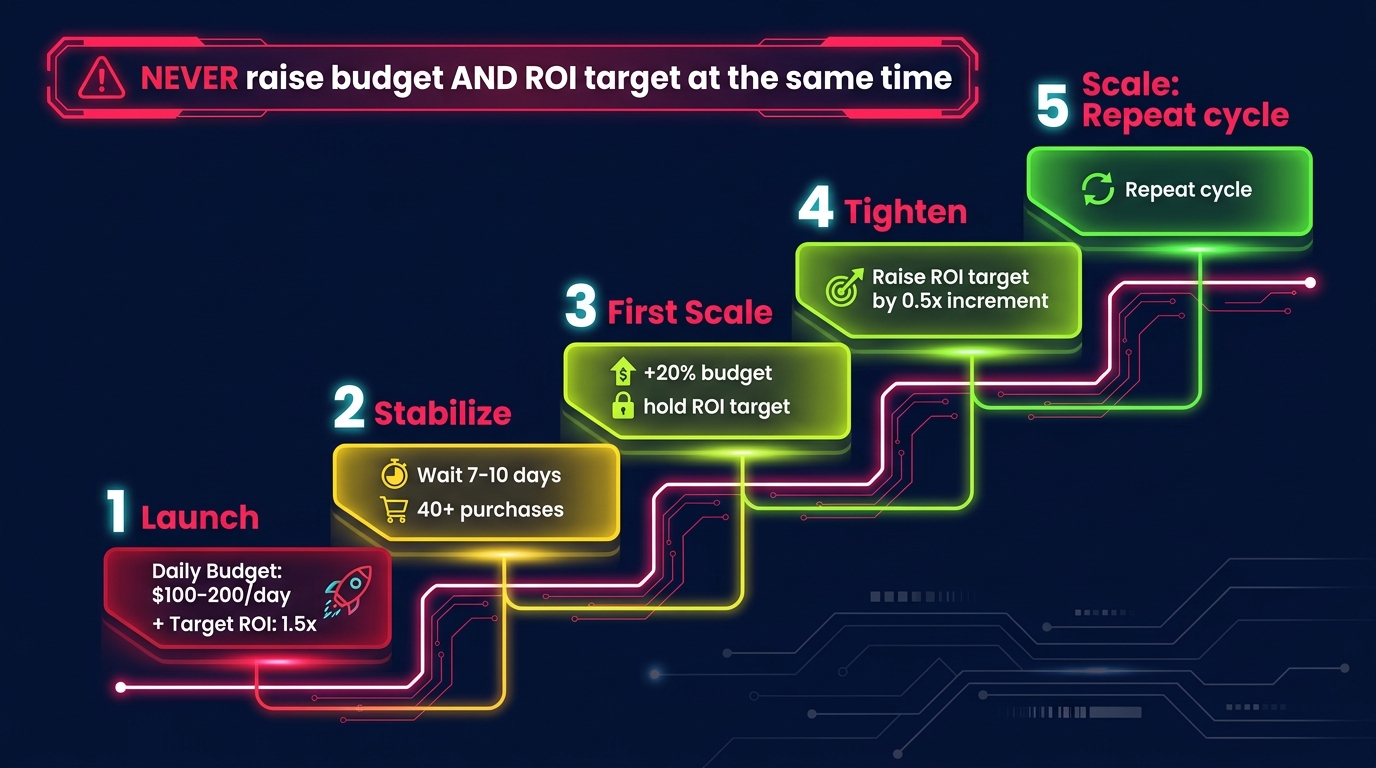
The approach that consistently produces better outcomes is to launch with a target ROI set below your actual profitability threshold — typically at 1.5x to 2x for brands that need a 3x to 4x return long-term — and treat this as the price of data collection. Once the campaign exits the learning phase and volume stabilizes (typically after 40 or more purchases and 7 to 10 days), you can begin raising the target ROI in small increments of 0.5x at a time, waiting for performance to restabilize at each increment before raising again.
This graduated approach allows the algorithm to progressively optimize toward higher-quality conversion signals while maintaining enough volume to keep its statistical models current. Brands that try to jump directly from their launch target to their desired long-term target in a single step frequently trigger a performance regression that takes another full learning cycle to recover from.
When to Override and When to Hold
A key judgment call for GMV Max operators is when poor early performance warrants intervention versus when it should be allowed to continue. The general principle: if the campaign is generating purchase volume — even at unsatisfactory ROAS — it is doing the work it needs to do during learning. Pause intervention for genuine signal problems: no purchases at all after 72 hours, clearly incorrect product catalog connections, or creative assets that have been flagged or rejected. Weak early ROAS in an otherwise-active campaign is almost never worth resetting over.
Campaign Structure: Building a Setup the Algorithm Respects
GMV Max dramatically simplifies the tactical layer of campaign management, but it has strong opinions about structure. Accounts that violate the structural principles the algorithm favors will see systematically weaker performance than accounts that align with them, even with identical budgets, products, and creative assets.
Fewer Campaigns, Higher Budgets
The most consistent recommendation from 2026 operator experience is to run fewer, larger campaigns rather than many smaller ones. The algorithmic reason is straightforward: each campaign needs its own purchase data to exit learning and optimize effectively. Splitting a $500 daily budget across 10 campaigns means each campaign is collecting purchase signal at roughly one-tenth the rate it would in a consolidated structure. All 10 campaigns stay in extended learning states, generating worse performance than 2 or 3 well-funded campaigns would.
The practical exception is when you have genuinely distinct product categories that serve very different audience segments and have meaningfully different target economics. In that case, separate campaigns make sense because the algorithm’s optimization for one category may actively conflict with another. The rule is: separate campaigns by product economics or audience type, not by product SKU or micromanagement preference.
Budget Minimums That Actually Matter
GMV Max requires sufficient daily budget to generate enough daily purchase events to keep the algorithm’s model current. Operators who run campaigns at the platform minimum (or near it) consistently report extended, frustrated learning phases and poor long-term performance. The minimum practical daily budget varies significantly by product price point — a $10 product needs far more daily budget to generate 5 to 10 daily purchases than a $100 product — but a commonly cited working minimum for most categories is $100 to $200 per day per campaign.
Running below that level is not just suboptimal. It can actively suppress performance relative to not running at all, because the algorithm serves ads inconsistently when budget is insufficient, creating discontinuous conversion signal rather than the steady stream the model needs for reliable optimization.
The 20% Budget Change Rule
When you do need to scale budget — either up or down — the standard guidance is to change it by no more than 20% at a time and to wait at least 3 to 5 days between adjustments. Budget changes of more than 20% in a single step can trigger a partial reset of the algorithm’s optimization model, as it needs to recalibrate its audience selection and bidding logic to accommodate the new spend level. This partial reset is less severe than a full learning phase restart but can still cause 3 to 7 days of degraded performance. Gradual, staged budget scaling avoids this disruption while still achieving the volume growth you are targeting.
Organic, Affiliate, and Paid: How the Three Signal Streams Interact
One of the most practically important — and frequently misunderstood — aspects of the GMV Max era is the relationship between organic traffic, affiliate performance, and paid campaigns. These are not independent channels. They are interconnected signal streams that feed the same underlying algorithm, and performance in one dimension directly affects potential in the others.
How Organic Performance Influences Paid Distribution
A product that is already converting well through organic TikTok discovery — appearing in search results, being saved and shared, generating purchase events from For You Page placements — enters the GMV Max system with a pre-built signal profile. The algorithm already has evidence that this product resonates with TikTok audiences. When paid budget is applied to it via GMV Max, the algorithm can optimize more aggressively and exit the learning phase faster because it has existing conversion data to anchor its model.
The reverse is also true: a product that has no organic presence, no affiliate coverage, and no prior TikTok conversion history starts with a cold signal state. The algorithm has to generate all of its calibration data from scratch via paid impressions, which is slower, more expensive, and produces less reliable early results. This explains why some brands see GMV Max generate strong results almost immediately while others experience extended frustrating learning periods with similar budgets — their products’ organic signal histories are fundamentally different.
The Affiliate Multiplier Effect
Affiliate and creator content generates a particularly powerful signal for GMV Max because it operates at the intersection of organic reach and conversion intent. A creator video that generates significant organic views and purchase events creates two types of value simultaneously: it drives direct revenue through affiliate commissions, and it generates product-level conversion signals that the algorithm uses to inform its paid distribution model.
Brands with strong affiliate programs — 20 or more active creators regularly posting about their products — effectively give the GMV Max algorithm a continuous stream of fresh, high-quality signal data that makes their paid campaigns more efficient. This is the structural mechanism behind the observation that brands with large creator networks get better GMV Max performance for the same ad budget: they are giving the algorithm better data, not just more content.
Spark Ads as the Bridge Between Channels
Spark Ads — TikTok’s format for boosting organic and creator content via paid distribution — serve as the technical bridge between the organic/affiliate signal stream and the paid GMV Max system. When an affiliate creator’s video is performing well organically and generating purchase events, a brand can authorize it for use as a Spark Ad within GMV Max, bringing that asset’s existing conversion signal into the paid campaign.
This is one of the most consistently high-performing moves in the advanced operator playbook: identify organic and affiliate content that is already demonstrating purchase intent signals, authorize it as Spark Ad creative, and bring it into GMV Max where the algorithm can amplify it at scale. The combination of existing conversion signal plus paid distribution budget is systematically more effective than cold creative entering the system without prior signal history.
What Actually Breaks the Algorithm — and Why Most Operators Don’t Know It’s Broken
One of the more insidious aspects of GMV Max is that its failure modes are not always visible in real time. The system does not throw errors when it is operating suboptimally. It simply delivers less GMV than it could — and because advertisers rarely have a clean counterfactual to compare against, they often do not recognize that their account structure or practices are suppressing performance.
The Constant Tinkering Problem
The most common form of self-inflicted algorithm damage is excessive campaign modification. Operators who check performance daily and make adjustments in response to short-term fluctuations — adjusting ROI targets, adding or removing creative assets, changing budget levels — are systematically disrupting the algorithm’s optimization model. Each significant modification triggers a recalibration period. For operators making multiple changes per week, their campaigns may never fully exit the learning phase.
This creates a counterintuitive operational principle: the less frequently you touch your GMV Max campaigns, the better they tend to perform. Discipline in leaving campaigns alone during stable periods — even when daily performance varies and the temptation to adjust is strong — is one of the most valuable operator skills in the GMV Max era.
Catalog Pollution and Its Cascading Effects
A less visible but equally damaging issue is catalog pollution: inactive SKUs, out-of-stock products, incomplete listings, or products with very poor conversion histories remaining in the product set that GMV Max is drawing from. When the algorithm cycles through these products during its exploration phase, it wastes budget on impressions that generate no conversion signal, diluting the quality of the data it is collecting and slowing the overall campaign optimization process.
Regular catalog hygiene — actively removing or suppressing products that should not be part of the GMV Max product set — is an underappreciated operational task. Think of it as curating the algorithm’s menu: the better the options you give it to work with, the better the choices it will make.
Creative Stagnation and the Invisible Performance Ceiling
Brands that launch with strong creative but fail to refresh it encounter an invisible performance ceiling: their top assets saturate their best audiences, performance gradually declines, and there is no fresh inventory for the algorithm to test against. The decline is typically gradual enough that operators attribute it to seasonal factors or competitive dynamics rather than creative fatigue. Without a systematic creative refresh cadence, many brands plateau well below their potential GMV Max performance.
What Advanced Operators Are Actually Doing Differently in 2026
Across the landscape of TikTok Shop operators who are consistently extracting strong performance from GMV Max in 2026, several operational practices appear repeatedly that distinguish them from the broader advertiser base.
Treating GMV Max as a System to Feed, Not a Tool to Adjust
The most fundamental mindset difference is in how they conceptualize the campaign. Advanced operators do not think of GMV Max as a campaign they run. They think of it as a system they feed. Their primary focus is on the quality and volume of the inputs — catalog health, creative supply, affiliate network, product conversion rates — rather than on campaign-level settings. They make campaign adjustments infrequently and deliberately, and spend the bulk of their operational time on upstream inputs.
Building a Pre-Warm Funnel Before Launch
Rather than launching GMV Max on cold products with no prior TikTok signal, top operators invest in a deliberate pre-warm phase. They drive organic posting and affiliate seeding of new products for 2 to 4 weeks before turning on paid amplification. By the time GMV Max launches on those products, there is already a base of organic conversion events, review momentum, and creator content available as Spark Ad material. The algorithm starts from a warm signal state rather than a cold one, compressing the learning phase and generating better early results.
Using Product-Level Reporting to Drive Catalog Strategy
GMV Max’s Seller Center product-level reporting provides visibility into which SKUs are receiving the most paid distribution and generating the most GMV. Advanced operators use this data to make catalog strategy decisions: doubling down on inventory for top-performing products, running price optimizations to improve conversion rate on products that are getting distribution but not converting, and actively suppressing SKUs that are consuming budget without generating meaningful purchase volume.
This creates a feedback loop between the algorithm’s distribution decisions and the operator’s catalog decisions — a flywheel where the operator is continuously improving the quality of what the algorithm has to work with based on what the algorithm’s behavior reveals about product-market fit.
The MER-First Measurement Framework
Rather than relying on platform ROAS as their primary performance metric, advanced operators consistently use a shop-level MER — total TikTok Shop GMV divided by total TikTok ad spend — as their north star. This metric automatically accounts for the blended nature of GMV Max attribution because it measures all channel revenue against all channel ad spend. If both go up proportionally, the strategy is working. If ad spend is rising faster than total GMV, there is a problem — regardless of what the platform ROAS number shows.
This external measurement discipline prevents the most common GMV Max trap: scaling spend aggressively against inflated platform ROAS numbers and discovering only when checking Shopify or backend revenue data that actual revenue growth has not kept pace.
Building Your GMV Max Signal Stack: A Practical Roadmap
Drawing together the signal architecture described throughout this article, here is a structured approach to building the foundation that GMV Max performance actually requires — organized by the sequence in which each element needs to be in place.
Phase 1: Catalog Foundation (Weeks 1–2)
Before any paid activity begins, the catalog needs to be genuinely ready. This means completing all product listings to the highest standard — professional images in all slots, complete and keyword-rich titles and descriptions, all variants properly set up, accurate pricing, and competitive positioning. Products with known conversion problems should be addressed before they are brought into GMV Max, not after. The algorithm cannot solve a product problem through distribution — it can only amplify the conversion results that already exist.
Inventory planning needs to happen in parallel. If a product’s GMV Max performance is going to be tested seriously, it needs enough inventory to sustain 4 to 6 weeks of accelerated sales without stockouts. Running a product out of stock during a scaling phase is one of the most expensive mistakes in the GMV Max playbook — you lose both the revenue momentum and the algorithmic distribution momentum simultaneously.
Phase 2: Organic and Affiliate Seeding (Weeks 2–4)
With the catalog foundation in place, the next phase is generating the organic and affiliate signal that will accelerate the paid campaign’s learning. This means posting regular organic brand content featuring the target products, activating affiliate creators to begin posting reviews and demonstrations, and tracking which organic content is generating the most engagement and purchase intent signals.
The goal by the end of this phase is to have a minimum of 5 to 10 organic or affiliate videos showing meaningful performance data, several completed purchase events through organic channels, and a shortlist of creator videos to authorize as Spark Ads when GMV Max launches.
Phase 3: Conservative GMV Max Launch (Week 4 Onward)
Launch GMV Max with a daily budget that ensures at least 5 to 10 daily purchase events at your expected conversion rate — not the platform minimum. Set the target ROI conservatively, below your long-term profitability threshold. Load the campaign with the best Spark Ad creatives from the pre-warm phase plus whatever brand content is available. Then do not touch it for 10 days.
At day 10, evaluate purchase volume. If you have 40 or more purchases, begin the first incremental ROI adjustment. If not, extend the learning phase and focus on improving the quality of the creative inventory. Scale budget by no more than 20% increments, waiting 5 days between each adjustment to observe performance restabilization before scaling further.
Conclusion: GMV Max Is a Discipline, Not a Feature
The GMV Max era has fundamentally changed what it means to advertise on TikTok Shop. The platform’s shift from manual media buying to fully automated commerce optimization is not a simplification — it is a redistribution of where strategic work needs to happen. Less of the value comes from campaign management. More of it comes from the quality of what you feed the system.
Understanding the signal architecture — product-level signals, the attribution model’s blended nature, the learning phase mechanics, the creative supply dynamic, the way organic and affiliate performance interconnects with paid results — gives you the framework to make better decisions at every layer. It explains why two brands with identical budgets and target ROI settings can see dramatically different results: one has built the signal foundation the algorithm needs, and the other has not.
The operators who are consistently outperforming in the GMV Max era share a common orientation: they have accepted that they are not running campaigns. They are stewarding a data system. Their competitive advantage comes not from clever bidding or audience selection — the algorithm controls those — but from the upstream work that determines what the algorithm has to work with.
Key Actionable Takeaways
- Audit your catalog before your campaigns. Product-level signals control distribution. Fix conversion problems, fill out incomplete listings, and suppress poor-performing SKUs before scaling ad spend.
- Pre-warm products with organic and affiliate content for 2 to 4 weeks before launching paid GMV Max campaigns. Cold-signal launches take longer and cost more to optimize.
- Set your launch target ROI below your profitability threshold. The cost of conservative early ROI is far lower than the cost of a restricted learning phase that never builds adequate conversion signal.
- Do not touch active campaigns for 10 days after launch. Treat early performance volatility as noise, not signal. Intervention costs more than patience almost every time.
- Build a creative refresh pipeline, not just a launch asset set. Creative fatigue is the most common invisible ceiling in GMV Max accounts. Three to five new creator assets per week is a working minimum for scaling accounts.
- Measure performance with a shop-level MER, not platform ROAS. Platform ROAS is a blended, inflated figure. External revenue data against total ad spend is the only number that tells you whether the economics actually work.
- Inventory is algorithm management. Stockouts suppress distribution and create algorithmic trust penalties that outlast the stockout itself. Plan inventory around GMV Max’s scaling trajectory, not your conservative sales forecast.
- Scale budget and ROI targets separately, never simultaneously. Changing both at once creates double uncertainty for the algorithm and significantly increases the chance of a performance regression.
GMV Max is a powerful commerce engine. But like any engine, it only performs at its potential when you give it the right fuel, maintain it correctly, and resist the urge to override its mechanics with interventions that feel productive but actually slow it down. The brands that understand this are building durable, scalable TikTok Shop businesses in 2026. Those that do not are running the same frustrated learning phases on repeat, wondering why the platform that works brilliantly for their competitors seems to resist them at every turn.