

Somewhere in the past 18 months, the economics of influencer marketing broke. Not spectacularly — no single viral scandal or platform collapse triggered it. The shift happened quietly, in spreadsheets and post-campaign debrief calls, when brand managers started running the actual numbers on their mega-influencer deals and realized the math didn’t hold up.
A $50,000 post from a creator with 2 million followers might generate 12,000 likes, a 0.6% engagement rate, and — if you were lucky enough to have proper tracking in place — a couple hundred attributable sales. Meanwhile, a skincare brand in the Pacific Northwest was quietly running 80 micro-creators simultaneously, paying each one $300–$500 in product and a 15% commission, and watching affiliate-sourced revenue climb past 40% of total monthly GMV.
The math is no longer theoretical. HypeAuditor’s 2026 benchmarks put Instagram nano-creator engagement at 1.78% versus 0.33% for accounts over one million followers. TikTok Shop data shows that brands with structured 100-creator affiliate programs drive 3–5× higher GMV than brands relying primarily on owned content. And the operational infrastructure to run these programs — once a legitimate barrier — has become accessible enough that mid-market brands can build them without agency budgets.
But here’s what the performance-marketing hype cycle consistently misses: the 100-creator pipeline is not a volume play. It is a systems play. Recruit 100 creators without a structured pipeline and you’ll end up managing a chaos operation where 60% go dark in the first month, 15 top performers carry 80% of the revenue, and your operations team is drowning. Build the system correctly, and those same 100 creators become a compounding distribution asset that gets more efficient every quarter.
This article is about how to build that system — from recruitment architecture and vetting logic to tier design, activation tactics, the 80/20 dependency trap, and attribution frameworks that actually reflect what creators contribute to your revenue.
What “100 Creators” Actually Means (and What It Doesn’t)
Before building anything, get clear on what 100 active creators in a pipeline actually represents — and where the common mental models go wrong.
The Difference Between Enrolled and Active
Most brands that claim to have a “100-creator program” have 100 enrolled creators. The number of creators actively producing content that drives tracked traffic in any given 30-day window is typically a fraction of that. Industry benchmarks suggest that even well-run programs see only 40–60% of enrolled creators post at least once per month. In poorly managed programs, that figure drops below 25%.
This means your target should be 100 active creators — which requires recruiting and onboarding significantly more than 100. A realistic funnel looks like this: recruit 250–300, expect 100–150 to complete onboarding, target 80–100 to post within the first 30 days, and aim to retain 60–70 as consistent monthly contributors over 90 days.
The distinction matters because it fundamentally changes how you think about pipeline health. A brand measuring success by total enrolled count is flying blind. A brand measuring 30-day active rate, 90-day retention, and per-creator GMV contribution has a real operating picture.
Micro vs. Nano: Picking Your Creator Mix
The “100 creators” framing often obscures an important strategic decision: which tier of creator should make up your mix? The answer depends on your category, margin structure, and operational bandwidth.
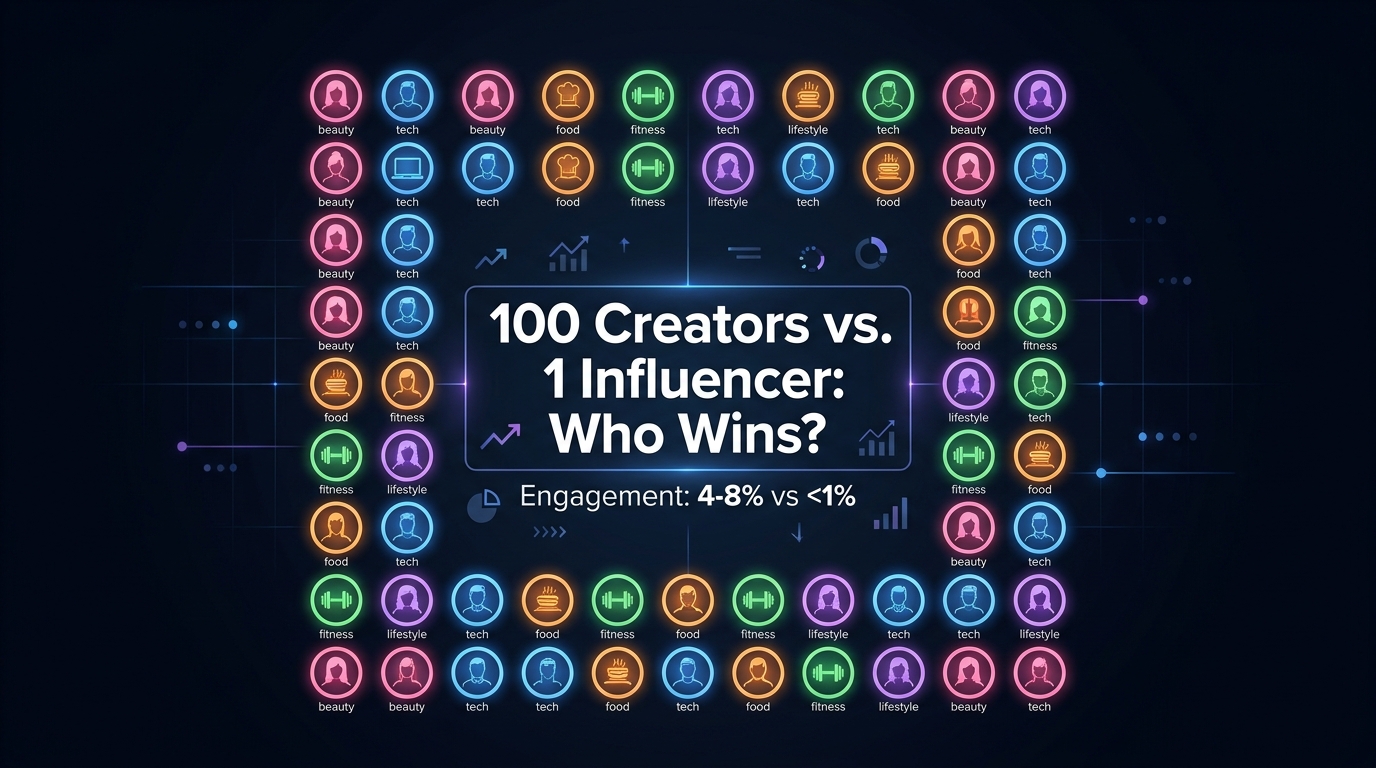
Nano creators (1K–10K followers) offer the highest engagement rates — often 4–8% on TikTok versus sub-1% for mega accounts — and the lowest content cost. They’re ideal for categories where authentic, personal recommendation carries more weight than production polish: supplements, skincare, pet products, home goods. The tradeoff is that each individual creator drives modest absolute volume, so you need more of them, and managing a portfolio of 80 nano creators requires more hands-on support per creator.
Micro creators (10K–100K followers) represent a middle ground. They’ve typically developed more consistent content cadences, have a clearer niche identity, and generate enough volume per creator that 20–30 of them can materially move your numbers. Commission benchmarks for this tier run 15–20% on TikTok Shop, versus 10–15% for nano. The content is generally more polished, and these creators are more likely to already be running affiliate programs and understand the mechanics.
The most effective 100-creator programs typically run a blended portfolio: roughly 65–70 nano creators providing high-trust, high-engagement coverage across diverse niches, plus 20–25 micro creators providing volume and category authority, plus a handful of rising stars in the 100K–500K range being developed through structured performance incentives.
Creator Affiliate vs. Paid Creator: The Hybrid Model
A meaningful portion of brands building creator pipelines in 2026 are moving toward hybrid compensation structures rather than pure commission-only models. Pure performance-only programs have a recruitment problem: established micro-creators — the ones you actually want — are selective about where they invest content creation time, and “post for commission only” competes badly against brands offering guaranteed fees.
The practical resolution is a low flat fee for the first piece of content (often $50–$200 depending on creator tier) combined with meaningful commission rates (12–18%) on tracked sales. This hybrid model reduces recruitment friction, improves first-content activation rates, and signals that the brand takes the partnership seriously — all without dramatically inflating program costs.
The Real Cost Breakdown — Commission vs. Operational Overhead
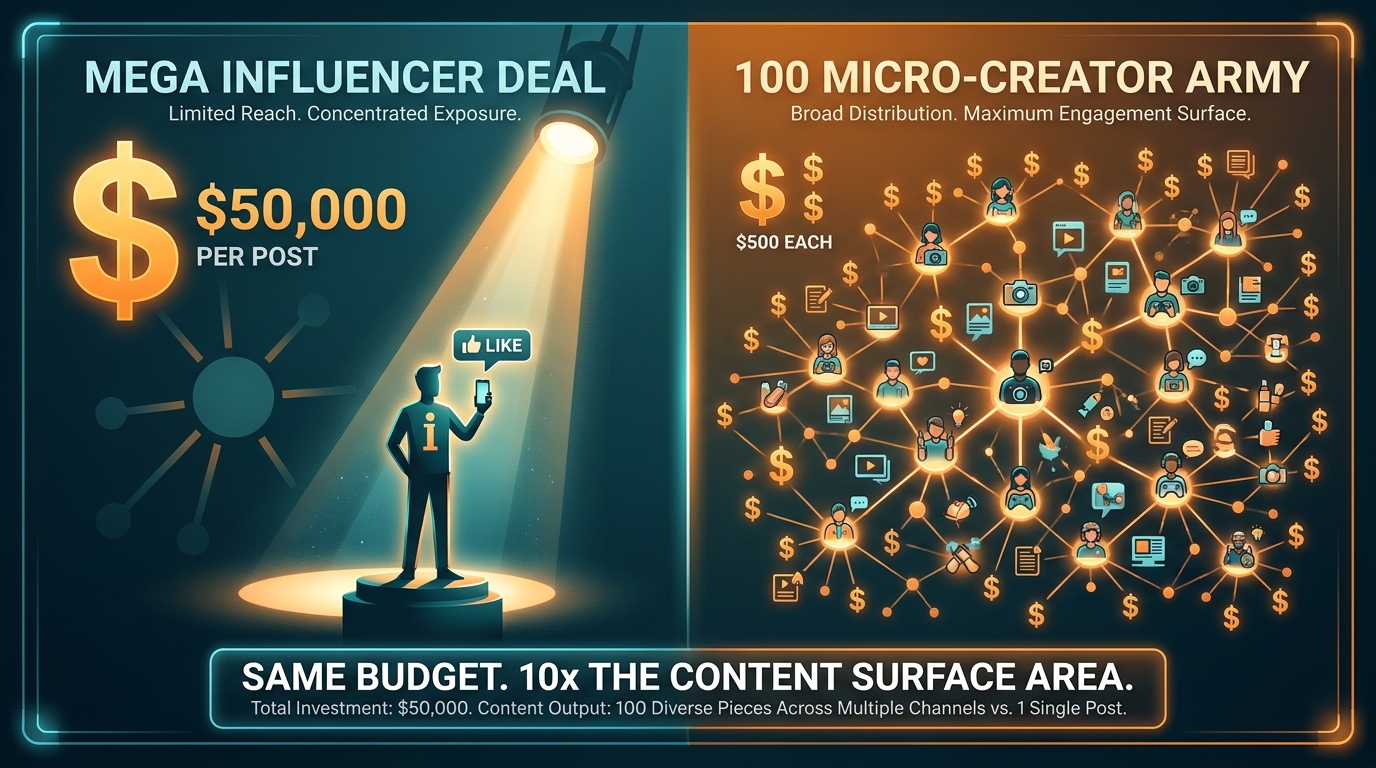
One of the most consistent mistakes brands make when modeling a 100-creator affiliate program is treating commission cost as the primary budget line. It isn’t. Commission is the most visible cost — it’s also the most defensible one, because it’s directly tied to revenue. The costs that kill programs are the operational ones that brands systematically underestimate.
Commission Economics
At a blended commission rate of 15% across a 100-creator program, for every $100,000 in attributed GMV, you’re paying $15,000 in commissions. If your program drives $500,000 in monthly creator-attributed revenue, you’re paying $75,000 in commissions. That sounds significant until you compare it against the customer acquisition cost equivalent: brands in competitive DTC categories regularly pay $40–$80 in paid social CAC for the same customer. Creator affiliate programs consistently show lower effective CAC when attribution is measured correctly.
For brands with 50% gross margins, a 15% commission leaves 35 points of gross margin on creator-acquired customers — better economics than most paid channels once you factor in the lifetime value difference between a creator-referred customer (who typically converts with higher intent and reorders at higher rates) versus a cold paid-social acquisition.
The Operational Cost Stack
Here’s what brands routinely leave out of their program ROI models, and what that omission costs them in credibility when programs underdeliver against projections:
Software and tooling: A properly instrumented creator affiliate program requires affiliate tracking software (Impact, ShareASale, or a platform-native solution), a creator relationship management tool, and ideally some form of analytics dashboard. Budget $500–$2,000/month depending on creator volume and platform integrations.
Management bandwidth: A creator program with 100 active affiliates requires somewhere between 0.5 and 1.5 full-time staff equivalents to run competently — more if the program spans multiple platforms. This is the cost that brands most consistently underestimate. One person can technically manage 100 creators. They cannot do it well — not if “managing” includes outreach, onboarding, content review, performance coaching, commission dispute resolution, and reactivation campaigns.
Product seeding: Unless your program is purely digital-product based, you’re sending physical product to creators for review and content creation. At 100 creators, with an average product cost of $20–$40 per creator plus shipping, that’s $3,000–$6,000 in seeding costs before a single piece of content is produced.
Content amplification: Top-performing creator content doesn’t just earn on organic reach. It gets whitelisted or boosted via Spark Ads (TikTok) or Partnership Ads (Meta). Budget for amplifying your best 10–20% of creator content adds another $5,000–$15,000/month in paid media spend, but this is where the ROI multiplication happens — branded creator content boosted via paid consistently outperforms standard creative in click-through and conversion metrics.
Total non-commission operational cost for a 100-creator program run competently: $40,000–$75,000 annually, according to program benchmarks from mid-market e-commerce operators. That’s real money, but it’s also fixed-cost infrastructure that supports a program capable of driving hundreds of thousands in monthly GMV if built correctly.
Recruitment Architecture — How to Fill the Top of the Pipeline
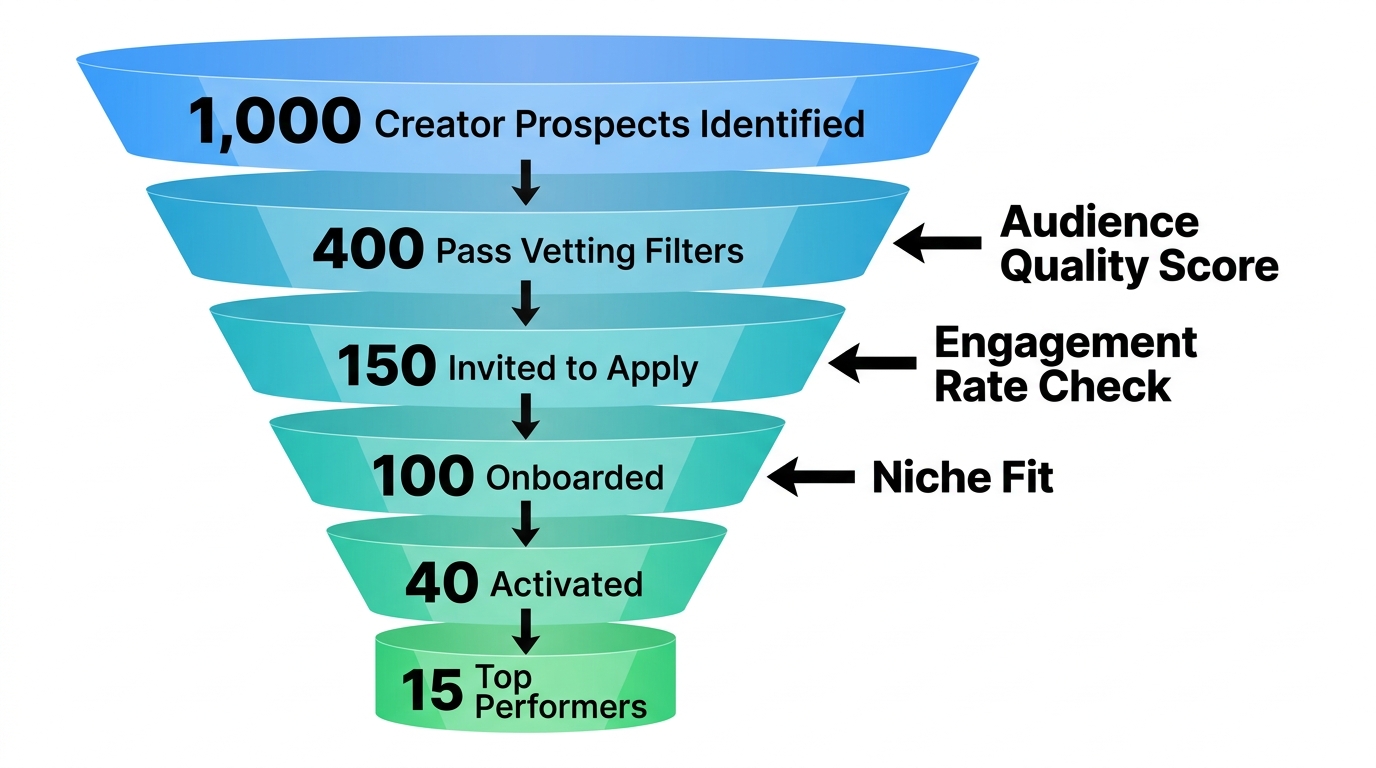
Getting to 100 quality active creators requires a structured recruitment system, not a spray-and-pray outreach operation. The funnel math is unforgiving: you’ll contact far more creators than will ever post a single piece of content for your brand. Building that funnel efficiently is a competitive advantage.
Where to Source Creators
Recruitment channels have multiplied significantly in 2026, and the most productive ones vary by category and platform:
Platform-native storefronts and marketplaces. TikTok Shop’s creator marketplace allows brands to search for creators actively running affiliate content, filter by category and engagement benchmarks, and initiate collaborations directly. This is the highest-intent recruitment channel available — you’re reaching creators who are already doing affiliate commerce, not educating cold prospects about the model. Amazon’s influencer program and Instagram’s partnership tools offer similar discovery pathways.
Competitor reverse-engineering. Tools like Modash, Upfluence, and CreatorIQ allow you to identify which creators are posting about competitor brands. These creators have already demonstrated category interest and content format familiarity. A targeted outreach to this cohort — with a better commission structure and more hands-on program support — converts at meaningfully higher rates than cold discovery.
Community and hashtag mining. TikTok hashtags, Reddit communities, and niche Facebook groups surface organic advocates — people who are already talking about your category or using your product without any formal partnership. These are the highest-quality recruits because their interest is already established. The challenge is that they’re the hardest to find at scale without dedicated research time.
Inbound from content seeding. Brands that send product to micro-creators as PR — without any formal agreement — frequently convert a percentage of those recipients into affiliate partners when the creator posts organically and sees engagement. Building an inbound pipeline through PR seeding takes 60–90 days to produce results but creates a steady stream of pre-warmed recruits who’ve already demonstrated they can produce content around your product.
Defining Your Creator Profile Before You Recruit
The single most costly recruitment mistake is starting outreach before locking in a clear creator profile. Without a defined profile, you optimize for reach (because it’s the most visible metric) rather than for niche fit, content format alignment, and audience income and purchase-intent match.
A useful creator profile for a 100-creator pipeline specifies: minimum and maximum follower count by tier, platform priority, content format (long-form review, short-form haul, tutorial, lifestyle integration), primary niche alignment, acceptable engagement rate floor (typically 2%+ for micro, 4%+ for nano), and geographic targeting if relevant to your distribution.
Recruitment volume targets follow directly from your funnel assumptions. If you expect 40% of outreach contacts to respond, 30% of respondents to apply, 70% of applicants to pass vetting, and 60% of approved creators to actually post within 30 days — then to reach 100 active creators, you need to initiate contact with roughly 700–800 prospects. That’s a real number. Build the recruitment infrastructure to support it.
Vetting That Scales — Moving Fast Without Letting Bad Actors In
Creator vetting is where many brands either move too slowly (applying enterprise-grade due diligence to every nano-creator applicant, creating bottlenecks) or move too fast (accepting creators who boost follower counts with purchased engagement, post brand-inauthentic content, or regularly violate FTC disclosure requirements).
The Core Vetting Checklist
An efficient vetting process for a 100-creator pipeline operates on a tiered logic: faster, lighter checks for nano-tier applicants; deeper analysis for micro-tier and above. The core criteria that apply across all tiers:
Engagement authenticity check. Follower count is a nearly useless signal by itself. What matters is the ratio of engaged accounts to follower count, the comment quality (real questions and reactions versus generic emoji clusters that signal purchased engagement), and consistency of engagement over time. Tools like HypeAuditor and Modash automate much of this analysis and flag accounts with statistically abnormal engagement patterns.
Content-audience alignment check. Does the creator’s existing content make your product placement credible? A fitness creator with an audience of 18–34 year old women who live in metropolitan areas is a plausible affiliate for a premium protein supplement. The same creator promoting a B2B SaaS tool is a niche mismatch that will produce low conversion regardless of engagement rate.
FTC compliance history. A spot check on a creator’s recent posts for proper disclosure (#ad, #sponsored, #partner) is a five-minute screen that can save you significant brand risk. Creators who routinely skip disclosure in their content are both a legal liability and a signal that they’re not operating professionally.
Brand safety screen. A basic check of the creator’s recent content for material that conflicts with your brand values — political content that could create controversy, competitor partnerships that create obvious conflicts, or content quality that simply doesn’t meet your standards. For nano-tier creators, this doesn’t need to be exhaustive; for micro-tier and above, it warrants more thorough review.
Vetting Infrastructure for Scale
At 100 creators, vetting is still manageable manually with a structured checklist and good tooling. At 500+, you need automated scoring. Most mid-market programs operating at 100-creator scale use a combination of one creator analytics platform (for engagement and audience data), a simple application form that collects the required profile URLs and self-reported metrics, and a standardized 20-point vetting scorecard applied by a program manager.
The decision rule is simple: creators who score above threshold on engagement authenticity, content-audience fit, and brand safety pass to onboarding. Those who don’t are rejected with a templated note. There is no partial credit. Accepting marginal applicants because recruitment targets are behind schedule is one of the fastest ways to degrade program quality.
Onboarding as a Conversion Rate Problem
Most creator affiliate programs treat onboarding as an administrative task: send a welcome email, include the affiliate link, attach the brand guidelines PDF, done. The predictable result is that the majority of newly enrolled creators never post.
High-performance programs treat onboarding as a conversion rate problem. The question isn’t “did we send the creator everything they need?” — it’s “did the creator take the first action that correlates with them becoming an active contributor?” That first action is almost always publishing their first piece of content within 7–10 days of onboarding.
The Onboarding Sequence That Drives First-Content Activation
The specific sequence that consistently improves first-content rate starts before the creator receives their product. The onboarding communication begins at acceptance — a warm, personalized acceptance message (not a generic template) that tells the creator exactly what happens next, when to expect product, and what content to create first.
Day 0 (acceptance): Personalized welcome with program overview, commission structure, and tracking link setup. Keep this short — 200 words maximum. Link to a single-page creator hub rather than attaching a 30-page brand guidelines PDF.
Day 1–3 (product confirmation): Shipping confirmation with tracking, plus the first real creative asset — a short brief for their first suggested content piece. The brief should be a recommendation, not a mandate: here’s a content angle that’s performing well for similar creators in our program, here are 3 talking points, here’s a before/after comparison that lands well. Make it easy to start.
Day 7–10 (check-in if no post): A personal check-in from the program manager — not an automated email — asking if the product arrived, if they have questions, and whether there’s anything that would make posting easier. This single touchpoint has been cited by multiple program operators as the highest-impact intervention for improving first-post conversion rates.
Day 14 (first post celebration): When a creator posts for the first time, acknowledge it immediately. Share the post internally, send a personal response, provide any relevant performance data you can share. The first post is the critical threshold — creators who post once are far more likely to post again than those who never break that initial inertia.
The Creator Hub: Your Single Source of Truth
One infrastructure investment that reliably improves onboarding outcomes is a dedicated creator hub — a simple web page or Notion-style document that contains everything a creator needs without having to email the program manager. This includes: the program commission structure and payout schedule, the affiliate link or code (dynamically updated), brand assets (logos, product images, color palette), content brief library (suggested angles and scripts), performance dashboard access, and an FAQ addressing the most common questions.
The hub doesn’t need to be elaborate. What it needs to be is current and easy to navigate. An outdated hub with dead links or wrong commission information destroys creator trust faster than almost anything else in the program lifecycle.
The Activation Gap — Why So Many Creators Go Dark After Week One
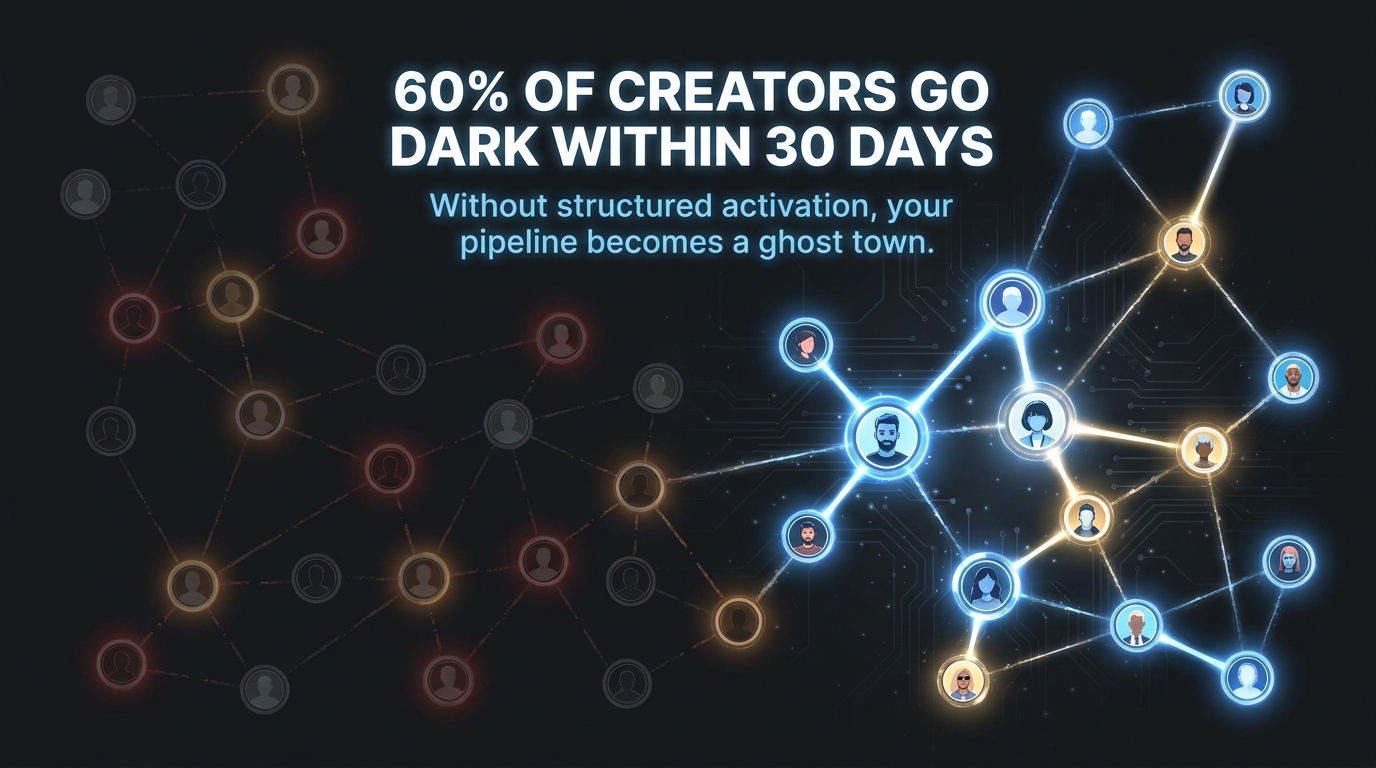
The activation gap — the chasm between onboarding completion and consistent content output — is the most expensive problem in creator affiliate program management. It’s not caused by creator laziness or bad recruiting. It’s almost always caused by structural program failures that the brand has the power to fix.
Why Creators Go Dark: The Real Reasons
The commission math doesn’t pencil out fast enough. A nano-creator with 5,000 followers posting for a 15% commission on a $40 product needs to drive roughly 7–8 sales from that single post to earn $40. If their content generates 500 views and a 2% click-through rate, that’s 10 link clicks — and at a typical affiliate conversion rate of 3–5%, they’re looking at zero to one sales. The economics feel broken, and creators who internalize this math quickly stop posting.
The fix isn’t simply to raise commissions (though that helps). It’s to give creators content angles that are likely to generate higher engagement and click-through on their specific account, and to be explicit about realistic time horizons. Creators who understand that the first 2–3 posts are a learning period — and who get coaching on what’s working for similar creators in the program — have dramatically higher 90-day retention than those left to figure it out alone.
Content fatigue from no feedback loop. Creating content into a void is demoralizing. When creators post and hear nothing — no performance data, no brand acknowledgment, no signal about whether the content resonated — they rapidly lose motivation. The feedback loop doesn’t need to be elaborate: weekly automated performance summary emails with views, clicks, and estimated earnings, plus a monthly program update with category-level performance benchmarks, are enough to keep most creators engaged.
Friction in the content creation process. Creators who have to generate their own product knowledge from scratch, shoot in unfamiliar formats, and reverse-engineer what content angles work are producing content slowly and inefficiently. Programs that provide a content brief library — 10–15 pre-tested content angles with talking points, video hooks, and visual suggestions — see meaningfully higher posting frequency than programs that provide brand guidelines alone.
The 30-Day Activation Window
Data from affiliate program operators consistently shows that creators who post at least twice in their first 30 days have dramatically higher 90-day retention rates than those who post once or not at all. This makes the first 30 days the highest-leverage window in the creator lifecycle, and it justifies disproportionate program manager attention during this period.
A practical approach: segment your newly onboarded creators into three groups based on their Day 7 status. Those who have already posted get a performance celebration and a next-steps nudge. Those who haven’t posted but have confirmed product receipt get a content coaching outreach. Those who haven’t confirmed product receipt get a logistics check-in. This three-segment approach requires less effort per creator than blanket outreach and produces better outcomes because the interventions are targeted to the actual friction point.
Building the Tier System That Rewards Performance and Reduces Churn
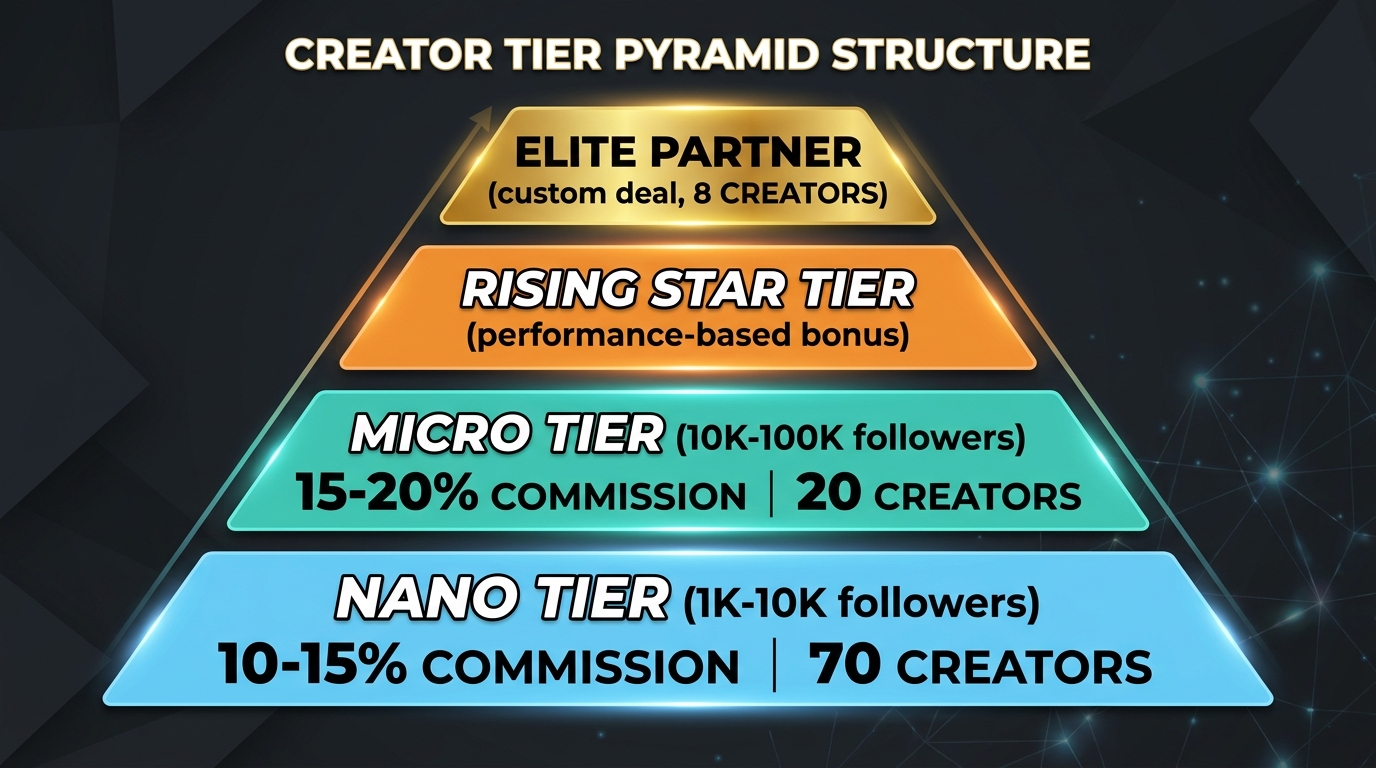
A flat commission structure — everyone gets the same rate regardless of performance — is the structural equivalent of paying your best salesperson the same base as someone who makes one call per month. It de-incentivizes high performers, removes motivation for mid-tier creators to push harder, and gives you no lever to reward the creators who are actually building your brand.
Designing a Four-Tier Commission Structure
The tier architecture that works for most 100-creator programs is built around two inputs: creator size (follower count by platform) and performance output (revenue generated, or GMV driven, over a rolling 30- or 90-day window). Combining these two signals prevents the tier system from simply rewarding follower count and instead builds in a genuine performance orientation.
Tier 1 — Nano Partners (1K–10K followers, entry level): Base commission of 10–12% on tracked sales. Product seeding in exchange for review content. Monthly performance summary. Eligible to advance to Tier 2 upon reaching a defined GMV threshold (e.g., $1,500 in attributed sales over 60 days).
Tier 2 — Micro Partners (10K–100K followers, or Tier 1 graduates): Commission of 15–18%. Product seeding plus a small guaranteed content fee for quarterly hero content pieces. Bi-weekly performance check-in from program manager. Access to upcoming product launches before public release — a privilege that creators genuinely value and that costs the brand nothing.
Tier 3 — Rising Stars (performance-qualified at any follower count): Commission of 18–22% plus performance bonuses for exceeding quarterly GMV targets. Co-marketing opportunities: featuring creator content in brand email campaigns, amplification via Spark Ads or Partnership Ads, and inclusion in brand case studies. Program managers actively invest more time coaching this tier toward their next content arc.
Tier 4 — Elite Partners (top 5–8% by GMV, typically mid-tier creators with proven conversion): Custom commission structure negotiated individually, often with guaranteed monthly minimums. Joint content planning sessions. Access to brand events. Potential for exclusivity agreements in specific product categories. These relationships are closer to traditional brand ambassador deals than standard affiliate programs.
Making Tier Advancement Visible and Achievable
The tier system only works as a retention and motivation tool if creators can see where they stand and what it takes to advance. A dashboard that shows each creator their current tier, their progress toward the next tier threshold, and estimated earnings impact of advancing — in real time — is a meaningful engagement driver.
This doesn’t require custom software. A well-structured Google Looker Studio report pulling from your affiliate platform’s API can display this information adequately for a program under 200 creators. The effort is in the setup and maintenance, not in expensive infrastructure.
Additionally, celebrate tier advancements publicly within your creator community. A creator cohort — a Slack group, Discord server, or even a weekly email to all program participants — that acknowledges when creators move up tiers creates positive social proof and peer motivation that costs nothing to generate.
The 80/20 Problem — Managing Top-Performer Dependency Risk
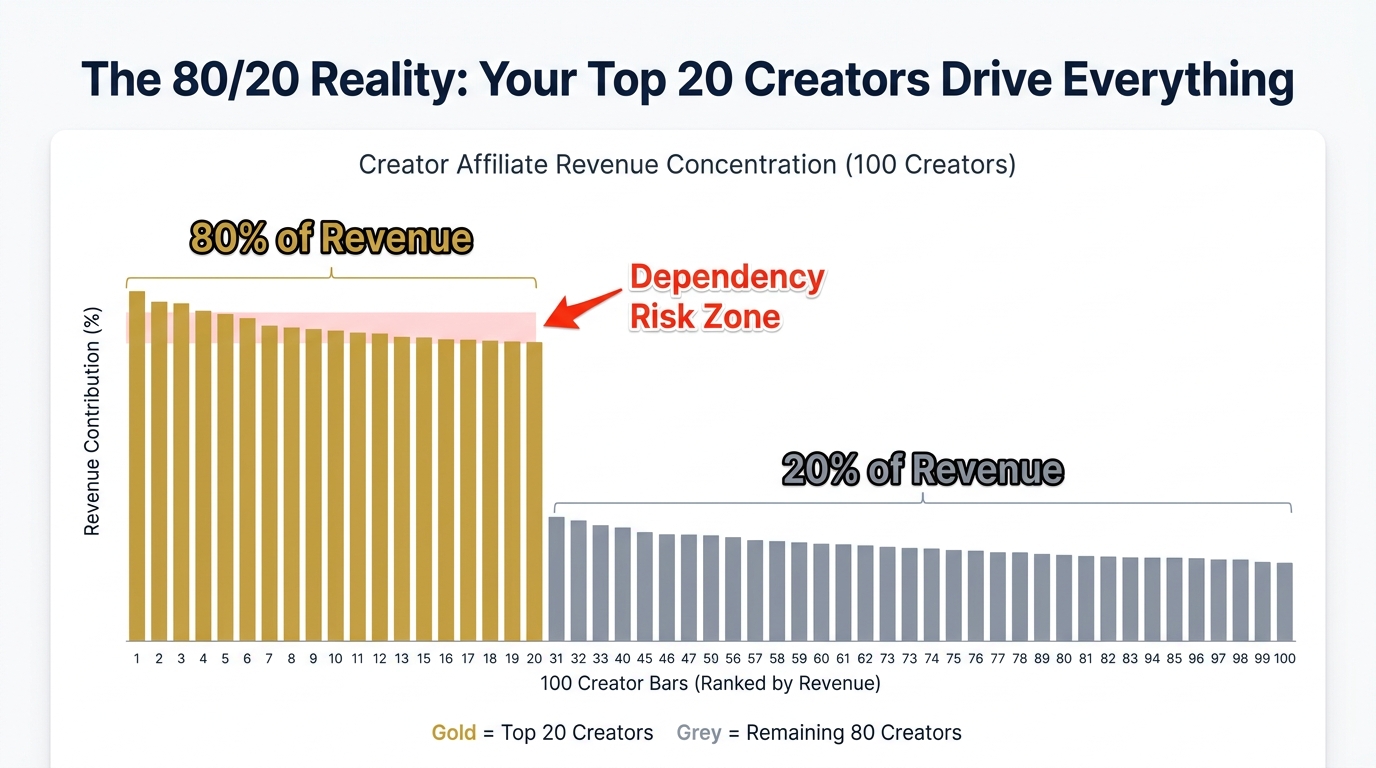
Here is the structural reality of almost every creator affiliate program at scale: roughly 20% of your creators will drive roughly 80% of your revenue. In some mature or highly concentrated programs, the split skews further — 10% of creators driving 90% of GMV. This is not a failure condition; it’s an expected outcome of how performance distributes in any large sales-adjacent system.
The problem is what happens when brands don’t recognize this pattern early enough and build operational responses to manage it.
How Top-Performer Dependency Becomes a Risk
When 15–20 creators drive the majority of your program’s attributed revenue, each of those creators represents a material revenue concentration. If one of your top five creators switches to a competitor program (which happens regularly when competitors offer better commission tiers), changes their content focus, or simply burns out and goes inactive, you lose a disproportionate share of program revenue with no immediate replacement.
This risk compounds when brands respond to top-performer concentration by investing even more in their top creators at the expense of developing mid-tier talent. The result is a fragile program where five or six creators effectively function as a single large influencer deal — exactly the structure the distributed pipeline was supposed to avoid.
Active Risk Management Strategies
Revenue concentration monitoring. Track what percentage of your program’s total attributed revenue comes from your top 10% of creators on a monthly basis. If this number consistently exceeds 70–75%, your program has structural dependency risk that warrants active intervention. Set a program-level target: no single creator should account for more than 15% of total monthly creator-attributed GMV.
Deliberate mid-tier investment. The creators at the 60th–80th percentile of your performance distribution — those who are clearly above average but not yet in the top tier — are your most valuable development targets. They have demonstrated performance capacity but haven’t reached their ceiling. Investing disproportionate coaching, content support, and commission incentives in this cohort builds your next generation of top performers and reduces dependency on the existing elite.
Non-exclusive agreements and competitive awareness. Understanding which of your top creators are currently running affiliate programs for competitor brands — and what those programs offer — is essential intelligence that most brands don’t actively maintain. A top creator who gets a better deal from a competitor will not always tell you before switching. Regular (quarterly) retention conversations with your top-tier creators, including proactive commission reviews, are a basic defensive practice.
Systematic pipeline replenishment. A 100-creator program isn’t a fixed asset that you build and maintain. It’s a living system with natural attrition — the industry benchmark suggests roughly 35% annual creator churn even in well-managed programs. That means you need to be recruiting 30–40 new creators per year just to maintain headcount, with higher targets if you’re aiming to grow. Treat recruitment not as a launch activity but as an ongoing operational function.
Tracking, Attribution, and the Truth About “Last Click”
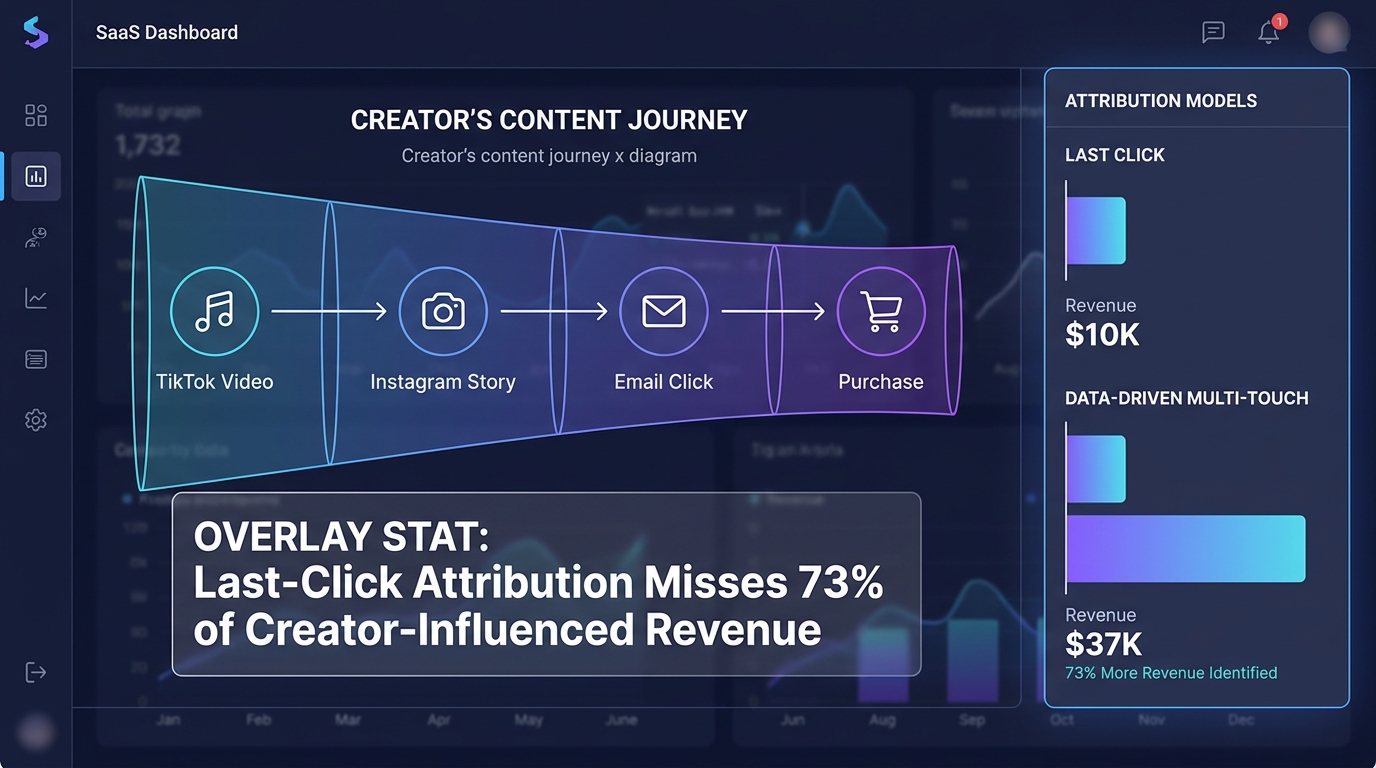
Attribution in creator affiliate programs is broken at the infrastructure level for most brands, and the consequences extend far beyond accounting — they distort which creators appear to be performing, which program investments look justified, and ultimately which creators you end up retaining or cutting.
The Last-Click Attribution Problem
Standard affiliate tracking assigns commission credit to the last affiliate touchpoint before a sale. In a world where creator content is consumed across multiple platforms over multiple sessions before a purchase decision is made, this model systematically undercounts creator contribution and misallocates credit between creators.
A consumer sees a TikTok video from Creator A that introduces them to your brand. They don’t click immediately. Three days later, they see a YouTube review from Creator B and click through to your site but don’t purchase. A week later, they remember the product, search Google, find a blog post with Creator C’s affiliate link, click through and buy. Last-click attribution gives 100% of the credit to Creator C. Creator A — who generated the initial brand awareness that started the entire purchase journey — gets nothing. Creator B gets nothing.
This matters operationally because brands cut creators who appear to be generating traffic but no attributed conversions, when in reality those creators are playing a crucial top-of-funnel role in purchase journeys that ultimately convert through different channels.
Practical Attribution Improvements
Perfect multi-touch attribution across channels remains genuinely difficult — the cross-device, cross-platform purchase journey is hard to stitch together without significant technical infrastructure. But there are practical improvements that most mid-market brands can implement without enterprise-grade tooling:
Custom UTM parameters per creator. Every creator should have unique UTM parameters embedded in their links that allow you to track their contribution to site traffic, even when the traffic doesn’t directly convert. A creator who drives 500 visits to your site with a 4-day average time-to-purchase cycle is contributing to conversions that show up in Google Analytics on the return visit — but you can connect that to the creator if the UTM data is captured correctly.
Unique discount codes alongside unique links. Many consumers share products from creators by copying the product URL rather than using the creator’s specific affiliate link. A creator-specific discount code (e.g., CREATOR15) captures these conversions that affiliate links miss. Running both a unique link and a unique code simultaneously gives you two attribution signals instead of one.
First-click windows and multi-click attribution rules. Most affiliate platforms allow you to configure attribution windows and credit rules. A 30-day cookie window with 7-day last-click priority captures more of the extended purchase journey than a standard 24-hour window. For higher-consideration purchases, extend this further — a 60- or 90-day window may be appropriate if your typical time-to-purchase is extended.
Post-purchase surveys. The simplest, often most overlooked attribution tool: ask customers how they heard about you. A one-question post-purchase survey asking “How did you first discover [Brand Name]?” with creator name options captures top-of-funnel credit that no tracking pixel will ever see. Brands that run these surveys consistently find that creator content is driving 20–30% more initial discovery than affiliate tracking data suggests.
Reactivation Campaigns — Waking Up Dormant Creators
At any point in time, a meaningful fraction of your enrolled creators will be dormant — not actively posting, not engaged with program communications, generating zero attributed revenue. In programs without proactive reactivation strategies, the dormant cohort typically represents 30–50% of total enrolled creators within six months of program launch.
The instinct is to cut dormant creators and redirect resources to new recruitment. This instinct is often wrong. A creator who was active six months ago, posted content that performed well, and then went quiet for personal or scheduling reasons is far easier and cheaper to reactivate than finding, vetting, and onboarding a brand-new creator from scratch.
Diagnosing Why Creators Go Dormant
Before running reactivation campaigns, segment your dormant creator pool by the reason for dormancy. The most common categories:
Low-earnings dormancy: The creator’s first few posts generated minimal commission, and they’ve concluded the program isn’t worth their content creation time. These creators need either a content coaching conversation to improve their conversion rate, a commission bump to improve the economics, or both. Without addressing the economics, a reactivation campaign will produce short-term posting activity followed by a second round of dormancy.
Life-event dormancy: The creator went through a life event (moved, changed jobs, had a child, traveled) that disrupted their content schedule. These creators are often highly reactivatable with a simple personal check-in and a low-friction “welcome back” offer: new product, updated brief, easy first-content angle. The barrier is time and momentum, not program dissatisfaction.
Competitive dormancy: The creator started prioritizing a competitor’s program that offers better economics or more hands-on support. These creators require a more compelling offer — a commission increase, an exclusive product access, or a co-marketing opportunity — to shift attention back to your program. If the competitor’s offer is materially better and you can’t match it, be realistic about reactivation probability.
The Reactivation Campaign Framework
An effective reactivation campaign isn’t a blast email to all dormant creators. It’s a segmented, personalized outreach that acknowledges the specific creator’s history with the program and makes a concrete, low-friction ask.
The most effective reactivation offers combine three elements: a new product (giving the creator fresh content material), a time-limited commission boost (typically 2–3% above their standard rate for 30 days), and a specific content brief tied to a seasonal moment or trending topic that gives them a clear creative starting point.
Response rates on well-segmented reactivation campaigns in creator programs typically run 20–35% — meaning roughly one in three dormant creators will re-engage if the offer is right and the outreach is personal. Among those who respond, 50–60% will post at least once. That makes reactivation meaningfully more efficient than equivalent new-creator recruitment costs.
Track reactivation conversion rates the same way you track new-creator activation rates. If reactivation campaigns consistently under-perform, that signals a program-level issue — typically either commission economics that are fundamentally unattractive or an onboarding failure that burned the relationship in the early days and that creators remember months later.
What Separates Programs That Scale from Those That Stall
After examining the mechanics of every major stage in the 100-creator pipeline — recruitment, vetting, onboarding, activation, tier design, 80/20 management, attribution, and reactivation — a clear pattern emerges in what distinguishes programs that consistently grow versus those that plateau or implode within the first year.
The Operating Discipline That Compounds
Scaling programs treat every part of the pipeline as a measured process with defined conversion rates, not as a collection of creative relationships. They know their recruitment-to-onboarding conversion rate. They know their 30-day first-post rate. They know their 90-day retention rate. They know their average GMV per active creator and how that number changes across creator tiers. And they review these metrics monthly, not quarterly.
This operating discipline is what makes the pipeline compound. When you know that your 30-day first-post rate is 45% and you can identify the specific onboarding step that most commonly precedes creator inactivation, you have an actionable optimization target. When you fix that step and your first-post rate moves to 55%, the improvement cascades through every subsequent stage of the pipeline — better activation, better retention, lower reactivation burden.
Community as Infrastructure, Not a Nice-to-Have
The programs that demonstrate the highest creator retention consistently build some form of creator community — a shared space where creators can interact with each other, share what’s working, compete on performance leaderboards, and feel part of something larger than a transactional commission arrangement.
This doesn’t require a custom platform. A well-moderated Slack or Discord with consistent brand engagement, a monthly creator spotlight, a bi-weekly content tip, and a quarterly performance leaderboard provides enough community infrastructure to meaningfully improve retention without significant operational overhead. The value is in the regular signal to creators that they are seen, valued, and part of an active program — not just a name in a spreadsheet.
Content Amplification as the Revenue Multiplier
The most financially significant operational decision in a 100-creator program is often how to allocate paid amplification budget across creator content. Brands that systematically identify their top-performing organic creator content and amplify it via Spark Ads or Partnership Ads consistently see their creator channel ROI increase by 2–4× compared to organic-only programs.
The selection logic is simple: amplify the top 10–15% of creator content by organic engagement rate, not by creator tier or relationship history. Some of the most effective Spark Ad creative comes from nano-creators with 3,000 followers whose product review hit an authentic note that resonated with their specific community. The brand’s job is to have the infrastructure to identify that content quickly and put paid spend behind it before the organic window closes.
The Long Game: Creator Programs as Brand Equity
There’s a dimension of micro-affiliate programs that doesn’t show up in monthly GMV reports but becomes material over 12–18 months of consistent operation: the depth of brand-creator relationship, the library of authentic creator content, and the accumulated audience trust that comes from consistent creator endorsement across dozens of niche communities.
These are brand equity assets. A library of 500 pieces of authentic creator content about your product, spread across TikTok, Instagram, and YouTube, creates a persistent presence that continues driving organic discovery long after the content was produced. A roster of 20 creators who have endorsed your brand consistently for 18 months carries credibility weight that no single influencer campaign replicates.
The brands that treat their creator affiliate program as a long-term brand equity investment — rather than a short-term GMV channel that needs to pay back in 90 days — are the ones that end up with genuinely defensible distribution advantages. The 100-creator pipeline isn’t just a marketing channel. Built and managed correctly, it becomes a distributed sales force, a content production engine, and a trust-building mechanism operating simultaneously across dozens of niche audiences.
That’s the compounding return that the single mega-influencer deal can never deliver.
Key Takeaways
- Measure active creators, not enrolled creators. Your 30-day active rate is the real health metric for a creator affiliate program. Expect to recruit 2.5–3× your target active headcount to account for onboarding drop-off and early dormancy.
- Commission is not the primary cost. Total operational costs for a well-run 100-creator program typically run $40,000–$75,000/year beyond commissions. Budget for this from day one or your ROI model will be wrong.
- Treat onboarding as a conversion rate problem. The first 30 days — and specifically the first post — determine whether a creator becomes a long-term contributor. Personal check-ins, content briefs, and rapid feedback loops are the highest-leverage interventions in this window.
- Build the tier system before you need it. A four-tier commission structure with visible advancement criteria motivates mid-tier creators, rewards top performers, and gives you a retention tool that doesn’t require constant individual negotiation.
- Monitor revenue concentration monthly. When your top 10% of creators drive 80%+ of revenue, you have a structural risk that needs active management — not celebration. Develop your mid-tier deliberately.
- Last-click attribution systematically undercounts creator contribution. Add unique discount codes, extended cookie windows, and post-purchase surveys alongside standard affiliate links to build a more complete picture of creator-influenced revenue.
- Reactivation is cheaper than recruitment. A well-segmented reactivation campaign targeting dormant creators with a concrete offer converts at 20–35% response rates — far more efficiently than equivalent new-creator acquisition.
- Amplify your best organic creator content. Systematic Spark Ad or Partnership Ad investment behind the top 10–15% of creator content by engagement rate consistently multiplies program ROI by 2–4× compared to organic-only operations.