


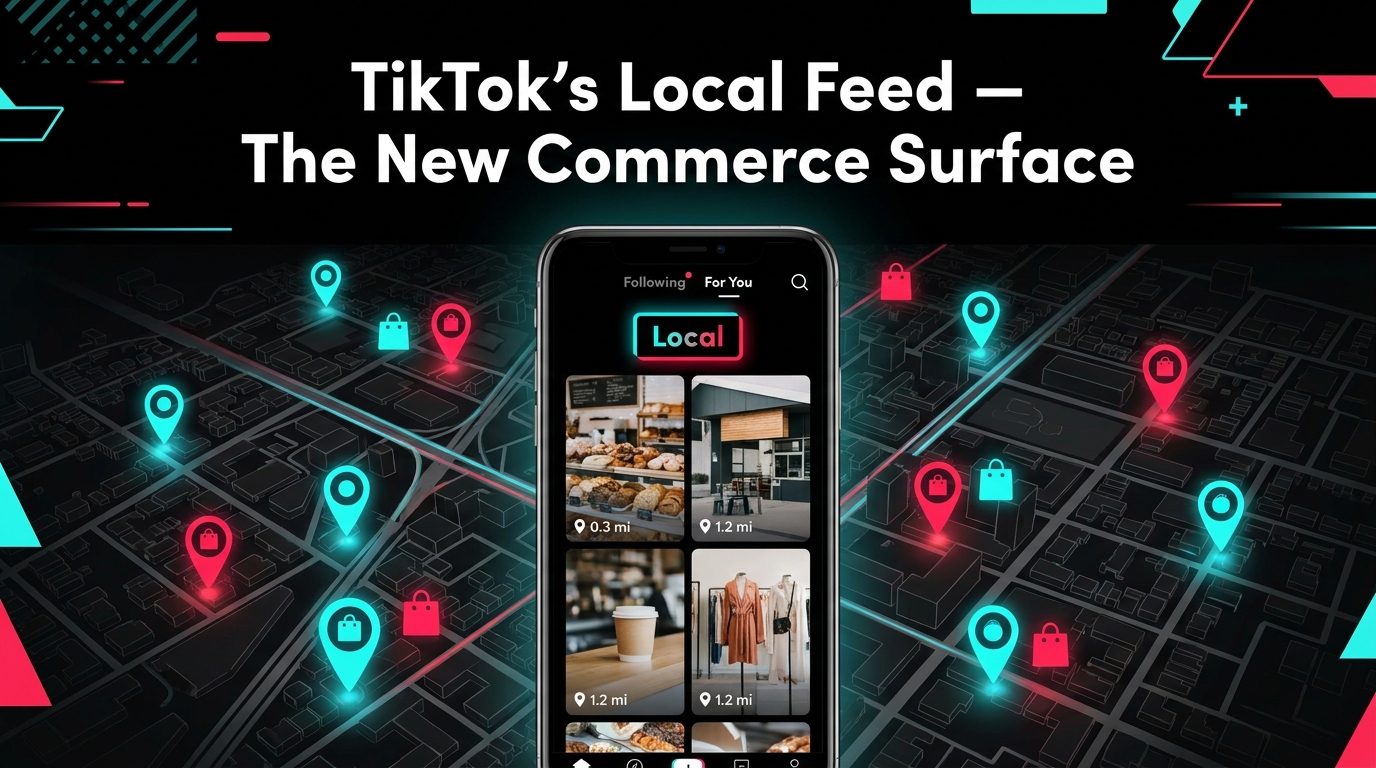
When TikTok quietly rolled out its Local Feed tab in the United States on February 11, 2026, most of the coverage framed it as a discovery feature — a nice addition for finding nearby restaurants and events. The commerce angle barely registered. That framing is wrong, and sellers who accepted it at face value are already paying for it.
The Local Feed is not a lifestyle feature with some commerce potential attached. It is a location-based sales channel with discovery features built in to drive users toward it. The distinction matters because it changes everything about how you build a content strategy around it. You are not trying to entertain people who might happen to buy something. You are positioning products and shops in front of people who are literally nearby, already using a tab designed to surface local businesses, and — critically — who opted into that experience on purpose.
That intent layer is what separates the Local Feed from anything TikTok has offered before. The For You Page built TikTok’s commerce reputation, but it operates on interest signals. The Local Feed operates on proximity signals, recency signals, and topical relevance signals, in combination with that same engagement quality layer the FYP made famous. Understanding how those signals interact — and how to load your content with them deliberately — is the entire game.
This piece breaks down how the Local Feed ranking system actually functions, how it differs from the FYP in ways that genuinely change your content strategy, what the four location signals TikTok is reading look like in practice, and how to combine organic Local Feed content with LIVE shopping and paid amplification to build a repeatable, measurable local sales machine. If you already read our piece on TikTok Shop’s broader algorithm, think of this as the tactical layer that sits on top of that foundation — hyperlocal, high-intent, and underexploited by the majority of sellers currently using the platform.
What TikTok’s Local Feed Actually Is (And What It Isn’t)
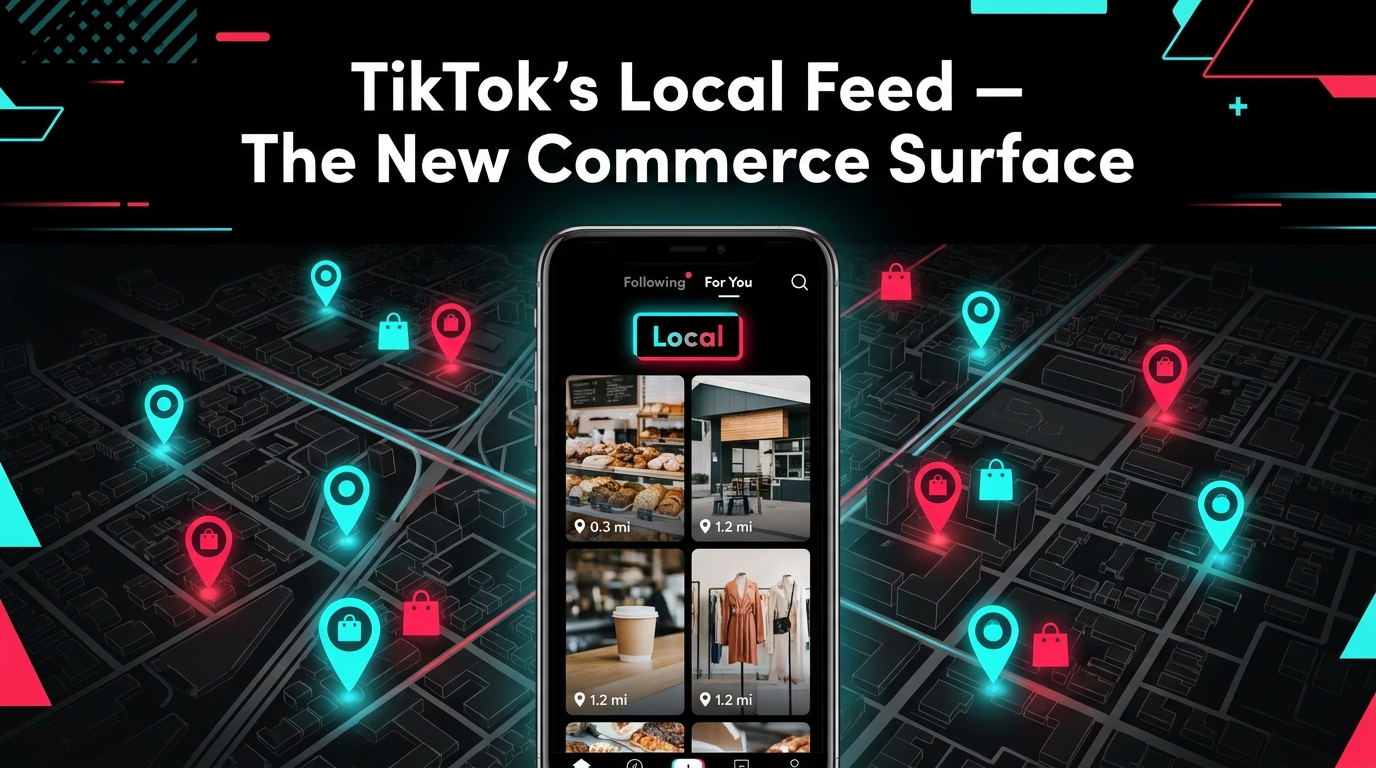
TikTok describes the Local Feed as a dedicated home-screen tab that surfaces content from nearby creators, shops, restaurants, events, and services, based on where a user is physically located. It sits alongside the For You and Following tabs — a third rail on the home screen that users aged 18 and over can access by enabling precise location sharing, which is off by default.
That opt-in structure is important for sellers to understand before they build strategy around it. The Local Feed is not a passive broadcast surface where TikTok decides who sees what without any user action. The people who see your content in the Local Feed have actively chosen to share their location and scroll a proximity-based feed. They have self-selected for local discovery. That behavioral signal is more valuable than almost any interest-based targeting proxy because it reflects an explicit, real-time statement of intent: I want to know what’s around me.
The Rollout Timeline and What It Means for Scale
TikTok tested location-based feeds internationally before the US launch. The feature debuted in the UK, France, Italy, and Germany in December 2025 under the “Nearby” label, giving TikTok several months of real-world behavioral data before expanding to the US market in February 2026. That sequencing matters because TikTok rarely rolls features globally without refining them based on adoption patterns and abuse vectors first. The international Nearby feed helped TikTok calibrate how to weight location data, how to handle privacy edge cases, and how to balance local-business content with creator content without the feed becoming a pure business directory.
The US Local Feed launched with a cleaner, more commerce-oriented design than its international predecessors, with explicit categories for shopping, restaurants, and services alongside creator content. TikTok also added that 18+ age gate, which removes the feed from the youngest user cohort — a deliberate decision that has the side effect of concentrating the audience on users with purchasing power.
What the Local Feed Is Not
It is not a replacement for the For You Page. Content that works in the Local Feed does not automatically perform well on the FYP, and vice versa. The audiences, intent signals, and content consumption patterns are different enough that you need to treat them as separate surfaces with overlapping but distinct strategies.
It is also not Yelp or Google Maps with video attached. Users are not coming to the Local Feed to search for specific businesses by name. They are browsing, discovering, and stumbling. Your content needs to interrupt that browsing pattern in the same way good FYP content does — with a compelling hook — but it also needs to carry enough local context that it feels relevant and trustworthy, not like generic content that happened to be nearby.
Finally, the Local Feed is not yet available everywhere. TikTok’s rollout has been phased, so not every US market has full visibility of the feature, and international availability varies significantly by country. Run your own tests — open the app in your target geography and look for the Local tab — before building a full strategy around the assumption that your audience can access it.
How the Local Feed Ranking System Works
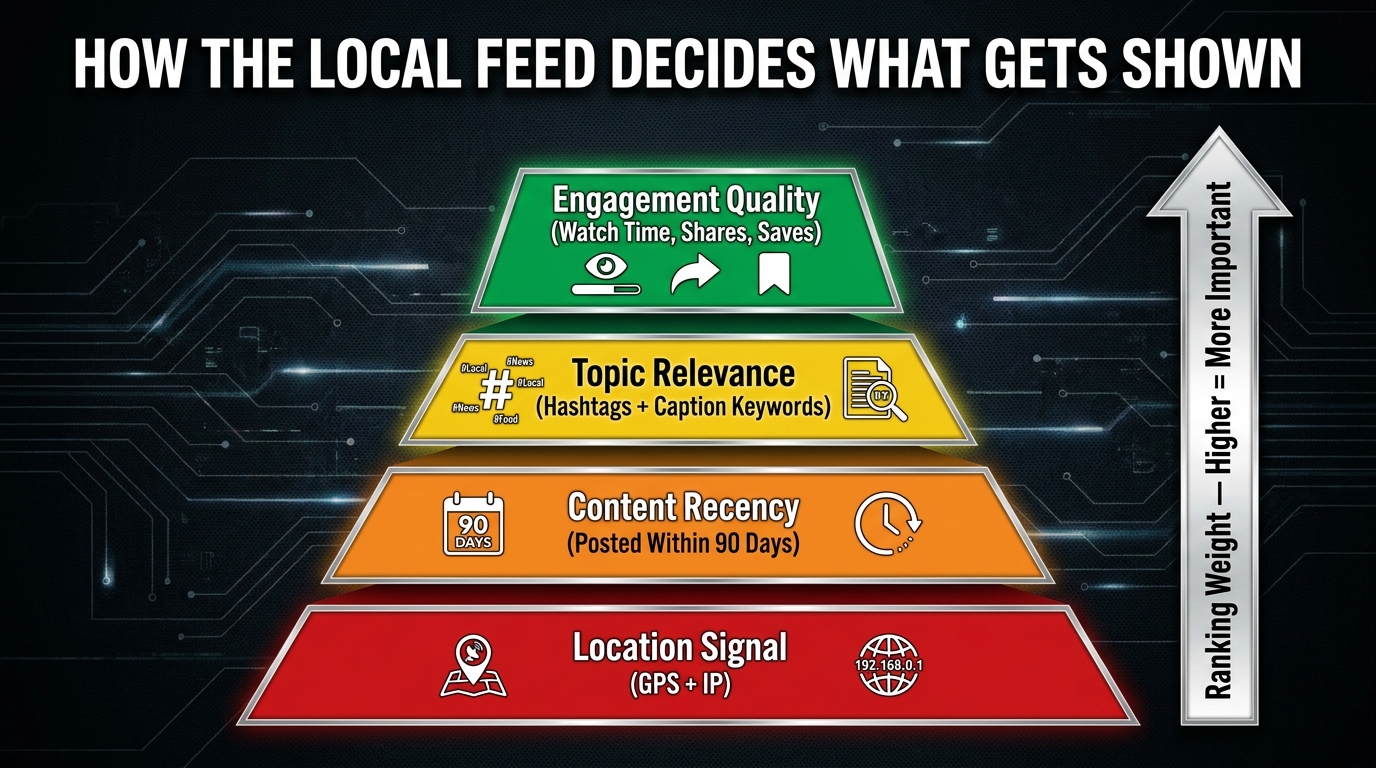
TikTok’s own announcement described Local Feed rankings as driven by three factors: location, topic of content, and when the content was posted. That description is accurate as far as it goes, but it obscures the actual mechanic, which is a layered filter system where location and recency function as gates, and engagement quality functions as the ranking signal within those gates.
The Gate Layer: Location and Recency
Think of the Local Feed algorithm as operating in two phases. The first phase is filtering: TikTok narrows the universe of eligible content to posts that meet the geographic and recency thresholds. A post from a store in Boston is simply not eligible to appear in the Local Feed for a user in Denver, regardless of how strong its engagement signals are. The geographic radius TikTok applies is not publicly specified, but based on how the feature describes itself and how comparable location-based feeds operate, the effective radius appears to be within a metro area — close enough to be genuinely “nearby” rather than just regionally relevant.
The recency gate operates on approximately a 90-day window, with posts published more recently receiving a significant distribution boost within that window. This is different from the FYP, where a viral older post can continue generating impressions for weeks or months. In the Local Feed, freshness is a prerequisite for sustained visibility, not just a tie-breaker. Sellers who post once a week and rely on a single strong video to carry their local reach will consistently lose to competitors who post more frequently, even if those competitors’ individual videos are less polished.
The Ranking Layer: Engagement Quality
Within the pool of geographically eligible, recently posted content, TikTok applies the same engagement-quality signals that drive the For You Page. Watch time and completion rate carry the most weight. A video that people in your city watch all the way through — or rewatch — signals to TikTok that the content is worth surfacing to more local users. Shares and saves carry strong weight as well, particularly shares, because they represent an active recommendation that TikTok’s system reads as genuine social endorsement.
Comments matter, especially early comments that demonstrate real engagement rather than bot-style one-word responses. Saves signal that the viewer found the content valuable enough to want to return to it — a strong purchase-intent proxy for shopping content. Follows from the video signal that a local viewer liked your content enough to want to see more of it, which compounds your Local Feed distribution over time as your local follower base grows.
Topic Relevance and Semantic Signals
The third component of Local Feed ranking is what TikTok calls “topic,” which is really a bundle of semantic signals the system reads to understand what your content is about. These signals come from your caption text, hashtags, on-screen text, spoken words (TikTok’s speech-to-text processing), and the text embedded in your video visuals. A restaurant posting a video of their new menu item without any verbal or textual mention of their city, neighborhood, or cuisine category is providing TikTok’s system with very little topic signal to classify the content as locally relevant to viewers in a specific area.
By contrast, a boutique that says “We just got these in at our [City] store” in the first five seconds of their video, overlays their neighborhood name as on-screen text, includes the name of a local landmark in their caption, and uses a mix of category-specific and geo-specific hashtags is loading their content with topic signals that make it far easier for TikTok to match it to nearby users who are browsing the Local Feed.
Local Feed vs. For You Page — Why You Need Both, and Why They Require Different Strategies
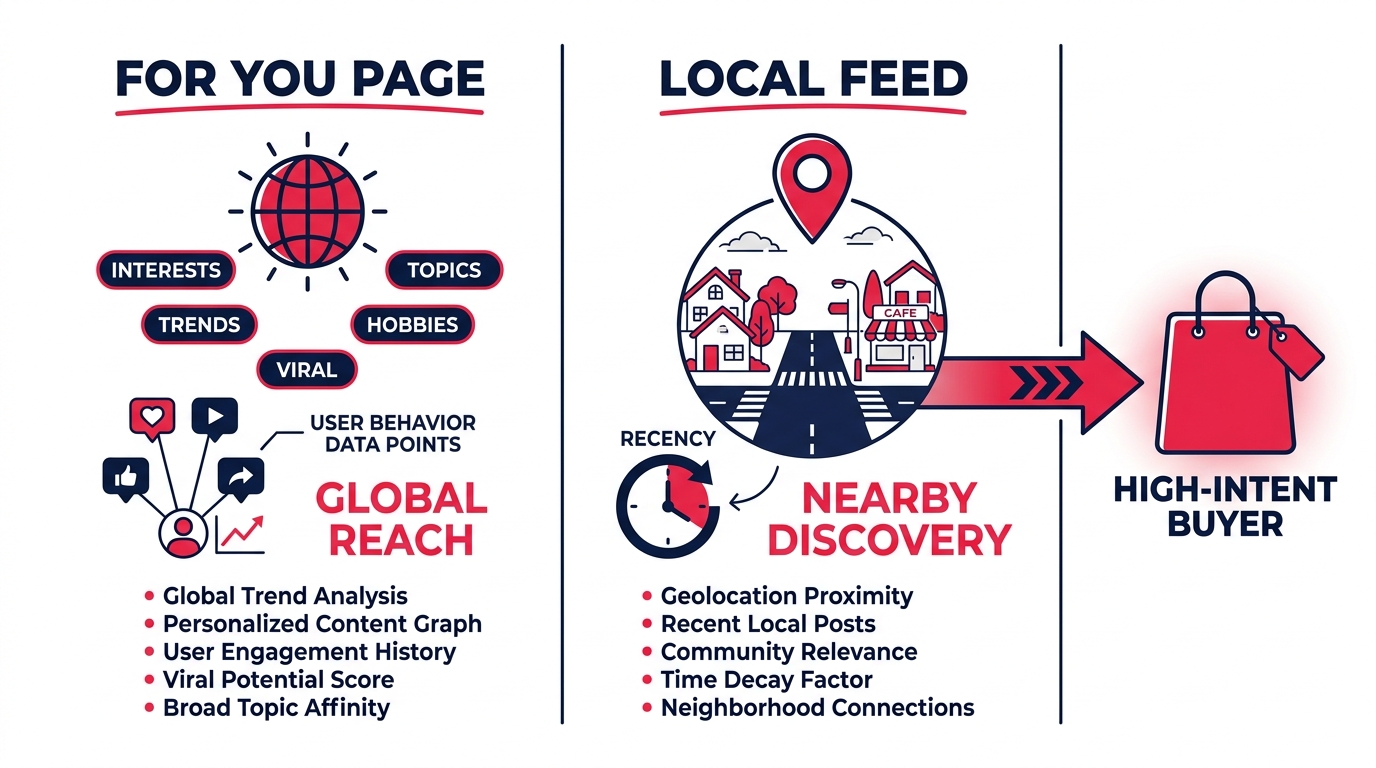
Many sellers make the mistake of treating the Local Feed and the For You Page as interchangeable, using the same content strategy for both. This fails in both directions: content optimized purely for the FYP often lacks the local context signals needed to surface in the Local Feed, while content over-indexed on local signals can feel too narrow to catch broad FYP traction.
The FYP: Your Demand Generation Engine
The For You Page is still where most impressions live. TikTok’s FYP operates globally, using interest graphs, behavioral signals, and content relevance to serve any piece of content to any user, regardless of geography. This is your demand generation surface — the place where unknown brands become known, where product categories get discovered by people who weren’t specifically looking for them, and where viral moments happen.
FYP-optimized content prioritizes: hook strength in the first two seconds, broad entertainment or informational value, trend participation, and creative production quality. Geography is irrelevant — a great piece of content from a Houston bakery can go viral nationally on the FYP because the FYP doesn’t filter for proximity. The trade-off is that most of those national viewers are nowhere near the bakery and will never convert to a real-world visit or a same-day delivery order.
The Local Feed: Your High-Intent Conversion Surface
The Local Feed operates with fundamentally different user intent. Someone browsing the Local Feed is not passively consuming content while waiting in line or relaxing before bed. They are actively seeking local information — places to eat, things to buy, events happening nearby. The intent layer is higher, the audience is geographically qualified, and the path from view to purchase or visit is shorter.
Local Feed-optimized content prioritizes: geographic anchoring in the first few seconds, community relevance over mass appeal, recency (what’s happening now, what just arrived, what’s on today), and clear calls to action that translate to real-world behavior — visiting a store, ordering for local delivery, attending an event or LIVE shopping session.
The Right Relationship Between the Two Surfaces
The most effective sellers in 2026 are using a two-tier content strategy. They produce broader FYP-optimized content — product showcases, trend participation, brand storytelling — that builds awareness and follower counts among an interest-aligned audience. Within that same volume of content, they also produce Local Feed-specific videos that are explicitly place-based and time-sensitive, designed to convert the nearby slice of their audience into purchasers. These local videos typically perform less well on the FYP by pure view count, but they generate disproportionately high click-to-shop and profile visit rates from the audiences they do reach — because those audiences are qualified by location.
A useful heuristic: if someone watching your video at a random location in another country would find it just as relevant and useful as someone three blocks away from your store, it’s FYP content. If the video is significantly more valuable to the nearby viewer, it’s Local Feed content. Build both, track them separately, and don’t judge Local Feed content by FYP metrics.
The Four Location Signals TikTok Actually Reads
Sellers often think “location signal” means one thing: the geotag you add to a post. In reality, TikTok is reading at least four distinct categories of location signal, and optimizing only one of them while ignoring the others leaves significant Local Feed visibility on the table.
Signal 1: Device GPS and IP-Based Location
When a user with the Local Feed enabled opens TikTok, TikTok captures their precise GPS coordinates (while the app is in use — this is an explicit requirement of the feature). Your account’s posting location is also registered when you publish content. The system cross-references viewer location against content origin location to determine geographic eligibility. This is the gate-level signal described earlier — it determines whether your content is even in the pool for a given user.
For sellers, this means posting from your business location, or at minimum from within your target city, matters more than it did before. A seller who manages their TikTok account remotely from a different city may find their content appearing in the Local Feed of the wrong market. Where possible, post from the physical location you want to be associated with, or ensure your account’s primary location settings reflect your business address accurately.
Signal 2: Explicit Geotags and Location Labels
The manual geotag you add to a post — the location sticker or tag that names a specific place — is a direct topical signal that tells TikTok’s system what geographic context to apply to your content. Tagging your store address, your neighborhood, or a recognizable nearby landmark all strengthen the local classification of your content. Tagging the city broadly (just “Los Angeles”) is less precise than tagging a specific district (“Silver Lake, Los Angeles”), which sends a stronger signal about exactly where you are serving.
Don’t over-rely on this signal alone, but don’t skip it either. Geotags are low-effort, high-return additions to every piece of locally targeted content you publish. The mistake is treating them as a complete local strategy rather than one input among several.
Signal 3: Verbal and On-Screen Text Cues
TikTok processes the audio of your videos through speech-to-text technology and reads any on-screen text you include. Both become inputs to the semantic topic classification system. When you say your city name, neighborhood name, local landmark, or even a locally specific phrase in your video, that spoken content is indexed. When you overlay your city or neighborhood as on-screen text — particularly in the first few seconds — TikTok captures it as a strong local relevance signal.
This signal is significantly underused by most local sellers. Many sellers add a geotag and call it done, then produce video content that could have been filmed anywhere. Adding one line of spoken dialogue — “We’re here at our [Neighborhood] location and we just got these in” — or one text overlay with your city name costs nothing and meaningfully strengthens your local feed eligibility for that specific video.
Signal 4: Caption Keywords and Hashtag Taxonomy
TikTok’s caption and hashtag system feeds into local topic classification in ways that go beyond simple keyword matching. The combination of geographic hashtags (your city, neighborhood, local identifiers), category hashtags (your product or service type), and descriptive caption text creates a topic fingerprint that TikTok uses to decide whether your content belongs in the “shopping nearby” section of the Local Feed versus the “events nearby” section or the “food and drink” section.
The optimal structure for Local Feed captions combines: a primary geographic identifier (city or neighborhood name), a category descriptor (what you sell or do), a time-sensitive hook (what’s happening now or soon), and a call to action. Hashtags should include two to three hyper-local tags (your city + neighborhood), two to three category-specific tags, and one or two broader reach tags. Avoid loading your captions with ten or fifteen generic hashtags — TikTok’s system reads dense, unfocused hashtag clusters as low-quality topic signals.
Content Architecture for Local Feed Dominance
Understanding the ranking signals is only half the problem. The other half is knowing what types of content to build around those signals — and in what sequence — to establish consistent Local Feed visibility rather than occasional spikes.
The Recency Imperative: Posting Cadence for Local Sellers
Because the Local Feed’s recency gate gives a significant distribution advantage to recently published content, posting cadence matters more for local sellers than for brands relying primarily on the FYP. The FYP can reward a single high-performing video with weeks of impressions. The Local Feed consistently rewards creators and businesses who show up frequently.
The practical floor for meaningful Local Feed presence is four to five posts per week specifically targeting local audiences. The ideal cadence for most local sellers is once daily, with content timed to local peak engagement windows — typically midday and early evening on weekdays, and late morning on weekends. These timing patterns reflect when your target geographic audience is most actively browsing TikTok, and hitting those windows with fresh content means your posts are at their youngest — and most favored by the recency signal — precisely when the most local users are in the feed.
The Three Content Types That Win in the Local Feed
Type 1: Time-sensitive “what’s happening now” content. New arrivals, today’s specials, limited-time offers, local events you’re participating in — anything with an explicit time dimension signals recency and creates urgency. This is the Local Feed’s highest-converting content category because it gives a nearby viewer a concrete reason to act immediately. A boutique that posts “just got these jackets in this morning, only three in this colorway” is giving a local viewer a reason to click and buy before someone else does.
Type 2: Community-embedded storytelling. Content that references local landmarks, neighborhood characteristics, community events, or nearby cultural touchstones resonates with local audiences in a way that generic product content cannot. A coffee shop that posts about a neighborhood art walk happening this weekend and mentions they’ll be open late is embedding their business in the community narrative that nearby viewers are already interested in. This type of content earns shares and saves from people who want to pass along the local tip — which compounds your local engagement signals significantly.
Type 3: Behind-the-store reality content. The Local Feed is not the place for high-production brand films. It rewards authenticity and immediacy — the kind of content that makes a viewer feel like they’re getting an insider look at what’s happening in their neighborhood right now. Walk-throughs of your store, quick tours of new product arrivals, candid moments from your team’s day, real customer reactions — these formats generate strong watch-time signals because they feel like lived local experience rather than advertising.
Hook Construction for Local Audiences
Your first two to three seconds determine everything, exactly as on the FYP. But Local Feed hooks have a distinct structure from FYP hooks. Where FYP hooks typically lead with emotional or informational bait (“You won’t believe what I found” or “Three things every buyer needs to know”), Local Feed hooks need to establish geographic relevance immediately alongside the emotional or informational hook.
Effective Local Feed hook structures include: “If you’re in [neighborhood/city], you need to see this before the weekend” — location first, urgency second. “This just landed at our [city] location” — location embedded in the product reveal. “The best-kept secret in [neighborhood]” — geographic identity as the intrigue mechanism. Each of these formats tells TikTok’s algorithm and the human viewer simultaneously: this content is for you, and it’s relevant to where you are.
LIVE Shopping and the Local Feed: The Combination Most Sellers Miss
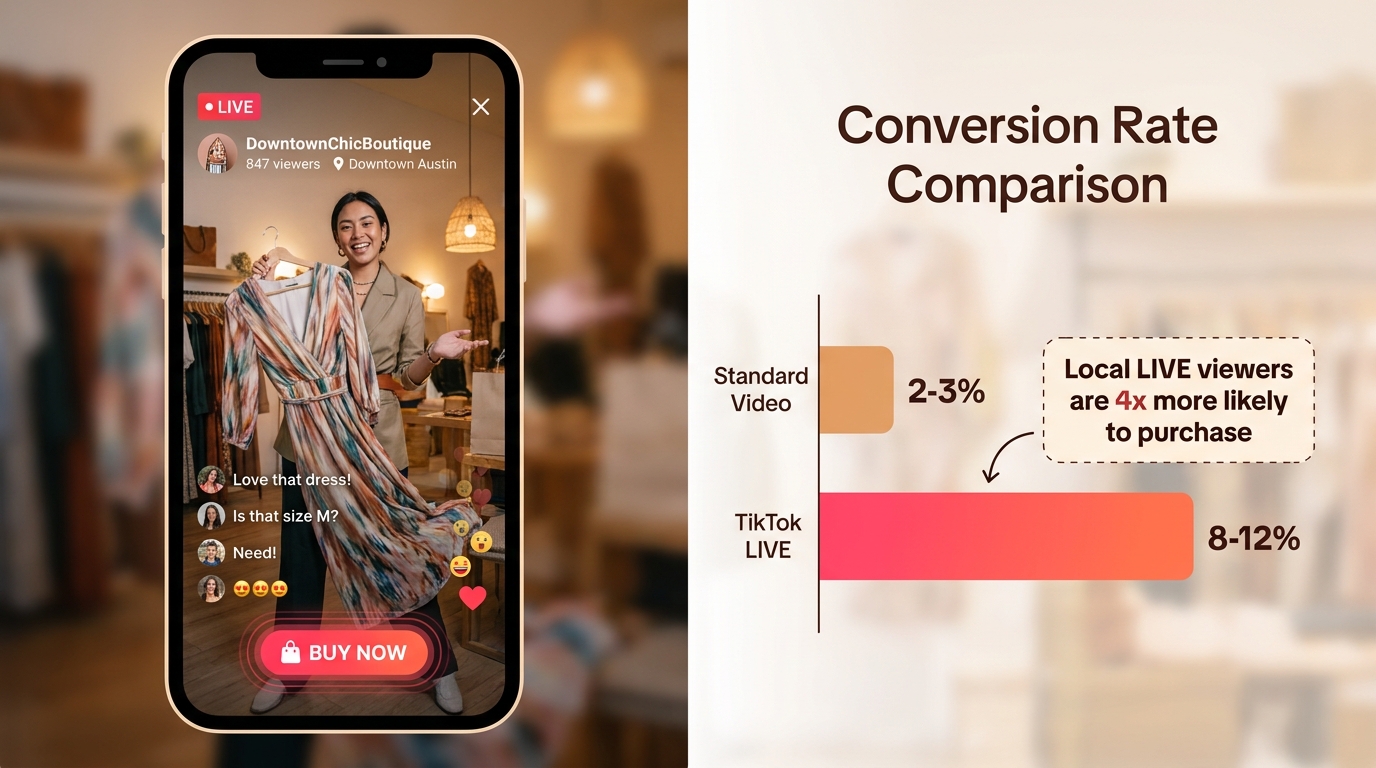
TikTok LIVE is already TikTok Shop’s highest-converting commerce format, with benchmark conversion rates in the 8–12% range compared to roughly 2–3% for standard in-feed videos. The Local Feed adds a dimension to LIVE shopping that most sellers have not yet figured out: it makes LIVE sessions discoverable to nearby users in real time.
How Local Feed Surfaces LIVE Content
When you go LIVE on TikTok, the session becomes eligible for the Local Feed just as any other content does — but with one critical difference. LIVE content has an inherent recency signal that no pre-recorded video can match: it is happening right now. The Local Feed’s recency weighting means an active LIVE session from a nearby business is among the freshest possible content the system can surface, and TikTok actively surfaces LIVE sessions to users to drive real-time engagement.
This creates a powerful compound effect for local sellers. A LIVE shopping session from a neighborhood boutique can appear in the Local Feed of people sitting in nearby coffee shops, riding the subway home from work, or browsing from nearby apartment buildings — all of whom can click into the LIVE, see the product being shown in real time, and purchase before the session ends. The geographic proximity combined with the real-time urgency of a LIVE format produces a buyer psychology that is fundamentally different from browsing a product page.
Structuring a Local LIVE Session for Conversion
Running a LIVE session that converts local viewers requires a different structure than a general TikTok Shop LIVE. The content needs to be built around local hooks that create a sense of shared community and exclusivity. Several elements work consistently well.
Opening with a local anchor: Start your LIVE by explicitly naming your location and acknowledging your local audience. “Hey, to everyone joining from [city] — this LIVE is especially for you” immediately signals to arriving viewers that this session is geographically relevant and that local buyers are a priority.
Creating local-only offers: Offering a discount code or bundle that is specific to the LIVE session, and announcing it as a “local viewer exclusive,” creates urgency and a sense of community belonging that drives immediate purchase decisions. The psychology is the same as a flash sale but with the added layer of geographic identity — viewers feel they are part of a local in-group getting access to something the wider world is not.
Referencing the physical store: If you have a physical location, show it. Show your storefront, your shelving, your team. A LIVE viewer who recognizes your store from their own neighborhood is a viewer who already has a trust relationship with you, even if they’ve never interacted with your brand before. Familiar physical environments reduce purchase hesitation.
Scheduling consistency: Local LIVE sessions perform best when they happen at consistent, predictable times. A boutique that goes LIVE every Thursday at 6pm builds a local audience habit — nearby viewers who enjoyed a previous session will tune in again because they know when to expect it. Irregular, unannounced LIVE sessions miss the audience habit formation that consistent scheduling builds.
Using Pre-LIVE Content to Seed Local Feed Discovery
Don’t wait until you go LIVE to activate the Local Feed. In the 24 to 48 hours before a scheduled LIVE session, post two or three teaser videos that are specifically designed to be Local Feed-eligible: geotag the posts, use local hooks in the captions, mention your city and neighborhood in the video audio, and tease what viewers will be able to buy or see during the LIVE. These pre-LIVE teaser posts build local audience anticipation and ensure that when your LIVE begins and TikTok surfaces it in the Local Feed, the potential audience is already primed and partially pre-warmed.
Multi-Location Brands and the Local Feed: Scaling Without Losing Authenticity
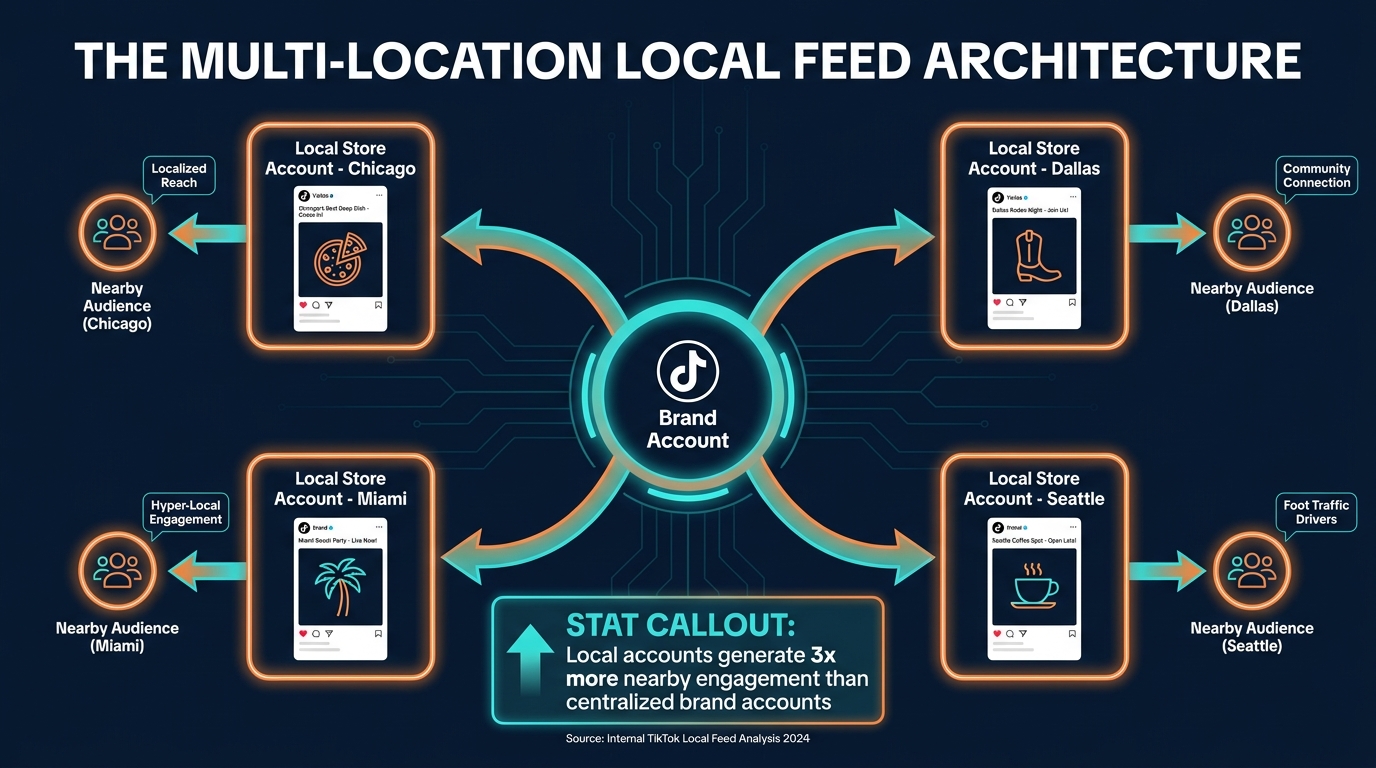
For brands operating in multiple cities or with multiple store locations, the Local Feed creates both an opportunity and an operational challenge. The opportunity is obvious: each location can build a distinct local presence that serves the high-intent nearby audience in that specific market. The challenge is that a single centralized TikTok account posting content from a brand headquarters cannot effectively serve the Local Feed in all the cities you operate in simultaneously.
The Hub-and-Spoke Account Architecture
The most effective structure for multi-location brands is a hub-and-spoke account model: a central brand account that maintains the overall brand identity, audience, and FYP-oriented content strategy, combined with individual location-specific accounts for each market that handle Local Feed content for their respective cities.
Each location account operates as a semi-autonomous content creator, posting city-specific content from the physical store, referencing local landmarks and community events, and running location-specific LIVE sessions. The brand account provides content direction, brand guidelines, trending audio assets, and creative templates that keep all location accounts visually and tonally consistent without homogenizing the local content into something that feels generic.
This architecture requires investment — someone at each location, or a regional content manager, needs to be responsible for the local account’s content output. But the return on that investment is significant: local accounts consistently generate higher engagement rates from nearby audiences than centralized brand accounts posting generic content, because the local specificity reads as authentic rather than manufactured.
Content Templatization Without Genericization
One way to operationalize multi-location Local Feed content without requiring each location to build an entirely independent creative strategy is to develop content templates that have local specificity built in as a variable. A “new arrivals” template might be a consistent format — same music choice, same filming angle, same caption structure — where the variable is the store’s city name, the specific product shown, and the local landmark or neighborhood reference. The consistency of the template reduces the production burden on each location, while the local variables ensure each post reads as genuinely local rather than duplicated content.
TikTok’s algorithm can detect and suppress duplicate or near-duplicate content across accounts, so it’s important that the local variables be substantive enough to make each version genuinely distinct. Swapping only the caption text while keeping identical video footage is not sufficient. The visual content itself — the store interior, the local team, the specific products — needs to vary by location.
Local Creator Partnerships as a Scale Mechanism
Multi-location brands that cannot resource a full internal local content team for every market can supplement their own Local Feed content with local creator partnerships through TikTok Shop’s affiliate program. Partnering with micro-creators who already have established local audiences in your target cities gives your products Local Feed eligibility in those markets without requiring a dedicated account or internal team in each city.
A local food blogger with 15,000 followers in a mid-size city is a more effective Local Feed asset for a restaurant or food brand than a national influencer with a million followers, because the local blogger’s content is already trusted and relevant in that specific geographic community. Their posts about your product will carry local engagement signals that a national influencer’s post simply cannot match, and they will surface in the Local Feed of their neighborhood with far greater authority.
Paid Amplification — How Geo-Targeted Ads Extend Local Feed Wins
Organic Local Feed presence is valuable, but it operates within the constraints of TikTok’s geographic eligibility rules and your organic engagement ceiling. Paid amplification through TikTok Ads Manager’s geo-targeting capabilities lifts those constraints and allows you to extend the reach of your best-performing local content to a larger nearby audience than organic distribution alone will achieve.
How TikTok’s Geographic Targeting Works in Ads Manager
TikTok Ads Manager supports location targeting at multiple granularities: country, region or state, metro area, city, and zip/postal code. The system finds users who are located in or regularly present in the selected geographic area, which means it captures both permanent residents and frequent visitors — relevant for local businesses in high-traffic areas like tourist districts, business districts, or near transit hubs where a significant portion of potential customers may not be full-time local residents but are frequent visitors.
TikTok does not currently support location exclusions or zip+4 targeting, which limits precision for some use cases, but city and metro-area targeting is sufficient for most local commerce applications. The key strategic move is using paid geo-targeting not to replace organic local content but to amplify it: take your highest-performing organic Local Feed posts and run them as Spark Ads, using city or metro-area targeting to push them in front of a larger nearby audience than the organic algorithm reached on its own.
Spark Ads as Local Feed Amplification
Spark Ads — TikTok’s native ad format that boosts an existing organic post rather than running a separate creative — are particularly well-suited for Local Feed amplification because they preserve all the social proof signals that the original organic post accumulated. When a viewer sees a Spark Ad, they see the real post with its real view count, like count, and comment thread, which reads as authentic community engagement rather than a manufactured ad creative.
The workflow for local sellers is: post organic Local Feed content, monitor the first 24 to 48 hours for early engagement signals, identify the posts that are generating above-average watch time and click-through rates from their organic local audience, then convert those posts into Spark Ads with city-level geo-targeting. This approach concentrates your paid budget on creative that has already demonstrated it resonates with a local audience, rather than spending ad dollars to test untested creative at scale.
GMV Max for Local Commerce
TikTok’s GMV Max (Gross Merchandise Value Maximum) optimization is TikTok Shop’s automated campaign type that lets TikTok’s system allocate budget across ad formats and audiences to maximize purchase volume. For local sellers with an established TikTok Shop product catalog, GMV Max campaigns combined with geo-targeting can be effective for driving local purchases because the system will automatically prioritize the creative and audience combinations that generate the most completed transactions — including from local users who discovered the product via the Local Feed.
The limitation is that GMV Max provides less transparency into how budget is being allocated across audience segments, making it harder to isolate specifically how much of your purchase volume is coming from local versus non-local viewers. For sellers who want to understand the Local Feed’s specific contribution to their sales, running separate geo-targeted campaigns with cleaner attribution structures is worth the additional setup cost.
Measuring What the Local Feed Is Actually Doing for Your Sales
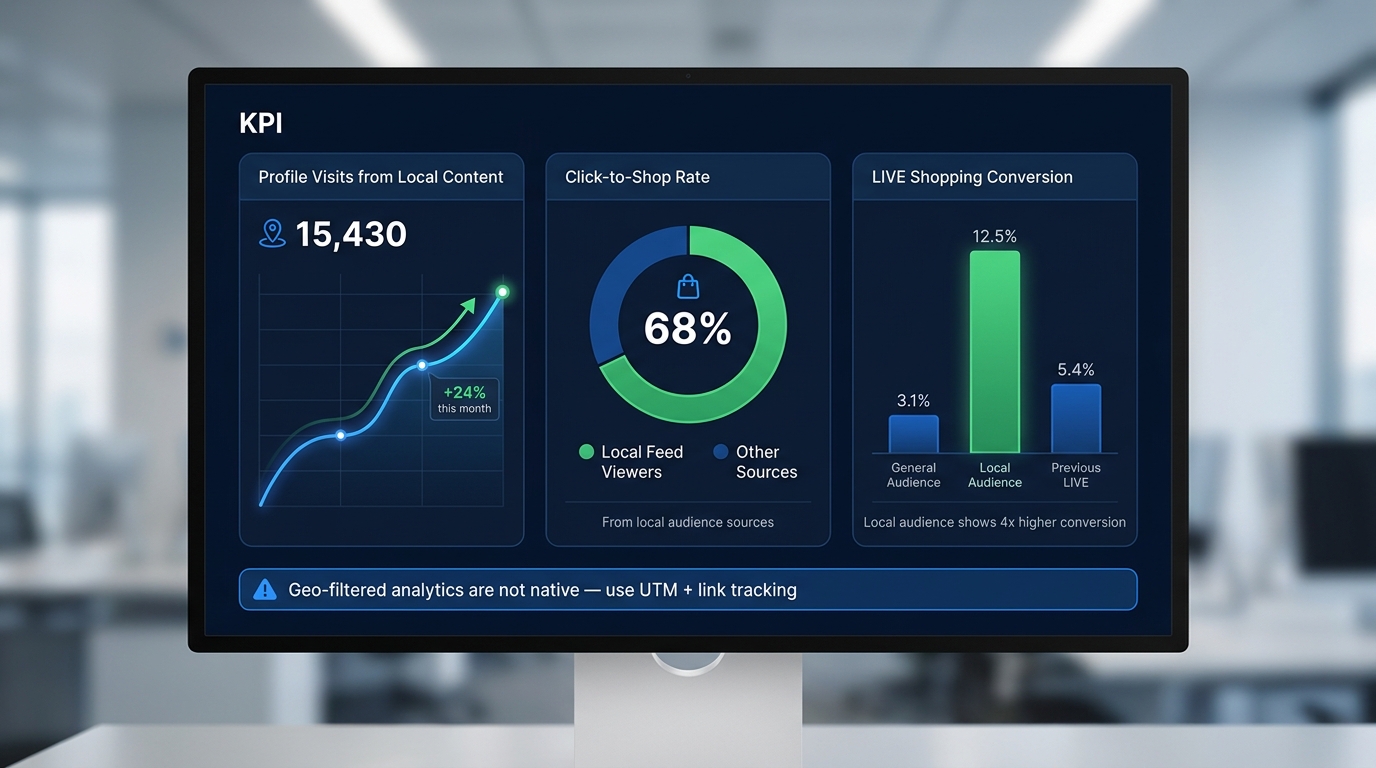
This is where most sellers hit a wall. TikTok does not currently provide native analytics that separate Local Feed impressions and engagement from For You Page or Following feed performance. Your TikTok Analytics dashboard shows total impressions, reach, engagement rate, and traffic sources, but it does not have a “Local Feed” row that tells you how many of your views came specifically from the Local tab.
What TikTok Analytics Does Tell You
TikTok’s analytics do show traffic source breakdowns, including “For You,” “Following,” “Search,” “Profile,” and “Other.” The “Other” category captures traffic from surfaces that TikTok doesn’t individually label in the analytics interface, and the Local Feed is currently believed to fall into this category. If you notice your “Other” traffic source percentage increasing after you begin a focused Local Feed content strategy — with other variables held roughly constant — that’s a directional signal that your local content is gaining traction on that surface.
TikTok also shows audience location data in your analytics, broken down by country and some sub-national geographic segments. If your locally targeted content is generating disproportionate engagement from your target city compared to your broader content, that’s another directional signal of Local Feed traction — though it’s not definitive.
Proxy Measurement Strategies
Because native Local Feed analytics are not yet available, effective measurement requires building proxy signals into your content and conversion flows. Several approaches work consistently.
UTM parameters and link tracking: Every TikTok Shop link or external link in your content should carry UTM parameters that identify the specific post it came from. When you tag your locally optimized posts with distinct UTM identifiers (for example, “local-feed-[city]-[date]”), you can track whether those posts generate purchase or profile visit conversions at a different rate than your non-local content — giving you a performance signal for your local strategy even without native analytics.
Exclusive local offer codes: Creating offer codes that are exclusive to your locally targeted content — codes you only mention in Local Feed-optimized videos or LIVE sessions — gives you a clean, directly attributed signal of how many conversions those specific pieces of content are driving. Every redemption of that code is a confirmed Local Feed-or-LIVE conversion. This is blunt but reliable measurement that doesn’t depend on TikTok surfacing analytics it currently doesn’t provide.
Foot traffic correlation: For sellers with physical locations, correlating increases in store visits with days on which you posted Local Feed-optimized content or ran local LIVE sessions gives you a rough but useful signal of the real-world impact. If Thursdays following your Wednesday LIVE session consistently show higher foot traffic than other days, the causal relationship is plausible even if not perfectly controlled.
The Metrics That Actually Predict Local Commerce Success
For Local Feed content specifically, the engagement metrics that correlate most strongly with downstream purchase behavior are shares, saves, and profile visits — not raw like counts or view counts. A locally targeted video with 5,000 views, 200 saves, and 150 profile visits from your target city is performing far better as a commerce driver than a video with 50,000 views, 1,000 likes, and 20 profile visits. The latter is getting FYP entertainment traction. The former is building a qualified local purchase pipeline.
The Mistakes That Get Local Sellers Buried in the Feed
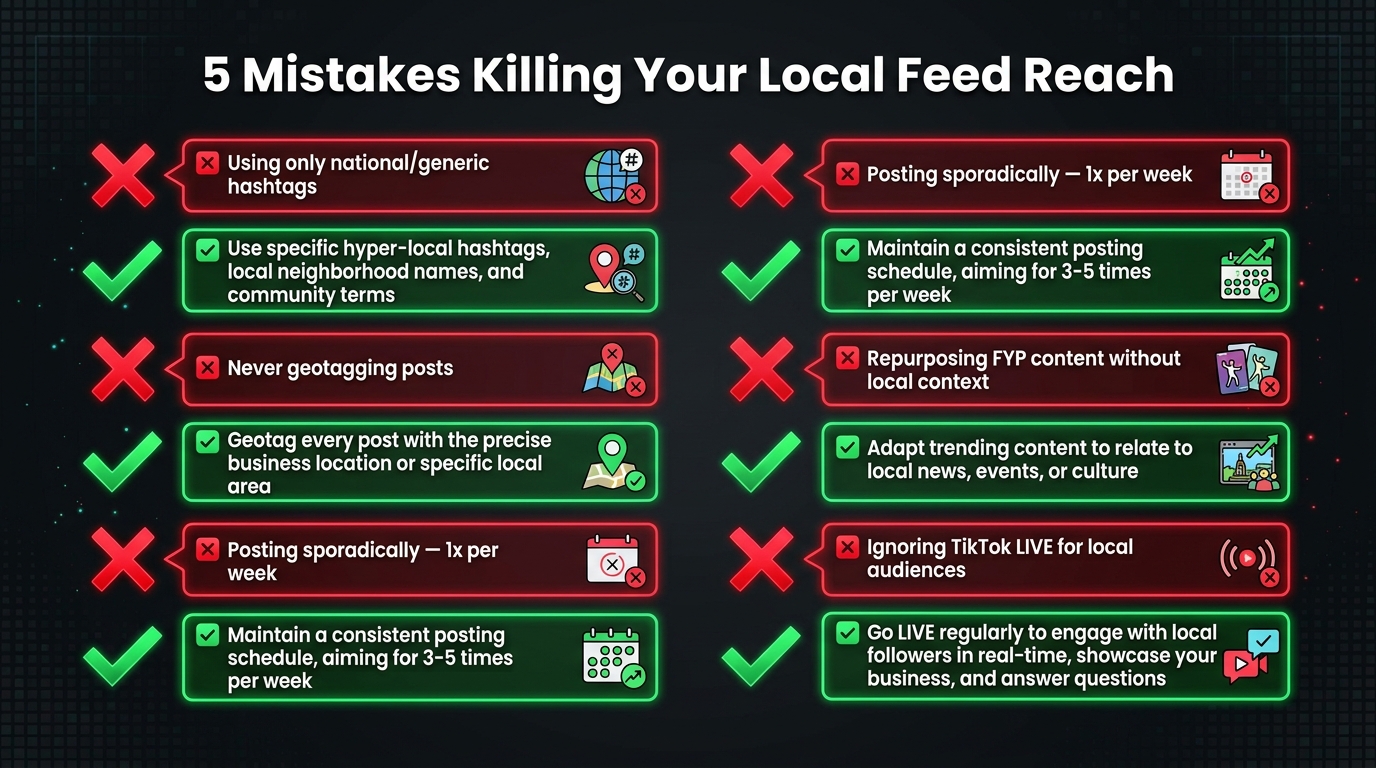
The sellers who are failing to gain Local Feed traction in 2026 are not failing because the feature doesn’t work. They’re failing because they’re applying the wrong mental model to the surface. These are the patterns that consistently bury local sellers in the feed.
Mistake 1: Using Generic National Hashtags as a “Local Strategy”
Adding #TikTokShop, #SmallBusiness, and #FYP to a video and calling it a local strategy is not a strategy. These hashtags tell TikTok nothing about the geographic context of your content. They are competed for by thousands of accounts simultaneously and carry no location signal whatsoever. A seller using only broad national hashtags is effectively opting out of the Local Feed’s topic classification system for their content, which makes local distribution far less likely regardless of how good the underlying video is.
Mistake 2: Posting Inconsistently and Expecting Compound Results
Some sellers post a local video, see modest results, and conclude that the Local Feed isn’t working for their category. The Local Feed rewards consistency because its recency signal is continuous, not retrospective. A single well-executed local post does not build Local Feed presence the way a week of consistently published local content does. The algorithm needs multiple data points from your account in a specific market before it has enough signal to reliably surface your content to local users. Sellers who give the feature a one-week trial and then abandon it will never see the compounding return that sustained local posting produces.
Mistake 3: Repurposing FYP Content Without Local Adaptation
A video filmed in a white-walled studio with no geographic context, using trending audio and a broad product hook, may perform well on the FYP. That exact same video, unchanged, will not perform well in the Local Feed because it carries no location signal for TikTok to classify it as geographically relevant to nearby users. Repurposing your FYP winners for the Local Feed requires adding the local layer: re-film from your physical location, add city-specific references to the caption and audio, overlay your neighborhood name as on-screen text, and update the hashtags to include geo-specific tags. The content structure can stay the same — the local layer is what changes.
Mistake 4: Treating the Local Feed as a Standalone Channel
Local Feed content that is never amplified through paid Spark Ads, never supplemented with LIVE sessions, and never part of a broader TikTok Shop product strategy will underperform relative to its potential. The Local Feed is a distribution layer, not a complete commerce strategy. It needs to sit within a broader system that includes a well-optimized TikTok Shop product catalog, a LIVE shopping cadence, an affiliate or creator partnership strategy, and paid amplification for your strongest organic performers. Sellers who treat it as a standalone tactic rather than an integrated layer will cap out their local reach faster than sellers who use it as one component of a coordinated local commerce operation.
Mistake 5: Ignoring the Opt-In Audience’s Expectations
The users in the Local Feed opted into a specific experience: discovering what’s happening nearby. They are not looking for polished national advertising. They are looking for authentic, immediate, local content that makes them feel like they’re getting insider access to their own neighborhood. Sellers who produce content that reads as advertising rather than local discovery — overly produced videos, heavy branding overlays, scripted sales language — will generate poor watch time and engagement from the Local Feed audience, which suppresses their ranking signal and limits their local distribution over time.
The Local Feed rewards the seller who acts like a local, not the one who acts like a brand. Authentic, immediate, place-based content consistently outperforms polished national-brand-style content on this surface, which is actually good news for small local operators who can’t match the production budgets of large brands but can easily out-authentic them.
Building a 30-Day Local Feed Launch Plan
For sellers who want to move from theory to execution, here is a concrete 30-day framework for establishing Local Feed presence and measuring early results.
Days 1–7: Infrastructure Setup
Before publishing a single piece of Local Feed content, ensure your TikTok business account is correctly configured. This means: your business location is accurately set in your profile and TikTok Shop settings; your TikTok Shop product catalog is complete, with all relevant products linked and properly configured for in-video shopping tags; your analytics baseline is documented (your current traffic source breakdown, follower location data, and typical engagement rates) so you have a pre-strategy benchmark to compare against; and your UTM tracking system is in place for any links you’ll be including in local content.
Use this week to also scout your local content calendar: identify what’s happening in your neighborhood or city in the coming weeks (events, seasonal moments, community activities) that you can legitimately tie your content to. Local relevance is not just about where you are — it’s about being embedded in the local narrative that your nearby audience is already paying attention to.
Days 8–21: Content Execution Phase
Publish local content daily during this period. Alternate between the three content types described earlier — time-sensitive “what’s happening now” content, community-embedded storytelling, and behind-the-store reality content. Track the early engagement signals on each post within the first 24 hours, paying attention to watch time, saves, shares, and profile visits. After two weeks of daily publishing, you will have enough performance data to identify which content format is generating the strongest signals for your specific local audience.
Run your first LIVE session during this period — in week two, once you have some local content already indexed and potentially surfaced to nearby users. Announce the LIVE in two or three posts in the days before it, using Local Feed-optimized content as your promotional vehicle.
Days 22–30: Paid Amplification and Iteration
Take your two or three best-performing local posts from the first three weeks — the ones with the highest saves, shares, and profile visit rates relative to their view counts — and convert them into Spark Ads with city-level geo-targeting. Run each with a modest test budget (sufficient to reach a meaningful local audience without over-committing before you understand the paid ROAS). Compare the cost per profile visit and cost per purchase between your locally targeted Spark Ads and any non-local paid campaigns you’re running to establish a Local Feed cost efficiency benchmark.
Use the full 30-day period to build your case for whether the Local Feed is delivering meaningful incremental sales for your specific business category and geography. Not every product or service category will find equal success — some will perform exceptionally well (restaurants, boutiques, personal services, local experiences) while others may find the Local Feed less impactful than the FYP for their specific customer acquisition pattern. Data from a properly executed 30-day test gives you that answer with reasonable confidence.
What Comes Next for TikTok’s Local Commerce Infrastructure
TikTok is not finished building out the Local Feed. The feature launched in February 2026 with a relatively lean feature set, and based on TikTok’s pattern of iterating rapidly on commerce infrastructure, several developments are plausible in the near term.
Local search functionality — the ability for users to search within the Local Feed for specific categories, products, or businesses — is a likely addition. TikTok’s investment in search as a discovery channel, which has been a consistent theme across their product updates, suggests they will extend that search capability into the local context. When that happens, local SEO for TikTok content — already important for FYP search discovery — will become even more critical, and sellers who have already established strong keyword and location signals in their content will have a head start.
Analytics improvements are also probable. As TikTok scales the Local Feed and more businesses build strategies around it, the pressure to provide Local Feed-specific analytics will increase. Sellers should build their measurement proxies now and use native analytics improvements when they arrive to validate and refine what they’re already measuring.
Local advertising products — ad formats or targeting options specifically designed for the Local Feed surface rather than the general in-feed ad inventory — are another plausible development, particularly as TikTok looks to monetize local business adoption of the feature. The Local Feed’s high-intent audience is a compelling pitch to local advertisers who have historically found national-scale social platforms too broad for their needs.
Conclusion: The Early Mover Advantage Is Still Available
Most sellers reading this are looking at a window of opportunity that is genuinely still open. The TikTok Local Feed launched in February 2026, making this a feature that has been live for months rather than years. The brands and sellers who establish Local Feed presence, build local audience habits, and develop operational playbooks for local content and LIVE shopping now will be significantly harder to displace once the feature matures and competition for local visibility intensifies.
The core insight is straightforward: the Local Feed is a high-intent, geographically qualified audience that has opted in to local discovery. The people scrolling the Local Feed are not passive entertainment consumers — they are active local explorers who are explicitly interested in what is happening around them. Your job is to be in that feed consistently, with content that feels authentic to the local context, at the moment when those high-intent nearby users are browsing.
That means posting frequently, anchoring your content in real geographic context, using all four location signals (not just geotags), combining organic local content with LIVE shopping and paid amplification, and measuring the right proxy metrics while TikTok builds out its native analytics. None of this is technically complex. All of it requires consistent execution over time.
Key takeaways for local sellers in 2026: Post local content a minimum of four to five times per week. Include your city or neighborhood name in both audio and on-screen text. Use a combination of geographic, category-specific, and broad hashtags — not just generic national tags. Run weekly LIVE sessions timed to local peak engagement windows. Convert your best organic local posts into Spark Ads with metro or city-level geo-targeting. Track performance through exclusive offer codes and UTM parameters until native Local Feed analytics arrive. And treat the Local Feed not as a separate channel but as the high-intent, geographically qualified layer of a broader TikTok Shop commerce strategy.
The sellers who treat the Local Feed as a core part of their commerce infrastructure — rather than an optional add-on — are the ones who will look back at 2026 as the year they built a significant, defensible local competitive advantage on TikTok. The window is still open. The question is whether you’re going to use it.