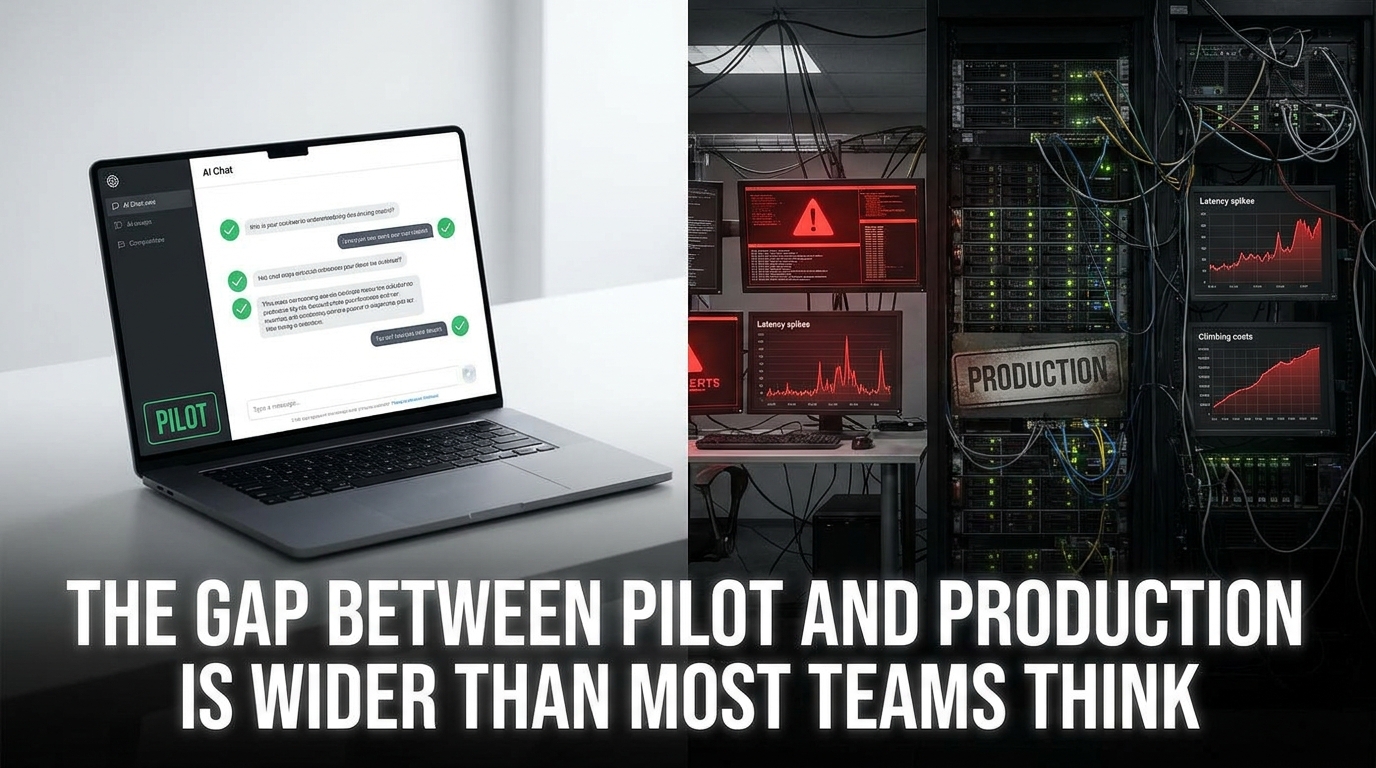

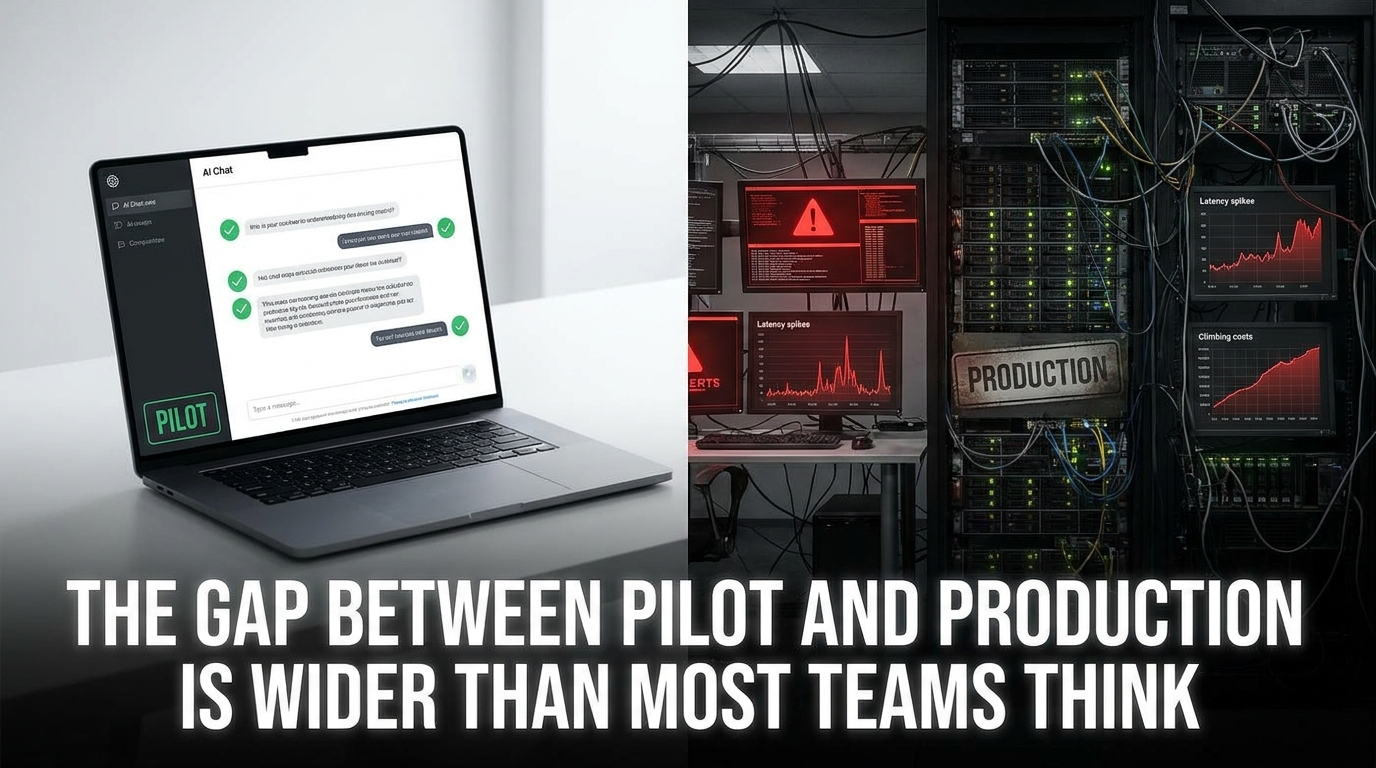
The demo worked. It worked well, actually. Leadership was impressed. The data science team celebrated. The proof-of-concept hit every accuracy target you set, latency looked fine on your laptop, and the model’s outputs were genuinely useful. So you did what you were supposed to do: you called it a success and started planning production deployment.
Then things got complicated.
This is the story of most enterprise AI projects in 2026. Not a story of bad models or insufficient compute — but a story of the enormous, underappreciated gap between a pilot that works in controlled conditions and a system that works reliably when real users, messy data, unpredictable traffic, and organizational friction all arrive at once. Industry data consistently shows that between 70 and 90 percent of machine learning projects fail to reach production or sustain meaningful operation once they get there. That number hasn’t changed much in years, despite better tooling, better models, and more investment.
The problem isn’t the AI. The problem is everything around it.
This post doesn’t cover the high-level ROI conversation or the business case for AI investment. Instead, it goes deep into the engineering and operational reality: the specific failure modes that kill production deployments, the practices that separate teams who ship AI reliably from those who don’t, and the honest checklist that production AI systems need to pass before they should ever go live. If you’ve been involved in an AI pilot that never quite made it across the finish line, or if you’re currently trying to make that crossing, this is for you.
Why “It Worked in the Demo” Is Basically Meaningless
There’s a particular kind of confidence that comes from a successful demo, and it’s one of the most dangerous things in AI engineering. The demo creates a mental model of the system — “we built a thing that does X” — that simply doesn’t match what production actually requires. Understanding why requires looking at what makes machine learning systems fundamentally different from traditional software.
The Three Axes of Change
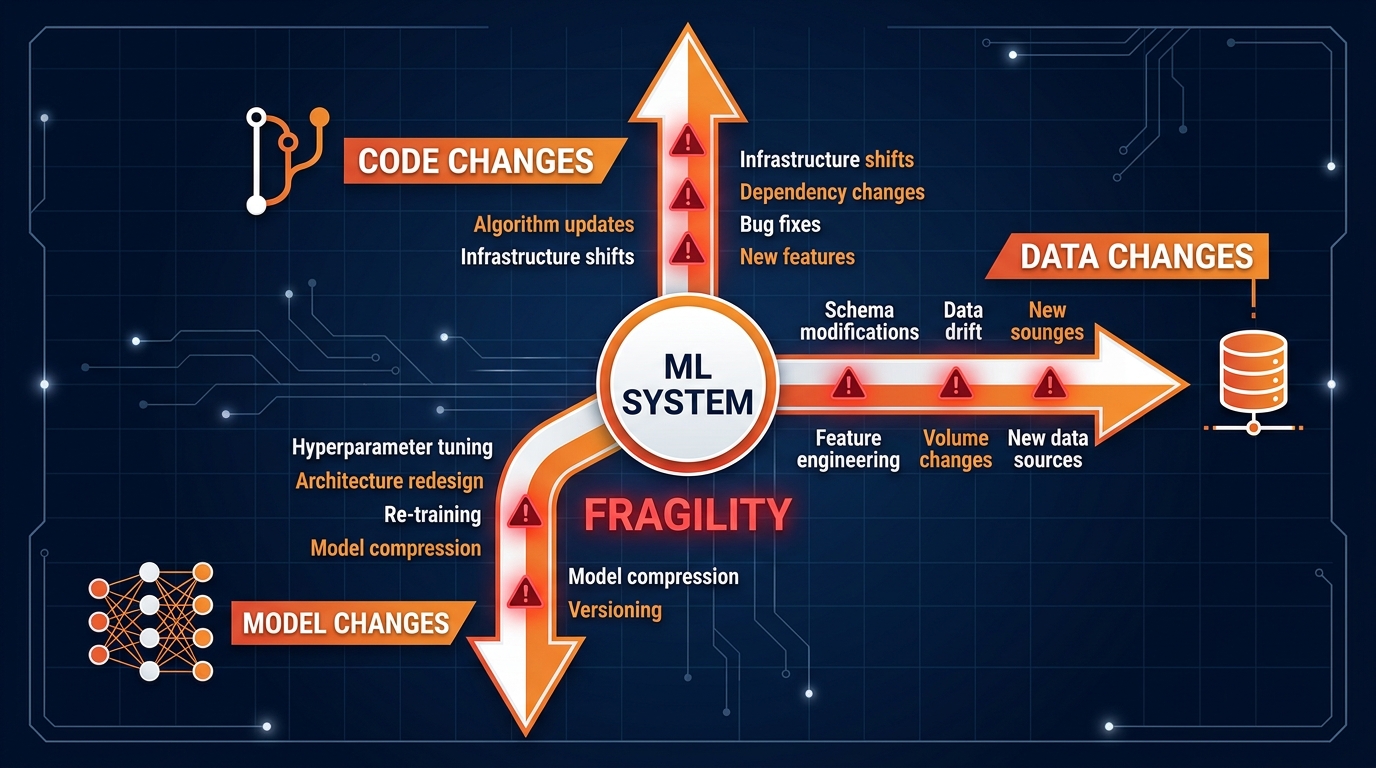
Traditional software changes along one primary axis: code. You write code, test it, deploy it, and the behavior of the system changes only when you change the code again. This makes reasoning about behavior relatively straightforward, and it’s what the entire edifice of modern software engineering — version control, CI/CD, testing, monitoring — was built to manage.
Machine learning systems change along three axes simultaneously: the code itself, the model weights, and the data feeding the system. A change in any one of these three dimensions can fundamentally alter system behavior. Your production environment will have different data distributions from your training environment. The upstream services your model depends on will evolve. User behavior will shift in ways that make the patterns your model learned obsolete over time. None of this shows up in a demo.
As the foundational Thoughtworks paper on Continuous Delivery for Machine Learning describes it, ML systems are “subject to change in three axes: the code itself, the model, and the data. Their behaviour is often complex and hard to predict, and they are harder to test, harder to explain, and harder to improve.” The demo tests only the intersection of all three axes at a single frozen moment. Production means all three axes are in continuous motion, simultaneously, forever.
Demo Conditions vs. Production Conditions
Consider how a pilot is typically run. The data science team selects a dataset — usually cleaned, complete, and representative of the “happy path.” Requests are made at a predictable rate, usually from one client or a small controlled group. The model version doesn’t change during the pilot. Latency is measured on a single machine, not under concurrent load. Edge cases either don’t appear, or when they do, a human decides to ignore them because “that won’t happen in production.”
In production, all of these conditions invert. The data arrives from multiple upstream sources with different schemas, different quality levels, and occasional complete failures. Traffic spikes unpredictably — sometimes by orders of magnitude — and the model has to handle concurrent requests under resource contention. Edge cases don’t just happen; they represent a measurable percentage of all requests, and when the model fails on them, real users experience real harm.
The gap isn’t a matter of scale. It’s a matter of kind. The demo tests whether a model can produce good outputs under ideal conditions. Production asks whether a system can sustain reliable behavior across an enormous range of real-world conditions, over an indefinite time horizon, while the world around it continuously changes. Those are different questions entirely, and teams that conflate them pay for it in failed deployments.
The Data Readiness Trap: Your Pilot Ran on Clean Data
If you ask engineering teams that have seen AI deployments fail what went wrong first, data is the most common answer — by a substantial margin. Not “bad” data in the sense of poor quality training sets, but production data infrastructure that simply wasn’t ready to serve an AI system reliably. This is the data readiness trap, and it catches more teams than almost any other single factor.
Pipeline Brittleness and Upstream Dependencies
AI systems in production are almost never the final consumer of data — they sit at the end of a data pipeline that typically spans multiple teams, systems, and operational domains. A customer-facing recommendation model might depend on event tracking data from the product team, inventory data from the supply chain system, user profile data from the identity platform, and behavioral signals from the analytics warehouse. During a pilot, each of these can be accessed in a controlled way, usually by a data engineer who manually prepares the inputs. In production, those connections have to be automated, reliable, and monitored — and they almost never are when teams first attempt deployment.
Pipeline brittleness shows up in subtle ways. An upstream schema changes because a product team added a new field, and suddenly the feature engineering pipeline crashes. A data quality check that was fine during the pilot starts failing when it encounters a class of transactions it never saw before. A data warehouse table starts having latency spikes during month-end processing, causing feature computation to time out and the model to fall back to degraded behavior silently.
The fix isn’t complicated — it requires treating data pipelines as first-class production infrastructure with the same rigor applied to application code — but it does require investment that most AI projects don’t budget for upfront. Data contracts between producer and consumer teams, automated schema validation, data freshness monitoring, and explicit SLAs for data availability all need to be in place before an AI system can reliably depend on them.
Schema Drift and the Problem of Temporal Data
One of the more insidious failure modes in production AI is schema drift — the gradual, often undocumented evolution of data structures over time. During a pilot, you’re working with the schema as it exists today. Production means living with the schema as it will exist across months and years of organic system evolution, which is something most organizations have never formally managed.
Temporal data adds another layer of complexity. Many production AI systems depend on features derived from historical data — rolling averages, trend indicators, seasonality features. During the pilot, that historical data is static. In production, the historical window is constantly moving, the underlying raw data gets corrected and backfilled, and edge cases like holidays, system outages, and unusual events create noise in the feature values the model was never trained to handle gracefully. Teams that discover this problem after deployment have a painful choice: retrain with updated data (expensive, time-consuming), build defensive logic that degrades gracefully (complex), or accept degraded performance in known edge cases (not acceptable for most use cases).
The practical answer is to treat data readiness as a hard prerequisite for AI deployment, not something you sort out alongside it. Specifically, this means verifying that every upstream data dependency has a documented schema with change management procedures, that freshness and quality SLAs are enforceable and monitored, and that the feature pipeline has been stress-tested with real-world edge cases — not just the clean ones from the pilot dataset.
The Hidden Cost Shock: When the Inference Invoice Arrives
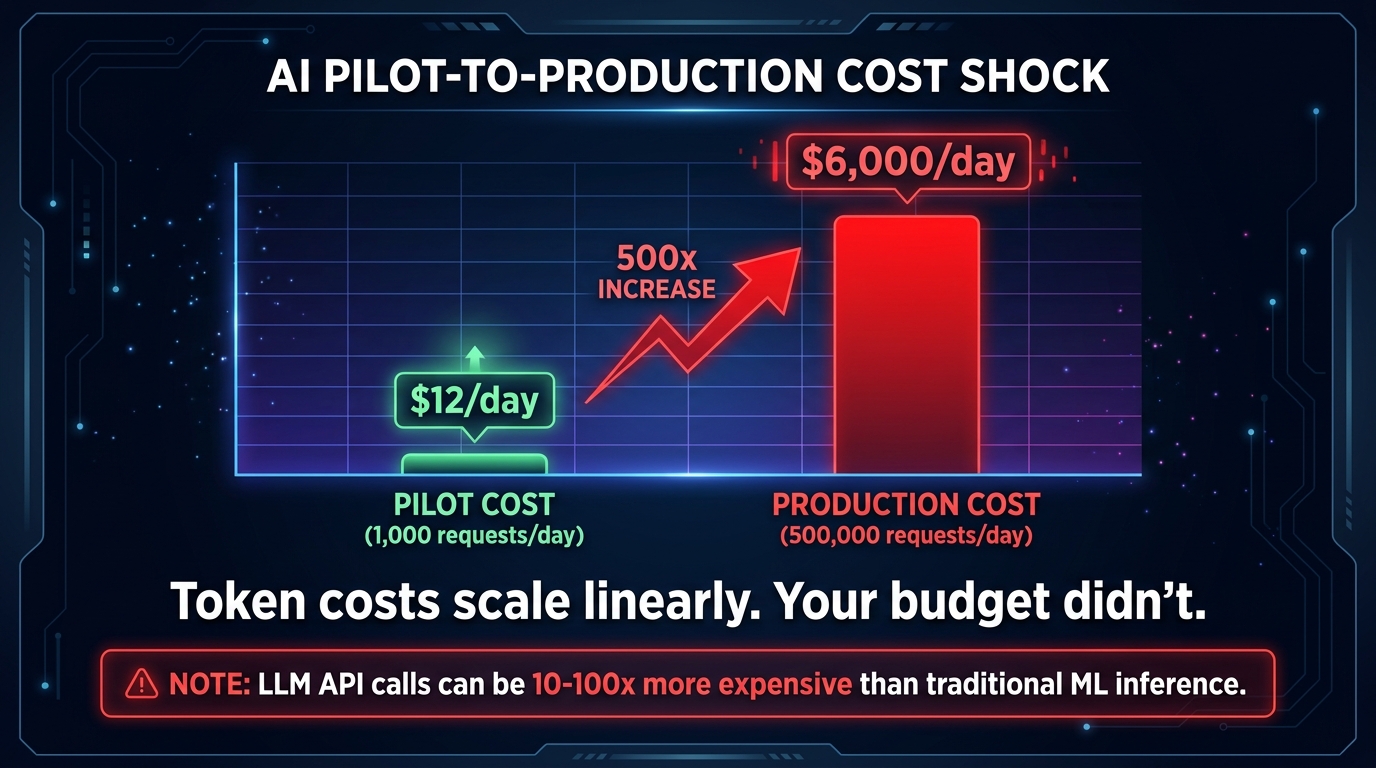
Cost surprises are one of the most common and most preventable reasons that AI projects stall between pilot and production. The problem is structural: pilots are usually run at volumes that make costs appear negligible, which means the economics of production-scale inference are never seriously examined until the first invoice arrives — and by that point, engineering decisions that are expensive to reverse have already been made.
The Inference Economics Problem
LLM API calls in 2026 are typically 10 to 100 times more expensive per inference than traditional machine learning inference. At pilot volumes — a few hundred or a few thousand requests per day — this price differential doesn’t matter. At production volumes — hundreds of thousands of requests per day — it matters enormously. A system that costs $12 per day at pilot scale and a production workload with 500 times the volume doesn’t cost $6,000 per day by accident; it costs that because nobody ran the math before committing to an architecture.
The math gets more complex when you account for token consumption patterns. During a pilot, prompts are carefully crafted, outputs are short, and the engineer controlling the system has tight control over what goes in and what comes out. In production, users interact with the system in ways the pilot never anticipated: longer queries, unexpected languages, edge case inputs that produce unexpectedly verbose outputs, retry logic that fires on failures and doubles the token count. Production token consumption almost always exceeds pilot estimates, sometimes by a factor of three or four.
Model Routing and Cost-Performance Trade-offs
The response to the inference cost problem that leading teams have converged on in 2026 is model routing — the practice of using different models for different request types based on their complexity, latency requirements, and cost tolerance. Not every request in a production system needs a frontier model. A substantial fraction of real-world requests can be handled effectively by smaller, cheaper 3B to 8B parameter models running on-premises or on lower-cost hardware, with only the genuinely complex requests routed to more capable and more expensive models.
Implementing routing well requires building evaluation infrastructure first. You need to understand the distribution of your production request types, the capability requirements of each type, and the performance characteristics of candidate models at each capability level. Teams that build this infrastructure report significant cost reductions — often 40 to 60 percent — without meaningful quality degradation for the end user, because the routing logic directs each request to the minimum capability model that can handle it well.
There’s also a latency dimension to this conversation. Production systems serving end users have hard latency requirements that pilots typically don’t. Sub-200ms response times are now treated as a hard requirement for user-facing AI workloads, and meeting that bar with large frontier models under concurrent load requires careful infrastructure design — specialized inference hardware, request batching, caching for repeated queries, and careful attention to the p95 and p99 latency distribution, not just average response time. These requirements don’t emerge naturally from a pilot; they have to be explicitly designed for.
Building the Deployment Ladder: Shadow → Canary → Full Production
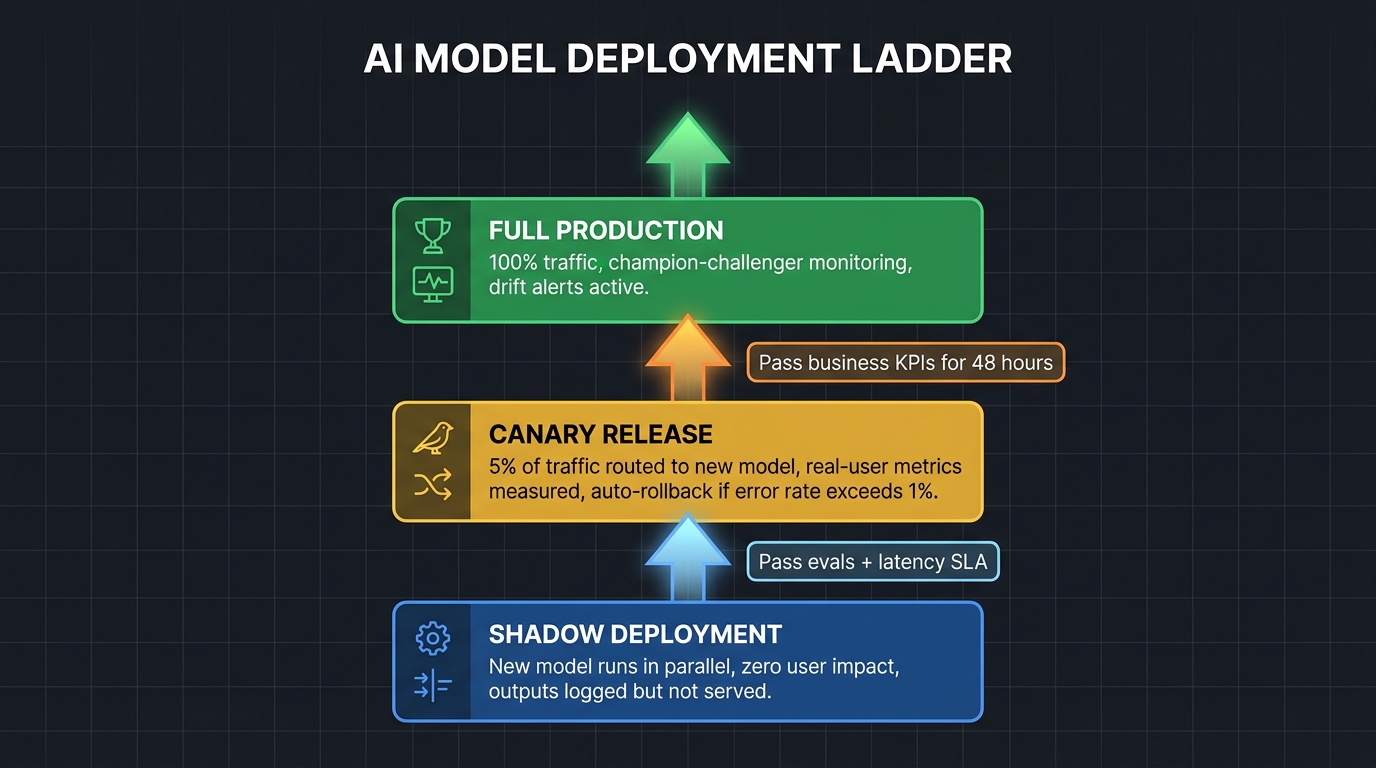
If there’s one set of practices that most clearly separates teams that ship AI successfully from teams that don’t, it’s the deployment ladder: a structured progression from zero user impact to full production traffic, with explicit quality gates at each transition. This isn’t a novel idea — it’s been standard practice in software engineering for years — but in AI deployment it requires specific adaptations that most teams haven’t fully worked out.
Shadow Deployment: The Safest First Step
Shadow deployment is the practice of routing copies of live production requests to the new model version, having that model generate outputs, and logging those outputs for comparison — without ever serving those outputs to actual users. The current production model continues serving users normally. The candidate model runs in parallel, invisibly, processing the same requests and producing outputs that are captured for offline analysis.
This is the safest possible way to validate an AI model against real production traffic because it carries zero user-facing risk. It answers questions that a pilot never can: Does the model handle the actual distribution of production inputs, including all the edge cases? Does it meet latency SLAs under real concurrent load? Does it produce outputs that are consistently superior to the current version, not just on the pilot dataset but on the full breadth of what users actually send? What percentage of requests produce concerning outputs that need human review before going live?
Shadow deployment should be the first step for every significant model change, and it should run for long enough to capture representative traffic across time periods the pilot might have missed — different days of the week, different times of day, seasonal patterns, promotional events. The minimum viable shadow period for most production systems is 48 to 72 hours of full-traffic observation. For high-stakes systems, it should be considerably longer.
Canary Gating: Measuring Real-World Business Impact
Once shadow deployment has validated that the model handles production traffic reliably, the next step is canary release — routing a small percentage of real users to the new model and measuring the actual business and quality impact before committing to full rollout. A typical starting point is 5 percent of traffic, with a predefined escalation schedule (5% → 20% → 50% → 100%) tied to specific metric gates.
The critical design decision in canary rollouts is choosing the right gate conditions. Technical metrics — error rate, latency, model confidence — are necessary but not sufficient. The most important gates are business metrics: task completion rate, user satisfaction signals, downstream conversion or engagement metrics, and whatever the primary business KPI of the system is. A model can pass all its technical benchmarks and still degrade the user experience in ways that only show up in business outcomes. The canary phase is where you find out.
Gate conditions need to be defined before the canary starts, not evaluated ad hoc during it. Pre-commit to the specific thresholds that will trigger an automatic rollback, the specific metrics that need to stay within bounds for a specific duration before the next traffic increment, and the specific humans who are authorized to override the automated gates in either direction. This removes decision ambiguity during a rollout — which is when decision ambiguity is most likely to cause problems.
Auto-Rollback as a First-Class Requirement
Canary releases without auto-rollback are significantly less valuable than canary releases with it. The point of the gradual rollout is to contain the blast radius of a bad deployment. If the rollback process requires human action and human awareness, the blast radius is bounded only by how quickly a human detects the problem and acts. At 3 a.m. on a Sunday, that might be hours.
Auto-rollback systems for AI models need to handle a specific complexity: the rollback condition isn’t just “error rate exceeded threshold.” It might be “output quality degraded below acceptable level,” which requires an automated evaluation pipeline — not just a health check — to detect. Building that pipeline is more complex than traditional software rollback, but it’s not optional if you want reliable production deployments.
The Evaluation Gap: Most Teams Don’t Actually Know If Their Model Is Working
Evaluation is arguably the most systematically neglected area in production AI. Most teams have monitoring — they know whether their endpoints are up, whether latency is within SLA, whether error rates are elevated. But monitoring system health is not the same as evaluating model quality, and confusing the two leads to a particularly dangerous failure mode: a system that appears healthy by all operational metrics but is quietly producing degraded or wrong outputs at scale.
Evals vs. Monitoring: Understanding the Difference
Monitoring tells you whether the system is running. Evaluation tells you whether the model is working. These are fundamentally different questions, and they require different infrastructure to answer. Monitoring is reactive — it fires alerts when something measurable goes wrong. Evaluation is proactive — it continuously assesses the quality of model outputs against a defined standard, whether or not any operational metric has crossed a threshold.
The distinction matters because AI systems can degrade in ways that don’t look like errors. A language model that starts giving subtly less helpful answers doesn’t produce HTTP 500 errors. A recommendation model that starts over-indexing on a narrow category of items doesn’t increase latency. A classification model that starts drifting toward false negatives doesn’t increase CPU utilization. All of these represent meaningful quality degradation, and none of them are detectable by a traditional monitoring stack.
Leading teams in 2026 maintain continuous evaluation pipelines that run alongside production, periodically sampling live model outputs and scoring them against a set of quality criteria — either using automated evaluators, human review queues, or a combination of both. The output of these pipelines feeds into dashboards that track model quality as a first-class operational metric, on par with latency and error rate.
Building a Golden Dataset
The foundation of a good evaluation pipeline is a golden dataset: a curated set of inputs with known-good expected outputs, covering the full range of cases the model is expected to handle in production. Building a good golden dataset is harder than it sounds, and it’s one of the areas where teams most commonly cut corners with consequences they pay for later.
A useful golden dataset has several properties. It’s representative — it covers the distribution of real production inputs, not just the easy cases. It’s adversarial — it includes the edge cases, the tricky inputs, the ambiguous queries that the model is most likely to fail on. It’s maintained — it grows over time as new failure modes are discovered, because a golden dataset that only covers yesterday’s problems is increasingly useless. And it’s version-controlled — when the golden dataset changes, you can understand exactly what changed and why, and rerun historical evaluations to understand how model performance has evolved.
For LLM-based systems, building golden datasets requires particular care because the “expected output” isn’t a single correct answer — it’s a range of acceptable outputs that satisfy certain quality criteria. This means evaluation rubrics need to be explicit, and automated evaluation needs to be validated against human judgment to ensure the automated scoring correlates with what humans actually consider good performance.
Closed-Loop Feedback: Production as a Learning Signal
The most mature production AI systems in 2026 treat production as a continuous source of learning signal, not just a deployment target. Every real-world interaction that produces a meaningful outcome — a user clicking or not clicking, a task completed or abandoned, an output rated as helpful or unhelpful — is potential training signal that can inform the next iteration of the model. Closing this loop between production outcomes and model improvement is one of the primary differentiators between organizations with stagnant AI systems and organizations whose AI systems continuously improve after deployment.
AI Observability Is Not the Same as Software Observability
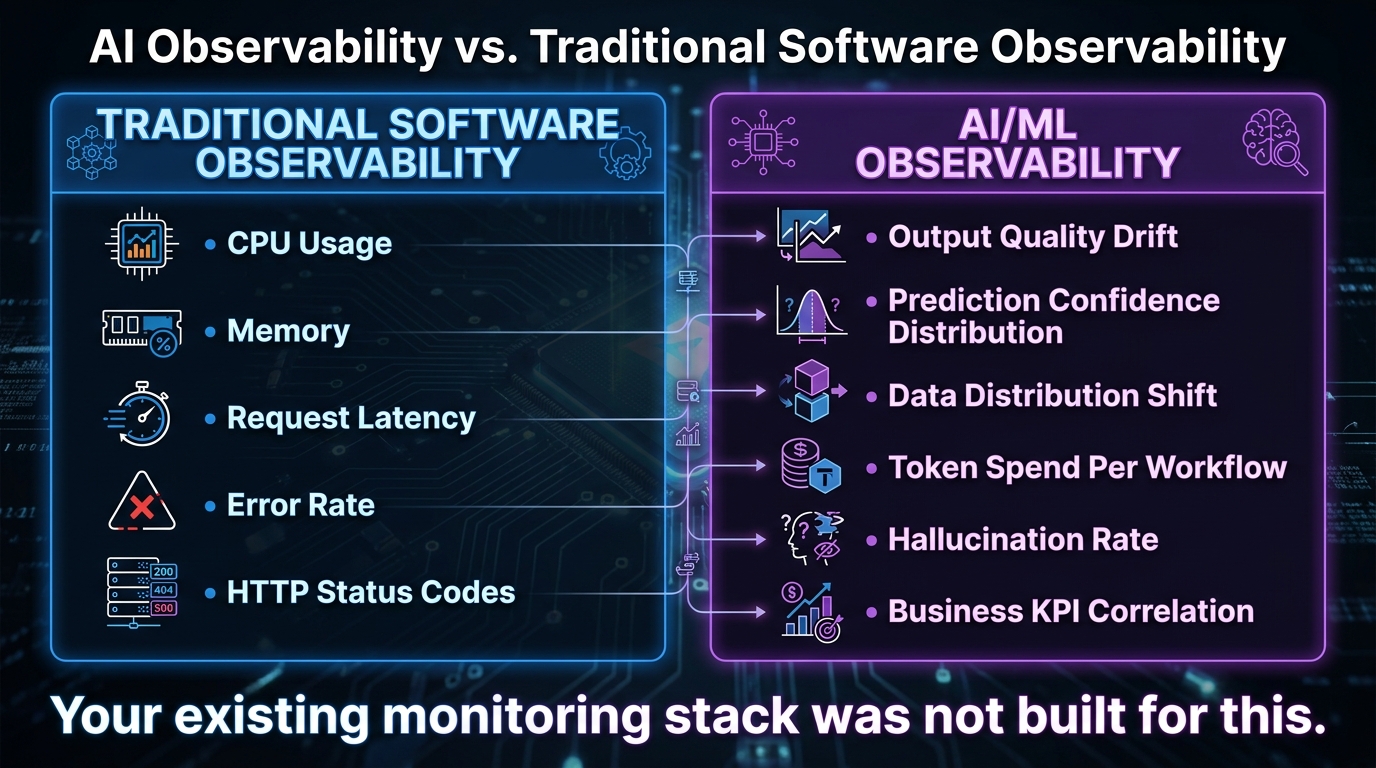
Engineering organizations that have built mature observability practices for their software systems often assume those practices transfer directly to AI systems. This assumption is wrong in important ways, and the gap between “we have observability” and “we have AI observability” is responsible for a substantial number of undetected production quality degradations.
Behavioral Drift vs. System Drift
Traditional software observability — the MELT stack of metrics, events, logs, and traces — is designed to detect system-level anomalies: a server running out of memory, a database query taking too long, an API endpoint returning unexpected error codes. These are changes in the system’s operational behavior, and the tools for detecting them are mature and well-understood.
AI systems introduce a new category of problem: behavioral drift. The system can be operationally healthy — all metrics green, latency within SLA, zero errors — while the model’s outputs are drifting away from the quality standard the system was deployed to achieve. This happens because the world changes: user intent shifts, input patterns evolve, the relationship between the features the model learned from and the outcomes the model is predicting becomes less reliable over time. None of this is detectable by metrics that measure system health rather than output quality.
Behavioral drift is typically slow and invisible until it reaches a threshold that causes measurable business impact. By that point, the model may have been producing degraded outputs for weeks or months. The teams that catch this early have instrumented quality signals — automated output scoring, business outcome correlation, distribution shift detection on input features — alongside their operational metrics. The teams that don’t find out when a stakeholder notices something is wrong and asks why.
What to Instrument in an AI Production System
Building effective AI observability requires instrumenting at multiple levels simultaneously. At the infrastructure level, the standard MELT approach applies: service latency, error rates, resource utilization, token consumption by model and by request type. These catch operational failures quickly.
At the data level, the critical signals are input distribution statistics — tracking the statistical properties of the inputs the model receives and alerting when they shift significantly from the training distribution. If a model trained primarily on one type of query starts receiving a different distribution of query types, this is an early warning that performance may be degrading before any output quality metric confirms it. Feature stores and data pipeline monitors should emit distribution statistics as first-class metrics, not just availability and freshness signals.
At the model level, the key metrics are confidence distributions, prediction consistency for repeated or similar inputs, and output quality scores from the evaluation pipeline. For LLMs specifically, additional signals include response length distribution (significant changes can indicate prompt following degradation), refusal rate, and semantic similarity between current outputs and reference outputs on the golden dataset.
At the business level, AI systems should be connected to the downstream business metrics they’re intended to influence: conversion rates, task completion rates, user satisfaction scores, or whatever KPI the model exists to move. The correlation between model behavior and business outcomes is the ultimate ground truth of whether a production AI system is working, and it should be visible in the same dashboard as the operational metrics.
Governance, Ownership, and the “Who’s On Call?” Problem
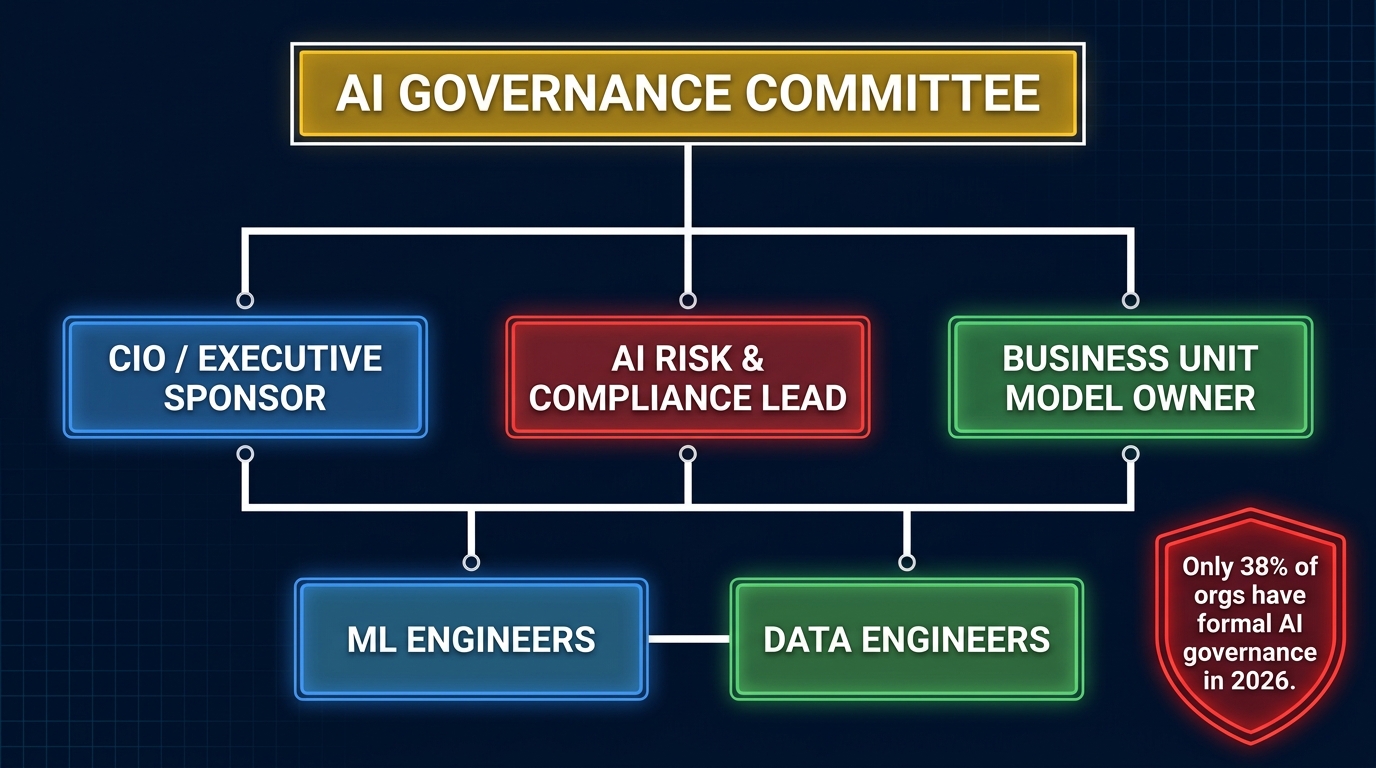
Governance and ownership aren’t the most exciting topics in AI engineering, but they’re responsible for more production failures than almost any technical factor. The specific failure mode is this: nobody knows whose problem the AI system is when something goes wrong. The data science team built the model, the platform team runs the infrastructure, the product team owns the user experience, and the business unit owns the outcomes — and when the system starts producing wrong outputs at 2 a.m. on a holiday weekend, all of those teams are looking at each other waiting for someone else to act.
The Cross-Functional Ownership Model
As of mid-2026, only 38 percent of organizations have a formal AI governance policy in place — a number that’s startling given how many of those same organizations are actively running AI in production. The gap between running AI and governing AI represents real risk: unclear ownership creates delayed responses to incidents, ambiguous accountability for quality degradation, and absent processes for managing model updates and retirement.
The ownership structure that works in practice is cross-functional by necessity. A named model owner, embedded in the business unit that depends on the system, is accountable for the system’s business performance and has authority to make decisions about when retraining is needed, when rollback is warranted, and when the model is causing harm that justifies taking it offline. This person is not an ML engineer — they’re the business stakeholder who can evaluate whether the model is doing its job.
Separately, a platform engineering or MLOps team owns the infrastructure, the deployment pipeline, the observability stack, and the on-call rotation for operational incidents. They’re accountable for keeping the system running and for executing the model owner’s decisions. The governance committee — involving risk, compliance, legal, and executive representation — owns policy: what the system is allowed to do, what safeguards are required, and how regulatory requirements are met. Each of these roles has clear, documented responsibilities. Overlap is fine; ambiguity is not.
Compliance Pressures Are Now a Production Engineering Concern
The regulatory environment for production AI has changed significantly. The EU AI Act is now a concrete compliance requirement for organizations operating in European markets, with specific obligations around transparency, documentation, human oversight, and risk assessment for different categories of AI systems. NIST’s AI Risk Management Framework and ISO/IEC 42001 are increasingly becoming contractual requirements in enterprise procurement, which means compliance is now a sales and retention concern as much as a legal one.
For production AI teams, the practical implication is that compliance requirements have to be designed into the system, not bolted on afterward. Documentation of training data provenance, model behavior boundaries, and human oversight mechanisms can’t be retroactively created for a system that’s been running for six months. The teams that are getting this right are treating compliance as an engineering discipline — writing model cards at deployment time, maintaining audit logs of model decisions for regulated use cases, and building human intervention pathways into every system that operates in a high-risk category as defined by applicable regulation.
The Definition of Done Has Changed
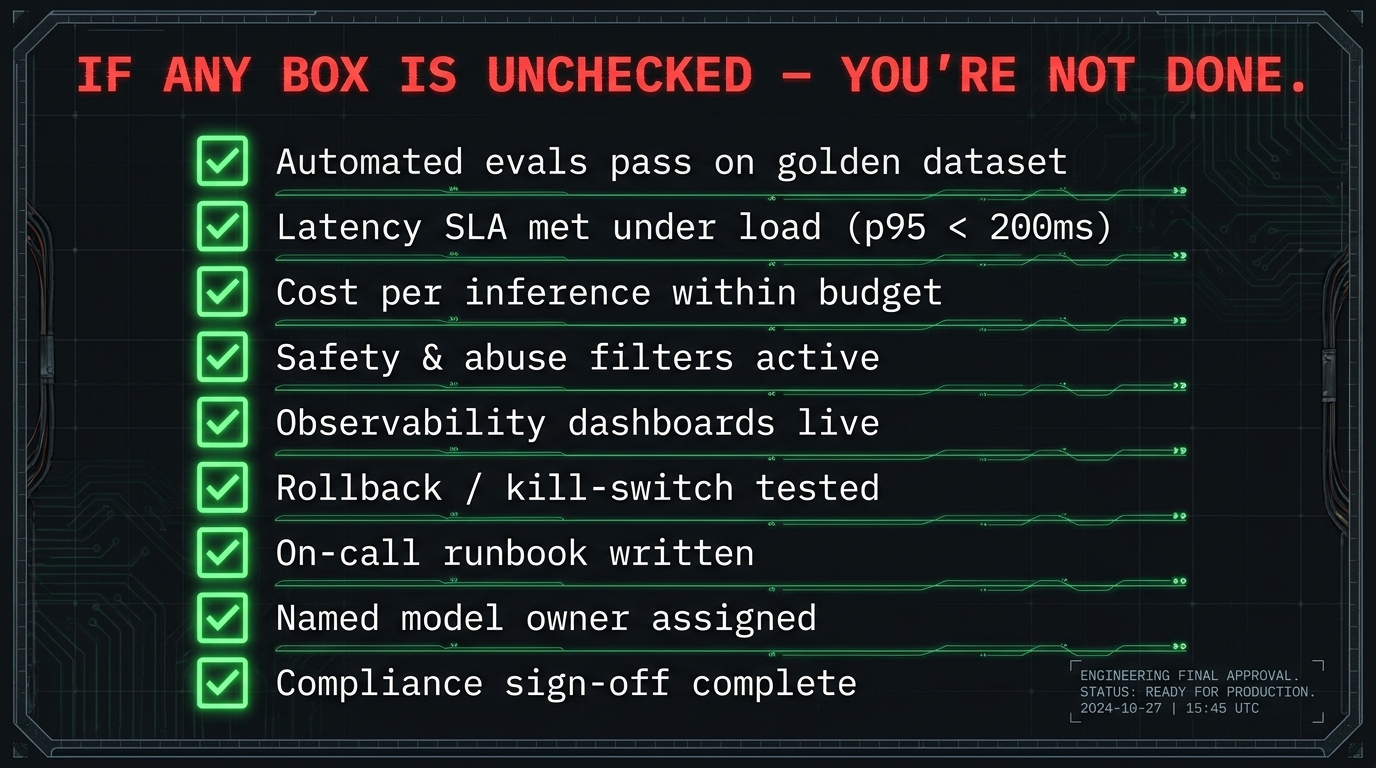
One of the most consequential shifts in AI production engineering is the redefinition of “done.” In traditional software development, “done” has a reasonably clear meaning: the code is written, tests pass, it’s been reviewed, it’s deployed to production. In AI systems, that definition is inadequate in ways that create real harm when teams don’t update it.
The AI Production Quality Gate Checklist
The most practical way to operationalize an updated definition of done for AI production is a quality gate checklist — a set of conditions that must be verifiably true before any AI system or significant model update is considered production-ready. The specific items on this checklist vary by system, but the following represent the minimum floor for any production AI in 2026:
Automated evals pass on the golden dataset. Not human inspection of sample outputs — automated evaluation against a maintained, versioned golden dataset, with results logged and thresholds enforced. The eval pass rate should be an explicit metric with a defined acceptable minimum, and any degradation from the previous model version should require documented justification.
Latency SLA is met under representative load. Not measured on a single machine — measured under the concurrent request load representative of production peak traffic. The relevant metric is p95 or p99 latency, not average, because average latency conceals the tail experience that a significant minority of users will encounter.
Cost per inference is within the approved budget. With a specific budget ceiling agreed with the business owner, not a vague “looks reasonable.” Token consumption should be modeled for average, peak, and adversarial scenarios (users who send unusually long or complex inputs).
Safety and abuse filters are active and tested. For LLM-based systems, this means adversarial testing against known prompt injection patterns, boundary testing of content policy enforcement, and validation that safety mechanisms haven’t been inadvertently degraded by model changes.
Observability dashboards are live before deployment. Not set up as a post-deployment task. The monitoring and evaluation infrastructure should be in place and generating baseline data before the model goes live with real users, so anomalies are detectable from day one.
Rollback and kill-switch mechanisms have been tested. Not documented — tested. The rollback procedure should be executed in a staging environment at least once before the live deployment to verify it works correctly and within an acceptable time window.
An on-call runbook exists and has been reviewed. The runbook should cover the specific failure modes most likely for this system, the escalation path for different incident severities, and clear instructions for the on-call engineer who may have no prior context on the AI system at 3 a.m.
A named model owner is assigned. A specific human being with documented accountability for the system’s business performance, not a team or committee. This person should be reachable by the on-call engineer and authorized to make go/no-go decisions.
Compliance sign-off is complete. For systems handling personal data, operating in regulated industries, or falling into high-risk AI categories under applicable law, sign-off from legal and compliance teams should be a hard prerequisite for production deployment.
The Kill-Switch Requirement
A kill-switch — the ability to immediately disable or bypass an AI system and revert to a fallback behavior — is not optional for any production AI. This sounds obvious, but a surprising number of production AI systems are built without a tested kill-switch, because the team building the pilot never thought through the failure mode carefully. When those systems begin causing harm, the absence of a kill-switch turns a recoverable incident into a prolonged crisis.
The kill-switch should be operable by the on-call engineer without requiring approval from the model owner, in the same way that a traditional software rollback can be executed by an on-call engineer without requiring approval from the product manager. Speed of response to a production incident is directly proportional to the authority and tooling available to the engineer responding to it.
What the Teams That Actually Ship AI Do Differently
After analyzing the patterns across organizations that successfully operate AI in production at scale, several consistent differentiators emerge. They’re not primarily about model capability or compute budget — they’re about how teams think about and organize the work of deploying and maintaining AI systems over time.
Platform Thinking Over Project Thinking
The single strongest predictor of sustained AI production success is treating AI deployment as a platform capability rather than a project deliverable. Project thinking says: we have a specific AI use case to ship, we’ll build the infrastructure needed for that use case, ship it, and move on. Platform thinking says: we need a reusable foundation for building, deploying, evaluating, and operating AI systems, and each new use case should extend that platform rather than rebuild it from scratch.
Teams with platform thinking have shared infrastructure for model training, evaluation, deployment, and monitoring. They have reusable components for common tasks like feature computation, output logging, and canary rollout management. They maintain a catalog of models in production with standardized metadata — owner, performance metrics, deployment date, training data provenance. New model deployments are exercises in configuration, not exercises in infrastructure construction.
The business case for platform investment is straightforward: organizations with mature MLOps platforms report 3 to 5 times faster model releases, 40 to 60 percent reductions in deployment-related incidents, and substantially higher ROI on their AI portfolio overall. The platform investment pays back quickly when measured against the cumulative cost of rebuilding infrastructure for each new use case.
Continuous Delivery for Machine Learning (CD4ML)
The CD4ML framework extends the principles of continuous delivery to the three-axis change model of machine learning systems. Instead of treating model updates, data pipeline changes, and code changes as separate processes managed by separate teams on separate timelines, CD4ML integrates all three into a single automated pipeline with consistent quality gates, version control, and deployment discipline.
In practice, this means: every change to model code, training data, feature definitions, or model configuration is tracked in version control. Automated pipelines rebuild and evaluate the model when any of these inputs change. Deployment to production follows the same shadow-canary-full ladder for every change, whether it’s a major model update or a minor prompt revision. The pipeline produces a complete, auditable record of what changed, when, what the evaluation results were, and who approved the promotion to production.
Teams that have implemented CD4ML with real discipline report that it doesn’t slow them down — it speeds them up, by making the deployment process predictable and reliable enough that teams can move confidently rather than cautiously. The bottleneck in most AI teams isn’t the speed of model development; it’s the friction and uncertainty in the deployment process. CD4ML addresses that friction directly.
The Org Change Nobody Budgets For
There’s a dimension of shipping AI to production that engineering discussions almost always underweight: the organizational change required to operate AI systems sustainably. Building the technical infrastructure is necessary but not sufficient. The humans who interact with, depend on, and maintain the system need to change their behaviors, their skills, and their expectations in ways that take time, investment, and intentional management.
The Skills Gap Between Pilot and Production
Pilots are typically run by data scientists, who are skilled in model development, experimentation, and analysis. Production AI systems require a different and broader skill set that includes ML engineering (operationalizing models, building pipelines, managing inference infrastructure), data engineering (building and maintaining production-grade data pipelines), platform engineering (managing the underlying compute and orchestration infrastructure), and reliability engineering (building monitoring, alerting, and incident response capabilities). These are four distinct specializations, and most pilot teams have none of them at full capability.
The skills gap is a primary driver of the pilot-to-production mortality rate. Teams that recognize this invest in ML engineering capability specifically — not just data science — and build cross-functional teams that include all four specializations before attempting production deployment. Teams that don’t recognize it try to have data scientists do everything and discover that model development skill doesn’t transfer to infrastructure engineering skill, at significant cost to both velocity and quality.
Stakeholder Trust and the Change Management Tax
Production AI systems change the workflows of the humans who interact with them, which is the entire point — but that change has a cost that rarely appears in a project budget. The customer service team that previously made every decision manually is now reviewing AI-generated recommendations. The underwriting team that previously evaluated every application independently is now working with AI-assisted risk scores. In both cases, the humans involved need training, process redesign, and — critically — enough experience with the system to develop calibrated trust in when to accept its outputs and when to override them.
Under-investing in this human transition is one of the most common causes of AI production deployments that technically work but never deliver their intended business value. The model is live, the infrastructure is operational, the evaluation metrics look fine — but adoption is low because the humans who were supposed to change their behavior never fully bought in. The fix is to invest in change management as seriously as in engineering, with dedicated effort to train affected teams, gather feedback, and iterate on the human-AI workflow based on real observed behavior. That investment is not glamorous, but it’s frequently the difference between an AI system that changes outcomes and one that changes nothing.
A More Honest Production Checklist: Where to Start
If you’re currently running an AI pilot and planning the path to production, or if you’re trying to understand why a previous production deployment underperformed, the following is the most honest condensed guidance the current evidence base supports.
Start with data infrastructure, not the model. The model is usually the least of your problems. The data pipelines, schemas, SLAs, and quality controls that the model depends on are where most production failures originate. Audit your data infrastructure against production requirements before committing to a deployment timeline.
Run the economics before committing to an architecture. Model the production inference costs at realistic traffic volumes, including adversarial inputs. If the numbers don’t work at scale, design for model routing and cost optimization before building the production system around a single expensive model.
Build the shadow deployment before the canary. Don’t skip straight to canary. Shadow deployment on real production traffic is the cheapest risk reduction available, and the information it produces — about how your model actually handles the full distribution of real inputs — is irreplaceable.
Treat evaluation as infrastructure, not as an afterthought. Build your golden dataset and your continuous evaluation pipeline in parallel with your deployment infrastructure. Don’t deploy to production until you have a way to know, continuously and automatically, whether your model is working.
Name an owner before you go live. A specific human being with accountability for the system’s business performance and authority to make go/no-go decisions. Not a team. A person. With a phone number in the runbook.
Invest in the platform, not just the project. The ROI on shared ML infrastructure compounds over time. Every new AI use case you build on a mature platform is faster, cheaper, and safer to deploy than the one before it. The platform investment pays back by the second or third use case and continues to compound indefinitely.
Budget for the human transition. The people whose workflows change when AI goes into production need training, support, and time to develop calibrated trust in the system. This cost is real and significant. Plan for it explicitly rather than discovering it when adoption is lower than projected.
Shipping AI from pilot to production is not a technical problem masquerading as an organizational one, or an organizational problem masquerading as a technical one. It is genuinely both at once, and the teams that succeed at it treat both dimensions with equal seriousness. The models are good enough. The infrastructure is maturing. The organizations that close the pilot-to-production gap in 2026 will be the ones that finally stop treating deployment as the end of the AI project and start treating it as the beginning.