



There is no shortage of TikTok Shop “playbooks” on the internet. Walk into any creator economy conference, scroll through any e-commerce community, or hire a TikTok growth agency, and within twenty minutes you will have a list of tactics: post daily, use strong hooks, run LIVE events, add affiliate creators, boost with Spark Ads. The tactics are not wrong. The problem is that knowing what to do and understanding why it works — and more critically, in what sequence, at what scale, and with what product — are completely different levels of knowledge.
Most TikTok Shop programs plateau around month three. They get early traction, recruit a batch of creators, run a few live sessions, and then watch GMV flatten. This is not a platform problem. It is an execution architecture problem. The programs that keep scaling share a specific mechanical logic that differs from the surface-level playbooks most operators are following.
This post breaks down that logic. Not the tactics themselves — those are well-documented — but the decision framework behind each stage: which products to pair with which creators, how to build a video that retains viewers long enough to trigger purchase intent, when LIVE shopping adds real value versus when it burns creator bandwidth, and how the amplification loop from organic to paid actually works in practice. If you have tried the standard playbook and hit a ceiling, the answer is almost certainly sitting in one of these mechanics.
The data points throughout come from the most current benchmarks available in 2026, including TikTok’s own platform guidance, third-party performance analyses, and patterns reported by operators running programs at scale. Where figures are ranges rather than fixed numbers, that is because TikTok Shop performance varies significantly by category, creator tier, and program maturity — and any source claiming otherwise is oversimplifying.
The Product-Creator Fit Problem Most Programs Skip
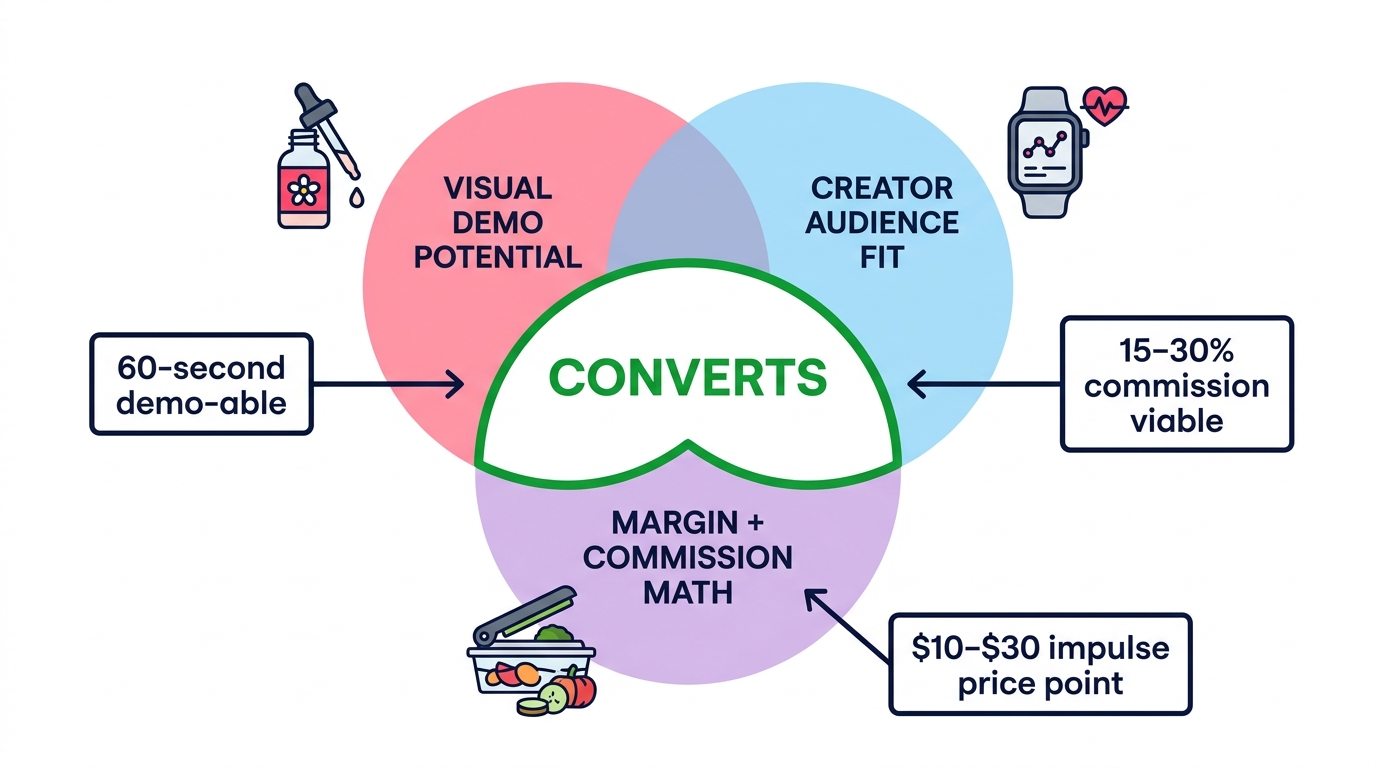
Before a single creator is recruited, the most important decision in any TikTok Shop program is already behind you: which products you put into it. Most operators select products based on what sells well elsewhere — on their website, Amazon, or in retail. This is exactly backwards for TikTok.
The Three-Axis Product Filter
Products that consistently convert on TikTok Shop share three characteristics that have nothing to do with whether the product is good or whether it sells on other channels.
Visual demo potential. TikTok is a video-first, sound-on medium where purchase decisions get made in seconds. Products that can demonstrate a visible transformation, a satisfying mechanism, or an obvious before-and-after in under 60 seconds convert at dramatically higher rates. This is why beauty tools, kitchen gadgets, fitness accessories, skincare, and pet products dominate TikTok Shop GMV in 2026. It is not that other categories cannot sell — it is that these categories compress the entire awareness-to-conviction arc into a single short video. A product whose value proposition requires reading a paragraph of explanation is structurally disadvantaged on this platform.
Impulse-friendly pricing. The sweet spot for TikTok Shop conversions sits roughly between $12 and $45. At this price range, the decision threshold is low enough that a compelling 30-second video can carry someone from cold discovery to checkout without them needing to research, compare, or deliberate. Products priced above $80 can and do sell on TikTok Shop — especially in the fashion and electronics categories — but they require significantly more content, more social proof, and often a LIVE event component to overcome the hesitation that comes with higher consideration purchases.
Creator-friendly unit economics. A product that converts well but destroys margin when you factor in a 15–20% affiliate commission, TikTok’s platform fee, and fulfillment costs is not actually a TikTok Shop winner. Before recruiting any creator, you need a clean unit economics model that shows what you can pay in commission without going upside down. This sounds obvious and yet it is the single most common mistake operators make when scaling affiliate programs: they offer high commissions to attract creators, then discover that the product was never viable at that commission rate.
Matching Product to Creator Audience Before You Recruit
Once you have filtered your catalog to products that pass all three tests, the next step is matching each product to a specific creator audience type — not a creator tier based on follower count, but an audience demographic and content context. A 50,000-follower creator whose audience is 35-to-45-year-old women interested in home organization will almost certainly outperform a 500,000-follower lifestyle creator when selling kitchen storage products. The follower count comparison is misleading. The audience match is what matters.
This means doing the work before you recruit: look at who the creator’s audience actually is (TikTok Creator Marketplace provides demographic data), what their top-performing content is categorically about, and whether their past product integrations have generated visible engagement signals like comments asking where to buy. Creators who have already generated organic interest in a product category — even without TikTok Shop links — are your highest-probability recruits. They have proven audience appetite for the content type without any financial incentive to fake it.
The Video Architecture That Drives Add-to-Cart
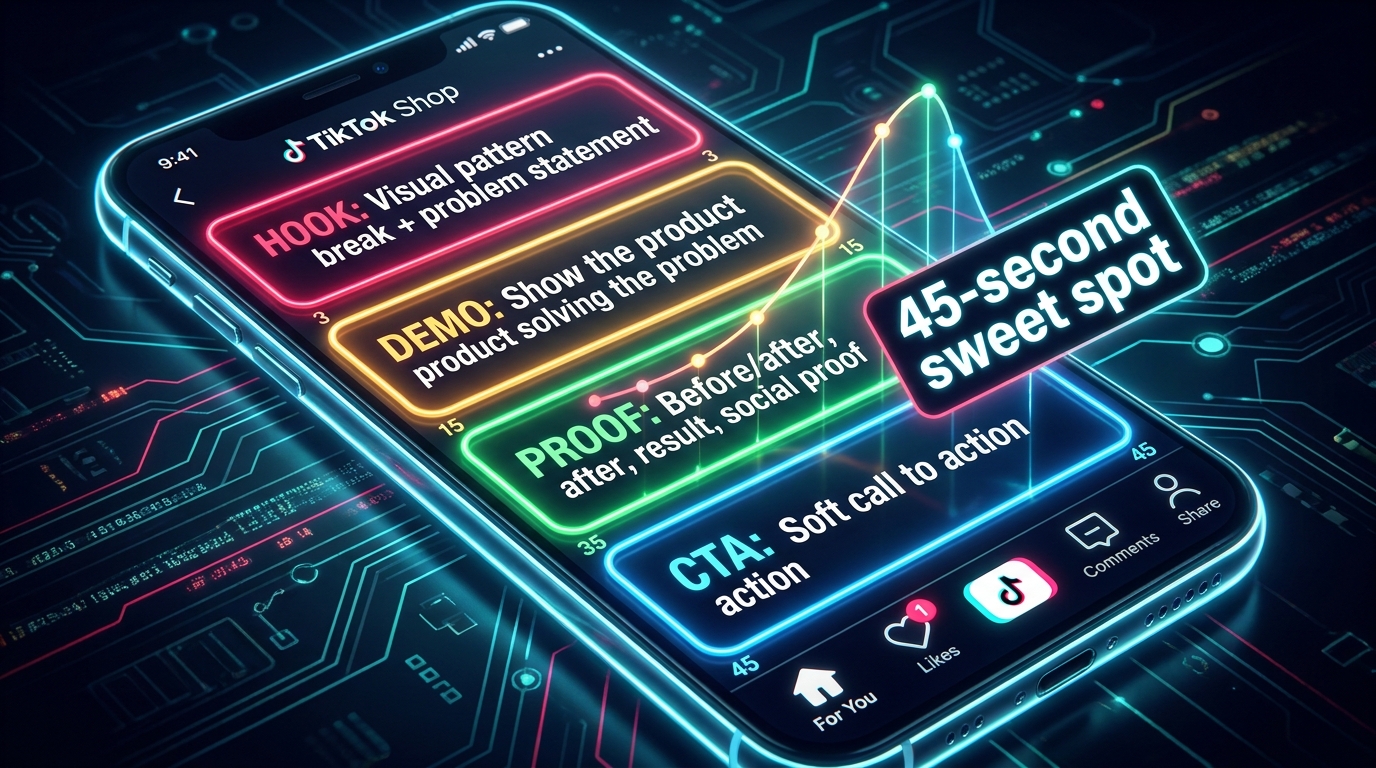
Every creator playbook talks about hooks. Very few talk about what happens after the hook, and the post-hook structure is often the real variable separating a 2% conversion rate from an 8% one.
The Hook Is a Promise, Not a Trick
The first two to three seconds of a TikTok Shop video have one job: establish a specific emotional contract with the viewer. The most effective 2026 hooks are not clever wordplay or jump cuts for the sake of it — they are an immediate, concrete articulation of a problem the target viewer has right now. “I was spending $300 a month on X until I found this.” “This is why your [product category] isn’t working.” “The reason your [common frustration] happens and the thing that actually fixed it.”
What these hooks share is specificity and audience self-recognition. The viewer sees the opening frame and thinks: that is my problem. When the hook lands this way, watch time extends naturally because the viewer is now invested in the resolution. This is a fundamentally different mechanism from a viral video hook, which is engineered for entertainment. A commerce hook is engineered for self-identification and problem ownership.
Hooks built around curiosity gaps (“You’ve been using this wrong”) perform well for reach because they attract a broad audience, but they convert less efficiently because a significant portion of viewers who click through are not actually buyers. The narrower, problem-specific hook attracts a smaller but more purchase-ready audience, which is what you want for commerce content.
The Demo Window: Seconds 3 to 20
After the hook locks in viewer attention, the window from roughly the three-second mark to the twenty-second mark is where the product earns its credibility. The most effective structure here is what practitioners call the “show, don’t argue” approach: let the product do something visually compelling rather than describing its features verbally.
A skincare creator showing a before-and-after texture difference under consistent lighting is more persuasive than thirty seconds of ingredient explanations. A kitchen gadget that peels, slices, and stores in one motion shown in real time is more convincing than any amount of “it’s so easy and fast.” The demo window should make the value self-evident. If a viewer needs to be told that something is impressive rather than seeing it directly, the product or the filming approach has a problem.
Pacing in this section matters more than most creators realize. TikTok’s retention data shows that drop-off spikes whenever content slows down — even for two or three seconds — and the algorithm penalizes videos with early retention loss by limiting their organic distribution. Tight editing, visual resets every four to six seconds (a slight camera angle change, a close-up cut, a text overlay appearing), and genuine momentum through the demo all help sustain the watch-through rate that pushes content into wider distribution.
The Proof Layer: Seconds 20 to 40
Social proof in a TikTok Shop video does not have to be elaborate to be effective. It can be as simple as a screen-recording of review stars and a few comment highlights, a verbal mention of how many units have sold, or a brief cut to the creator’s genuine reaction to using the product for the first time. What matters is that the proof arrives before the call to action — because in that sequence, the CTA lands not as a sales ask but as the obvious next step after credibility has already been established.
One effective and underused structure in 2026 is the “objection demolition” layer: immediately before or after the proof, the creator directly addresses the most common reason someone would not buy. “You might be thinking this is just another generic [product type] — here is what makes this one different.” Handling the objection inside the video means viewers do not hold it in their heads as an unresolved blocker when the product card appears.
The Call to Action: Framing, Not Pressure
The highest-converting CTAs in TikTok Shop videos in 2026 are not aggressive. They are directional. “Link is right in the video” or “it’s in my shop tab” in a neutral, informational tone consistently outperforms urgent pressure language like “buy now before it sells out.” The pressure language signals sales intent loudly and triggers viewer skepticism at exactly the moment you need trust.
A softer but specific CTA — particularly one that references the product name or a specific feature one more time — keeps the transaction feeling like a natural conclusion to the story the video just told rather than a hard commercial break.
Micro vs. Mega: The Creator Tier Math Nobody Talks About
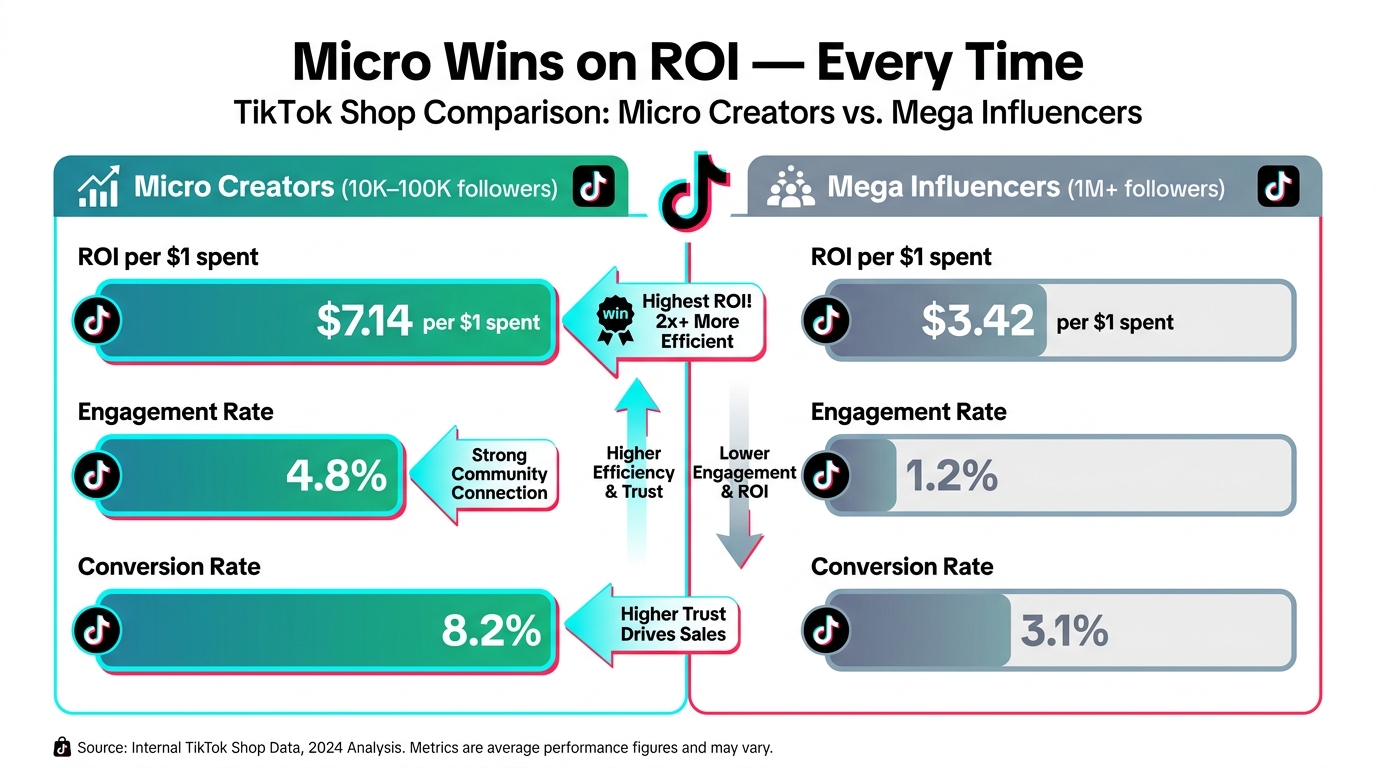
The debate about micro versus macro creators has been running in influencer marketing circles for years. On TikTok Shop specifically, the data in 2026 has settled it fairly clearly — not in the sense that mega creators are useless, but in the sense that the ROI math for performance-focused programs favors micro and nano creators in almost every measurable dimension.
The ROI Gap at Scale
Across 2026 benchmarks from multiple independent analyses, micro-influencers (broadly defined as creators with 10,000 to 100,000 followers) are delivering approximately $7.14 in revenue per dollar spent, compared to roughly $3.42 per dollar for mega-influencers with over one million followers. That is a two-to-one gap in spend efficiency that compounds dramatically when you are running a large affiliate program.
The underlying reasons are structural, not coincidental. Micro-creators on TikTok tend to have more niche, coherent audiences that closely match specific product categories. Their engagement rates are materially higher — not just in raw likes-to-follower ratios, but in the comments-to-views ratio that actually signals active interest rather than passive scrolling. A 40,000-follower creator whose audience is obsessed with budget beauty dupes will frequently outsell a million-follower lifestyle creator promoting the same product because the alignment between the offer and the audience intent is far tighter.
Micro-creators are also structurally cheaper to work with on a per-video basis, which means you can diversify across a larger number of them with the same budget. If ten micro-creator posts generate five strong-performing videos that you then amplify with Spark Ads, you have arrived at paid-scale winners at a fraction of the cost of a single mega-creator post — and with much more creative variety to test against each other.
When Mega Creators Actually Make Sense
Mega-influencers are not the wrong choice — they are the wrong choice at the wrong stage. There are specific scenarios where their reach advantage justifies the cost premium. Category launches where you need rapid awareness in a short window — especially for new brands entering TikTok Shop for the first time — can benefit from a single high-reach creator post that generates initial social proof at scale. A video from a well-known creator that drives 50,000 comments and 200,000 saves creates a social credibility signal that ten micro-creator videos cannot replicate in terms of visible momentum.
The smarter playbook is sequential: use one or two larger creators to establish initial credibility and generate first-mover attention, then shift the bulk of ongoing program spend to micro-creators who will reliably out-ROI on a sustained basis. Treating mega-creators as a launch mechanism rather than a growth engine is the distinction that separates efficient programs from expensive ones.
The Ghost Creator Problem
One underreported dimension of the creator tier question is what happens at the long tail of any affiliate program. Recent data from TikTok Shop operator networks suggests that approximately 92% of affiliates generate zero sales in any given 30-day window. This is a program management problem more than a creator quality problem. The programs that close this gap do not work harder at recruiting more creators — they work harder at activating the creators they already have.
The single highest-leverage intervention for ghost creator reactivation is personalized product recommendations paired with content guidance. A generic outreach message (“just wanted to remind you about our affiliate program!”) generates minimal response. A message that says: “We pulled your top three performing videos and noticed your audience responds strongly to [specific content type]. We have a new product that fits that exact format — here is a sample on its way” converts significantly better because it signals investment in the creator’s success rather than just asking them to sell for you.
Content Cadence: The Volume-Velocity Relationship
There is a persistent belief in creator marketing that quality and quantity are in tension — that pushing for higher posting frequency necessarily degrades the quality of individual pieces. On TikTok Shop, this belief is actively harmful because it leads programs to produce too little content too slowly to build the algorithmic signal they need.
Why Volume Is a Signal, Not Just a Number
TikTok’s discovery algorithm for Shop content is deeply probabilistic. It distributes content to progressively larger audiences based on engagement signals, but it needs a volume of content to identify which signals to amplify. A brand or creator posting three times per week is giving the algorithm a small, infrequent sample to work with. A creator posting one to three shoppable videos per day is generating a much richer signal density that the algorithm can use to identify patterns — which hooks work for which audience segments, which product demos generate the highest click-through rates, which CTAs drive add-to-cart.
This is why top-performing TikTok Shop programs in 2026 are not optimizing individual videos in isolation — they are treating the entire content output as a testing matrix. Post volume creates iteration speed. The goal is not to make each video perfect before publishing; it is to publish enough variations that the algorithm tells you which one is closest to perfect, then double down on that template.
The Sustainable Cadence Framework
For brand-owned accounts, the current benchmark recommended across most practitioner playbooks is a minimum of five to seven shoppable video posts per week, with aggressive growth programs targeting one to three posts per day. For affiliated creator networks, programs running at scale typically target fifteen to thirty creator-generated videos per week across the full creator pool.
The “sustainable” qualifier matters because the biggest failure mode is a burst-and-crash pattern: a brand recruits twenty creators, generates a surge of content in the first two weeks, and then watches output drop to near-zero by week four as creators run out of ideas, lose motivation, or move on to other programs. Preventing this requires infrastructure that most brands do not build: content brief libraries, product sample pipelines that keep creators stocked with new items to feature, and a creative feedback system that gives creators data on what is working so they can self-optimize rather than waiting for direction.
The Evergreen vs. Trending Content Mix
Not all TikTok Shop content needs to be trend-reactive. In fact, one of the more durable findings from 2026 operator analysis is that evergreen product demo videos — the kind that are not built around a trending sound, a trending format, or a cultural moment — often continue generating sales for months after they are posted. These are the workhorses of a TikTok Shop content library: clear, well-structured product explanations that someone can find via search or get served by the algorithm’s long-tail distribution logic at any point in time.
The practical implication is that cadence planning should split content roughly into two buckets: fifteen to twenty percent trend-reactive content built to capitalize on current platform momentum, and eighty percent durable product content that compounds over time. Most programs do this in reverse, spending disproportionate creative energy on trend-chasing that has a shelf life of days.
LIVE Shopping Economics: When the Format Actually Pays Off
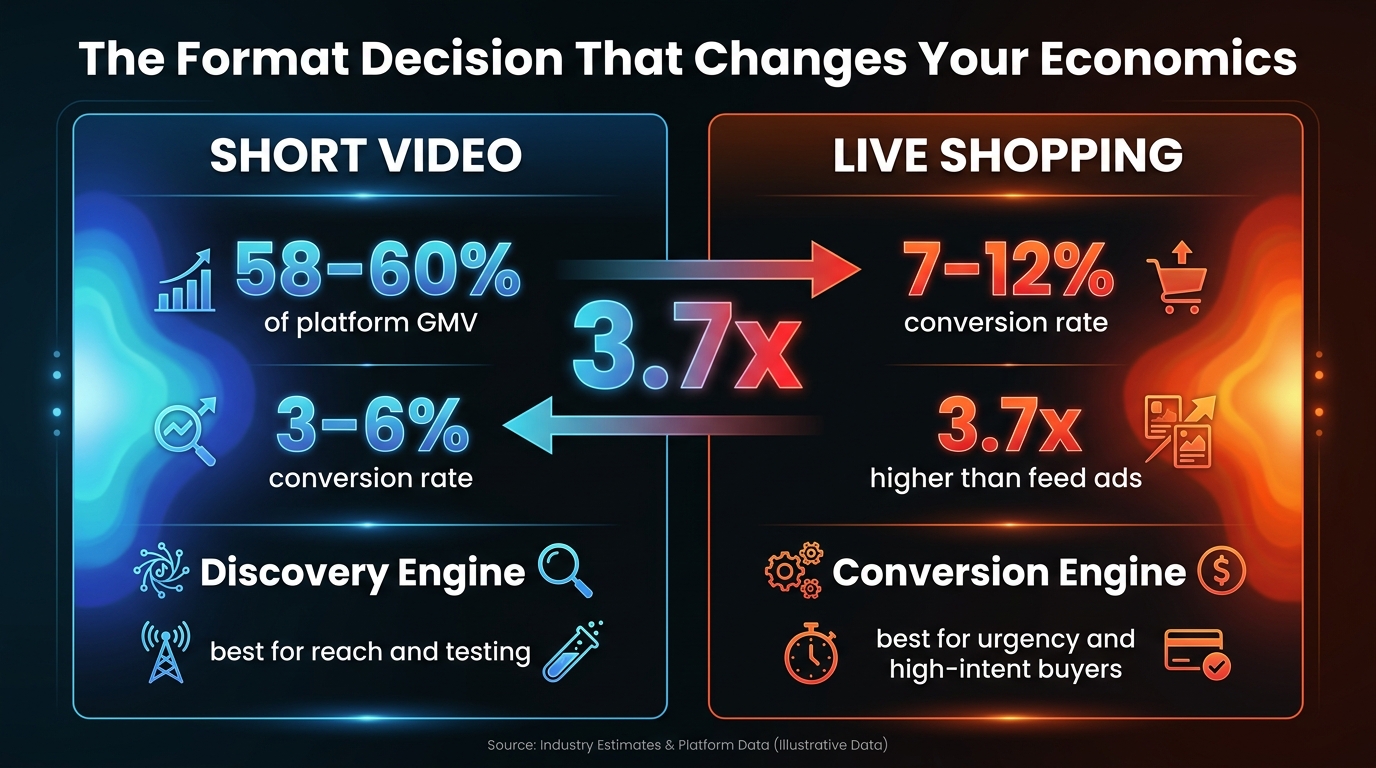
LIVE shopping on TikTok generates the platform’s highest per-viewer conversion rates, with well-run sessions typically landing between seven and twelve percent conversion on active live viewers — compared to three to six percent for short-form shoppable video. That headline number attracts a lot of enthusiasm. What gets less attention is the full economics of running a LIVE program, and why those economics do not work for every brand or every creator at every stage.
The Real Cost of a LIVE Event
A high-converting LIVE session on TikTok Shop requires more operational infrastructure than most first-time operators expect. At minimum, you need: a host who is genuinely comfortable on camera for extended periods (typically sixty to ninety minutes), lighting and audio setup adequate for sustained professional-looking video, a product staging area that allows for easy transitions between items, a co-host or moderator who can manage the comment section and surface audience questions in real time, and an offer structure — discounts, limited bundles, live-only pricing — that gives viewers a genuine incentive to buy during the stream rather than later from the shop tab.
Without the last element especially, LIVE sessions convert poorly. The mechanism that makes LIVE work is real-time urgency: the perception that this price, this bundle, or this offer is only available for people watching right now. Strip out that urgency and LIVE becomes a longer, more expensive version of a product video with a lower reach ceiling.
The 3.7x Conversion Premium and What It Requires
TikTok’s own platform data points to a 3.7x conversion rate advantage for LIVE over standard feed ads. This figure is real, but it is worth unpacking what generates it. The viewers who convert during LIVE events are disproportionately people who were already warm to the brand or creator — they tuned in with some level of existing interest. The conversion rate is high partly because the audience is self-selected. Cold viewers who stumble into a LIVE for the first time convert at rates much closer to feed ad benchmarks.
This means that LIVE shopping works best as a conversion event for an already-warmed audience, not as a cold acquisition channel. The most effective playbook pairs ongoing short-video content — which builds familiarity with the brand and creator at scale — with periodic LIVE events that convert the accumulated warm audience into buyers. Running LIVE before you have an established audience is a high-effort, low-return activity.
Frequency, Timing, and Session Structure
For brands and creators who are ready for LIVE, the cadence most commonly recommended in 2026 practitioner guides sits at two to four sessions per week. Daily LIVE is possible and practiced by some of TikTok’s top Shop sellers, but it requires either a dedicated on-camera host team or a creator whose content calendar is built entirely around commerce — a model that works in China’s live-commerce ecosystem but is still relatively rare in Western markets.
Session timing matters significantly. TikTok Shop LIVE data consistently shows that evening sessions — particularly between 7pm and 10pm in the viewer’s local timezone — generate higher viewer counts and conversion rates than daytime streams. Weekend afternoons also perform above average. Launching a LIVE at 2pm on a Tuesday may technically check the “ran a LIVE” box but will deliver a fraction of the results that a 7:30pm Thursday session generates.
Within the session itself, the highest-converting structural pattern in 2026 starts with an audience warm-up segment where the host is conversational and not immediately pushing products, transitions into a timed offer reveal (“For the next twenty minutes, here is what we have at live-only pricing”), and cycles between product showcases and audience interaction throughout. The comments — especially questions and requests for specific products — function as a live conversion signal. A host who responds to comments in real time and incorporates them into the product presentation creates a personalization effect that pre-recorded video cannot match.
The Amplification Loop: From Organic Proof to Paid Scale
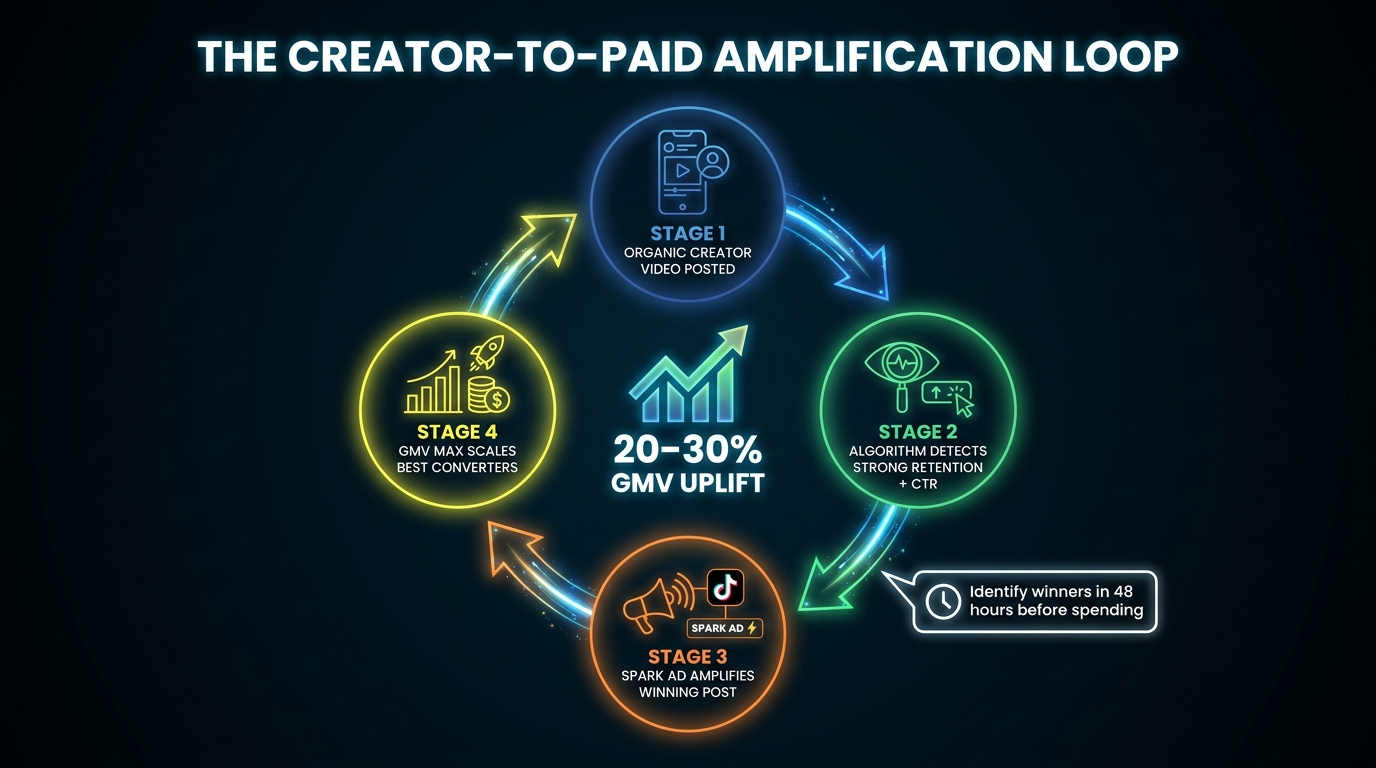
One of the most important structural shifts in TikTok Shop strategy in 2026 is the relationship between organic creator content and paid amplification. These are no longer separate activities managed by separate teams — they operate as a single integrated loop where organic performance is the filter that determines what gets paid amplification, and paid amplification validates what belongs in your organic content strategy going forward.
Why You Identify Winners Before You Spend
The key insight in this system is that TikTok’s organic distribution — even for new content from smaller creators — provides enough signal within the first 24 to 48 hours to tell you whether a video has conversion potential. If a post generates strong retention rate (viewers watching more than 50% of the video), a meaningful click-through rate to the product link, and add-to-cart activity without any paid spend behind it, you have a validated creative asset.
Spending money to amplify videos that have not yet shown organic signals is one of the most common and costly mistakes in TikTok Shop advertising. You are essentially betting on an unvalidated hypothesis with paid budget. The amplification loop reverses this: let organic content prove itself first, then bring paid capital in to scale what is already working.
Spark Ads: The First Amplification Layer
Spark Ads allow you to boost existing organic creator posts — including affiliate creator posts — as paid advertisements, while preserving the authentic post format, creator handle, and comment thread. This last detail matters more than it sounds: consumers engage differently with content that appears native to the platform versus content that is clearly marked as an advertisement. Spark Ads sit in a middle ground that maintains the organic feel while giving you paid distribution control.
The standard Spark Ads workflow in 2026 is: identify posts that are performing in the top 20% of your content library by conversion metrics, request creator authorization (for affiliate posts), and run them with a test budget of $50 to $150 per day to validate that the organic performance scales with paid reach. Posts that maintain their conversion rate at paid scale become your GMV Max input assets. Posts that convert organically but fall apart with paid reach often signal that the audience was self-selected in a way that does not transfer to cold traffic — useful information that tells you to reconfigure the targeting or the product angle.
GMV Max: The Scaling Layer
TikTok’s GMV Max is a commerce automation tool that distributes your ad spend across all available TikTok Shop placements — in-feed ads, search results, related products — and automatically optimizes toward GMV and return on ad spend rather than requiring manual campaign management for each placement. It essentially treats your entire creative library as a portfolio and allocates budget toward the combinations of creative and placement that are performing best at any given time.
Programs that have graduated their best-performing Spark Ad videos into GMV Max are seeing reported GMV uplifts in the range of twenty to thirty percent compared to manual placement management. The mechanism is algorithmic efficiency: GMV Max responds to real-time conversion data faster than any human campaign manager can adjust bids and budgets across multiple placements simultaneously.
The caveat is that GMV Max is only as good as the creative inputs you feed it. A library of weak creative — videos that did not convert organically — will produce weak GMV Max results regardless of budget. This is why the amplification loop starts with organic performance testing, not with the paid tools. The tools are acceleration mechanisms for creative that has already been proven. They are not discovery mechanisms for finding out whether your creative works.
Why 92% of Affiliates Never Sell — And How to Fix the Program
The statistic that roughly 92% of TikTok Shop affiliates generate no sales in any given 30-day period is one of the more confronting data points in the creator commerce industry. It is also, upon examination, entirely predictable given how most affiliate programs are structured.
The Structural Reasons Affiliates Go Silent
Most TikTok Shop affiliate programs are built on a passive recruitment model: the brand opens its affiliate program, sets a commission rate, and waits for creators to discover it and start posting. Creators who join organically — without proactive outreach, product samples, creative support, or audience context — are essentially making cold business decisions about whether to invest their time creating content for a product they may have no personal connection to.
From the creator’s perspective, the economics only make sense if: the product converts at a high enough rate to justify the time spent filming, editing, and posting; the commission is meaningful enough relative to other monetization options available to them; and they have enough confidence in the product to put their name behind it. Without proactive engagement from the brand on all three dimensions, the default decision for most creators is to not create the content.
The Product Sample Pipeline Is Not Optional
The single most consistent finding across operator post-mortems of failed affiliate programs is that creators who received product samples — especially creators who asked for them and had to wait less than a week to receive them — generate content at rates that are roughly five to eight times higher than creators who did not receive samples. The sample does two things simultaneously: it removes the financial risk for the creator (they are not out money if the product does not convert), and it creates a psychological obligation of reciprocity — having been given something, most creators feel a stronger motivation to actually post about it.
Sample programs are not free, but the cost calculus is straightforward. If a product has a $20 cost of goods and a creator who posts a video generates an average of $300 in sales over thirty days, the sample cost pays back on the first sale. The programs that treat sample costs as a pure expense rather than a creator activation investment are cutting the highest-ROI line item in their affiliate budget.
Content Briefs That Enable Rather Than Restrict
The other major failure mode in affiliate management is over-scripting. Brands that provide detailed scripts, mandatory language, and rigid content formats are essentially asking creators to be actors in a commercial rather than authentic voices for a product. TikTok’s audience has an exceptionally well-calibrated radar for content that lacks genuine enthusiasm — comments on highly scripted creator content frequently include variations of “this is so obviously an ad,” which actively suppresses conversion.
Effective content briefs in 2026 provide direction without prescription: here is the core problem the product solves, here are three or four features worth highlighting, here are any compliance or claims constraints you need to know about, and here is what the best-performing content in this category tends to look like structurally. What the brief does not do is tell the creator what to say word-for-word or dictate the exact format of the video. Creators who are given genuine latitude to integrate a product into their existing content voice generate more authentic — and more converting — content than those who are handed a script.
The 90-Day Plateau: Why Programs Stall and How to Break Through
The pattern is consistent enough to have a name in TikTok Shop operator circles: the 90-day plateau. A program launches with energy, generates strong initial GMV from a core group of active creators and a successful LIVE event or two, and then hits a wall. Week-over-week growth flattens. Existing creators keep posting but with diminishing returns. New creator recruits do not activate. The brand starts questioning whether TikTok Shop is actually a viable channel.
The Three Drivers of the Plateau
The plateau almost always has one or more of three causes. The first is creative saturation: the initial set of content hooks, demo formats, and product angles has been exhausted, and incremental variations of the same approach stop generating new signal for the algorithm. What worked in month one starts to look familiar to the algorithm and to the audience, and both reward novelty.
The second is creator attrition. The creators who were most active in the first ninety days were early adopters with high intrinsic motivation — the easiest cohort to engage. The next tier of creators in the program require more activation effort. Without a structured reengagement system, these creators drift to passive status and the effective creator pool shrinks even as the program’s nominal roster stays the same size.
The third is product fatigue. Running the same one or two SKUs through a creator network for three months means that many potential buyers have already seen the product multiple times without purchasing — a signal that either the product-audience fit is weaker than initially measured or that the program has reached a saturation ceiling for that specific SKU with that audience.
The Breakout Strategy
Breaking through the plateau requires a deliberate intervention on at least two of these three vectors simultaneously. On the creative side: run a structured creative refresh. Review every video in your library by format and hook type, identify which structural patterns have not been tried, and brief a fresh cohort of creators specifically to test those new angles. Format diversity — story-based reviews, educational “how to use” videos, reaction content, comparison posts — prevents any single approach from dominating and wearing out.
On the product side: introduce one to two new SKUs specifically selected for TikTok Shop viability criteria. New product launches generate inherent novelty that re-activates both the algorithm and the creator community. A sample drop to your existing affiliate network announcing a new product creates a natural reengagement moment that does not require you to recruit new creators from scratch.
On the creator side: rather than trying to reactivate the entire passive cohort, identify the top ten to fifteen percent of creators by historical performance and invest significantly more in those relationships — higher commission rates, exclusive product access, co-creation opportunities. Depth of relationship with a smaller, high-performing creator group consistently outperforms shallow relationships with a large, low-activity pool.
Measuring What Actually Matters
TikTok Shop programs that optimize for the wrong metrics will consistently make the wrong decisions. The platform makes it easy to focus on vanity metrics — total video views, follower growth, LIVE viewer counts — because these are the numbers that feel encouraging and are easy to report. They are also the numbers least correlated with actual program health.
The Metrics That Predict GMV
The metrics that actually predict sustained GMV performance are: video click-through rate to the product link (ideally above two percent for a healthy shoppable post), add-to-cart rate from the product page (a signal of product page quality as much as video quality), video-to-purchase conversion rate (the end-to-end percentage), and revenue per video posted (a creator-level efficiency metric that normalizes for posting frequency).
At the program level, the metrics that matter are: active creator percentage (what share of your affiliate roster has posted at least one video in the past 30 days — this is the real health indicator of your creator community), cost per GMV dollar across different creator tiers (validating the ROI math that should have been in your program design from the start), and return rate by SKU (a high return rate is a content problem as often as it is a product problem — it means your creator content is generating conversions from buyers who are not a good fit for the product).
Creator-Level Reporting: The Underused Asset
Most brands track aggregate program metrics without generating individual creator performance reports. This is a significant missed opportunity. A creator-level report that shows each affiliate’s video count, views, click-through rate, conversion rate, and GMV for the past thirty days tells you exactly who to invest more in, who to reactivate, and who to deprioritize. More importantly, it gives you the data to have genuinely useful conversations with your top creators: “Your videos that focus on [specific product benefit] are converting at twice the rate of your other content — here is why we think that is, and here is what we would love to see more of.”
Creators who receive this kind of performance-informed feedback are dramatically more likely to iterate toward higher-converting content than creators who only hear from the brand when there is a new product launch or a commission payment. The data is the relationship infrastructure. It makes every creator interaction more useful and signals that you are treating the partnership as a performance optimization, not just a transactional arrangement.
Building a Creator System, Not a Campaign
The deepest reframe available to any TikTok Shop operator in 2026 is the shift from thinking about creator partnerships as campaigns — discrete, time-bound activations with defined start and end dates — to thinking about them as systems. A campaign asks: what can we get out of creators this month? A system asks: what infrastructure do we need to build so that creators keep generating better and better content with less and less friction over time?
Systems thinking changes what you invest in. Instead of spending the most on individual creator fees, you invest in the pipeline infrastructure: a sample request and fulfillment process that turns around product deliveries in five days or less, a content brief library that gets updated monthly with new angles and seasonal opportunities, a creator data dashboard that makes performance visible to both brand and creator, and a tiered commission structure that rewards long-term performance rather than treating every creator with the same flat rate regardless of results.
It also changes the timeline you plan against. A campaign is typically measured over thirty to sixty days. A creator system is measured over six to twelve months, because the compounding dynamics of algorithmic distribution, creator relationship depth, and creative learning take time to generate their full returns. The brands that are generating the most consistent TikTok Shop GMV in 2026 are not the ones who ran the most aggressive short-term campaigns — they are the ones who built programs robust enough to generate consistent content volume month after month, identify and amplify winners systematically, and evolve their creative strategy based on what the data is actually telling them.
TikTok Shop rewards systems thinking with disproportionate returns. The platform’s algorithmic structure means that programs with consistent content volume and strong historical performance data get increasingly efficient distribution over time. The hard part is surviving the first ninety days — keeping investment high before the flywheel is fully spinning. The programs that make it to month six with their creator community intact and their content strategy refined tend to see the compounding effect kick in with a clarity that makes the earlier patience feel entirely worth it.
Key Takeaways for Operators Ready to Execute
Across the mechanics covered in this post, several actionable patterns emerge consistently:
- Filter your product catalog before recruiting creators. Visual demo potential, impulse-friendly pricing, and creator-viable unit economics are non-negotiable prerequisites. Products that fail these tests will underperform regardless of creator quality.
- Match on audience demographics, not follower count. A 40,000-follower creator with a perfectly matched audience will consistently outperform a 400,000-follower creator with broad, misaligned reach. The matching work happens before the outreach call.
- Build your video structure around the sequence: hook → demo → proof → CTA. Compress each element, use visual resets every four to six seconds, and let the product demonstrate its value rather than describing it verbally.
- Use the organic-first amplification loop. Post content, wait 48 hours for performance signals, then allocate Spark Ad budget only to posts that have already demonstrated organic conversion potential. Graduate proven Spark Ad assets into GMV Max for scaled reach.
- Treat your affiliate roster as a tiered portfolio. Invest deeply in your top ten to fifteen percent of performers, actively manage the middle tier, and accept that the long tail will remain largely inactive regardless of your reactivation efforts. Adjust your cost model accordingly.
- Measure creator-level metrics, not just aggregate program metrics. Revenue per video posted, active creator percentage, and return rate by SKU tell you more about program health than total views or follower growth ever will.
- Plan for the 90-day plateau in advance. Build your product refresh cadence, creative brief rotation, and creator reengagement protocols into the program design from day one rather than scrambling to respond when growth stalls.
The playbooks that convert are not secret formulas — they are coherent systems built on decisions that reinforce each other at every stage. Product selection informs creator matching. Creator matching determines video format. Video format shapes the amplification strategy. The amplification strategy feeds the measurement system. And the measurement system drives the next round of product, creator, and content decisions. When these pieces are aligned, TikTok Shop becomes a compounding revenue engine. When they are misaligned — even by one degree at each step — the whole system underdelivers and looks like a platform problem when it is really a systems architecture problem.
The operators who figure this out are not the ones with the biggest budgets or the most famous creator partnerships. They are the ones who treat creator commerce as a discipline with its own internal logic — and who are willing to build the infrastructure that logic requires.