



Ask almost any Amazon seller how their advertising is set up, and you’ll hear some version of the same answer: Sponsored Products campaigns, some auto and manual targeting, maybe a Sponsored Brands campaign pointing to their Store. They’ll mention watching their ACoS, pulling weekly reports, and bidding up on their best keywords.
What they’re describing is a conversion funnel. A single-stage conversion funnel.
It captures shoppers who already know what they want and are already searching for it. It does almost nothing to create demand, introduce the brand to new audiences, or pull back shoppers who viewed a product but didn’t buy. In a market where ad costs keep rising and organic rank is harder to hold, a single-stage strategy is increasingly expensive to sustain — and it leaves real revenue on the table at every other stage of the buyer journey.
A genuine full-funnel Amazon advertising strategy doesn’t just mean running more ad types. It means deliberately architecting campaigns around what a shopper knows, wants, and needs at each stage of their decision process — and measuring each stage against the right goals rather than a single blunt ROAS number.
This guide walks through how to build that architecture from the ground up. Not theory — practical setup decisions, budget logic, structural rules, measurement tools, and the mistakes that quietly drain budget in accounts that look full-funnel but aren’t functioning as one.
We’ll start where every full-funnel setup actually has to start: not at the top of the funnel, but at the bottom — and before you run a single upper-funnel dollar, at the listing itself.
What “Full-Funnel” Actually Means on Amazon (And What It Doesn’t)
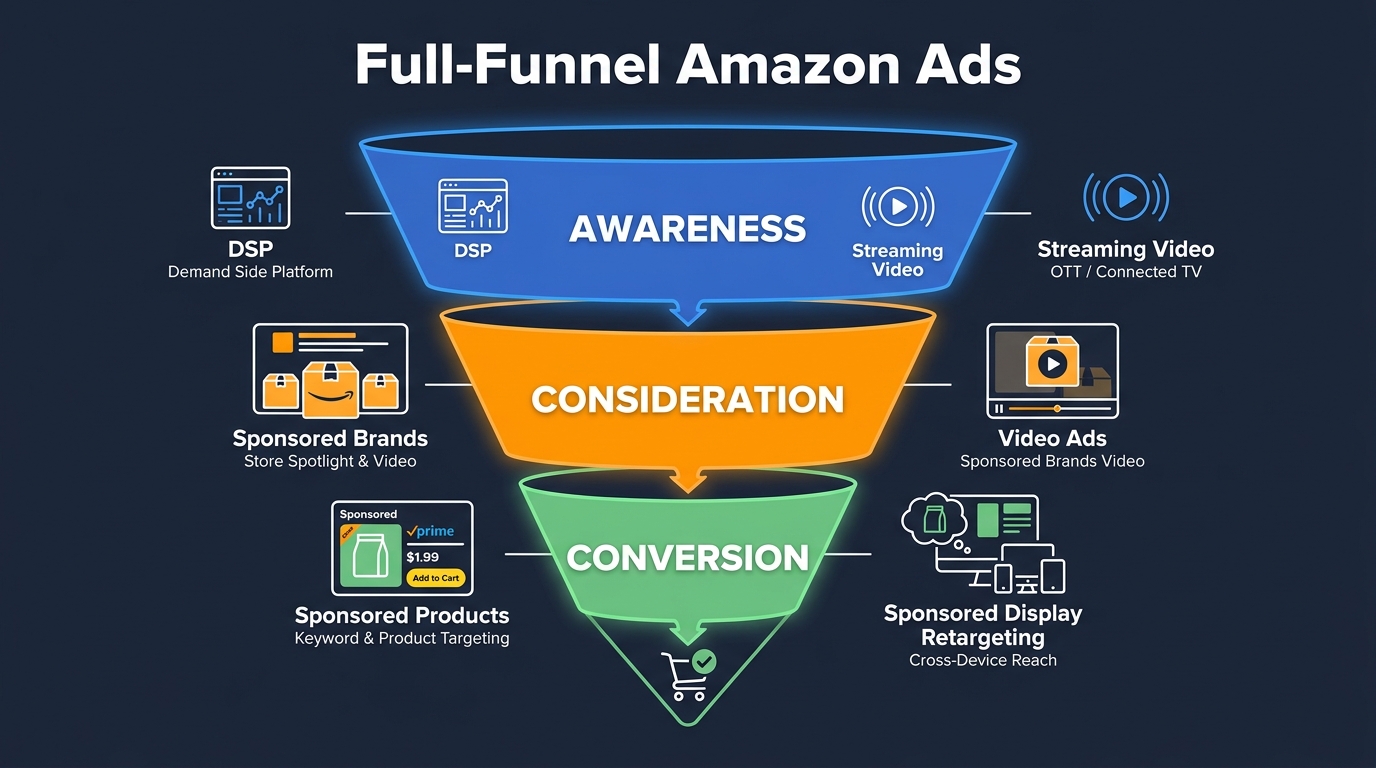
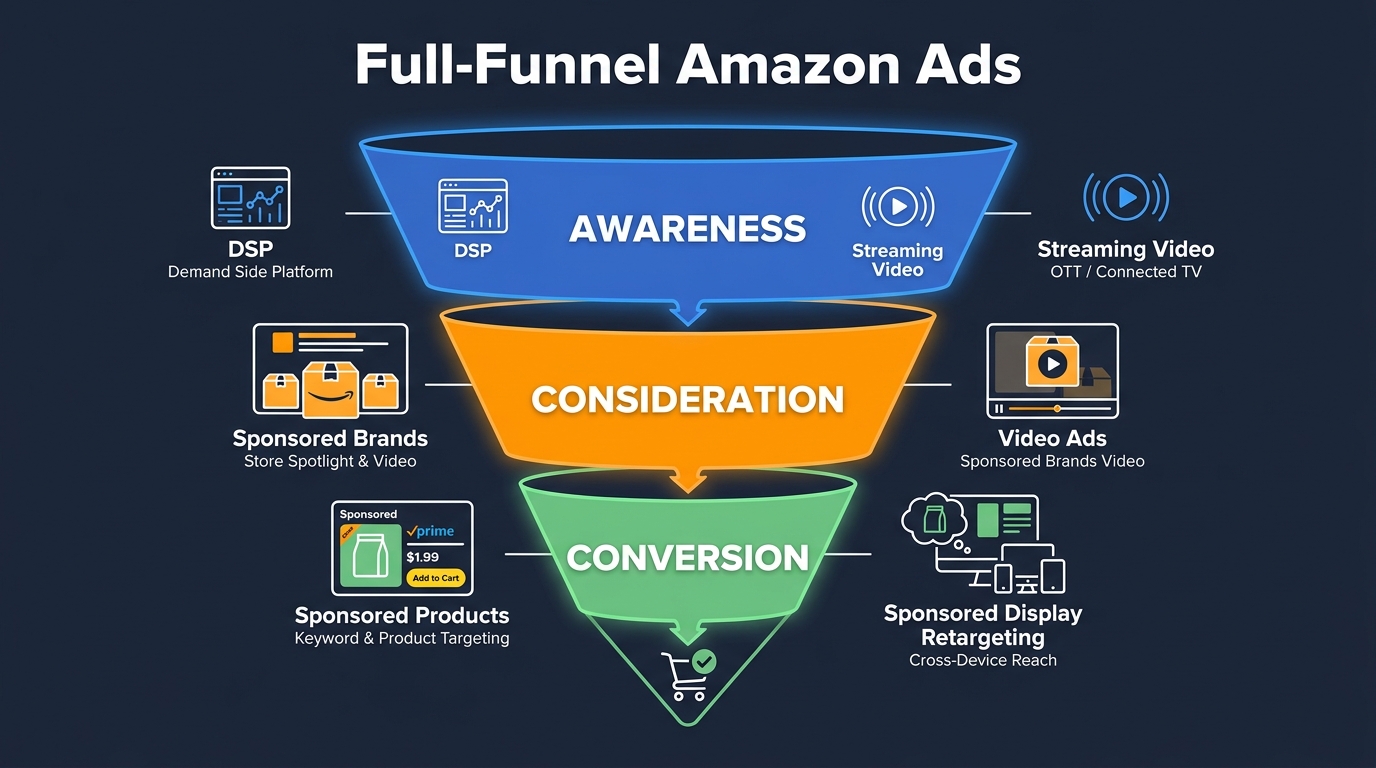
The phrase “full-funnel advertising” gets used loosely. For most sellers it means “we run Sponsored Products, Sponsored Brands, and Sponsored Display.” That’s three ad types. It isn’t automatically a funnel.
A real funnel does two things that a random mix of ad types doesn’t:
- It maps each campaign’s objective to a specific stage of the shopper’s decision journey.
- It measures each stage against KPIs appropriate to that stage — not one universal ROAS target.
The buyer journey on Amazon typically moves through four recognizable phases:
Phase 1: Awareness
The shopper doesn’t know your brand or product exists. They may not even be actively searching for it yet. Reaching them requires interruption-style ad placements — streaming video on Prime Video, display ads across Amazon’s publisher network, or upper-funnel DSP placements. The goal here is impressions, reach, and brand recall. ROAS is a meaningless metric at this stage. What matters is cost-per-thousand impressions (CPM), video completion rate, and eventual branded search lift.
Phase 2: Consideration
The shopper is now researching. They’re searching category keywords, browsing comparable products, and visiting detail pages. Sponsored Brands campaigns — particularly video — intercept them during this research phase. Sponsored Brand placements at the top of search results put your product in the frame of comparison shopping. Key metrics here shift toward click-through rate, product detail page views, Store visit volume, and new-to-brand percentage.
Phase 3: Conversion
The shopper has intent. They’re searching your brand name, clicking your product, or returning to a detail page they visited before. This is where Sponsored Products — keyword-targeted, bidding on high-intent search terms — does its most efficient work. It’s also where Sponsored Display retargeting re-captures shoppers who viewed but didn’t purchase. Metrics here are ACoS, ROAS, cost-per-acquisition (CPA), and conversion rate.
Phase 4: Loyalty and Repeat Purchase
Often overlooked in ad strategy conversations, the post-purchase phase is a genuine advertising opportunity on Amazon. Sponsored Display campaigns targeting past purchasers of your own ASINs for cross-sell or upsell, Subscribe & Save promotions, and DSP re-engagement campaigns can meaningfully increase customer lifetime value. The relevant metric is repeat purchase rate and revenue-per-customer over a 90-day window.
None of these phases operates in isolation. The real power of a full-funnel approach is that upper-funnel activity builds the audiences that make lower-funnel campaigns cheaper and higher-converting. When a shopper sees your brand through a streaming video ad and later searches for your category, they’re more likely to click your Sponsored Product listing — and more likely to convert when they do. The funnel multiplies the efficiency of every stage below it.
But none of that compounding works if your listings can’t convert the traffic when it arrives.
The Retail Readiness Pre-Flight Check: Do This Before Spending on Upper Funnel
Driving awareness traffic to a listing that isn’t ready to convert it is one of the most expensive mistakes in Amazon advertising. Upper-funnel campaigns generate impressions and clicks. If those clicks land on a listing with three reviews, blurry images, and a generic title, that traffic converts poorly — and the algorithm notices.
Amazon’s A9/A10 ranking system treats conversion rate as a signal of listing relevance. Poor conversion from paid traffic doesn’t just waste ad spend; it can actively suppress organic rank for the keywords you’re bidding on. The funnel breaks before it ever really started.
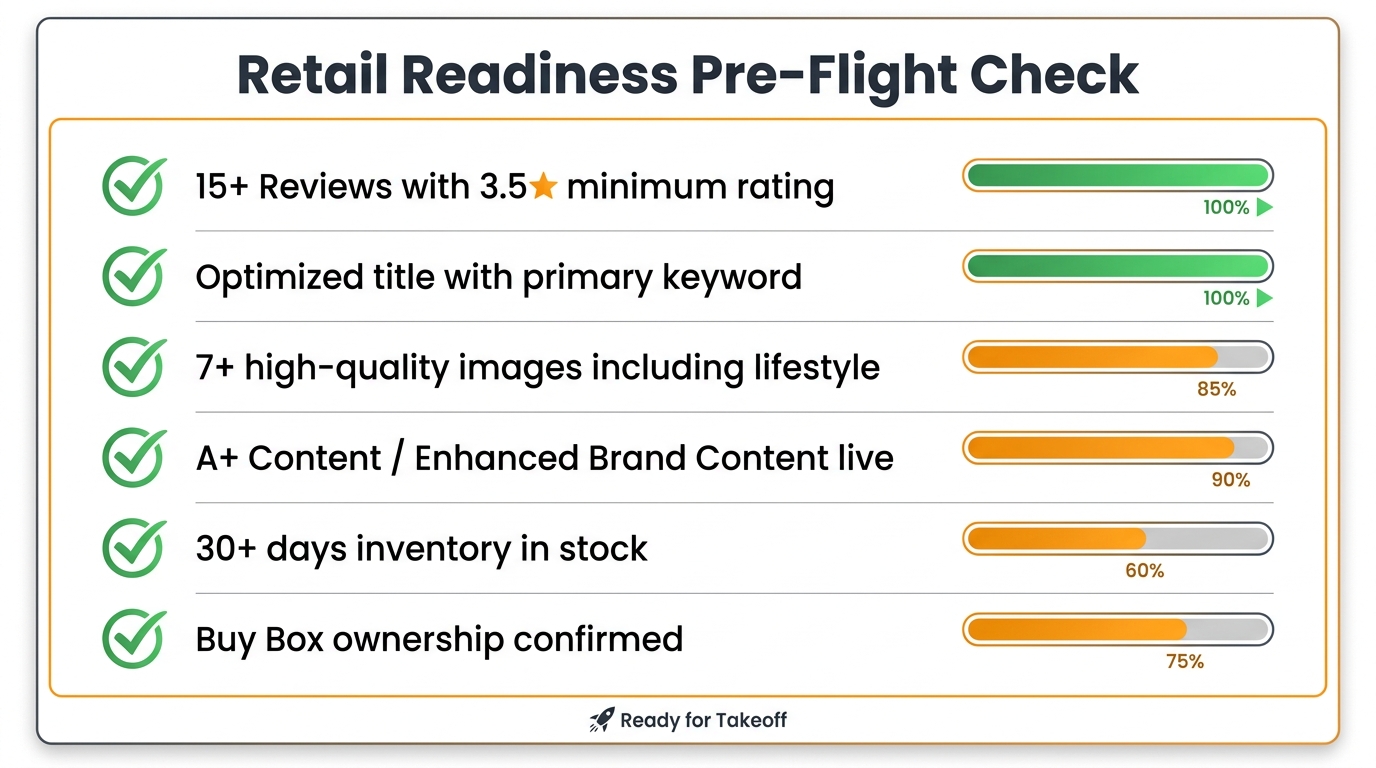
Before scaling any campaign beyond bottom-funnel Sponsored Products, run every ASIN through these six checkpoints:
1. Review Volume and Rating Threshold
Current best practice — and Amazon’s own guidance — sets a minimum of 15 reviews and a 3.5-star rating before investing significantly in paid traffic, and at least 50+ reviews before upper-funnel spend makes economic sense. Below these thresholds, social proof is too thin to convert discovery-stage traffic. You’re essentially paying to send shoppers to a product that can’t close the sale. Reviews below 3.5 stars will actively hurt conversion from any paid placement.
2. Title and Content Optimization
Your title needs your primary keyword, key product attributes, and enough specificity that a first-time visitor immediately understands what the product is and why it matters. Body copy — bullet points and the product description — should address objections, not just list features. If your copy reads like a spec sheet rather than a purchase rationale, upper-funnel traffic will bounce.
3. Image Quality: Minimum Seven Images
Amazon allows up to nine images per listing. You should have at least seven, including: a hero image on white that meets Amazon’s main image standards, at least two lifestyle images showing the product in use, one or more infographic images highlighting key specs or features, and a size/scale comparison image. Listings with fewer than five quality images see materially lower conversion rates from cold traffic — exactly the traffic upper-funnel campaigns send.
4. A+ Content Is Live
A+ Content (Enhanced Brand Content) is free for brand-registered sellers and consistently lifts conversion rates. Amazon has reported average conversion lifts of 5–10% for listings with A+ Content compared to those without it. For categories with high visual comparison shopping — home goods, apparel, supplements, electronics accessories — A+ Content is non-negotiable before running mid or upper-funnel ads.
5. Inventory Health and Buy Box Status
Running upper-funnel campaigns when you’re at risk of going out of stock is a budget fire. Amazon will continue serving your ads even when inventory runs low, and if you go out of stock mid-campaign, you pay for clicks to a page that can’t complete a purchase. Maintain at least 30 days of inventory buffer before scaling any funnel stage above Sponsored Products. Buy Box ownership also needs to be stable — if competitors are winning your Buy Box, your paid traffic is converting sales for them.
6. Pricing Competitiveness
If your price is more than 15–20% above comparable competing products, no amount of paid traffic will move the needle. Amazon shoppers are highly price-conscious and comparison-shop easily. Upper-funnel traffic especially — coming from shoppers at the research stage — will click to compare and choose the better-priced option. Before investing in awareness campaigns, confirm that your pricing is competitive within the category.
Retail readiness is the foundation. Skip this check and every dollar you spend above the bottom of the funnel is working against an unlevel playing field.
Bottom of Funnel First: Building the Conversion Engine with Sponsored Products
The standard advice to “start at the bottom of the funnel” sounds obvious. In practice, sellers frequently violate it — either by launching upper-funnel campaigns too early, or by having a technically-present bottom funnel that isn’t actually optimized before layering on more complexity.
Bottom-of-funnel Sponsored Products campaigns should be profitable and structurally clean before anything else gets added. This is the engine that will justify and subsidize investment in every stage above it.
Campaign Structure: The Three Core Campaign Types
A well-structured Sponsored Products bottom funnel uses at least three distinct campaign types, each with a separate objective and budget:
Exact Match — Branded Keywords. These campaigns defend your own brand terms and capture shoppers who already know your brand. They almost always have the best conversion rates and lowest ACoS on the account. They shouldn’t be lumped in with generic keyword campaigns, because their performance will inflate the apparent efficiency of the broader campaign and mask what’s actually happening with non-branded traffic.
Exact Match — Competitor Keywords. Bidding on competitor brand names and ASINs captures shoppers in active comparison mode. Conversion rates are lower than branded campaigns but often still efficient, and the traffic is genuinely high-intent. Keep these separate so you can evaluate the true cost of competitive conquest traffic.
Broad/Phrase Match — Category Keywords. This is where you discover new keyword opportunities. Use broad and phrase match campaigns with strong negative keyword lists to mine for converting search terms, then graduate the best performers to exact match campaigns. Without disciplined negatives, broad match campaigns bleed spend on irrelevant queries.
Auto Campaigns: Use Them for Discovery, Not as Your Main Engine
Auto campaigns let Amazon’s algorithm determine targeting based on your listing content. They’re useful for surfacing search terms you wouldn’t have identified manually, especially for new ASINs. But they should be treated as research tools with capped budgets — not as the primary conversion driver. Review search term reports weekly and pull high-converting terms into manual campaigns. Pause or add negatives for irrelevant or non-converting terms.
Bid Strategy: Target ACoS vs. Target ROAS
Amazon offers several automated bidding strategies — Dynamic Bids Down Only, Dynamic Bids Up and Down, and Fixed Bids. For bottom-funnel Sponsored Products on competitive keywords, start with Dynamic Bids Down Only to limit overspend, then shift to Target ROAS bidding once you have at least 30 days of conversion data in a campaign. Giving Amazon’s algorithm time to learn on real conversion data before using Target ROAS prevents poor early optimization decisions.
The ACoS target for bottom-funnel campaigns should be set based on your actual product margin, not category benchmarks. A 30% ACoS target might be perfectly profitable for a 60% margin product and a disaster for a 35% margin product. Know your breakeven ACoS — which is simply your profit margin percentage — and set targets accordingly.
When Is Bottom Funnel “Done Enough” to Layer More?
A useful threshold: your Sponsored Products campaigns should be running profitably at target ACoS, with stable conversion rates, for at least 30–60 consecutive days before you begin investing meaningfully in mid-funnel campaigns. That doesn’t mean perfect — it means the engine is working and generating enough data to make informed decisions about what to amplify above it.
Mid-Funnel Architecture: Sponsored Brands, Video, and Store Traffic
Once bottom-funnel is stable, the mid-funnel layer is where brands start genuinely differentiating from competitors who only run Sponsored Products. The mid-funnel captures shoppers in active research mode — they’re searching category keywords, comparing options, and forming preferences. It’s where brand building on Amazon actually happens in a measurable, performance-oriented way.
Sponsored Brands: Headline Search Done Right
Sponsored Brands ads appear above search results — the most visible real estate on any Amazon search page. They can link to a custom landing page, your Amazon Store, or a product collection. The key strategic decision is where to send the click.
For accounts with a robust Store (with multiple pages, strong visuals, and A+ content), sending Sponsored Brands traffic to the Store consistently outperforms sending it to a single product detail page. Store visits allow shoppers to explore the full brand offering, cross-sell naturally, and develop brand familiarity. Amazon’s own data shows that brands using their Store as a Sponsored Brands destination see higher new-to-brand customer rates than those sending traffic directly to a product page.
For accounts without a well-built Store, a curated product collection landing page — selecting 3–5 complementary or top-performing ASINs — is the next best option. Single-product destinations underutilize the format’s brand-building potential.
Sponsored Brands Video: The Most Underused Mid-Funnel Format
Sponsored Brands Video ads appear in search results, autoplay silently, and link directly to a product detail page. They’re consistently among the highest-converting formats on Amazon — benchmarks in 2026 show conversion rates in the 8–12% range for well-optimized creatives, matching or exceeding the platform-wide average of 9–11%.
Yet most sellers either don’t run them or run them with creative that isn’t designed for the format. Effective Sponsored Brands Videos on Amazon are:
- Silent-first: The video must communicate the core value proposition without audio, since most shoppers browse with sound off. Text overlays, product demonstrations, and clear visual storytelling are essential.
- Short: 15–30 seconds is the optimal range. Longer videos see completion rates drop sharply, and the algorithm rewards engagement.
- Problem-solution oriented: Lead with the problem the product solves in the first 3 seconds, then show the solution. Don’t start with a brand logo or generic lifestyle imagery.
- Product-forward: Amazon shoppers in search results are in buying mode. Show the product clearly, in use, from the first frame. Abstract brand films don’t convert in this placement.
Keyword targeting for Sponsored Brands Video should skew toward broad and phrase match category keywords — the same terms where shoppers are doing comparison shopping. These aren’t necessarily your best-converting bottom-funnel keywords; they’re the discovery keywords where video-format interruption has the most impact.
Amazon Store: The Mid-Funnel Hub
An Amazon Store isn’t just a landing page destination — it’s a standalone brand presence that Amazon promotes organically through “See all products” links and Store Spotlight placements. Well-built Stores with multiple pages, curated product collections, and video content see measurably higher average order values from Store visitors versus shoppers who arrive through a product detail page.
A high-performing Store for mid-funnel purposes typically includes: a homepage with a brand story and hero visual, category sub-pages organized by use case or product type (not just SKU), A+ Content-quality imagery throughout, and at least one embedded video. Treat the Store like a miniature website — because for many shoppers, it’s the deepest brand experience they’ll have before purchasing on Amazon.
Upper Funnel: Sponsored Display Prospecting and Amazon DSP
Upper funnel is where a lot of sellers hesitate — because the metrics look worse. Lower ROAS, higher CPM, longer time-to-conversion. This is expected and, crucially, it doesn’t mean the spend isn’t working. It means you’re measuring it wrong.
Upper-funnel activity builds the pool of shoppers who eventually become your most valuable bottom-funnel conversions. The goal isn’t immediate ROAS. It’s building reach, branded awareness, and a retargetable audience pool that makes all your downstream campaigns more efficient.
Sponsored Display: Two Very Different Jobs in One Format
Sponsored Display does two fundamentally different things depending on how you configure it, and many advertisers conflate them:
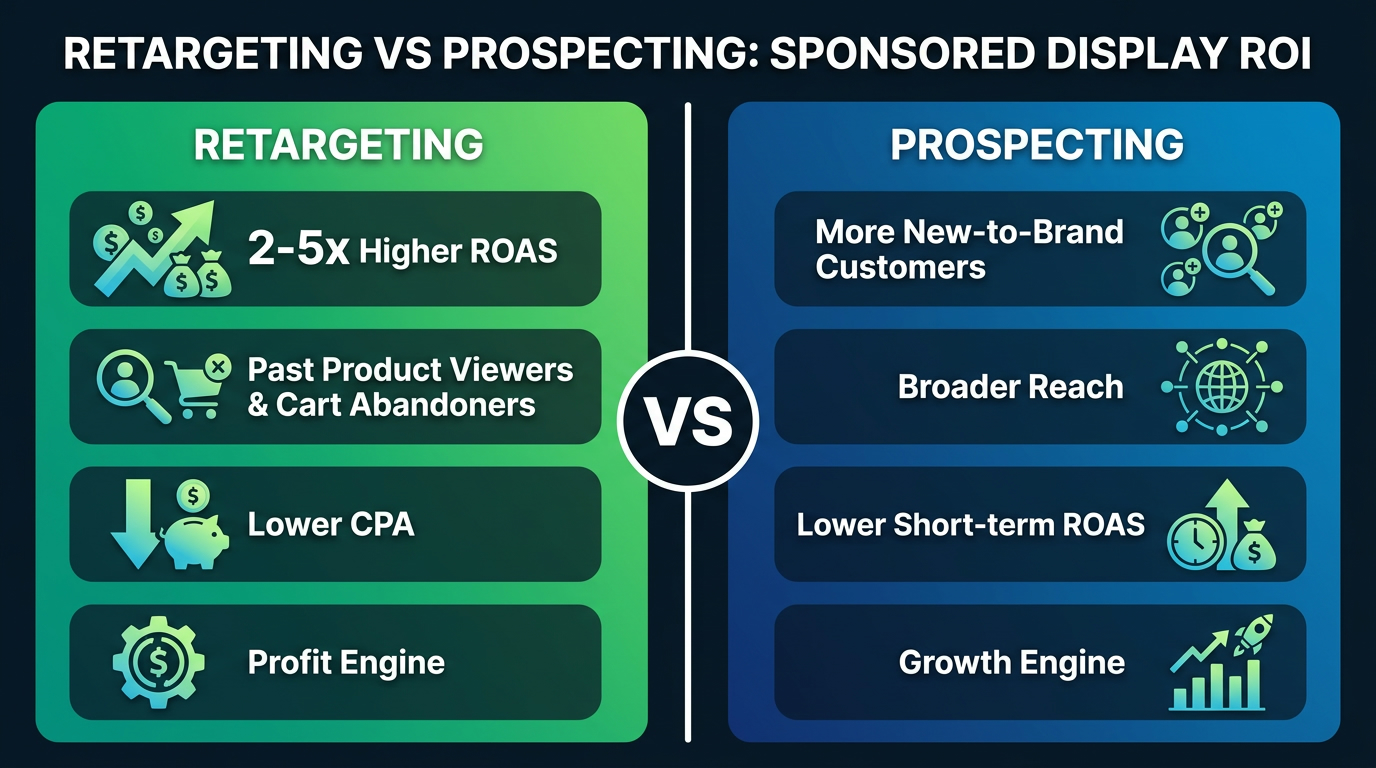
Retargeting (Audience Targeting — Views): Re-engages shoppers who have viewed your product page but didn’t purchase. This is the most efficient Sponsored Display use case. Benchmarks consistently show that retargeting audiences deliver 2–5x higher ROAS than cold prospecting audiences. These campaigns should have relatively aggressive bids, because the audience is warm and the conversion probability is meaningfully higher than cold traffic.
Prospecting (Audience Targeting — In-Market/Lifestyle): Reaches new shoppers who match the behavioral profile of your customer — based on Amazon’s first-party shopping data. These audiences are cold, so ROAS will be lower. But this is how you build reach beyond the shoppers who are already finding you organically or through keyword-based Sponsored Products. The relevant metric here isn’t ROAS; it’s new-to-brand customer rate and detail page views from new audiences.
Keep these as separate campaigns with separate budgets and separate success metrics. Combining them in one campaign budget and judging the blended ROAS makes it impossible to evaluate whether either job is getting done properly.
Sponsored Display: Product Targeting for Competitive Interception
Beyond audience targeting, Sponsored Display also supports product and category targeting — placing your ads on competitor product detail pages. This intercepts shoppers in active consideration on a competitor listing and introduces your product as an alternative. It tends to work best for categories where your product has a clear differentiator (lower price, higher reviews, different size/variant) that a competitor-page shopper might find compelling.
Target competitor ASINs that are similar to yours in category and price range but have lower review scores or higher prices. A shopper looking at a 3.6-star competitor listing is genuinely persuadable.
Amazon DSP: When and Why to Add It
Amazon DSP (Demand-Side Platform) is a programmatic advertising layer that extends Amazon’s first-party audience data beyond the Amazon marketplace — placing display and video ads on Amazon-owned properties (IMDb, Twitch, Fire TV, Freevee) and third-party publisher sites. It provides access to streaming video placements on Prime Video and other premium inventory that isn’t available through self-serve Sponsored Ads.
The honest answer on DSP timing: most sellers aren’t ready for it. Current guidance from practitioners and agencies consistently recommends adding DSP only once monthly ad spend has reached approximately $25,000 or more, Sponsored Ads campaigns are fully optimized and profitable, and you have the measurement infrastructure (specifically Amazon Marketing Cloud) to evaluate incrementality rather than just reported ROAS.
At scale, DSP provides reach that Sponsored Ads simply can’t achieve — particularly for brands that want to intercept shoppers earlier in their journey, on streaming platforms, or off Amazon entirely. But below the scale threshold, the minimum commitments (DSP typically requires $10,000–$15,000/month minimum through managed service) make it difficult to generate enough data to optimize effectively.
For brands not yet at DSP scale, Sponsored Display’s audience targeting provides meaningful upper-funnel reach within the self-serve Sponsored Ads framework — without the minimum commitments.
Amazon Marketing Cloud: The Measurement Layer That Ties It All Together
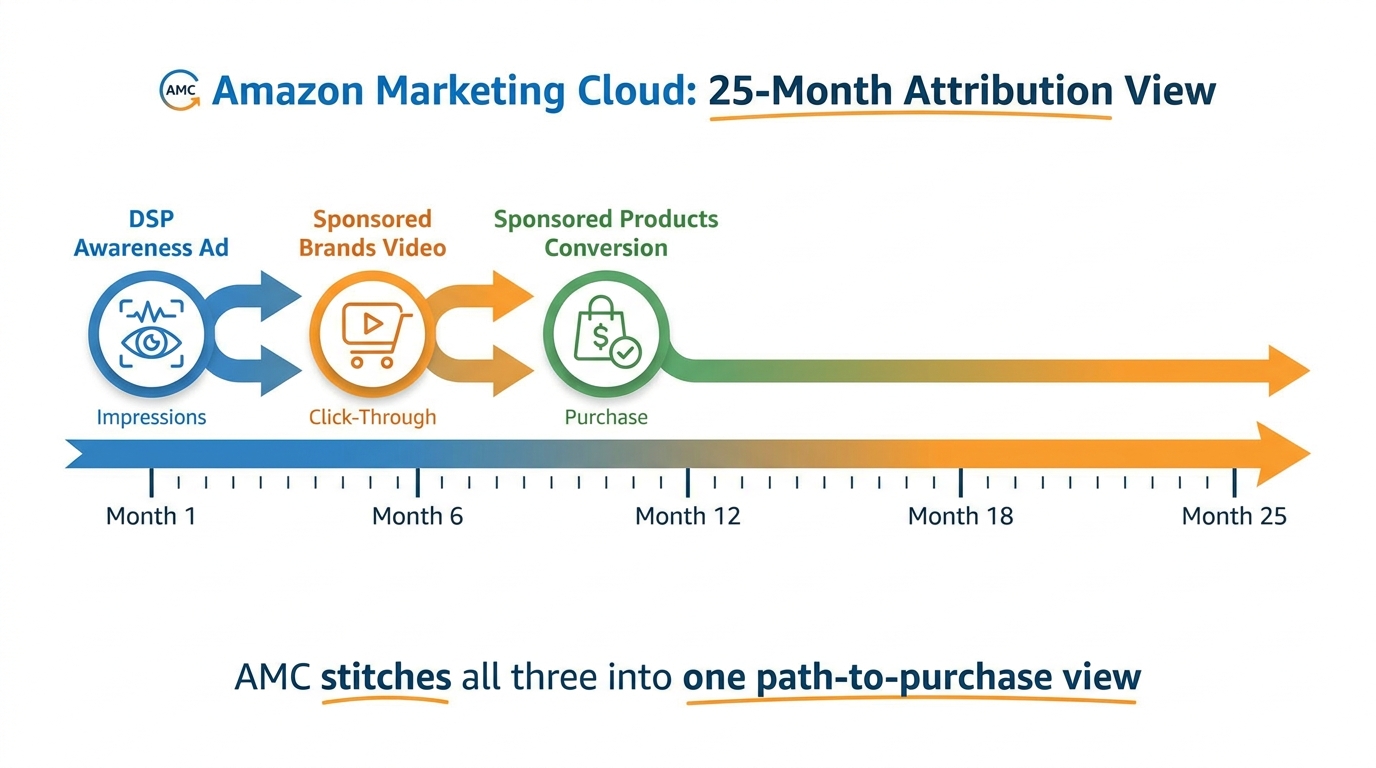
One of the hardest problems in full-funnel advertising — on Amazon or anywhere — is attribution. If a shopper sees a DSP ad in Week 1, clicks a Sponsored Brands Video in Week 3, and converts through a Sponsored Products click in Week 6, which campaign gets credit?
In standard Amazon Ads reporting, the answer is: the last click. The Sponsored Products campaign shows a conversion. The DSP and Sponsored Brands campaigns show no conversions — even though they were essential parts of the path that got the shopper there. A marketer looking at siloed ROAS reports from these three campaigns will conclude that DSP and Sponsored Brands aren’t working, cut their budgets, and watch their Sponsored Products conversion rate gradually decline as the audience pool feeding it shrinks.
Amazon Marketing Cloud (AMC) solves this problem — or at least makes it substantially more visible.
What AMC Actually Is
AMC is Amazon’s clean room analytics environment. It stores 25 months of ad signal history across all your Sponsored Ads formats and DSP campaigns, keyed to anonymized shopper IDs. Within AMC, you can run SQL queries to analyze multi-touch attribution paths — seeing not just the last click, but every ad touchpoint that occurred before a conversion, in sequence.
The practical insight this produces is path-to-purchase analysis: which combinations of ad formats, in which sequence, correlate with the highest conversion rates and the best new-to-brand customer acquisition. Brands using AMC consistently find that cross-format exposures — shoppers who touched three or more ad formats before converting — convert at dramatically higher rates than single-touch exposures. Amazon’s Haleon case study documented a 153% ROI improvement and a 10x lift in page views when running three to four ad formats in a coordinated full-funnel approach versus single-format campaigns.
AMC Audiences: Turning Insights into Targeting
AMC isn’t just a measurement tool — it’s an audience creation platform. You can define audiences based on the behavioral patterns you discover in your path-to-purchase analysis and then activate those audiences in DSP campaigns. For example: build an audience of shoppers who viewed your product at least twice but haven’t purchased, then target them with a time-limited promotion through DSP. Or create an audience of shoppers who purchased once in the last 90 days and target them with a Sponsored Display cross-sell campaign.
This closed loop between measurement and audience activation is what distinguishes sophisticated full-funnel Amazon advertisers from those who are simply running more ad formats.
AMC Access and Practical Onboarding
AMC requires a DSP account to access, which previously meant managed service minimums. Amazon has been expanding self-serve access, and as of 2026, AMC is accessible to more brands through API access and third-party tools that build no-code AMC interfaces. If you’re running DSP at any level, AMC activation should be an immediate priority — the 25-month lookback window means you’re already generating data even if you haven’t run a single AMC query yet.
For brands not yet on DSP, Amazon Attribution tags (available through Seller Central and Brand Registry) provide basic cross-channel measurement for external traffic sources — but they don’t provide the cross-format path analysis that AMC does for internal Amazon campaigns.
Budget Allocation by Funnel Stage: The Numbers That Actually Work
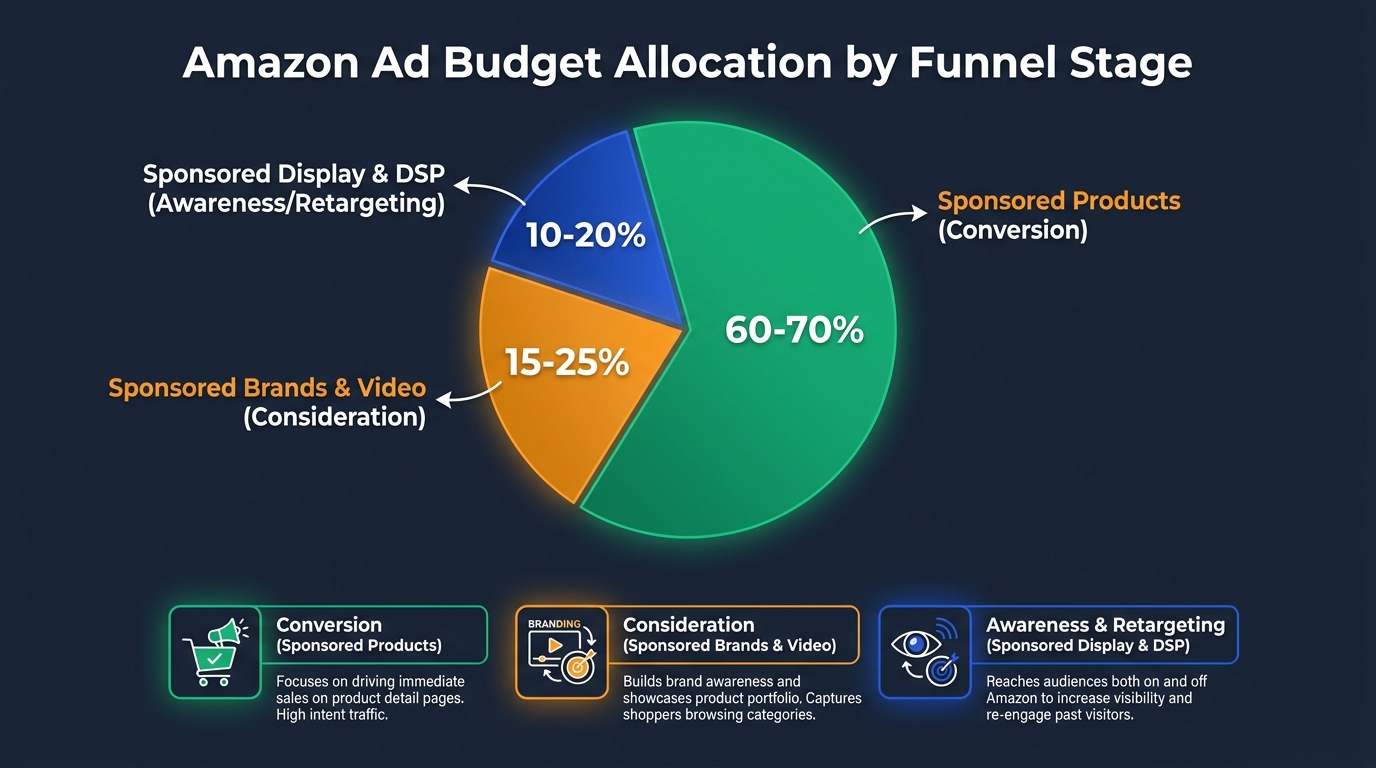
Budget allocation is where full-funnel strategy either holds together or falls apart. The single most common error is applying an equal-opportunity budget split across all formats — or, conversely, spending 90% on Sponsored Products and calling that a “funnel” because there’s a token Sponsored Brands campaign running.
Current practitioner consensus on budget allocation for a mature full-funnel Amazon account is:
- Sponsored Products (Bottom Funnel / Conversion): 60–70% of total ad spend
- Sponsored Brands + Video (Mid Funnel / Consideration): 15–25% of total ad spend
- Sponsored Display + DSP (Upper Funnel + Retargeting): 10–20% of total ad spend
These ranges are starting points, not fixed rules. Category, competitive landscape, brand maturity, and revenue stage all influence the right split. A brand-new product with low organic rank needs more bottom-funnel investment to drive initial conversion velocity. A well-established brand with strong organic ranking can shift relatively more budget upward into awareness and consideration formats.
The Staged Scale-Up Approach
Rather than trying to fund all three funnel stages simultaneously from day one, a staged approach reduces risk and makes budget decisions easier to justify:
Month 1–2: Allocate 85–90% of ad budget to Sponsored Products. Get the bottom funnel profitable and the conversion engine working. Test and establish your breakeven ACoS. No upper-funnel investment yet.
Month 3–4: Add Sponsored Brands (including at least one video campaign) at roughly 10–15% of budget. Begin building Store traffic. Evaluate NTB customer rate from Sponsored Brands traffic. Bottom-funnel Sponsored Products stays at 80–85%.
Month 5–6: Add Sponsored Display retargeting — capturing viewers who didn’t convert — at 5–10% of budget. This is your first genuine “funnel loop.” Bottom funnel now at 75–80%, Sponsored Brands at 12–15%, Display at 8–10%.
Month 7+: If total monthly ad spend is approaching $25,000 and Sponsored Ads are fully optimized, begin evaluating DSP for upper-funnel reach. Gradually shift some Sponsored Display prospecting budget to DSP as it proves efficiency. AMC activation should be happening at this stage if it isn’t already.
Dynamic Reallocation: Weekly, Not Quarterly
One of the highest-leverage but least-practiced habits in Amazon advertising is weekly budget reallocation based on campaign performance. Static budgets set once a month — or once a quarter — let underperforming campaigns keep consuming budget that should be flowing to what’s working.
Establish a weekly cadence: review ACoS, ROAS, NTB rate, and conversion rate by campaign and format. Shift budget toward campaigns trending positively and away from campaigns that are stagnant or over-target on cost. Even 10–15% budget shifts week-over-week compound into meaningful efficiency improvements over a quarter.
New-to-Brand Metrics and Attribution Changes: What Shifted in 2026
One of the most significant and least-discussed changes to Amazon advertising measurement in 2026 is the shift in view-through attribution. Starting January 1, 2026, Amazon moved to a shopping-signal enhanced last-touch model for view-attributed conversions on Sponsored Brands, Sponsored Display, and DSP campaigns running in the Amazon Store.
What this means in practice: the view-through attribution window now requires a more qualifying signal (a shopping behavior, not just an ad impression) before crediting a conversion. Brands that relied heavily on view-through conversions in their DSP and Sponsored Display reporting may see reported ROAS drop — not because the ads stopped working, but because fewer views now qualify for conversion credit under the new, stricter model.
How to Read New-to-Brand (NTB) Metrics Correctly
New-to-brand metrics — available for Sponsored Brands and, through AMC, for DSP campaigns — measure customers who haven’t purchased from your brand on Amazon in the past 12 months. NTB metrics are the most direct measurement of whether your mid and upper-funnel campaigns are actually growing your customer base.
A Sponsored Brands campaign with a modest ROAS but a 70% NTB customer rate is doing something fundamentally different and more valuable than a Sponsored Products branded keyword campaign with high ROAS and 5% NTB rate. These two campaigns should never be judged by the same metric. The Sponsored Brands campaign is acquiring customers. The Sponsored Products campaign is converting shoppers who already know you.
Actionable NTB benchmarks to set for 2026:
- Sponsored Brands (video + static): target 50%+ NTB customer rate
- Sponsored Display prospecting audiences: target 60%+ NTB rate (the whole point is reaching new shoppers)
- Sponsored Products branded keywords: expect and accept low NTB (5–20%) — this is a retention/conversion tool, not an acquisition tool
- Sponsored Products competitor keywords: target 40–60% NTB rate (competitive conquest should be bringing in new customers)
If your NTB rates for mid and upper-funnel campaigns are significantly below these benchmarks, your targeting is likely reaching too many of your own existing customers — and you’re not growing the brand the way you think you are.
The 14-Day Click Attribution Window Still Governs Purchase Attribution
Click-through attribution windows for purchases remain at 14 days across Sponsored Ads formats. This means a shopper who clicks your ad today and purchases within 14 days attributes that purchase to the campaign. For most purchase decisions — especially in sub-$50 product categories — this window is more than sufficient. For higher-consideration purchases (above $100), some conversions will fall outside the window and show as organic even though paid ads were part of the path. This is another use case where AMC’s path-to-purchase analysis captures what standard reporting misses.
Amazon’s AI Campaign Tools: Where Automation Helps and Where It Doesn’t
Amazon has been moving aggressively toward AI-assisted campaign management in 2026. Two developments deserve specific attention: the Ads Agent and the Full-Funnel Campaigns feature.
Ads Agent: What It Can and Can’t Do
The Ads Agent is a natural language interface for campaign management — allowing advertisers to build campaigns, adjust bids, generate creative assets, and pull AMC insights through conversational prompts rather than manual campaign manager navigation. Early adopter reports indicate meaningful time savings on routine campaign setup and reporting tasks.
Where it genuinely helps:
- Campaign creation and keyword seeding for new ASINs
- Generating AMC SQL queries for advertisers without SQL expertise
- Creative asset suggestions based on listing content
- Identifying high-converting search terms for promotion to manual targeting
Where human judgment is still essential:
- Setting ACoS/ROAS targets that reflect actual product margins (the AI optimizes to the target you give it — if the target is wrong, the optimization is wrong)
- Strategic budget decisions across funnel stages
- Evaluating creative quality and brand alignment for video ads
- Interpreting whether a metric decline reflects a strategy problem or an attribution model change
Full-Funnel Campaigns Feature: Useful Starting Point, Not a Strategy
Amazon’s Full-Funnel Campaigns feature in Campaign Manager allows advertisers to set up coordinated awareness, consideration, and conversion campaigns through a guided wizard interface, with the AI handling budget pacing and cross-format targeting. For brands that have never run a multi-format strategy, this provides a useful structural template.
The caution: the wizard-generated structure isn’t optimized for your specific margin profile, competitive position, or brand stage. It’s a generic starting configuration. Use it as a scaffold for learning the format mechanics, then rebuild campaigns manually once you understand how each format is performing. The AI bidding and pacing within Full-Funnel Campaigns performs best after the system has 30+ days of conversion history — treat the first month as a learning phase with conservative budgets.
Fixing the Five Most Common Full-Funnel Structural Mistakes
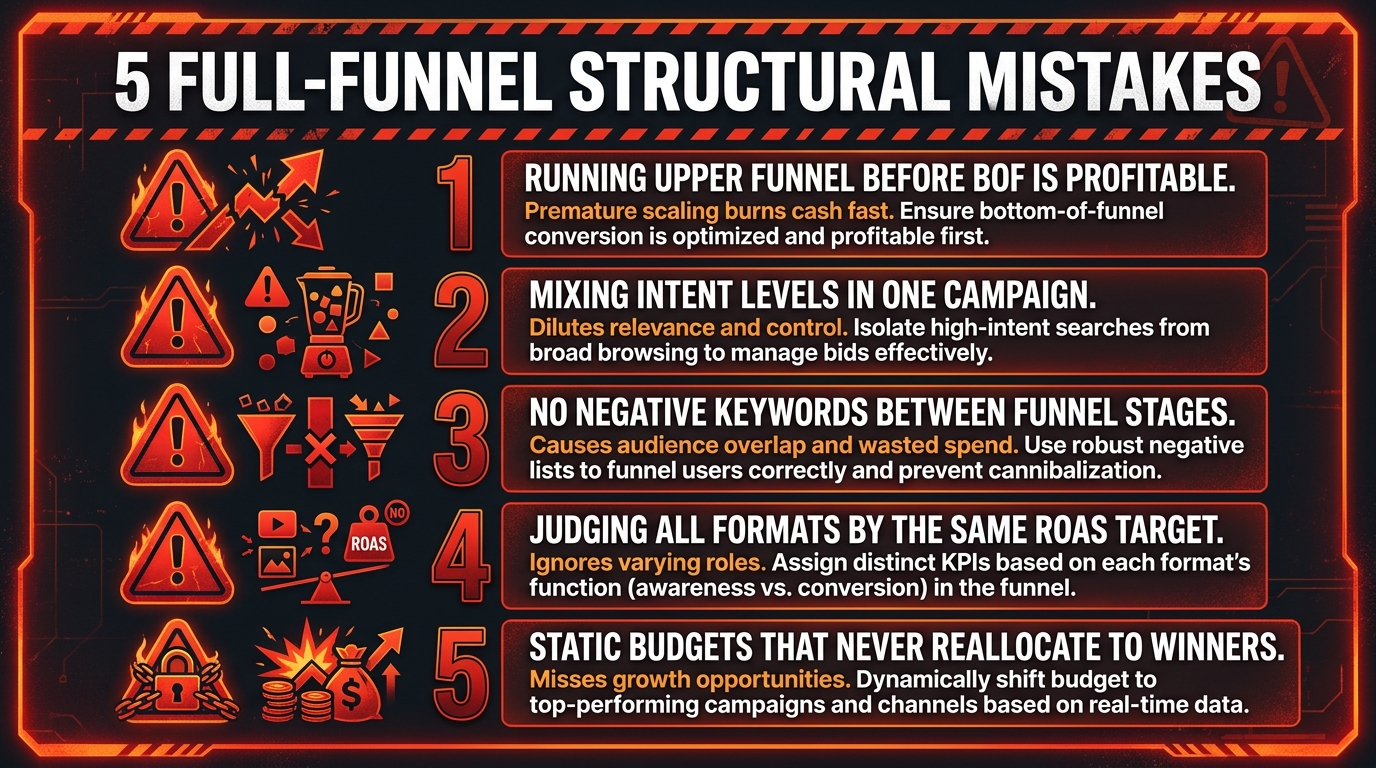
Most accounts that call themselves “full-funnel” have structural problems that prevent the funnel from functioning as designed. These five mistakes appear so consistently across accounts that they deserve their own section.
Mistake 1: Running Upper-Funnel Before Bottom-Funnel Is Profitable
The appeal of upper-funnel advertising — building brand awareness, reaching new shoppers — is real. But the sequencing matters enormously. Investing in awareness campaigns when your bottom-funnel conversion engine isn’t yet profitable creates two simultaneous problems: you’re driving new traffic to a funnel that can’t close it efficiently, and you’re diverting budget from the campaigns that need continued optimization. Get the bottom funnel working first. The patience required for this sequencing is uncomfortable but necessary.
Mistake 2: Mixing Intent Levels in One Campaign
Branded keywords, competitor keywords, and generic category keywords have fundamentally different conversion rates, CPCs, and customer acquisition profiles. Mixing them in a single campaign means the bidding algorithm tries to optimize for an average of very different auction dynamics — and usually wins the wrong impressions at the wrong prices. Separate these into distinct campaigns with separate bids, budgets, and targets. This applies equally to audience targeting in Sponsored Display: retargeting audiences and cold prospecting audiences should never share a campaign.
Mistake 3: Insufficient Negative Keywords Across Campaign Types
Negative keywords aren’t just for filtering irrelevant traffic — they’re the mechanism that prevents cannibalization between your own funnel stages. If you’re running both broad match and exact match campaigns for the same keyword, your broad match campaign will trigger for that exact term and compete against your own exact match campaign in the same auction. Systematically add exact match keywords as negatives in the broad/phrase match campaigns that discovered them. This is one of the highest-ROI weekly maintenance tasks in Amazon advertising, and most accounts do it sporadically at best.
Mistake 4: Applying the Same ROAS Target Across All Funnel Stages
This is perhaps the most consequential structural mistake in full-funnel Amazon advertising. A 4x ROAS target for Sponsored Products branded keywords is reasonable. A 4x ROAS target for Sponsored Display prospecting campaigns — where you’re reaching cold audiences at the top of the funnel — will almost certainly cause those campaigns to underspend, limit reach, and fail to build the audience pool that eventually converts at the bottom of the funnel. Every funnel stage needs its own success metric: ROAS and ACoS for bottom funnel, NTB rate and DPVR (detail page view rate) for mid-funnel, CPM and branded search lift for upper funnel.
Mistake 5: Static Budgets That Never Reallocate
Ad performance on Amazon shifts week by week — seasonality, competitor activity, algorithm changes, and inventory availability all affect which campaigns are currently the highest-value use of budget. An account running the same budget allocation it set up six months ago is almost certainly misallocating money. High-performing campaigns are capped and leaving impressions on the table; underperforming campaigns are consuming budget that should have been redirected. Build a weekly budget review into your advertising operations rhythm and treat reallocation as a core task, not an occasional cleanup exercise.
Building a Funnel That Compounds Over Time
The case for full-funnel advertising on Amazon isn’t just about reaching more shoppers. It’s about building a system where each stage makes every other stage more efficient — and where that efficiency compounds the longer the system runs.
Upper-funnel activity builds brand awareness and increases the probability that a shopper, when they eventually search for your category, will click your listing over a competitor’s. Mid-funnel Sponsored Brands Video exposure increases branded search volume over time — which lowers your competitive keyword costs because more shoppers are already looking for you specifically. Bottom-funnel Sponsored Products converts that intent efficiently. Retargeting campaigns capture the shoppers who got close but didn’t close, pulling them back into the funnel at minimal incremental cost.
The math behind Haleon’s widely-cited case study — a 153% improvement in measured ROI from a full-funnel vs. single-format approach — isn’t a one-time event. It reflects the structural efficiency gain of running interconnected campaigns versus isolated ones.
The Measurement Discipline That Makes It Sustainable
A full-funnel strategy only stays coherent if you measure it correctly. That means:
- Separate dashboards and KPIs for each funnel stage — not a single blended ROAS number
- AMC path-to-purchase analysis run at least quarterly to validate cross-format attribution
- NTB customer rate tracked monthly as a leading indicator of top and mid-funnel health
- Branded search volume tracked over time as the ultimate measure of upper-funnel effectiveness
- Total advertising cost of sale (TACoS — ad spend as a percentage of total revenue, not just ad-attributed revenue) as the account-level efficiency metric
TACoS is particularly important. As a full-funnel strategy matures and upper-funnel investment starts lifting organic rank and branded search volume, a well-functioning account will see its TACoS decline over time even as ROAS stays flat or improves. That declining TACoS — reflecting more organic revenue being generated from the same ad investment — is the compounding effect made visible in the numbers.
Six Actionable Takeaways to Start With
- Audit your retail readiness before touching your ad structure. Run every major ASIN through the six-point checklist. Fix what’s broken before scaling any paid traffic above bottom funnel.
- Separate your bottom-funnel campaigns by intent type. Branded, competitor, and category keyword campaigns should be distinct, with separate budgets and ACoS targets.
- Launch at least one Sponsored Brands Video campaign. If you have a registered brand and aren’t running video ads in search results, you’re leaving mid-funnel discovery entirely to competitors who are.
- Build retargeting before prospecting in Sponsored Display. The views-retargeting audience is warm, converts at 2–5x the rate of cold audiences, and gives you immediate feedback on whether your product can close consideration-stage shoppers.
- Assign stage-specific KPIs to every campaign. Retire the single-ROAS-fits-all approach. Each stage of the funnel has its own goal and its own measure of success.
- Set up AMC as soon as you have DSP access. The 25-month lookback window is already storing data. The moment you activate AMC, you can start analyzing paths to purchase that standard reporting has been hiding from you.
Full-funnel Amazon advertising isn’t a destination — it’s an operating model. The accounts that run it well aren’t doing dramatically different things in any single campaign. They’re doing a lot of smaller things correctly, in the right order, measured against the right goals, and adjusted consistently over time. That combination is rarer than it sounds, which is exactly why it still creates competitive separation for the brands that get it right.