


There is a version of GMV Max that looks incredible on paper. The dashboard shows a 7x return. GMV climbed 40% month-over-month. Orders are flooding in. The campaign feels unstoppable.
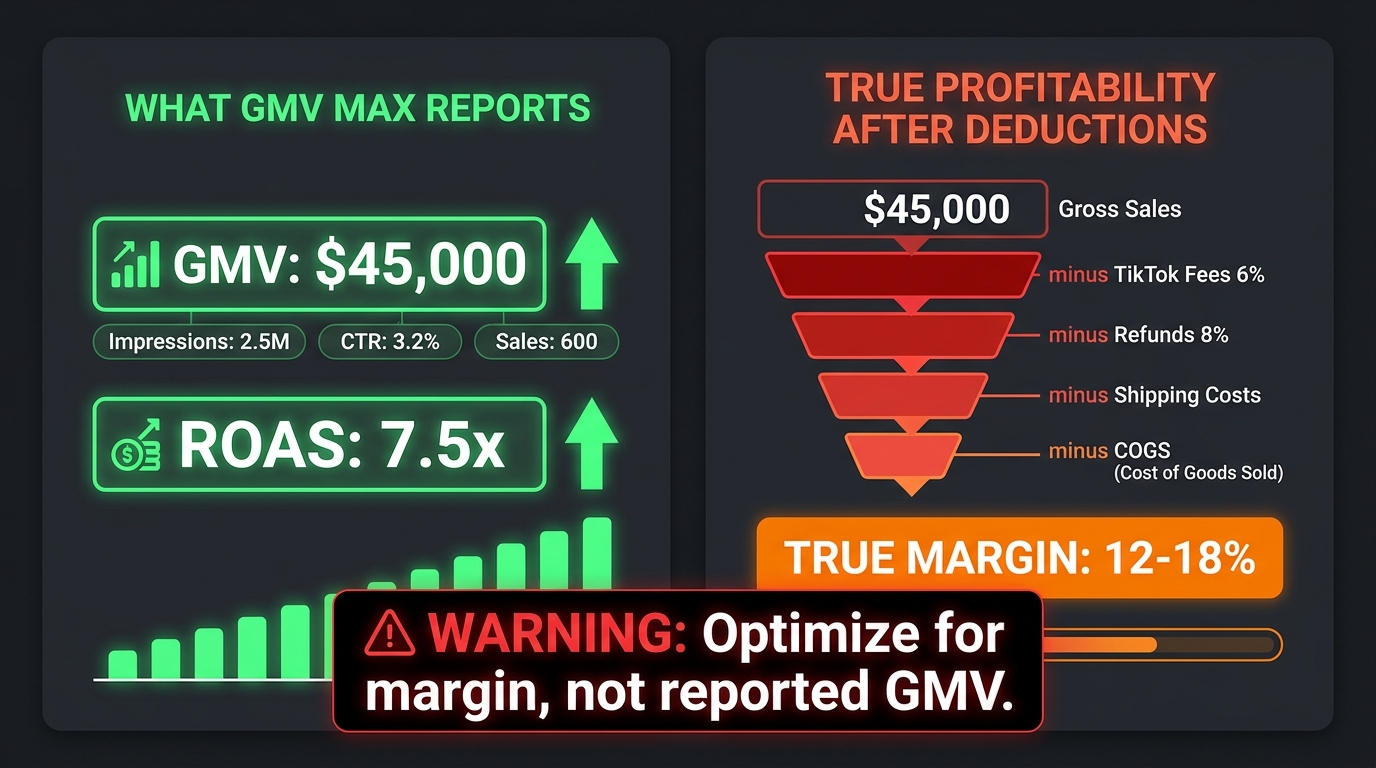
And then you check your actual bank account — after TikTok fees, after refunds, after shipping, after cost of goods — and the numbers tell a completely different story.
This is the GMV Max paradox that most sellers figure out the hard way: the platform’s most automated campaign type demands the most disciplined operator thinking. TikTok’s AI is optimizing hard. But it is optimizing for what it is told to optimize — and if the inputs are wrong, the AI will efficiently drive you in the exact wrong direction at scale.
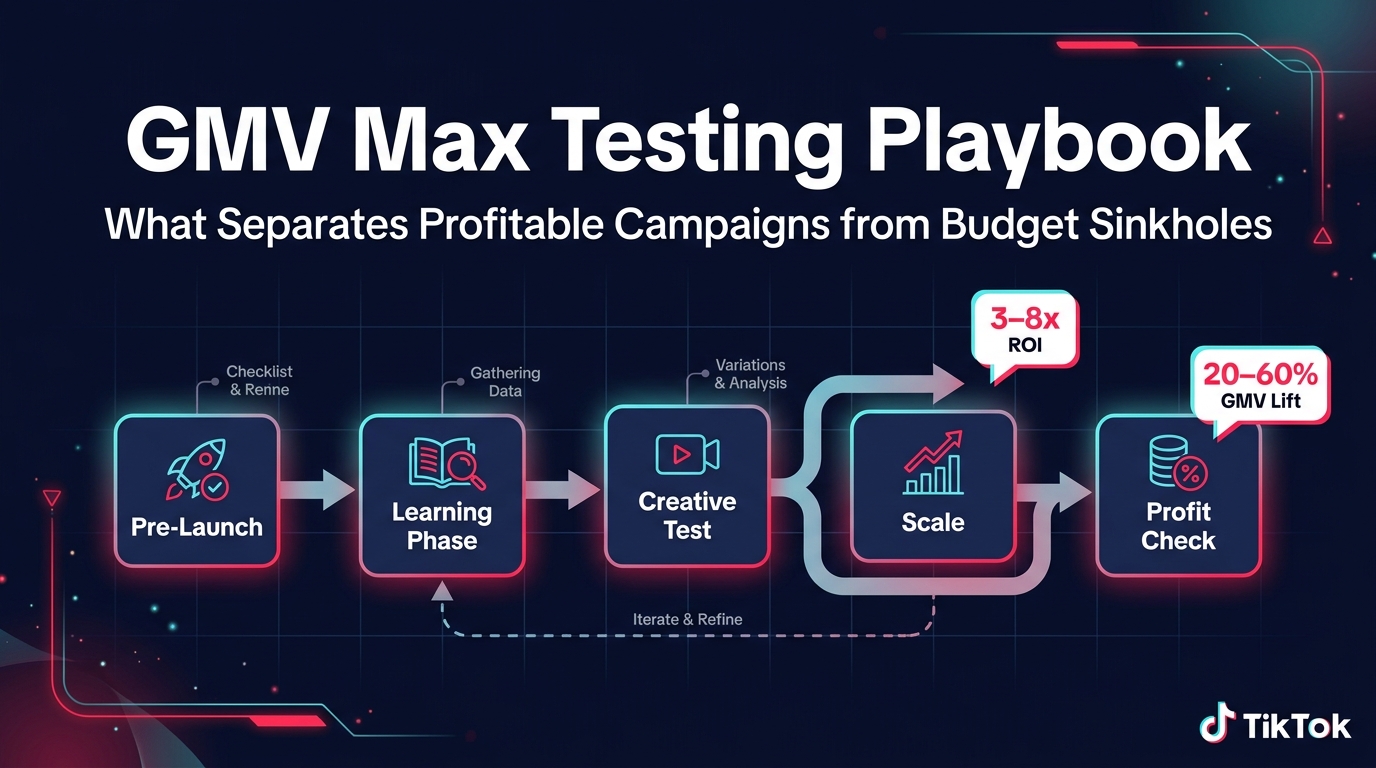
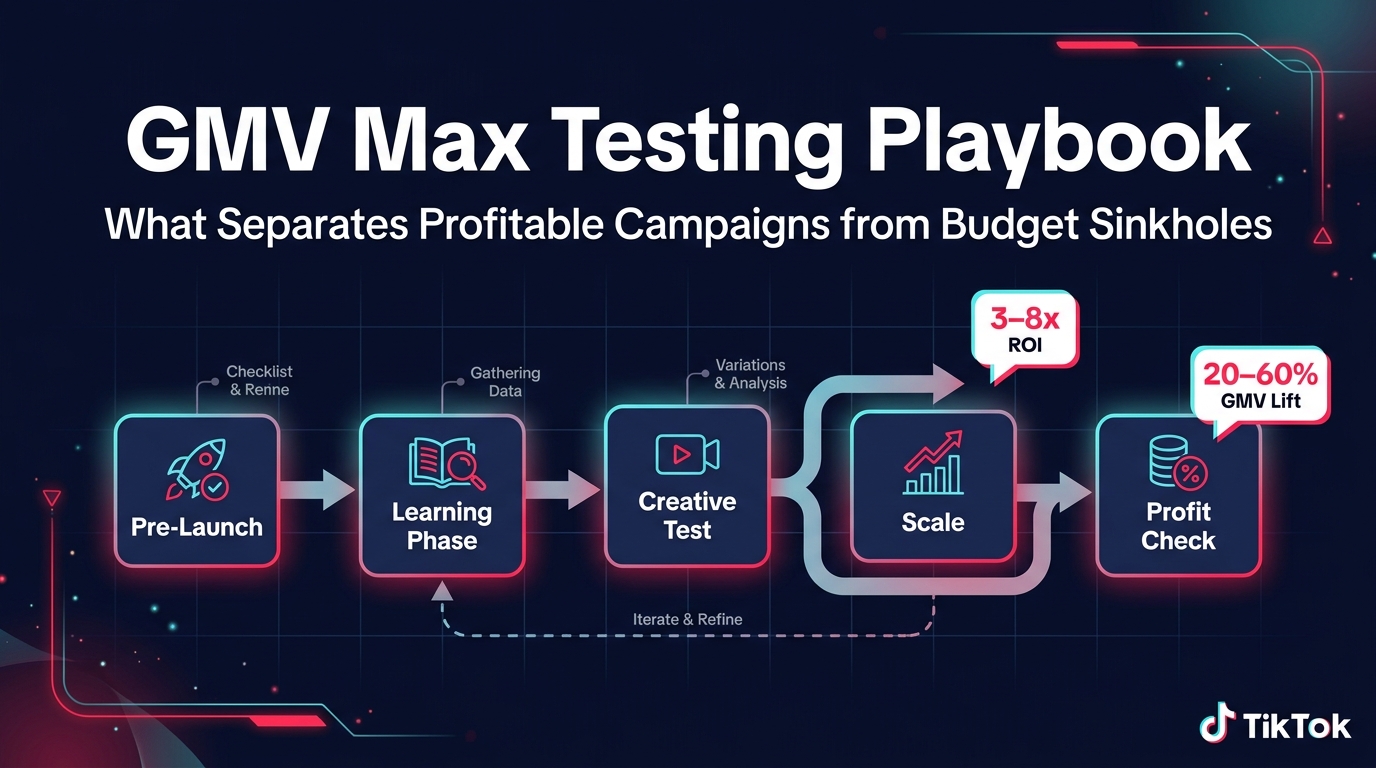
GMV Max became the mandatory format for TikTok Shop sales ads in mid-2025, and by 2026, every Shop seller is running it whether they understand it or not. TikTok reports its own internal testing showed a 20% GMV uplift for early adopters. Agency benchmarks from the past twelve months put the typical range at 3–8x ROI and 20–60% incremental GMV lift for sellers who set campaigns up correctly. But those same sources flag a consistent problem: sellers who copy the surface-level setup — set a budget, pick some products, hit go — are often spending their way into breakeven or worse while the dashboard glows green.
This playbook is for the operators who want to run GMV Max at the second level. Not the tutorial. The actual decision framework: what to do before you launch, how to survive the learning phase without destroying your data, how to read attribution without being misled, and how to build a scaling architecture that holds up past the first 30 days.
How GMV Max Actually Works in 2026
Before you can test GMV Max intelligently, you need a working model of what it actually does — because TikTok’s documentation describes the mechanics, but not the behavior.
The Core Mechanics
GMV Max is TikTok’s AI-driven, automated campaign format exclusively for TikTok Shop sellers. You set two primary inputs: a daily budget and a Target ROI. The algorithm then handles everything else — targeting, bidding, creative selection, and audience matching — with the explicit goal of maximizing your shop’s gross merchandise value while trying to stay at or above your ROI target.
Unlike traditional TikTok ad campaigns where you manually set age ranges, interests, and keyword targeting, GMV Max receives no audience restrictions. The algorithm decides who sees your products based on purchase intent signals, content engagement patterns, and conversion history across TikTok Shop. This is both the product’s greatest strength and the source of its most common operator errors.
The Blended Optimization Model
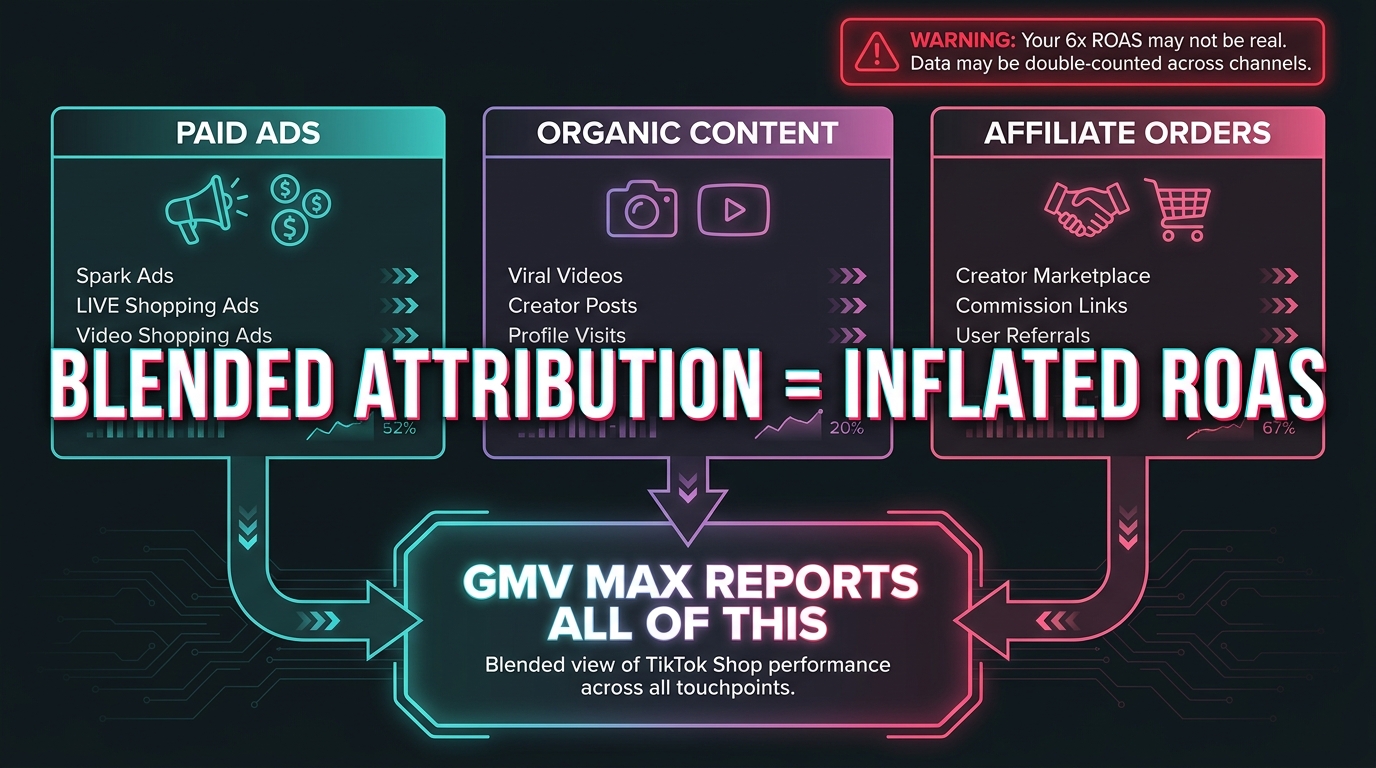
What makes GMV Max fundamentally different from other ad formats — and what most sellers miss — is that it does not optimize for paid conversions alone. It optimizes for total product GMV across all channels: paid ads, organic TikTok content, and affiliate-driven orders all feed into the same optimization engine.
TikTok’s official Seller Center documentation is explicit on this point: all orders resulting from advertised products are attributed to GMV Max, including those from organic content and affiliate orders. The algorithm is learning from and optimizing toward the full commerce signal, not just the paid click path. This creates a more sophisticated optimization loop — but it also creates significant measurement complexity that we will address in depth later.
The Two Campaign Types
In TikTok Seller Center in 2026, GMV Max exists in two primary configurations:
- Product GMV Max: Optimizes at the individual product or SKU level. You select specific products to promote, and the algorithm focuses its spend and creative distribution around driving sales for those items. Best for sellers with a clear hero product or a small catalog of proven performers.
- Shop GMV Max: Optimizes at the entire shop level, allowing the algorithm to distribute spend across your full catalog to maximize total shop revenue. Better suited for established shops with multiple high-performing SKUs and sufficient historical data for the algorithm to work from.
The choice between these two configurations is not arbitrary — it has direct implications for your learning phase, your attribution data, and your ability to diagnose what is actually working. New sellers and those testing GMV Max for the first time should default to Product GMV Max with a controlled product set before attempting shop-level optimization.
The Pre-Launch Readiness Framework
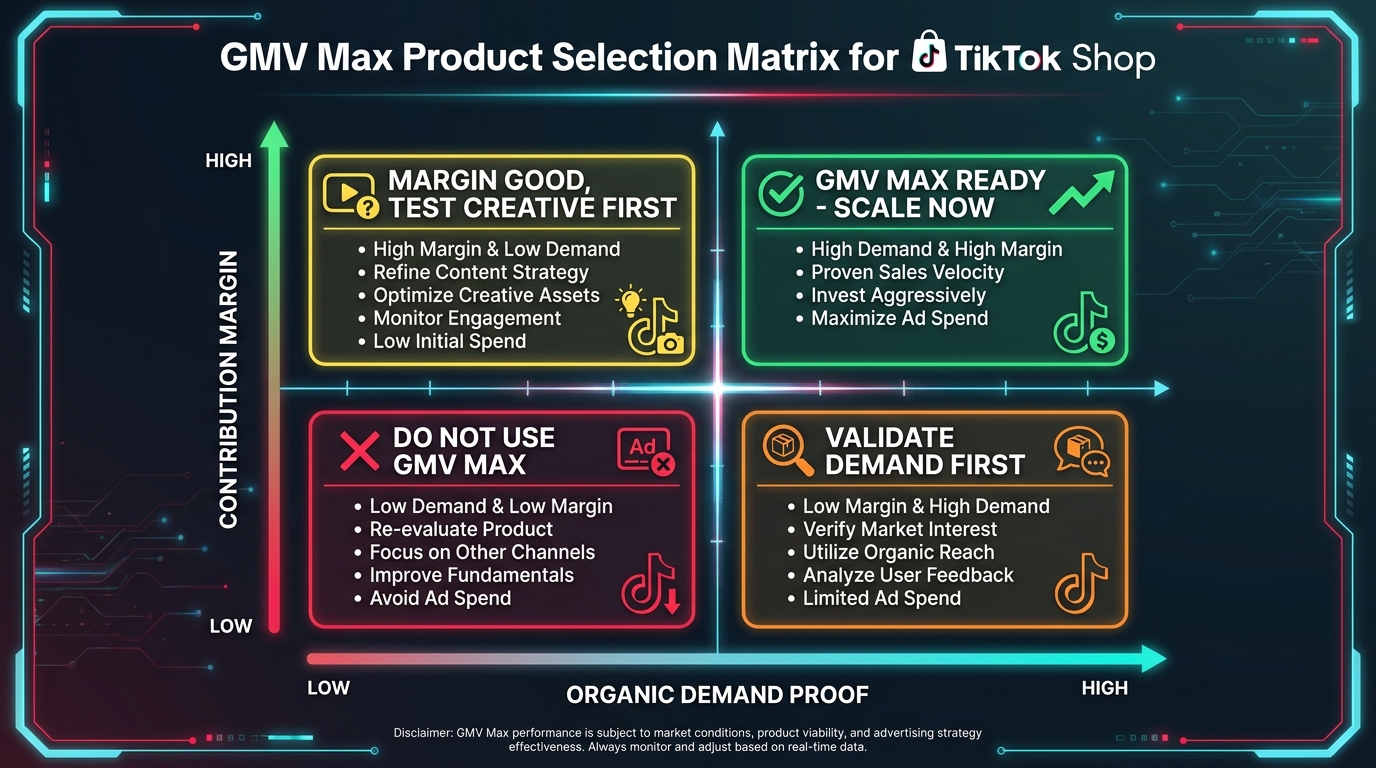
The most expensive GMV Max mistake is also the most common: launching the campaign before the conditions for success exist. Because GMV Max is a scaling tool — not a testing tool — feeding it unproven products, thin content, or weak economics is a reliable way to burn through budget while teaching the algorithm to optimize for transactions that lose you money.
Before you activate GMV Max on any product, work through this readiness checklist.
Product Qualification Criteria
GMV Max performs best on products that already have organic demand signals. The algorithm learns faster and bids more accurately when it can reference existing conversion data. A product that has never sold on TikTok Shop organically gives the AI nothing to calibrate against — you are essentially paying for the data collection phase at full ad spend rates.
The specific thresholds that experienced operators use before activating GMV Max on a product:
- Minimum 20–30 organic or affiliate-driven orders in the past 30 days. This gives the algorithm a baseline conversion rate and buyer profile to optimize toward.
- At least one piece of performing organic content (video with a measurable click-to-shop rate) attached to the product. Content that already converts organically is the strongest signal that paid amplification will work.
- A contribution margin of at least 30–40% after TikTok platform fees (typically 6–8% in 2026 depending on category), shipping, and estimated return rate. Lower margin products can work, but require extremely precise ROI target calibration.
- Stock depth to absorb a 5–10x demand spike over a 14-day window. Running out of inventory during the learning phase is one of the cleanest ways to corrupt your algorithm data and force a restart.
Account-Level Readiness
Beyond individual product criteria, your TikTok Shop account itself needs to be in a stable state before you scale with GMV Max. Account health signals — response rate, dispute rate, on-time shipping percentage — directly influence how aggressively TikTok’s algorithm will distribute your campaigns. A shop with a dispute rate above 2% or shipping compliance below 95% will face algorithmic throttling that no budget increase can overcome.
Critically, when you activate GMV Max on a product, TikTok automatically pauses any other overlapping paid campaigns promoting the same product. This is by design — the platform prevents bid competition against yourself. But it means you need to audit your existing campaign structure before launching, or you will inadvertently kill campaigns that were working.
The Competitive Pricing Check
GMV Max’s algorithm factors price competitiveness into its bidding decisions. Products priced significantly above comparable listings in the same category will receive less favorable placement even with high budgets. Before launch, verify that your pricing is within 10–15% of the top-selling comparables in your category. This is not about being the cheapest — it is about not creating an algorithmic ceiling on your distribution before you even start.
The Learning Phase: The 14 Days That Determine Everything
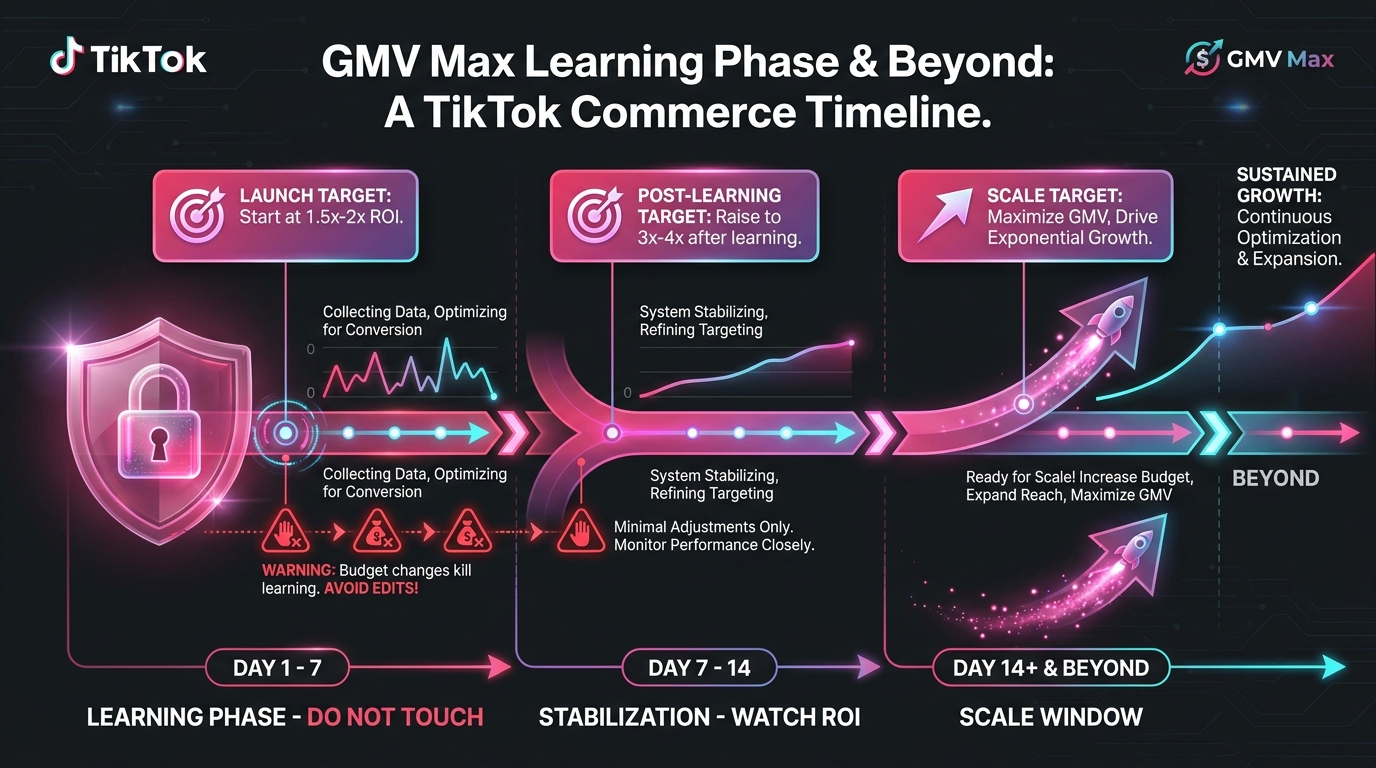
The learning phase is where most GMV Max campaigns are damaged before they ever have a chance to perform. TikTok’s algorithm requires approximately 7–14 days of active data collection before it can bid and allocate accurately. During this window, the system is making imprecise decisions by design — and operator interference during this period is the leading cause of campaigns that never exit learning, perpetually resetting and burning budget without ever reaching optimization.
What Happens During Learning
In the first 7 days, GMV Max is running broad experiments: testing which audiences respond to which creatives, establishing conversion rate baselines, and calibrating its bid model against your Target ROI. Delivery during this phase will often look inefficient — CPMs may be higher than expected, conversion rates inconsistent, and reported ROI volatile.
This is normal. The volatility is data. What you do with it is the difference between operators who scale GMV Max successfully and those who spend 90 days in an endless learning loop.
The Non-Negotiable Rules for the Learning Phase
These are not suggestions. Every one of these errors has been documented as a learning phase killer by practitioners and agency operators working with GMV Max at scale in 2026:
- Do not change your ROI target during Days 1–14. Every change to your Target ROI resets the learning cycle. Even a 0.5x adjustment triggers a full algorithmic recalibration. Set your target and leave it alone for two full weeks minimum.
- Do not pause and re-activate the campaign. Pausing the campaign — even for a few hours — interrupts the data collection cycle and can force a partial learning reset. If you need to reduce spend, lower the daily budget modestly. Do not toggle the campaign off.
- Do not change your product selection mid-learning. Adding or removing products from a GMV Max campaign during the learning phase forces the algorithm to re-learn product-audience fit from scratch.
- Do not significantly increase budget during the first 7 days. Budget spikes during early learning create artificially inflated bidding behavior. The algorithm has not yet established accurate bid ceilings, and large budget availability can trigger over-bidding on low-quality impressions.
- Do set a minimum daily budget that gives the algorithm enough volume. The general operator benchmark is $50–$100 per day minimum for Product GMV Max on a single SKU. Below this threshold, the algorithm collects data too slowly and may take 3–4 weeks to exit learning instead of 14 days.
ROI Targets for Launch: The Right Starting Point
The single most impactful decision you make when launching GMV Max is your opening ROI target. Set it too high and the algorithm cannot spend — it will throttle delivery trying to find transactions that meet your threshold and may never gather enough data to learn. Set it too low and you will generate volume but potentially at unprofitable economics.
The framework practitioners use for opening ROI target setting:
- Calculate your break-even ROI: the ratio of revenue to ad spend at which you neither profit nor lose money after all costs (COGS, fees, shipping, returns).
- Set your opening Target ROI at break-even plus 20–30%. This gives the algorithm room to spend while protecting you from deep losses during the learning data collection period.
- For a product with a 35% contribution margin and an average order value of $45, break-even ad spend is roughly $15.75 per order. A 2.0–2.5x opening ROI target is appropriate.
- After the learning phase exits and delivery stabilizes, you raise the ROI target incrementally toward your true profitability threshold.
Creative Architecture: The Real Lever Operators Are Ignoring
Because GMV Max removes manual targeting, the most powerful variable a seller can actually control is creative. The algorithm distributes spend to the product-creative combinations that are performing — which means a campaign with one video and a campaign with 25 diverse videos are not the same product at all. They are fundamentally different algorithmic inputs with wildly different optimization ceilings.
Why Creative Volume Matters More Than You Think
GMV Max uses all eligible content linked to your promoted products — your own videos, authorized creator content, affiliate videos, and LIVE stream recordings — as the distribution surface for ad spend. The algorithm dynamically allocates impressions to whichever content pieces are converting best at any given moment.
Agency data from operators running GMV Max at scale in 2026 consistently shows that campaigns with 15 or more diverse creative assets outperform single-video campaigns significantly in both ROI and volume. This is not because more creative is inherently better — it is because more creative gives the algorithm more distinct signals to optimize from. Different hooks appeal to different audience segments. Different video formats perform differently at different points in the buying journey. The AI needs diversity of input to find the high-performing combinations.
The practical benchmark: aim for a minimum of 15 active video assets before launch, with a pipeline of 3–5 new creatives added per week during active scaling. Creative fatigue in GMV Max shows up as declining conversion rates and rising CPMs — the algorithm has exhausted its current creative pool and is recycling assets to audiences that have already seen them.
Video Ads vs. LIVE Ads: When to Use Each
GMV Max supports both shoppable video content and LIVE stream ads within the same campaign framework. These two formats serve different functions in the optimization ecosystem, and treating them as interchangeable is a common structural error.
Video ads (both brand-owned and creator-authorized content) are the primary demand-generation surface. They introduce products to cold audiences, drive product page visits, and create the top-of-funnel signal that the algorithm uses to identify high-intent users. Video ads work best for products with clear visual demonstration value — anything where seeing it in use creates desire.
LIVE ads are a high-conversion, high-intent format that tends to perform best for products with complex value propositions, price-sensitive buyers who benefit from real-time Q&A, and categories with strong community engagement dynamics (beauty, health, fashion, home goods). LIVE-based GMV Max campaigns typically show higher average order values but require consistent streaming quality and active host engagement to sustain performance.
The operator-level framework: run video-led GMV Max as your primary campaign to build volume and algorithmic data, then layer in LIVE ad spending once you have an established streaming cadence and can maintain consistent quality. Do not launch LIVE-based campaigns as your first GMV Max activation — the format requires its own learning curve on top of the algorithmic learning phase.
Creative Authorization: The Step Most Sellers Skip
For GMV Max to include creator content or affiliate videos in its distribution, those assets must be formally authorized within TikTok Seller Center. This is a manual step that many sellers overlook — leaving significant creative inventory inaccessible to the algorithm and artificially limiting what the AI can work with.
Authorizing creator content for GMV Max requires either a Spark Ad authorization (where the creator approves the brand to run their video as paid media) or direct brand video authorization. Build this into your standard affiliate onboarding process. Every time a creator posts a product video, get the Spark Ad authorization immediately — the content has a short peak performance window, and delays in authorization mean delays in algorithmic learning.

ROI Target Strategy: The Dial Most Sellers Set Wrong
The Target ROI setting in GMV Max is simultaneously the most important lever you have and the most misunderstood one. It is not simply “the ROAS you want.” It is a behavioral signal that tells the algorithm how aggressively to bid, how broadly to cast its audience net, and ultimately how much volume versus efficiency you are prioritizing.
How Target ROI Shapes Algorithm Behavior
When you raise your Target ROI, you are telling the algorithm: “Only bid for impressions where the predicted return is above this threshold.” The algorithm becomes more selective, bids more conservatively, and generates less volume — but at higher efficiency. When you lower the Target ROI, you open the bidding aperture wider, generating more volume and reach but at lower per-unit efficiency.
This creates a fundamental tension that operators must manage intentionally: volume and efficiency pull in opposite directions. A seller who sets their Target ROI at their maximum profitability ceiling will often see the campaign starve for impressions — the algorithm cannot find enough inventory at that threshold to spend the budget. A seller who sets it at bare minimum break-even will generate orders but at margins that erode profitability with scale.
The Incremental ROI Target Adjustment Framework
Experienced GMV Max operators treat ROI target adjustments as a weekly process, not a reactive one. The framework:
Phase 1 — Launch (Days 1–14): Set Target ROI at break-even plus 20–30%. Do not touch it.
Phase 2 — Stabilization (Days 14–21): Once the campaign has exited learning and delivery is stable, assess actual ROI versus Target ROI. If actual ROI is consistently 20–30% above Target ROI for 5+ consecutive days, the algorithm is performing above expectations and there is room to raise the target.
Phase 3 — Efficiency Ramp (Weeks 3–6): Raise Target ROI in increments of 0.5x per week. Each increase should be evaluated over a 5–7 day window before the next adjustment. Watch for delivery drops — if impressions fall more than 30% within 48 hours of a target increase, you have hit the algorithmic ceiling for your current creative and audience conditions.
Phase 4 — Equilibrium Management (Month 2+): At full optimization, you will identify a Target ROI band where the algorithm delivers strong volume at acceptable efficiency. This band changes seasonally, with competitor activity, and with creative refresh cycles. Weekly reviews are the standard operating cadence at this stage.
The Budget-ROI Relationship
Budget and Target ROI are not independent settings. They interact in ways that create some of the most common GMV Max failure modes. Specifically:
- A high Target ROI with a low budget creates a campaign that is both selective about which impressions to bid on and limited in how many it can pursue. The algorithm often cannot find enough high-quality inventory to spend the budget, leading to chronic under-delivery.
- A low Target ROI with a very high budget creates rapid volume but can push the algorithm into bidding on progressively lower-quality inventory as it tries to exhaust the budget at the permissive threshold. You end up buying marginal traffic at your most expensive CPMs.
- The most stable GMV Max configurations typically operate at 70–85% daily budget utilization with actual ROI running 15–25% above Target ROI. This is the zone where the algorithm has both adequate constraints and adequate runway.
The Attribution Reality Check
This section may be the most important one in this entire playbook — because misreading GMV Max attribution is how sellers convince themselves a campaign is profitable when it is not, and how they make scaling decisions based on fundamentally flawed data.
What GMV Max Reports vs. What Actually Happened
GMV Max’s blended attribution model credits all orders for promoted products to the campaign — regardless of whether those orders originated from a paid ad impression, organic TikTok content, or an affiliate video. This is clearly stated in TikTok’s Seller Center documentation, but its implications are routinely underestimated.
Consider a scenario: your product generates 200 orders in a week. 80 came from organic content and affiliates. 70 came from paid ad clicks through GMV Max. 50 cannot be attributed to a specific touchpoint with confidence. GMV Max’s dashboard attributes all 200 orders to the campaign, reporting a ROAS that reflects the revenue from all 200 orders divided by the ad spend that directly drove 70 of them.
The reported ROAS is mathematically accurate according to GMV Max’s definition of attribution. But it does not represent the efficiency of your paid media. It represents the efficiency of your entire shop ecosystem — of which paid media is only a fraction.
How to Estimate True Paid-Media Efficiency
To get a cleaner read on your actual paid media performance within GMV Max, operators use a holdout methodology:
- Establish your organic baseline before activation. Track your daily orders for the 14–21 days before you launch GMV Max on a product. Record organic and affiliate order volume at the SKU level.
- Run your GMV Max campaign and track total reported orders.
- Subtract your baseline organic/affiliate volume from GMV Max’s reported orders. The delta represents your approximate incremental paid contribution — orders that would not have occurred without the campaign.
- Divide your ad spend by the incremental order count to get a true incremental cost-per-order for paid media.
This is an approximation, not a precise measurement — organic order rates will naturally fluctuate, and GMV Max’s paid amplification does have a genuine organic halo effect (increased product visibility driving more organic discovery). But it gives you a far more honest picture of paid efficiency than the dashboard’s blended number.
The Organic Halo Effect: Real, but Often Overstated
GMV Max does generate genuine organic halo — increased paid visibility raises your product’s algorithmic rank in TikTok Shop’s search and discovery surfaces, which drives incremental organic traffic that would not have arrived without the campaign. This is a real benefit worth counting in your economics.
The problem is that sellers frequently use the existence of the organic halo as a reason to dismiss attribution concerns entirely. “It’s all incremental anyway.” This thinking leads to campaigns that are justified by halo effects that cannot be precisely measured, while actual paid-media efficiency erodes undetected.
The disciplined approach: acknowledge the halo, model it conservatively (industry practitioners typically attribute 10–20% of organic lift to paid GMV Max halo, depending on category), and require your paid-specific economics to stand on their own even after the halo is excluded.
Scaling Without Breaking the Machine
Scaling GMV Max incorrectly is how campaigns that were working in weeks two through four suddenly collapse in week six. The algorithm is sensitive to rapid changes, and budget scaling in particular follows a set of rules that experienced operators have learned by trial and error — often expensive error.
The Incremental Budget Scaling Protocol
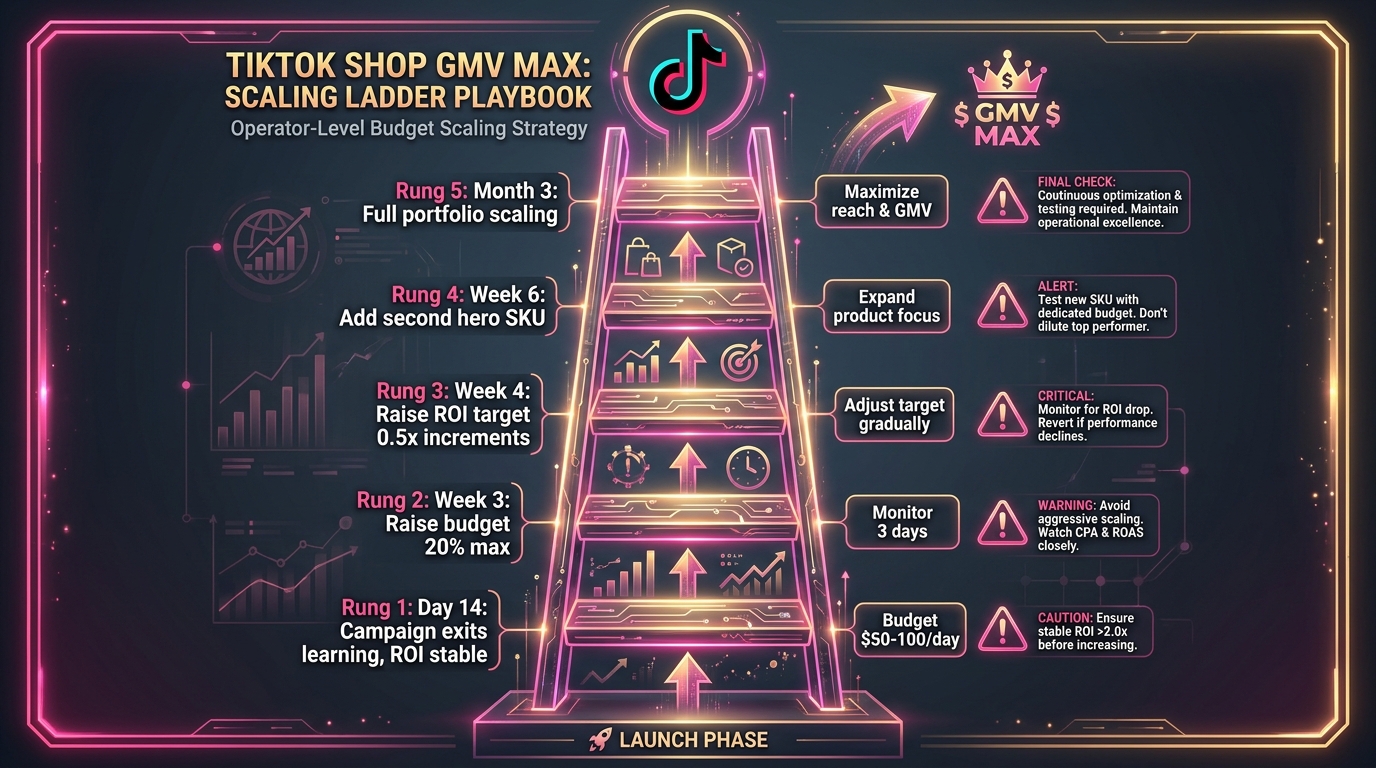
The standard operator guideline for GMV Max budget scaling: never increase daily budget by more than 20–30% in a single adjustment. Larger increases — doubling the budget, tripling it, the kind of aggressive scaling that makes intuitive sense when a campaign is performing — consistently trigger algorithmic recalibration that degrades performance for 3–7 days post-increase.
The mechanism: when you significantly increase budget, the algorithm’s existing bid strategy (calibrated to spend a smaller amount efficiently) must expand its reach to absorb the new capital. This expansion pushes into lower-quality inventory at the margins of the audience it has already identified, temporarily degrading efficiency until it recalibrates.
A practical scaling cadence:
- Week 2–3: Confirm campaign has exited learning, ROI above target for 5+ days. Increase budget 20–25%. Monitor for 3 days before any further changes.
- Week 4: If delivery and ROI remain stable, apply a second 20–25% budget increase. Begin first ROI target adjustment (+0.5x) if actual ROI is consistently above target.
- Week 5–6: Continue incremental budget escalation at 20% intervals, no more than weekly. This is also the right window to consider adding a second proven SKU to Product GMV Max or evaluating whether to expand to Shop GMV Max.
- Month 3+: Full portfolio scaling becomes viable once you have 60+ days of campaign data, stable ROI patterns, and proven creative supply chains.
When to Add Products and When Not To
A GMV Max campaign optimized for Product A does not automatically perform well when you add Product B mid-campaign. Adding new products introduces new creative requirements, new audience-product fit questions, and additional algorithmic complexity that can temporarily disrupt the optimization of your existing product.
The safe approach: treat each meaningful product addition as a partial learning reset. Expect 7–10 days of volatility when you add a significant new SKU to an existing campaign. Schedule additions during lower-stakes periods — avoid adding products the week before a promotional event or during periods when you need stable, predictable performance.
Seasonal and Promotional Event Planning
GMV Max behaves differently during platform-wide promotional events (11.11, Black Friday, TikTok Shop Sale events) and requires specific preparation. During major sale events, competitive CPMs spike significantly — sometimes 2–3x normal rates — because every seller on the platform is pushing budget simultaneously. Your Target ROI and budget settings calibrated for normal traffic conditions will produce different results under sale conditions.
The operator practice for major events: increase budget 5–7 days before the event (not during) to allow the algorithm to pre-warm its bidding model at higher spend levels. Temporarily lower your Target ROI threshold during the event window by 20–30% to maintain delivery at competitive CPMs. Restore normal settings 48–72 hours after the event ends and expect a 5–7 day recalibration period.
The Failure Mode Catalog: Why GMV Max Campaigns Collapse
Every GMV Max failure has a diagnosis. The following patterns represent the most consistently documented campaign failure modes from practitioners operating at scale in 2026. Recognizing these patterns early — before they consume significant budget — is one of the highest-leverage skills an operator can develop.
Failure Mode 1: The Perpetual Learning Loop
Symptoms: Campaign shows “In Learning” status for 3+ weeks. Delivery is low and inconsistent. ROI data is highly volatile with no trend toward stability.
Causes: Too-frequent ROI target changes, campaign pauses, budget fluctuations, or product additions during the learning window. Also caused by budgets set too low to generate sufficient daily conversion volume.
Fix: Pause the campaign entirely, audit the setup, relaunch with a clean configuration. There is no way to “speed up” a learning phase that has been repeatedly reset — you must start over. Treat it as a sunk cost and relaunch with discipline.
Failure Mode 2: The GMV Vanity Trap
Symptoms: Dashboard shows impressive GMV numbers and high reported ROAS. But bank account does not reflect expected profitability. Margins are thin or negative despite “strong” campaign performance.
Causes: Over-reliance on GMV Max’s blended attribution without accounting for true costs. TikTok platform fees (6–8%), return rates (category-dependent but often 8–15% in fashion and beauty), shipping costs, and COGS are not visible in the GMV Max dashboard.
Fix: Build a true profitability model outside the TikTok dashboard. Track per-order economics manually: subtract all fees, returns, shipping, and COGS from revenue, then divide that contribution margin by ad spend to get your actual return on ad spend. This number will often be 30–50% lower than the dashboard figure.
Failure Mode 3: The Creative Desert
Symptoms: Campaign performed well for weeks 2–5, then CPMs started rising and conversion rates dropped. ROI is declining despite no changes to budget or target settings.
Causes: Creative fatigue. The algorithm has saturated the highest-performing audience segments with existing creative, and CPMs are rising as it pushes into audiences that convert less efficiently. A campaign with 3–5 static creatives will hit this ceiling quickly.
Fix: Establish a standing creative refresh cadence. Add 3–5 new videos per week during active scaling phases. Rotate in new hooks, new creators, new formats. Creative supply is not a launch task — it is an ongoing operational requirement for sustained GMV Max performance.
Failure Mode 4: The Hero SKU Dependency
Symptoms: Shop GMV Max performs well initially, then plateaus. Drilling into the data reveals that 80–90% of attributed GMV is concentrated in one or two products, while other SKUs in the campaign are receiving minimal spend.
Causes: The algorithm concentrates spend on the highest-converting products in the campaign, starving lower performers of budget. When those hero products hit inventory or creative constraints, overall campaign performance drops.
Fix: For portfolio management, either use Product GMV Max with independent campaigns per hero SKU (allowing each product’s performance to be tracked and managed independently), or regularly rotate and audit which products are included in Shop GMV Max to ensure you are feeding it consistently strong candidates rather than a mixed catalog that the algorithm effectively ignores.
Failure Mode 5: The Profitable-on-Paper Product
Symptoms: Campaign ROI looks strong, but the product category has high return rates or dispute rates that are not captured in the ad platform data.
Causes: GMV Max optimizes for orders generated, not for net-revenue-after-returns. Categories with high return rates (apparel, electronics, certain health and beauty products) can show strong GMV while net revenue after returns tells a completely different story.
Fix: Track return rate at the SKU level in Seller Center separately from GMV Max reporting. Any product with a return rate above 10–12% should have its GMV Max ROI target calculated based on net revenue after returns, not gross GMV. This typically means setting a higher Target ROI than the gross numbers suggest is necessary.
Measuring True Profitability: The Metrics That Actually Matter
GMV Max gives you a rich set of metrics inside TikTok’s platform. Most of them are useful. Some of them are misleading when read without context. And a few of the most important metrics for your business are not in the platform at all.
The GMV Max Dashboard Metrics Worth Tracking
Within TikTok Seller Center and Ads Manager, the GMV Max campaign view surfaces several metrics. The ones that carry real diagnostic value:
- Orders (SKU-level): More diagnostic than GMV alone. Track orders by SKU to see what the algorithm is actually selling, not just aggregate revenue.
- Cost per Order: The inverse of conversion efficiency. Rising cost per order before budget increases or ROI target changes is a leading indicator of creative fatigue or audience saturation.
- Conversion Rate (from click to purchase): If your conversion rate drops, the problem is usually the product listing, pricing, or reviews — not the campaign itself. GMV Max is getting people to the product page; something at the listing level is losing them.
- Campaign ROI vs. Target ROI gap: The spread between your Target ROI and actual campaign ROI indicates how much optimization room the algorithm has. A consistently large gap (actual well above target) suggests your Target ROI is set too conservatively and you are leaving volume on the table.
The Metrics You Must Track Outside the Platform
These are the numbers that determine whether your GMV Max campaign is actually building a profitable business:
- Net Contribution Margin per Order: Revenue minus COGS, TikTok platform fees, shipping costs, and return costs. This is your real per-order profitability and should be calculated weekly.
- Incremental Orders (baseline-adjusted): As described in the attribution section — the difference between your post-campaign order volume and your pre-campaign organic baseline. This represents your true paid media contribution.
- True paid ROAS (incremental): Ad spend divided by the revenue generated by incremental orders only. This is your honest paid media efficiency number.
- Return rate at SKU level: Track weekly in Seller Center separately from the ad campaign data.
- Inventory run rate: At current GMV Max order velocity, how many days of stock do you have? Stockouts during active campaigns waste algorithmic learning and require restarts.
The Weekly Review Process
Top GMV Max operators run a structured weekly review that takes 30–45 minutes and covers:
- Actual ROI vs. Target ROI gap — any ROI target adjustments needed?
- Daily budget utilization rate — is spend hitting the daily cap consistently, or is delivery throttled?
- Creative performance rankings — which videos are driving the most conversions this week? Which are fatiguing?
- Cost per order trend — rising or falling versus prior week?
- Inventory status — days of stock at current velocity for each GMV Max product?
- Net margin check — is true profitability improving, stable, or degrading?
This review cadence is not glamorous. But it is the operational discipline that separates sellers who run profitable GMV Max programs long-term from those who chase impressive-looking dashboard numbers into unprofitable territory.
The Operator Mindset Shift GMV Max Requires
The deeper challenge with GMV Max is not mechanical — it is conceptual. Most sellers have spent years developing media buying intuition: adjust targeting, test ad sets, manage audiences. GMV Max removes all of that. There are no audience controls. No manual bid strategies. No ad set architecture to optimize.
This creates a real psychological challenge for experienced digital marketers who feel unmoored when their primary optimization levers disappear. The response is often to over-manage the settings that remain — adjusting ROI targets too frequently, making budget changes reactively, adding and removing products in search of something to control. This over-management is the primary driver of learning phase failures and perpetual reset cycles.
What You Control and What the Algorithm Controls
Understanding this boundary is the foundation of effective GMV Max operation. The algorithm controls: audience selection, bid levels, creative distribution weights, real-time budget pacing, and traffic timing. You control: which products are eligible, the ROI threshold below which the algorithm will not bid, the total daily budget ceiling, which creative assets are authorized, and the product economics that determine whether the algorithm’s output is profitable for you.
Reframed this way, GMV Max operator skill is not about managing the algorithm — it is about managing the inputs to the algorithm. Product selection, creative supply, ROI threshold calibration, and unit economics management become the core competencies. The sellers who are succeeding with GMV Max at scale in 2026 are not the ones with the best media buying instincts. They are the ones with the best product operations, the most consistent creative pipelines, and the most disciplined approach to measuring true profitability.
When to Use GMV Max and When to Step Back
There are situations where GMV Max is the wrong tool entirely, regardless of how well you run it:
- New product launches with no TikTok demand history. Use organic seeding and affiliate outreach to build an initial demand signal first. Launch GMV Max once you have 20–30 baseline orders.
- Products with thin margins below 25% after all fees. The ROI targets required to protect profitability at low margins will often throttle delivery so severely that the campaign cannot exit learning.
- Catalog cleanup or slow-mover clearance. GMV Max is not a clearance tool. The algorithm deprioritizes poor-performing products regardless of budget, and pushing slow movers into it corrupts the data quality of better performers in the same campaign.
- Periods of inventory uncertainty. If you cannot confidently predict 30-day stock levels, do not start a GMV Max learning phase. An inventory stockout mid-learning is one of the cleanest ways to reset weeks of algorithmic calibration.
Building a Sustainable GMV Max Program: The 90-Day Arc
Most GMV Max playbooks focus on launch mechanics. The more valuable question is what a sustainable, long-running GMV Max program looks like at the 90-day mark and beyond — because that is where the real economics of TikTok Shop advertising actually play out.
Month 1: Foundation
The entire first month is about data quality, not performance. Your goal is to run a clean learning phase, establish baseline metrics, and validate that your pre-launch readiness assessment was accurate. If you exit month one with stable delivery, actual ROI above Target ROI, and clear product-creative performance data, you have done the hard work correctly. Resist the temptation to scale aggressively at the first sign of positive numbers.
Month 2: Efficiency Optimization
Month two is where you begin incremental ROI target increases, systematic creative refresh, and careful budget scaling. You are building the efficiency architecture of the campaign — the settings, cadences, and review processes that will govern the program long-term. Budget increases should be deliberate and documented, with clear performance criteria that justify each step up.
Month 3: Scaling and Portfolio Expansion
With two months of clean data and an optimized single-product campaign, you can begin meaningful scaling — both in budget and in product scope. This is also the appropriate window to evaluate whether Shop GMV Max makes sense as an addition to your Product GMV Max campaigns. Sellers with 5+ proven products and consistent creative pipelines can see material efficiency gains from the portfolio-level optimization that Shop GMV Max enables.
The 90-day mark is also when you should be seeing the organic compounding effects of sustained GMV Max activity: improved product search rank in TikTok Shop, a larger body of creator content generating ongoing organic traffic, and an affiliate pipeline that has been strengthened by the visibility that paid promotion provided.
The Honest Assessment: What GMV Max Can and Cannot Do
GMV Max is a genuine capability step-change for TikTok Shop sellers. The automation is real, the optimization sophistication is real, and the GMV lift documented in TikTok’s own research (15% average in their UK study of 11 Beauty and Health advertisers above the $30K spend threshold) and in agency case studies (20–60% incremental lift for campaigns with strong foundations) is achievable — but highly conditional.
It is not a passive income machine. It is not a fix for weak products or thin margins. It does not replace the need for strong creative, operational inventory management, or disciplined unit economics thinking. Every one of those inputs still requires active human management — GMV Max just automates what happens after those inputs are in place.
The sellers who will win with GMV Max over the next 12–18 months are not the ones who understand the settings the best. They are the ones who build the strongest creative supply chains, select products with honest margin analysis, and manage the program with the patience to let the algorithm do its job without constant interference. That combination — operational excellence upstream, algorithmic discipline in-platform — is the actual playbook. Everything else is configuration detail.
Key Takeaways
GMV Max demands more operator discipline, not less, precisely because it removes the levers most advertisers are used to pulling. Success lives in the inputs — product selection, creative volume, margin management — not in the settings.
- Launch readiness matters more than launch speed. A product needs 20–30 baseline organic orders, a minimum 30–40% contribution margin, and 15+ authorized creative assets before GMV Max can optimize effectively.
- The learning phase is sacred. Do not touch ROI targets, budgets, or product selections for the first 14 days. Every change resets the clock and wastes accumulated algorithmic data.
- GMV Max’s reported ROAS is not your actual ROAS. Blended attribution includes organic and affiliate orders. Build a separate incremental tracking model using your pre-campaign organic baseline.
- Creative supply is a perpetual operation, not a launch task. Campaigns with 15+ diverse assets significantly outperform those with fewer creatives. Plan for 3–5 new assets per week during active scaling.
- Scale in 20% increments. Budget jumps larger than 20–30% trigger algorithmic recalibration and 3–7 days of degraded performance. Patience on budget scaling compounds into better long-term efficiency.
- Measure true profitability outside the dashboard. Net contribution margin per order — after TikTok fees, returns, shipping, and COGS — is the only number that tells you whether your GMV Max program is building a real business.
- GMV Max is a scaling tool, not a testing tool. Use organic seeding and affiliate content to validate demand before you invest in paid automation. The algorithm amplifies what is already working — it does not find what works for you.