


For years, running Amazon PPC felt like a well-understood craft. You pulled the Search Term Report, found what was converting, pushed those terms into exact-match campaigns, and bid against the competition. Rinse. Repeat. The whole industry built standard operating procedures, agency playbooks, and software tools around that workflow.
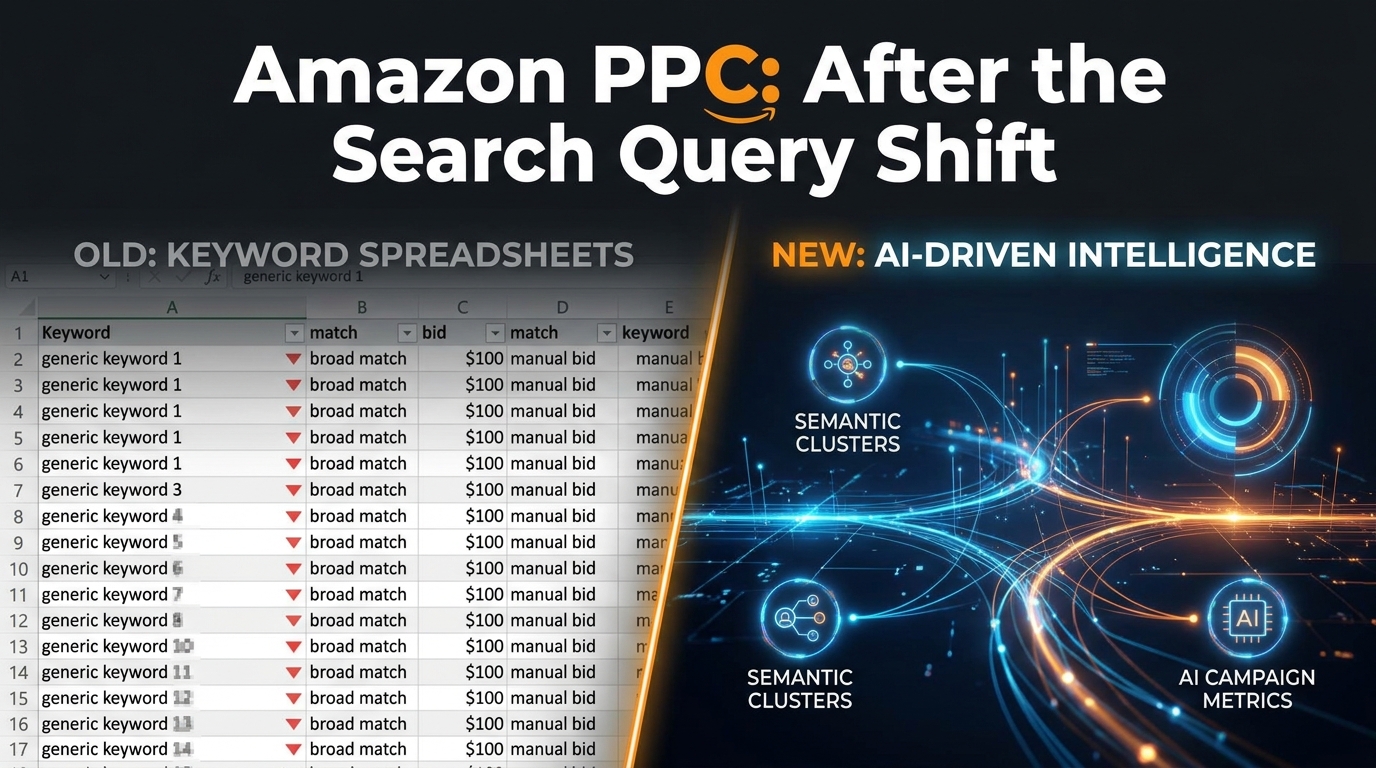
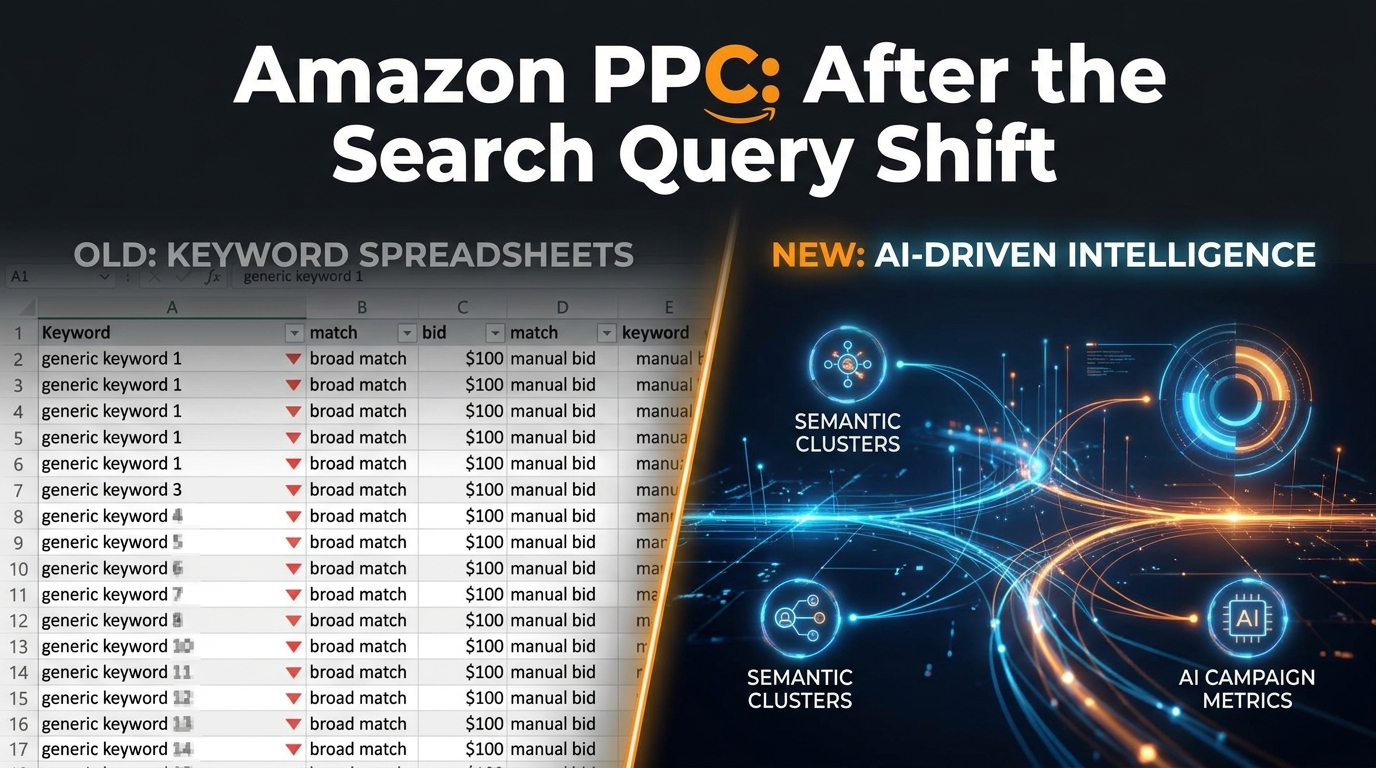
Then Amazon started quietly changing the underlying rules — not with a single announcement, but through a series of incremental shifts that, viewed together, amount to a fundamental restructuring of how keyword data flows, how match types behave, and where real search demand is actually recorded.
The result: a growing number of advertisers are making spend decisions based on data that is structurally incomplete, running campaigns optimized for a matching logic that no longer works the way they think it does, and measuring performance against metrics that are quietly understating or overstating what is really happening.
This post is about what has actually changed, why it matters more than most PPC guides are letting on, and what a structurally sound Amazon advertising approach looks like in 2026 — one built for the environment as it is, not the environment as it was three years ago.
What the Search Query Shift Actually Is (and Isn’t)
Before getting into strategy, it is worth being precise about what has changed, because the discourse tends to oscillate between two equally wrong positions: either “nothing has really changed, keywords still work” or “AI has taken over and keywords are dead.” Both misread the situation.
What Has Not Changed
Amazon has not removed keyword targeting for Sponsored Products, Sponsored Brands, or Sponsored Display. Exact, phrase, and broad match still exist. The Search Term Report (STR) still exists. The Search Query Performance (SQP) report still exists. The basic mechanic — bid on a keyword, win an auction, appear in search results — is intact.
Anyone telling you to abandon keyword-based PPC entirely is selling something. Sponsored Products alone account for roughly 60–70% of total Amazon ad revenue in 2026. That share is not built on audience targeting alone — it runs on keyword bids.
What Has Changed — and Why It Creates Real Problems
What has changed is how the system interprets, matches, and reports on those keywords — and the changes are significant enough to make old optimization workflows actively misleading.
First, Amazon’s matching logic across all three match types has become substantially more semantic. Broad match has always pulled related terms, but now it does so through an AI-driven intent layer that can match your keyword to queries that share no literal overlap with your target term. Phrase match has expanded similarly. Most critically, even exact match now permits close variants, synonyms, and semantically equivalent queries that Amazon’s system deems equivalent to your target — what practitioners are calling “mostly exact” in 2026.
Second, the relationship between what shoppers search and what shows up in your PPC reporting has become structurally fragmented across two separate data environments — the SQP report and the Search Term Report — that measure different things, use different attribution rules, and cannot be directly compared. Advertisers who do not understand this distinction are routinely reading the wrong data and making wrong decisions.
Third, the entry of Rufus (Amazon’s AI shopping assistant, now integrated as Alexa for Shopping) has introduced a new class of conversational search queries that surfaces Sponsored Products in ways that traditional keyword targeting does not cleanly capture, creating a new category of invisible spend.
Together, these three shifts mean the classic keyword playbook — pull STR, harvest converters, push to exact — is still viable as a partial workflow, but it is no longer sufficient as a complete strategy. And for advertisers who have not updated their approach, it is now producing systematically wrong conclusions.
The Two-Report Problem: SQP vs. the Search Term Report
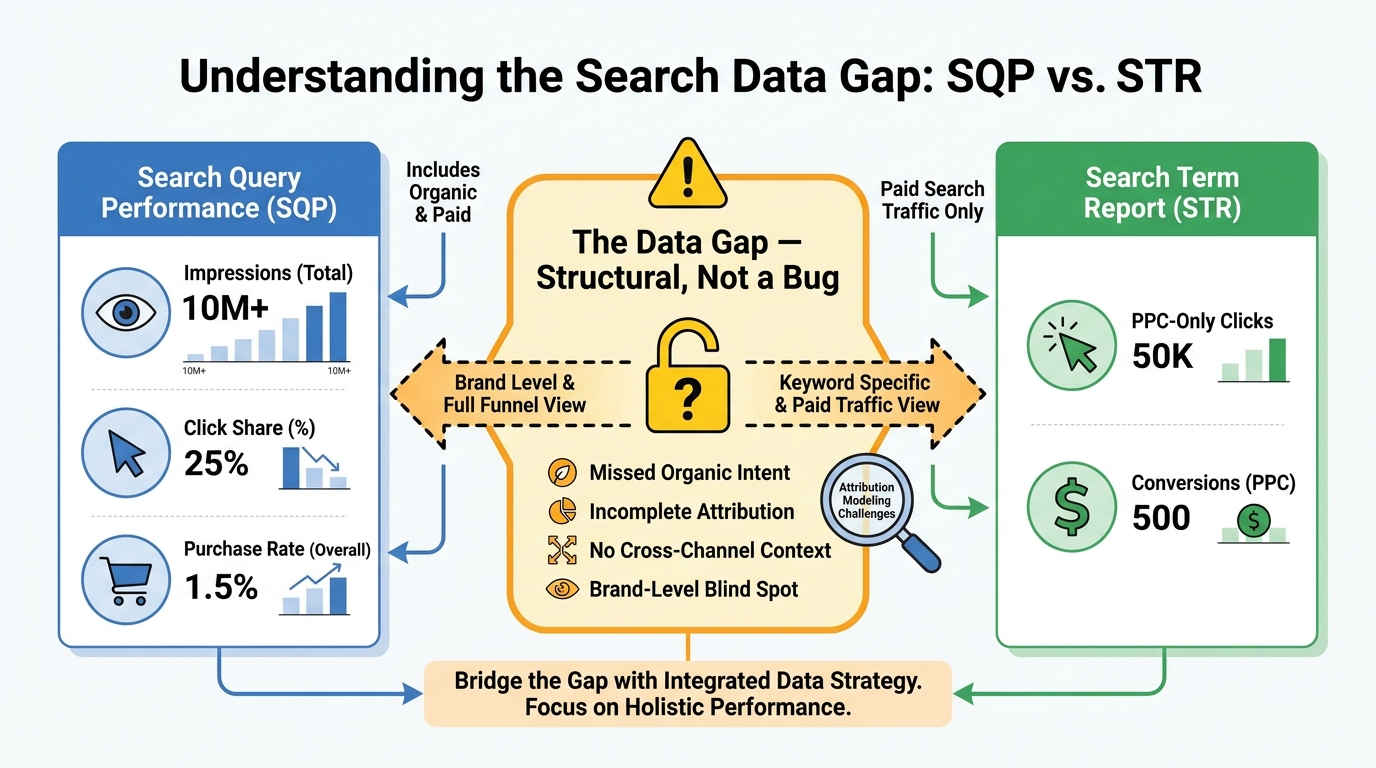
This is arguably the most underappreciated structural issue in Amazon PPC right now. Many advertisers know both reports exist. Far fewer understand that they are measuring fundamentally different things — and that treating them as comparable views of the same data leads to conclusions that are systematically off.
What the Search Term Report Captures
The Search Term Report (STR), found inside Campaign Manager, shows you the queries that triggered your sponsored ads and resulted in a click. It is PPC-specific. If a shopper searched for your target term, saw your ad, and did not click — that query does not appear. If they clicked through organic results — that query does not appear. The STR is a view of paid, click-generating queries only, filtered through a lookback window that Amazon has tightened over time.
This is enormously useful for bid management: it tells you exactly what triggered a click and what converted afterward. But it is a narrow view of actual search demand on the platform. It tells you nothing about how much total search volume exists for a query, nothing about your organic click share, and nothing about what percentage of customers who searched that term ultimately bought your product via any path.
What the Search Query Performance Report Captures
The SQP report, found in Brand Analytics, operates at a completely different level. It shows total search volume for queries within your category, along with your brand’s impression share, click share, and purchase share for each query — across both organic and paid results. It is a brand-level market share report, not a campaign-level performance report.
Crucially, Amazon explicitly states that SQP metrics cannot be directly compared to Campaign Manager metrics because they use different attribution methodologies and measure different scopes of activity. The numbers will not match. They are not supposed to match. They are measuring different things.
The Strategic Implication of the Gap
The gap between these two reports is not a bug — but it creates a bug in your decision-making if you do not account for it.
Consider a common scenario: your STR shows that a particular search term is converting at a strong rate and you are spending significantly against it. Based on that data alone, you might conclude you have that term handled. But when you check the SQP report, you see your click share on that query is only 8% — meaning 92% of shoppers who searched that term clicked on something else. Your STR told you the term is performing well. Your SQP told you you are almost invisible on it. Both are correct, but they are telling you different things about different dimensions of your performance.
The advertisers who are winning in 2026 are using these reports together, with a clear understanding of what each one is measuring. SQP drives their keyword targeting and bidding prioritization — it tells them where demand exists and where their market share is weakest. The STR drives their conversion rate optimization and negative keyword management. The two are complementary inputs into a single strategy, not interchangeable data sources.
The Lookback Window Complication
There is one more wrinkle: the PPC Search Term Report has a rolling lookback window that limits how far back you can access granular search term data. Combine that with the fact that SQP data is aggregated at a weekly or quarterly level, and you have a situation where your two primary keyword data sources are not just measuring different things — they are measuring them over different time horizons. Building a coherent picture requires deliberate data management that most PPC workflows were not designed to do.
How Match Types Quietly Mutated
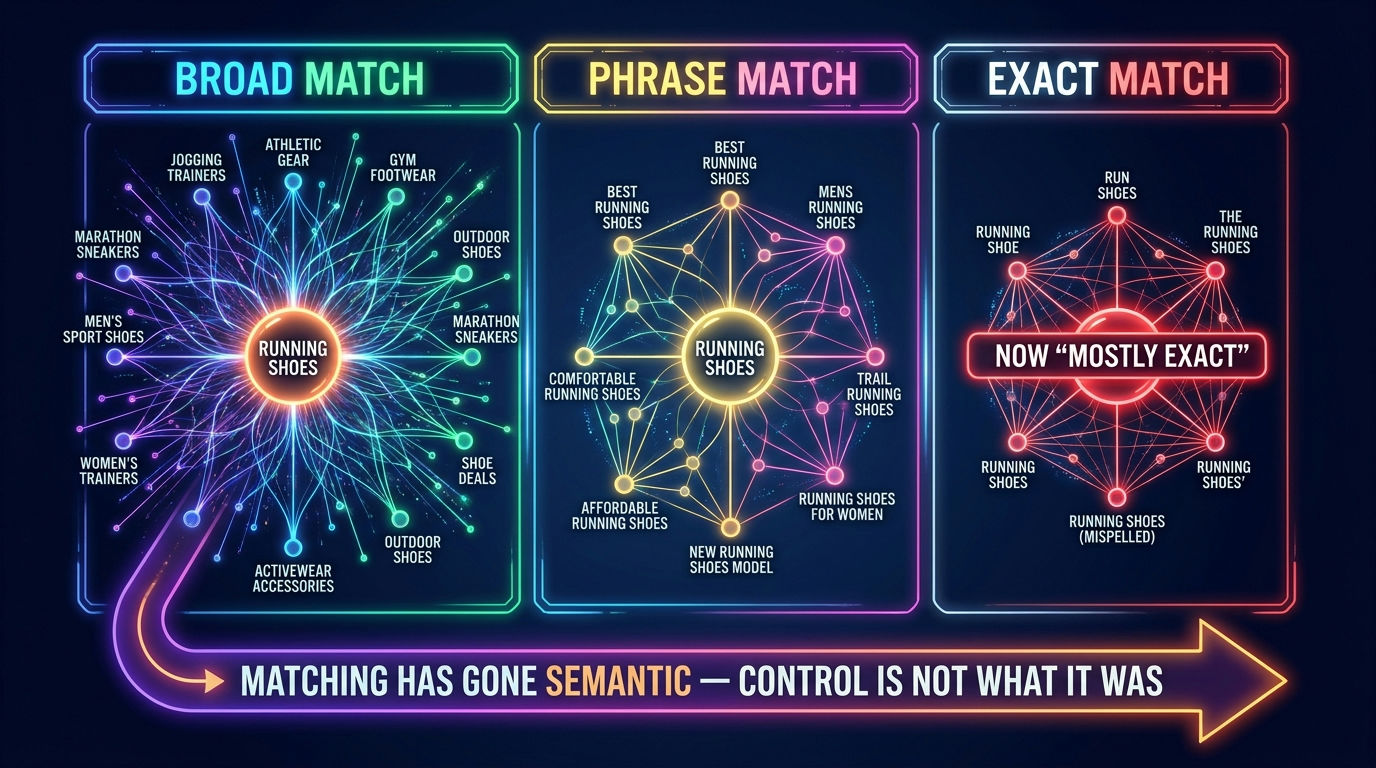
Match types are the mechanism advertisers use to control which search queries trigger their ads. They were designed to give advertisers a predictable tradeoff between reach and precision. That tradeoff still exists, but the calibration has shifted significantly — and if your bidding structure was built around the old calibration, it is now behaving differently than you think.
Broad Match: Now an AI Discovery Engine
Broad match has always been the loosest match type, designed to capture a wide range of related queries. In 2026, “wide” has taken on a new meaning. Amazon’s broad match now operates through a semantic intent layer, meaning it can match your keyword to queries that share an underlying shopper intent without containing your keyword’s literal words. A broad match campaign for “stainless steel water bottle” might now trigger for “insulated tumbler that keeps drinks cold” — because the intent is aligned, even if the vocabulary is different.
This is genuinely powerful for discovery. Broad match campaigns can surface demand that strict keyword research would never uncover, because they find queries based on what shoppers mean rather than what words they use. But it requires a much more rigorous negative keyword management practice, because the same semantic latitude that finds good matches also allows more irrelevant traffic than the old broad match did.
The practical adjustment: treat broad match campaigns as a deliberate, structured discovery tool — not a set-and-forget volume driver. Run them with aggressive negative keyword lists, review the Search Term Report weekly, and have a defined promotion criteria for when a term from broad match earns its way into a tighter campaign.
Phrase Match: The Middle Ground Is Moving
Phrase match is supposed to match queries that contain your keyword phrase, in order, potentially with additional words before or after. In practice, phrase match in 2026 has become more semantically flexible, allowing for synonym substitutions and close-variant interpretations that were not part of the original definition. The “phrase” behavior is now closer to what was once considered “modified broad.”
This creates both an opportunity and a structural overlap problem. If your exact and phrase campaigns are targeting the same keywords, you may find them competing for the same auction — which drives up your own costs and muddies your attribution data. Deliberately segmented structures with match-type-level negative keywords are no longer optional housekeeping; they are a core component of campaign architecture.
Exact Match: “Mostly Exact” Is a Real Thing
Exact match was the gold standard for control: bid on a term, show up for that term and that term only. That was always a slight simplification (plurals and misspellings were covered), but the intent was precision. In 2026, exact match officially includes “close variants” — words with the same meaning or intent, as determined by Amazon’s algorithm. Amazon’s own documentation, updated in March 2026, confirms this, though the specific definition of what constitutes a “close variant” is not published in granular detail.
The operational consequence is that exact match is now better understood as a high-precision match type rather than a perfect-precision one. It is still your most controllable option, and it should still be the home for your highest-performing, highest-confidence terms. But auditing exact match campaigns against the STR to verify which queries are actually triggering them is now a necessary practice, not just a best practice — because you will find queries you did not intend to bid on.
The Discover-Harvest-Graduate Funnel Is Under Pressure
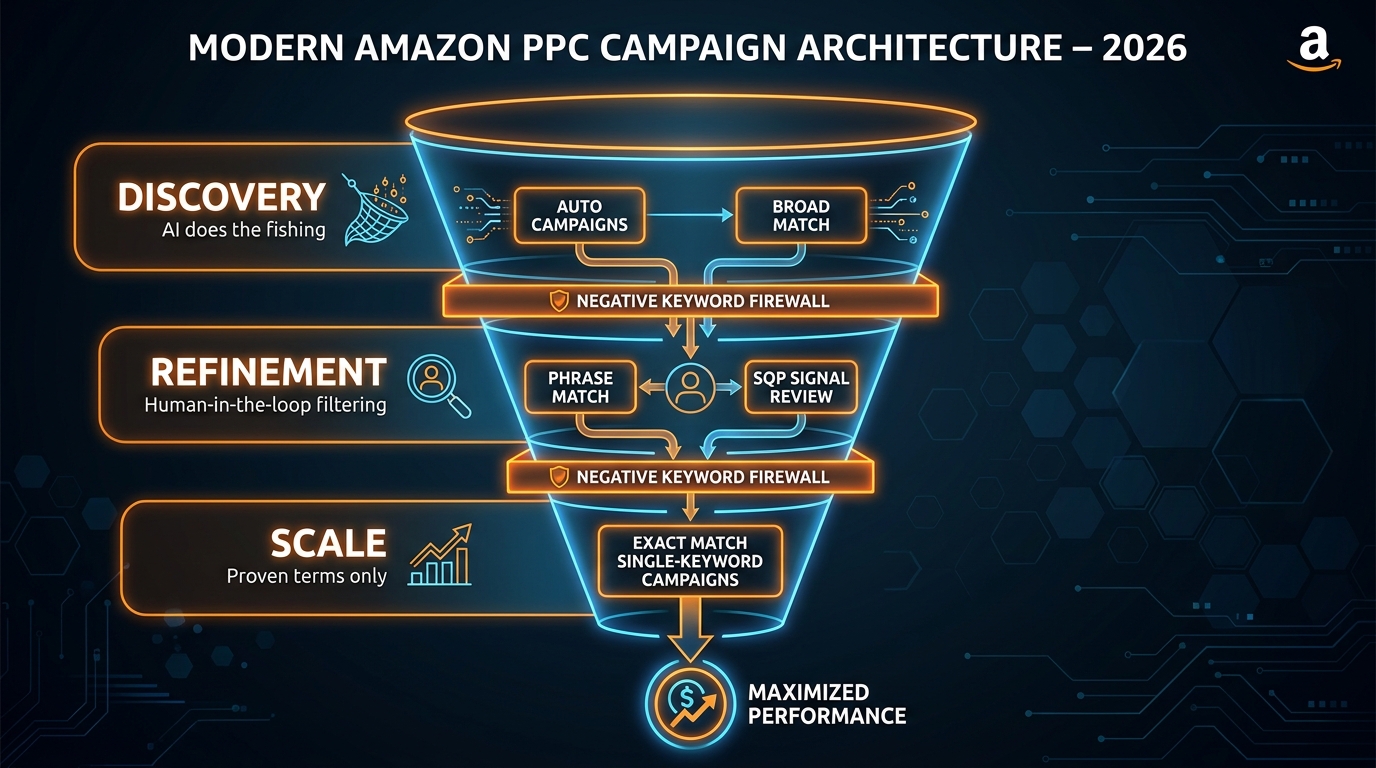
The discover-harvest-graduate workflow has been the backbone of disciplined Amazon PPC management for years. Run an auto campaign or broad match to discover converting search terms. Pull the STR. Promote high-performers into manual exact-match campaigns. Negative out the promoted terms in the source campaign. Repeat.
This is still a valid workflow. But several things have changed that make the simple version of it less reliable — and the failure mode is not that it stops working, but that it stops capturing the full picture of what is happening.
Why Classic Harvesting Misses More Than It Used To
The STR only shows you queries that generated ad clicks. As broad match and auto campaigns become increasingly semantic — serving ads for queries that are intent-matched rather than keyword-matched — the gap between what queries exist in the market and what queries appear in your STR grows wider. Terms that shoppers are using to find your category, but that your ads are not efficiently winning clicks on, are invisible to the harvest-based workflow entirely.
The SQP report partially fills this gap by showing you total query volume and your click share — but its weekly aggregation and brand-level scope mean it is not a direct replacement for granular STR-based harvesting. You need both, used for different purposes.
Shorter Attribution Windows Create Premature Negating
Amazon has tightened attribution windows on PPC reporting over time. The practical result is that a search term might appear to be converting poorly when viewed within a short window, leading advertisers to negate it — when in reality, the conversion path for that term is longer than the attribution window captures. This is particularly common for higher-consideration products where shoppers research over multiple sessions before purchasing.
Rebuilding harvesting around this reality means: evaluating terms over longer time horizons before negating, cross-referencing apparent non-converters in the STR with SQP data (where conversion patterns are visible at a broader level), and using Amazon Marketing Cloud where available to trace multi-session purchase paths that fall outside standard attribution windows.
Intent-Based Graduation Criteria
The traditional graduation criteria for promoting a search term from broad/auto to exact was typically some combination of impressions, clicks, and a conversion threshold — often framed as “10 clicks with no sale, negate; 2+ conversions, promote.” In 2026, experts are layering in additional filters before graduation: Does the term appear in SQP with meaningful total volume? Is the intent clearly aligned with your product, or is the conversion in the STR anecdotal? Does promoting this term to exact serve a strategic priority (like owning a high-search-volume query) or just a tactical one (it converted twice)?
Applying these filters requires pairing the STR and SQP data together as a unified research input — a workflow shift that changes who manages harvesting and how long that process takes.
Rufus and Alexa for Shopping: The Invisible PPC Participant
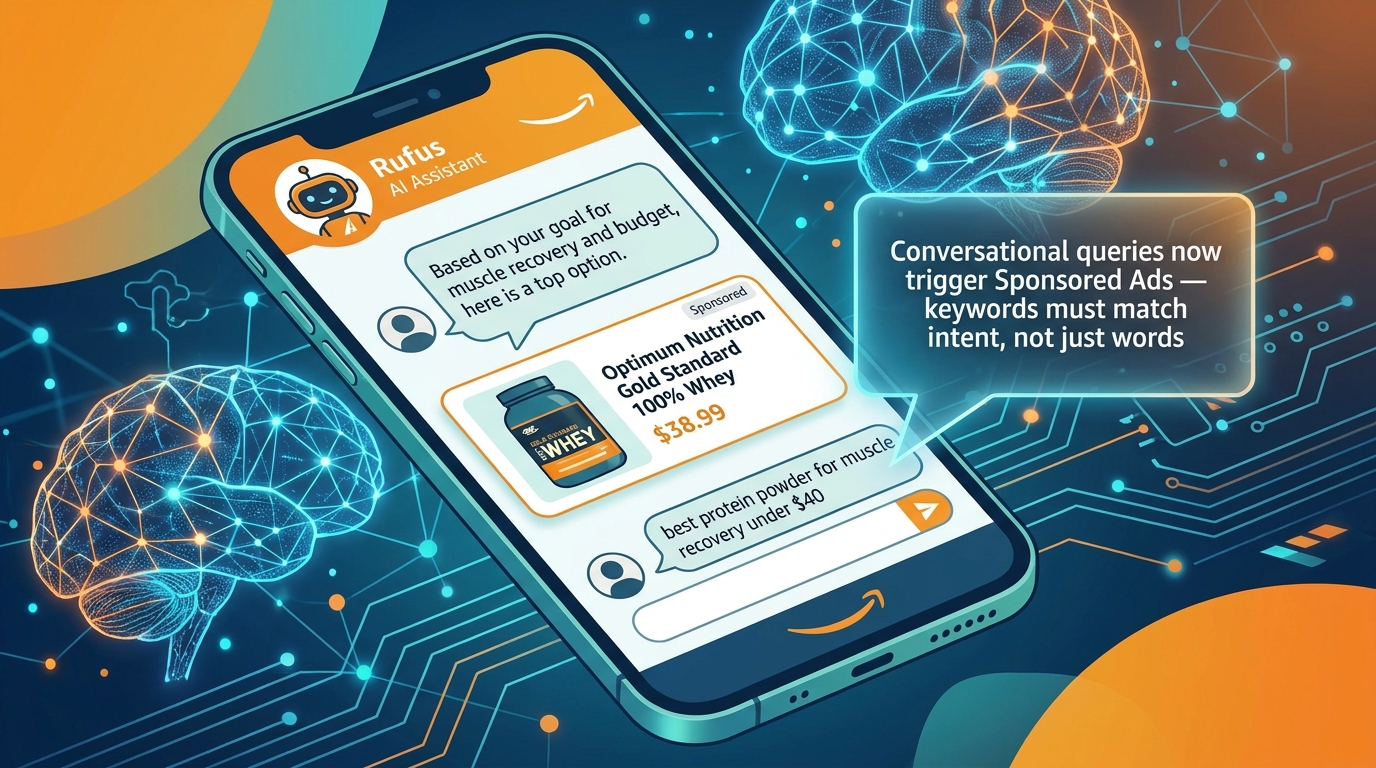
Amazon’s Rufus — its AI-powered shopping assistant, now functionally integrated across the platform as part of Alexa for Shopping — is not a separate ad platform. It does not have its own bidding interface. But it is materially affecting how sponsored ads are triggered and how query data should be interpreted, and most advertisers are not accounting for it.
How Rufus Changes Query Patterns
Traditional Amazon search is transactional and keyword-driven: a shopper types “running shoes men size 10 wide” and the results page responds with listings and sponsored ads matched to that query. Rufus introduces a conversational layer: shoppers can now ask questions like “what should I look for in running shoes if I have plantar fasciitis?” and receive an AI-generated response that includes product recommendations — some of which are sponsored.
The queries generated through Rufus interactions are longer, more intent-rich, and often bear little syntactic resemblance to the short, transactional keywords that most PPC campaigns are built around. A traditional keyword-based campaign for “plantar fasciitis insoles” may not efficiently capture the Rufus-triggered traffic for “shoes that help with arch support and heel pain for people who stand all day” — even though those queries are directly relevant to the same product category.
Sponsored Prompts and Rufus Metrics Emerging in Campaign Manager
Amazon has been rolling out new “Rufus prompt” metrics within Campaign Manager for some advertisers. These metrics expose impressions and engagement from conversational AI-driven placements separately from traditional search result placements. The early signal from practitioners in 2026 is that Rufus-engaged shoppers show higher conversion rates, likely because the conversational interface creates a more specific, higher-intent demand signal before the shopper reaches a product page.
The implication for PPC strategy is that keyword lists built purely on traditional search terms are increasingly incomplete. Effective keyword research in 2026 now needs to account for the conversational query patterns that Rufus generates — longer, intent-forward phrases built around problems, contexts, and use cases rather than product descriptors alone.
What This Means for Keyword Architecture
Adapting to Rufus means expanding keyword lists with what practitioners call “intent phrases” — longer queries built around the shopper’s situation rather than the product’s attributes. “Best water bottle for hiking in hot weather” instead of just “insulated water bottle.” “Supplements for post-workout muscle recovery under 30 dollars” instead of “protein powder.”
These phrases are less competitive, often lower CPC, and — critically — they convert well when they are served to shoppers who arrived via Rufus because those shoppers have already received a recommendation from the AI. They are primed to convert rather than browse.
Incorporating intent phrase keywords into broad and phrase match campaigns, then monitoring the SQP report for patterns in how conversational queries are distributed across your category, gives you an early advantage in Rufus-driven traffic before the competition figures out the same thing.
Amazon Marketing Cloud: From Advanced Analytics to Structural Necessity
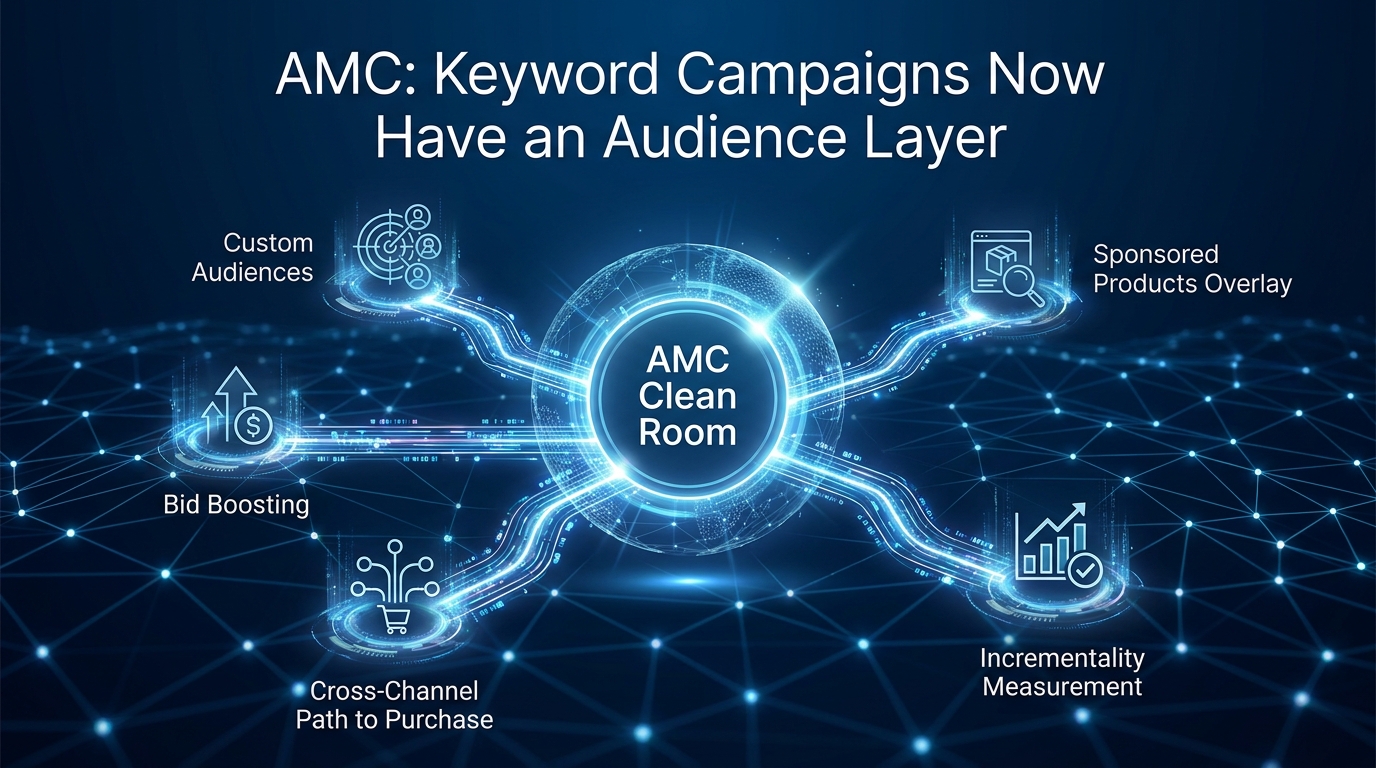
Until late 2024, Amazon Marketing Cloud was largely an enterprise-level tool — accessible primarily to brands running Amazon DSP alongside their sponsored ads, and requiring SQL-level data skills to extract value from. That changed when Amazon opened AMC access to all sponsored ads advertisers, making it a standard capability rather than a premium add-on.
That access expansion is a meaningful shift for how keyword and audience data interact. Understanding it is no longer optional for serious Amazon advertisers.
What AMC Actually Gives You That Standard Reports Cannot
AMC is a cloud-based clean room environment where Amazon’s first-party shopping data is made available for advertiser queries. The key capability that standard Campaign Manager reports cannot replicate is multi-touch path to purchase analysis. Standard Amazon attribution credits a conversion to the last ad click before purchase. AMC lets you query the full interaction sequence — which ads a customer saw, in which order, across how many sessions, before converting.
For keyword strategy, this is significant. It means you can identify keywords that are influencing purchase decisions even when they do not receive the last-touch attribution credit. A broad match discovery campaign for a high-funnel term might consistently appear in the purchase path even though it rarely gets credited with a conversion in the Campaign Manager. Without AMC, that campaign looks like a waste of spend and gets cut. With AMC data, you can see it is driving assisted conversions that your exact-match terms then close — and that cutting it would harm downstream performance.
Audience Bid Boosting on Sponsored Products
AMC also enables audience bid boosting for Sponsored Products — a capability that effectively adds an audience layer on top of keyword targeting. Once you have built a custom audience in AMC (say, previous purchasers of a specific ASIN, or shoppers who viewed your listing but did not buy), you can instruct Sponsored Products campaigns to bid more aggressively when those audience members are searching for your target keywords.
This is a meaningful structural upgrade to how keyword campaigns behave. Previously, Amazon PPC was purely contextual — you bid on a keyword and whoever searched it saw your ad. With AMC-driven bid boosting, you can now prioritize the subset of searchers who fit your highest-value audience profile, effectively adding a customer data layer to a keyword-triggered auction. For branded keywords, this is particularly powerful: you can ensure that high-value previous customers — the ones most likely to repurchase — see your ads at the top of results when they return to search.
Incrementality Measurement — Finally Answering the Real Question
The question Amazon PPC has always struggled to answer definitively is: are these ad clicks driving sales that would not have happened anyway, or are they just capturing demand that was going to convert organically? Standard ROAS figures do not answer this — they credit every conversion to the ad click, regardless of whether the shopper would have bought without the ad.
AMC’s incrementality measurement tools are changing this by enabling advertisers to run controlled audience holdouts and measure the true lift from sponsored ads. For mature brands with strong organic rankings, the incrementality analysis often reveals that some portion of their Sponsored Products spend on branded terms is capturing conversions that were going to happen anyway — spend that could be reallocated to genuinely incremental placements.
This is not a reason to cut all brand defense spend. Competitive dynamics on branded terms can mean ceding that space to a competitor even when the baseline incrementality is low. But having the data to make that decision deliberately — rather than defaulting to “brand terms always convert well so keep spending” — is a significant improvement in how budgets get allocated.
Rebuilding Campaign Architecture for a Semantic World
The structural changes described above — semantic matching, the SQP/STR split, Rufus-driven queries, AMC audience overlays — do not require rebuilding your Amazon PPC campaigns from scratch. They do require updating the underlying architecture principles to reflect how the system now works.
Layer One: The Discovery Layer
Auto campaigns and broad match campaigns form the first layer of a well-structured 2026 Amazon PPC account. Their explicit purpose is to surface converting search terms and intent patterns that your research did not anticipate. Given how broadly Amazon’s AI now interprets keyword targets in these match types, this layer is genuinely capable of surfacing demand that would have been invisible to the manual keyword research approaches of prior years.
Running this layer effectively requires: moderate bids (enough to generate data, not so high that irrelevant clicks are expensive), a comprehensive negative keyword list that prevents obvious waste from day one, and a rigorous weekly or bi-weekly review cadence for the Search Term Report output. The review is where humans add value — evaluating which discovered terms have strategic merit beyond just a conversion rate in a small sample.
Layer Two: Refinement and Validation
The middle layer — typically phrase match or structured broad with tighter negatives — is where discovered terms from Layer One get tested at higher bid levels before being committed to an exact match structure. This is also where SQP data becomes the key input: before spending significantly against a term, verify in SQP that it has meaningful total search volume and that your current click share suggests an opportunity for incremental gain.
This validation step catches a consistent failure mode in older harvesting workflows: a term converts twice in a low-traffic auto campaign, gets promoted to an exact-match campaign with a high bid, and then generates minimal impressions because actual search volume for that query is very low. The SQP data would have caught this before the budget was committed.
Layer Three: Exact Match at Scale
Single-keyword exact match campaigns (SKECs) remain the highest-control element of a well-structured account. They are the appropriate home for terms that have demonstrated both meaningful search volume (verified via SQP) and strong conversion efficiency (verified via STR data over a sufficient lookback window). In this layer, budgets are not rationed — these are the terms worth owning, and the goal is to defend position and drive purchase share.
The key discipline in this layer is to negate target keywords from the discovery and refinement layers once they are promoted, preventing internal auction competition that inflates your own CPCs. This is standard practice, but it is frequently neglected in accounts that have grown organically without deliberate architecture planning.
The Firewall: Negative Keywords as Strategy, Not Cleanup
In a semantically-driven matching environment, negative keywords are no longer just cleanup — they are an architectural tool. Setting up negative keyword lists as shared library resources, applied across all campaigns in a structured tier, is the mechanism that prevents layers from competing with each other and that keeps your semantic-match discovery campaigns from bleeding into irrelevant traffic at scale.
Building a master negative keyword list at account level, match-type-specific negatives at campaign level, and product-specific negatives at ad group level creates a layered firewall that allows broad and auto campaigns to do their job — discovering real demand — without generating the unbounded waste that typically leads advertisers to simply turn them off in frustration.
Click Share and Impression Share as the New North Star Metrics
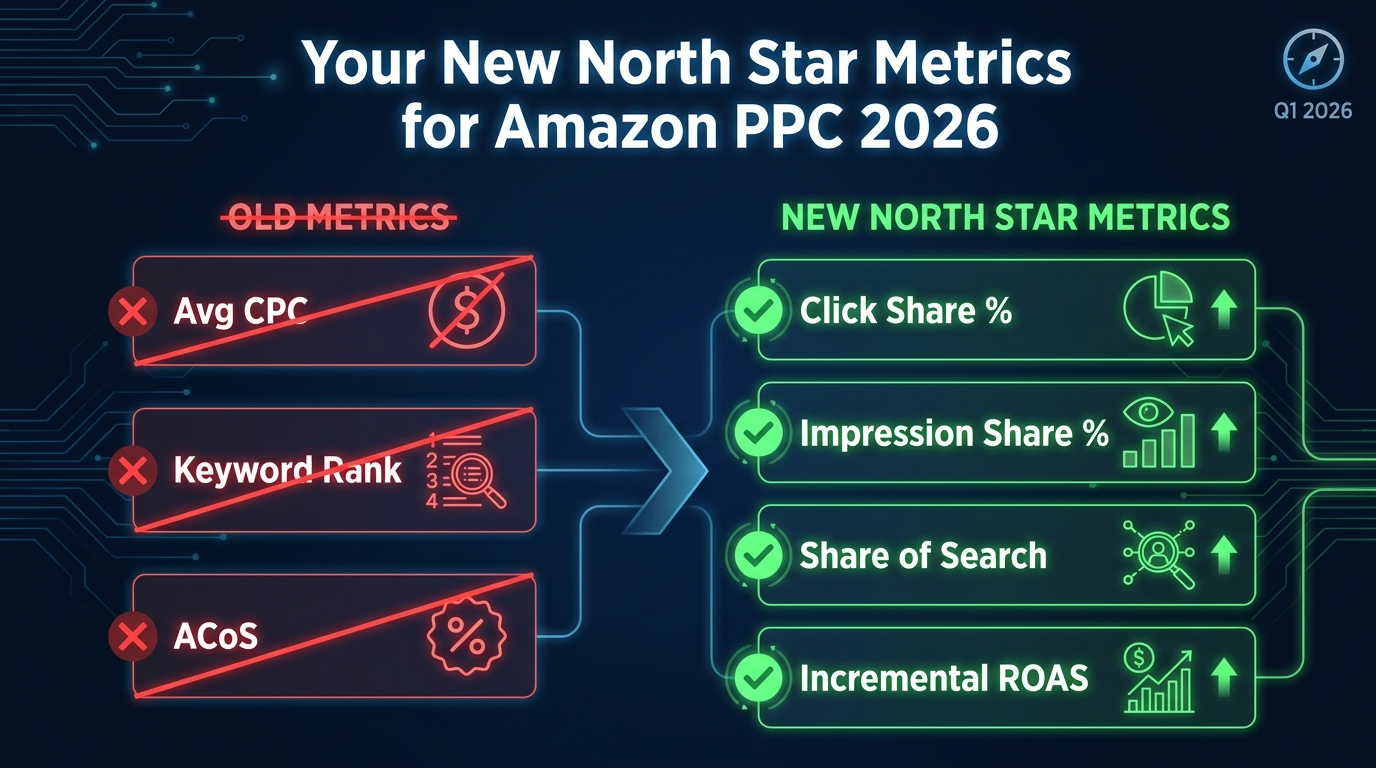
The metrics that most Amazon PPC dashboards are built around — ACoS, average CPC, ROAS, total ad spend — are campaign-level efficiency metrics. They tell you how efficiently your ads are converting the traffic you are already paying for. What they do not tell you is how much of the available traffic you are capturing, whether your share of a query is growing or shrinking relative to competitors, or whether your spend is going where the actual demand is.
The shift to semantic matching and the availability of SQP data makes a different set of metrics far more strategically informative.
Click Share: Your True Market Share Proxy
Click share in the SQP report shows what percentage of total clicks on a given search query are going to your listings — across both organic and paid results, for your entire brand. A click share of 6% on a high-volume query you are actively targeting means you are capturing a very small fraction of available demand. A click share of 40% on a medium-volume query means you own that query.
Tracking click share trends over time — weekly or monthly — gives you an early warning system that standard PPC metrics miss. If a campaign’s ROAS holds steady while its click share on target queries declines, that is a signal that competitors are taking share even though your own conversion efficiency looks fine. You are winning among the smaller pool of shoppers who click your ad; you are losing among the larger pool who are now clicking someone else’s ad instead.
Impression Share: Where the Auction Is Being Lost
Impression share shows what percentage of total impressions on a query your listings are receiving. Low impression share on a target query has two possible causes: either you are not winning the auction often enough (a bidding problem), or Amazon’s algorithm is not finding your listing sufficiently relevant to serve it in that context (a listing quality problem). Diagnosing which is the case requires cross-referencing impression share with your Quality Score indicators and listing optimization state.
This distinction matters because the solution is different. A bidding problem gets fixed by adjusting bids. A relevance problem gets fixed by improving listing content, backend keywords, and product data quality — changes that affect your organic ranking and your ad serving eligibility simultaneously.
Share of Search as a Competitive Benchmark
Share of search — the combination of impression share and click share across a defined set of high-priority queries — functions as a competitive benchmark that tracks the overall health of your presence in a category, not just the efficiency of your ad spend. Brands that track share of search alongside traditional PPC metrics make systematically better budget allocation decisions because they can see where competitors are gaining ground before that competition shows up in their own ROAS data.
Setting up a monthly share-of-search tracking report using SQP data, anchored to your 10–15 highest-priority search queries, takes less than an hour to establish and provides a strategic view of campaign health that daily Campaign Manager data simply cannot give you.
What a Modern Amazon PPC Audit Looks Like in 2026
Given everything that has changed, what does a proper audit of an Amazon PPC account look like in 2026? The structure of such an audit has evolved significantly from what it was two or three years ago. Here is what the key diagnostic questions have become.
Diagnostic 1: Are Your Two Data Sources Being Used Together?
The first question is whether the account is using SQP and STR data as complementary inputs or treating them interchangeably. Signs of the former: keyword prioritization decisions are informed by SQP volume data, not just STR conversion rates. Signs of the latter: the primary optimization workflow runs entirely out of Campaign Manager with no regular SQP review. The fix is procedural — building SQP review into the standard weekly optimization cadence alongside Campaign Manager analysis.
Diagnostic 2: What Is the Match Type Architecture Actually Doing?
Pull the Search Term Reports for all broad and phrase match campaigns and analyze what queries are actually triggering them. In 2026, the semantic drift from your target keywords to the actual triggering queries is often significant. If the average query triggering a broad match campaign shares fewer than half of its words with the target keyword, the campaign’s serving pattern has drifted substantially from its intent. This may or may not be a problem — some of that drift is useful discovery — but it should be deliberate, not unknown.
Also check whether exact match campaigns are serving on queries that your phrase and broad match campaigns are simultaneously targeting. Internal auction competition is one of the most consistent sources of inflated CPCs in unaudited accounts.
Diagnostic 3: Are Your Highest-Priority Terms Winning Share?
Pull SQP data for your five to ten highest-priority search queries. What is your click share on each? How has it trended over the past 90 days? If click share is flat or declining on terms you are spending significantly against, the issue is usually one of three things: competitor bid escalation you are not matching, listing quality gaps that are costing you placement, or budget caps that are limiting impression frequency. Each has a different fix.
Diagnostic 4: Is the Negative Keyword Architecture Maintaining Layer Separation?
Check whether terms that have been graduated from auto/broad to exact match are negated in the source campaigns. In accounts that have been running for more than a year without a deliberate architecture review, this discipline commonly breaks down — leading to multiple campaigns competing for the same high-value terms and pushing CPCs above optimal levels. A structured negative keyword audit, run quarterly, prevents this from accumulating into a significant efficiency problem.
Diagnostic 5: Is AMC Data Available and Being Used?
Check whether the account is using Amazon Marketing Cloud for path-to-purchase analysis and audience bid boosting. Given that AMC access is now available to all sponsored ads advertisers, accounts that are not using it at all are leaving a material analytical advantage on the table. Even basic AMC usage — building a remarketing audience of previous customers and applying bid boosting to Sponsored Products branded keyword campaigns — typically produces measurable efficiency gains with minimal setup effort.
Structural Risks of Staying With the Old Playbook
It is worth being explicit about what happens to accounts that do not adapt to these shifts, because the failure mode is not sudden — it is gradual degradation that looks like natural competitive pressure until it becomes a structural problem.
Chronic Impression Share Erosion
Accounts optimized purely on STR-based conversion data often continue to show acceptable ACoS and ROAS while their impression share on high-value queries slowly declines. Competitors who are using SQP data to identify these gaps and bidding into them take share progressively, while the non-adapting account’s metrics look fine because they are measuring efficiency on the shrinking share of traffic they do capture. By the time this becomes visible in revenue data, the share loss can be substantial and expensive to reverse.
Semantic Match Leakage
Accounts with outdated negative keyword management practices are increasingly vulnerable to what can be called “semantic leakage” — broad and phrase match campaigns serving on large volumes of tangentially related but ultimately non-converting traffic, driven by Amazon’s expanded semantic matching. The cost does not always show up as obviously high ACoS because the campaign ROAS metrics are averaged across converting and non-converting traffic. But ad efficiency at the margin is significantly lower than it appears.
Attribution Blind Spots Growing Larger
As conversational search through Rufus grows as a share of total Amazon shopping queries, the fraction of relevant purchase journeys that standard Campaign Manager attribution cannot see grows with it. Accounts that are not measuring purchase paths through AMC are making budget decisions with an increasingly incomplete picture of what is actually driving conversions — which is a subtle but real structural disadvantage relative to those who are.
The Advertisers Who Will Win in 2026 and Beyond
The search query shift on Amazon is not a crisis for PPC advertisers. It is a selection event. The mechanics of keyword-based sponsored advertising are not going away, and there is no impending moment when Amazon suddenly requires a completely different approach. What is happening is a more gradual bifurcation between advertisers who have updated their frameworks to match how the system actually works and those who are still operating on the prior model.
The advertisers who will outperform in this environment share a few specific characteristics:
- They use SQP and STR as a unified research system, not two separate reports to check periodically. Their keyword decisions are informed by market-level demand signals from SQP and validated by conversion signals from the STR.
- They treat match types as a spectrum with deliberate controls, not as precision settings that work automatically. Their campaign architecture explicitly manages the overlap and leakage between layers with structured negative keyword discipline.
- They have incorporated intent-forward keyword research to capture the conversational query patterns driven by Rufus and Alexa for Shopping, not just the short transactional keywords that traditional tools surface.
- They use Amazon Marketing Cloud to understand what keyword campaigns are doing across the full purchase path — not just what they credit at last touch — and to add audience precision to keyword-triggered campaigns through bid boosting.
- They track share of search as a strategic KPI, checking impression share and click share trends regularly enough to catch competitive movement before it appears in revenue data.
None of these are exotic capabilities requiring large budgets or engineering resources. They are workflow updates, analytical discipline, and a willingness to operate with a more nuanced model of how Amazon’s ad system now works. That is what the search query shift actually demands — not a new strategy, but a more accurate understanding of the system you have always been advertising in.
The most dangerous place in Amazon PPC right now is not having too little data. It is having two datasets that measure different things and treating them as the same thing.
The keyword playbook is not dead. But the version of it that worked on a simpler, more transparent data model is under genuine pressure. Updating it — methodically, with clear priorities — is the practical work of Amazon advertising in 2026.
Key Takeaways
- SQP and STR measure different things. Using both together, for different purposes, is now a baseline requirement for informed PPC management — not an advanced practice.
- All three keyword match types have become more semantically flexible. Exact is “mostly exact.” Broad is now an AI intent engine. Campaign architecture must account for increased overlap and leakage between match types.
- Classic harvest-and-graduate workflows need updating. Add SQP volume validation and longer attribution window evaluation before promoting or negating terms.
- Rufus-driven conversational queries are generating a new class of search terms. Expanding keyword lists with intent phrases — built around shopper situations, not product attributes — is a direct and practical response.
- Amazon Marketing Cloud is no longer enterprise-only. Path-to-purchase analysis and audience bid boosting on Sponsored Products are accessible to all advertisers and produce measurable returns with relatively modest setup effort.
- Click share and impression share are the metrics that tell you whether you are winning or losing in your category. Standard Campaign Manager metrics measure efficiency within the traffic you already captured — not whether you are capturing enough of it.