



You found the perfect creator. Their aesthetic matched your brand, their engagement looked healthy, and they responded quickly to your first message. You signed a loose agreement, wired the payment — often the full amount — and then waited. And waited. And then, nothing. No content. No reply. No refund.
This scenario plays out hundreds of times a day across small brands, DTC businesses, and startups investing in creator marketing. It is called creator ghosting, and it is one of the most financially damaging and emotionally exhausting problems in influencer marketing today. Unlike platform scams or bot fraud, creator ghosting often happens in plain sight — through an otherwise normal-looking collaboration that simply never delivers.
The instinct after being burned is to write off creator marketing entirely, or to become more selective about who you “trust.” But trust is not the variable that needs fixing. Structure is. The brands that rarely get ghosted are not lucky — they have built a system of milestone payments, contract protections, escrow mechanisms, and thorough vetting that makes ghosting structurally difficult and financially pointless for a creator to attempt.
This guide breaks down exactly why creator ghosting happens, who it happens to most often, and the specific, actionable steps you can put in place starting with your next campaign to eliminate the vast majority of risk before a single dollar leaves your account.
What Creator Ghosting Actually Looks Like
Creator ghosting is not always a sudden, dramatic disappearance. More often it unfolds slowly, in a pattern that is maddeningly predictable once you know what to look for. Understanding the different forms it takes is the first step toward recognizing — and preventing — it.
The Slow Fade
This is the most common pattern. After payment is received, the creator responds to check-ins with shorter and shorter messages. Deadlines get pushed back by a few days, then a week, then a month. Content drafts are promised but never delivered. Eventually, messages stop being read at all. There was never a single moment the relationship broke down — it just dissolved under the weight of delays and ignored follow-ups.
The slow fade is particularly common with micro-influencers (10,000–100,000 followers) who are managing brand deals alongside full-time jobs or school. They accepted payment in good faith but underestimated the time and effort required to deliver, and when life got busy, the easiest thing to drop was the unpaid — or already paid — obligation.
The Full Disappearance
Less frequent but far more damaging, the full disappearance involves a creator who accepts payment — sometimes substantial five-figure amounts on larger campaigns — and then becomes completely unreachable across every channel simultaneously. Email bounces. DMs are left on read. The phone number provided goes straight to voicemail. In some cases, the social media account itself is deleted or pivoted to a different handle.
This pattern is more likely to involve deliberate fraud rather than negligence, and it tends to cluster around creators with relatively new accounts (under 18 months old), inflated follower counts, and unusually low rate cards designed to attract inexperienced brands quickly.
The Partial Delivery Ghost
This version is particularly frustrating because the creator delivers some of the agreed work — enough to make disputing the payment complicated — and then stops. They may post two of the five agreed Instagram Reels, send one draft of the blog content, or publish a Story that disappears after 24 hours rather than the permanent post that was contracted. Then communication ceases.
Partial delivery ghosting is intentional roughly 40% of the time, according to campaign managers who deal with creator disputes regularly. The other 60% is a mix of burnout, changing priorities, and the creator discovering that delivering the full scope of work was more difficult or time-consuming than expected.
The Scope Creep Excuse
Some creators do not ghost outright — instead they use every communication to renegotiate, delay, or reframe the original agreement. They cite “revised brand guidelines,” request additional payment before delivering the next asset, or claim the original brief was unclear. This pattern functions as a soft ghost: the collaboration never officially ends, but it also never delivers. Brands stuck in this cycle often wait months before cutting ties, by which time they have lost not just the upfront payment but significant time and energy.
Why Creators Ghost: The Root Causes Behind the Vanishing Act
Blaming creators entirely misses the broader picture. While deliberate fraud does exist, most creator ghosting stems from a combination of structural failures, mismatched expectations, and the absence of accountability mechanisms. Here is what actually drives most ghosting incidents.
Overstretched Workloads and Poor Self-Management
The creator economy has grown faster than the professional infrastructure to support it. Many creators — particularly nano and micro influencers with follower counts between 1,000 and 50,000 — are essentially solo operators running a content production business without project management skills, accounting systems, or reliable schedules. When they accept three, four, or five brand deals simultaneously, the math often does not work out.
Research consistently shows that creators underestimate production time by 40–60% when quoting timelines. A creator who confidently promises a polished video in two weeks may genuinely believe that when they say it. The reality of scripting, filming, editing, and revision cycles with approval rounds often triples that estimate. When timelines slip, shame and avoidance frequently take over, turning a late delivery into a complete communication breakdown.
Financial Desperation and Opportunistic Fraud
A smaller but significant subset of ghosting involves creators who accepted payment they could not afford to refund, with no intention of delivering from the start — or who intended to deliver but used the advance to cover personal expenses before the work was complete. When delivery time came, they lacked the resources to produce the content and lacked the financial capacity to return the funds.
This pattern is more common in the nano influencer space (1,000–10,000 followers) where creators may have no prior brand deal experience and where the payment amounts are small enough that brands sometimes skip formal contracts. A $300 deal with no contract and no milestone structure creates virtually zero accountability for a creator in financial difficulty.
The Payment Removes All Incentive
This is the most structurally important cause of creator ghosting, and it is entirely preventable. When a brand pays 100% of the agreed fee before any content is delivered, the creator’s financial incentive to complete the work is eliminated. The rational outcome for a creator under pressure — whether from overwork, competing opportunities, or personal circumstances — is to deprioritize the already-paid job and focus on the one that still has money on the table.
This is not a moral failing. It is basic incentive economics. Upfront payment, in the absence of legal consequences or reputational risk, severs the link between compensation and performance. No business would accept this arrangement from a contractor in any other industry. Creator marketing, perhaps because of its informal roots in social media culture, has normalized a payment structure that objectively serves the brand’s interests poorly.
Lack of Accountability Infrastructure
In traditional freelance work, late delivery or non-delivery has clear consequences: loss of future work, referral damage, potential legal action. Creator marketing has historically lacked these feedback loops. Review platforms for creators are fragmented. Contracts in the space are often vague or absent. Legal action over small amounts is rarely economically viable for brands. And the creator economy has grown so quickly that a creator can often find a new brand willing to pay them — and repeat the same pattern — with minimal professional consequences.
The Upfront Payment Trap: Why Full Payment Up Front Is a High-Risk Bet
Paying a creator in full before work is delivered is the single highest-risk action a small brand can take in a creator partnership. Yet it remains surprisingly common, driven by creator requests, informal deal norms, and brands’ eagerness to secure talent quickly.
The Scale of the Problem
Influencer marketing fraud — which includes non-delivery, fake engagement, and inflated audiences — cost brands an estimated $1.3 billion to $4.6 billion annually in wasted spend. Research from 2024–2026 found that 68.4% of brands experienced influencer fraud in some form, with e-commerce brands disproportionately affected at 74.2%. The average loss per fraudulent campaign partnership reached $5,000 before brands typically detected a problem, with some campaigns registering average losses of $214,000 when macro-influencer budgets were involved.
These numbers include all forms of fraud, not just ghosting. But they illustrate the broader environment in which brands operate: one where a significant percentage of creator partnerships carry some form of financial risk, and where the absence of structural protection exposes brands to substantial losses.
Why Creators Ask for Upfront Payment
It is worth understanding the creator’s legitimate perspective here. Many creators have experienced brands that disappear after content is delivered — the reversal of the ghosting dynamic. Having been burned by non-payment, creators reasonably seek upfront compensation as protection. This is not inherently manipulative. It reflects a real risk that exists on the creator side of the equation.
The challenge is that full upfront payment simply transfers all risk onto the brand. The solution is not to refuse payment security to creators, but to create a shared security structure — one that protects both parties through milestone payments and escrow systems, rather than requiring one side to absorb all exposure.
What Full Upfront Payment Actually Signals
From a fraud-detection perspective, a creator who insists on full upfront payment before any work begins — and who becomes difficult to work with when you suggest a milestone structure — is displaying one of the clearest early warning signs. Legitimate, professional creators understand milestone payments. They may prefer upfront compensation, and it is reasonable to offer a partial deposit. But a creator who categorically refuses any structure that ties remaining payment to delivery is a creator who cannot be held accountable for completing the work.
This does not make every upfront-payment-requesting creator a fraudster. But it makes full upfront compliance without any milestone structure a high-risk position for the brand — regardless of how legitimate the creator appears.
Milestone Payments: The Structural Fix That Works
Milestone-based payment is the single most effective structural change a small brand can make to reduce creator ghosting. By tying payment releases to specific, verified deliverables, you align financial incentive with performance at every stage of the campaign — making ghosting both less likely and less damaging when it occurs.
The Standard Three-Stage Model
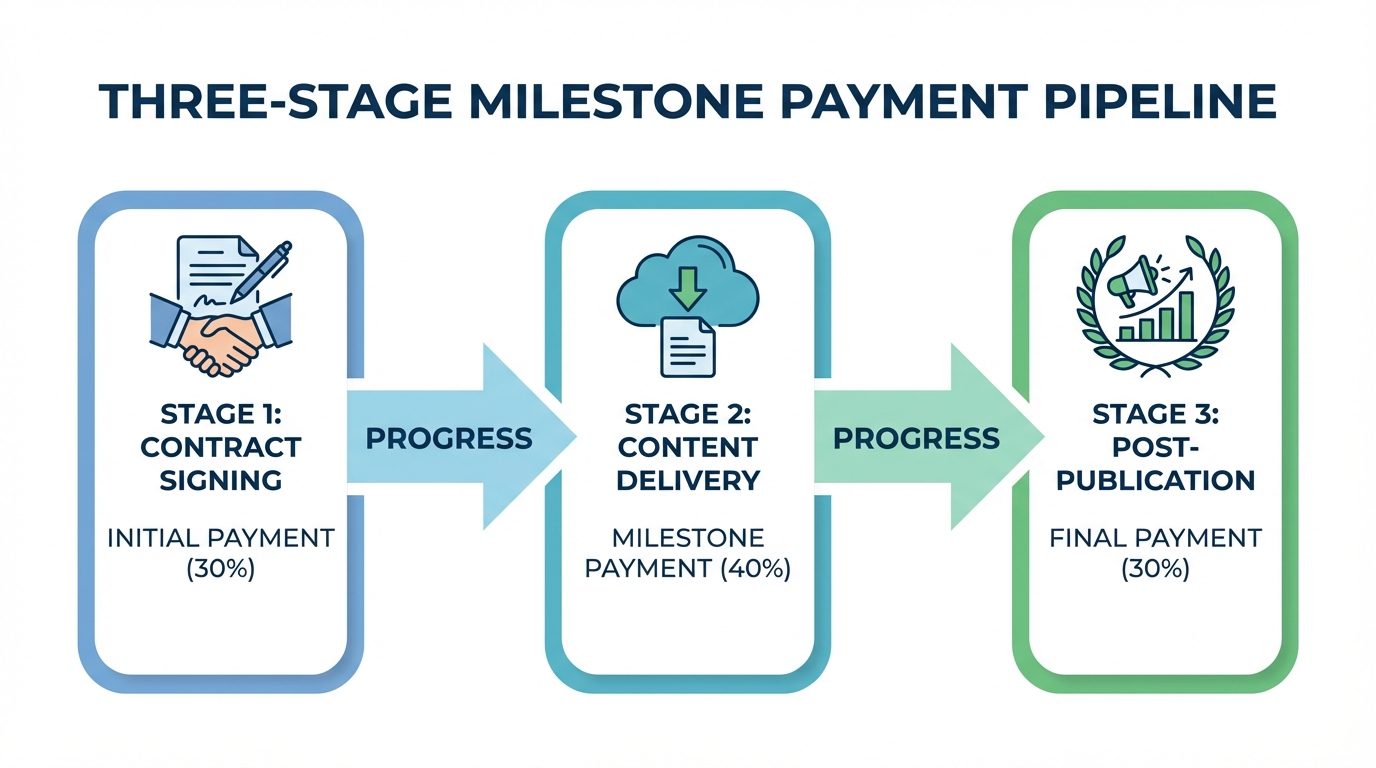
The most widely adopted milestone payment structure for influencer campaigns divides the total fee into three tranches:
- 30% on contract signing — This deposit secures the creator’s time, signals the brand’s good faith, and gives the creator working capital for any production costs (equipment, props, locations). It is enough to motivate the creator to begin without giving away a majority of the budget before work starts.
- 40% on content approval — The largest tranche is released after the brand has reviewed and approved the content draft. This is the critical leverage point. The creator has strong financial incentive to produce quality work and engage with feedback, because 40% of their fee depends on it.
- 30% after go-live and performance reporting — The final tranche releases after the content has been published to the agreed platform(s) and the creator submits basic performance data (reach, impressions, engagement). This ensures the content actually goes live and that the creator provides the analytics access they agreed to.
For simpler, lower-budget partnerships, a 50/50 structure — half on signing, half on delivery — is often sufficient and easier to manage.
A Four-Stage Model for Larger Campaigns
For campaigns involving multiple deliverables, longer timelines, or higher budgets, a four-stage structure provides tighter accountability:
- 25% on contract signing
- 25% on content creation (draft submission)
- 25% on publication
- 25% after 30 days of performance monitoring
The 30-day monitoring phase is particularly valuable for campaigns where the brand needs ongoing analytics access, where the content should drive traffic over an extended period, or where the creator is expected to engage with comments and follow-up questions from their audience after publishing.
Why Milestone Payments Work
Milestone structures work because they continuously realign financial incentive with performance. A creator who is tempted to deprioritize your campaign knows they still have 70% of their fee outstanding if they want it. A creator who is in financial difficulty and considering ghosting has to weigh the loss of unpaid milestones against the option of disappearing — a calculus that is very different from the all-upfront scenario where there is nothing left to lose.
Beyond preventing ghosting, milestone payments also improve content quality. When approval and feedback rounds are tied to payment release, creators have a direct financial incentive to engage constructively with revisions rather than pushing back or ignoring brand input.
Communicating Milestone Structures to Creators
Frame milestone payments as mutual protection, not as distrust. Most professional creators — the ones worth working with — will understand and accept this framing. A useful script: “We use a milestone payment structure on all partnerships because it protects both of us. You’re guaranteed payment at each stage, and we’re guaranteed delivery before the next release. It keeps both sides accountable and has made our partnerships much smoother.”
This framing positions structure as a professional standard rather than a personal accusation. Creators who react negatively to this framing — insisting they are trustworthy and should receive full payment immediately — are showing you something important about how they approach professional relationships.
Platform Escrow: Letting Technology Hold the Line
For brands that want an additional layer of protection beyond contractual milestone agreements — or for those working with creators they have not built an established relationship with — platform-based escrow services provide a neutral third-party mechanism that holds funds until agreed conditions are met.
How Influencer Marketing Escrow Works
Escrow in creator partnerships functions similarly to real estate escrow: the brand deposits the agreed campaign fee into a protected account held by the platform. The funds are held — inaccessible to either party — until the creator delivers the agreed content and the brand approves it. Only then are funds released to the creator.
From the creator’s perspective, this model offers security that the brand cannot simply refuse to pay after content is delivered. From the brand’s perspective, it ensures that payment only flows when work is actually complete. Both parties are protected simultaneously, without either side having to absorb full risk.
Platforms with Built-In Escrow or Payment Protection
Several influencer marketing platforms have integrated escrow or structured payment release mechanisms into their core product:
- Collabstr — A UGC and influencer marketplace that holds brand payments in escrow until content is delivered and approved. Widely used for micro-influencer partnerships at accessible price points.
- Nowfluence — Uses Stripe-based escrow to hold brand funds. Payments release to creators after content delivery is confirmed, with a structured dispute resolution process if delivery is incomplete.
- AspireIQ (now Aspire) — Includes workflow management and payment control features that tie compensation releases to content approval stages within the platform.
- Grin — Used primarily by mid-to-large brands, Grin offers integrated payment management with deliverable tracking, ensuring payment schedules align with campaign milestones.
When to Use Escrow vs. Self-Managed Milestones
Escrow platforms add a management fee — typically 5–15% of the campaign value — in exchange for the added protection and dispute resolution they provide. For small campaigns under $500, this overhead may not be justified. For campaigns above $1,000, or when working with a creator for the first time, escrow provides a level of protection that self-managed milestone contracts struggle to match, particularly when it comes to dispute resolution.
If a creator ghosts mid-campaign on a self-managed milestone contract, recovering withheld funds involves legal processes that are often slow and expensive relative to the amount at stake. Escrow platforms typically have built-in resolution protocols that return unreleased funds to the brand without requiring legal action.
The Psychological Effect of Escrow
Beyond the practical mechanics, escrow has a documented psychological effect on creator behavior. When creators know funds are being held by a neutral party that will only release on verified delivery, the incentive to deliver is reinforced by something more concrete than a contractual promise. In surveys of creator professionals, escrow-based deals consistently produce higher on-time delivery rates than equivalent non-escrow agreements — even when the total compensation is identical.
Vetting Creators Before the First Dollar Moves
Milestone payments and escrow protect you after engagement. Thorough vetting prevents the wrong partnerships from forming in the first place. A well-executed vetting process eliminates the majority of high-risk creators before the first message is sent.
Step 1: Verify the Basics
Before anything else, confirm you are dealing with a real person operating a real account. This sounds obvious but is frequently skipped. Conduct a reverse image search on the creator’s profile photo using Google Images or TinEye. Check whether the account handle matches the name used in email communications. Verify that the account history shows consistent, organic growth rather than a sparse older history followed by a sudden surge in content and followers.
For creators you found on platforms rather than through direct outreach, check whether their account is verified on the platform, how long they have been on the platform, and whether their profile information is consistent across their other social channels. Inconsistencies — different names, different locations, different follower counts than quoted — warrant deeper scrutiny.
Step 2: Analyze Engagement Quality
Follower count is the least reliable metric in creator marketing. What matters far more is engagement quality. Calculate the engagement rate (likes + comments + shares divided by total followers) and compare it against benchmarks for the platform and follower tier:
- Nano influencers (1K–10K followers): Healthy engagement rate of 5–10%
- Micro influencers (10K–100K followers): Healthy engagement rate of 3–8%
- Macro influencers (100K–500K followers): Healthy engagement rate of 1–4%
- Mega influencers (500K+): Healthy engagement rate of 0.5–2%
Beyond raw rates, read the comments. Genuine engagement features specific responses to the content, questions about products or topics, and back-and-forth conversation between the creator and their community. Bot-driven engagement typically shows generic phrases (“Great post!”, “Love this!”), unrelated hashtag spam, and comments from accounts with no profile photos or zero posts of their own.
Step 3: Review Audience Authenticity with Tools
Free manual analysis only goes so far. For partnerships involving more than $500, invest in a tool like HypeAuditor, Modash, or Upfluence to run an automated audience audit. These platforms analyze follower account quality, geographic distribution, follower growth history, and engagement patterns to generate a fraud risk score.
Research shows that 41.3% of influencer accounts show some form of fraudulent activity, with macro-tier accounts (100K–500K followers) experiencing fraud rates as high as 48.3%. An audience audit that takes ten minutes to run can prevent you from committing budget to an account where nearly half the “audience” consists of bots or inactive accounts.
Step 4: Check Professional References and Prior Brand Work
Ask creators for a media kit that includes case studies or references from prior brand partnerships. Then actually follow up. Contact one or two brands they have worked with and ask a simple question: “Did they deliver everything they agreed to, on time?” This step takes five minutes and eliminates a disproportionate share of high-risk candidates.
Also review their published sponsored content directly on their channels. Look for consistency: Do their brand deals look professional? Do they clearly disclose partnerships with #ad or #sponsored tags (an FTC requirement that signals professional awareness)? Are the posts they created for brands stylistically consistent with their organic content, or do they look like they were inserted with minimal effort?
Step 5: Assess Communication Professionalism
Pay close attention to how a creator communicates during the outreach and negotiation phase. Response speed, clarity of communication, and the quality of their questions tell you a great deal about how they will behave when a deadline approaches or a revision is needed. Creators who respond slowly, communicate vaguely, or struggle to answer basic questions about their audience and content process during the courtship phase are not going to improve once the deal is signed and the payment is sent.
Contracts That Actually Protect You: Must-Have Clauses

A handshake agreement, a DM conversation, or a brief email exchange is not a contract. It is an aspiration. Every creator partnership — regardless of size — should be governed by a written agreement that specifies deliverables, timelines, payment terms, and consequences for non-delivery. Here is what that contract needs to include.
Clause 1: Specific Deliverables with Format Requirements
Vague deliverables are the root cause of most contract disputes. “One Instagram post” is not a deliverable — it is an intention. A proper deliverable clause specifies: the exact content type (e.g., Instagram Reel), the minimum duration (e.g., 30–60 seconds), the quality standard (e.g., 1080p or 4K), the caption requirements (e.g., 150–200 words, including specified keywords and hashtags), the disclosure language required (e.g., #ad in the first line), and any visual branding guidelines (e.g., must include product in frame for minimum 10 seconds).
The more specific the deliverable definition, the harder it is for a creator to claim they delivered what was agreed while actually delivering something substandard — and the easier it is for you to withhold payment legitimately if standards are not met.
Clause 2: Timeline with Hard Deadlines
Every deliverable should have an attached deadline. The contract should specify: when the content draft must be submitted for brand review, how long the brand has to provide feedback (typically 3–5 business days), how many revision rounds are included, and the final publication date. Include language that automatic deadline extensions are not granted without written agreement from both parties.
Clause 3: Milestone Payment Schedule
The contract should explicitly list the milestone payment structure — amounts, trigger conditions, and payment method. Something like: “Payment Tranche 1 ($X) released upon contract execution. Payment Tranche 2 ($X) released upon brand approval of content draft. Payment Tranche 3 ($X) released upon confirmed publication and submission of performance analytics.”
This removes any ambiguity about when money moves and what condition must be satisfied for each release.
Clause 4: Non-Delivery Penalties and Refund Terms
If a creator fails to deliver the agreed content by the agreed deadline, what happens? This must be spelled out clearly. A standard approach: “In the event that Creator fails to deliver the agreed Content within 14 days of the agreed deadline, Brand reserves the right to terminate this Agreement and recover all payments made, including but not limited to the signing deposit, within 30 days of written notice of termination.”
For milestone structures, include language that makes withheld tranches clearly non-payable if preceding milestones are not completed: “Payment of subsequent tranches is contingent on successful completion of prior milestone deliverables and brand approval.”
Clause 5: Content Ownership and Usage Rights
Even if the creator delivers, conflicts over content ownership can arise later. Specify whether the brand receives a license to repurpose the content for paid advertising, and for how long. This is a separate negotiation from the base fee and should be reflected in the contract.
Clause 6: Exclusivity Terms
If you need the creator to avoid promoting direct competitors during and after the campaign, specify the exclusivity period (typically 30–90 days after publication) and the categories covered. Without this clause, a creator is free to post a competing brand’s content the day after yours goes live.
Clause 7: Dispute Resolution
Include a clause specifying how disputes will be resolved — typically through mediation before litigation, and specifying the jurisdiction. While legal action over small amounts is rarely practical, having a dispute resolution clause changes the power dynamic and makes creators aware that there are formal consequences for non-compliance.
Red Flags to Spot Before You Sign
Experience working with creators reveals a consistent set of early warning signs that predict ghosting or non-delivery. These are the patterns worth scanning for during outreach and negotiation.
Red Flag 1: Inconsistent Metrics Across Platforms
A creator claims 50,000 Instagram followers in their media kit but their visible post likes average 45–80 per post. A creator’s YouTube subscriber count is 80,000 but their recent videos have under 200 views. Dramatic inconsistencies between follower count and actual engagement signal either purchased followers, a declined account, or deliberate misrepresentation of reach — any of which should disqualify the partnership.
Red Flag 2: Pressure to Pay Quickly
Urgency is a classic manipulation tactic. Creators who push you to sign and pay immediately — citing other interested brands, a closing rate card window, or an upcoming trip that means they need payment today — are using time pressure to short-circuit your due diligence process. Legitimate creators are willing to allow reasonable time for contract review and vetting.
Red Flag 3: A Very New Account with High Follower Counts
An account created less than 18 months ago that already has 50,000 or 100,000 followers is statistically unusual and warrants scrutiny. Organic audience growth of that scale in under 18 months is possible — viral content can drive rapid legitimate growth — but it requires explanation. If the creator cannot point to specific content that drove that growth, the follower count is suspect.
Red Flag 4: Refusal to Sign a Formal Contract
Any creator who expresses reluctance to sign a written agreement — citing that they “always work on trust” or that a contract feels like an insult — is explicitly removing the accountability infrastructure that protects both parties. This is a non-negotiable. No contract, no payment. This stance, applied consistently, eliminates a significant portion of ghosting risk on its own.
Red Flag 5: No Prior Brand Partnership Evidence
A creator with no documented history of brand collaborations is not automatically a bad choice — but it should adjust your risk posture. For a first-time brand deal partner, reduce the upfront payment percentage, use escrow, and keep the initial partnership scope small enough that non-delivery is not catastrophic.
Red Flag 6: Email Domain Mismatch
Fraudsters posing as well-known creators often use near-identical usernames but different email domains. If you received an outreach from someone claiming to be a creator you found online, verify that the email domain matches the creator’s stated business contact information. An outreach from a generic Gmail address claiming to represent a creator whose media kit lists a branded domain is a red flag worth investigating.
When Things Go Wrong: What to Do After Being Ghosted
Even with strong systems in place, ghosting can still occur — particularly if you are still in the process of building these structures. Here is a practical response framework if a creator goes dark after partial or full payment.
Step 1: Document Everything Immediately
Before taking any action, compile a complete record of the partnership: the contract (or all communications if no formal contract exists), all payment receipts, every message exchange, and a clear timeline of missed deadlines and unanswered contacts. This documentation is the foundation of every subsequent step.
Step 2: Send a Formal Written Notice
Send a written notice — email with read receipt requested, or via certified mail if you have a postal address — formally stating that the creator is in breach of agreement and specifying the outstanding deliverables. Set a clear 14-day deadline for response or delivery, and state explicitly what will happen if the deadline is not met (pursuit of refund, platform dispute, legal action). This notice creates a paper trail and sometimes prompts a response from creators who have gone quiet due to embarrassment or overwhelm rather than deliberate fraud.
Step 3: Use Platform Dispute Mechanisms
If the partnership was conducted through an influencer marketing platform with built-in dispute resolution, initiate the formal dispute process immediately. Platforms with escrow will return held funds to you. Platforms with dispute mechanisms can issue warnings to the creator, restrict their account, or facilitate mediation.
Step 4: File a Chargeback (for Card Payments)
If payment was made via credit card and the creator has failed to deliver agreed services, you may be entitled to file a chargeback with your card issuer. Chargebacks for non-delivery of services are generally supported by card networks when you can document the agreement and the non-delivery. Note that chargebacks are typically subject to a 60–120 day window from the transaction date, so do not delay if this is the route you are considering.
Step 5: Small Claims Court for Larger Amounts
For amounts worth pursuing legally — generally $1,000 or more — small claims court is often an accessible option. Most jurisdictions allow businesses to file small claims for amounts up to $5,000–$10,000 without an attorney. The existence of a written contract dramatically strengthens your position. Even if the creator does not appear, courts frequently issue default judgments in the plaintiff’s favor, which can then be used to pursue payment through collections or wage garnishment.
Step 6: Report and Leave Reviews
Report fraudulent creators to the influencer marketing platforms where you found them. Leave honest reviews on marketplace platforms that allow brand feedback. Share your experience in relevant professional communities. This creates the reputational accountability that the creator economy currently lacks at scale, and it protects other brands from the same individual.
Building a Repeatable System to Eliminate Risk

Individual protective measures are valuable. But the brands that experience the least ghosting and the highest campaign delivery rates are those that have institutionalized these protections into a repeatable, systematic process — one that applies to every creator partnership, regardless of follower count, platform, or relationship warmth.
Create a Creator Intake Process
Treat creator partnerships the way you would treat any vendor relationship. Build a standardized intake process that every creator goes through before a contract is issued. This might include: submitting a media kit, completing a brief brand alignment questionnaire, authorizing an audience audit, and acknowledging your standard payment terms before any negotiation begins.
This process serves two purposes. First, it collects the information you need for due diligence. Second, it signals to creators — including those with fraudulent intent — that you operate systematically and professionally. Fraudsters and ghost-prone creators overwhelmingly prefer to work with brands that operate informally. A formal intake process alone deters a significant share of risk.
Maintain a Creator CRM
Keep a simple database of every creator you have worked with or seriously considered, including: their contact information, the platform(s) they operate on, their follower counts and engagement rates at the time of partnership, the campaign details, payment milestones sent and received, content delivered and dates, and any performance data. Over time, this database becomes a valuable asset — a roster of vetted, proven creators and a reference library for due diligence on new candidates.
Standardize Your Contract Template
Do not write a new contract from scratch for each partnership. Develop a standard template that includes all the clauses described in this guide, with clear fields for campaign-specific variables (deliverables, amounts, dates). Having a ready template means contracts get signed faster, you are less likely to forget a critical clause under time pressure, and your terms appear professional and consistent.
For brands running five or more creator partnerships per year, investing in a template review by a commercial attorney is worth the one-time cost. A solid template, once created, can be reused indefinitely with minimal modification.
Build a Preferred Creator Roster
The best long-term defense against ghosting is a roster of creators you have worked with before, who have proven their reliability, and who have an ongoing professional relationship with your brand to protect. Invest in building and nurturing these relationships. Creators who genuinely value their relationship with your brand — because you pay promptly at milestones, give clear briefs, provide constructive feedback, and treat them as professional partners — are dramatically less likely to ghost you than a cold-outreach creator receiving their first payment from an unknown company.
Use Performance-Linked Bonuses to Align Interests
Beyond milestone structures, consider adding a performance bonus layer to your creator agreements. The base fee (paid in milestones) covers content production. A separate bonus — paid 30 days after publication — rewards creators who hit agreed performance metrics (click-through rate, promo code redemptions, traffic to a landing page). This model, now used in approximately 60–70% of high-performing creator partnerships, means that creators have a direct financial incentive to promote their content actively after publication, rather than posting and moving on.
The Trust vs. Structure Debate: Why Structure Always Wins
There is a recurring argument in the creator marketing space that the solution to ghosting and non-delivery is better creator selection — finding trustworthy people and building genuine relationships. This argument is not wrong. Trust and relationship quality genuinely matter.
But trust is not a system. It does not scale. It cannot be audited. And it fails catastrophically when the person you trusted turns out to be in a difficult personal situation, overcommitted, or simply not who they presented themselves to be.
Structure, by contrast, is consistent. It applies equally to trusted and untrusted creators. It creates accountability without accusation. And when it is framed correctly — as mutual protection rather than brand-side policing — it rarely damages creator relationships. In fact, professional creators often prefer working with brands that have clear systems, because clarity about payment timing, deliverable expectations, and approval processes makes their work easier.
The goal is not to approach every creator as a suspect. The goal is to build a partnership environment where delivering on commitments is the path of least resistance, and where the financial and professional consequences of not delivering are clear and real. That environment is built through structure — not through the hope that good intentions will be enough.
“The brands that stop getting ghosted are not the ones who got better at reading people. They are the ones who stopped making ghosting easy.”
Conclusion: Stop Betting on Goodwill — Start Building Systems
Creator ghosting is a solvable problem. It is not inevitable, it is not random, and it is not primarily a reflection of the creator’s character. It is overwhelmingly a reflection of the deal structure — specifically, the absence of structural accountability between payment and performance.
The brands that eliminate the vast majority of their ghosting risk do so by applying a consistent set of structural practices: they vet creators thoroughly before engagement, they use milestone payment structures that tie financial releases to verified deliverables, they leverage platform escrow for additional protection on first-time partnerships, and they govern every collaboration with a written contract that specifies exactly what is being paid for, when, and what happens if it is not delivered.
None of these practices require a large marketing team, a big legal budget, or years of creator marketing experience. A standardized intake form, a contract template, a milestone payment policy, and an audience audit tool — these are accessible to any brand, at any size, starting with the next partnership they pursue.
Your Action Plan: Starting With the Next Partnership
- Implement a 30/40/30 milestone payment structure immediately — no exceptions for new creator relationships.
- Run an audience audit using HypeAuditor, Modash, or a similar tool on every creator before committing budget.
- Use a platform with escrow (Collabstr, Nowfluence, Aspire) for all first-time partnerships over $500.
- Create or adopt a contract template with specific deliverable definitions, hard deadlines, and non-delivery refund terms.
- Build and maintain a creator CRM — even a simple spreadsheet — to track performance history across partnerships.
- Learn the red flags and apply them consistently during outreach — pressure to pay quickly, refusal to sign contracts, and engagement rates that do not match follower counts are your clearest early warnings.
The creator economy is a genuinely powerful channel for small brands willing to engage with it thoughtfully. The risk is not inherent to creator marketing — it is inherent to creator marketing done informally. Formalize the process, and the risk drops sharply. That is not pessimism about creators. It is a straightforward, evidence-based case for why structure protects everyone — including the creators who depend on brand partnerships as a meaningful part of their income.
Stop betting on goodwill. Start building systems. Your next campaign will be better for it.