


When TikTok Shop launched in the United States in September 2023, it came in at a deliberately below-market price: a 2% referral fee, almost no fulfillment requirements, and a wild-west approach to listings that made Amazon’s enforcement look medieval by comparison. That era is over.
By mid-2026, TikTok Shop has pushed through more structural policy changes in an 18-month window than most marketplaces attempt in a decade. Referral fees have tripled from their launch rate. A mandatory shipping overhaul was announced, met with massive seller backlash, and then rolled back — but the intent behind it hasn’t gone anywhere. A new Account Health Rating system now holds sellers’ entire shop existence hostage to a single numerical score. And a June 2026 product listing policy published new image requirements and explicitly banned “fictitious listings” — a category broad enough to catch sellers who simply hadn’t updated their copy.
The question most sellers are asking is the wrong one. They’re asking, “How do I avoid getting hit?” The better question is: “Now that the full cost stack is visible, what does this platform actually cost me — and does my business model still work on it?”
This piece is a systematic breakdown of every major fee and policy shift TikTok Shop has enacted through 2026, what each one actually costs, and how the cumulative picture is reshaping who wins and loses on the platform. The numbers may surprise you — especially if you’ve been running your TikTok Shop economics off the headline 6% referral fee alone.
The Fee Stack Nobody Warned You About
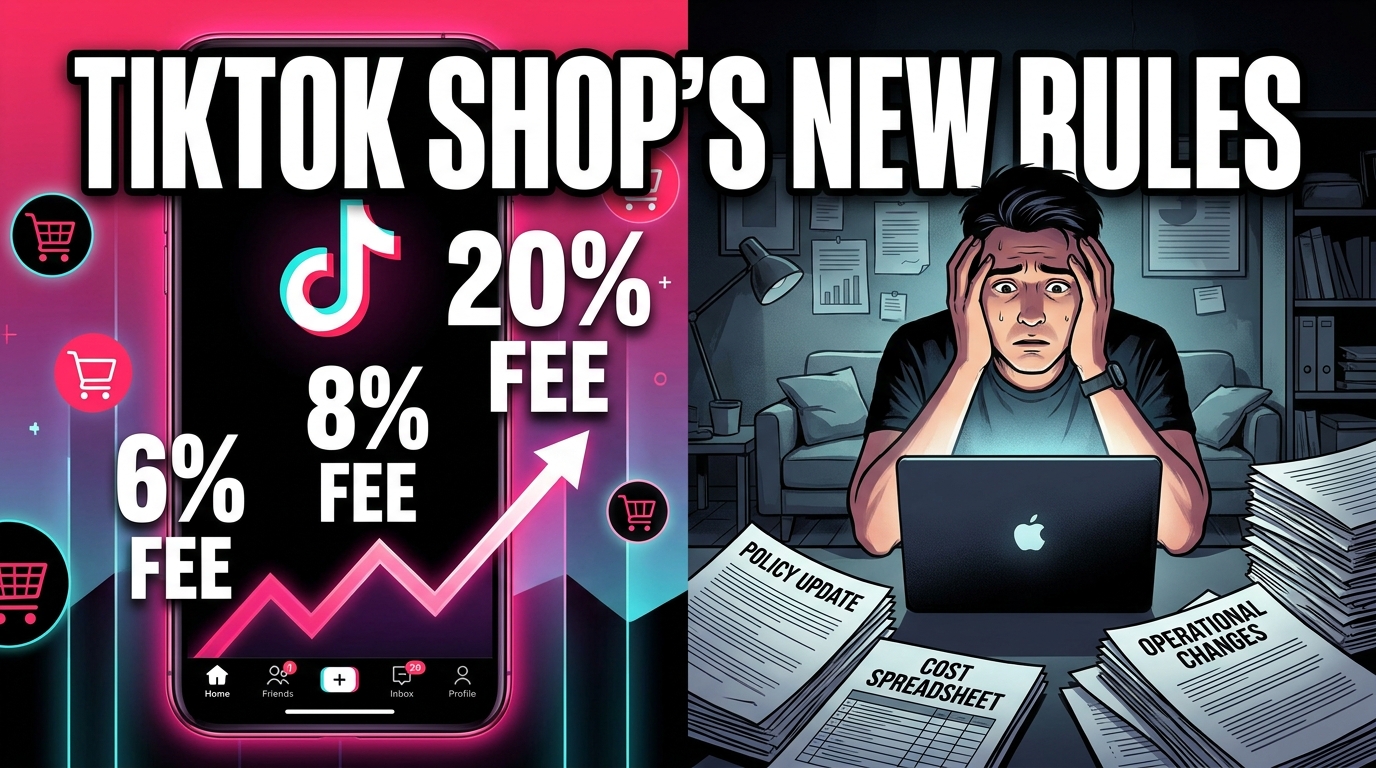
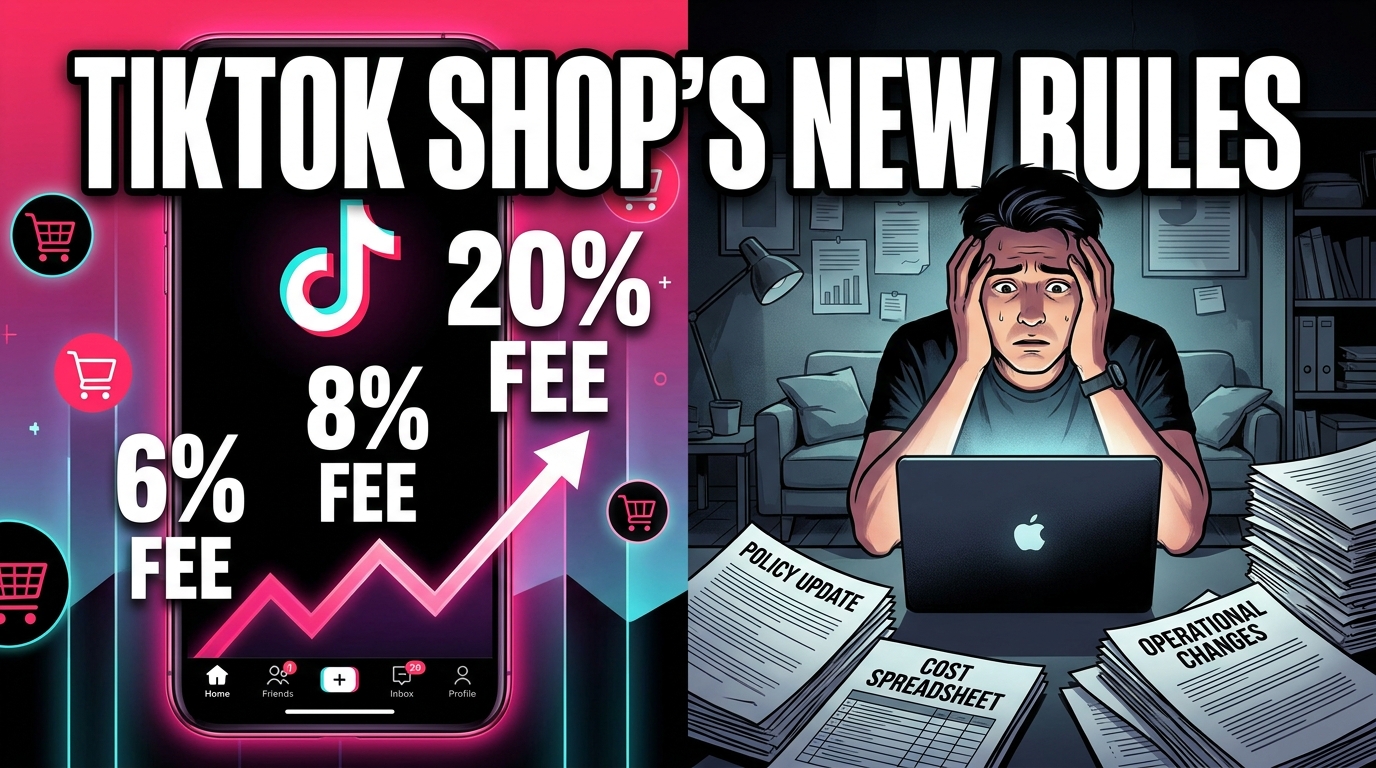
The 6% referral fee is TikTok Shop’s headline number. It’s the one that shows up in every comparison chart positioning the platform against Amazon (where fees average 15%) and eBay (around 12.9%). That comparison, while technically accurate, is close to meaningless for any seller who’s actually operating at scale — because the referral fee is just the entry point to a fee architecture that runs far deeper.
Layer 1: The Referral Fee
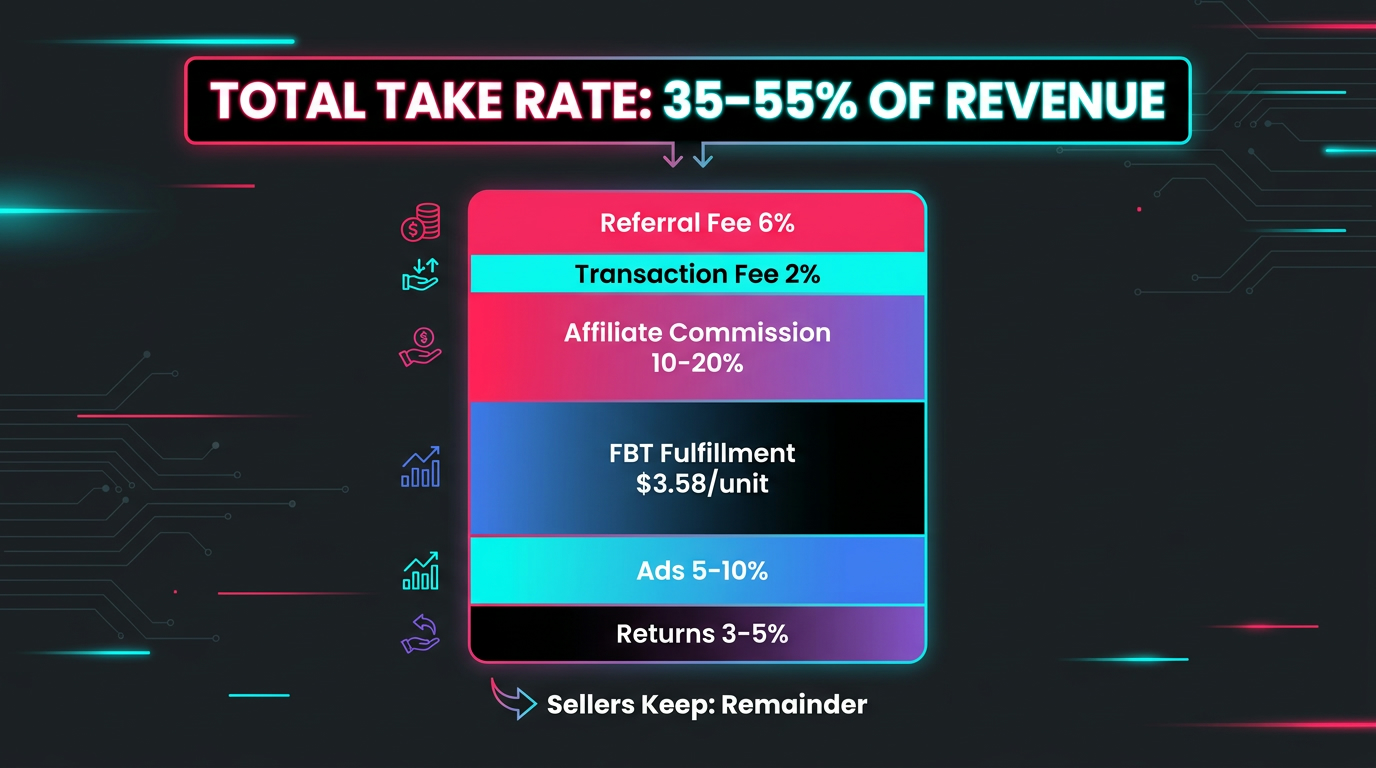
TikTok Shop’s US referral fee is currently set at 6% per qualified order for most categories. New sellers receive a temporary 3% promotional rate for their first months on the platform, which has historically been a retention and onboarding tactic. But that rate expires, and 6% becomes the floor.
Some categories carry higher rates. The current structure ranges from 2% to 8% depending on the product category. High-demand verticals like beauty, wellness, and apparel that dominate TikTok Shop’s GMV tend to cluster near or at the upper end of that range. This alone is worth understanding: if your category is 8%, the favorable-sounding 6% benchmark doesn’t apply to you.
Layer 2: Transaction and Payment Processing
On top of the referral fee sits a transaction and payment processing charge, typically running around 2% of order value. This is rarely highlighted in TikTok’s own marketing materials but appears consistently in detailed seller cost analyses. For a $30 product, that’s 60 cents on top of the $1.80 referral fee — small in isolation, material when multiplied across thousands of orders.
Layer 3: Affiliate and Creator Commissions
This is where TikTok Shop’s cost structure genuinely diverges from traditional marketplace math. TikTok Shop’s commerce model is fundamentally dependent on creator-driven traffic. Most sellers running affiliate programs — which is to say, most competitive sellers on the platform — are paying creator commissions of 10% to 20% of order value, and some aggressive campaigns push above 25% for high-priority products.
That commission is not a platform fee in the traditional sense. But it’s also not optional if you want meaningful discovery. TikTok’s feed algorithm elevates products that are actively being promoted by affiliates. A seller with zero affiliate activity is effectively invisible to the platform’s primary traffic engine. The commission isn’t a line item you can cut to protect margin — it’s the cost of acquisition on a platform where the feed is the storefront.
Layer 4: Fulfillment Costs
Whether sellers use Fulfilled by TikTok (FBT) or manage their own shipping, fulfillment is a real cost. FBT pricing starts at approximately $3.58 per unit for single-unit orders under 4 lbs, with rates rising based on weight and order complexity. Self-managed shipping through TikTok’s “Seller Shipping” option carries its own carrier costs, though sellers retain more control over the carrier relationship.
Layer 5: Advertising Spend
TikTok Shop’s SHOP ads and in-feed commerce placements are increasingly necessary as the organic reach of non-promoted content declines. Sellers running paid campaigns typically allocate 5% to 10% of revenue back into advertising — though in highly competitive categories, that number climbs considerably higher.
Layer 6: Returns and Refund Administration
When an order is refunded or canceled, TikTok charges a refund administration fee of 20% of the original referral fee, capped at $5 per SKU. At first glance, this seems minor. But in categories with high return rates — apparel, electronics accessories, some beauty segments — this fee stacks quickly. A seller processing 15% returns on a volume product is paying not just the cost of the returned goods and reverse logistics but also an additional administrative charge per refunded transaction.
The Cumulative Picture
Add it up. A seller with a standard 6% referral fee, 2% transaction charge, 15% affiliate commission, FBT fulfillment at $3.58/unit on a $35 product (roughly 10%), a 7% ad spend, and a 5% blended return impact is looking at a total take rate of approximately 45% of gross revenue before cost of goods and overhead. Industry benchmarks for 2026 put the typical all-in take rate between 35% and 55% of GMV, depending on the channel mix and affiliate intensity.
For a seller with a 50% gross margin — already quite healthy — that leaves roughly 5% to 15% net margin before any operational overhead. For sellers running tighter COGS, the math turns negative fast.
The Shipping Mandate That Wasn’t — And Why It’s Still Coming
The most operationally disruptive policy announcement of early 2026 wasn’t a fee increase. It was TikTok Shop’s attempt to eliminate independent seller shipping entirely in the US market — and then, seventeen days later, its decision to walk that back.
What TikTok Actually Announced
In January 2026, TikTok Shop issued guidance that it would end “Seller Shipping” — the option for US merchants to buy their own postage and ship independently — by March 31, 2026. The mandate would require all US orders to be fulfilled through one of three TikTok-managed options: Fulfilled by TikTok (FBT), Upgraded TikTok Shipping, or Collections by TikTok (CBT). Sellers would also need to integrate with approved ERP or warehouse management systems to qualify.
Enforcement was set to begin February 25, 2026. Sellers who hadn’t transitioned would face listing suppression and order routing restrictions.
The Seller Response
The backlash was immediate and loud. Small and mid-size merchants — particularly those with existing third-party logistics relationships, custom packaging requirements, or products that don’t fit neatly into TikTok’s FBT intake specifications — pushed back hard. The core complaint wasn’t just about cost. It was about control. Sellers argued that TikTok’s fulfillment network wasn’t operationally ready to absorb the volume, that the timeline gave no room for transition planning, and that forcing proprietary logistics on sellers with established carrier relationships was economically punitive.
On February 17, 2026 — just eight days before enforcement was set to begin — TikTok issued a reversal. Seller Shipping would remain available. The mandate was “paused.”
Why the Pause Is Not a Cancellation
Every logistics expert and marketplace analyst who has commented on this rollback says the same thing: the mandate is paused, not abandoned. TikTok’s trajectory as a platform has consistently moved toward the closed-loop commerce model that makes Pinduoduo, Shopee, and Lazada so profitable in Asian markets. In that model, the platform controls the transaction, the delivery, the return, and the customer data — and charges accordingly at every step.
The February 2026 rollback was a timing and readiness failure, not a strategic retreat. Sellers who read it as a permanent reprieve and made no preparations for a transition to TikTok-managed logistics are likely to be caught flat-footed when the next version of the mandate arrives. Because it will arrive. The only open questions are the timeline and the terms.
In practical terms, sellers who voluntarily adopt FBT now — before any future mandate — have more time to optimize their SKU selection, packaging, and unit economics within the FBT framework. Those who wait will do so under pressure, with less leverage to negotiate terms or troubleshoot operational issues before they affect their Account Health Rating score.
Fulfilled by TikTok: The Real Cost Math Behind the 3-Day Badge
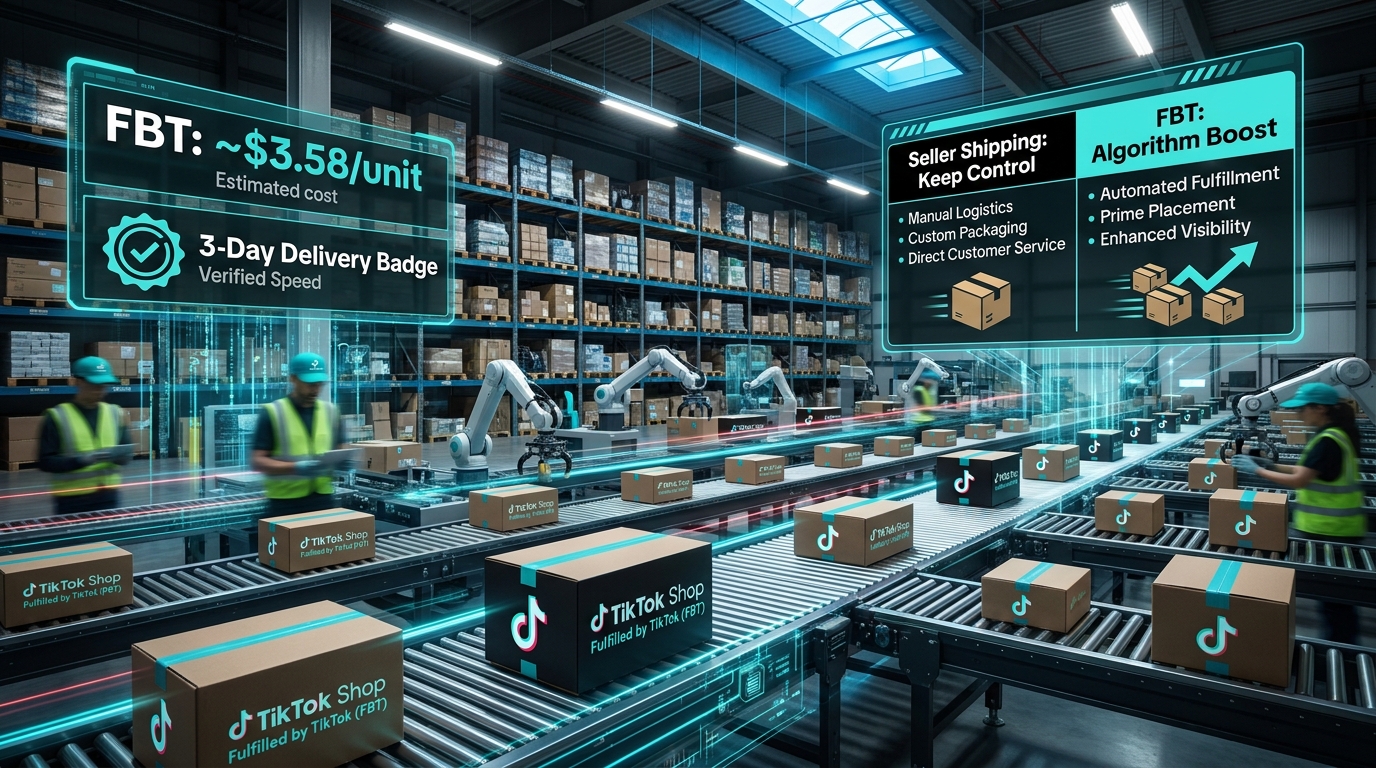
TikTok Shop markets Fulfilled by TikTok with two primary value propositions: lower per-order fulfillment costs than self-managed shipping, and the “Free 3-Day Delivery” badge that appears on FBT-eligible listings in the app. Both claims have merit. Both also come with caveats that significantly affect whether FBT is actually the right call for any given seller or product.
The Actual FBT Fee Structure
TikTok’s published FBT rates for the US in 2026 start at approximately $3.58 per unit for single-unit orders in the 0–4 lb weight range. The rate scales upward with product weight and order complexity. Multi-unit orders within the same package receive a partial per-unit discount. Long-term storage fees apply after the initial 60-day free storage window expires, creating an additional cost for sellers with slower-moving inventory.
TikTok’s own estimates suggest FBT cuts per-order fulfillment costs by 20% to 35% compared to self-managed shipping for sellers who were already using commercial small parcel rates. That estimate is broadly credible for sellers shipping standard-size, sub-4-lb products with consistent order volumes — but it breaks down for sellers with:
- Heavy or oversized products that push into higher FBT weight tiers
- Slow-moving SKUs that incur long-term storage fees before they sell
- Fragile items with custom packaging needs that FBT’s standardized handling can damage
- High-value products where loss or damage liability under FBT terms is a meaningful financial exposure
The Algorithm Advantage (and Its Limits)
The FBT badge does appear to improve conversion rates and product visibility in TikTok’s feed. TikTok has confirmed that fulfillment speed and reliability are signals in the platform’s ranking system, and FBT products carry a verifiable delivery guarantee that self-shipped orders do not. For a platform where impulse purchase decisions happen in seconds, the “Free 3-Day Delivery” badge reduces a meaningful friction point in the checkout flow.
However, the visibility advantage of FBT is not unlimited. It’s one signal among many. Products with weak creative, thin affiliate coverage, or poor review profiles won’t be rescued by an FBT badge alone. The badge amplifies performance; it doesn’t create it.
The Decision Framework
The honest FBT calculus depends on your specific product economics. Sellers should run the numbers on three scenarios: current self-managed shipping costs, FBT fees at projected volume, and the revenue impact of improved conversion from the delivery badge. If the conversion lift from FBT — even estimated conservatively at 5% to 10% — more than offsets the per-unit cost difference, FBT is likely the right move. If it doesn’t, or if your products have characteristics that make FBT handling risky, the voluntary option to remain on Seller Shipping (while it exists) deserves serious consideration.
Account Health Rating: The 0–1,000 Score That Controls Your Entire Business
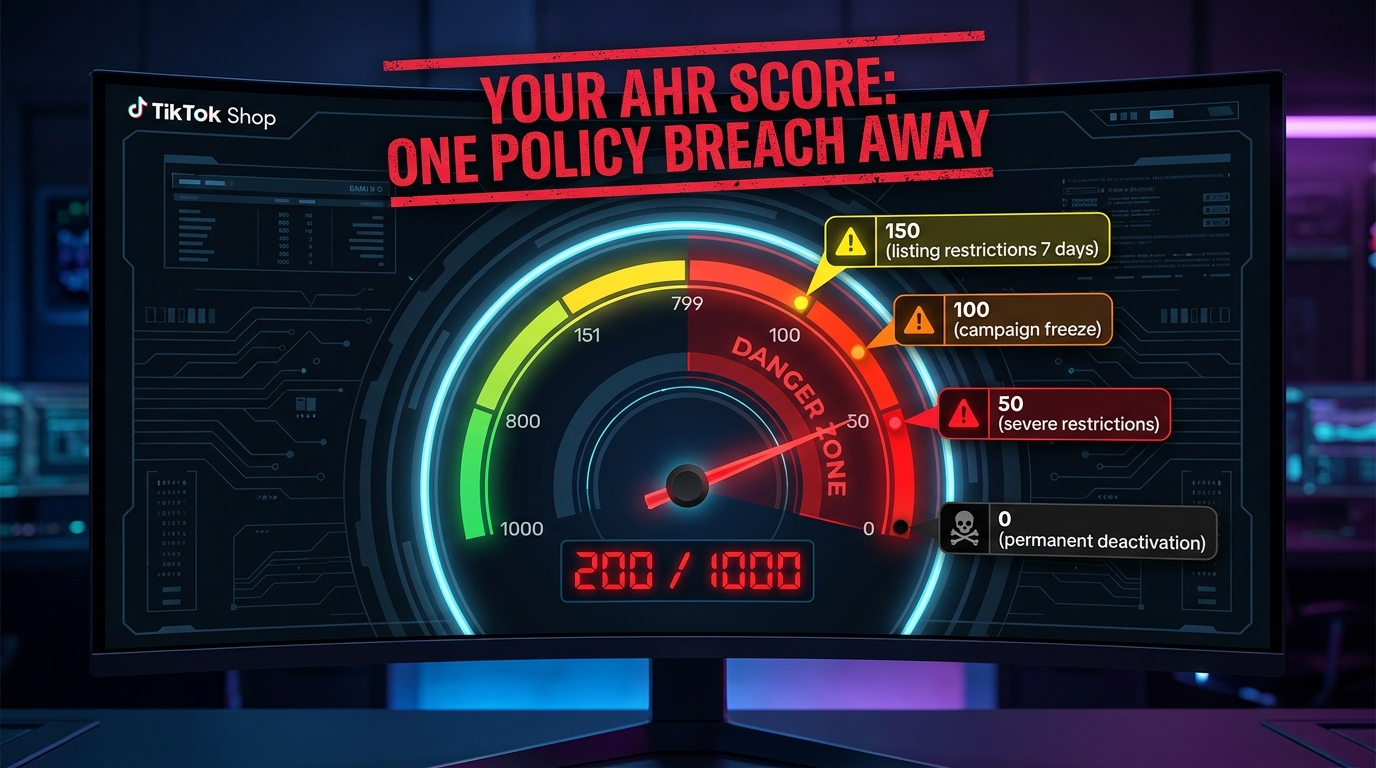
Of all the structural changes TikTok Shop has introduced in 2026, the Account Health Rating (AHR) system may be the most consequential — not because of what it does to sellers who violate policies outright, but because of what it does to sellers who simply fail to track the cumulative weight of small operational lapses.
How the AHR System Works
The AHR is a numerical score that ranges from 0 to 1,000 points, calculated based on a rolling 180-day window of seller activity. All new sellers start at 200 points. Points are added for good performance and compliance, and deducted when violations occur — whether those violations are policy breaches, fulfillment failures, content standard misses, or return-handling issues.
The score is color-coded into health bands, and enforcement thresholds are set at four specific milestone scores:
- 150 points: First enforcement level. Listing restrictions applied for 7 days. Campaigns may be paused on affected products.
- 100 points: Escalated enforcement. Campaign freezes extend to the shop level. Visibility in search and feed is reduced.
- 50 points: Severe restrictions. Most promotional capabilities disabled. Seller’s products may be removed from relevant discovery surfaces.
- 0 points: Permanent deactivation of the seller account.
What Triggers AHR Deductions
The AHR deduction system covers a broad range of violation types, which is precisely what makes it treacherous for sellers who think “compliance” just means not selling prohibited goods. Deductions occur across several categories:
Fulfillment violations: Late dispatch, missed SLAs, unconfirmed shipments, and failure to meet carrier scan requirements all generate AHR deductions. The severity of the deduction scales with the frequency and magnitude of the failure. A single late shipment in a high-volume month might cost a handful of points. A pattern of late dispatch over several weeks can push a seller through multiple enforcement thresholds rapidly.
Content and listing violations: Misleading product descriptions, image standard violations, unsupported claims, and the new “fictitious listing” category all produce deductions. The fact that TikTok’s June 2026 Product Listing Policy introduced specific new standards means sellers who haven’t reviewed their listings since launch are almost certainly sitting on violations they don’t know about yet.
After-sale violations: Slow response to buyer inquiries, failure to process refunds within policy timelines, and improper return handling all affect AHR. The platform treats buyer experience as a direct input to seller health scores — a design choice that mirrors Amazon’s own approach and creates meaningful operational pressure for sellers who don’t have dedicated customer service capacity.
The Hidden Danger of the Starting Score
New sellers beginning at 200 points are, mathematically, closer to the first enforcement threshold (150) than they might realize. A seller who launches, has a rough first two weeks with fulfillment issues during onboarding, accumulates some content flags from an early product that gets updated, and receives a few after-sale deductions from buyer disputes could plausibly hit 150 points before they’ve even had their first good month on the platform.
This is not a hypothetical edge case. Sellers new to TikTok Shop’s operational requirements — particularly those migrating from Amazon, where the policy environment is different — frequently underestimate how quickly AHR deductions compound. The 180-day rolling window means early mistakes don’t age out quickly. They stay on the score for six months.
The Fictitious Listing Crackdown and the June 2026 Product Listing Policy
TikTok Shop’s June 2, 2026 Product Listing Policy update is the most substantive change to content standards the platform has made since launch. It touches three major areas: image requirements, claim accuracy, and a newly explicit prohibition on “fictitious listings.”
What “Fictitious Listings” Actually Means
The term is broader than it might initially sound. A “fictitious listing” under TikTok Shop’s March 2026 enforcement update — which preceded the June 2026 policy — refers not just to outright fraudulent products, but to any listing where the product representation materially diverges from what the buyer actually receives. This includes:
- Listings using manufacturer sample images that don’t match the actual production unit being shipped
- Descriptions that include features or specifications the product doesn’t possess
- Bundle listings where the stated bundle contents don’t match the physical package
- Listings where the primary image shows an accessory configuration not included in the base product price
For sellers who source products from overseas manufacturers and rely heavily on supplier-provided imagery — a common practice in the dropshipping and private-label spaces — this creates a genuine compliance risk. The images your supplier gave you may have been accurate for the sample. Whether they’re accurate for the batch that’s now in your FBT inventory is a different question.
New Image Requirements
The June 2026 policy introduced several specific image standards. Each listing must include at least three original product images. Listings that rely solely on manufacturer stock photos with third-party watermarks are explicitly non-compliant. Cover images are now regulated for overlay content, misleading composition, and category-specific restrictions — meaning the “lifestyle” hero image that shows your product in an aspirational context may now require review to confirm it doesn’t violate the new overlay rules.
TikTok issued a “Review and Correct Product Listing Information by 20 June 2026” notice requiring all sellers to audit their active listings against the new standards. For sellers with large catalogs — hundreds or thousands of active SKUs — this was a significant operational undertaking on a very compressed timeline.
Ingredient and Claim Disclosure
For new product categories, particularly in health, wellness, and personal care, the June 2026 policy expanded ingredient and material disclosure requirements. New listings in these categories must include complete ingredient information where applicable. The enforcement mechanism here is automated flagging during the listing review process, but manual review can be triggered by buyer complaints or affiliate creator activity that generates volume on a non-compliant listing.
The Practical Risk to Product Launch Cadence
For sellers who rely on frequent product launches — adding new SKUs quickly to capitalize on trending content — the new listing policy creates a meaningful speed bump. Each new listing now requires more original photography, verified claim accuracy, and in some categories, ingredient disclosure that may require consultation with suppliers. Sellers who launch fast and fix problems later are now facing AHR deductions for the “fix later” part of that model.
Refund Policy Changes: Auto-Approvals, “Change of Mind,” and What Sellers Are Actually Absorbing
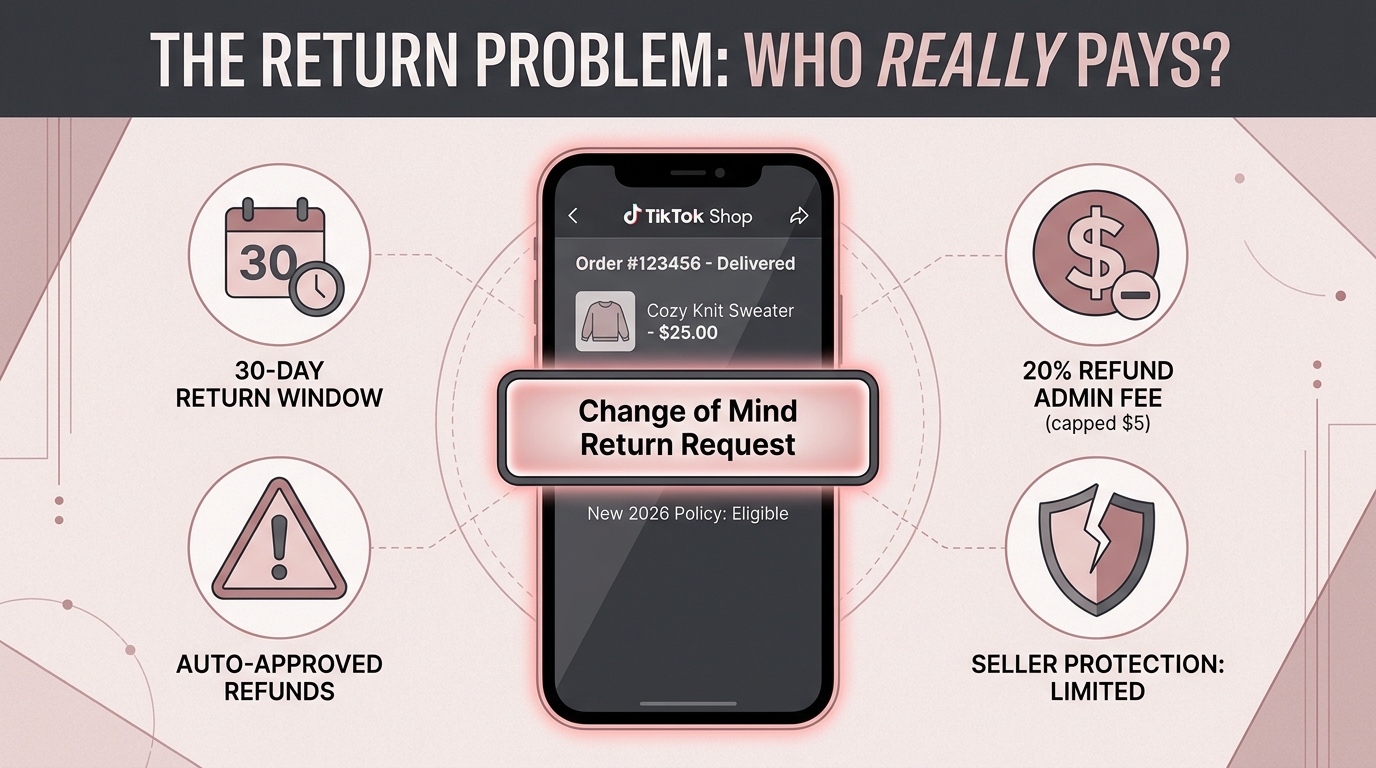
TikTok Shop’s return and refund framework has undergone several changes in 2026, with the clearest trend being that the platform is increasingly automating buyer-side decisions — sometimes in ways that leave sellers holding costs they didn’t anticipate.
The “Change of Mind” Rename and Its Implications
On June 11, 2026, TikTok Shop renamed the “No Longer Needed” return reason to “Change of Mind.” This sounds trivial. In practice, it reflects a broader policy stance: buyers can initiate returns for subjective dissatisfaction, and the renamed category explicitly acknowledges this as a legitimate return basis. Sellers were advised to review product quality before approving such returns — a guideline that places the operational burden on the seller without providing new structural tools to contest returns that may be abusive.
Auto-Approved Refunds
TikTok Shop’s refund system now includes conditions under which refund-only requests can be automatically approved without seller review. These conditions include situations where the seller’s shop is deactivated, where the product listing has been removed from the platform, or where the refund request matches the parameters the seller had previously set for automatic handling. In the latter case, sellers who set overly permissive auto-approval rules during initial setup may find their refund policies triggering on cases they didn’t intend to cover.
The auto-approval mechanism is designed to improve buyer confidence — a stated platform goal. But from the seller’s perspective, it removes a review step that could catch fraudulent or abusive return requests before they’re processed.
The 30-Day Return Window
TikTok Shop’s standard return window is 30 days from delivery for most product categories. This is meaningful when combined with the platform’s affiliate-heavy discovery model. Products that go viral through creator content often experience compressed, spike-shaped demand curves — large volumes of orders in a short window, followed by a wave of returns that arrives 20 to 30 days later, often after the initial revenue figures have already informed a seller’s next purchasing or inventory decision.
The 20% refund administration fee (capped at $5/SKU) applies to those returns. In high-return categories, this fee layers onto the direct cost of the returned goods and reverse logistics, creating a total return cost that can reach 25% to 40% of the original order value.
Seller Protection: What Exists and What Doesn’t
TikTok’s official seller protection framework for returns is narrower than many sellers assume. Protection is available for orders that are confirmed delivered and where buyers are making claims that contradict tracking data. But for the broader category of “buyer dissatisfaction” returns — including Change of Mind — seller protection is largely limited to dispute documentation and appeals. The appeals process is real but time-consuming, and the outcome depends heavily on the completeness of the seller’s evidence and the specific circumstances of the transaction.
The practical takeaway: sellers in high-impulse, trend-driven categories need to price return risk explicitly into their unit economics. Treating return rates as a fixed, stable input — rather than a variable that spikes sharply after viral content events — is one of the most common margin miscalculations on TikTok Shop.
The Margin Reality: What’s Actually Left After All the Fees
Let’s build a concrete picture of what TikTok Shop seller economics actually look like in 2026 across different operating models. These are representative scenarios based on industry benchmarks, not isolated best-case or worst-case outlooks.
Scenario A: Affiliate-Heavy, FBT-Enabled, Mid-AOV Product ($35 sale price)
- Referral fee (6%): $2.10
- Transaction fee (2%): $0.70
- Affiliate commission (15%): $5.25
- FBT fulfillment: $3.58
- Ad spend (7% of revenue): $2.45
- Blended return cost (8% return rate): $1.40
- Total platform costs: $15.48 (44.2% of revenue)
- Typical COGS (45% gross margin product): $19.25
- Net before overhead: $0.27 (0.8% net margin)
This is the math that’s quietly ending businesses on TikTok Shop right now. A $35 product with a healthy 45% gross margin, running a standard affiliate and FBT setup, is essentially breaking even before paying for staff, software, photography, or any other overhead.
Scenario B: Organic-First, High-AOV Product ($85 sale price, 55% gross margin)
- Referral fee (6%): $5.10
- Transaction fee (2%): $1.70
- Affiliate commission (8% — selective, organic-amplified): $6.80
- Seller shipping (self-managed, estimated): $6.50
- Ad spend (4%): $3.40
- Blended return cost (5% return rate): $2.55
- Total platform costs: $26.05 (30.6% of revenue)
- COGS (55% gross margin): $38.25
- Net before overhead: $20.70 (24.4% net margin)
This is what a well-structured TikTok Shop operation looks like for a seller who’s found the right product profile and isn’t drowning in affiliate dependency. The differences — higher AOV, better gross margin, controlled affiliate spend, and lower return rate — are each individually achievable. Achieving all of them simultaneously is the operational discipline that separates TikTok Shop winners from the rest.
The Industry Benchmark Range
Across multiple seller analyses and industry reports, the consensus for 2026 is that the all-in take rate on TikTok Shop lands between 30% and 55% of GMV depending on model. Sellers running lean organic programs in high-margin categories can net approximately 18% to 24% after all platform costs. Sellers running aggressive affiliate and paid acquisition programs in price-competitive categories are often netting in the 5% to 12% range — or less.
How the Policy Shift Is Creating a Two-Tier Seller Market
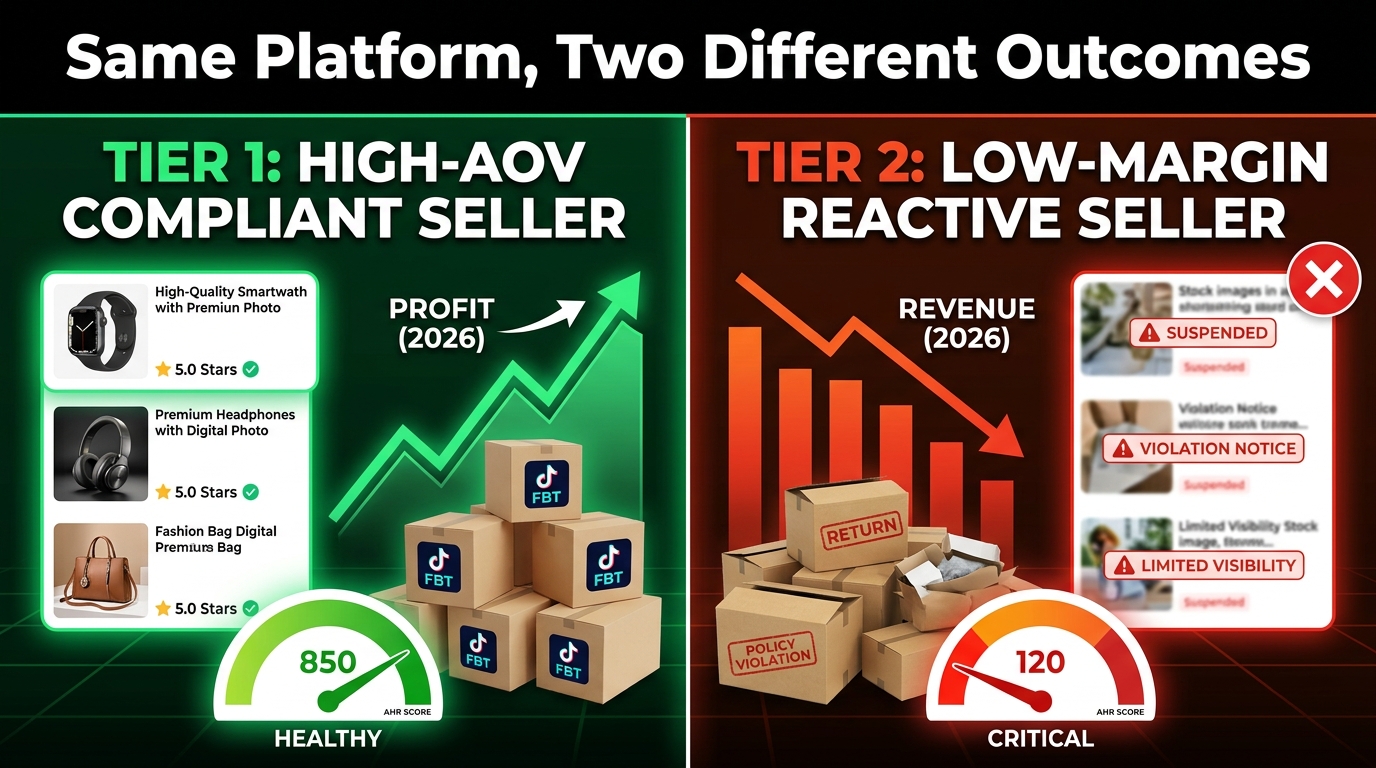
The combined effect of TikTok Shop’s 2026 policy changes — the fee increases, the AHR system, the listing standards, the logistics direction — is not random. It is producing a specific, predictable structural outcome in the seller ecosystem: a bifurcation between two very different kinds of operators.
Tier 1: Compliant, High-Margin Operators
The sellers who are thriving under the new framework share a set of characteristics that aren’t accidental. They tend to sell products with average order values above $50, which gives the fee stack less destructive power relative to revenue. They have gross margins above 50%, which means they have real buffer between revenue and cost of goods before platform fees enter the picture. They run selective affiliate programs with curated creator relationships and commission rates that have been negotiated rather than defaulted to category norms.
These sellers are also compliant in advance of enforcement. Their listings were reviewed against the June 2026 policy before the deadline. Their AHR scores are healthy because their fulfillment operations are built around TikTok’s SLA requirements, not retrofitted to them. They are voluntarily adopting FBT for their best-performing SKUs because the conversion data shows it works, not because they’re being forced into it.
For these sellers, the policy changes are actually good news. Tighter standards and higher compliance burdens function as market consolidation mechanisms — they push out the low-margin, high-volume operators who were competing on price using unsustainable economics, and they create more space for higher-quality, higher-priced products to rank and convert.
Tier 2: Reactive, Low-Margin Operators
At the other end of the market are sellers who built their TikTok Shop presence on the platform’s original, more permissive economics. Low-priced products with thin margins, heavily affiliate-dependent discovery, and listing libraries that haven’t been touched since launch. These sellers are finding that:
- The referral fee alone now takes a larger percentage of margin than their business models can absorb
- Their AHR scores are under pressure from the combination of fulfillment issues, listing flags, and return handling deductions
- The June 2026 listing policy has put a meaningful fraction of their SKU catalog into technical violation
- Their affiliate commission structures were set during a period when platform traffic was cheaper, and they haven’t been renegotiated to reflect current economics
The US market has approximately 475,000 registered TikTok shops but only around 216,000 active sellers. That gap — roughly 260,000 registered shops with no meaningful activity — reflects the early shake-out that has already happened. The 2026 policy environment will accelerate this consolidation further.
The Platform-Always-Wins Dynamic
It’s worth being clear-eyed about what’s happening at the structural level. TikTok Shop’s global GMV is projected to reach approximately $112 billion in 2026, up from $33.2 billion in 2024. The US market alone is on a path from $9 billion in 2024 to over $20 billion in 2026. At that scale, TikTok can afford to make the platform more expensive for sellers, because the demand-side traffic — 57.7 million US buyers — doesn’t disappear when fees go up. The sellers who can’t afford the new economics simply get replaced by sellers who can.
This is the fundamental asymmetry every TikTok Shop seller is operating within: the platform has pricing power because the buyers are there, and as long as the buyers are there, the platform can extract more from sellers. Understanding this dynamic doesn’t mean sellers should exit. It means they need to build businesses that remain viable as the extraction rate increases — which is a different design challenge than simply maximizing for current-month GMV.
How to Restructure Your TikTok Shop Operations for the New Fee Reality
Given everything above, what should a seller actually do? The answer isn’t to exit the platform — TikTok Shop’s buyer base is real, the growth trajectory is real, and for the right products and operators, the margins are real. The answer is to rebuild the business model around the 2026 cost structure rather than the 2023 one that many sellers are still implicitly working from.
Audit Your Actual Take Rate, Not Your Reported Take Rate
Most sellers know their referral fee. Far fewer have calculated their true all-in take rate by mapping every cost layer: referral, transaction, all affiliate commissions (including any platform-suggested rates), fulfillment, advertising, and a realistic return cost. Do this calculation for your top 20 SKUs by revenue. The results will almost certainly surprise you. And the answer to “does this product have a viable margin on TikTok Shop?” often varies significantly across a catalog — which means the response isn’t to exit the platform, but to exit specific products.
Raise Your AOV Minimum
The single most effective structural response to rising percentage-based fees is raising the average order value of what you sell. Every flat cost (the FBT per-unit fee, the refund administration cap) becomes cheaper as a percentage of revenue when AOV goes up. Every percentage-based fee stays the same percentage but represents more margin coverage when the absolute order value is higher. Sellers whose TikTok Shop catalogs are currently centered on sub-$25 products need to evaluate whether moving into higher-priced configurations — bundles, multi-packs, premium variants — makes the economics viable.
Restructure Your Affiliate Program by Product Maturity
Affiliate commissions are the largest and most variable component of most TikTok Shop cost stacks. They’re also the one that’s most directly in the seller’s control. The platform’s ecosystem makes it tempting to offer high commissions to attract creator attention — and that approach makes sense during product launches and trend chases. But maintaining 20% commissions as a steady-state baseline for mature products is economically indefensible for most sellers. Build a creator tiering system: launch-phase creators get higher commissions for the traffic momentum they provide, while mature-product affiliate rates are renegotiated down as the product finds its organic audience.
Conduct a Proactive AHR Audit
Log into Seller Center and check your AHR score and the specific violations contributing to any deductions. If your score is below 500, treat that as an active risk signal, not background noise. Map every deduction category to an operational process in your business and assign accountability for correcting it before the violation repeats. The 180-day rolling window means that proactive improvement today begins aging out old violations in six months. The sellers who wait until they hit 150 points to start caring about AHR are the ones who discover that six months of rolling data is very hard to overcome quickly.
Review Every Listing Against the June 2026 Policy
If you haven’t done a full catalog review since June 2, 2026, you have an unknown number of listings in technical violation. Prioritize your highest-revenue SKUs and work through the catalog systematically. The specific items to check: cover image compliance with the new overlay rules, minimum three original images per listing, accuracy of all specifications and claims against the current physical product, and ingredient disclosure completeness for any health, wellness, or personal care items.
Begin the FBT Transition on Your Best SKUs
You don’t have to convert your entire catalog to FBT to benefit from it. Start with your five to ten highest-velocity products — the ones where the conversion lift from the 3-Day Delivery badge is most likely to be meaningful and where your unit economics can absorb the FBT fee. Run a 60-day comparison of FBT vs. self-shipped conversion rates on those products. If the data supports broader adoption, expand. If it doesn’t, hold on the remaining catalog until the operational case is clearer. What you shouldn’t do is treat the February 2026 mandate rollback as a reason to delay this analysis indefinitely.
The Compliance Dividend: Why Early Adapters Win Disproportionately
There’s a counterintuitive dimension to TikTok Shop’s 2026 policy environment that doesn’t get enough attention in the seller community’s understandably frustrated response to fee increases and compliance demands: early adaptation to stricter standards creates durable competitive advantage.
When TikTok began enforcing the June 2026 Product Listing Policy, a meaningful fraction of active listings across the platform were out of compliance. Sellers who had audited and updated ahead of the deadline continued operating without disruption while competitors faced listing removals, visibility reductions, and AHR deductions. During the period when those competitors were scrambling to restore their catalog performance, compliant sellers were capturing incremental search share and affiliate attention that their competitors had temporarily ceded.
The same dynamic applies to FBT adoption and AHR management. Sellers with consistently healthy AHR scores qualify for promotional programs, campaign access, and creator collaboration opportunities that TikTok gatekeeps by health score. A seller at 850 AHR has access to tools and visibility that a seller at 250 AHR simply doesn’t — even if the lower-scoring seller is generating more nominal GMV in any given month.
There’s also a structural moat that builds over time for compliant operators. As TikTok’s enforcement tightens and the policy environment becomes more complex, the operational infrastructure required to stay consistently compliant — the systems for catalog auditing, AHR monitoring, fulfillment SLA tracking, and return rate management — becomes harder for new entrants and reactive sellers to replicate quickly. Sellers who build that infrastructure early aren’t just avoiding penalties. They’re building a durable operational capability that their less-organized competitors will struggle to match.
The platform’s direction is not ambiguous. TikTok Shop is moving toward a more structured, more expensive, more enforced marketplace environment. The sellers who will win disproportionate share of the projected $112 billion in global 2026 GMV are those who adapt their operations now — not those who wait for each successive policy change to force adaptation under duress.
Conclusion: The Platform Has Changed. Has Your Business Model?
TikTok Shop in 2026 is not the platform that launched in 2023. The fees are higher, the compliance requirements are stricter, the logistics direction is clear, and the account health system creates real existential risk for sellers who run operations that were adequate twelve months ago but aren’t adequate today.
None of this means TikTok Shop is the wrong platform. The buyer base is enormous, growing, and genuinely buying — not just browsing. The GMV trajectory from $9 billion to $20+ billion in the US alone in two years reflects real purchase behavior, not platform optimism. The opportunity is real.
But the opportunity is now structured differently than it was. The key actionable takeaways for sellers operating in this environment:
- Calculate your true all-in take rate for every major SKU. If you’re working from the headline 6% referral fee, you don’t actually know your margin.
- Treat the shipping mandate rollback as a temporary pause, not a strategic victory. Begin your FBT transition planning now, on your own timeline, rather than waiting for the next mandate to force it under pressure.
- Monitor and actively manage your AHR score. New sellers starting at 200 points are 50 points from the first enforcement threshold. That buffer disappears faster than most sellers expect.
- Audit your listings against the June 2026 Product Listing Policy. Unknown violations accumulate AHR deductions on a rolling 180-day clock. Every day you wait is a day of potential scoring damage you don’t know about.
- Price return risk explicitly into your unit economics. The “Change of Mind” return category and auto-approved refunds mean buyer-side return rates are a structural cost, not an anomaly to be managed case by case.
- Restructure affiliate commissions by product maturity. Launch-phase rates should not be your steady-state rates. The difference is often the deciding factor between profitable and breakeven operations.
- Shift toward higher-AOV products where feasible. The entire fee structure is more manageable at $75 per order than at $25 per order, even at the same percentage rates.
The platforms always set the rules. What differentiates the sellers who thrive from those who merely survive is whether they understand the rules well enough to build businesses around them — or whether they’re still operating on assumptions that were accurate two years ago and haven’t been true since.
TikTok Shop has given you the policy documents, the fee schedules, and the enforcement timelines. The only remaining variable is what you do with that information.