

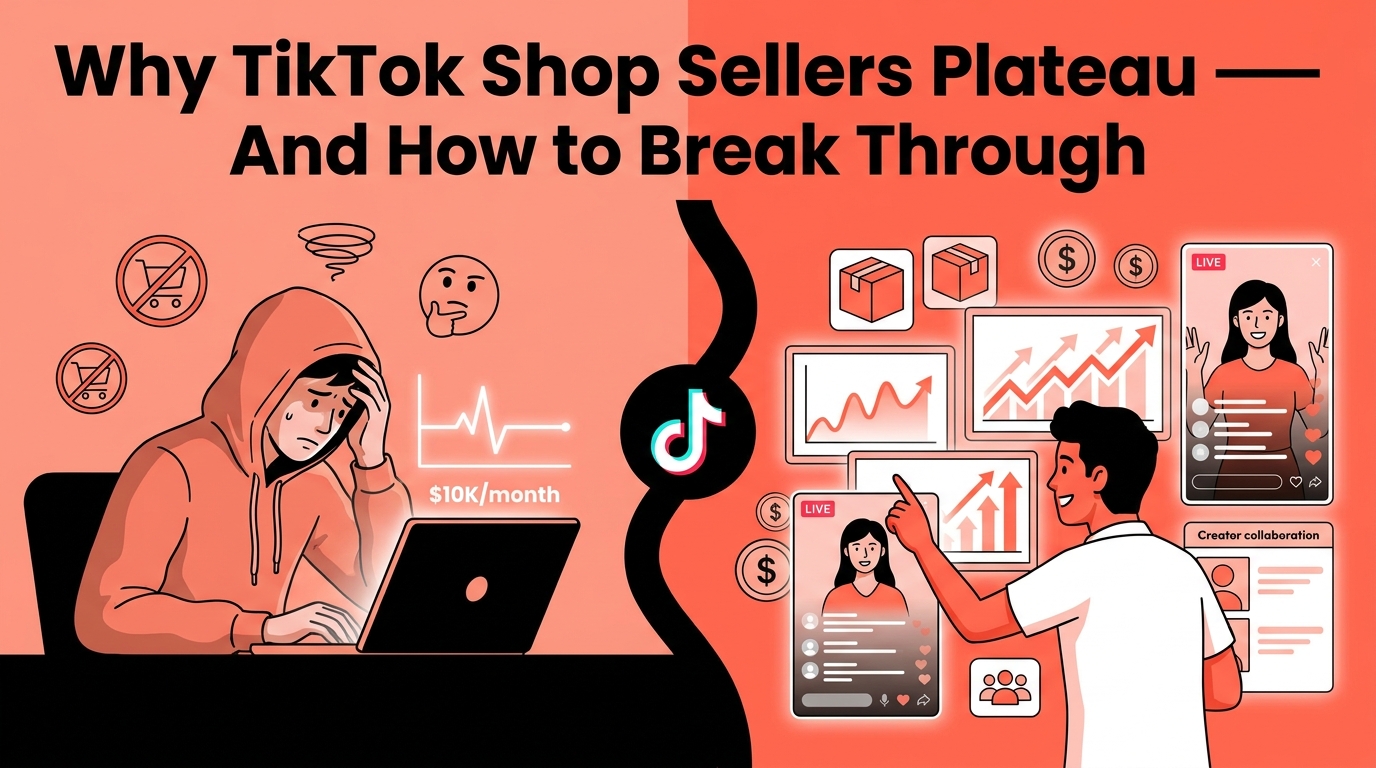

There is a ceiling that most TikTok Shop sellers hit — and almost nobody talks about it honestly. You launch, you get some traction, maybe you go viral once or twice, and then the numbers stall. Monthly GMV hovers somewhere between $5,000 and $15,000. New videos get views but conversions slow. You keep posting, keep seeding creators, and nothing seems to move the dial.
This is not bad luck. It is not the algorithm punishing you. It is a structural problem — and it is completely solvable, but only once you understand what is actually causing it.
The sellers who push past that ceiling share a set of common behaviors: they treat TikTok Shop as a multi-channel business rather than a single-content play, they build creator relationships that compound over time, they understand their real unit economics, and they know exactly which metrics are telling them the truth versus which ones are flattering them into complacency.
This post breaks down the mechanics of what separates plateaued shops from high-growth ones in 2026 — from product selection and creator strategy to fulfillment economics, paid traffic timing, and the cross-channel stack that protects you from platform dependency. Whether you are just starting out or already doing consistent revenue and trying to scale, there is a layer of the system here you probably have not fully built yet.
TikTok Shop’s Scale in 2026 — The Opportunity Is Real, But So Is the Crowding
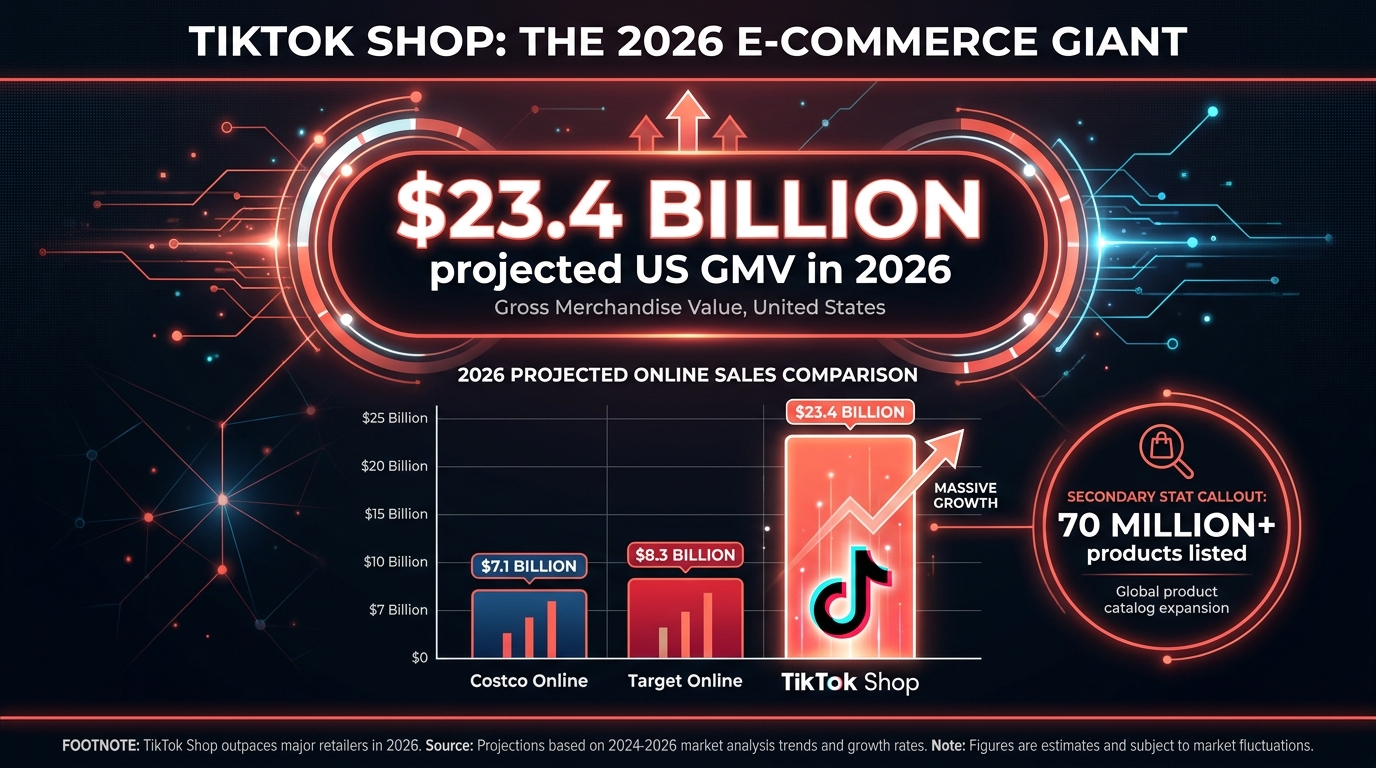
Let’s start with the numbers, because they put the stakes in context. TikTok Shop is projected to reach $23.41 billion in US sales in 2026 — a figure that would put it ahead of what Costco and Target generate through their online channels. That is not a niche social experiment. That is a mainstream retail force.
The platform currently hosts more than 70 million products, which means the catalog is already enormous and competition within categories is real. TikTok Shop launched in the US in 2023 and reached that scale in roughly three years — faster adoption than Amazon’s early ecommerce arc. The audience engine is simply different from anything that came before: TikTok’s recommendation algorithm does not require a seller to have followers, a history, or paid reach to get in front of buyers. A brand-new account can go viral on day one. That is both the platform’s greatest feature and one of its most misunderstood ones.
The Follower Myth
Many new sellers assume TikTok Shop success is tied to follower count. It is not — at least not directly. The platform’s discovery engine surfaces shoppable content to users based on engagement signals, watch time, and behavioral data, not on how large a seller’s audience is. This is fundamentally different from Instagram Shopping or Pinterest, where your existing audience largely determines your reach.
The implication is important: a seller with 2,000 followers and a highly engaging product demo can out-convert a seller with 200,000 followers posting generic lifestyle content. The algorithm rewards relevance and engagement, not audience size. That said, follower count does matter for one specific use case — the affiliate program, where creators need a minimum threshold to participate as promoters. For sellers building their own content channels, though, follower accumulation is a lagging indicator, not a leading strategy.
The Crowding Problem
With 70 million products in the catalog, the floor-space problem is real. The Shop tab serves personalized recommendations, which means that buyers are not browsing a uniform marketplace — they see a curated feed that mirrors their interests and past behavior. This is good news for niche sellers and bad news for generic commodity players. If your product looks like 500 other products in the category, TikTok’s algorithm has no strong signal to surface yours over theirs. Differentiation — through presentation, creator relationships, and product specificity — is the only durable advantage in a crowded catalog.
The Discovery-to-Purchase Engine — How TikTok Shop Actually Converts
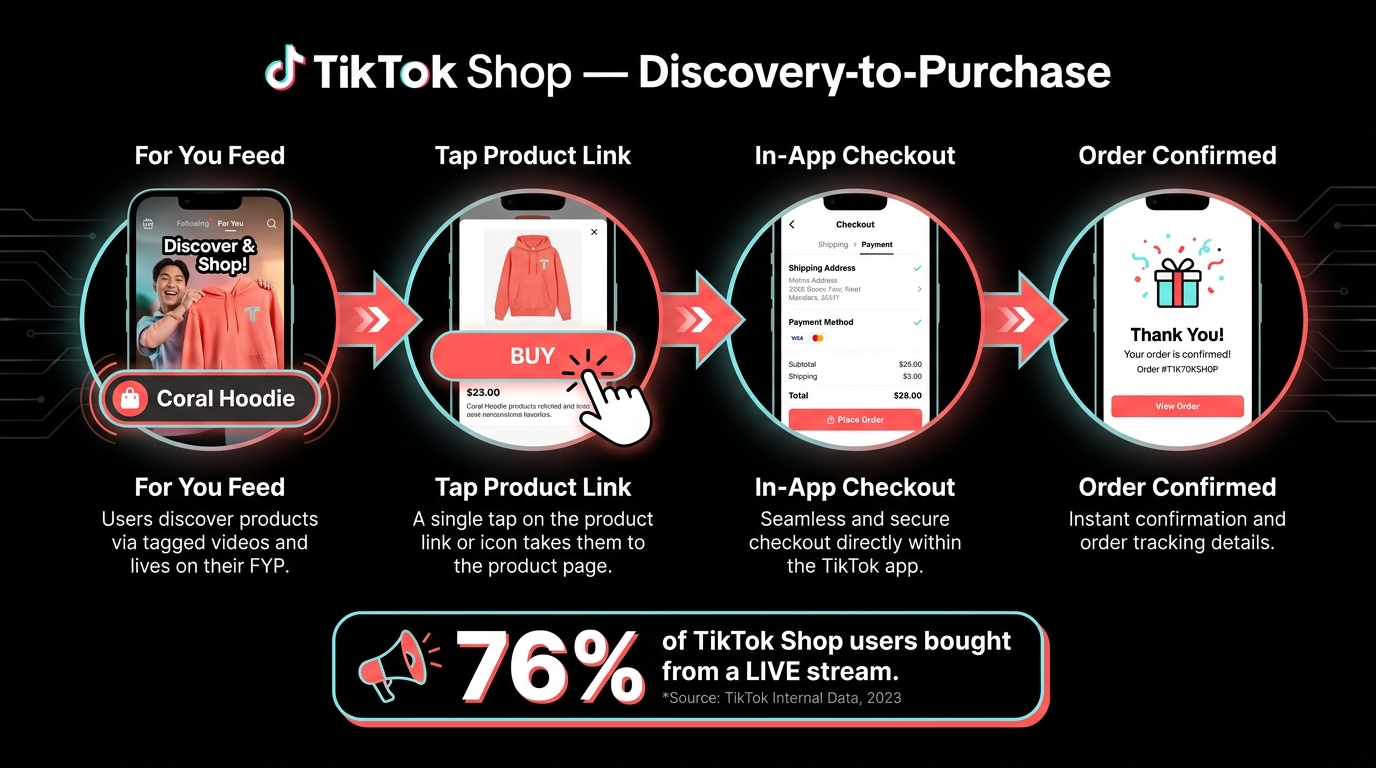
Understanding why TikTok Shop converts at the rates it does requires understanding what makes the purchasing journey fundamentally different from any other ecommerce channel. The answer is friction — or rather, the systematic removal of it.
On a traditional ecommerce path, a shopper might see a product mentioned on social media, visit a brand website, browse, add to cart, and then abandon — or come back later after a retargeting ad reminds them. Multiple steps. Multiple opportunities to drop off. TikTok Shop compresses this entire journey into a single in-app experience. A user is watching a video, sees a product they like, taps the shoppable link at the bottom of the screen, reviews the product page, and completes checkout — all without leaving the app they were already in.
The Psychology of In-Feed Commerce
This matters more than most sellers realize. Ecommerce conversion typically benefits from buyer intent — people who go to Google and search “best running shoes under $100” are already in a purchasing mindset. TikTok Shop converts a different psychological state: discovery impulse. The buyer was not looking for anything. They were entertained. The product appeared to solve a problem they had not consciously articulated yet, or sparked desire they did not know existed five seconds earlier.
This impulse-to-purchase dynamic creates a specific kind of buyer who buys fast and decides later whether they love the product. That is the user experience TikTok Shop was built around, and it explains why product presentation — the actual video — matters more than the product listing page. The listing page is where the buyer confirms what the video already convinced them of.
Live Shopping: The Highest-Converting Format
A 2025 GlobalData survey found that 76% of consumers who had used TikTok Shop bought an item from a livestream in the prior year. That is an extraordinary statistic for a format that most Western brands still treat as experimental. In Southeast Asian markets like Indonesia and Thailand — where TikTok Shop has been operating longer — live commerce already accounts for the majority of platform GMV. The US and UK are catching up rapidly.
What makes live shopping so effective is the combination of real-time demonstration, social proof (visible viewer counts and live comments), and artificial scarcity signals like countdown timers and limited stock indicators. It recreates the energy of a live market or televised shopping channel, but accessible from a phone at any hour. The format rewards sellers who can entertain, demonstrate, and create urgency simultaneously — and it heavily penalizes static, scripted, or low-energy presentations.
The 4 Sales Channels Within TikTok Shop — And Which One Most Sellers Ignore
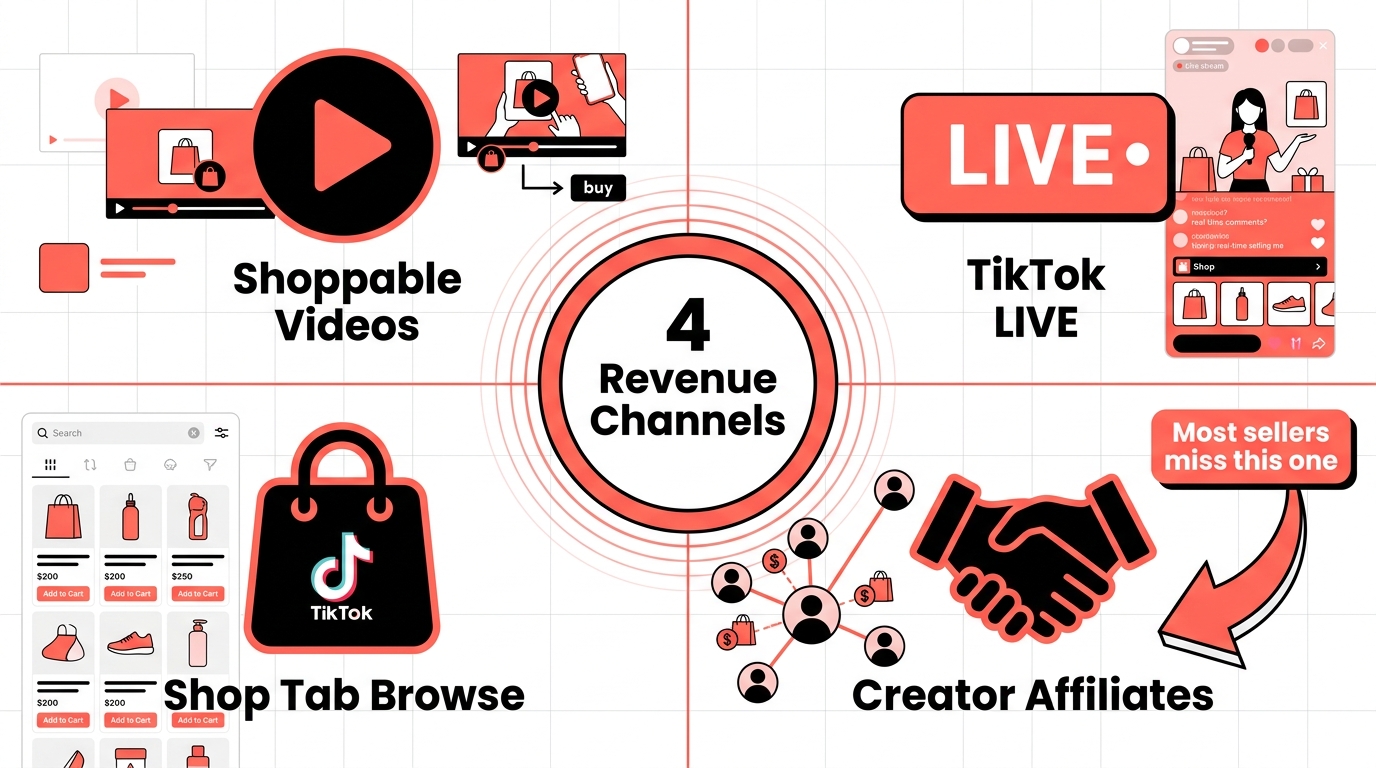
TikTok Shop is not one sales channel. It is four distinct revenue surfaces — and the sellers who plateau are almost always the ones using only one or two of them while leaving the others completely untapped.
Channel 1: Shoppable Videos (Organic)
This is the most visible channel and the one most sellers start with. You post a video — product demo, unboxing, problem-solution format — with a tagged product link embedded in the content. When viewers tap the link, they go directly to your product page without leaving the app. The key variable is not how many views your video gets. It is your shoppable video click-through rate: what percentage of viewers who saw the product tag actually tapped it. A video with 50,000 views and a 2% CTR drives more product page visits than a video with 200,000 views and a 0.3% CTR. Most sellers only look at views. That is the wrong metric to optimize for.
Channel 2: TikTok LIVE
Live shopping deserves its own extended treatment (covered in depth below), but in terms of the channel mix: LIVE is not just a different format. It is a different business with different inventory requirements, different hosting skills, and different scheduling logic. The mistake is treating LIVE sessions as “just going on camera sometimes.” The shops that generate significant GMV from LIVE treat it like a scheduled broadcast — consistent days, consistent times, consistent hosts, built around a repeatable format that viewers come back to.
Channel 3: Shop Tab
The Shop tab is TikTok’s native browse experience — a personalized product discovery feed that surfaces items based on user behavior and preferences. Many sellers do not actively think about the Shop tab at all because they cannot “post” to it directly. But your products appear in Shop tab feeds based on your shop’s performance signals: conversion rate, reviews, order fulfillment speed, and shop score. This is a passive channel that rewards operational excellence more than content creation. Clean listings, fast fulfillment, strong reviews, and a healthy shop score will get you Shop tab placement without a single additional video.
Channel 4: Creator Affiliate Program
This is the channel most sellers either underprioritize or approach wrong. The TikTok Shop affiliate program allows creators to add your products to their own videos and earn a commission on sales they generate. When it works, this is the most scalable channel in the entire stack — because you are effectively running hundreds of product demo videos simultaneously, created by people whose audiences already trust them, at zero upfront production cost.
The failure mode is treating affiliate outreach like a transaction: set a commission, hope creators find your product, occasionally message someone. The shops that genuinely scale through affiliates build relationships, invest in product seeding, create briefs that give creators enough information without restricting their voice, and think of their affiliate network as an asset they are continuously developing.
Product Selection Is Where Most Sellers Actually Lose
The single most common mistake among plateaued TikTok Shop sellers is not a marketing problem or a content problem. It is a product problem they have been misdiagnosing as something else. Specifically, it is one of two failure modes: choosing products that are trending but not viable at margin, or choosing products that may have good margins but are not “TikTok-native” — meaning they cannot be demonstrated compellingly in a short video format.
The Trending Trap
TikTok’s Creative Center surfaces what is selling right now. It is an enormously useful tool — but it is a trailing indicator. By the time a product appears prominently in trend data, it has already been through its discovery phase. The sellers who got in early are now established. The sellers entering now are entering a saturated market at a moment when the original demand wave is already cresting. Chasing trending products with no margin buffer, no supplier relationship, and no differentiated angle is a reliable path to thin sales and even thinner profits.
The smarter use of trend data is directional, not literal. If a problem-solving kitchen gadget category is trending, that tells you something about buyer receptivity to that problem space — not that you should source the exact same product 400 other sellers are already pushing.
What Makes a Product “TikTok-Native”
A TikTok-native product has a visible transformation, a dramatic before-and-after, or a demonstration that creates an immediate “I need that” reaction in the first three to seven seconds of a video. The product’s value proposition has to be showable, not just describable. A supplement with “proprietary blend of adaptogens” is hard to demonstrate visually. A cleaning solution that dissolves grease on contact — the viewer can see the result happen. A posture corrector that visibly changes someone’s silhouette in a ten-second demo — undeniable. A journal with a beautiful cover — forgettable in a feed.
This does not mean boring or simple products cannot work. It means the video strategy for them requires more creativity, and often a more sophisticated creator relationship to make the content feel authentic rather than forced. When product and format are mismatched, no amount of posting frequency will fix the underlying conversion problem.
Hero SKU vs. Catalog Strategy
Many sellers spread their focus across ten or fifteen products simultaneously, hoping one will break out. In practice, this dilutes your content, your creator briefing, your affiliate attention, and your shop’s algorithmic trust signals. The shops that scale fastest in 2026 typically have one hero SKU — a single product that is getting the lion’s share of content, creator seeding, and traffic — and they expand only after that product is generating consistent, profitable velocity. Once the hero is proven, the catalog grows from a position of strength rather than hope.
The Creator Affiliate Flywheel — Why Seeding Strategy Separates 6-Figure Shops
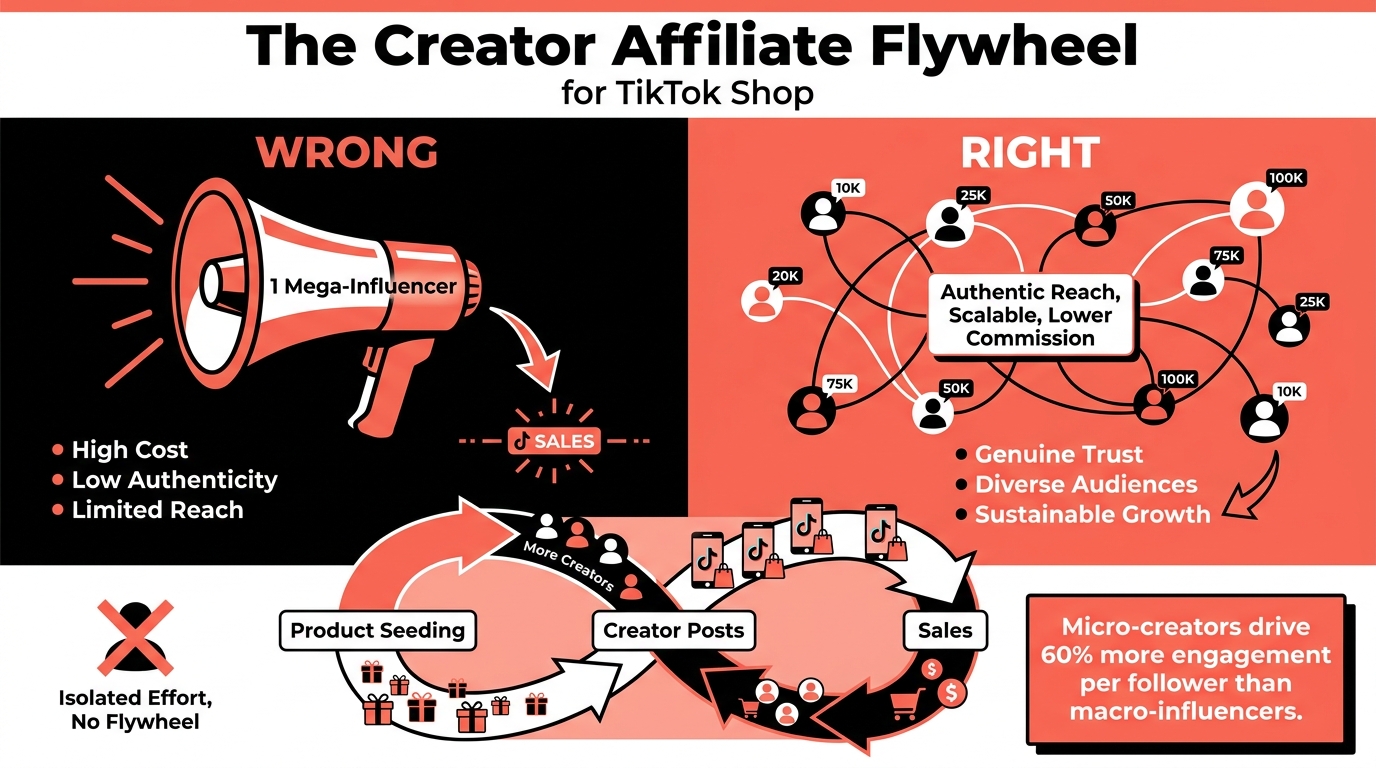
The creator affiliate program is where TikTok Shop’s model diverges most sharply from every other ecommerce channel — and it is the mechanism that most distinguishes the shops doing seven figures from those stuck at five. Getting it right is less about the commission rate you set and more about the infrastructure you build around creator relationships.
Finding the Right Creators (Not the Biggest Ones)
The instinct when building an affiliate program is to chase creators with the largest followings. This is usually the wrong move. Macro-influencers — those with hundreds of thousands or millions of followers — typically command either large upfront fees, performance guarantees, or both. Their audiences, precisely because they are large and broad, tend to be less aligned with any specific product category. Their conversion rates on shoppable content frequently underperform.
Micro-creators — generally those with between 10,000 and 150,000 followers — operate with higher audience trust, stronger niche alignment, and more genuine engagement. Their followers often see them as a peer or trusted advisor rather than a celebrity. When a micro-creator in the home organization space says a specific storage product changed their kitchen setup, their audience believes it in a way they would not for a sponsored post from a lifestyle influencer with a million followers. For TikTok Shop affiliate programs, micro-creator networks consistently outperform on cost-per-acquisition compared to fewer, larger partnerships.
Product Seeding vs. Paid Partnership
Product seeding — sending free product to creators with no contractual posting obligation — is underutilized and misunderstood. Many sellers avoid it because it feels like giving product away with no guarantee. But the math is different from what sellers assume. If you seed ten micro-creators with a $25 product and three of them post authentic content that drives $500 in sales each, you have spent $250 in product cost and generated $1,500 in gross revenue before factoring in affiliate commissions — and you may have generated content that continues converting for weeks. The creators who post without obligation also tend to post more authentically, which converts better than the mandatory-post content that often feels like a review checkbox being ticked.
The key to seeding that works is targeting creators who are already posting content in your product’s natural context. If you sell skincare, look for creators who already post skincare routines — not just beauty creators broadly. When a product fits naturally into content someone was already making, the post feels earned rather than sponsored, and the audience responds accordingly.
Commission Structures That Attract Serious Affiliates
Commission rates on TikTok Shop vary widely by category, but the sellers who attract the highest-quality affiliates — the ones who are genuinely selective about what they promote and whose audiences convert — tend to offer rates in the upper range of their category norms, combined with responsive communication and reliable fulfillment. Affiliates who have been burned by late shipping or poor product quality stop promoting. They have limited time and creator capital, and they allocate it to sellers who make them look good to their audiences. Your fulfillment and product quality are affiliate retention tools, not just customer experience ones.
TikTok LIVE Is a Different Business — Treat It That Way
Live shopping on TikTok is often treated as a feature sellers add to their existing strategy. In reality, it is better understood as a separate sales business that happens to run on the same platform. The sellers doing significant LIVE GMV have built specific operational infrastructure around it that looks nothing like their organic video operation.
The Scheduling Logic of LIVE
TikTok’s algorithm rewards LIVE sessions with consistent scheduling. When you go live at the same time on the same days each week, the platform learns to surface your session to viewers who are likely to engage — and repeat viewers begin to anticipate your broadcasts and return voluntarily. This is the same behavioral dynamic that made television appointment viewing work for decades. Random, unpredictable LIVE sessions get less algorithmic support and build no audience habit. Sellers who treat LIVE like a spontaneous format tend to get inconsistent results and eventually abandon it.
The minimum viable LIVE cadence to start seeing compounding effects is typically three to four sessions per week, each of at least 60 to 90 minutes. That may sound like a large time commitment, and it is — which is why LIVE commerce should be treated as a resource allocation decision, not just a content experiment.
The Host Effect
In live shopping, the host is the product at least as much as the product is. Energy, authenticity, responsiveness to the chat, ability to demonstrate, and the skill of creating urgency without being pushy are all host variables that directly drive conversion. A highly engaging host selling a mediocre product will frequently outperform a disengaged host selling an excellent one. This means that finding, training, or becoming a compelling LIVE host is a genuine operational priority — not a nice-to-have.
Brands that do not have a naturally charismatic presence on camera have several options: hire a dedicated LIVE host (increasingly common in Southeast Asia and beginning to emerge in the US market), partner with a creator who runs LIVE sessions for multiple brands, or invest in host training. Whatever the approach, “we will just wing it” is not a live commerce strategy.
Inventory and LIVE-Specific Planning
LIVE sessions require different inventory logic than standard ecommerce. You need to be able to show limited quantity signals convincingly — “we only have 47 of these left” — and actually back that up with accurate stock counts. Overselling during a LIVE is a fulfillment disaster and a trust killer. Many shops create LIVE-specific SKUs or bundle configurations that exist only in the LIVE context, allowing for different pricing, different packaging, or a perceived exclusivity that drives session-specific conversion.
The Fulfillment Reality — Where Profit Actually Goes
The financial math of TikTok Shop is more complex than it appears at the gross revenue level, and this is where many sellers discover they are working hard for thin or even negative margins. Understanding the full cost stack — not just product cost and platform fees — is what separates sustainable TikTok Shop businesses from operations that burn out after a viral moment.
TikTok Fulfilled vs. Seller-Fulfilled Shipping
TikTok offers its own fulfillment option, TikTok Fulfilled (TF), similar in concept to Amazon FBA. You send inventory to TikTok’s warehouses and they handle pick, pack, ship, and returns processing. The primary advantage is speed and consistency — two-day delivery expectations increasingly drive both conversion and reviews on the platform. The tradeoff is cost: fulfillment fees, storage fees, and the loss of direct control over the unboxing experience.
Seller-fulfilled shipping gives you more control over packaging (which matters enormously for generating organic unboxing UGC) but requires robust logistics infrastructure to meet the delivery speed expectations TikTok buyers now have. Late shipments directly damage your shop score, which in turn reduces your Shop tab visibility. Speed is not optional — it is a ranking input.
Return Rates in Social Commerce
Social commerce has higher return rates than search-intent ecommerce by nature. Buyers who purchase on impulse — which describes a significant portion of TikTok Shop transactions — have a higher rate of post-purchase reconsideration than buyers who researched a product before buying it. This is not a TikTok-specific problem; it is an inherent property of discovery-driven commerce. But it has to be modeled into your margin math. If your product category has a 15–20% return rate and you did not plan for it, you will find yourself consistently surprised by profitability that does not match your gross sales numbers.
Packaging as Content Infrastructure
One of the undervalued assets in TikTok Shop fulfillment is the physical package itself. Buyers who receive a thoughtfully designed package — something that is interesting to open, photograph, and share — frequently post organic unboxing content. This UGC then functions as additional product demo and social proof, appearing in the feeds of the creator’s own audience at zero additional cost to you. Investing in distinctive packaging — inserts, custom tissue paper, handwritten-feel thank-you notes — creates a self-sustaining content loop that sellers using generic brown boxes leave completely on the table.
Paid Traffic on TikTok Shop — When to Turn It On (And When Not To)
Paid advertising on TikTok Shop is one of the most common areas where sellers waste money at scale. The mistake is almost always the same: turning on paid traffic before the organic signals are in place to support it. Understanding the sequencing of when paid makes sense — and what it actually buys you — is critical to not burning budget on a channel that is not yet ready for it.
The Organic-First Proof Requirement
TikTok Shop’s paid advertising products work most efficiently when they are amplifying content and conversion rates that already have organic proof. If your best shoppable video has a 0.4% CTR and a 1% product page conversion rate, paying to put more eyes on it will generate mediocre results. The algorithm is not going to rescue an underperforming product with paid budget. What paid traffic does is multiply whatever organic velocity you already have.
The practical threshold many experienced TikTok Shop operators use: before activating any paid spend on a product, it should have at minimum 3–5 organic videos with a CTR above 1.5%, a product page conversion rate north of 3%, and at least 20 verified reviews with a 4-star average or better. Below those thresholds, paid budget is subsidizing a product that has not yet earned market fit.
TikTok Shop Ad Formats Worth Knowing
Video Shopping Ads place your shoppable content directly in the For You feed, with the product tag and buy button embedded. They work like boosted organic content — and they work best when the underlying content already converts well organically. LIVE Shopping Ads drive real-time viewers to an active livestream, increasing concurrent viewer count and creating the social proof dynamics that drive LIVE conversion. These make sense once your LIVE cadence and host quality are consistent enough to convert the traffic being sent. Product Shopping Ads appear in the Shop tab itself, targeting users who are actively browsing in a shopping mindset — making them higher-intent than standard feed placements, and most effective when your shop score and reviews are already strong.
Starting with Video Shopping Ads on proven organic content is the lowest-risk entry point for paid. Layer in LIVE Shopping Ads once the broadcast infrastructure is ready. Use Product Shopping Ads for catalog-level visibility once your shop’s operational health metrics are solid. The sequence matters.
Cross-Channel Integration — How Top Sellers Use TikTok Shop as Part of a Bigger Stack
The existential risk of TikTok Shop, for any seller building a serious business on it, is platform dependency. The platform’s US regulatory history has made this risk concrete in a way that no other ecommerce channel has quite matched. Sellers who at various points had 100% of their revenue running through TikTok Shop understood this viscerally. The response, among the sellers who are building durable businesses, is to treat TikTok Shop as a powerful discovery engine within a broader multichannel stack — not as a standalone business.
TikTok as Top-of-Funnel for DTC
The most resilient model uses TikTok Shop to generate first-purchase volume — often at breakeven or thin margin — while capturing customer data that feeds an owned channel, typically email. A buyer who purchases through TikTok Shop is inside TikTok’s ecosystem by default. But a buyer who purchases, receives excellent product and packaging, and is then invited to join a loyalty program or email list becomes a customer you own, regardless of what happens to any single platform.
This requires intentional design: package inserts with clear value propositions for signing up to your owned list, QR codes that lead to landing pages offering exclusive deals for email subscribers, and post-purchase flows that acknowledge the TikTok purchase context while building a direct relationship. It is an extra operational step, but it is the difference between building an audience and renting one.
Multi-Platform Inventory Sync
Sellers running TikTok Shop alongside Shopify, Amazon, or other channels need inventory synchronization to avoid overselling during viral moments. A TikTok video that generates unexpected velocity can sell out your available stock faster than a manual inventory update can track. Real-time sync tools — either through native integrations like TikTok’s Shopify connector or third-party inventory management platforms — are not optional at any serious volume. Running out of stock during a viral moment is the most expensive operational mistake in the TikTok Shop model: you capture the demand but cannot fulfill it, and the algorithmic momentum dissipates before you can restock.
Protecting Against Platform Risk
The lesson from TikTok’s US regulatory turbulence — regardless of how specific situations ultimately resolve — is that concentration risk on any single platform is a structural vulnerability. The sellers who weather disruption best are the ones who have already built a Shopify DTC presence, an Amazon listing, an email list, and a diversified creator affiliate network that can post across multiple platforms. Building redundancy into your business architecture before you need it is the strategic equivalent of fast fulfillment: you cannot retrofit it in a crisis.
The Metrics That Actually Matter — And the Vanity Numbers to Ignore
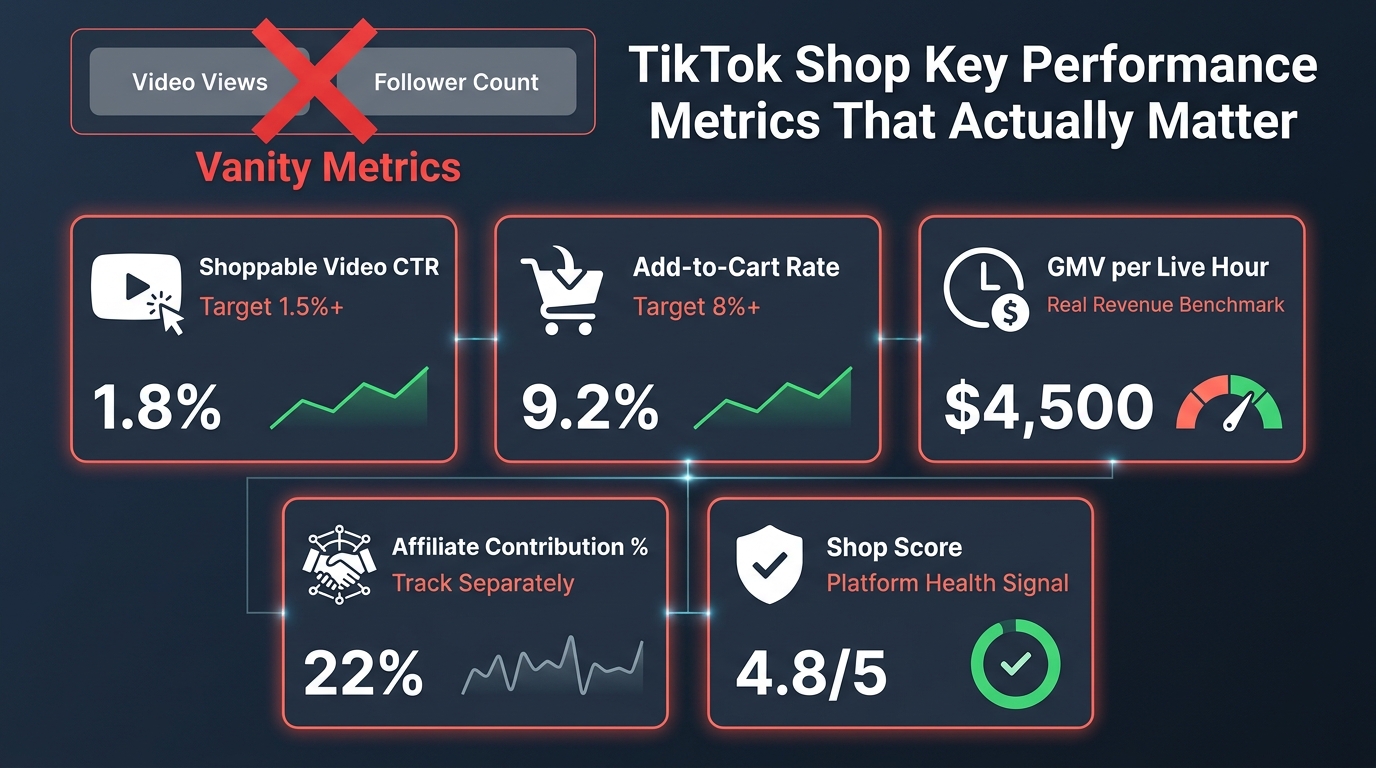
Perhaps the most common reason TikTok Shop sellers stall is that they are tracking the wrong things. The platform generates an enormous amount of data, and most of it — views, follower gains, video likes — is gratifying but not particularly actionable for a seller trying to understand their business. The metrics that actually tell you what is working are fewer, more specific, and require a bit more effort to pull and interpret.
The Metrics That Tell the Truth
Shoppable Video CTR is the percentage of viewers who tap the product link embedded in a video. This is your content-to-commerce efficiency number. A healthy benchmark for shoppable content is 1.5% or above. Below 1%, the video is generating awareness but not purchase intent — which might be fine for a brand-building campaign but is wasteful if your goal is direct revenue. Every optimization effort on your video content should be measured against whether it moves this number.
Product Page Conversion Rate is the percentage of users who visit your product listing and then complete a purchase. TikTok Shop conversion rates vary by category, but consistently above 3% is a strong signal and above 5% is excellent. Below 2% suggests a disconnect between what your video promises and what your listing delivers — usually a mismatch in price perception, insufficient reviews, or unclear product photography.
GMV Per Live Hour is the real productivity metric for any seller investing in LIVE commerce. Total GMV from a session divided by hours broadcast gives you a normalized revenue-per-time metric that lets you compare sessions, hosts, times of day, and product mixes directly. This is how you optimize your LIVE operation — not by gut feel about which sessions “felt good.”
Affiliate Contribution Percentage tells you how much of your total GMV is being generated by third-party creators rather than your own content. Tracking this separately is important because affiliate revenue has a different cost structure (commissions instead of content production costs) and a different risk profile (it scales without requiring your own time). A shop where affiliate contribution is growing as a percentage of total GMV is building a leveraged content system. A shop where it is flat or declining is too dependent on its own posting cadence.
Shop Score is TikTok’s composite signal for your shop’s health — it incorporates fulfillment speed, return rates, review quality, policy compliance, and other operational factors. Your shop score directly affects your eligibility for Shop tab placement and promotional programs. Many sellers ignore it until they notice their organic reach declining, by which point the damage is already done. Checking it regularly and understanding which inputs are dragging it down is preventive maintenance on your most important distribution asset.
The Numbers That Flatter Without Informing
Video views are the most seductive vanity metric in TikTok Shop. A million-view video that converts at 0.2% CTR is outperformed by a 50,000-view video that converts at 3% CTR by a factor of three on product page visits — with vastly better ROI on any paid budget applied to it. Follower count, total likes, and comment counts are similarly useful for brand pulse-checking but tell you almost nothing useful about commercial performance.
Make the discipline to open your seller analytics every week and look at the conversion-side metrics first — before anything else. What you see there will reorient how you think about content, product, and operations more effectively than any amount of time spent refreshing your view count.
Building a Durable TikTok Shop Business in 2026 — What the Breakout Sellers Are Actually Doing
The pattern is consistent when you look at the sellers who have moved from plateau to genuine scale in 2026. They are not smarter, more creative, or luckier than their peers. They are more systematic. They have made specific structural decisions that compound over time, and they are running their TikTok Shop operation like a business with deliberate architecture — rather than a content experiment they are hoping will eventually turn into reliable revenue.
Here is what that architecture looks like in practice:
- They pick one hero SKU and go deep on it before expanding the catalog. All creator seeding, content production, and paid traffic tests run on that product first. The catalog grows only after the hero has proven margin, velocity, and repeat customer behavior.
- They activate all four sales channels — shoppable video, LIVE, Shop tab, and creator affiliates — with specific resource allocation to each. LIVE has a fixed schedule. Affiliate outreach is a weekly activity, not a sporadic one. Shop tab performance is managed through operational scores, not hope.
- They build owned customer relationships in parallel. Every TikTok Shop purchase is an opportunity to bring a customer into a channel the platform cannot take away. Email, SMS, and loyalty programs are built from day one, not retrofitted after a scare.
- They model the real unit economics, including returns, affiliate commissions, fulfillment costs, and platform fees, before deciding whether a product or channel is profitable. Gross GMV is reported. Net margin is what matters.
- They track conversion metrics, not vanity ones. CTR, product page conversion rate, GMV per live hour, and shop score are reviewed weekly. Views and follower count are checked monthly, if that.
TikTok Shop in 2026 is a genuinely large commercial opportunity — the projected $23.41 billion in US GMV is real, and a meaningful share of it is accessible to individual sellers and small brands with the right approach. But the platform has also matured past the point where a single viral video is a business strategy. The sellers building durable operations understand that the discovery algorithm gets you found, but the system you build determines whether you can capitalize on being found, sustain the momentum, and survive a platform disruption if one occurs.
The $10K ceiling is not a ceiling at all. It is a prompt: build the other three channels, tighten the unit economics, compound the affiliate network, and treat LIVE like a scheduled broadcast. The shops that do this consistently break through it — not with a viral moment, but with a system that does not depend on one.