

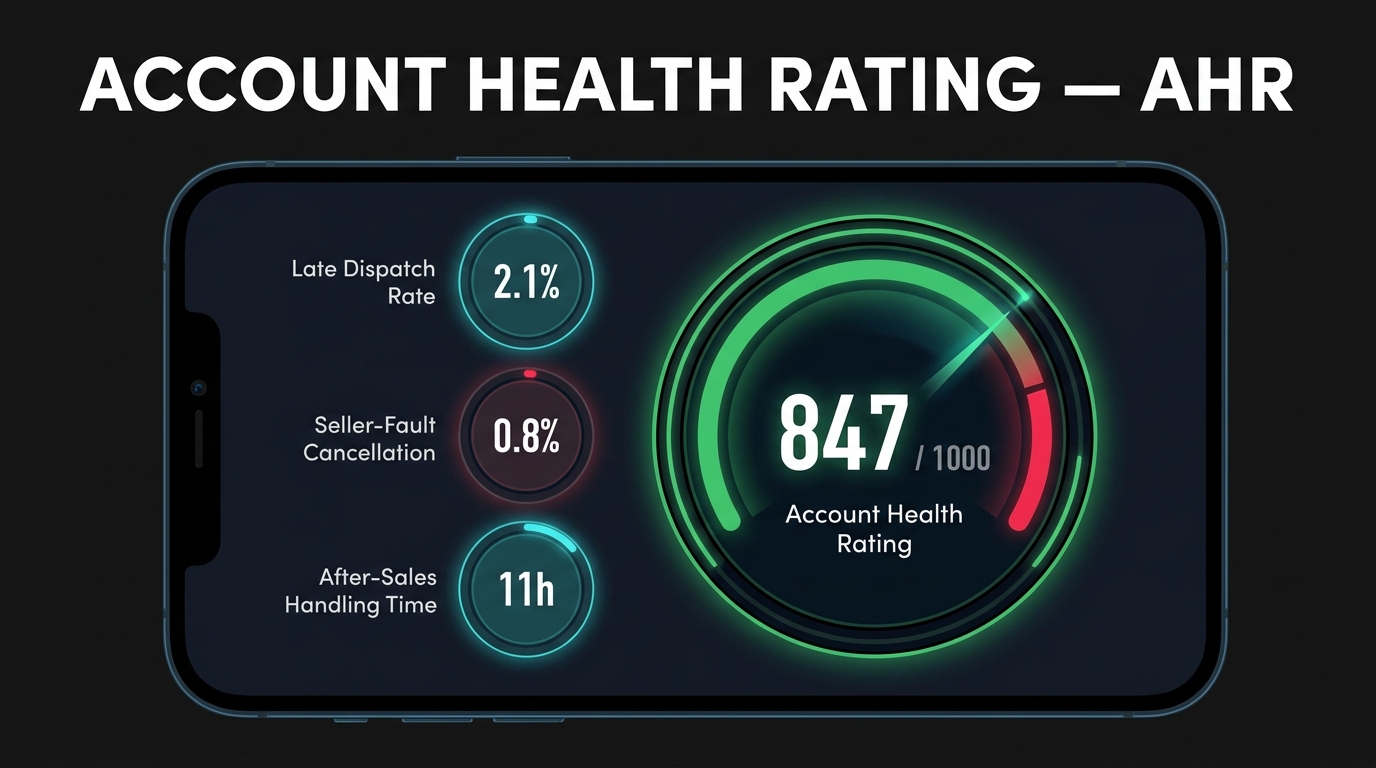

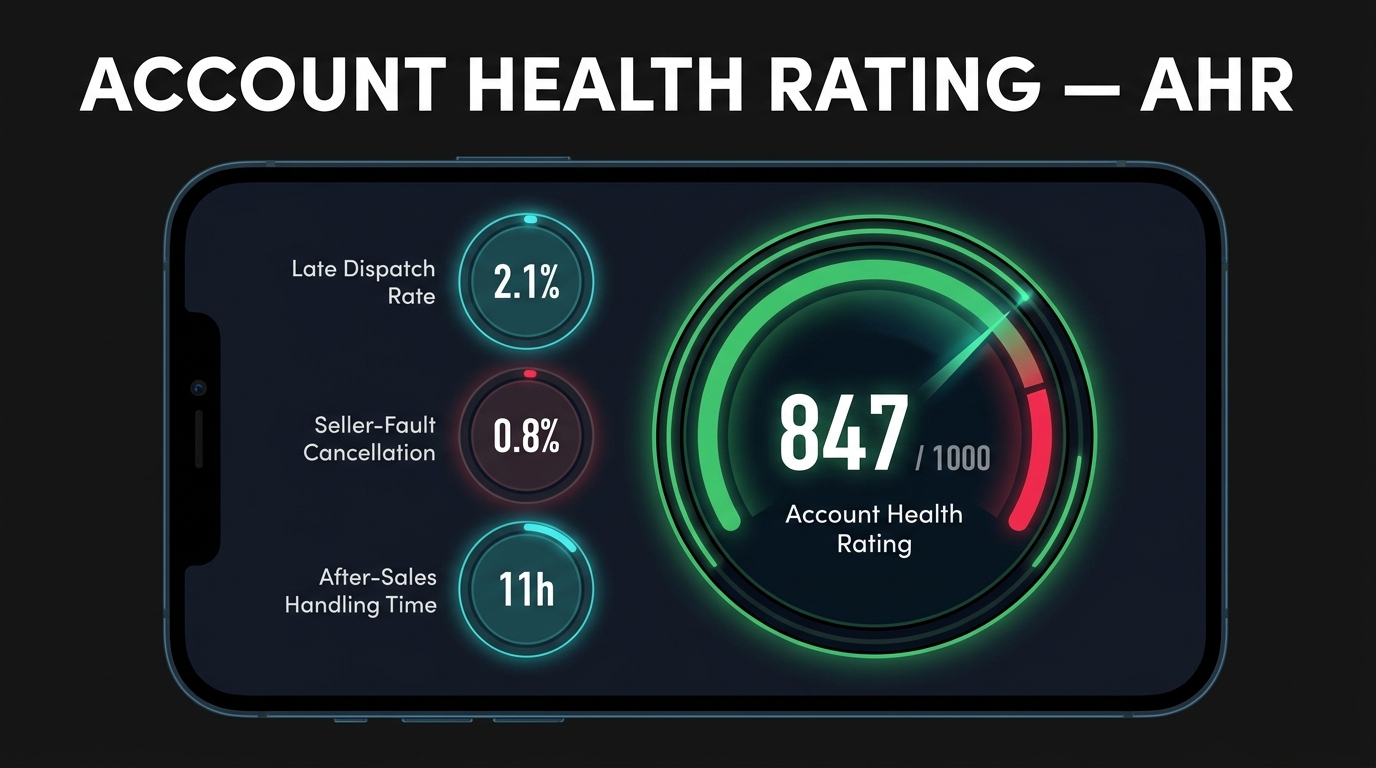
There is a number sitting inside your TikTok Shop Seller Center right now that has more influence over your business than your ad spend, your product selection, or your content strategy. Most sellers have glanced at it. Very few have actually understood what moves it — in either direction.
That number is your Account Health Rating (AHR). And since TikTok Shop made it the live enforcement mechanism for the platform in July 2026, it now determines whether you can list new products, join promotional campaigns, get distributed in the Shop Tab, or keep your account open at all.
This is not a document about what TikTok Shop’s rules say in theory. It is a practical operating manual for sellers who need to understand exactly how AHR is calculated, what moves it up or down, what happens at each enforcement threshold, and how to recover when the score trends the wrong way. The system replaced the older Violation Points model mid-year, and the mechanics are meaningfully different — different enough that sellers who are still operating on the old mental model are already making mistakes they haven’t noticed yet.
We will cover the score structure, the full penalty table, the four enforcement milestones, the fulfillment metrics wired into the system, how AHR differs from Store Rating, how to use policy quizzes to recover points, and what a long-term AHR protection workflow actually looks like. By the end, you will have a complete picture of the system and a set of operational steps you can apply immediately.
Why the Old Violation Points System No Longer Applies
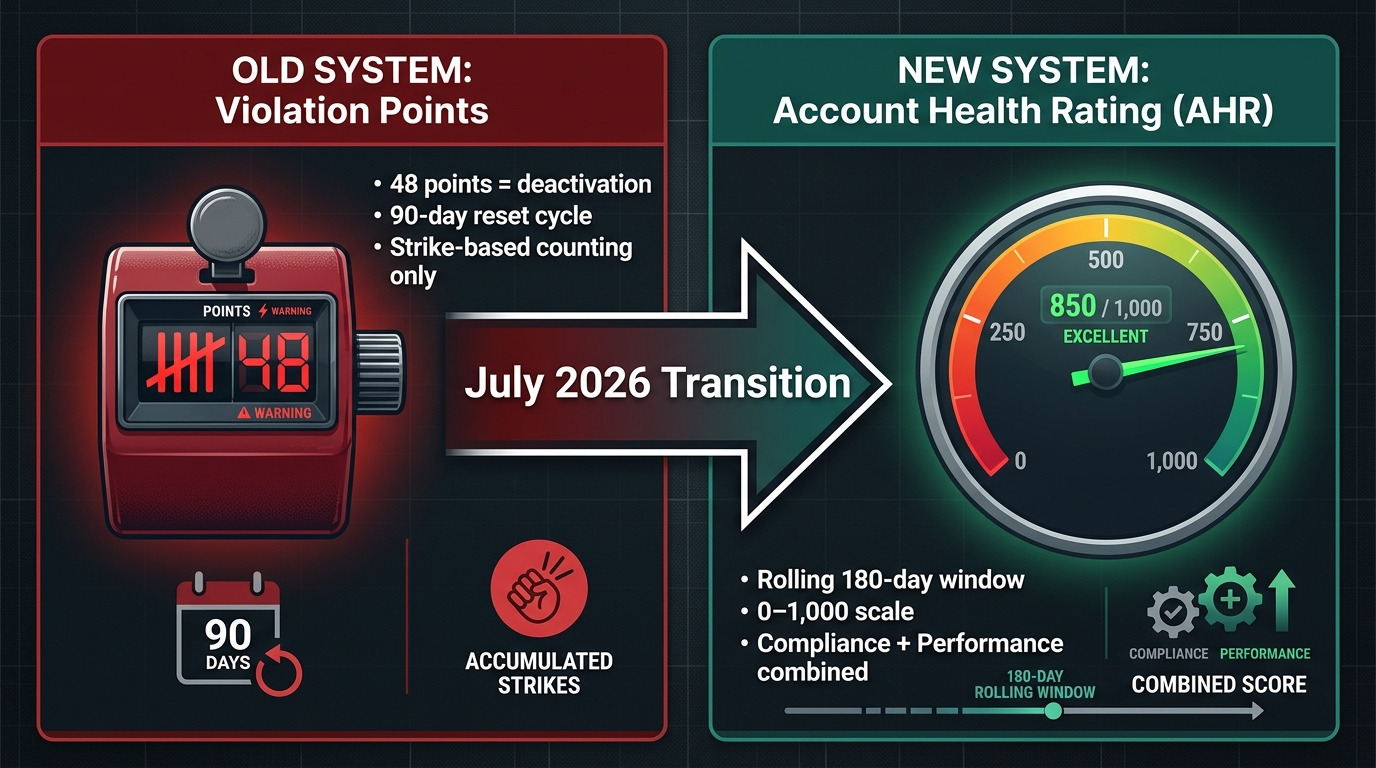
Before July 2026, TikTok Shop’s enforcement backbone was a system called Violation Points. It worked like a traditional strike model: each policy breach added a fixed number of points to a running tally. Accumulate enough strikes, and the platform escalated penalties, ultimately reaching permanent deactivation at 48 points. The key feature of that model was its 90-day reset cycle — violations aged out of the system on a rolling basis, giving sellers a natural recovery window just by avoiding new infractions.
That model had predictable behavior. Sellers who understood the reset cycle could absorb a violation or two, sit tight for a quarter, and come out the other side clean. It rewarded patience as much as compliance. It was also relatively binary: you either violated a rule or you didn’t, and your score reflected an accumulation of those binary events.
What Changed and When
TikTok Shop previewed the new Account Health Rating in May 2026, giving sellers roughly six weeks to familiarize themselves with the system before it became the live enforcement mechanism. The full transition to AHR as the primary account health signal happened in July 2026, at which point the Violation Points model was effectively retired in most markets.
The shift is more than cosmetic. Where Violation Points only counted compliance failures, AHR incorporates both positive and negative signals. You can earn points through compliant behavior — successfully completed orders, passed policy quizzes, clean fulfillment — and lose them through violations and performance failures. This makes AHR a continuous, living score rather than a simple penalty tally.
Why This Is Operationally More Demanding
The 90-day reset in the old system meant sellers had a structural safety valve. AHR operates over a rolling 180-day window, which is twice as long. Violations do not disappear after a quarter — they stay in the score calculation for six months. That means a bad two-week stretch in January can still be affecting your enforcement eligibility in June.
More importantly, because AHR includes positive performance signals, the score responds to your ongoing operations, not just your compliance events. A shop with consistently clean fulfillment and fast after-sales resolution will naturally accumulate and maintain a healthier score than one that meets the minimum thresholds. This is the core behavior change TikTok is trying to drive: it wants sellers thinking about account health as an operations metric, not just a compliance checkbox.
If you spent 2025 managing Violation Points, the mental model you built is only partially useful going forward. The structural mechanics, the scoring horizon, the recovery mechanisms, and the penalty thresholds are all different. That is where this guide begins.
How the 0–1,000 Score Actually Works (and What 200 Really Means)
AHR runs on a scale from 0 to 1,000. New sellers begin at 200 points, which is also the effective minimum for a healthy account status. Understanding why those two numbers are the same is key to understanding how the system works in practice.
How Points Are Added and Removed
AHR is not purely a deduction system — it has both positive and negative inputs. Points are added when you successfully fulfill orders, complete policy quizzes linked to past violations, and maintain compliant listings. Points are deducted when you breach policy rules or fail on key performance metrics. The exact weight of each action is not published in full by TikTok, but the directional logic is clear: clean operations build score, violations and performance failures reduce it.
This means a seller sitting at 200 points is at their starting baseline. They haven’t built reserve score above the new-seller floor, which means any deduction immediately pushes them into yellow or red territory. Sellers who have been operating cleanly for several months, by contrast, may have a score in the 400–700 range — a meaningful cushion against the occasional compliance stumble.
The 180-Day Rolling Window
All activity within AHR is evaluated over the past 180 days. This is a rolling, continuous window, not a fixed calendar quarter. Violations and positive performance events from more than 180 days ago fall out of the calculation and no longer affect your score. This means:
- A violation from last month still carries full weight today.
- A violation from seven months ago no longer affects your current AHR.
- Consistent clean performance over several months can gradually push a recovering score upward as older violations age out of the window.
What “Above 200” Means in Practice
TikTok’s official guidance positions 200 as the green zone baseline — the point at which your account is considered in good standing. The operational goal for any active seller should not be to sit at 200; it should be to build a score significantly above that number to create buffer room for the occasional hiccup. A single serious violation can drop 15 points (for counterfeit products). A cluster of late-dispatch incidents can compound that. Sellers operating at 210 or 220 are one bad week away from the first enforcement threshold at 150.
Building genuine score reserve — ideally above 400 — is the difference between a shop that can absorb a compliance incident without disruption and one that immediately faces campaign restrictions. This is a long-term operational posture, not a one-time fix.
The Two Scorecards: AHR vs. Store Rating — They’re Not the Same Thing
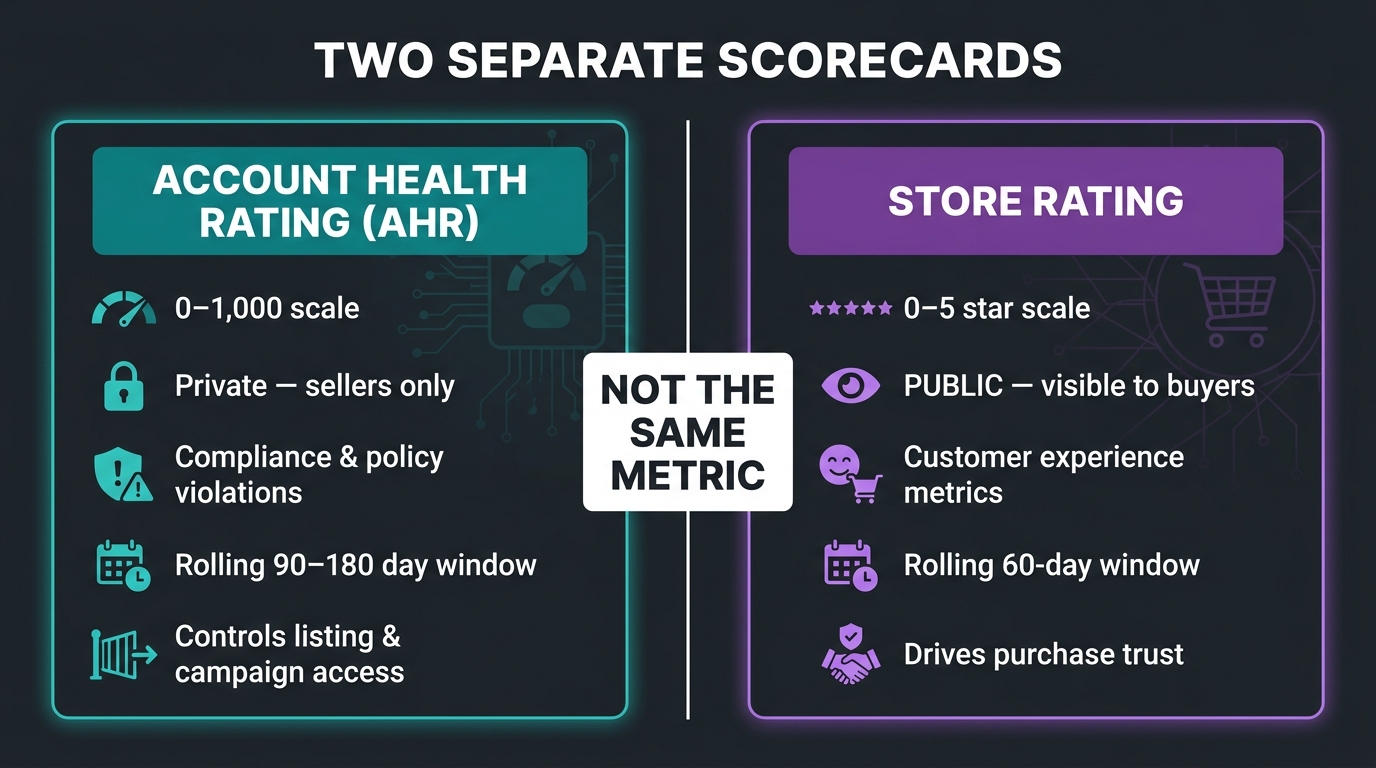
One of the most common points of confusion in seller conversations about TikTok Shop health is conflating Account Health Rating (AHR) with Store Rating. These are two distinct systems measuring different things, feeding into different outcomes, and with different audiences.
Account Health Rating (AHR)
AHR is your compliance and policy health score. It runs on a 0–1,000 scale, is based on the past 90–180 days of activity (documentation varies slightly by region and page), and is private — only you, the seller, can see it in Seller Center. It is the score that controls platform enforcement actions: whether TikTok can restrict your ability to list new products, join campaigns, or ultimately keep your account active.
The inputs to AHR are primarily policy violations — IP infringement, prohibited products, misleading listings, fulfillment failures — plus positive signals from clean operations. When TikTok enforces a restriction, blocks you from a mega campaign, or deactivates an account, it is AHR that triggered it.
Store Rating
Store Rating is your customer experience score. It runs on a 0–5 scale, is based on the past 60 days of performance, and is publicly visible to shoppers browsing your store on TikTok. A strong Store Rating builds consumer trust and can influence purchase decisions. A weak Store Rating is visible to every potential customer who views your page.
Store Rating is calculated from three main performance pillars:
- Product satisfaction — tied to review scores and how products match their descriptions.
- Fulfillment and logistics — tied to on-time delivery and dispatch rates.
- Customer service — tied to after-sales responsiveness and resolution quality.
Where They Intersect and Why That Matters
The practical complexity is that some operational failures will affect both scores simultaneously. A pattern of late dispatch will hurt your AHR through fulfillment metric violations and hurt your Store Rating through the logistics component. A high Seller-Fault Return/Refund Rate will damage your Store Rating and, if it crosses certain thresholds, can contribute to AHR deductions.
The critical distinction is in the downstream consequences. AHR governs what you’re allowed to do on the platform — operational access and enforcement risk. Store Rating governs how buyers perceive you — consumer trust and conversion. You can have a healthy AHR and a poor Store Rating (usually if you’ve had compliance issues in the past that have since been resolved, while recent service quality has slipped). You can also have a strong Store Rating while your AHR trends downward (if fulfillment is good but you have active policy violations in your catalog).
Managing them as separate systems — with separate monitoring processes and separate remediation workflows — is the correct approach. Most sellers treat them as one thing, which leads to diagnostic errors when things go wrong.
What Deducts Points and By How Much: The Full Penalty Table
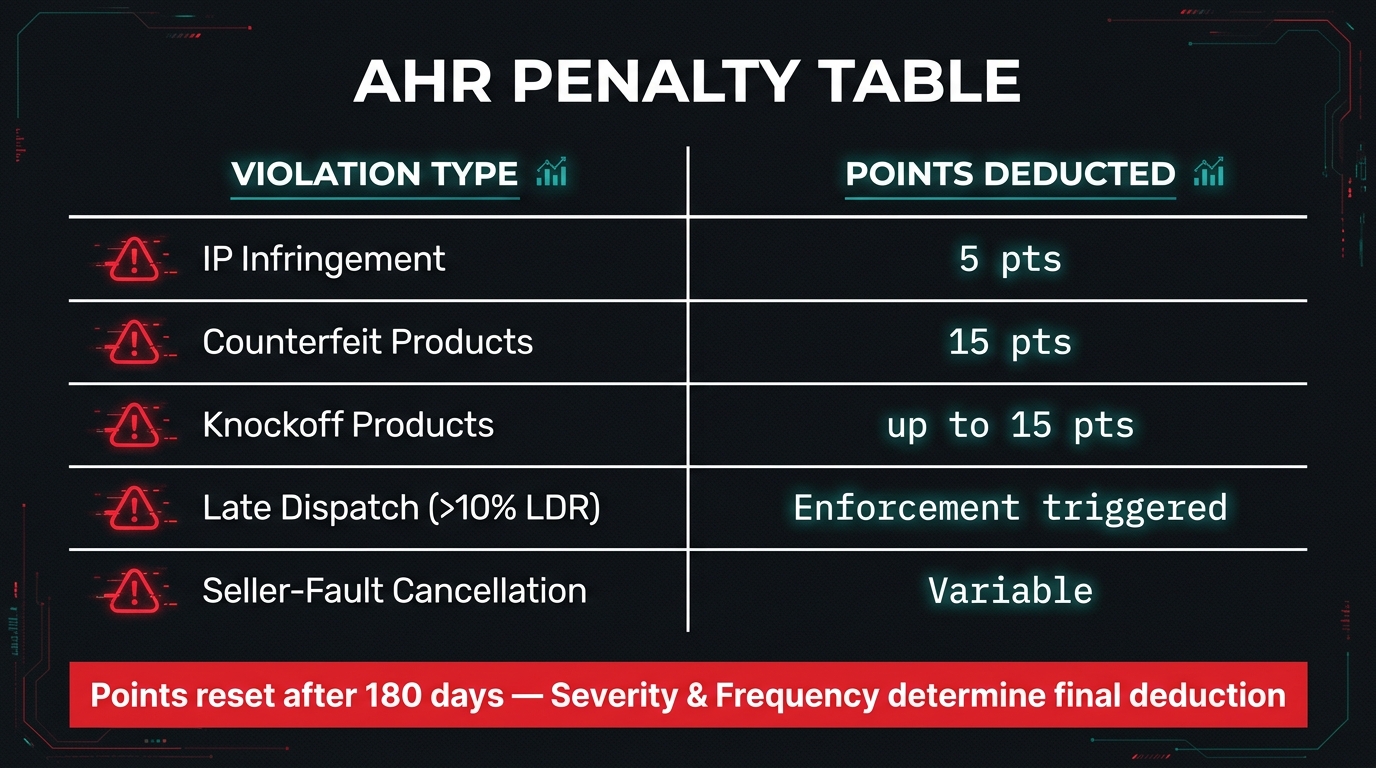
TikTok’s Seller Center publishes a partial deduction table in its enforcement policy documentation. It is not comprehensive — the platform does not publish a full mapping of every possible violation to its exact point cost — but what is disclosed gives sellers a clear picture of the higher-risk areas to protect.
Published Point Deductions by Violation Type
- Intellectual Property (IP) Infringement: 5 AHR points, up to shop closure in severe cases.
- Counterfeit Products: 15 AHR points, up to shop closure.
- Knockoff Products: Up to 15 AHR points.
- Fair Trading Violations: Variable, depending on severity and frequency.
- Product Listing Violations: Variable, with potential for shop closure at the extreme end.
- Performance Failures (Late Dispatch, Seller-Fault Cancellations): Variable deductions tied to breach of specific metric thresholds.
How Severity and Frequency Change the Calculus
TikTok explicitly states that AHR deductions depend on both the severity and frequency of the violation. A single IP infringement on a listing that is quickly corrected may result in a 5-point deduction. A pattern of repeated IP violations across multiple listings — especially if the seller has been notified and hasn’t corrected — is likely to result in escalated deductions and potentially a different enforcement track.
This is an important nuance. The published point costs are likely the minimum-tier deductions for a first or isolated occurrence. Repeat violations of the same type, or violations that the platform interprets as deliberate, can carry significantly higher costs. This is why a “we’ve never had a problem before” defense after a second or third violation tends not to work — the system is designed to escalate based on pattern recognition, not just individual events.
When Points Reset
Deducted points reset after 180 days under the US market guidance. This means a 15-point deduction from a counterfeit product violation in January 2026 will age out of your score calculation by July 2026, assuming no further violations of the same type. However, the violation record itself may remain in your enforcement history even if its AHR point cost has expired — which can affect how TikTok treats future violations of the same category.
The Gray Zones: Violations That Are Ambiguous
Several violation categories carry meaningful ambiguity in practice. “Misleading claims” and “inaccurate product descriptions” are subject to platform review and interpretation. A seller who describes a supplement as “supporting immune health” may or may not cross a line depending on how the claim is worded and how the product is categorized. These gray-zone violations can be harder to predict and harder to appeal, because the enforcement call involves subjective review rather than a clear policy breach.
The safest posture here is conservative listing copy, verified factual claims only, and regular cross-reference against TikTok’s prohibited and restricted product lists, which are updated periodically. Listing copy that worked six months ago may now trigger a review under revised guidelines.
The New Metrics That Most Sellers Haven’t Adjusted To Yet
The July 2026 transition to AHR didn’t just change the score structure — it changed which specific performance signals matter most. Two updates in particular have caught many sellers off guard because they require operational changes rather than just compliance awareness.
After-Sales Handling Time (AHT): The New Replacement for Customer Complaint Rate
After-Sales Handling Time (AHT) replaced Customer Complaint Rate as the core after-sales metric in TikTok Shop’s performance measurement. This is a significant shift in what’s actually being measured.
Customer Complaint Rate counted how often complaints occurred. AHT measures how quickly sellers resolve them. Specifically, it is the average time a seller spends handling refund, return, cancellation, or replacement requests over the past 60 days. Critically, it only counts requests that the seller has actively reviewed or set automated rules for — passive inaction does not get excluded from the calculation.
TikTok’s target for AHT is below 20 hours. A seller whose AHT sits above 20 hours is performing below the platform’s standard and is likely to see this reflected in their Store Rating and, depending on how far above the threshold they are, in their AHR trajectory.
The practical implication: sellers who previously managed after-sales by processing requests in weekly batches now need to move to daily or more frequent review cycles. A refund request that sits for three days before the seller looks at it is adding significantly to the AHT calculation. Building a systematic after-sales review process — checking the queue at the same time each day, using automated rules for common request types — is now an AHR protection measure, not just a customer service nicety.
Category-Relative Benchmarking for Review Rate and Return Rate
The second major change affects how two specific metrics are judged: Negative Review Rate and Seller-Fault Return/Refund Rate. Previously, these were measured against platform-wide averages. In 2026, both are now benchmarked against same-category sellers.
This is a structural shift with asymmetric consequences depending on what you sell. Sellers in categories with naturally higher return rates — clothing, shoes, electronics with complex setup requirements — are now judged against peers who operate in the same product environment. That’s fairer in one sense. But it also means that if you’re in a high-return category and your competitors have invested in better product photography, more accurate sizing information, or faster returns processing, you need to match their standard, not just the platform average.
For low-return categories, the benchmark effect works in the opposite direction. If your category peers have exceptionally clean return records, even a modest uptick in seller-fault returns can push you into below-benchmark status faster than a platform-wide threshold would.
The operational response to category benchmarking is to know where your category sits. Check your metric performance not just in absolute terms but relative to the benchmark indicator TikTok shows in your performance dashboard. If you’re below benchmark, that is a concrete operational target to close — usually through product accuracy improvements, better pre-purchase information, and faster after-sales resolution.
The Four Enforcement Milestones and What Happens at Each One
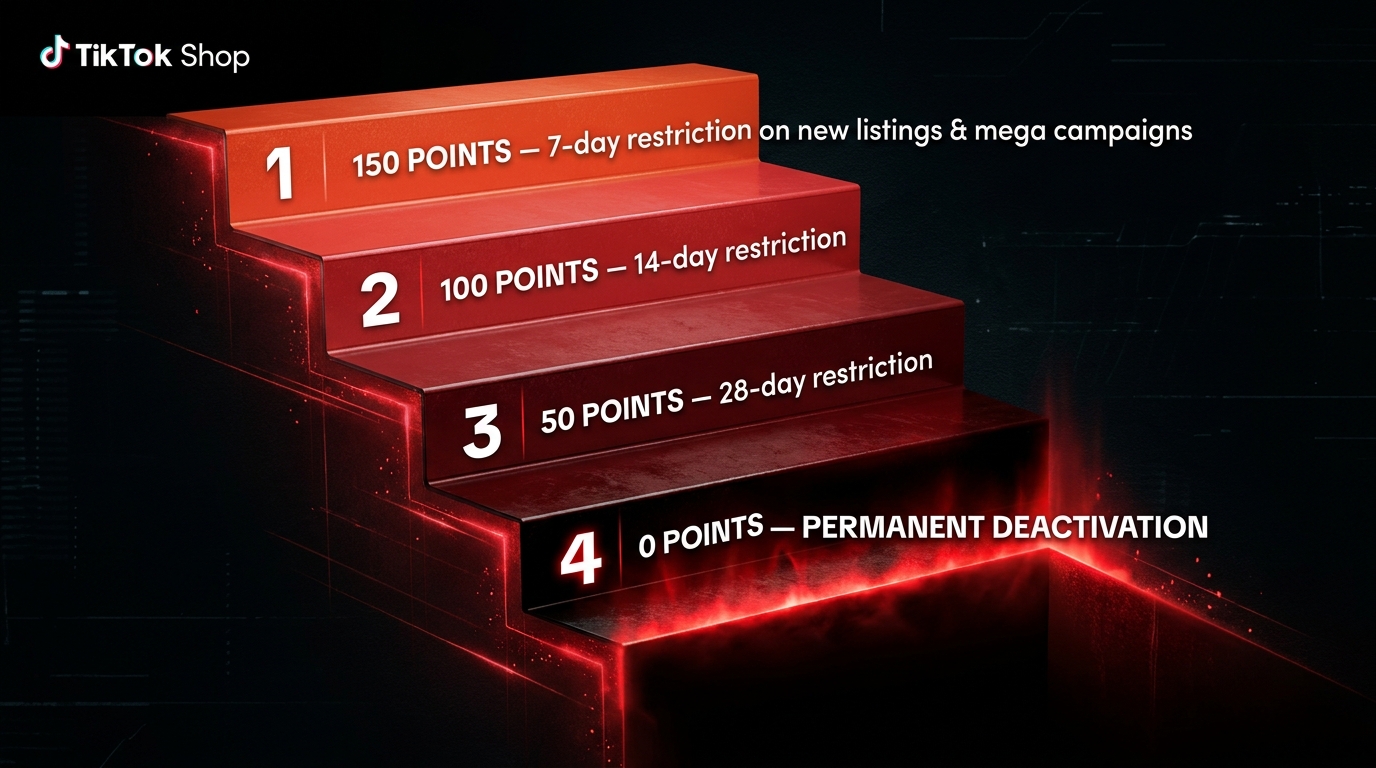
TikTok Shop’s enforcement against AHR does not happen on a sliding scale — it triggers at specific point thresholds. There are four milestone points, and what happens at each one is documented in Seller Center policy. Understanding these thresholds is essential because they determine both the urgency of your response and the tools available to you.
150 Points — First Restriction Tier
At 150 AHR points, TikTok Shop can impose the following restrictions for approximately 7 days:
- Block on creating new listings.
- Removal of eligibility for mega campaigns (platform-wide promotional events).
- Potential reduction in certain platform benefits tied to account status.
The 7-day window is significant because it can coincide with major promotional events — a Black Friday-equivalent campaign or a platform-wide sale — that represent a disproportionate share of monthly revenue for many sellers. A 7-day ban from mega campaign participation during such an event is not just a compliance penalty; it can be a revenue event in itself.
100 Points — Second Restriction Tier
At 100 AHR points, the same restrictions extend to 14 days. At this level, the operational disruption becomes harder to absorb. Two weeks without new listing capability or campaign participation is significant for shops that regularly launch new SKUs as part of their growth strategy. The compounding effect — violations driving you to 100 points while also limiting your ability to add fresh catalog — can slow recovery momentum.
50 Points — Third Restriction Tier
At 50 AHR points, restrictions extend to 28 days. A full month of restricted operation is operationally severe. At this level, TikTok is signaling that the account has persistent compliance or performance problems, and the platform’s response is designed to be painful enough to force operational correction. Most sellers who reach 50 points are either not monitoring their AHR actively, have a systemic listing quality issue across their catalog, or have had a significant operational failure that generated cascading violations.
0 Points — Permanent Deactivation Risk
At 0 AHR points, TikTok can permanently deactivate the shop. This is the terminal enforcement action. Sellers who reach 0 typically have a combination of serious policy violations (counterfeit products, persistent IP infringement), failed appeals, and a track record of non-compliance across the 180-day window. There is no automatic recovery from 0 points — any path forward involves direct engagement with TikTok’s seller support under review conditions that are significantly more stringent than standard appeal processes.
What Happens Between Milestones
Between milestones, the platform does not impose hard operational restrictions. But score degradation in the 200–150 range — even without triggering the 150-point milestone — can still affect how the platform distributes your listings and how prominently you appear in Shop Tab recommendations. TikTok’s official seller guidance acknowledges that low AHR can reduce livestream traffic and Shop Tab visibility, though it does not publish a precise formula for that relationship. The practical observation from seller communities is that score trends matter, not just absolute values: a score that has been declining for several weeks signals differently to the platform than a stable score at the same level.
Late Dispatch, Cancellations, and the Fulfillment Metrics Tied to AHR
Three operational metrics sit at the intersection of fulfillment performance and AHR health. These are not abstract compliance concepts — they are outcomes of day-to-day shipping and inventory management decisions. Understanding them means understanding which operational failures carry compliance consequences.
Late Dispatch Rate (LDR)
Late Dispatch Rate (LDR) measures the share of orders that are not updated to “Shipped” status by the dispatch deadline over a 7-day rolling window. TikTok’s threshold is clear: an LDR above 10% triggers enforcement action. A same-day LDR below 5% is the target for avoiding service restrictions on that specific delivery timeframe promise.
LDR is the fulfillment metric that trips up the most sellers, particularly those using dropshipping models or working with suppliers whose fulfillment timelines are inconsistent. Promising same-day or next-day dispatch when your supplier ships in 48–72 hours is a structural LDR problem. The fix is not to chase the shipping status — it is to set dispatch promises that match your actual operational reality, even if that means longer advertised shipping windows.
Manipulating shipping status to mark orders as “Shipped” before the carrier has actually scanned them is another common LDR workaround that creates additional violations. TikTok tracks carrier scan data, and systematic discrepancies between seller-reported ship status and actual carrier pickup events generate their own policy flags.
On-Time Delivery Rate (OTDR)
On-Time Delivery Rate (OTDR) measures the share of orders delivered by the customer-facing delivery estimate. TikTok’s minimum threshold for OTDR is 80%. Falling below 80% consistently triggers enforcement and can feed into both AHR deductions and Store Rating degradation.
OTDR is partly outside seller control — carrier delays, weather events, and regional logistics capacity constraints can affect delivery timing. The seller-controllable component is choosing carriers with reliable performance in your primary shipping regions and setting delivery estimates that account for realistic transit variability rather than best-case scenarios.
Seller-Fault Cancellation Rate (SFCR)
Seller-Fault Cancellation Rate (SFCR) measures the share of orders cancelled due to seller-side issues: stockouts, listing errors that prevented fulfillment, or seller-initiated cancellations. Cancellations initiated by buyers for their own reasons are typically excluded from the seller-fault calculation, though the categorization can vary by specific circumstance.
SFCR is a direct indicator of catalog hygiene and inventory management quality. A seller who regularly lists products that go out of stock quickly, or who maintains listings for products they can no longer source, will see SFCR accumulate over time. The remediation is operational: accurate inventory tracking, prompt listing suspension when stock depletes, and never listing a product until fulfillment is confirmed.
How to Read Your AHR Dashboard Before It’s Too Late
The most common operational failure with AHR is not making violations — it’s not catching score changes quickly enough to respond before enforcement kicks in. TikTok’s notification system for AHR events is not designed to provide maximum advance warning. Sellers who rely on platform notifications alone will often find out about a score problem after the first enforcement milestone has already been hit.
Where to Find Your AHR in Seller Center
Your Account Health Rating is accessible through your TikTok Shop Seller Center account. Navigate to the account health section of the dashboard, where you’ll find your current AHR score, a trend indicator showing recent movement, and a breakdown of active violation types contributing to your current score. The dashboard also shows your current tier relative to the enforcement milestones at 150, 100, 50, and 0 points.
What to Monitor and How Often
Sellers with active, growing catalogs should check AHR at minimum weekly. Sellers running promotional campaigns, launching new products, or operating in restricted categories (supplements, electronics, beauty with drug claims) should check daily. The score can move materially in a short window if a batch of orders has fulfillment problems or if a listing review has resulted in new violations.
The key signals to track in order of importance:
- Current score relative to the nearest enforcement milestone. How many points of buffer do you have before the next threshold? Anything under 60 points of buffer from a milestone requires active intervention, not just monitoring.
- Score trend over the past 30 days. A declining trend even at a safe current level is an early warning that violations or performance failures are accumulating faster than positive actions are compensating.
- Active violation breakdown. Which specific violation types are contributing to deductions? This determines the remediation priority.
- Fulfillment metric performance. LDR, OTDR, and SFCR should be reviewed alongside AHR because they are leading indicators of future AHR movement.
Setting Up Proactive Alerts
TikTok’s Seller Center allows for some notification configurations. Ensure you have policy notification emails enabled and are receiving enforcement alerts to the email account actively monitored by your operations team — not a shared inbox that goes unchecked for days. In higher-volume shops, assigning a specific team member to own AHR monitoring as a named operational responsibility (rather than leaving it as everyone’s vague background concern) is a structural protection against the notification-reading failure mode.
Recovery Mode: How to Rebuild Score After a Drop
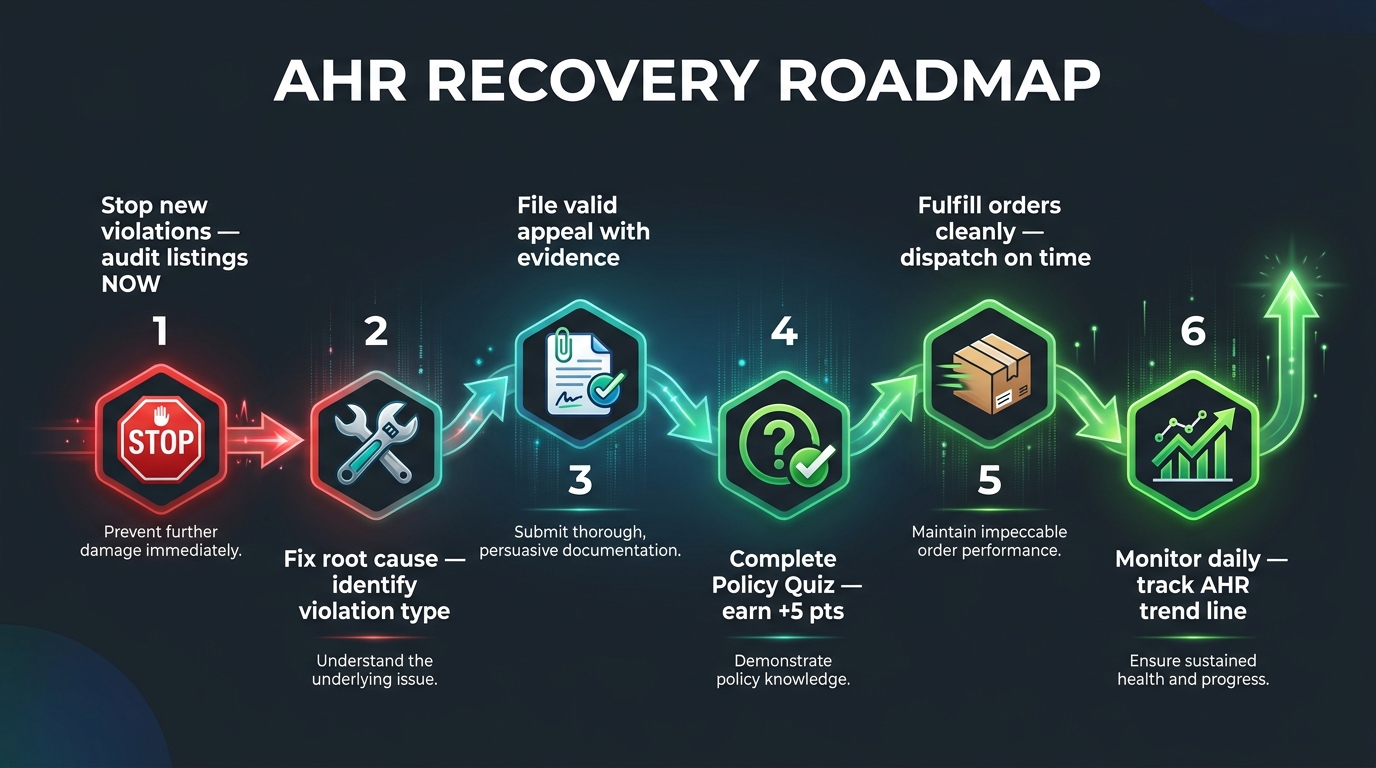
An AHR drop is not a permanent sentence — but recovery requires active management, not passive waiting. There is no automatic reset mechanism in AHR. Points do not restore themselves without positive operational inputs. The recovery arc for a shop that has dropped to, say, 160 points (dangerously close to the first enforcement milestone) depends entirely on what the seller does next.
Step One: Stop New Violations Immediately
The first priority is always to stop the score from moving further downward. Before doing anything else, conduct an emergency audit of your active listings against TikTok’s current prohibited and restricted product list. Remove or correct any listing that could trigger a new violation. If you have a large catalog, prioritize by category risk: restricted product categories, listings with health or safety claims, and listings that use third-party brand names in any way.
Every new violation during a recovery period compounds the problem. Trying to recover points while new deductions are still hitting the score is like attempting to bail out a boat while the hole is still open.
Step Two: Identify the Root Cause
Your violation breakdown in Seller Center should tell you exactly what type of violation is driving the deductions. The root cause remediation depends entirely on the violation type:
- IP infringement violations: Review every listing that uses brand names, logos, or product imagery that isn’t your own. Remove or replace non-compliant content.
- Listing accuracy violations: Audit product descriptions for claims you cannot document or substantiate. Remove health claims, performance guarantees, and superlative language that cannot be verified.
- Fulfillment metric failures: Address the operational process causing late dispatch or cancellations — this usually means fixing supplier relationships, carrier selection, or inventory management workflows.
- Product compliance violations: Verify that every product in your catalog is accurately categorized and meets the specific requirements for that category.
Step Three: File Valid Appeals
For violations you believe were issued in error, TikTok’s appeal process is available. The critical word in that sentence is “valid.” Appeals should be filed when you have concrete evidence that a violation was incorrect — not as a delay tactic or a general challenge to an enforcement decision you don’t agree with but can’t disprove.
A well-documented appeal with clear evidence of compliance (product authenticity certificates, brand authorization letters, corrected listing screenshots) has a reasonable chance of success. A vague appeal stating the violation was unfair, without supporting documentation, is almost always rejected. Document everything before you file, and ensure your evidence directly addresses the specific violation type cited.
Step Four: Increase Positive Score Inputs
While violations age out over the 180-day window, you can accelerate recovery by increasing positive score inputs. Clean, completed orders are the primary mechanism. Every order that is dispatched on time, delivered successfully, and requires no after-sales resolution adds a positive signal to your AHR. Sellers in recovery mode should prioritize operational quality on every single order during the recovery period — this is not the time to test new suppliers or extend into new product categories.
The Policy Quiz Mechanism: Five Points at a Time
One of the less-discussed tools in the AHR recovery framework is the policy quiz system. When you receive certain violations, TikTok may offer a policy quiz linked to the specific rule that was breached. Completing that quiz with a perfect score earns you 5 AHR points back.
How the Quiz System Works
Policy quizzes are not available for all violation types — they are offered selectively, typically for less severe first-time violations where TikTok’s enforcement posture is oriented toward seller education rather than punitive action. You’ll see the quiz offer in your Seller Center notification related to the specific violation event. The quiz covers the policy area where the violation occurred and must be passed with a perfect score to earn the point restoration.
Five points sounds modest, and it is — a 15-point counterfeit violation won’t be fully offset by a single quiz. But in a recovery scenario where you’re at 160 points and need to stay above 150, five points matters considerably. And if you have multiple eligible violations, the cumulative quiz recovery can be meaningful.
The Behavioral Signal the Quiz Sends
Beyond the mechanical point restoration, completing policy quizzes sends a compliance signal to TikTok. The system is designed to reward sellers who engage with policy education and demonstrate that they understand what the violation was and why it was incorrect. Sellers who complete quizzes and subsequently avoid the same violation type tend to be treated differently by the enforcement system than sellers who receive repeated violations of the same category without ever engaging with the quiz or appeal process.
Which Violations Are Quiz-Eligible
Based on available Seller Center documentation, quiz eligibility appears to be linked to listing and product policy violations more often than to severe violations like counterfeit goods. If you receive an IP infringement notice for a minor listing issue, there’s a reasonable chance a quiz will be offered. A counterfeit product notice — which carries the 15-point deduction — is less likely to come with a quiz option. The platform’s logic is intuitive: education is offered for correctable mistakes, not for deliberate policy breaches.
Protecting Your AHR Long-Term: An Operational Checklist
Managing AHR well is an ongoing operational discipline, not a one-time compliance exercise. The sellers who maintain consistently high AHR scores over time tend to have several structural practices in common. These are not complex — they are consistent.
Listing Quality and Catalog Hygiene
- Audit active listings quarterly against TikTok’s current restricted and prohibited product list. The list is updated periodically, and products that were acceptable before may now require compliance review.
- Remove any listing using third-party brand names or product imagery unless you have documented authorization. IP infringement violations are among the most common and most avoidable.
- Strip unverifiable claims from all listing copy. Health claims, performance promises, and comparison language (“better than X”) are violation targets. Replace with factual product descriptions and specifications.
- Categorize products accurately. Wrong-category listings trigger both algorithmic suppression and compliance review in some cases. If a product could plausibly belong in a restricted category, verify before listing.
Fulfillment Operations
- Set dispatch promises you can consistently meet. Optimistic shipping promises that generate LDR violations are worse than conservative promises that are always kept. Review your advertised dispatch windows against actual carrier pickup times.
- Monitor LDR weekly, not after the fact. Identify any orders approaching their dispatch deadline each day and handle them before the deadline, not after.
- Maintain real-time inventory accuracy. Listings for out-of-stock products are SFCR violations waiting to happen. Build a process for suspending listings when stock depletes below a safe threshold.
- Vet carrier performance by region. An OTDR below 80% is often a carrier selection problem in specific destination regions. Review delivery performance data by carrier and route, and make adjustments.
After-Sales Management
- Set a daily after-sales review window. Process the after-sales queue every day at the same time. Do not let requests age beyond 24 hours if you can avoid it — every hour of unprocessed time adds to your AHT calculation.
- Build automated rules for common request types. If you regularly receive return requests for specific size or defect reasons, create automated handling rules that initiate the appropriate resolution action without requiring manual review each time.
- Keep AHT below 20 hours as a non-negotiable operational standard. This is TikTok’s published target. Treat it like an SLA, not an aspiration.
Score Monitoring and Documentation
- Review AHR weekly at minimum. High-velocity shops and those in restricted categories should review daily.
- Document your compliance evidence. If you sell in categories prone to authenticity challenges (branded products, supplements, electronics), maintain organized records of supplier authorization, product compliance documentation, and brand authorization letters. The time to organize this is before a violation notice arrives, not after.
- Complete eligible policy quizzes immediately when offered. Do not delay — points recovered early help maintain buffer above the next enforcement milestone.
- Log the date and type of every violation received, even ones that are appealed successfully. This gives you visibility into whether any specific listing category, supplier, or product type is generating a disproportionate share of your compliance risk.
Conclusion: Managing AHR Like a Business Metric, Not a Report Card
The frame most sellers bring to account health management is reactive: they check the score when something feels wrong, respond to violation notices when they arrive, and otherwise assume that running a straightforward business keeps the score healthy. That frame was marginally workable under the old Violation Points model. Under AHR, it is not adequate.
AHR is a continuous, living score that responds to your operations every day the shop is active. It accumulates positive inputs from clean fulfillment and compliant listings. It decays from violations, performance failures, and slow after-sales resolution. The 180-day rolling window means the score you are looking at today reflects six months of operational behavior — and the score you will be looking at six months from now depends on what you do starting now.
The July 2026 transition from Violation Points to AHR was TikTok’s clearest signal yet that it is managing TikTok Shop as a commerce platform with standards and accountability, not just a discovery channel where seller quality is buyer’s-beware. The enforcement milestones at 150, 100, 50, and 0 points are designed to escalate proportionally with the severity of the problem. But they also create a natural early-warning architecture: a seller at 160 points who responds decisively can arrest the decline and rebuild before hitting the first restriction. A seller who doesn’t notice until they’re at 145 has a much harder problem.
The Three Priorities That Separate High-AHR Shops from Struggling Ones
Across everything the AHR system measures, three operational priorities consistently separate sellers who maintain strong scores from those who cycle through violations and restrictions:
- Catalog discipline. High-AHR sellers treat every new listing as a potential compliance event and review it against current platform policies before it goes live — not after a violation notice forces the issue.
- Fulfillment consistency. High-AHR sellers set conservative dispatch and delivery promises, use reliable carriers, and maintain real-time inventory accuracy. They would rather convert fewer customers on a longer shipping promise than convert more customers and fail on fulfillment.
- Proactive monitoring. High-AHR sellers check their score and their performance metrics on a defined schedule, treat any downward trend as an immediate operational question, and respond to violation notices within hours, not days.
None of these require advanced technology or significant budget. They require consistent process and the organizational decision to treat AHR as a first-tier business metric — something reviewed on the same cadence as revenue, not something that surfaces in a crisis retrospective.
The sellers who master TikTok Shop’s AHR system in 2026 will not be the ones who know all the rules. They will be the ones who have built the operating habits that make violations uncommon, recovery quick, and enforcement milestones a distant concern rather than a regular emergency.