


There’s a version of TikTok Shop that most sellers still operate in: post a video, hope it hits the FYP, watch sales spike for 48 hours, then vanish. The virality lottery. Some sellers have built real businesses on it — but the margins are thin, the consistency is zero, and the moment the algorithm stops favoring your content, so does your revenue.
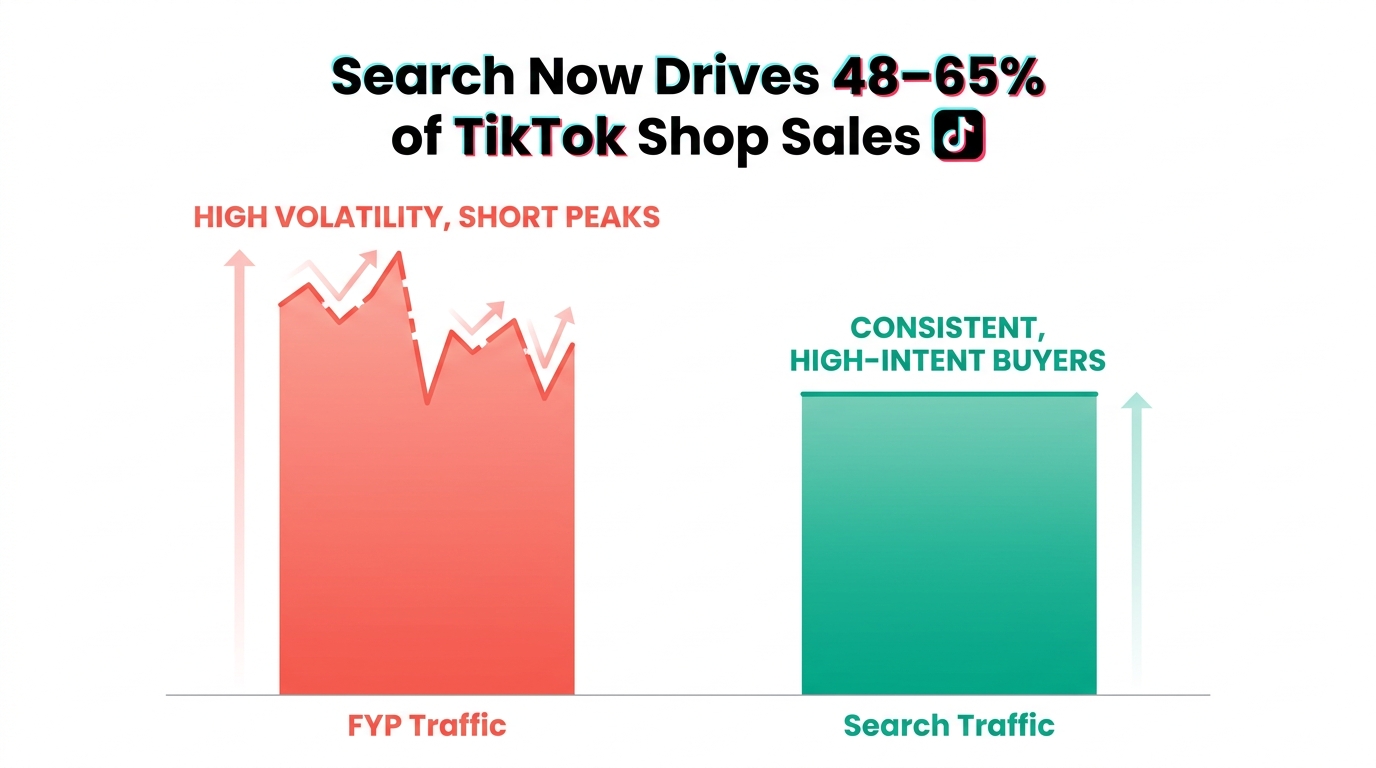
That version is becoming obsolete. Not because TikTok killed the FYP — it hasn’t — but because something structurally more important has taken hold: search-driven commerce now accounts for an estimated 48–65% of TikTok Shop sales depending on category and market, according to mid-2026 practitioner analyses. Users are coming to the app with buying intent already formed. They type “wireless earbuds under $50” or “retinol serum for dry skin” and they expect ranked results that match exactly what they’re looking for.
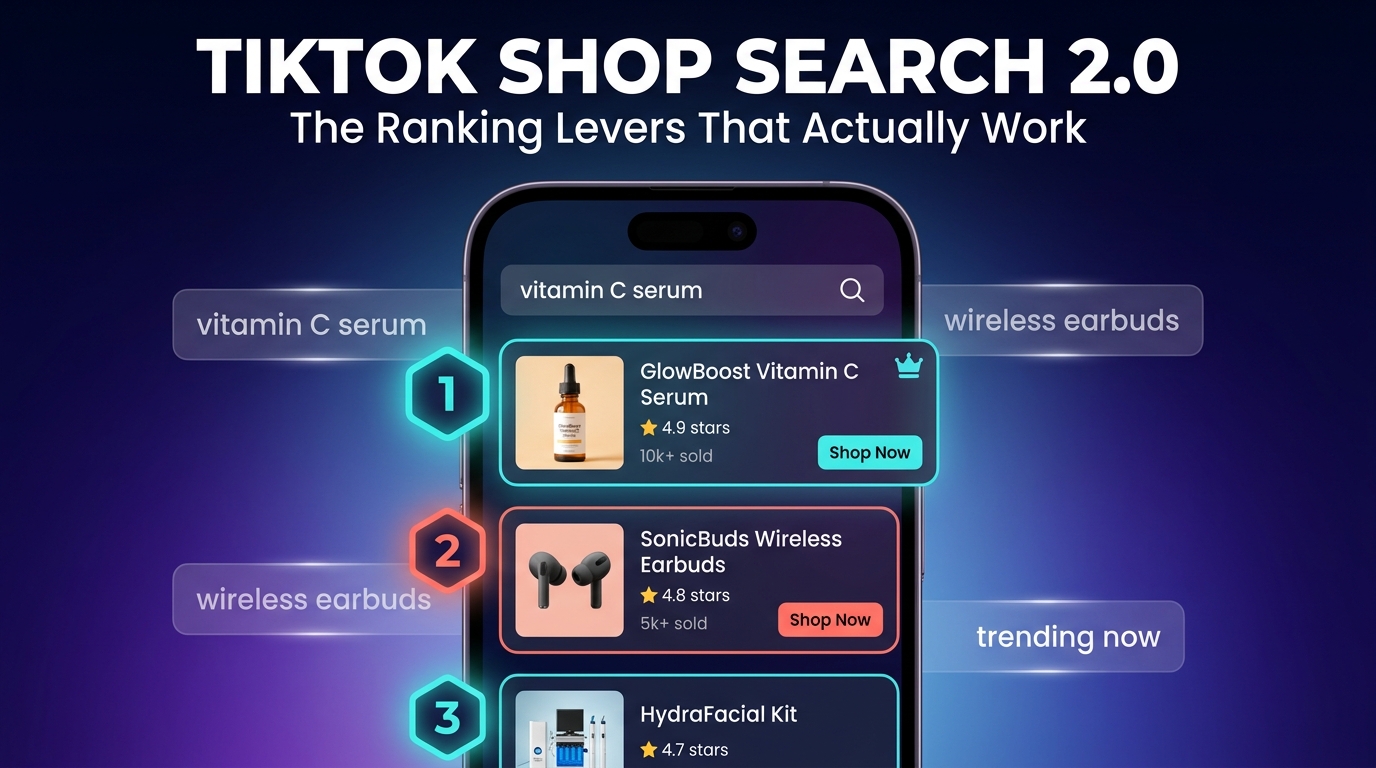
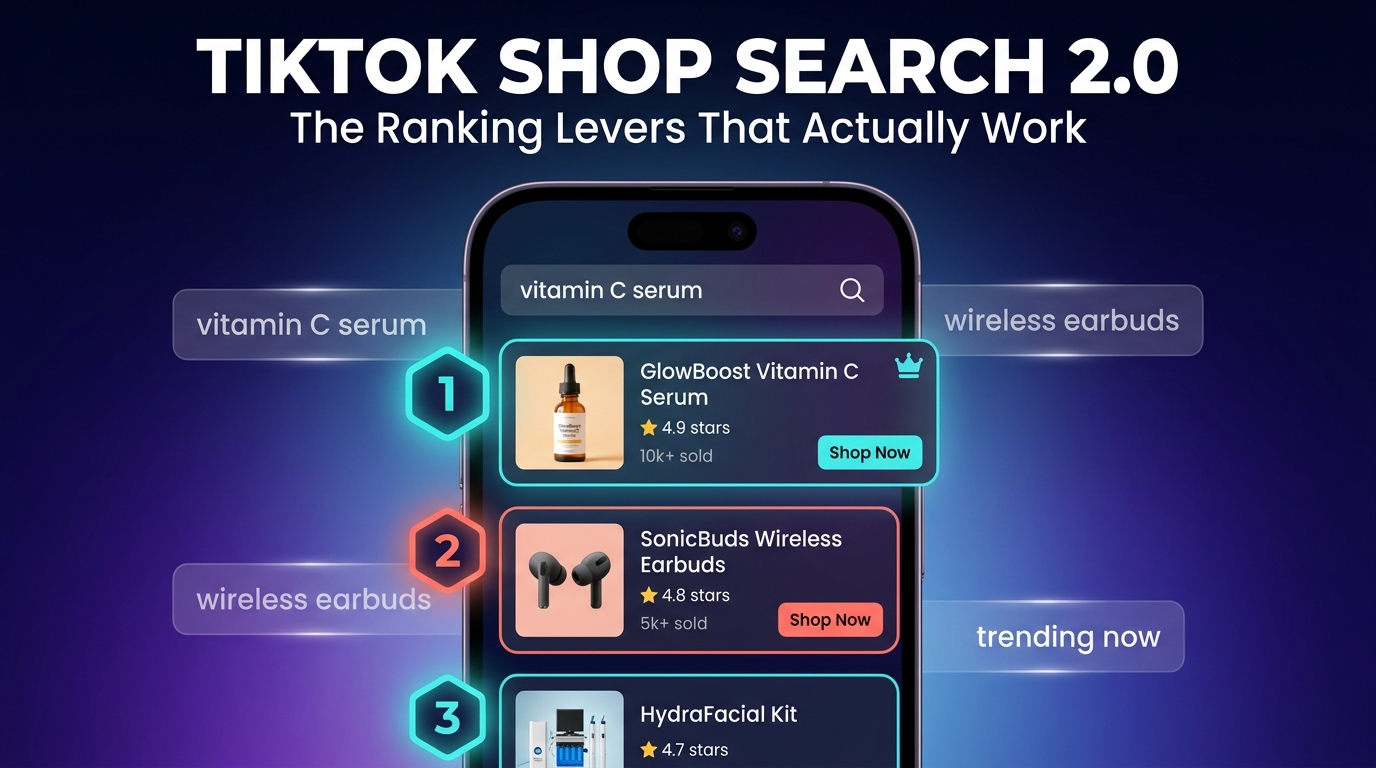
This is Search 2.0. And it operates by a completely different set of rules than anything TikTok sellers have historically optimized for.
The challenge is that most sellers don’t know which levers they can actually reach. TikTok doesn’t publish a ranking algorithm. Seller Center guidance is sparse. And a lot of the advice circulating in communities conflates FYP optimization — hook rates, watch time, comment bait — with search ranking, which is a fundamentally different system with different inputs.
This post maps out what that system actually looks like in 2026, which signals you control, which ones you don’t, and — critically — what order to address them in. There’s no viral trick here. There’s just a set of concrete levers, most of which sellers either ignore, underweight, or pull in the wrong sequence.
Why Search Became the Revenue Engine (Not Just a Discovery Feature)
For most of TikTok’s commercial history, search was treated as a secondary experience. Users discovered products through creator videos served algorithmically on the FYP. Search existed, but it was used mainly to find accounts or trending sounds — not to shop.
That changed materially in 2024 and accelerated through 2025 and into 2026. TikTok has reported that total search volume on the platform is up 40% year over year, with users conducting billions of searches daily. But the more meaningful shift for sellers isn’t the raw growth in searches — it’s the intent behind them.
From Passive Discovery to Active Intent
FYP traffic is fundamentally passive. The algorithm surfaces products to users who weren’t necessarily looking for them. It produces spikes — sometimes enormous ones — but the buyer who sees a viral video and impulse-purchases is a different buyer from the one who types a specific search query. The search buyer has already made a category decision. They’ve already identified a need. They’re looking for the best available option in a defined space, not discovering that a category exists.
Higher purchase intent means higher conversion rate. That’s why sellers who’ve begun tracking traffic sources inside TikTok Shop analytics consistently report search visitors converting at a meaningfully higher rate than FYP visitors for most product categories. The exact differential varies by niche, price point, and creative quality, but the directional consensus from agency analyses is consistent: search traffic converts better and retains better. The customer acquired through a search-driven purchase has a shorter consideration cycle and a cleaner path to checkout.
The Stability Problem with FYP-Only Revenue
There’s also a structural resilience argument. FYP revenue is viral revenue — it’s feast-or-famine, driven by whether a particular video catches an algorithmic wave. A single creative that doesn’t land means a dead week. Search revenue, by contrast, follows demand curves that are relatively stable. If 40,000 people search for “posture corrector brace” this week, roughly that same number will search for it next week, regardless of what’s trending on the FYP.
Sellers who’ve built search-optimized catalogs are essentially building a compounding asset. Each well-ranked listing generates consistent traffic that doesn’t require new creative investment to maintain. FYP traffic requires continuous creative output — new videos, new hooks, new affiliate activations — just to sustain the same revenue level.
This doesn’t mean abandoning video. Far from it. As we’ll see shortly, video content is actually one of the most powerful ranking signals in TikTok Shop’s search system. But the relationship between video and search is very different from the relationship between video and FYP performance — and conflating the two is one of the biggest strategic mistakes sellers make.
How Search 2.0 Actually Scores Your Listing: The Three-Layer Model
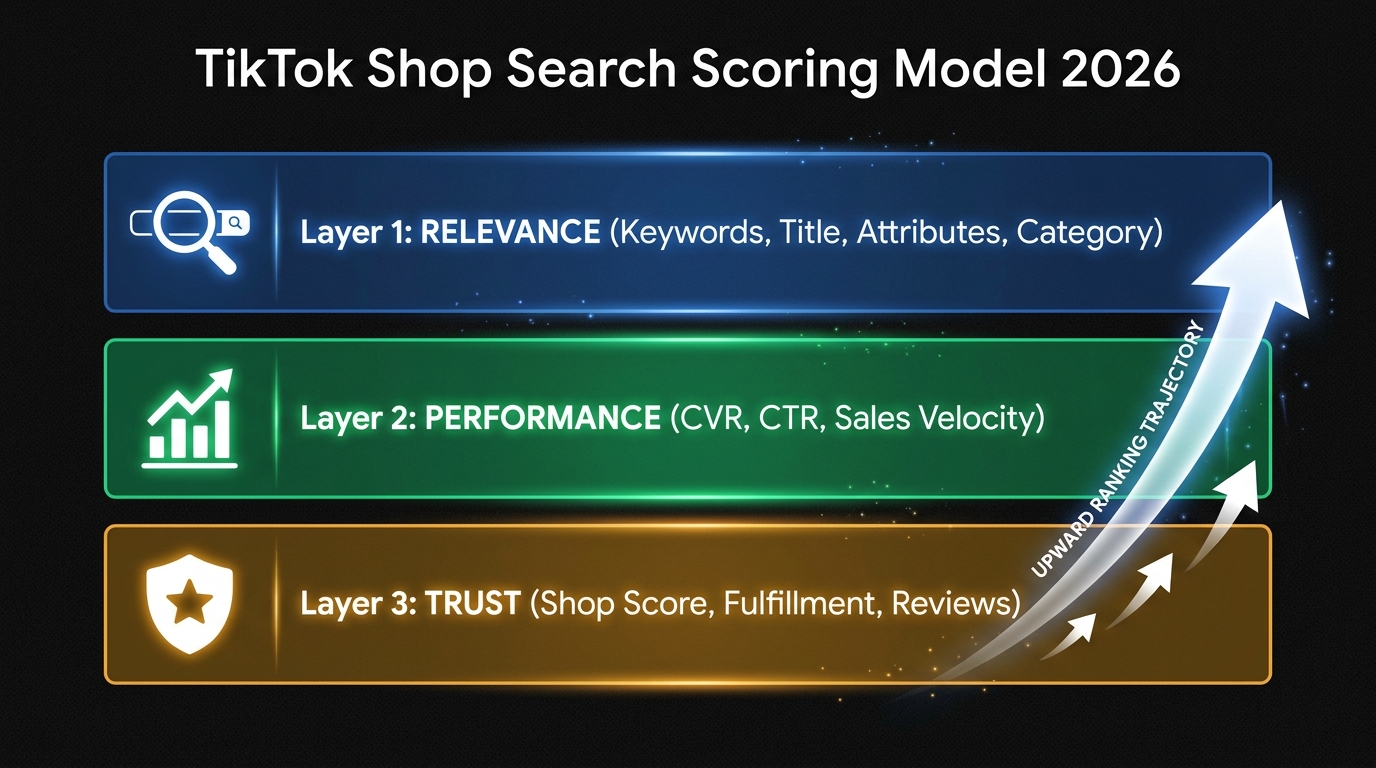
Before you can pull any lever intelligently, you need a working mental model of what TikTok’s search system is actually scoring. TikTok doesn’t publish a ranking spec. What we know comes from Seller Center documentation, practitioner reverse-engineering, and observable patterns from sellers who’ve run systematic tests. With that caveat in place, the consensus framework breaks down into three interdependent layers.
Layer 1: Relevance — Can TikTok Match You to the Query?
This is the foundation. Before TikTok can assess whether your product performs well for a given search, it needs to determine whether your product is relevant to that search at all. Relevance is determined by text signals: your product title, description, category assignment, attributes, and — increasingly — the content of videos linked to your listing.
The system does both exact-match and semantic matching. Exact match means the words in the query appear verbatim in your listing. Semantic matching means TikTok’s models understand that “noise cancelling headphones” and “ANC headphones” are related queries, even if one phrase doesn’t appear in your title. Sellers who rely exclusively on one primary keyword term and ignore related vocabulary are leaving semantic coverage on the table.
Relevance is the qualifying round. Without sufficient relevance signal, your listing won’t enter the ranking competition for a given query at all. This is why getting the relevance layer right is the necessary first step — not the only step, but the entry requirement.
Layer 2: Performance — Does TikTok Believe You’ll Convert for This Query?
Once TikTok determines a listing is relevant to a search, it then assesses which relevant listings are most likely to result in a successful transaction for that specific query. The primary inputs here are click-through rate (CTR), add-to-cart rate, purchase conversion rate (CVR), and sales velocity. These signals are query-specific: TikTok tracks how your listing performs when it’s surfaced for a particular search term, not just how it performs overall.
This is where TikTok’s search system starts to look meaningfully different from traditional e-commerce search. It’s not just evaluating historical ranking signals — it’s doing continuous, real-time inference about conversion probability. A listing that converts exceptionally well for one query might rank lower for a slightly different query where its conversion rate is weaker. The ranking is not static; it reflects ongoing performance.
Layer 3: Trust — Does TikTok Believe Your Shop Is Safe to Surface?
The third layer is shop-level and seller-level credibility. This encompasses your shop score, fulfillment performance, return and dispute rates, review velocity, and review quality. Think of this layer as a floor and ceiling modifier on your rankings. A shop with poor operational metrics can’t fully capitalize on strong relevance and performance signals — TikTok is cautious about ranking products from shops that generate post-purchase dissatisfaction, because a bad buyer experience reflects poorly on the platform itself.
Conversely, a shop with an excellent operational track record gets a form of ranking headroom — more tolerance for launching new listings without established performance history, better treatment in competitive queries, and faster recovery when performance temporarily dips.
All three layers matter. Many sellers focus exclusively on Layer 1 (keywords) and ignore Layers 2 and 3. Others have excellent shop scores but mediocre relevance optimization. The sellers who rank consistently well are those who’ve addressed all three layers together.
The Title Architecture Problem: Why Most Sellers Build This Backwards
If there’s one lever that delivers the highest return on time invested in TikTok Shop search optimization, it’s the product title. TikTok’s own Seller Center documentation confirms that the title is a primary ranking signal. And yet the majority of TikTok Shop listings are built around titles optimized for something other than search: brand recognition, marketing tone, or copy-paste from supplier sheets.
The Recommended Title Formula
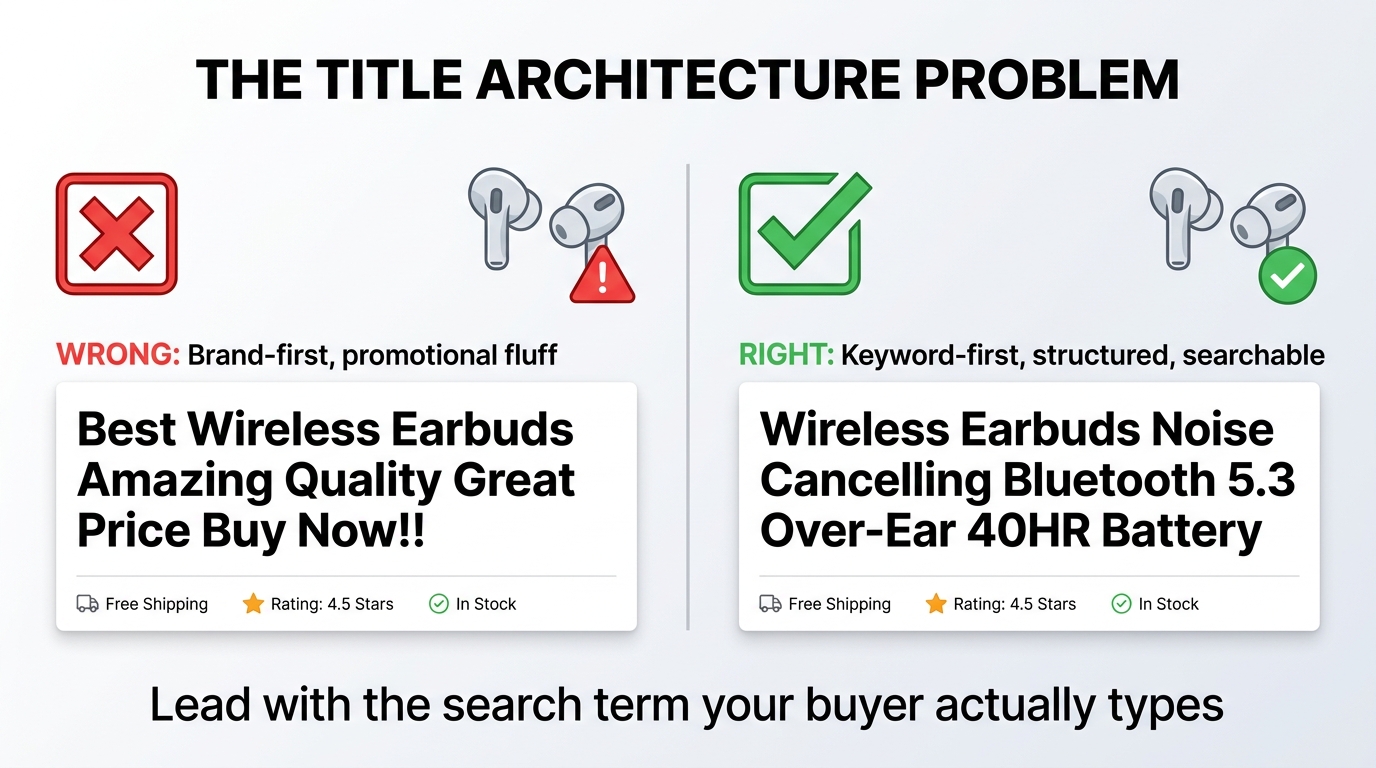
TikTok Seller Center’s official guidance on title construction follows a specific structure: Brand + Product Type + Key Attributes + Secondary Features/Benefits. Practitioners who’ve tested title variations consistently find that the most important variable is what appears in the first 20–30 characters — what’s visible before truncation in search results. The primary search keyword your buyer would type should lead the title, not your brand name.
This runs directly against the instinct of most brand-conscious sellers. When you’re building a brand identity, you want to put your name first. But in search, your brand name is irrelevant to a buyer who doesn’t know you yet. They’re searching for a product type — “bamboo cutting board,” “pore vacuum blackhead remover,” “compression knee sleeve.” If your title leads with “BrandName Premium Quality Amazing Value — Best Bamboo Cutting Board,” you’ve buried the relevant keyword past the truncation point. TikTok may still index the term, but the click-through rate on a search results page will be lower because the visible title doesn’t immediately match what the user searched for.
Keyword Stuffing: The Counter-Signal
The opposite error — cramming as many keywords as possible into a title — is equally damaging. Titles like “Wireless Earbuds Bluetooth Headphones Noise Cancelling TWS In-Ear Sports Gaming Running” signal low listing quality to TikTok’s system, generate poor CTR because they’re hard to read, and can trigger manual review penalties under Seller Center quality policies.
The discipline is selecting one primary keyword phrase — the highest-volume, most intent-aligned term — and building a natural, readable title around it. Secondary keywords belong in the description and attributes, not jammed into the title.
Searcher Language vs. Seller Language
One underappreciated dimension of title optimization is the gap between how sellers describe products and how buyers search for them. Sellers often use technical, supplier-derived terminology. Buyers use colloquial, problem-oriented language. A seller listing a “cervical traction orthopedic support device” is using clinical language. The buyer is searching for “neck pain relief pillow” or “neck stretcher.” Running competitor listings through TikTok’s search autocomplete — which surfaces the actual queries users type — is the fastest way to identify this language gap. The listings that rank are typically the ones using the searcher’s exact vocabulary, not the supplier’s catalog language.
Attribute Completion: The Silent Ranking Tax
Product attributes are the fields you fill in beyond the title: color, size, material, compatibility, age range, skin type, occasion, and dozens of category-specific options. Most sellers treat attribute completion as an administrative checkbox — fill in what you know, skip what you don’t, move on. That’s a mistake with direct ranking consequences.
Why Attributes Drive Filter-Based Discovery
Attributes serve two distinct functions in TikTok Shop’s search system. First, they power filtered search results. When a buyer searches for “moisturizer for oily skin” and then applies a price filter and a “cruelty-free” filter, TikTok serves results based on attribute data, not keyword scanning. If you haven’t completed the relevant attributes, your listing is invisible to filtered searches — a significant portion of high-intent queries where buyers are narrowing their options before purchasing.
Second, attributes help TikTok’s classification model understand what your product is. When your title and description cover the product broadly but attributes are incomplete, TikTok has less confidence in how to categorize the listing and may rank it lower for specific query types where its exact nature matters. Complete, accurate attributes reduce ambiguity in TikTok’s classification engine — which translates to more confident ranking decisions in your favor.
The Category Accuracy Problem
Closely related to attributes is category selection. Sellers who choose a broader or more familiar category when a more specific one exists are paying a hidden cost. TikTok’s search system uses category as a relevance filter: a query for “vegan leather wallet” will be served predominantly from the correct subcategory, not from a broad “accessories” category. Selecting the most granular, accurate category available is not just good practice — it’s the difference between being in the ranking pool for high-intent searches and being excluded from it entirely.
The practical exercise here is straightforward: search for your own product on TikTok Shop and examine which category the top-ranking competitors appear in. If they’re consistently in a subcategory you’re not using, that’s your signal to reclassify.
Attribute Auditing as a Quarterly Practice
TikTok regularly adds new attribute fields to categories as the platform matures. A listing optimized at launch may be missing attributes that were added subsequently. Building a quarterly audit into your operations cadence — checking each active listing against the current attribute fields for its category — ensures you don’t accumulate a silent ranking deficit over time. This is one of those maintenance tasks that costs almost nothing in time but compounds meaningfully in discovery coverage.
The Multimodal Signal Stack: Audio, OCR, and Captions Working Together
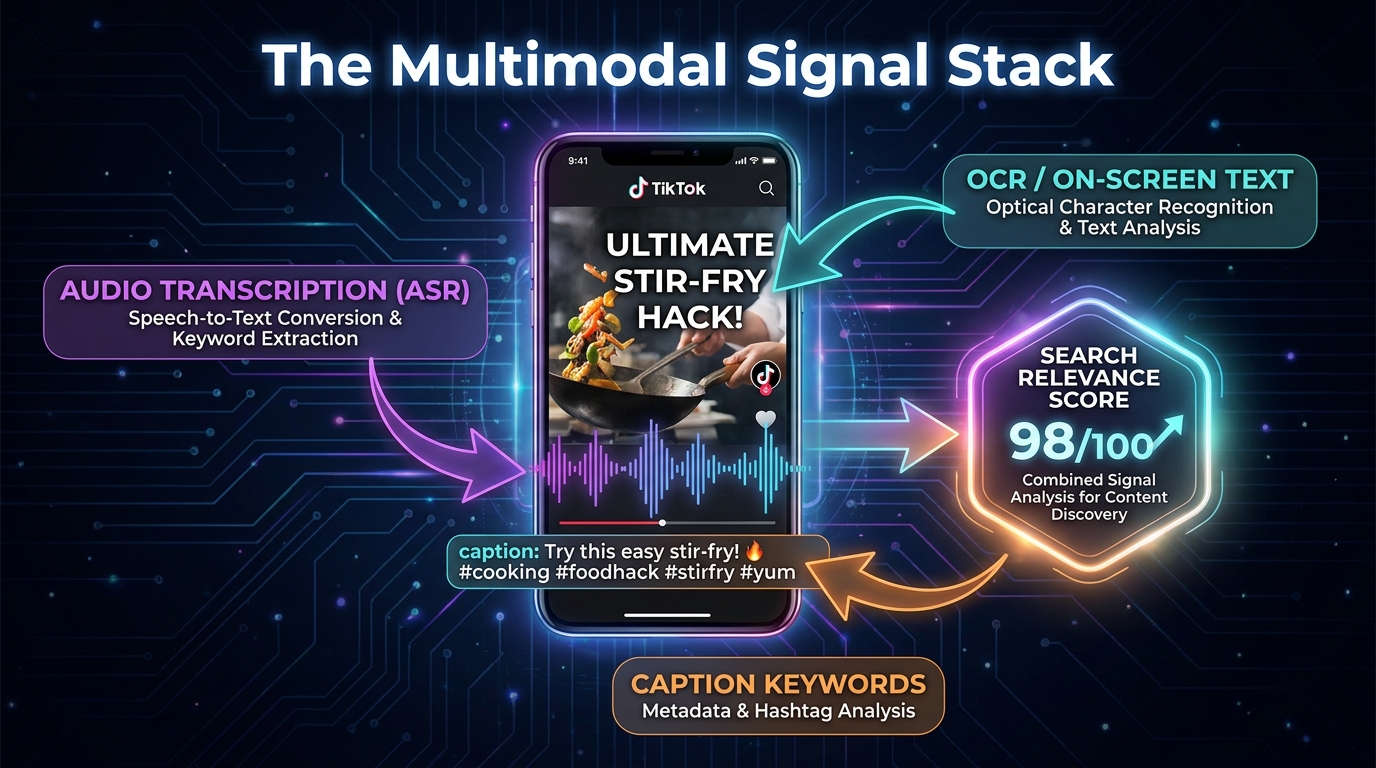
Here’s where TikTok Shop’s search system diverges most dramatically from any other e-commerce search engine. Amazon’s search algorithm reads text. Google Shopping reads text and structured data. TikTok’s search system reads text and video — including the words spoken aloud in your creator content, the text displayed on screen, and the keywords in your captions. This is what practitioners are calling the multimodal signal stack.
Automatic Speech Recognition (ASR) as a Ranking Input
TikTok transcribes the audio from videos using Automatic Speech Recognition (ASR) technology. That transcription is indexed as a text signal for the product linked to the video. This means if a creator says “I’ve been using this vitamin C brightening serum every morning for three weeks and my dark spots are almost gone,” TikTok’s system extracts “vitamin C brightening serum,” “dark spots,” and related terms as relevance signals for the associated listing.
The practical implication: the vocabulary used in creator audio directly affects which search queries your associated listings surface for. Creators who speak the buyer’s search language — using the exact terms buyers type — are generating relevance signals that reinforce the listing’s keyword coverage. Creators who use vague language (“this product is amazing, I love it”) are generating almost no meaningful ASR signals. Briefing creators on the specific terms to use verbally — not just in captions — is a ranking lever that almost no seller is deliberately pulling.
OCR: What’s Written on Screen Gets Indexed
Optical Character Recognition (OCR) means TikTok is reading text that appears on screen in videos — product names, benefit callouts, “before and after” labels, price graphics, and any text overlays creators add. This is another indexable text layer that contributes to your listing’s relevance score for specific queries.
Sellers who provide creators with specific text overlay suggestions — “use this exact phrase as your first on-screen callout” — are seeding an additional keyword signal that compounds with ASR and caption signals. When all three layers are aligned around the same primary keyword, TikTok’s classification confidence for that query increases, which correlates with higher ranking probability.
Caption Keywords: Underused and Undervalued
Video captions receive less SEO attention than they deserve. Most creators write captions that are conversational, hashtag-heavy, or blank. But captions are a direct text input to TikTok’s search indexing — the same ASR and OCR signals from video are complemented by caption text. A caption that opens with the primary search query (“Struggling with dry, flaky skin? This ceramide moisturizer changed everything for me 🧴”) is a clean, indexable signal that reinforces the listing’s relevance for “ceramide moisturizer” and related terms.
The guideline for creators should be: write the first line of every caption as if it’s an answer to the search query the target buyer would type. This single instruction, communicated clearly in creator briefs, yields measurable search relevance improvement across every video linked to your listing.
Conversion Rate as a Ranking Signal: The CVR Loop That Accelerates Rankings
The most misunderstood mechanic in TikTok Shop’s search system is how conversion rate feeds back into ranking. Most sellers treat CVR as a business metric — something you watch in your dashboard to assess sales health. In reality, CVR is an active input into TikTok’s ranking algorithm, which creates a feedback loop with significant strategic implications.

The Feedback Mechanism
When TikTok’s search system shows your listing for a query, it monitors what happens next. Buyers who click and then purchase create a positive conversion signal for that specific query-listing pairing. Buyers who click, browse, and leave without purchasing create a negative signal. Over time, TikTok’s system learns which listings convert best for which queries and weights its rankings accordingly.
This means an early investment in conversion rate optimization — improving product images, sharpening the price-value proposition, accumulating reviews — pays compound dividends in search ranking, not just in direct sales efficiency. A listing that converts at 5% for a given query will rank higher than an otherwise equivalent listing that converts at 2%, and the ranking difference further amplifies the traffic difference, which in turn generates more conversion data that reinforces the ranking advantage. This is the CVR loop: a virtuous cycle where better conversions produce better rankings, which produce more traffic, which produces more conversion opportunities.
Product Page Elements That Drive CVR
Several listing-page elements have direct, documented effects on conversion rate and therefore indirect effects on search ranking:
- Hero image quality: The thumbnail and first product image determine whether a buyer engages further. Lifestyle images that show the product in use consistently outperform white-background studio shots in most consumer categories on TikTok.
- Price and offer clarity: TikTok buyers are highly price-sensitive. Listings with clear, prominently displayed prices — and especially those with visible promotions or bundle offers — see higher CTR from search results and higher add-to-cart rates on product pages.
- Review count and rating: Social proof is a direct conversion lever. Listings with more than 25–30 reviews and a rating above 4.5 consistently outperform newer listings with no review history. Review accumulation should begin on day one of a product launch.
- Video assets on the product page: Native product videos on the listing page itself — not just creator content — improve add-to-cart and purchase rates, particularly for products that require demonstration to clarify their value proposition.
- Description completeness: Buyers who scroll past the images need a description that answers their remaining questions. Common objections — sizing accuracy, material quality, compatibility — should be preemptively addressed in the description text.
The 3.2% Baseline and Why You Should Exceed It
Broad practitioner benchmarks for TikTok Shop conversion rates hover around 3.2% overall, but this average encompasses a huge range — from sub-1% for poorly optimized listings to north of 8–10% for well-matched, well-priced products with strong social proof. The useful reference point isn’t the overall average but the CVR of your top-ranking competitors for a specific query. If competitor listings ranking above yours are converting at 6% and yours is at 2.5%, the gap is as much a ranking problem as it is a revenue problem.
Shop Score and Operational Trust: The Floor Beneath Your Ranking Ceiling
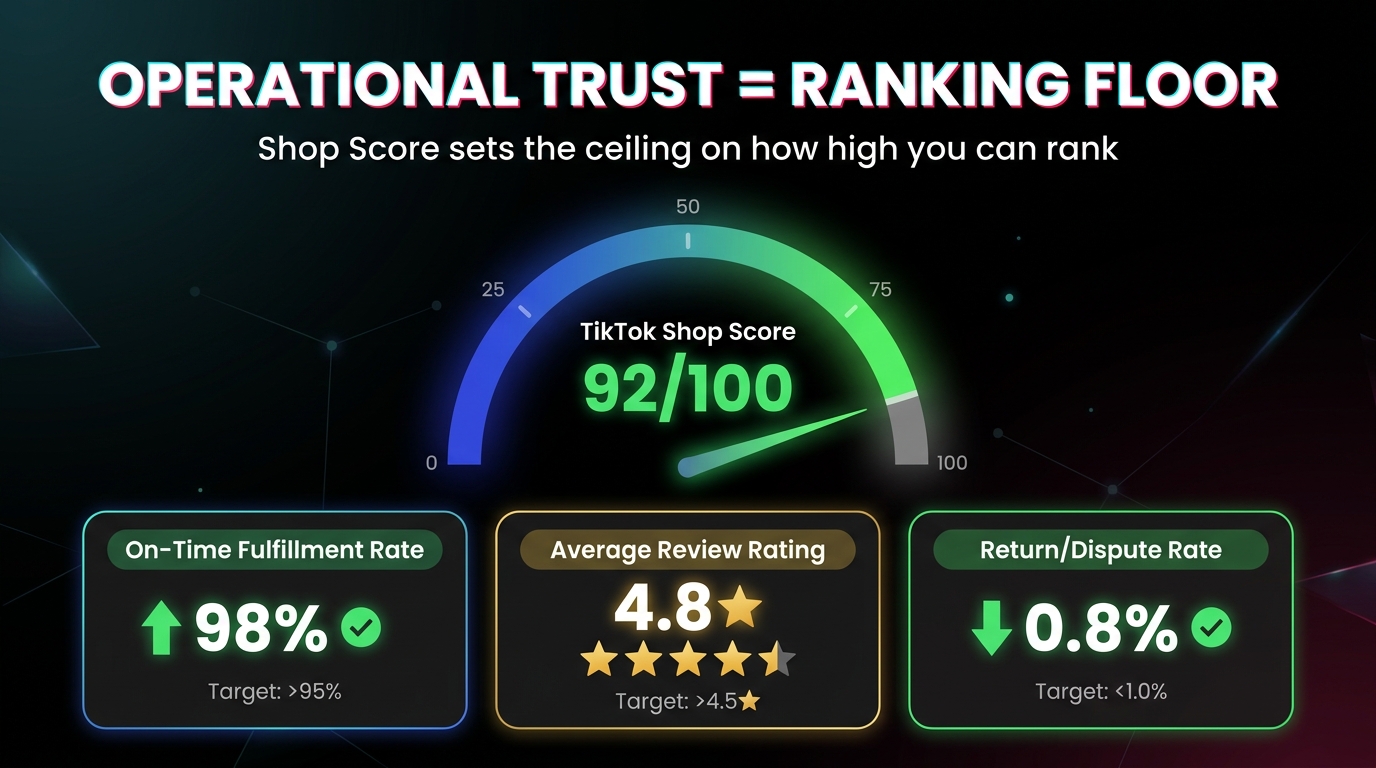
Every seller on TikTok Shop operates under a Shop Score — a composite metric that reflects operational quality including fulfillment speed, on-time delivery rate, return and dispute rates, review quality, and compliance with platform policies. This score functions as what might best be described as a ranking modifier: it doesn’t directly place you in position 3 versus position 7 for a specific query, but it sets the upper boundary on how high you can rank, and how tolerant TikTok’s system is of your listing when it competes with better-established alternatives.
Why Fulfillment Speed Is a Ranking Signal, Not Just a Service Metric
TikTok has competitive incentive to surface products that buyers will actually receive quickly and without problems. A buyer who orders and receives their product in two days and leaves a 5-star review generates value for the platform. A buyer who orders, waits ten days, receives a wrong item, files a dispute, and leaves a 1-star review costs TikTok platform trust. The search ranking system incorporates fulfillment performance precisely because fast, accurate fulfillment is a proxy for buyer satisfaction.
Sellers using TikTok’s native fulfillment services (where available in their market) or maintaining tight third-party logistics relationships tend to see stronger shop scores and — all else being equal — better ranking headroom. The specific thresholds TikTok doesn’t publish, but the directional principle is consistent: an on-time fulfillment rate above 95% is the target floor for maintaining strong ranking eligibility. Falling below this threshold creates drag on search performance that no amount of keyword optimization can fully overcome.
Review Velocity: Getting the Flywheel Turning
Review count and review recency are both components of the trust layer. A listing with 100 reviews accumulated over three years does not carry the same weight as a listing with 80 reviews from the past 90 days — recency signals that the product is currently selling, currently satisfying buyers, and currently relevant. Sellers who’ve implemented systematic post-purchase review request workflows (within TikTok Shop’s permitted communication channels) consistently see faster review accumulation and the corresponding shop score benefits.
One tactical note: review quality matters as much as review count. Reviews that mention specific product attributes — “the noise cancellation on these earbuds is excellent for flights” — serve dual functions: they’re social proof for buyers and they’re text signals that may influence how TikTok’s system categorizes the listing’s relevance for specific queries. Encouraging buyers to write specific, detailed reviews rather than generic star ratings produces compounding benefits across both the trust layer and the relevance layer.
Dispute and Return Rate Management
High dispute rates and return rates are direct negative signals in the shop score calculation. The most common sources of these metrics are product-description mismatches (the buyer received something that didn’t match what was shown), sizing inaccuracies, and quality inconsistencies. Addressing these at the source — improving description accuracy, adding sizing guides, implementing incoming quality checks on supplier shipments — is not just customer service work. It’s direct search ranking work, because every dispute prevented is a shop score point preserved.
Search Ads and Organic Ranking: The Paid-to-Organic Flywheel
TikTok has been explicit that paid search ads do not directly guarantee improved organic rankings — there’s no “pay to rank” mechanism in the way that some sellers hope for. However, the relationship between Search Ads and organic search performance is more nuanced than a simple “paid and organic are separate” framing suggests.
How Paid Search Generates Organic Ranking Signals
When you run TikTok Search Ads targeting specific keywords, the resulting clicks, add-to-carts, and purchases for those keywords generate conversion and engagement data for your listing under those specific query terms. That data feeds TikTok’s performance layer — the same signals that determine organic ranking. A listing that has accumulated strong CVR data through paid search for a given keyword is, over time, better positioned to rank organically for that keyword, because TikTok’s system has observed that the listing converts well for that query.
This is the paid-to-organic flywheel: paid search generates the performance data that organic ranking requires, particularly for new listings that lack organic history. Rather than waiting months for organic signals to accumulate, sellers can accelerate the process by running targeted search campaigns against their highest-priority keywords early in a product’s lifecycle.
Budget Allocation: Seeding vs. Sustaining
The strategic implication is that paid search budget should be thought of differently depending on where a listing is in its lifecycle. For new listings, Search Ads are a signal-generation investment — you’re buying performance data that seeds organic ranking. The goal isn’t necessarily ROAS maximization in week one; it’s accumulating sufficient CVR signal at the keyword level to become competitive organically. For established listings with good organic ranking, paid search can shift to a sustaining role — defending position against competitors who are aggressively bidding on your category keywords, and capturing incremental volume beyond your organic reach.
GMV Max campaigns — TikTok’s automated shopping campaign format — also feed conversion signals back into the search and recommendation systems, though the mechanism is less query-specific than Search Ads. Many experienced TikTok Shop operators run both in combination: GMV Max for broad conversion signal generation and audience learning, Search Ads for keyword-specific CVR seeding on priority terms.
Keyword Research for TikTok Shop in 2026: Tools and Tactics That Work
Effective keyword research for TikTok Shop is not the same exercise as Amazon or Google keyword research. The query vocabulary is different, the intent signals are different, and the tooling is still relatively immature compared to those established ecosystems. Here’s what’s actually available and how to use it.
TikTok-Native Tools
TikTok has built out a meaningful set of keyword research capabilities within its native ecosystem, though they’re scattered across different surfaces:
- Search Ads Keyword Planner: Available within TikTok Ads Manager’s Search Ads workflow, this tool provides search volume estimates, keyword suggestions, and competitive bid data for specific terms. It’s designed for paid campaign planning but is equally useful for organic keyword strategy — if a term has high search volume in the keyword planner, it’s a priority for organic title optimization.
- Creator Search Insights: TikTok’s tool for identifying what content creators should make based on search demand. For sellers, it surfaces high-demand, low-supply query areas — topics users are searching for but not finding enough good content about. These represent ranking opportunities where you can win with targeted creative.
- TikTok Search Autocomplete: The platform’s autocomplete suggestions when typing queries are direct evidence of actual user search behavior. Systematically working through your category’s search terms and recording autocomplete suggestions produces a first-party, real-time keyword list that no third-party tool can fully replicate.
Third-Party Research Tools
The third-party TikTok Shop analytics ecosystem has matured considerably through 2025 and into 2026. Platforms like FastMoss and Kalodata provide GMV estimates, creator activity tracking, and product performance data across TikTok Shop categories. While these tools are primarily positioned as competitive intelligence and product research platforms, they’re valuable for keyword strategy in a specific way: by examining the top-performing listings in your category and analyzing their title structures, you can infer which keyword patterns are associated with the highest-performing listings — a form of competitive keyword reverse-engineering.
The Gap Analysis Approach
Beyond individual keyword identification, the most valuable keyword research exercise for TikTok Shop is gap analysis: mapping the queries users are searching for in your category against the keywords your listings are currently optimized for, and identifying the mismatches. This typically reveals two types of gaps. First, high-volume queries where you’re present in search but not ranking well (optimization gap — your listing exists but needs title/attribute work). Second, high-volume queries where you have no relevant listing at all (catalog gap — an opportunity to expand your product range or create a listing variant that addresses that specific demand).
The Ranking Mistakes Sellers Keep Making (And Why They’re Hard to See)
Most search ranking problems on TikTok Shop aren’t the result of ignorance of the general principles. Sellers broadly know that keywords matter. What produces persistent underperformance is a set of specific execution mistakes that are either invisible from the dashboard or intuitively feel like they shouldn’t matter.
Brand-First Titles
Putting your brand name at the start of the title when buyers aren’t searching for your brand. This is the most common title mistake and the most consequential in terms of ranking impact on competitive queries.
Category Mismatch at Scale
Using a parent category instead of the most specific subcategory available. Particularly damaging for sellers with large catalogs who bulk-upload listings using templated category assignments rather than reviewing each SKU individually.
Ignoring the Attribute Update Cycle
Never returning to a listing’s attributes after initial setup. As TikTok adds new attribute fields, listings with incomplete attributes fall behind competitors who’ve filled in the new fields. This is a slow-moving ranking deterioration that doesn’t show up as a sudden drop — it shows up as gradual decline in discovery impressions over months.
Treating All Videos the Same for Search
Not distinguishing between videos optimized for FYP virality and videos optimized for search ranking. The two require different approaches to caption writing, on-screen text, and spoken language. Sellers who use one creative strategy for both surface types underperform on at least one of them.
Launching Without a Review Accumulation Plan
New listings with zero reviews are at a structural disadvantage in search results. Every major product launch should have a review generation plan that activates within the first two weeks — whether through existing customer outreach, affiliate programs, or platform review request tools.
Ignoring Shop Score Until It’s an Emergency
Shop Score problems tend to compound quietly. A fulfillment partner that starts slipping — delivery times creeping from two days to five days — creates a slow-building shop score problem that only becomes visible when search rankings have already meaningfully deteriorated. Monitoring shop score components weekly, not monthly, prevents small operational issues from becoming search ranking crises.
Building Listings Once and Walking Away
Unlike a static product listing on a wholesale site, a TikTok Shop listing needs to be treated as a living asset. Titles should be refined as keyword research reveals better opportunities. Attributes should be audited quarterly. Images should be refreshed as creative testing reveals higher-converting alternatives. The set-and-forget approach trades long-term search rank for the short-term convenience of not maintaining the listing.
Misreading Search Analytics
TikTok Shop’s analytics surfaces overall listing performance metrics but doesn’t always make it easy to isolate search-driven performance from FYP-driven performance. Sellers who optimize based on blended metrics — treating their overall CVR as their search CVR — may be making decisions based on incomplete signals. Where possible, using UTM parameters or TikTok’s traffic source breakdown to isolate search-driven visitor behavior produces cleaner optimization data.
Building a Repeatable Search Ranking Cadence
Knowing which levers exist is half the battle. The other half is building the operational habit of pulling them systematically, not just reactively. The sellers who compound their search rankings over time are those who’ve turned optimization from a one-time project into a recurring workflow.
The Weekly Check (30 Minutes)
Every week, a brief review of the metrics most likely to signal emerging problems or opportunities:
- Search impressions and click-through rate for top listings — sudden drops signal ranking changes worth investigating.
- Shop score components — fulfillment rate, review scores — to catch operational issues before they become ranking penalties.
- Review activity — new negative reviews that may need a response and/or signal a product quality issue to address at the source.
The Monthly Audit (2–3 Hours)
Once a month, a structured review of the listing portfolio:
- Keyword research refresh — running the top 10 priority queries through TikTok search autocomplete to identify new term variations or emerging buyer vocabulary.
- Competitive review — checking the top 3–5 ranking competitors for each priority query to see whether their titles, attributes, or pricing have changed in ways that affect your relative position.
- Creator content review — auditing linked creator videos for ASR/OCR/caption alignment with priority keywords and identifying videos that need updated caption copy or on-screen text revisions.
The Quarterly Deep Dive (Full Day)
Four times a year, a comprehensive review that covers everything the weekly and monthly checks don’t:
- Full attribute audit across all active listings against current category fields.
- Category reclassification review for listings where subcategory options have expanded.
- Conversion rate benchmarking against current category leaders — identifying which listings have the largest CVR gap and prioritizing those for image, description, or pricing optimization.
- Search Ads performance review — assessing which paid keywords have generated sufficient CVR data to drive organic ranking improvement and which are consuming budget without generating organic signal.
- Catalog gap analysis — identifying high-volume search queries in your category that you have no listing competing for, and evaluating the product expansion or variant creation opportunity they represent.
The Search-Led Seller Mindset: What Changes When You Accept That Search Has Won
There’s a deeper strategic shift that happens when sellers genuinely accept that search — not viral FYP performance — is now the primary driver of durable TikTok Shop revenue. It changes how you think about almost every aspect of operations.
Product Selection Becomes Search-Demand Driven
Rather than selecting products based on what looks viral or what a supplier is pushing, search-led sellers validate product candidates by analyzing TikTok search volume for the category. If there’s an established, growing search demand for a product type, that’s evidence of sustainable commercial interest — buyers who will still be searching for it six months from now, not just the week a viral video hits. Products that have search demand but insufficient supply of well-optimized listings are the highest-opportunity targets.
Creator Relationships Become a Search Asset, Not Just a Traffic Source
Creators who understand that their audio and on-screen text contribute to search ranking signals become vastly more valuable than creators who are simply driving FYP views. The briefing process changes: instead of just sharing product features and asking for authentic content, you’re providing specific keyword guidance — the terms to use verbally, the text overlays to include, the caption structure to follow. This requires slightly more work in the creator relationship but produces content that serves both FYP and search simultaneously.
Inventory Management Becomes Proactive Rather Than Reactive
Search-ranked listings that go out of stock lose their ranking position quickly and often don’t recover it immediately when restocked. The inventory confidence that a consistently available listing projects is itself a signal in TikTok’s system — products that are reliably in stock are products that TikTok can rank without risking surfacing a buyer to an unavailable item. Search-led sellers build inventory buffers specifically calibrated to protect their ranking positions, not just their sales continuity.
The Long-Game Compound Effect
Perhaps the most significant mindset shift is accepting that search ranking is a compounding asset with a meaningful build time. A well-optimized listing in a competitive category won’t jump to page one overnight. Relevance signals take time to index fully. Performance signals require traffic volume to become statistically meaningful. Trust signals require review accumulation. But the seller who starts this process today is six months ahead of the seller who starts it next quarter — and in TikTok Shop’s increasingly competitive search landscape, that lead time represents a defensible competitive position.
The FYP will always produce exciting spikes for sellers who feed it well. But it’s the search rankings that keep the lights on between those spikes. Building them deliberately, maintaining them systematically, and compounding them through consistent attention to all three ranking layers — relevance, performance, trust — is the operating model that separates sustainable TikTok Shop businesses from those perpetually one algorithm change away from irrelevance.
Conclusion: Pull the Right Levers, in the Right Order
TikTok Shop’s search system is more sophisticated than most sellers realize and more controllable than the platform’s reputation for algorithmic randomness suggests. The ranking is not a black box — it’s a multi-layer scoring model with clear, documented inputs at each layer, most of which you can directly influence.
The levers are real: title architecture, attribute completeness, category accuracy, multimodal content alignment (audio, OCR, caption), conversion rate optimization, shop score maintenance, and strategic use of Search Ads to seed performance data. None of them require extraordinary effort individually. What requires discipline is pulling all of them together, in sequence, as a sustained practice rather than a one-time project.
The sellers winning in TikTok Shop search in 2026 are not primarily the ones with the most viral content or the most followers. They’re the ones who understood earlier than their competitors that search had become the primary commerce surface, built their operations around that reality, and have been quietly compounding their ranking advantage ever since.
If you’re still operating primarily in FYP mode — great creative, reactive optimization, no systematic search strategy — the gap between you and the search-led sellers in your category is growing every day. The good news is that most of the levers described here are available right now, require no special platform access, and can be activated with existing resources. The question is whether you start pulling them this week or wait until the competitive landscape makes it significantly harder.
Key Takeaways: Prioritize Layer 1 (relevance: title, attributes, category) first — it’s the entry requirement. Then build Layer 2 (performance: CVR, CTR, sales velocity) through conversion optimization and strategic Search Ads. Then protect Layer 3 (trust: shop score, fulfillment, reviews) through operational excellence. Repeat the cycle every week, month, and quarter. That’s the full lever set.