




For most of Amazon’s history, selling on the marketplace came down to two places a product could show up. You could earn a spot in organic search by building sales velocity and reviews over time. Or you could pay for one through Sponsored Products and the other ad formats that now sit around and between the organic results.
Almost every Amazon seller tool, agency report, and internal dashboard was built around those two shelves. Keyword rank, share of voice, ACoS, TACoS: they all measure how a product performs on the search results page.
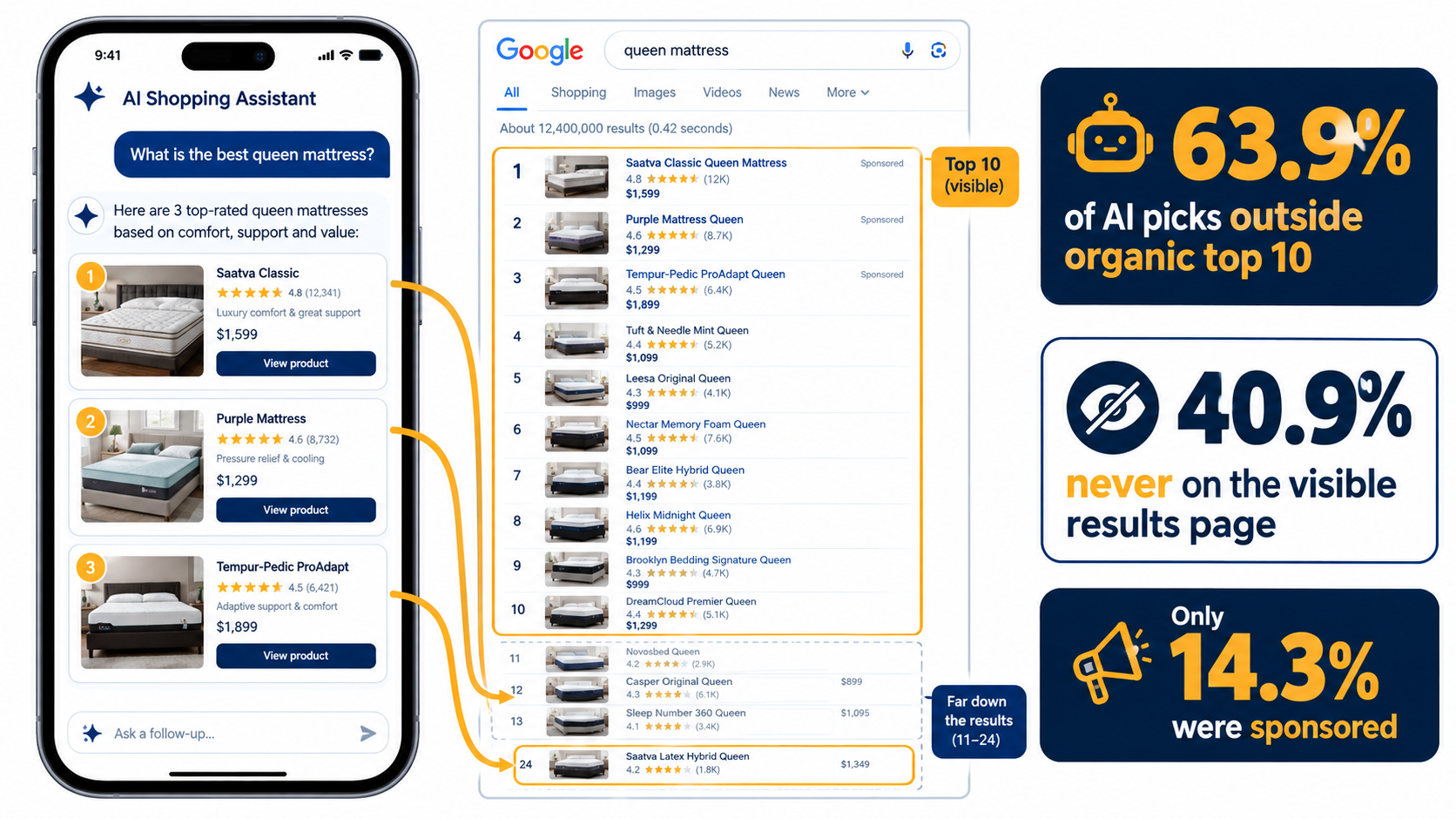
In 2026, a third shelf showed up, and the early data says it doesn’t follow the rules of the first two. Amazon’s AI shopping assistant, renamed from Rufus to Alexa for Shopping in May 2026, recommends products in a way that has surprisingly little to do with search rank. In one of the first large studies of its recommendations, 63.9% of the assistant’s picks fell outside the organic top 10 for the matching search term, and 40.9% never appeared on the visible results page at all.
That finding comes as the marketplace around it is shifting too. Demand is growing again. Ad spend is at record levels. The sellers who hold top positions are changing. And Amazon has just turned Seller Central into a control panel for rival marketplaces.
This article goes through the 2026 data on each of those shifts: what the numbers say, what they don’t say, and what sellers can actually do about it. The aim isn’t to sell you on a new tactic. It’s to give you an accurate picture of where visibility on Amazon comes from now, and where it’s likely heading.

The 2026 Marketplace in Numbers: Demand Is Back, but It’s Concentrating
Before getting into the shelves themselves, it helps to know what kind of market sellers are competing in. After a slow 2025, the numbers turned up in 2026.
E-commerce growth has resumed
According to Marketplace Pulse’s analysis of U.S. Census data, U.S. e-commerce grew 12.2% in the second quarter of 2026, its fastest rate in five years. Online sales hit a record 17.1% of all retail spending. It was the second quarter in a row of double-digit growth, after four years without one.
Marketplace Pulse described 2025 as “less like the arrival of maturity and more like a pause.” Growth ran at about 5% a quarter that year, while tariffs and the end of the de minimis exemption hit the categories where online had been gaining fastest.
Some of the growth is just higher prices
There’s an important caveat. Total retail grew 6.7%, and Marketplace Pulse estimates that roughly a third of the recent e-commerce acceleration comes from higher prices, not more orders. That puts real growth near 8%, about where it ran in 2024.
For sellers, that’s a recovery to the earlier trend, not a boom. If your revenue is up 10% year over year but your unit volume is flat, you’re seeing the same price effect, and your margins may be getting squeezed by rising landed costs at the same time.
The biggest platforms are taking most of the gains
The largest platforms are all growing faster than the overall market. In the same period:
- Amazon’s online store sales grew 15%.
- Walmart’s U.S. online sales rose 24%, and its advertising business grew 38%.
- Shopify’s North American merchants sold 28% more.
Marketplace Pulse estimates Amazon’s total GMV at about $830 billion. Growth above the market rate has to come from somewhere, and it’s coming from smaller retailers and independent channels. The same thing is happening among sellers: revenue keeps flowing toward those already at the top.
What this means for sellers
Demand is real, but it isn’t spread evenly. A growing market with heavier concentration means the gap between sellers who capture visibility and those who don’t is getting wider. That’s why it matters so much to understand where visibility comes from, across all three shelves.
Shelf One: Organic Search, and Who Actually Holds the Top Positions
Organic rank is still the foundation of Amazon selling. But the data on who holds top rankings, and how long they keep them, has changed in ways that affect strategy.
Top positions are more durable than ever
Marketplace Pulse tracks the top 10,000 sellers on Amazon.com. In its July 2026 analysis, 68.6% of today’s top sellers held that position a year ago, compared with 67% in 2019. Over three years the stickiness is even clearer: 49.6% were already in the top 10,000 three years ago, up from 41% in 2019.
In other words, getting into the top tier hasn’t become easier, and once a seller is there they tend to stay. Organic rank still compounds over time.
But who holds those positions has flipped
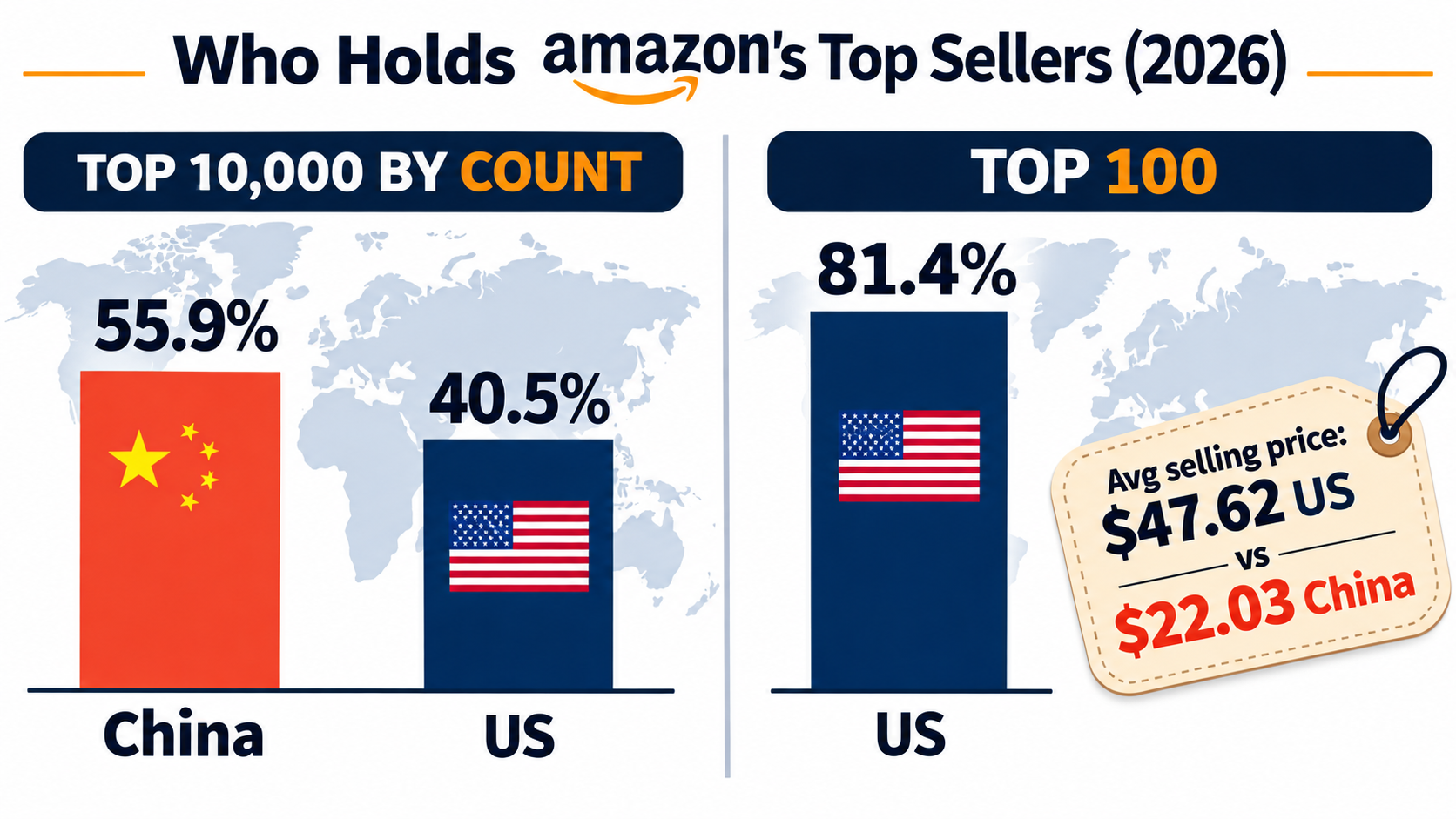
The turnover rate hasn’t changed. Who fills the seats has. Since July 2020, Chinese sellers have gained 1,342 positions in the top 10,000 and U.S. sellers have lost 1,320. Chinese sellers made up 42.5% of the group then and 55.9% today. American sellers fell from 53.7% to 40.5%.
Marketplace Pulse explains the shift this way: new Chinese entrants arrive “with manufacturing proximity, direct factory relationships, export subsidies, and AI tooling that erased the listing-quality gap once protecting domestic sellers.”
That last point is worth stopping on. Polished listing copy and good images used to set many U.S. sellers apart. That edge has mostly disappeared, because generative tools make professional-looking listings cheap for everyone.
The pandemic cohort got squeezed
Seller age matters too. Half of today’s top sellers registered before 2019, down from over 60% a year earlier. The smallest cohort is sellers who registered between 2019 and 2021, at just 17.5% of top positions. Marketplace Pulse calls it a “pandemic vintage that entered at the marketplace’s peak and has been squeezed from both directions since.”
Sellers who joined between 2022 and 2024 already hold 26.9% of top positions, and 6.3% arrived within the last eighteen months. Newer entrants are taking positions from both veterans and the pandemic group.
Headcount doesn’t tell the whole story
Here’s the counterweight. Even though Chinese sellers lead by count, U.S. sellers produce 65.3% of the GMV generated by the top 10,000, against 28.6% for Chinese sellers. At the very top, American sellers are 81.4% of the top 100 and produce 93.2% of its GMV.
The difference is price. In the top 100, the average selling price is $47.62 for U.S. sellers versus $22.03 for Chinese sellers. U.S. sellers have higher average prices at every rank level.
The takeaway for organic search: competing on price in a crowded, factory-direct category is a losing game for most domestic sellers. The sellers holding the most valuable positions are winning on brand, positioning, and higher price points, not on being the cheapest listing on the page.
Shelf Two: Paid Placement and the $68 Billion Ad Load
If organic rank is earned slowly, paid placement is bought immediately. In 2026 it’s also the most expensive way to get seen.
The size of the ad market
According to Marketplace Pulse, sellers paid $68.62 billion in Amazon advertising in 2025. That money buys placement around and inside organic search results. As ad load has grown, the share of the page that organic results occupy has shrunk.
Marketplace Pulse’s analysis of top sellers notes that veterans “built rank through organic position and review history; that real estate has steadily given way to sponsored placement, and factory-direct entrants operating on thinner product margins outspend them for it.”
Rank and ads feed each other
The two search shelves aren’t separate. Marketplace Pulse describes them as “the first earned slowly through the sales velocity that ad budgets are spent to manufacture, the second bought outright at auction.”
In practice, many sellers run ads not because the ads are profitable on their own, but because the sales they generate push organic rank up. That makes ad spend partly an investment in shelf one. It also means that when ad costs go up, it gets more expensive to hold organic rank.
Sellers feel the cost pressure
Jungle Scout’s State of the Amazon Seller 2025 report, based on a survey of nearly 1,500 sellers and businesses in January 2025, found rising costs at the top of the list of challenges:
- 38% cited higher shipping costs as a top challenge.
- 34% said they were struggling with the rising cost of goods.
- 32% said growing advertising expenses were a concern.
Jungle Scout also found that nearly 40% of enterprise brands were concerned about profitability. The same survey reported fewer businesses sourcing from China, with U.S. sourcing nearly doubling, a change that often raises cost of goods even as it lowers tariff risk.
The squeeze in practice
Put these numbers together and you get the classic margin squeeze. Landed cost per unit rises. Ad cost per sale rises. Meanwhile price competition from factory-direct sellers caps what you can charge in commoditized categories.
That’s why a surface that doesn’t respond to ad spend, at least for now, is so interesting. If the third shelf rewards something other than budget, it’s one of the few places where a smaller or newer seller can compete on something besides money.
Shelf Three: What the First Large Study of Alexa for Shopping Found
Amazon’s AI shopping assistant launched as Rufus in 2024. Early versions, as Marketplace Pulse put it, “merely returned links to searches shoppers could have run themselves.” In May 2026 Amazon renamed it Alexa for Shopping and folded it into a broader assistant.
The question for sellers is simple: when a shopper asks the assistant for a recommendation, which products does it pick? And does a product’s standing in search affect its odds?
The study design
Autopilotbrand.com, a vendor that sells AI visibility services to brands, captured 1,963 non-branded queries and 12,810 recommendations from Alexa for Shopping in May and June 2026. Marketplace Pulse reported on the results.
The method compared two kinds of queries. One asked the assistant a “best of” question, for example “what is the best queen mattress?” The other was the plain category search, “queen mattress.” The gap between the two measures how differently the assistant picks when it’s asked to recommend rather than list.
The headline findings
- 63.9% of the assistant’s picks fell outside the organic top 10 for the matched search term.
- 40.9% never appeared on the visible search results page at all.
- Only 14.3% of picks were products running a sponsored listing on that search page.
- Of those sponsored picks, 83% already ranked organically anyway.
What the numbers mean
Taken together, these figures suggest that neither organic rank nor ad spend currently does much to decide what the assistant recommends. The sponsored figure is especially telling. Most of the sponsored products the assistant picked were already ranking organically, so there’s little evidence the ad spend itself earned the recommendation.
Marketplace Pulse called rank “the sharper omission – the metric Amazon teams build dashboards around, and the one thing the assistant most conspicuously declines to follow.”
The caveats matter
This is not settled science, and it shouldn’t be treated that way. Marketplace Pulse itself flagged that it’s “a single snapshot from one US account, captured early.” Recommendations may vary by shopper history, location, Prime status, and time. The study was run by a company that sells services in this area, which doesn’t invalidate it but is worth keeping in mind.
It also doesn’t tell us how many shoppers use the assistant, or how much revenue flows through it compared with search. Treat it as a strong early signal, not a law of nature. Even so, a two-thirds gap between AI picks and search rank is too large to ignore.
Why the AI Shelf Picks Differently From Search
To act on the study, sellers need a working theory of why the assistant picks differently. Amazon hasn’t published the inner workings of Alexa for Shopping, so what follows is reasoning from the evidence, not a confirmed spec.
Listing versus recommending
A search results page answers the question “which products match this keyword, ordered by how likely they are to sell?” Sales velocity, conversion rate, and relevance signals drive that order. Ads add a paid layer on top.
A recommendation answers a different question: “which product is right for this shopper’s stated need?” A shopper asking for “the best queen mattress for a side sleeper with back pain” is describing a situation, not typing a keyword. The best answer may be a product that sells less overall but fits that situation better.
Seen that way, it isn’t surprising that the assistant reaches past the top 10. Search rewards popularity. Recommendation rewards fit.
Context as the currency
Christian Umbach, co-founder and CEO of Autopilotbrand.com, summed up the implication in comments to Marketplace Pulse:
“We’re seeing the emergence of a third shelf alongside organic search and paid placements. Brands cannot simply buy or rank their way onto it; they need to give Amazon’s AI Alexa enough context to understand when and why their product is the right recommendation. That means richer catalog data, optimization around shopper intent, and continuous updates as seasonal use cases and product differentiators evolve. For products that do not yet own the top of search, this creates an entirely new path to compete.”
The key phrase is “when and why.” A listing built for search tells Amazon what the product is and which keywords it matches. A listing built for the AI shelf also has to explain who it’s for, what situations it fits, and how it compares to alternatives.
From reprinting results to reasoning about them
Marketplace Pulse frames the change as the assistant maturing: “A two-thirds decoupling from search rank is the measure of a system that stopped reprinting its own results.” Early assistants grew “more confident but not more intelligent.” The 2026 version appears to be drawing on a deeper pool of the catalog.
For sellers, that means the long tail of the catalog, the products that never break into page one, can suddenly be visible in a new way. Marketplace Pulse called the AI shelf “the rare surface where rank incumbency is a weaker moat.”
Why this matters for newer and smaller sellers
Recall the organic search data: top positions are sticky, and nearly half of top sellers have been there for three years or more. Breaking into page one for a competitive keyword can take months of ad spend.
The AI shelf, at least in this early snapshot, offers a different route. A well-documented product with a clear use case could be recommended above a category leader without first winning the keyword battle. That’s not a guarantee, but it’s a real opening that didn’t exist two years ago.
How to Build Catalog Context the AI Shelf Can Use
If context is what the assistant appears to reward, the practical question is how to give it more. None of the following is a confirmed ranking factor. These are sensible steps based on how the assistant is described and on what the study found. Most of them also make your listings better for human shoppers, so the downside is low.
1. Fill every structured attribute
Amazon’s catalog has hundreds of structured fields across categories: material, dimensions, intended user, compatible devices, care instructions, and more. Many sellers fill only the required ones. Structured data is the easiest kind of information for any system to read, so incomplete attributes are an easy gap to close.
Go through the category template for each ASIN and fill every field that honestly applies. Make sure the attributes agree with the title, bullets, and images.
2. Write for situations, not just keywords
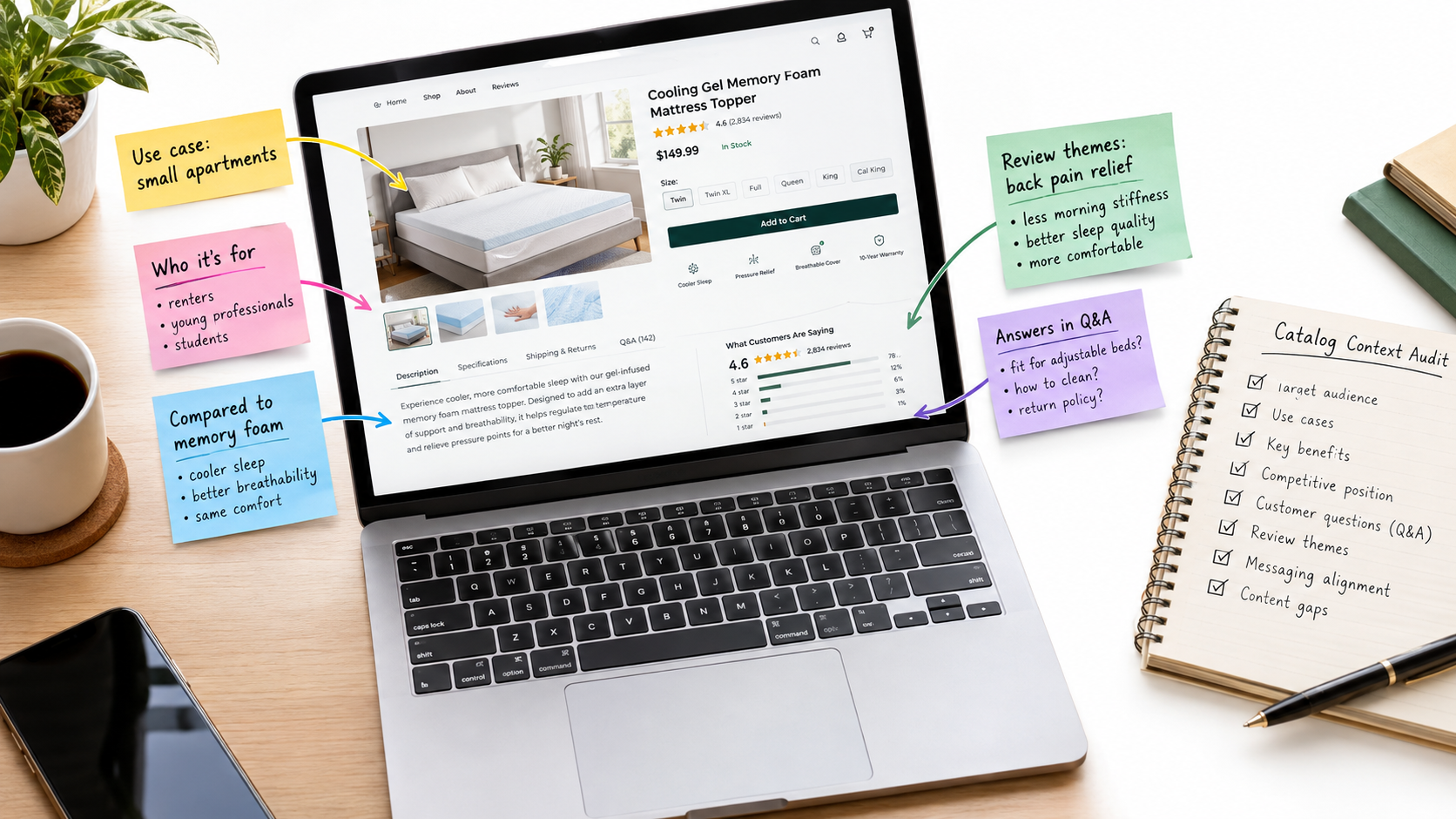
Traditional listing copy packs in search terms. AI-shelf copy should also describe the situations where the product is the right choice. Think in terms of the questions shoppers actually ask:
- Who is this for? (“Designed for side sleepers who wake up with shoulder pressure.”)
- When does it fit? (“Sized for studio apartments and dorm rooms under 300 sq ft.”)
- What problem does it solve? (“Keeps coffee hot for six hours on long commutes.”)
- When is it not the right choice? Honest limits help a recommendation system match you to the right shopper.
3. Make comparisons explicit
“Best of” questions are comparisons. If your product is lighter, quieter, or more durable than the typical alternative, say how and by how much, in specific, verifiable terms. Amazon’s policies limit naming competitors, but you can compare against product types (“unlike memory foam, our hybrid design…”) without breaking the rules.
4. Treat reviews and Q&A as context sources
Reviews and customer questions contain the language real shoppers use to describe their needs. Read your reviews for recurring themes. If buyers keep mentioning a use case you never listed, add it to the listing. If a question keeps coming up, answer it in the bullets or A+ content instead of leaving it buried.
5. Keep it current
Umbach specifically mentioned “continuous updates as seasonal use cases and product differentiators evolve.” A patio heater’s context in October is different from its context in May. A product that just got a new version needs updated comparison language. Schedule listing reviews quarterly at a minimum, and before each major season.
6. Make sure the claims are true
This sounds obvious, but it matters more with an AI recommending your product. If the assistant suggests your product for a specific need and it doesn’t deliver, you’ll see it in returns and negative reviews, which feed back into every shelf. Accurate context is a long-term asset. Inflated context is a liability.
The Monetization Clock: How Long Will the AI Shelf Stay Open?
The most important sentence in the Marketplace Pulse analysis may be this one: “Search looked like that once too, before the ad load found it.”
Ads are already arriving in the assistant
Amazon isn’t leaving the AI shelf unmonetized. In May 2026, the same month as the Alexa for Shopping rebrand, Amazon launched Sponsored Products and Brand Prompts inside Rufus. Marketplace Pulse described an “agentic ad convergence” that appeared to be “closing the last non-ad path to scale.”
Outside Amazon, the same pattern played out. Marketplace Pulse reported that ChatGPT abandoned its organic-checkout alternative, another sign that AI shopping surfaces are heading toward paid models.
Two different questions
It’s worth separating two things. The first is whether Amazon sells ad placements within the assistant experience. It clearly does now. The second is whether a product’s search standing or search ad spend influences the assistant’s organic recommendations. The study suggests it mostly doesn’t, for now.
Both can be true at once. The assistant can show paid prompts alongside recommendations that aren’t driven by ads, just as search shows sponsored results alongside organic ones.
History suggests the window narrows
Amazon search started with mostly organic results. Over time, ad placements took a growing share of the page, and the $68.62 billion sellers spent in 2025 shows how far that went. There’s no reason to expect the AI shelf to follow a completely different path.
Marketplace Pulse’s conclusion is measured: “The AI shelf’s economics are not yet written. The sellers learning how it selects now are the ones who will notice the day that changes.”
The practical stance
The sensible approach is to treat the current period as an early-mover window, not a permanent free lunch. Invest now in catalog context, which also improves conversion on search. Start measuring AI visibility so you’ll notice when the rules change. And be ready to judge AI-surface ad formats on their own numbers once they mature, instead of assuming they work like Sponsored Products.
Positioning Over Price: Where Domestic and Brand Sellers Still Win
All three shelves point to the same strategic conclusion. Competing purely on price against factory-direct sellers is getting harder. Competing on fit, quality, and clear positioning is getting more valuable.
The price gap at the top
The Marketplace Pulse top-seller data makes the case. U.S. sellers hold 81.4% of Amazon’s top 100 seller positions and 93.2% of that group’s GMV, with an average selling price more than twice that of Chinese sellers in the same tier ($47.62 vs. $22.03).
The sellers who dominate by count are winning the long tail of lower-priced goods. The sellers who dominate by revenue are selling higher-value products to shoppers willing to pay more.
Why positioning fits the AI shelf
A recommendation engine trying to match a product to a stated need will naturally favor products whose positioning is clear. “Cheapest option” is one kind of positioning. But “best for people with small kitchens,” “quietest model for nurseries,” or “most durable for commercial use” are positions that hold up regardless of price.
Brands that have done the work of defining exactly who their product is for are, in effect, already writing the context the AI shelf seems to reward.
Amazon Business: a less crowded segment
One segment often overlooked in this discussion is B2B. Marketplace Pulse reported in July 2026 that Amazon Business reached $60 billion in annualized gross sales, up from $35 billion disclosed in 2023 and $25 billion in 2021. That’s roughly 7% of Amazon’s estimated $830 billion GMV.
Business buyers tend to care about specifications, compliance, bulk pricing, and reliability more than impulse appeal. For sellers with products that fit office, industrial, healthcare, or institutional use, B2B is a channel where detailed, accurate specs matter more than ad budget.
Questions to pressure-test your positioning
- Can you describe in one sentence who your product is best for and why?
- Is there a specific situation where your product clearly beats the top-ranked alternative?
- Does your listing say that situation out loud, in words a shopper would use?
- If your only advantage is price, how long will it last against a factory-direct competitor?
If those questions are hard to answer, the problem probably isn’t your listing copy. It’s the product’s position in the market.
Seller Central Becomes a Multichannel Hub: Opportunity and Dependence
The third shelf is about how shoppers find products on Amazon. The other big 2026 change is about how sellers run their business across channels, and Amazon has moved to the center of that too.
What Amazon announced at Accelerate 2026
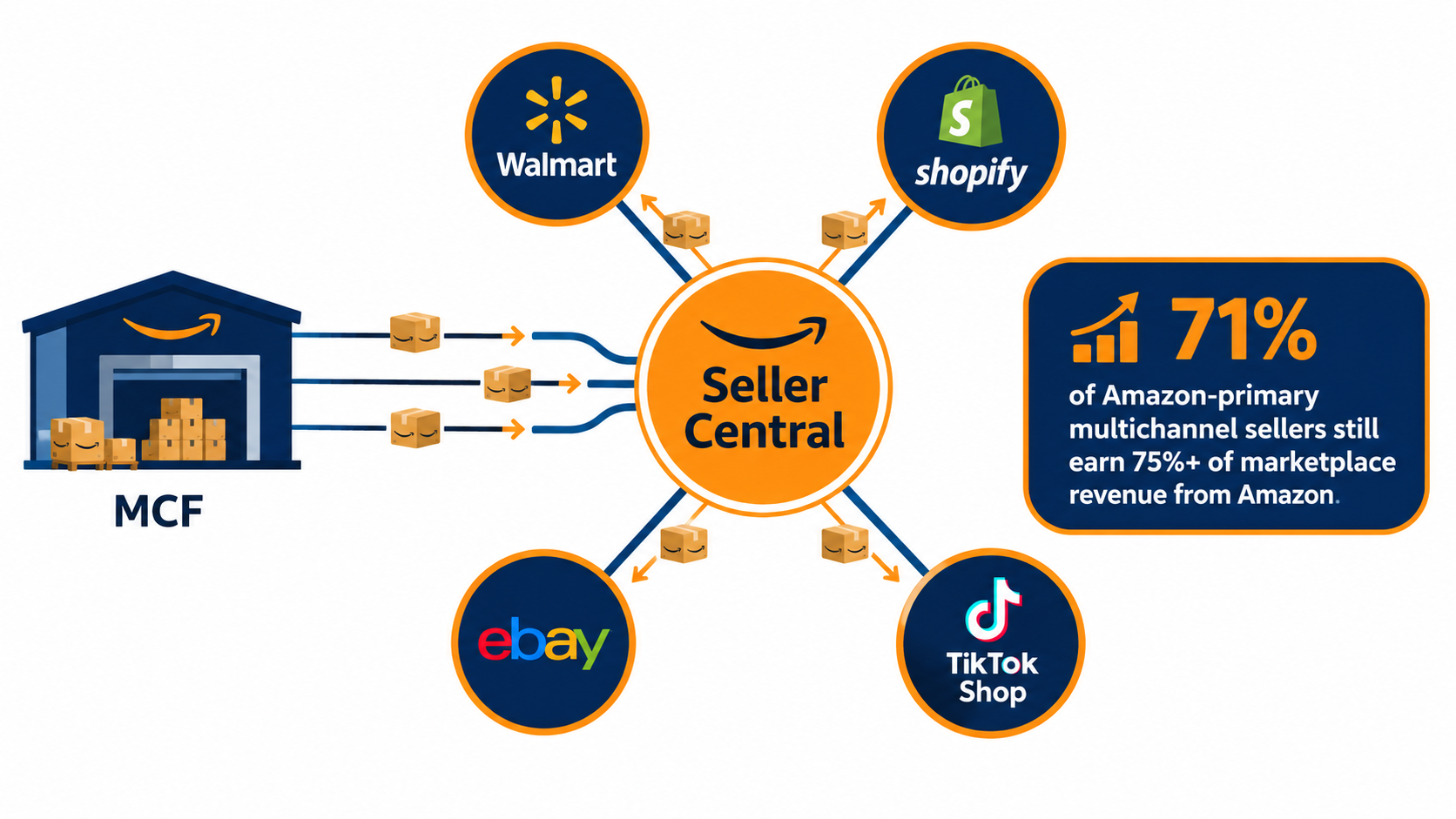
At its Accelerate seller conference in September 2026, Amazon announced that sellers will be able to manage their eBay, Shopify, TikTok Shop, and Walmart businesses from inside Seller Central. The tools are rolling out gradually to U.S. sellers at no extra cost.
According to Marketplace Pulse, the features include:
- Editing a product description once, with Amazon reformatting and publishing it to linked listings on eBay, Walmart, and Shopify.
- Shopify and Walmart orders showing up alongside Amazon orders, with fulfillment through Amazon in a few clicks.
- A profitability view showing what each product earns on each channel.
Five years from roadblock to hub
Marketplace Pulse traces how far this has come. Five years ago, Amazon was “the roadblock of multi-channel commerce.” FBA charged more to ship off-Amazon orders, and unbranded packaging was still in beta. Products priced lower elsewhere could be suppressed, and as Marketplace Pulse notes, they still can be today.
Then came Buy with Prime for independent websites. At Accelerate 2024, Amazon said Multi-Channel Fulfillment served more than 200,000 U.S. sellers and order volume had grown 70%. At Accelerate 2025, it announced MCF integrations with Walmart and Shein. The 2026 tools go further, putting Amazon in front of other channels instead of behind them.
Multichannel is not the same as diversified
Amazon says more than 95% of its sellers sell on multiple channels. But Marketplace Pulse’s 2026 Seller Index shows that 71% of Amazon-primary sellers active on at least one other marketplace still earn three-quarters or more of their marketplace revenue from Amazon.
Being listed on Walmart or TikTok Shop isn’t real diversification if almost all of the revenue still comes from one place. Policy changes, account suspensions, or fee increases on Amazon would still hit almost the whole business.
The trade-off
The new tools may genuinely help sellers grow on other channels. Running Walmart and Shopify from one dashboard removes real operational friction, and Walmart’s 24% online growth and Shopify merchants’ 28% gain show those channels are worth taking seriously.
But Marketplace Pulse points out the catch: “For sellers, the risk is deeper dependence on a channel that the Seller Index shows many are working to rely on less.” Amazon can now see not only what sellers charge elsewhere but how much they sell there, though it says the data won’t inform its retail business.
How to use it sensibly
- Use the profitability view to find products that earn more per unit off Amazon, and invest in growing those channels.
- Keep independent records of customer data and channel performance outside Seller Central.
- Watch price parity. Running everything from one place makes it easier to spot, and fix, the price gaps that can suppress Amazon listings.
- Set a concentration target, such as getting Amazon below a certain share of revenue over 24 months, and track it quarterly.
A 90-Day Plan for Measuring and Competing on the AI Shelf
The biggest risk with the third shelf isn’t doing the wrong thing. It’s not measuring it at all. Most seller dashboards track only search rank and ad performance, so a product could be gaining or losing AI visibility without anyone noticing. Here’s a practical plan to fix that.
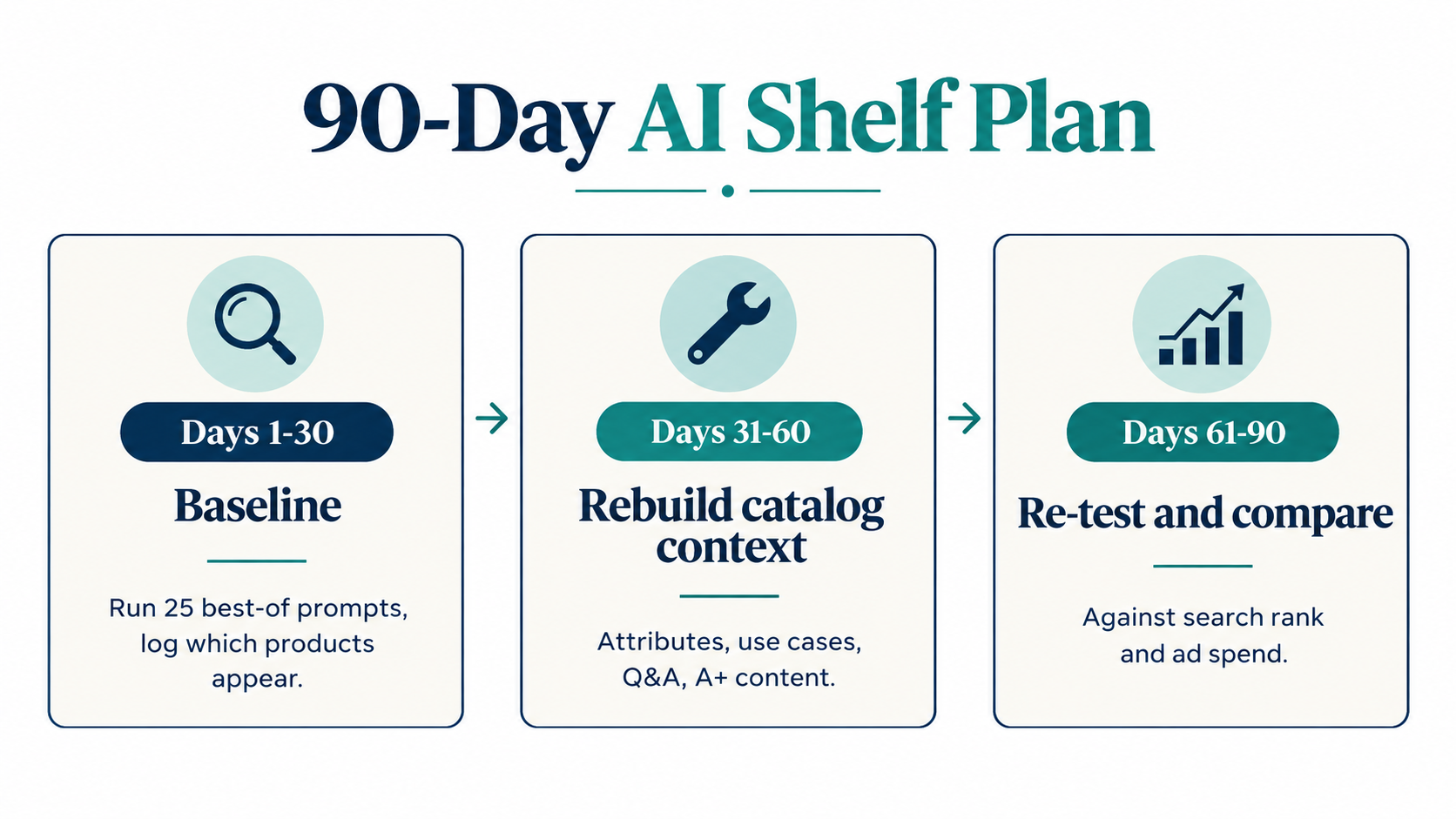
Days 1–30: Build a baseline
Start by learning what the assistant currently says about your category.
- Write 20–30 recommendation prompts for your core products. Mix broad questions (“what’s the best stainless steel water bottle?”) with situation-specific ones (“best water bottle for hiking in hot weather that fits a bike cage”).
- Run each prompt in Alexa for Shopping and record which products it recommends, in what order.
- Run the matching plain search for each prompt and note where the recommended products rank organically and whether they’re sponsored.
- Note what the assistant says about why it picked each product. The reasons it gives show what context it’s drawing on.
Because the study came from a single account, run your tests from more than one account and device if you can, and repeat them over a couple of weeks. You’re looking for patterns, not a single answer.
Days 31–60: Rebuild catalog context
Use the baseline to spot gaps. If competitors keep getting recommended for a use case your product handles just as well, your listing probably isn’t saying so clearly enough.
- Fill missing structured attributes for every priority ASIN.
- Rewrite bullets and A+ content to name specific use cases, users, and situations.
- Add honest, specific comparisons against product types.
- Pull recurring themes from reviews and Q&A into the listing.
- Note the date of each change so you can match it to later results.
Days 61–90: Re-test and compare
Run the same prompt set again. Compare:
- How often your products now appear in recommendations, versus baseline.
- Whether those changes line up with changes in search rank, or move independently.
- Whether AI visibility gains show up in sessions, conversion rate, or sales for the affected ASINs.
- How your ad spend changed over the same period, so you don’t credit context work for gains that came from ads.
Make it a habit
After the first 90 days, fold a smaller monthly prompt check into your regular reporting. Add a quarterly full re-run. The goal is to have a trend line in place before the AI shelf’s economics change, which Marketplace Pulse suggests is only a matter of time.
What This Doesn’t Change: The Fundamentals Still Apply
With any new surface, it’s tempting to chase it at the expense of everything else. That would be a mistake. The AI shelf adds to Amazon selling; it doesn’t replace the basics.
Search is still where most of the money flows
There’s no public data yet showing that AI recommendations drive a share of Amazon sales anywhere near what search does. Sellers spent $68.62 billion on search ads in 2025 for a reason. Organic rank and efficient advertising remain the core of most Amazon businesses.
Unit economics still decide who survives
With 38% of businesses naming shipping costs and 34% naming cost of goods as top challenges in Jungle Scout’s survey, margin discipline matters more than any visibility tactic. A product that gets recommended by the AI but loses money on every sale is still a losing product.
Good context helps every shelf
The good news is that the work the AI shelf appears to reward, clear positioning, complete attributes, honest use-case language, current information, also tends to raise conversion on search. Better conversion improves organic rank and lowers effective ad costs. The three shelves reinforce one another.
Longevity still compounds, but less
Marketplace Pulse concluded in 2019 that it takes years to build a lasting business on Amazon, but that once built, it can last for years. In 2026 it revisited that: “Time on the platform still compounds into advantage, but less of it, and for fewer sellers.” Experience on the platform still counts, but it no longer protects you by itself.
Conclusion: Stock All Three Shelves
Selling on Amazon in 2026 means competing for attention in three places, each with its own logic.
Organic search rewards accumulated sales velocity and reviews. Top positions are stickier than ever, but the sellers holding them are changing fast, with Chinese sellers now 55.9% of the top 10,000 by count while U.S. sellers keep the most valuable, highest-priced positions.
Paid placement rewards budget. At $68.62 billion in seller ad spend in 2025, it’s the most expensive shelf, and it increasingly decides who holds organic rank too.
The AI shelf appears, for now, to reward context and fit. In the first large study of Alexa for Shopping, 63.9% of recommendations came from outside the organic top 10 and only 14.3% were sponsored products. That’s an opening, especially for sellers who don’t own page one, but ads are already arriving inside the assistant.
Key takeaways
- Demand is back but concentrating. U.S. e-commerce grew 12.2% in Q2 2026, but about a third of that came from higher prices, and the largest platforms and sellers are taking most of the gains.
- Don’t fight on price alone. The most valuable top-seller positions belong to sellers with higher average selling prices and clear brand positioning.
- Write for “when and why,” not just “what.” Fill every attribute, describe specific use cases and users, make honest comparisons, and update listings by season.
- Measure the AI shelf now. Build a prompt-based baseline, change listings deliberately, and re-test so you have a trend line before the rules change.
- Treat the window as temporary. Sponsored Products and Brand Prompts are already in the assistant. Early movers will be best placed to judge whether paid AI placements are worth it.
- Use the multichannel hub, but track your dependence. Seller Central’s new tools make other channels easier to run, but 71% of multichannel Amazon sellers still earn most of their marketplace revenue from Amazon.
- Keep the fundamentals first. Search and unit economics still drive most outcomes. Context work pays off across all three shelves.
The sellers who will do best over the next few years aren’t the ones who drop everything for AI. They’re the ones who see that Amazon now has more than one way to be found, and who make sure their products give each of those ways something to work with.