
Every TikTok Shop seller eventually gets the same advice: “You need to go LIVE.” Account managers say it, agencies pitch it, and the platform keeps adding features, studios, and training programs built around it. The pressure makes sense. TikTok’s parent company watched Douyin turn livestream selling into a huge business in China, and it wants the same thing to happen in the US.
But the US data tells a more complicated story. Livestreams have never made up 30% of TikTok Shop’s US revenue, according to e-commerce intelligence firm Charm.io. Pre-recorded creator videos, meanwhile, have grown to roughly two-thirds of the platform’s sales. At the same time, some categories now run almost entirely on LIVE. In 2026, TikTok said 94% of US luxury resale revenue on the platform year-to-date came from livestreams.
So the useful question isn’t “should every seller go LIVE?” It’s “which sellers, selling which products, running which kind of stream, actually get a return?” That’s what this article covers.
Earlier coverage here has dealt with TikTok Shop unit economics, search ranking, algorithm changes, and commission structures. This piece is only about live selling. It covers the real share of sales LIVE drives, the categories where it wins, the operating models brands like Crocs, QVC, and MAC Cosmetics use, what a live program costs to staff, how to plan a stream people actually watch, and how to measure whether your streams make money or just move sales around.
If you’re deciding whether to put hours, people, and inventory into TikTok Shop LIVE in 2026, this is the evidence you’ll want to look at first.
The Real Numbers Behind TikTok Shop LIVE
Before choosing a live strategy, look at the full picture: how fast LIVE is growing and how much of the platform’s revenue it actually drives. Those are two separate questions, and people tend to blur them together.
The growth story is real
TikTok Shop has grown very quickly overall. Figures compiled by DemandSage from Statista and other sources put global gross merchandise value at about $64.3 billion in 2025, with a 2026 estimate of $123.5 billion. US retail sales on the platform reached about $15.8 billion in 2025, which is 18.2% of US social commerce. US GMV for the first half of 2026 was reported at $11.8 billion, more than double the same period a year earlier.
Live activity has grown along with it. TikTok says brands and creators hosted more than 8 million hours of live shopping sessions in the US in 2024. In late 2025, Patrick Nommensen, TikTok Shop’s head of strategic initiatives, told Modern Retail that the number of live sessions creators and merchants host each month had “nearly tripled over the past year.”
Holiday results point the same way. In the 2025 Black Friday–Cyber Monday window, TikTok Shop drove more than $500 million in US sales, a record for the company. Shoppers tuned into 760,000 livestream sessions that generated 1.6 billion views. A TikTok spokesperson said sellers who hosted livestreams saw 84% sales growth over the period, ahead of the 76% growth reported for brands with more than $10 million in annual revenue.
The share story is more modest
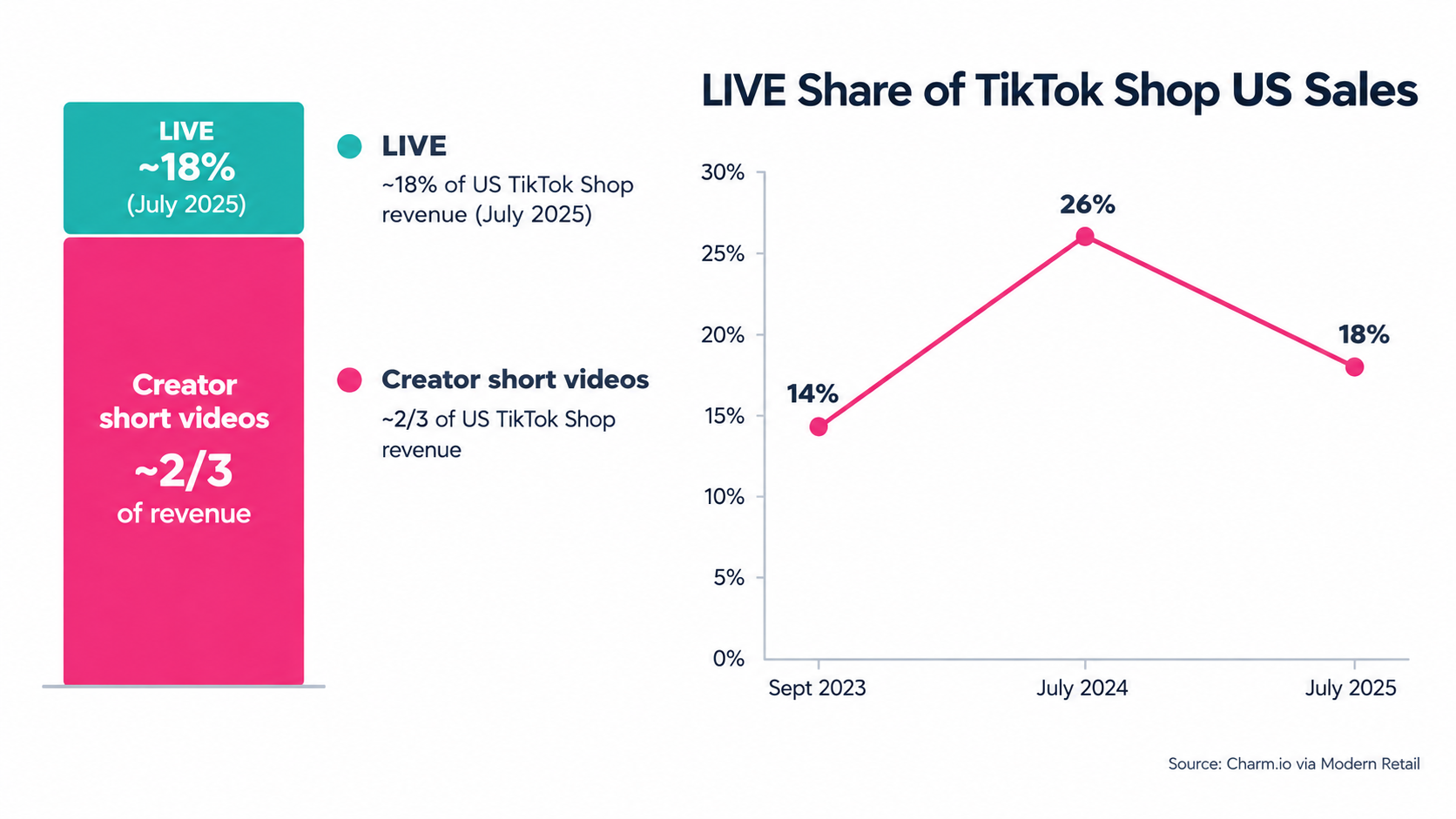
Here’s where the advice starts to diverge from the data. Charm.io tracks product sales across TikTok Shop. Its figures show livestreaming made up just under 14% of US sales when the format launched in September 2023. That share rose to 26% by July 2024, then fell back to about 18% by July 2025.
Pre-recorded creator videos grew steadily over the same period and now account for roughly two-thirds of revenue. In other words, more live hours went in, but LIVE’s share of sales did not keep climbing. The total grew, and short video grew faster.
What both sets of numbers mean together
Both stories are true, and both matter for planning:
- LIVE is a real channel. A format with millions of hours a year and hundreds of millions of holiday dollars behind it isn’t a fad.
- LIVE is not where most US purchases happen. For the typical shop, short-form video is still the main sales engine.
- Averages hide the categories where LIVE matters most. An 18% platform average includes categories where LIVE is close to zero and others where it’s close to everything.
The rest of this article is about finding which side of that average your shop sits on.
Why LIVE Still Trails Short Video in the US
If live shopping works so well in China, why hasn’t it taken over in the US? The answer affects how you should design your own streams.
The China comparison sets expectations too high
eMarketer estimates live shopping in China at about $703 billion. Douyin, TikTok’s sister app, reportedly made more than $200 billion from livestream sales in 2022. MAC Cosmetics has sold on Douyin for years, and Emily Bromfield, its SVP of global marketing, told Modern Retail that “half of our Douyin sales are from livestreaming.”
Compare that with US forecasts. Coresight Research projected live shopping would reach only about 5% of total US e-commerce by 2026. Even the 2025 holiday record, $500 million over four days on TikTok Shop, sits next to $44.2 billion in total US online sales over Thanksgiving weekend, according to Adobe Analytics.
The gap is cultural as much as technical. “Ultimately, live-streaming is a really big cultural shift for the U.S.,” Charm.io CEO Alex Nisenzon told Modern Retail. “I don’t think [U.S. consumers] would ever get to a point where they would prefer live-streaming over more traditional forms of e-commerce.”
Short video fits how Americans already use TikTok
Most US users open TikTok to scroll, not to sit and watch. A 30-second creator clip fits into that habit. It shows up in the feed, makes its point, and links straight to checkout. A livestream asks for more: you have to stay, wait for the product you care about, and catch the deal while it’s running.
GlobalData’s survey for TikTok Shop found that 70% of TikTok Shop consumers have bought a product recommended by a creator. That reach mostly comes through short video, which can be cut, tested, boosted, and reposted indefinitely. A livestream is gone once it ends unless you clip it.
Demand exists, but in pockets
None of this means US shoppers ignore LIVE. A TikTok and GlobalData survey found that 76% of consumers who engaged with TikTok Shop said they’d bought something from a livestream in the past year. A 2024 VTEX survey found that 45% of US consumers had browsed or bought from live-shopping events in the previous 12 months.
So plenty of people have tried live shopping. What’s missing is the daily habit. US buyers come to LIVE for certain kinds of products and certain moments. A seller’s job is to figure out whether their products and timing match that behavior.
The takeaway for sellers
Don’t plan a live program on the assumption that the US will follow China. Plan it on the assumption that LIVE in the US works for specific occasions: when a product needs to be shown, when trust has to be built, or when an event is happening. Build around those needs, not around a general expectation that live shopping is about to take off everywhere.
The Categories Where LIVE Clearly Outperforms
The 18% average hides wide variation. Where LIVE works, it often works very well. Here are the clearest examples so far.
Luxury resale: trust is what’s being sold
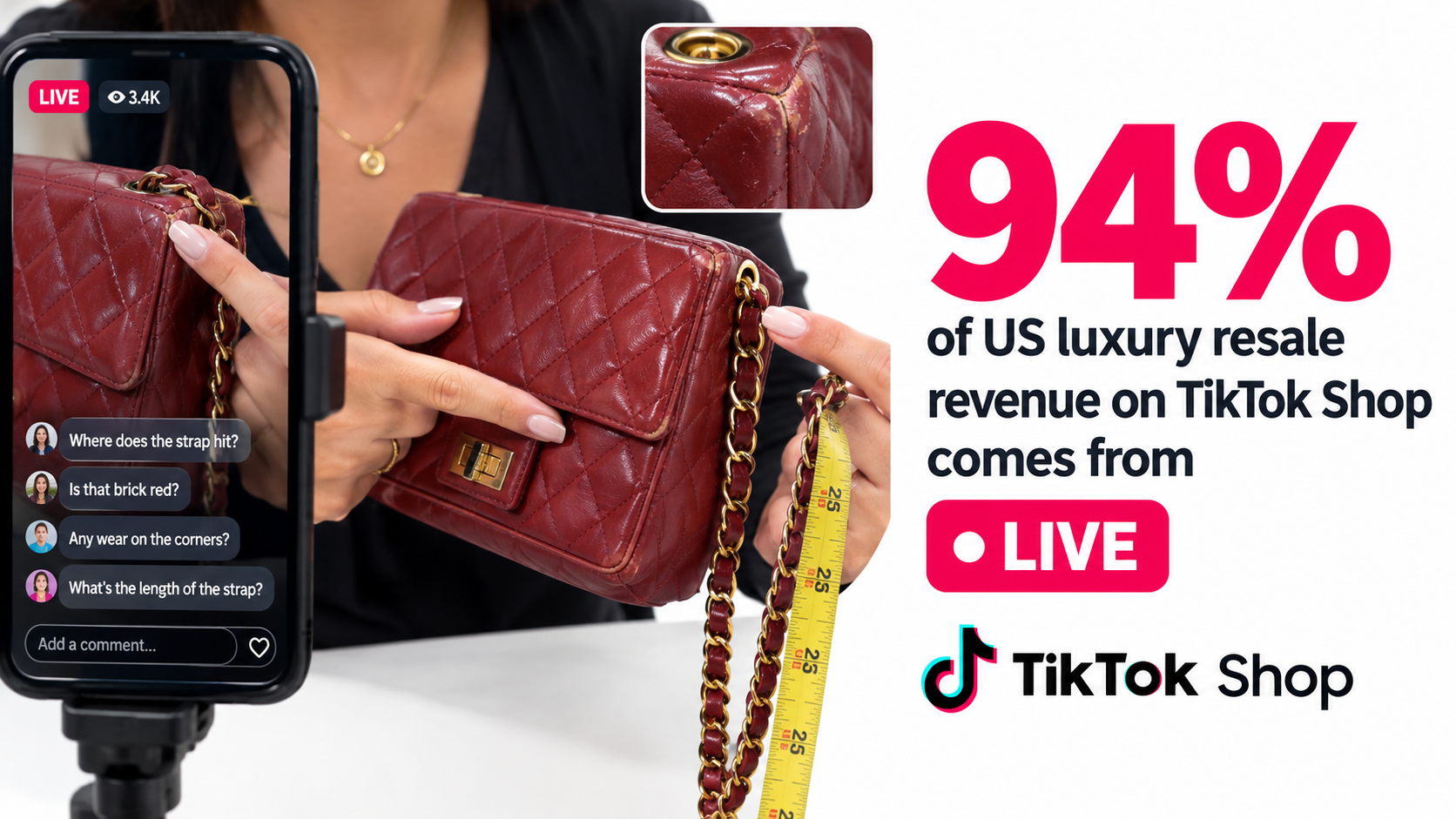
Luxury resale is the strongest case. At TikTok Shop’s first Luxury Resale Summit in 2026, the platform said 94% of US luxury resale revenue year-to-date came from LIVE. Luxury resale GMV was also up 400% year over year, led by handbags and watches.
Rainee Walker, TikTok Shop’s US head of category for luxury resale, explained why: “To convey trust, there needs to be a conversation. But where is that conversation happening? It’s happening on live.” In a stream, the host can show scratched hardware, stained lining, and real dimensions. A shopper can ask where a strap sits on someone of a certain height, or whether a red is “more brick red” or “a little bit more orange.”
Sellers have built their businesses around this. Fashionphile runs several lives a day through “Fashionphile TV,” and TikTok Shop accounts for a little over 25% of its UK business. MyGemma’s founder said TikTok and other livestream channels bring in about 15–20% of company revenue.
Beauty: products that need to be shown
Beauty leads TikTok Shop sales overall, and it suits LIVE because results can be shown on camera. Bromfield described MAC’s approach as “more of a show than a tell,” built on transformation and quick results. MAC sold more than 160,000 units on TikTok Shop in its first few months. Going into its first US holiday season on the platform, it ran three live formats: creators on MAC’s channel, MAC appearing on creators’ channels, and its own makeup artists streaming from stores.
Smaller beauty and fragrance brands have seen bigger relative jumps. Mavwicks Fragrances founder Megan Reep said the business went from about $300,000–$400,000 in annual sales to $32 million in its first year on TikTok Shop, with livestreams that she runs like entertainment events.
Collectibles and fashion: the Whatnot evidence
Whatnot isn’t TikTok, but it shows which products US shoppers will buy live. On Black Friday 2025, Whatnot reported more than $75 million in single-day live sales, triple the previous year. One sports card seller passed $1 million in a single show. Fashion, from luxury bags to vintage tees, now rivals collectibles as one of Whatnot’s biggest categories.
Collectibles work live because of scarcity, the thrill of opening packs, and community. Many of the same products sell on TikTok Shop, and Pop Mart’s Labubu streams were among the most popular during TikTok’s 2025 BFCM period.
What these categories have in common
- High consideration or uncertainty: condition, authenticity, fit, or shade can’t be fully explained in a static listing.
- Visual proof: the product changes, transforms, or shows its quality on camera.
- Scarcity or one-of-a-kind items: resale goods, limited drops, and blind boxes make people want to watch in real time.
- Community: regular viewers come back for the host, not just for deals.
If your products have two or more of these traits, LIVE probably deserves a serious test. If they have none, such as a commodity phone cable or a basic kitchen gadget, short video will almost certainly do better per dollar spent.
A Decision Framework: Should Your Shop Stream at All?
Most sellers decide on LIVE based on gut feel or because a platform rep asked them to. A more structured approach looks at five factors. Score each one honestly before you commit people and hours.
1. Product explainability
Ask how much a buyer gains from a live demo or answer that a 30-second video can’t give them. Products with variable condition, fit questions, shade matching, or complex features score high. Simple, single-purpose products score low.
2. Price and margin room
Live shoppers expect live-only deals, bundles, and giveaways. Crocs said exclusive livestream products and giveaways were among the most effective parts of its “Croctober” campaign. If your margins are already thin after platform fees, affiliate commissions, and shipping, live discounts can lose money. A higher average order value and healthy margins leave room for this.
3. Catalog depth
A one-hour stream with a single product gets repetitive fast. Streams work best when the host can move through a range of items, show bundles, and pull in different viewers as they join. Resellers with dozens of unique items have a natural advantage. A single-SKU brand has to work harder on entertainment to keep people watching.
4. Inventory reliability
A successful stream can sell a lot very quickly. Recall that a 5,000-follower creator’s video once sold 11,000 pairs of Pacsun’s Casey jeans in 48 hours. If you can’t fulfill a spike on time, LIVE can create late shipments and cancellations that hurt your shop’s standing. Check stock and fulfillment capacity before you stream.
5. Team capacity and on-camera talent
Someone has to host, someone has to moderate chat and pin products, and someone has to plan the run of show. Ask honestly whether you have people who are good on camera and can be consistent. If you don’t, you’ll need agencies or creators, which changes the cost.
Reading your score
- High on explainability and catalog depth, with margin room: LIVE should be a core channel. Commit to a regular schedule.
- Mixed scores: Use event-based LIVE around launches, holidays, and promotions, with short video as the main engine.
- Low on explainability with thin margins: Skip owned streams for now. Get exposure through affiliates’ live sessions and put your effort into short video.
The framework won’t make the decision for you. What it does is replace a blanket instruction to “go LIVE” with a choice that fits your business.
Three Operating Models: Always-On, Event-Based, and Creator-Hosted
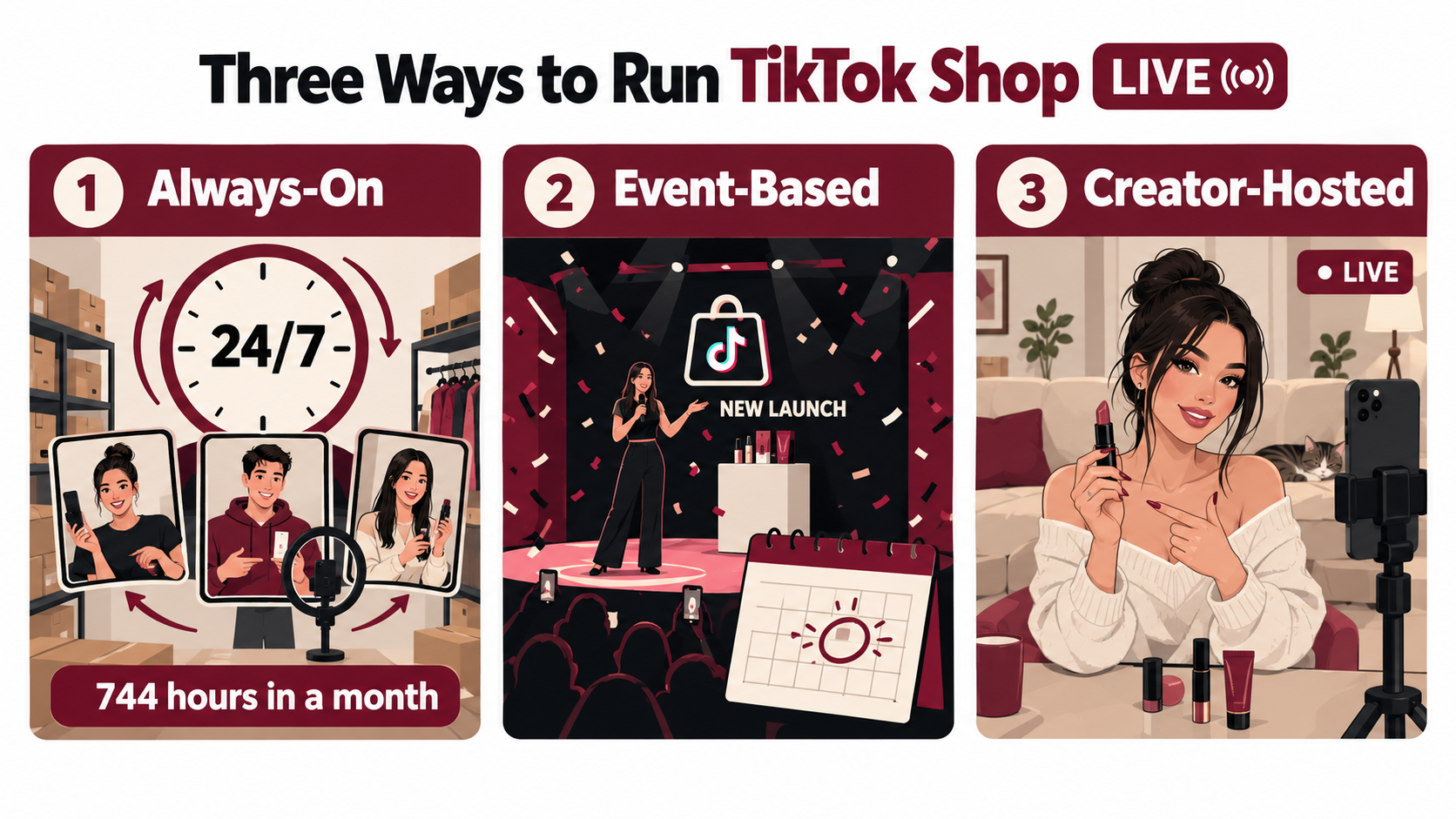
Once you’ve decided to stream, the next choice is how. The brands with the clearest public results use three distinct models, and many combine them.
Model 1: Always-on streaming
This is the most demanding model. In October 2025, Crocs streamed on TikTok Shop 24 hours a day for all 31 days, a total of 744 hours. Streams ran from its SoHo concept store and from off-site studios, with agency hosts on camera for several hours at a stretch.
Crocs didn’t share sales figures, but chief brand officer Terence Reilly said the effort was “significantly exceeding” its forecast for both new customers and revenue. The US shop account’s followers nearly tripled during the month. One surprise was timing: some of the highest viewer counts came between 12 a.m. and 7 a.m. local time.
QVC Group runs a similar model as a permanent operation. It began streaming around the clock on TikTok in April 2025 and now runs five channels, including QVC Beauty, QVC Fashion, and QVC Home. The company said it drew 35 million livestream views in under a year and traced more than 100,000 new customers in Q2 2025 to TikTok Shop alone.
Best for: large catalogs, established brands with agency budgets, and retailers that already have broadcast experience.
Model 2: Event-based streaming
MAC’s main lesson from Douyin was that LIVE “is particularly powerful … when it’s paired with a specific moment in your brand,” whether that’s a new launch, a new face, or a high-traffic date. Event-based streaming focuses effort on those moments instead of filling a calendar.
TikTok’s own events support this. QVC’s day-long stream during TikTok’s Super Brand Day in May 2025 featured celebrity “Q50 ambassadors” and exclusive deals. CEO David Rawlinson said it was QVC’s “highest-viewed and most-engaged QVC-hosted livestream.” Sellers who streamed during BFCM 2025 saw 84% growth.
Best for: mid-sized brands, seasonal products, and any seller testing LIVE before committing to a schedule.
Model 3: Creator-hosted streaming
In this model, you don’t host most streams yourself. Affiliates go live on their own channels and sell your products to audiences who already trust them. QVC works with around 400,000 creators and has 75,000 products available for affiliates to tag. It also runs an affiliate loyalty program that gives top sellers better commissions and early product access.
The benefit is reach without production cost. The downside is control: you can’t fully manage how your product is presented, and commissions take a share of each sale.
Best for: brands with strong affiliate programs, products creators like to demo, and sellers without in-house talent.
Mixing models
Most mature programs blend these. MAC’s holiday plan used all three at once. A practical starting mix for a mid-sized seller might be one or two owned streams a week, bigger event streams at key dates, and a group of affiliates who go live with your products on their own channels.
What a Live Program Actually Costs to Staff and Produce
Live selling looks cheap: a phone, a ring light, and someone talking. Done consistently, it isn’t. Costs come mainly from people and time, and they add up quickly.
The roles behind a stream
Even a small live operation usually covers these roles, sometimes with one person doing several:
- Host(s): on-camera talent who can demo products, answer questions, and keep energy up for an hour or more.
- Producer/moderator: pins products, launches flash deals, manages chat, removes spam, and passes questions to the host.
- Merchandiser/planner: chooses featured products, sets live-only offers, and checks inventory.
- Clipper/editor: cuts highlights into short videos after the stream (covered below).
Crocs used agency hosts for its 24/7 run. QVC moved its existing on-air expertise onto the platform. Stila Cosmetics built a livestream studio in its office for TikTok Shop sales. Modern Retail has reported that many brands are now creating dedicated “head of TikTok Shop” roles. That shows how much operational work the channel has come to require.
Thinking through the hourly math
Pricing for hosts and agencies varies too much to quote a standard rate, and you should get your own quotes. The structure of the calculation stays the same, though. Add up everyone’s loaded hourly cost for a stream, including prep and post-production, plus any studio and giveaway costs. That gives you your cost per live hour.
Then compare it with the contribution margin the stream produces: GMV minus discounts, platform fees, commissions, cost of goods, and fulfillment. A stream with impressive GMV can still lose money if live discounts and giveaways eat the margin.
Hidden costs to plan for
- Ramp-up time: new shop accounts rarely draw big audiences right away. Expect weeks of small streams while you build followers and learn.
- Host burnout: streaming for hours takes a lot out of people. Rotating hosts protects quality but adds headcount.
- Giveaway inventory: giveaways work, as Crocs found, but every free pair costs you money.
- Returns: impulse purchases during a high-energy stream may come back. Track return rates on live orders separately.
None of this means LIVE is a poor investment. It means you should cost it like any other channel, with a clear view of hourly spend and margin after discounts.
Programming a Stream People Actually Watch
The difference between a stream that sells and one that drifts along usually comes down to programming. Sellers with strong results treat a stream as a show with a structure, not as a product catalog read aloud.
Entertainment comes first
QVC has worked out this formula over decades. Bromfield credited it directly: “That’s why QVC worked. It was entertainment and shopping at the same time.” She calls MAC’s version “edutainment,” which means educating and showing while keeping viewers entertained.
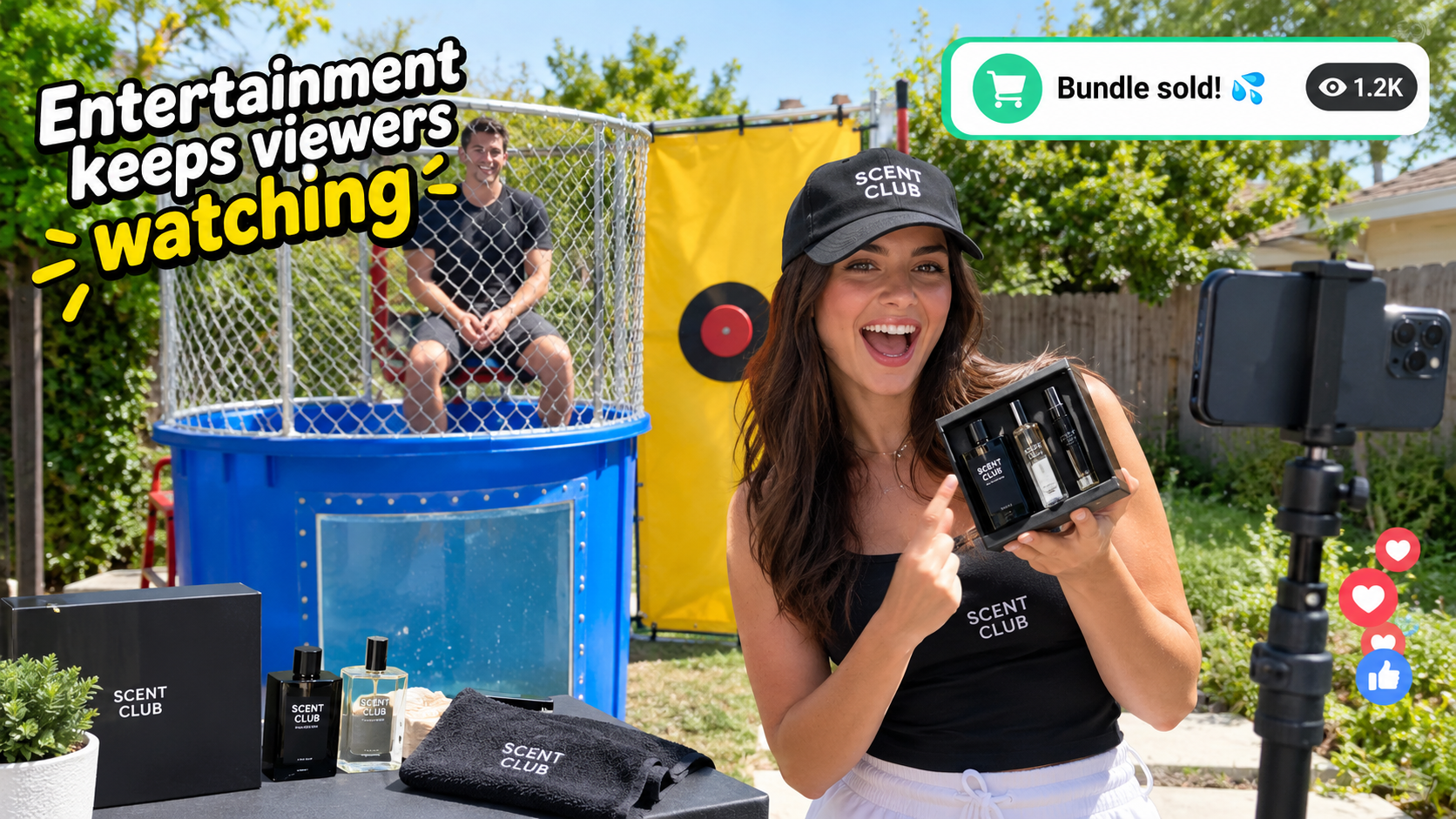
Smaller brands take it further. Mavwicks Fragrances once put a dunk tank on its stream, and every bundle purchase dropped the founder’s husband into the water. “Keeping exciting things happening on screen” keeps people watching, Reep said. You don’t need a dunk tank, but you do need a reason for viewers to stay through the next five minutes.
Live-only offers give viewers a reason to buy now
Crocs sold items that were only available on its livestream, including Crocs baseball caps and Knicks and Nets shoes. QVC offered deals exclusive to its TikTok Shop during Super Brand Day. Exclusivity gives viewers a reason to buy during the stream rather than saving the product for later. Without it, a stream is just a slower version of your product page.
Answer questions as they come in
The luxury resale data shows that answering questions is often what closes the sale. Walker described LIVE as bringing “a static product description page to life.” Have the moderator pass questions to the host quickly, and give the host the knowledge to answer them: measurements, materials, ingredient lists, condition notes.
A simple run-of-show structure
- Opening hook (first 2–3 minutes): say what’s on today’s stream and what live-only deal is coming up.
- Product segments (8–12 minutes each): demo, answer questions, pin the product, run a short-timed offer.
- Re-hook every 10–15 minutes: recap for new viewers, since many people drop in partway through.
- Engagement moments: giveaways, polls, guest appearances. Crocs brought on athletes such as Nets forward Jalen Wilson and Giants quarterback Jaxson Dart.
- Close: final call on live deals and a preview of the next stream so viewers come back.
Test time slots instead of assuming
Crocs’ audience peak between midnight and 7 a.m. shows that the best time to stream may not be what you’d expect. Competition for viewers can also be lower at off-peak hours. Test several time slots over a few weeks before you settle on a schedule.
Making LIVE and Short Video Work Together
Since short video drives about two-thirds of US TikTok Shop revenue, the strongest live programs don’t treat LIVE as separate from video. They use each to feed the other.
Every stream produces raw material for clips
A one-hour stream holds dozens of possible clips: a strong demo, a funny moment, a sharp answer to a common question, someone’s reaction to a product. Cut those into short videos, tag the products, and post them in the format that drives most of the platform’s sales. That way the stream’s value doesn’t end when the broadcast does.
This also changes the cost math from the previous section. If one live hour produces five or ten usable clips, part of the production cost is really content production for your video pipeline.
Short video brings viewers to the stream
The flow works the other way too. Post short videos before a stream to tease the live-only deal or a guest appearance. Viewers who see those clips are more likely to join when you go live, and you start the stream with an audience.
Followers gained live improve future reach
Crocs’ shop account follower count nearly tripled during “Croctober.” Those followers don’t vanish after the stream. They become an audience for future videos and streams. LIVE often builds followers more effectively than short video because viewers spend more time with the brand.
Use affiliates for both formats
Creators who sell your products in short videos are good candidates to go live with them as well, and the reverse is also true. QVC’s model, where creators appear on QVC channels or promote products on their own, shows how one affiliate network can support both. Pacsun’s example, 11,000 pairs of jeans from a single 5,000-follower creator’s video, shows how much a small creator can move.
Putting the flywheel together
- Before the stream: 2–3 teaser videos featuring the live-only offer.
- During the stream: record in a quality you can clip from, and note timestamps of strong moments.
- After the stream: within 48 hours, post 5–10 clips with products tagged, and share the best ones with affiliates.
- Over time: track which clips sell best and use those angles in the next stream’s run of show.
Measuring a Live Program Honestly
Reported LIVE results can be misleading. Raw GMV from a stream looks good on a slide but leaves out the question that matters: would those sales have happened anyway? Here’s a more reliable way to measure.
Metric 1: Contribution per live hour
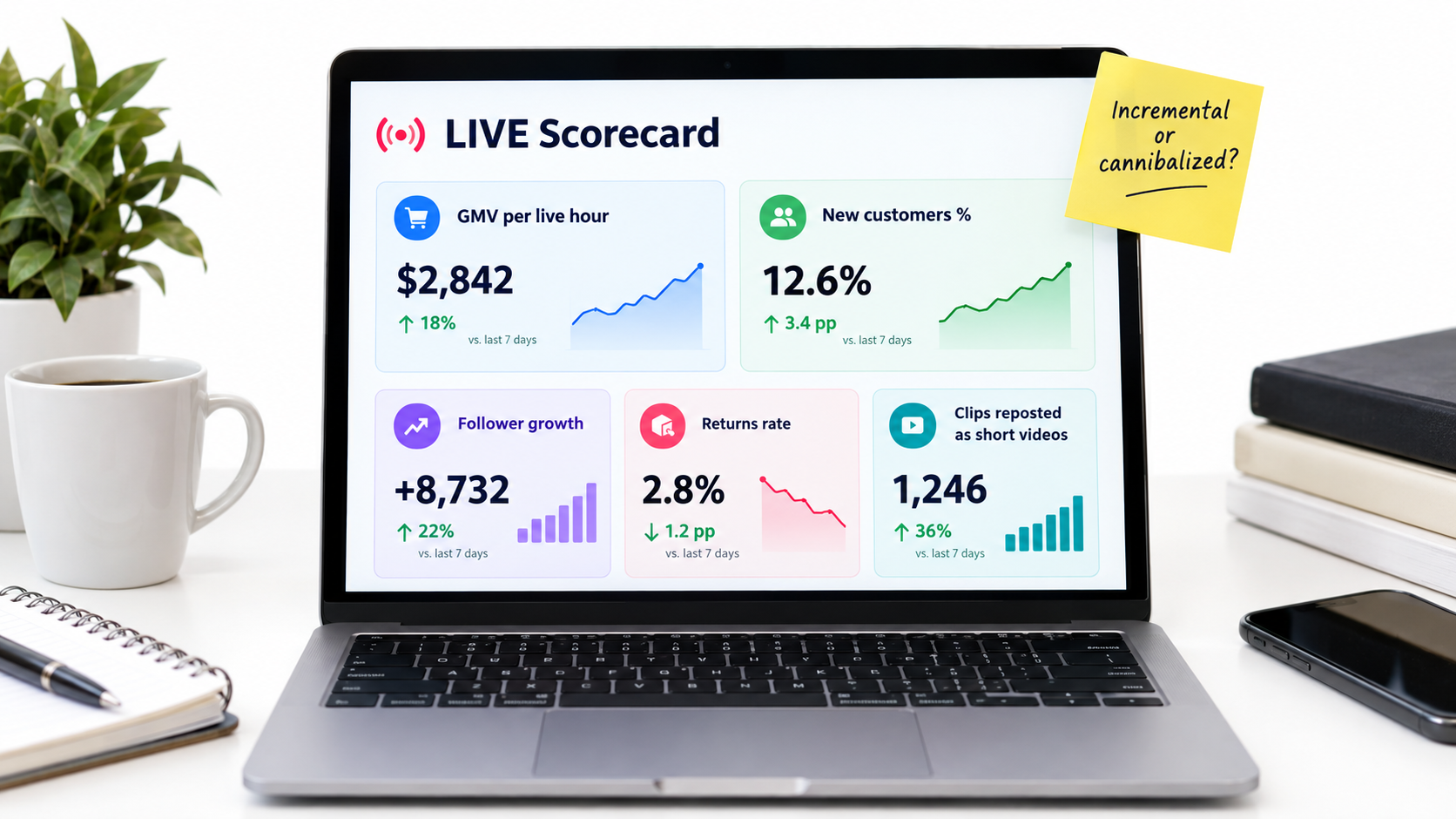
Use contribution per live hour rather than GMV per live hour: GMV minus discounts, fees, commissions, cost of goods, fulfillment, and giveaway costs, divided by hours streamed including prep. This is the clearest single measure of whether LIVE pays for itself.
Metric 2: New customer share
Both Crocs and QVC pointed to new customer acquisition as a main benefit. QVC traced more than 100,000 new customers to TikTok Shop in a single quarter. If most live buyers already purchase from you through other channels, the stream may be shifting sales rather than creating them. Track the share of live orders from first-time buyers.
Metric 3: Cannibalization checks
Compare total shop sales, not only live sales, for periods with and without streams. If live GMV goes up while video and storefront sales drop by a similar amount, you’ve mostly moved sales to a more expensive channel. A simple test is to alternate weeks with and without streams over a month or two and compare totals.
Metric 4: Follower and audience growth
Followers gained per live hour shows LIVE’s longer-term value. A stream that roughly breaks even but adds thousands of followers may still be worth running.
Metric 5: Downstream content value
Track sales from clips cut from live footage. If those clips perform well, give some of the credit back to the stream that produced them.
Metric 6: Returns and cancellations
Impulse purchases during high-energy streams can come back as returns. Late shipments after a sales spike can hurt your shop’s performance. Look at return rates and fulfillment timing for live orders separately from other orders.
Keep the scorecard simple
A weekly scorecard with these six metrics, compared against your short-video results, tells you more than any single headline figure. It also gives you evidence when someone pushes to stream more, or to stop.
A 90-Day LIVE Pilot Plan
If the framework above says LIVE is worth testing, here’s a structured way to do it without overcommitting.
Days 1–30: Set up and learn
- Choose 10–20 products that score highest on explainability and margin room.
- Set up a basic studio: stable lighting, good audio, a clean background, and a second device for chat moderation.
- Decide on hosts. Test internal team members first, since founder-hosted streams often work well because of authenticity, as GlobalData’s Neil Saunders noted.
- Stream two to three times a week, 60–90 minutes each, in different time slots, including at least one off-peak slot.
- Set up the scorecard and record baseline shop sales before the pilot starts.
Days 31–60: Refine and add content
- Keep the best two or three time slots and drop the rest.
- Add live-only offers and a regular giveaway.
- Start the clip process: post 5–10 clips from every stream within 48 hours.
- Invite your top affiliates to go live with your products on their own channels.
Days 61–90: Test an event and decide
- Plan one event stream around a launch, a holiday, or a TikTok promotional moment, with teaser videos beforehand.
- Run the cannibalization check by comparing weeks with and without streams.
- Review contribution per live hour, new customer share, and follower growth.
- Decide whether to scale up to a regular schedule or always-on, stay with event-based streaming, or move resources back to short video and affiliate streams.
What a good pilot result looks like
A good result doesn’t need to be a viral stream. It means contribution per live hour is positive or close to it, the share of new customers is meaningful, followers are growing steadily, and clips are adding to video sales. If you see those four signs, you have grounds to scale. If you don’t, you’ve learned that cheaply and can move the hours to short video.
Conclusion: Treat LIVE as a Business Decision
The data on TikTok Shop LIVE points in two directions. Live activity is growing quickly: session counts have nearly tripled, 8 million hours were streamed in the US in a single year, and holiday streamers saw 84% sales growth. Yet in the US, LIVE still drives a minority share of platform revenue, about 18% as of mid-2025, while short video drives roughly two-thirds.
Both are true because LIVE pays off unevenly. It works best where trust, demonstration, scarcity, or community matter, which is why luxury resale gets 94% of its revenue from livestreams and beauty brands like MAC and Mavwicks treat it as central. It works poorly for simple, low-margin products that a 30-second video can sell just as well.
Key takeaways
- Score your products before streaming. Explainability, margin room, catalog depth, inventory reliability, and team capacity decide whether LIVE fits.
- Pick an operating model that fits your resources. Always-on, event-based, and creator-hosted streaming suit different businesses, and most mature programs combine them.
- Plan streams as entertainment with live-only offers. Exclusive offers and on-screen action keep viewers watching and buying.
- Clip every stream. Turn live footage into short videos, the format that drives most of TikTok Shop’s US sales.
- Measure contribution, not GMV. Track contribution per live hour, new customer share, cannibalization, followers, and returns.
- Pilot before you scale. A structured 90-day test shows whether LIVE pays for your shop before you commit to full-time streaming.
TikTok will keep encouraging sellers to go LIVE, and for some shops that’s the right move. Decide based on your own numbers and products rather than on platform averages.