
The headline numbers around TikTok Shop are big. According to data compiled by DemandSage from Statista, eMarketer, and CNBC, the platform has more than 15 million sellers worldwide. Global gross merchandise value (GMV) is projected to reach roughly $123.5 billion in 2026, close to double 2025’s estimated $64.3 billion.
In the United States, TikTok Shop sales reached about $15.8 billion in 2025. More than 215,000 small businesses sell there. In the first half of 2026 alone, US GMV reportedly hit $11.8 billion, more than double the same period a year earlier.
Buried in that same research is a detail most launch guides skip. A seller count is not the same as a store count, and many registered stores have never made a single sale. The platform is growing fast, but a large share of shops never get their first order.
Plenty has already been written about scaling past a revenue plateau, decoding algorithm updates, and the economics of commissions. This article covers the stage before all of that: the first 90 days. We’ll look at what happens between “shop approved” and “orders coming in every day,” and at the specific decisions that put a new store in the active minority or leave it among the dormant majority.
The framework is split into three phases:
- Days 1–14: Foundations. Shop health, listings, fulfillment readiness, and choosing a launch product.
- Days 15–45: Seeding. Creator samples, your own content engine, and LIVE sessions as a way to learn about buyers.
- Days 46–90: Amplification. Paid spend, but only behind products that have already shown organic signal.
Every section ends with concrete actions. Where this article relies on platform mechanics that change often, such as fees, policy thresholds, and program eligibility, it says so, and you should check the current numbers in your own Seller Center before acting.
The Store-Count Illusion: What “15 Million Sellers” Actually Means
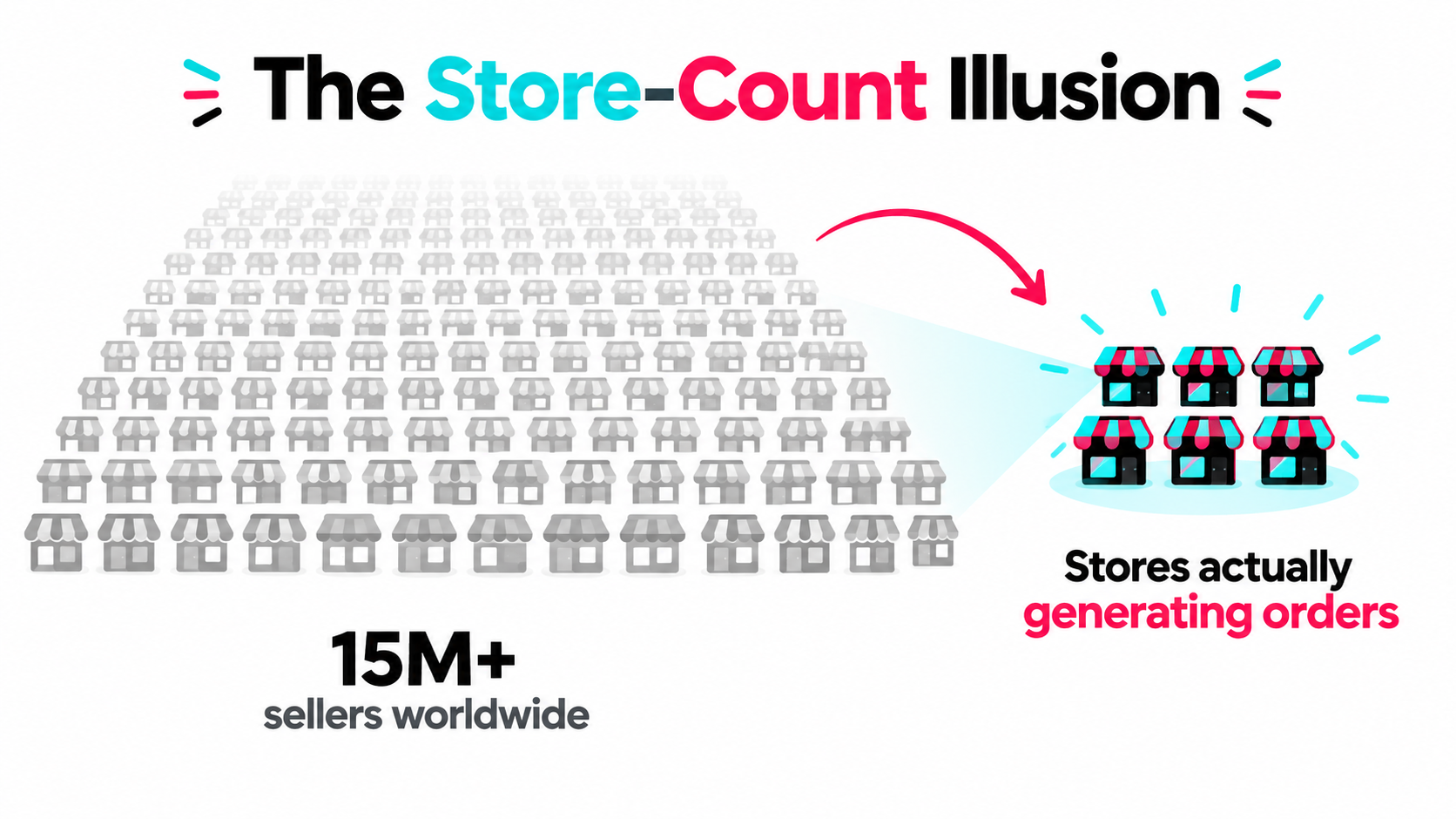
When a marketplace reports millions of sellers, it’s natural to picture millions of competitors. On TikTok Shop that picture is misleading. Opening a shop costs almost nothing, so many stores are opened on impulse, as a test, or as a side project that never gets a product live.
Registered is not active
DemandSage’s analysis says it directly: some reports show hundreds of thousands of stores, but many of them have never sold anything. The total store count can look much bigger than the number of businesses actually trading. That matters for new sellers in two ways.
First, the competition is less crowded than the headline suggests. You aren’t competing with 15 million shops. You’re competing with the much smaller group that runs content, keeps the shop in good standing, and ships on time. Second, the usual reasons stores stay dormant are operational, not mysterious. They can be fixed.
The common failure patterns
Across seller communities and platform guidance, dormant shops tend to share a few patterns:
- Listing without content. The seller uploads products and waits for search traffic, as they would on a traditional marketplace. TikTok Shop discovery is mostly driven by content, so a product with no videos is close to invisible.
- Picking products that don’t demonstrate well. Commodity items with no visual “moment” struggle on a platform where the video is the sales pitch.
- Early shop-health damage. Late shipments, cancellations, or policy violations in the first weeks can restrict a shop before it builds any history.
- Spending on ads too soon. Running paid campaigns behind an unproven product and unproven creative usually burns budget without teaching the seller much.
- Quitting before the feedback loop starts. Content-driven sales often lag effort by weeks. Many sellers stop just before results would have arrived.
The opportunity in the gap
The audience is clearly there. One estimate puts the number of US shoppers buying on TikTok Shop at about 54 million. Creators reportedly drive around 42% of US TikTok Shop sales, and users aged 25 to 34 make up the largest shopper group. Beauty and personal care lead product sales.
The bottleneck is rarely demand. It’s execution in the first few weeks. The rest of this article is about that execution.
Action step: Before you list anything, write down how you’ll know the shop is “active” by day 90. A reasonable bar is consistent daily orders, at least one product with repeat organic video sales, and a healthy shop score. Revenue targets come later.
Why 2026 Is a Different Starting Line for Domestic Sellers
The competitive landscape a new US seller faces in 2026 is not the one of 2023 or 2024. One policy change matters most.
The end of the de minimis exemption
In May 2025, the US ended the de minimis import exemption. That rule had allowed low-value shipments to enter the country without duties. According to the DemandSage compilation, sales from foreign sellers dropped sharply afterward, and domestic businesses picked up more of the demand.
For new domestic sellers, this changes the math. In the earlier phase of TikTok Shop, many categories were flooded with ultra-low-priced items shipped directly from overseas. Competing on price against those listings was often impossible. With that pressure reduced, domestic sellers with reasonable cost structures have more room to win on speed, quality, and trust.
A maturing buyer base
The platform’s growth path also shapes buyer expectations. US TikTok Shop sales grew from about $1.5 billion in 2023 to $7.61 billion in 2024 and $15.82 billion in 2025. That represented roughly 18.2% of US social commerce. Projections cited by DemandSage put 2026 US sales around $23.4 billion.
As a channel matures, buyers get more selective. Early adopters bought on novelty. Today’s buyer has probably had at least one disappointing TikTok Shop order and pays closer attention to reviews, shipping times, and whether the product in the video matches what arrives.
What this means for a new shop
- Speed is a competitive edge. Domestic inventory and fast dispatch are visible advantages in a buyer’s decision.
- Trust signals compound. Early reviews, accurate listings, and low return rates carry more weight with a skeptical buyer.
- Price isn’t the only lever anymore. You don’t need the cheapest listing in the category. You need the clearest, most believable demonstration of value.
The window isn’t permanent. As more established brands move onto TikTok Shop, categories will fill up again with professionally run competitors. For a small seller launching in 2026, though, the conditions are more favorable than they were two years ago.
Action step: Note your realistic dispatch time and shipping speed now. If you can reliably ship within one to two business days from domestic inventory, make that a central part of your listing and creator briefs.
Days 1–14: Build a Shop That Won’t Get Throttled
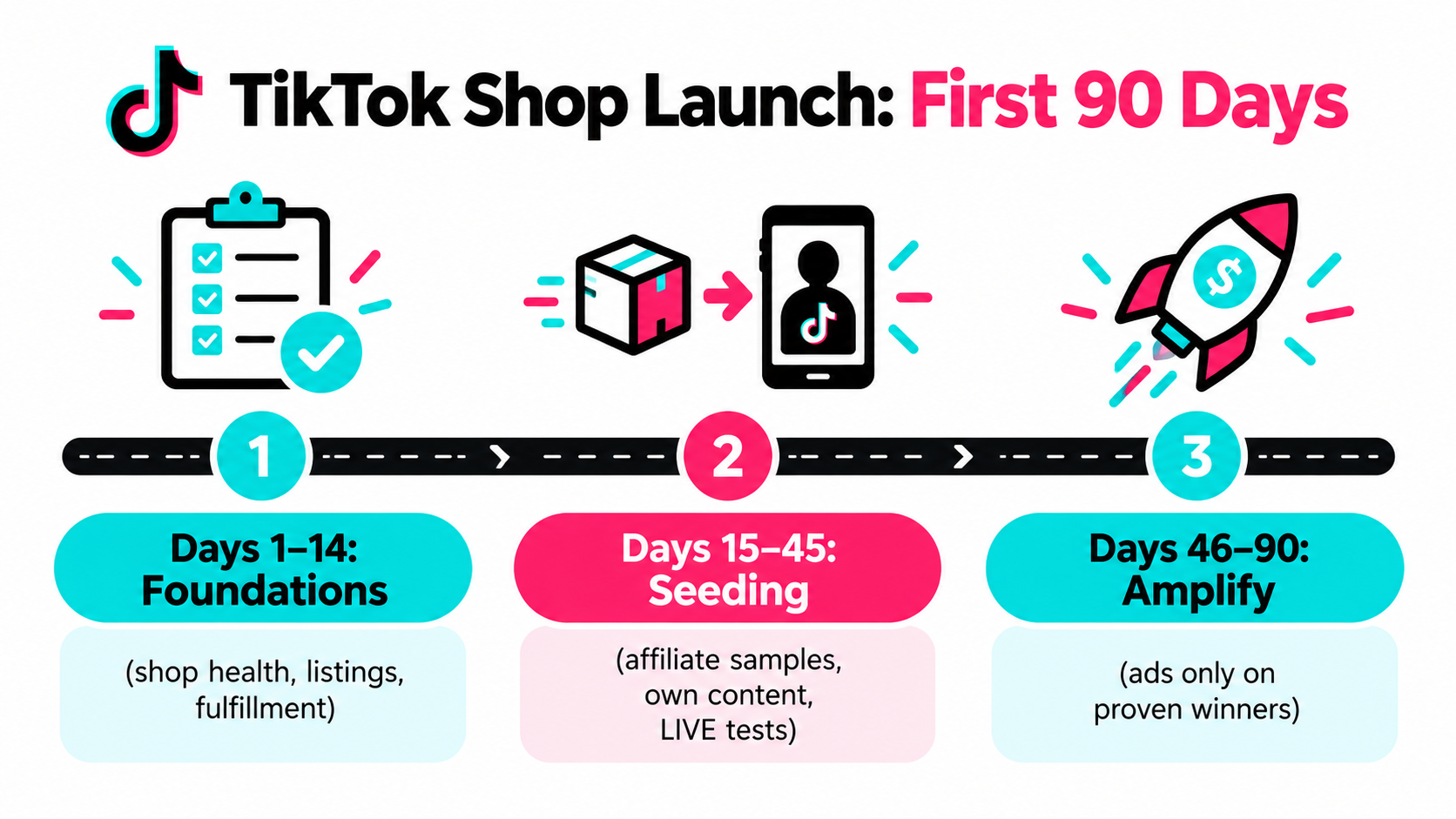
The first two weeks aren’t about sales. They’re about making sure that when sales arrive, the shop can handle them without picking up penalties that hold it back for months.
Understand the shop health system before you need it
TikTok Shop measures seller performance through a shop health or performance score. It tracks things like late dispatch, cancellations, returns, customer-service responsiveness, and policy violations. The exact metrics, thresholds, and penalty structure are updated periodically, so read the current version in your Seller Center instead of relying on a blog post or forum thread.
The principle stays the same: a new shop has no track record to absorb mistakes. A few late shipments for an established seller with thousands of orders barely register as a percentage. For a new seller with 20 orders, the same mistakes can make up a large share of total volume.
The pre-launch checklist
- Complete verification fully and accurately. Mismatched business details are a common source of delays and holds.
- Read the prohibited and restricted product policies for your category. Beauty, supplements, and health-adjacent products often have extra requirements.
- Set dispatch times you can beat, not ones you hope to hit. Under-promise on handling time, especially before you know your real order rhythm.
- Configure return and refund settings so you know exactly what happens when a buyer files a claim.
- Set up customer-service coverage. Decide who answers buyer messages and how often they check. Response time is commonly tracked.
- Test your own checkout. Place an order (and cancel or refund it within policy) so you see the buyer experience and the fulfillment workflow from start to finish.
Decide on fulfillment early
You can generally self-fulfill, use a third-party logistics provider, or use TikTok’s own fulfillment program where it’s available in your market. Each option shifts cost, control, and risk.
- Self-fulfillment gives the most control and the lowest fixed cost. It also puts all the dispatch-speed risk on you. It suits very low early volume.
- A 3PL adds cost per order but absorbs volume spikes. That matters on TikTok, where one video can produce hundreds of orders overnight.
- Platform fulfillment may come with visibility or badge benefits, depending on current program rules. Check eligibility and fees directly.
The overlooked risk is the spike. TikTok Shop sales don’t build smoothly the way search-driven sales often do. A creator video can go from zero to tens of thousands of views in hours. If your fulfillment can’t absorb a tenfold day, the success that should launch your shop can damage its health score instead.
Action step: Write a one-page “spike plan.” If you get 300 orders tomorrow, who packs them, where does the inventory come from, and how quickly can you get more? If you can’t answer that, fix it before seeding creators.
Choosing a Launch Product the Feed Can Actually Sell
Product selection on TikTok Shop follows different rules from product selection on a search marketplace. On a search marketplace, buyers arrive with intent and compare options. On TikTok, most buyers didn’t plan to buy anything until a video gave them a reason.
The demonstration test
The most useful filter for a launch product is simple: can someone show why this product is worth buying in the first three seconds of a video? Products that pass usually have one or more of these traits:
- A visible before-and-after. Cleaning products, skincare, organization tools, and hair tools fit this pattern.
- A satisfying or surprising mechanism. Something that unfolds, transforms, or works in an unexpected way.
- A relatable problem solved quickly. A frustration most viewers recognize, fixed on camera.
- A sensory payoff. Texture, sound, or color that translates through a phone screen.
It’s no coincidence that beauty and personal care lead TikTok Shop sales. These products demonstrate naturally, have visible results, and are bought on impulse at accessible prices.
Price bands and impulse purchasing
TikTok Shop purchases are often impulsive, so price works as friction. Higher-priced items can and do sell, but they usually need more trust-building content, more reviews, and often a recognizable creator or brand behind them. For a first product, a price that lets a viewer decide within the length of one video tends to give faster feedback.
That doesn’t mean picking the cheapest possible item. You need enough margin to cover affiliate commissions, platform fees, shipping, samples, and eventually ads. A product that sells but loses money on every order teaches you the wrong lesson.
Launch with one hero, not a catalog
New sellers often list their whole catalog at once. That spreads creator attention, content effort, and review volume across too many products. A focused launch tends to work better:
- One hero product that gets most of your sample budget and content effort.
- One or two supporting products that pair naturally with the hero for bundles or add-ons.
- Everything else held back until the hero has a track record.
Concentration builds review count, creator familiarity, and algorithmic history on one listing faster. A product page with 80 reviews converts differently from four pages with 20 each.
Validate before committing to inventory
Before you place a large inventory order, look for evidence that similar products are already moving through content. Browse the TikTok Shop marketplace in your category, watch what creators are posting, and note which product angles get repeated. You’re not looking for an empty niche. You’re looking for proven demand where you can offer a clearly better version, angle, or experience.
Action step: Score your candidate products on demonstrability, price friction, margin after all variable costs, and fulfillment simplicity. Launch with the highest scorer as your single hero.
Your Product Page Is the Second Half of a Video
On a traditional marketplace, the product page does most of the selling. On TikTok Shop, the video does most of it, and the product page has a narrower job: don’t lose the buyer the video already convinced.
Match the promise
Someone who taps a product link from a video arrives with a specific expectation shaped by that video. If the creator showed the product in a certain color, solving a specific problem, at a specific price, the page needs to confirm all three right away. Any mismatch creates doubt, and doubt kills impulse purchases.
That means:
- The main image should look like the product in the videos, not a heavily styled render that seems like a different item.
- The title should name the problem it solves, in the words buyers actually use.
- Variants should be obvious. If creators feature one shade or size most often, make sure it’s easy to find and select.
Answer the comment-section questions on the page
Your creators’ comment sections are a free research tool. The same questions come up again and again: Does it work on curly hair? Is it safe for sensitive skin? What size is it really? How long does shipping take?
Every repeated question is an objection. Put the answers in your product images and description so a buyer doesn’t have to leave the page to find them. Many sellers add a simple image showing the product held in a hand or next to a familiar object, because size confusion drives returns.
Use video on the listing itself
Where the platform allows product videos on the listing, use a short demonstration that repeats the core payoff. A buyer arriving from a creator’s video who sees the same result again gets confirmation. A buyer arriving from search or the shop tab gets the demonstration they would otherwise have missed.
Reviews are part of the listing
Early reviews carry a lot of weight on a skeptical, maturing platform. Encourage them through legitimate means only: a well-packed product, a thank-you insert, and follow-up within platform rules. Never incentivize reviews in ways that break policy. Review manipulation is a fast path to the shop restrictions you worked to avoid in days 1–14.
Action step: After your first ten creator videos go live, read every comment. Turn the five most common questions into answers on the listing within 48 hours.
Days 15–45: Seeding Creators Without Burning Your Sample Budget
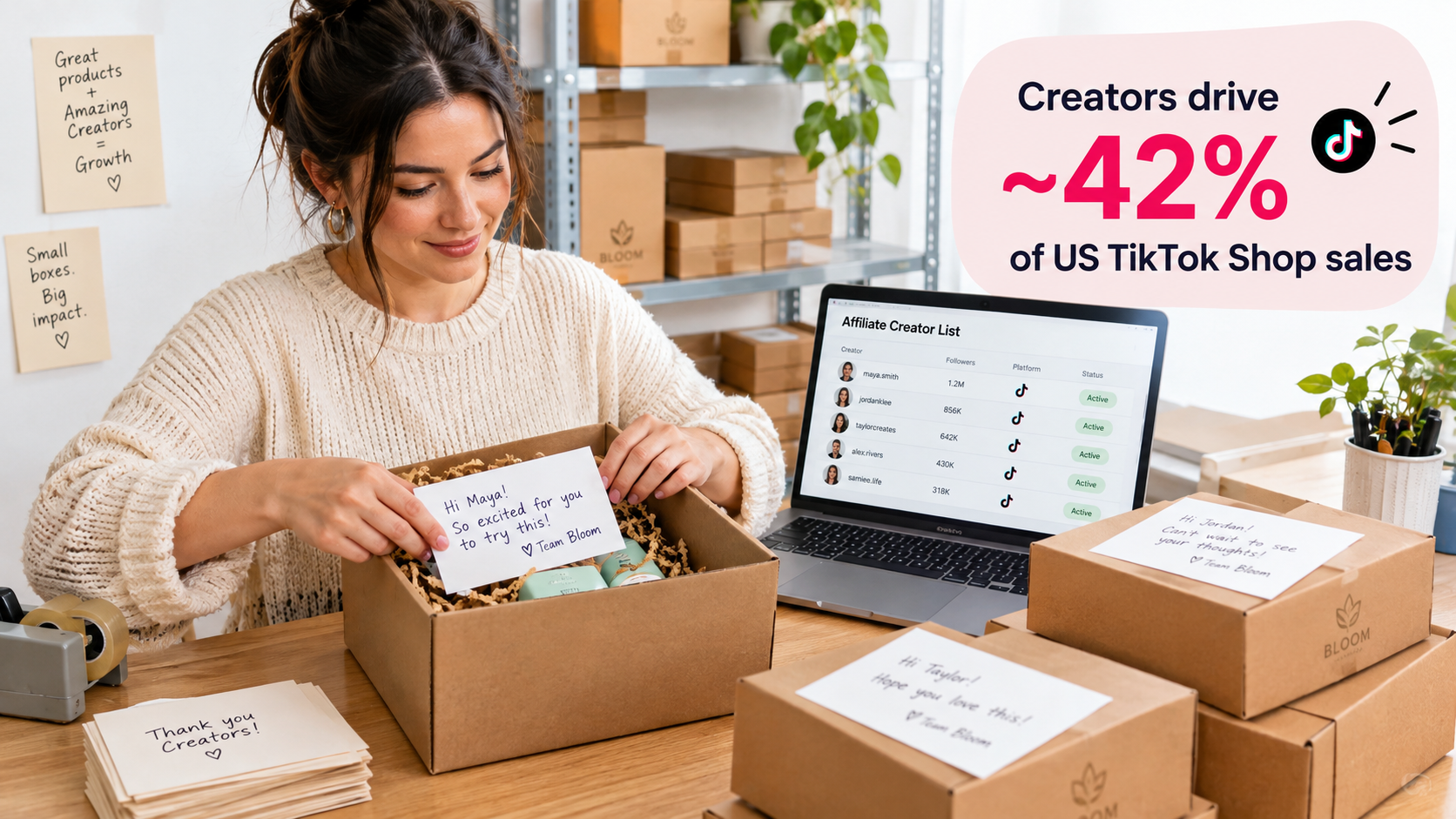
If creators drive around 42% of US TikTok Shop sales, as the DemandSage compilation reports, then for most new shops the affiliate program is the main engine of early growth. It’s also where most early budget gets wasted.
The sample-to-post problem
Most new sellers run into the same frustration. They send free samples to dozens of creators, and only a fraction ever post. Creators receive a lot of free product, prioritize items they think will earn commissions, and some request samples with no real intent to post.
Avoiding samples isn’t the answer. Treat them as an investment with a measurable return:
- Track the posting rate. Of every sample sent, how many produced a video within a set window?
- Track sales per video. Which creators’ videos actually drove orders, not just views?
- Re-invest in proven creators. A creator who drove sales once is worth sending your next product to before you spend on someone new.
Choose creators for fit, not follower count
Follower count is a weak predictor of TikTok Shop sales. Signals that tend to matter more:
- They already sell through TikTok Shop and have a showcase of products in your category.
- Their audience matches your buyer, by age, interests, and buying behavior visible in their comments.
- Their content style suits your product. A creator who does fast, punchy demonstrations fits a product with a quick visual payoff.
- Consistency. Creators who post shoppable content regularly have audiences used to buying from them.
Smaller creators who sell consistently are often a better bet for a new shop than larger accounts. They’re more likely to respond, more likely to post, and their audiences often trust them more.
Write a brief that gives creators material, not a script
Creators know their audiences better than you do, and scripted ads read as scripted. A good brief gives them what they need to make a strong video:
- The single most compelling result the product delivers.
- Two or three demonstration ideas that have worked or that you expect to work.
- Key facts: what it’s made of, who it’s for, any claims they must avoid for compliance.
- Your shipping speed and any current offer, since these reduce buyer hesitation.
- Freedom to do it their way.
Commission strategy for a new shop
New shops have no track record, so creators take more of a risk promoting them. A competitive commission rate, at least at first, can offset that. Some sellers run a higher launch rate for targeted collaborations with chosen creators and a standard rate in the open marketplace. Commission structures and fees change, and they’ve been adjusted recently, so model your margin with current figures before you commit.
Action step: Build a simple tracking sheet with these columns: creator, date sample sent, date posted, views, orders attributed, and “send again?” Review it weekly and move your sample budget toward what’s working.
Running Your Own Content Engine Alongside Affiliates
Relying only on affiliates means relying on other people’s schedules, priorities, and creative choices. Shops that make it through the first 90 days usually also produce their own content, even if it’s basic.
Why seller-produced content matters early
Your own account does three things affiliates can’t:
- It guarantees volume. You control how often your product appears in the feed, regardless of whether creators post this week.
- It tests angles quickly. You can try five hooks in five days and see which one buyers respond to, then pass the winner to creators.
- It builds a brand home. Buyers who want to know more about you will check your account. An empty profile undercuts trust.
Content formats that work for sellers
You don’t need to become an entertainer. Several formats suit founders and small teams:
- The straight demonstration. Problem, product, result, in as few seconds as possible.
- Behind the scenes. Packing orders, sourcing materials, testing batches. Buyers on TikTok respond to small businesses that show their work.
- Answering comments. Reply to a real buyer question with a video. It answers the objection and shows you’re responsive.
- Comparisons. Your product next to the common alternative, shown honestly.
- Stitching or duetting creator content where platform features and permissions allow, to extend what’s already working.
Set a sustainable cadence
Consistency usually beats intensity. Posting daily for a week and then disappearing for three weeks gives you less information than posting a few times a week for 12 weeks. Pick a cadence you can keep through the whole 90 days.
Treat content as a hook-testing system
The opening seconds of a video decide whether anyone watches the rest. Use your own account to test openings deliberately. Keep the product and demonstration the same, change only the first line or visual, and compare retention and click-through in your analytics. When a hook clearly wins, share it with your creator roster as a suggested angle.
Action step: Plan 30 videos for days 15–45. Aim for at least ten different hooks on the same core demonstration. By day 45, you should know which two or three openings work best for your product.
Using LIVE as a Research Lab, Not Just a Sales Event
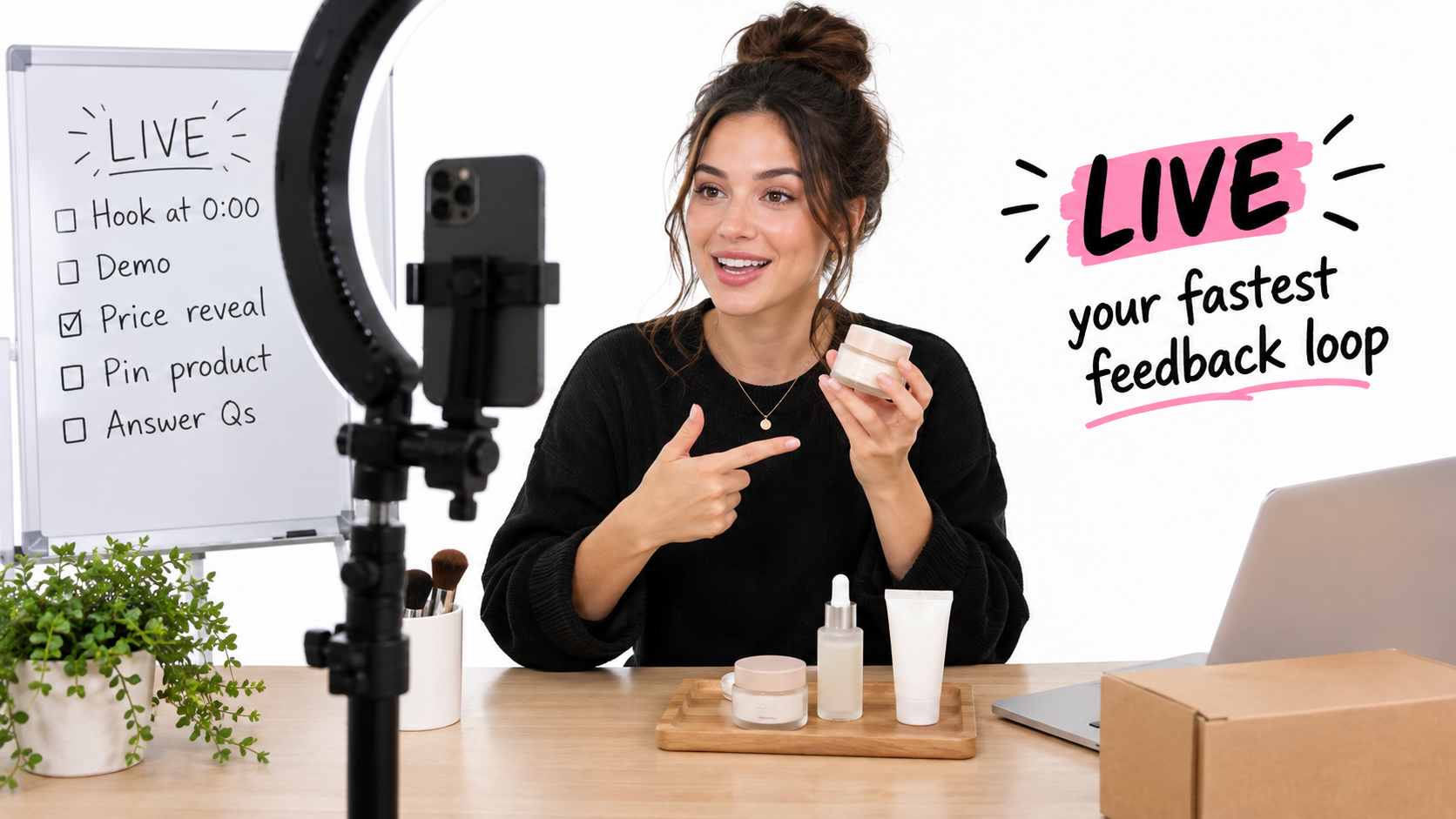
LIVE shopping is one of TikTok Shop’s defining features. The platform’s own description of the product includes livestreams through which products can be promoted and bought in real time. Many new sellers avoid LIVE because their early viewer counts are small. That misses what LIVE is most useful for at this stage.
Small audiences, high-quality signal
A LIVE with 15 viewers won’t make you rich. It will give you something no other format offers: real-time, unfiltered questions and reactions from potential buyers. You’ll hear the objections they actually have, in their own words, as they come up.
Pre-recorded video gives you metrics after the fact. LIVE lets you test an answer to an objection and see whether the next viewer buys. For a new seller still learning the buyer, that loop is very useful.
A simple LIVE structure for beginners
You don’t need a studio. You need a phone, decent lighting, the product, and a plan:
- Open with the payoff. Viewers drop in and out constantly, so show the result right away and repeat it often.
- Demonstrate in cycles. Run the full demonstration every few minutes for newcomers.
- Pin the product so viewers can buy without leaving the stream.
- Read and answer every question by name. Engagement keeps viewers watching and tells you what matters to buyers.
- Give a reason to act now, such as a LIVE-only bundle or limited offer, within platform rules.
What to write down after every LIVE
The value of a small LIVE is in what you capture afterward. After each session, note:
- The three most common questions.
- The moment viewer count or purchases jumped, and what you were doing then.
- Any objection you couldn’t answer well.
- Phrases viewers used to describe the product or their problem.
That list feeds straight into your listing copy, your creator briefs, and your short-form hooks. The words buyers use in a LIVE chat are often better hooks than anything a marketer writes.
Consistency builds an audience
LIVE audiences tend to grow through habit. Going live at the same time on the same days lets returning viewers find you. A regular schedule of shorter sessions usually does better than an occasional marathon.
Action step: Schedule two LIVE sessions a week from day 15 to day 45. Measure them by what you learn, not by sales. By the end, you should have a written list of your buyers’ top objections and the answers that convert.
Fulfillment, Returns, and Surviving Your First Bad Review
The first 90 days are when a shop is most fragile operationally. A run of problems that a mature shop could absorb can define a new shop’s reputation and health score.
The first spike is the real test
At some point, usually without warning, a video will take off. That’s when your spike plan from days 1–14 earns its keep. Sellers who have a plan ship on time and turn a viral moment into lasting momentum: reviews, creator interest, and algorithmic history. Sellers without one fall behind on dispatch, rack up late-shipment penalties, and get cancellation requests from buyers who expected fast delivery.
If a spike gets ahead of your capacity, act quickly:
- Communicate proactively with buyers about realistic timelines.
- Adjust inventory availability so you don’t sell stock you can’t ship in time.
- Bring in temporary help or a 3PL rather than letting dispatch slip.
Returns tell you something
Every return comes with information. Sort returns by reason and look for patterns:
- “Not as described” often points to a gap between creator videos and the actual product. Fix the listing, or brief creators more accurately.
- “Wrong size” or “didn’t fit” usually means the listing needs clearer dimensions or a size guide.
- “Damaged” points to packaging. Improve it before volume grows.
- “Didn’t work” could be a quality problem or a buyer expecting too much. Check whether your content is overpromising.
Overpromising deserves attention. Creators naturally show the best-case result. If that result isn’t typical, you’ll pay for it in returns and negative reviews. A slightly less dramatic but honest demonstration often produces better net revenue after returns.
Handling the first negative review
It will happen. Respond professionally and within platform guidelines. Acknowledge the problem, offer a fix through official channels, and never argue. Future buyers read your responses as closely as the reviews.
Then fix the cause. One negative review is an anecdote. Three reviews mentioning the same issue are a product or listing problem that needs action.
Customer service is a ranking factor, indirectly
Response time and resolution quality typically feed into shop performance metrics. They also affect whether buyers return. Set a firm internal standard for how fast messages get answered and stick to it, even when you’re busy packing a spike.
Action step: Make a returns log with columns for order, reason, product, and source video (if known). Review it every week. Any reason that shows up three or more times gets a specific fix before the next week ends.
Days 46–90: Paid Amplification Only After the Signal
Paid advertising can speed up a TikTok Shop launch a lot. Used too early, it’s also one of the fastest ways to lose money. The key question is sequencing.
Why ads come after organic signal
Ads multiply whatever you already have. If your product, listing, and creative convert organically, ads put more people in front of a system that works. If they don’t, ads put more people in front of a system that doesn’t, and you pay for every one of them.
By day 46, if you’ve followed the earlier phases, you should have:
- A hero product with real reviews.
- Several creator videos that have driven attributable orders.
- Tested hooks from your own content showing which openings hold attention.
- A written list of buyer objections and answers from LIVE.
- Fulfillment that has survived at least one spike.
That’s the foundation ads need. Without it, you’re paying to learn lessons organic content could have taught you for free.
What to amplify first
Start by putting spend behind content that has already proven itself:
- Your best-performing creator videos, where the platform allows you to promote affiliate content with the creator’s permission. Content that converted organically is the strongest ad creative you have.
- Your winning hooks from your own account, reshot or reused as ad creative.
- LIVE sessions, once your hosting is consistent enough that new viewers will stay.
TikTok offers automated campaign types for Shop sellers that optimize toward GMV. These tools change often, so review the current options in TikTok Ads Manager and Seller Center rather than relying on older guides.
Set guardrails before spending
Before launching any campaign, calculate your break-even ad cost per order. Take your selling price and subtract product cost, platform fees, affiliate commission (if applicable), shipping, packaging, and an allowance for returns. What’s left is the most you can spend on ads to get one order without losing money.
Set a daily budget you can afford to lose completely while you learn. Judge campaigns by contribution margin, not top-line GMV. A campaign that doubles GMV while losing money on every order is a problem, not a success.
Keep the organic engine running
A common mistake in this phase is letting organic work slip once ads are running. Creator seeding, your own posting schedule, and LIVE sessions should continue. Ads tend to perform better when they’re backed by steady organic activity, and the organic engine keeps generating fresh creative to feed your campaigns.
Action step: Write your break-even ad cost per order on a sticky note and keep it in view while managing campaigns. Pause anything consistently above that number after a fair test period.
The 90-Day Scorecard: Metrics That Actually Matter at Launch
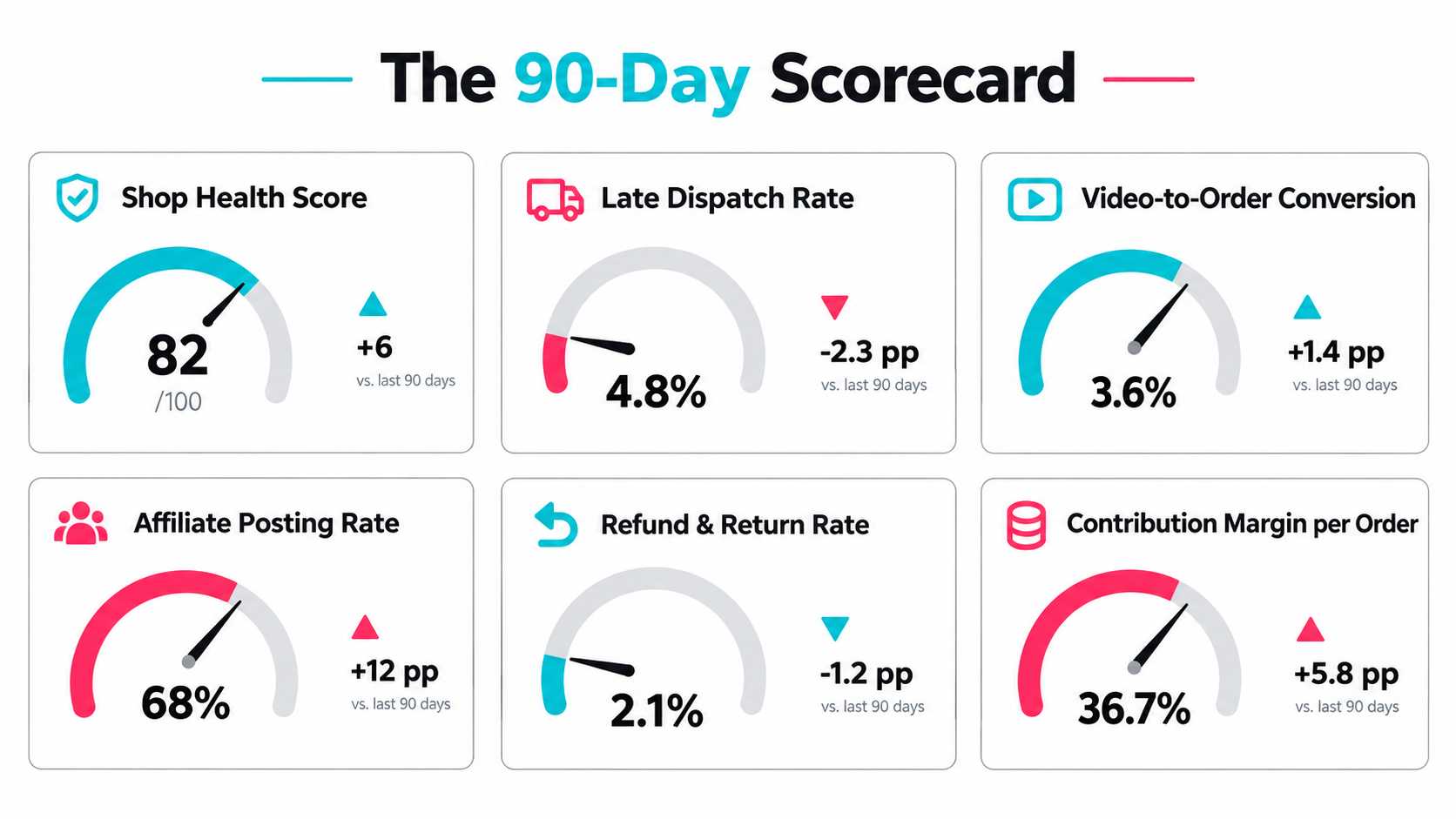
New sellers often track the wrong numbers. They watch total views and GMV and miss the indicators that predict whether the shop will survive. Here’s a scorecard built for the launch phase.
1. Shop health score
This is the foundation. If it falls into a restricted range, nothing else matters much. Check it at least weekly and look into any decline right away.
2. Late dispatch and cancellation rates
These are the most controllable inputs to shop health and the most common early failures. Your target should be as close to zero as you can manage. On a small order base, each miss counts for a lot.
3. Affiliate posting rate
Of the samples you sent, what percentage turned into published videos? This tells you whether your creator selection and outreach are working. A low rate means you need to change who you target or how you approach them before sending more product.
4. Video-to-order conversion
Views alone don’t pay the bills. Track how many orders each video drives relative to its views, for both creator and seller content. This shows which content actually sells, which isn’t always the content with the most views.
5. Refund and return rate
A rising return rate is an early warning of overpromising content, listing gaps, or quality problems. Segment it by product and, where possible, by source video.
6. Contribution margin per order
After product cost, fees, commission, shipping, returns, and ad spend, how much does each order actually contribute? A shop can show strong GMV growth while losing money. This number tells you whether growth is real.
Metrics to de-emphasize early
- Follower count. Useful eventually, but a weak predictor of early sales.
- Total views. Vanity without conversion.
- Raw GMV. Meaningful only next to margin.
A weekly review ritual
Set aside one fixed hour each week to review the scorecard. Ask three questions: What got worse? Why? What one change will I make this week? Small weekly corrections over 12 weeks add up to a far stronger shop than a burst of effort followed by guesswork.
Action step: Build the six-metric scorecard in a simple spreadsheet before day 1, and fill it in every week for the full 90 days.
Conclusion: Joining the Active Minority
The TikTok Shop opportunity is real and still growing. Global GMV is projected around $123.5 billion for 2026. US sales are projected to pass $20 billion. An estimated 54 million Americans are shopping on the platform. After the end of the de minimis exemption, domestic sellers face a more favorable competitive mix than they did a few years ago.
The headline seller count hides the more useful fact: many stores never make a sale. They don’t fail because the market is saturated. They fail because they treat TikTok Shop like a search marketplace, launch without content, damage their shop health early, spend on ads before they have signal, or stop just before the feedback loop starts paying off.
Your 90-day checklist
Days 1–14: Foundations
- Complete verification accurately and read the current category policies.
- Set dispatch times you can beat and arrange customer-service coverage.
- Choose your fulfillment model and write a one-page spike plan.
- Score candidate products and launch with one demonstrable hero.
- Build a listing that matches what the videos will promise.
Days 15–45: Seeding
- Send samples to creators chosen for fit and selling history, not follower count.
- Track posting rate and orders per creator, and reinvest in proven partners.
- Publish about 30 of your own videos testing at least ten hooks.
- Run two LIVE sessions a week and document buyer objections.
- Update the listing with answers to repeated comment questions.
Days 46–90: Amplification
- Calculate your break-even ad cost per order before spending.
- Amplify proven creator content and winning hooks first.
- Keep the organic engine running at full cadence.
- Review the six-metric scorecard weekly and make one correction at a time.
None of this depends on luck or a viral moment. It depends on building a shop that’s ready when one comes, and on staying consistent long enough for content-driven sales to compound. The sellers who get there aren’t necessarily the most creative or the best funded. They’re the ones still working the process on day 90.