


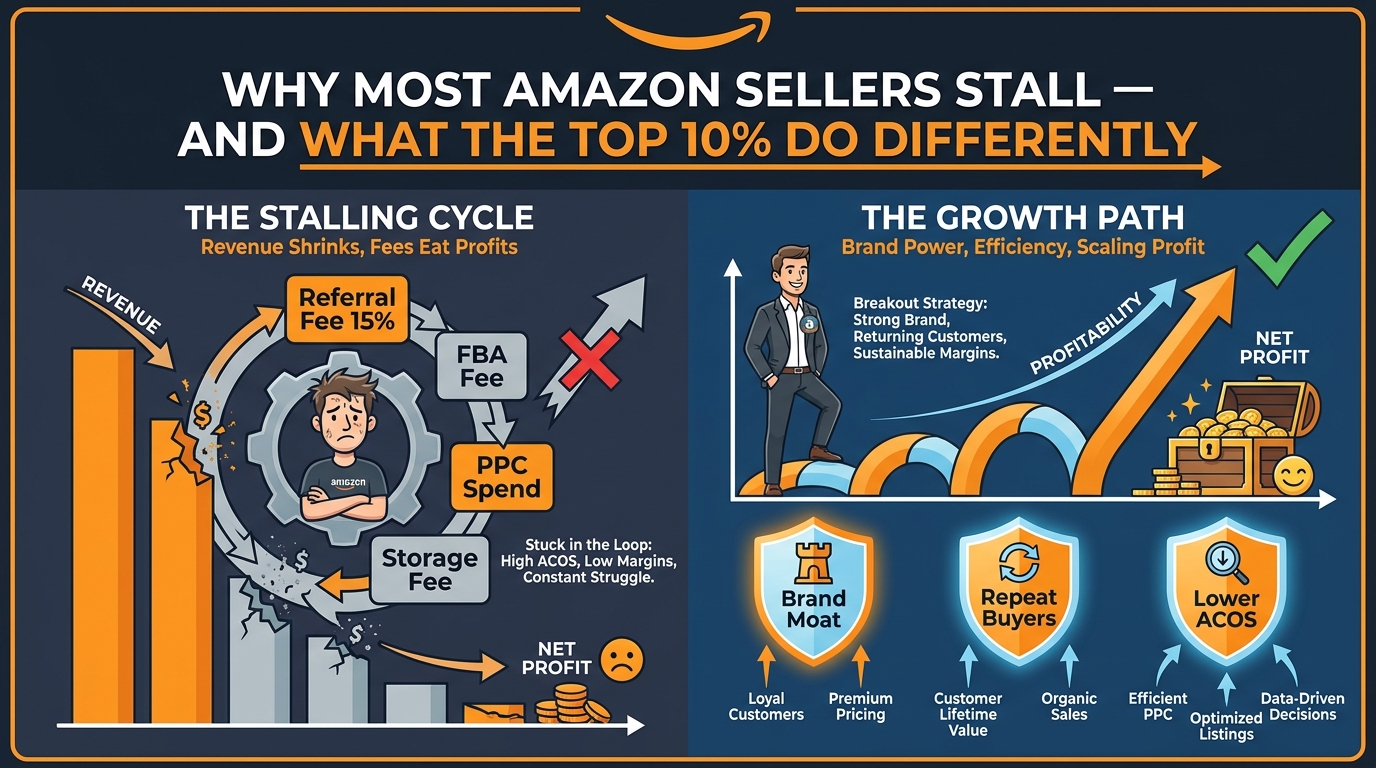

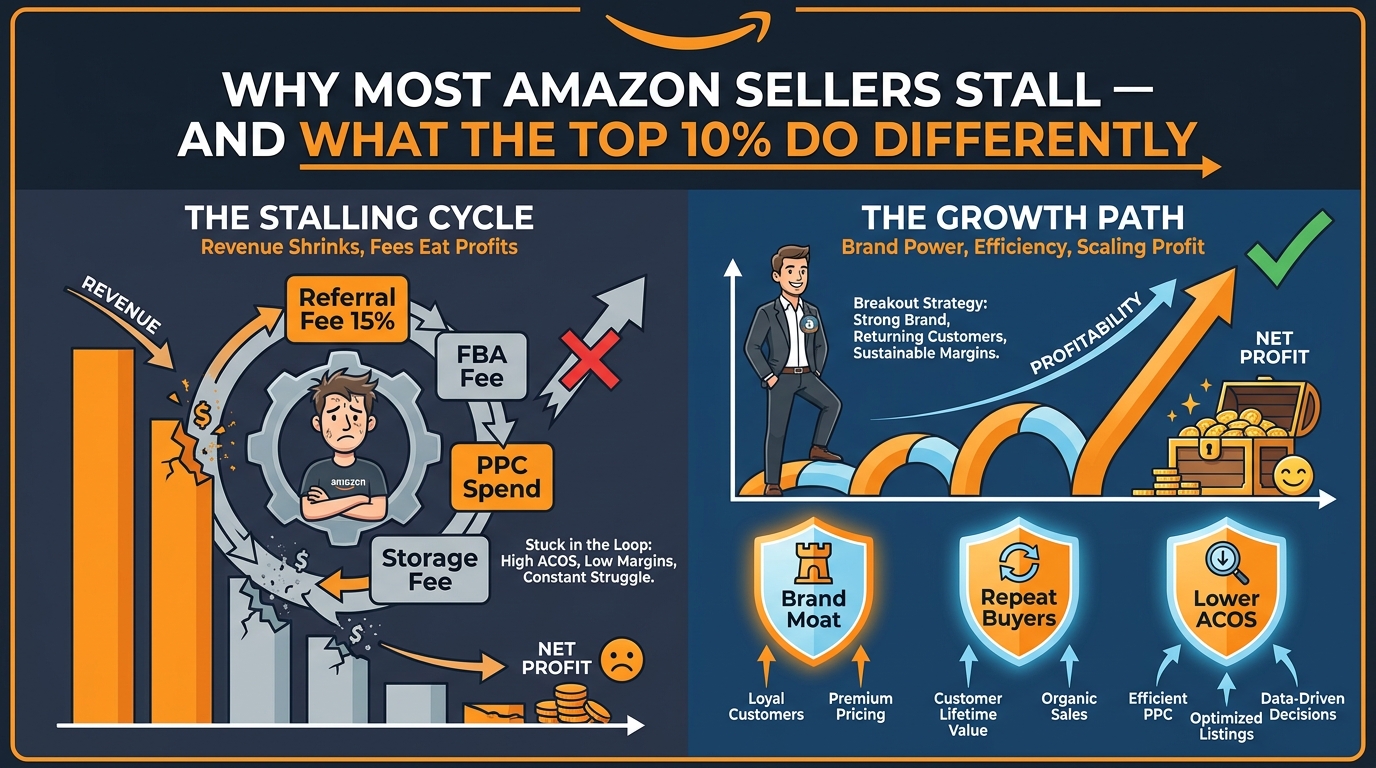
In 2024, more than 55,000 independent Amazon sellers generated over $1 million in annual sales. On the surface, that sounds like a gold rush. But zoom out and the numbers tell a very different story: the average independent seller in the U.S. generated around $290,000 in gross sales — a figure that looks respectable until you subtract fees, cost of goods, advertising, returns, and storage. What’s left can be remarkably thin.
The honest truth about Amazon selling in 2026 is this: generating revenue is not the hard part. Millions of sellers can move product. What separates the operators who build real, profitable businesses from those who spin their wheels at the same revenue level year after year isn’t hustle — it’s math. Specifically, it’s whether they understand the actual unit economics of their business model, and whether they’ve made intentional decisions about how they’re structured rather than just defaulting into the first approach that generated a sale.
This article isn’t about tactics you apply to an existing listing. It’s about the deeper structural decisions that determine whether an Amazon business is viable at scale — what the fee stack actually does to margin, which business model fits which seller archetype, how cash flow silently kills growing brands, and what the operators running seven-figure Amazon businesses think about differently from everyone else. If you’re already selling and wondering why growth feels like pushing uphill, or you’re evaluating whether Amazon is the right channel for a product you’re developing, this is the analysis that most guides skip entirely.
The True Cost of Selling on Amazon: Decoding the Fee Stack
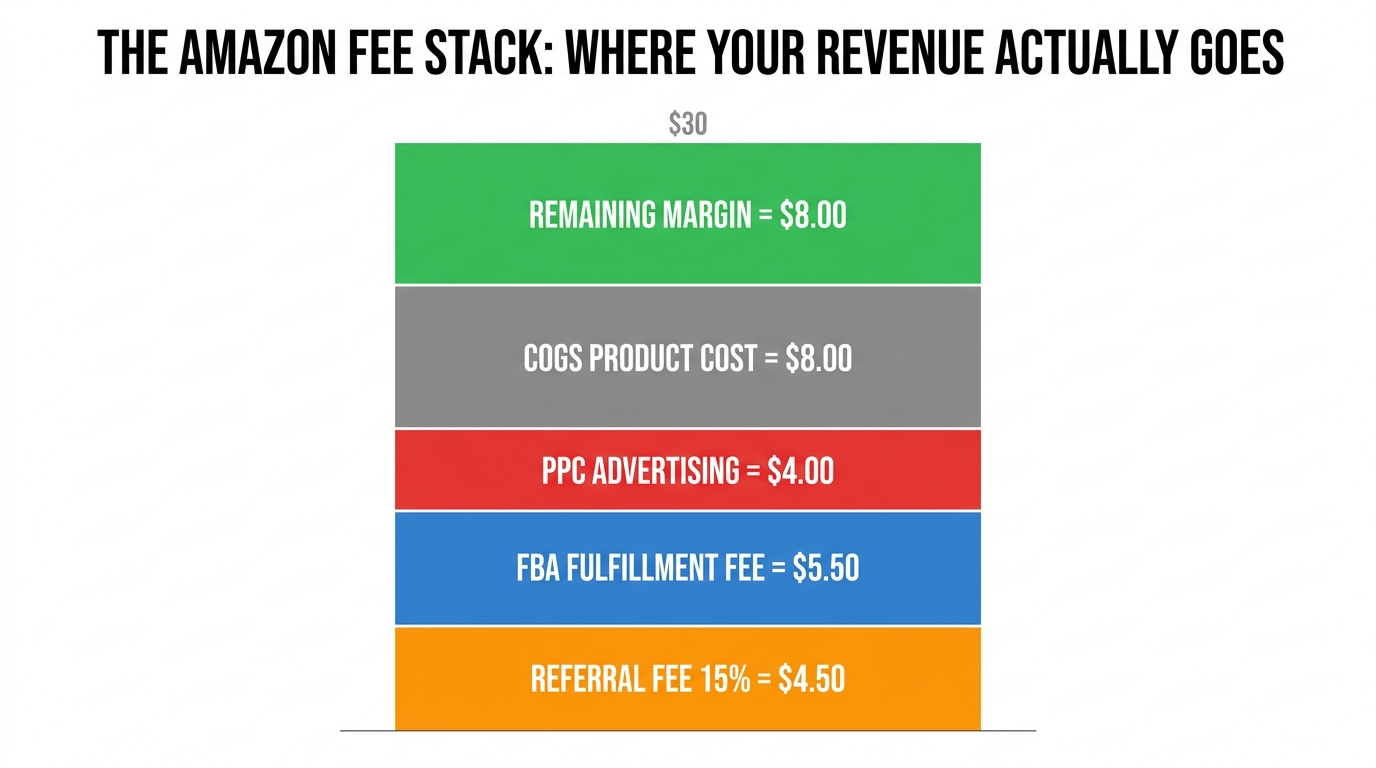
Before you can make smart decisions about your Amazon business, you need a ruthlessly honest picture of what it costs to operate. Most sellers who struggle aren’t being beaten by competitors — they’re being beaten by their own fee structure, which they never properly mapped out.
The Referral Fee: Amazon’s Cut Before Anything Else
Every sale on Amazon begins with a referral fee — Amazon’s commission for hosting the transaction. These fees vary widely by category. Consumer electronics run at 8%. Home and Kitchen sits at 15%. Clothing and Accessories charges 17%. Jewelry can go as high as 20% on the first $250 of sale price. If you’re in a 15% referral fee category and selling a $30 product, Amazon takes $4.50 off the top before you’ve done anything else. This is non-negotiable and non-reducible — it’s the cost of accessing the marketplace.
The category you sell in is therefore one of the most important financial decisions you make, and it’s often made casually. Two products at the same price point and the same manufacturing cost can have dramatically different Amazon viability simply because of category referral fees. A $30 item in Consumer Electronics costs $2.40 in referral fees. The same $30 item in Clothing costs $5.10. That $2.70 gap is the difference between a viable margin and a loss at thin cost structures.
FBA Fulfillment Fees: Paying for the Privilege of Prime
If you use Fulfillment by Amazon — which most serious sellers do, because Prime eligibility is essentially a prerequisite for Buy Box competitiveness — you pay per-unit fulfillment fees based on size and weight. For a standard small envelope item, you’re looking at fees in the $3–$4 range. A standard-size item that ships in a medium box typically runs $5–$7. Oversize items, heavy items, or products with awkward dimensions can push fulfillment fees well into double digits — sometimes exceeding $20 per unit before you’ve sold a single dollar.
These fees don’t scale. Whether you sell one unit or one thousand units, the per-unit fulfillment fee stays the same. That means FBA works beautifully for products with high retail prices relative to their size and weight, and it works terribly for heavy, bulky, or low-price products. A seller pushing heavy pet supplies priced at $18 is operating in a fundamentally different economic reality than someone selling a lightweight supplement at $35.
Storage Fees: The Silent Tax on Slow Inventory
Amazon charges monthly storage fees based on the cubic footage your inventory occupies in their fulfillment centers. Standard-size inventory runs roughly $0.78 per cubic foot per month (January through September) and surges to around $2.40 per cubic foot during the October through December peak season. That sounds manageable until you have several hundred units sitting unsold, or until your inventory turns slowly because you over-ordered for a seasonal spike that didn’t materialize.
The real sting comes from aged inventory surcharges — additional fees applied to inventory that has been stored for 271 days or more. These surcharges escalate dramatically the longer inventory sits. For sellers who misjudge demand and end up with excess stock, storage costs can compound into a meaningful percentage of product cost. Amazon’s incentive is to push high-velocity products through their network; the fee structure punishes slow movers accordingly.
Advertising: The Fee That Never Shows Up in the Fee Schedule
Here’s what most fee breakdowns miss: advertising isn’t technically a platform fee, but in practice it functions as one. In 2026, it is functionally impossible to launch a new product on Amazon without paid advertising. Sponsored Products, Sponsored Brands, and Sponsored Display campaigns have become the oxygen of new listing visibility. The average Amazon seller spends between 10% and 15% of their revenue on advertising — and sellers in competitive categories routinely spend 20% to 25% during launch phases.
When you add advertising to the actual fee stack, the picture changes significantly. On a $30 product in a 15% referral fee category: $4.50 referral fee + $5.50 FBA fulfillment + $4.50 advertising (15%) = $14.50 in platform and marketing costs, before a single dollar of product cost. If your cost of goods is $8, you’re left with $7.50 in gross margin — a 25% margin on a product that generates $290,000 in annual sales produces only $72,500 in pre-tax profit. Not a bad income. But not the explosive wealth that many sellers imagine when they see seven-figure revenue numbers.
Returns and Refunds: The Variable Nobody Models
Return rates vary dramatically by category. Electronics and apparel see return rates between 20% and 30%. Home goods typically run 8% to 15%. Each return involves Amazon’s return processing fee (charged to the seller in many cases), potential refurbishing or disposal costs, and the lost revenue from the original sale. For sellers in high-return categories who haven’t modeled this into their unit economics, returns alone can turn a borderline-profitable product into a losing one.
The takeaway: Build your full fee stack before you build a single listing. Use Amazon’s Revenue Calculator (available on Seller Central) to model total fees at your price point and category. If the math doesn’t work at the calculator stage, no amount of listing optimization will fix it at the sales stage.
Choosing Your Business Model: The Decision That Shapes Everything Else

One of the most consequential — and most poorly made — decisions in Amazon selling is choosing which business model to operate. Many sellers pick a model because it’s what the first YouTube video they watched used, or because it required the least upfront capital. Neither is a good reason. Each model has a distinct risk and reward profile, and the right choice depends entirely on your capital position, risk tolerance, available time, and long-term goals.
Private Label: High Ceiling, High Commitment
Private label is the model most associated with “Amazon success stories.” You source a product from a manufacturer (typically in China, though Southeast Asia, India, and domestic suppliers are increasingly viable), brand it as your own, and sell it exclusively under your label. The appeal is clear: you own the product, you control the listing, and there are no competing sellers on your exact ASIN.
The economic reality is more nuanced. Private label requires meaningful upfront capital — typically $5,000 to $20,000 for an initial product order of reasonable size, plus photography, listing creation, and advertising budget for launch. The time from product concept to first sale is often 90 to 180 days when you factor in supplier sourcing, sample iteration, manufacturing, and shipping. And the success rate is lower than the gurus admit: the vast majority of private label product launches fail to gain meaningful traction because the product selection was based on surface-level keyword research rather than genuine market analysis.
When it works, though, it works well. A well-differentiated private label product in a defensible niche can generate 25% to 40% net margins at scale. The brand has real asset value — Amazon aggregators (companies that buy Amazon brands) have paid 3x to 5x annual net profit for well-run private label businesses. Private label is the model for sellers who want to build something they can eventually sell, or who want compound growth from a single product family.
Wholesale: Lower Ceiling, More Predictable
Wholesale sellers buy branded products in bulk from distributors or directly from brands and resell them on Amazon. The advantage is that you’re working with established products that already have demand, reviews, and market validation. You’re not building something from scratch — you’re plugging into an existing sales flow.
The disadvantages are significant. Because other sellers can (and do) source the same products, you’re competing on the same listing — and often in a race to the Buy Box that comes down to price and fulfillment metrics. Margins are typically thin: 10% to 20% net is common, and competitive wholesale categories can compress margins further. The business model also requires robust operations — reliable supplier relationships, careful inventory forecasting, and pricing discipline to avoid death spirals where multiple sellers undercut each other.
Wholesale works best for sellers with strong operational capabilities and capital to deploy at volume. It’s more of a distribution business than a brand business, which means it scales differently and exits at lower multiples than private label.
Retail and Online Arbitrage: Fast Start, Slow Ceiling
Retail arbitrage (buying discounted products from physical retail stores) and online arbitrage (buying from other online retailers at lower prices) let sellers start generating revenue with minimal upfront investment — sometimes just a few hundred dollars. You find products selling below their Amazon price elsewhere, buy them, and resell at a profit.
The model’s weakness is structural. It doesn’t scale beyond what one or a few people can physically source and process. Margins are inconsistent and depend on finding deals that disappear as more people hunt them. Amazon has also tightened restrictions on certain brand categories that require approval to sell, which can suddenly lock arbitrage sellers out of their best sources. Most sellers in this model plateau between $50,000 and $200,000 in annual revenue — which is fine as a side income or an entry point, but inadequate as a business strategy.
Dropshipping: Lowest Barrier, Highest Compliance Risk
Dropshipping — selling products you don’t hold in inventory, with the supplier shipping directly to customers — is technically permitted on Amazon under very specific conditions. The seller must be the seller of record, fulfill in their own name, and remove all third-party branding from packaging. In practice, many dropshipping setups violate at least one of these conditions, which leads to account suspension.
Beyond compliance, the economics are brutal. Dropshipping margins on Amazon typically run 5% to 15%, and the lack of inventory control means quality and fulfillment consistency are entirely dependent on the supplier. It can work in very specific circumstances — direct relationships with brands who allow it and fulfill reliably — but it’s the highest-risk, lowest-margin model available. Treat it as a product testing mechanism, not a long-term business model.
The framework: Match your model to your capital and goals. If you have $15,000+ and a 12-month horizon, private label has the best long-term returns. If you have capital but want faster deployment and lower risk, wholesale is viable. If you have under $5,000 and are learning the platform, arbitrage is a valid starting point — just understand its ceiling.
The Product Selection Formula Most Sellers Get Wrong
Product selection is where the majority of private label Amazon businesses succeed or fail, and it’s where the most consequential mistakes are made. The conventional wisdom — find a product with high search volume and low competition, source it cheaply, launch it — is incomplete to the point of being misleading.
Demand Without Differentiation Is a Trap
Every product selection tool available in 2026 — Helium 10, Jungle Scout, DataDive, and others — can tell you search volume and estimated sales. What they can’t tell you is whether there’s a reason for a new entrant to win. High search volume combined with an existing top-10 page full of listings with 3,000+ reviews, strong Brand Registry presence, and established sponsored ad positions is not an opportunity. It’s a fortress.
Entering a crowded category without a meaningful differentiator is one of the most common and expensive mistakes Amazon sellers make. “Differentiation” doesn’t have to mean a patented invention — it can mean a superior formulation, better packaging for a specific use case, a bundle that solves a problem the current products don’t, a significantly better main image, or targeting a customer segment the current listings are ignoring. But it has to be something real that a buyer would choose you for, not just a slight variation on the same product that’s already selling.
The Price Point Math: Aim for the $25–$60 Sweet Spot
Price point is a product selection variable that gets less attention than it deserves. Products priced below $15 are extremely difficult to make profitable on Amazon once you account for referral fees, FBA fees, and advertising. The fee stack consumes most of the revenue, leaving almost nothing for COGS and profit.
Products priced above $100 face a different challenge: higher buyer hesitation, more research-intensive purchase decisions, longer review accumulation timelines, and often more demanding quality expectations. They can absolutely work, but they require more sophisticated listing strategies, better photography, and typically longer payback periods on advertising spend.
The $25–$60 range has historically been the most workable sweet spot for new private label sellers. Fees are manageable, conversion rates are reasonable, buyers don’t agonize over the decision the same way they do for $150 purchases, and there’s enough gross revenue per unit to support meaningful advertising spend without the product economics collapsing.
Velocity Over Margin: The Review Accumulation Problem
A product with a 40% gross margin but slow sales velocity will often lose to a product with a 25% gross margin and fast velocity. Why? Because velocity drives organic rank, which drives more organic sales, which drives more reviews, which drives more conversions — the entire Amazon flywheel runs on velocity. New sellers routinely choose higher-margin products that sell too slowly to ever accumulate the reviews and organic rank needed to compete.
The product selection benchmark worth checking: can this product realistically sell 10 or more units per day within 90 days of a properly executed launch? If the answer is no — either because the category volume isn’t there or because the economics of getting there are prohibitive — the product math gets very difficult.
Inventory Strategy: Cash Flow Is the Constraint Nobody Talks About
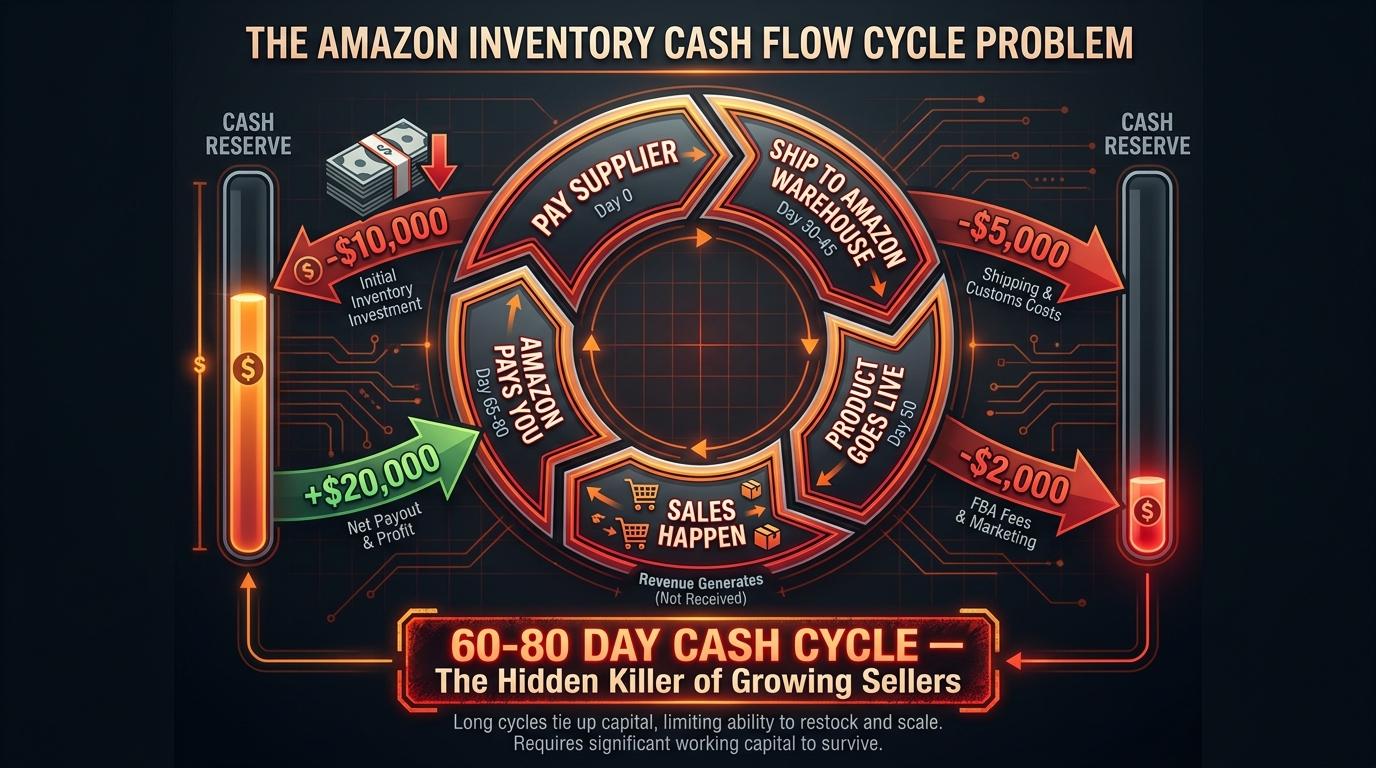
The most underestimated challenge in Amazon selling isn’t finding a product or ranking a listing — it’s surviving the cash flow cycle. Amazon FBA creates a structural cash flow problem that is mild at small scale and becomes genuinely threatening as a business grows.
The 60-80 Day Cash Gap
Here’s the typical cash timeline for an FBA seller sourcing from overseas: you pay your supplier on Day 0 (often 30% upfront, 70% before shipment). The manufacturing run takes 30 to 45 days. Ocean freight to the U.S. adds another 25 to 35 days. Amazon check-in and inventory processing adds 5 to 10 more days. Your product is now live, but you’ve had your capital tied up for 60 to 90 days before the first sale. Then Amazon pays you on a 14-day cycle — but only for sales that have cleared their holding period. Total time from writing the supplier check to receiving payment for your first sale: 75 to 100 days.
This matters enormously when you try to grow. Suppose your product sells well and you want to reorder. You need to start that reorder process before you run out of stock — ideally 60 to 90 days before stockout, which means reordering while you’re still selling the first shipment. That means you’re paying for a second production run with capital you haven’t fully recouped from the first. At small scale, this is manageable. At $500,000 in annual revenue, you might be cycling $100,000+ in inventory capital at any given time — capital that has to come from somewhere.
Stockouts Are More Expensive Than Sellers Realize
Running out of stock on Amazon is not a neutral event. It damages your organic ranking, which Amazon builds around sustained sales velocity. A listing that goes out of stock for one to two weeks can drop multiple pages in organic results, requiring a fresh round of advertising spend to rebuild. The cost of a stockout isn’t just the lost sales during the out-of-stock period — it’s the cost of re-ranking afterward, which can equal weeks or months of elevated advertising spend.
Conservative inventory management that keeps you well-stocked but generates storage fees is often more profitable than aggressive lean inventory management that risks stockouts. The math changes product by product, but the rule of thumb is to maintain 60 to 90 days of inventory in the FBA network for steady-state products.
Financing Options: Knowing What’s Available
Amazon’s own financing programs — including Amazon Lending and the Buy with Prime Capital offering — provide inventory financing to eligible sellers based on their sales history. These loans are relatively straightforward to access for established sellers with a track record, though interest rates aren’t always competitive. Third-party options like Clearco, Parker, and Wayflyer offer revenue-based financing specifically designed for e-commerce brands, often with faster approval timelines than traditional small business loans. Understanding these options before you need them — not when you’re already running out of cash — is a mark of an operator rather than a hobbyist.
Advertising on Amazon: Why High ACOS Doesn’t Always Mean You’re Losing
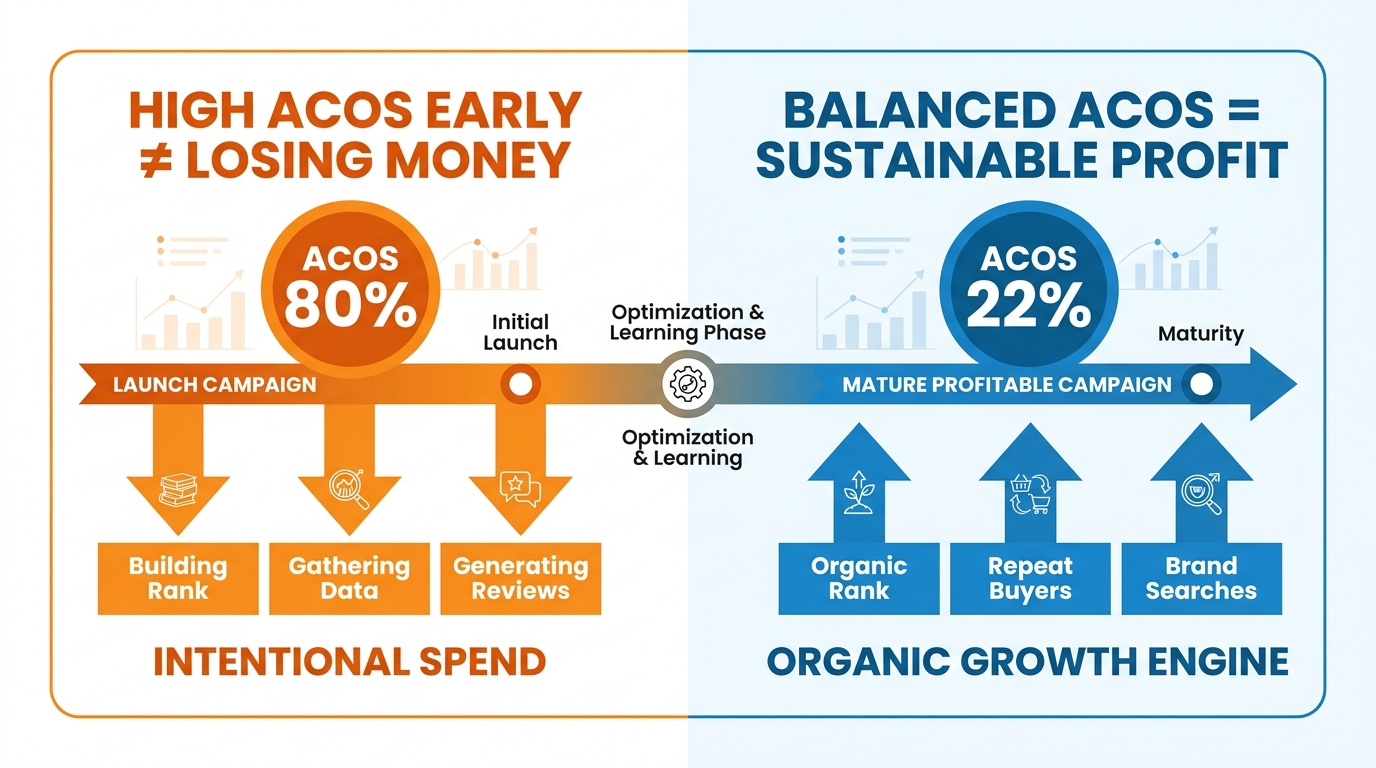
Advertising Cost of Sales (ACOS) is the metric most Amazon sellers fixate on, often to their detriment. ACOS = advertising spend ÷ advertising revenue. A 30% ACOS means you spent $30 to generate $100 in sales from ads. Lower is generally better, in isolation. But ACOS in isolation tells you almost nothing about whether your advertising strategy is working.
Launch ACOS vs. Mature ACOS: Two Very Different Benchmarks
When you launch a new product on Amazon, your ACOS will be high — sometimes 60%, 80%, or even 100%+. This is normal and expected, and sellers who panic and cut spend at this stage often condemn their product to failure. During launch, advertising serves three simultaneous purposes: generating sales velocity, building organic rank, and gathering keyword conversion data. The “cost” of that advertising isn’t just buying revenue — it’s buying all three of those things simultaneously.
The relevant question during launch isn’t “Is my ACOS low?” It’s “Is my rank improving? Am I gathering review velocity? Am I identifying which keywords convert?” A product that runs at 75% ACOS for 90 days but exits that period with 50 reviews and a page-one organic position for its primary keyword has made an investment. A product that runs at 25% ACOS for 90 days by only targeting low-volume keywords may look profitable on paper but has built no foundation.
Total Advertising Cost of Sale (TACOS): The Metric That Actually Matters
TACOS — Total Advertising Cost of Sale — divides ad spend by total revenue (both paid and organic), not just ad-attributed revenue. This gives a more accurate picture of how advertising fits within the full business. A product generating $50,000 in monthly revenue, of which $35,000 is organic and $15,000 is ad-attributed, with $5,000 in ad spend, has a 33% ACOS but a 10% TACOS. That’s an extremely healthy picture — the advertising is maintaining rank and catching incremental buyers while the organic baseline does the heavy lifting.
TACOS trending downward over time as organic rank improves is the sign of a healthy launch progression. TACOS trending upward, or staying flat at high levels, indicates a product where advertising is propping up revenue rather than building a sustainable organic base. That’s a product with a structural problem that more ad spend won’t solve.
Campaign Architecture That Scales
Sellers who treat Amazon PPC as a single campaign are leaving significant efficiency on the table. A mature campaign architecture separates brand keywords (your own brand name), exact-match keywords (specific high-intent terms you’ve proven convert), phrase and broad match research campaigns (for discovery), and competitor targeting (showing your ads on competitor listings). Each campaign type serves a different function and should have different ACOS targets. Mixing them all together makes it impossible to optimize any of them properly.
The practical implication: set different ACOS targets for different campaign types. Brand campaigns should run at very low ACOS — you’re defending territory you already own. Research campaigns should have a higher allowable ACOS because they’re generating data and potentially discovering high-value keywords. Exact match campaigns for proven converters should be optimized aggressively for efficiency.
Building a Brand Moat: Why “Having a Product” and “Having a Brand” Are Completely Different Things
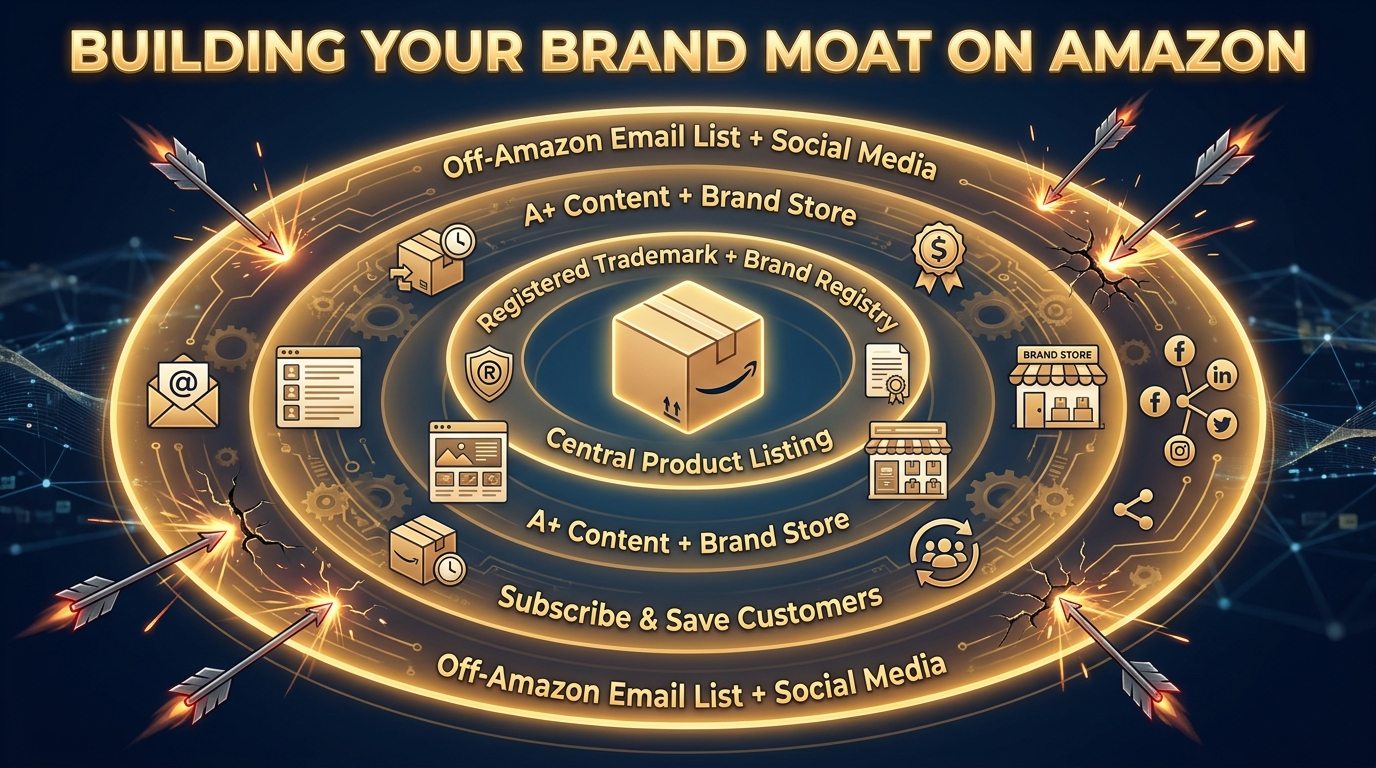
The single most important distinction between Amazon sellers who plateau and those who scale sustainably is whether they’re building a brand or just selling a product. The difference isn’t philosophical — it has direct, measurable impact on advertising costs, conversion rates, competitive resilience, and ultimately, what your business is worth.
Amazon Brand Registry: The Minimum Viable Defense
Amazon Brand Registry requires a registered trademark (or a pending application in eligible countries) and gives sellers access to a suite of tools that non-registered sellers can’t use: A+ Content, Brand Storefront, Sponsored Brands ads, Brand Analytics, and critically, enhanced IP protection against unauthorized sellers and counterfeiters. It also gives you access to the “Report a Violation” tool for proactively monitoring your listings.
The trademark registration process takes 8 to 12 months through the USPTO, so sellers who want Brand Registry protection should initiate the process well before they need it. Amazon’s IP Accelerator program can connect sellers with trademark attorneys and may speed up interim access to Brand Registry while the trademark application is pending. For any seller serious about building a lasting Amazon business, Brand Registry is the foundation, not an optional upgrade.
A+ Content: The Conversion Rate Lever Most Sellers Under-Invest In
A+ Content — the enhanced product description modules that replace the standard bullet points with rich media, comparison charts, and brand storytelling — has been shown to increase conversion rates by 3% to 10% on average, according to Amazon’s own data. For a product converting at 12% without A+, a 5-point improvement gets you to 17% — which means 42% more sales from the same traffic, without spending more on advertising.
The best A+ Content doesn’t just look attractive — it addresses objections, explains differentiators, shows the product in context, and makes the purchase decision feel obvious. Comparison modules (showing your product against variations or complementary products in your own catalog) also encourage upsell and cross-sell behavior. Sellers who treat A+ Content as a “nice to have” are leaving conversion rate improvement — and therefore margin improvement — on the table.
Subscribe & Save: The Metric That Predicts Long-Term Business Health
For consumable or replenishable products — supplements, coffee, cleaning supplies, pet food, personal care — Subscribe & Save enrollment is one of the most powerful brand-building tools on Amazon. Customers who subscribe create predictable, recurring revenue with no advertising cost per repeat purchase. A Subscribe & Save customer who stays subscribed for 12 months might generate four to eight purchases at effectively zero incremental marketing spend after the initial acquisition.
The Subscribe & Save enrollment rate for a product is a leading indicator of customer satisfaction and product-market fit. A product where 25% or more of buyers choose to subscribe is a product customers genuinely value enough to commit to. A product where fewer than 5% subscribe — despite being eligible — may have satisfaction or differentiation problems that reviews alone aren’t capturing.
Building Off-Amazon Customer Relationships
One of Amazon’s most significant structural disadvantages for sellers is that Amazon owns the customer relationship. You don’t get buyer email addresses. You can’t remarket to previous buyers through Amazon’s systems for anything other than follow-up reviews (via the Request a Review button). This means every repeat sale from a previous buyer still flows through Amazon’s funnel — and if Amazon suspends your account, your relationship with those customers evaporates.
Smart operators build off-Amazon customer touch points deliberately. Product insert cards that drive customers to a warranty registration page, a recipe community, a how-to guide, or a loyalty program — with optional email opt-in — convert a percentage of Amazon buyers into direct relationships. Even 5% of buyers joining an email list creates a growing asset that is completely separate from Amazon’s control. When brands have their own customer list, they have leverage: to launch new products, to weather Amazon disruptions, and to build valuation that aggregators and strategic buyers will pay more for.
Going Multi-Channel Without Losing Amazon Momentum
As Amazon sellers grow, the question of channel diversification becomes increasingly urgent. Dependence on a single marketplace creates existential business risk — account suspensions, policy changes, fee increases, or category restrictions can devastate a business overnight. But expanding beyond Amazon requires careful execution that doesn’t inadvertently harm the Amazon momentum you’ve built.
Why Shopify and Amazon Are Complementary, Not Competitive
Many sellers approach Shopify as a “backup” or an afterthought. That misses the real opportunity. A Shopify store serves functions that Amazon cannot: it captures customer data, enables email marketing, allows custom brand experiences, supports subscription models with full economics, and builds direct-to-consumer (DTC) revenue that commands higher valuation multiples. Amazon generates volume and discovery. Shopify converts that volume into owned relationships.
The operational integration matters. Using Amazon’s Multi-Channel Fulfillment (MCF) to fulfill Shopify orders from your Amazon inventory eliminates the need to maintain separate inventory pools in the early stages. Buy with Prime — Amazon’s program that lets Shopify merchants offer Prime shipping on their DTC store — has shown meaningful conversion rate improvements for DTC sites, because Prime’s trusted shipping experience travels with buyers outside of Amazon.
Wholesale and Retail: The Paths That Add Credibility
Getting your product into wholesale retail — regional chains, specialty retailers, boutiques, or even Target or Whole Foods for the right categories — does something that Amazon sales don’t: it builds brand credibility with consumers who discover you in the physical world and then search for you online. Wholesale channels typically involve lower margins (retailers mark up 100%+ from wholesale price), but the brand equity spillover into Amazon sales can be significant.
A product in Whole Foods or on the shelves of a national sporting goods retailer generates a halo effect on its Amazon listing. Shoppers who see it in-store often search Amazon for it, and that branded search traffic converts at extremely high rates with low advertising cost. Physical retail and Amazon are not in competition for the same customer — they’re serving different discovery contexts for the same customer.
International Amazon Marketplaces: The Underused Growth Lane
Amazon operates marketplaces in 20+ countries, and the competitive dynamics in most international markets — particularly Amazon Europe (UK, Germany, France, Spain, Italy) and Amazon Japan — are meaningfully less saturated than the U.S. marketplace. Products that are fighting for page-one position in the U.S. against 500 competitors may face 50 competitors on Amazon.de, with correspondingly lower advertising costs and easier ranking thresholds.
The barriers are real: VAT registration, EU product compliance requirements (CE marking, REACH, extended producer responsibility for packaging), translated listings, and customer service in local languages. But Amazon has built infrastructure to reduce much of this friction. The Build International Listings tool can auto-create listings in other marketplaces from U.S. listings with AI-assisted translation. FBA in Europe is managed through a Pan-European network that distributes inventory across countries from a single send. For sellers already running a well-optimized U.S. operation, international expansion is often the highest-return growth investment available.
Reviews, Returns, and Reputation: The Data Behind Buyer Trust
Amazon’s review system is one of the most consequential trust signals in all of e-commerce. Research consistently shows that product conversion rates increase significantly with each milestone in review count: a product going from zero reviews to 10 reviews sees a dramatic conversion improvement; going from 10 to 50 reviews adds another meaningful lift; 50 to 100 is the threshold at which most products begin to perform comparably to their eventual steady-state rate. The specific conversion impact varies by category and price point, but the directional reality is consistent: reviews matter enormously, and accumulating them faster than competitors is a structural advantage.
Getting Reviews Without Violating Policy
Amazon’s review policies are strict and enforced aggressively. Incentivized reviews — offering discounts, refunds, or gifts in exchange for reviews — are prohibited and carry account suspension risk. Fake review services are prohibited and periodically purged by Amazon’s detection systems, sometimes sweeping out thousands of reviews at once from sellers who paid for them. The short-term gain isn’t worth the account risk.
The compliant approaches available to sellers include: the “Request a Review” button in Seller Central (which sends a templated review request email from Amazon, not from the seller, protecting both parties); enrollment in Amazon Vine, which provides up to 30 free review-generating units to Amazon’s trusted reviewer program (available to Brand Registry holders with products that have fewer than 30 reviews); and product inserts that direct buyers to leave a review, as long as the insert doesn’t incentivize positive reviews specifically. Amazon Vine is particularly valuable for new product launches — paying $200 to enroll a product and getting 20 to 30 honest reviews within weeks is dramatically cheaper than any alternative.
Managing Negative Reviews Strategically
Negative reviews hurt, but they also provide market intelligence that most competitors ignore. A pattern of negative reviews mentioning the same issue — a lid that doesn’t seal properly, instructions that are confusing, a scent that doesn’t match the description — is product development feedback that competitors are revealing publicly. Sellers who systematically read their own and competitors’ negative reviews and use that information to improve their product or listing are executing a research strategy that costs nothing.
For reviews that violate Amazon’s policies — containing hate speech, competitor attacks, or personal information — sellers can report them through Brand Registry. For legitimately negative reviews that reflect real product problems, the only sustainable response is to fix the product problem. Appealing to customers via public seller response is visible to all future buyers and can demonstrate responsiveness — but only if the response is professional, solution-oriented, and free of defensiveness.
Knowing When to Scale, Pivot, or Exit — The Decision Most Sellers Avoid
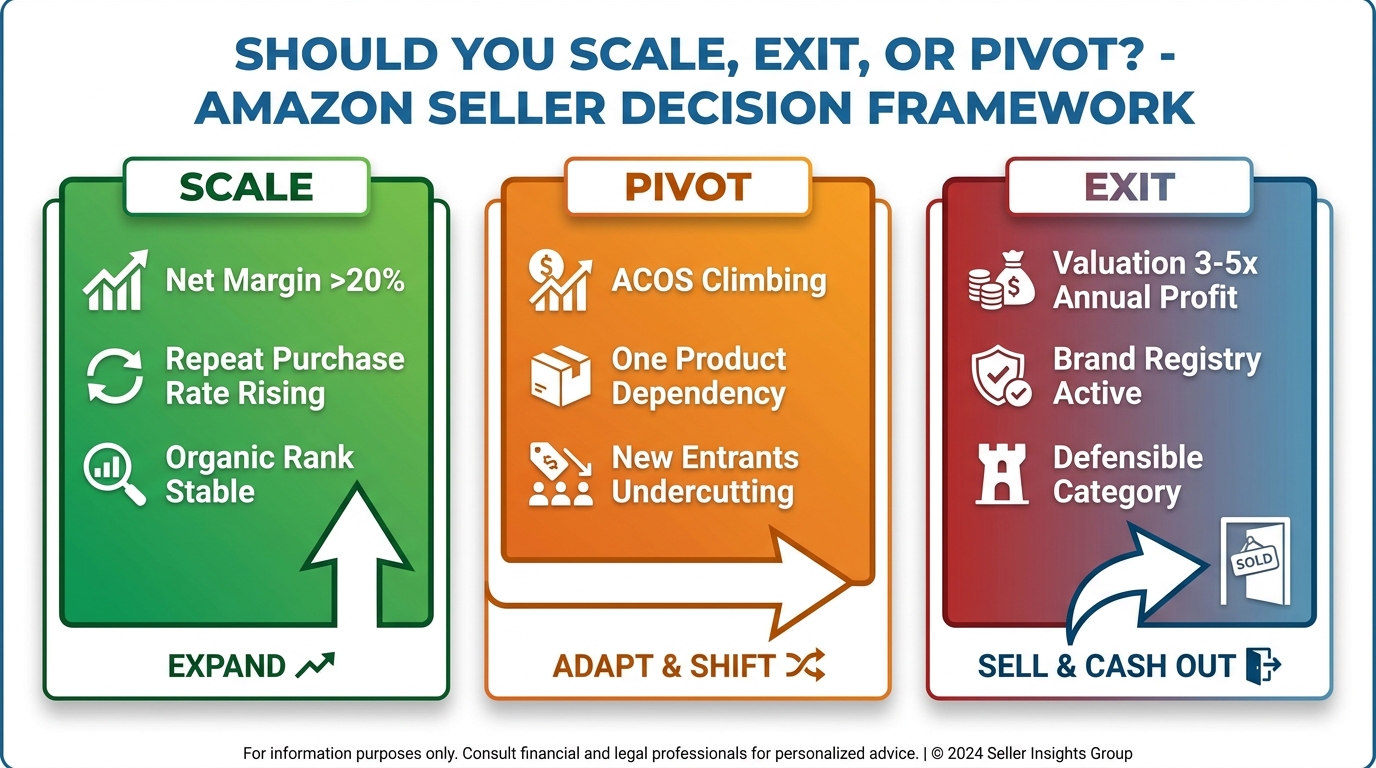
One of the most consistently avoided conversations in Amazon selling is the decision about what to actually do with the business you’ve built. Most sellers default to “keep growing” indefinitely — adding more products, entering more categories, spending more on ads — without ever evaluating whether that’s the optimal move given their current position. The operators who build the most value do three things: they know when they’re in a scale-worthy position, they recognize when they need to change course, and they understand the exit opportunity that exists in well-run Amazon brands.
The Signals That Say “Scale Now”
A business in a position to scale aggressively has several characteristics working in its favor simultaneously. Net margin above 20% after accounting for all fees, COGS, advertising, and overhead means there’s real profit to reinvest. Organic rank stability — holding page-one positions on primary keywords without requiring constant ad spend to maintain — means the flywheel is working. Rising repeat purchase rates or Subscribe & Save enrollment means customers are satisfied enough to come back. And a TACOS trending downward means advertising is becoming more efficient as the brand matures. When all of these signals point in the same direction, capital invested in inventory expansion, additional SKUs in the same category, or international marketplace entry will compound effectively.
When It’s Time to Pivot
Pivoting doesn’t mean giving up — it means recognizing when a specific product or strategy has reached its ceiling and redirecting capital toward something better. The warning signals: ACOS has been rising for more than three months despite optimization efforts, suggesting the category has become more competitive than the product’s differentiation can withstand. TACOS has plateaued at high levels, meaning the advertising is maintaining revenue but not building organic leverage. New entrants are consistently pricing below you at similar or better quality. Single-SKU dependency — one product driving more than 70% of revenue — creates fragility that limits business value and resilience.
Pivoting productively might mean expanding within a proven category with a better-differentiated next product rather than defending a commoditizing first product. It might mean shifting the category focus entirely based on what the analytics reveal about where margins are holding up. It might mean moving from FBA to FBM for certain slow-moving products to reduce storage fees while maintaining listing presence.
The Exit Opportunity: Understanding What Your Business Is Worth
The Amazon aggregator market — which saw explosive growth in 2021 and 2022 before contracting as capital costs rose — has matured into a more selective but still active acquisition market in 2026. Well-run Amazon brands with Brand Registry, consistent profitability, defensible product differentiation, and clean account health continue to attract acquisition interest from aggregators, strategic buyers, and private equity-backed roll-ups.
Valuation multiples for Amazon-native brands typically range from 2.5x to 5x annual Seller’s Discretionary Earnings (SDE), with premium multiples going to brands with strong off-Amazon presence, high Subscribe & Save rates, trademark-protected products, and diversified SKU catalogs. A business generating $200,000 in annual SDE could realistically sell for $500,000 to $800,000 — which is not a small outcome for something built from a laptop and a good product idea.
The preparation for exit takes 12 to 18 months. Clean financials, documented SOPs for every operational process, supplier agreements that transfer, and a healthy Amazon account with no recent policy violations all increase buyer confidence and reduce negotiated discount. Sellers who want to maximize exit value should begin that preparation well before they’re ready to sell — ideally as part of ongoing operational discipline rather than a frantic cleanup.
The Operator Mindset: What Separates Sellers Who Scale from Those Who Stall
Every section of this article comes back to the same underlying distinction: the difference between approaching Amazon as a seller and approaching it as an operator. A seller optimizes for today’s sales. An operator builds systems and structures that generate sales reliably, improves them based on data, and increases the value of the business at every step.
Systems Over Heroics
Sellers who reach $1 million in Amazon revenue without building documented systems — sourcing processes, inventory reorder triggers, advertising review cadences, listing quality audits — typically find that growth beyond that level requires hiring people who then operate without guidance. The result is inconsistency, errors, and eventually a ceiling imposed by the founder’s bandwidth. Operators build standard operating procedures for every repeatable function, even when they’re the only person executing them. Those SOPs make hiring faster, reduce mistakes, and directly increase exit value.
Financial Discipline: Knowing Your Numbers Weekly, Not Monthly
The sellers who navigate Amazon’s constant changes — fee adjustments, algorithm updates, policy changes, competitive entries — do so because they know their numbers with enough precision to respond quickly. Reviewing P&L monthly is the minimum; reviewing key unit economics weekly (TACOS, sales velocity, inventory days remaining, return rate by SKU) allows course corrections before small problems become expensive ones.
Amazon’s Seller Central reporting has improved substantially but still has significant gaps for serious financial management. Third-party tools like Sellerboard, Fetcher, or AccountingDesk fill those gaps with proper cost accounting that includes FBA fees, return costs, and advertising at the SKU level — giving operators the product-level P&L clarity that Amazon’s native reporting doesn’t provide.
Treating Amazon as a Channel, Not as a Business
Perhaps the most important mindset shift for sellers who want to build durable, valuable businesses: Amazon is a channel through which you sell — it is not the business itself. The business is the brand, the product, the customer relationships, the supplier network, and the operational capability. Amazon provides distribution. Treating it as the core of the business rather than as one channel among several is what creates fragile, single-point-of-failure operations that can be destroyed by a single policy change or account action.
The sellers who cross $500,000 in net profit — not revenue, profit — almost invariably have this orientation. They’re running a consumer products brand that happens to sell primarily through Amazon, not an “Amazon seller” who happens to have a product. The distinction seems semantic but has enormous practical consequences for how decisions get made, how capital gets allocated, and what the business becomes over time.
Building Toward $500K and Beyond: The Actionable Framework
Drawing together everything in this analysis, here is a practical framework for sellers at different stages of the journey:
For Sellers Under $100K in Annual Revenue
- Model your full fee stack before you launch anything. If the math doesn’t work on paper, it won’t work in practice.
- Choose your business model deliberately. Private label if you have capital and a long horizon. Wholesale if you have operational strength. Arbitrage only as a learning mechanism, not a scalable strategy.
- Prioritize review velocity over margin optimization. Getting to 50 reviews matters more than squeezing an extra 3% margin in the first six months.
- Start your trademark application immediately. The 8-to-12-month process means you’re already behind if you wait.
For Sellers Between $100K and $500K in Annual Revenue
- Calculate TACOS, not just ACOS. If your TACOS isn’t trending down, your advertising strategy isn’t building organic leverage.
- Build your A+ Content and Brand Store properly. A 5-point conversion rate improvement at your current traffic level compounds dramatically.
- Model your cash flow 90 days out, always. Know when you need to reorder before you feel the inventory pressure.
- Start capturing off-Amazon customer relationships. Even 5% of buyers converted to an email list builds long-term value that exceeds almost any other investment at this stage.
For Sellers Above $500K Looking to Scale or Exit
- Evaluate international marketplaces seriously. Amazon EU and Japan are often meaningfully less competitive than the U.S. for established products.
- Document every operational process. SOPs don’t just make the business more efficient — they make it more valuable.
- Run proper unit economics at the SKU level. Know which products are generating profit and which are consuming it while looking like revenue.
- If you’re considering an exit, start preparing 12 to 18 months out. Clean financials, no account health issues, documented supplier relationships, and a brand with off-Amazon presence all command better multiples.
Conclusion: Revenue Is Vanity, Profit Is Sanity, Cash Flow Is Reality
The reason most Amazon sellers never cross $500,000 in meaningful profit — as opposed to gross revenue — isn’t that the marketplace is too competitive or that the algorithm is too opaque. It’s that they’re optimizing for the wrong things, with an incomplete understanding of their own cost structure, and without the systems and strategic orientation that turn a product-on-Amazon into a business-that-sells-through-Amazon.
The fee stack is non-negotiable, but its impact is manageable when you’ve built it into your product economics from day one. The business model you choose shapes every downstream decision — there’s no universally right answer, only the answer that fits your capital, skills, and goals. Product selection determines whether you’re fighting uphill or downhill before a single listing goes live. Cash flow is the constraint that kills growing businesses while they’re technically succeeding. Advertising is a tool with a phase-appropriate purpose, not a cost to minimize at all times. And the brand you build — or don’t build — determines whether you have a business worth owning for the long term or a revenue stream that depends entirely on Amazon’s goodwill and algorithm stability.
None of this is secret knowledge. But very few sellers apply it systematically, from the first product idea through to an exit or a multi-channel brand. Those who do are the ones building Amazon businesses that actually cross the thresholds that matter — and staying there.