


TikTok Shop is projected to hit $23.41 billion in US sales in 2026 — a number that puts it ahead of Costco’s US e-commerce revenue and closing fast on Target. That statistic gets repeated a lot. What gets talked about far less is what it actually takes to capture any meaningful slice of that number as an independent seller.
The gap between TikTok Shop’s headline growth story and the day-to-day reality of running a shop on the platform is enormous. There are four distinct sales surfaces. A fee structure that most sellers misread until they’ve already eaten into their margins. An affiliate engine that runs very differently from influencer marketing on other platforms. A LIVE commerce format that can drive extraordinary volume — or completely flop — depending on operational decisions made before you ever go on camera.
This post is for sellers who are past the “should I try TikTok Shop?” question and into the harder ones: How do I actually build this into a channel that converts? Where does my margin go? What does a functioning TikTok Shop operation look like at different stages?
We’ll go deeper than the setup checklist — into the commercial mechanics, the content decisions, the fulfillment realities, and the metrics that tell you whether what you’ve built is actually working. Let’s start with the piece most sellers get wrong first.
The Four Sales Surfaces — and Why Most Sellers Only Use One
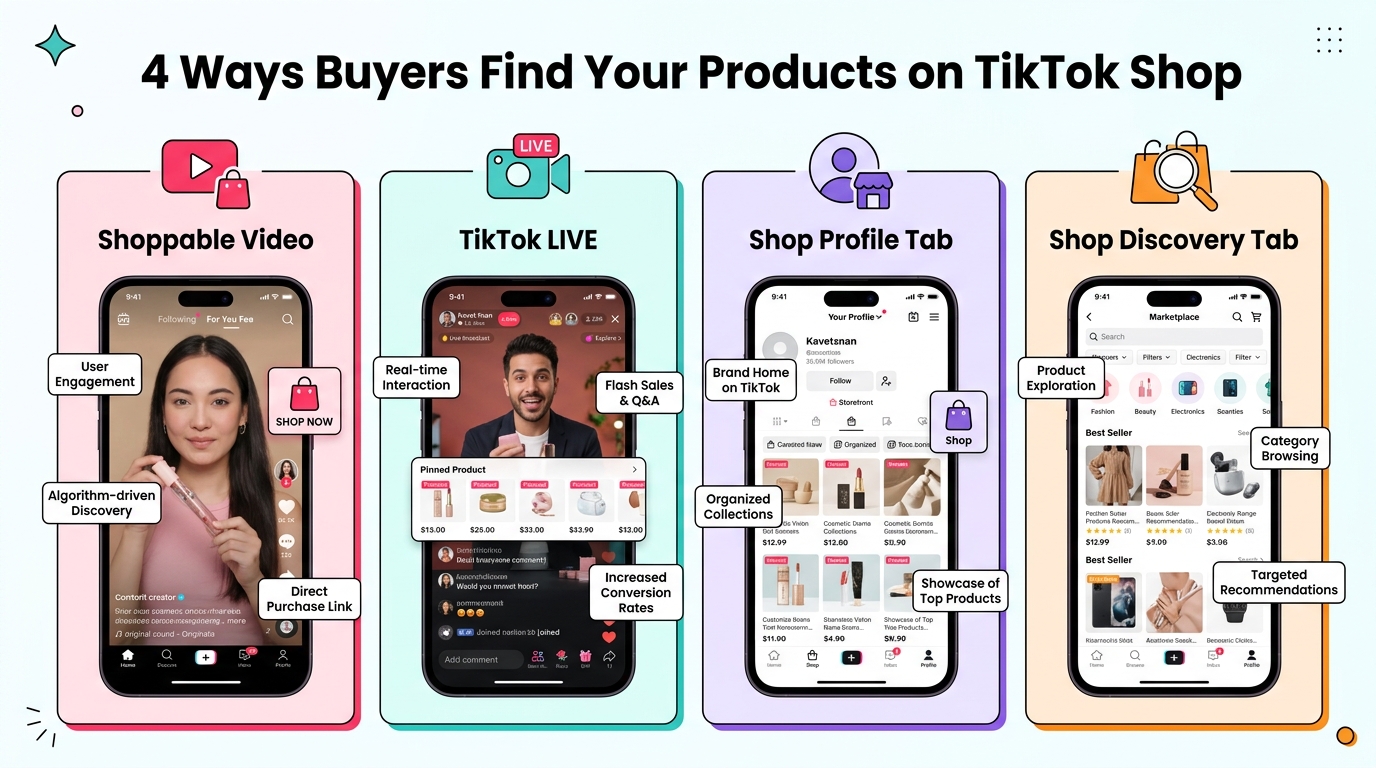
When most sellers think about TikTok Shop, they picture one thing: a video with a product tag. That’s shoppable video content, and it’s genuinely effective — but it’s only one of four distinct surfaces where buyers can discover and purchase your products. Understanding all four, and how they interact, is foundational to building a shop that generates consistent revenue rather than occasional spikes.
Surface 1: Shoppable In-Feed Videos
Shoppable videos are the most visible format. A product tag appears in the lower portion of the screen during a video. Users can tap the tag, browse product details, and complete a purchase without leaving the app. These videos appear in the standard For You feed alongside organic content and paid ads — which means your reach is determined by a combination of content quality, engagement signals, and the platform’s recommendation engine.
The key commercial reality here: shoppable video performance is not uniform. A video that racks up 500,000 views can underperform a video with 30,000 views if the latter targets users who have stronger purchase intent. View count is a vanity metric on this surface. What you want to track is the video’s GMV conversion rate — the percentage of viewers who go from watching to buying.
Surface 2: TikTok LIVE with Pinned Products
TikTok LIVE shopping is the highest-conversion surface on the platform by a significant margin. During a livestream, sellers can pin product cards to the screen, creating a one-tap path to purchase for viewers. A 2025 GlobalData survey found that 76% of consumers who used TikTok Shop purchased an item from a livestream in the prior year — a number that reflects how optimized the format is for impulse buying combined with real-time social proof.
LIVE requires operational commitment. You can’t run a casual 15-minute stream and expect meaningful conversion. Successful LIVE sellers treat their sessions as structured sales events with a beginning, middle, and end — product reveals, limited-time offers, Q&A periods, and clear calls to action. More on the mechanics of this in a dedicated section below.
Surface 3: The Shop Tab (Platform Discovery)
TikTok’s Shop tab functions as a browsable marketplace within the app — closer to Amazon’s browse experience than social media. Users navigate here intentionally to discover products, browse categories, and check deals. Visibility in the Shop tab is influenced by your product listing quality, your shop’s review score, your sales velocity, and whether you’re participating in platform promotions like flash sales or TikTok Shop campaigns.
Many sellers underestimate this surface. For categories where buyers do some research before purchasing — skincare, home goods, electronics accessories — the Shop tab can drive a meaningful volume of considered purchases that balance out the more impulsive buys from the feed.
Surface 4: The Shop Profile (Brand Storefront)
Your shop profile is accessible from your TikTok account — users who visit your profile see a shopping bag icon and can browse your full catalog. This surface matters more as your brand grows, because it captures the traffic from users who specifically seek you out after discovering you through content. It’s also the surface most affected by your overall brand coherence: your shop name, logo, product photography, and review ratings all contribute to whether a profile visitor converts or bounces.
The operational takeaway: Design your TikTok Shop strategy to activate all four surfaces deliberately. Most sellers who plateau are running shoppable video on repeat and ignoring LIVE entirely, or they have a strong LIVE strategy but weak Shop tab listings that lose the buyers who want to browse at their own pace.
How TikTok Shop’s Discovery Engine Actually Works
TikTok’s broader content algorithm is widely discussed — but the discovery mechanics specific to TikTok Shop operate on a layer that most sellers haven’t mapped out. Understanding this layer changes how you approach product listings, content timing, and promotional participation.
Content Signals vs. Commerce Signals
TikTok Shop’s discovery system pulls from two overlapping signal pools. The first is the standard content algorithm: watch time, completion rate, shares, comments, saves, and profile visits. The second is a commerce-specific signal layer that includes add-to-cart rates, product page views, wishlist additions, and actual purchase conversions. When a product generates strong commerce signals — even without viral video performance — TikTok’s system can surface it more prominently in the Shop tab and in personalized recommendations.
This means a product with modest video views but high add-to-cart rates can actually build discovery velocity in ways that pure view-chasing doesn’t. Sellers who understand this concentrate on the quality of traffic they’re generating, not just the volume. A video that attracts the right audience — people who actually want to buy this type of product — is worth more to the system than a video that gets millions of plays from people who have zero purchase intent.
The Role of Platform Campaigns and Flash Sales
TikTok Shop runs regular platform-level promotional events — category-specific flash sales, holiday campaigns, and seller participation programs. Participating in these events can dramatically accelerate your visibility on the Shop tab because TikTok actively merchandises participating sellers to buyers who are in a high-intent shopping mode.
The tradeoff is margin. Flash sale participation typically involves discounting your products, and the math needs to work before you opt in. Sellers who use platform campaigns strategically — discounting slower-moving SKUs to generate review velocity, or using a hero product at a thin margin to drive new customer acquisition — get more from these campaigns than sellers who discount everything and watch their profitability collapse.
How Affiliate Content Feeds Discovery
When a creator posts affiliate content tagged to your product, that content enters the platform’s standard discovery engine with your product’s commerce signals attached. If multiple creators post about the same product in a short window and that content collectively generates strong watch time and purchase signals, TikTok’s system can interpret this as trending product behavior — which can trigger organic amplification well beyond what the creator’s own audience size would suggest.
This flywheel effect — content signals plus commerce signals plus platform amplification — is how some TikTok Shop products go from zero to thousands of orders in a matter of days. It’s not random. It’s an emergent property of the signal system that can be deliberately cultivated by coordinating creator content and timing.
The Product-Content Fit Problem: Why Not Everything Belongs on TikTok Shop
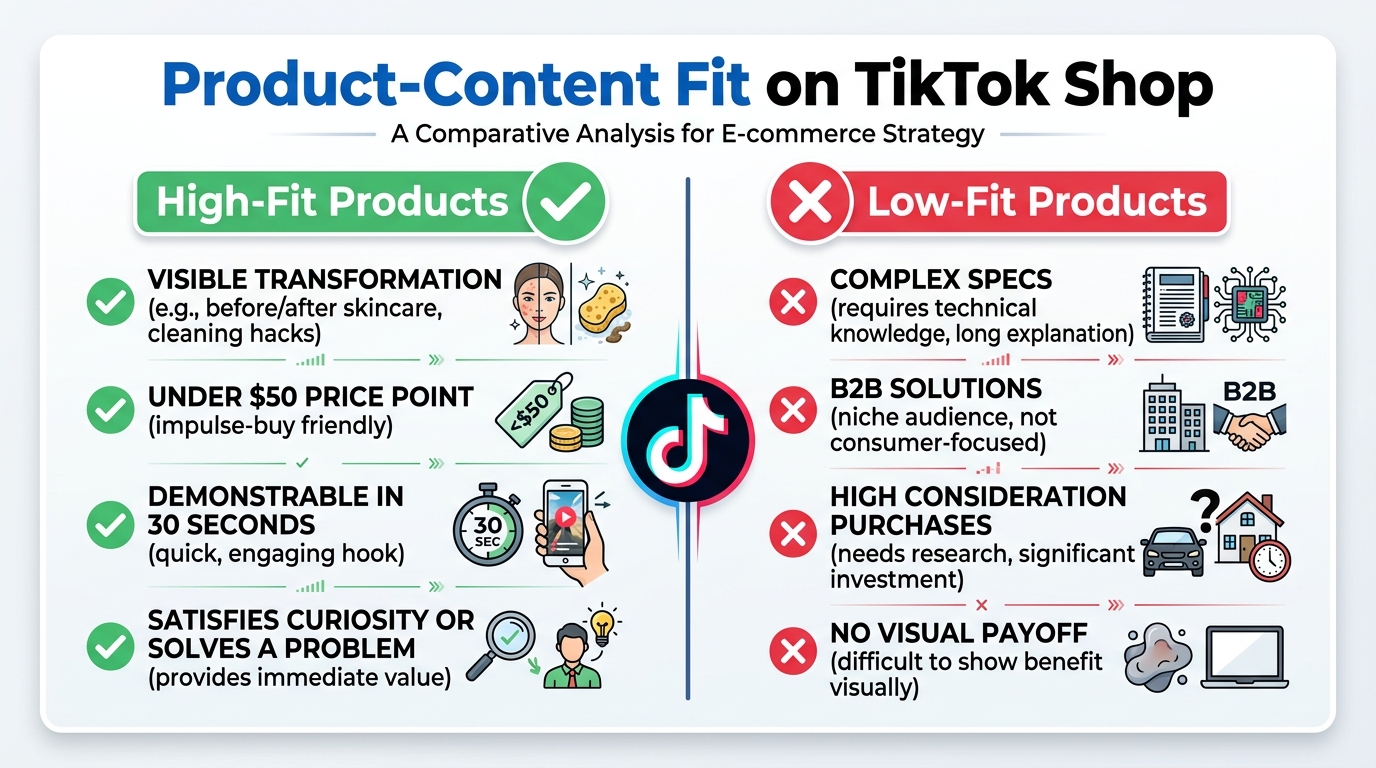
One of the most common and expensive mistakes new TikTok Shop sellers make is bringing a product to the platform without honestly assessing whether it has what you might call content-commerce fit. TikTok Shop is not a neutral fulfillment pipe — it’s a discovery-first commerce environment where product demonstrability, price accessibility, and visual payoff determine whether your listing ever gains traction.
What High-Fit Products Have in Common
Products that consistently perform on TikTok Shop share a cluster of characteristics. They deliver a visible transformation or result that can be captured on camera in 30–60 seconds. A skincare product that visibly reduces redness in real time, a cleaning tool that makes a grimy surface gleam, a kitchen gadget that does something surprising — these products create the “wow moment” that makes viewers stop scrolling and tap the product tag.
They also tend to hit a sweet spot in pricing. Products priced between $15 and $60 tend to convert most effectively on TikTok Shop — low enough to enable impulse purchasing, high enough to generate meaningful revenue per sale. Products above $100 can sell, but they require significantly more trust-building, often through extended LIVE demonstrations with detailed Q&A, before buyers will commit.
Additionally, high-fit products satisfy what you might call the curiosity-or-problem test: either they spark genuine curiosity (“what is that?”) or they solve a clearly relatable problem (“I need that”). Both of these motivations translate into content that the platform’s audience engages with and shares organically.
What Low-Fit Products Look Like
Products with poor content-commerce fit share their own patterns. Anything that requires extensive specification reading before a buyer can understand its value — technical electronics, B2B tools, industrial supplies — is poorly suited to TikTok’s visual, fast-moving format. High-consideration purchases like furniture, appliances, and jewelry can work but require a fundamentally different content approach and longer buyer journeys than the platform’s impulse-buy architecture is optimized for.
Products with no visual payoff — supplements with results visible only over months, services, digital products — face an additional challenge: without a demonstrable moment, the content has to work much harder to create purchase intent. It’s possible, but the content-to-conversion math is less favorable.
Assessing Your Product Before You List
Before listing a product on TikTok Shop, run it through three questions. First: can I show what this product does in under 60 seconds in a way that makes a viewer feel something — surprise, delight, or recognition of their own problem? Second: is the price low enough that someone who sees one video would feel comfortable buying on the spot? Third: does this product have an angle that would make a creator want to make content about it, independent of commission?
If you can answer yes to all three, you have a strong candidate. Two out of three is workable. One or fewer is a signal to either rethink the product or invest heavily in the content and creator strategy to compensate for the structural disadvantages.
Building Your Affiliate Engine: The Right Way to Work With Creators
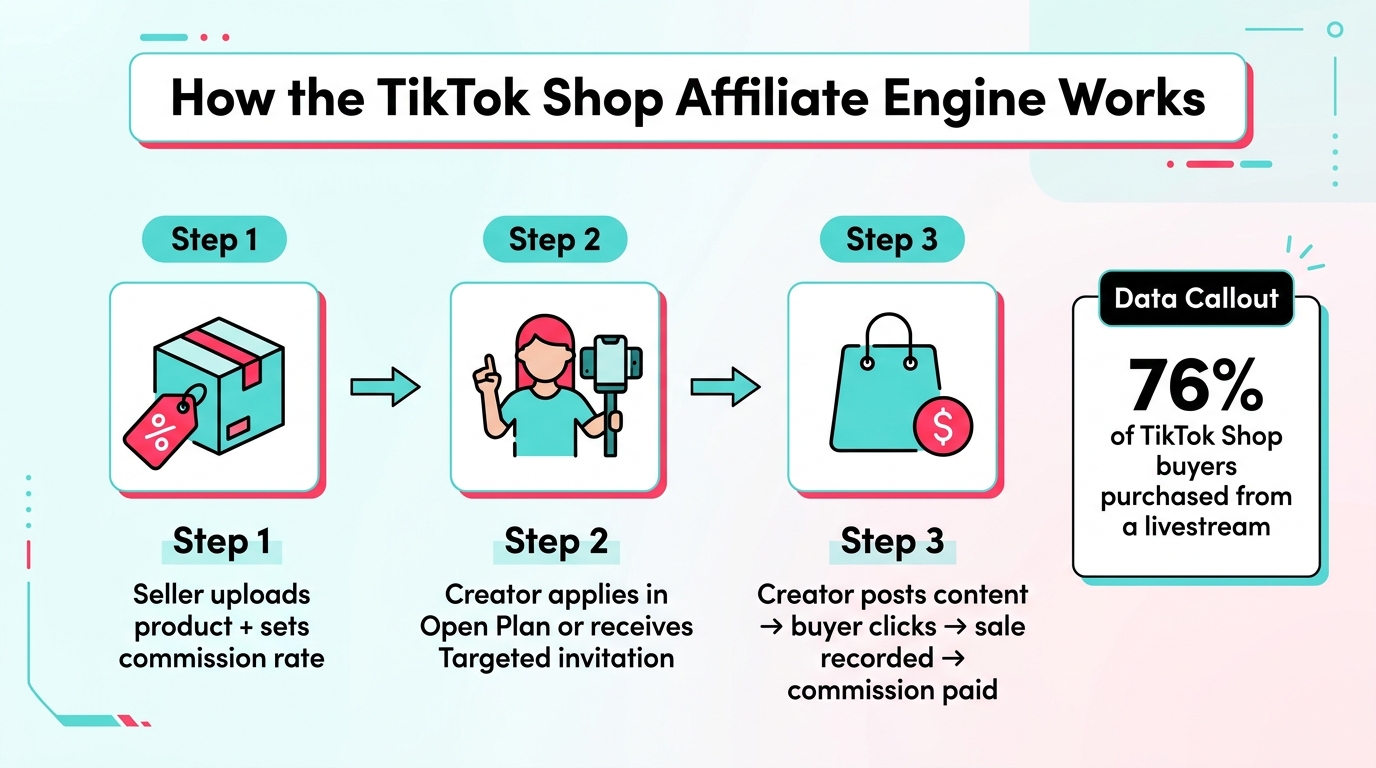
TikTok Shop’s affiliate program is structurally different from most influencer marketing arrangements, and treating it like a standard influencer campaign is one of the fastest ways to underperform. The mechanics are closer to an affiliate marketplace — creators browse available products, apply to promote them (or accept direct invitations from sellers), and earn a commission on sales they generate. Understanding how this system works operationally is essential to getting results from it.
Open Plan vs. Targeted Plan
TikTok Shop’s affiliate system has two primary modes. The Open Plan makes your product visible to any creator searching the affiliate marketplace — they can apply to promote it without you needing to specifically invite them. This is a passive approach that works best for products with strong visual appeal and competitive commission rates that stand out in a crowded marketplace.
The Targeted Plan lets you proactively invite specific creators to promote your product. You can search creators by category, audience size, engagement rate, and past performance. This is more effort but substantially more control — you’re selecting who represents your product rather than waiting to see who applies. For brands with quality standards or specific audience targeting needs, Targeted is almost always the better approach.
Setting Commission Rates That Actually Work
Commission rates in TikTok Shop’s affiliate marketplace are competitive, and creators with meaningful audiences have options. A 5% commission on a $20 product — $1 per sale — is unlikely to motivate a creator to invest time producing quality content. A 15–20% commission on that same product means $3–4 per sale, which changes the math for creators who can move volume.
The most effective sellers think about commission rate as customer acquisition cost, not a cost center. If it costs you $15 in affiliate commission to acquire a customer who has an average order value of $45 and a reasonable chance of repeat purchase, that’s a very different calculation than paying $15 per click in paid ads with no guaranteed conversion. When the commission rate enables quality creator participation, it tends to be one of the most efficient acquisition mechanisms available on the platform.
The Sample Strategy
One of the most effective and underused tactics in TikTok Shop affiliate marketing is the strategic use of product samples. Rather than paying upfront for content creation, sellers can offer free product samples to creators who agree to produce content. TikTok’s Seller Center has tools to facilitate this — you can send samples to creators directly through the platform. When a creator has the product in hand and has actually used it, the resulting content tends to be more authentic and perform better than content made from brand briefs alone.
The selection process matters here. Before sending samples, review a creator’s past content: do they produce videos that show products in use, or do they just hold them up and talk? Do their comment sections show an engaged audience asking where to buy things, or are they mostly passive viewers? The quality of creator selection at this stage determines the quality of content you get back.
Volume and Diversity Over Single Big Bets
The temptation in affiliate management is to find one big creator with a million followers and let them carry your product. The reality is that TikTok Shop affiliate results are notoriously hard to predict at the individual creator level. A creator with 50,000 followers in exactly the right niche can outsell a creator with 2 million followers whose audience is too broad to generate targeted purchase intent.
Successful TikTok Shop affiliate programs are diversified — 20 to 50 active creators across different audience sizes, content styles, and sub-niches, rather than two or three big bets. This diversification also means the platform sees consistent commerce signals from your product across multiple content sources, which can support your broader discovery visibility.
TikTok Shop LIVE: The Mechanics of Selling in Real Time
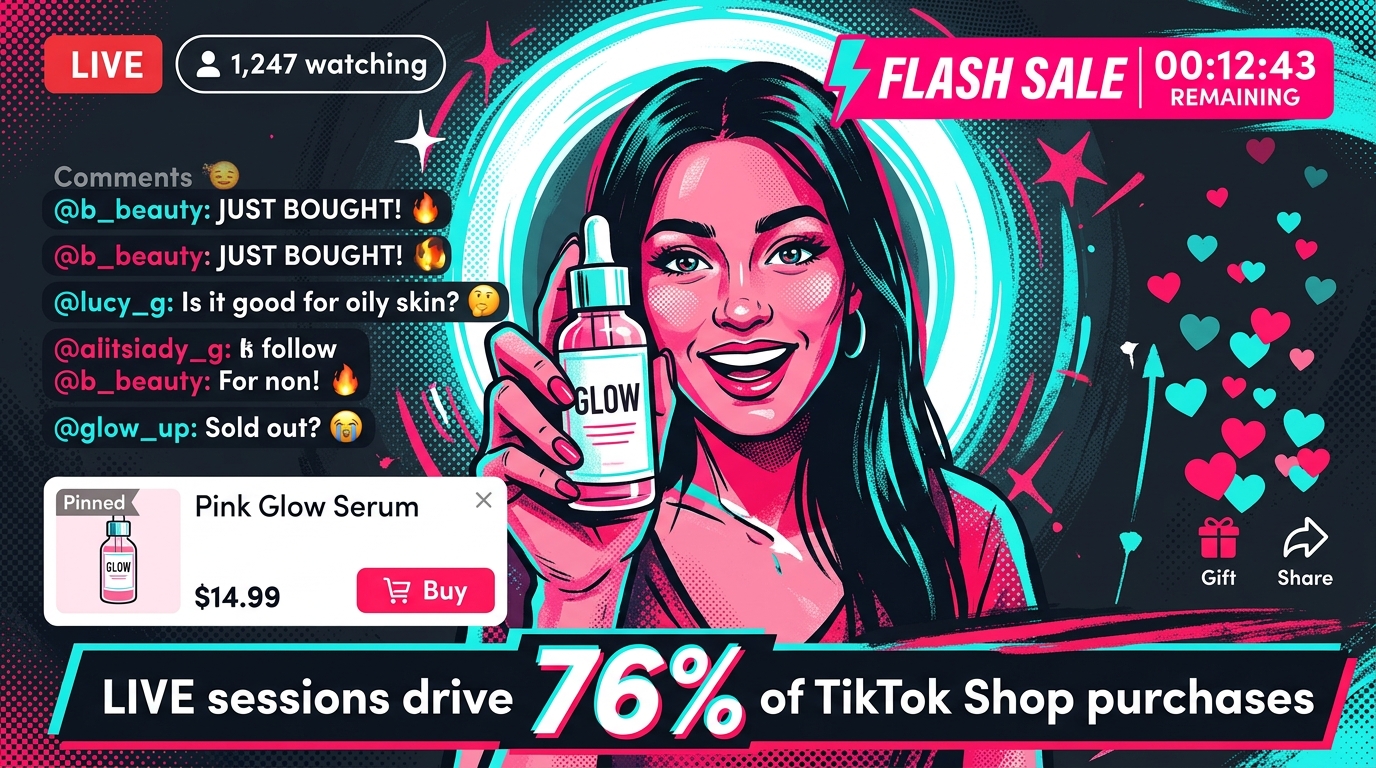
TikTok LIVE commerce is the closest Western equivalent to the live shopping formats that have dominated platforms like Taobao Live in China for years — where multi-hour live sessions routinely drive tens of millions of dollars in sales per broadcast. The US market isn’t there yet, but the underlying mechanics are the same, and sellers who master them early are building durable advantages as the format grows.
The Session Structure That Converts
A high-converting LIVE session has a deliberate structure, not a casual one. The most effective format follows a rhythm: introduce a product, demonstrate it thoroughly, address objections through the comment stream, create urgency with a time-limited offer or quantity limit, and call the viewer to action. Then transition to the next product and repeat. This cycle — sometimes called the “LIVE selling loop” — keeps existing viewers engaged while giving new viewers who join mid-session an easy entry point into the content.
Session length matters more than most new LIVE sellers expect. Platform data consistently shows that longer sessions — minimum 60 minutes, often 90 to 120 — outperform short sessions not just in total sales but in sales per minute. The first 20–30 minutes of a LIVE session are typically spent building audience through the platform’s discovery distribution of live content. Volume peaks in the middle and sustained tail of the session. Going offline too early leaves money on the table.
Timing, Frequency, and the Algorithm
TikTok LIVE sessions benefit from consistent scheduling for two compounding reasons. First, your existing audience can anticipate your sessions and tune in intentionally. Second, TikTok’s system rewards regular LIVE sellers with better discovery distribution — sellers who go live consistently are more likely to appear in the “LIVE” section that platform users browse.
Peak engagement windows in the US market cluster around evenings between 7 PM and 10 PM local time, with weekend afternoons also performing well. These windows align with when the majority of the TikTok audience is most active and most likely to be in a leisure-oriented, browsing mindset — which correlates with purchase receptiveness. Morning sessions can work for specific niches (fitness products, breakfast foods) but are generally harder to build audience on from scratch.
The Production Setup You Actually Need
LIVE commerce doesn’t require broadcast-studio production. What it does require is quality you can control reliably: stable lighting (a ring light or softbox), a clean background that doesn’t distract from the product, a microphone that picks up your voice clearly, and a stable internet connection. These basics are table stakes.
Beyond basics, what separates strong LIVE setups is how well they showcase the product. If you’re selling clothing, you need a way to show fit and movement. If you’re selling skincare, you need close-up capability and good skin-tone lighting. If you’re selling kitchen tools, you need a counter-level camera angle that shows the product in use. Build your setup around your product category, not around generic “looking good on camera” principles.
Managing the Comment Stream as a Sales Tool
The comment stream during a LIVE session is one of its most powerful and most neglected commercial tools. Viewers post questions about product sizes, ingredients, shipping times, and comparisons to competing products. Answering these questions on-stream does three things: it helps the viewer who asked, it provides social proof to everyone else watching, and it signals to TikTok’s system that the session has high viewer engagement — which can trigger additional discovery distribution.
Sellers running significant volume often have a dedicated comment moderator who surfaces priority questions in real time and can handle customer service messages. For solo sellers, reading the comment stream yourself is manageable in smaller sessions but becomes a distraction from selling as audience size grows.
The Fee Stack Decoded: Understanding Your Real Margin
One of the most common financial surprises for new TikTok Shop sellers is discovering that their margin is substantially thinner than they expected once all platform costs are accounted for. TikTok Shop’s fee structure is not inherently punitive, but it has several components that stack, and each one needs to be factored in before you price your products.
The Referral Fee
TikTok Shop charges sellers a referral fee on each transaction — the platform’s primary revenue mechanism. This fee varies by product category. In the US market, referral fees have generally ranged from 2% to 8% of the item sale price, with categories like electronics accessories and home goods at the lower end and categories like apparel and beauty at the higher end. TikTok has also adjusted these rates as the platform has matured, so checking the current rate for your specific category in Seller Center before pricing is essential.
Shipping Costs
You have two primary fulfillment options on TikTok Shop: seller-fulfilled (you ship orders from your own warehouse or 3PL) or platform-fulfilled (TikTok handles fulfillment through its fulfillment network). Seller-fulfilled shipping costs come entirely out of your pocket. If you’re offering free shipping to compete effectively — and most successful TikTok Shop sellers do — that cost needs to be baked into your price.
Sellers transitioning from Amazon who are used to FBA will find TikTok’s logistics ecosystem less mature. Shipping time expectations on TikTok Shop are demanding — buyers expect quick delivery times, and slow shipping generates negative reviews that compound into listing visibility problems. Building a reliable fulfillment operation, whether in-house or through a 3PL, is not optional infrastructure. It’s directly tied to your shop’s ranking health.
Affiliate Commissions
If you’re running creator affiliates — and you should be — their commission comes out of your revenue per transaction. At 10–20%, this is frequently the largest single cost component after the product cost itself. A $30 product with a 15% affiliate commission means $4.50 per sale going to the creator, before referral fees, shipping, or any ad spend.
The discipline here is setting your commission rates at a level that attracts strong creators while keeping your unit economics viable. Running the math on every SKU before you set an affiliate rate is not optional. Commission optimization — adjusting rates based on which products creators are actually promoting and what conversion rates look like — is an ongoing practice in well-run TikTok Shop operations, not a one-time setup decision.
Advertising Spend
TikTok Shop Ads let you boost product visibility through paid placements in the For You feed and Shop tab. This spend is entirely optional, but most sellers who reach meaningful scale use it selectively to accelerate momentum on new listings, test product angles, or defend against competitors on key search terms. The key word is selectively. Running paid ads on products with poor organic conversion rates is a fast way to amplify losses. Ads work when your listing and content fundamentals are already working.
Building the Complete Margin Model
The discipline is to build a complete unit economics model before you list. For every SKU, map out: product cost, referral fee (at your category rate), shipping cost, affiliate commission (at your target rate), any ad spend per unit, and your desired net margin. That calculation tells you your minimum viable price. If the math doesn’t work at a price that’s competitive on TikTok Shop, the product isn’t viable on this channel at this time — and it’s better to know that before you’ve produced 500 units of inventory.
Fulfillment Realities: What Happens After the Click
Fulfillment is where many TikTok Shop seller operations quietly fall apart. The content and discovery side of the business gets the attention and the excitement. The warehouse, the shipping labels, the return process, and the customer service queue get neglected — until they start generating the reviews and seller scores that tank your Shop tab visibility.
Delivery Time Expectations
TikTok Shop buyers have internalized fast shipping as a baseline expectation, shaped by Amazon Prime and years of e-commerce conditioning. While TikTok Shop doesn’t mandate two-day delivery the way Amazon FBA does, sellers consistently report that delivery times above 5–7 business days generate significantly higher rates of negative reviews and order cancellations. For US sellers, this means your fulfillment operation needs to be domestic and reasonably close to your primary customer base, or you need to use a 3PL with multiple warehouse locations.
Returns and the Review Funnel
Returns on TikTok Shop are a double-edged reality. The platform expects sellers to offer a reasonable return window, and handling returns poorly — slow refunds, difficult processes, poor customer communication — generates the kind of negative reviews that surface prominently on your Shop profile. Since the Shop tab surfaces your review score as a core ranking signal, a degraded review profile is a direct hit to your discovery visibility.
Sellers who handle returns graciously and quickly — full refunds with minimal friction — often find that even dissatisfied customers leave neutral rather than negative reviews. The speed and ease of resolution matters more than the resolution itself in most cases. Building a clear, fast return process before you scale your volume prevents a customer service backlog from becoming an existential threat to your shop’s visibility.
Inventory Management and Viral Spikes
One of the genuinely unique operational challenges of TikTok Shop is the unpredictability of viral events. A single piece of creator content can send a product from 10 orders per day to 500 orders per day in 48 hours. Sellers who aren’t prepared for this — either with inventory on hand or a supply chain that can surge quickly — face the worst outcome: a viral moment that generates a wave of cancellations, delayed shipments, and negative reviews because they couldn’t fulfill what they sold.
Planning for viral upside is uncomfortable because it means holding inventory that might not move at normal velocity. But successful TikTok Shop sellers who’ve experienced viral events consistently say the same thing: the cost of understocking during a viral window exceeds the carrying cost of the inventory buffer many times over. A framework of maintaining 30–45 days of inventory at current velocity, with a fast-replenishment relationship with your supplier, is a reasonable baseline.
Connecting TikTok Shop With Your Existing Channels
TikTok Shop is rarely — and shouldn’t be — a seller’s only channel. Most sellers on the platform also operate on Amazon, Shopify, or both. Integrating TikTok Shop with these existing operations without creating operational conflicts or margin confusion requires deliberate architecture.
The Shopify Integration
TikTok’s native Shopify integration is one of the more mature platform connections available. The TikTok for Shopify app allows you to sync your product catalog from Shopify to TikTok Shop, manage TikTok Shop orders from within Shopify’s order management interface, and sync promotions bidirectionally. For Shopify sellers, this integration significantly reduces the operational overhead of running TikTok Shop as an additional channel — rather than a separate inventory and order management system, it becomes an additional sales surface feeding into your existing Shopify infrastructure.
Key practical considerations: your product descriptions and images sync from Shopify, but TikTok Shop has its own content standards and character limits that may require optimization on the TikTok side. And promotional sync works in principle, but verifying that discounts are applying correctly on both platforms before running any significant campaign is worth doing manually each time.
TikTok Shop and Amazon: Channel Conflict and Opportunity
Sellers who operate on both Amazon and TikTok Shop navigate genuine tension between the channels. Amazon’s policies restrict certain off-Amazon marketing practices, and while directing TikTok Shop traffic to Amazon is generally fine, running the same ASINs at different prices across platforms can create complications on the Amazon side if you trigger price parity rules.
The more strategic approach many sellers take is differentiated SKU architecture: certain products or bundles exclusive to TikTok Shop, certain products exclusive to Amazon. This eliminates cross-platform price conflict, allows you to optimize each listing for its native platform’s requirements, and gives each channel’s audience a reason that’s exclusive to that channel — TikTok Shop shoppers aren’t just getting the same thing they could get on Amazon with more friction.
Email and Owned Audience Building
TikTok Shop’s biggest structural limitation as a channel is that you don’t own your customer relationships. Sales happen inside TikTok’s ecosystem, customer data stays with TikTok, and if your account faces an issue or the platform itself changes its policies, you can’t reach those customers directly. This is a real risk that mirrors the Amazon seller experience.
The mitigation is to use TikTok Shop as a customer acquisition engine and build owned touchpoints — email lists, SMS programs, direct website traffic — as a parallel effort. Sellers who include a well-designed package insert with every TikTok Shop order, directing buyers to register on their website for a discount or exclusive content, are building an owned audience that survives platform changes. It’s a slower build, but it’s the difference between a channel-dependent business and a resilient one.
Metrics That Actually Tell You If Your TikTok Shop Is Working
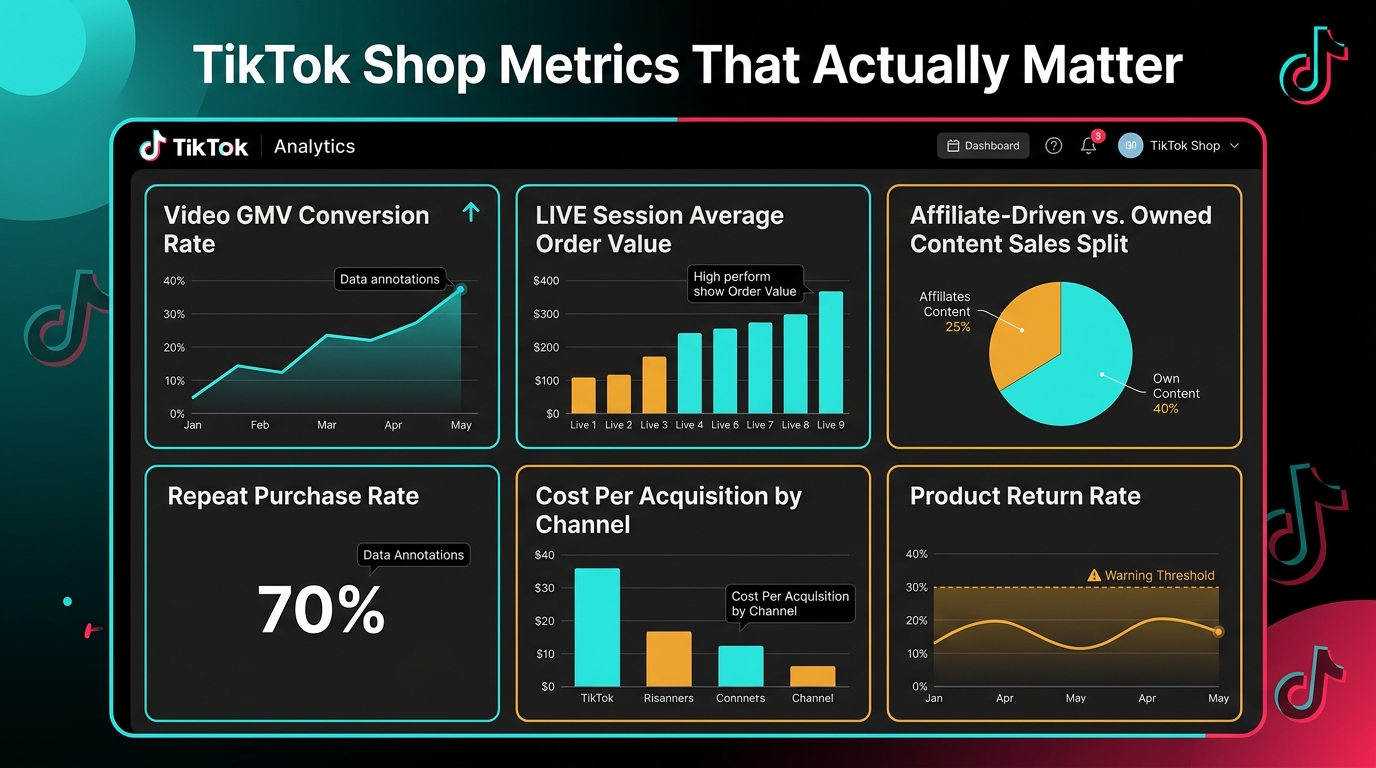
TikTok’s Seller Center provides a range of analytics, but the default view emphasizes reach and engagement metrics that are easier to generate than to translate into business health. Sellers who run operationally mature TikTok Shop businesses track a different set of numbers — metrics that connect directly to revenue, margin, and sustainability.
Video GMV Conversion Rate
This is the percentage of video viewers who complete a purchase. It’s the single most important metric for evaluating your shoppable video content, and it varies enormously across content types and products. A GMV conversion rate of 0.5–2% is typical for general content; top-performing shoppable videos can hit 5% or higher. Tracking this metric per video reveals which content angles, hooks, and product presentations are actually moving buyers — versus which ones are generating views from an audience that has no purchase intent.
LIVE Session Performance Metrics
For sellers running LIVE commerce, the key metrics are average concurrent viewers (not peak, which can be misleading), GMV per LIVE session, average order value per session, and the conversion rate from viewer to buyer. Trend these week over week rather than session to session — individual sessions vary significantly based on timing, topic, and which products are featured. What you’re looking for is the directional trend line over a month or more of consistent LIVE activity.
Affiliate Attribution and Channel Mix
Understanding what percentage of your sales come from affiliate-driven content vs. your own content vs. Shop tab discovery gives you a clear picture of channel dependency and opportunity. A shop where 90% of sales come from one affiliate creator has a concentration risk problem. A shop where the split is diversified across channels — owned video content, multiple affiliates, Shop tab organic, LIVE — has a more stable sales base and more levers to pull when any single channel softens.
Return Rate by Product
Your return rate is a leading indicator of listing quality and product-content fit problems. Products with return rates significantly above category averages usually have one of two issues: the product is underperforming expectations set by the content (which is a content honesty problem) or the product itself has a quality consistency issue. Either way, a high return rate on a specific SKU is a signal that needs investigation before it compounds into a review score problem.
Repeat Purchase Rate
TikTok Shop is widely understood as a new-customer acquisition engine, and that’s largely accurate. But in categories where repeat purchasing is natural — consumables, skincare, food, cleaning products — the repeat purchase rate on TikTok Shop tells you whether you’re building customers or just transactions. A low repeat rate on a product that should generate repeats usually indicates a product or post-purchase experience gap rather than a channel problem.
Common Failure Patterns and How to Avoid Them
The failure modes on TikTok Shop are predictable enough that they’re worth mapping explicitly. Most sellers who stall out or give up do so for reasons that were visible and addressable before things went wrong.
Treating TikTok Shop Like a Passive Listing Platform
The most common failure pattern: a seller lists products, adds a product tag to a few videos, and then waits for sales to come. TikTok Shop is emphatically not a passive marketplace. Discovery on this platform is driven by active content — either your own, your affiliates’, or both — and consistent engagement with the platform’s promotional mechanics. Sellers who don’t commit to content production or to building an active affiliate program are effectively listing products in a location with no foot traffic. The inventory exists; the customers just can’t find it.
Launching With Too Many SKUs
Another common mistake is listing an entire product catalog at launch and hoping something sticks. The problem with this approach is that affiliate management, content production, and listing optimization all require focused attention, and spreading that attention across 50 SKUs from day one means none of them gets the concentration needed to generate initial velocity. The better approach is to identify two or three hero products that have the strongest content-commerce fit and build initial traction around those before expanding.
Ignoring the Review Ecosystem
Reviews on TikTok Shop influence both buyer confidence and platform visibility, but many sellers treat them as an afterthought. Not actively monitoring your reviews, not responding to negative feedback, and not having a process for encouraging satisfied buyers to leave reviews all erode your position over time. TikTok doesn’t allow direct review solicitation with incentives the way some other platforms have historically permitted, but order confirmation messages and package inserts that simply ask for feedback are standard practice.
Underpricing for Market Share
Price competition on TikTok Shop can be fierce in popular categories, and the temptation is to undercut the market to drive initial volume. The problem is that thin-margin products leave no room to absorb affiliate commissions, shipping costs, or a promotional campaign. Sellers who win on price alone with no margin to reinvest into content or creator partnerships typically can’t sustain the channel when competition intensifies. Building at a price point that supports a viable affiliate program and paid visibility from day one is a more durable foundation.
Neglecting Post-Sale Experience
TikTok Shop’s discovery engine is exceptional; its post-purchase experience is entirely in your control. Sellers who invest in every aspect of content and discovery but ship products in generic poly mailers with no branding, no insert, and no follow-up are leaving customer lifetime value on the table. The unboxing experience — or lack thereof — is the moment when a TikTok-acquired customer decides whether they’re interested in this brand or just got a product they needed. It’s the conversion point for the second purchase.
What Sellers Who Scale Actually Do Differently
Across the patterns of sellers who build TikTok Shop into a meaningful, scaling revenue channel, a few consistent behaviors emerge. They aren’t secrets — they’re disciplines that are unglamorous enough that most sellers don’t sustain them.
They Commit to Content as Infrastructure, Not a Campaign
Scaling TikTok Shop sellers produce content consistently — not in bursts when they feel motivated or when a new product launches. Content is treated as operational infrastructure: scheduled, produced on a regular cadence, and evaluated methodically for what’s converting. This doesn’t mean a large team or high production budgets. Many successful sellers produce two to four pieces of content per week with minimal equipment. The consistency is the advantage, not the production quality.
They Build Their Affiliate Roster Before They Need It
The sellers who can capitalize on viral moments are the ones who already have 30 or more active creators in their affiliate network before any single piece of content breaks out. Building that creator roster takes time — identifying the right accounts, sending samples, reviewing content, providing feedback, and building relationships. Sellers who start this process only after they need it are always six to eight weeks behind where they want to be.
They Know Their Numbers Cold
Every SKU, every channel, every creator partnership: scaling TikTok Shop sellers know their unit economics precisely. Commission rates are set intentionally, not guessed at. Ad spend has a defined CAC ceiling before it gets paused. Slow-moving SKUs get delisted or discounted on a regular cadence rather than sitting in inventory accumulating carrying cost. The operational discipline of knowing your numbers is what makes growth sustainable rather than just exciting.
They Use the Platform’s Native Tools
TikTok Shop has a range of native promotional tools — limited-time offers, bundle deals, flash sale participation, LIVE-exclusive discounts — that many sellers ignore in favor of external promotion tactics. These native tools work because they’re built into the platform’s commerce mechanics and often receive additional distribution support from TikTok itself. Sellers who systematically use the full suite of available tools consistently outperform sellers who rely on a single tactic.
They Think in Quarters, Not Weeks
TikTok Shop results are rarely linear. The first month of a new shop is often slow — the affiliate roster is thin, the content library is small, and the platform’s system hasn’t accumulated enough commerce signals to drive substantial organic discovery. Month two improves. Month three, with a functioning affiliate program and consistent LIVE sessions, can be dramatically different from month one. Sellers who evaluate TikTok Shop after four weeks and decide it “doesn’t work” are stopping precisely when the flywheel is about to start turning.
Conclusion: Building for the Channel, Not Just on It
TikTok Shop’s $23 billion trajectory in 2026 is a real opportunity. But the sellers who capture meaningful share of that number are not the ones who list a few products and hope the algorithm notices. They’re the ones who understand the platform’s mechanics deeply enough to work with them deliberately — four sales surfaces, not one. A creator ecosystem built as a system, not a series of one-off deals. LIVE commerce treated as a structured sales event, not an informal chat. Margins modeled before pricing, not after.
The platform is still maturing. The competition in most categories is less consolidated than on Amazon. The affiliate ecosystem is still developing its norms. LIVE commerce in the US is still building the cultural muscle memory that makes it second nature in Asian markets. These are advantages for sellers who enter now with operational discipline — the compounding returns of early competence in a format that’s growing.
What TikTok Shop rewards, at its core, is the same thing every durable commerce business is built on: genuine product-market fit, operational reliability, and consistent customer value. The platform’s mechanics amplify those fundamentals. They don’t substitute for them.
The sellers who scale on TikTok Shop aren’t the ones who “crack” the algorithm. They’re the ones who build an operation that the algorithm has something real to work with.