


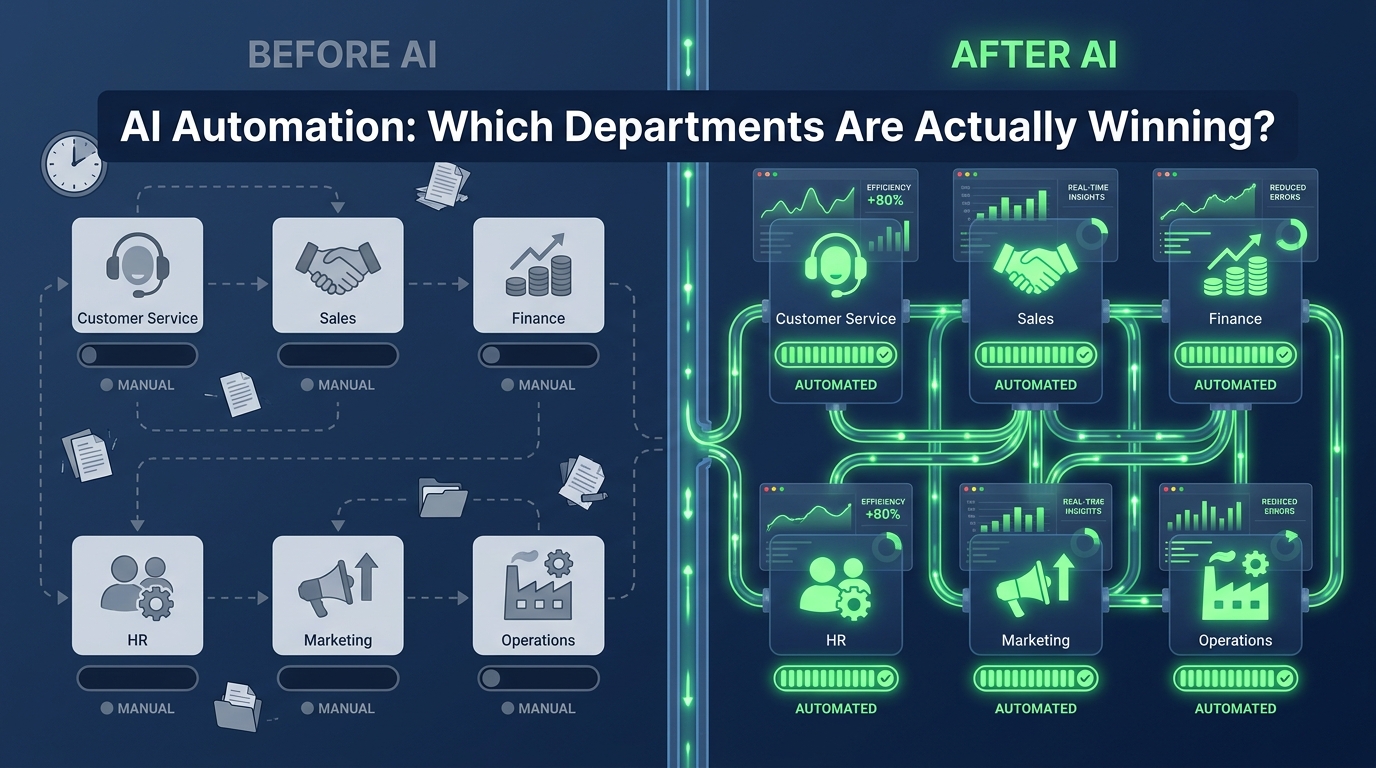

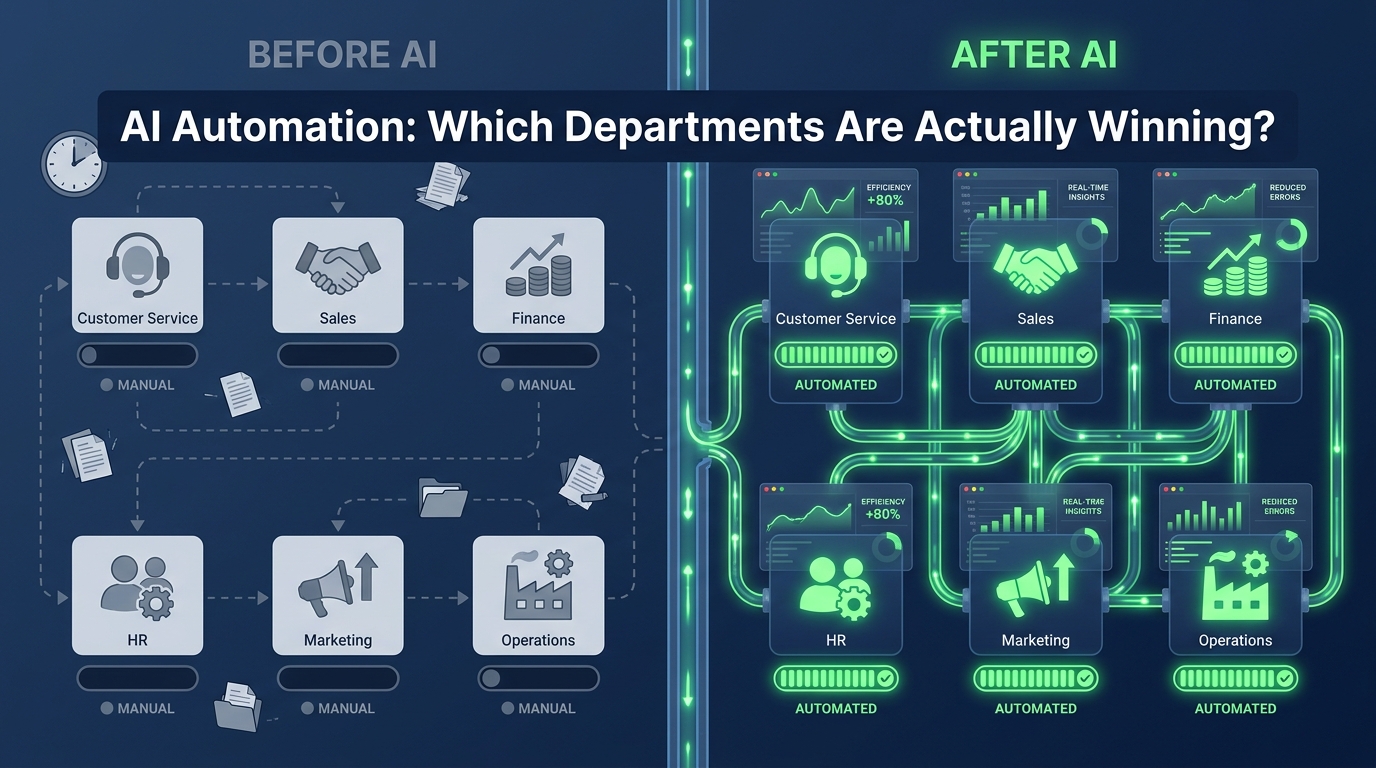
Every business leader in 2026 is being told the same thing: automate with AI or fall behind. The messaging is everywhere — in conference keynotes, vendor pitches, board-level strategy decks, and breathless LinkedIn posts. But beneath the hype, the more useful — and far less discussed — question isn’t whether to automate with AI. It’s where.
Because AI automation is not a single lever you pull across your entire organization. It behaves completely differently depending on which business function you’re applying it to. In customer service, it can resolve the majority of incoming tickets before a human agent even logs in. In financial operations, it compresses multi-day invoice cycles into hours. But in strategic HR decisions or creative brand work, AI support alone often produces worse outcomes than a skilled human working without it.
That gap — between the departments where AI automation genuinely delivers and the ones where it flatters to deceive — is where most companies lose money, time, and employee trust. They buy tooling, apply it broadly, and then wonder why the ROI never materializes at scale.
This post cuts through that noise. We’ve mapped AI automation performance across the seven core business functions where adoption is highest in 2026: customer service, sales, finance, human resources, marketing, operations, and IT. For each one, we break down what’s actually working, which specific tasks benefit most, where the common implementation mistakes happen, and what realistic outcomes look like once the dust settles.
If you’re trying to decide where to focus your AI investment — or trying to make sense of why your current automation isn’t delivering — this department-by-department breakdown is where to start.
Customer Service and Support: The Highest-Performing Department for AI Automation
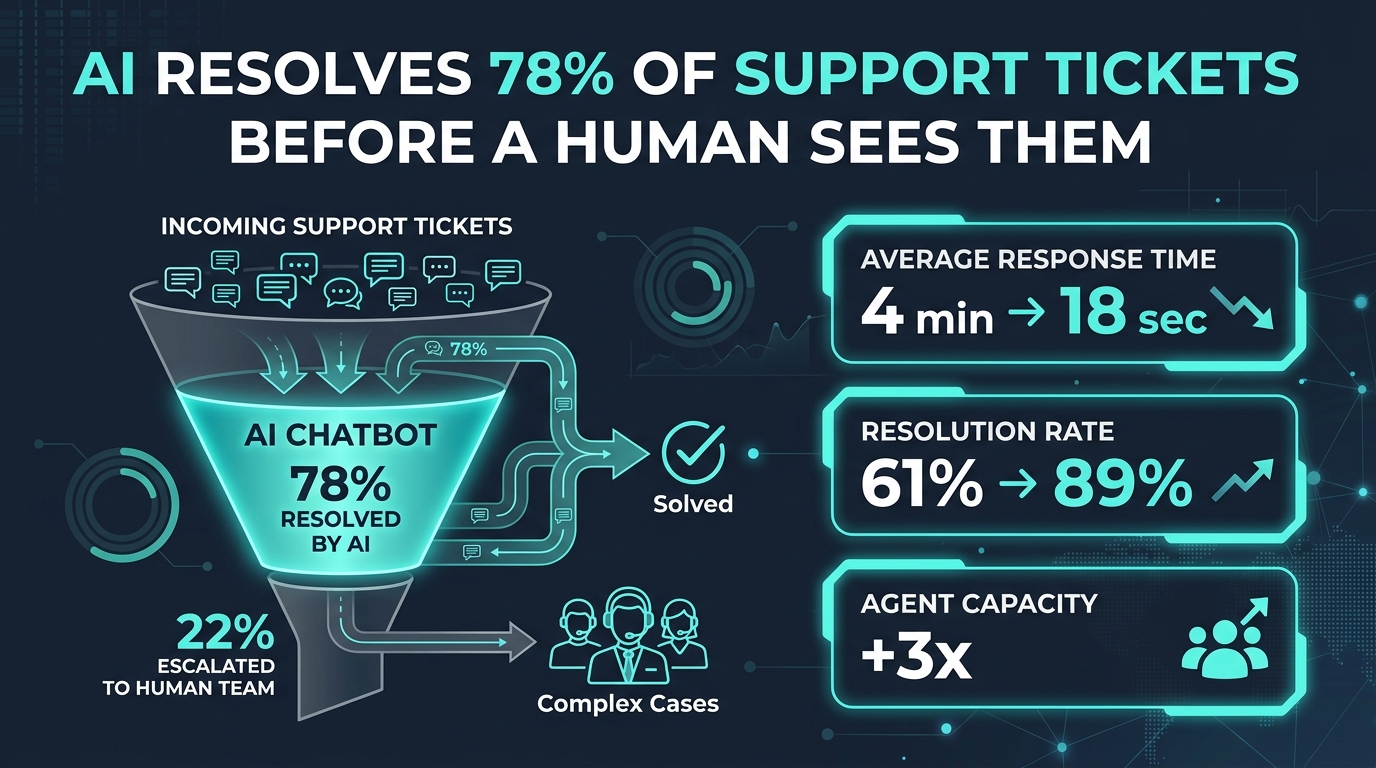
If you could only automate one business function with AI, the data points overwhelmingly toward customer service. No other department combines high task volume, consistent decision patterns, tolerance for AI responses, and measurable ROI as clearly as support operations. It’s not a close contest.
Why Customer Service Is AI’s Natural Home
The mechanics are straightforward. A typical support team handles thousands of tickets per month. A large portion of those tickets — often 60 to 80 percent — fall into predictable categories: password resets, order status inquiries, return requests, billing clarifications, basic product questions. These are not ambiguous problems. They have defined answers, follow consistent patterns, and require zero creative judgment to resolve.
AI thrives in exactly this environment. Natural language processing (NLP) allows modern AI systems to read incoming tickets in any format — email, chat, voice transcription — classify them instantly, and either resolve them outright or route them to the appropriate team member with context already attached. The ticket that used to wait four hours for a human to read and forward now gets processed in seconds.
Chatbot and conversational AI tools have matured dramatically since the clunky rule-based systems of the early 2020s. Today’s AI support agents understand intent even when customers phrase things poorly, handle multi-turn conversations coherently, escalate to humans at the right moment, and can pull live data from order management systems, CRMs, or inventory tools mid-conversation. They’ve moved well past the “sorry, I didn’t understand that” loop that destroyed early customer experiences.
What Measurable Outcomes Look Like
Organizations deploying AI automation across their support function typically report three categories of improvement simultaneously. First, response time collapses — from hours to minutes or seconds, even at 3 AM on a Sunday. Second, resolution rates rise because the AI doesn’t get tired, doesn’t miss steps in a resolution script, and doesn’t need to look up product information. Third, agent capacity expands, because human staff spend their time on genuinely complex or emotionally sensitive cases rather than password resets.
The cost math is compelling. A single AI-powered support layer can handle the equivalent work of several full-time agents on routine inquiries — and unlike headcount, it scales instantly during demand spikes without overtime costs, training time, or recruitment lag.
Where Customer Service AI Still Stumbles
The failure point is almost always escalation handling. AI systems that try to resolve everything — including emotionally charged complaints, complex billing disputes, or situations requiring empathy and nuance — tend to frustrate customers rather than help them. The best implementations build in explicit escalation triggers: sentiment detection that flags an angry or distressed customer and routes them immediately to a human, regardless of whether the AI could technically answer the question. The goal is resolution plus experience, not just resolution.
The second common mistake is deploying AI on top of a broken knowledge base. If the underlying documentation is outdated, incomplete, or poorly structured, the AI will confidently deliver wrong answers at scale. That’s worse than the problem you started with. AI in customer service amplifies what’s already there — good processes become great, bad processes become disasters.
Best-fit tasks: Ticket triage and classification, FAQ resolution, order tracking, appointment scheduling, returns processing, sentiment analysis, agent assist (real-time suggestions to human agents), post-interaction CSAT surveys.
Sales and Revenue Operations: High Potential, Uneven Execution
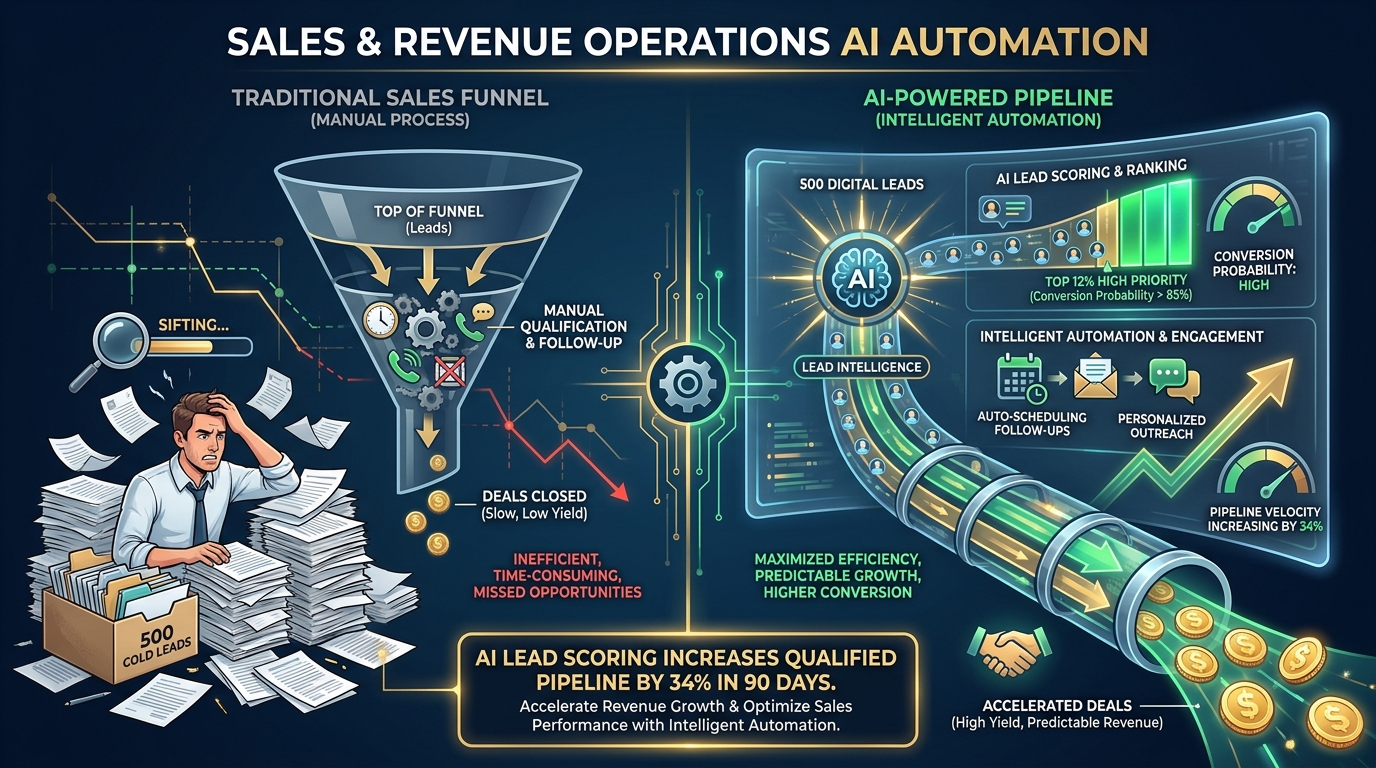
Sales is the department where AI automation generates the most excitement and, paradoxically, some of the most avoidable implementation failures. The potential is real — AI can genuinely reshape how pipelines move, how reps allocate their time, and how forecast accuracy improves. But the path from potential to result requires getting the data foundation right, which is where most sales teams skip a step.
Lead Scoring and Pipeline Intelligence
The most immediately impactful AI application in sales is intelligent lead scoring. Traditional lead scoring was rule-based: a prospect who visited your pricing page twice and downloaded a whitepaper gets 40 points. This approach was better than nothing, but it treated all behaviors as equal and couldn’t learn from outcomes over time.
AI-powered lead scoring does something fundamentally different. It trains on historical closed-won and closed-lost data to identify the behavioral patterns, firmographic signals, and engagement sequences that actually correlate with purchase. It then scores incoming leads in real time against those learned patterns — not against a static rubric someone built in 2021. The result is a prioritization list that reflects what converts in practice, not what someone guessed would convert in theory.
Sales teams that switch from rule-based to AI-powered scoring consistently report that reps spend more time on prospects that matter and less time on leads that were never going to buy. Pipeline velocity improves not because reps are working harder, but because they’re working the right list.
Outreach Personalization at Scale
AI has also changed what “personalization” means in sales outreach. For years, personalization meant inserting a first name and company name into a template and calling it custom. Today, AI can synthesize signals from a prospect’s recent LinkedIn activity, company news, job postings, product reviews, and CRM history to generate genuinely relevant opening lines or call talking points — not just mail merge fields.
This matters because buyers have become highly tuned to generic outreach. Sequence open rates and reply rates have been declining for years as inboxes fill with template-formatted emails. AI-personalized outreach, when implemented well, reverses that trend — not because buyers suddenly want more email, but because a message that references something genuinely relevant to their situation stands out in a commoditized channel.
Revenue Forecasting and Deal Intelligence
AI doesn’t just help on the front end of sales. In revenue operations, machine learning models can analyze the pipeline with far greater accuracy than manual forecast reviews. By evaluating deal age, engagement patterns, historical stage conversion rates, and rep-level behaviors, AI forecasting tools can flag deals at risk weeks before a quarterly call would surface them — giving sales leadership time to intervene rather than explain missed targets after the fact.
The Implementation Gap
The reason sales AI underperforms in so many organizations comes down to data hygiene. AI lead scoring is only as good as the historical data it trains on. If your CRM has inconsistent close reason logging, duplicate contacts, three years of deals marked “unknown” in the stage field, or reps who skip call logging entirely, the model learns the wrong lessons. Before investing in AI sales tooling, the necessary first step is an honest audit of CRM data quality. That’s not the exciting part, but it’s the part that determines whether the AI delivers or disappoints.
Best-fit tasks: Lead scoring and prioritization, outreach personalization, meeting scheduling, call transcription and coaching, pipeline risk detection, revenue forecasting, competitive intelligence summarization, post-demo follow-up drafting.
Finance and Accounting: The Quiet AI Automation Overachiever
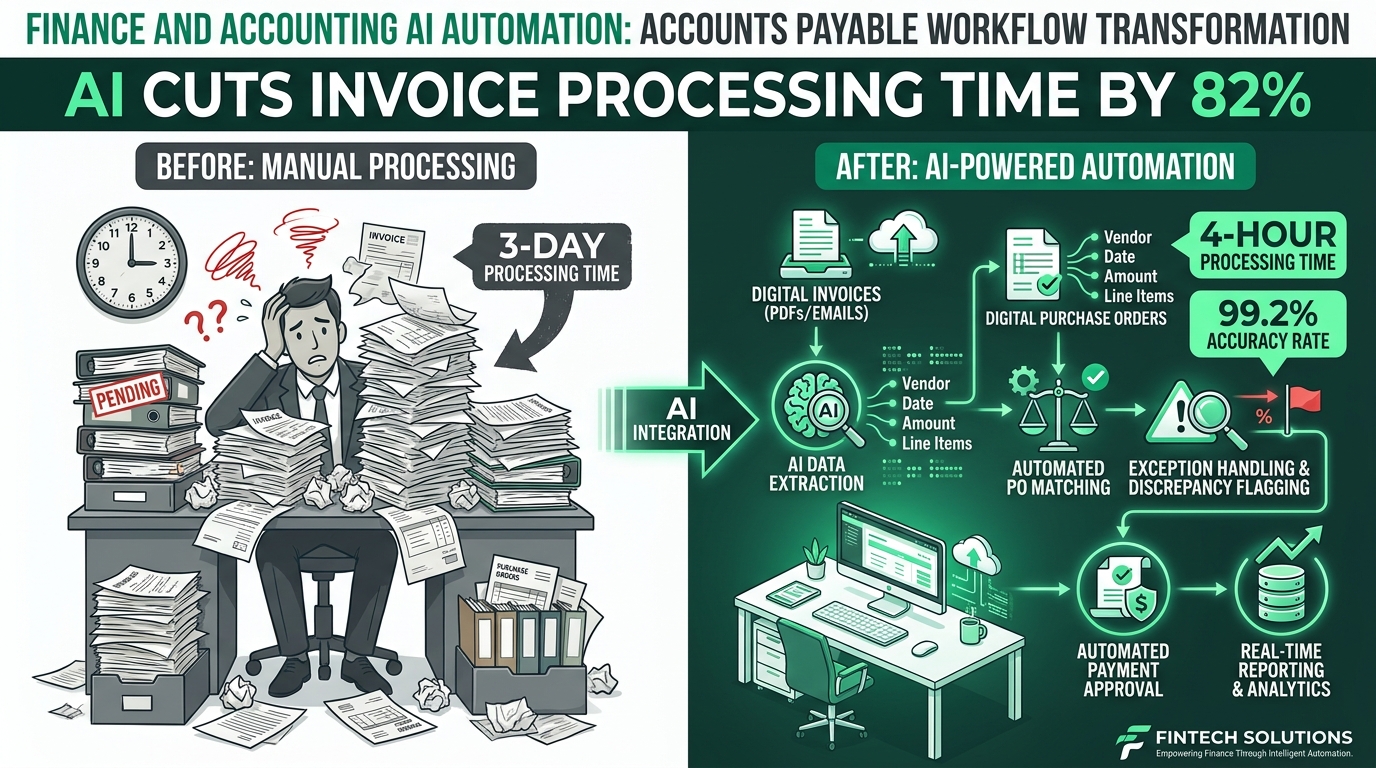
Finance and accounting rarely make headlines as an AI success story. There are no splashy demos, no consumer-facing chatbots, no LinkedIn thought leadership threads. But behind the scenes, AI automation has quietly delivered some of the most consistent, measurable ROI of any business function — particularly in the high-volume, rule-heavy processes that define most finance departments’ daily workload.
Accounts Payable and Invoice Processing
Accounts payable is a microcosm of everything AI automation does well. The process involves receiving invoices in various formats (PDF, email, paper scan, EDI), extracting structured data, matching against purchase orders, checking for discrepancies, routing for approval, and executing payment. Every step is well-defined, repetitive, and consequential — the exact profile that AI excels at.
AI-powered AP automation uses a combination of optical character recognition (OCR), machine learning, and NLP to read invoices regardless of format or layout. It extracts line items, vendor details, and amounts, then cross-references them against the relevant PO in the ERP system. Discrepancies are flagged for human review; clean matches are auto-approved and queued for payment. The entire cycle that once took three to five days of manual processing can run in hours.
Accuracy improves alongside speed. Human data entry carries an inherent error rate — misread figures, transposed digits, skipped line items. AI systems trained on finance documents routinely exceed 99% extraction accuracy, which means fewer payment errors, fewer vendor disputes, and fewer costly corrections at month end.
Accounts Receivable and Collections Intelligence
On the receivables side, AI brings predictive intelligence to collections prioritization. Instead of following a uniform aging-based contact sequence, AI models can predict which accounts are at risk of late payment based on historical payment behavior, communication patterns, and external signals. Collections teams can focus their outreach on the accounts that are actually likely to slip, rather than sending the same dunning email to every account on a 30-day schedule.
Cash flow forecasting benefits similarly. AI systems that monitor invoice aging, payment terms, and historical payment velocity can generate rolling cash flow projections that are significantly more accurate than spreadsheet models built on assumptions. For businesses where timing is critical — seasonal inventory purchases, payroll timing, debt covenants — this precision has real financial impact.
Reconciliation and Month-End Close
Month-end close is one of finance’s most time-consuming and error-prone processes. Reconciling bank statements, intercompany transactions, and general ledger accounts manually takes days of concentrated effort from senior finance staff. AI automation can handle the matching logic — flagging unreconciled items, surfacing anomalies, and generating reconciliation reports — leaving finance teams to focus on investigation and decision-making rather than the mechanical matching work.
Companies that have deployed AI across their entire order-to-cash and procure-to-pay cycles report significant reductions in close cycle times — in many cases cutting the month-end process from 10 or 12 business days to four or five. That’s not a minor efficiency gain. It means financial leadership has accurate data faster, which improves decision quality at the senior level.
The Compliance and Audit Dimension
Finance AI also creates an inherently better audit trail. Because AI systems log every data extraction, match decision, and exception flag with timestamps and reasoning, the documentation that auditors require exists automatically. Manual processes depend on whoever remembered to save the email chain. AI-automated processes create a clean, searchable record by default.
Best-fit tasks: Invoice extraction and matching, payment approval workflows, collections prioritization, cash flow forecasting, bank reconciliation, expense report processing, fraud detection, financial close acceleration, tax document preparation.
Human Resources: Where AI Helps Most in the Hiring Pipeline — and Least in the Human Parts
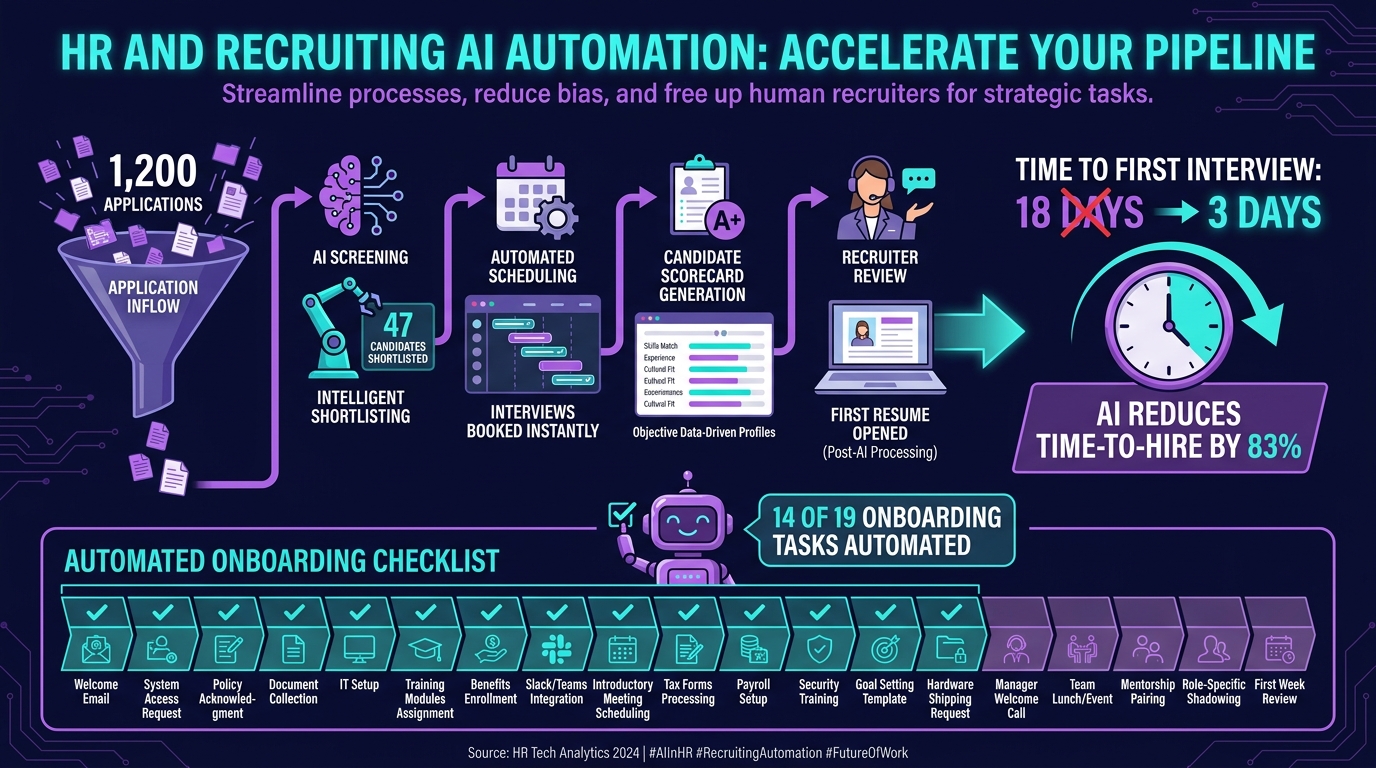
Human resources sits in an interesting position in the AI automation landscape. On the transactional side of HR — recruiting logistics, document processing, onboarding administration, policy queries — AI delivers consistent results and often dramatic time savings. On the judgment-intensive side — culture assessment, performance management, career development, sensitive employee situations — AI support without careful human oversight can actively make things worse.
Understanding that line is the difference between an HR team that uses AI to do more meaningful work and one that loses employee trust while trying.
Recruiting and Talent Acquisition
The recruiting function has the longest history with AI automation, and the results show it. Modern AI tools can ingest thousands of applications, parse resumes against job requirements, rank candidates by fit, send initial screening questions, schedule phone screens directly into recruiter calendars, and generate structured interview guides — before a human recruiter has looked at a single application.
The time savings are significant. Roles that required three weeks of recruiter effort to move from application review to first interview can reach that milestone in three to four days with AI handling the front-end logistics. For high-volume hiring — retail, logistics, customer service — this difference is operationally meaningful. A distribution center ramping up for peak season can’t afford a three-week screening cycle per requisition.
AI also improves consistency in early-stage screening. Human recruiters apply inconsistent standards across a long stack of applications — fatigue, cognitive bias, and time pressure affect judgment in ways that disadvantage strong candidates who apply on a Thursday afternoon versus a Monday morning. AI scoring is consistent across the entire stack.
The Bias Warning That Cannot Be Ignored
The most important caveat in HR AI is also the most frequently glossed over: AI models trained on historical hiring data can encode and amplify the biases already present in that data. If your historical hiring skewed toward candidates from certain schools, geographies, or demographic backgrounds — for reasons that had nothing to do with actual job performance — an AI trained on those patterns will continue that skew, now at scale and with the credibility of algorithmic objectivity.
Organizations deploying AI in recruiting must invest in ongoing bias auditing of their models. That means regularly testing screening decisions against demographic data, using structured scoring criteria rather than holistic “fit” models, and maintaining human review at any stage that could disproportionately affect protected classes. This isn’t optional ethical window dressing. It’s a legal and reputational requirement — and in several jurisdictions, a regulatory one.
Onboarding and Employee Administration
Once candidates are hired, AI continues to deliver value in onboarding. The administrative checklist that follows a new hire — form completion, systems access provisioning, policy acknowledgment, training enrollment, equipment ordering — is a high-volume, low-judgment process that AI handles well. Automated onboarding workflows can trigger the right tasks for the right people at the right time, ensure nothing gets missed, and give new employees a faster path to productivity.
Employee service chatbots handle the HR equivalent of customer support: “How many PTO days do I have left?”, “How do I update my direct deposit?”, “What’s the process for requesting a leave of absence?” These queries consume significant HR staff time across most organizations and have entirely predictable answers that an AI assistant handles accurately and instantly, 24 hours a day.
Where HR AI Should Stay in a Supporting Role
Performance evaluations, termination decisions, promotion recommendations, and compensation reviews all carry legal exposure, cultural weight, and human complexity that make AI judgment — even as a primary input — risky. AI can inform these decisions with data: flagging patterns in performance metrics, surfacing compensation equity gaps, or synthesizing feedback from multiple reviewers. But the final decision should remain with an accountable human who understands context AI cannot capture. The employee who underperformed this quarter because they were dealing with a health crisis needs a manager making their performance decision, not a model.
Best-fit tasks: Application screening, interview scheduling, onboarding task automation, policy query chatbots, employee document processing, time-off management, training enrollment, offboarding checklists, compensation benchmarking data aggregation.
Marketing: AI’s Creative Paradox
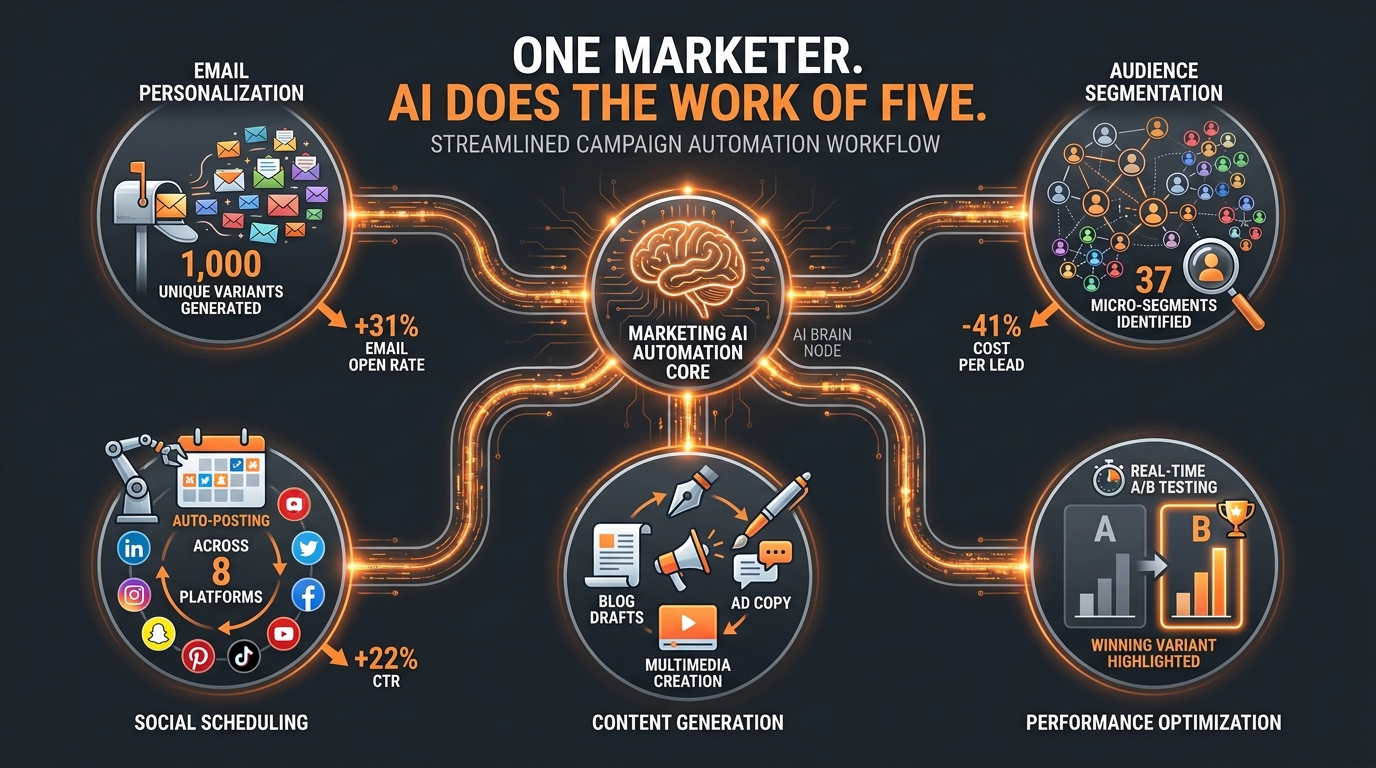
Marketing is the department where AI automation generates the widest range of outcomes — from genuinely impressive efficiency and performance gains to brand-damaging content missteps and generic campaign output that erodes differentiation. The determining factor is almost always how the team positions AI in their workflow: as a production accelerant or as a creative decision-maker.
Content Production and Personalization
The volume of content marketing now requires is staggering compared to a decade ago. A mid-sized B2B company is expected to maintain a blog, produce email campaigns, create social content across multiple platforms, build landing pages for paid campaigns, develop sales enablement material, and generate ad copy in multiple variations — all continuously, all optimized, all on-brand. The headcount required to do that manually is prohibitive for most organizations.
AI writing tools, image generators, and content workflow platforms have become essential infrastructure for marketing teams that want to maintain that output without burning out their team or exploding their contractor budget. When used correctly, they don’t replace creative thinking — they eliminate the low-value production work that was eating creative professionals’ most productive hours. A content strategist who was spending 40% of their time drafting social captions can now spend that time on positioning, audience insight, and campaign strategy.
Email personalization is one of the clearest AI wins in marketing. AI systems can dynamically adjust email content — subject lines, body copy, product recommendations, send timing — based on individual subscriber behavior. The result is an email that reads as if it were written for a specific person rather than a segment. Engagement rates improve; unsubscribe rates fall.
Audience Segmentation and Campaign Targeting
AI has fundamentally changed what audience segmentation means. Traditional segmentation created a handful of broad buckets — enterprise vs. SMB, new customer vs. returning, high-value vs. low-value. AI-powered segmentation creates micro-segments based on behavioral signals too granular and numerous for humans to analyze manually: purchase recency, content consumption patterns, feature usage sequences, support interaction history, social engagement patterns.
Campaigns built for these micro-segments outperform broad-bucket campaigns on virtually every metric because the message actually matches where the recipient is in their journey. A customer who bought a product six months ago, hasn’t engaged with any marketing in three months, but just visited the pricing page twice is in a completely different position than a customer with identical purchase history who opens every email and hasn’t visited pricing in a year. AI segments them correctly. Static rules don’t.
Performance Optimization and A/B Testing
AI has also accelerated and improved the testing cycle. Traditional A/B testing requires running variants long enough to achieve statistical significance — often weeks for lower-traffic campaigns. Multi-armed bandit algorithms, an AI approach to testing, allocate traffic dynamically toward better-performing variants in real time, which means you stop sending budget to losing variants faster and extract more value from every campaign dollar.
Paid advertising platforms have embedded AI optimization into their core bidding and targeting systems to such a degree that manual campaign management is now genuinely disadvantaged in most auction environments. Understanding how to configure AI campaign tools correctly — setting appropriate conversion goals, providing sufficient training data, structuring campaigns to give the AI system meaningful signals — has become a core marketing competency.
The Brand Voice and Originality Problem
The danger zone in marketing AI is brand differentiation. When every company uses the same AI tools to produce content, the natural equilibrium is homogenized output — the same sentence structures, the same framing patterns, the same “here’s why this matters” constructions. This is not hypothetical. Content produced at volume by AI without strong editorial direction has a recognizable sameness that sophisticated audiences detect.
The most effective marketing teams treat AI as a first-draft engine and an optimization tool, not as the voice of the brand. Original thinking, distinctive positioning, and creative risk-taking still come from humans. AI handles the translation of those ideas into volume — variations, formats, platforms, and personalizations — rather than generating the ideas themselves.
Best-fit tasks: Email subject line optimization, content brief generation, first-draft production, social caption writing, SEO keyword clustering, ad copy variants, audience segmentation, send-time optimization, performance reporting, image resizing and asset adaptation.
Operations and Supply Chain: AI Where Milliseconds and Margins Both Matter
Operational functions — logistics, inventory management, procurement, vendor management, quality control — have been using automation for decades. What AI brings to the table isn’t automation from scratch; it’s intelligence layered on top of systems that were already automated but couldn’t learn, adapt, or predict.
Demand Forecasting and Inventory Optimization
Traditional demand forecasting relied on historical sales data, seasonal adjustments, and the institutional knowledge of planners who’d been doing the job for years. It worked reasonably well in stable environments, but it struggled with sudden demand shifts — a viral product moment, a supply chain disruption, an unexpected competitor entry, or an economic shock that changed consumer behavior overnight.
AI demand forecasting ingests a far richer signal set. Historical sales, yes — but also weather data, social media trend signals, web search volume, competitor pricing, regional economic indicators, and logistics lead times. It can update forecasts daily as new signals come in, rather than waiting for the weekly or monthly planning cycle. The result is inventory positioning that reduces both stockouts and overstock simultaneously, which for retail and e-commerce businesses directly impacts both revenue capture and working capital efficiency.
The gains compound over time as the model learns from its own predictions. An AI system that forecasted demand accurately through a Black Friday season, a supply disruption, and a product discontinuation has learned lessons that improve its next prediction. Static models don’t improve. AI models do.
Procurement and Vendor Management
AI is changing procurement by introducing analytical depth that wasn’t feasible when procurement teams were managing vendor relationships manually across spreadsheets and email chains. AI tools can monitor vendor performance in real time, flag delivery time degradation before it becomes a service failure, surface alternative supplier options when primary vendors show risk signals, and analyze contract terms at scale across a large supplier portfolio.
On the sourcing side, AI can analyze spend categories, identify maverick spending (purchases outside preferred vendors), and flag opportunities to consolidate buying power for better pricing. Procurement teams that previously needed days to build a spend analysis can generate it on demand. That speed changes how procurement participates in business decisions — from reactive to genuinely strategic.
Logistics and Last-Mile Delivery
For businesses with physical fulfillment operations, AI route optimization delivers measurable fuel and time savings that accumulate daily. Traditional routing used fixed rules — load trucks in address order, follow established zones. AI routing considers real-time traffic, delivery time windows, vehicle capacity, driver hours, and historical completion rates to generate routes that humans couldn’t construct manually at the same quality or speed.
Predictive maintenance in manufacturing and logistics infrastructure is another high-value application. AI models trained on sensor data from equipment can identify failure patterns before breakdowns occur — giving maintenance teams advance warning to schedule repairs rather than scrambling for emergency fixes. The cost difference between a planned replacement and an unplanned production shutdown is often orders of magnitude.
Best-fit tasks: Demand forecasting, inventory replenishment triggers, purchase order processing, supplier risk monitoring, route optimization, quality control image analysis, equipment monitoring, warehouse slotting optimization, returns processing classification.
IT and Security: AI’s Fastest-Growing Operational Footprint
Information technology and cybersecurity have become among the most active AI automation domains — driven partly by genuine value and partly by necessity. The volume of security events, system alerts, and IT service requests facing modern organizations has grown beyond what human teams can manage manually at the speed required. AI isn’t a nice-to-have in IT operations and security; for many organizations, it’s becoming the only way to keep pace.
Security Monitoring and Threat Detection
Modern enterprise security infrastructure generates an almost incomprehensible volume of event data — millions of log entries per day across network traffic, endpoint activity, authentication events, and application behavior. Human security analysts reviewing this data manually would face an impossible task. Important signals would drown in noise. Attackers would operate in the gaps.
AI-powered security information and event management (SIEM) platforms and extended detection and response (XDR) tools apply machine learning to establish behavioral baselines across the environment, then flag deviations from those baselines as potential threats. The system learns what “normal” looks like for each user, device, and application — and alerts on anomalies that rule-based systems would miss because the attack pattern is novel.
This is particularly valuable against the class of attack most likely to evade traditional defenses: insider threats and slow-burn intrusions where attacker behavior mimics legitimate activity but at an unusual time, rate, or target pattern. AI models catch these because they’re comparing against dynamic behavioral profiles rather than static signature databases.
IT Service Management and Help Desk Automation
The IT help desk serves the same structural role as customer support — high volume, repetitive request types, predictable resolutions — and benefits from AI automation in the same ways. Ticket classification, routing, and common-issue resolution (password resets, software access requests, VPN configuration) are all highly automatable. AI can handle a significant portion of help desk volume without human intervention, reducing resolution time from hours to minutes for standard requests.
Beyond reactive support, AI is being applied to proactive IT operations: monitoring system health metrics and predicting failures before they impact users, automatically scaling cloud resources in response to load patterns, and detecting configuration drift before it creates security exposure. The shift from reactive to predictive IT operations is one of the more tangible value propositions AI delivers at the infrastructure level.
Vulnerability Management and Patch Prioritization
Most security teams manage a vulnerability backlog that is impossible to work through fully — there are simply more identified CVEs and exposed surfaces than available time to remediate them. AI systems can prioritize that backlog intelligently, combining exploit likelihood, business criticality of the affected system, and exposure to external attack to generate a remediation queue that reflects actual risk rather than severity scores alone. Teams spend their patching effort where it matters most.
Best-fit tasks: Security event monitoring and anomaly detection, help desk ticket routing and resolution, patch prioritization, cloud resource scaling, configuration compliance monitoring, user access review, incident response playbook execution, system health prediction.
The Functions Where AI Automation Still Falls Short
Intellectual honesty requires mapping the boundaries as clearly as the wins. There are business functions and process types where AI automation consistently underperforms expectations in 2026 — not because the technology isn’t advancing, but because the nature of the work itself creates fundamental challenges that current AI systems haven’t overcome.
Strategic Planning and Executive Decision-Making
AI can synthesize information at a speed and breadth that no human team matches. Ask an AI system to summarize competitive landscape changes across 15 markets, or to analyze three years of financial performance against macroeconomic indicators, and it will produce a coherent, detailed output faster than any analyst team. But the output is synthesis, not judgment. Strategic decisions require weighing incommensurable values, understanding stakeholder dynamics, reading organizational culture, and making bets under radical uncertainty where the right answer genuinely doesn’t exist in historical data. AI can inform these decisions. It cannot make them.
Complex Negotiations and Relationship Management
High-stakes negotiations — enterprise contracts, M&A activity, partnership agreements, labor negotiations — depend on reading the room, understanding what the other party actually wants versus what they’re saying, and building the kind of trust that only forms through sustained human interaction. AI can help prepare for negotiations by surfacing relevant precedents, analyzing contract language, or modeling scenarios. But the negotiation itself is irreducibly human.
The same applies to key account management, board relationships, and investor relations. These are long-term relationships where trust, consistency, and genuine human connection create the foundation that allows business to get done. Automating the relationship management itself — having AI draft all the touchpoints, manage all the communication — tends to produce the thin, detectable hollowness that sophisticated counterparts notice immediately.
Genuine Creativity and Brand-Building
AI can produce content that resembles creativity — it can combine existing patterns in ways that look novel, write jokes that land in context, or generate visual concepts that match a brief. But it doesn’t take genuine creative risks, doesn’t have a point of view shaped by lived experience, and doesn’t make the kind of creative choices that distinguish a brand from its category. AI is an exceptional creative production tool. It is not a creative director.
Crisis Response and Sensitive Communications
When things go wrong — a product recall, a public relations crisis, a major service outage, a workplace incident — the communications that matter most require human leadership, accountability, and genuine empathy. An AI-drafted crisis statement, even a well-crafted one, carries the risk of sounding exactly like what it is. Stakeholders in a crisis are particularly attuned to authenticity. This is the moment for humans at the front of the response, with AI perhaps supporting research and information gathering in the background.
How to Build Your AI Automation Priority Map
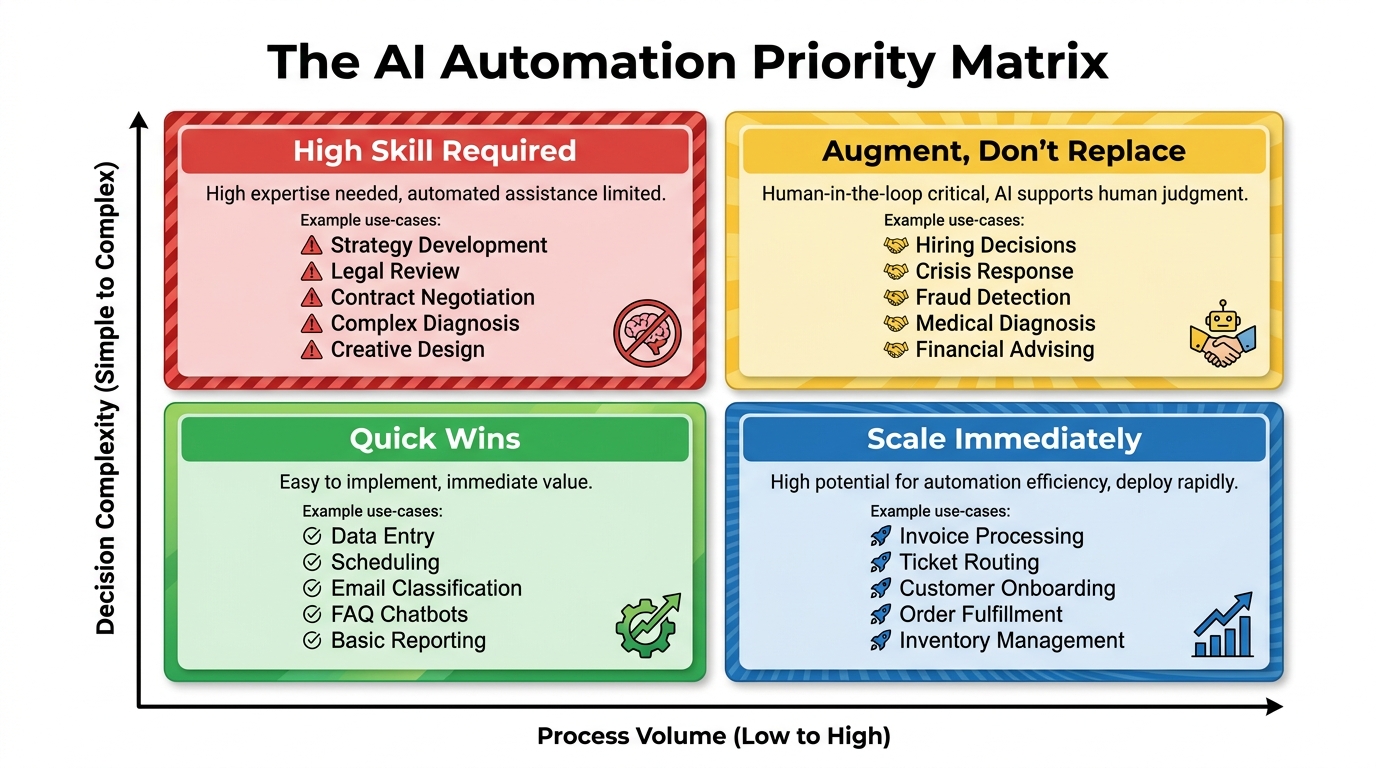
With a department-by-department picture in place, the practical question becomes sequencing: where do you start, how do you build from there, and how do you avoid burning your organization’s appetite for AI change on projects that don’t deliver?
The Two-Axis Assessment
Map every candidate process on two dimensions: process volume (how often does this happen?) and decision complexity (how much judgment does it require?).
- High volume + low complexity — These are your immediate priorities. Invoice processing, ticket triage, meeting scheduling, password resets, basic reporting. These processes are expensive to do manually at scale and straightforward for AI to handle accurately. Start here. Build quick wins that demonstrate value.
- High volume + high complexity — These are “AI-assisted” use cases. Lead qualification, demand forecasting, content production. AI handles the pattern-recognition and production work; humans provide the judgment layer. These projects take longer to implement but deliver sustained competitive advantage.
- Low volume + low complexity — These are often not worth the implementation effort. If the process only happens twice a month, the ROI of building an automated workflow rarely justifies the cost. Do these manually for now.
- Low volume + high complexity — Strategy, negotiations, executive communications. Keep humans in the lead. AI can prepare and inform, but shouldn’t be doing the work here.
Start With One Department, Go Deep
The most common AI automation mistake is horizontal spreading: deploying thin AI capability across every department simultaneously. The result is shallow implementation everywhere, staff confusion about priorities, and not enough ROI in any single area to build the internal credibility that drives further adoption.
The better approach is to pick one department — ideally the one where the cost of manual processes is highest, the data quality is best, and leadership is most willing to champion change — and build deep capability there first. Document the results. Quantify the impact. Then use that documented success as the template and the proof point for the next department rollout.
Fix the Data Before the AI
Every AI automation project eventually reveals the quality of your underlying data. AI models for lead scoring need clean CRM data. AI invoice processing needs consistent vendor master data. AI demand forecasting needs accurate historical sell-through data without gaps or errors. If you have a known data quality problem in a particular system, address it before or alongside the AI implementation — not after the AI deployment fails and you spend three months diagnosing why.
Define Success in Advance
Before any AI automation project launches, define the specific metric you will use to evaluate success, the baseline it’s being measured against, and the time frame for assessment. “We’ll deploy the AI chatbot and see how it goes” is not a definition of success. “We’ll measure tier-1 ticket resolution rate, average handle time, and agent utilization at 90 days against the pre-deployment baseline” is. The specificity matters because AI implementations without clear success criteria tend to drift — either oversold as successful based on anecdotes or written off as failures without understanding why.
The Human Layer Every AI Automation Needs
One of the least-discussed elements of AI automation implementation is the infrastructure of human oversight that determines whether the system performs well over time or degrades quietly without anyone noticing.
Monitoring for Model Drift
AI models trained at a point in time will eventually encounter conditions that differ from their training data. A lead-scoring model trained before a major market shift may misrank leads that are actually high-quality because their behavioral pattern doesn’t match historical converters. A demand forecasting model trained before a supply chain disruption may systematically overstock in ways that hurt cash flow. Model drift is real, and it happens silently — the model keeps producing outputs, they just get progressively less accurate.
Every production AI system needs a monitoring protocol: a set of metrics reviewed regularly to detect when model performance is degrading. This doesn’t require a data science team for every business — many modern AI tools include built-in performance monitoring dashboards. But someone has to be looking at them, on a schedule, with authority to escalate when numbers move in the wrong direction.
Exception Handling and Escalation Design
The design of escalation paths — which situations the AI passes to a human and what information it passes with them — is often as important as the AI model itself. AI systems with no clear escalation design either try to handle situations they shouldn’t (with bad outcomes) or route everything to humans as soon as they’re uncertain (eliminating the efficiency benefit). Good escalation design defines specific trigger conditions, attaches relevant context to every escalated item, and routes to the right human based on case type rather than just dumping into a generic queue.
Employee Adaptation and Workflow Redesign
AI automation changes jobs. It doesn’t eliminate them in most cases, but it shifts what people spend their time on — and that shift requires intentional support. Employees whose previous role involved primarily the tasks now handled by AI need a clear picture of what their redefined role looks like, what new skills they’re expected to develop, and how their value to the organization is being assessed in the changed environment. Organizations that skip this conversation and assume employees will just “figure it out” see adoption resistance, quality issues at the human-AI handoff points, and retention problems among staff who feel replaced rather than evolved.
The most effective AI automation implementations treat employee experience design as a parallel workstream to the technical implementation — not an afterthought once the system is live.
Building Toward a Connected AI Automation Architecture
Individual AI automation wins by department are valuable. But the organizations extracting the most sustainable advantage from AI in 2026 are the ones building toward a connected architecture — where AI systems across departments share context, data, and workflow handoffs rather than operating as isolated department tools.
Breaking Down the Automation Silos
When the AI customer service tool that resolved a billing question can’t update the record in the financial system because the two systems don’t communicate, value is lost. When the AI lead-scoring model that identified a high-priority prospect can’t trigger a personalized outreach sequence in the marketing platform because they’re disconnected, the advantage evaporates at the handoff. Siloed automation creates the appearance of an AI-forward organization without the compounding benefits that integration delivers.
Integration layer investment — APIs, middleware platforms, data pipelines, and unified data models — is less exciting than AI model selection, but it’s the technical infrastructure that allows automation wins in one department to create value in the next. Organizations that skip this tend to find themselves rebuilding later at higher cost and complexity.
Building a Central Automation Intelligence Layer
More advanced organizations are moving toward a centralized automation intelligence model, where a unified data platform serves as the backbone for AI tools across the business. Customer behavior signals collected through the marketing automation platform inform the customer service AI’s response personalization. Sales pipeline data feeds the finance forecasting model. HR performance data informs operational capacity planning.
When data flows this way, the AI tools become more capable together than they are individually — because they’re operating on a richer, more complete picture of the business than any single department’s data provides. This is the architecture that separates organizations with AI experiments from organizations with AI infrastructure.
Governance and Accountability at Scale
As AI automation spreads across departments, the governance questions become more complex. Which decisions can AI make autonomously? Which require human sign-off? Who is accountable when an AI-generated recommendation causes a business problem? Which uses of AI require disclosure to customers or regulators?
These questions need organizational answers — not just technical ones. AI governance frameworks, which define the decision rights, accountability structure, and compliance requirements for AI use across the business, are transitioning from aspirational best practice to operational necessity. Organizations that don’t build this structure proactively will build it reactively — after an incident forces the issue.
Conclusion: The Department-First Mindset That Separates Results from Regret
AI automation in 2026 is neither the universal solution its most enthusiastic proponents claim nor the overhyped distraction its skeptics dismiss. It is a set of genuinely powerful tools that work remarkably well in certain conditions and poorly in others — and the conditions are defined by the specific nature of the work being automated.
Customer service, finance, and IT operations have the clearest value case and the most consistent ROI track record. Sales and marketing deliver strong results when data foundations are sound and AI is positioned as an accelerant rather than a replacement for judgment. HR and operations offer significant wins on the transactional side while requiring careful human oversight on the judgment-intensive side. Strategic functions — planning, negotiation, creative leadership — remain fundamentally human domains where AI supports rather than leads.
The organizations that build durable advantage from AI automation share a consistent profile. They start narrow and go deep in the highest-value department before spreading. They fix data quality before they deploy models. They define success metrics before they launch projects. They design human oversight into the system from day one rather than bolting it on after problems emerge. And they treat employee adaptation as a program requirement, not an afterthought.
None of that is technically sophisticated. Most of it is organizationally disciplined. Which is, ultimately, the real differentiator in the age of AI.
Actionable Takeaways
- Audit your process inventory. List every repeatable process across departments and score them on volume and decision complexity. Your immediate priorities are high-volume, low-complexity tasks where manual handling creates cost without adding judgment value.
- Start with one department and document everything. Your first successful AI automation implementation is your proof of concept and your internal case study for the next one. Measure it rigorously.
- Invest in data quality before model quality. An excellent AI model on poor data will underperform a basic model on clean data. Clean the data first.
- Build escalation paths deliberately. Define in advance which situations get escalated to humans, what information travels with the escalation, and who’s accountable for the handoff.
- Design your monitoring protocol at launch, not after drift occurs. Schedule regular reviews of AI performance metrics and assign ownership for acting on degradation signals.
- Talk to your employees before the tools go live. Explain how AI is changing their role, what the new expectations are, and what the path forward looks like. People support what they understand and resist what they feel is happening to them.
- Plan for integration from day one. Even if your first deployment is a standalone tool, design it with eventual connectivity to adjacent systems in mind. The compounding value of connected AI is where the real long-term advantage lives.