


There’s a version of AI automation that works beautifully. Tasks get processed without anyone touching them. Reports that used to take three hours are ready in four minutes. Customer queries get routed, triaged, and resolved before a human ever opens their inbox. It’s real, it’s happening in specific pockets of specific organizations, and the productivity numbers are genuinely striking.
And then there’s the version most businesses actually live in: the AI tool that was onboarded with enthusiasm eight months ago now sits mostly idle, quietly accumulating subscription fees. The workflow that worked perfectly in the demo but collapsed under the weight of real-world edge cases. The automation that made something faster without making it better — and in one critical instance, made it actively worse.
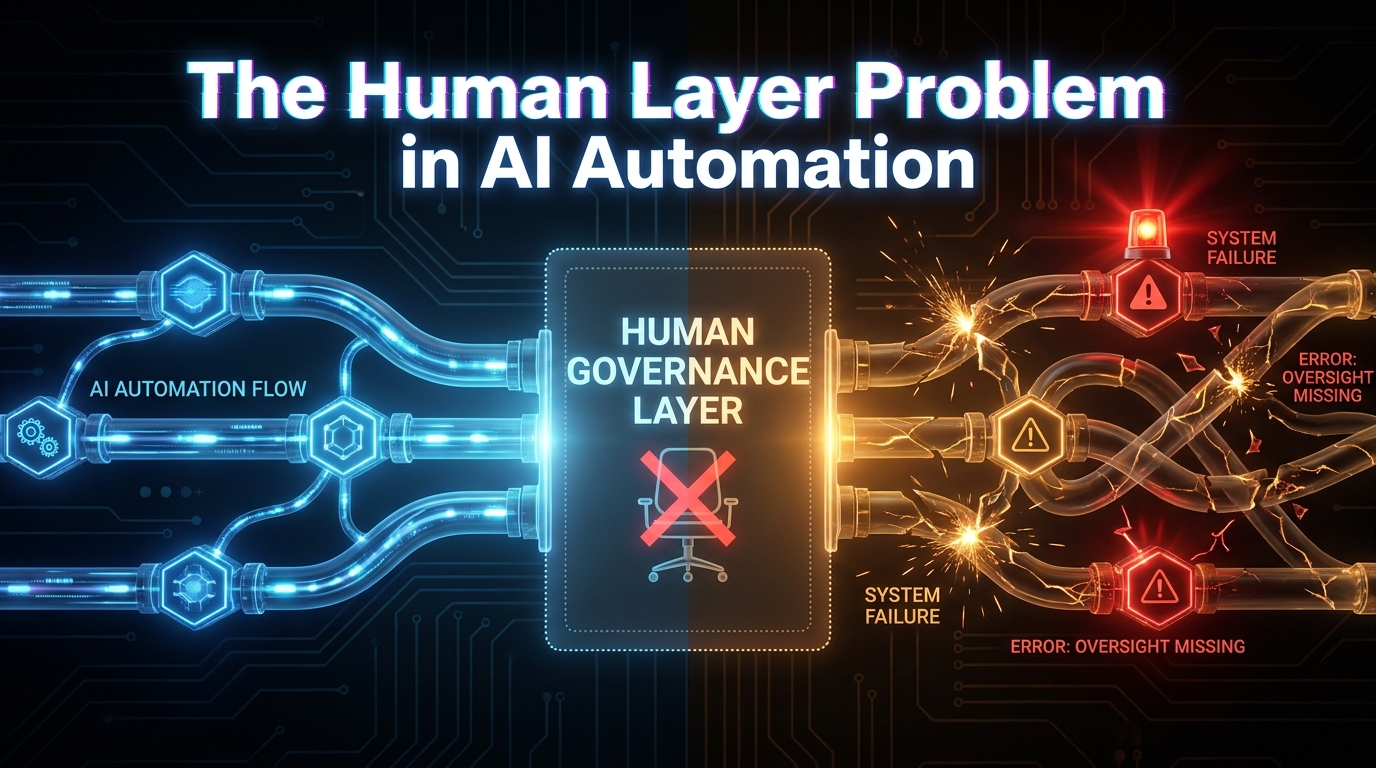
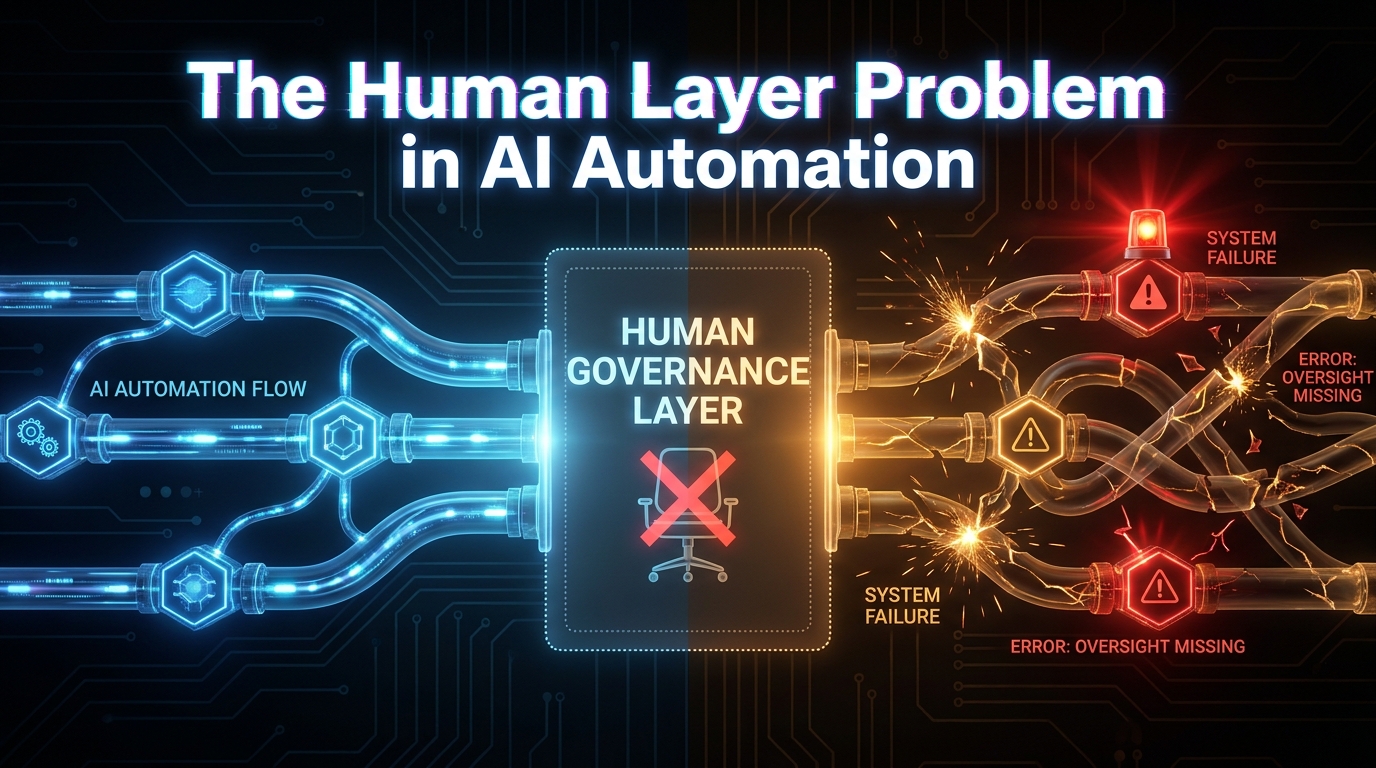
What separates these two realities isn’t the sophistication of the AI. It isn’t the budget, the vendor, or even the specific use case. What separates them is a problem that almost nobody talks about clearly: the human layer. The decisions, structures, policies, and oversight mechanisms that businesses need to build around AI — and that most businesses are either skipping entirely or building in the wrong order.
In 2026, as AI automation matures from novelty to infrastructure, the failure points are becoming clearer. The technology is ready. Organizations, largely, are not. This article examines exactly why — and what you can do differently.
The Governance Vacuum Nobody Saw Coming
When a new employee joins your company, something predictable happens. They get provisioned. They receive credentials. They’re assigned a manager, given a role, and eventually — when they leave — those credentials get revoked. There’s a lifecycle, and most organizations know how to manage it.
When an AI agent gets deployed in your organization, almost none of that happens.
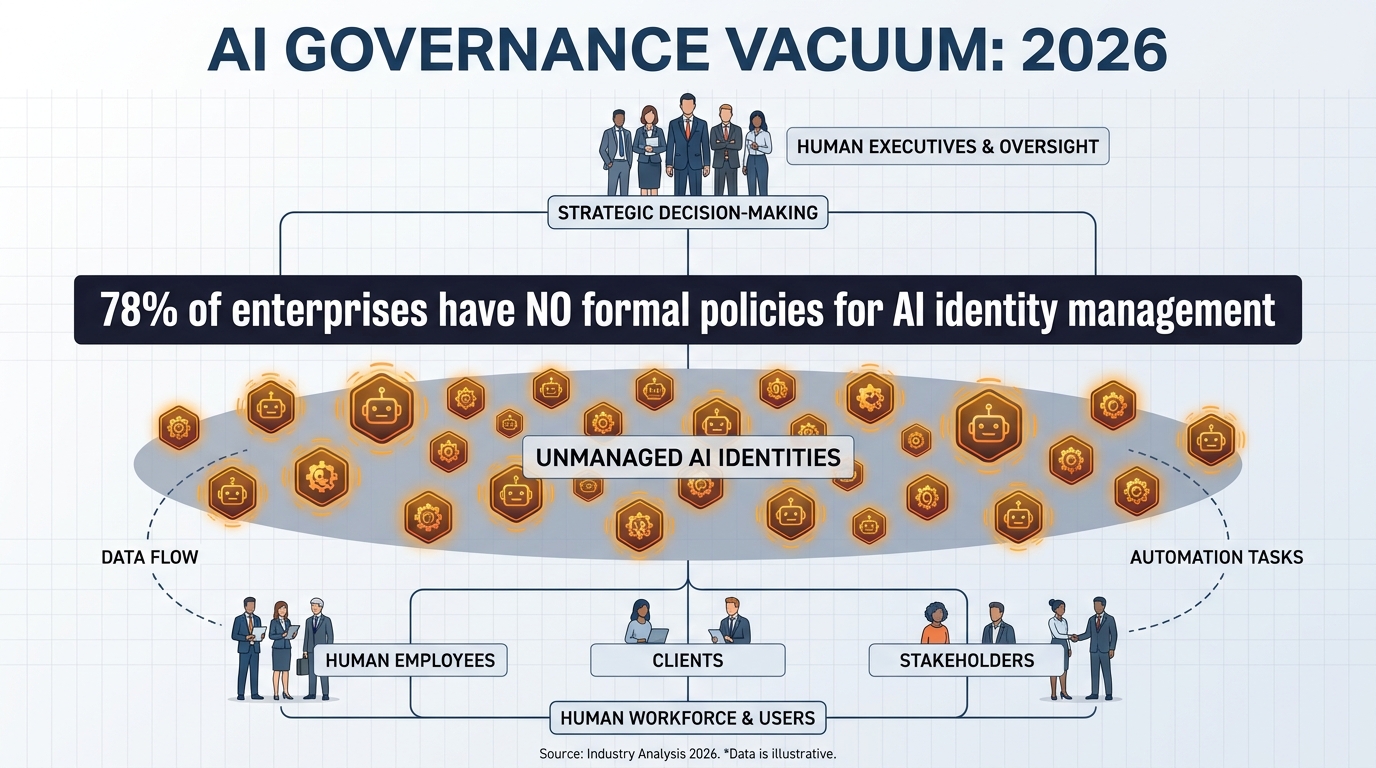
A January 2026 survey by Oasis Security and the Cloud Security Alliance, covering 383 security leaders across enterprise environments, found that 92% are not confident their legacy identity and access management tools can handle AI and nonhuman identity risk. More alarmingly, 78% reported having no formally adopted policies at all for creating or removing AI identities. That’s not a niche finding from a small sample — it’s a structural gap across organizations of every size and sector.
The Scale of the Nonhuman Population
Part of why this has become such a pressing problem is the sheer speed at which the nonhuman population inside enterprise environments has grown. Rubrik Zero Labs estimates the ratio of nonhuman identities to human identities across general enterprise environments is approximately 45:1. In cloud-native, DevOps-heavy organizations, CyberArk’s 2025 Identity Security Landscape study puts that ratio closer to 82:1.
Those numbers sound abstract until you consider what they mean operationally. For every human employee at a midsize company, there are dozens — potentially hundreds — of AI agents, automation scripts, API connections, and service accounts operating in the background. Each one was created by someone. Many of those people have since changed roles or left the organization entirely. The credentials remain active. The oversight is gone.
Research from Entro found that 47% of nonhuman identities go unrotated for more than a year. In AWS environments specifically, 62% of service accounts sit in a similar state — live, permissioned, and completely unmonitored. This is what a governance vacuum looks like in practice. It’s not a hypothetical. It’s the current state of most organizations deploying AI automation.
Why This Matters Beyond Security
The governance vacuum isn’t just a cybersecurity problem, though it certainly is that. It’s a business operations problem. When you don’t know which AI systems have access to what, you can’t audit them. When you can’t audit them, you can’t improve them. When you can’t improve them, you’re running automation on autopilot — and autopilot, in complex business environments, eventually hits something.
The organizations that are getting AI automation right in 2026 are starting with an identity inventory before they start with AI deployment. They’re treating every AI agent like a contractor: defined scope, defined access, defined expiry. It’s not glamorous work, but it’s what makes everything else stable.
Why Automating the Wrong Tasks First Is a Silent Budget Killer
There’s a particular type of meeting that happens in organizations that are struggling with AI automation. The executive team gathers. Someone presents a list of “processes we should automate.” Enthusiasm is high. The list gets approved. Vendors get selected. Months later, the return is underwhelming, and nobody quite understands why.
The reason is almost always task selection. Most organizations automate what’s visible rather than what’s valuable. They automate what’s technically feasible rather than what creates the most leverage. And they automate without ever honestly mapping out how hard the implementation will actually be.
The Task Selection Matrix
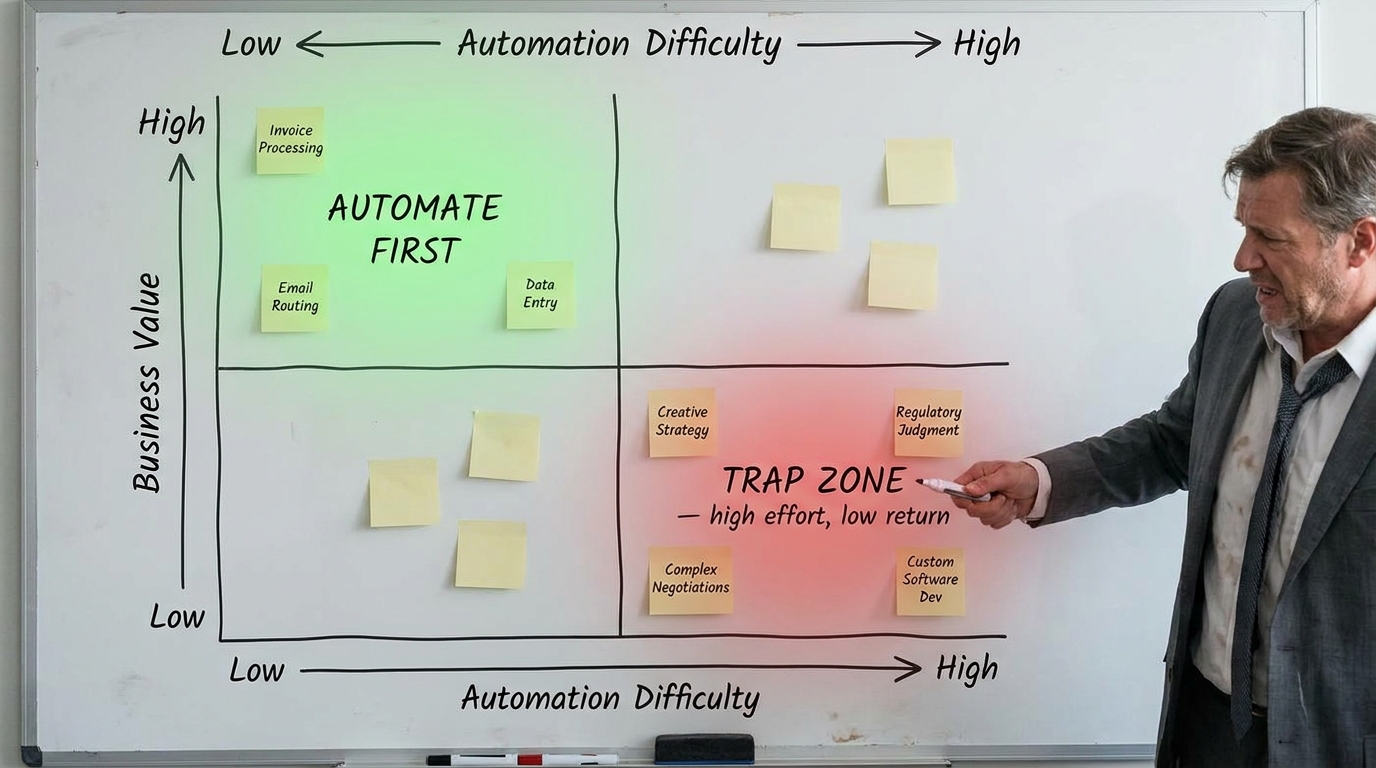
Think of every automatable business task along two dimensions: the difficulty of automating it reliably, and the business value it delivers. The ideal targets are in the top-left quadrant: relatively low automation complexity, high business value. Invoice processing, document classification, meeting transcription and summarization, data extraction from structured forms — these land here for most organizations.
Where companies go wrong is selecting tasks from the bottom-right quadrant: high automation difficulty, low business value. These are the “impressive demo” tasks. They look great in a vendor presentation. They’re technically interesting. And they consume enormous implementation and maintenance effort while delivering modest returns. Creative strategy development, nuanced regulatory judgment, complex negotiation support — these aren’t impossible to support with AI, but they require far more scaffolding than the impressive-sounding pitch suggests.
The Hidden Costs of Automation Complexity
There’s also a third factor that rarely appears in the initial task selection conversation: maintenance burden. Every automated process requires ongoing management. Models update and behave differently. Edge cases surface that weren’t anticipated in the design phase. Business rules change. Data formats shift. The pipeline that runs smoothly in month one may need significant rework by month six.
Research on software development workflows illustrates this clearly. When Paul Iusztin, an engineer with over seven years of experience, built an AI-powered software factory for his development projects, his first version was so overengineered that he stopped using it entirely. The lesson was the same one most organizations are learning the hard way: the goal isn’t maximum automation, it’s appropriate automation — knowing when to stop building before you add more friction than you remove.
What the Best Candidates Actually Look Like
Across organizations that are reporting consistent AI automation returns in 2026, the highest-performing use cases share a common profile: they’re repetitive, they’re clearly defined, they produce structured outputs that can be easily verified, and the cost of a mistake is correctable. Think: first-pass invoice review flagging anomalies for human approval, not automated payment approval with no human checkpoint. Think: AI-generated first drafts of routine communications reviewed before sending, not fully autonomous customer outreach with no review step.
The distinction matters. The former keeps a human in the loop at the point of consequence. The latter removes them. And in 2026, the most expensive AI automation mistakes are almost always happening at exactly that removal point.
A practical three-question filter before committing to any automation target: How often does this task occur? How predictable and standardized is the input? What happens when the automation produces a wrong output? If your honest answers are “frequently,” “very,” and “it’s correctable and detectable,” you have a strong automation candidate. If any answer is “we’re not sure,” that uncertainty is a signal to investigate further before building.
The Nonhuman Identity Problem — and Why It Affects Every Business
The term “nonhuman identity” sounds like something that only matters to large enterprises with dedicated security teams. It doesn’t. If your business uses any combination of AI tools, Zapier-style automation platforms, API integrations, or SaaS software with automated workflows, you already have a nonhuman identity problem — you just may not have named it yet.
What Nonhuman Identities Actually Are
A nonhuman identity is any system, agent, script, or service that authenticates against your business systems using credentials. This includes the AI tool that connects to your CRM, the automation that pulls data from your accounting software, the chatbot that has read access to your customer database, and the scheduled script that syncs your inventory data with your fulfillment partner.
Every one of these has credentials. Every one of those credentials has a permission level. And in the vast majority of small and midsize businesses, those credentials are created when needed and then never revisited. They don’t expire. They don’t get audited. When the employee who set them up leaves, nobody knows they exist.
The Specific Risk to Business Operations
The operational risk here is both broader and more specific than most business leaders recognize. On the security side, a compromised nonhuman identity doesn’t trigger the same alerts as a compromised human login — because its behavior pattern (sending data, accessing records, making API calls) looks identical to normal operation. The exploit chain can run for weeks or months before anyone notices.
But the business operations risk is equally significant. When an AI agent has broader permissions than it needs, its mistakes have broader consequences. An AI automation tool with write access to your customer database and your email outreach system, given a poorly constructed prompt or a changed business rule, can do significant damage before any human intervenes. The principle of least privilege — giving every system only the access it actually requires — is one of the most practical governance rules any organization can apply, and most don’t apply it to their AI tools at all.
A Three-Step Minimum Viable Governance Framework
You don’t need an enterprise identity and access management platform to get basic control over your nonhuman identities. You need three things: an inventory (a living document listing every AI tool and automation with access to your systems, what it can access, and who owns it); a rotation policy (a defined schedule for updating credentials — at minimum annually, quarterly for anything with broad system access); and an offboarding check (when any employee leaves, a specific step in their exit process to audit and revoke any automations or AI tools they created or owned).
This is the governance floor. It won’t catch everything, but it closes the most obvious exposure gaps and gives you a foundation to build from. The organizations in the Oasis Security survey that reported confidence in their AI identity management weren’t running complex bespoke platforms — they were running these basics, consistently.
How the “Software Factory” Model Is Changing What Human Oversight Looks Like
One of the most useful concepts to emerge from the engineering community in 2026 is the software factory — a framework for thinking about how AI agents fit into a structured production process rather than operating as standalone tools. The concept was a central theme at AI Engineer World’s Fair 2026, where it was defined as “the whole loop, the whole lifecycle of developing software with autonomy.”
The idea is worth borrowing far beyond software development. It applies directly to any business process that involves AI automation.
Assembly Lines Need Checkpoints
The factory metaphor is useful because factories have always had quality control built into them. An assembly line without inspection checkpoints produces defects at scale. The same principle applies to AI automation pipelines. Without defined points at which a human reviews and approves the output before it moves downstream, errors compound rather than get caught.
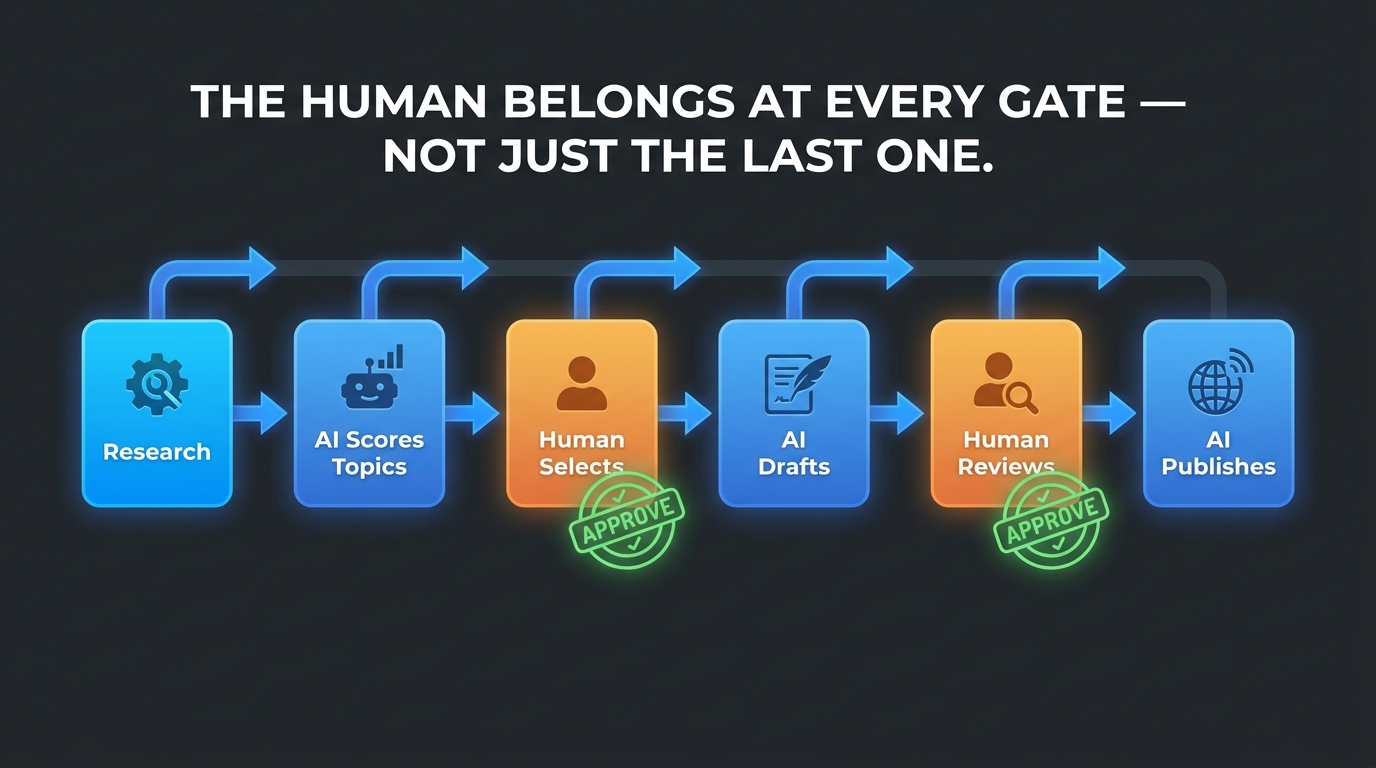
Max Johnson, founder of the AI agency briix, demonstrated this clearly when building an automated content production workflow in 2026. His pipeline ran in three stages: an AI agent researching and scoring potential topics (stage one), a human making the final topic selection (stage two), and then AI generating hooks and drafting the full script (stage three), with a final human review before anything was published. Every AI stage was bookended by a human decision gate.
That structure — AI does the work, human approves the consequence — is what separates automation that produces consistent quality from automation that produces variable output that sometimes embarrasses you. As Johnson himself noted about the process: “Vibe coding is describing what you want clearly and letting the model handle the entire building process for you. However, you’re still ultimately responsible for what’s built.” The same principle applies to every automated business process, not just code.
Where to Place the Gates
The key design question in any automated workflow is: where does a mistake become expensive? That’s where a human gate belongs. Before a customer-facing communication goes out. Before a financial transaction gets executed. Before a vendor order is placed. Before a piece of content gets published under your brand name. Before a hiring decision gets made.
The gates don’t need to be slow. In a well-designed pipeline, a human review step can take thirty seconds — it just needs to exist. The AI handles the volume; the human handles the consequence checkpoints. This is the model that’s producing durable, reliable automation results in 2026, and it’s also the model that most businesses underinvest in because the human checkpoints feel like they’re defeating the purpose of automation.
They’re not defeating the purpose. They’re what makes the purpose achievable at scale without creating downstream liability.
Knowing When to Stop Automating
The software factory concept also includes a principle that gets overlooked: knowing when not to automate. Paul Iusztin, reflecting on his experience building automated development pipelines, noted explicitly that the goal is to identify “when to stop automating before it adds more friction than value.” Over-automation — building pipelines so complex they become brittle, or automating tasks that genuinely require human judgment — is a failure mode just as real as under-automation.
The most common symptom of over-automation is a pipeline that requires more human intervention to manage and fix than the manual process it replaced would have required. If your team spends three hours a week maintaining an automation that was supposed to save two hours a week, the math has inverted. Recognizing that point before you reach it is a design discipline, not an admission of failure.
The Model Size Trap — When Bigger AI Costs More and Delivers Less
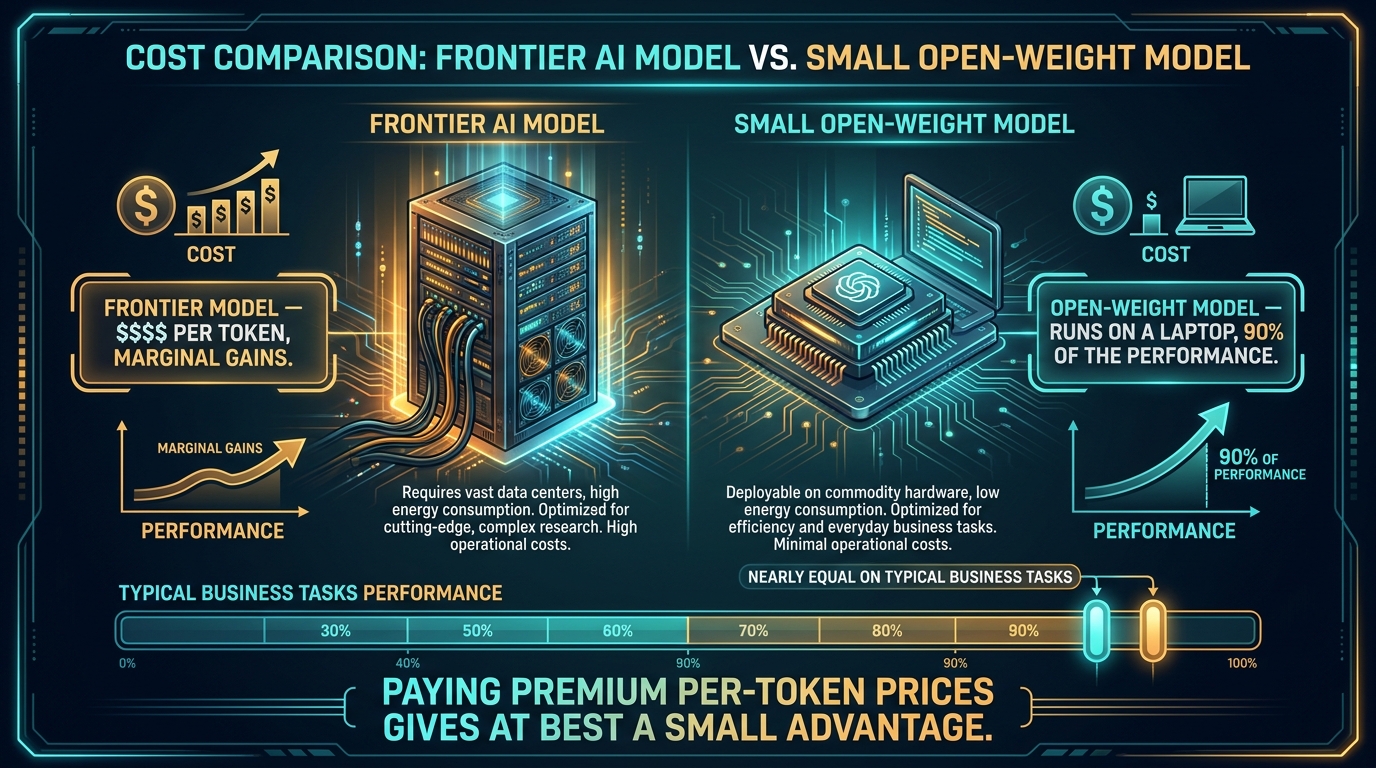
If your business is paying per-token rates for frontier AI model access to run routine business automation tasks, there’s a strong probability you’re spending significantly more than necessary for the actual performance difference you’re getting.
This is one of the most concrete and consequential shifts in the AI landscape through mid-2026, and it has real implications for how businesses should be structuring their automation costs.
Capability and Model Size Are Decoupling
The September 2026 O’Reilly Radar Trends report noted explicitly what many practitioners have been observing for months: “Capability and model size are decoupling. Several models run comfortably on a laptop or a single accelerator while claiming performance close to much larger frontier systems.” The report also made a pointed observation about economics: “Organizations are realizing that paying premium per-token prices for the latest frontier models gives at best a small advantage over the best open-weight models.”
IBM’s Granite 4.2 is a case in point. It’s a small open-weight reasoning model tuned for multistep tasks, available in 3B, 8B, and 30B sizes — all deployable locally, all competitive with frontier model performance on specific categories of business tasks. Meanwhile, a model called Ox Alpha briefly became the most-used model on the OpenRouter platform before being confirmed as GLM-5.3-Flash, a 320B open-weight model claiming performance similar to premium frontier offerings — running entirely on locally available hardware.
The direction of travel is clear. The performance gap between frontier and open-weight models for standard business tasks is closing faster than most organizations’ procurement assumptions account for.
What This Means for Business Automation Design
For business leaders making AI tool decisions, the practical implication is this: don’t assume the most expensive model is the right model for your use case. Frontier models — the latest flagship offerings from major AI labs — genuinely do have capabilities that smaller models don’t. They handle nuance better in open-ended creative tasks. They’re stronger on complex reasoning chains with many interdependencies. They’re more reliable on obscure edge-case knowledge. But for the majority of business automation tasks — structured data extraction, document processing, standardized communications, routine analysis and categorization — smaller, cheaper, often locally deployable models perform comparably.
A practical model selection framework: match capability to task complexity, not budget to vendor prestige. Reserve frontier model access for genuinely complex, high-stakes tasks where the nuance differential matters. Route routine, structured tasks through smaller models that cost a fraction of the price. Track your cost-per-task by category. And revisit those assignments quarterly — the model landscape in 2026 is evolving quickly enough that an assumption made in January may be outdated by April.
The Risk of Model Lock-In
Beyond cost, there’s a strategic risk in building automation workflows that are tightly coupled to a specific frontier model’s behavior. When that model updates, changes pricing, or — as happened with the announced removal of OpenAI model access from certain third-party platforms starting late 2026 — restricts access, organizations with hard dependencies face expensive emergency rework. Model-agnostic architecture, in which your business logic is separated from the specific model executing it, isn’t just good software design. In 2026, it’s a business continuity decision. We’ll return to this in more detail shortly.
Where AI Automation Is Actually Paying Off — A Department-by-Department Reality Check
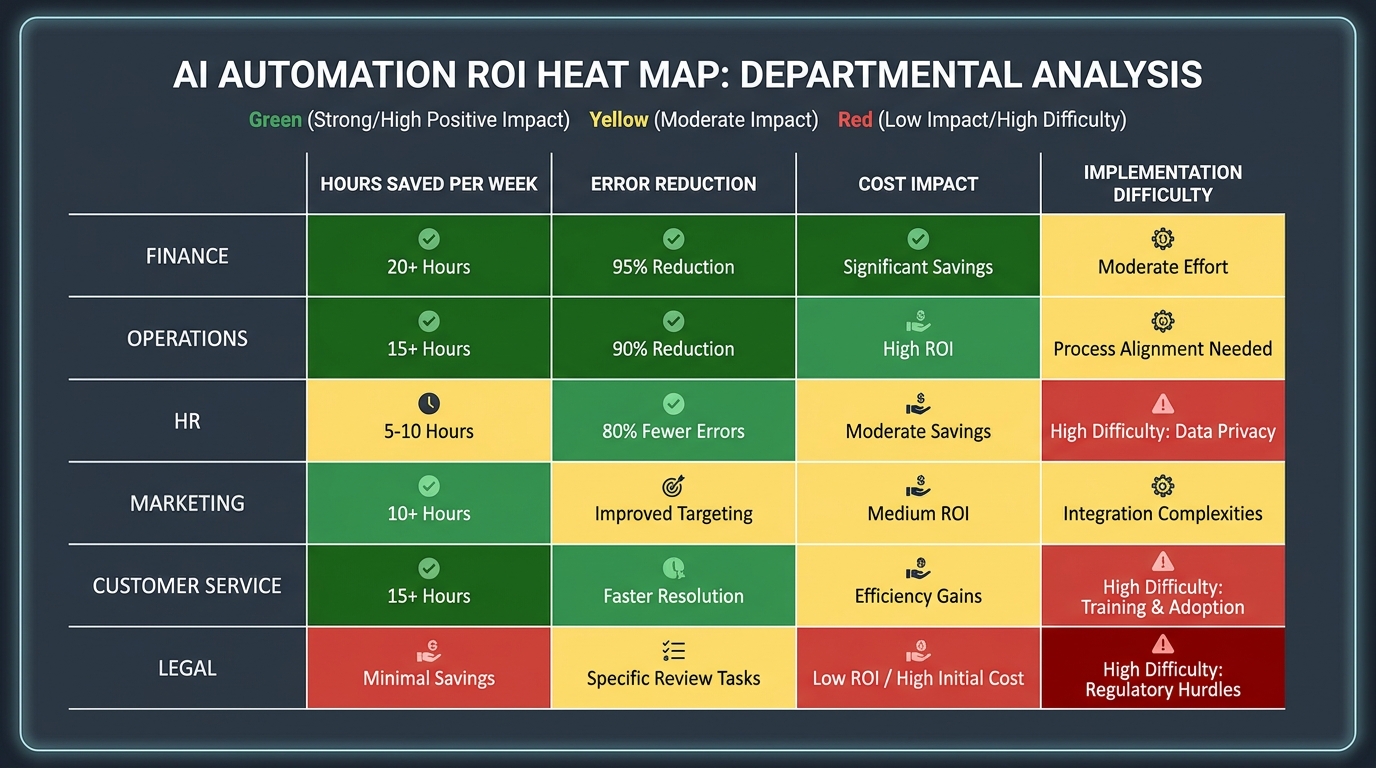
Not all departments benefit equally from AI automation. The honest assessment — which many vendor pitches gloss over — is that AI automation delivers strong returns in some areas, modest returns in others, and in certain domains, creates more problems than it solves at current capability levels. Here’s a frank look at where the evidence actually points.
Finance and Accounting: The Strongest and Most Consistent Returns
Finance consistently shows the highest ROI from AI automation, and the reasons are structural rather than coincidental. Financial processes are heavily rule-based. Inputs are largely standardized (invoices, expense reports, bank statements, purchase orders). Outputs are defined (approved/rejected, categorized, reconciled, flagged). Errors are detectable because numbers either balance or they don’t.
The strongest applications include invoice processing and three-way matching (cross-referencing purchase orders, receipts, and invoices automatically), accounts payable and receivable automation, expense report review and policy compliance checking, financial close process acceleration, and anomaly detection in transaction data. Organizations implementing AI effectively in these areas commonly report time savings of 60–80% on specific tasks, with meaningful reductions in processing errors — though those numbers are highly dependent on the quality of the underlying data infrastructure feeding the automation.
Operations and Supply Chain: High Value, Higher Complexity
Operations is the second strongest area, but with an important caveat: the value is real, and the implementation complexity is substantially higher than in finance. AI automation in operations typically requires integration with multiple systems — ERP platforms, supplier portals, logistics systems — and those integrations are where most projects bog down or overrun their timelines and budgets.
Where operations automation delivers well: demand forecasting, inventory optimization signals, shipping route optimization, routine supplier communication automation, and quality control exception flagging. Where it consistently struggles: scenarios with highly variable or unstructured inputs, real-time physical-digital coordination requirements, and any process that requires understanding context that isn’t captured in structured data fields.
Marketing and Content: Genuine Gains, Genuine Risks
Marketing is the most visible AI automation success story in 2026 — and also the source of some of the most visible and costly public failures. The gains are real: first-draft content generation, social media scheduling, performance reporting and attribution, audience segmentation, and email personalization all benefit from AI assistance. The risk is equally real: automation without adequate human review produces content that’s off-brand, factually incorrect, or tone-deaf in ways that damage customer relationships.
The consistent pattern among marketing teams getting AI automation right is the pipeline approach described earlier — AI generates, human approves. The teams getting it wrong have removed the approval step in the name of speed and later reversed course after a public-facing mistake that cost them more in damage control than the automation ever saved.
HR and Talent: Promising but Requires Careful Governance
HR automation delivers genuine value in a narrow set of areas: resume screening and initial candidate sorting by defined criteria, interview scheduling coordination, policy Q&A through internal knowledge base chatbots, and onboarding document processing. The risks in HR are more serious than in most other departments because errors involve people, employment decisions, and in several jurisdictions, legal liability for discriminatory screening outcomes.
AI-assisted hiring processes in particular are subject to emerging regulatory requirements in multiple regions that add governance overhead. The honest guidance: automate the administrative burden, not the judgment calls. Let AI handle scheduling, document routing, and information retrieval. Keep humans firmly in the decision loop for anything that affects employment outcomes.
Legal and Compliance: The Domain That Punishes Overconfidence
Legal is the area where AI automation confidence most consistently outruns actual capability. AI tools are genuinely useful for contract review flagging clauses that deviate from standard templates, regulatory monitoring tracking changes in applicable rules, and document management and organization. They are not reliably useful for legal judgment, strategic advice, or interpretation of novel situations — and treating AI outputs in these areas as authoritative without expert review creates significant liability exposure.
The specific failure mode to watch for: organizations automate contract review, trust the AI’s flagging as comprehensive, and miss clauses the AI didn’t surface because they didn’t match the pattern the system was calibrated on. The solution isn’t to avoid AI in legal contexts entirely — it’s to use it as a first-pass tool that reduces the volume of work reaching human reviewers, not as a substitute for that review.
What “Human in the Loop” Actually Means in Practice
“Human in the loop” has become one of the most overused and under-defined phrases in the AI automation conversation. It appears in every responsible AI framework, every vendor’s governance messaging, and most project plans. And in practice, it often means almost nothing operationally specific.
The Three Versions — and Why the Distinction Matters
There are actually three distinct things people mean when they say “human in the loop,” and they have very different operational implications for your automation design.
Human-on-the-loop means a human is monitoring and can intervene, but the process runs automatically unless they do. Outputs are produced and acted on; a human can see them and theoretically override them; without an override, they proceed. This is the weakest form of oversight — it requires the human to catch errors proactively, which requires them to be actively monitoring, which is often not realistic in practice at volume.
Human-in-the-loop in its strict sense means a human actively approves each output before it proceeds. The process pauses, a notification goes to a designated reviewer, they review and approve or reject, and only then does the pipeline continue. This is the most reliable form of oversight but is only practical at scale if the volume is manageable or the review step is genuinely fast (under two minutes, realistically).
Human-at-the-gate is a hybrid: the automation runs freely within defined parameters, but any output that falls outside those parameters — above a transaction size threshold, below a confidence score, involving a new vendor not on an approved list, touching a record flagged as sensitive — triggers a mandatory human review before proceeding. This is the most scalable approach for most business contexts because it focuses human attention where it’s actually needed rather than distributing it uniformly across every output.
Calibrating the Right Model for Each Workflow
The right human oversight model for any given workflow depends on three factors: the consequence of an error in that workflow, the volume of outputs it produces, and the demonstrated reliability of the AI system in your specific context (not in the vendor’s benchmark). High-consequence, lower-volume processes — contract approvals, customer refunds above a defined threshold, hiring stage advancement decisions — warrant strict human-in-the-loop. High-volume, lower-consequence, demonstrably reliable processes — email classification, document formatting, data entry into internal systems — can operate with human-on-the-loop or human-at-the-gate.
The mistake organizations make is applying the same oversight model uniformly across all their automation, usually defaulting to the weakest form (human-on-the-loop) because it feels like it’s maintaining oversight while actually requiring the least organizational change. The organizations with the best automation track records make the oversight model a deliberate, documented design decision for each workflow — not a default setting.
Building a Durable Automation Stack That Survives Model Changes
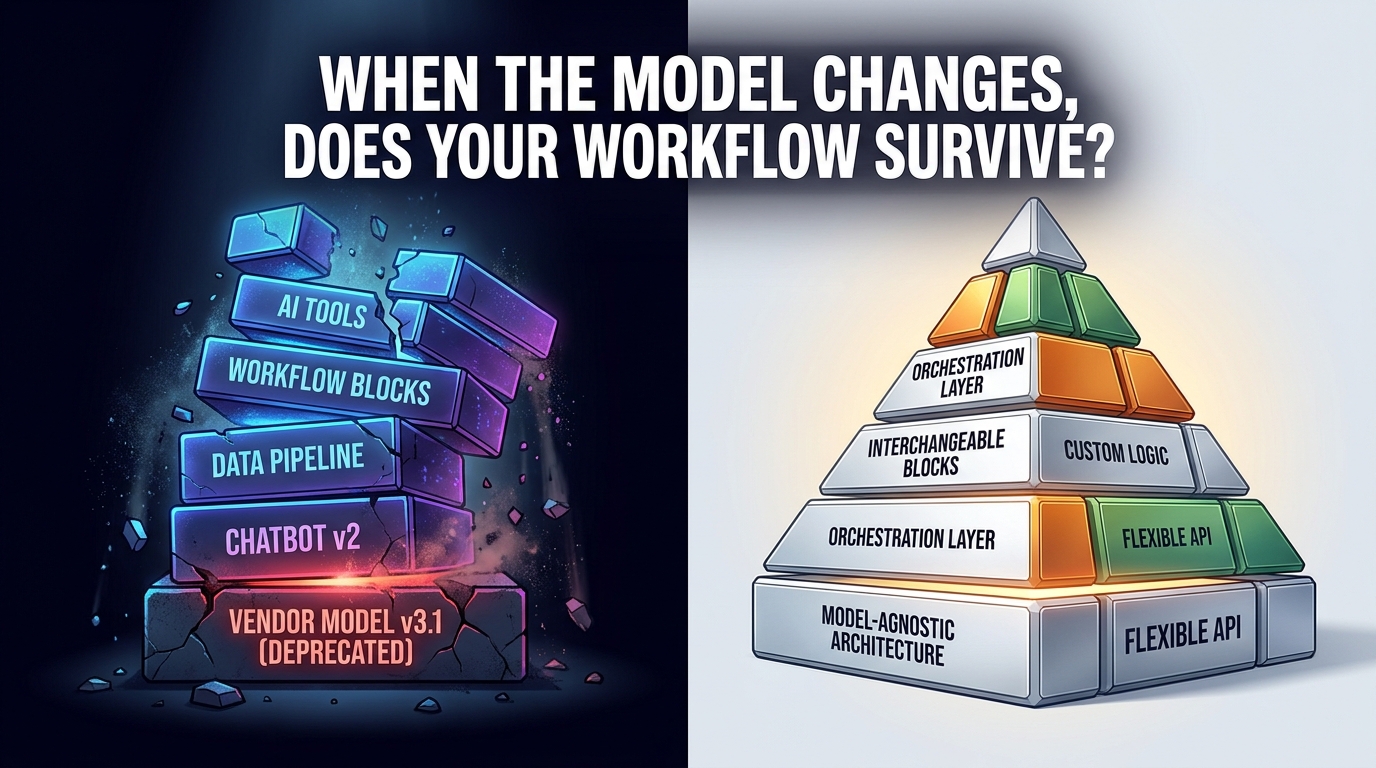
In August 2026, OpenAI announced that beginning November 12, 2026, Cursor — a widely used AI development environment — would no longer have access to OpenAI models. For organizations running business-critical automation built around specific model access through specific platforms, this type of announcement is the scenario that turns a working system into an emergency project. And it’s becoming more common, not less, as the AI platform landscape continues to consolidate, pivot, and reprice.
The Model-Agnostic Architecture Principle
Durable automation stacks are built on a straightforward architectural principle: your business logic lives in one layer; the AI model that executes it lives in another; and those two layers communicate through an interface that can be redirected. When one model becomes unavailable, too expensive, or superseded by a better option, the business logic doesn’t need to be rebuilt. Only the connection layer needs updating.
In practice, this means avoiding hard-coded model dependencies in automation workflows. Instead of building a pipeline that calls a specific model version directly, you route calls through an abstraction layer — whether that’s an internal API gateway, a model router service, or an orchestration platform that handles model selection as a configurable parameter rather than a hard dependency. The added engineering complexity upfront is a fraction of the scramble cost when a model changes and you’re rebuilding under deadline pressure.
Data Architecture Is as Important as Model Architecture
The durability of your automation stack also depends heavily on how your data is structured relative to your AI tools. Automation that works with clean, well-structured, accessible data survives tool and model changes much better than automation tightly coupled to how a specific tool ingests and processes messy raw inputs.
This is another contributing factor to why many organizations find their automation returns below expectations: the AI tool was selected and deployed before the data infrastructure was ready to support it cleanly. Getting the data layer right — standardized formats, reliable and timely sources, accessible APIs, consistent schema — is foundational work that pays dividends every time you update or replace a component in your automation stack. Organizations that skip it pay for it repeatedly, in unexpected ways, every time the underlying tooling shifts.
Treat Your Automation as a Living System
Perhaps the most important mindset shift for organizations building durable automation is moving from implementation thinking to operational thinking. Automation isn’t a project with a launch date and a completion marker. It’s infrastructure with ongoing operational requirements: monitoring, maintenance, regular updates, performance reviews, and periodic rebuilding as the environment changes.
The organizations with the most reliable automation in 2026 have designated automation owners — specific individuals responsible for the performance and health of specific pipelines — and they have regular review cycles where those pipelines are assessed against current business needs, current model options, and current cost structures. A general guideline that’s emerged from teams running automation in production: budget 20–30% of implementation cost annually for ongoing maintenance, and treat it as a fixed operational expense rather than a contingency. Automation that was optimally configured twelve months ago may need meaningful adjustment today. Treating it as a permanent, static system is the most reliable path to an expensive, brittle stack when the environment shifts.
The Businesses Getting AI Automation Right Have One Thing in Common
Pull back from the individual sections above — the governance frameworks, the task selection criteria, the model architecture principles, the oversight models — and there’s a single unifying characteristic among the organizations genuinely succeeding with AI automation in 2026. It’s not that they have better AI. It’s not that they have bigger budgets. It’s not that they made smarter vendor choices.
What separates them is that they built the human infrastructure first.
They decided who owns each automation before building it. They established what “human review” actually means in each workflow context before removing the human review step. They inventoried their nonhuman identities before deploying more. They designed for failure before building for the success path. They allocated maintenance budgets before they celebrated launch day. And they measured what automation was doing to their people alongside what it was doing to their productivity metrics.
None of this is technically complex. None of it requires a dedicated AI center of excellence or a six-figure consulting engagement. It requires discipline, specificity, and the willingness to slow down the implementation conversation long enough to answer the organizational questions that determine whether implementation holds up over time.
The Practical Starting Point
If you’re looking for a concrete place to begin, start with your smallest, most successful existing automation — the one that’s been quietly running and delivering value for months — and document it completely. Who owns it? What does it touch and with what permissions? What are its failure modes? What happens when it produces a wrong output? How would you know if it started performing poorly? What would you do if the underlying model or tool became unavailable?
If you can answer all of those questions cleanly and specifically, you have a template for how automation should be structured and governed across your organization. If you can’t — if the answers involve “I’m not sure,” “nobody specifically,” or “we’d probably find out when something goes wrong” — then you’ve found the governance gap that every subsequent automation investment will fall into until you close it.
Actionable Takeaways
- Build your nonhuman identity inventory now. List every AI tool and automation that authenticates against your business systems. Assign a named owner to each. Set a rotation schedule and an offboarding audit requirement. This single step prevents the most common governance failures organizations are experiencing in 2026.
- Select automation targets by three criteria before anything else: how frequently the task occurs, how standardized and predictable the input is, and what happens when the automation produces a wrong output. High frequency, high standardization, low failure consequence is your highest-value starting zone.
- Design your oversight model deliberately for each workflow. Choose explicitly between human-in-the-loop, human-on-the-loop, and human-at-the-gate for each process. Document why. Revisit that decision as the workflow’s volume and reliability profile changes.
- Separate your business logic from your model dependency in every automation you build. If swapping one AI vendor for another would require rebuilding your workflow from scratch, that’s an architecture problem to fix before you need to fix it under pressure.
- Budget 20–30% of implementation cost annually for maintenance. Treat your automation stack as infrastructure, not a completed project.
- Audit your model usage by task category. Don’t pay frontier model prices for tasks that smaller, cheaper, locally deployable models handle just as reliably. The cost savings are often substantial and reinvestable into expanding your automation footprint.
- Track what automation is doing to your people, not just your processes. Employee confidence in AI outputs, knowledge retention in affected roles, and exception handling quality are leading indicators of automation health that most organizations measure too late.
AI automation is not primarily a technology problem. It’s an organizational one. The businesses that build reliable, durable, genuinely high-performing automation in 2026 and beyond are the ones that treat it that way — and build the human layer with the same rigor, intention, and ongoing investment they bring to the technical one.