


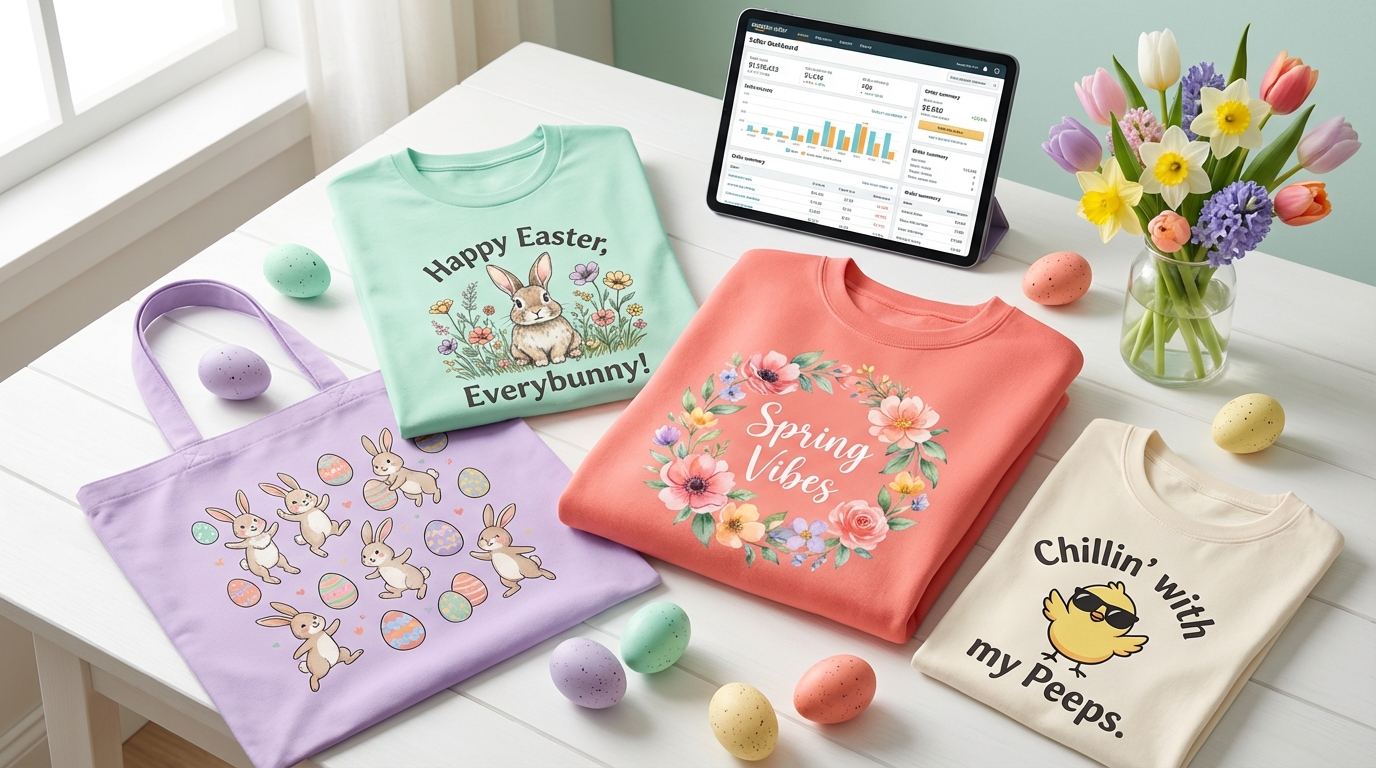

Most print-on-demand sellers treat Easter the same way they treat every other holiday — throw up a generic bunny graphic in early April, watch the listing go nowhere, then wonder why Christmas is the only season that ever moves the needle. That approach doesn’t work, and the sellers who figure that out early are the ones quietly stacking wins while everyone else is chasing trends they’re already late to.
Easter is a different kind of seasonal opportunity. It’s compressed, it’s driven by identity-based buying (family matching sets, professional pride, faith expression), and it rewards preparation in ways that more forgiving seasons simply don’t. Done right, Easter POD can generate a meaningful percentage of your annual Merch by Amazon revenue in a window of roughly six to eight weeks — before, during, and immediately following the holiday.
This post is the operational playbook. Not the surface-level “upload some bunny shirts” advice you’ve already read. We’re going deep into timing, design frameworks, niche stacking, product diversification, keyword architecture, and BSR-based research — the specific mechanics that separate sellers with Easter momentum from those who upload and pray. Whether you’re running Merch by Amazon, Redbubble, or a Printify-powered storefront that feeds Amazon, the principles here apply.
Let’s start where most guides don’t: with the actual size of the opportunity.
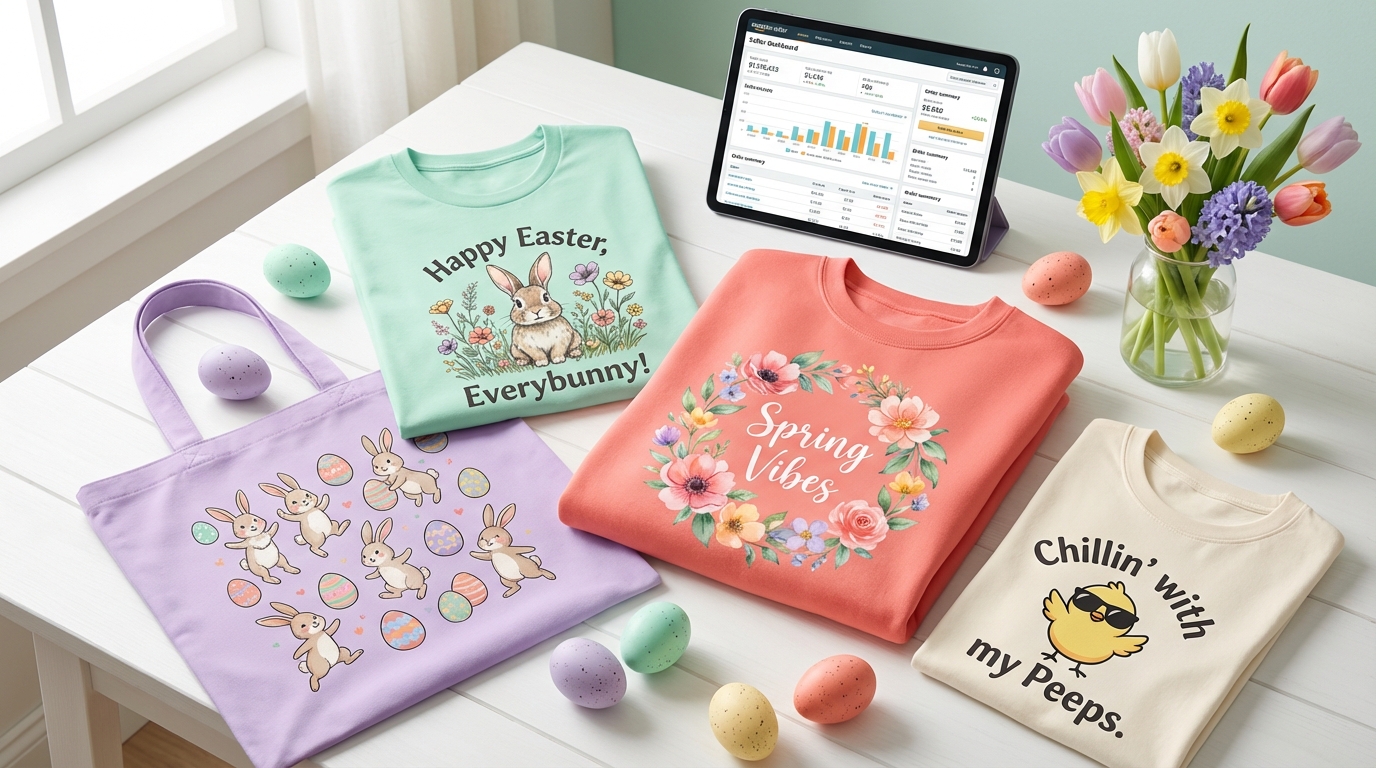
The Easter Spending Reality That Should Change How You Plan
If you’ve been treating Easter as a second-tier holiday — something to cover with a few designs after you’ve exhausted your St. Patrick’s Day uploads — the numbers from 2026 should recalibrate your thinking completely.
According to the National Retail Federation and Prosper Insights & Analytics, based on a survey of 7,845 consumers conducted in March 2026, total US Easter spending is projected to reach a record $24.9 billion — surpassing the previous record of $24 billion set in 2023. Average per-person spending hit $195.59, another all-time high. These aren’t soft projections. They’re based on reported purchase intent across categories that map directly to what POD sellers can offer.
What the Category Breakdown Means for POD Sellers
Breaking that $24.9 billion down by category reveals exactly where the opportunity lives:
- Clothing: $3.7 billion — 51% of consumers plan to buy Easter clothing
- Gifts: $3.9 billion — 64% plan to purchase gifts for others
- Decorations: 53% plan decoration purchases
- Candy: $3.5 billion (not a POD category, but signals overall household engagement)
- Flowers: $2.2 billion
The $3.7 billion clothing figure alone should grab your attention. That’s the slice of the pie where t-shirts, sweatshirts, family matching sets, and holiday-themed apparel live. And it represents spending by real consumers with real purchase intent — not wishlist browsers. When 51% of holiday shoppers say they’ll buy clothing for Easter, and a large portion of them are doing that research on Amazon, the question isn’t whether demand exists. It’s whether your listings are positioned to capture it.
Why Easter Outperforms Its Reputation
Easter routinely gets dismissed as a secondary holiday in e-commerce circles — smaller than Christmas, less culturally unified than Halloween. But that framing misses what makes it commercially distinct.
First, Easter demand is compressed. Unlike Christmas shopping, which begins in October and stretches for weeks, Easter buying surges in a shorter window — roughly four to six weeks before the holiday. That compression creates urgency on both sides: buyers who need gifts and family outfits quickly, and sellers who either have optimized listings ready or don’t.
Second, Easter buying is identity-driven. People aren’t buying Easter shirts for themselves in isolation. They’re buying family matching sets, buying gifts for teachers, buying something that signals faith, humor, or their kid’s favorite hobby. That identity dimension makes Easter an exceptionally strong niche-stacking opportunity, which we’ll unpack in detail shortly.
Third, Easter search volume on Amazon is substantial. The keyword “Easter” alone generates approximately 2.58 million monthly searches on Merch by Amazon — comparable to the search volume for “Halloween.” That’s not a niche keyword volume. That’s a market.
The Upload Timing Window: Why Being Early Is the Entire Game
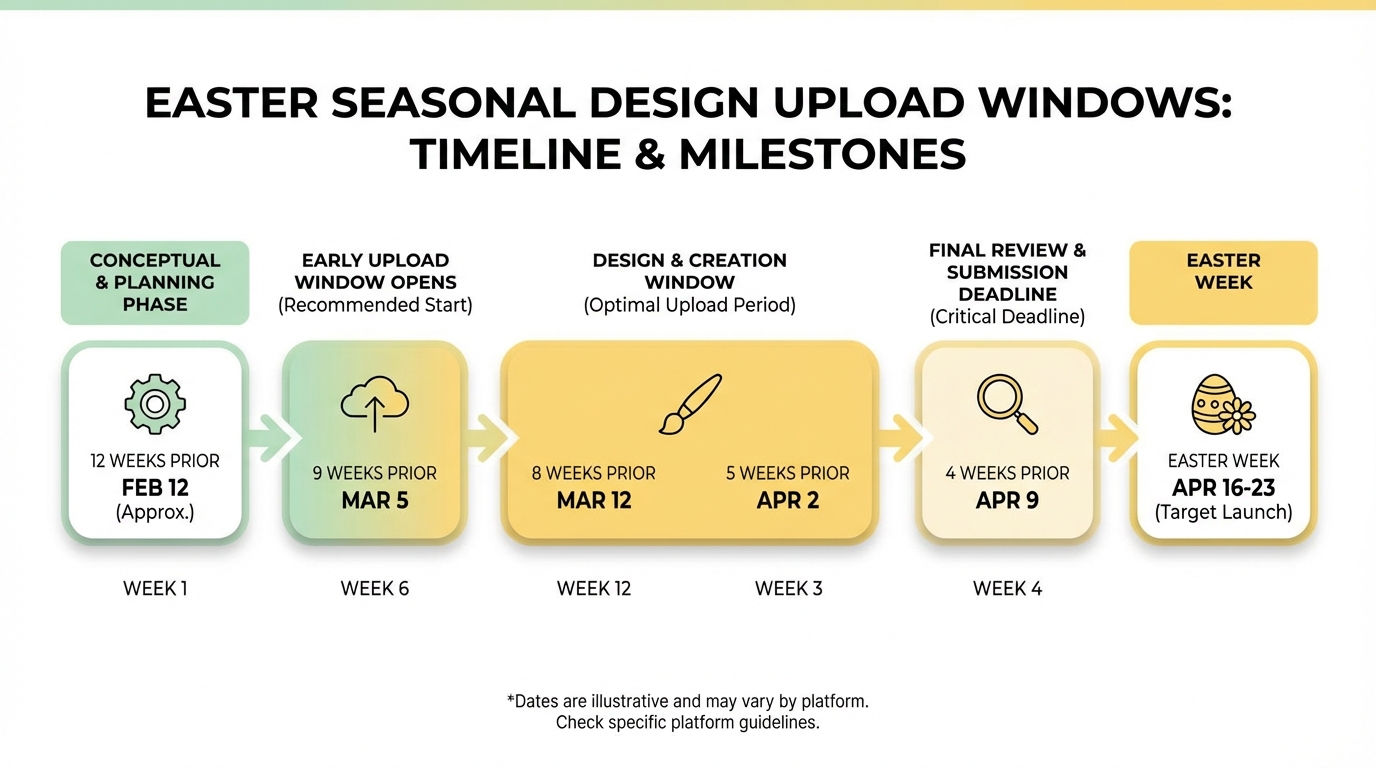
This is the section most sellers wish they’d read before their first bad Easter. The timing mechanics of seasonal POD on Amazon are not forgiving, and misunderstanding them is the single most common reason solid designs fail to generate meaningful sales.
The 35-Day Rule
The widely validated guidance for seasonal POD uploads on Amazon Merch is to have designs live approximately 35 days before the holiday date. For Easter 2026, which fell on April 5, that optimal upload window opened around March 1st. Sellers who uploaded in the first week of March had their listings indexed, earning initial sales data, and starting to accumulate BSR momentum before competition truly intensified.
Why does the 35-day window matter? Because Amazon’s algorithm needs time to do its work. A newly uploaded listing doesn’t immediately rank for “Easter bunny teacher shirt.” It needs to be indexed, it needs initial sales data (even a handful of units), and it needs click-through signals to start building organic ranking authority. Listings uploaded two weeks before Easter are effectively starting from scratch in a crowded field where competitors have already accumulated weeks of sales history.
The Pre-Season Research Phase (6–8 Weeks Out)
Serious Easter POD sellers aren’t doing research in March. They’re doing research in January and early February — analyzing what sold well the previous Easter, what niche angles remain underpenetrated, and what cultural trends (color palettes, design aesthetics, viral micro-trends) are building momentum heading into spring. By the time upload season opens, their design queue is already built.
The practical implication: if you’re using Easter to learn timing for the first time, you’re already behind this season. The value in understanding this framework is that it recalibrates how you plan for the next seasonal window. Summer designs need to be researched now. Fall and back-to-school need to be in ideation. Holiday designs need an early queue. This is the mindset shift that separates hobby POD sellers from those building a compounding seasonal catalog.
Post-Upload Momentum: The First 72 Hours Matter
When a design goes live on Merch by Amazon, the platform is watching what happens. Early sales signals — even two or three units in the first 72 hours — can meaningfully accelerate how quickly the algorithm serves your listing in search results. Sellers who understand this use small-scale Sponsored Products campaigns to seed that early data, then pull back on paid spend as organic ranking builds.
This isn’t a paid-advertising-dependent strategy. It’s about using a modest budget to compress the timeline from “new listing” to “organically ranking listing.” For a seasonal product with a hard deadline, that compression is worth a great deal more than it costs.
Design Frameworks That Actually Convert: Getting Past the Generic Bunny
The single biggest design mistake in Easter POD is defaulting to a generic Easter bunny — a clipart-adjacent graphic with no creative angle, no identity hook, and nothing to differentiate it from the forty thousand other bunny designs already on the platform. That design will not sell. Not because the bunny motif is wrong, but because the execution provides no reason for a specific buyer to choose it over anything else.
The designs that generate consistent Easter sales share a set of structural characteristics. Understanding those characteristics is more valuable than chasing any specific trend.
The Identity Anchor Principle
High-converting Easter designs give the buyer a reason to say “that’s for me.” They anchor to something beyond just “Easter.” That anchor can be:
- A profession (nurse, teacher, firefighter, accountant)
- A family role (mom, grandma, aunt, dog mom)
- A hobby or interest (reading, coffee, cats, gardening)
- A faith expression (He Is Risen, cross motifs, scripture references)
- A humor/personality type (puns, sarcasm, “it’s fine” energy)
The buyer who sees “Hoppy Easter, Blessed Nurse” isn’t just purchasing an Easter shirt. They’re purchasing an Easter shirt that represents them. That identity specificity is what makes someone click “Add to Cart” instead of scrolling past.
Design Simplicity Over Complexity
A consistent finding across POD platform data is that simpler designs outperform complex ones — especially on Amazon, where product images are small in search results and buyers make click decisions in fractions of a second. A clean, legible graphic with a punchy line of text performs better than an intricate illustrated scene that loses all its detail at thumbnail size.
The practical design rule: if you can’t read the key message of your design clearly when the mockup image is shrunk to 150px wide, the design won’t click well in search results. Prioritize visual clarity, high contrast, and instantly readable text over decorative complexity.
The Aesthetic Angle: 2026 Design Trends Worth Knowing
Easter 2026 has been influenced by several converging aesthetic trends that show up in top-selling listings:
- Coquette/bow aesthetics: Bunnies with oversized bows, feminine flourishes, and soft pastel palettes. Selling at high velocity on sweatshirts and crewnecks, particularly to women aged 25–44.
- Retro/Y2K revival: Bunnies in space, doodle art Easter eggs, wavy 1960s–70s bubble text typography. These bring a nostalgic creative energy that differentiates from flat, modern designs.
- Chintzery florals: Dense floral pattern backgrounds with Easter motifs overlaid — a trend that bridges the Pinterest “patina blue” color-of-the-year aesthetic with Easter’s natural spring associations.
- Faith-adjacent designs: Not overtly religious in the heavy-cross sense (which can narrow appeal), but subtly faith-forward — “He Is Risen” in elegant script, empty cross silhouettes, dove motifs. These serve a substantial audience that wants spiritual relevance without aggressive religious imagery.
- Pun-forward text designs: “Prepare to Die Dye,” “Hoppy Easter,” “Some Bunny Loves You,” and variations. These remain perennially effective because humor is a universal purchase trigger for gift buyers who need something that feels personal and fun.
Niche Stacking: The Cross-Niche Formula That Moves Real Volume
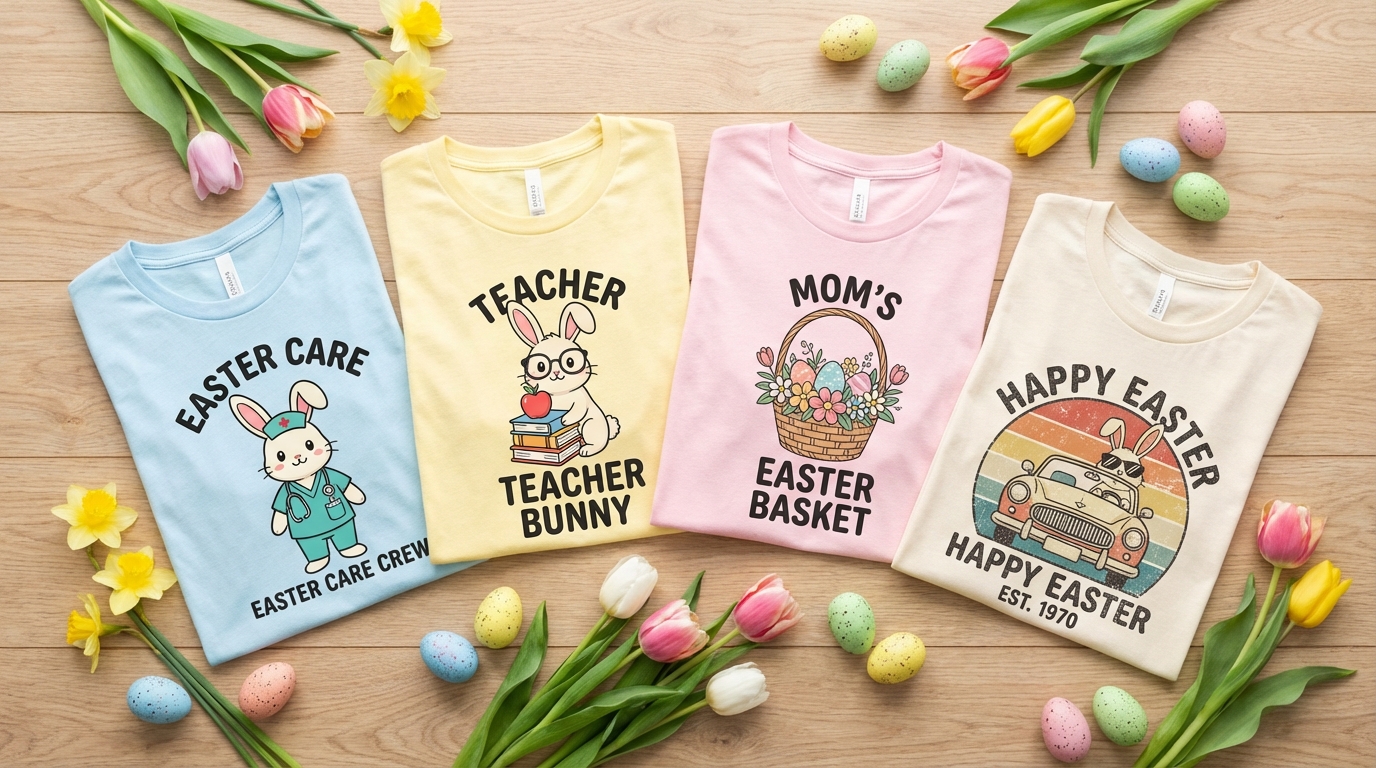
Niche stacking is the practice of combining two or more audience identifiers in a single design — Easter + a profession, Easter + a hobby, Easter + a family role. It’s the highest-leverage design strategy in seasonal POD, and it’s where the most experienced sellers generate disproportionate volume relative to the number of designs they upload.
The logic is straightforward: a generic Easter bunny shirt competes with the entire Easter apparel market. An “Easter Bunny NICU Nurse” shirt competes only with other Easter + nurse designs — a fraction of the competition, with equivalent or higher buyer specificity and purchase intent.
The Niche Stack Formula
The most effective niche stacks follow a simple three-part structure:
[Easter element] + [Identity group] + [Emotional hook or pun]
Examples that perform well in the market:
- Easter + Nurse: “Hoppy Easter, Nurse Life” — bunny in scrubs, stethoscope detail, coffee cup prop. Targets the massive nurse gift-buying market (family members buying for nurses, nurses buying for themselves).
- Easter + Teacher: “Some Bunny’s Favorite Teacher” — bunny with apples, pencils, or classroom elements. Effective for both teacher self-purchase and parent/student gifting.
- Easter + Mom: “Blessed Mama, Hoppy Easter” — works as a family-matching anchor piece. Mom buys her own shirt, the matching kids’ designs, potentially the dad variant too.
- Easter + Coffee: “Coffee and Easter Vibes” — targets the enormous coffee-obsessed demographic that buys merch year-round. Low competition relative to the audience size.
- Easter + Reading/Books: Reading-themed designs in wavy retro typography have tracked some of the strongest early-season BSR performance in March 2026, with rankings reaching 20K–23K — indicating consistent daily sales.
- Easter + Pets: “Dog Mom Easter,” bunny-eared pet illustrations. The pet niche is one of the most reliably purchase-motivated communities in all of e-commerce.
- Easter + Grandma: “Hoppy Easter Grandma” — grandparents buying for themselves, grandchildren buying as gifts. Double purchase trigger with strong gift intent.
How Deep to Stack
Two niches in a stack is typically the sweet spot. A three-niche stack (Easter + nurse + dog mom, for example) becomes too narrow to generate meaningful search volume, while a single niche (just Easter) is too broad to stand out. The two-niche formula hits the balance between specificity and audience size.
When planning your upload catalog for a season, a practical approach is to identify your top five to eight niche categories (professions, hobbies, family roles), then create two to three design variations for each Easter + niche combination. That gives you fifteen to twenty-four designs total — enough to cover a range of buyer personas without spreading your creative energy too thin.
Family Matching Sets as a Catalog Strategy
Family matching Easter outfits are a distinct sub-strategy worth addressing separately. Buyers purchasing matching family sets aren’t just buying one item — they’re buying four to six products (mom, dad, multiple kids, possibly grandparents) from the same design family. If your catalog supports that complete purchase, you capture multiple transactions from a single buyer intent.
This means designing Easter graphics that work on adult unisex shirts, women’s fitted styles, toddler tees, and infant garments simultaneously. The design should be consistent enough that they clearly “match” while being adapted for each product’s dimensions and audience. Sellers who build matching families tend to see higher average basket values from their Easter listings than those selling standalone pieces.
Product Types Beyond the T-Shirt: Where the Overlooked Margins Are

T-shirts dominate POD conversation because they dominate POD volume — approximately 50–60% of all print-on-demand sales across platforms occur in the apparel category. But framing your Easter strategy around t-shirts alone leaves a meaningful portion of revenue on the table, particularly when you consider that the gift and decoration spending categories (collectively $7.8 billion of the $24.9B Easter total) are where non-apparel products live.
Sweatshirts and Crewnecks: The High-Margin Apparel Move
If t-shirts are the volume play, sweatshirts and crewnecks are the margin play. They sell at $35–55 retail versus $18–28 for a standard tee, with royalty rates that translate to meaningfully higher per-unit income. The Easter window in late March and early April still has cool weather across much of the US and Canada, making a spring-weight crewneck a genuinely useful product — not just a novelty piece.
Coquette-style Easter bunny sweatshirts, specifically, have shown strong early-season velocity in 2026, with some Etsy-tracked designs selling eight to nine units per day — a strong signal for Amazon POD sellers to replicate the aesthetic on Merch listings and Printify-connected storefronts.
Tote Bags: The Easter Basket Connection
Tote bags are underutilized in Easter POD and represent a genuine opportunity. The connection to Easter baskets is intuitive — a reusable tote with an Easter graphic serves as an egg hunt bag, a gift presentation vessel, or a simple Easter basket alternative. Buyers searching for “Easter basket alternatives” or “Easter bag for kids” have strong purchase intent and relatively little competition in the POD-specific product space.
Design adaptation for tote bags is minimal: most Easter graphics that work on a t-shirt work on a tote with minimal modification. The key technical consideration is ensuring your design file is sized correctly for the tote’s print area (typically a larger canvas than a shirt), so the design doesn’t appear stretched or pixelated.
Mugs and Drinkware: The Easter Morning Gift
Easter morning coffee is a real ritual in millions of households. A mug with “Hoppy Easter” or a faith-based message for a grandparent, teacher, or coworker is a plausible and frequently purchased gift. Mugs price in a gift-friendly range ($16–24 retail) and have the advantage of being gender-neutral and age-flexible — the same design can plausibly sell to a 22-year-old and a 70-year-old.
The design consideration for mugs is simplicity and wrap-around legibility. Designs that work on t-shirts often need simplification for mugs — fewer elements, larger text, cleaner composition. Reusing a t-shirt design without adaptation is one of the documented mistakes that reduces mug conversion rates.
Home Décor: Tapping the 53% Decoration Buyer
With 53% of Easter shoppers planning decoration purchases, home décor POD products represent a category that’s structurally underserved by most Merch-focused sellers. Canvas wall prints, throw pillows, and blankets with Easter designs attract a buyer who is specifically in purchase mode for home use — not apparel, not gifts for others, but items for their own space.
The aesthetic for home décor Easter designs skews slightly more refined than apparel humor. Watercolor Easter scenes, floral bunny illustrations, and “Happy Easter” typography in elegant script perform better here than puns or niche-stacked profession graphics. Think of the person browsing Amazon for a spring-themed throw pillow — they want something that looks good in their home, not a joke shirt that happens to exist in pillow form.
Phone Cases and Stickers: Lower Price Points, Impulse Buys
Phone cases and sticker packs function as impulse additions and gift basket fillers. At $12–18 retail, they’re low-friction purchases with reasonable royalty margins. Phone cases have an additional advantage: they’re platform-searchable by device model, which creates a secondary keyword dimension (iPhone 16 Easter case, for example) that most sellers never optimize for.
Keyword Architecture for Easter Listings: Building for the Algorithm
Easter keyword strategy on Merch by Amazon operates on a hierarchy: broad seasonal terms drive volume, niche-specific long-tail terms drive conversion. Understanding that hierarchy — and how to use it across your title, bullet points, and backend search terms — is the difference between a listing that Amazon serves in relevant searches and one that sits invisible.
The Three-Layer Keyword Framework
Layer 1 — Broad Easter Terms (Title anchor):
These are the high-volume, lower-conversion terms that establish relevance for the season. “Easter shirt,” “Easter gift,” “Happy Easter,” “Easter basket stuffers” — these should appear naturally in your title, where Amazon places the highest indexing weight. “Easter” alone generates approximately 2.58 million monthly searches with relatively low competition intensity, making it one of the most accessible high-volume keywords in seasonal POD.
Layer 2 — Niche-Specific Phrases (Bullets and title tail):
These are where your niche stack becomes keyword strategy. “Easter nurse shirt,” “teacher Easter gift,” “Easter mom sweatshirt,” “Easter bunny funny tee” — these narrower phrases attract the buyer who has already moved past generic browsing and knows specifically what they’re looking for. Conversion rates on these terms are substantially higher than on broad terms because the buyer intent is more defined.
Layer 3 — Long-Tail Buyer Intent Phrases (Backend keywords):
These are the phrases that many sellers overlook entirely. “Easter gift for nurse coworker,” “matching Easter family shirts,” “Easter basket stuffers for women,” “funny Easter shirt for mom” — these phrases attract buyers in active gifting mode, which means higher purchase urgency and stronger conversion. They may have lower search volume, but they punch above their weight on conversion rate.
What Not to Do With Keywords
Keyword stuffing — the practice of jamming as many keyword variations as possible into a title or bullet point without regard for readability — is a documented conversion killer on Amazon. It creates titles like “Easter Shirt Funny Easter Bunny Gift Easter Basket Stuffer Easter Teacher Nurse” that look like keyword spam to both the algorithm and the buyer. Amazon’s search system, increasingly sophisticated in 2026, penalizes keyword density patterns that sacrifice readability.
A better practice: write your title the way a buyer would say it. “Funny Easter Bunny Teacher Shirt — Easter Gift for Teachers” is keyword-rich, niche-specific, and completely readable. It passes the human test and the algorithm test simultaneously.
Seasonal Keyword Timing
Start integrating Easter keywords into listings approximately six weeks before the holiday — not all at once, but gradually. Amazon rewards listings that build organic ranking history before demand peaks, rather than listings that appear fully keyword-optimized overnight with no preceding data. If you’re updating existing listings for Easter relevance, begin that process in late January or early February for an April holiday.
BSR as a Research Weapon: Validating Demand Before You Design

Best Seller Rank is one of the most actionable research signals available to POD sellers, and most people either don’t know how to read it or don’t use it consistently. Using BSR correctly to validate Easter niche demand before committing design hours to a concept is a fundamental skill for any serious seasonal seller.
Understanding BSR in the Context of Easter Designs
BSR is a relative ranking within a product category — lower numbers mean higher sales velocity. A t-shirt with a BSR of 50,000 is selling significantly more units than one ranked at 500,000. The key in seasonal research isn’t finding one design with a low BSR — it’s finding multiple designs in the same niche with consistently low BSRs. That pattern indicates genuine, sustained demand rather than a one-off sale.
In practical terms for Easter 2026: Easter shirts that achieved BSRs in the 75,000–100,000 range shortly after upload in early March were indicating early sales volumes in the range of 10–20 units per day on the stronger performers. Designs reaching BSRs of 20,000–23,000 (like the reading-themed Easter designs tracked in early March) were indicating substantially higher sales velocity — a signal worth replicating in your own upload strategy.
The Multi-Listing BSR Check
Here’s the specific research method: when you’re evaluating a niche angle (Easter + nurse, for example), search that phrase on Amazon and look at the BSR for the top five to ten organic results. If multiple listings in that search have BSRs under 500,000 — and ideally several under 200,000 — that niche has confirmed demand. If the top results all have BSRs above 1 million, the searches aren’t converting to purchases, and the niche isn’t worth prioritizing.
You’re looking for what experienced sellers call “BSR convergence” — multiple separate listings, from different sellers, all showing strong sales in the same niche. That convergence pattern confirms that buyer demand is real and persistent, not just a search curiosity that doesn’t convert.
Watching BSR Movement Over Time
A single BSR snapshot is useful. BSR movement over time is far more valuable. A listing that had a BSR of 300,000 three weeks ago and now has a BSR of 80,000 is rapidly gaining sales momentum — a signal that the niche is building. A listing that started at 80,000 and is now at 400,000 is losing momentum, likely post-peak. For Easter research, you want to identify niches in the building phase, not the declining phase.
Tools like Helium 10’s BSR tracking, Merch Informer, and even manual Amazon review date analysis (checking how recent the most recent reviews are) can help you assess BSR trajectory without expensive software subscriptions.
Common Easter POD Mistakes That Kill Sales
Understanding what not to do is as valuable as knowing what works. These mistakes are consistently documented across POD forums, seller communities, and platform data — and most of them are entirely avoidable with a bit of forethought.
Mistake 1: Uploading After the Window Closes
This is the most common mistake and the most damaging. Uploading Easter designs in the final week before the holiday gives your listings essentially no time to index, accumulate data, or build organic ranking. The result is listings that go live into a crowded search environment with no ranking authority, which means they effectively don’t exist. Next Easter, your goal is to have designs uploaded by the first week of March, ideally earlier.
Mistake 2: Copyright and Trademark Blind Spots
Easter is full of IP landmines that catch new sellers off guard. The most common: character-adjacent designs (anything that could be construed as resembling a licensed character — Easter Bunny imagery that borrows too heavily from a known IP), phrase trademarks (seemingly generic phrases that have been trademarked in the clothing category), and font licensing issues (fonts downloaded from Google Fonts or free sources that are actually not commercially licensed for printed goods).
The practical defense: run any phrase you intend to use through the USPTO TESS database before uploading. Use only design assets you’ve purchased commercial licenses for or created yourself. When in doubt, don’t use it — the cost of a Merch account suspension vastly outweighs the upside of any single design.
Mistake 3: Reusing T-Shirt Designs Unchanged on Other Products
A design file that looks great on a t-shirt frequently looks wrong on a mug, tote bag, or phone case without adaptation. The proportions differ, the print area wraps differently, and details that are legible at shirt-print size become muddy at mug-wrap scale. Taking the extra hour to create product-specific design adaptations meaningfully improves conversion rates on non-apparel products.
Mistake 4: Overt Religious Imagery That Narrows Buyer Pool
Faith-based Easter designs perform well — there’s a strong, underserved audience for them. But designs that lead with aggressive or prescriptive religious imagery substantially narrow the buyer pool without a proportional increase in purchase intent from the faith audience. Designs that offer a subtle faith nod — an elegant “He Is Risen” in script, a minimalist empty cross, a dove motif with a scripture reference — reach both the devout buyer and the casually faith-adjacent buyer. The subtle approach typically outperforms the heavy-handed approach in sales data.
Mistake 5: No Post-Easter Design Thinking
Easter designs can continue generating sales after the holiday if you build them with some evergreen flexibility. A “Spring Vibes” design that happens to feature a bunny sells in April, May, and even into June. A “Blessed Mom” design with spring florals can run year-round. Sellers who only create hard-dated Easter content lose all residual value the day after the holiday. Building in subtle flexibility — avoiding year-specific dates, keeping the seasonal hook visual rather than explicit — extends the earning window considerably.
Design Aesthetics Winning in 2026: The Visual Language of What’s Selling
Beyond the structural frameworks of niche stacking and keyword architecture, the visual execution of your designs determines whether a buyer stops scrolling. These are the specific aesthetic directions showing up in high-performing Easter listings in 2026.
Color Palette Trends
Pinterest’s 2026 trend forecasting and Etsy’s color-of-the-year data (patina blue) align on one clear signal: cool blues are having a major moment in spring aesthetics. Specifically, dusty teal, soft powder blue, and sage green are performing strongly in Easter designs, often paired with cream or off-white rather than stark white. The traditional Easter pastels (lavender, bubblegum pink, butter yellow) remain relevant but feel less fresh against this cooler backdrop.
For POD design purposes: if your Easter designs are defaulting to hot pink and electric yellow, consider testing cooler-toned palette variants. The visual differentiation alone can improve click-through in a search results page where most competitors share a similar warm pastel visual language.
Typography Choices
Two typography families are dominating Easter POD in 2026:
- Retro bubble/groovy text: The wavy, chunky typefaces associated with 1960s–70s design are showing up in top-ranking Easter designs consistently. Simple phrases like “Happy Easter” in this style have a visual distinctiveness that reads immediately in thumbnail-size images.
- Elegant script: At the other end of the spectrum, refined serif and script fonts paired with minimalist illustrations perform well in the faith-adjacent and mom/grandma buyer segments. Clean, sophisticated typography signals a premium quality that justifies sweatshirt-level price points.
What’s not working as well: overly trendy fonts that feel dated within months, decorative typefaces that sacrifice readability at small sizes, and multi-font combinations that create visual clutter rather than hierarchy.
Illustration Style
Three illustration approaches are generating consistent results:
- Minimalist line art: Simple, single-color or two-color outline illustrations — a bunny silhouette, an egg outline, a simple cross. Highly adaptable across product types and color palettes.
- Watercolor wash: Soft, painterly backgrounds with bunny or floral subjects. This style reads as artisanal and commands higher price tolerance from buyers. Effective for sweatshirts and home décor.
- Bold graphic / vector flat: High-contrast, clean vector art with no gradients or complex shading. Reproduces cleanly across print surfaces, reads well at thumbnail size, and adapts easily to different product types.
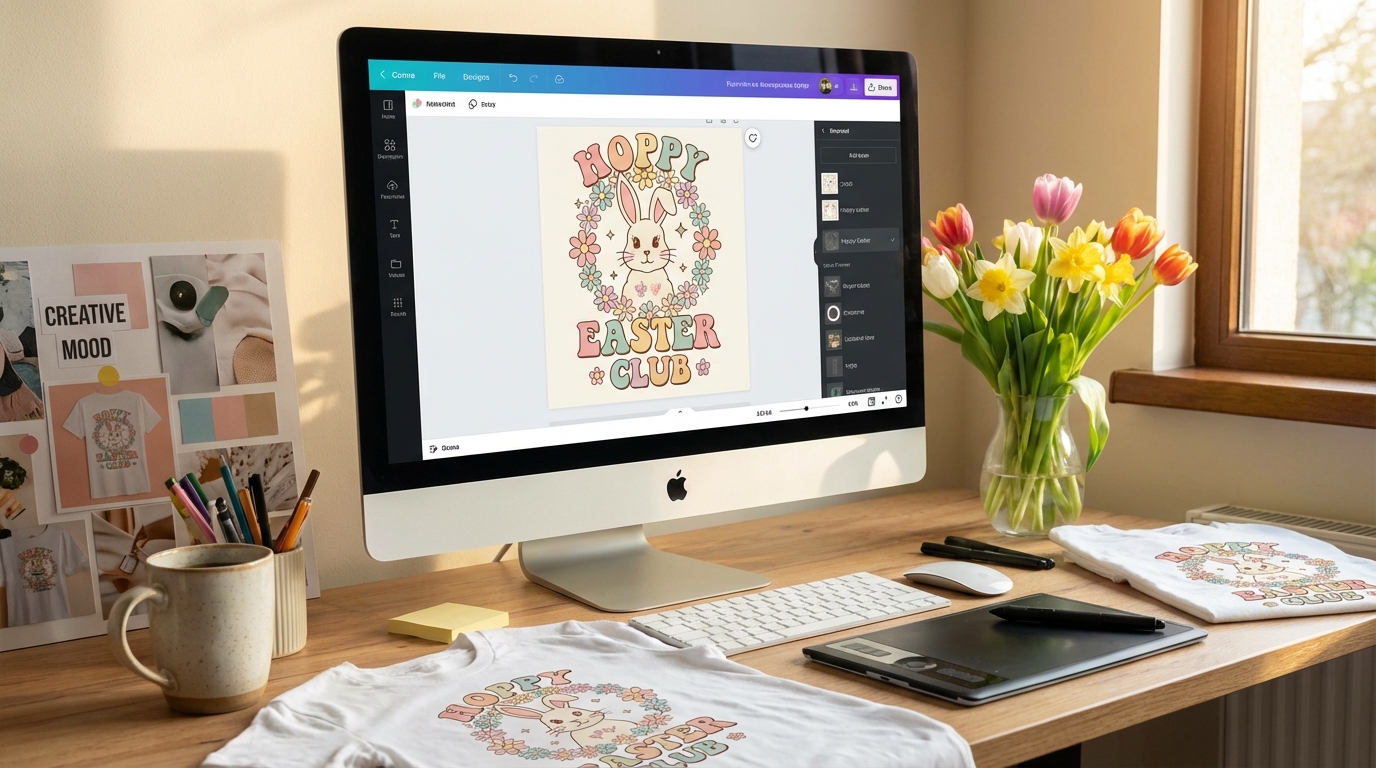
AI-assisted design tools — Playground AI, Midjourney, Adobe Firefly — have made all three of these styles accessible to sellers without professional design backgrounds. The key is using these tools to generate a starting asset, then refining it in a design application like Canva or Adobe Illustrator to ensure the file specs meet platform requirements: 300 DPI, transparent background, sRGB color profile, PNG format.
Post-Easter Strategy: Building a Catalog That Earns Year-Round
The Easter window closes, and sellers who’ve been purely reactive — uploading seasonal designs, chasing sales, then moving on — are left with a catalog of dormant listings and no compounding value. The sellers building durable POD businesses think differently about what happens after a seasonal peak.
Post-Season Analysis: The Data You Should Be Collecting
In the week following Easter, pull every piece of data available from your Merch dashboard and any third-party tools you use:
- Which designs sold at least one unit?
- Which niche stacks performed best relative to their competition?
- Which product types generated the highest per-unit royalties?
- Which keywords drove organic traffic to your top listings?
- What price points converted best?
This data is worth more than any trend research you can do externally, because it reflects your specific catalog’s performance with real Amazon buyers. A niche combination that you tested this season and that outperformed your expectations is almost certainly worth expanding for next season — with more design variations, more product types, and better keyword optimization built in from day one.
Evergreening Your Easter Designs
Designs that performed well during Easter can be adapted for year-round relevance with minor modifications. A “Bunny Nurse” design can become a “Spring Nurse” design with a botanical border swap. A family matching Easter set can be relaunched with summer colors and a beach-adjacent theme. The underlying niche stack contains the real commercial insight, and that insight applies across seasons with aesthetic adaptation.
Some Easter designs require no adaptation at all. Generic spring florals, faith expressions without specific holiday references, and humor-forward phrases that reference spring (rather than Easter specifically) can remain live and earning through May and June without any updates. Let these listings sit and capture residual search traffic — even 10–20 additional sales per listing per month adds up across a catalog of 50+ designs.
Building Your Easter Catalog for Next Year — Starting Now
The most valuable insight from this playbook is also the hardest to act on immediately: the best time to prepare for next Easter is in the months following this one. The successful sellers consistently dominating Easter searches aren’t starting their research in January. They’re running Easter post-mortems in April and May, building their niche research and design queue through the summer, and uploading a polished, strategically selected catalog in late January or early February the following year.
That twelve-month preparation cycle sounds extreme if you’re used to reactive seasonal uploading. But it’s the difference between a catalog that earns $300–500 during Easter week and one that earns $3,000–5,000 across the full seasonal window — from the first research-mode buyers in February through the last-minute shoppers on Easter morning.
The Seasonal Compounding Effect
Each well-researched seasonal upload adds to a catalog that earns passively in every subsequent year. An Easter bunny nurse design that you upload this spring isn’t just a 2026 asset — it’s a 2027 asset, a 2028 asset, and a 2029 asset, assuming it stays compliant and earns enough sales to maintain its tier status. Over three to five years, a well-maintained seasonal POD catalog becomes a genuinely significant passive income source — not because any single design is exceptional, but because the compounding effect of many good designs across many seasons produces cumulative royalty income that dwarfs what any individual upload can achieve.
This is the long game that most POD sellers never reach, because they never develop the discipline to prepare seasonally rather than react seasonally. Easter is the perfect season to start building that discipline — compressed, clear-deadline, data-rich, and repeating annually whether you’re ready or not.
Conclusion: The Easter POD Playbook in Practice
Easter POD success on Amazon isn’t about being the most creative designer or having the largest catalog. It’s about executing a repeatable process at the right time, with the right niche angles, across the right product mix, with listings that are built to rank and convert.
The $24.9 billion in projected 2026 Easter spending — including $3.7 billion in clothing alone — confirms that the buyer demand is real, substantial, and structurally tilted toward the kinds of identity-based, gift-driven purchases that print-on-demand is uniquely positioned to serve. The sellers capturing meaningful slices of that spending are doing so not by accident, but by understanding the specific mechanics this playbook covers:
- Upload timing: 35 days before the holiday is your target. Research starts 6–8 weeks before that.
- Niche stacking: Easter + identity (profession, family role, hobby) outperforms generic Easter every time.
- Product diversification: T-shirts are the volume play, but sweatshirts, tote bags, mugs, and home décor expand your addressable buyer base into gift and decoration spending.
- Keyword architecture: Three-layer structure (broad, niche-specific, long-tail buyer intent) built for readability, not keyword density.
- BSR validation: Research niches before designing, not after. Confirm demand with multiple low-BSR listings, not just one.
- Design execution: Simplicity, identity anchoring, and current aesthetic trends (coquette, retro, chintzery, cool blues) over generic clipart.
- Post-Easter discipline: Analyze what worked, evergreen what you can, and begin next year’s research cycle while everyone else is recovering from the holiday rush.
The sellers who win at Easter POD aren’t the ones with the most designs. They’re the ones who treat it as a strategic exercise — timed, researched, and optimized — rather than a creative dump. Apply this playbook to your next seasonal cycle, and the results will compound in ways that reactive uploading never will.