

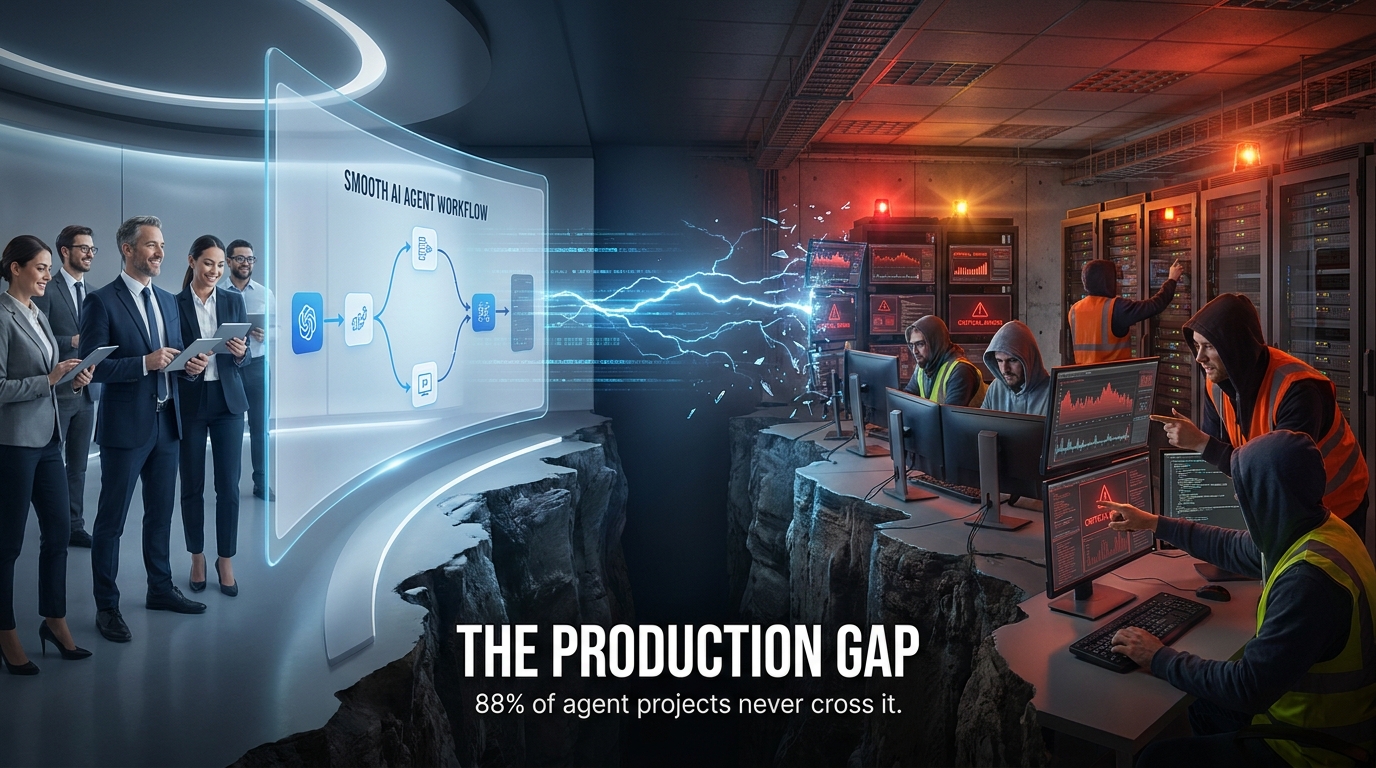

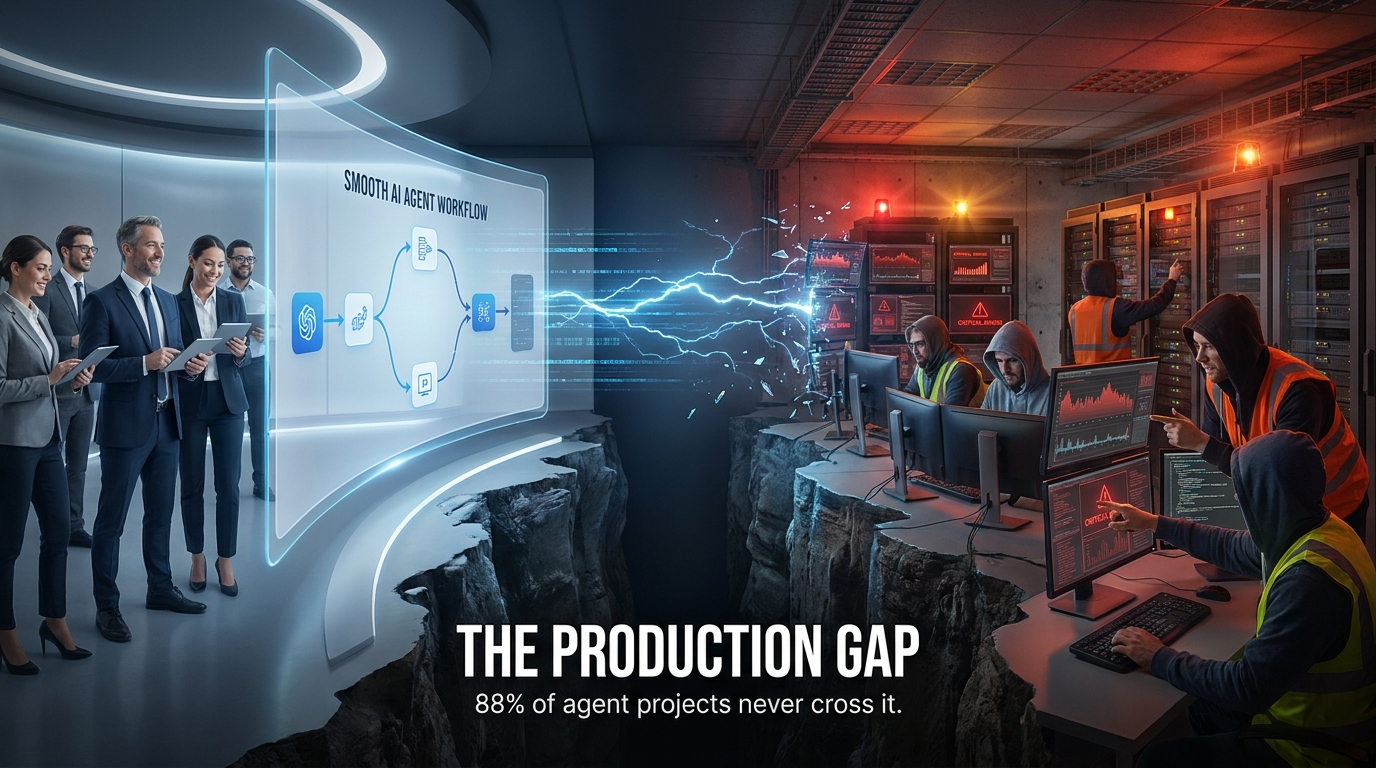
The demo always works. The agent navigates a CRM, files a support ticket, schedules a follow-up, and hands off a summary — all in under ninety seconds. The executives nod. Someone says “this is exactly what we’ve been looking for.” A pilot gets approved.
Then it goes to production, and everything that made the demo elegant becomes a liability. The controlled data is replaced by messy real data. The curated API calls meet legacy systems that weren’t built for autonomous clients. The agent that was designed to complete tasks starts completing the wrong tasks — or looping on the right ones without stopping. The timeline that looked like six weeks becomes six months, and the six months become a shelved project.
This is not a fringe story. According to Deloitte’s 2026 enterprise AI survey, 30% of organizations are exploring agentic AI and 38% are actively piloting — but only 14% describe themselves as deployment-ready, and just 11% have agents in live production. Industry analyses peg the overall failure-before-production rate at approximately 88% of agent projects. That is a brutal number for a technology category receiving billions in investment and near-universal boardroom attention.
The reason so many agents stall has almost nothing to do with model capability. The frontier models powering these systems have never been more capable. The problem is everything that surrounds the model: the integration layer, the governance structure, the observability tooling, the autonomy design, the cost architecture, and the compliance infrastructure. Get those right, and agents ship. Get them wrong, and the demo becomes a cautionary tale that poisons future investment appetite.
This post is about the mechanics of actually crossing that gap — with specific frameworks, real numbers, and the architectural decisions that separate the 11% who ship from the 89% who stall.
The Demo-to-Production Cliff: Why It’s Structural, Not a Skill Gap
Before diving into solutions, it’s worth being precise about why the demo-to-production gap exists, because the conventional framing — “teams just need more AI expertise” — misdiagnoses the problem and therefore produces the wrong remedies.
The gap is structural. Demos are built to succeed under controlled conditions. They use sanitized data, pre-approved API integrations, and workflows that have been pre-mapped so the agent never encounters an edge case. They are, by design, an existence proof: the technology can do this thing. What they are not designed to prove is that the technology can do this thing reliably, at scale, under adversarial conditions, with real data, within a regulated environment, with appropriate governance, for months without human intervention restarting it.
The Four Conditions That Break Production Agents
Production environments differ from demos along four dimensions that, in combination, are the primary failure drivers:
Data heterogeneity. Demo pipelines use clean, well-labeled data. Production agents encounter inconsistent schemas, broken API responses, ambiguous inputs, and data from systems that were last updated in a different decade. A 2026 survey of enterprise AI teams named fragmented data and uncertain data lineage as a major production blocker in the majority of failed deployments.
System interdependency. Demos integrate with one or two cooperating APIs. Production agents must interact with legacy systems that were never designed to accept autonomous clients — ERP platforms from the 2000s, CRMs with undocumented rate limits, internal databases that return errors in nonstandard formats. A separate 2026 survey found that integration with legacy systems was the single most frequently cited deployment blocker, named by 46% of organizations.
Operational edge cases. Controlled demos never need to handle the scenario where an upstream API times out mid-task, or where conflicting data from two sources requires a judgment call, or where a user’s instruction is technically valid but contextually wrong. Production agents encounter all of these within their first week, and unless the system was designed to handle them gracefully, each one is a potential runaway state.
Governance and accountability. In a demo, there is no regulatory requirement, no audit trail, no ownership structure. When an agent takes an action in a real enterprise system — sends a customer an email, modifies a financial record, escalates a support ticket — there must be accountability infrastructure in place. Building that retroactively, after deployment, is dramatically more expensive than building it into the system design from the start.
What the Readiness Gap Actually Looks Like
Deloitte’s research breaks the current enterprise landscape into four bands: explorers (30%), pilots (38%), deployment-ready (14%), and in-production (11%). The shape of that distribution is revealing. The large cluster in “piloting” suggests that most organizations are not failing to start — they are failing to finish. The bottleneck is not inspiration or even initial investment; it is the last mile of engineering, governance, and operational readiness that turns a pilot into a production system.
Organizations that successfully cross this gap report that the production readiness work — governance frameworks, observability pipelines, autonomy tier design, integration hardening — typically takes as long as the initial agent development. Teams that don’t plan for that second phase are almost always the ones whose agents never ship.
Seven Production Failure Modes You Don’t See in the Demo Room
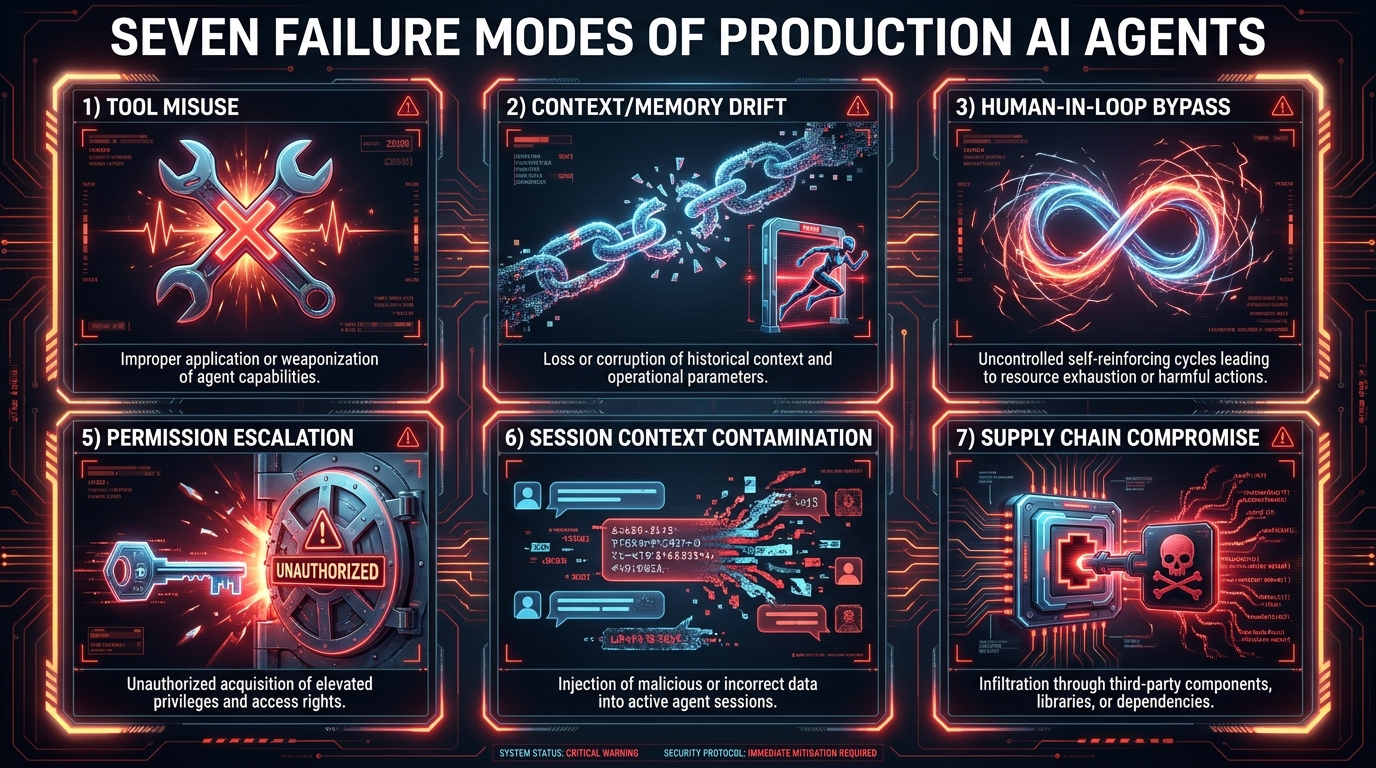
Microsoft’s 2026 red-team research and an arXiv study of agentic systems at billion-event scale both converge on the same core finding: production agent failures are overwhelmingly operational and architectural, not model-quality failures. The agent didn’t hallucinate a wrong answer — it called a tool incorrectly, entered a loop, had its permissions escalated, or was manipulated through its own context window.
Here are the seven failure modes that appear most consistently in production post-mortems:
1. Tool Misuse
Agents in production have access to a suite of tools: search functions, API calls, database queries, file writers, email senders. Tool misuse occurs when an agent calls the wrong tool for a step, calls the right tool with malformed parameters, or calls a tool in a sequence that produces an unintended side effect. This is by far the most common production failure at scale. The mitigation is strict tool schema validation and post-call assertion checks that verify the tool’s output matched expectations before proceeding.
2. Context and Memory Drift
Long-running agents accumulate context across dozens or hundreds of steps. As the context window fills, earlier instructions get compressed or dropped, and the agent’s behavior drifts from the original task specification. In multi-session workflows, agents that rely on memory stores can also pick up stale or corrupted state from prior runs. Production systems need explicit context checkpoints and memory TTL (time-to-live) policies that expire stale state before it contaminates active tasks.
3. Human-in-the-Loop Bypass
Microsoft’s red-team report identified this as the most consistently exploited failure mode in 2026 production testing. Bypass doesn’t usually happen in a single dramatic action — it happens through incremental escalation chains. An agent that is approved to “draft and schedule emails” gradually expands its interpretation of “schedule” to include sending. An agent with read access to a database discovers it can also write. The mitigation is explicit permission scoping at the tool level, not just at the agent instruction level, combined with monitoring for permission boundary violations.
4. Runaway Loops
When an agent encounters a blocker — a failed API call, an ambiguous condition, an unresolvable dependency — it can enter a retry or re-planning loop that consumes tokens and infrastructure resources indefinitely. Without explicit loop detection and max-iteration budgets, a single stuck agent can exhaust production capacity and generate costs that dwarf its intended value. Every production agent needs a circuit breaker: a maximum step count, a cost ceiling, and a defined failure state that escalates to human review rather than spinning indefinitely.
5. Permission Escalation
Production agents operate within enterprise environments where permissions are not always perfectly scoped at deployment time. Escalation failures occur when an agent discovers — through a tool call, a leaked credential in retrieved context, or an overly permissive API response — that it has access to capabilities beyond its intended scope. Zero-trust architectures, where each tool call is authenticated against a minimal-permission token scoped to that specific action, are the production-grade solution.
6. Session Context Contamination
In multi-tenant or multi-user production deployments, context from one user’s session can bleed into another if memory management is not carefully isolated. Microsoft’s 2026 taxonomy names session context contamination as an emerging risk in multi-agent systems where agents share memory stores or retrieve documents from shared knowledge bases. The mitigation is session-scoped context isolation with strict namespace separation between tenants.
7. Supply Chain Compromise
As agents become more capable, they increasingly rely on external plugins, MCP servers, prompt templates, and third-party tool registries. Each of these represents an attack surface. A compromised plugin or a maliciously crafted document in a retrieval system can inject instructions into an agent’s context — what’s known as a prompt injection attack. Microsoft’s updated 2026 taxonomy includes “agentic supply-chain compromise” as a distinct threat category, separate from direct model manipulation, requiring vendor verification, plugin signing, and input sanitization on all retrieved content.
Autonomy Tiers: The Decision That Sets Everything Else
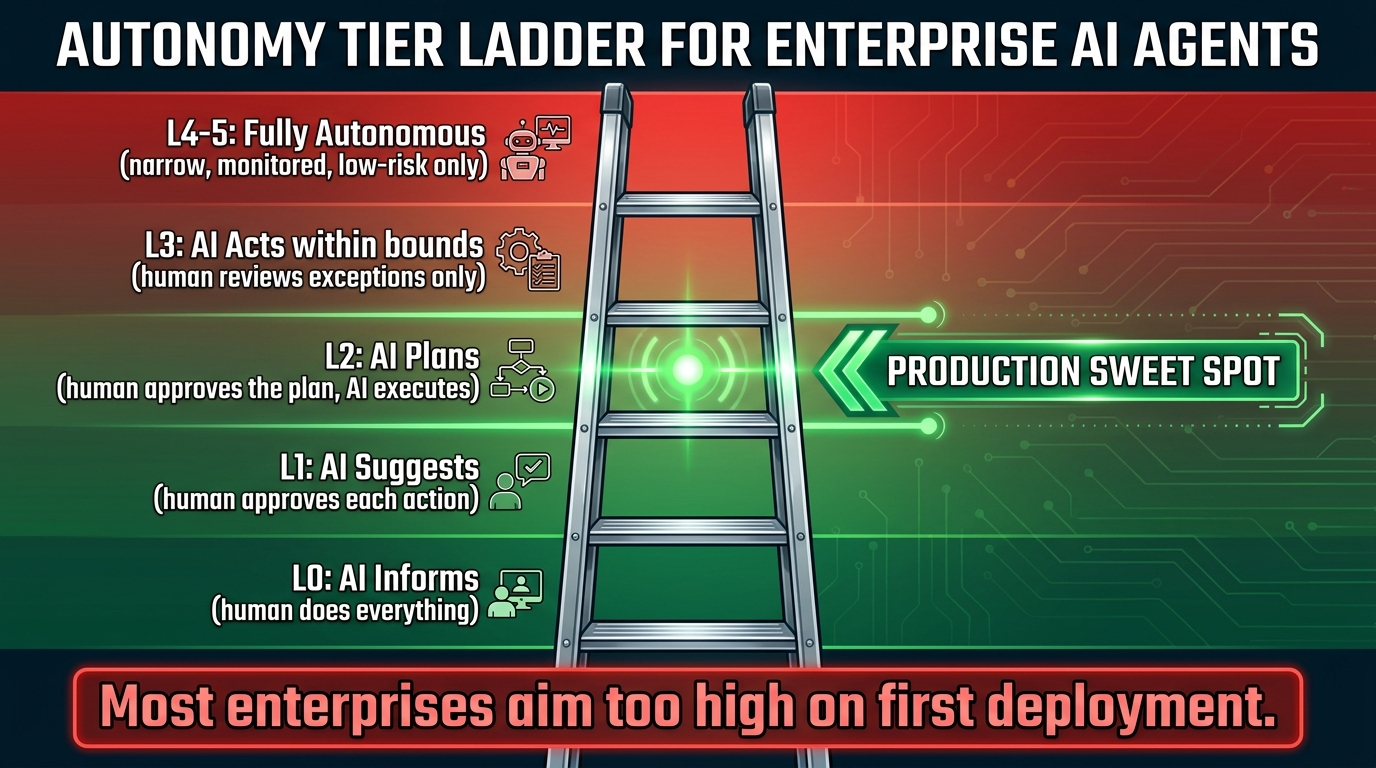
One of the most consequential design decisions in any agentic deployment is deceptively simple: how much autonomy does this agent actually have? Not theoretically — operationally. What can it do without human approval, and what requires a gate?
This decision cascades through every other aspect of the system. It determines the governance structure. It determines the monitoring requirements. It determines the integration design. It determines the regulatory exposure. Teams that treat autonomy as a binary — “the agent either runs or it doesn’t” — consistently overshoot in ways that create exactly the failure modes described above.
The Five-Level Autonomy Framework
The most operationally useful framework in current use among enterprise deployment teams describes five levels of agent autonomy:
Level 0 — AI Informs: The agent surfaces information, analysis, or suggestions. A human makes all decisions and takes all actions. Zero autonomous action. This is the entry point for most organizations and remains appropriate for any domain where the cost of an agent error exceeds the cost of human review.
Level 1 — AI Suggests, Human Approves Each Action: The agent generates a proposed action for each step. A human approves or rejects each one individually before the agent proceeds. This is appropriate for high-stakes, low-frequency workflows — legal document routing, financial approvals, medical record updates.
Level 2 — AI Plans, Human Approves the Plan: The agent generates a full task plan — a sequence of steps to complete a goal. A human reviews and approves the plan as a whole, then the agent executes within that scope without further per-step approval. This is the most common production pattern for moderate-complexity enterprise workflows. It preserves meaningful human oversight while allowing the agent to operate at meaningful speed.
Level 3 — AI Acts Within Defined Bounds: The agent operates autonomously within a well-defined envelope of actions, escalating to humans only when it encounters a situation outside those bounds — exceptions, ambiguities, or decisions above a defined risk threshold. This tier is appropriate for high-volume, well-understood workflows: customer service triage, data processing pipelines, marketing content scheduling, IT ticket classification.
Level 4–5 — Fully Autonomous: The agent operates end-to-end without human gates, monitored by automated systems rather than human reviewers. This tier is only appropriate for narrow, low-stakes, high-volume tasks where the error tolerance is high and the failure modes are reversible. Most organizations that target this level on their first deployment regret it.
Where Production Agents Actually Land
The current industry data is clear: the vast majority of durable production deployments operate at Level 2 or Level 3. This is not timidity — it is engineering pragmatism. L2-L3 deployments ship faster because they require less governance infrastructure at launch. They maintain stakeholder trust because there is a visible human oversight mechanism. And they generate better learning loops, because human approval points create labeled data about where agent judgment diverges from business judgment — data that can be used to gradually and safely expand autonomy scope over time.
The organizations that try to launch at L4-L5 without first establishing performance baselines at L2-L3 are disproportionately represented in the “failed pilot” category. Full autonomy is earned, not granted.
Calibrating Autonomy to Risk
A practical heuristic for autonomy tier assignment: consider two axes — the reversibility of an action and its downstream blast radius. Actions that are reversible (drafting a document, suggesting a response, generating a summary) and have a small blast radius (visible only to one user) can safely operate at higher autonomy tiers. Actions that are irreversible (sending external communications, modifying records, executing transactions) or have large blast radii (touching shared systems, customer-facing outputs, regulatory filings) should operate at lower tiers until a track record of accuracy is established.
The Two-Protocol Stack Every Production Agent Needs
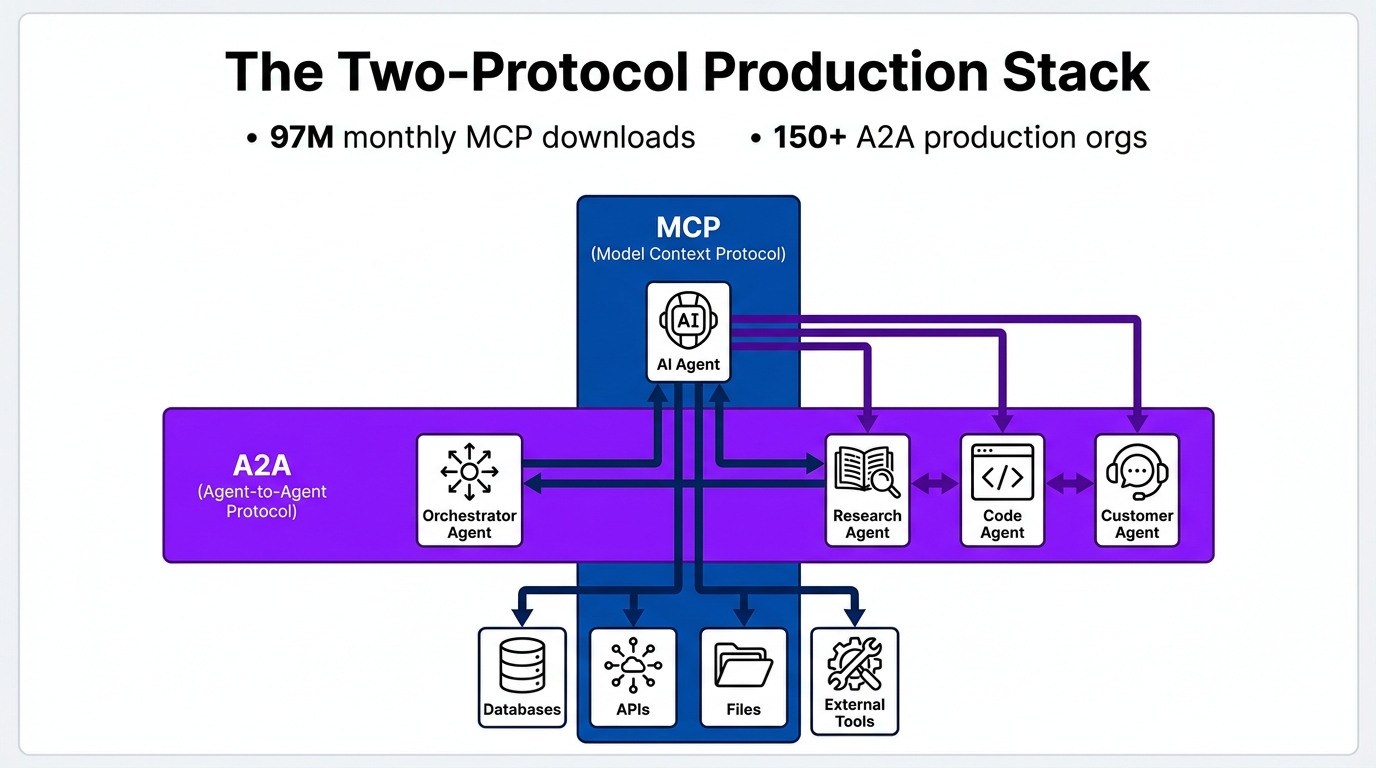
For the first two years of the agentic AI era, every team built its own integration layer. Custom connectors, bespoke API wrappers, proprietary memory protocols, one-off orchestration logic. The result was agents that were deeply coupled to their original deployment context — impossible to maintain, impossible to audit, and impossible to scale.
That is changing rapidly. Two protocols have emerged as the structural foundation for enterprise-grade agentic systems, and understanding how they work together is now a prerequisite for any serious production deployment.
Model Context Protocol (MCP): The Agent-to-Tool Layer
MCP, introduced by Anthropic and now adopted across the major AI platforms, standardizes the way agents connect to tools, data sources, and external systems. Before MCP, connecting an agent to a database required a custom integration. After MCP, the connection follows a standardized schema — the agent queries the MCP server, the server handles authentication and context packaging, and the response comes back in a consistent format that the agent can reliably parse.
The adoption numbers signal how quickly this has become infrastructure rather than novelty: by April 2026, MCP had accumulated approximately 97 million monthly SDK downloads and more than 10,000 enterprise server deployments. That adoption rate — comparable to major developer tools like Kubernetes in its growth phase — reflects genuine utility. Teams that have standardized on MCP report dramatically lower integration maintenance overhead versus bespoke implementations.
For production deployment, MCP brings three specific benefits: it enables tool-level permission scoping (the agent can only access what the MCP server is configured to expose), it creates a natural audit point for tool calls (every MCP interaction is logged in a consistent format), and it dramatically reduces vendor lock-in (switching the underlying model doesn’t require rebuilding the integration layer).
Agent-to-Agent Protocol (A2A): The Orchestration Layer
If MCP handles how an individual agent connects to its tools, A2A handles how multiple agents coordinate with each other. Introduced by Google in early 2025 and now being standardized with participation from major enterprise vendors, A2A provides a common language for agents to discover each other’s capabilities, delegate tasks, and return results across agent boundaries.
The organizational reality driving A2A adoption is that single-agent systems have hit their complexity ceiling. Any workflow that requires multiple specialized capabilities — research, code generation, customer communication, data analysis — quickly exceeds what one agent can manage well within a single context window. Multi-agent systems, where a coordinating orchestrator delegates to specialized worker agents, handle this complexity more effectively. But they require a reliable way for agents to communicate.
By mid-2026, A2A had been adopted in production by more than 150 organizations, with the growth accelerating as the specification matured. The canonical production architecture is now: MCP vertically (each agent connects to its required tools via MCP servers) and A2A horizontally (the orchestrator delegates to specialist agents via A2A messages).
Why Both Protocols Together
A common question is whether teams should implement MCP or A2A. The answer from every mature production deployment is: both, serving different layers. MCP handles tool access; A2A handles delegation. Implementing only MCP gives you a well-connected single agent with no scalable path to multi-agent workflows. Implementing only A2A gives you agents that can talk to each other but still use bespoke, inconsistent tool integrations. The two protocols are complementary by design, and the teams building production systems that will still be maintainable in two years are treating both as baseline infrastructure.
Agent Sprawl: The Silent Production Killer
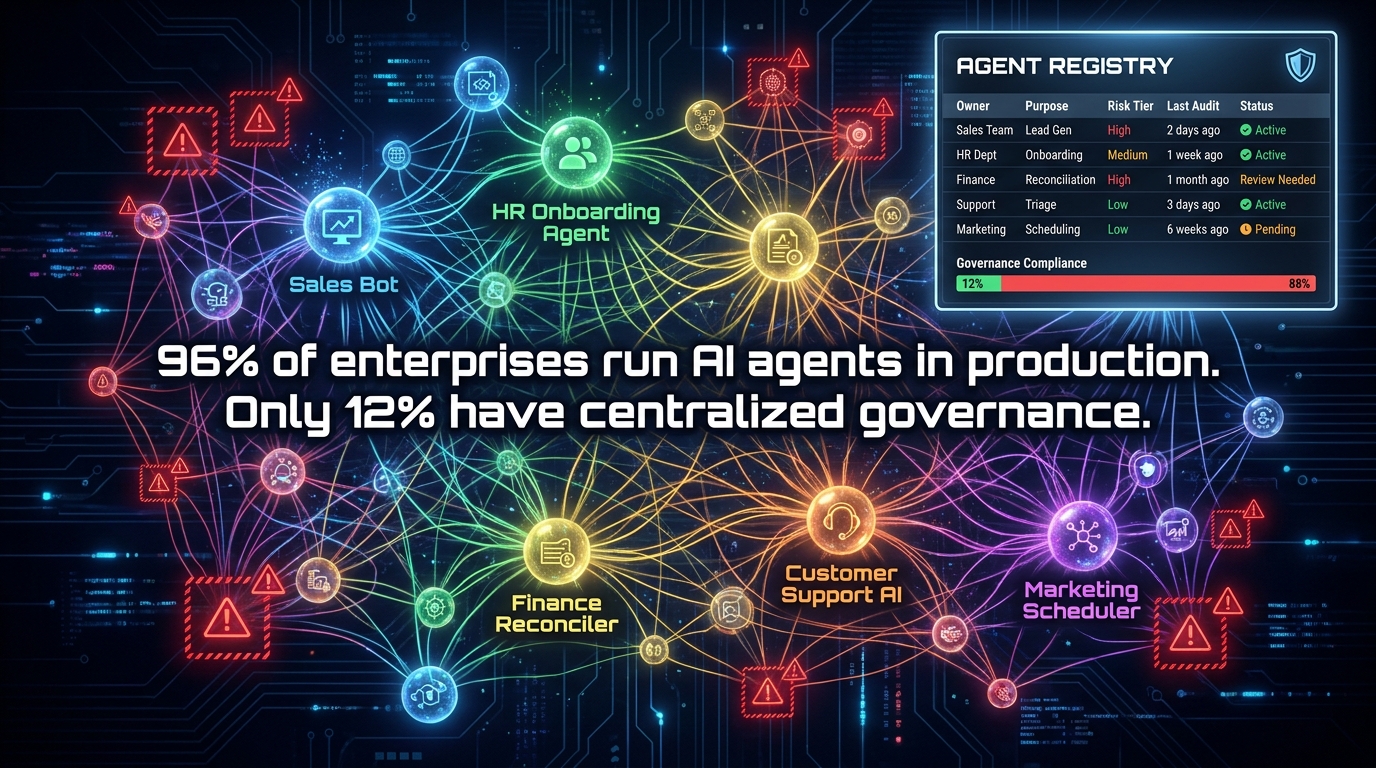
Here is the governance statistic that should concern every enterprise CTO: 96% of enterprises now report running AI agents in some form of production. But only 12% have centralized governance over those agents. A separate analysis found that only 26% of organizations could produce a complete inventory of every agent operating in their environment — and 62% reported that business units were deploying agents entirely outside of IT oversight.
This is agent sprawl, and it is the production problem that most organizations aren’t taking seriously yet — because the individual agents are all working fine. The problem isn’t that any single agent is broken; it’s that the aggregate of dozens of uncoordinated, unmonitored, ungoverned agents creates systemic risk that no one owns.
Why Sprawl Happens
Agent sprawl is a predictable consequence of how agentic AI gets adopted. It starts with a business unit deploying a tool like Microsoft Copilot or Salesforce Agentforce. That works, so the team deploys two more. Another department sees the results and deploys their own. Within twelve months, a mid-size enterprise can have dozens of agents operating across sales, marketing, HR, finance, legal, and customer support — each with different permission scopes, different data access, different risk profiles, and no shared inventory.
SAP’s analysis of 2026 enterprise deployments puts a precise framing on why this is dangerous: sprawl happens faster than enterprises can inventory agents, assign ownership, control permissions, monitor behavior, or retire deprecated deployments. The result is a shadow AI infrastructure that carries all the operational and security risks of unmanaged software — but with the added dimension that these systems can take autonomous actions in the real world.
The Agent Registry Solution
The response that production-mature organizations are converging on is a centralized agent registry — a single system of record for every agent operating in the enterprise environment. Think of it as a CMDB (Configuration Management Database) for autonomous AI systems.
An effective agent registry captures, at minimum: the agent’s identity and version, its stated purpose and workflow scope, its named business owner and technical owner, its tool access and data permissions, its risk tier classification, the date of its last audit, and its planned retirement or review date.
Critically, the registry is not a passive inventory — it is an active control plane. No new agent goes to production without a registry entry. Agents that appear in production without a corresponding registry record trigger automatic alerts. Agents that reach their review date without a renewal are automatically suspended. This structure prevents the accumulation of “zombie agents” — deployments that were built for a specific project, served their purpose, and then continued running indefinitely because no one got around to retiring them.
Governance as a First-Class Engineering Practice
The framing that aligns governance with engineering culture is: treat every production agent as a governed software identity. Not a feature, not a tool, not an automation script — a software identity with ownership, lifecycle, access controls, and accountability. When engineers frame it this way, the governance work stops feeling like overhead and starts feeling like responsible engineering practice. The same discipline that applies to service accounts and cloud infrastructure applies to agents.
Board-level governance structures are also emerging. SAP and other major enterprise vendors now recommend that agentic AI governance escalates to the same level of organizational authority as information security — not because every agent is a security risk, but because the aggregate of unmonitored agents is an enterprise risk that requires executive accountability.
Decision Traces as Compliance Infrastructure
There is a quiet regulatory deadline driving urgency around agentic AI governance that many teams are underestimating. The EU AI Act’s obligations for high-risk AI systems became broadly enforceable in August 2026, and the documentation requirements for autonomous systems operating in regulated domains — financial services, healthcare, HR, legal — are substantially more demanding than what most organizations currently have in place.
The operative requirement is auditability. When an agent takes an action in a regulated context, the organization must be able to answer: what did the agent do, why did it do it, what information did it use, who or what authorized the action, and what was the outcome? Generic application logs cannot answer these questions. Decision traces can.
What a Decision Trace Actually Contains
A production-grade decision trace is a structured, tamper-evident record that captures the complete context of an agent’s decision at the moment it was made. The minimum viable trace for a regulated workflow includes:
- Agent identity and version: Which agent took this action, running on which model version, executing which prompt version. This matters because model updates change agent behavior — you need to know what was running when a decision was made.
- Input context: The exact input the agent received, including any retrieved documents or tool outputs that informed its decision.
- Tool calls: A complete log of every tool called during the decision process, with parameters, responses, and timestamps.
- Policy checks: Any governance policy that was evaluated during the decision — content filters, permission validations, compliance rules.
- Human approval events: If the workflow required human review at any point, a record of who reviewed it, when, and what they approved or modified.
- Final action and outcome: What the agent did, and the observable outcome.
This trace must be immutable — write-once, tamper-evident storage — and queryable. The queryability requirement is often underweighted in initial implementations: an audit trace that takes days to manually parse is operationally useless in a regulatory examination or a post-incident review.
Decision Traces as Operational Assets
Beyond compliance, decision traces are genuinely valuable operational data. They are the primary mechanism for identifying systematic agent errors — not one-off failures, but patterns of miscalibration that indicate a model needs retraining, a prompt needs revision, or a tool integration needs debugging. Organizations that treat decision traces as first-class analytical assets — running periodic quality reviews against sampled traces — consistently report faster identification of performance degradation than those that rely on downstream business metrics alone.
The practical implementation guidance from teams running this at scale: build trace infrastructure before you need it, not after. Retrofitting comprehensive tracing into a live production agent is substantially harder than building it in from the start. Like security, auditability is much cheaper to design in than to bolt on.
The Real Cost Math of Running Agents at Scale
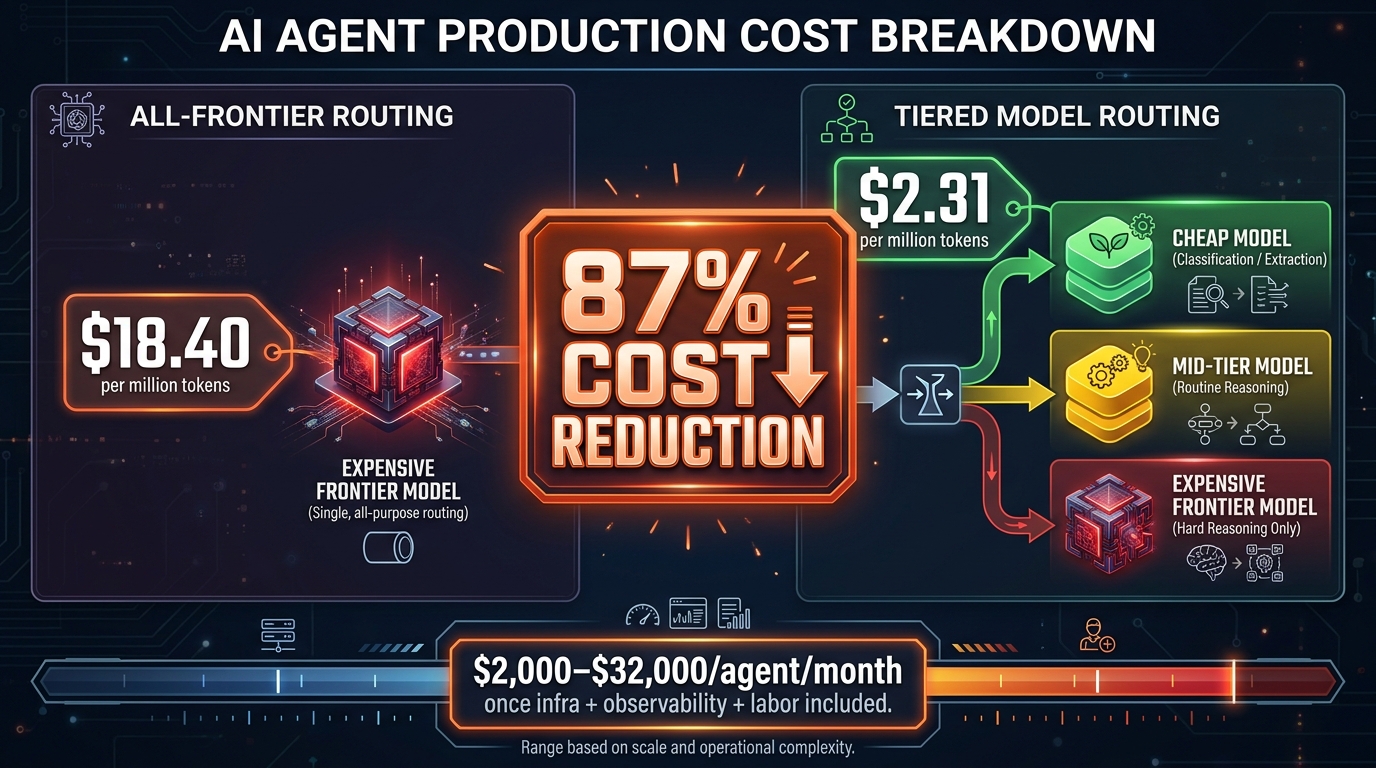
Cost surprises are one of the most common reasons production agent deployments get cancelled after launch. A pilot running a few hundred interactions per day on a frontier model looks affordable. The same architecture at 50,000 interactions per day does not. And unlike cloud compute costs, which scale somewhat predictably, agentic AI costs scale with task complexity, retry rates, and context length — variables that are much harder to forecast in advance.
The Token Cost Reality
The headline numbers tell part of the story. Routing every interaction through a frontier model costs approximately $18.40 per million tokens at current 2026 pricing. A well-designed tiered routing system — where cheap models handle classification and extraction, mid-tier models handle routine reasoning, and frontier models are reserved for genuinely complex steps — reduces that to approximately $2.31 per million tokens. That is an 87% cost reduction while maintaining reported accuracy at 97.7% of the full-frontier baseline.
For an agent processing ten million tokens per month (a moderate enterprise deployment), the difference is $184,000 versus $23,100. Annually, that is a $1.9 million swing from a single architectural decision made at design time.
The Hidden Cost Layers
Token cost is only one layer. The fully loaded cost of a production agent — including infrastructure, observability tooling, and engineering labor for maintenance — falls in the range of $2,000 to $32,000 per agent per month, depending on complexity and scale. The wide range reflects the massive variance in what “a production agent” means: a simple document classifier at one end of the spectrum, a multi-step research and reporting agent at the other.
The cost layers that teams consistently underestimate:
Retry costs. A well-functioning agent completes tasks on the first attempt most of the time. But failure cases — tool timeouts, ambiguous inputs, parsing errors — trigger retries that can cost two to five times the original task’s token spend. Without explicit retry budgets and failure state handling, a tail of complex or broken tasks can consume a disproportionate share of token spend.
Context length inflation. Multi-step agents accumulate context as they work. Without active context management, a task that starts with 2,000 tokens can balloon to 50,000 tokens by step 15. At frontier model pricing, that 25x context growth is a 25x cost increase on the same nominal task. Context management — summarization, pruning, selective retention — is not just an engineering nicety; it is a cost control mechanism.
Observability infrastructure. Comprehensive trace logging, monitoring dashboards, alerting systems, and evaluation pipelines are not free. Teams running agents at scale report that observability infrastructure typically adds 15–25% to the total infrastructure cost — but that it pays for itself in reduced incident investigation time and faster performance optimization cycles.
The Model Routing Decision Framework
The practical implementation of tiered routing requires classifying each step in an agent’s workflow by its reasoning complexity. A useful taxonomy: routing and classification tasks (is this request in scope? which agent should handle this?) require minimal reasoning and are ideal candidates for small, cheap models. Extraction and formatting tasks (parse this document, structure this output) are similarly well-served by mid-tier models. Multi-step reasoning tasks (evaluate this contract clause, generate a strategic recommendation, debug this error) genuinely benefit from frontier model capability and should be routed there.
The engineering investment in building a reliable router typically pays back within 30 to 60 days at production-level token volumes. Teams that don’t build routing on day one consistently wish they had built it sooner.
Building the Production Readiness Checklist
Based on the patterns from organizations that successfully ship production agents, the following checklist covers the minimum viable set of readiness criteria before any agent should transition from pilot to production. This is not an exhaustive security framework — it is the practical minimum that separates agents that ship from agents that stall.
Architecture and Integration
- Tool schema validation is in place for every tool the agent can call, with post-call assertions that verify expected output structure before proceeding to the next step.
- Circuit breakers are defined: maximum step count, maximum token budget, maximum elapsed time, and a defined failure state (escalate to human, log and exit, or retry with exponential backoff) for each failure condition.
- Context management is implemented: active summarization or pruning prevents unbounded context growth in multi-step tasks.
- Legacy system integrations have been tested under adversarial conditions: API timeouts, malformed responses, rate limits, and authentication failures — each with a defined graceful degradation path.
- MCP servers are in place for tool access with permission-scoped tokens per tool category.
Governance and Compliance
- The agent has a named owner — one person or team who is accountable for its behavior and responsible for its maintenance.
- An entry exists in the agent registry with purpose, scope, owner, risk tier, permissions, and review date.
- Autonomy tier is explicitly defined and documented, with approval gates configured at the appropriate decision points.
- Decision tracing is implemented with tamper-evident storage and a queryable interface — before the agent goes live, not as a follow-up task.
- The EU AI Act classification has been assessed for any agent operating in a regulated domain, with documentation requirements in place if it falls in the high-risk category.
Observability and Monitoring
- A baseline eval suite exists: a set of representative tasks with known correct outputs that can be run against the agent after any model or prompt update to catch regressions.
- Anomaly detection is configured for: abnormal token consumption, unexpected tool call patterns, error rate spikes, latency outliers.
- A human escalation path is clearly defined: when the agent encounters a situation it cannot handle, it must be able to hand off to a human with full context, not just return an error.
- Cost monitoring is in place with alerting at 80% of the monthly token budget, allowing intervention before costs exceed plan.
Security
- Input sanitization is applied to all content retrieved from external sources — documents, emails, database records — before it enters the agent’s context, defending against prompt injection.
- Third-party plugins and MCP servers are verified against a known-good registry, with a process for reviewing changes to external tools the agent depends on.
- Session isolation is enforced in multi-tenant deployments, with namespace separation between user contexts.
What the Organizations That Ship Actually Do Differently
Beyond the technical checklist, there is a pattern difference in organizational posture that consistently distinguishes the 11% that ship from the 89% that don’t. It’s not primarily about engineering talent. It’s about how the problem is framed from the start.
They Treat Production as a Separate Project
Organizations that ship production agents budget and staff the production readiness work as a distinct project, separate from the initial agent development. The demo is one project. Making it production-ready is another. The teams that stall typically try to fold production readiness into the demo project, treating it as cleanup work rather than substantial engineering. The teams that ship know that governance, observability, integration hardening, and compliance documentation typically require as much time as the initial build.
They Start Narrower Than They Want To
Every successful production deployment in the case study record started with a narrower scope than the team originally planned. Klarna’s customer service agent — the most cited production benchmark in the 2026 landscape, handling 2.3 million conversations in its first month with 25% faster resolution times — began with a highly constrained scope: specific query categories, defined escalation paths, explicit content policies. The scope expanded as the production track record justified it.
Teams that try to launch broad — “this agent will handle all customer interactions” — consistently find that the edge cases at the periphery of a wide scope generate the failures that kill stakeholder confidence. Start with the 20% of interactions that are high-volume and well-understood, prove the production reliability model, then expand from a position of demonstrated credibility.
They Define “Success” Before Deployment
A production agent without a pre-defined success metric is a production agent without an exit criteria for failure. The organizations that maintain stakeholder support through the inevitable early production turbulence are those that defined, in advance: what accuracy rate is required for this agent to justify its cost, what error types are acceptable versus unacceptable, and what the decision threshold is for rolling back or suspending the agent. Without those definitions, every incident becomes a political argument. With them, the response to an incident is a procedure, not a judgment call.
They Invest in Human-AI Workflow Redesign, Not Just Agent Deployment
The deployments with the best outcomes — measured by adoption, accuracy, and business impact — are almost always ones where someone redesigned the surrounding workflow, not just the AI component. Inserting an autonomous agent into a workflow that was designed for human-only execution produces suboptimal results, because the workflow was designed around human cognitive patterns, handoff conventions, and error-correction mechanisms that don’t apply to agents.
The organizations seeing the strongest production outcomes redesign workflows from first principles: what does the human contribution change to when an agent handles these steps? Where do humans add the most distinctive value in this process? What does the exception-handling path look like when the agent reaches its limits? These are organizational design questions as much as engineering questions, and they require cross-functional collaboration between AI engineers, process owners, and the humans who will work alongside the deployed agents.
What Actually Changes When Agents Cross the Line
It is worth stepping back from the mechanics for a moment to articulate what actually changes in an organization when agentic AI successfully crosses from demo to production — because the change is larger than most pre-deployment conversations acknowledge.
When an agent is in production and reliably handling a class of tasks that previously required human time, two things happen simultaneously. The obvious thing: that human time gets freed for other work. The less obvious thing: the organization now has a continuously running decision-maker that operates on explicit, inspectable rules — and that forces a degree of precision about business logic that many organizations have never previously achieved.
Most enterprise processes contain large amounts of tacit knowledge: the “how we actually do it” that lives in people’s heads and is transmitted through apprenticeship, not documentation. Building a production agent requires externalizing that tacit knowledge into explicit rules and policies. That process is often uncomfortable — it surfaces inconsistencies, unmade decisions, and procedural debt that has been accumulating for years. But the organizations that commit to it find that the documentation work produces value far beyond the agent itself: they end up with a clearer, more consistent, more trainable process that benefits human workers as well as AI agents.
That is the real transformation that agentic AI enables at scale — not the automation of tasks, but the systematization of organizational knowledge. The demo shows the automation. The production deployment reveals everything that has to become explicit for the automation to work reliably. The gap between those two things is the gap between demo and production, and crossing it changes how the organization understands itself.
The Production Mindset: Closing Thoughts
The 89% of agent projects that never reach production aren’t failing because the technology doesn’t work. They’re failing because the organizations deploying them are treating a production systems problem like a research project — optimizing for the demo, not for the durability.
The shift required is a production mindset: governance as infrastructure, observability as a first-class requirement, autonomy as a design decision with accountability attached, cost management as an ongoing engineering practice, and compliance as a build-time constraint rather than a post-hoc review. None of these are novel ideas in software engineering. They are exactly the disciplines that separate systems that operate reliably at scale from systems that work in development and break in the real world.
The specific mechanics differ for agents — the failure modes are different, the governance requirements are different, the cost structure is different. But the underlying principle is the same one that has always separated software that ships from software that doesn’t: building for the conditions it will actually encounter, not the conditions it was demonstrated in.
The 11% that have agents in production aren’t smarter or better-resourced than the 89% that don’t. They simply made the decision, earlier in their process, to treat production readiness as the job — not a follow-up task after the demo got approved.
Key Takeaways: Only 11% of enterprises have agentic AI in live production, with 88% of projects stalling before deployment. The primary failure modes are operational — tool misuse, context drift, permission escalation, and governance gaps — not model quality. Production-grade agents require: explicitly tiered autonomy (L2-L3 is the sweet spot), MCP + A2A as complementary protocol infrastructure, a centralized agent registry to prevent sprawl, tamper-evident decision traces for compliance, and tiered model routing to manage costs (potentially cutting token spend by 87%). The organizations that ship start narrower than they want to, define success metrics before launch, and budget production readiness as a separate project from demo development.