


Every conversation about TikTok Shop fees starts the same way: someone mentions the 6% referral rate, another seller nods, and everyone moves on feeling like they understand their cost structure. They don’t.
The 6% figure is real — it’s just the least important number in the equation. By the time a single order completes its journey from discovery to delivery to payout, the platform has touched your revenue in at least five distinct ways. Add in the sweeping policy architecture TikTok quietly rebuilt in the first half of 2026 — a brand-new Account Health Rating system, a June listing policy overhaul, and a logistics mandate that remains partially in flux — and the cost of doing business here looks nothing like the promotional materials suggested when most sellers first signed up.
This isn’t an argument against TikTok Shop. The platform still moves serious volume, creator-led conversion rates outperform most channels, and for the right product at the right margin, it remains genuinely attractive. But those economics only work if you build your P&L around what you’re actually paying, not the number that shows up in headline announcements.
This article breaks down the complete fee architecture as it stands in mid-2026: every cost layer, how TikTok’s new compliance systems interact with your bottom line, what the global fee divergence means if you sell across markets, and how to structure a business that survives — and profits from — a platform that has decisively moved past its growth-subsidy era.
From Subsidies to Real Economics: How TikTok Shop’s Pricing Philosophy Changed
To understand where TikTok Shop’s fee structure is today, you need to understand where it came from — and why the gap between “launch economics” and “operating economics” is still tripping sellers up three years in.
The Subsidy Era (2023–2024)
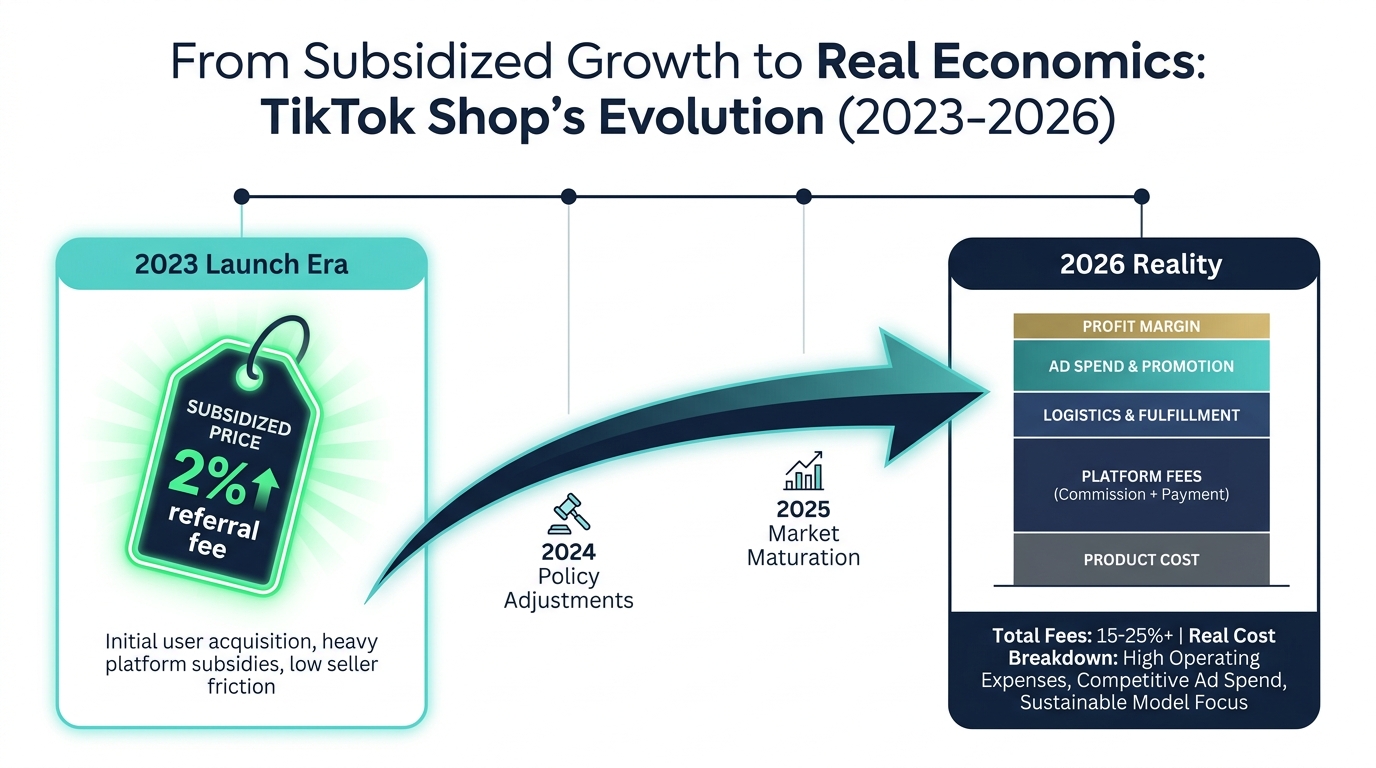
When TikTok Shop launched aggressively in the US market in late 2023, it was buying market share with subsidized economics. Early sellers frequently operated on referral fees as low as 2%, with TikTok absorbing significant portions of shipping costs, promotional discounts, and creator incentives from its own balance sheet. The platform was effectively paying to populate itself with inventory, transactions, and seller experience.
This wasn’t a secret — it was a deliberate strategy. TikTok had watched Shopee, Lazada, and other Southeast Asian social commerce platforms use the exact same playbook. Subsidize the early adopters heavily enough to create supply density, then normalize fees once the ecosystem is established and sellers are too committed to leave easily.
The strategy worked. By mid-2024, TikTok Shop had become a meaningful revenue channel for hundreds of thousands of US sellers and was already the dominant social commerce platform by transaction volume. The subsidies had done their job.
The Normalization Wave (2025–2026)
What followed was a systematic, market-by-market migration toward what TikTok describes internally as “sustainable marketplace economics” — which, in practice, means fee rates that fund the platform’s operations rather than just its growth targets.
The UK moved first, reaching its 9% standard commission in late 2024. The EU followed in January 2026, jumping from 5% to 9% across its five core markets (Germany, France, Italy, Spain, and Ireland). The US held its 6% baseline but quietly ended most of the promotional rate programs that had allowed early sellers to operate at lower effective take rates.
Simultaneously, TikTok redesigned its compliance and logistics infrastructure in ways that added new cost layers even where headline rates stayed flat. The cumulative effect is a platform that now operates with fundamentally different unit economics than the one many sellers originally stress-tested their products against.
Why This Matters More Than the Rate Change Itself
Sellers who built spreadsheet models in 2023 using a 2% referral fee have two problems, not one. The obvious problem is that their fee input is wrong. The subtler problem is that their model probably didn’t account for the other cost layers that exist today — layers that didn’t fully exist, or existed at lower rates, when they originally ran the numbers.
This is the structural issue most seller guides miss: TikTok Shop’s fee migration wasn’t just about raising a single number. It was about building a full-stack cost architecture. And you can’t manage what you haven’t modeled.
The Full Fee Stack: Every Layer You’re Actually Paying
Here is every fee component active in 2026 for a standard US-based TikTok Shop seller. The exact amounts vary by category, product type, and logistics arrangement — but these are the layers, and every one of them is real.
Layer 1: Platform Referral Fee (Commission)
The headline number. In the US, the standard referral fee sits at 6% of order value for most product categories in 2026. This is calculated on the total customer payment plus any platform-funded discounts, minus tax — a distinction that matters when you’re modeling promotional pricing. Some categories carry lower rates: certain jewelry and pre-owned/collectible categories can be as low as 5%.
A few categories sit higher. Health and beauty, where competition for premium positioning is intense, can see category-specific rates at or above the standard. New sellers historically received a 3% promotional rate for their first period of sales — some variants of this still exist in onboarding incentives, but the terms have tightened considerably compared to the 2023–2024 versions.
Layer 2: Payment Processing / Transaction Fee
Separate from the referral fee, TikTok charges a payment processing fee on every completed transaction. This sits in the range of 1.8% to 3.0% of transaction value depending on market and payment method. In the US, the most commonly cited figure is approximately 2.2% for standard card-based transactions.
This fee is easy to overlook because it’s not always prominently displayed in seller-facing dashboards alongside the referral fee. But it’s structural — it applies to every order regardless of category, promotion status, or seller tier.
Layer 3: Affiliate / Creator Commission
This is the fee layer that most changes the economics, and it’s technically variable — but for any seller who wants meaningful organic reach, it functions as a near-fixed cost. TikTok Shop’s creator affiliate program allows sellers to set commission rates for affiliate creators, with the rate visible to creators when deciding whether to promote a product.
In practice, competitive affiliate commission rates in 2026 range from 10% to 20% of sale price for most categories, with beauty, supplements, and fashion products often requiring 15–20% to attract quality creator attention. Products sitting below 10% commission simply don’t get promoted at volume by the affiliate ecosystem — creators have too many options.
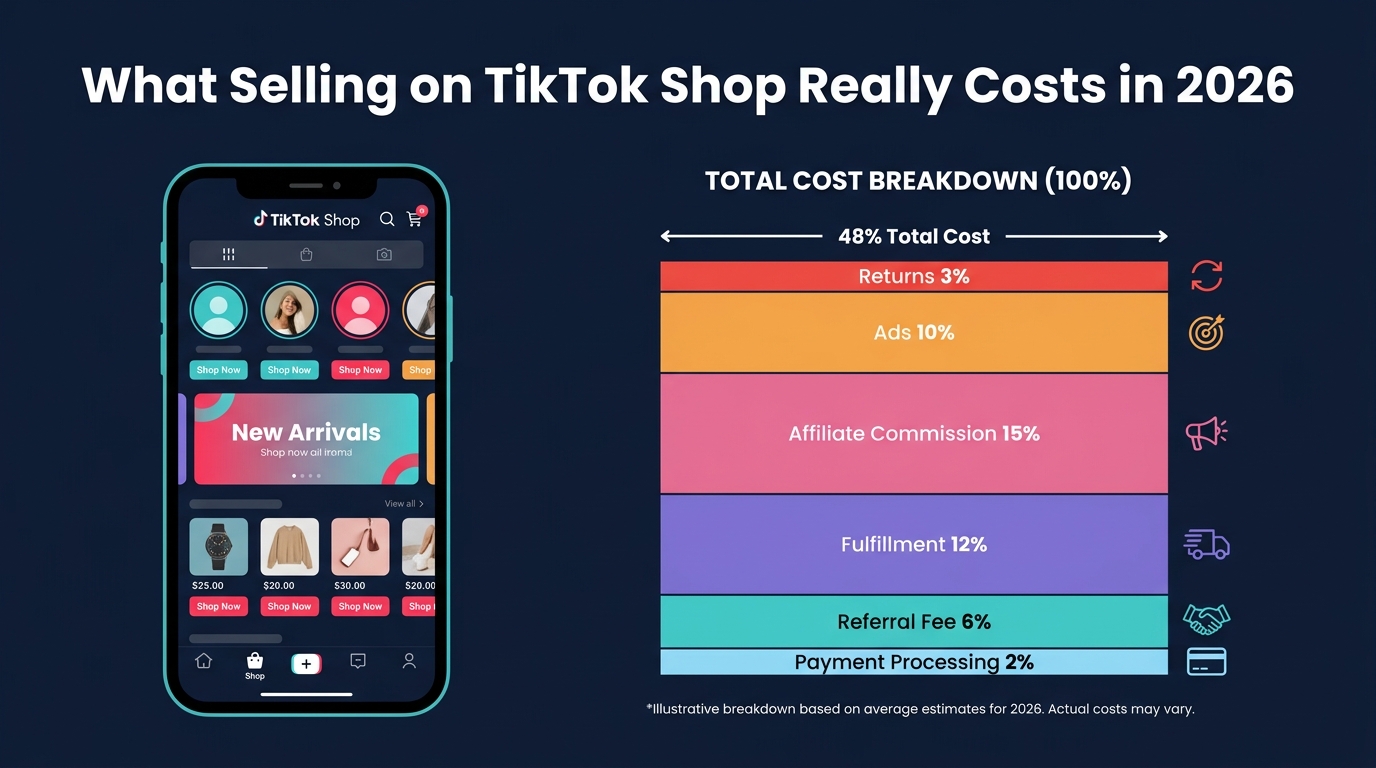
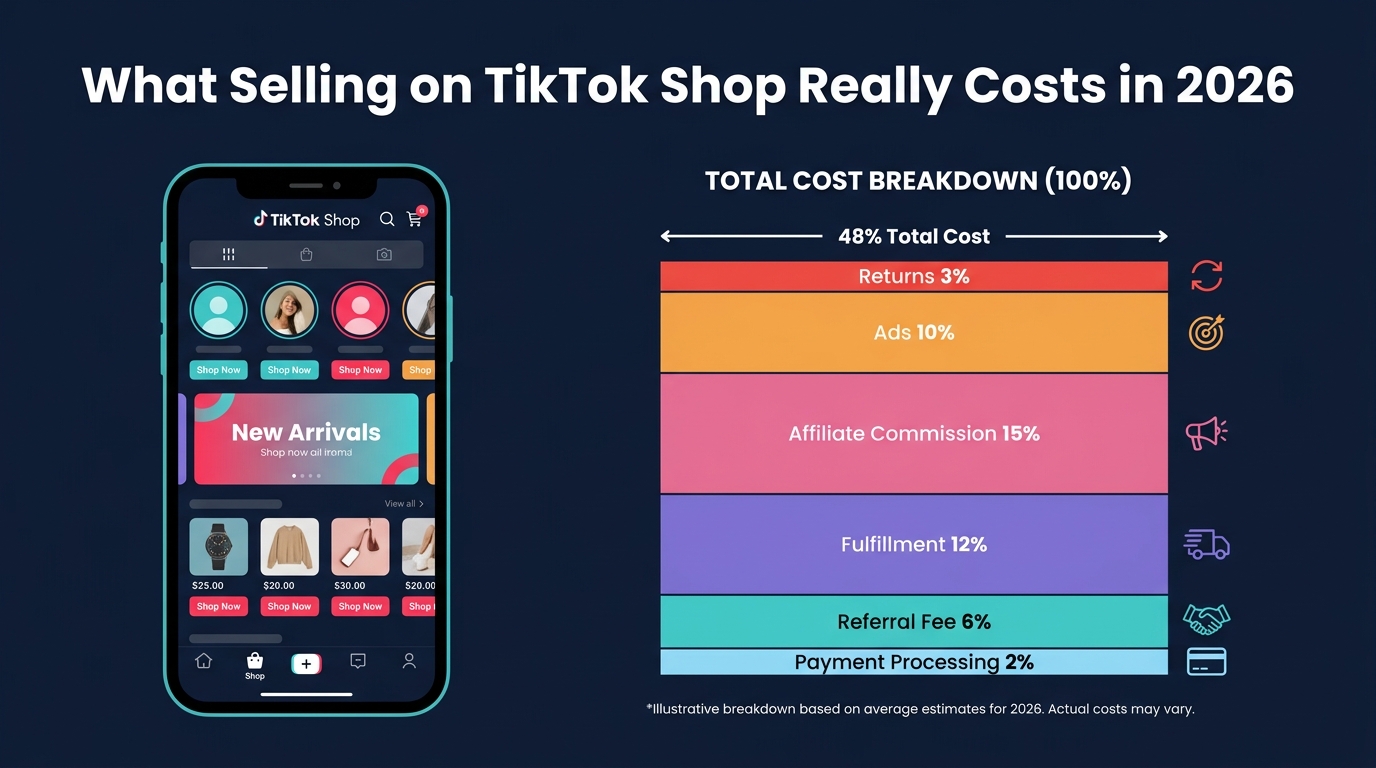
A seller running a 15% affiliate commission is now at 23.2% (6% + 2.2% + 15%) of revenue before a single unit ships.
Layer 4: Fulfillment and Shipping
TikTok Shop’s 2026 logistics changes (covered in detail in a later section) mean that most US sellers must now use one of TikTok’s approved logistics pathways. The cost implications are real and vary significantly depending on your chosen method:
- Fulfilled by TikTok (FBT): Sellers ship inventory to TikTok’s fulfillment centers; TikTok handles pick, pack, and delivery. Costs vary by unit size and weight but typically run $4–$8 for standard small items.
- Upgraded TikTok Shipping: You handle warehousing and packing; TikTok provides pre-negotiated carrier rates through its platform. Generally cheaper than FBT for lower-volume sellers but requires operational infrastructure.
- Collections by TikTok (CBT): A newer option designed for specific use cases; TikTok manages customer-facing logistics through collection points.
For a typical small-to-mid-weight product, fulfillment costs of $5–$12 per order are realistic in 2026, depending on weight, dimensions, and destination zone. On a $30 product, that’s 17–40% of selling price just for shipping.
Layer 5: Returns and Refunds
TikTok Shop’s buyer-friendly return policies, while good for conversion, create a real cost line for sellers. Return rates vary significantly by category — apparel and fashion items can see returns of 15–25%, while hard goods typically run lower at 3–8%. The key cost isn’t just the product coming back (though that matters); it’s the fulfillment costs that are generally non-recoverable on returned orders.
Layer 6: Promotional and Platform Fees
TikTok Shop runs frequent platform-wide promotional campaigns (flash sales, deal events, seasonal campaigns) where sellers are invited or expected to participate. Participating typically requires offering discounts — often 15–30% off — during the event window. While platform campaigns can dramatically boost sales volume, they compress per-unit margins and need to be modeled separately from regular-day economics.
In some markets, there are also specific new fees — Malaysia introduced a RM0.50 per-order Platform Support Fee in February 2026, a sign that per-order charges may eventually expand to other markets.
The Transaction-Level Math: Building a Real P&L Per Order
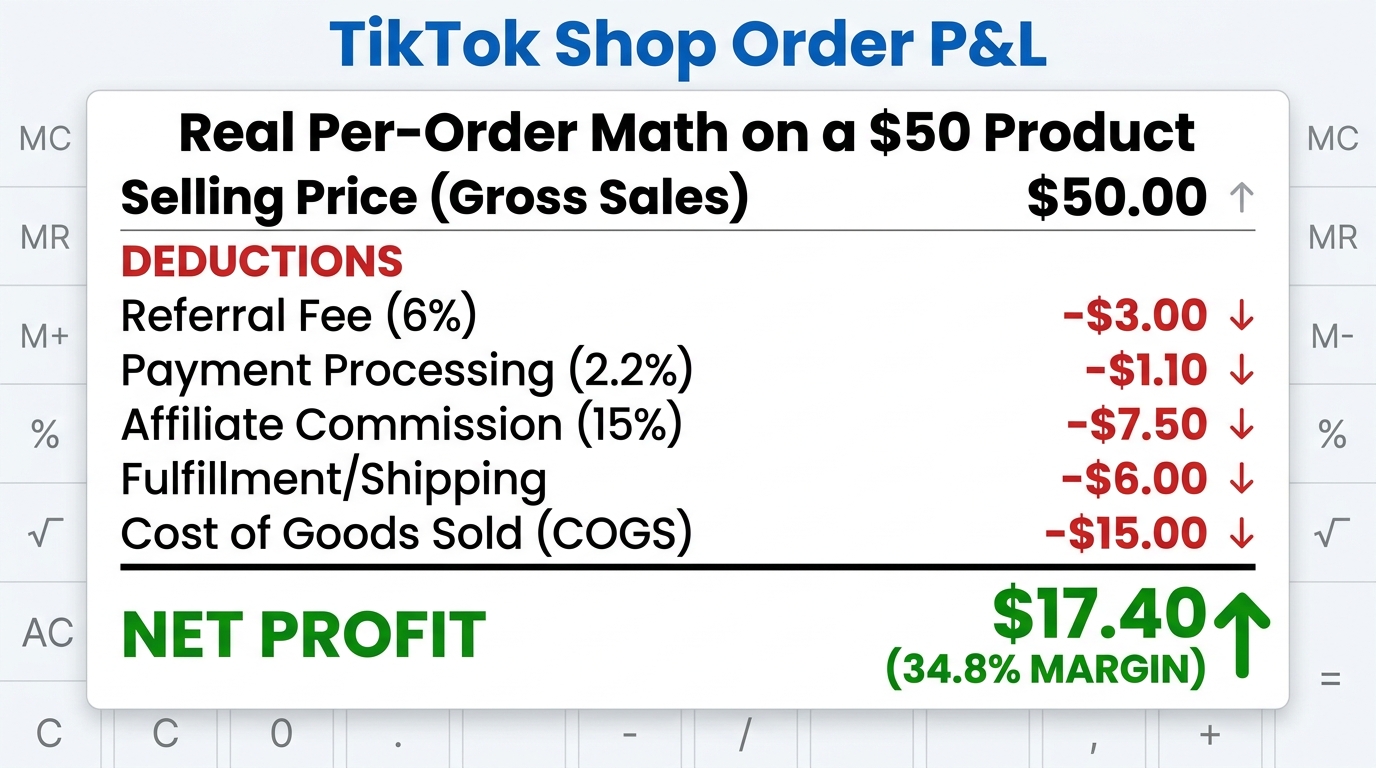
Abstract percentages are less useful than a worked example. Let’s model a product with a $50 selling price — a realistic mid-range item in beauty, wellness, or home goods.
The P&L Breakdown
| Cost Item | Amount | % of Revenue |
|---|---|---|
| Selling Price | $50.00 | 100% |
| Platform Referral Fee (6%) | -$3.00 | 6.0% |
| Payment Processing (2.2%) | -$1.10 | 2.2% |
| Affiliate Commission (15%) | -$7.50 | 15.0% |
| Fulfillment / Shipping | -$6.00 | 12.0% |
| COGS (product cost) | -$15.00 | 30.0% |
| Net Contribution | $17.40 | 34.8% |
This model excludes TikTok Ads spend (if used), packaging materials, customer service overhead, return provisions, and any promotional discounts. Add a modest 10% ads allocation and a 5% return provision, and net contribution drops to approximately $12.40 (24.8%).
The 60% Gross Margin Threshold
Most experienced TikTok Shop operators and advisors now cite a rule of thumb: your product needs at least 60% gross margin (revenue minus COGS) before any TikTok fees to have a realistic path to profitability on the platform.
In the example above, the product costs $15 on a $50 selling price — that’s a 70% gross margin, which is why it survives the fee stack with a positive number. A product with 40% gross margin (COGS of $30 on a $50 sale) would show negative contribution after all TikTok costs are applied. This is exactly the scenario that’s pushing low-margin sellers out of the platform as the subsidy era ends.
High-Volume vs. High-AOV Strategies
The math changes materially as you move up or down the price point. Flat fulfillment costs become less painful as order value increases — a $120 beauty set absorbs the $6 shipping cost far more gracefully than a $12 impulse-buy item. This is pushing TikTok Shop economics toward higher-AOV products and away from the commodity/consumables space where razor-thin margins can’t absorb the fee stack.
Sellers who built their TikTok strategy around high-frequency, low-ticket items — $10–$20 accessories, household consumables, small beauty items — are facing the steepest adjustment. The platform’s cost structure has become structurally unsuitable for the bottom tier of their catalogs.
The Global Divergence: How Fees Differ by Market
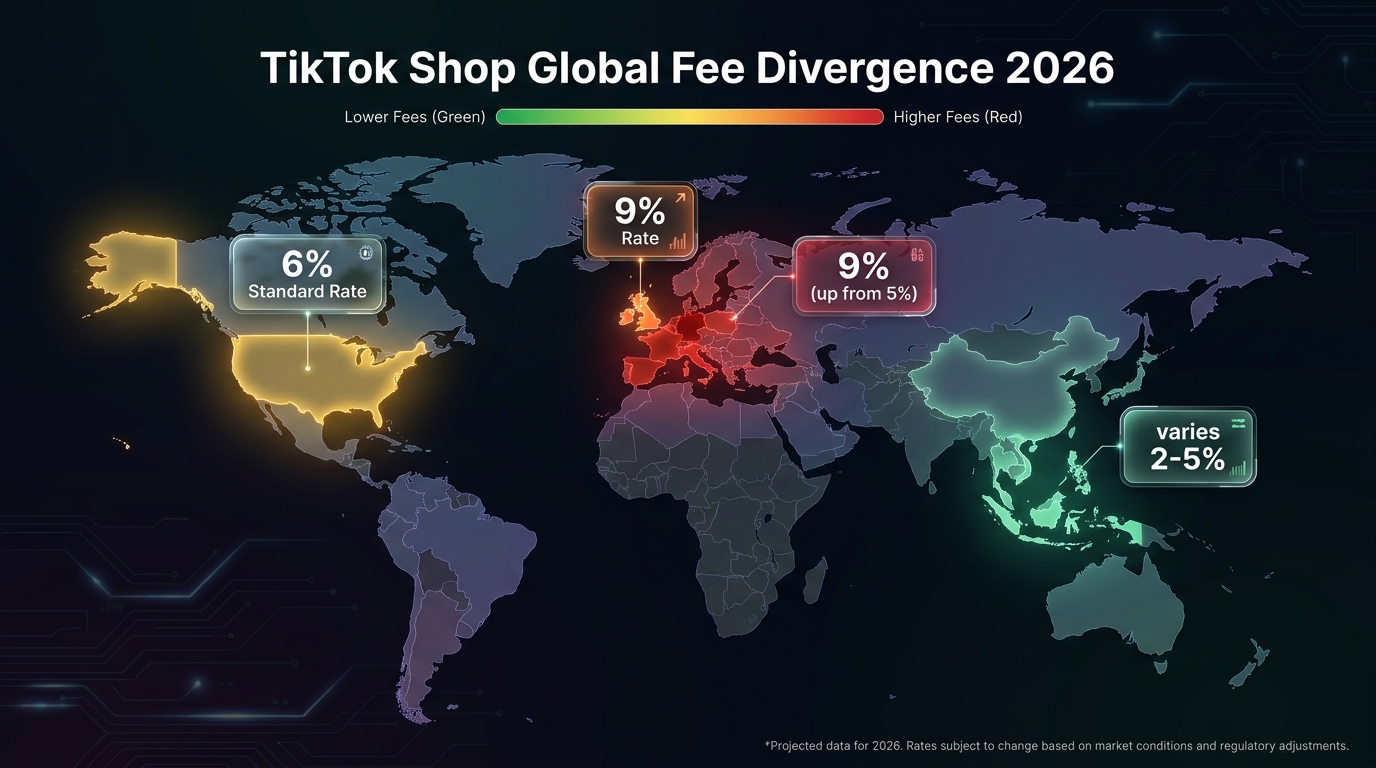
For sellers operating across multiple TikTok Shop markets, the fee landscape looks remarkably different depending on geography — and the divergence has widened significantly in 2026.
United States: The 6% Baseline
The US remains TikTok Shop’s largest and most watched market. The standard referral fee holds at 6% for most categories, with select categories (certain jewelry, pre-owned items) at 5% and some specialty categories potentially above standard. Payment processing adds approximately 2.2%, making the core platform take-rate roughly 8.2% before affiliates and logistics.
The US also has the most developed affiliate ecosystem, which adds the highest variable commission pressure. In competitive categories, effective affiliate rates of 15–20% are common, pushing the total platform-related cost (excluding COGS and fulfillment) to 23–28% of revenue.
UK: 9% and Settled
The UK moved to a 9% standard commission rate in late 2024, and by 2026 that rate is fully normalized. UK sellers have had more time to adapt their pricing and product mix than their EU counterparts, and many have. The main challenge in the UK market is that product pricing expectations are relatively fixed by competitive market dynamics, meaning sellers can’t simply pass fee increases through to customers without volume impact.
Consumer electronics is one category that benefits from an exception at approximately 7%, acknowledging the extremely tight margin structure that characterizes electronics retail.
EU5: The Biggest Single Jump
The most disruptive fee change of 2026 happened in January, when TikTok raised EU5 commissions (Germany, France, Italy, Spain, Ireland) from 5% to 9% — a 4-percentage-point increase that took effect immediately on January 8. For sellers who had built EU pricing models around the 5% rate, this represented an overnight margin compression of 4 points of gross revenue.
TikTok offered a 4% onboarding incentive rate for new sellers entering the EU market, designed to soften the impact on new entrants. Existing sellers received no such cushion and had to either absorb the cost, raise prices, or restructure their EU catalog.
The EU jump is the clearest data point illustrating TikTok’s trajectory: 5% was always a temporary market-development rate. The 9% level is where TikTok believes its EU business is sustainably monetized.
Southeast Asia: The Most Variable Landscape
TikTok Shop’s home market region remains the most fee-variable globally. Markets like Indonesia, Thailand, Vietnam, and Malaysia each operate on their own rate structures, and TikTok has been willing to experiment with new fee types here first. Malaysia’s introduction of a RM0.50 per-order Platform Support Fee in February 2026 is viewed by many seller advisors as a template that could eventually arrive in Western markets.
Southeast Asian sellers also generally deal with lower absolute fee rates (category commissions often in the 2–5% range) but operate in markets where average order values are significantly lower, meaning the total margin equation can look similarly tight.
What Multi-Market Sellers Should Do
The global fee divergence creates both risk and opportunity for sellers with cross-market flexibility. Products that are margin-challenged in the UK or EU at 9% may still work profitably in the US at 6%. Sellers with manufacturing relationships that allow market-specific pricing have a structural advantage. The key is running separate P&Ls for each market rather than averaging across a global blended rate — the variance is too large for averaged models to be useful.
The New Compliance Architecture: Account Health Rating Explained
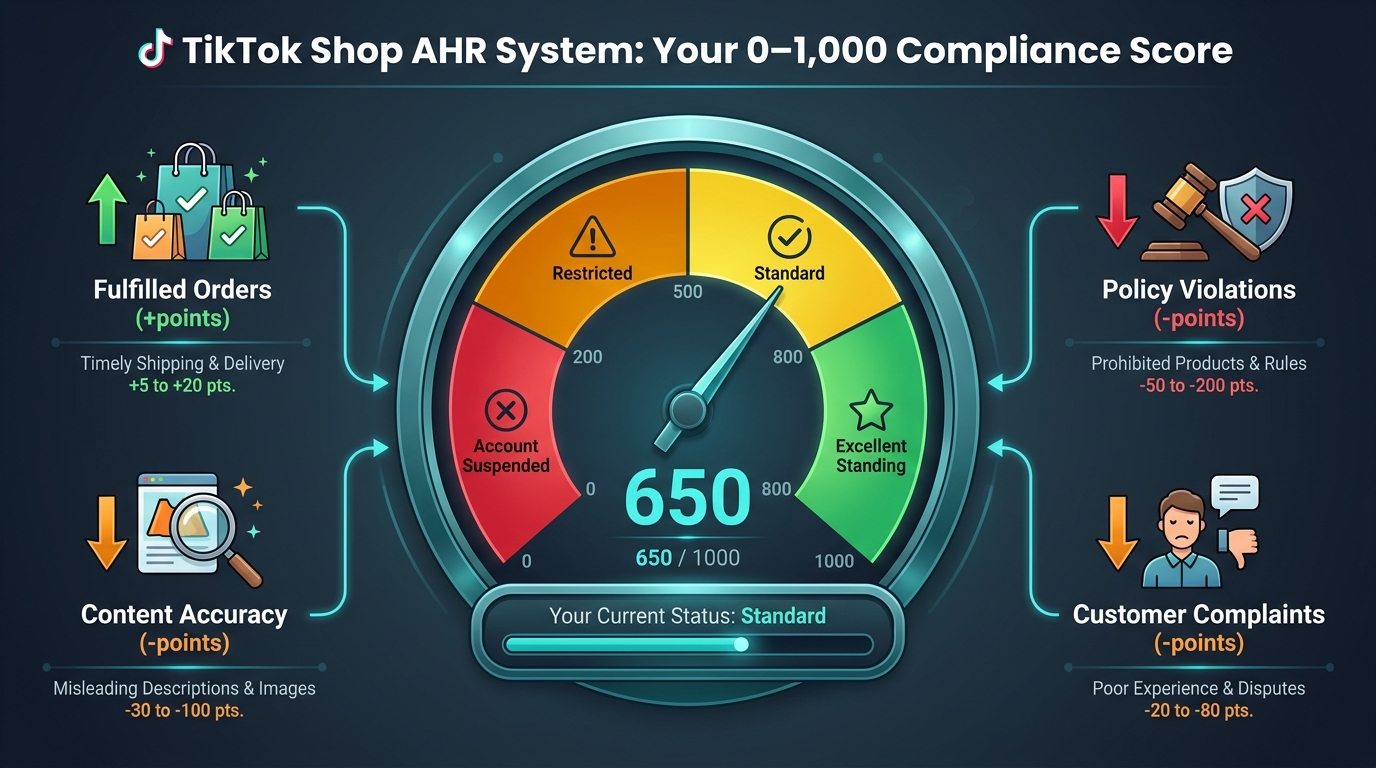
Fees are the most visible part of TikTok Shop’s 2026 policy overhaul. But the compliance architecture changes may be more consequential over the long term, because they determine whether you can sell at all — and at what visibility level.
What Replaced the Violation Points System
TikTok Shop launched its Account Health Rating (AHR) system in mid-2026, replacing the previous Violation Points framework. The shift matters because Violation Points operated as a tally — you accumulated negative points for infractions until you hit a threshold — whereas AHR is a continuous, dynamic score on a 0–1,000 scale.
Most sellers start with a baseline score of approximately 200 points. The system recalculates continuously based on a rolling 180-day window of platform activity. This means your score can improve over time with consistent good behavior — it’s not permanently punitive in the way that accumulated violations could be.
What Affects Your AHR Score
TikTok has disclosed the general categories of factors that raise and lower AHR scores, though not the precise weighting formula:
Score-building activities:
- Successfully fulfilled and delivered orders
- Completing platform policy quizzes and seller education modules
- Maintaining low late shipment rates
- Positive customer satisfaction indicators
Score-reducing factors:
- Policy violations (listing accuracy, prohibited claims, restricted category infractions)
- High cancellation or refund rates
- Intellectual property complaints
- Counterfeit or misleading product complaints
- Content policy violations in associated videos or live sessions
- Customer complaints about product quality or description accuracy
What Your Score Controls
This is where AHR becomes economically significant beyond just compliance. Your score tier determines operational capabilities:
- 800–1,000 (Excellent): Full platform access, campaign eligibility, enhanced listing visibility, priority customer service.
- 500–799 (Standard): Normal platform operations with some campaign restrictions.
- 200–499 (Restricted): Limited campaign participation, potential listing suppression, heightened monitoring.
- Below 200 (Critical): Listing freezes, payout holds, potential account suspension.
The campaign access restriction is particularly impactful. TikTok Shop’s major deal events — the platform equivalents of Prime Day in terms of volume uplift — require a minimum AHR threshold for participation. A seller whose score has been damaged by violations may find themselves excluded from the highest-traffic periods of the year.
The Hidden Cost of Low AHR
There’s also an algorithmic dimension to AHR that isn’t officially documented but is widely observed by sellers: lower AHR scores correlate with reduced organic discovery visibility. TikTok’s product recommendation algorithms appear to deprioritize listings from lower-health accounts, creating a compounding effect where compliance problems reduce traffic, which reduces sales, which makes it harder to rebuild score through fulfilled orders.
This creates an asymmetric risk: the sellers most likely to face AHR problems (newer sellers still learning the rules, sellers expanding into regulated categories without full documentation) are also the sellers who can least afford the traffic reduction that a suppressed score brings.
The June 2026 Product Listing Policy: What Really Changed
On June 2, 2026, TikTok Shop implemented a comprehensive Product Listing Policy update that changed the compliance requirements for getting and keeping products live on the platform. This wasn’t a minor update — it was a structural reset of what “compliant” means.
The Core Accuracy Standard
The new policy establishes that every listing element — title, main image, description, brand attribution, pricing, and product variations — must be clear, truthful, and legally compliant. TikTok’s previous standards had similar language but enforcement was inconsistent and largely reactive (responding to complaints rather than proactively auditing listings).
The 2026 policy introduced AI-powered proactive listing auditing that flags potential violations before they’re reported by buyers or competitors. This is a significant operational shift: sellers can no longer rely on a complaint-driven enforcement model where listings stay live until someone objects.
Claim Substantiation Requirements
Any claim made in a product listing about performance, efficacy, or results now requires substantiation. This is not new in principle — it was always implied by consumer protection standards — but TikTok’s new policy makes it an explicit listing-level requirement with enforcement consequences.
For categories like health and wellness, beauty, supplements, and fitness equipment, this is particularly impactful. Phrases like “clinically proven,” “dermatologist recommended,” or “reduces wrinkles by 40%” now require supporting documentation to be submitted alongside the listing. Without it, the listing can be suppressed or removed — and the removal will affect your AHR score.
Documentation-Gated Categories
The most significant practical change in the June policy is the expansion of what TikTok calls “documentation-gated” listings. In these categories, products cannot go live until required compliance documents have been uploaded and reviewed. The gated categories now include:
- Baby and children’s products: Safety certifications, materials documentation
- Health and medical devices: FDA clearance documentation where applicable
- Supplements and ingestibles: Manufacturing certifications, ingredient documentation
- Pesticides and household chemicals: EPA registration numbers
- Electronics and electrical devices: Safety certification documentation (UL, CE, FCC)
- Food and beverage: Labeling compliance documentation
For sellers already operating with proper compliance documentation, this adds administrative overhead but doesn’t fundamentally change their business. For sellers who relied on TikTok Shop’s historically lighter-touch approach to bypass documentation requirements they might face on other platforms, it’s a structural barrier.
The May 22 Content Policy Companion
Running alongside the June listing policy, TikTok also updated its Content Policy on May 22, 2026, specifically governing what creators, affiliates, and brands can say in shoppable videos and live sessions. This matters for the fee model because affiliate partners who violate content policy using your product can generate AHR deductions against your account — a compliance liability that originates from creator behavior you don’t fully control.
Smart sellers are now building explicit content guidelines into their affiliate briefing packages and requiring creator acknowledgment of the key prohibited claims before approving collaborations.
The Logistics Mandate: FBT, Upgraded Shipping, and What “Mandatory” Actually Means
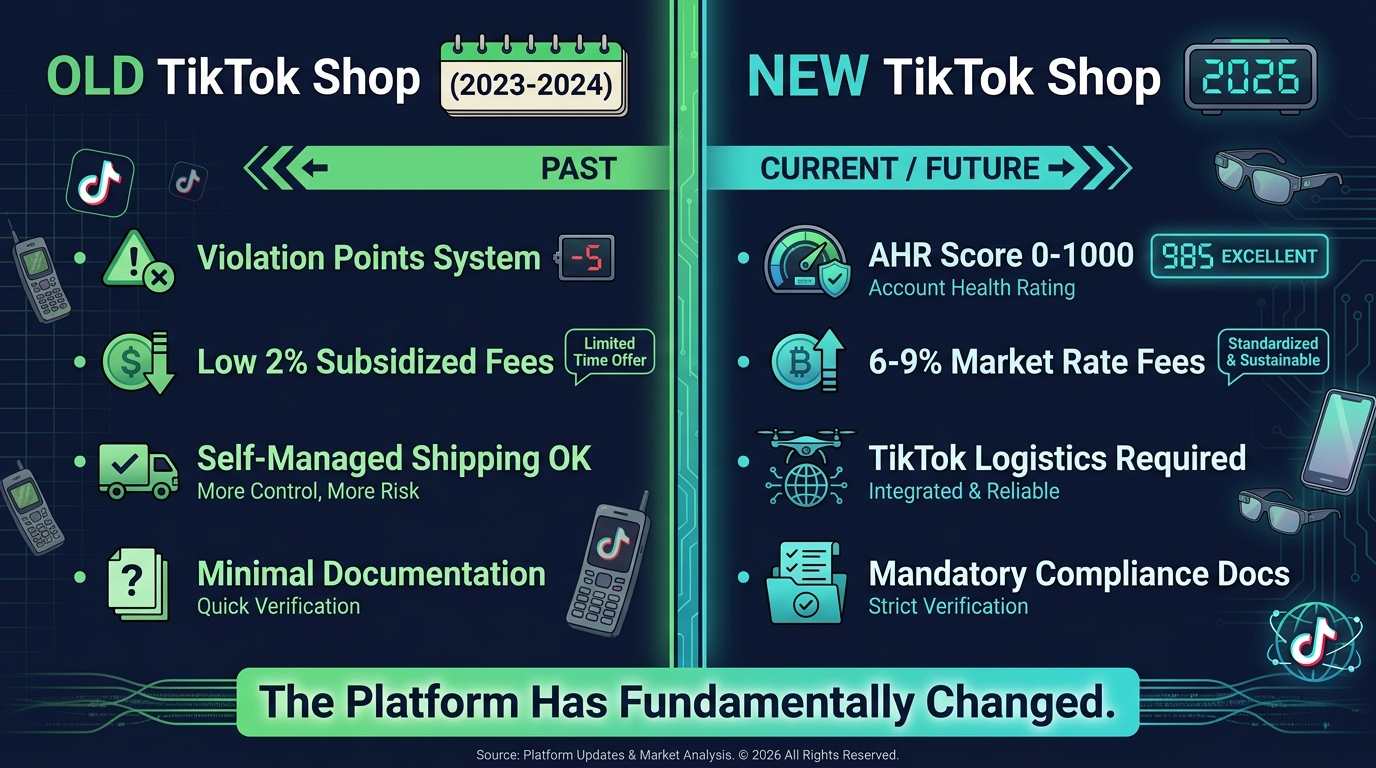
TikTok Shop’s logistics policy for US sellers has been one of the more turbulent policy areas of 2026 — a mix of firm commitments, pauses after seller pushback, and ongoing re-clarification that has left many sellers genuinely uncertain about what’s required.
What Changed From Self-Managed Shipping
Historically, TikTok Shop allowed US local sellers to ship orders using any carrier of their choice — self-managed labels, their own fulfillment accounts, their own last-mile arrangements. This gave sellers full flexibility but also meant TikTok had limited data on and control over the customer delivery experience.
In 2026, TikTok moved to require that US local sellers use one of three approved logistics pathways within the TikTok Shop Logistics Services umbrella:
- Fulfilled by TikTok (FBT): Inventory sent to TikTok’s fulfillment network; TikTok handles storage, pick, pack, and delivery.
- Upgraded TikTok Shipping (UTS): Seller manages storage and packing; TikTok provides platform-negotiated carrier rates and handles label generation.
- Collections by TikTok (CBT): TikTok manages last-mile logistics through collection/locker networks.
The “Mandatory” That Isn’t Fully Mandatory
The nuance that confused most sellers is that while TikTok Shop Logistics Services as a category became mandatory, FBT itself is not strictly required. Sellers who prefer to maintain their own warehousing and operations can use Upgraded TikTok Shipping and remain compliant.
Importantly, the original mandate was paused in early 2026 following significant seller pushback before eventually being re-implemented in modified form. The current enforcement reality is that sellers using completely self-managed shipping (outside any TikTok logistics pathway) face listing restrictions and degraded fulfillment metrics scores — but the hard cutoff originally threatened for March 31, 2026 was extended and softened.
The Real Cost of the Logistics Shift
Regardless of which TikTok logistics pathway you choose, the economic reality is that TikTok now sits between you and your fulfillment in ways it didn’t before. This has two cost dimensions:
Direct cost: FBT fees vary by product size and weight but typically run $4–$8 for standard items. Upgraded TikTok Shipping generally offers competitive carrier rates, but sellers lose the ability to use negotiated rates from their own carrier relationships.
Flexibility cost: Sellers using FBT lose some of the flexibility they had with self-managed fulfillment — including the ability to easily bundle orders across channels, fulfill from the same inventory pool that serves other platforms, or respond quickly to inventory recall or quality issues.
For sellers whose primary fulfillment infrastructure was already built around FBA (Amazon’s fulfillment network), the dual-warehouse requirement of maintaining FBT inventory separately represents a real working capital cost that doesn’t appear in any fee schedule.
Category by Category: Who Gets Hit Hardest by the New Structure
The fee and policy changes of 2026 don’t land equally across product categories. Some categories are actually better positioned than they were — the new compliance architecture creates a higher barrier that rewards established brands. Others are facing existential margin pressure.
Categories Under the Most Pressure
Low-ticket fashion and accessories ($10–$25): The fixed-cost nature of fulfillment (even $5–$6 shipping on a $15 item is 33–40% of revenue) makes the math nearly impossible at realistic affiliate commission rates. Sellers in this space either need to move upstream to higher price points, create bundles that increase AOV, or exit the category.
Commodity consumables: Paper goods, basic cleaning products, and other commoditized consumables face both margin pressure and the documentation requirements of food/chemical categories. The combination is particularly unfavorable.
Supplements and health products: High competition for affiliate attention (requiring 15–20% commissions), strict documentation requirements under the June policy, and elevated return rates combine to compress margins significantly. High-margin, differentiated supplement brands can still work; white-label commodity supplements face a structural challenge.
Categories with Better Economics
Premium beauty ($50–$150): High gross margins (often 70–80%+ for cosmetics), strong affiliate content performance, and high repeat purchase potential make premium beauty one of the most structurally sound categories on TikTok Shop despite the fee increases.
Home décor and lifestyle ($40–$120): Good visual content performance, reasonable margins, and relatively lower return rates compared to fashion make this a favorable space.
Electronics accessories ($30–$80): The 7% EU rate relief helps in European markets. In the US, accessories (phone cases, earbuds, cables) with strong brand differentiation and high margins can absorb the fee stack.
Subscription-eligible products: Any product that converts a one-time TikTok sale into a recurring subscription dramatically improves the LTV math. The initial TikTok order may break even or lose money; subsequent subscription revenue doesn’t carry the same affiliate and acquisition costs.
How to Build a Fee-Resilient Business Model on TikTok Shop
Understanding the fee architecture is table stakes. Building a business model that performs within it — and isn’t one policy update away from margin collapse — requires structural adjustments, not just spreadsheet tweaks.
Principle 1: Price for the Fee Stack, Not Against It
The most common margin mistake on TikTok Shop is building a price that’s competitive in the market and then subtracting fees to find profit. Sustainable TikTok Shop pricing works in the opposite direction: you start with your required net contribution, add back every fee layer, and arrive at the floor selling price that makes the business viable. If that floor is above the market’s acceptable price ceiling, the product isn’t suitable for the channel — regardless of how well it performs in terms of views or conversions.
Principle 2: AOV Engineering
If individual units don’t clear the margin threshold, bundles often can. A $15 item with 40% gross margin is margin-challenged. A three-unit bundle at $42 with the same gross margin percentage suddenly has a fighting chance, because the fixed fulfillment cost is spread across three units and the percentage-based fees scale with revenue while contribution margin scales favorably.
Many successful TikTok Shop sellers have built their product strategy specifically around bundles and kits designed to hit the $40–$80 AOV range where the fee stack becomes manageable. This isn’t a workaround — it’s rational price architecture for the channel.
Principle 3: Own Your AHR Score Like a Business Asset
With AHR controlling campaign access, listing visibility, and ultimately account survival, your health score is not a compliance metric — it’s a revenue driver. Sellers should monitor their score as actively as they monitor their sales rank.
Practical steps: complete all available seller education modules (they build score), audit listings for any claim that lacks documentation before the algorithm finds it, establish a creator briefing process that reduces content policy violation risk from affiliates, and maintain fulfillment metrics well above the minimum thresholds.
Principle 4: Build Compliance Documentation as a Competitive Moat
The June 2026 listing policy’s documentation requirements create a barrier that hurts sellers who lack compliance infrastructure — but that barrier is an opportunity for sellers who build it first. In categories where documentation-gated listings have raised the barrier to entry, sellers with clean compliance dossiers face reduced competition from underprepared entrants.
Investing in proper compliance documentation (safety certifications, efficacy testing, manufacturing standards) isn’t just about staying live on TikTok Shop. It’s about defensibility across every channel — and it becomes a compounding asset as regulatory requirements tighten across the industry.
Principle 5: Use Organic-First to Reduce Affiliate Dependency
Affiliate commission is the largest variable cost in most TikTok Shop fee stacks. Sellers who build genuine organic presence — a brand TikTok account with engaging content, a loyal following, shoppable posts that drive purchases without affiliate payouts — structurally reduce their cost per acquisition on the platform.
The challenge is that organic reach requires consistent content production and a brand story compelling enough to generate views without paid amplification. This is harder than setting a 15% commission and letting affiliates handle content. But the margin difference is significant enough that the operational investment has clear ROI for any seller planning to scale on the platform.
What Sellers Who Are Still Growing Are Doing Differently
Despite the fee increases, compliance complexity, and margin pressure, there are sellers meaningfully growing on TikTok Shop in 2026. The common patterns across successful operators aren’t secrets — but they’re worth naming explicitly.
They Modeled the Full Stack Before Launching
The sellers performing best in 2026 are disproportionately those who built their TikTok Shop entry strategy after 2025’s fee normalization — which means they never operated with subsidized economics and don’t have legacy margin assumptions to unlearn. They started with the current fee structure as their baseline.
They Treat TikTok as One Node in a Multi-Channel LTV Model
The most sophisticated TikTok Shop operators don’t evaluate TikTok orders purely on TikTok contribution margin. They measure customer lifetime value across channels — TikTok as acquisition, their own D2C site or subscription program as retention. A TikTok order that breaks even on the platform but converts to a $200 annual customer on a direct channel has positive ROI in the full model.
This requires building the infrastructure to track cross-channel customer journeys — not trivial, but essential for making TikTok Shop economics genuinely work at scale.
They Have Dedicated Compliance Operations
At scale, TikTok Shop compliance has become a job function, not a sidebar task. Sellers with 50+ active SKUs in regulated categories, multiple affiliate partners creating content, and AHR scores to maintain have found that informal compliance management is too costly when violations hit. A dedicated person (or team) monitoring listing accuracy, reviewing creator content before it goes live, and staying current on policy updates is increasingly the difference between stable and volatile platform performance.
They Compete on Margin, Not Just Price
The sellers best positioned for TikTok Shop’s current economics are those competing on genuine product differentiation rather than price competitiveness. A product with a compelling, demonstrable benefit that converts well in short-form video can command a price point that makes the fee stack work. A commodity product competing primarily on being the cheapest option cannot. TikTok Shop’s fee structure now effectively selects against price competition as a primary strategy.
The Maturation Tax — and Why It’s Not All Bad
Here’s the counterintuitive take on everything covered above: the fee increases, the compliance architecture, the logistics mandates, and the AHR system are individually inconvenient and collectively expensive. But they’re also signs of a platform that’s building for the long term rather than burning capital to generate volume metrics.
The early TikTok Shop era — 2% fees, minimal compliance, seller-managed everything — attracted enormous volume, but it also attracted an enormous amount of bad behavior. Counterfeit products, misleading health claims, unreliable fulfillment, and predatory creator practices were rampant in 2023–2024. The consumer experience suffered, which created brand safety concerns for legitimate sellers sharing the marketplace with fraudulent operators.
The 2026 architecture is TikTok attempting to close that gap. Higher fees fund better infrastructure. The AHR system removes bad actors more efficiently than the violation points model ever did. Documentation requirements make it harder to list unregulated health products with unfounded claims. The logistics mandate gives TikTok real control over the delivery experience that shapes customer satisfaction.
None of this makes the fee stack less expensive. But it does mean the platform you’re paying higher fees to operate on is more defensible, more credible to consumers, and more hostile to the low-quality operators who were degrading the ecosystem around you.
The Sellers Who Should Reconsider TikTok Shop
That said, the honesty has to go both ways. There’s a meaningful segment of sellers for whom TikTok Shop’s 2026 economics genuinely don’t pencil. If your products have gross margins below 50%, your category faces documentation requirements you don’t have the compliance infrastructure to meet, your price points are too low to absorb fulfillment costs gracefully, and you lack the brand story that drives organic content performance — TikTok Shop at 2026 rates is not the right primary channel.
This isn’t a failure of strategy. It’s the platform communicating clearly about who it’s designed to serve. The sellers who should be here are those with high-margin, differentiated products that lend themselves to compelling short-form video content. For everyone else, the channel math now requires a compelling reason to prioritize it over alternatives with better structural economics for your specific product.
What to Watch in the Next 12 Months
A few developments are worth tracking as indicators of where TikTok Shop’s fee and policy trajectory goes next:
- Per-order charges expanding beyond Malaysia: The RM0.50 per-order Platform Support Fee introduced in February 2026 may be a template for other markets. If this arrives in the US or UK, it changes the economics for high-volume, low-ticket sellers substantially.
- AHR score thresholds for advertising access: There’s early evidence that TikTok is experimenting with using AHR scores to gate access to TikTok Shop Ads (TSSA) features. If low-AHR accounts are increasingly restricted from paid amplification, the compliance-to-commercial link becomes even tighter.
- Category-specific fee restructuring: The EU electronics exception (7% vs 9%) signals willingness to create category-specific rates where generic rates are unworkable. US sellers in high-margin categories may see differentiated rate structures emerge.
- Logistics cost normalization: FBT pricing has moved around in 2026 as TikTok calibrates its fulfillment network. As the network matures and scale increases, logistics costs may stabilize or even decrease — a potential source of partial relief from the current fee pressure.
Building Your 2026 TikTok Shop Business Around the Real Numbers
The most important shift in thinking that 2026 demands from TikTok Shop sellers is moving from “what’s the fee?” to “what’s the total cost structure, and what does my business need to look like to be profitable within it?”
The headline 6% referral rate was never the full story. It’s one layer of a stack that, when fully assembled, can account for 35–55% of revenue for an actively marketed, affiliate-driven product. That’s not surprising for a commerce channel — Amazon FBA’s equivalent all-in costs are broadly comparable. But it does require the same discipline in margin modeling that Amazon sellers learned to apply years ago.
The compliance architecture changes — AHR, the June listing policy, the content policy update — add operational complexity that has a real cost. But they also add predictability. A well-run seller who understands the rules, maintains their score, keeps documentation current, and monitors creator partners has a fundamentally stable position on the platform. The sellers who will face disruption are those who haven’t updated their compliance operations to match where TikTok’s enforcement actually is in mid-2026.
The sellers building durable businesses here share a common perspective: they see the maturation of TikTok Shop’s economics not as evidence the opportunity is closing, but as evidence the competitive field is clearing. The easy-money era attracted easy-money operators. The 2026 architecture is selecting for sellers who’ve done the work — on product margins, compliance, logistics, and brand building. If you’re that seller, the higher fees aren’t just a cost. They’re a filter working in your favor.
Key Takeaways for TikTok Shop Sellers in 2026:
- Model your full fee stack (referral + processing + affiliate + fulfillment), not just the referral rate. Total channel costs typically run 35–55% of revenue.
- The 60% gross margin threshold is a practical rule of thumb — products below this level face serious structural margin challenges at current TikTok Shop fee rates.
- The AHR system now controls more than compliance — it affects campaign access, listing visibility, and payout stability. Treat your score as a business asset.
- The June 2026 listing policy introduced AI-powered proactive auditing and documentation-gated categories. Review all listings in regulated categories for documentation completeness.
- Build affiliate content guidelines into your creator partnerships to reduce the risk of content policy violations affecting your AHR score.
- If you sell across US, UK, and EU markets, run separate P&Ls for each — the fee divergence (6% US vs 9% EU/UK) is too large for blended models to be reliable.
- High-AOV products, bundles, and differentiated brand narratives are structurally advantaged in the 2026 fee environment. Low-ticket commodity items face the steepest headwind.